FOCUS: AT THE NEXUS OF THE STRUGGLE BETWEEN SPIRIT AND FLESH

What follows are some reflections about one of the most difficult expressions of contemplative prayer, one that I never get rid of, one that is with me as long as I traverse the halls of silence and solitude in search of God wherever I may encounter Him today.

Focus is one of those human traits that, like the meaning of love, we humans don’t do automatically. When I sit in Eucharist Adoration before the Blessed Sacrament, I am always faced with the feeling that I should be somewhere else, or that this is not a productive use of my time. In this most recent Lectio Divina (Philippians 2:5), I actually took a conscious look at my focus process and came up with some interesting observations.

In the first few minutes, I carry with me the flurry of what the world says is important. For example, I have a meeting scheduled in two hour, I am due for lunch at home and my wife wants to know what I want to eat, or in the chapel at Good Shepherd, Tallahassee, Florida, it seems stuffy and too hot. My mind conjers up any number of flashing choices for me to make. I call this my detoxification period (from one to five minutes), where I try to focus on Christ. I try to overcome this alarming flashes of temptation to do something meaningful, After all, who wants to sit in a darkened chapel with no one there, only a burning votive candle beside the tabernacle, and it smelling a bit stuffy. There are many, many reasons my senses tell me to go, but only one good reason to stay…love.

At this stage of my Lectio Divina, I have tried to Have in me the mind of Christ Jesus (Philippians 2:5) by beginning to think of my Lectio statement, the only one I have had each day since 1962. I am beginning to be aware of where I am and who is there with me. I try to move from self to God by thinking about God. St. Benedict, in his Chapter 4 of the Rule tells me not to overcome evil with evil but overcome evil with good.

This happens to me every single time I do Lectio Divina, a veritable gauntlet of thoughts and mental jousting with Satan or his demons. Struggling to have in me the mind of Christ Jesus (Philippians 2:5) is not fun and, I will admit, I am not always successful at my focus, as if I have gone through the anxiety of trying and failing and trying and failing and then some success. In reading the book, The Little Prince, by Saint Exupery, the fox is trying to tell the Little Prince how to tame the rose. In this way, the rose will not be frightened. Listen to the Youtube account of one of my favorite analogies on focus. https://www.youtube.com/watch?v=dkiZuu79N_I The fox, in the story goes on to say that it is the time to take to tame your rose that makes it valuable. The moral of the story for me is the saying, “It is only with the heart that ones sees rightly, what is essential is invisible to the eye.” Lectio Divina is trying to see what is invisible, and what is essential to our Lay Cistercian spirituality. It is the time I spend trying to calm down my flesh so that I can enter into stillness by focusing on silence and solitude, which is also part of prayer.

Next time you read about the passion and death of Christ, think of the temptation in the Garden of Gethsemani as one of losing focus of what the mission was. Christ overcame his temptation to abandon the humilitation and pain of the cross by telling the Father that his will be done, not that of Christ. What a model to follow when we do Lectio Divina. Think of you sitting on a park bench in the dead of winter and waiting for Christ to come by. It is the time you spend waiting that make your prayer pleasing to the Father, through, with, and in Christ.

Focus is an act of the will to keep Christ centered in your heart for as long as possible. If you want to enter that place where no one wants to look, then you must anticipate the effects of Original Sin. Struggle is, in itself, a way to increase the capacity of God within us. Amen and Amen.

WHAT DOES IT MEAN FOR US TO LOVE OTHERS AS CHRIST LOVES US?

THE CHRIST IMPERATIVES

LISTEN TO ME, FOR I AM MEEK AND HUMBLE OF HEART. Matthew 11:28-30

  • Thirsty? Drink of the living waters! John 7:37.
  • Hungry? Eat the food that gives eternal life!  John 6:33-38.
  • Bewildered? Believe in the Master! John 3:11-21.
  • Without hope? Be not afraid! John 13:33-35.
  • Lost? Find the way. John 14:6-7.
  • Tired because of the pain? Be renewed! John 15:1-7.
  • Afraid? Find peace! John 27-28.
  • Afraid to believe? Believe! John 11:25-27.
  • Without a family? Listen! John 10:7-18.
  • In darkness? Walk in the light! John 8:12.
  • Spiritually depressed? Be healed! John 5:24

“Welcome, good and faithful servant, into the Kingdom, prepared for you before the world began.”

RELAX!

What follows are my reflections on some ideas that came up during my Lectio Divina (Philippians 2:5).

Here are ten things you don’t need to worry about as you live out your spiritual life.

  1. The Church Universal is going to disappear and collapse. If you read the sensationalist, tabloid press (all press seems to be tabloid), the Catholic Church is losing people and will end up in bankruptcy. If the Church Universal collapses and the gates of Hell prevail, then there is no Holy Spirit. If there is no Holy Spirit, there is no Resurrection. If there is no Resurrection, there is no God. If there is no God, go out and have a cup of Kona Brand coffee and wait to die. You can’t change anything but your own world. Relax!
  2. It sometimes seems like the unrepentant adulterers, fornicators, thieves, detractors, drunks, witches, drug addicts, unfaithful priests and religious, fake politicians, parental strife, incest, drug gangs, murderers, and prostitutes will inherit the earth. It might seem like evil will conquer the world and all those evildoers get away with murder. They will not inherit the Kingdom of Heaven. Notice the important word “unrepentant”. Relax!

3. Don’t make the mistake of judging who is saved or who is going to Hell. That is a subtle form of idolatry. You spend all your time being judgmental about others and less time about loving God with all your heart, all your mind, and all your strength, and your neighbor as yourself. Who made you God? Relax!

4. Seek first the kingdom of heaven and all else will follow. Matthew 6:33 New Revised Standard Version Catholic Edition (NRSVCE) 33 But strive first for the kingdom of God[a] and his[b] righteousness, and all these things will be given to you as well. Relax!

5. Don’t worry about who is right in the Bible and who is not. John 20:30-31 30 Now Jesus did many other signs in the presence of his disciples, which are not written in this book. 31 But these are written so that you may come to believe[a] that Jesus is the Messiah,[b] the Son of God, and that through believing you may have life in his name. Sacred Scripture was written down so that you may believe that Jesus Christ, Son of God, is Lord and Messiah. Concentrate on your belief and not on why everyone else does not believe in Christ as you do. Relax!

6. The Ecumenical Councils (21 of them to be exact) contain the policies and procedures of the Church Universal in that age. It would be wrong to think of the Pope as having great secular authority over us. He does have authority, but, in keeping with the sign of contradiction, it is one of being the servant of the servants of Christ, not one to lord it over us. Authority comes from Christ alone and to anyone to whom he entrusts it. Accepting Christ means you accept those that shepherds of the flock. St. Benedict points out in his Rule, Chapter 4 for monks,

“57 Every day with tears and sighs confess your past sins to God in prayer
58 and change from these evil ways in the future. 59 Do not gratify the promptings of the flesh (Gal 5:16);
60 hate the urgings of self-will.
61 Obey the orders of the abbot unreservedly, even if his own conduct–which God forbid–be at odds with what he says. Remember the teaching of the Lord: Do what they say, not what they do (Matt 23:3).” https://christdesert.org/prayer/rule-of-st-benedict/chapter-4-the-tools-for-good-works/ Relax!

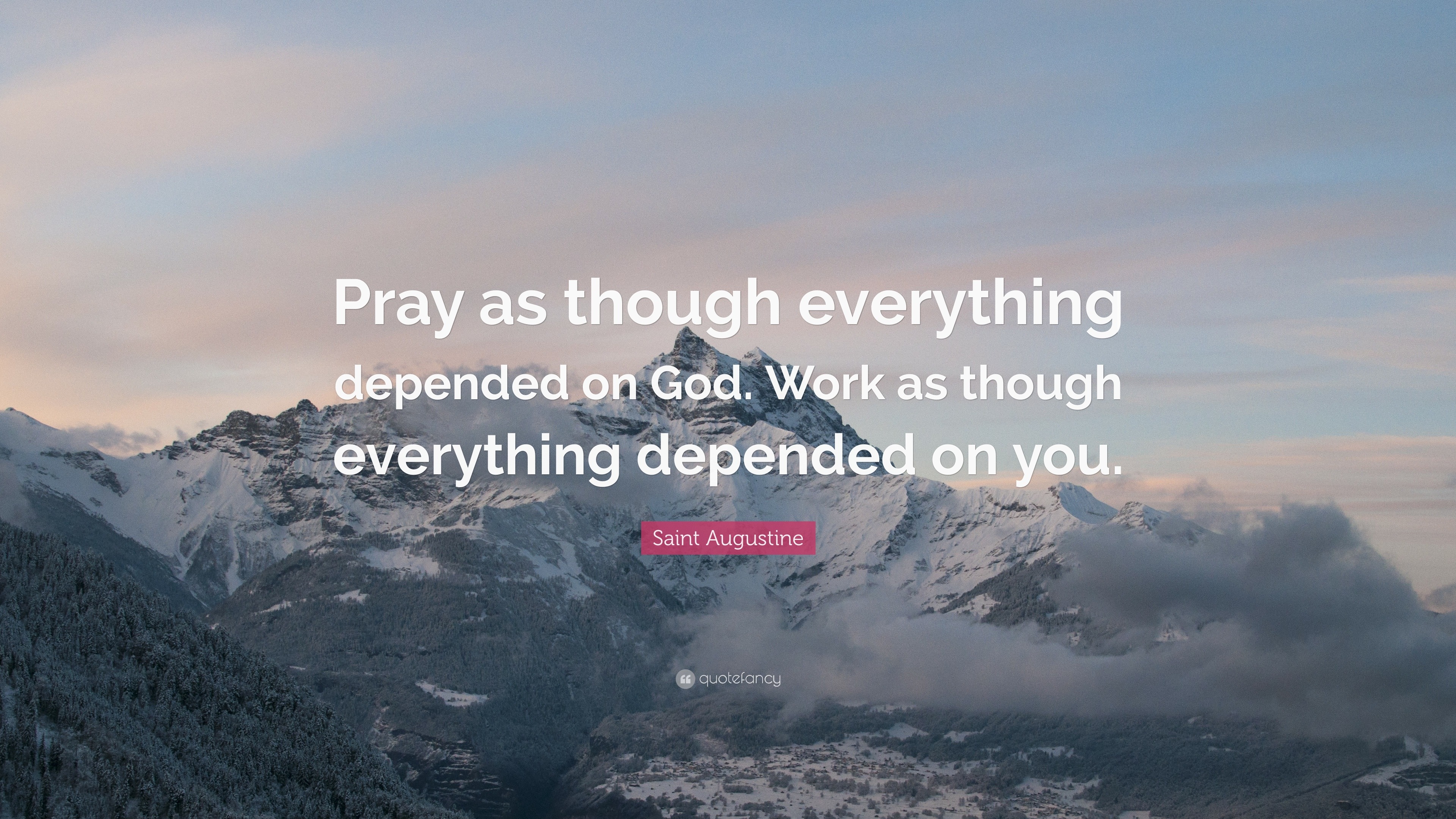
7. Pray as though everything depends upon God and work as though everything depends upon you. — St. Augustine. Relax!

Saint Augustine Quote: “Pray as though everything depended on God ...

8. Don’t make the mistake of thinking that you are not good enough to be in the presence of God now, and later on, in heaven. You are not! Moving from a false self to a true self is a process that takes a lifetime. It is Christ who sits with us on that park bench and is our mediator with the Father. It is the Holy Spirit, the Advocate, who allows us to say, “Jesus is Lord.”https://www.youtube.com/watch?v=UG77k-xLpz8. Relax!

9. Don’t worry that you sometimes think of Christ and sometimes it is just not your day. The peaks and valleys of life are part of our journey. Just because your road is rocky doesn’t mean you are on the wrong road. Trust in God to help you on the way to the truth, and thus live the life that you alone can experience. What you can do is, in silence and solitude, look right next to you and find Christ was there all along. Anyone marked with the sign of faith (the cross) has Christ as a companion. Contemplative practices just allow each of us to say hello to Christ in the stillness of our hearts. Relax

10. Place your Hope in God alone. Relax!

Praise be to the Father and to the Son and to the Holy Spirit, now and forever. The God who is, who was, and who is to come at the end of the ages. Amen and Amen –Cistercian doxology

MONOS

What I am experiencing, as I move through the stages of the Coronavirus 19 effects on my personal space, my environment, my relationships, is isolation and the failure of those human structures I have built up to sustain my life on a daily basis. I am talking about the isolation from other people, the inability to touch others in social contexts, such as the sign of peace at Eucharist, and the Eucharist on my computer, the inability to congregate in the community for the social interaction that is crucial to finding meaning and purpose. All of these experiences are new for me and could be a bit off-putting, were it not for three things that have kept me grounded. In these comments that follow, I will share with you those spiritual principles I use, and continue to use on a daily basis, to keep me grounded. I make these comments in the hope that you might examine your self against what you consider to be the central principles of your life, as you experience this opportunity to reflect and be solitary. Granted, we don’t go deeper into ourselves very often, but this virus might be God’s way of telling us to get our house cleaned before the next plague hits. Not that these are like the plagues of Egypt that Moses dealt with, but they do resemble them from a modern perspective, e.g., monetary plagues, health plagues, the failure of people to love, the rise of the cult of relativism, lack of resources (water and food) and wars based on power and control.

All of these are plaguing us now, but there is one place that we can forget about looking, inside each of us. Monos. Alone. The place where no one wants to look. How I look at reality externally is in direct proportion to how to look at reality within me and what I fall back upon in times of crisis. When the virus hits, it strips away some of these external distractions that are only cosmetic, to lay bare what is within me. When I look at these phenomena, in my case, I feel like Anthony of the Desert and early monks who fled the allurements of the time to seek the cleansing power of silence and solitude. http://www.spiritualite-orthodoxe.net/vie-de-priere/index.php/saint-antony-the-great-writings The isolation afforded me by this small hiccup in my journey of life is a sign from the Holy Spirit that I must go out to the desert within me, that I may have been wandering in the Sinai desert of the World for the last forty years mesmerized by the seductive temptations of the Wiley One. This is a wake up call for me to turn to the only center than leads me out of this desert of the seven deadly sins to put on a new person in Christ. I have done that many times in the past, but I forgot one important point about spirituality: I need to take up my cross DAILY and follow Christ. Yesterday’s conversion is not today’s triumph over the plagues that infect society now.

I wrote a book entitled, The Place No One Wants to Look, which details six questions each human must ask themselves before they die. https://www.amazon.com/s?k=Dr.+Michael+F.+Conrad&i=stripbooks&ref=nb_sb_noss My thinking was that there is a place no one wants to think about, and that is inside us, in the mind and in the heart. Yet, this is where I must go, like St. Benedict, St. Bernard of Clairvaux, on those Cistercian men and women who yearned to “…have in them the mind of Christ Jesus.” (Phlippians 2:5) It is the modern desert, the place where I am alone with the heart of Christ, the place where I am in the presence of I am who am. No words, no expectations, no petitions, no praise are needed. It is the place where Christ bids me to come to sit on a park bench in the dead of winter and wait for him. Why do I have to wait for Christ when he is everywhere? He is everywhere, but I must not be so full of pride and lack of obedience to God’s will that I think God does my bidding. It is quite the reverse. Here are three spiritual principles that guide me through the valley of death (the World).

WHAT IS MY CENTER? A center, not to be confused with centering prayer, is the one principle that, if you took it away, your whole spiritual universe would have no meaning. It is the capstone spoken of in Scriptures, the cornerstone that keep together with your temple of the Holy Spirit. My center, which I chose in 1962, is from Philippians 2:5: “have in you the mind of Christ Jesus.” Centers are not logical constructs that you have and forget, they are there to move you from your false self to your true self. Entering the spiritual universe at Baptism, you have Original Sin taken away, by God, but, there is a problem, you still must live out your life with the effects of that Sin and the daily temptations by the Devil (the snake) to choose him over God. Far from being easy, your life after Baptism is a battle, a gauntlet you must run through, a struggle you make each and every day. Why do you think Christ told us to take up our cross daily? Do you know how heavy a cross is? By ourselves, we don’t stand a chance against “the roaring lion seeking whom he may devour.”

FEEDING MY CENTER From the moment you are Baptized, you begin to corrupt, just like a piece of metal begins to rust. To keep it from rusting, you must keep it clean. How will you nourish that precious gift of Faith? Christ told us he would not leave us orphaned (John 14:18) Do you think Jesus abandons those who put their trust and faith in Him. No! He left us his real presence for each age to continue his admonition to love one another as He loves us. Think about that. Christ is not present to us like the virtual 2020 NFL Draft. We are not spectators of Christ who lived 2000 years ago. We are adopted sons and daughter and we need food to keep our Faith from atrophying. Christ gave his life on the cross for all humans, believers or not, and he provides the only food that can keep Faith from being like the fig tree, barren and dead. If you eat this Food, His very own body and blood that walked the earth those many centuries ago, you will live forever. The Church, the living body of Christ, our head, is the real presence in each age to continue the message of forgiveness of sin, giving glory to the Father through Christ in the Eucharist, forgiving sins with a firm purpose of amendment, and charisms of humility and obedience to the will of the Father. Christ is most real today, if we have Faith to see what cannot be seen, the Mystery of Faith.

I approach the Mystery of Faith, as a professed Lay Cistercian, by trying to emulate the practices and charisms of the Cistercian way (Trappist). This means solitude is critical to my being able to focus on Christ. Most of the time, I make a holy hour before the Blessed Sacrament. But, more than that, my Lay Cistercian circumstances (I do not live in a sequestered monastery) are that my monastery is my sphere in which I seek God where I am. A theme that has imprinted itself on my consciousness is that of the corruption of matter and values espoused by the World. Everything in the physical and mental universe corrupts or deteriorates.

Matthew 6:18-20 NRSVCE – Matthew 6:18-20 New Revised Standard Version Catholic Edition (NRSVCE)” 18 so that your fasting may be seen not by others but by your Father who is in secret, and your Father who sees in secret will reward you.[a]Concerning Treasures19 “Do not store up for yourselves treasures on earth, where moth and rust[b] consume and where thieves break in and steal; 20 but store up for yourselves treasures in heaven, where neither moth nor rust[c] consumes and where thieves do not break in and steal.

The kingdom of heaven begins with Christ and is activated by you at Baptism, making you an adopted son or daughter of the Father. The problem is we still live in two universes (physical and mental) that suffer the effects of Original Sin. Those who live in the world but are not of it seek God where they are, as they are. St. Benedict provides his monks with tools for good works in Chapter 4 of his Rule. These tools are meant to help sustain us as we await the coming of Christ in glory. Scripture is not just a book to be read but a mindset to be lived so we can be with Christ each day…Forever. (John 20:30-31) The kingdom of heaven does not corrupt.

CHRISTS TEACHINGS DON’T MAKE SENSE

If you want to understand, ever so slightly, what is going on in Sacred Scripture, Liturgy of the Hours, Eucharist, Penance, and Healing, then you must apply the Rule of Opposites. This is explained in more detail in my book, Three Rules of the Spiritual Universe. What the physical and mental universes hold as true is just the opposite in the spiritual universe of the kingdom of heaven. Philippians 2:5-12, my personal center, gives a good rationale for why God emptied himself to take on human nature in addition to the divine nature. It is a revelation from Christ that there is but one God and three persons. No one would have reasoned about this dogma of the Faith, one we recited at each Eucharist in the Creed. It is by faith that we can approach the Father, and only then in, with, and through Christ. For those without faith, none of this makes any sense; for those with faith, there is no need to prove it, (St. Thomas Aquinas)

In the stillness of my heart, I sit down on a park bench in the middle of winter and wait for the Lord to pass by. This is the monos of the soul, that which heremitical monks sought when they went out into the desert. In the silence and solitude of the heart informed by the mind. It is abandoning self to seek that which is beyond making sense, the Mystery of Faith. It is preferring nothing to the love of Christ, each day, seeking God where I am, as I am. (St. Benedict, Chapter 4, Rule of St. Benedict).

For Lay Cistercians, and I am speaking only for myself, we live in the cloister of the heart informed by our mind. It is a place of stillness, humility, gentleness, joy, for those who enter it. Don’t think that all this silence, solitude, humility, comes from us. I am aware that these spiritual attributes don’t come from me, as I try to move from self to God. Everything comes from being present to the real presence of Christ.

In terms of the Coronavirus, or any physical or mental challenge, nothing changes. Christ is the same yesterday, today, and tomorrow. BibleGateway – Hebrews 13:8 “Jesus Christ is the same yesterday and today and forever.”

Praise be to the Father and to the Son and to the Holy Spirit, now and forever. The God who is, who was, and who is to come at the end of the ages. Amen and Amen. –Cistercian doxology

THE MARTYRDOM OF seeking god every day

When you read this title, you may find it a bit discombobulating. Isn’t martyrdom shedding your blood for Christ? Isn’t that reserved only for the Saints? What can any of this have to do with Lay Cistercian spirituality and contemplation? I found the answer to that at 2:32 A.M. this morning, when I woke up and, as is my habit, looked at the clock and started my Lectio Divina (Philippians 2:5). I do my due diligence to my urinary system and then plop back in bed and go to sleep. But there is something at work here, something wonderful. I feel happy like I would be if one of our friends comes over for supper. This morning, true to form, my Lectio Divina came through, as I lay down on my pillow trying to get to sleep again. I always do (get to sleep again) Lectio this way, one of the four or five times a day that I take quickie Lectio Divina breaks while waiting for my wife at Wal-Mart or Trader Joe’s while sitting in my favorite chair, or closing my eyes and just waiting for Christ with the Holy Spirit to whomp me with another title from left field. Speak, your servant listens, Lord. I am always more than amazed at what the Lord speaks to me. Like the Movie, The Neverending Story, this story of my daily encounters with seeking God seems never to end. I bring this up because being A Lay Cistercian, especially in these quite queer times, it is not a question of too little time for prayer and reading, there is too much time. I normally do Lectio formally in the afternoon, sitting in my recliner with a glass of freshly made lemonade picked off the Meyer Lemon tree. I may have mentioned this before, but my contemplative attention span has gone from two minutes +, over six years ago, to two hours (in silence and solitude, of course). So, how about the martyrdom of everyday living? Do you know how difficult it is to do anything on a daily basis? I am not talking about breathing (that is the autonomic response, such as your heart beating or blinking), but rather when each day presents itself in all its infinite possibility to encounter the purpose of life, it is a struggle to focus on doing just that one Lectio or that one reading from Scripture that you tell yourself you are going to do one of these days. It is actually quite heroic if you think about what is happening.

In the Monastery, they have a daily schedule that does not vary. This helps monks and nuns to focus on Christ as their Center through Liturgy of the Hours, Eucharist, Penance, reading Scripture. The community of like believers (although in fact different from each other)gives support and is even necessary to move from self to God through silence and solitude. Rather than comparing the seemingly quiet corridors of the Monastery with the hustle and bustle of living in the world, it would be a mistake to think one way is better than another. Comparisons are odious. Instead, both monks, nuns, and Lay Cistercians all seek to move from their false self to their true self as adopted sons and daughters of the Father. To do this takes a great deal of focus and strength of Faith. Like the fatigue that accompanies weightlifting or strenuous exercise, there is an exhaustion that comes from pushing against the daily temptations that distract from the love of others as Christ loves us.

The martyrdom of those who seek God every day goes almost unnoticed. Here are some situations to ponder in your heart. http://devotiontoourlady.com/november-martyrs.html At the risk of sounding full of myself, I would like to relate you to some of these situations of daily martyrdom as I have or do encounter them in my own life. When you look back at your life experiences you will no doubt have similar encounters.

DO NOT WORRY

One of the products of putting myself in the presence of the Holy Spirit in Lectio Divina each day (maybe several times a day) is that I don’t worry about anything as much as I used to do. I do not ever remember focusing on “not worrying” about what is important. All of a sudden, it just pops up. There it is, invading my thoughts, although quite surprisingly, leaving me wondering from where that came. Here is what I think happened to me. I never consciously did a Lectio Divina (Philippians 2:5) to ask God to take away my cross from me each day. What I did do, and continue to do on a daily basis, is struggling to keep myself anchored to my center, Christ. My beginning Lectio is eight words from Philippians 2:5, “have in you the mind of Christ Jesus.” When I do my Lectio, several times a day, all I do is place myself in the presence of the Holy Spirit and wait. When I read a book, such as the one Lay Cistercians at Our Lady of the Holy Spirit (Trappist) use as the bases for their discussions, Thomas Merton’s The Waters of Siloe, then I try to absorb its meaning into my daily behaviors. In a way, what was written by Thomas Merton becomes part of me. I am beginning to realize that, without even being consciously aware of it, that when I read my center from Philippians 2:5 over all those years, I have slowly become it. The silent power of the Word is transformative. I am just beginning to be aware of this great power in the Kingdom of Heaven. I don’t have to worry about anything, it just happens. What did Christ tell us? What follows is Sacred Scripture on the need to focus on what is most important. The martyrdom comes when I must die to self in order to seek first the Kingdom of Heaven. This is the kenosis or emptying of self that comes when you realize that, each day, you must die to your old self in order to rise with Christ to your new life. For me, the Cistercian practices and charisms are ways for me to stay focused on what is important in my life. Read the wonderful passage from Matthew about worry. If I apply the Sacred Scriptures to my situation right now, I don’t worry about the Coronavirus or what is going on in the world. Some people have told me this is the end of the world as we know it. I look at it as the opportunity to reflect on reality in terms of what is the most important part of my life–to seek God daily wherever I am and however I am.

Matthew 6:25-34 New Revised Standard Version Catholic Edition (NRSVCE)

DO NOT WORRY

25 “Therefore I tell you, do not worry about your life, what you will eat or what you will drink,[a] or about your body, what you will wear. Is not life more than food, and the body more than clothing? 26 Look at the birds of the air; they neither sow nor reap nor gather into barns, and yet your heavenly Father feeds them. Are you not of more value than they? 27 And can any of you by worrying add a single hour to your span of life?[b] 28 And why do you worry about clothing? Consider the lilies of the field, how they grow; they neither toil nor spin, 29 yet I tell you, even Solomon in all his glory was not clothed like one of these. 30 But if God so clothes the grass of the field, which is alive today and tomorrow is thrown into the oven, will he not much more clothe you—you of little faith? 31 Therefore do not worry, saying, ‘What will we eat?’ or ‘What will we drink?’ or ‘What will we wear?’ 32 For it is the Gentiles who strive for all these things; and indeed your heavenly Father knows that you need all these things. 33 But strive first for the kingdom of God[c] and his[d] righteousness, and all these things will be given to you as well.

34 “So do not worry about tomorrow, for tomorrow will bring worries of its own. Today’s trouble is enough for today.”

EACH DAY IS A LIFETIME

As I have come to realize my interpretation of Cistercian spirituality, I am more and more at peace with myself. Each day is the opportunity for me to seek God where I am, as I am. Coronavirus notwithstanding, I am moving ever closer and closer to Omega. The martyrdom of everyday living is that the struggle is not something to fight against, it is part of the process of prayer, that which leads me to take up my cross daily and follow Christ. And what does following Christ mean? As verse 34 of the above passage states: 34 “So do not worry about tomorrow, for tomorrow will bring worries of its own. Today’s trouble is enough for today.” Seeking God where I am, right now, means I use Cistercian practices and charisms as a mindset rather than activities. The day becomes lifted up to the Father through Christ’s atonement for sin. The Holy Spirit allows me, each day, not to worry about what is not important. The heaviness of the daily cross is that I must be constant in my need to have Christ grow in me (capacitas dei). The temptations of the World lash the shores of my life every day. Some days are better than others.

THE SAINTS ARE SINNERS WHO DIED TO SELF

For many years, I took for granted the canon of Saints, those whom the Church Universal has raised up for our edification and examples of how Christ changed their lives. Some of them shed their blood for Christ, while others suffered the daily buffeting and bruising of the fight to keep Christ as their center. It is a fallacy to think that being a follower of the Master is without struggle or pain. This dying to self happens every day. https://www.fullycatholic.com/about-fully-catholic/ The Saints are ones that the Church Universal has raised up to help our Faith. The saints are ones, like us, that struggle with the martyrdom of being in the world but not of it.

PEACE: THE PRODUCT OF MARTYRDOM

That may sound like a strange statement. Martyrdom is about dying, either through blood or living an ordinary life extraordinarily well with Christ as your center. One of the ways I can tell if I am on target is inner peace. Inner peace means I don’t worry about what is outside of my center (Philippians 2:5). I am content to continue to do all I can to seek God every day in the silence and solitude of whatever presents itself to me. When I make all things new with the grace of the Holy Spirit, it is not peace as the world gives it, but rather the peace that comes from sitting on a park bench in the dead of winter and just waiting for Christ to stop by for a chat. Isn’t Christ everywhere? Yes, but he is not in the inner room of my spirit unless I open the door from the inside. I experience that peace that is not the absence of conflict (as the world defines it) but is the presence of Love, the resonance that comes from the martyrdom of my dissonance. Martyrdom of every day produces peace, the energy of God, the ability to see what is invisible to the world, to be a sign of contradiction as was Christ. In terms of the present Coronavirus, it is not something that is a jarring departure from what is real for me. Christ is the same yesterday, today, and tomorrow. If Christ is my North on the compass of life, of whom should I be afraid? This was the feeling expressed by those who shed their blood for Christ. When I place myself in the presence of Christ through the Holy Spirit, something happens, something that may not be discernable at first. I have come to accept that it is moving from my false self to my true self. And what is my true self? Read these two notations. https://artsandculture.google.com/story/seven-acts-of-mercy/hwLiY3AmAvR6LA https://fwdioc.org/works-of-mercy.pdf

MY GRACE IS SUFFICIENT

Read 2 Corinthians 12. “Although if I should wish to boast, I would not be foolish, for I would be telling the truth. But I refrain, so that no one may think more of me than what he sees in me or hears from me7because of the abundance of the revelations. Therefore, that I might not become too elated,* a thorn in the flesh was given to me, an angel of Satan, to beat me, to keep me from being too elated.b8Three times* I begged the Lord about this, that it might leave me,c9* but he said to me, “My grace is sufficient for you, for power is made perfect in weakness.” I will rather boast most gladly of my weaknesses,* in order that the power of Christ may dwell with me.d10Therefore, I am content with weaknesses, insults, hardships, persecutions, and constraints, for the sake of Christ;e for when I am weak, then I am strong.”*

  • For the widow or widower who lost a spouse and now faces life alone, my grace is sufficient.
  • For the Catholic who has doubts about the Church Universal, because it is full of sinners, my grace is sufficient.
  • For the single mom or dad who must raise their children alone with very little monetary support, my grace is sufficient.
  • For the monk or nun in a cloistered monastery who is tempted to feel that their life is without meaning as they perform routine daily prayers, my grace is sufficient.
  • For those young believers who can’t yet see with the eyes of faith and thinks that all Faith is just a mental constructs and meaningless babble, my grace is sufficient.
  • For those who have wandered away from the Church Universal, the School of Love, and decry that there is no place to help them love authentically, my grace is sufficient.
  • For those who find themselves in a relationship where one partner is actively blocking your practice of the Faith, my grace is sufficient.
  • For those who are rich in money but poor in spirit, my grace is sufficient.
  • For those who are M&M Catholics (melt at the first sign of adversity and struggle), my grace is sufficient.
  • For those believers who think that all they need do is get on the conveyor belt of life and they are automatically assured of making it to Heaven, my grace is sufficient.

Christ only gave us one, new command, that we love one another as he has loved us. His example was one of acceptance of God where we find him, in each century, in each age, in each one of our hearts. There is no resurrection of Christ without the cross, the indelible sign tattooed on our hearts at Baptism. Christ is there to walk with us, not to walk for us. The martyrdom of every day is to realize, every day, that we must try to have in us the mind of Christ Jesus. (Philippians 2:5). Being an authentic Catholic means you must take up your cross daily and follow Christ. We are told not to worry about the passing of the world. Christ’s grace is sufficient. Compared to all of the above, the Coronavirus, anything from the world, is so much straw.

Praise be to the Father and the Son and the Holy Spirit, now and forever. The God who is, who was and who is to come at the end of the ages. Amen and Amen. –Cistercian doxology

WHAT I WILL PACK FOR THE TRIP TO HEAVEN: SPIRITUAL READING

In a recent Lectio Divina (Philippians 2:5), the thought of how lucky we are to have Sacred Scriptures presented itself to me. You can’t make this stuff up, with so many people writing about God. One thought, in particular, stood out for me: God communicates to humans through humans. How else can God do it? Some detractors say that all Sacred Scriptures is just the wild imagination of those living at the time. Maybe. Not so fast! Spiritual reading is not like reading the phone book, or a Jack Reacher novel by British author, Lee Child. My focus on selecting a spiritual book is intentional. I want to use it as an instrument to bring my mind and heart closer to Christ. Sacred Scripture is a good example of writings that were inspired by God, according to the Church. When I read it, I pray that I become what I read. Your levels of spiritual reading might be different than mine. Here is what I intend to pack.

Whenever I think of spiritual reading, there are five levels of books that are meaningful to me. Think of a dartboard with five circles on it. The first one is the bull’s eye, the most points, and the most difficult to hit consistently. Using this analogy, here are five levels of books that I consider spiritual reading.

SACRED SCRIPTURES: I use the term Sacred Scriptures rather than The Bible, because, at least in my spiritual reality, it denotes the holiness and primacy of the readings. When I read Sacred Scriptures, the words are transformative to help me grow from self to God. I read it daily in Liturgy of the Hours and private, spiritual reading. The Church Universal gathered together in prayer to the Holy Spirit to determine which books were inspired and which were spurious. Scriptures are transformative when I read them. With the Word of God, I pray to become what I read.

Resources: http://www.usccb.org/bible/books-of-the-bible/index.cfm http://www.usccb.org/bible/approved-translations/index.cfm http://www.usccb.org/bible/reflections/index.cfm http://www.usccb.org/bible/understanding-the-bible/index.cfm

ECUMENICAL COUNCILS: These are the interpretive results of how the Church Universal viewed Sacred Scripture and other housekeeping rules in order to maintain a unified approach to spirituality in each age. There were twenty-one such councils and you have the opportunity to look at their results. These Ecumenical Councils proposed the principles and policies of the age in which they are contained. The Pope ratifies the results, but it is the Ecumenical Council that is the Church Universal at work under the guidance of the Holy Spirit.

Resources: https://www.newadvent.org/library/almanac_14388a.htm

EARLY FATHERS OF THE CHURCH: From apostolic times, there have been commentators on Sacred Scriptures and how we should look on passages in order to increase Christ in us and decrease our false self. Some of these writers were considered heretical (not authentic according to the Church Universal).

Resources: https://www.newadvent.org/fathers/

THE REFORMERS: These writings come from those whom the Church has designated as Saints, Martyrs, Reformers, Doctors of the Church, Pastors, Religious Men and Women, our major league players of how we should keep ourselves centered on Christ alone. These Saints are the Hall of Fame for the rest of us saints. All the Saints, indeed everyone who ever lived, except Christ and Mary, were sinful and imperfect. We honor them not because they were perfect, but rather because they were imperfect and filled their lives by loving others as Christ loved us. They wrote of their journies from their false self to their true self. We gain inspiration and courage from their struggles to have in them the mind of Christ Jesus (Philippians 2:5). These reformers did not try to reform the Church in the time in which they lived, although they did just that, but focused on their own interior relationship with Christ.

Resources: https://www.newadvent.org/library/ https://forums.catholic.com/c/apologetics https://www.newadvent.org/ https://www.newadvent.org/cathen/s.htm

FOUNDATIONAL WRITERS: There are exceptional Saints and Holy Men and Women who formed systematic approaches to loving Christ. Such persons are St. Dominic, St. Francis of Assisi, St. Benedict, St. Bernard of Clairvaux, St. Ignatius of Loyola, St. John of the Cross, St. Scholastica, St. Mother Theresa of Calcutta, just to name a few who founded schools of love for their followers to focus on preferring nothing to the love of Christ (St. Benedict in his Rule, Chapter 4). I do have one recommendation for those seeking resources, one that I, myself, use frequently. Go to the URL, http://www.newadvent.org, then sign up to receive their newsletter.

Research: https://christdesert.org/prayer/rule-of-st-benedict/

https://www.virginiatrappists.org/2012/02/further-suggested-reading-cistercian-authors/

wHERE ARE THOSE OLD WEDDING PICTURES NOW

When is the last time you looked at your wedding pictures, assuming that you are married? This seemingly innocuous statement contains several layers of complexity that I recently explored as I thought about my Lectio Divina center (Philippians 2:5), “have in you the mind of Christ Jesus.” I asked myself, HOW do I sustain any serious commitment and keep it from going sour, given that we live in a condition where everything has a beginning and an end, plus all things corrupt or deteriorate? In this context, what God made, Adam and Eve, is, by its nature, good, but yet subject to the forces of corruption and disintegration. You won’t be here one hundred years from now. Have you thought about the fact that every single human (including Christ) does not live past a hundred? Do you get the point? Our history of being human lasts only seventy or eighty years, if we are strong, says the Psalmist in Psalm 90. http://www.usccb.org/bible/psalms/90 Read this Psalm in its entirety, three times. The first time you detoxify the influence of Original Sin; the second time you look for just one theme the Psalm is trying to convey; the third time, reading very slowly, you stop after each stanza and think how this applies to you. Very slowly!

When I read this Psalm three-times, my second time through I was struck by how humanity must pass on what it has learned to the next seventy or eighty years. The third time I read Psalm 90 I thought of how all life passes on its genetic code to the next generation. Spiritual Apes, which is what I term humans who have voluntarily accepted Christ as their Lord, is an exception to the natural progression of all that lives. You must choose to enter the Kingdom of Heaven. You can only make this choice by Faith that comes only from God. There are forces at work outside of you that try to lead you astray from your Baptismal commitment. Humans are like God in that they have the ability to reason and they have the freedom to choose. What they choose can either be God or themselves.

DIFFERENT TYPES OF IDOLATRIES TODAY

There is such a thing as the idolatry of the mind, where human reasoning, to the exclusion of anything spiritual, is god. Reality is what is visible, what is historical, what you can discover with your mind and five senses, not what is the opinion of each individual who only lives for seventy or eighty years. In the early Church, there were three major (mortal) sins that caused the individual to be cast out of the gathering or assembly: offering incense to the Emperor, adultery, and murder. To get back into the community, you had to be re-washed with the blood of the Lamb. We call that the Sacrament of Forgiveness with a promise not to sin again and do penance for the rest of your life.

There is such a thing as idolatry of free choice, where you can choose either what is good for you or what is bad for you, and you make the wrong choice (as Adam and Eve did). Each of us has seventy or eighty years to discover how to love authentically. We learn from the successes and failures of what went before us. History is a succession of those seventy or eighty years, linked together in such a way that we can look back on what happened before and learn.

There is the idolatry of thinking that all there is, is contained in the few years we appear on the earth. If we worship at this altar, we must find meaning and the purpose of life within a few, short years. There are millions upon millons of people who are now living or who have lived before us. We move forward because of the legacy of those who have gone before us. We learn from the discoveries of generations of the past. Only humanity as a race has a history. Individually, we do our share to make this a better world for ourselves and our children, eighty years or so at a time.

The effects of Original Sin are that we will only live to seventy or eighty if we are lucky, granted me don’t get cancer or have a heart attack (I had both). It seems like a fixation that humans are trying to go into space to find new worlds and perhaps new civilizations. With all our attempts to go to the Moon or to Mars, we are still limited by Original Sin. In the case of space travel, consider that we are not born in space but in a gravity-based rock with gases on it. Even if we wanted to travel to distant planets, which we don’t about yet, it would take us more than those seventy or eight years to get there, and, we must take our gravity and gases with us to survive. Consider that the productive life of a human is forty years, granted you don’t die or disease.

You are probably worndering why I am wandering. Hold your horses! Everything fits together in the end, although we not realize it within the timeframe we have to discover what is true. Isn’t it strange that Christ would want to enter this world of corruption and Original Sin? As God, Scriptures says, he became sin for us so as to rescue (save) us from death. To do that, he became one of us (Philippians 2:5-12) in all things but sin. He came to tell us how to live beyond those seventy or eighty years, preparing us to live in the Kingdom of Heaven with God…Forever. Faith is not about what is natural, but what is supernatural. To get there you must use the gifts that God gave all humans (the ability to reason what is good or bad for you and the ability to choose what is good or bad for you). What God won’t do is make the choice for you. There fundamentally two choices you can make, one of which will lead you to life and one to death. Jesus not only became one of us to tell us what was authentic (the Old Testament) but to show us how to follow his footsteps (the New Testament).

Sacred Scriptures, given to us down through twenty centuries until it informs me now how to find the way, the truth, and the life, are love letters from God in which he tells us through the Holy Spirit inspiring writers to show us how to live in such a way that we prepare to live beyond death. Of course, not of this makes sense to the World, but that is why Christ saved us from his viewpoint that only recognizes the values of the World.

Those snippets of seventy to eighty years of living walking with Christ through twenty centuries (the Church Universal), provides a pathway from the Apostles to my life, now. You can read the path that the Church Universal has taken as it has stumbled down the path toward Point Omega. Sometimes we got off the path, such in thinking that the Church Universal is perfect, is without sin, that we are better than anyone else, is infallible in its practice. History tells of our misadventure with monarchial power, how we are very much, in each age, subject to the same effects of Original Sin as Adam and Eve. The Prophets of the Old Testament continuously railed against the infidelity of Israel keep the Law. The Saints are the prophets of the New Testament, the Church Universal in each age. Saints are important because they give us hope that the Holy Spirit has not abandoned us, despite our collective sinfulness. The Church Universal must focus on “loving others as Christ has loved us.” This Church must not be confused with a building or the Vatican governance, nor any other perishible things. These things come and go depending on the age in which we live. What remains is that Christ loved us so much that He volutarily gave up his life to die on the cross. He did that to SHOW us how we should live out our seventy or eighty years, in helping others. (Matthew 25:36) The promise of Christ was that the Holy Spirit would be with us and that the gates of Hell would not prevail against us. He promised that we should drink the cup of salvation with him, which we do in the Eucharist. The most marvelous gift of Christ is one where he gives up his life for us (humanity), continues the Resurrection from the dead, and returns to the Father in glory, now both fully God and fully human. The perfect gift of honor and glory to God. This is our sharing in the love of the Father for the Son and the Holy Spirit. This is our way to rise above our false self and put on the armor of Christ to combat the temptations of the Devil (the World). In the Hymn, Amazing Grace, we sing, “amazing grace, how sweet the sound, that saved a wretch like me” Grace is God’s own energy within us. In each age, the Church Universal focuses us on Christ in the Liturgy, the Liturgy of the Hours, the Eucharist, Penance and the Forgiveness of Sins, Healing and Preparing for Heaven.

When you think of those old wedding pictures, if you have to blow the dust off of them, you are missing a great opportunity for renewal of your Marriage Commitment to each other. It is not as though we don’t have an annual rededication of our Faith. During the Easter Vigil, those present are asked to renounce Satan and all his allurements.

Rededication to your Faith should be done frequently. It is Christ making all things new in your life, the life within your seventy or eighty years. https://www.amazon.com/s?k=Dr.+Michael+F.+Conrad&i=stripbooks&qid=1588101315&ref=sr_pg_1

What follows are the promises I made to the Abbot of Our Lady of the Holy Spirit Monastery (Trappist), Conyers, Georgia in May 2018. I renew them frequently to remind myself that Christ is my Lord and Savior. I pray that I become what I have promised with God’s grace and mercy.

FINAL PROMISES AS A LAY CISTERCIAN OF OUR LADY OF THE HOLY SPIRIT MONASTERY (TRAPPIST), CONYERS, GEORGIA

I, Michael Francis Conrad, a member of the Lay Cistercians of Our Lady of the Holy Spirit, a community of Catholics living in the world, promise to strive for a daily conversion of life as my response to the love of God.

I commit myself to live in a spirit of contemplative prayer and sacrifice in obedience to God’s universal call to holiness, using daily Cistercian practices and charisms of simplicity, humility, obedience to God’s will, hospitality, and striving for conversion of life to move from self to God.

I give thanks to my wife, Young, and my daughter, Martha, for standing with me on my journey. I ask for prayers from the Monastic community of the Monastery of the Holy Spirit, and the Lay Cistercian community, to include the  Ecumenical and Auxiliary communities. I place myself in the hands of those already stand before the throne of the Lamb, including Holy Mary, Mother of God, St. Benedict, St. Bernard, the Seven Cistercian Martyrs of Our Lady of Atlas, Father Anthony Delisi and other deceased monks and Lay Cistercians of the Monastery of the Holy Spirit, and also Deacon Marcus Hepburn. Finally, I accept the Rule of St. Benedict as interpreted by the constitutions and statutes of the Strict Observance Cistercians as my guide for living the Gospel within the time I have remaining. Ut in Omnia Dei glorificatur.

uiodg

TEN THINGS YOU SHOULD KNOW ABOUT THE DEVIL

While taking a break from watching movies in my downtime, due to the pandemic, I found myself looking at the titles of movies. What is astonishing is the sheer number of movies out there about demons, the devil, possession, Dracula (although that is a fictional character), and the living dead. To a young person, impressionable because she or he equates what it in a movie with what is real, it must be confusing. Here are some of my thoughts from a Lectio Divina (Philippians 2:5) on the forces of evil at work today. Most of those who do evil don’t even know what they don’t know about the devil, (Did you notice that the Devil and Evil come from the same root?)

  1. What does the Devil look like? Scripture portrays Lucifer as a snake (Genesis 1-2), seducing Eve, who in turn seduced Adam to choose themselves over God. I have never seen the Devil in person, but I have felt and seen the effects of evil. One of the best representations of the Devil is the choreography by Bob Fosse in the movie, The Little Prince. I watched it three times, once for the choreography, once time for the words (these words are important) and the third time to sit back and enjoy the whole movie as I try to see how it fits into my view of reality as a Lay Cistercian. https://www.youtube.com/watch?v=xXonK8EBqmk

2. What is the nature of the Devil? I know, this sounds esoteric, but bear with me. Think about this. There are three natures that correspond to the three universes of reality (physical, mental, and spiritual.)

The physical universe has animal nature plus humans, the mental universe has only human nature, the spiritual universe has only God with humans admitted as adopted sons or daughters. These three natures are separate, as are the three universes. Humans are not divine in nature. Animals and humans share the same animal nature, which is why, when we act like an animal, we are not acting our nature, and that is sinful (missing the mark of being human). Genesis, that archetypal story of human nature, details how humans are not animals. God made humans last of all, to be caretakers of his garden. Into the garden (reality) comes the Devil, as a snake. The Devil is not God, nor Adam or Eve. Whereas God is seen as a human being (anthropomorphic), He is still of divine nature and Adam and Eve are human nature. Where does that leave Satan? He is an animal nature (snake). When he tempts Adam and Eve, he wants them to be like him (animal nature) and not human nature. Why should any of this matter to anyone? All these movies and television shows, such as Lucifer, have messed up who Satan really is. Here is the point: Satan is not God’s equal as light is the opposite of darkness. Stan or Lucifer is a fallen angel, one of the Archangels along with Michael, Raphael, and Gabriel. God made Lucifer. Lucifer did not make God or is he equal to God. That is what he wants you to believe.

3. Lucifer and Adam made similar choices. God made all the angels with reason and free will. If it were not so, Lucifer could not or would have made the choice to be God. There are consequences to all our choices, both good and bad. Lucifer wanted to be like God. He chose his own will instead of serving the will of God. Why is that so bad? One reason may be found in the fact that we are made for Heaven (Garden of Eden) and our prototypes (Adam and Eve) did not pass the test, just like Lucifer. That temptation is the same one the Devil used on Adam and Eve in the Garden of Eden. There were consequences to that choice of evil, disguised as something good. We lost access to Heaven until someone could come and redeem us. The Hebrew word for redeem is Gaal. https://biblehub.com/hebrew/1350.htm It means a kinsman buys back that which was pawned away. Do you know who the kinsman is who redeemed us from our collective sin? Jesus. Think about it. Jesus of Nazareth became human (Philippians 2:5-12) so He could be our kinsman. We have the opportunity to be adopted sons and daughters of the Father.

Read what New Advent has to say about the Devil. I quote this in its entirety so that you will get the flavor of the text and also use New Advent as a primary resource. You will find excellent Scriptural references with New Advent. https://www.newadvent.org/cathen/04764a.htm

“As may be gathered from the language of the Lateran definition, the Devil and the other demons are but a part of the angelic creation, and their natural powers do not differ from those of the angels who remained faithful. Like the other angels, they are pure spiritual beings without any body, and in their original state they are endowed with supernatural grace and placed in a condition of probation. It was only by their fall that they became devils. This was before the sin of our first parents, since this sin itself is ascribed to the instigation of the Devil: “By the envy of the Devil, death came into the world” (Wisdom 2:24). Yet it is remarkable that for an account of the fall of the angels we must turn to the last book of the Bible. For as such we may regard the vision in the Apocalypse, albeit the picture of the past is blended with prophecies of what shall be in the future:

And there was a great battle in heavenMichael and his angels fought with the dragon, and the dragon fought and his angels: and they prevailed not, neither was their place found any more in heaven. And that great dragon was cast out, that old serpent, who is called the devil and Satan, who seduceth the whole world; and he was cast unto the earth, and his angels were thrown down with him. (Apocalypse 12:7-9)

To this may be added the words of St. Jude: “And the angels who kept not their principality, but forsook their own habitation, he hath reserved under darkness in everlasting chains, unto the judgment of the great day” (Jude 1:6; cf. 2 Peter 2:4).

In the Old Testament we have a brief reference to the Fall in Job 4:18: “In his angels he found wickedness“. But to this must be added the two classic texts in the prophets:

How art thou fallen from heaven, O Lucifer, who didst rise in the morning? how art thou fallen to the earth, that didst wound the nations? And thou saidst in thy heart: I will ascend into heaven, I will exalt my throne above the stars of God, I will sit in the mountain of the covenant, in the sides of the north. I will ascend above the height of the clouds, I will be like the most High. But yet thou shalt be brought down to hell, into the depth of the pit. (Isaiah 14:12-15)”

“In this the children of God are manifest and the children of the devil: for the devil sinneth from the beginning. For this purpose the Son of God appeared, that He might destroy the works of the devil” (1 John 3:8).

4. Lucifer can only tempt humans. We must let him inside. I Peter 5:8 tells us: “Discipline yourselves, keep alert. Like a roaring lion your adversary, the devil prowls around, looking for someone to devour.” Temptation is not a sin. Sin has to do with choosing, in this case, choosing that which comes from God, or, alternatively, what comes from Satan, the World, that which will not lead us to fulfill our destiny as adopted sons and daughters of the Father and claim our rightful inheritance.

5. If you think there is no Devil, he has already seduced you with the false promises of the World.

6. Moving from our false self to our true self means renouncing Satan and all his allurements and recommitting yourself to Christ as your center.

7. Jealousy is at the core of Lucifer’s hatred for God. Lucifer tempted Eve with Jealousy. He tempted Adam with the sin of Pride.

8. Read the story of Job to get an interesting perspective on the Devil. In this scenario, the Devil and God make a wager. Read about who won the wager and what it tells you about the power of God.

9. God created both angels and demons but gave them intelligence and the freedom to choose. Angels chose God who is love; the demons chose jealousy, envy, hatred, and the seven deadly sins. The wages of sin, says Scripture, is death. God created all that is living (Genesis 1-2) and then made a gardener tend the garden. From Gardner he fashioned Eve. He gave both of them intelligence and the freedom to choose. He told them not to eat of the fruit of the tree of good and evil, the Devil tempted them with jealousy, envy, hatred and the seven deadly sins. They chose poorly and the consequences of that sin (we call it Original because it describes human nature and the corruption in which we live). What Adam and Eve lost was their relationship with God. Since human nature offended a divine nature, human nature, by itself, could not apologize to God (seeking forgiveness). When you offend God, only God can apologies to God, which sounds a little bizarre until we realize that Christ, who is God, inserted himself into history by becoming one of us in all things but sin. (Philippians 2:5-12). The fixation of Christ is on completing his mission, the kinsman who buys us back (redeems us) from the sin of Adam, culminates with the temptation in the Garden of Gethsemani (like the Garden of Eden) where he pays the price for Adam’s sin (Romans 5), the passion, death, and resurrection to atone for our sins and open the Gates of Heaven again.

10. Just as each of us has a guardian angel, we also have assigned to us our own personal demon. At least, that is what Abbot Issac of the Monastery Stella in France thought (c. 1100-1168) What follows is an excerpt from Sermon 38, the Third Sunday of Lent. Read it for yourself.

  1. “His physical absence and the disciples’ powerlessness clearly represent what we said before: without the presence of his divine power and the grace to work with it, nothing could be cast out anywhere. For this reason, to those who asked him why they were unable to cast out the demon, he answered, Because of your unbelief. Either they did not know this yet, or they did not yet believe as they should have. So it is also that elsewhere he calls certain people who claim that they are something (arrogantes) to return to themselves, saying, Do not boast that spirits are made subject to you, etc. For I have seen Satan falling like lightning from heaven because of his haughtiness. (arrogantia)
  2. We begin by mentioning these matters, brothers, so that you will not presume to claim anything for yourselves and foolishly boast in what you have received. For it is God who does all things in us, mercifully casting out what is evil and introducing what is good, and sometimes justly taking away what is good and inflicting what is evil.
  3. Therefore, Jesus was casting out a demon, and continues to do so today. Let us ask good Jesus for ourselves, beloved; let us constantly ask him to completely cast our demons out of us, or at least restrain them for a while. All demons are dangerous to us and rejoice when they harm us or discover that we have suffered harm. They all often heap up a great many wide-ranging and chance acts around many different people to deceive them. Yet Scripture informs us that we all have our own particular (familiaris) demon who is especially attentive toward us and who watches us everywhere in all our dealings. A monk must certainly be aware of this particular demon.
  4. For I reckon that I know and understand my demon quite well, beloved. Nothing is better known to me, because nothing does me more harm. Nothing is more familiar (familiarius) to me, because nothing is more constant. I am hardly unaware of the nature and kind of temptation that most frequently and sharply pricks me. I also know in what area I am most easily afflicted. This is why I must also cry out as a man who sees his weakness and recognizes his enemy: Lord Jesus, you who alone are mighty, snatch the helpless one from the hands of those who are stronger; the poor, needy one from his plunderer. Snatch the poor one, and free the needy one from the hand of the sinner. Snatch me from the hand of the sinner and from the hand of the wicked one who acts against the law. When I sing these and other verses like them in the assembly, beloved, I certainly direct that psalm against him in secret.
  5. And it was mute, it says. Mine talks constantly to me and weaves endless and deceitful tales about the glory, beauty, and delights of this world. It whispers ideas about these things and a thousand others like them, both promising and threatening miracles. It tells a thousand lies, saying that I can do many things that I cannot, and that I cannot do many things that I can. It says that others recount amazing things about me, both good and bad. It goes on at great length to me, variously talking about my knowledge, my religious observance, my habits, what kind of person I am, my charm, my eloquence, or my refinement. In short, it often grabs and takes over my ears for itself after this fashion, so that I am free neither to read nor to listen to someone else reading to me. This is its purpose in speaking to me: to make me entirely mute, to render me deaf and dull.
  6. And perhaps this is why a wicked spirit that does not stop speaking evil is called mute: because it makes those whom it attacks mute, unable to praise God or use their rational tongues properly. If someone speaks, says the apostle Peter, let it be with God’s words, as it were. I can thus understand that the rational tongue is not for speaking empty and lying words, words of conflict and ruin, words of slander or pride, of cupidity and lust, or any kind of nonsense, which is inappropriate. The tongue, whether it calls out with all these words and chatters in the ears of others or engages in inner conversation with its particular demon, is mute before God. As it is written, Because I was silent, my bones grew old, while I called out all day long. There are three ways, then, with which the tongue speaks God’s words: when it praises God, when it accuses itself in his presence, and when it builds up its neighbor. But those who do not engage in these kinds of speech are mute, no matter how much they cry out.
  7. O Lord Jesus, cast out my demon, and open my lips to humbly confess my sins, so that my mouth may worthily announce your praise. If you do not, no beautiful praise will be found in the sinner’s mouth: You have put on confession and beauty, Scripture says. For confession is beautiful, and beauty gives praise.”

Here are some of my concluding thoughts about Satan and demons.

We live in a world wounded by Original Sin but not evil. Human nature is wounded as well.

We become adopted sons and daughters of the Father through water and the Holy Spirit.

We must constantly pray (daily) to be on our guard against the temptations of the Devil to seduce us with values and behaviors of the world.

In the Lord’s Prayer, we pray with Christ that we are not abandoned to the Devil when tempted.

Christ’s grace is sufficient.

The greatest triumph of the Devil is to convince the pusillanimous that he does not exist.

WHY CHRIST DOESN’T MAKE SENSE

Don’t be fooled by the title. I actually want to talk about the sign of contradiction, God becoming human. When I think about it, one of the reasons God did become one of us, with all our frailties and sinfulness, was to tell and show us how to love as Christ loves us. This is something that we must acquire using the ability to reason and our freedom to choose what we think is good for us. No one chooses something bad or inconvient for themselves. Yet, that is what everyone born of water and the spirit is asked to do, voluntarily. It is not enough that Christ told us how to love others as He loves us, He actually showed us how to do it.

Consider this. When we are born, we come into a world that is imperfect. The default of the world has a beginning and an end, in fact, everything in the physical and mental universes has a beginning and an end. Each human, although saved by the redeeming blood of the Lamb of God, must use their ability to reason to make a choice, in this case to place and sustain Christ as the center of their existence. God won’t make it for us. The transition from the physical and mental universes to a reality that includes physical, mental, and spiritual universes is needed to be able to even understand what Christ is telling us and showing us. Here is my point. If you only look at Christ from the viewpoint of the World (physical and mental universes), nothing He says makes sense.

In recent Lectio Divina meditations (Philippians 2:5), I have been thinking about what it means to be saved (passive)? Saved from what? First, we are saved from our own lack of Faith by Christ coming to show us how to love others as He loves us. God doesn’t need my praise or my prayers, I need it to sustain my relationship with Christ. When I join Christ in the Eucharist, I am an adopted son of the Father, tagging along with Christ who actually sees the Father. This is where the sign of contradiction comes into play. My spirituality only makes sense because Christ first loved me. He tells us, I have chosen you, you have not chosen me. All the believers in the world won’t make Eucharist the Real Presence. Only Jesus can do that. Faith is when I am overshadowed by the Holy Spirit to be able to call God, Abba, Father.

Next, Christ came to save us from just getting our values from the World. Read what Bishop Barron has to say about the World and the Law. https://www.wordonfire.org/resources/video/israel-the-church-and-the-law-part-2-of-2/131/

Our values come from Christ. Christ shows us and gives us tips on how to prepare ourselves to live with Him Forever and not get our circuits fried by the pure knowledge, pure energy, pure love that is God. Here is my point. The Spiritual Universe can only be understood in terms of the sign of contradiction. Everything in the Kingdom of Heaven is the reverse of the World. St. Benedict instituted a School to learn how to love because the word “love” means different things to the World and the Spirit. (Galatians 5). Chapter 4 of his Rule instructs us in how to behave in this spiritual universe, where we are asked to deny ourselves, take up our cross daily, and follow Christ’s footsteps. I ask you to stop now and reflect on how Christ gives us what we need to know, love, and serve God in this life, so that we can be happy with Him in Heaven.

When the sign of the cross, a symbol of this sign of contradiction is the standard that we carry. We have a tattoo indelibly etched on our spirit, the sign of the cross. Like a tattoo, we can’t get rid of it, but we can ignore it, at risk of losing the gift of Faith.

Read what I Corinthians has to say about the sign of contradiction. Our sign, our standard is the cross of Christ Jesus.

“The Message of the Cross

18For the message of the cross is foolishness to those who are perishing, but to us who are being saved, it is the power of God. 19For it is written:

“I will destroy the wisdom of the wise; the intelligence of the intelligent I will frustrate.”b

20Where is the wise man? Where is the scribe? Where is the philosopher of this age? Has not God made foolish the wisdom of the world? 21For since in the wisdom of God the world through its wisdom did not know Him, God was pleased through the foolishness of what was preached to save those who believe.

22Jews demand signs and Greeks search for wisdom, 23but we preach Christ crucified, a stumbling block to Jews and foolishness to Gentiles,c 24but to those who are called, both Jews and Greeks, Christ the power of God and the wisdom of God.

25For the foolishness of God is wiser than man’s wisdom,d and the weakness of God is stronger than man’s strength.

Wisdom from God

26Brothers, consider the time of your calling: Not many of you were wise by human standards; not many were powerful; not many were of noble birth. 27But God chose the foolish things of the world to shame the wise; God chose the weak things of the world to shame the strong. 28He chose the lowly and despised things of the world, and the things that are not, to nullify the things that are, 29so that no one may boast in His presence.

30It is because of Him that you are in Christ Jesus, who has become for us wisdom from God: our righteousness, holiness, and redemption. 31Therefore, as it is written: “Let him who boasts boast in the Lord.”e

Read this passage again, very slowly, and think about the sign of contradiction that is Christ Himself (Philippians 2:5-12). I have described this event in terms of a polar reversal. https://www.youtube.com/watch?v=I6Ggs7nUjxA

When Christ died on the cross, and the veil in the Temple was torn in half, there was also a polar reversal in spiritual time. From now on, disciples must not see reality as the World sees it, but as Christ sees it. If you want to be the greatest in the Kingdom of Heaven, you must be the servant of all. If you love those who love you, what merit is that? To be disciples of the Master, you must love those who hate you, do good to those who persecute you, become like a little child. This sign of contradiction is the badge we wear over our hearts and marked on our souls, the cross of a criminal, an outcast, one scorned by his own people.

  • Christ doesn’t make sense because, to be a disciple, we must prefer nothing to the love of Christ (Chapter 4, Rule of St. Benedict)
  • Christ doesn’t make sense because we must die to self to be able to rise with Christ.
  • Christ doesn’t make sense because you must renounce yourself and take up your cross daily and follow Him. (Luke 9:23)
    Christ doesn’t make sense if you don’t believe that the Resurrection of Christ is real.
  • Christ doesn’t make sense because He asks you to be Baptized with water and the Holy Spirit in order to enter the Kingdom of Heaven.
  • Christ doesn’t make sense to those without Faith, folly to the Gentiles and a stumbling block to the Jews.
  • Christ doesn’t make sense because God loved us so much to send His only begotten Son to save us from the sin of Adam. (Romans 5 and Philippians 2:5-12)

I have tried to make my Lay Cistercian lifestyle consistent with this sign of contradiction by the daily practice of trying to have in me the mind of Christ Jesus. (Philippians 2:5). Some days are better than others. It is the time I try to try to prefer nothing to the love of Christ that is my yearning for Christ. It is one a once a day experience, but rather the whole day is lifted up to the Father in praise and glory through the Son, in the unity of the Holy Spirit, now and forever. The God who is, who was, and who is to come at the end of the ages. Amen and Amen. –Cistercian doxology

WE ARE DEFINED BY OUR CHOICES.

One of the characteristics of being human is the need to belong. Another one seems to be the need to be spiritual, and why we must struggle to be spiritual, and why we, of all living beings, have the ability to reason. From the very beginning of what we know to be human existence, Genesis 2:17-19 (NRSVCE) “7 but of the tree of the knowledge of good and evil you shall not eat, for in the day that you eat of it you shall die.18 Then the Lord God said, “It is not good that the man should be alone; I will make him a helper as his partner.” 19 So out of the ground the Lord God formed every animal of the field and every bird of the air, and brought them to the man to see what he would call them; and whatever the man called every living creature, that was its name.

It is noteworthy to realize that Adam (Adama, Hebrew: the ground) was made by God and so were all the animals, as you read above. Eve alone was made from a rib from Adam’s side and not from the earth. This suggests that, while all males are dirty by nature, women proceed from human flesh (Adam’s rib) are are not dirty or defiled. Perhaps that is why Mary was selected by God as the Second Eve, this time the mother of the Church Universal.

OUR NEED TO BELONG

From time immemorial, humans have tended to cluster in groups of their own kind (e.g., humans don’t run with baboons, although sometimes you wouldn’t know that by the hatred some political parties have for those who do not agree with them, all contrary to Chapter 4 of the Rule of St. Benedict).

The genius of the Book of Genesis is that it recounts what it means to be human. Adam and Eve were created by God. They were made because God needed a gardner for his paradise (Heaven). As the story goes, Adam and Eve confused being gardner or caretaker with being God. In this story, we see two elements that make humans what they are, separate from all other living things. They are the ability to reason, and the ability to make choices. Reason gives us the awareness to choose what is good for us. Genesis relates how Adam and Eve knew that the tree of the knowledge of good and evil was forbidden. They wee not to eat of it, but they did. Even though they thought they were doing right or knew that they were disobeying God, they did it hoping God would not know. They wanted to be God.

To be sure we share processes of procreation, safety, sustenance, and survival. One other needs common to other animals is belonging. Belonging, rather than being a Lone Ranger among humans, is how we focus all the other needs. As God says in Genesis, “…it is not good for man to be alone.” God tells Adam and Eve that there are consequences to sin (death, pain, suffering, having to work for their survival, lack of security, and they realized they were naked.

Life outside the Garden of Eden meant that God was not there to tell them what was right or wrong, nor to protect them from the consequences of their mistake. Genesis is describing us in our relationship with God. They still had hope that God would protect them. Indeed, in the Old Testament, through Abraham, Moses, David and the Prophets, God sets us a covenant relationship with Israel and even gave them laws (10 Commandments) and Jewish traditions of sacrifice and governance. But, it is not without consequences for those seeking to live the covenant relationship. Think about this! Israel had to choose between what is right (God’s way) and what was easy. The writings of the Old Testament told of how Israel did or did not keep the covenant. In addition, there was always the hint of one to come to save the people (from their enemies, but more importantly, from themselves). In each age, we have the same choice. The wages of sin, says Scripture, is death. We pay the price for what Adam and Eve did. With Christ, we must still die, but now we are heirs of the Kingdom of Heaven and we are given helps to sustain us on earth while we proclaim the death of the Lord until He comes again.

UNINTENDED CONSEQUENCES

If God is not part of the way you find meaning for your purpose in life, you may be oblivious to the consequences of sin. There are three dimensions to spirituality, the beginning (creation), the re-creation, and the continuation. The Father is Lord of creation; the Son is Lord of re-creation or salvation; and the Holy Spirit is Lord of the Church until the Second Coming of Christ. The Church is all about doing what was won for us by the blood of the Lamb. All three dimensions are separate, yet all three are one.

Every choice we make has a consequence, although most of them won’t kill us. Scripture says in.Romans 6:23, “For the wages of sin is death, but the gift of God is eternal life in Christ Jesus our Lord.” For me, that sums it up nicely, but there is a catch. Who determines what is sin (missing the mark) and what happens when we do sin? When is something sinful and when is it just part of the everyday routine? Let’s go back to the concept of reality being three universes (physical, mental and spiritual). These three different and separate realms of reality are one. Yet this reality is one into which Christ became human (Philippians 2:5-12).

There are two kinds of humans: those who live in two universes (physical and mental) and those who live in three universes (physical, mental and spiritual). The first kind we call living in the World. This is the place where the purpose of life is to live, learn to love, breed, find meaning, and eventually to die. Not a bad living when compared to the purpose of an animal, i.e., to be born, to live, eat, procreate, get old, and die. The World is limited in that our morality is governed by governments, those in power, and ultimately the individual. Relativism (no one has the truth because everyone can believe whatever they want and what they believe is reality.

The second type of human also lives in the World but is not of it. Because of Faith and their consent to that relationship, humans voluntarily join the Kingdom of Heaven (begins with Baptism and continue on Forever). The consequences of this choice are:

  • you are an adopted son or daughter of the Father,
  • you must love others as Christ has loved you,
  • you must take up your cross (the heavy one, not styrofoam) daily and follow Christ
  • following means doing those things he left us to help give glory to the Father through, with and in Him
  • each day, pledging yourself once more, to have Christ as your savior and redeemer, in humility and obedience to the Holy Spirit
  • to seek God in every situation in which you find yourself
  • you dedicate whatever time you have left to practicing the charisms from which you grow from your false self to your new self In Christ
  • you realize that even though you pray, Faith is necessary to keep you from falling into the archetypal sin of thinking that you are god
  • you don’t presuppose Faith but must fast and pray that you don’t enter into temptation
  • you place your hope in God alone

Here is an unusual thought from my Lectio Divina meditation (Philippians 2:5). Ecclesiastes 3 speaks of a time for everything under heaven. In that context, why did Christ have to become human at any time? Erich Fromm’s book, The Art of Loving, states his premise that we are not born knowing how to love, we must learn it and authentic love is an art. Following this line of reasoning, I thought about one of the reasons, perhaps an unintended consequence, of why Christ had to become one of us was to show us how to love as God loves us. Christ left us but one command, a new one, that bids his followers to love each other as He loves us. The life of Christ, the mission of Christ was to love the Father as his only begotten Son could do (being both divine and human nature). For who want to be his disciples, they must learn how to love. This love is not like the world teaches you, although that love is good. This is the love that transcends all knowing, how to love as God the Son would do for us. I asked myself why Christ would not only tell us what love is but go to all this trouble to show us, even to giving up his life voluntarily on the cross? Christ did not leave us orphans after he rose from the dead and ascended into heaven. The Holy Spirit took over, ever so seamlessly, the task of being with the Church or Gathering of those who practice in this School of Love, as St. Benedict organized it in his Rule. The Church, as living Body of Christ on earth, in heaven, and in purification, makes it possible for each one of us individually to learn the art of loving spiritually, as Christ both taught us and showed us. Here is the point that amazes me. Heaven is all about pure love. Without Christ, we could not even entertain the hope of going to be with that same Christ. Yet, through, with and in Him, we are saved from ourselves, given both the words of life (Scriptures) and how to love as Christ Himself loves us. We do this by loving others. And how do we do that? Read Matthew 25: 36ff. In loving others on while we live, we prepare ourselves to live as adopted sons and daughters of the Father in the life to come. None of this makes any sense without Faith. Just as God overshadowed Mary, Mother of God, the Holy Spirit is with each of us each day, our companion on the rough road we each lead towards our destiny, to be one with the One who says, Behold, I gather all things to myself. If that is not Good News, I don’t know what is.

As a Lay Cistercian struggling to have in me the mind of Christ Jesus each day, I call upon the name of the Lord in my Lay Cistercian practices of Lectio Divina, Liturgy of the Hours (www.divineoffice.org), Rosary, Reading from Scripture, writing my blog and writing down what the Holy Spirit tells me (errors and all). All of this I do in silence and solitude, (if my dog, Tucker, allows me), each and every day so that, in calling upon the name of the Lord, I might seek God wherever I find him, and give glory to the Father through, with and in Christ.

Praise be to the Father and to the Son and to the Holy Spirit, now and forever. The God who is, who was, and who is to come at the end of the ages. Amen and Amen. –Cistercian doxology


I SAW AND HEARD JESUS YESTERDAY

Yesterday, at 10:15, Easter Sunday, reliving the Resurrection of Christ, I actually saw Jesus. Calm down! I am not a spiritual zealot. You can see Jesus, too, if you go to this website and click on the live stream triangle for the 10:15 Mass on Easter Sunday.

https://www.goodshepherdparish.org/livestream

AT THE CORE CENTER OF MY LIFE IS NOT THE CATHOLIC CHURCH

Holy Mother's Center

Before you look for the matches to burn me at the stake, think about this. This was one of my Lectio Divina (Philippians 2:5) during Holy Week. Consider that there are two characteristics that separate humans from all other living things; a)the ability to reason; and b), the ability to choose what is good for us based on that reasoning. The problem is, not everything is good for us. To complicate things even more, the World is composed of those who look at reality with only two universes (the physical one, of which we are a part, along with all living things, and the mental universe. This universe, along with the platform to allow us to exist is called the World. To live in three universes (physical, mental, and spiritual) takes God’s help through Baptism or desire. This is called the Kingdom of Heaven (on earth as well as in Heaven). We have not chosen God, but Christ has chosen us first, from before time existed. What we do as individuals is give our assent or belief to God’s gift of adoption as sons and daughters. Mary, Mother of God, is the archetype of this belief. Read Luke 1-2.

Each of us has, at our core, one principle that informs everything we do and are. God has given all humans reasoning and the ability to choose whatever they want at their center. You must select a center that will propel you beyond death. Today, the Resurrection of Christ from the dead gives each of us a gift beyond all telling. Read the blog I wrote on the Resurrection Enigma. False centers are your spouse or family, your money, power, The Mother of God, and the Church. These are false centers because there can be only one Center, and all others flow from that one principle, the Christ Principle.My personal center is Philippians 2:5. I have had that as my center since 1960. The two choices each human must make are: 1. God as my center guides me down right paths and I fear no evil. 2. I am my own god and whatever I think about life is informed by the World, not God. None of us can serve two masters.

In the Lord’s prayer, we say: Our Father, which are in Heaven, holy is your name; your kingdom come, your will be done, on earth as it is in heaven. There is another one who wants to be our Master, if we will but bow down and worship him. Our choices from this master are hatred, jealousy, envy, the seven deadly sins. (Galatians 5). We are defined by our choices.

In this context of choosing Christ as the very center, each and every day, there is a battle between the two Masters. I must struggle to choose Christ each day (take up your cross each day and follow me). Christ produces energy for us to endure the toll that this struggle takes on my spiritual resolve to have in me the mind of Christ Jesus. (Philippians 2:5) When you look at the stained glass window in Church (building) of Our Lady of the Holy Spirit (Trappist), in Conyers, Georgia, you notice that at the center of Mary’s heart is the heart of Christ. Seek first to put Christ as center, and all else follows. It is not enough for me to just sit back and trust that Faith alone will produce Grace alone. I am not like the Sherman-Williams logo of the earth being covered by paint. The effects of Adam and Eve still pervade every moment while I live. Faith alone will save me from the attacks of the Evil One, but I must work as though everything depends on me and pray as though everything depends on Christ.

My title sounds a bit controversial until you think about it. If I choose Christ as my center, and he is the head of the Church, I must also choose the Church Universal, the living Catholic Church in each age, linked to the Apostles in heritage. What happens, when I choose the Church as my center, and things fall apart or we have a crisis? People fall away from the Church because they have put Church as their center, in the same way as someone puts their spouse at their center. What happens when that spouse dies? You lose your center. Only Christ as my Center means I can profess my Catholic Faith and not worry that this center won’t be there in one hundred years. Far from being alienated by the Church, this thinking puts Christ first and then everything else in perspective. It is a reaffirmation that the Holy Spirit will not let the gates of Hell prevail against it. The Church is not a denomination but the real presence of Christ in each age. As St. Benedict says in Chapter 4 of his Rule, “place your Hope in God alone.”

Seek first the Kingdom of Heaven and all else will be given to you, says Scriptures. What say you?

uodg

THE RESURRECTION ENIGMA

On a recent television show, I watched as two of the experts gave opinions about Jesus a) not existing at all or, b) being a deluded young man who fantasized about being the Messiah. In traditional arguments of the Historical Jesus group, they said the Resurrection was made up by his followers.

I am not going to share with you any of my ideas about their denial of the Resurrection. I actually dismiss the Historical Jesus as not knowing what they do not know. It is like arguing with an alcoholic that they are not a drunk. Who cares? I will share with you some thoughts I had as a result of my Lectio Divina (Philippians 2:5) contemplation.

COSMIC CHARM

Humans are different from any other life form that exists. Why is that? How do I know that humans are different from all other life forms, although we share some of the same characteristics? I know because I know that I know. What sounds like gobbledygook is actually one of the first characteristics of human existence, i..e., self awareness. Humans know that we know. Why? Secondly, humans have the ability to choose what is good for them, even if it is bad for them. All humans are defined by their choices and are responsible for what we choose. The question in Genesis 1-2 is, who tells us what is good or bad for us? Only humans are prone to evil and that is due to where they find the answer to what is good for them. The answer to that seeming enigma is either God or you. Because what God has created is good, he shepherds the flock and guides them down right paths, the path we are all destined to take from the moment God spoke that Word (John 1:1). Remember, the freedom to choose is all about choices. We are defined by our choices. The Old Testament is a record of fidelity to God’s Word and infidelity to it, as evidenced by the constant focus on the Prophets on being faithless and worshipping false idols.

Free choice is so important to the human condition that God allows us to make choices that are not hitting the mark of what it means to be human. When we make decisions based on our choice that comes from us (the World), then this is called sin, or missing the mark you should have been aiming for. The choice itself is not evil but what you choose may be. Galatians 5 is a classic Scripture for distinguishing the flesh from the decisions that come from the Spirit. You are free to choose that which comes from the World (the physical and mental universes only) or that which comes from God, the Spirit of Truth (the physical, mental AND spiritual universes). In the Lord’s Prayer, we petition the Father that we act as His will dictates, rather than our own self-idolatry.

In the New Testament, Jesus came to fulfill the Law and the Prophets. In order to do this Jesus took on our human nature, with our tendency to want to be our own god, and show us how to transform our false self to that of God’s will. If you do not believe in the resurrection of Christ from the dead, then everything we hold true is false and the historical Jesus advocates that won. A note about belief. Belief is the human response to a set of conditions or beliefs in which we place or trust, our hope, and our choices. All the belief in the world won’t make Christ present in the Eucharist. Our belief does not have the power to change water into wine, or even make the dead rise from the cross. We believe it because it comes from Christ. Belief belongs to the World (physical and mental universes only). Faith, on the other hand, comes from God in Christ by means of the power of the Holy Spirit. It is a mystery somewhat known because Jesus revealed it to us, but mostly hidden from our reason, as looking through a foggy glass. The reason we have reason is to be able to move past what the World tells us is meaningful to what Christ says is meaningful. St. Benedict in Chapter 4 of his Rule says ” our way of acting must be different from the world. https://christdesert.org/prayer/rule-of-st-benedict/chapter-4-the-tools-for-good-works/The love of Christ must come before all else.” It is when we abandon ourselves to the will of God that we, paradoxically, have the most freedom of all, because we seek God, the way, the truth, and the life.

THE PARADOX OF FAITH

The ultimate abandonment to God’s will is the Resurrection. Christ voluntarily gave His life to the Father in reparation for the sin of Adam and Eve and restored us to life. Reason alone won’t get you to heaven. Believing in the historical Jesus is nice but like cotton candy. It tastes good and looks good, but has no nutritional value. Without Jesus there is no hope for us beyond the grave. Without Jesus’ resurrection He is not God, just a deluded young man whose followers make up all those stories that have endured to this day.

Of course, the Resurrection from the Dead does not make sense to just human reasoning. It is only by choosing to follow the will of God in Christ with humility and obedience to what He says is good for us, that we are adopted sons and daughters of the Father and heirs of the Kingdom of Forever. This is not easy to do, which is why Jesus instituted a Church to help us in each age. Even though crazy humans in the Church Universal have lead it away from having in them the mind of Christ Jesus, Philippians 2:5), and the Gates of Hell will not prevail against it. By all accounts, the Church Universal should have folded many, many times in the past. There was always a reformer to bring us back to Jesus as our sole center. Faith informed by reason can render us at least able to begin to scan the Mystery of Faith and pluck some low hanging fruit.

If there is no Resurrection from the dead, then Christ is not the Son of God. Everything we believe in the Creed is nonsense. All the prayers we say are a waste of time. There is no Faith, Grace, Scriptures, Christ, or Church. All those peoples for twenty centuries have been dupped. There is no Holy Spirit, no Saints, no one exists past their death.

My reply to those who cast doubt on the resurrection is “With Faith no answer is needed. Without Faith, no answer is possible”. –St. Thomas Aquinas

THE WISDOM OF SACRED SCRIPTURE

John 11 describes the resurrection of Lazarus in these words. http://www.usccb.org/bible/john/11

Martha said to Jesus, “Lord, if you had been here, my brother would not have died.i22 [But] even now I know that whatever you ask of God, God will give you.”23 Jesus said to her, “Your brother will rise.”24 Martha said to him, “I know he will rise, in the resurrection on the last day.”j25 Jesus told her, “I am the resurrection and the life; whoever believes in me, even if he dies, will live,k26 and everyone who lives and believes in me will never die. Do you believe this?”27* l She said to him, “Yes, Lord. I have come to believe that you are the Messiah, the Son of God, the one who is coming into the world.”

28 When she had said this, she went and called her sister Mary secretly, saying, “The teacher is here and is asking for you.”29 As soon as she heard this, she rose quickly and went to him.30 For Jesus had not yet come into the village, but was still where Martha had met him.31 So when the Jews who were with her in the house comforting her saw Mary get up quickly and go out, they followed her, presuming that she was going to the tomb to weep there.32 When Mary came to where Jesus was and saw him, she fell at his feet and said to him, “Lord, if you had been here, my brother would not have died.”33 When Jesus saw her weeping and the Jews who had come with her weeping, he became perturbed* and deeply troubled,34 and said, “Where have you laid him?” They said to him, “Sir, come and see.”35 And Jesus wept.m36So the Jews said, “See how he loved him.”37But some of them said, “Could not the one who opened the eyes of the blind man have done something so that this man would not have died?”

3 8So Jesus, perturbed again, came to the tomb. It was a cave, and a stone lay across it.39 Jesus said, “Take away the stone.” Martha, the dead man’s sister, said to him, “Lord, by now there will be a stench; he has been dead for four days.”40 Jesus said to her, “Did I not tell you that if you believe you will see the glory of God?”41 So they took away the stone. And Jesus raised his eyes and said, “Father,* I thank you for hearing me.42 I know that you always hear me; but because of the crowd here I have said this, that they may believe that you sent me.”n43 And when he had said this, he cried out in a loud voice,* “Lazarus, come out!”44 The dead man came out, tied hand and foot with burial bands, and his face was wrapped in a cloth. So Jesus said to them, “Untie him and let him go.”

Matthew 28 has an account of the actual Resurrection of Christ.

a After the sabbath, as the first day of the week was dawning,* Mary Magdalene and the other Mary came to see the tomb.2* b And behold, there was a great earthquake; for an angel of the Lord descended from heaven, approached, rolled back the stone, and sat upon it.3c His appearance was like lightning and his clothing was white as snow.4The guards were shaken with fear of him and became like dead men.5Then the angel said to the women in reply, “Do not be afraid! I know that you are seeking Jesus the crucified.6* He is not here, for he has been raised just as he said. Come and see the place where he lay.7d Then go quickly and tell his disciples, ‘He has been raised from the dead, and he is going before you to Galilee; there you will see him.’ Behold, I have told you.”8Then they went away quickly from the tomb, fearful yet overjoyed, and ran to announce* this to his disciples.9* e And behold, Jesus met them on their way and greeted them. They approached, embraced his feet, and did him homage.10Then Jesus said to them, “Do not be afraid. Go tell my brothers to go to Galilee, and there they will see me.”

The Report of the Guard.*11While they were going, some of the guard went into the city and told the chief priests all that had happened.12They assembled with the elders and took counsel; then they gave a large sum of money to the soldiers,13telling them, “You are to say, ‘His disciples came by night and stole him while we were asleep.’14And if this gets to the ears of the governor, we will satisfy [him] and keep you out of trouble.”15The soldiers took the money and did as they were instructed. And this story has circulated among the Jews to the present [day].

Contemplation helps me to cut through all the dissonance in life to find resonance in, with and through Christ, to the glory of the Father. The resurrection happens every time I hear and accept the words of consecration in the Eucharist and proclaim the death of the Lord until He comes again. The resurrection happens every time I try to place myself on a park bench in the middle of winter and wait for Christ to sit down next to me. The resurrection happens every time I confess that Jesus Christ is Son of God, Savior. The resurrection happens every day I recite the Liturgy of the Hours and offer them up in reparation for my sins and failings and ask for God’s mercy. The resurrection happens when I read Scriptures, especially Philippians 2: 5-12 and also in John 11: Do you see a parallel of Lazarus and Christ’s resurrection and what you do now? My belief doesn’t make the resurrection happen, but the resurrection makes my belief believable.

In history, Julius Caesar lived, was murdered, and we think of his memory. Genghis Khan lived, conquered many peoples, and died but we know him through history. Constantine the Emperor lived, died, and we read about him in books. Sigmund Freud lived, wrote books which we can read and he, also, died. Everyone who ever lived, had a life full of their choices, then they died. Even Christ died on the cross, but with one difference. He gave his life up for the ransom of all humanity and God raised him up on the third day. He lives today just as he lived all those many years ago. Because of the resurrection, we are adopted sons and daughters of the Father and await our inheritance purchased for us by the blood of the Lamb of God. Because of the resurrection, like Christ, our bodies will die but will be resurrected through the energy of God. Some people choose not to believe this, either through pride or prejudice. Those who do believe it move forward with the Hope that the words of Christ are true: “j25 Jesus told her, “I am the resurrection and the life; whoever believes in me, even if he dies, will live,k26 and everyone who lives and believes in me will never die. Do you believe this?”27* l She said to him, “Yes, Lord. I have come to believe that you are the Messiah, the Son of God, the one who is coming into the world.” (John 11)

Finally, St. Paul states the resurrection in brutal but eloquent terms in I Corinthians 12. “12 Now if Christ is preached as raised up from the dead, how do some among you say that there is no resurrection of the dead? 13 But if there is no resurrection of the dead, Christ has not been raised either. 14 But if Christ has not been raised, then[b] our preaching is in vain, and your faith is in vain. 15 And also we are found to be false witnesses of God, because we testified against God that he raised Christ, whom he did not raise if after all, then, the dead are not raised. 16 For if the dead are not raised, Christ has not been raised either. 17 But if Christ has not been raised, your faith is empty; you are still in your sins. 18 And as a further result, those who have fallen asleep in Christ have perished. 19 If we have put our hope[c] in Christ in this life only, we are of all people most pitiable.”

If we are defined by the choices we make, there can be no more appropriate destiny for a human than to be raised up by God to be an adopted son or daughter of the Father. Without the resurrection, we are just blowing dust from age to age. We are indeed pitiable.

uiodg

in THE STILLNESS OF TIME

Sitting before the Blessed Sacrament while thinking about my lectio divina phrase (Philippians 2:5), I realized how much I have changed since I first began this leg of my journey of life, that of a Lay Cistercian. http://www.trappist.net. This was not a mental construct but rather a feeling somewhere inside me. I had consciously taken time to sit in from the Blessed Sacrament and wait. As is my custom, I thought about silence and solitude and recited over and over my Lectio Divina phrase (Philippians 2:5).

My thoughts turned to trying to move through the four levels of Lectio Divina (lectio, meditatio, oratio, contemplation). Over the years, I have moved from consciously and deliberately moving through these four stages to that of doing it as a seamless progression. What is important is the process not keeping or not doing this or that step.

Quitely, in just a whisper, I just sat there in the stillness of time. I realized how important it was for be to be still to my false self so I become more like Christ. Another product of my Lectio was the realization that each day, each day I must begin from zero. I begin my Morning Offering before my toes his the floor as I get out of bed. It takes time to move from my old, false self to newness of life. I must keep the words of St. Benedict before me as he wrote in Chapter 4, Tool for Good Works. This is the daily struggle, the cross that I accept to carry each day. I offer you four outcomes or products from being consistent and faithful to Cistercian practices of Lectio Divina, what I notice about myself now that were not present even a year ago.

  1. STILLNESS: I can sit and look at the blue sky or the fresh greens of Spring trees and grasses and be happy with myself in being able to look without any thoughts of a product. The difference is, as the Jewish Existential Philosopher writes, I allow more and more of reality to just be what God created it to be.
  • “The true meaning of love one’s neighbor is not that it is a command from God which we are to fulfill, but that through it and in it we meet God.” ~ Martin Buber
  • “Our relationships live in the space between us which is sacred.” ~ Martin Buber
  • “To love God truly, one must first love man. And if anyone tells you that he loves God and does not love his fellow-man, you will know that he is lying.” ~ Martin Buber
  • “All actual life is encounter.” ~ Martin Buber

The Stillness of the Mind: The mind must be tamed to make it accepting of spiritual contemplation. How does one tame the mind? In his book, The Little Prince, Saint Exupere gives us a clue. Listen to the clip about how how to tame the heart. Listen also for the final statement about the heart. The mind prepares us to love along with the mind. https://www.youtube.com/watch?v=d33AQNo8H6U

The emptying of the mind of all extraneous thoughts and preoccupations takes time and practice, it takes taming. For me, the Cistercian practices have become occasions where I leave behind my personal preoccupations and focus just on Christ and not just on Scriptures, although I do that also. I like to focus sitting on a park bench in the middle of a severe winter and waiting for Christ. Isn’t Christ everywhere? Yes, but in this way, I use my reason which God gave me to separate me from being so occupied with my own self to refocus just on Philippians 2:5, the only Lectio Divina I have ever used consistently and every day. The product of all of this is not that I embrace Christ but the realization that He has loved me first. This is the Christ that I don’t make into an image and likeness of myself, but one where I am open to the ontic possibility of the manifestibility of Being itself. I must tame my mind and my heart first to receive what Christ, through the Holy Spirit, wants to share.

The stillness of the heart: Another product of having in me “…the mind of Christ Jesus”, (Philippians 2:5) is my heart is less concerned with what makes me happy than with just being in the presence of Christ.. St. Augustine says,”My heart is restless until it rests in Three.” The stillness of the mind allows me to find and open the door of my hear. St. Benedict calls this, “…listen to the ear of your heart,” in his Prologue to the Rule. What does Christ say is at the core of both the New and Old Testaments? “

Deuteronomy 6:4-7 New Revised Standard Version Catholic Edition (NRSVCE)

Hear, O Israel: The Lord is our God, the Lord alone.[a] You shall love the Lord your God with all your heart, and with all your soul, and with all your might. Keep these words that I am commanding you today in your heart. Recite them to your children and talk about them when you are at home and when you are away, when you lie down and when you rise.

Matthew 22:37-40 New Revised Standard Version Catholic Edition (NRSVCE)

37 He said to him, “‘You shall love the Lord your God with all your heart, and with all your soul, and with all your mind.’ 38 This is the greatest and first commandment. 39 And a second is like it: ‘You shall love your neighbor as yourself.’ 40 On these two commandments hang all the law and the prophets.”

The heart has many distractions when trying to contemplate. I can only describe what happens to me as a work in progress. Some days are better than others. As you listened to in the clip from The Little Prince, it is the time you take in taming someone that is precious. As applied to my quest for Lectio Divina and contemplation, it is the time I take with all the distractions and detours that makes it so meaningful. Lectio Divina is not just the actual time you take in prayer, but also everything that leads up to it.

If my life is a journey, it is the time I take along the way to seek God in everyday living that is itself my prayer of abandonment to the will of the Father through Christ by means of the Holy Spirit.

2. EVERY DAY IS A LIFETIME. A product of silence and solitude is my thinking that what I did yesterday to praise the Father does not count for this day, a new day. If I miss a Liturgy of the Hours Morning Prayer one day, no problem. It is what I do that day, whatever it is that compels me to seek God for that day, not that I did or did not do one of the Hours. This behavioral outcome or product has caused me to emphasize my practices more and re-energize my saying Compline as a night prayer. All of us have a spiritual attention span. As a result of my collective moving from self to God, ever so slowly, almost imperceptibly, my attention span in meditation with a view to contemplation, has grown from two or three minutes, to more than an hour or more.

3. SIMPLICITY OF LIFE. I am consciously becoming more simple in my prayer life and in contemplation. Simplicity of life now means I seek first the kingdom of heaven and wait for all that comes after that as God’s will. I have slowed down my life in order to get off the Merry-Go-Round of the World. I find that I used to tell God what I wanted as a result of my praying to Him, such as peace, love, and community. Now I wait for God to tell me what is good for me, the antithesis of Adam and Eve.

4. RETURN TO CLASSIC SPIRITUALITY. One of my favorite books on spirituality is the The SOUL of the APOSTOLATE by Dom Jean-Baptiste Chautard, O.C.S.O., Cistercian (Trappist) Abbot of Sept-Fons in Central France. I include it here for your spiritual reading and meditation. https://servusfidelis.files.wordpress.com/2013/03/soul_of_the_apostolate.pdf

I have discovered what is more important than Faith alone. I know a bit more how Faith is not one dimensional but contains layers, the three being One Faith. They are Faith, Hope and Love, and the greatest of these is Love. You cannot have Love without having Faith. Faith comes from the overshadowing of the Holy Spirit, Love comes from loving others as Christ has loved us.

1 Corinthians 13 NRSVCE – The Gift of Love – If I speak in the – Bible Gateway

1 Corinthians 13 New Revised Standard Version Catholic Edition (NRSVCE “If I speak in the tongues of mortals and of angels, but do not have love, I am a noisy gong or a clanging cymbal. And if I have prophetic powers, and understand all mysteries and all knowledge, and if I have all faith, so as to remove mountains, but do not have love, I am nothing. If I give away all my possessions, and if I hand over my body so that I may boast,[a] but do not have love, I gain nothing.Love is patient; love is kind; love is not envious or boastful or arrogant or rude. It does not insist on its own way; it is not irritable or resentful; it does not rejoice in wrongdoing, but rejoices in the truth. It bears all things, believes all things, hopes all things, endures all things.Love never ends. But as for prophecies, they will come to an end; as for tongues, they will cease; as for knowledge, it will come to an end. For we know only in part, and we prophesy only in part; 10 but when the complete comes, the partial will come to an end. 11 When I was a child, I spoke like a child, I thought like a child, I reasoned like a child; when I became an adult, I put an end to childish ways. 12 For now we see in a mirror, dimly,[b] but then we will see face to face. Now I know only in part; then I will know fully, even as I have been fully known. 13 And now faith, hope, and love abide, these three; and the greatest of these is love.”

I wanted you to read this entire quote because it reminds me of the dynamics at work within the very nature of God. The Father is the Lord of Faith; the Son is the Lord of Love; the Holy Spirit is the Lord of Hope. All three are one. There is only one Lord, one Faith, one Baptism as St. Paul writes in his Epistle to the Ephesians 4,
There is one body and one Spirit, just as you were called to the one hope of your calling, one Lord, one faith, one baptism, one God and Father of all, who is above all and through all and in all.But each of us was given grace according to the measure of Christ’s gift.”

FILLING HOLES, FILLING TIME, FILLING SPACE

As I usually do every morning, I turn on the computer and watch ESPN or one of the variations of Fox Sports. I stay away from major network news, Fox News, etc… because of the hatred, negativity, false or misleading information, and mainly I am tired of people mistrusting one another. The sports program I was watching had a commercial whose premise was: We need something to believe in. The natural conclusion was that Sports is a diversion, filling the void of a bored individual in the home. We all need purpose and the power that comes from knowing that my life is not without meaning.

Even sports programs get boring. How many reruns of basketball, football, and baseball can you stand? Is this what will make us happy and fill the hole in our lives that causes boredom and anxiety? When someone loses a lifetime partner, that is a real hole, not an inconvenience. When the holes in our lives get too much for us to handle, we have options to choose. Remember, God gave us reason for a reason and the ability to choose what is good for us or, conversely, what is bad for us. Here are some options or fillers.

Alcohol, drugs and orgiastic sex: One of my favorite authors is Erich Fromm whose book, The Art of Loving, inspired me to ask the question: What is love? His premise is that we humans must learn to love. It is not infused in our DNA. This comes with the freedom to choose what is good for us, or even those things that are bad for us but we select them anyway. Some of his quotes from http://www.azquotes.com

  • “It takes a moment to tell someone you love them, but it takes a lifetime to prove it.” ~ Erich Fromm
  • “To love somebody is not just a strong feeling – it is a decision, it is a judgment, it is a promise.” ~ Erich Fromm
  • “Love isn’t something natural. Rather it requires discipline, concentration, patience, faith, and the overcoming of narcissism. It isn’t a feeling, it is a practice.” ~ Erich Fromm

I bring up Erich Fromm as one who tells us what love will fill our holes and what will not (alcohol, drugs, and orgiastic sex). Fromm’s use of love is a great insight into human nature and the deepest, more intimate emotion we have. It is, however, only what the World thinks of love (physical and mental universe only).

FILLING THE HOLE WITH CHRIST True love comes when we build on our human nature with what Christ came to tell us. He has loved us first. (Philippians 2:5-12) If God is not the builder of the house, we labor in vain who build it. This is the temple of the Holy Spirit. There is someone out there who can make the rough ways smooth and the crooked ways straight. It takes Faith to take a shovel and fill your hole with Christ. It doesn’t cost anything in terms of money, but it will take everyTHING you have.

CONTEMPLATION — Understood properly, contemplation of Christ must be with no strings attached, just unconditional love, like sitting on a park bench in the midst of a cold winter and waiting, longing for Christ to sit next to you, Someone asked me, “But Christ is always with us.” I responded, “Of course he is, but you are not always with Him. In silence and solitude, seek God without human conditions.”

With what will you fill the hole left by the Coronavirus 19?

uiodg

contemplative prayer as you wait out the coronavirus19

Today, my Lectio Divina (Philippians 2:5) was about how fortunate I am to have time to focus on Christ and taking time to meditate on various topics and look up things on the Internet to help me do that. Yes, the coronavirus is bad. Yes, I am 79.7 years old and have to take extra precautions. Yes, I am bound to the house in self exile, much like the Fathers of the desert were. I asked myself the question, What would I want you to know and to look up on the Internet to make your time meaningful? Instead of watching movies and television shows to fill up the space, here is what I would recommend, in no order of importance. It is what I am doing.

INTERNET SIGHTS THAT WILL FILL UP ANY TIME YOU HAVE WITH THE LOVE OF CHRIST.

DON’T MISS THIS SITE: If there is one site you should visit and bookmark, it is this one. The text is from 250 AD, a Marian prayer, where it came from and other very valuable things about the Coronavirus around the world. https://aleteia.org/2017/04/29/the-oldest-known-marian-prayer-is-from-egypt/

Here is the Marian prayer that has been in use since well before 250 AD (that is just the papyrus fragment dating).

Latin Text 
Sub tuum praesidium
confugimus,
Sancta Dei Genetrix.
Nostras deprecationes ne despicias
in necessitatibus nostris,
sed a periculis cunctis
libera nos semper,
Virgo gloriosa et benedicta
English Text
We fly to Thy protection,
O Holy Mother of God;
Do not despise our petitions
in our necessities,
but deliver us always
from all dangers,
O Glorious and Blessed Virgin. Amen.
EARLIEST KNOWN MARIAN PRAYER (250 AD)

USCCB: This is a great site and I use it frequently to find out what is going on. There are so many resources on this URL that I want you to access it yourself and just browse around. http://www.usccb.org/bible/readings-audio.cfm

LAY CISTERCIAN SITES WORTH READING:

I am going to go to Confession for the sin of Pride for telling you to read my blog site. https://thecenterforcontemplativepractice.org

https://laycistercians.org/ This is an ecumenical lay cistercian group.

PRAYING THE LITURGY OF THE HOURS EACH DAY

If you want to practice the most difficult but most rewarding experience in your prayer life, try praying the Morning Prayer and Evening Prayer (two of the seven hours of prayer) each day. The best site for this is http://www.divineoffice.org If you look at the bottom right hand column under “Resources” you will find my blog site.

STUDY THE RULE OF ST. BENEDICT

https://christdesert.org/prayer/rule-of-st-benedict/

WATCH VIDEOS ABOUT ALL THINGS CHRIST

One of the best theologians is Scott Hahn. Look at this website and, by all means, view one of his video clips. http://www.scotthahn.com/

Bishop Robert Barron is another wonderful speaker. Watch his videos. https://www.wordonfire.org/ You can sign up for a free course on evangelization.

HOMILIES

Listen for homilies from your local parish website. Two I like are: https://goodshepherdparish.org/homilies. Listen to anything by Fr. Tom Dillon. https://www.trappist.net/homilies. Trappist homilies you must hear.

READ CATHOLIC ENCYCLOPEDIA, ETC…

http://www.newadvent.org/fathers/ Read the Fathers and Mothers of the Church in this site. http://www.newadvent.org/cathen/index.html

http://www.newadvent.org/library/index.html All the documents of the Holy Father and much more. http://www.newadvent.org/library/almanac_14388a.htm Check out a list of Ecumenical Councils.

CISTERCIAN SOURCES

These resources are just a few of the many resources you can abandon yourself in as you wait out the Cronavirus19. That in all things, may God be glorified. –St. Benedict

PROFOUND LISTENING

As I was trying vainly to describe contemplation to prisoners at the Wakulla Correctional Institution (Annex) near Tallahassee, Florida, I happened to use the words “profound listening.” I reflected on these words in light of the admonition of St. Benedict to his monks in the Prologue to the Rule to listen “with the ear of the heart.” https://christdesert.org/prayer/rule-of-st-benedict/ I have noted a few observations and some recommendations about how to listen profoundly.

PROFOUND LISTENING IS NOT THE SAME AS THE WORLD DESCRIBES. I use this phrase as one of the ways that we communicate with God with Faith alone and He responds to us with grace and enlightenment. Profound listening is not the same as listening to the Nightly News or Fox News. In the stillness of silence and solitude, we sit on a park bench in the dead of winter and listen for the footsteps of Christ approaching. It is this longing for Christ to grace us with his real presence that is a characteristic of listening with the ear of the heart.

LISTENING IN THREE UNIVERSES — Those who know my discombobulated mind know that I think in threes when it comes to all human words. Profound listening exists in three universes, not just two.

Physical Universe— all matter, all energy, time, space, everything on earth that has life, is part of this universe. Humans live on this level. It is the platform on which we realize that we are unlike everything else in the universe. Animals are subject to the Laws of Nature (what happens naturally in the order of things) as are we. What God makes is good, including humans.

Mental Universe– I hold that there is another separate universe called the mental one. Only humans live here, just humans (of course, that may include other sentient life forms on other worlds, if they exist). This is the universe where we use reason to make choices that affect who we are. What is the reason we have reason at all? We are free to make good or bad choices for us. Why? Animals only choose what is good for them according to the Laws of Nature. There are consequences to our human choices. Adam and Eve had the chance to make a choice for good or evil in the archetypal story of Genesis 1-2. God told them not to eat the fruit of the tree of the knowledge of good or evil or they would die. The snake (Satan) tempted Eve who then tempted Adam to eat of the fruit (sins of vanity and pride and greed). The consequences of sin is death. Romans 6:23[Full Chapter] “For the wages of sin is death, but the free gift of God is eternal life in Christ Jesus our Lord.” So what restores us to our heritage?

Spiritual Universe — If the first two universes contain what St. Paul refers to as the World, then this last universe completes the first two and is the fulfillment of reality. This universe can be entered only by an act of free will. Also, it is by Faith alone that we can even make such as choice. Our consequences are we still have the effects of Original Sin (death, pain, injustice, false promises, temptations by Satan), but we are now adopted sons and daughters of the Father. We have the Resurrection of Christ with victory over death. We know how, as you read this, we can love others as Christ loves us.

Contemplative prayer puts us in touch with that whole universe that we cannot see, touch, hear, feel, or taste with the World but actually makes sense with the Spiritual Universe. The Christ Code, if you will, is to follow how he acted so that we can walk in his footsteps and avoid the minefield of sin and unbelief. All of this points to the whole spiritual universe being the opposite of what the world thinks is necessary for fulfillment. Christ points out that we must die to self to live life in the Spirit. Some call this the sign of contradiction or a polar reversal of the spiritual world. Contemplation is, using humility and silence with solitude, listening to what God is saying. This is profound listening, hearing what cannot be heard and seeing what cannot be seen. Remember! Without the Resurrection, the ultimate sign of contradiction foretold in the Old Testament, none of this makes any sense whatsoever.

PROFOUND LISTENING IN THREE UNIVERSES

Let’s use the words “profound listening” as seen in three universes.

  • Physical universe: This is the foundation where we live. Hearing is one of our five senses where we can react to our environment and hear language. Animals have their own language. This is good.
  • Mental universe: Listening is taking in signs and symbols (language, science, poetry) to discover meaning, how something is, why something is, and how it is constructed. This is good. On this level, humans alone exist and have the ability to choose what is good for them and choose what may be bad for them.
  • Spiritual universe: Free choice is needed to choose this universe. It is invisible and therefore folly to the Gentiles and a stumbling block to the Jews. Profound listening is translating this contraction so that it makes sense. Profound listening picks up the language of God. And what is that? It is loving God with your whole heart and your whole mind, and your whole strength plus loving our neighbor as yourself. (Deuteronomy 6:5 and Matthew 22:35ff) Contemplative prayer places you in the presence of the source of the way, the truth, and the life, and bids you to wait.

We have been profoundly blessed with the love of Christ.

uiodg

POPE FRANCIS ON PRAYER AND FASTING

Pope Francis on Fasting and Prayer

Here are some penitential practices for all year long.Pope Francis proposes these 15 simple acts of charity as concrete manifestations of love:

  1. SMILE. A Christian is always cheerful
  2. Say THANK YOU for little things (even if you don’t have to).
  3. Remind others how much you LOVE them.
  4. GREET with joy the persons you see every day.
  5. LISTEN to other people’s stories without prejudice, and with love.
  6. STOP to help. Pay attention to whoever needs you.
  7. Try to RAISE the spirits of people around you.
  8. CELEBRATE the qualities or success of others, thus avoiding envy or jealousy.
  9. SORT OUT the things you no longer use or need, and give them to those in need.
  10. Be ready to HELP when you are needed so that others may rest.
  11. GIVE CORRECTIONS with love, do not keep quiet out of fear.
  12. Maintain good relations with those around you.
  13. Keep clean the things you use in the house.
  14. HELP others overcome obstacles.
  15. CALL, and call on, your parents more often.

THE BEST FASTING:

  • Fast on offensive words and transmit only sweet and tender words
  • Fast on dissatisfaction and fill yourself with gratitude.
  • Fast on anger and fill yourself with meekness and patience.
  • Fast on pessimism and be filled with optimism
  • Fast on worries and be filled with confidence in God
  • Fast on laments and take pleasure in the simple things of life.
  • Fast on stress and fill yourself with prayer.
  • Fast on sadness and bitterness, and fill your heart with joy.
  • Fast on selfishness, and be filled with compassion for others.
  • Fast on unforgiveness and vendetta, and be filled with acts of reconciliation and forgiveness.
  • Fast on words and fill yourself with silence and readiness to listen to others.

If we all practice this style of fasting, our everyday will be filled with peace, joy, trust in each other, and life.

WONDER IF….

Holy Mother's Center

As I sat musing the state of my world with the introduction of the Coronavirus, I kept wondering what would happen if certain scenarios played out. One such outcome is, this virus would mutate, become airborne, and kill millions of people, including myself. Such a doomsday picture is easily dismissed because I tend not to be a conspiracist, but it is very much a part of my thinking, which brings me to my daily Lectio Divina meditations. What happens as I try to contemplate Christ as I sit on a park bench in the dead of Winter, is very much informed by what happens around me. In no [particular order, here are some of my disjointed thoughts as I now contemplate Philippians 2:5, the only phrase I have used since 1961.

Wonder if there never was a God, no Trinity, no hope for us for the future, what would my world look like? How would I react? Gods would look like me, act like me, think like me. I would just try to lead a peaceful life and then die. That’s all folks! Happy are they who trust in the Lord.

Wonder if the Blessed Mother, ashamed because she found herself pregnant without having intercourse, humiliated before her family and relatives, open to public stoning for her shame, thought of her circumstance and decided to get an abortion? What would my world be without Jesus? What would be the center of my life? No Eucharist. No Resurrection. No Salvation. No Hope. No Holy Spirit. Happy are those hope in the Lord.

Wonder if there is no Resurrection of Christ from the dead to make us sons and daughters of the Father and heir to His kingdom? What would my world look like? No Eucharist. No Liturgy of the Hours. No Lectio Divina. Without Christ as living and true God, none of this make any sense. Happy are they who hear the word of God and keep it.

Luke 16 NRSVCE – The Parable of the Dishonest Manager The Rich Man and Lazarus 19 “There was a rich man who was dressed in purple and fine linen and who feasted sumptuously every day. 20 And at his gate lay a poor man named Lazarus, covered with sores, 21 who longed to satisfy his hunger with what fell from the rich man’s table; even the dogs would come and lick his sores. 22 The poor man died and was carried away by the angels to be with Abraham.[g] The rich man also died and was buried. 23 In Hades, where he was being tormented, he looked up and saw Abraham far away with Lazarus by his side.[h] 24 He called out, ‘Father Abraham, have mercy on me, and send Lazarus to dip the tip of his finger in water and cool my tongue; for I am in agony in these flames.’ 25 But Abraham said, ‘Child, remember that during your lifetime you received your good things, and Lazarus in like manner evil things; but now he is comforted here, and you are in agony. 26 Besides all this, between you and us a great chasm has been fixed, so that those who might want to pass from here to you cannot do so, and no one can cross from there to us.’ 27 He said, ‘Then, father, I beg you to send him to my father’s house— 28 for I have five brothers—that he may warn them, so that they will not also come into this place of torment.’ 29 Abraham replied, ‘They have Moses and the prophets; they should listen to them.’ 30 He said, ‘No, father Abraham; but if someone goes to them from the dead, they will repent.’ 31 He said to him, ‘If they do not listen to Moses and the prophets, neither will they be convinced even if someone rises from the dead.’”
No Resurrection means what we are doing is a waste of time. Is it?

Wonder if there is no Real Presence in the Eucharist but it is just a symbol, a mental construct to help us think of Jesus, with no intrinsic power to heal, no life, no truth, no way to the Father? The real presence of Christ is a sign of contradiction. Ii doesn’t make sense to those without Faith, but to those with Faith, no explanation is needed. Blessed are those who believe that the words of Christ are true and let their good works shine before humans so that they can glorify our heavenly Father.

Wonder if there is no Devil, only the hallucinations of old men trying to frighten children with threats of sin and going to hell? No templations! No sin! Only my interpretation of good and evil and if someone does not agree, I kill them (Cain and Abel). There is no good but what I say it is. There is no evil but what I say. Blessed are they who come in the name of the Lord.

Wonder if there was no Adam and Eve? We are just animals with instincts of self preservation and procreation. No love. No morality. No hope. We don’t know that we know. Life has a beginning and an end. No Jesus. No heaven. No way. No truth. No life. All creation bless the Lord for your words to us are light, and in this light we see life.

Wonder if there is no Lay Cistercians? No growing deeper in Christ Jesus. No praising the Father through the Son with the Holy Spirit. No contemplation. No loving others as Christ loved us.

In this Lenten time of penance and reparation for our sins of the past, we join in the passion and suffering of Christ as he, once again, works he way towards death, the death he would conquer by rising from the dead. It is due to Faith that we can even say Jesus is Lord. We must all die to self, a contradiction that is folly to the Pagans and a stumbling block to the Jews, in order to rise again and again with Christ.

How blessed we are through grace to be able to recognize that we are adopted sons and daughters of the Father and heirs of the kingdom. We begin by making that kingdom real on this earth to prepare for living with the Mystery of Faith after we die. Death has no more sting, as we hear in the Exsultet for Easter Vigil. https://www.youtube.com/watch?v=XzJGFIa6R80

Finally, wonder if God so loved the world that he gave his only begotten son to free us from physical death, show us how to love one another as Christ loved us, and live life using the tools for good works as found in Chapter 4 of the Rule of St. Benedict. How blessed are we to have heard the word of God and try to keep it with God’s grace. Alleluia.

uiodg

SeekING GOD AT COSTCO

Several days ago, I found myself looking at a very low tire pressure on my right front tire of my car. It looked like a slow leak. The next day, I went to Costco, Tallahassee, Florida, where I had purchased the tires and told them of the problem. They fixed it in about thirty to forty minutes. I found myself sitting on a bench in the tire department waiting for them to fix a slow leak. They found a screw in the tire but it would be thirty minutes before I could get my car.

Bored, with no magazines to read, I kept looking at the stacks of Micheline and B.F. Goodrich tires in rows on the stack before me. There was a strong smell of rubber. Glancing to the right, I saw three rows of batteries all displayed for customers. Faced with a long wait, I usually try for some form of lectio divina, based on my eight words, “have in you the mind of Christ Jesus.” (Philippians 2:5). What a queer place to seek God, I thought. What could I possibly see at Costco to remind me of Christ, my center?

The tires I saw reminded me of how Faith wears out and must be maintained and even updated every so often. Faith is one but, unfortunately, I only last until I die in the hope of the Resurrection. The Sacrament of Penance is the check-up to see how my Faith is doing. Sin is a nail in my tire that may cause a slow leak. No wonder the Scriptures tell us that the wages of sin is death. Ever tried to drive a car with only three wheels?

The mechanic is Christ who stops by now and then to ask if everything is okay and to see if I need anything. If my battery is low (they only last so long), then I need a replacement. The battery of my spiritual life is Christ who gives me grace or His own energy to sustain me as I travel down the road towards my final destiny. Christ gives us our spiritual batteries at Baptism(no cost), along with a credit card. There is only one limitation to the card–I must love others as Christ loves us. Everything I do is contained on that card which I will present to Christ as a result of my stewardship on earth. Matthew 25.

Christ tells me that he is the map (the way, the truth and the life) but will not drive the car for me. That, I must do for myself (but he will sit in the front seat and be a passenger). “Learn from me for I am meek and humble of heart.”

This is only a brief snippet of what I thought about in my Lectio meditation. In this very simple setting of the World, I managed to transform myself just a tiny bit from my false self to my true self, an adopted son of the Father.

uiodg

KERNELS OF FAITH

If Faith is the infinite storehouse of God’s goodness for us as adopted sons and daughters of the Father, then Belief is how we take the kernels of Faith and dispose them to those around us. For those who consciously seek God where they are, the “capacitas dei” or ability to hold Faith is a constant quest. I must decrease, He must increase. Using contemplative spirituality, we do that by practices that allow Christ to be in us. We put ourselves in a state of mind, or lifetime thinking for some, where we sit and wait for the Holy Spirit, through the real presence of Christ, to overshadow us as God did to the Blessed Mother. This is a conscious act, in keeping with our ability to reason and to make choices that have consequences for us. Faith is not a one time shot at grace and forgiveness of sins, but just the beginning of our lifetime struggle to have in each of us the mind of Christ Jesus. (Philippians 2:5)

Our Faith must be informed by reason, not that we can ever completely know the mind of God, but we can know what we can know. Most of those who live in darkness (two universes of the physical and mental only) do not get the wisdom of God for us. What we do in our Lay Cistercian practices is to seek God’s mercy on a daily basis, always praying for God to have mercy on us, in need of daily Faith. I receive kernels or drips of Faith in my seeking God each day. To be exposed to the totality of who God is would fry my neurons for I am not created to be God, but, like the angels, to seek God in the short time span I have left.

Faith is like drinking concentrated orange juice, too strong to drink by itself, it needs the water of my Belief to water it down. This water is contained in my personal cup of salvation, one that Christ gave me at Baptism. I will present it to Christ when I die. He will look at the cup and see how full of grace it is. Grace only comes from God, belief is my assent to my overshadowing, my doing what Christ aaught us: love one another, as I have loved you. Every day, in every way, that is mindset that I try to maintain. Lay Cistercian practices help keep me focused on how much I need Christ each day just to maintain the grace in my cup. The Church, (the assembly of Faithful in heaven, those still on earth, and those awaiting purification), is a living, dynamic Body of Christ now, in each age. Church is a gathering of those who, suffering the effects of Original Sin, proclaim he death of the Lord until he comes. This gathering is one in centering themselves around Christ, Son of God, Savior; it is holy because Christ, the head is holy; it is catholic because it is not limited to any denomination or religion, but open to all who call upon the name of the Lord; it is apostolic because the teachings of Christ were handed on from the Apostles to allow this gathering in each age to love God with all their hearts, all their minds, and all their strength and their neighbor as themselves. (Matthew 22:36)

Kernels of Faith are contained in the Apostles and Nicene Creeds. They are ratified by the Ecumenical Councils in each age, the Church Universal at work.What follows are some questions for you to answer in the silence of your heart.

  • If you fall into the duality trap (liberal vs. conservative) in Faith and Belief, what happens when the Pope, elected by the Holy Spirit, says something you think is betraying what you consider to be a dogma of the Faith, such as keeping the tradition of celibate men as priests? Do you stand on Faith or are you standing on J-ello?
  • On what do you fell back in times of uncertainty about all the laws of the church changing, laws, and practices that you have done from your youth, perhaps laws that you have abandoned long ago when you lost your Faith?
  • Is your Faith based on the Church or on Christ? One will get you to Heaven, one will not. Don’t make the mistake of thinking that the Church Universal, the living body of Christ, the Head, is not important. If Faith, which comes from God through Christ is important, it is important because it is the occasion for us to give glory to the Father. When we are baptized to newness of life, we are baptized into the Faith of the Church, the collective belief of those in heaven, those on earth still alive, and all those awaiting purification.
  • If you have lost your Faith, what have you lost? I asked a young woman this question several years ago (and I mean several), and she told me she did not think she had lost her faith but the Church has lost its Faith. When Christ told Peter that he was the Rock and on this rock he would build his Church, he did not say we would not wander down false paths in the future, he told him that the gates of Hell would not prevail against it. When individuals become their own Church, they can make up anything they want and it will be correct. After all, they are god. We need the Holy Spirit, the Advocate, to inspire reformers to reset our sights on Christ.
  • One of the mysteries of Faith is why Jesus entrusted his message of loving others, as he loves us to fragile and sinful people.

One of the charisms of what I have learned from Lay Cistercians is called “conversio morae” or conversion of life to become more like Christ. It is lifestyle change a polar shift in loving and doing because Christ first loved us.

Faith alone is needed for salvation but a dead Faith without the grace from Christ is like a barren fig tree. Belief alone will not get you to heaven any more than good works alone, without Faith, will. Faith is one side of the coin, belief is the other. Remember, both Faith and belief are not just for you, but the whole Church Universal giving praise, honor an glory to the Father through Christ in union with the Holy Spirit.

Amen.

ONE SOLITARY LIFE

I share with you something I have read and re-read over time. It is humbling.

“One Solitary Life

Here is a man who was born in an obscure village, the child of a peasant woman. He grew up in another village. He worked in a carpenter shop until He was thirty. Then for three years, He was an itinerant preacher.

He never owned a home. He never wrote a book. He never held an office. He never had a family. He never went to college. He never put His foot inside a big city. He never traveled two hundred miles from the place He was born. He never did one of the things that usually accompany greatness. He had no credentials but Himself…

While still a young man, the tide of popular opinion turned against him. His friends ran away. One of them denied Him. He was turned over to His enemies. He went through the mockery of a trial. He was nailed upon a cross between two thieves. While He was dying His executioners gambled for the only piece of property He had on earth – His coat. When He was dead, He was laid in a borrowed grave through the pity of a friend.

Nineteen long centuries have come and gone, and today He is a centerpiece of the human race and leader of the column of progress.

I am far within the mark when I say that all the armies that ever marched, all the navies that were ever built; all the parliaments that ever sat and all the kings that ever reigned, put together, have not affected the life of man upon this earth as powerfully as has that one solitary life.


This essay was adapted from a sermon by Dr James Allan Francis in “The Real Jesus and Other Sermons” © 1926 by the Judson Press of Philadelphia (pp 123-124 titled “Arise Sir Knight!”). If you are interested, you can read the original version .

i have a problem

For the last several weeks, I have been experiencing some very unusual thoughts. I would not say they are bad thoughts, but just persistent. Let me share. For the last month, I have been waking up at night almost always about 2:30 a.m. I have the old man’s problem (I don’t know if old women have this or not) of going to the bathroom and getting back to sleep. That is not the problem I have. I had a problem in 2007 which was cardiac arrest (The Widow maker). That is not the problem I have. In 2014, I was diagnosed with CLL type Leukemia and received nine chemo treatments to flush out a football size mass on the outside of my liver. I am cancer free after five years. That, too, is not the problem I have.

Going back to waking up at 2:30 a.m., I found myself thinking of the center of my life and also the only Lectio Divina I have ever used. (Have in you the mind of Christ Jesus. Philippians 2:5). What is strange is that I find myself always drawn to thoughts about Christ that I could use in my blog, the one you are reading. This very topic came to me this morning. I began to realize that I have been doing Lectio Divina so many times and with such frequency that I don’t even use the four stages of Lectio (Reading, Meditation, Prayer, and Contemplation.) Just this morning, I was sitting at the table around 10:00 a.m. waiting for the plumber to come and fix our toilet bowl, and I found myself thinking of my Lectio saying. This led to all sorts of ideas, two of which I am going to write down for possible books. The flush of ideas and wonderful thoughts is undiminshed over the last year or so. Is there such a thing as a human not having the ability to process the limitless grace he receives from the Holy Spirit? Well, that is my problem and I am most grateful to have it as a challenge for the future.

uiodg

SIMPLICITY of contemplation

One of the characteristics I learned about contemplation as practiced by the Cistercian monks at the Monastery of the Holy Spirit (Trappist) is that of simplicity. Like so many of the attributes that have influenced me, simplicity is one of those hidden gems that are right in front of me but hidden, due to my lack of awareness. Other attributes about seeking God each day where I am, are: balance, silence, solitude, repetition, consistency, When sitting in front of the Blessed Sacrament, I try to use all of these attributes along with the charisms of humility and obedience to Christ.

  • Simplicity is seeking to love God with all your heart, all your mind, all your strength and your neighbor as yourself.
  • Simplicity means not falling into the trap of thinking that all I have to do is pray, pray, pray, multiple times and those prayers will make me holy. This is keeping the letter of the law without the transformative power deep within each time we reach out to the Father with our minds and hearts. Simplicity is the awareness that I must pray as though everything depends upon God but work each day as though everything depends on me.
  • Simplicity is the skill needed to sit on a park bench in the dead of Winter and long for Christ to sit next to you. You don’t presuppose that God will sit down with you just because you asked Him to do so. That is pride.
  • Simplicity is being aware that life on earth must be converted to God time by the “conversio morae” of your life each day.
  • Simplicity of life means each day is its own lifetime. You have control of the now by the choices you make.
  • Simplicity is realizing that God is One, but that One contains all of reality in one moment, beyond space and time that we know.
  • Simplicity is Faith that the words of Our Lord are true, Hope that there is a Resurrection, and Love as a result of our helping others through good works.
  • Simplicity of lifestyle means THINGS are not important. Love is important.
  • Simplicity means you seek to abandon all trappings that would distract you from focusing only on having in you the mind of Christ Jesus (Philippians 2:5)
  • Simplicity is continuously evaluating the meaning of the World against the love of Christ.

Seek first the kingdom of heaven and all else will be given to you. I have found this sign of contradiction to be true.

uiodg

LINKING life’s lessons

Sometimes, thoughts trickle into my Lectio Divina (Philippians 2:5) reflections from very unlikely places. I have noticed recently that my focus is interrupted by sources, like my wife asking me to take her to Publix or Trader Joe’s. I always take her, or anyone who asks, without hesitation and cheerfully (not saying I am too busy). In what seemed like a nanno second, I recalled the reason I take people where they want to go with never a whimper.

The year was either 1957 or 1958 (you can tell I am feeling my age of 79.7). I was attending St. Meinrad Seminary High School with about 250 other young aspirants to the Roman Catholic Priesthood. The place was St. Meinrad Archabbey and School, http://www.st.meinrad.edu and the occasion was the end of Summer semester. My parents, whom I remember as never complaining because they had to drive 70 miles from Vincennes, Indiana (my home) to St. Meinrad, Indiana, picked me up early one May morning. I had packed all my things and was more than eager to meet them and make the drive home. On the way home, I noticed that there was a new road over some recently dug strip mining countryside. What struck me was the road buckled up and down as well as from side to side, as the land settled from all that mining. We finally made it home. Whenever I come from a big institution like St. Meinrad to my home, and walk in the front door, I am struck at how tiny my home has become That last less than a day and then I adjust to reality. As soon as I entered the door of my home, I realized that I had left some of my clothes and other stuff in my downstairs locker at St. Meinrad. I remember being flush with embarrassment at having to ask my Dad if we could go back and get it. Without such as a deserved comment about my stupidity, he said, “Get in the car, you can practicing driving on the way to St. Meinrad. Let’s have some time together.” My immediate thought was, “What a good Dad I have! I promise that, if I ever get in this situation with another person, I will not seek to put them down but cheerfully take them where they want to go.”

I have never forgotten his life lesson, a transforming type of experience that continues to inform how I act towards others. As my thoughts progressed (remember, all of this happened in less than a second), other life events came to mind, one of which was my introduction to Lay Cistercian spirituality. Although I am a professed Lay Cistercian (five years of fidelity to have in me the mind of Christ Jesus), I will always be a novice at moving from self to God. I am grateful for all of the practices and charisms of the Cistercian spirituality which helps me focus. It is Christ, however, who gives the issue.

META THOUGHTS

All of us are defined by our choices we have made.

Choices we will make are informed by choices we have made.

Unlike other animals, we have both reason and the ability to choose. We learn what is good and bad for us.

Loving others as Christ loves us means we must try to have in ourselves the mind of Christ Jesus. (Philippians 2:5)

Heaven is all about linking ourselves with Christ, who is linked with all those who do God’s will.

uiodg

A LAY CISTERCIAN REFLECTS ON WEALTH AND HAPPINESS

In a recent Lectio Divina (Philippians 2:5), the following thoughts emerged. I am still trying to decipher what it all means, but I wish you share it with you.

  • How many rooms do you need in your house?
  • How many cars do you need to drive?
  • How much money in the bank is enough?
  • How many vacations do you need to take to be happy?
  • Can bourbon make you feel better?
  • Do you have an addiction to food, alcohol, soft drinks, potato chips, candy (except chocolate), watching television, eating out, smoking, taking pain pills not prescribed, binging on vitamin pills, reading pornography, putting other people down who don’t believe like you do (whatever that is), wishing you had the wife of another person, wishing your wife would marry someone else, having no relationship with anyone other than yourself, making yourself god, telling falsehoods about people to build up yourself in their sight, having secret girlfriends or boyfriends your spouse does not know about, and having the psychopathology of the average?
  • Do you have a way to make all things new in your life?

These are waste products that come from living a life without dusting or cleaning out your spiritual life. Christ is the broom, but you must sweep your house to make it clean. For a hint, read Chapter 4 of St. Benedict’s Rule. https://christdesert.org/prayer/rule-of-st-benedict/chapter-4-the-tools-for-good-works/

Christianity is about doing, doing Christ.

uiodg

THE TOWER OF BABEL rEDUX: the INEXPLICABLE race by our race toWARDS ignorance and self delusion

Where I am in my spiritual journey is not where I expected to be at this point in my life. The first part of my life (from birth to my profession as a Lay Cistercian at Our Lady of the Holy Spirit Monastery (Trappist), in Conyers, Georgia.) I might characterize as keeping the Laws of the Church. The better I keep the laws, the more I am like Christ. With my introduction to Cistercian spirituality, with its stress on personal prayer and contemplation using silence, solitude, work, prayer, in the context of community, I am slowing moving into a new beginning (that is quite a feat for a broken-down, old temple of the Holy Spirit.) More and more, the word “abandonment to the will of Christ” trickles into my daily Lectio Divina devotions (Philippians 2:5). I say that because Philippians 2:5-12 speaks of abandonment in terms of emptying of self to fill it with something new. This is the new paradigm of my life, the all consuming fire in my heart which only grows in enlightenment and intensity when I sit quietly on a park bench in the dead of winter and get rid of all that the World says is important in relationships or through language. Abandonment to self to be able to have an increased capacity for Christ (capacitas dei) demands focus, sustainability, daily seeking God where I am, and fidelity to prayer and practices of Lay Cistercian spirituality.

The context of my life journey to seek God is my eighty years (so far) of struggling to have in me the mind of Christ Jesus (Philippians 2:5). I am not there yet, nor do I ever expect to attain fulness of knowledge and love. Profound love for me comes only from placing myself in the presence of Christ and waiting for my friend to sit down next to be and just be. That being, far from just an object to be encountered one to another person, as Martin Buber states in his theory of being, I-Thou and I -It. http://www.angelfire.com/md2/timewarp/buber.html Contemplation is placing myself in a context where I can have an I-Thou relationship with the being of Christ. How can this happen? As with all mysteries of faith, my awareness is still unfolding, in process of becoming something about which I have no experiences, an abandonment of logic, words, human values of the World, all just to be in the presence of the Real Christ, the pearl of great price. Contemplation has morphed for me into an emptying of self each day to be able to fill up in me what is lacking. It is the ontic possibility of the manifestibility of all being encountered. My reflections about reality are now not formed by language, words, concepts, worldly values, the seven deadly sins, but simply by placing myself purposefully (prayer) in the presence of Being. Notice the upper case “B”?

THE PRESENCE OF BEING AND BEING PRESENT TO BEING

The implication of this approach, gradually revealed through time and patience, are that my being is in the presence of the center of all that is, The Supreme Being, or the person we call God. What happens when we do sit on a park bench in the dead of winter waiting for the Lord as sentinels wait for the dawn, to quote the Psalmist? I actually don’t know, since I am not sure of particulars, but I do get a sense of what it means from the Feast of the Transfiguration of Christ, highlighted in the Gospel for the Second Sunday of Lent. The Transfiguration passages are inserted for a reason, as are all the stories about Christ. This Gospel gives us a glimpse of Christ as he really is. Peter, James and John were overcome by fear when they saw this, as we will be when we gaze upon the face of Christ. We will never see the face of the Father because our human nature can not stand in the presence of God. Yet, we are adopted sons and daughters of the Father and heirs to his kingdom. What can this mean? Christ came to be our intercessor, our good will ambassador with the Father. I am beyond worrying about what all this means. I am content to sit in silence and solitude on a park bench in the dead of Winter and wait for Christ to sit next to me. (Yes, God is everywhere.)

What I think happens is, when I am in the presence of pure energy, pure knowledge, pure love, pure service, Christ alone is my mediator, my mentor. My human nature absorbs energy from the greater nature, divine. No need for words at this deepest level of intimacy. Person to person, but with a difference. The one person is Christ, Son of God, Savior, and the other person is me, sinful, in need of God’s mercy, bound by time and space of the physical and mental universes, but at the same time, unlimited by Christ’s love and care for me. Reflect on the Transfiguration Moment.

Matthew 17 New Revised Standard Version Catholic Edition (NRSVCE) The Transfiguration 17 Six days later, Jesus took with him Peter and James and his brother John and led them up a high mountain, by themselves. And he was transfigured before them, and his face shone like the sun, and his clothes became dazzling white. Suddenly there appeared to them Moses and Elijah, talking with him. Then Peter said to Jesus, “Lord, it is good for us to be here; if you wish, I[a] will make three dwellings[b] here, one for you, one for Moses, and one for Elijah.” While he was still speaking, suddenly a bright cloud overshadowed them, and from the cloud a voice said, “This is my Son, the Beloved;[c] with him I am well pleased; listen to him!” When the disciples heard this, they fell to the ground and were overcome by fear. But Jesus came and touched them, saying, “Get up and do not be afraid.” And when they looked up, they saw no one except Jesus himself alone.

THE TOWER OF BABEL: At the Root of Original Sin

What follows are my conclusions and reflections on reality as I see it now. Genesis 1-2 tells us about those deep, dark archetypes that lurk in the collective human consciousness down through the ages. When asking myself the question, “Why all the confusion of ideas in our days? Why the mess humans have made of environment, the freedom to choose, and human reasoning?” a clue might be found in Genesis 9:1-9, the story of the Tower of Babel. After Adam and Eve were cast out of the Garden of Eden, there were a series of incidents in Scripture to identify how humans fared after the Fall. First Cain killed Abel, then there was Noah and the Flood, the Covenant with the People, the one people as descendents of Noah and finally, the great flood where God caused a confusion of tongues. Why are these particular stories written for generations to ponder?

All Scriptures are linked together, even if we don’t quite know how it fits together. Brother Michael O.C.S.O. told us in retreat a few years back that Scriptures are love letters from God. He chastises those who break the Law in the Old Testament but he always forgives and has mercy on the people. The Tower of Babel story might well fit the confusion and the self-righteousness of the individual with which we find ourselves in each age, but particularly in this age. The story points out that there is one people and one language but God Himself causes a diversity of tongues so that people could not finish building the city to the heavens. Don’t you find that strange that God doesn’t want humans to complete building the city of God? Like all mythic stories of the collective human consciousness, what is real is hidden behind ordinary, human experiences. The story of Babel could be viewed as the natural progression of cultures and evolution, the way humans spread out from the one seed, Adam and Eve, proliferating throughout the world. This might be true, but might there be a deeper meaning, a fatal flaw in human existence, a darker meaning to the movement of human reasoning and choice than is first perceived. Might this story be a clue to our own absurd obsession of building our own city of God instead of abandoning our wills and following the will of the Father?

In my Lectio Divina, one morning at 2:30 a.m. (yes, I dream my Lectio Divina (Philippians 2:5), I came up with the Tower of Babel story as being a perfect paradigm for what is happening today in the world around me. I thought about my being on my favorite park bench in the dead of winter and waiting for Christ to visit. It occured to me that this is like the Tower of Babel story, not just a fairy tale but one that has implications for my own contemplation grow from self to God. I thought about what language I am using to communicate with Christ as I wait. Quite naturally, English. God does speak English, doesn’t he? I want him to come so I can relinquish my responsibility to take up my own cross each day and abandon myself to do God’s will each day. I want to control the agenda so that, if I sit on the park bench and wait for Christ, I am sure he will come and talk to me. After all, he is everywhere and he said, “Come to me all you who are heavily burdened and I will refresh you.” Do you see what I am doing? I am speaking in a language where I control God. I pray, therefore God must respond. God speaks through me if I do good works. The Tower of Babel is the seduction of our mind and will to think that I can build a city of God in my image and likeness. Contemplation means I abandon all things to see Christ where I am and when I am. I use silence and solitude to set myself apart from the World so that I can be present to the source of pure love. Faith alone can allow me the energy to do this. My product is loving others as Christ loves us.

CONFUSION OF TONGUES IN MY REALITY

The more I think about it, the more I can identify those languages that I use in everyday living some of them leading to being one with Christ and others not so much. You may not notice it, but there are a multitude of languages spoken. Language is a set of words with specific meaning known to those who comprehend the assumptions behind those words. I only speak English and don’t consider myself an expert in that language. I like to write my thoughts down in English, but those who don’t speak the language don’t know what I am saying, even if they hear it. Remember Christ telling people that “seeing they do not see, and hearing they do not hear?” They knew the language that Christ used and the words but were not able to see deeper into the parable.

Here are some types of language:

  • Science has it own language. Within science, physics, chemistry, medicine, mathematics, and geometry, we learn about the physical universe and discover why something is and how it relates to us, eventually helping the race to become better. Scientific thinking is good and should be cultivated, but science is not the only language.
  • French, English, Spanish, Chinese, Japanese, Korean cultures have their own and sometimes multiple dialects within them.
  • Each culture has its own language. Australian, Israeli, Arab.
  • Each Church has their own language and, what is more important, the assumptions behind the words. These are handed down in the heritage of the Faith family. You can say the word “God” and, even in English, ten different people will have ten different assumptions about it.
  • Christ gave us the way, the truth, and the life. The Body of Christ fumbles its way down the centuries of life trying to always place Christ at the center of reality. Some attempts are better than others.
  • Politics has it own language and set of assumptions.

THE LANGUAGE OF GOD

God doesn’t need a language in the same way he doesn’t need Faith. He is Faith. He is the language–pure love, and pure energy. We need help from Christ (divine and human nature) to show us how to love others as He has loved us. This is the language of contemplation, abandoning self with all the human trappings of fame, fortune, adulation, relationships, and honors for the good we do. God speaks simplicity, silence and solitude in the midst of the complexities of the world

One of the great challenges for me before I pass over to the next reality of heaven is, why is it so difficult for other languages to speak God? Why can’t the great scientists grasp the great mystery of being and are afraid or can’t look at the one place Steven Hawking could not look. Why? He is certainly intelligent enough. He did not speak the language.

THE THREE ARE ONE: The paradox of God.

Reality, in my view, is made up of three distinct universes, the physical, the mental, and the spiritual. Each of them is separate yet inseparable. Each of them contains a language separate from the other. The three are one (sound familiar?). The first two universes, in which we have our platform for discovering the purpose of life and, within that, our particular purpose, has the natural law as its default principle. We call that “The World” because humans begin to value those things that are good but also worship the golden calf of false gods. They make laws which other people follow. I live in this reality and The next reality

My own reflection on reality has led me to explore the language of God using different assumptions. This is what I have garnered from my Lectio Divina (Philippians 2:5) about why so many people don’t see what seems obvious to those with Faith. At this point in my journey, I don’t care if you believe me or not. I do care that you explore the depths of your Faith with the tools of contemplation in Chapter 4 of the Rule of St. Benedict. Three dimensions of the language of God stand out for me as I seek God wherever I am.

  1. When you enter the spiritual universe (Baptism), you must choose to do so. This choice ratified the gifts of reason and freedom to choose either good or bad for you (Belief). When you are born of the World, you don’t choose your birth or your parents. If you just live in two universes (physical and mental) you may actually have a fulfilled life but miss the reason you are reading this blog.
  2. Faith alone can save you, but you must pray as though everything depends on God and work in carrying your daily cross as though everything depends on you (and Christ).
  3. In learning the language of God, realize that everything you believe and aspire to is opposite of what the World says is true. No wonder scientists do not have a clue about spirituality, they don’t speak the language. What is that language? Love one another as I have loved you. Think about that. In the spiritual world, the Kingdom of Heaven, God’s playground, everything is upside down, a paradox that can only be understood if you abandon yourself to the World and accept Christ as Lord and Master of the Universe. At a local Panera restaurant, a group of friends was commenting on how useless and fruitless it is to believe without any proof. I told them that I agreed with them that spirituality, and in particular, contemplative Lay Cistercian spirituality, did not make sense. One fellow about dropped his coffee. I went on to explain my notion of three distinct universes all coexisting together seamlessly, undetectable to those who only live in the physical and mental universes.

Have you ever heard of Fermat’s Last Theorem, supposedly unsolvable? https://www.youtube.com/watch?v=1BSFyEIY2BY https://www.youtube.com/watch?v=qiNcEguuFSA

If you look at this Youtube blog, you will gain some understanding of why the language of Mathematics is so exciting and valuable to finding out the make up of matter, time, and energy. The more we know about the physical universe, using the tools of the mental universe, the greater humans can discover who they are and what they will become. The problem comes when you introduce spirituality into the mix. The assumption is all universes must use the same language and measurements. All the assumptions of the physical universe and human investigation of what is and how it is are of the physical universe only.

My thinking leads me to think that Jesus came down to show us a third universe, one which would not be understood by those in the Old Testament or the New Testament upon to the present age. He could not describe it as it really is because humans were, and are still, incapable of knowing God as He truly is. We see God through Christ, the Son of the Father. St. Paul sees it as looking through a foggy glass. This spiritual universe is voluntary in keeping with reason and the ability to choose. The spiritual universe is unscientific. My view of the spiritual universe is that when God came to become human (Luke 1) there was a polar shift in time and space. Unlike the polar shifts that have happened to the Earth in times past, the shift is of the whole spiritual universe. Up becomes down, what is logical somehow is the opposite of what makes sense. This is the Christ Code, given to those who have gathered together in the Faith of the Universal Church. This code is not hidden, but is actually there for all to use, if they know how. The World doesn’t know about this code or how to use it. Upon Baptism we are given this code tattooed on our hearts. It is the sign of contradiction, the ultimate paradox that is the cross and the resurrection to new life that keeps reminding us that to gain our life, we must lose it, to be the greatest in the Kingdom of Heaven, we must serve others, to live life fully as a human, we must die to self to rise with Christ to claim our inheritance as adopted sons and daughters of the Father. When people can’t agree on this or that about Christ, I just keep silent and marvel as the confusion of thoughts and tongues.

Before Christ, the World was the norm and Israel was the norm in learning how to love God. Keep the laws of God perfectly and I will be your God. The history of the Old Testament recounts the frustration that the Prophets had with a stiff-necked people who easily turned to stone idols. History records ten of the twelve tribes were assimilated into the general populace of Syria. This indicates, on a rather broad scale, how Israel needed to be whole again, once again with Twelve Tribes, and needing a champion to lead them to the New Jerusalem. Christ came to redeem not only Israel from its folly but to make it whole again. An indication of this is found in the story of the Eleven Apostles, the new tribes of the New Jerusalem. To be whole again, the Israel of God must be whole. The Messiah would be one to restore Israel to the way, with the truth, so they could have life and fulfill its destiny.

The Tower of Babel continues to be real and a stumbling block to each age. The confusion of tongues is not just about a particular language but, in an even deeper sense, a search for what is true. That search is made more difficult because of the confusion of words, but not only the words themselves, but our insistence that we have a right to our opinion and, of course, our opinion is right. Each person becomes a language, a stumbling block to what Christ wants to share with us about loving our neighbor. The big elephant in the room of this age is, everyone thinks they are god. To think otherwise, you must abandon yourself and accept the will of the Father and the humility of Christ. Philippians 2:5-12.

Acts 1 NRSVCE – The Promise of the Holy Spirit –

21 So one of the men who have accompanied us during all the time that the Lord Jesus went in and out among us, 22 beginning from the baptism of John until the day when he was taken up from us—one of these must become a witness with us to his resurrection.” 23 So they proposed two, Joseph called Barsabbas, who was also known as Justus, and Matthias. 24 Then they prayed and said, “Lord, you know everyone’s heart. Show us which one of these two you have chosen 25 to take the place[g] in this ministry and apostleship from which Judas turned aside to go to his own place.” 26 And they cast lots for them, and the lot fell on Matthias; and he was added to the eleven apostles.

LOOSE ENDS

I discovered an even deeper meaning to Lectio Divina this morning. I got up early and went to feed my dog his cup of dog food, made my usual cup of Kona Roast coffee from Costco, popped in two pieces of whole wheat bread and waited. My dog, Tucker, sat dutifully at my feet looking up at me with those eyes that just begged for food. I went to the computer to begin writing (this very blog), eating my toast and drinking delicious black coffee. Concentrating on my writing, I payed little attention to Tucker but he just sat there looking at me with those eyes that pleaded for just a scrap of toast. Then it hit me. While trying to seek God wherever I am, I was seduced by my own needs for food and failed to see my dog’s plea. This situation is like Lectio Divina, in some respects. I am the dog and Christ is sitting at the computer of life (probably browsing ESPN or Fox News). I sit next to him in silence and solitude, looking mournfully at Christ with those eyes that long for just the scraps from his toast. This scenario is a great comparison to what happens in contemplation– all without words, heart to heart, longing for just one or two scraps from the bread of Heaven. Jesus doesn’t disappoint.

ACTIO

Pope Benedict XVI says that there is a fifth level to Lectio Divina, that of Actio or Do Something as a result of God sitting next to you sharing His Being.

https://www.conceptionabbey.org/wp-content/uploads/2018/11/lectio-divina-card.pdf

https://thecenterforcontemplativepractice.org/2018/06/28/lectio-divina-actio/

  • Realize that everytime you say a word as the World uses it, e.g. Peace, there are three levels of meaning.
    • What does it means in the physical world of all matter, time, space and energy (and you)? Peace means resonance not dissonance of being.
    • What does it mean in the mental world of ideas, language, scientific inquiry, poetry, and values? You live in the physical and mental universe because you are born. Here, peace means the lack of conflict or hostility.
    • What does it mean to the spiritual universe? You must have a reservation to get in and know how to use the tools to help you make sense out of the physical and mental universes. You must petition to get into this universe. Reservation is by Faith Only. St. Benedict, in his Chapter 4 of the Rule gives us some helps to maintain our Faith in the midst of the World (Original Sin). Contemplation is profound focus on Christ without words, without agenda, with Hope in the Resurrection, by moving from self to God. Peace as Christ gives it is not the absence of conflict, but the presence of lofe.

MY GOAL IS NOT AS YET ATTAINABLE BUT IT IS WITHIN SIGHT

Philippians 3 NRSVCE –

Pressing toward the Goal12 Not that I have already obtained this or have already reached the goal;[g] but I press on to make it my own, because Christ Jesus has made me his own. 13 Beloved,[h] I do not consider that I have made it my own;[i] but this one thing I do: forgetting what lies behind and straining forward to what lies ahead, 14 I press on toward the goal for the prize of the heavenly[j] call of God in Christ Jesus. 15 Let those of us then who are mature be of the same mind; and if you think differently about anything, this too God will reveal to you. 16 Only let us hold fast to what we have attained.17 Brothers and sisters,[k] join in imitating me, and observe those who live according to the example you have in us. 18 For many live as enemies of the cross of Christ; I have often told you of them, and now I tell you even with tears. 19 Their end is destruction; their god is the belly; and their glory is in their shame; their minds are set on earthly things. 20 But our citizenship[l] is in heaven, and it is from there that we are expecting a Savior, the Lord Jesus Christ. 21 He will transform the body of our humiliation[m] that it may be conformed to the body of his glory,[n] by the power that also enables him to make all things subject to himself.

Praise be the to the Father and to the Son and to the Holy Spirit, now and forever. The God who is, who was, and who will be, at the end of the ages. –Cistercian doxology

SIXTY SECOND CATHOLIC: aRE YOU WASTING TIME JUST WAITING TO DIE?

Unless you have been hiding under a blanket for the last thirty years, you have probably heard of the New One Minute Manager, Ken Blanchard’s view of leadership. https://www.youtube.com/watch?v=F4VnMmSr0HM I like to think of this blog as the Sixty Second Catholic, the concentrated orange juice of contemplative spirituality. At Baptism, we receive God’s gift of Faith (concentrated orange juice). To make it happen in our hearts, we must add the waters of Baptism and the Holy Spirit to activate Faith. As good as Ken Blanchard’s books are, they won’t get us to Heaven. Faith alone with our good works will do that. (Matthew 25)

The topic is: Are You Just Waiting to Die? Here are some ideas, if this is you.

  • You did not ask to be born but you do have control of how you go out of this life.
  • Don’t worry about heaven or hell. Concentrate on loving Christ as Christ has loved us.
  • Spirituality is not about knowing God, but in knowing, loving, and serving him. (Faith without works is dead, but your works without Faith is idolatry.)
  • Get back with your Gathering (Church) and join ministries that visit the sick, bring Holy Communion to the shut ins and elderly.
  • If you don’t have these ministries, start just one. Visit the widows and widowers plus those too old to attend Eucharist. Make sure you pair up with another person. It is not by chance that Christ admonished his disciples to go out “in twos”. As the Christophers say, “It is better to light one candle than to curse the darkness.”
  • Avoid reacting to death as though it won’t come to pass, embrace it and help others in need.
  • Avoid passing the time until you die by watching television, doing Sudoku or reading all the books in your public library. Seek first the kingdom of God and all else will be given to you.
  • Join a spiritual group, such as Lay Cistercians (www.trappist.net), Lay Dominicans, Benedictine Oblates, Franciscan Third Order, and Lay Carmelites, just to name a few. These systems of spirituality will provide you with order, principles of practice, contemplative prayer opportunities, and movement away from self to God. You can’t possibly imagine how joyful that seeming contradiction.
  • Read Chapter 4 of the Rule of St. Benedict every day. Every day is important. https://christdesert.org/prayer/rule-of-st-benedict/chapter-4-the-tools-for-good-works/
  • If you did nothing but try to become what St. Benedict challenges his monks to do (540 AD), then you would become what you pray. If you become what you pray, you have purpose to your life from now until the end, real purpose, not treasures that rust and moth consumes.
  • Remember, Heaven is God’s playground. If you want to go there you must follow His rules. The only rule is: love God with all your heart, with all your soul, with all your strength, and your neighbor as yourself.
  • Do any of these suggestions and you place yourself on a park bench in the dead of winter and long to have Christ say to you, “Come blessed of my Father, because you have been faithful over a few things, I will put you in charge of many more. Come, share your Lord’s joy.”
  • Faith comes only from God, God’s own energy. Without Christ to be our transformer, our neurons and memories would be fried. Humans cannot look at the face of Christ, but Christ is our brother, making us adopted sons and daughters of the Father with the energy of the Holy Spirit.
  • Abandon your trust in the World. Don’t trust in princes, as the psalmist says. Trust in God alone. Make the leap of Faith from everything depending on you and how much you understand about God to saying, “Thy will be done on earth as it is in Heaven.” Hope is all we have that the words of Christ to us are true. If there is no Resurrection, then the World has won and God has lost the battle of our hearts and minds.
  • Don’t try to prove anything about the Bible to yourself or others. Seek to be present to Christ in silence and solitude, seeking to decrease while praying that Christ will grace you with His real presence.
  • Once in your lifetime, make a retreat at a MONASTERY. http://www.trappist.net, http://www.st.meinrad.edu
  • The foolishness of God is wiser than all the knowledge of all the human minds in the history of our race. Your reward? Not money. Not promotion. Not 77 virgins who wait on pleasing you. Not being the most popular or most read politician. Not being a retired physician without portfolio now. Not being a service member with no framework of meaning. Not being a prisoner who is devoid of Hope in the future. What happens right now, as you are retired, and you think life is over. There is nothing left to live for. There is no Hope.
  • With Faith from God, you will find the purpose of why you are here. With Love from Christ, you will find the purpose of why He came just to tell you how to get to Heaven. With Hope from the Holy Spirit, you abandon all that is of the World and embrace Faith, Hope and Love, and the greatest of these is Love.
  • If you just must binge watch television, look at all ten of these thoughts by Bishop Barron. This is good Lenten penance (besides reading this blog.)
  • https://www.wordonfire.org/resources/blog/bishop-barrons-10-most-popular-homilies/25863/

Praise be to the Father and to the Son and to the Holy Spirit, now and forever. The God who is, who was, and who is to come at the end of the ages. –Cistercian doxology

liturgy of the hours:GUIDE TO PRAYING WITH THE CHURCH UNIVERSAL TO THE FATHER THROUGH CHRIST

When I made my promises as a Professed Lay Cistercian at the Monastery of Our Lady of the Holy Spirit, I promised to seek God every day where I might be and in whatever venue I might find myself. This is a lifetime promise which I still reflect on and renew at least once per week. In order to maintain my Faith by having in me the mind of Christ Jesus (Philippians 2:5), I have devised a spiritual plan of action that includes daily Liturgy of the Hours (Office of Readings and Morning Prayer in the AM and Evening Prayer and Compline in the PM. I began slowly and gradually progressed to four of the seven Hours that is the official, public prayer of the Church. Among other things, that means, even if I pray these ancient prayers in private, it is in union with the Church Universal. I am saved by my Faith in Christ Jesus. The Liturgy of the Hours is not for everyone. It demands substantial commitment that needs sustaining on a daily basis.

Let’s take a look at what the Church Universal is. We can pray the Liturgy of the Hours in private, but it is, along with the Eucharist, a universal prayer of the whole body of Christ, each time.

https://www.vatican.va/archive/ccc_css/archive/catechism/p123a9p3.

THE CHURCH MILITANT– These are the faithful who are alive now but who are baptized and received the Holy Spirit but who must continue to struggle until death. Christ walks with each of us on our journey, but he won’t let us skip being human. My grace is sufficient, He says. Grace produces God’s energy in us (Faith) and we must do what Christ taught us to be counted as one of his disciples. This Church (assembly) makes Christ present in their bodies daily and joins with Christ to give fitting honor and glory to the Father through, with, and in Christ.

THE CHURCH TRIUMPHANT- Christ made it possible for us to be adopted sons and daughters of the Father. This is the Church of those whose names are written in the book of the Lamb, those judged worthy as they are judged before the Way, the Truth, and the Life. Read Matthew 25.

THE CHURCH AWAITING PURIFICATION: To get Purgatory, you must also think about the resurrection of Christ. If there is no resurrection, what we do is a colossal waste of time (my interpretation). The Resurrection is important because the reason Jesus became human was to be our redeemer. Redeemed from what? If you just live in two universes (physical and mental), you won’t get what I am about to say. It doesn’t make sense. If you live in three universe (physical, mental, and spiritual) then you get that everything in this universe is a sign of contradiction. Up is down. Right is left. This universe begins on earth when we are Baptized (given a reservation to the banquet of Forever by God) and continues on in the Kingdom of Heaven after we die. In order to sustain us in our lifetime, we are given grace by God (we eat the bread of Heaven in the Eucharist) and continue to make all things new by loving others as Christ has loved us. At some point, we all wake up and say, “Wow! Jesus Christ is Lord and Savior.” The very early Church had a symbol of this statement by drawing a fish, in Greek, Ichthus. https://en.wikipedia.org/wiki/Ichthys This awakening is sometimes termed being reborn. I like to think of it as getting a credit card from Jesus which we can use to love others as Christ loves us. No one gives out the credit card but Christ.

A PARABLE OF WOE: If you think of heaven as a restaurant and you show up for a meal there, what is the first thing the Maitre ‘D asks you? “Do you have a reservation?” If the answer is “YES”, they look for your reservation and escort you to your table. If you answer “NO” you will have to wait for a table to be opened. The second question they will ask you is “Do you have a credit card recognized by the restaurant to pay your bill? Again, you will answer either “YES” and they will seat you at table, or “NO.” If “NO,” and you only have cash, they will escort you out of the building and tell you that you should have called ahead to find out what kind of payment they accepted. They advise you to contact your family or friends and ask them to come down to the restaurant and use their credit card, provided it is one accepted by the restaurant.

QUESTIONS:

  • What is the restaraunt?
  • Who is the Maitre ‘D?
  • Is it important to have a reservation?
  • If you don’t have a reservation, what is the waiting room?
  • Why do you need a credit card issued by the owners of the restaurant? Who owns the restaurant? What is the meaning of credit (available money) on your credit card? Where does that come from?
  • How does this parable help explain or purification for those not judged worthy of heaven but not going to hell? Does it?

WHAT I DO WHEN I PRAY

Prayer is lifting the heart and mind to God. It is seeking God wherever we are and recognizing that God is Master and Lord of the Universe. I do not limit myself to one prayer, but I do have a routine of prayer. Life becomes a prayer of reparation to the Father for the sins and failings of the Church Universal, my own shortcomings, and my prayers for the Church Purgative. 2 Maccabees 12:46 Douay-Rheims 1899 American Edition (DRA) “46 It is therefore a holy and wholesome thought to pray for the dead, that they may be loosed from sins.”

I take five to ten seconds before each of the hours (Liturgy of the Hours, Morning Prayer, Evening Prayer and Compline or Night Prayers) to stop and offer this for those written in my book of Life, the Church Universal, my family and friends, in reparation for my sins and to ask for God’s mercy. http://www.newadvent.org/cathen/12775a.htm

Simplicity is what I strive for in my contemplation and meditation.

I try to mean what I pray, when I pray the Liturgy of the Hours.

That in all things, may God be glorified. –St. Benedict

Liturgy of the Hours: WWW.DIVINE OFFICE.ORG

A favorite site of mine is the URL http://www.divineoffice.org. Divine Office is another name for saying the Liturgy of the Hours, like Lectio Divina is a more in-depth look at contemplation. The purpose of all of these prayers is to “have in you the mind of Christ Jesus.” (Philippians 2:5) In this segment of my Liturgy of the Hours reflections, I want you to be aware of this website because you can actually pray the Liturgy of the Hours using it. The Liturgy of the Hours goes way back in our heritage, back before the time of St. Benedict (c. 540 AD) who wrote a booklet called The Rule of St. Benedict. There are seven prayers that make up the day, Office of Readings, Morning Prayer, Mid-day Prayers (3), Evening Prayer, and Night Prayer.

The site is free and you may want to sign up for it. I would encourage you to give them a generous donation to keep them on-line.

My own blog is on the Home page (right side towards the bottom). It is A Lay Cistercian Reflects on Spiritual Reality.

Questions you might want to consider, if you want to grow deeper in Christ Jesus, are:

Am I strong enough in my Faith to commit to daily reading (private or in a group) of the Liturgy of the Hours? I am fortunate to have Office of Readings and Morning prayer as well as Evening Prayer at my Church of Good Shepherd, Tallahassee, Florida.

Can I sustain my Faith on a daily basis? Too busy? Too bored? Too tired? There are a million reasons not to take up reciting the Liturgy of the Hours but only one good one to do it: He must increase and I must decrease (capacitas dei).

uiodg

FIVE PITHY SAYINGS THAT PACK A CONTEMPLATIVE PUNCH

I like the word “pithy” because it is not common usage and sounds a bit naughty. As I use it, the word means poignant and concise. It is like drinking concentrated orange juice. Good, but you need to add water to make it taste better.

In my Lectio Divina (Philippians 2:5) last month, while preparing to teach inmates at Wakulla Correctional Institution (Annex) near Tallahassee, Florida, I thought of how I could arrange sayings that I have actually used in helping to shape my comprehension of the contemplative practice of silence, solitude, prayer and work in the context of community. I am far from an expert in anything, much less Cistercian spirituality, but I have gleaned several nuggets that have served me well, so far on my journey to have in me the mind of Christ Jesus. (Philippians 2:5)

MEAN WHAT YOU PRAY What sounds like a no brainer is actually at the core of your contemplative prayer. Remember! Contemplative prayer is not meditation, but rather, in silence and solitude, just sitting and waiting for Christ to show up. (Yes, I know God is everywhere.)

PRAY FROM BOTH THE HEART AND MIND Prayers of the mind are prescriptive prayers, such as Eucharist, the Rosary, Liturgy of the Hours. You read what is written for you.That is why you must take the initiative to mean what you pray. Pray slowly, deliberately, savour the words

PRAY AS THOUGHT EVERYTHING DEPENDS UPON GOD (IT DOES), AND WORK AS THOUGH EVERYTHING DEPENDS UPON YOU (IT DOES). When you pray, realize that God doesn’t need your prayer, but you need God’s energy to sustain you in prayer. Scripture tells us no one can say Jesus is Lord without the Holy Spirit.

PRAY AS YOU CAN Brother Michael, O.C.S.O. taught our Lay Cistercian class of Juniors that we should look for ways to pray that are part of every day living. He is trying to lead us to seeking God in daily living where we are. It is an awareness of life itself and how each day is its own beginning and end. As you see above, our work can transform not only ourselves but those around us. Matthew 25.

CONTEMPLATIVE PRAYER MEANS YOU SIT ON A PARK BENCH IN THE MIDDLE OF WINTER AND LONG TO SIT NEXT TO CHRIST. I love this photo of a cold day. Why a cold day? For me, this represents the World around me, the effects of Original Sin, that my spirituality will always be contained in a place whose default is the secular state. Because I have the ability to reason and also have the ability to make choices that affect who I am, I must work to keep myself warm as I sit and wait for Christ.

uiodg

MOVING FROM SELF TO GOD

REFLECTIONS OF A SEEKER

When reading the book The Cistercian Way, by the late, great Cistercian Abbot, Dom Andre Louf, O.C.S.O., he impressed upon me the need to continuously move from self to God. It is not so much as one action, one time, but a mindset that you have with you all day and every day. I must admit to being a bit confused about how to do this, when I first read about it seven years ago. Since then, the Holy Spirit has been very gentle with me. Gradually, very slowly, I found myself thinking differently and so behaving differently. I tried to have in me the mind of Christ Jesus every day (Philippians 2:5), and I must confess to being more interested to the time I spent on Contemplating the Heart of Christ than just abandoning myself and trusting that Christ would give me what He wanted. What changed for me is that I went from trying to do all those steps in doing Lectio Divina (lectio, oratio, meditatio, and contemplatio) and started praying them naturally. It took time, but daily fidelity to my prayer life and constantly coming back to my center (Philippians 2:5) each and every time actually changed the level of peace in my heart. Peace was not just the absence of conflict (the definition of the World) but the presence of the Love of Christ inside. I could, and can, feel that peace which the World cannot give. What I kept hearing in my ear each day was, all this is a waste of time, you could better spend your time actually helping other people rather than retiring within in silence and solitude to seek God where you are, now. The archetypal drama of Genesis always comes to my mind. Satan is hard at work trying to separate me from the Love of Christ. Today, I am more aware of what is going on.

The Cistercian Way, as I understand it from the monks of Holy Spirit Monastery (Trappist), is one of simplicity in prayer, seeking God where I am, daily commitment to dying to self so that I can rise to new life in Christ (moving from self to God), and moving from my false self to my true self as an adopted son of the Father to name a few. Those can be just a lot of words, but St. Benedict, in his prologue to the Rule, states that we should “listen with the ear of the Heart.” Here are ten new, behavioral, practices that are the result of my trying to move from my false self to God.

  1. Cistercian charisms (humility) and practices (Lectio Divina) are possible outside of the Monastery setting, but must be adapted to the situation and also the person.
  2. Pray as you can. Brother Michael O.C.S.O. offered this advice to our class. It is profound yet simple. Because of this, I have a schedule of daily prayer activities but am not a slave to the agenda.
  3. The center of my life (Philippians 2:5) is always revolving, a hard target to pin down, yet that is what I have to do every day to keep from spiritual atrophy. Christ is the unchanging center, but Original Sin causes me to have to struggle to keep myself grounded.
  4. Spirituality is a daily battle with the forces of irrelevance and relativism (everyone is correct just because they think it).
  5. I must continuously fight in my battle between the World and the Spirit. I find that I must treat each day as a lifetime. Like a diet, when I fail (and this happens frequently), I must seek God’s mercy and ask for the power of Christ to make all things new, once again.
  6. Silence, Solitude, Work, Prayer and Community are the charisms that I seek to have in my mind and my heart. They help me listen “with the ear of the heart,” as St. Benedict tells us in his Prologue to the Rule.
  7. I am becoming more and more able to sustain longer periods of time in my Lectio Divina. Before, my spiritual attention span was about four minutes.
  8. I find that I am becoming more and more accepting of who I am, who I want to become, and the power of Profound Listening. I like who I am but am fearful of pride in my accomplishments. St, Benedict says, in Chapter 4 of the Rule, that any accomplishments that happen as a result of using the Tool for Good Works, I should give credit to God, while those things that are sinful I should own and seek mercy.
  9. It all depends upon Christ overshadowing me with the Love from His heart and my ability to accept His energy in silence and solitude and with humility.
  10. I look forward to spending time with Christ in Lectio Divina, Eucharist, Rosary, Liturgy of the Hours, Reading Scriptures, sitting on a park bench in the dead of winter and just longing to be in the presence of the Lamb of God.

Spirituality is not the number of prayers I spend with Christ in contemplation but rather my trying to have in me the mind of Christ Jesus each and every day. It is the time that I take throughout the whole day that longs to be in the presence of Christ Jesus. It is the struggle to move from self to God and my awareness that all of this is a result of the love that Christ has for me that enables me to relax, slow down my life, realize who I am in the sight of God, to seek simplicity of purpose, and trust in the Lord.

Praise be to the Father and to the Son and to the Holy Spirit, now and forever. The God who is, who was, and who is to come at the end of the ages. Amen and Amen. –Cistercian doxology

CONTEMPLATION: Sharing

THE SIXTY SECOND CATHOLIC:

Here are some of my thoughts from a Lectio Divina (Philippians 2:5) on sharing. I was thinking, as I always do, about “have in you the mind of Christ Jesus” (Philippians 2:5) and h

THE SIXTY SECOND CATHOLIC:

Here are some of my thoughts from a Lectio Divina (Philippians 2:5) on sharing. I was thinking, as I always do, about “have in you the mind of Christ Jesus” (Philippians 2:5) and how we are so blessed to have God share his Son with us. Here are my thoughts.

GOD SHARES LOVE WITH HIMSELF: The essence of God, or God’s center, is the Father loving, loving the Son. This love is so pure that it is a Person, the Holy Spirit. This is revealed to us by Christ, who took on our human to give us a glimpse of what love is.

GOD SHARE LOVE WITH US: If God suddenly appeared as a champion warrior of one race to the exclusion of other humans, it would be suspect. Love is sharing unconditionally with all humans. Christ is the love of God for all humans, a person to bridge the unattainable gulf between divine and human nature. Pontifex Maximus. God shares his essence with humans by sending his only Son, Jesus the Christ, to tell us and show us how to love others as He loves us.

GOD TEACHES US TO LOVE ONE ANOTHER: Philippians 2:5-12. We can eventually come to what love is in the natural world, but it is not enough to bridge the gap so that we can love with the love of God. In the Old Testament, God spoke through Moses and the Prophets to guide the people from slavery to self to freedom from just mouthing platitudes (the Law). He did not come to destroy, but to give us life…Forever. We could not possibly comprehend nor prepare ourselves to exist in the presence of God without help. Through Christ alone, we receive adoption as sons and daughters of God the Father, and we inherit the kingdom. We know what that means through the teachings and parables of Christ.

GOD TEACHES US TO SHARE LOVE WITH ONE ANOTHER. First of all, to love as Christ loves us, we must realize that we are loved by God with the love of God and not as the World defines love. This is God sharing who He is with humans who must struggle with the imperfection of being human and the perfection of Pure Love. He chose us before the World began. Our response is called belief which closes the circle on Faith alone as only mediated through Christ. But, Faith without love is a seed that does not die to self and bear fruit. Loving is sharing this love we received with others, with our whole heart, our whole mind, all our strength and loving our neighbor as our self. (Deuteronomy 6:5, Matthew 22:36ff)

GOD SHARES HIS LOVE THROUGHOUT TIME THROUGH THE MYSTICAL BODY OF CHRIST God Himself gives us ways to share in His Love. In Baptism, God invites all humans to share in His love (as they are capable) In Confirmation, the Holy Spirit shares enlightenment and grace by overshadowing us throughout our lifetime. In Eucharist, we share the real Christ (God and man) under the appearance of bread and wine. In Penance, we confess our sins and receive forgiveness with our commitment not to sin again with God’s grace. In marriage, we share intimacy with husband and wife to procreate others to share in God’s love. In Holy Orders and Religious Life, we sustain all the above with persons who have given up all to follow Christ. In Anointing and Healing, we proclaim the death of the Lord until he comes in glory by sharing His love. Scriptures are the inspired love letters from Christ to give us grace, pure energy, and enlightenment.

GOD IS PRESENT TO ME IN MY HEART, SHARING LOVE WITH ME AS I HAVE THE CAPACITY TO RECEIVE IT. As an individual, I look at the one I love, Jesus the Christ, and try to move from my Worldly self to that of living in the Spirit. Contemplation helps me to focus on Christ alone. I long to see Christ sitting next to me on a park bench in the dead of winter. My whole focus is on me dying to self so that I can rise to new life in Christ. I wish to grow in humility and obedience to God’s will on a daily basis, seeking fidelity to my Lay Cistercian commitment I made in before Dom Augustine, O.C.S.O., and the Lay Cistercian community of Our Lady of the Holy Spirit Monastery (Trappist).

For those without Faith, all of this is nonsense. For those with Faith, I don’t need to say more.

The blessing I wish you is at the center of my view of reality, “Have in you the mind of Christ Jesus.” (Philippians 2:5)

A SPIRITUAL AUDIT

Everyone during tax season seems to be doing an audit (filing taxes), our parish just concluded an audit of their books and procedures. I wondered what it would look like if I conducted an audit on my spiritual experiences today. It would be a snapshot of where I am now in my “capacitas dei” practices of Lay Cistercians of the Monastery of the Holy Spirit (Trappist), not where I was or have been.

Six areas seem to pop out, when I ask the question that Christ might ask of me, “how do you love others, as I have loved you?” Remember, this is an audit of not what we have done throughout our lifetime, but what practices and charisms we use to “have in you the mind of Christ Jesus.” (Philippians 2:5) When we die, we will have accountability to Christ for our entire stewardship, what we have learned about how “to love with our whole heart, our whole mind, and our whole strength and our neighbor as our self.” (Matthew 22:36)

  1. I NOW KNOW A LITTLE MORE OF WHAT I DON’T KNOW. Humility has taught me to look at reality in terms of three separate universes, each a realm of the Trinity. THE PHYSICAL UNIVERSE: The Father is Lord of creation and of the mind, imprinting his divine DNA on all that is in this universe. THE MENTAL UNIVERSE: the Son is Lord of the Heart, being a visible sign of an invisible God and allowing us to become adopted sons and daughters of the redeemer and savior and showing us the way as the way, the truth, and the life; THE SPIRITUAL UNIVERSE: the Holy Spirit is Advocate and enabler of those left on earth. The Spirit is not contained by any one religion but favors the righteous and faithful to Jesus’ admonition to die to oneself so as to rise to new life.
  2. PRAYER IS LIFTING THE HEART AND MIND TO GOD. Contemplation is sitting on a park bench, in the dead of winter, longing for Christ to sit with you, just to sit in silence and solitude with your heart next to the heart of Christ. Contemplation is profound listening and feeling the energy of God surrounding you. He has chosen you, you have not chosen Him. Paradoxically, it is only when you respond to this choice that you complete the cycle of Faith and Belief.
  3. UPON ENTERING THE SPIRITUAL UNIVERSE, EVERYTHING IS THE OPPOSITE OF WHAT THE WORLD TEACHES. Love in the world means self-gratification and fulfillment as a human being. Love in the Spirit means you must deny yourself, take up your cross and follow Christ. He is the way, the truth, and the life, not playing god or being your own church, not a political party, a movie star, or the modern Pharasasees (telling people what to do but not doing it themselves). CONTRADICTIONS: If you wish to be my disciple, keep the commandments. You must love others as I have loved you. The Virgin shall conceive and bear a son and he shall be called Emmanuel. You must die to self to rise to new life.
  4. THE RESURRECTION IS REAL. If there is no resurrection of Christ from the dead, that means there is no Heaven, no Grace, no Faith, no Church, and no Scriptures. It means Christ died, just like you and me, and that is it. Scriptures become fiction. Like you, I always believed in the Resurrection of Christ. We celebrate it every Easter. What has surprised me about my Lectio Divina is how pervasive this event is to my Cistercian spiritual practices. When St. Paul says that, if there is no resurrection from the dead, everything we believe is a waste of time.
  5. THE REAL PRESENCE IS THE PROOF OF THE RESURRECTION. I try to do most of my Lectio Divina praying before the Blessed Sacrament. The assumption here is that the insignificant-looking wafer of bread contains the Real Presence of Christ (humanity and divinity). I use contained in the sense that Christ is not limited to the Bread of Life, but uses it as a way to be present to his adopted sons and daughters. In some religious traditions, it is only a symbol. The gap between those two ways of believing is infinite. All the people who ever live or whoever will live can’t make Christ appear just because they believe it. This is a question of Faith. St. Thomas Aquinas states that when you approach the Real Presence, for those with Faith no proof is necessary, while those who do not have Faith, no explanation is possible. Christ would not leave us orphans. He left us his most treasured possession, Himself. Each time I think about this, I lower my eyes from the heavens and proclaim, “Be merciful to me, Lord, a sinner.” As the song says, “How Great Thou Art.”
  6. TREAT EACH DAY AS A LIFETIME. This might be the biggest awareness of where I find myself today. Like Alcoholics Anonymous, life must be lived a day at a time. Every day, we start again from zero. That is why Christ asked us to take up our cross daily and follow him.
    • DAILY PRACTICES:
    • Say the Lord’s Prayer “give us this day, our daily bread.
    • Read Chapter 4 of St. Benedict’s Rule every day. Pray to become what I read.
    • Pray Lectio Divina each day and write down what the Holy Spirit tells me.
    • Pray the Liturgy of the Hours every day, (Office of Readings, Morning Prayer, Evening Prayer, and Compline.
    • Read Thomas Merton’s The Silence of Siloam

I am in a better place spiritually than I have ever been before and I don’t credit it to me but, with the use of Cistercian charisms (humility, obedience, kindness) and practices (Eucharist, Liturgy of the Hours, Rosary, Sacrament of Penance, Lectio Divina, Spiritual Reading from Scripture), I now just begin to know the meaning of St. John the Baptist’s statement: I must decrease but He must increase. My spirituality has infected my whole well-being.

So. does God test me? I am accountable for my actions, I will be judged according to Matthew 25. I am not worried, I have spent the better part of my life just longing to sit near the heart of Christ and listen profoundly to his Being.

Praise be to the Father and the Son and the Holy Spirit, now and forever. The God who is, who was, and who will be, at the end of the ages. —Cistercian doxology

CANTICLE OF PURE ENERGY

What follows is the Canticle of Daniel’s prayer as the three where praising God in the fiery furnace. At 3:50 A.M., this Saturday morning, I awoke suddenly and started my Lectio Divina (Philippians 2:5). What came out was Daniel’s Canticle, but with a twist. I was updating it with what I know of Scripture, Science and Existential Phenomenology. Granted, the purpose of all contemplative prayer is to sit next to Christ and have a heart to heart chat. In the silence and solitude of this morning, here are my reflections.

May I suggest that you first read the Canticle from Daniel in Scripture.

Prayer:

Canticle — Daniel 3:57-88, 56

Bless the Lord, all you works of the Lord.
Praise and exalt him above all forever.
Angels of the Lord, bless the Lord.
You heavens, bless the Lord.
All you waters above the heavens, bless the Lord.
All you hosts of the Lord, bless the Lord.
Sun and moon, bless the Lord.
Stars of heaven, bless the Lord.

Every shower and dew, bless the Lord.
All you winds, bless the Lord.
Fire and heat, bless the Lord.
Cold and chill, bless the Lord.
Dew and rain, bless the Lord.
Frost and chill, bless the Lord.
Ice and snow, bless the Lord.
Nights and days, bless the Lord.
Light and darkness, bless the Lord.
Lightnings and clouds, bless the Lord.

Let the earth bless the Lord.
Praise and exalt him above all forever.
Mountains and hills, bless the Lord.
Everything growing from the earth, bless the Lord.
You springs, bless the Lord.
Seas and rivers, bless the Lord.
You dolphins and all water creatures, bless the Lord.
All you birds of the air, bless the Lord.
All you beasts, wild and tame, bless the Lord.
You sons of men, bless the Lord.

O Israel, bless the Lord.
Praise and exalt him above all forever.
Priests of the Lord, bless the Lord.
Servants of the Lord, bless the Lord.
Spirits and souls of the just, bless the Lord.
Holy men of humble heart, bless the Lord.
Hananiah, Azariah, Mishael, bless the Lord.
Praise and exalt him above all forever.

Let us bless the Father, and the Son, and the Holy Spirit.
Let us praise and exalt him above all forever.
Blessed are you, Lord, in the firmament of heaven.
Praiseworthy and glorious and exalted above all forever.

MY REFLECTIONS

What does it mean to say, “all you birds of the air, bless the Lord.” How can birds bless the Lord, they don’t have human reason? This bothered me for a long time until I had a Lectio Divina (Philippians 2:5) one day last year in which I thought about this: a bird blesses the Lord by being what it is, its nature is to be a bird. All creation praises God by being what it is, a creation by God containing his DNA (pure energy). Humans alone have a problem. We don’t act our nature sometimes (Adam and Eve). We have been given the gifts of human reasoning and the ability to choose, even what is bad for us. The Scriptures are stories and love letters inspired by God to help use choose wisely. They chronicle what happens when we stray from the path of righteousness (God’s will). Still, God allows us to choose poorly. With free choice comes the freedom to choose good or evil. Lucifer choose pride when he made the choice. Michael, Gabriel, Raphael all chose wisely. They reaffirmed their resonance with reality while Lucifer fell into dissonance with all that is.

What follows is the result of my Lectio Divina this morning on the Canticle of Pure Energy (God).

Bless the Lord, you time and space.
Praise and exalt him above all forever.
All matter and energy, bless the Lord.
You quarks and muons, bless the Lord.
All H20 on the face of the earth, bless the Lord.
All you five continents, bless the Lord.
All you gravity and anti-gravity, bless the Lord.
Streams and rivers at the bottom of the oceans, bless the Lord. Darkness from light, bless the Lord. Light from darkness, bless the Lord.
Absolute zero, bless the Lord.
All you protons and molecules, bless the Lord.
All you elements of time, bless the Lord.
All Strong and Weak Forces, bless the Lord.
Hypernovas and black holes, bless the Lord.
Tornadoes and Hurricanes, bless the Lord.
All you scientists that seek the truth, bless the Lord.
Praise and exalt him above all forever.
All humans that know that they know, bless the Lord.

O Humans, bless the Lord.
Praise and exalt him above all forever.
All Being, bless the Lord.
I and Thou, bless the Lord
Praise and exalt him above all forever.

Let us bless the Father, and the Son, and the Holy Spirit.
Let us praise and exalt him above all forever.
Blessed are you, Lord, in the firmament of heaven.
Praiseworthy and glorious and exalted above all forever.

THREE UNIVERSE: ONE REALITY

In my view of reality, there is such a thing as pure energy, that is, God is 100% of His nature. The Trinity is so powerful, so beyond the language of humans with just their human nature that St. Thomas Aquinas says we are never able to comprehend God with human reasoning or logic. The Mystery of Faith is that Jesus came to give us parables and stories so that we could use our own frame of reference to just glimpse the greatness of what awaits us. God created humans from all other life forms so that they could have the ability to reason and also the ability to choose that which they reasoned as meaningful and truth. Unfortunately for humans, Adam sinned (missed the point of what it means to be of a human nature) and thus we are burdened to live in a world with death. Everything has a beginning and an end. Everything corrupts and doesn’t last. Chapter 5 of Romans is about Christ being the second Adam and redeeming us from sin (but not its effects). That is why Christ is the way, the truth, and the life. We are adopted sons and daughters of the Father and brother to Christ. We are temples of the Holy Spirit to carry the living Christ to our immediate world by loving others as Christ loves us.

PHYSICAL UNIVERSE:Think about this: why are we able to know that the most powerful energy in the physical universe, the hypernova can obliterate us, but it does not have the ability to know who we are or that we even exist? Why is that?

MENTAL UNIVERSE:Why it is that, of all living things, we have reason for a reason and the ability to choose? Choose what? Why can we go to McDonald’s to order a 2 for 3 dollar meal and my dog can’t? (He can eat it, but not order it or pay for it.) Why is that?Like Adam and Eve, the archetypal first humans, we can also choose to eat the fruit of the tree of the knowledge of good and evil (Genesis 2-3). Why is that?

SPIRITUAL UNIVERSE: Why is it that Christ alone had to become one of us (Philippians 2:5-12) to show us the way, because reason alone was incapable of grasping the Mystery of Faith? Faith comes only from God; believe comes only from us. They are two sides of the same coin.

These three questions are at the heart of three universe of reality. Not everyone believes in three universes–the spirit (they only believe in the physical and mental universes –the world). For people who only live without Christ as the center of their lives, spirituality and contemplation do not make sense. Actually, they do not. The Spiritual universe is , at its heart, the sign of contradiction:

  • God took on a human nature. It doesn’t make sense.
  • The Virgin shall bear and Son and he shall be called Emmanuel. It doesn’t make sense.
  • If you want to be my follower, love those who hate you and do good to persecute you. It does not make sense.
  • The greatest among you is the servant of all. It does not make sense.
  • I am the resurrection and the life. Those who believe in me will never die. It doesn’t make sense.
  • Unless you eat the flesh of the Son of Man and drink his blood, you will not have life in you. My flesh is real food. My blood is real drink. This is the Real Presence, the living God present. That does not make sense.
  • If you want mercy from God, you must show mercy. This doesn’t make sense.
  • The Kingdom of Heaven is within you. This doesn’t make sense.
  • If there is no resurrection, then, according to St. Paul, all we do is foolish. That is the greatest contradiction of all.

With the Psalmist, we can proclaim that the folly of God is wiser than all the wisdom of all the people who have, and who ever will live.

Look at the photo of the cup in the window. What are the three universes of reality in this picture? How does Christ fit into the picture of reality?

uiodg

CONTEMPLATION: Focus on Christ alone

I must admit to having trouble focusing on Christ, an acquired skill. I can think of Christ for a while, but my spiritual attention span is minutes, if not seconds. What has helped me is my introduction to Cistercian Spirituality, in terms of contemplative charisms and practices.

By charisms, I mean those qualities that put me in touch with my inner self, “The Place No On Wants to Look.” Silence, solitude, work, prayer, and community. Practices are those things which I use to place my heart next to the heart of Christ and just wait. Granted that Christ is everywhere, the problem is, I am not always focused to listen with the “ear of the heart” as St. Benedict writes in the Prologue to his Rule.

What follows are some of my fractured comments of my own struggle with “focus”.

  1. I realize that whatever I attempt and whatever I do must be focused on Christ alone.
  2. To reach contemplation (from meditation), I must, like the grain of wheat, die to self (my worldly or false self) in order to make room for Christ.
  3. Profound listening (with the ear of the heart), takes silence and solitude for me to wipe away the cobwebs of distractions from my focus.
  4. I found that I need a spiritual plan, a paradigm, a framework that allows me to be present to Christ on a daily basis. (Daily is important, if I am to love others, as Christ loves me.) The frequency of contact with the one you love induces habits of behavior to form. Christ is always present, so I must make the effort to take up my cross daily and seek God where I am.
  5. I am a temple of the Holy Spirit. That awareness, not easily grasped except through faith alone, means I am a guardian of the love of Christ to those in the world. I must clean my temple out daily from the corrupting influence of Original Sin.
  6. I realize that, to focus on that which cannot be grasped by mere human effort, I must have humility, daily, to recognize that I need mercy and forgiveness of my lack of faith.
  7. I cannot approach the Father to receive his pure energy, pure love, and pure service, except through Christ, because he is both Divine Nature and Human Nature, who alone can approach the Father. Even in Heaven, we are as one before the Throne of the Lamb (Christ), who sits at the right hand of the Father.
  8. Contemplation helps me sit on a part bench, in the dead cold of winter, and seek to see Christ coming down the snow-filled road. It is the watching and longing for Christ that is important. Contemplation is about feeling that, not just knowing that.
  9. Because God is One, God (the Trinity) visits you through your humanity and sinful nature, not through magic. God is alive, not dead (I might be dead to Christ’s message.) This is our personal redemption each time we proclaim “the death of the Lord until he comes again in glory” (Eucharistic proclamation).
  10. I must avoid the temptation to keep asking God for favors in my meditation, leading to contemplation. If my spouse or children have fallen away from the Christ, there is the temptation to focus on God bringing them back to the Faith of their Baptism. The danger here is, when God doesn’t bring them back, you get angry with God because he did not do what you wanted. I try to separate contemplation from my petitions that are very close to my heart. Now, I just sit in a quiet place (maybe Trader Joe’s, Target), and repeat my center , over and over. It is “Have in you the mind of Christ Jesus.” (Philippians 2:5) I let God do the talking and I just listen. I don’t approach God except in openness to whatever comes, open to the possibility of the manifest ability of Being itself. Contemplation is just you and Christ on that park bench, in the cold of winter, and you listen profoundly “…with the ear of your heart.”
  11. Humility, Obedience to what God tells you, Doing what you hear, keeping the room of your being free from spiritual hording, moving from your false self (the World) to your true self (One in the Spirit), joining with community of believers, eating the Bread of Heaven for nourishment while you are in the World, Praying to the Real Presence of Christ, reading Sacred Scriptures, receiving the Peace of Christ (not the absence of conflict but the presence of Love), all are product of the energy that you receive from Christ, if you focus.

SLOW DOWN YOUR PRAYER

This past weekend, I attended the annual retreat for Lay Cistercians of Our Lady of the Holy Spirit Monastery (Trappist), Conyers, Georgia. It was a three day retreat (from Friday evening through Noon on Sunday). The theme was Praying with Mary, a topic of great importance and also of great interest, as I meditate on Philippians 2:5, my personal center for all that exists.

During the next several blogs, I will attempt to write down some of the ideas I gleaned from the retreat. I must confess that my memory is not what it once was and I have trouble remembering what was said in the talks. Please be patient with the foibles of a broken-down, old, Lay Cistercian trying to seek God where he find him each day.

One of my behavioral changes, as I become more in tune with Cistercian spirituality, is the notion of speed. Everything has a beginning and and an end. Everything! My retreat had a beginning and an end. My life has a beginning and an end. When I look at contemplative prayer, most especially the Cistercian practices in which I participated in my retreat, I was struck by the slowness of prayers. The monks take their time in chanting the Divine Office, offering the gift of Christ in Eucharist to the Father, meditating on the life of Christ in the Rosary, and, most noticeably, the silence and solitude of Lectio Divina once daily.

Listen to the Gregorian chant by the monks. https://www.youtube.com/watch?v=VbE92dFGG50

Did you notice that they are VERY slow in their singing, pausing frequently. This is deliberate, after all, all they do is praise God as their primary purpose in life.

Here are some of the tips about prayer that I learned from the monks.

  • Pray as you can, not as you should.
  • Say the words as a prayer, not to just get them over with as quickly as possible.
  • Pause between the antiphons and the psalms (Liturgy of the Word), and when reading the Epistles or Gospel at Eucharist, take your time and read it as though you St. Paul and you want your audience to know something about “having in them the mind of Christ Jesus.” (Philippians 2:5)
  • Pray the Rosary slowly, not to get it over as soon as possible.
  • Use prayer to communicate with God and listen to what He tells you.
  • Listen with “the ear of the heart,” as St. Benedict tells his monks at the Prologue to the Rule.
  • All prayer is God time. God doesn’t live in human time.
  • Don’t forget who you are in relationship to the Father. You can only go through Christ to get to the Father, even if we say we pray “to” the Saints. God is One and so there is no one else to pray to except the NOW, “I am the one who is.” In this sense, since they are before the Throne of the Lamb, we ask the Blessed Virgin and the Saints to join with us in our adoration of the Father through, with, and in Christ, in union with the Holy Spirit.

Praise be to the Father and the Son and the Holy Spirit now and forever. The God who is, who was, and who will be, at the end of the ages. —Cistercian doxology

CRAZY THOUGHTS IN MY LECTIO DIVINA

As you know, if you have tried to focus on the Lectio part of Lectio Divina, thoughts can sometimes come out of left field for a second and then disappear into the blackness. Here are some of my thoughts that I had and cast them onto Christ, as St. Benedict says in his Chapter 4 of the Rule of Benedict.

WONDER IF… Mary, upset with the fact that she was having a baby that was not Joseph’s, and fearful of being stoned, had an abortion?

WONDER IF… Jesus did not rise from the dead, but was a great hoax from followers who did not want to lose their power?

WONDER IF… The Real Presence of Christ is only a remembrance of the mind, much like July 4th, and not the same Christ in heaven who is real?

WONDER IF… We don’t die to self in order to have the grain of wheat die and bear fruit?

WONDER IF… Saint Peter, distraught at denying Christ three times, committed suicide, like Judas?

WONDER IF… St. Benedict, like other bands of roving monks, did not write his Rule and stabilize the monastic movement in 540 AD?

WONDER IF… There was no St. Bernard of Clairvaux who reformed the Rule of St. Benedict?

WONDER IF… There was no Martin Luther, who gave the Church Militant a wake up call to return to “having in you the mind of Christ Jesus?”

WONDER IF… Saint Mother Teresa of Calcutta did not rise above her terrible doubts of faith during her lifetime and gave in to the temptation of letting the poor die without the presence of Christ with them?

WONDER IF… Your grain of wheat fell on rocky soil, you lost your Faith, your heritage, and you ended up not knowing what do did not know about loving God with our whole heart, our whole mind, and our whole self and love our neighbor as ourselves? Would your life be lifeless? It doesn’t have to be wasted.

uiodg

DO YOU LOVE GOD MORE THAN YOUR SPOUSE?

This topic is like walking in quicksand. If I am talking with my wife, of course, she is more important because she is more present to me (and, I would get killed if I said otherwise). If I am honest with what I believe about the purpose of life and my purpose in that purpose, I must defer to what St. Benedict says in Chapter 4: “prefer nothing to the love of Christ”.

In my world of reality, putting God means I put my wife first. Think about it. If I seek God where I am, and where I choose to live out my life is in the marriage covenant, then putting God first gives me the energy from God (Faith) to love others as Christ loves me.

Think about it. If I try to have in me the mind of Christ Jesus, (Philippians 2:5), I do that by respecting those around me.

If I try to love God with all my heart, and soul, and all my strength, then I try to move from my false selfishness to allow Christ to grow in me (capacitas dei). When I do that, I am at resonance with reality and not in dissonance.

If I struggle with living out my Cistercian charisms and practices as I promised at my lifetime profession, in humility, I must recognize that the default in which in life is THE WORLD, and I said I would live my life IN THE SPIRIT.

The words of Christ come to mind, “seek first the Kingdom of Heaven, and all things will be given to you besides.”

Amen.

ARE YOU A SPIRITUAL HORDER?

This past Wednesday, I had the privilege of presenting my thoughts on contemplative spirituality to some of the inmates of Wakulla Correctional Institution-Annex. This is part of a series I am writing on the Foundations of Contemplative Spirituality, using what I have gained so far from Cistercian monks at Our Lady of the Holy Spirit Monastery, Conyers, Georgia. I was asked to conduct a series of sessions on Contemplative Prayer. Having written 67 books on the subject, and donating them to as many prisons who will have them, they are my reflections as a Lay Cistercian on how to seek God where you are using contemplative charisms and practices.

All of these thoughts come as a result of my Lectio Divina (Philippians 2:5) meditations and sometimes contemplation.

So far, we have had four sessions in the series of twelve (one per month). I would like to share with you some of the lessons or take-aways that I am presenting to the prisoners. Here are my thoughts:

Everything that is or was has a beginning or an end, be it the “big bang” or you life. Why is that?

The most powerful energy in the universe is the hyper-nova (at least that we can detect), yet we know about hyper-novas and they don’t know about us. so, who or what is more powerful? Why is that?

Animals, plants, all matter, has a beginning and an end. What happens between that span of time we call reality? Why is there life on the earth and not an organic molecule anywhere else?

Of all that exists, molecules, gases, Neutron Stars, animals, plants, only the human species knows that it knows. Why is that?

why do humans have the ability to reason and to make choices beyond the natural law? Every other living thing is tied to nature and humans seem to have some collective purpose down the road. What is that?

We humans live or seventy or eighty years, then die. Our collective contributions in science and trying to make sense out of what the world thinks is meaningful gives us a past history where we can say this or that is meaningful. Is this our destiny? Is there anything more to life than here and now?

When you think of it, we don’t live in the past, nor do we live in the future. The past, with its choices of good or bad, defines our future. Humans have the ability to reason what is good or bad and then choose it. No other living thing can do that. Why is that?

As an individual you have the power over the NOW in your life. You have reason to be able to select good from evil for you, then choose a direction.

SKILL ONE: Learn to see reality in three’s: the physical universe, composed of you and everything NOW or in the past. It is our platform for the next universe, the mind. Only humans live in this universe because only humans know that they know. Why it that? Then, there is the logical conclusion to all of this, the spiritual universe. This is God’s playground. Everything that is can be seen in terms of these three universes.

SKILL TWO: Building on three universes, we go deeper. There are two dimensions of reality: THE WORLD, (composed on two universes, the physical and the mental). We take meaning from ourselves and what we think is good or bad, influenced by our upbrings from mom and dad, society, etc… THE SPIRIT, or those who use their reason and ability to choose to go deeper into reality to be able to listen profoundly to what God tells us is the purpose of life and how we can be fully human. Another way to think of it is, we only get to Heaven, not because of any works or money that we have, but only by invitation. We call that Faith, for lack of a better term, but it actually is God accepting us as his very own adopted sons and daughter and inviting us to share in the purpose for which Adam and Eve were created (Genesis 2-3) but then lost it through pride.

SKILL THREE: You must live each day as a complete lifetime, which means you start every day at zero. Contemplative thinking means you use charisms and practices to help you and God are friends and you listen profoundly to what is said to you (it means you listen and God talks to you through Christ and the Holy Spirit) and then make it happen.

SKILL FOUR: If you are a room, you must make space for Christ to visit you. Are you are spiritual horder? What does your room look like? Have you thrown away all those things in your past that have been bad choices and poor judgements? You don’t want to ask God into your room with it being full of garbage. The World and its false promises of power, fame, fortune and meaning lead us astray. We must struggle to clean out our room and make it presentable to Christ each day.

SKILL FIVE: If your room is cluttered, you must make the effort to transform it by putting in good works and getting rid of the garbage. What is garbage? “The seven Heavenly Virtues are Chastity, Temperance, Charity, Diligence, Patience, Kindness, and Humility and they oppose the Seven Deadly Sins of Wrath (Anger), Greed, Sloth, Pride, Lust, Envy, and Gluttony.” This process of transformation is ongoing and demands much fortitude and strength of will. Only with the help of Christ can we hope to sweep clean our room of its clutter and prepare the way for the Lord. Faith alone can help us to overcome the effects of Original Sin. https://www.youtube.com/watch?v=wG4VF0jU568

Cistercian writers, as found in The Cistercian Way, written by the late Dom Andre Louf, O.C.S.O., speak of a false self (the Seven Deadly Sins) and a true self (the seven Heavenly Virtues). Each day, we must struggle to “have in us the mind of Christ Jesus.” (Philippians 2:5) St. Benedict, in his Chapter 4 of the Rule of Benedict gives us the tools of good works to help sweep out our room of its clutter. https://christdesert.org/prayer/rule-of-st-benedict/chapter-4-the-tools-for-good-works/

“20 Your way of acting should be different from the world’s way;
21 the love of Christ must come before all else.

22 You are not to act in anger
23 or nurse a grudge.
24 Rid your heart of all deceit.
25 Never give a hollow greeting of peace
26 or turn away when someone needs your love.
27 Bind yourself to no oath lest it prove false,
28 but speak the truth with heart and tongue.”

Skill Six: To clean out your room, transform yourself from your false self to your true self. Each day, pray Chapter 4 with the aim of becoming what you pray. Every day! The key here is to become what you pray. Believe me, it is not easy to sustain this prayer every day. At first, I noticed no difference and Satan kept telling me that you are wasting your time. I kept think of what St. Benedict said to do, “20 Your way of acting should be different from the world’s way; 21 the love of Christ must come before all else.

As time went on, I noticed slight but definite behavioral changes in how much I was at peace inside. This is not the peace the World gives. Peace of Christ is not the absence of conflict but the presence of love. The road to transformation is challenging and not all can persevere in continuity. To those who do, you receive the reward of Christ saying to you, “Come, share your Lord’s joy.”

Skill Seven: Learn the skill of profound listening. Profound listening is using silence and solitude to place yourself in the presence of Christ, asking the Holy Spirit to be with you,

Skill Eight: Pray as you can. Contemplate as you can. Stay grounded in Christ in all things.

More to come as the inmates and I explore what it means to seek God where you are using Cistercian charisms (humility and obedience) and practices.

Glory be to the Father and to the Son and to the Holy Spirit, now and forever. The God who is, who was and who is to come at the end of the ages. Amen and Amen. –Cistercian doxology

May the Peace of Christ be with you.

My Lectio Divina for Christmas Day (Philippians 2:5) takes me to a place I have never entered. We throw around the word, Peace is such a cavalier way that it almost becomes like eating oatmeal without the sugar and a dab of butter for flavor.

This is the day when we don’t just think about what Christ did for us, but actually have in us the mind of Christ Jesus. It is a time to feel again the peace that the world cannot give.

John 14:26-28 NRSVCE – But the Advocate, the Holy Spirit, whom – Bible Gateway

26 But the Advocate,[a] the Holy Spirit, whom the Father will send in my name, will teach you everything, and remind you of all that I have said to you. 27 Peace I leave with you; my peace I give to you. I do not give to you as the world gives. Do not let your hearts be troubled, and do not let them be afraid. 28 You heard me say to you, ‘I am going away, and I am coming to you.’ If you loved me, you would rejoice that I am going to the Father, because the Father is greater than I.

On Christmas, we not only remember that God became one of us, but also that he died, rose from the dead, ascended into Heaven and waits for us at the right hand of the Father, with all our loved ones. You either believe that or you don’t. St. Thomas Aquinas said, “With Faith no answer is necessary, and without Faith, no answer is possible.” Christmas is when our hearts sit on the park bench in the dead of winter and long for the coming of Christ. In Advent, we strained to have Christ fill up the potholes in our lives. Why? Like preparing to go to a fancy restaurant to eat, we dress up our behaviors to prepare to be worthy to receive the only meal that propels us to live…Forever.

At Christmas Eucharist, Christ is really present (think about that) and that same Christ gives us His body and blood to sustain us, but not only that, he gives his peace (not as the world gives peace). The peace of Christ is not the absence of conflict, but the presence of Love itself in our hearts. God gives us, now, everything He is. When I receive that, I want to share it with others such as yourself. and give it to others at the sign of peace in the Eucharist. This Christmas I have been gifted by Christ and he only bids me do one thing, “love one another as I have loved you.” What a friend we have in Jesus,” as the song says.

A personal note: I have been blessed to be asked to present Cistercian spirituality (as I know it) to the prisoners at Wakula Correctional Institution in Tallahassee, Florida. This is my third presentation and, so far, they want this broken-down, old, Lay Cistercian to come back. Please pray for me, my team, the Chaplains, the guards, the prisoners and their victims so that all of us have the peace of Christ in our hearts “And the peace of God, which surpasses all understanding, will guard your hearts and your minds in Christ Jesus.” Philippians 4:7

Glory be to the Father and to the Son and to the Holy Spirit, both now and forever. The God who is, who was and who is to come at the end of the ages. –Cistercian doxology

HOW GOOD ARE YOU AT FILLING HOLES?

My Lectio Divina has transported me to many unusual places. This is a recent one. My Lectio is always Philippians 2:5, but, when meditating (meditatio), I find that recent events pop into my consciousness (or is that unconsciousness?) I was recently talking with a widower and a widow about their recent loss of their spouse. Mainly, I just listen.

They were talking about the big hole left in their lives by the death of their wife/husband. Think about it.

  • One day, you have a routine established over years of give and take, one where you have a role and your spouse has another one. All of a sudden, overnight, it is gone with no hope of that person ever coming back into your life.
  • Your emotional support is gone.
  • Your partner is doing everyday tasks is not there. You are alone.
  • You realize that death is real.
  • You move through Kubler-Ross’ stages of grief without knowing it.
  • Some people try to comfort you, but you go back to your house alone. You sleep alone. You eat alone.

What fills the holes?

Advent is a time to make the rough ways straight and fill in the potholes of life. One of these potholes is the death of a loved one. You realize that alcohol won’t fill the hole, nor will you find that if cry your eyes out each night when others cannot see you, your loneliness still won’t go away.

Those that have religion can take some comfort from being with others at their church. It won’t fill the hole completely or take away your loss.

Only people can fill the hole, like getting a new puppy after your aging dog has died after sharing with you many years of companionship. The loss of another human can be filled by spiritually having a companion that is real and one you can talk to about how you feel and advice on how to continue to love and learn from what life has to give.

Contemplative spirituality, with its stress on not only thinking about the one you love but feeling their presence, is one way to begin to fill that hole. You may find that you can never completely fill that hole, or that as soon as you fill it, you find it empty again. For me, Advent is a time to fill potholes with the only filler that endures, Christ Jesus. I find that the more I try to have in me the mind of Christ Jesus (Philippians 2:5), the more peaceful I am inside.

I recommend that, in silence and solitude, you concentrate on trying to fill your holes with love and peace. It is good to remember that peace is not just the absence of conflict, but the presence of love. Christ tells us to come to him if we labor and are heavily burdened and he will give us peace. This takes work, but so does filling a pothole in your driveway.

Advent is a time to prepare for the coming of the Lord. We do that by filling in those potholes and making straight our crooked paths.

Unless the Lord builds the house, we build it in vain.

uiodg

ALL SOULS’ DAY

Today is All Souls Day. It might seem morbid to pray for someone who is already dead. If someone dies and is cremated, there are only ashes remaining, that is, if you don’t believe in the Resurrection. If you do hope that the words of Christ are true, that if we believe we will rise again with Christm then we actually just pass through another threshold, we don’t die.

This is significant for a proper understanding of the afterlife. If there is no Resurrection, then there is no Heaven, there are no people in Heaven or Hell, nor can we pray for the dead. Some assumptions that I make based on my belief (fides querens intellectum) faith informed by reason.

When people die, they will be judged by God according to their works. (Matthew 25:36)

People don’t die they pass through another portal or gateway into the next phase of their existence, one that is pure energy, pure knowledge, pure love, and pure service.

Christ is the great translator of what we see and feel in Heaven.

We take with us all those experiences and good deeds that we did in the name of Christ.

Heaven is forever, an eternal NOW. We call that the Mystery of Faith because it is not within our wheelhouse of experiences.

Christ came to show us how to get to Heaven and to prepare ourselves to live there.

Those that do not believe or have prepared will reap the reward of their works.

There is no sin in Heaven.

Heaven is not an entitlement of Faith but must be earned. Faith is needed for salvation but faith without works is dead.

There is only one command: love one another as I have loved you.

Life is a time when we pack our suitcase with what we will take to Heaven. What will you bring? It can’t be physical. It can be mental and spiritual.

In memorial of all the souls, who are still alive and awaiting the Last Judgement, we pray for them and ask them to pray to Christ with us as they stand before the Throne of the Lamb.

uiodg

COME, SHARE YOUR LORD’S JOY

My favorite Aunt died last week at St. Mary of the Woods, Indiana. She was 99.9 years of age. What follows is what I wrote in an obituary for the funeral home. May she rest in the peace of Christ. https://spsmw.org/

Perpetual Eucharistic Adoration at St. Mary of the Woods Motherhouse

“Florida calling. Sister Adrian Marie, my Aunt, and I talked about this topic a few days before she died. I would like to share some of our conversation, not a long one, but one that focused on what lies ahead for her using what went behind her throughout her lifetime.

For those who believe in the Resurrection, life is changed, not ended. The good times and love she shared with us, love that comes directly from Christ Himself, she is experiencing in Heaven right now. We are the ones who should “weep for ourselves and our children.” At Baptism, she received a golden thread, Jesus Christ, unbreakable and with whom she could thread all of us, our experiences, happy times, sunrises and sunsets, as well as times of challenge. She loved Gethsemani and St. Benedict’s saying, “that in all things, may God be glorified.” She put that tread through all the nuns and laity associated with St. Mary of the Woods, especially her beloved companion Sister Thomas Jeanne; she threaded her love for the Eucharist in Adoration before the Blessed Sacrament Chapel at the Woods; she threaded the golden thread for all the children she taught and for whom she gave her life in a living martyrdom of Love; she threaded together all the reunions that she loved so much so that the family heritage might be passed on, and what a heritage that was; she threaded her beloved Mom and Dad, her brothers and sister, all her nieces and nephews, those of us honored to be her blood and for those whom she adopted with that one golden thread; she threaded all her friends and experiences in Las Vegas and Los Angeles, those with whom she lived in her apartment on Amhurst Blvd in L.A., especially for dear friends Governor Gray and Sharon Davis, and Arthur and Janet Kassal; come to think of it, she put a golden thread through about anyone she met and all life events. I don’t know this to be a fact, but I Hope (upper case H) that all those persons, events, situations that she threaded with the Golden Thread of Christ, will be her heaven. If so, we are all in for one big reunion, one that has no beginning nor end. She loved and respected all nationalities but especially the Jewish people. She had many Jewish friends and kept recounting to me how kind and loving they were to her and Sister Thomas Jeanne. A couple of days ago, we spoke of the purpose of life as described in the Old Testament (Deuteronomy 6:5 and in the New Testament (Matthew 22:36) and how both Jews and Jesus had the exact same purpose. She loved that. Look it up.

For those who do not believe in the Resurrection, Sister Adrian Marie lived her life fulfilling the destiny of what each human should try to attain, to love others. In her case, she added, “…as Christ loved us.” It did not matter to her that others did not believe as she did or had abandoned their traditions for which she had taught them all those years. What mattered was the person in front of her.

It takes a lifetime to rise above the struggle of setbacks and successes, if we ever do, to be being kind and putting up with depression, with positive thinking about people and recognizing that they often disappoint us, of loving without any hope of seeing that love returned. What counts is our trying to rise above our setbacks and struggles. This is unconditional love and Sister Adrian Marie was a wonderful example for each of us in the holy tradition of Saint Mother Theodore. Just because your road is rocky doesn’t mean you are on the wrong road, I used to tell her when her physical ailments got too much to carry by herself. Christ was always there for her to help her carry her cross daily. I told her that Christ won’t carry it for you, but will carry it with you. Her life is a testament to that Faith, that Hope in the Resurrection, and especially Love for us all. Her reward? ‘Come, you that are blessed by my Father, inherit the kingdom prepared for you from the foundation of the world; 35 for I was hungry and you gave me food, I was thirsty and you gave me something to drink, I was a stranger and you welcomed me, ” Matthew 25:33-35″

THE GRAND HANDOFF

The last thing I remember saying to Sister was to echo the words of Christ, “Don’t be afraid.” She is in the arms of Christ, wrapped in that Notre Dame blanket, and is safe and home. We are the ones who must be willing to let go and let Christ take her to the next stage of her life. This is the big handoff. “Don’t be afraid,” says Christ, “I am with you. You will have your turn to move from self to God. Don’t worry, I won’t drop you.”

Michael

Michael F. Conrad, Ed.D., Professed Lay Cistercian

NOW WHAT?

As an immutable part of living, one of the aspects we take for granted is, everything we do has a beginning and an end. Why is that? I just returned from visiting my 99.10 year old Aunt who is a Sister of Providence at Terre Haute, Indiana. https://www.smwc.edu/ I only bring this up because this flitted across my mind as I did my Lectio Divina this morning. (Philippians 2:5) I planned to visit my Aunt two months ago. I had to coordinate my schedule (one dog and two cats) and plan where my wife and I would say. I knew that we would take our Yellow Lab, Tucker, with us, and provide for our cats while we were gone for four days. Now what? We had our visit and then stayed overnight in Vincennes, Indiana to visit with my three sisters and their husbands. Now what? We returned to Nashville to stay overnight with our daughter, Martha. Now what? We took Tucker with us and returned home. Now what?

How to Die Well: You Know You Are Going to Die...Now What?
N

I recommend that you consider that everything we do has a beginning and an end. Then, there is the next event, task, problem, accomplishment, then what? This is the price of our mortality. We have a beginning and an end. Now what? I wrote a book of the same title. https://www.amazon.com/s?k=dr.+michael+f.+conrad&i=stripbooks&ref=nb_sb_noss

THE PARABLE OF THE RETIRED PHYSICIAN

Once there was a young boy who dreamed of becoming a world-renowned surgeon of the brain and spinal cord. He studied hard and made the MCAT to enter Medical School. And then what?

His passion to help others drove him to levels of excellence beyond the normal student of Medicine. He entered a speciality of brain surgery and was apprentice for five years with some of the most innovate surgeons in the country. His fame spread so much that he had a waiting list of sometimes six months for his specialized surgery. And then what?

He was acclaimed by the top schools of Medicine for his achievements and was sought out by other physicians who would learn from him as he had once learned from his mentors. And then what?

He continued to do good and help heal people for many, many years. Old age caught up with him and he retired from surgery and just did consultation. And then what?

With advancing age, he was forced to give up his practice of Medicine and stayed at home all day. No one came to see him. No one asked his advice on how to clean a carpet, much less brain surgery. And then what?

He and his wife traveled to many locations and attended musical venues in his retirement. And then what?

He died at an advanced age, surrounded by his family, loved ones and fortified by the Last Rites of the Catholic Church. And then what?

CHAPTER 4: Entitlements?

Unless you are a person who hs no television and does not know what Google means, you will recognize the sayings: Be All You Can Be, and, The Few. The Proud. A Marine.

These statements suggest that, if you belong to the Army or are a Marine, you are special, elite, set apart from the ordinary mortals who populate this planet.

In one of my Lectio Divina meditations, I went through my Lectio (Have in you the mind of Christ Jesus–Philippians 2:5)) and came out the other end of the rabbit hole thinking about the exclusivity that some people wrap themselves in. Read what the Scripture says about those who think they are the norm for righteousness rather than Christ.

Luke 18 NRSVCE – The Parable of the Pharisee and the Tax Collector“He also told this parable to some who trusted in themselves that they were righteous and regarded others with contempt: 10 “Two men went up to the temple to pray, one a Pharisee and the other a tax collector. 11 The Pharisee, standing by himself, was praying thus, ‘God, I thank you that I am not like other people: thieves, rogues, adulterers, or even like this tax collector. 12 I fast twice a week; I give a tenth of all my income.’ 13 But the tax collector, standing far off, would not even look up to heaven, but was beating his breast and saying, ‘God, be merciful to me, a sinner!’ 14 I tell you, this man went down to his home justified rather than the other; for all who exalt themselves will be humbled, but all who humble themselves will be exalted.”

I think of this passage whenever I am tempted to believe that salvation comes through me and not Christ. There seem to be two different ways to look at salvation:
1. SALVATION BY ENTITLEMENT. I have been gifted by God with salvation because of my Baptism. I am entitled to salvation because I am Baptized and no matter what I do, I am automatically saved by the blood of the Lamb. I get on the conveyor belt of time, can do any sin without consequences, and get off the belt when I get to Heaven. No judgment by God. No problem if I die in a state of sin. No consequences or reparation for my sins.
2. SALVATION BY GRACE. I have been gifted by God with salvation because of my Baptism but, because of Original Sin, I need the constant and daily conversion of my false self to my new self. This doesn’t depend on God (God gives us His Grace) but upon me. Read Matthew 25:36. The message of the Good News is salvation was won by the redemption of Christ. We participate in that act of redemption by loving others as Christ loves us. We share in the act of salvation by sharing the gifts we receive from God in terms of what we do for others, e.g., if you want mercy, you must give mercy to others.

We are not entitled to salvation, it is a gift, as is Baptism, Confirmation, Eucharist, Forgiveness of Sins, Marriage, Holy Orders, and Anointing of the Sick. Christ tells us to share peace with others, by taking up our cross daily and following Him.

There is the last judgment where we will all be judged by our works, our stewardship of the gift of Baptism. If we do nothing with our Faith (not belief) from God but put it under the mattress, it is like the steward that buried his Master’s money and had no interest to give to his Master upon being asked for his accounting.

St. Benedict tells us in Chapter 4 of His rule “These are the tools of spiritual craft. When we have used them without ceasing day and night and have returned them on judgment day, our wages will be the reward the Lord has promised: What the eye has not seen nor ear heard, God has prepared for those who love him. (I Corinthians 2:9).

My take-away from this is that I must love others as Christ has loved us. That means work on my part. Chapter 4 of the Rule helps give me the perspective that keeps my Faith from being anemic, so much cotton candy that tastes good but has no substance.

Humility keeps each of us from the danger of thinking we are exclusive, as the story of the Pharisee above. Humility and the notion of entitlement are mutually exclusive thinking that I am owed heaven because I have been baptized. True, Baptism is necessary for salvation, but let God judge those who are not baptized, not you.

uiodg

TEN REASONS PEOPLE FALL AWAY FROM THE FAITH

I write this because my Lectio Divina this week took me to a place where the Scriptures said even Jesus could not work miracles because of their lack of Faith.

What comes first my belief or Faith? Scriptures also teaches us that no one can say “Jesus is Lord except by the Holy Spirit”. (I Corinthians 12:3) Faith is first because it is a gift from God, one that be given, one that be taken away (reference the Book of Job). The coin of Faith has two sides: one side is the gift of adoption as sons and daughters of the Father, one that allows us to proclaim Jesus is Lord to the glory of the Father; the second side is our assent to that Faith by doing what the Lord commanded. And what did He command? Love one another as I have loved you.

John 13:34-35[Full Chapter]
I give you a new commandment, that you love one another. Just as I have loved you, you also should love one another. By this everyone will know that you are my disciples, if you have love for one another.”

The Church, or assemblies of believers, practices that by having in them the mind of Christ Jesus (Philippians 2:5).

We are guided by our teaching authority (those officially authorized as head of the body in Church Universal, our dioceses, our religious communities). Just as Christ is the head of the Church, so those to whom he has entrusted his Kingdom of Heaven on Earth share in leadership with Christ, the Good Shepherd. All of us (except Christ and Mary, His mother) are sinners. It is only because the Holy Spirit overshadowed Mary (Faith) and she uttered her Magnificat (Belief) that she is without sin (she still suffered the effects of sin, e.g., a sword of sorrow would pierce her Heart at what would happen to her Son, and she had to die.)

Matthew 8 NRSVCE – Jesus Cleanses a Leper –

The centurion answered, “Lord, I am not worthy to have you come under my roof; but only speak the word, and my servant will be healed. For I also am a man under authority, with soldiers under me; and I say to one, ‘Go,’ and he goes, and to another, ‘Come,’ and he comes, and to my slave, ‘Do this,’ and the slave does it.” 10 When Jesus heard him, he was amazed and said to those who followed him, “Truly I tell you, in no one[d] in Israel have I found such faith. 11 I tell you, many will come from east and west and will eat with Abraham and Isaac and Jacob in the kingdom of heaven, 12 while the heirs of the kingdom will be thrown into the outer darkness, where there will be weeping and gnashing of teeth.” 13 And to the centurion Jesus said, “Go; let it be done for you according to your faith.” And the servant was healed in that hour.

Below are some situations and reasons why people leave the Church.

  • Faith is a gift from God that we can reject or lose, if we don’t cultivate it.
  • I don’t know how to pray. No one ever taught me to pray only to say rote prayers like the Our Father.
  • I don’t know how to look beneath the surface of Church to see the Mystery of Faith.
  • I have never experienced God’s mercy for me.
  • I can’t believe in what I can’t see.
  • I won’t believe in a corrupt Church.
  • The clergy are too boring.
  • I have to work too hard for the payoff I receive.
  • There must be more to Faith than going to Church on Sunday.
  • Everyone around me is a phony.
  • All they want is money.

Christ gives us two ways to energize our Faith: Eucharist and Making All Things New. If you think you are entitled to go to Heaven because you happened to be Baptized, if you think loving others as Christ loves us is a waste of time, if you think you can get on the conveyor belt of Faith without taking up your cross daily and following Christ, then your Faith is in danger of becoming irrelevant. You may believe but your belief has no roots, like eating cotton candy. It tastes good at the time but there is no nutrition.

Be careful of what you believe.

uiodg

The Mystery of Faith

I never learned to read and speak Hebrew. I came close a couple of times. All language is simply learning the words and then applying them so that others can understand what you are saying. I have come to the awareness that there are many different languages besides French, English, Spanish, and so on. Each language must be mastered to be able to use it to communicate. Science is a language, Mathematics, Physics, Chemistry are all aspects of it. The problem with knowing about reality is we all speak different languages with different assumptions about words and meaning. I think of this whenever I look at reality from the viewpoint of three universes (physical, mental and spiritual). The three distinct universes each have their own language. Again, the problem comes when we use the language of science to decipher the spiritual universe. Each uses different languages and measures of accomplishments. The three are one. It is the template for what is real. The Mystery of Faith is the attempt by humans to penetrate the language of God. God tells us what the purpose of life is but it is Christ, who is God and man, who shows us what love feels like. This book is about three discussions that have helped me find resonance in a sea of dissonance. What doesn’t make sense using conflicting human languages makes perfect sense with the language of God, love. One of the reasons Faith does not make sense is that language is one of contradiction to what we use in the World. With the Mystery of Faith, we can begin to make sense out of what seems to be an enigma.

What follows is an excerpt from my latest book (published today) entitled The Mystery of Faith: A Lay Cistercian reflects on three ways to make sense out of what can’t possibly be real.

FIRST DISCUSSION: APPROACHING VISIBLE AND INVISIBLE REALITY:  What does it look like?

I tried for many years to discover how Science (the quest for what is and how it is) interfaces with philosophy (the pursuit of meaning about what is and what it could be) regarding spirituality (the resolution of why what is, is meaningful). The only way I could reconcile how reality fit together was to accept that there were three distinct universes, each with its purpose, complimenting each other but with very different assumptions about what is real and true, and how to measure them. It made sense to me that looking at two universes was using all five senses to access the powers of reason to make hypotheses about the world, learning from the collective wisdom and knowledge of what went before me, in science, philosophy, and spirituality. In the physical universe, animals just live, procreate and then die. In the mental and physical universes, humans are born, can know that they know, find meaning, procreate, then die. The spiritual, mental and physical universes work as one to allow the individual to live…Forever with God.

I used everything I knew to address the issue of visible and invisible reality with the two-universe theory but always thought there was a missing part of the equation, to use a mathematical term. I knew that I was not the center of the universe. How could someone who lived seventy or eighty years if he was strong, contain the collective wealth of knowledge accumulated by the result of our learning? We have only been able to collect and synthesize information until very recently, thanks to technology. A word of caution about what is invisible. In the Little Prince, St. Exupéry writes: “what is essential is invisible to the eye.” The question becomes, what is essential in life?This is one of the reasons that the three universe concept makes so much sense for me. Invisibility may be seen from two viewpoints: one has to do with how the world sees it, which is that the only things real are those you can measure and prove, and the other way has to do with approaching a mystery, in our case, The Mystery of Faith. Both are authentic. One leads to spiritual reality and enlightenment the other one just gives insights into the world as it perceives it to be; right, but in no way transforming. In the Nicene Creed that we recite every Sunday or Solemnity of the Lord, we say the words that we believe in what is visible and invisible. What does that mean? Why even say it at all? As usual, in dealing with the Mystery of Faith, the meaning is far greater than we can ever imagine. I will describe four different elements that I believe are contained in each of the three ideas. Remember, elements are those concepts of reality that are buried (invisible) within the Mystery, but, like assumptions, contain the prescription for what they signify. They are hidden, waiting to be uncovered by reason, experiences, and even contemplation, in this lifetime. All will be known in Heaven. Here is how I see Jesus even though He is invisible.

I. THE FIRST ELEMENT: I am the Way, the Truth, and the Life. (Realm of the Mind)

What follows are my Lectio Divina Meditations, and maybe a bit of contemplation, about what is important as both a community and someone immersed in its value system. The key issue facing all of the humanity in the Twenty-First Century is not nuclear waste, the deteriorating environment, or the rise of Religion Wars. Those are all serious issues, but they exist in the physical and mental universes only. What worries me the most happens in the invisibility of the spiritual universe. It is an invisible thought process. It is called relativism, i.e., each of us is the center of reality. No one can tell you that you are wrong because you have the right to hold whatever you want and whatever you this is right is your center. I know, it seems foolish to speak about something invisible as being so important, but what I am talking about is the pervasive conviction that I am the center of the universe instead of God. I am god. To see invisibility, you must look at the footprints it makes in the sands of reality. I offer four such footprints.

THE WAY: Whenever society blinds itself to God as the path to Forever, it must substitute itself for Christ. What a poor way is the one which has false centers like money, fame, fortune, family, church, or me, like the one principle upon which all others are based. There are only two ways from which to choose: my way, or Christ’s way of life. The Life of Christ is one of contradiction, one where you must renounce yourself to follow him, one where try to follow the Tools for Good Works as described in Chapter 4 of St. Benedict’s Rule. Scriptures, the ultimate guide to perfection and right behavior, shows us how to lead The Life of Christ by doing the will of the Father. It is this Way that leads to loving God with all your hearts, your minds, and your strength plus loving our neighbor as yourself. (Deuteronomy 6, and Matthew 22:37) When I think of invisible reality, I think of Christ as the Way, making straight the path to the Father, taking me, as a poor sinner, along for a ride that I could never make by myself.

LEARNING POINTS

1. There is only one way, just as there is only one truth or one life.

2. Living the Life of Christ means practicing the right behaviors. Right behaviors come from Scriptures and the exemplary sacrifices and faith of the martyrs and saints.

3. The way is not seen as being attractive by the secular world and by even some religions.

THE TRUTH  When Pilate asked the question, “What is truth?” he did not realize that he was identifying one of the core issues of all time. (John 18:37) Truth, in the pervasive thinking of most people, even Catholics, is tinged with relativism. The truth has to be realized in three universes (physical, mental, and spiritual). Ironically, it is science and its disciplines that protect us from relativism by using the rigor of tools and logic to keep our intellectual heritage safe from the ravages of those who pollute facts with politics, even religious politics. It saves all of us from being servants of our whims of the pronouncements of another human. When a President of the United States or even a Pope says, “truth is what I say it is,” we should be skeptical. Likewise, when Jesus Christ says, “I am the Way, the Truth, and the Life,” I am also skeptical but test and verify the truth by not only using my reason, but also the collective reasoning of my heritage through the ages. Truth now is truth as it was in the time of Christ. Truth is one.

My problem with the scientific approach to truth is not the methods or even the results it discovers, but that it only looks at part of reality (the physical and the mental universe). Remember, the physical universe is what is, the mental universe asks the questions, why is it, what makes it up, how does it operate, and how does it fit into other realities.  Spiritual universe is composed of the physical, mental and spiritual universes. It asks the questions that science does but expands this reality to include what is invisible. We recite the words, “I believe in the visible and invisible,” when we say the Nicene Creed at Eucharist every day. Truth makes what is invisible, visible to those who have the eyes to see and the ears to hear.

As an aspiring Lay Cistercian, I try to have in me the mind of Christ Jesus each day (Phil 2:5). I focus on this because it helps me to begin to realize what it means to lead my life from self to God, to practice the Life of Christ. I do not worry about philosophical theories of truth as much as I try to emulate the words of St. Paul, “ …For him, I  have accepted the loss of everything, and I look at everything as so much rubbish, if only I can have Christ and be given a place in Him.” (Phil. 3:8-9)

Here is the thing about truth, and it goes back to the very beginning of this essay on truth, “What is truth?” It is that truth depends on placing Truth as your center. Don’t make the mistake of confusing a person’s right to hold any center they want, with the center that is right (correct). There can be only one center, just as there is only one reality. Humans use our mental capabilities to discover both meaning and truth. Truth is at the center of all reality because it is. All truth, and therefore our view of reality, depends on what we place at our center. Truth has to have a center or core or pole against which we measure all that is. If I am the center of truth, I make myself god, which is what is happening in our politically-correct and morally challenged society, one that God will correct, just as the San Andreas Fault will someday snapback due to all the pressure. Read about Sodom and Gomorrah.

The significance of Christ’s statement, “I am the way, the truth, and the life” is that this truth is a person, the person of both God and human, not a process or a product of my belief. Christ says he is the core, the center, the meaning of all reality. If you believe him (using the gift of Faith) you have life in you, that is, you can see what is unseen, you can know what others consider folly, you can hear what others can not hear about the journey to Forever. If you place Christ as your center, you stand outside the convenience of science looking at only two parts of a three-part universe, if you have you as you are the pole of all reality, you are your church, your god, your judge of who goes to heaven or hell.

THE LIFE: THE CHRIST PRINCIPLE

A principle, as I learned it back Philosophy Class in 1962, is “that from which anything proceeds in any way.” I take that to mean the hub on a wheel. The truth is not as easy to discover as you might imagine. Many think they have the truth when they only have part of it, like a dart board with concentric rings of 10 points each. So, comes the big question, “What is the truth?

Moreover, who has the truth?” If you believe in Christ, he answers both of these questions. The problem is not the Christ Principle, the center or the dartboard, or the assumption that He is the Way, the Truth and the Life. The problem becomes many people have different ideas about what that center is. They cannot all be right.  There is only one center and one truth. They make Christ in their image and likeness, instead of the reverse. This issue goes back to the very beginning of this discussion about reality. I called it relativism because everyone thinks they are right (correct) and have the truth when the truth is only one. Truth is One, and there is only one truth.

“There is one body and one Spirit, just as you were called to the one hope of your calling,  5 one Lord, one faith, one baptism,  6 one God and Father of all, who is above all and through all and in all.” (Ephesians 4:4)

If Christ is the reference point, then everything centers around Him as the source of truth. There is one problem, and it relates to original sin and the Tower of Babel; whose Christ did you put as the center of all reality? Again, there are two choices: Christ says that He is the Way, the Truth, and the Life for all that is, and you must discover what that means with your Faith informed by reason, or you, who say that Christ is the center of your world and everyone must believe what you said is true because Christ said it in Scripture. So, how do we, in the 21st century escape the relativism sweeping our secular thinking processes and discover which Christ is true and which one is false? There is a formula used in the early formation of the church, and we use it in the Nicene Creed that we recite at each Sunday Eucharist. What is true now must also have been true in the immediate time after the death and resurrection of Christ. These are the four marks of the Church, not invented in the last one hundred years, but handed down to us to distinguish what is from Christ and what is from man. Traditionally, they are one, holy, catholic, and apostolic.

http://www.newadvent.org/cathen/15179a.htm

I think this writing from New Advent perfectly describes these four marks and their significance merits quoting here in its entirety.

“The marks of the Church are certain unmistakable signs or distinctive characteristics which render the Church easily recognizable to all, and clearly distinguish it from every other religious society, especially from those who claim to be Christian in doctrine and origin. That such external signs are necessary to the true Church is plain from the aim and the purpose which Christ had in view when He made His revelation and founded a Church. The purpose of the redemption was the salvation of men. Hence, Christ made known the truths which men must heed and obey. He established a Church to which He committed the care and the exposition of these truths, and, consequently, He made it obligatory on all men that they should know and hear it (Matthew 18:17). It is obvious that this Church, which takes the place of Christ and is to carry on His work by gathering men into its fold and saving their souls, must be discernible to all. There must be no doubt as to which is the true Church of Christ, the one which has received and has preserved intact the Revelation which He gave it for man’s salvation. Were it otherwise the purpose of the Redemption would be frustrated, the blood of the Saviour shed in vain, and man’s eternal destination at the mercy of chance. Without a doubt, therefore, Christ, the all-wise legislator, impressed upon His Church some distinctive external marks by which, with the use of ordinary diligence, all can distinguish the real Church from the false, the society of truth from the ranks of error. These marks flow from the very essence of the Church; they are properties inseparable from its nature and manifesting of its character, and, in their Christian and proper sense, can be found in no other institution. In the Formula of the Council of Constantinople (A.D. 381), four marks of the Church are mentioned — unity, sanctity, Catholicity, Apostolicity — which is believed by most theologians to be exclusively the marks of the True Church.”

Christ is the principle upon which we based our truth, even for those who do not share the same value system or no value system at all. The Church inherited and is the caretaker of truth, not to lord it over others because they do not share the unity, heritage, holiness, and universality with Christ, but to live the life of Christ.

ASSUMPTIONS ABOUT THE CHRIST PRINCIPLE AND HOW TO FIND IT

1. Christ gives us what we need to know, the grace to love each other, and the humility to serve others as He served all of us by his passion, death, and resurrection.

2. Christ lives in and through the Church universal and local community. The four marks of the Church are not individual marks.

3. The marks of the Church come forward from Apostolic times and do not revert from the 21st century back to the 1st Century. The journey moves forward down the centuries but does not leapfrog back in time.

4. When all opinions are considered to be equal by secular minds, these four marks differentiate how views are vetted to ensure what is true.

5. Perhaps the most important yet underwhelming assumption is that of a mystery as a sign of contradiction. In my view, the sign of contradiction is one of the three rules of the spiritual universe. When you enter this universe, up is now down and down is now up. You can read a more detailed version of this in my book, Three Rules of the Spiritual Universe at www.thecenterforcontemplativepractice.org

The sign of contradiction is why words make a difference and truth takes on a more sophisticated meaning. Make sure you think of the spiritual way of thinking with Christ as the Way, the Truth, and the Life when you read the following four marks to tell which Church is true and authentically from Christ.

QUESTIONS

  1. If you are going to pack your bags for heaven, provided you believe in that, why would the Mystery of Faith be important for you?
  2. If God gave you the keys to the kingdom of heaven but you were too busy making money or doing your hobby, what do you think He will say to you?
  3. How do the four quadrants of the Mystery of Faith help you to drill down into the unknown?

MY GROWTH IN CHRIST JESUS

One of my spiritual directors told me that I needed to keep growing in Christ Jesus every day in order to sustain my faith, hope, and love. Growing can mean many things, but I had a Lectio Divina meditation on it the other day and this is what I discovered (Philippians 2:5).

I thought about my orange tree in my front yard and how the fruit is beginning to turn orange from its natural green. The tree must be good this year because we have 80+ oranges on it so far. This reminds me of my faith. I must do something to cultivate this tree (my faith) so that it does what it is created to be– to bear fruit. I thought about how I am created to love God with my whole heart, my whole mind, and my whole strength and love my neighbor as myself. (Matthew 22:34) To keep my fruit growing, I must water the tree, give it fertilize, keep off the bugs and protect it when the limbs break off from too much weight. If I don’t help the plant (my faith) by cultivating it, it will not produce fruit.

FROM THEN TO NOW

Six years ago (which seems like only yesterday), I began my journey as a Lay Cistercian at Our Lady of the Holy Spirit (Trappist) in Conyers, Georgia. I had always had a desire to become a contemplative monk, either Benedictine or Trappist, but that did not work out. When I got the chance to apply for admission as a novice as a Lay Cistercian, I did it with the understanding that they may not approve of me or I might not like it. This is called discernment, a process of discovery and growth. Look back on that initial meeting, which is like looking back at your wedding pictures, I realized that I am not the same person. Physically, I may be the same, but mentally, I have been exposed to ideas and experiences that have made me better, stronger, more peaceful, more powerful in knowing who I am and my purpose in life (see above).

When I first began my journey as a Lay Cistercian, I had no history against which to measure myself. I thought of silence and solitude as being an individual thing and pictured myself alone, in adoration before the Eucharist. That has not happened to me, but something else that is wonderful did. I applied silence and solitude to where I found myself each day as I lived in the World. My growth, as suggested by the many sessions on Cistercian contemplative spirituality that we had together in a Gathering Day each month, was that I was an individual but not alone. I was in silence and solitude IN THE MIDST OF A COMMUNITY of like-minded people who also tried to have in them the mind of Christ Jesus (Philippians 2:5). What I began to see what that the Holy Spirit in each of these individual Lay Cistercians was helping shape my own way to approach the Mystery of Faith. Chapter 4 of the Rule of St. Benedict suggests tools to help with good works. These tools are not the end but only the means to an end–Christ must grow and I must decrease. To do that, I needed to purposefully make room (capacitas dei) for God in my mind and heart each day. I seek God each day as a part of a larger group of believers, even though I am not present to them. I am a part of them but not apart from them. If you extend this thinking to the Church Universal, then there is but one Body, one Christ, one Faith, one Lord. As individuals, we make up the living Body of Christ on earth, in heaven, and those awaiting purification. The one but many, the sign of contradiction, the Mystery of Faith.

It is in this context of solidarity with other humans seeking the meaning of love, that I have moved from self to God. Here is what happened to me.

Whenever I try to seek God where I am, good things happen. Since the year 2000, I had been putting together a series of books on contemplative spirituality (before I became a Lay Cistercian). I have written over 60+ books since that time. The problem was, and is, what do I do with them? They are on Amazon.com https://www.amazon.com/s?k=dr.+michael+f.+conrad&i=stripbooks&ref=nb_sb_noss. I did not nor do not have the money to promote these books because of the lack of support from those closest to me. So, I am stuck with all these books. What should I do? I decided to give them away to prison libraries, libraries in churches, Newman Centers, Hospice Centers, Nursing Homes, and Independent Living Centers. I also wanted to offer to conduct a session on contemplative prayer at these places and train others to do it. Last week, I turned 79 years old, so what does this broken-down, old Lay Cistercian do with his retirement? He grows in Christ Jesus where he is at.

Last week, I met with Chaplain George of the Wakulla Correctional Institution Annex (Florida) who wanted me to give a series of talks (perhaps on-going) on the topic of contemplative prayer. You see how the Holy Spirit works for those who trust more in God and less on themselves? As St. Benedict says: that in all things, may God be glorified.

If you are interested in being a part of this outreach, either through prayer or by donating to buy books for prisons for this blog and to train others to be present to those in need, you can be a big help.

Donations accepted by the Center for Contemplative Practice:

  • The Center for Contemplative Practice
  • Michael F. Conrad, Ed.D.
  • 2402 Glenshire Lane
  • Tallahassee, Florida 32309

My conclusion is actually the beginning. Where this goes I don’t know. After all, that is not up to me or you, is it?

uiodg

THE SHIBBOLETH OF GOOD WORKS

Is there such a thing as a shibboleth of good works? What seems like a mouth full of gummy bears might actually have some importance for contemplative practice.

THE TOWER OF BABLE

It would be easier to be tossed into the proverbial briar patch of religious concepts than it would be to untangle the Gordian Knot surrounding these two words, “good works.” Depending on which side of the Catholic or Protestant Reformation you find yourself, it is indeed a Tower of Babel with very strongly held beliefs about its meaning on both sides. And, might I add, misunderstandings. Several years ago, I had occasion to talk with an Army Chaplain colleague about the concept of Faith Alone, the idea that only Faith can save someone. I told this Chaplain that I believed that I am saved by Faith alone, understood as a totally undeserved gift from God that allows each of us to say Jesus is Lord. He told me that I did not actually believe what I told him but that Faith Alone could save a person through their belief. He was telling me what his interpretation was of the words, good works, i.e., that they are not necessary for salvation, just Faith. I kept trying to tell him that my concept of good works did not include the idea that I could work my way to salvation but that good works were the result of a dynamic Faith. When I used the verse from James 2:14-26, he got very angry with me and stormed off muttering something about my lack of Faith. I bring this up to point out that there are great difference in beliefs about what Faith is, how we can be saved and what our role is in the salvific plan of God. I must admit to being a little miffed over being told that I believed something that I had just told Chaplain I did not hold to be true.

The following ideas came in one of my Lectio Divina meditations on the subject of good works as necessary for salvation and where they fit in the scheme of things. I will share with you three elements that make up what I think about the notion of good works. Realize that I do not speak authoritatively as a representative of any religion or Lay Cistercian group. I am only a broken-down, old Lay Cistercian making his way down the rocky road of life, trying to make it to the next rest stop on the way to meet Christ. Most of the time I find myself short of breath and having to rest along the way.

THE RULE OF ST. BENEDICT — Chapter 4 of the Rule of Benedict is entitled “Instruments of Good Works”. It lists activities that we can do to have in us the mind of Christ Jesus. I pray this Chapter 4 every day, at least in part, because I want to become what I pray. I am conscious that these practices and values are only a means to an end and not an end in themselves. St. Benedict calls Chapter 4 the ‘Instruments for Good Works.” What is important here is the notion that these works are not the end but merely the tools to reach the end, the end being “have in you the mind of Christ Jesus.” If you become what you read, you will be loving others as Christ loves you.

THE BALANCE OF JAMES CHAPTER 2 The purpose of Scriptures, according to John 20:30 is that you may believe that Jesus Christ is Son of God. This is not a dead Faith but one that makes present in you the very life of God, so that you may have life in his name. Good works are the product of Faith. Good works by each of us are making Christ present on the earth in our particular time frame. The living body of Christ is us, imperfect as we are. Is there such a thing as losing your Faith? Can you stop believing in Christ? Faith comes from God. Belief comes from humans. Both are different sides of the coin.

WHAT IS GREATER THAN FAITH? How could there be anything greater than Faith, if Faith is a gift from God to enable the mind and heart to say, Abba, that is, Father? Faith has three dimensions. Faith, Hope, and Love. The Church calls it the three theological virtues. All of one, yet all are separate.

MATTHEW 25 NRSVCE – Matthew points out an important about Faith, one that is uncomfortable. Faith is not an entitlement nor a right, but the power from God to complete the purpose of Adam and Eve in the Garden of Eden, to care for all reality, including to love others as Christ loves us. When we die, we have a particular judgment about how well we loved. Faith comes the responsibility to implement and produce something with that Faith we first received in Baptism. It is nourished with Eucharist (Christ’s own body and blood) and sustained through the forgiveness of our sins by making all things new. There is accountability, according to Matthew. We are bid to show mercy to others if we want mercy for ourselves. We are judged according to our works or the product of Faith. Dead trees don’t produce good fruit. It is a warning that we must DO what we promise in our Baptismal commitment. We must love others as Christ has loved us.

The Judgment of the Nations31 “When the Son of Man comes in his glory, and all the angels with him, then he will sit on the throne of his glory. 32 All the nations will be gathered before him, and he will separate people one from another as a shepherd separates the sheep from the goats, 33 and he will put the sheep at his right hand and the goats at the left. 34 Then the king will say to those at his right hand, ‘Come, you that are blessed by my Father, inherit the kingdom prepared for you from the foundation of the world; 35 for I was hungry and you gave me food, I was thirsty and you gave me something to drink, I was a stranger and you welcomed me, 36 I was naked and you gave me clothing, I was sick and you took care of me, I was in prison and you visited me.’ 37 Then the righteous will answer him, ‘Lord, when was it that we saw you hungry and gave you food, or thirsty and gave you something to drink? 38 And when was it that we saw you a stranger and welcomed you, or naked and gave you clothing? 39 And when was it that we saw you sick or in prison and visited you?’ 40 And the king will answer them, ‘Truly I tell you, just as you did it to one of the least of these who are members of my family,[g] you did it to me.’ 41 Then he will say to those at his left hand, ‘You that are accursed, depart from me into the eternal fire prepared for the devil and his angels; 42 for I was hungry and you gave me no food, I was thirsty and you gave me nothing to drink, 43 I was a stranger and you did not welcome me, naked and you did not give me clothing, sick and in prison and you did not visit me.’ 44 Then they also will answer, ‘Lord, when was it that we saw you hungry or thirsty or a stranger or naked or sick or in prison, and did not take care of you?’ 45 Then he will answer them, ‘Truly I tell you, just as you did not do it to one of the least of these, you did not do it to me.’ 46 And these will go away into eternal punishment, but the righteous into eternal life.”

DIALOG

It would be a big mistake to think that there has been no dialogue between Catholics and Lutherans on the subject of good works as necessary for salvation. Read the document for yourselves and make up your own mind as to the progress taking place.

http://www.vatican.va/roman_curia/pontifical_councils/chrstuni/lutheran-fed-docs/rc_pc_chrstuni_doc_2013_dal-conflitto-alla-comunione_en.html#Members_

MY REFLECTION

Good works are what we do to help us move from self to God.

Faith has three dimensions: Faith (God’s energy), Hope, Love.

Love is the product of good works.

You can not buy or pray your way to Heaven without Faith.

There are only three types of works: good works, bad works, and no works.

In Marriage, saying you love someone is not enough to sustain a relationship.

We are all saved by Faith, but that Faith, must be demonstrated by its product, love.

uiodg

HEROES AND HEROINES

ST. THOMAS AQUINAS, O.P.

When I use the word “saints” (lower case), I refer to a group of people all of whom are baptized with water and the Spirit, those in Heaven, those awaiting purification, and those special persons whom we hold up as heroes and heroines of holiness. In this case, holiness means Christ told us to love one another as Christ loves us, and these people are raised up by the Church Universal as those whom we publically acknowledge being Saints (upper case).

From earliest times in the catacombs, Christians have venerated those who have given their lives for Christ, either through martyrdom or by virtuous living. The Church Universal provides special status to those whom we venerate as having in them the mind of Christ Jesus (Philippians 2:5) to a heroic degree. We call that canonization (the word canon meaning list).

We are all saints belonging to the communion of saints. Some are designated Saints (upper case) meaning they are special. In the Calendar of Saints, we honor and venerate (not adore) those whose lives were exceptional examples of how to love others as Christ loves us. The Eastern Church has its calendar of Saints as does the Western Church (Rome). Saints belong to the Hall of Fame, to use a sports analogy. Here are my top ten Saints.

St. Thomas Aquina, O.P. https://dominicanfriars.org/saint-thomas-aquinas-2/

“Grant me, O Lord my God, a mind to know you, a heart to seek you, wisdom to find you, conduct pleasing to you, faithful perseverance in waiting for you, and a hope of finally embracing you. Amen.” ~ Thomas Aquinas

“Grant me, O Lord my God, a mind to know you, a heart to seek you, wisdom to find you, conduct pleasing to you, faithful perseverance in waiting for you, and a hope of finally embracing you. Amen.” ~ Thomas Aquinas

“The greatest kindness one can render to any man consists in leading him from error to truth.” ~ Thomas Aquinas

“He who is not angry when there is just cause for anger is immoral. Why? Because anger looks to the good of justice. And if you can live amid injustice without anger, you are immoral as well as unjust.” ~ Thomas Aquinas

“We must love them both, those whose opinions we share and those whose opinions we reject, for both have labored in the search for truth, and both have helped us in finding it.” ~ Thomas Aquinas

“Better to illuminate than merely to shine.” ~ Thomas Aquinas

“Nothing created has ever been able to fill the heart of man. God alone can fill it infinitely.” ~ Thomas Aquinas

“To love is to will the good of the other.” ~ Thomas Aquinas

“God has no need for our worship. It is we who need to show our gratitude for what we have received.” ~ Thomas Aquinas

“A man’s heart is right when he wills what God wills.” ~ Thomas Aquinas

“There is nothing on this earth more to be prized than true friendship.” ~ Thomas Aquinas

“If you can live amid injustice without anger, you are immoral as well as unjust.” ~ Thomas Aquinas

THE HALL OF FAME

Saints (upper case) are those whom the Church Universal deems worthy of emulating, which is a big word for being a hero or heroine in loving others as Christ loves us. One of the best ways to know what Scriptual references mean is to actually have people live the Scriptures. John 20:30 gives us the reason for Scriptures. Scriptures are stories and examples of how to love as Christ loves us.

One way I look at Saints is to compare it with the Football Hall of Fame. People vote on who should be in that rarified air of excellence. We honor these athletes because of their skills. Saints are elected to sainthood because they were so good at trying to love God with all their minds, their hearts, and all their strength. From earliest times (John the Baptist), we have venerated the Saints as worthy of our attention. Each Saint is assigned a calendar day for being remembered at the Eucharist. Just like the Hall of Fame at Cooperstown, we visit the Saints each Eucharist and learn how they were selected as being worthy reminders of what it means to love Christ as he loves us. We do not adore Saints, nor do we believe that they are God. They are, by Faith, a reflection of God’s image and likeness, as are we.

uiodg

BIRTHDAY THOUGHT FROM A BROKEN-DOWN, OLD, LAY CISERCIAN

Here is what came out of my Lectio Divina meditation on my 79th birthday. That in all things God be glorified. –St. Benedict. Listen to the poem in silence and solitude.

–A traveler in a foreign land

SPIRITUAL READING

Part of what it means to be a Lay Cistercian is a reverence for the word (lower case) that writers have for the Word (upper case) of God and how they interpret it. Cistercian authors advance the understanding of the Word by their words. Their words try to describe how they have in them the mind of Christ Jesus. (Philippians 2:5)

The point here is that all scriptural reading is good for the mind and heart but not all reading is equal. To put it another way, not everything we read that is spiritual reading is scriptural reading. Scriptural reading refers only to the Sacred Scriptures (Bible). The word Bible simply means book, which those who read it deem special. I like the words Sacred Scriptures because these words are deemed to be inspired by God Himself, although written by scribes and authors of the four Gospels. To those who don’t have faith (God’s life in us), mere men just write their own biases and ethnic peculiarities, but to those who do have faith (not belief), God speaks to us down through the centuries. With inspiried Words, only found in the Sacred Scriptures, we have assurances from Christ that this is from God. But who gives us this assurance? It is not an individual person, but the Church Universal with Christ as its head. He authorized the Church (not individuals) to bind and loose on earth as it is in Heaven. Such awesome authority is a testament to the trust Christ had in his Church to such an extent that the gates of Hell will not prevail against it.

Scriptural reading — actual Words from Sacred Scriptures (Old Testament and New Testament),

Spiritual reading — the words and reflections of those who read and comment on Sacred Scriptures.

You will notice that not all early documents floating around the early Church (until the Council of Nicea in 325 A.D. were recognized as inspired by God. The Church Universal determined which readings were so inspired.

http://www.newadvent.org/cathen/11044a.htm

Who gave them the authority to determine which books were inspired and which were not and why? Where does this authority, to say what God thinks is inspired and what is not, come from?

That same Church Universal exists today, the Mystical Body of Christ, the Mystery of Faith, the sign of contradiction to the World. The Church Universal has four marks of authenticity: One, Holy, Catholic, Apostolic. No matter how bad humans mess up the Gospel, we have assurances that the Holy Spirit is with us and the gates of Hell will not prevail against the forces of Evil.

SOME SPIRITUAL READING ONLINE RESOURCES I USE http://www.vatican.va/archive/ENG0015/_INDEX.HTM For spiritual reading, there is no other source that is so inspiring and leads me to try to have in me the mind of Christ Jesus as does the Catechism of the Catholic Church. Read it for yourself. The source of all of it is to love others as Christ has loved us.

http://www.newadvent.org/library/almanac_14388a.htm

SUMMARY

Have in you the mind of Christ Jesus. (Philippians 2:5) every day

Primary reading is Sacred Scripture every day.

Secondary reading is Spiritual Reading once a week.

Pray that you become what you read.

uiodg

A PRAYER BY THOMAS MERTON

Here is one of my favorite prayers from Father M. Louis (Thomas Merton), O.C.S.O.

6 months ago “My Lord God, I have no idea where I am going. I do not see the road ahead of me. I cannot know for certain where it will end. Nor do I really know myself, and the fact that I think that I am following your will does not mean that I am actually doing so. But I believe that the desire to please you does, in fact, please you. And I hope I have that desire in all that I am doing. I hope that I will never do anything apart from that desire. And I know that if I do this you will lead me by the right road, though I may know nothing about it. Therefore will I trust you always, though I may seem to be lost and in the shadow of death. I will not fear, for you are ever with me, and you will never leave me to face my perils alone.”

YOU ARE RETIRED, NOW WHAT?

Several people around me, myself included, have retired from a regular job. Retirement affects each individual differently. The big question seems to be, can I keep busy doing something that is meaningful to me.

Had I placed my job at the center of my life, my life would essentially be over. I would have nothing to live for. Centers are important because they transcend jobs, family, power, money, and position. (This is not centering prayer.)

This blog asks only three questions:

  • What is the center of my life?
  • What is my personal center, based on the center I just selected?
  • How can I protect my center from the clutches of Original Sin?
  • A Full Colonel retires from the Air Force to civilian life. Usually, there is time for a second career, if not what do you do?
  • A physician spent her whole life as a pediatrician. but now does not practice anymore. What will occupy her time?
  • Here is the point! Each of us has to have something to fill in the gap between retirement and when we die. What will it be for you?

WHY I USED TO FILL IN THE GAPS

Finding myself at the end of my career(s), I looked around for something to do besides watching the plastic flowers bud, I joined the Lay Cistercians of the Monastery of Our Lady of the Holy Spirit (www.Trappist.net). Lay Cistercians are not monks but try to follow the Rule of St. Benedict as interpreted by the monks and nuns that follow the Cistercian Way. Lay Cistercians all live in their respective communities and promise to be faithful to the practices and charisms of the Cistercians as best they can.

We are encouraged to have a schedule of activities for each day and to seek God where we are. Sometimes we act alone and sometimes we are lucky enough to have other Lay Cistercians join us in our work and prayer.

Work, in my instance, has taken on a dimension I never envisaged when I first began my discernment.

Since 2000, I have written over 61 books on contemplative spirituality. You may find the list of them at http://www.amazon.com/books, then type in Dr. Michael F. Conrad.

I have written all these books, now what to do with them? I had the thought that I will donate them to prison libraries in Florida and Georgia, both Federal and State. You must choose your own ministry.

Let me know what you want to try. I can help you with a consultation.

uiofg

WHERE ARE THOSE OLD WEDDING PICTURES, NOW?

When was the last time you looked at those old wedding pictures? Blow off the dust and take a look at them again. They transport you back to a time when you celebrated something wonderful, your marriage with each other and your reliance on Christ to help you grow in wisdom and meaning together.

Over the years, like everything in the physical and mental universes, reality rusts, gets old, has adjustments, shrinks in some values while enhancing other new ones. In marriage, you continue to grow older, but with a caveat–you do so with a significant other. The good time and bad times, sickness and health, the times you grew apart, then back together, only to repeat the cycle over and over. It is in living with the emotions and personality quirks of the other person that defines the quality of your relationship. A few quick reflections before we look at what it means to be legally married but physically and mentally divorced and five remedies.

THE SIXTY SECOND CATHOLIC: Marriage

  • Marriage is one of the seven sacraments Christ gave us to help us grow in grace through and with each other. These gifts are ministered through the Church to help sustain you through the ups and downs of Original Sin.
  • In marriage, your ministry is to each other primarily, then to your children.
  • This ministry means you are committed to helping spouse and children to discover the purpose of life, then to identify their purpose in life.
  • Marriage means you have stability (you stay with your spouse in good times and in bad, in sickness and in health, until death ends your vows.)
  • Marriage is a voluntary commitment, just as is Baptism.
  • Marriage is based on love, but not just any love. As a Baptized Catholic, love is defined by Christ’s loving us first. He is the norm against which we measure what love is. Love is helping each other grow in caring, respect, knowledge, and sharing, all while becoming fulfilled as a human being.
  • Like faith, love can wither on the vine if not cultivated and protected. Love needs the nourishment of Christ in the Eucharist and the elimination of waste through the forgiveness of sins.
  • Like sustaining your Faith, Marriage can grow apart through boredom, neglect, not sharing anything with your spouse, verbal, physical and spiritual abuse. I term that “Legally Married, Physically and Mentally Divorced”, based on my book of the same title.

THREE QUESTIONS

I. WHAT DO YOU SEE? When you look at those old wedding pictures, what do you see? Just write down what you see physically in as much detail as you can. Just write down what is in those wedding pictures, don’t interpret what they mean to you.

___________________________________________________________________________________________________________________________________________________________________________________________________________________________________________________________________________________________________________________________________________________________________________________________________________________________________________________________________________________________________________________________________________________________________________________________________________________________________________________________________________________________________________________________________________________________________________________________________________________________________________________________________________________________________________________________________________________________________________________________________________________________________________________________________________________________________________________________________________________________________________________________________________________________________________________________________________________________________________________________________________________________________________________________________________________________________________________________________________________________________________________________________________________________________________________________________________________________________________________________________________________________________________________________

II. WHAT DO YOU SEE? Write down how you felt during the time you first took those wedding pictures? This is the mental universe, the place you find meaning and measure your achievements against values. What were two of those values you share with your spouse about marriage? What two values did you want to have in your marriage that you could not live without? Do you still have those same two values? If not what other values have replace them? ___________________________________________________________________________________________________________________________________________________________________________________________________________________________________________________________________________________________________________________________________________________________________________________________________________________________________________________________________________________________________________________________________________________________________________________________________________________________________________________________________________________________________________________________________________________________________________________________________________________________________________________________________________________________________________________________________________________________________________________________________________________________________________________________________________________________________________________________________________________________________________________________________________________________________________________________________________________________________________________________________________________________________________________________________________________________________________________________________________________________________________________________________________________________________________________________________________________________________________________________________________________________________________________________

WHAT DO YOU SEE? When you look at those old wedding pictures this time, notice where you are now verses where you were when you got married. What is the value of the time you spent in your relationship? Where is your treasure? What part does love play in your relationship with each other. You are looking at the wedding pictures, you do so from the viewpoint of loving others as Christ has loved you. Does that make a difference in what you see?

________________________________________________________________________________________________________________________________________________________________________________________________________________________________________________________________________________________________________________________________________________________________________________________________________________________________________________________________________________________________________________________________________________________________________________________________________________________________________________________________________________________________________________________________________________________________________________________________________________________________________________________________________________________________________________________________________________________________________________________

PRIVATE RETREAT

If you are legally married, but, when you look at your old wedding pictures, mentally and spiritually divorced, what can you do? What follows is a retreat that the both of you can make in the privacy of your home. It is contemplative because, with Christ, you can move from your old self to your new self. Remember, it takes two.

What follows is an excerpt from my book entitled, Legally Married, Mentally and Spiritually Divorced. http://www.amazon.com/books/ then type in Dr. Michael F. Conrad.

THE TWELVE GIFTS OF RELATIONSHIP

Twelve Gifts God Gives You to Help You Get to Heaven

When God gives a gift, it is not like receiving some delicious fudge at Christmas, or a pair of exquisite Steuben swans for a wedding anniversary. http:// steuben.com God gives from the depth of who God is. That gift is always given with unconditional love. Once more, God always gives us a part of who God is, as a gift. That is our template. God allows us to participate in his own energy, off-the-scale knowledge, love, and service. When you read about these twelve gifts,

THINK SPIRITUALLY! Read Galatians 5:16-26.

  • Love Joy  Peace Patience Kindness Goodness
  • Trustfulness Gentleness Self Control
  • Food for the Journey Drink for the Journey Faith, Charity, and Hope
Lesson Twelve

Make A Twelve Gifts Retreat With Each Other

You are in a marriage which is legal, but somehow your relationship leaves a lot to be desired. Right? You have just read this book which provided you with some thoughts for spiritual food. Right? You have just completed the exercises to heighten your sensory and mental awareness of relationship. Right? So, what is left? You need closure with the past, and a recommitment to the future…together. No one will be telling you what to say or how to think in this retreat. It is self-directed. My suggestion is that you take the themes on page 208 (in the book) and develop a program for your partner. Take turns being the leader.

  1. Agree to set aside some time for your spiritual development. If the children interrupt, tell them this is very important, that it is about spiritual development. Two hours minimum?
    1. Agree on a time frame in which to hold these private meetings.
    1. Each time you meet, read the two pages for each of the themes. Add your own comments. Talk to each other about the most intimate parts of your self. Remember to face

each other.

Lesson Twelve THE FIRST GIFT LOVE

Love is the first gift you will give one another…For- ever. At Christmas, you give gifts to symbolize the love that is behind it. Love may be the most important gift you give to your spouse. Share God’s love with each other.

DISCUSSION:
  1. Face each other. Look at each other, even if  it seems awkward and uncomfortable. If you want to revitalize your marriage relationship, you can only do so by facing each other.
  2. Talk with each other about the meaning of love. Each of you tell a story from your past that illustrates the meaning of love.
  3. Talk about physical love and intimacy, mental love and intimacy, and spiritual love and intimacy. Share what intimacy means to you.
  4. What do you want the rest of your lives together to be like? What part does love play in your vision for your future together?
  5. Look at your wedding pictures and share your feelings now, compared to when you first saw them. What has changed? Is that good or bad?
Lesson Twelve

Your Very First Meeting

Share the love that leads to authentic relationship.

Without trying to sound too simplistic, the relationship is doing activities together. It means sharing your- self with another person, in this case, your spouse. It means facing your spouse and talking together. This relationship is different from that of you and your children. If you are legally married, you can also be sexually distant, yet still, be spiritually united. You can be mentally and spiritually joined together, yet have little or no sexual intercourse. You can be romantic without having to perform sexual intercourse. Most importantly, you can have sexual contact, using all your senses and your mind, and still not experience the physical act of intercourse. What is essential is love that leads to a relationship. Your norm in finding authentic love is the love that God has for each of us. Read John 3:15-21 together. What does love mean in terms of your relationship? Spirituality helps you grow towards each other by sharing the gift of love. You only have the gift of love because God saw fit to share it with both of you. God shares, not from the excess of love, but from the very center of who God is. That love is pure energy.

Lesson Twelve THE SECOND GIFT JOY

Joy is the second gift you will share with one another. At Christmas you give gifts to symbolize the love that is behind it. Giving produces great joy. Sharing joy with your family is what life is all about on earth, but also in Heaven. You can share joy together every day.

DISCUSSION:

  1. Face each other. If you want to revitalize your marriage relationship, you can only do that by facing each other.
  2. Talk with each other about what gives you great joy.
  3. Talk about your relationship and how giving joy to your spouse make you feel.
  4. What do you want the rest of your lives together to be like? If you don’t have joy together because you are legally married, but mental and spiritually divorced, how do you change that?
  5. Make a pledge to each other to do things together, such as taking walks, and cooking together. Facing each other produces great joy.

Lesson Twelve  Your Second Meeting Just Being There.

Because Josh couldn’t stand his wife’s nagging about his personal habits, he gradually became alienated in his affections towards Beth. Both Josh and Beth were like their parents. Josh’s father was easy going and slow to anger. Beth was like her mother, tactless, opinionated, and a faultfinder. They both did well for the first three years of marriage, but the last twenty were without job, without sex, and without hope. Josh would read his Scriptures every day. That did not seem to help his situation, but he never gave us hope. He did not believe in divorce, and Beth was too insecure to want a separation, despite her pseudo bravado. As the years rolled by, including the birth of two children, Beth began to mellow a little. In everyone’s life, there is a critical moment that can lead to a dramatic change in behavior. Beth and Josh attended a Marriage Encounter retreat at their church. It was the first time they had faced each other in years. They accepted the opportunity to share with each other. This retreat turned them towards each other. They began to listen without fault-finding.

Lesson Twelve THE THIRD GIFT PEACE

Peace is the third gift you will share with one another. Peace does not only mean you know how to hold your temper when you are aggravated.

DISCUSSION:
  1. Face each other. If you want to revitalize your marriage relationship, you can only do that by facing each other mentally, as well as spiritually.
  2. Talk with each other about what gives you the gift of spiritual peace.
  3. Talk about your relationship and how it feels to experience the peace of The Master within you.
  4. Share the peace of The Master with each other. You can give the peace of The Master to your spouse only when you, yourself have received it from God. How does this peace change how to solve conflicts of ideas?
  5. Make a pledge to each other to enhance this spiritual peace and make it flourish. This is the peace that will dissolve your legally married, but mentally and spiritually divorced relationship. It does not happen overnight, but it will happen.
Lesson Twelve

Your Third Meeting

Use the energy of God’s peace to face each other mentally and spiritually.

Peace is not just the absence of conflict or war, as darkness is the absence of light. Rather, peace is a gift that provides sustenance and the ability to gain perspective over your life. Peace is a gift that causes you to face God, your spouse, your family, and most importantly, yourself. When you empty yourself of hatred, jealousy, envy, lust, mean-spirited, self-indulgence, fill the vacuum with the gift of peace. For spiritual relationships, peace is the gift of God’s own energy to fill the darkness of your animality. On a human level, you can have peace, which is the lack of stress, or the absence of conflict, but it is not the same as spiritual peace. When God gives you a gift, it does something wonderful within you both, and between you. God is pure energy. That means the power of God is available for you to help you face each other. What may be difficult on the human level is possible on the spiritual level. Did you understand that statement? You can be living independent lives, yet still, be facing each other mentally and spiritually. That is much different than being legally married, yet mentally and spiritually divorced.

Lesson Twelve

THE FOURTH GIFT

PATIENCE

Patience is the fourth gift you will share with one another. Patience means you can control yourself, when faced with a stressful situation.

DISCUSSION:
  1. Face each other. If you want to revitalize your marriage relationship, you can only do that by facing each other mentally, as well as spiritually.
  2. Talk with each other about what gives you the gift of spiritual patience.
  3. Talk about your relationship and how it feels to experience the patience of The Master within you.
  4. Share the patience of The Master with each other. You can give the patience of The Master to your spouse only when you, yourself have first received it from God. How does patience solve conflicts of ideas? It does so by giving you perspective over your anger.
  5. Make a pledge to each other to enhance this spiritual patience the next time you get angry.
Lesson Twelve

Your Fourth Meeting

You are not your spouse.

One of the great lessons of human relationship is to let each other be themselves. You are not your wife, and you are not your husband. You are not your children, and you are not your parents. Identifying who you are is the first step of facing each other. Do you want to make your spouse into your image and likeness? If so, you will no doubt be legally married, but mentally and spiritually divorced. If you have a need for control, you must let go of making your spouse into your image and likeness. You will feel the tension and pull, as your significant other resists the pressures to conform to what you think they should be. The results may show up in an alienation of affection, or a lack of being able to live together. You still love the person, but inexplicably, don’t want them to touch you. You shy away when they touch you. Perhaps just ten minutes before, your spouse told you that “You are something. I can’t stand to look at you.” Then ten minutes later, your partner wants to sit on your lap. Do you notice a bizarre pattern of love and hate? What allows you to continue in your relationship without mental or physical abuse is patience?

Lesson Twelve

THE FIFTH GIFT

KINDNESS

Kindness is the fifth gift you will share with one another. Kindness means you can control yourself when faced with a stressful situation.

DISCUSSION:
  1. Face each other. If you want to revitalize your marriage relationship, you can only do that by facing each other mentally, as well as spiritually.
  2. Talk with each other about what gives you the gift of spiritual kindness. Bring God’s kindness into the picture and you will enhance your own relationship with a spouse, family, and even strangers.
  3. Talk about your relationship and how it feels to experience the kindness The Master had for each of you.
  4. Make a pledge to each other to be kind to each other. Kindness will refresh your tired relationship. Set a goal to do a small act of kindness each week for your spouse, your children, and those at work. Small acts of kindness make a huge impact.
Lesson Twelve

Your Fifth Meeting

Anticipation is the key to renewing relationships.

Being kind to your spouse is a gift. Being kind means that you anticipate the needs of each other. For example, when you bring home TCBY treats, and your wife says, “You didn’t have to do that. That is so thoughtful!” You can say, “I know I don’t have to do it, but that is what love is all about.” Central to understanding kindness is realizing the needs of your spouse, your family, and even those with whom you have no ties of direct relationship. Our model is The Master. He does not know us, yet he gave up his life so that we might join the Father in Heaven. That is unconditional kindness! That is unconditional love! What does God get out of the relationship with us? God is pleased when we humans discover how his creation makes sense, and how we fit into it. We fit into God’s plan, not the other way around, don’t you think? God anticipated our needs by sending his only Son, The Master. Read Philippians 2:5-12.

When you are kind, because of the kindness that God has bestowed on us, you can take everything you do and think to Heaven with you. You have linked the Kingdom of Heaven on earth with the one in Heaven.

Lesson Twelve

THE SIXTH GIFT

GOODNESS

Goodness is the sixth gift you will share with one another. Goodness is the gift from God that enables you to view your partner with fresh eyes.

DISCUSSION:
  1. Face each other. If you want to revitalize your marriage relationship, you can only do that by facing each other mentally, as well as spiritually.
  2. Talk with each other about what gives you the gift of spiritual goodness. What makes a person good? Does God have anything to do with helping you become good?
  3. Talk about your relationship and how it feels to experience the goodness with which The Master has filled you.
  4. Make a pledge to each other to be good to each other. Make an effort to learn the center of your spouse and your children. Goodness comes from God, through the Master. Through you, you pass it to your

spouse and your family. Goodness creates a ripple effect. It permeates your thinking, helping you maintain your Center.

Your Sixth Meeting

Walk with each other towards a common goal.

Being good to your spouse is a gift. Goodness exists in the eye of the beholder. There is a saying about communications from St. Thomas Aquinas that goes, “Whatever is received, is received according to the disposition of the recipient.” Applied to goodness as a gift from God to you both, it means you must determine what goodness is. You can only do that by communicating with each other about the deepest parts of your feelings. You can only communication your deepest feelings when you face each other. Being legally married, but mentally and spiritually divorced means you DO NOT face each other. You go along in life as though you and your spouse are going in opposite directions. When you use the gift of goodness, you communicate to your spouse that you want to walk with him or her towards the goal of eternal life together, and not go in opposite directions. Your path in life is different from your spouse. You can choose to walk in the same direction, hopefully, to share your centers with each other. Goodness helps you to learn from each other. A good heart can see the footprints of God.

Lesson Twelve

THE SEVENTH GIFT

TRUSTFULNESS

Trustfulness is the seventh gift you will share with one another. Trustfulness is the gift from God that enables you to relax, knowing that your spouse is truthful.

DISCUSSION:
  1. Face each other. If you want to revitalize your marriage relationship, you can only do that by facing each other mentally, as well as spiritually.
  2. Talk with each other about what gives you the gift of spiritual trustfulness. What makes a person trustful? Does God have anything to do with helping you become trustful?
  3. Talk about your relationship and how it feels to experience the trustfulness with which The Master has filled you.
  4. Make a pledge to each other to be faithful to each other. Make an effort to learn the center of your spouse, and your children. The ability to trust comes from God, through the Master. It is because The Master trusts both of you to help each other get to Heaven, that you can enjoy the trustfulness that comes from  sharing spiritually.
Lesson Twelve

Your Seventh Meeting

Trust means you believe that your spouse will keep their promise to you.

Trustfulness in a relationship means you believe that the words to you from someone else are true. Your marriage vows are not just a pledge for the moment, but the basis for a contract. You pledge to be faithful to each other, to help each other in sickness and in health, until death due you part.  Being legally married, but mentally and spiritually divorced is a death of sorts, the slow death of a relationship. You can live together in this state of death, but why would you want to do so? Some spouses make an accommodation that they lead separate lives, which means they have other sexual experiences outside of their marriage contract. They can rationalize that they can’t have sexual intercourse or romance inside their relationship, so they will get it from people outside of their legal marriage. Remember the story of Katharine Hepburn and Spencer Tracy? If you are trustworthy inside side your relationship, then you will be truthful with other external relationships. God trusts you to be truthful with yourselves and not experiment with other primary relationships. You can love other men and women, but not in the same way as your spouse.

Lesson Twelve

THE EIGHTH GIFT

GENTLENESS

Gentleness is the eighth gift you will share with one another. Gentleness is the gift from God that enables you to respect your spouse and family members.

DISCUSSION:
  1. Face each other. If you want to revitalize your marriage relationship, you can only do that by facing each other mentally, as well as spiritually.
  2. Talk with each other about what gives you the gift of spiritual gentleness. What makes God gentle? Does God have anything to do with you becoming gentle? Read Matthew 11:29-30.
  3. Talk about your relationship and what being gentle with each other means.
  4. Make a pledge to be gentle in your relationship with each other. Make an effort to learn the center of your spouse and your children. Be gentle with your loved ones as God is gentle with you. Gentleness means forgiveness.
Lesson Twelve

Your Eighth Meeting

Gentleness is a sensitivity to how your partner feels.

Forgiveness is intimately bound up with relationship. We are bid to forgive others as God forgives us. Gentle- ness comes from a willingness to be sensitive to how your partner feels.

Carline had a mental dysfunction which caused her to rage uncontrollably when certain topics were brought up, such as her husband’s weight, or their finances. Carline and her husband, Josh, were polar opposites, when it came to an agreement on most subjects. Josh knew that Carline had problems controlling her temper, but he thought he could control herself. He was wrong. Josh was a gentle man, slow to anger and quick to forgive. Carline was a thoughtful person on the surface, but her dark side could pop up at any time, especially when the hot button topics were raised. For twenty years of marriage, Josh stayed married to Carline, He survived by walking away when she was screaming at him. When he returned five minutes later, it was as though Carline was a different person. He used his gentleness as a strength to help make peace.

Lesson Twelve

THE NINTH GIFT

SELF CONTROL

Self-control is the ninth gift you will share with one another. Self-control is the gift from God that enables you to love each other unconditionally.

DISCUSSION:
  1. Face each other. If you want to revitalize your marriage relationship, you can only do that by facing each other mentally, as well as spiritually.
  2. Talk with each other about what gives you the gift of spiritual self-control. What makes a person able to focus on the needs of the other? Have you told each other that you continue to love each other? Read Galatians 5:16-26.
  3. Talk about your relationship and what the next phase of your relationship will be. What you do want it to be?
  4. Make a pledge to each other to focus on giving each other as much love as possible. What God expects of you should be what you give to each other. Read Matthew 22:34-40. What does it mean to love each other unconditionally, knowing that you are imperfect?
Lesson Twelve

Your Ninth Meeting

Self-control means you desire to give your spouse as

much physical, mental, and spiritual pleasure as possible.

Here are some ideas that will challenge your assumptions about controlling your sexual urges. Think of self- control as focusing your attention span, so that you give your spouse the most intense physical pleasure within your power to perform. This is not only the act of intercourse, but, more importantly, the infinite range of sexual and emotional experiences tied to sexual feelings. Explore together what these feeling mean. It is another way of saying that you not only face each other, but also control your urge to do less than your maximum efforts, when giving your partner sexual stimulation. The same idea goes for mental, as well as spiritual intimacy. By now, you may have seen a pattern emerging. Two people who face each other will not be legally married, but mentally and spiritually divorced. They may have difficulties, but they care for each other. Sexual intercourse is not the purpose of life. You can live without sexual intercourse, but you cannot exist without sexual intimacy. Do you see the difference? A spiritual person is not one who denies sexuality but seeks to fulfill their partner without limits.

Lesson Twelve

THE TENTH GIFT

FOOD FOR THE JOURNEY

Food for the journey is the tenth gift you will share with one another. This food is the gift from God that enables you to sustain your relationship through times of famine and spiritual depression.

DISCUSSION:
  1. Face each other. If you want to revitalize your marriage relationship, you can only do that by facing each other mentally, as well as spiritually.
  2. Talk with each other about what sustains you in times of trouble in your relationship. If you are legally married, but mentally and spiritually divorced, are you incapable of taking the nourishment to give you the strength to re-establish your to face each other. Read John 6:32-40.
  3. Physical food brings you together. Mental food nourishes your minds when you feed each other meaning and fulfillment. Spiritual food is eating the very energy of The Master, not just metaphorically, but in spirit and truth.
Lesson Twelve

Your Tenth Meeting

Where can you find the spiritual food come down from Heaven?

Ask each other where you can find this spiritual food that will sustain you in your common relationship and provide you with nourishment for the journey to

…Forever? The answer is right in front of you, although you may not see it. Read John 6:52-58. If you are parents, do you not feed your children and provide for them? If you are parents, do you not show your children what will nourish their bodies, just a mother polar bear teaches her cubs to hunt? Food nourishes the body and makes it strong. Without some form of food, you will surely die. Spiritual food, which is God’s own energy and power, nourishes your spirit. Without this food, your spiritual life will surely die. The Holy Spirit is the energy, or pure love, between The Father and The Master, His Son. You can share in that pure-energy, but only to the extent that you prepare yourself through faith, hope, and love. Spiritual faith is the heart that pumps God’s own life-giving blood through your veins. You can have faith as to move mountains, but if you do not have love, your spiritual muscles atrophy. Read I Corinthians 13. You must eat to grow. You must grow to get to Heaven.

230                     The Twelve Gifts of Relationship

Lesson Twelve

THE ELEVENTH GIFT

DRINK FOR THE JOURNEY

Drink is the eleventh gift you will share with one another. The spiritual drink is the gift from God that enables you to receive God’s own energy.

DISCUSSION:
  1. Face each other. If you want to revitalize your marriage relationship, you can only do that by facing each other mentally, as well as spiritually.
  2. Talk with each other. What gives you the  gift of spiritual energy? What is this drink that comes from God, and where can you get it?
  3. Talk about your relationship and what being one with The Master means. Do you help each other attain the purpose for which all humans exist–to know, love, and serve God, and to be happy with God in Heaven?
  4. Make a pledge to help each other be spiritually alive through the drink that gives eternal life, now, and in the life to come. It is the true “pause that refreshes.”

The Twelve Gifts of Relationship

Lesson Twelve

Your Eleventh Meeting

You need a spiritual drink to sustain your relationship,

not only with God but with each other.

231

You need spiritual drink to sustain your relationship with God. You need spiritual drink to refresh tired re- lationship with your spouse and your family. Spiritual drink take the appearance of ordinary looking wine at Eucharist. As part of the bigger picture, it is the very life’s blood of the Master, made present today, every day. When you drink this blood and eat this flesh, you have life in you. We are not talking cannibalism here, as some of the nonbelievers tell you, but rather the Lamb of God, who takes away the sins of the world. Just imagine! The greatest gift The Master gave to the Father was himself, to allow us to make the jump to Heaven. When we join with that same Master, we too can approach the Father with that same gift from the Son. This gift is without time or space since it exists in Heaven. Humans cannot approach the Father directly. The brilliance of that pure energy would fry our puny minds. We tag along, so to speak, with The Master. Read John 17. We are destined to be with God in Heaven.

Spiritual drink allows you to exist in the presence of pure energy, and pure love…Forever.

Lesson Twelve

THE TWELFTH GIFT

FAITH, HOPE, CHARITY

The virtues of faith, hope, and love are the twelfth gift you will share with one another. Faith, hope, and love are gifts from God that provide you with the core principles for helping each other get to Heaven.

DISCUSSION:
  1. Face each other. If you want to revitalize your marriage relationship, you can only do that by facing each other mentally, as well as spiritually.
  2. Talk with each other about the these gifts from God. How does faith help you? When you are down and depressed, how can faith, hope, and love help you? What can you do to help your spouse walk through the dark times? Think about whose faith, hope, and love you bring into your relationship. What effect will it have on you?
  3. Talk about your relationship and how faith, hope, and love can help you remain centered.
  4. Make a pledge to each other to increase faith in each other, expand hope in the future, and seal it with love, as a sign of your relationship.

Lesson Twelve

Your Twelfth Meeting

Faith, Hope and Love are core energies flowing from God’s own Center.

To help you help your spouse and loved ones get to Heaven, God gives us what we need for the trip. When God gives a gift, it is for a purpose. Gifts from God are pure energy, totally 100% of God’s nature. Humans re- ceive these gifts according to their individual capacity to know, love, and serve God in this life. The reward? Life with God together…Forever. Now THAT’S a gift worth having. But, it comes at a price.

FAITH-– Faith comes in two parts, as befits any relationship. First, God accepts you as his adopted son or daughter through a covenant agreement, usu- ally through a faith community. Secondly, you accept God as Father, the Son as Savior, and the Holy Spirit as Advocate.

HOPE — Hope is the trust for the future, that the words told to you by the Master are true. Others can say that there is no Heaven. You can only say, “I hope so!” Remember, this is not human faith, but the gift of Hope that comes from sharing God’s life. You must have Faith, to have Hope. You must have Charity to show love.

LOVE — Love is the product of faith and the recogni- tion that you hope in the Master’s promise. Read that promise in John 11:25-26.

LEARNING POINTS
  1. There are twelve gifts of relationship that can help you move from being legally married, but mentally and spiritually divorced toward healing your lives with the help of God’s power.
  • You can share these gifts with each other, as God has shared them with you.
  • Gifts from God are energy to help sustain your spiritual dimension.
  • Gifts from God are not passive, but active. God is 100% of his nature, which is divine, for lack of a better word. When these gifts from God pervade your spirit, the Spirit infuses you with the power out of this world, quite literally. It is the only power that can turn around a couple who are legally married but mentally and spiritually divorced.
  • You both related to God when you share these gifts with each other. To do so, you must have hope that the words spoken by The Master are true. Read John 17.

FIVE QUESTIONS YOU NEED TO ASK YOURSELVES AND, OF COURSE, ANSWER

  1. Are you the same person now as you were when those wedding pictures were taken? If there is no change, you have not grown at all. If you did grow, what how are you different now than when you made your wedding vows.
  2. Do you do things of significance to your spouse together, or, do you lead separate but equal lives? What difference does that make?
  3. Are you legally married, but mentally and spiritually divorced? How would you rate your spiritual awareness? Do you help your spouse to be spiritually alive?
  4. Do you still remember those vows you took with each other? To have and to hold; in sickness and in health; until death do us part. Well, do you hold each other? Do you give your partner sexual intimacy as part of love? Do you feel bad, not complete, when you are not with your partner?
  5. If you are legally married, but find yourself mentally and spiritually divorced, what are your options? Do you know how to fix this? Do you want to fix it? What role does Christ play in you loving your spouse as Christ loves you?

uiodg

BLUE SKYS

Here is a story that brings to mind all kinds of spiritual linkages. It is one that I heard from my wife, a true story that is happening in our days. When meditating on Philippians 2:5, this blue sky story led me to places heretofore outside of my boundaries of thought.

BLUE SKY

When my wife returned to South Korea to visit her family and take care of some family business, she related to me that there were many days in which the Sun never appeared and there were no blue skies. The reason was the particulates in the air from all the pollution that came from industrial factories in South Korea but mostly from China. Imagine not having control over normal weather patterns. People must wear masks, there is a high degree of frustration over not being able to see blue skies.

Whenever I see a blue sky in Florida, which is frequently, I always comment on how beautiful it looks, how much we appreciate being able to breathe without wearing a mask. I don’t take for granted the color blue.

SEEKING GOD IN NATURE

Blue sky offer me the opportunity to say thank you to God for all the blessings of nature: blue sky, green trees, and shrubs, the way the golden sun hits those same trees every day on the way to Eucharist. I am reminded of the Canticle of Daniel 3:57-88,

61All you powers, bless the Lord;

praise and exalt him above all forever.

62Sun and moon, bless the Lord;

praise and exalt him above all forever.

63Stars of heaven, bless the Lord;

praise and exalt him above all forever.

64Every shower and dew, bless the Lord;

praise and exalt him above all forever.

65All you winds, bless the Lord;

praise and exalt him above all forever.

66Fire and heat, bless the Lord;

praise and exalt him above all forever.

67Cold and chill, bless the Lord;

praise and exalt him above all forever.

68Dew and rain, bless the Lord;

praise and exalt him above all forever.

69Frost and chill, bless the Lord;

praise and exalt him above all forever.

70Hoarfrost and snow, bless the Lord;

praise and exalt him above all forever.

71Nights and days, bless the Lord;

praise and exalt him above all forever.

72Light and darkness, bless the Lord;

praise and exalt him above all forever.

73Lightnings and clouds, bless the Lord;

praise and exalt him above all forever.

74Let the earth bless the Lord,

praise and exalt him above all forever.

75Mountains and hills, bless the Lord;

praise and exalt him above all forever.

76Everything growing on earth, bless the Lord;

praise and exalt him above all forever.

77You springs, bless the Lord;

praise and exalt him above all forever.

78Seas and rivers, bless the Lord;

praise and exalt him above all forever.

79You sea monsters and all water creatures, bless the Lord;

praise and exalt him above all forever.

80All you birds of the air, bless the Lord;

praise and exalt him above all forever.

81All you beasts, wild and tame, bless the Lord;

praise and exalt him above all forever.

82All you mortals, bless the Lord;

praise and exalt him above all forever.

83O Israel, bless the Lord;

praise and exalt him above all forever.

84Priests of the Lord, bless the Lord;

praise and exalt him above all forever.

85Servants of the Lord, bless the Lord;

praise and exalt him above all forever.

86Spirits and souls of the just, bless the Lord;

praise and exalt him above all forever.

87Holy and humble of heart, bless the Lord;

praise and exalt him above all forever.

88Hananiah, Azariah, Mishael, bless the Lord;

praise and exalt him above all forever.

For he has delivered us from Sheol,

and saved us from the power of death;

He has freed us from the raging flame

and delivered us from the fire.

89Give thanks to the Lord, who is good,

whose mercy endures forever.

When you think about this Canticle of David, it doesn’t make sense according to how the World thinks. How can the sun and moon bless the Lord? They are not alive. How can ice and snow bless the Lord? They don’t have the ability to reason or to choose what is meaningful. Yet, all creation can bless the Lord by being what it was created to be. Humans were created in the image and likeness of God, yet, with the Original Sin of Adam and Eve, it took Christ becoming human to re-establish the linkage between God and humans once more. Nature provides humans with a pathway to link the World and the Spirit together. Not taking for granted the Blue sky, when they remind us of God, become instruments for us to find meaning. Nature is a pathway to God, when linked to the source of all reality, God. Only humans can be transformers of reality from the profane to the sacred.

Next time you look at the blue sky, praise God.

St. Benedict tells us, “that in all things, may God be glorified.”

I

CONCENTRATED ORANGE JUICE

Try to drink this cup of the Mystery of Faith! It is like concentrated orange juice–very tasty but strong. I had to address this in one of my Lectio Divina meditations (Philippians 2:5). I warn you, this is way out there (out there is okay as long as it is tethered to Christ). Hold on to your parachute!

THE SIXTY SECOND CATHOLIC

There may be something out there called dark matter and dark energy. Science is still trying to prove this. This is energy in the physical universe that has matter, energy, time and all of us. It is the platform in which we discover that we know that we know. It is the only place we know of where humans exist. It is the only place we know of where we can choose good or bad for us and be free to do so. It is where we find purpose. The mental universe allows us to pass to the next level of existence, the spiritual universe but only with an invitation by God (baptism).

All reality has polarity (north and south, good and evil, male and female) If there is actually dark matter, it is logical that there may be something out there called white matter. It exists, but only in the spiritual universe as the pole with the physical universe. The mental universe is the synthesis between the two, mediating the transfer from one universe to another (think of wormhole). White matter has it own set of measurements that is the opposite of the physical universe. This is called the sign of contradiction and a way for humans to begin to understand the Mystery of Faith. White matter can only be approached, not captured or understood, by evolving collective reasoning of all human time. To access white matter, the Supreme Being (God) invites us to share in the fullness of what it means to be human. White matter is pure energy, pure, love, pure service (know, love, and serve God). This pure energy is God’s playground, not ours. We only know how to play there by the example of Christ (Philippians 2:5) to deny ourselves, take up our cross daily and follow Him. Earth is where we learn to love others as Christ loves us. Heaven is a component of the Mystery of Faith that exists only in the now, not the past or future. To make that jump, we need the help of God with Christ as our navigator (the way, the truth, and the life). We can catch a glimps of white matter in the Baptism and Transfiguration of Christ. The Ascension of Christ is the human body taken through a wormhole from our physical, mental and spiritual universes to the pure energy or white energy of what is.

The problem for humans is our human senses, our emotions, our reasoning, even our Faith, is tainted by Original Sin. Christ came to show us how to act in such a way that we can survive whatever containment field God has created for those who love him (St. Paul). No one can look on the face of God. It is only with, through, and in Christ, that we can approach God, based on how much we are one with Christ. The Church is simply the multi-generational vehicle that spans generations to keep us focused on Christ as Lord of all and the way, the truth, and the life.

Our purpose in life is not to make money, gain fame, notoriety, power over others, but rather to be Christ for those in need. St. Benedict, in Chapter 4 says for us to: “Your way of acting should be different from the world’s way. The love of Christ must come before all else.” We become what we place at our center. Behavior proceeds from what lies at the center of your being. Lay Cistercian spirituality is all about placing your heart next to the heart of Christ, and, in silence and solitude, listening. You become what you love. You share being with Being. You decrease and God increases. You fulfill your destiny prepared for you from the first Big Bang.

Praise to the Father and to the Son and to the Holy Spirit, both now and forever. The God who is, who was, who is to come at the end of the ages. Amen and Amen.

THE SIXTY SECOND CATHOLIC

Prayer is lifting up the heart and mind to God.

Prayer is listening to what God says and who God is.

The heart is the destination of prayer.

The mind opens the door of the heart. We must all have in us the mind of Christ Jesus–the key.

Each person must turn the key for him or herself.

The Church provides the opportunity to approach the door.

Christ will not turn the key for you. You must ask for help to turn the key.

The heart of Christ helps you turn the key with love, God’s love.

Christ tells us what is on the other side of the door (death). It is God the Father and the Son and the Holy Spirit.

THE SIXTY SECOND CATHOLIC

As someone who has professed faith in Christ Jesus:

Do you mean what you say?

Do you mean what you pray?

When was the last time you were present before the Blessed Sacrament in Eucharistic Adoration?

Is your spiritual attention span over ten seconds?

uiodg

READINGS IN CONTEMPLATIVE THOUGHT

In order to develop contemplative practice, you must practice contemplative thinking. One way I do that is by reading. If your reading on a daily or weekly basis is on topics that deepen your “capcitas dei” the capacity to grow in Christ, then reading should be an important practice that allows you to meet Christ through the views of other contemplative thinkers. All reading is not the same. Here is my order of important and sources of reading for spiritual reading.

SCRIPTURE — This reading is not just human in origin but comes from God via the inspiration of the Holy Spirit by writers. The Church, authorized by Christ, tells us what is authentic and what is not. The mission of the Church Universal, down through each age, is to keep before our minds and hearts that command from Christ to love one another as He has loved us and to warn us against evil interpretations (heresies) that seduce us off mission.

The Word of God produces grace by our reading it. When we do so, we make an act of the will to commit so much time, each day, each week to pick up the Scriptures and spend time reading God’s Valentine Letters to us (a good way to look at Scripture). Reading a novel by Sr. Authur Conan Doyle produces enlightenment and pleasure. Reading Scripture inspired by God produces grace. The Scripture is only a vehicle to place our heart next to the heart of Christ. Scripture tells us how to love as Christ loves us.

OTHER PRAYERS COME FROM A SCRIPTURAL BASE

Scriptural reading permeates every aspect of my Lay Cistercian approach to prayer. I try to read directly from Scripture each day in order to gain insight into how I should live my life as Christ did. Not only that, Eucharist has the readings from Scripture as its first part, The Liturgy of the Word. All prayers come from Scriptural quotes as their bases. All Sacraments use direct quotes from Scripture in their formats. We are, thankfully, surrounded by Scripture. Lectio Divina comes from Scripture. My one and only Lectio Divina saying is “Have in you the mind of Christ Jesus.” (Philippians 2:5) I say that over and over in hopes of becoming what I pray.

The Rosary is an example of meditation on the aspects of the Life of Christ. I try to say this prayer once a day. The Scriptural Rosary is one where you read directly from Scripture before each decade (e.g. Luminous Mysteries and the Transfiguration of Christ, Luke 9:28-36). When we bring Scripture into our hearts, God does something to us, something so wonderful we don’t appreciate it fully until perhaps much later on.

Scripture allows us to meet Christ where we are in life. The best way I have found to do Lectio Divina is to repeat my saying, “Have in your the mind of Christ Jesus.” and then listen. What follows does not come from me but is the product of being in the presence of Christ.

WHAT DO OTHERS SAY ABOUT THEIR EXPERIENCE READING SCRIPTURE?

You won’t be sorry if you take the time to visit the website of the Monastery of Christ in the Desert. https://christdesert.org/prayer/desert-fathers-stories/ This site contains saying of Desert Fathers which give some interesting insights into how Scripture has impacted their meeting Christ.

New Advent (www.newadvent.org) is a great source to read the actual writings of the early Church. We can gain insight into Scripture by reading what others had to say about how Scripture influences their thinking.

Digging around on the Internet produces a profundity of resources about Scripture.

uiodg

THE POLITICS OF HATRED

Do you remember the late Sen Ted Kennedy and Sen. Alan Simpson, (R-Wyoming) debate in the early 1990s?  https://jfk.blogs.archives.gov/2018/09/24/facing-off-senator-ted-kennedy-debates-his-republican-colleagues/?subscribe=success#blog_subscription-5

Now, the era of civility in politics is out the door. Respect for the office of President is lacking among lawmakers. Oh, did you look up the latest approval rating for Congress? You won’t believe it. It is for sure that Congress does not believe it, or just doesn’t care. The only thing both parties want is to show how they can hate each other, block judicial nominees, and sabotage the agenda from the other side. Usually, I don’t interfere in the political process, but I have five recommendations to combat the politics of hatred.

  1. Don’t vote for anyone who supports hatred, calumny, and detraction coming from candidates.
  2. Don’t support anyone who wants to disrespect the right of people to choose whatever religion they want.
  3. Don’t choose someone who is a socialist or elitist, one-issue politician.
  4. Don’t vote for people who want to spend money they don’t have.
  5. Don’t vote for anyone against the military.

MAKE A CONTEMPLATIVE RETREAT

Making a retreat is one of those events where there are a thousand reasons not to go but only one good one to go– to grow in the capacity to move from self to God. Movement is a sign you are alive. You can be physically and mentally alive but spiritually lethargic or even dead. One thing about the spiritual dimension in each of us is that we live in a physical body inhabited by reason and the ability to choose what is good for us. Grace builds on nature. As such, we can take our spiritual temperature to see if we are just coasting down the road of life or really engaged in the trip and enjoying the scenery. What we do and say OR DON’T DO OR SAY betrays our spiritual dimension. If you remember, we have the occasion to reflect on this at the beginning of the Eucharist when we say the prayer of penance to ask forgiveness for our sluggish approach to God and our neighbor.

Penitential Act Form A (Confiteor)

I confess to almighty God and to you, my brothers and sisters, that I have greatly sinned, in my thoughts and in my words, in what I have done and in what I have failed to do, through my fault, through my fault, through my most grievous fault; therefore I ask blessed Mary ever-Virgin, all the Angels and Saints, and you, my brothers and sisters, to pray for me to the Lord our God.

or, Form B

PRIEST: Have mercy on us, O Lord. PEOPLE: For we have sinned against you. PRIEST: Show us, O Lord, your mercy. PEOPLE: And grant us your salvation. or Form C PRIEST: Lord, have mercy. PEOPLE: Lord, have mercy. PRIEST: Christ, have mercy. PEOPLE: Christ, have mercy. PRIEST: Lord, have mercy. PEOPLE: Lord, have mercy.

(The Latin Form is)

PRIEST: Kyrie, Eleison. PEOPLE: Kyrie, Eleison. PRIEST: Christe, Eleison. PEOPLE: Christe, Eleison. PRIEST: Kyrie, Eleison. PEOPLE: Kyrie, Eleison.

http://www.catholictv.org/mass-prayers-responses

Having a penitential mindset is very important because it is something not natural to our spiritual thinking. This simple reminder of who we are in relation to God and how we are what we are because we long to sit next to the heart of Christ and just be there is a definition of love. We are not perfect but Christ is perfect. We are bid to be perfect as our heavenly Father is perfect. That is impossible because we are only human and not God, but Christ became one of us (human) so that we can at least approach the Father through, with, and in Him.

A PENITENTIAL RETREAT

Contemplative retreats stress long periods of silence and solitude. All retreats are penitential, in that we withdrawal from the World so that we can come apart and rest awhile. This past week, August 19-22, 2019, to be exact, a group of us traveled to the Monastery of Our Lady of the Holy Spirit in Conyers, Georgia (near Atlanta) to spend some time with Jesus in contemplating how to grow and move more towards Christ and away from the World.

The topic of our focus was, of course, how Christ can increase and I can decrease. The book we used was called THE PLACE WHERE NO ONE WANTS TO LOOK: Six Questions humans must ask and answer before they die. https://www.amazon.com/s?k=The+Place+No+ONe+Wants+to+Look&i=stripbooks&ref=nb_sb_noss These six questions are the foundation of spirituality (grace builds on nature). Christ has answered them in his behaviors, in teaching us how to love others as He loves us. This retreat presents some ideas about Christ’s love for us and then we listen.

A SIN FIXATION OR CHRIST FIXATION

Many of us grew up knowing a lot about what is a sin or isn’t. There might be a tendency to see our Catholic Faith as only conformity to rules. There is that aspect to it but it is by no means the core or center of spirituality. The core is “have in you the mind of Christ Jesus.” (Philippians 2:5) Being a professed Lay Cistercian, I try to do things and think things that bring me into the presence of the Mystery of Faith and ask God for enlightenment. It is a daily struggle to overcome the notion that I am not “sin-centered” but rather an adopted son of the Father who needs Christ to help me transform myself from the way the World thinks to God’s will. Penance, in this context, is putting humility where there is pride; Chastity where there is Lust; Love where there is hatred. I ask you to take some time and look at Bishop Barron’s talk on seven deadly sins and seven lively virtues. https://www.youtube.com/watch?v=wG4VF0jU568

WALKING ON MOLASSES

A Monastic retreat is one where everything slows down. The prayers of the monks in choir (chanted first on one side then the other) are much slower than in the parish. This gives us time to actually focus on what is being said. One lady said it was like walking on molasses.

Coupled with the ambience produced by silence and solitude, the effects are quite astonishing. You must experience it to actually appreciate how it feels.

CONTEMPLATIVE PRAYER

Father Cassian, O.C.S.O., a Trappist monk, shared with us some thoughts about contemplation and prayer. He used the Catechism of the Church to pull out some ideas, which we discussed. I have the complete handout he gave us so that you could read what we talked about. http://www.vatican.va/archive/ccc_css/archive/catechism/p4s1c3a1.htm

The Catholic Catechism is one of the best resources I have found for study and meditation. I would never have guessed that. Here is an answer to the question, “What is contemplation?”

III. CONTEMPLATIVE PRAYER

2709 What is contemplative prayer? St. Teresa answers: “Contemplative prayer [oracion mental] in my opinion is nothing else than a close sharing between friends; it means taking time frequently to be alone with him who we know loves us.”6 Contemplative prayer seeks him “whom my soul loves.”7 It is Jesus, and in him, the Father. We seek him, because to desire him is always the beginning of love, and we seek him in that pure faith which causes us to be born of him and to live in him. In this inner prayer we can still meditate, but our attention is fixed on the Lord himself.

2710 The choice of the time and duration of the prayer arises from a determined will, revealing the secrets of the heart. One does not undertake contemplative prayer only when one has the time: one makes time for the Lord, with the firm determination not to give up, no matter what trials and dryness one may encounter. One cannot always meditate, but one can always enter into inner prayer, independently of the conditions of health, work, or emotional state. The heart is the place of this quest and encounter, in poverty ant in faith.

2711 Entering into contemplative prayer is like entering into the Eucharistic liturgy: we “gather up:” the heart, recollect our whole being under the prompting of the Holy Spirit, abide in the dwelling place of the Lord which we are, awaken our faith in order to enter into the presence of him who awaits us. We let our masks fall and turn our hearts back to the Lord who loves us, so as to hand ourselves over to him as an offering to be purified and transformed.

2712 Contemplative prayer is the prayer of the child of God, of the forgiven sinner who agrees to welcome the love by which he is loved and who wants to respond to it by loving even more.8 But he knows that the love he is returning is poured out by the Spirit in his heart, for everything is grace from God. Contemplative prayer is the poor and humble surrender to the loving will of the Father in ever deeper union with his beloved Son.

2713 Contemplative prayer is the simplest expression of the mystery of prayer. It is a gift, a grace; it can be accepted only in humility and poverty. Contemplative prayer is a covenant relationship established by God within our hearts.9 Contemplative prayer is a communion in which the Holy Trinity conforms man, the image of God, “to his likeness.”

2714 Contemplative prayer is also the pre-eminently intense time of prayer. In it the Father strengthens our inner being with power through his Spirit “that Christ may dwell in [our] hearts through faith” and we may be “grounded in love.”10

2715 Contemplation is a gaze of faith, fixed on Jesus. “I look at him and he looks at me”: this is what a certain peasant of Ars in the time of his holy curé used to say while praying before the tabernacle. This focus on Jesus is a renunciation of self. His gaze purifies our heart; the light of the countenance of Jesus illumines the eyes of our heart and teaches us to see everything in the light of his truth and his compassion for all men. Contemplation also turns its gaze on the mysteries of the life of Christ. Thus it learns the “interior knowledge of our Lord,” the more to love him and follow him.11

2716 Contemplative prayer is hearing the Word of God. Far from being passive, such attentiveness is the obedience of faith, the unconditional acceptance of a servant, and the loving commitment of a child. It participates in the “Yes” of the Son become servant and the Fiat of God’s lowly handmaid.

2717 Contemplative prayer is silence, the “symbol of the world to come”12 or “silent love.”13 Words in this kind of prayer are not speeches; they are like kindling that feeds the fire of love. In this silence, unbearable to the “outer” man, the Father speaks to us his incarnate Word, who suffered, died, and rose; in this silence the Spirit of adoption enables us to share in the prayer of Jesus.

2718 Contemplative prayer is a union with the prayer of Christ insofar as it makes us participate in his mystery. The mystery of Christ is celebrated by the Church in the Eucharist, and the Holy Spirit makes it come alive in contemplative prayer so that our charity will manifest it in our acts.

2719 Contemplative prayer is a communion of love bearing Life for the multitude, to the extent that it consents to abide in the night of faith. The Paschal night of the Resurrection passes through the night of the agony and the tomb – the three intense moments of the Hour of Jesus which his Spirit (and not “the flesh [which] is weak”) brings to life in prayer. We must be willing to “keep watch with [him] one hour.”14

IN BRIEF

2720 The Church invites the faithful to regular prayer: daily prayers, the Liturgy of the Hours, Sunday Eucharist, the feasts of the liturgical year.

2721 The Christian tradition comprises three major expressions of the life of prayer: vocal prayer, meditation, and contemplative prayer. They have in common the recollection of the heart.

2722 Vocal prayer, founded on the union of body and soul in human nature, associates the body with the interior prayer of the heart, following Christ’s example of praying to his Father and teaching the Our Father to his disciples.

2723 Meditation is a prayerful quest engaging thought, imagination, emotion, and desire. Its goal is to make our own in faith the subject considered, by confronting it with the reality of our own life.

2724 Contemplative prayer is the simple expression of the mystery of prayer. It is a gaze of faith fixed on Jesus, an attentiveness to the Word of God, a silent love. It achieves real union with the prayer of Christ to the extent that it makes us share in his mystery.”

If you have not done so, plan to make a contemplative retreat at the Monastic Retreat House. http://www.trappist.net

uiodg


JOIN THE SCHOOL OF LOVE

St. Benedict composes a Rule (d. 649 A.D.) to organize monks into forming a school for charity (love) in which they can move from the false self to the true self. What follows is an excerpt from my book on Learning How to Love.

God the Father creates a platform for humans to survive. The purpose is to learn how to love with all our minds, all our hearts, and all our strength and love our neighbor as ourself. (Deuteronomy 6:5 and Matthew 22:36) Christ came to show us what that meant by becoming one of us (Philippians 2:5-12) to the extent of voluntarily giving up his life to save us. He left the Church in the hands of sinners and saints and trusted it to preserve the message of loving one another as He has loved us. If the Scriptures are God’s love letters to us, then the Church is a school to learn how to love as Christ loves us.

PREMISE: We need to attend a school of love to learn how to love as Jesus loved us. I could not address the meaning of love without mentioning St. Benedict and his school of love or charity. It would be foolish indeed to attempt to start my own School of Love when there has been one well before St. Benedict of Nursia wrote his Rule (c.540 A.D.) to develop practices to organize the monks of his day. To help them learn how to love. https://www.britannica.com/topic/Monte-Cassino. http://www.osb.org/rb/text/rbejms1.html#pro

I am not advocating setting up an competing program to what is already going on in the parish community. I do suggest that you look at offering the opportunity for people to learn the contemplative approach to prayer, based on St. Benedict’s Rule. This does have to be a special meeting or weekly prayer group, such as Centering Prayer. Just sit down together and ask how you can practice being silent and with solitude using the practices you have.

If you begin with something, I suggest you try to read Chapter 4 of the Rule of St. Benedict every day for thirty days, then think about what you read for ten or fifteen minutes.

Here is an excerpt from the Prologue of the Rule of St. Benedict. “LI S T E N carefully, my child, to your master’s precepts, and incline the ear of your heart (Prov. 4:20). Receive willingly and carry out effectively your loving father’s advice, that by the labor of obedience you may return to Him from whom you had departed by the sloth of disobedience.

To you, therefore, my words are now addressed, whoever you may be, who are renouncing your own will to do battle under the Lord Christ, the true King, and are taking up the strong, bright weapons of obedience.”

He founded a monastery for monks at Monte Casino, Italy, which still follows this Rule. What is the school of love? It is a place where you learn the disciplines of how to love using proven practices and charisms (what you convert your life into when you say you want to be like Christ). The Christ Principle has endured to this very day.

These disciplines are not easily mastered and may take a lifetime of conversion only to realize they are beyond mastery in this lifetime, but not in the next, and that you may approach them only when you love others as Christ loved you. Each day is a lifetime in this school. Conversion from your false self to your true self is the curriculum. There is no graduation. Christ is the only Master. His only command: love one another as I have loved you. This is a School of Spiritual Love where you practice the art of loving.

Cistercians (contemplative monks and nuns) and Carthusians (hermits) evolved from the Benedictine tradition c. 1090’s, with a desire to love Christ even more fiercely. They did this through their intense focus on contemplative prayers and practices (silence, solitude, work, prayer, and community), adapting the Rule of Benedict to each new generation. This is the same school that comes down to us today practicing same horaria, traditions, writings, wisdom, temptations, and graces in each age. It is an unbroken, monastic tradition.

Characteristics of a School of Love

  • All Schools of Love have a Master. The model, of course, is Christ whom we call Rabonni or teacher. He is the Master, and we are all disciples, in all ages, from all cultures and philosophies.
  • The Lay Cistercians have a Master of their School, called an Abbot or Abbess. His person is the personification of Christ in the School. Humility and obedience to the command of Christ are paramount. “Prefer nothing to the love of Christ,” says St. Benedict in his Chapter 4 of the Rule. In the Church Universal, we have many religious orders of men, women, brothers, and laity. They all have a superior, one who represents Christ to the disciples.
  • The School of Love has a conversion of life as one of its purposes. There is little value in a school that doesn’t do anything to make you more than you were before.
  • As a Lay Cistercian, I do not live within the walls of a monastery, but I do live within the walls of my own self. The more I make room for Christ in my life, the greater is my “capacitas dei” or the capacity to love as Christ loved us.
  • A school is a discipline that helps me focus on love in the midst of a world full of Original Sin. x The School of Love provides practices and charisms to enable you to touch the heart of Christ, who is the way, the truth, and, most certainly, the life. Contemplation is a way to put you in the presence of Christ, then asks you to be silent in solitude to let God-talk.
  • The School of Love stresses being present to the Holy Spirit in other community members. The School of Love begins the process of answering these six questions of life with Christ by using Cistercian spirituality and contemplation to provide meaning and clarification on what might seem murky. The School of Love approaches the Mystery of Faith in humility and obedience to the will of God, being open to the energy of the Holy Spirit. Each of the six questions must be answered in turn because they build on the answer before it. These six questions have not been fully answered but are in the process of being discovered.
  • These are the six questions I had to discover. I use Cistercian spirituality in the form of Lectio Divina, Eucharist, Adoration before the Blessed Sacrament, daily Rosary, daily Liturgy of the Hours, and prayer to grow deeper into the Mystery of Faith.
  • The School of Love bring joy to the heart, not the joy that the world gives, but the ability to love others as Christ loved us.
  • Joy is the product of loving as Christ loved us, it does not come before loving others but is the result of our loving others. This book is a journaling retreat about how to love spiritually. I call it loving fiercely. It is only by doing spirituality in contemplation and with others that you enter the school for loving spiritually. It is what you do with the rest of your life as you learn these practices and the charisms of humility, obedience to God’s will and not your own, hospitality, that sitting next to Christ on a park bench in the dead of winter and longing to see Him with all your mind, all your heart, and your strength that will sustain you daily for the rest of your life. It is time you take to overcome self-inflicted obstacles and temptations that say all of this is irrelevant and foolish and does no good, that is meaningful and makes the journey worthwhile.
  • This journal-retreat is a trip to enter the one place no one wants to look, i.e., within you. If you allow, I will take you to a place where you may have never been, one that begins to answer the six questions the human heart asks. I will show you how contemplation and prayer using both mind and heart can unlock the darkness.
  • The mystery continues to mean something beyond our mortal intellectual, capability, but it will be welcomed as an old friend and not as a block to the truth.

LOVE: WHY DO HUMANS HAVE LOVE AND ANIMALS DON’T?

Animals don’t love, at least not human love that requires reason and free choice. They do have affection and respond to attention (and food). Humans, if you accept the premise that Erich Fromm suggests, that we are not born with love but must learn it. https://en.wikipedia.org/wiki/The_Art_of_Loving Where we get that love and how we apply in throughout our life has consequences. We call those moral choices. The World (physical and mental universes) sets forth some of the conditions of love: unconditional love, giving one’s life for another, sharing, respect, knowledge, presence, and giving. All of this is good and noble. Can we just love each other, in a good sense, without God? Yes, we can, but with a caveat. We are created by one who loved us, we are here for a purpose, we fulfill that purpose by loving others. Here is the caveat. We don’t move to the next level of maturation (I would say evolution but that has so much negative baggage associated with it), the spiritual universe, automatically. We must choose it freely. Not only that, but we must sustain it against the corruption of the World (Original Sin). For those who place God as their center of reality, there is the realization that we need help to fulfill our destiny as a human being. The Old Testament was written down to tell us what was authentic and what God wanted us to know. The New Testament is the fulfillment of the Old by showing us how to love as Christ loved us. We know love, in the fullest sense, by doing what Christ taught us. This is not just a way of life-based on how much you know, but how that knowledge opens your heart to all being. The School of Love helps provide direction, focus, sustainability, sharing, respect for each other, helping each other to grow in Christ, using contemplative practices to grow from self to God.

A danger in all this is that we focus on the School of Love as an endpoint of our actions. The School of Love is a means to an end. The end is love and we continue to learn the meaning of love through, with, and in Christ. God is love. The School of Love is an organized way to remind ourselves that we must love as Christ loved us. We are not assigned to a dark closet where we pray all day. Love is doing for others as Christ did for us. (Matthew 25:40 ff) The School of Love is where we find good soil in which to grow in Christ Jesus. It is the seminarium, greenhouse, where the tender young shoots can sprout and give their produce. A monastery is a particular setting for such a school, but more generic setting is all that is outside of the cloister. The principles are the same for both but the applications are much different.

WHAT DOES A SCHOOL OF LOVE DO?

  • A School of Love has a set of practices that followers do together in order to increase the “capacitas dei” (the capacity for God) inside each person.
  • A School for Love teaches by doing love for others as Christ loved us.
  • A School for Love is organizing members to be present to God so that they can listen to the heart of Christ in silence and solitude. This is the contemplative dimension of spirituality. It is
  • A School of Love in the parish or for Lay Cistercians, is not a building, although you may hold activities in the parish hall.
  • For monastery, the School of Love is the physical boundary of the cloister. If you are a Lay Cistercian or practicing Catholic, your boundary is the whole world, in general, and your immediate space around you, in particular as lived out in the context of a community of faith.
  • The Rule of St. Benedict provides monks with a time-tested approach to the School of Love with the Abbot or Abbess as the representative of Christ. In the parish, the pastor is the representative of Christ who shepherd the sheep to find green grass and water for their sustenance.
  • One of the big challenges (another word for problems) we face is not only telling our young, our newly professed Catholics, each member of the Body of Christ, what love is, but allowing them to influence each other with that same love and peace that comes from Christ. The Church is the mind is knowledge; the Church of the heart is love. Both of these dimensions must be present for a community of faith to move forward. Christ is the fuel, the energy, the motivation to become more like God and less like your false self.
  • The School of Love already exists. It is the local Church (the parish), it is the diocese (groups of local Churches under the authority of a Bishop), it is the Church Universal under the authority of the Holy Father, it is the Body of Christ (those still living on earth, those living in Heaven, those awaiting their purification).
  • At the heart of the School of Love is Christ. How we organize that love so that we can share it with Christ are the practices of Eucharist, Forgiveness of Sins, Penance, Liturgy of the Hours, Eucharistic Adoration, Rosary and other private prayers, Lectio Divina. We do that as individuals in the context of a community of Faith. This is called contemplative prayer, which we will explore in the section on prayer.
  • In Chapter 4 of the Rule of St. Benedict, he provides a checklist of those things that each of us must DO to have in us the mind of Christ Jesus (Philippians 2:5). Each day, I pray Chapter 4 in the hopes that I can become what I pray. Some days are better than others. This is a good examination of conscience at the end of the day to determine if you did what you said you were going to do.
  • The School of Love teaches us to grow in our capacity to hold Christ in our hearts. He must increase, I must decrease. I don’t do this alone, but I do it as an individual who is part of the community of faith, even when I seek God in silence and solitude.

If you wish to explore this topic more thoroughly, look up the following URLs.

uiodg

uiodg

SLOW DOWN

The first time I attended the recitation of the Liturgy of the Hours (4:00 a.m.) at the Monastery of the Holy Spirit (Trappist), Conyers, Georgia, I noticed that the monks were deliberate with their prayers and said them slowly. While trying to stay awake at that hour and concentrating on praying, their purposefulness was evident. Slowing down the prayers has the effect of moving deeper into prayer. The monks also paused at appropriate times for what seemed like two or three seconds between stanzas of the Liturgy of the Hours.

Slowing down my praying the Rosary, reciting prayers that put me in the presence of God, and even Lectio Divina has become more meaningful as I slowly take charge of my prayers. How do I do that? I find that by letting go of my urge just to recite the prayers for the sake of saying them, leads me to the next level of spiritual awareness, pray the Word. At first, it sounds strange when I purposefully slow down saying prayers. Now, I look forward to deliberately praying slowly. Try it.

LUMEN GENTIUM: The Mystery of the Church

Holy Mother's Center

There is no more challenging sign of contradiction of our Faith than that of the Church. At once, holy and sinful, one yet diverse, catholic yet individual, and apostolic and current in each age. The Ecumenical Council of Vatican II produced a profound statement that begins to address the Church in the Modern World.

   
DOGMATIC CONSTITUTION ON THE CHURCH 
LUMEN GENTIUM
SOLEMNLY PROMULGATED BY HIS HOLINESS
POPE PAUL VI
ON NOVEMBER 21, 1964 
CHAPTER ITHE MYSTERY OF THE CHURCH1. Christ is the Light of nations. Because this is so, this Sacred Synod gathered together in the Holy Spirit eagerly desires, by proclaiming the Gospel to every creature,(1) to bring the light of Christ to all men, a light brightly visible on the countenance of the Church. Since the Church is in Christ like a sacrament or as a sign and instrument both of a very closely knit union with God and of the unity of the whole human race, it desires now to unfold more fully to the faithful of the Church and to the whole world its own inner nature and universal mission. This it intends to do following faithfully the teaching of previous councils. The present-day conditions of the world add greater urgency to this work of the Church so that all men, joined more closely today by various social, technical and cultural ties, might also attain fuller unity in Christ.2. The eternal Father, by a free and hidden plan of His own wisdom and goodness, created the whole world. His plan was to raise men to a participation of the divine life. Fallen in Adam, God the Father did not leave men to themselves, but ceaselessly offered helps to salvation, in view of Christ, the Redeemer “who is the image of the invisible God, the firstborn of every creature”.(2) All the elect, before time began, the Father “foreknew and pre- destined to become conformed to the image of His Son, that he should be the firstborn among many brethren”.(3) He planned to assemble in the holy Church all those who would believe in Christ. Already from the beginning of the world the foreshadowing of the Church took place. It was prepared in a remarkable way throughout the history of the people of Israel and by means of the Old Covenant.(1*) In the present era of time the Church was constituted and, by the outpouring of the Spirit, was made manifest. At the end of time it will gloriously achieve completion, when, as is read in the Fathers, all the just, from Adam and “from Abel, the just one, to the last of the elect,”(2*) will be gathered together with the Father in the universal Church.3. The Son, therefore, came, sent by the Father. It was in Him, before the foundation of the world, that the Father chose us and predestined us to become adopted sons, for in Him it pleased the Father to re-establish all things.(4) To carry out the will of the Father, Christ inaugurated the Kingdom of heaven on earth and revealed to us the mystery of that kingdom. By His obedience He brought about redemption. The Church, or, in other words, the kingdom of Christ now present in mystery, grows visibly through the power of God in the world. This inauguration and this growth are both symbolized by the blood and water which flowed from the open side of a crucified Jesus,(5) and are foretold in the words of the Lord referring to His death on the Cross: “And I, if I be lifted up from the earth, will draw all things to myself”.(6) As often as the sacrifice of the cross in which Christ our Passover was sacrificed, is celebrated on the altar, the work of our redemption is carried on, and, in the sacrament of the eucharistic bread, the unity of all believers who form one body in Christ (8) is both expressed and brought about. All men are called to this union with Christ, who is the light of the world, from whom we go forth, through whom we live, and toward whom our whole life strains.4. When the work which the Father gave the Son to do on earth (9) was accomplished, the Holy Spirit was sent on the day of Pentecost in order that He might continually sanctify the Church, and thus, all those who believe would have access through Christ in one Spirit to the Father.(10) He is the Spirit of Life, a fountain of water springing up to life eternal.(11) To men, dead in sin, the Father gives life through Him, until, in Christ, He brings to life their mortal bodies.(12) The Spirit dwells in the Church and in the hearts of the faithful, as in a temple.(13) In them He prays on their behalf and bears witness to the fact that they are adopted sons.(14) The Church, which the Spirit guides in way of all truth(15) and which He unified in communion and in works of ministry, He both equips and directs with hierarchical and charismatic gifts and adorns with His fruits.(16) By the power of the Gospel He makes the Church keep the freshness of youth. Uninterruptedly He renews it and leads it to perfect union with its Spouse. (3*) The Spirit and the Bride both say to Jesus, the Lord, “Come!”(17)Thus, the Church has been seen as “a people made one with the unity of the Father, the Son and the Holy Spirit.”(4*)5. The mystery of the holy Church is manifest in its very foundation. The Lord Jesus set it on its course by preaching the Good News, that is, the coming of the Kingdom of God, which, for centuries, had been promised in the Scriptures: “The time is fulfilled, and the kingdom of God is at hand”(18). In the word, in the works, and in the presence of Christ, this kingdom was clearly open to the view of men. The Word of the Lord is compared to a seed which is sown in a field;(19) those who hear the Word with faith and become part of the little flock of Christ,(20) have received the Kingdom itself. Then, by its own power the seed sprouts and grows until harvest time.(21) The Miracles of Jesus also confirm that the Kingdom has already arrived on earth: “If I cast out devils by the finger of God, then the kingdom of God has come upon you”.(22) Before all things, however, the Kingdom is clearly visible in the very Person of Christ, the Son of God and the Son of Man, who came “to serve and to give His life as a ransom for many:”(23)When Jesus, who had suffered the death of the cross for mankind, had risen, He appeared as the one constituted as Lord, Christ and eternal Priest,(24) and He poured out on His disciples the Spirit promised by the Father.(25) From this source the Church, equipped with the gifts of its Founder and faithfully guarding His precepts of charity, humility and self-sacrifice, receives the mission to proclaim and to spread among all peoples the Kingdom of Christ and of God and to be, on earth, the initial budding forth of that kingdom. While it slowly grows, the Church strains toward the completed Kingdom and, with all its strength, hopes and desires to be united in glory with its King.6. In the old Testament the revelation of the Kingdom is often conveyed by means of metaphors. In the same way the inner nature of the Church is now made known to us in different images taken either from tending sheep or cultivating the land, from building or even from family life and betrothals, the images receive preparatory shaping in the books of the Prophets.The Church is a sheepfold whose one and indispensable door is Christ.(26) It is a flock of which God Himself foretold He would be the shepherd,(27) and whose sheep, although ruled by human shepherds; are nevertheless continuously led and nourished by Christ Himself, the Good Shepherd and the Prince of the shepherds,(28) who gave His life for the sheep.(29)The Church is a piece of land to be cultivated, the tillage of God.(30) On that land the ancient olive tree grows whose holy roots were the Prophets and in which the reconciliation of Jews and Gentiles has been brought about and will be brought about.(31) That land, like a choice vineyard, has been planted by the heavenly Husbandman.(32) The true vine is Christ who gives life and the power to bear abundant fruit to the branches, that is, to us, who through the Church remain in Christ without whom we can do nothing.(33)Often the Church has also been called the building of God.(34) The Lord Himself compared Himself to the stone which the builders rejected, but which was made into the cornerstone.(35) On this foundation the Church is built by the apostles,(36) and from it the Church receives durability and consolidation. This edifice has many names to describe it: the house of God (37) in which dwells His family; the household of God in the Spirit;(38) the dwelling place of God among men;(39) and, especially, the holy temple. This Temple, symbolized in places of worship built out of stone, is praised by the Holy Fathers and, not without reason, is compared in the liturgy to the Holy City, the New Jerusalem (5*). As living stones we here on earth are built into it.(40) John contemplates this holy city coming down from heaven at the renewal of the world as a bride made ready and adorned for her husband.(41)The Church, further, “that Jerusalem which is above” is also called “our mother”.(42) It is described as the spotless spouse of the spotless Lamb,(43) whom Christ “loved and for whom He delivered Himself up that He might sanctify her”,(44) whom He unites to Himself by an unbreakable covenant, and whom He unceasingly “nourishes and cherishes”,(45) and whom, once purified, He willed to be cleansed and joined to Himself, subject to Him in love and fidelity,(46) and whom, finally, He filled with heavenly gifts for all eternity, in order that we may know the love of God and of Christ for us, a love which surpasses all knowledge.(47) The Church, while on earth it journeys in a foreign land away from the Lord,(48) is like in exile. It seeks and experiences those things which are above, where Christ is seated at the right-hand of God, where the life of the Church is hidden with Christ in God until it appears in glory with its Spouse.(49)7. In the human nature united to Himself the Son of God, by overcoming death through His own death and resurrection, redeemed man and re-molded him into a new creation.(50) By communicating His Spirit, Christ made His brothers, called together from all nations, mystically the components of His own Body.In that Body the life of Christ is poured into the believers who, through the sacraments, are united in a hidden and real way to Christ who suffered and was glorified.(6*) Through Baptism we are formed in the likeness of Christ: “For in one Spirit we were all baptized into one body”.(51) In this sacred rite a oneness with Christ’s death and resurrection is both symbolized and brought about: “For we were buried with Him by means of Baptism into death”; and if “we have been united with Him in the likeness of His death, we shall be so in the likeness of His resurrection also”.(52) Really partaking of the body of the Lord in the breaking of the Eucharistic bread, we are taken up into communion with Him and with one another. “Because the bread is one, we though many, are one body, all of us who partake of the one bread”.(53) In this way all of us are made members of His Body,(54) “but severally members one of another”.(55)As all the members of the human body, though they are many, form one body, so also are the faithful in Christ.(56) Also, in the building up of Christ’s Body various members and functions have their part to play. There is only one Spirit who, according to His own richness and the needs of the ministries, gives His different gifts for the welfare of the Church.(57) What has a special place among these gifts is the grace of the apostles to whose authority the Spirit Himself subjected even those who were endowed with charisms.(58) Giving the body unity through Himself and through His power and inner joining of the members, this same Spirit produces and urges love among the believers. From all this it follows that if one member endures anything, all the members co-endure it, and if one member is honored, all the members together rejoice.(59)The Head of this Body is Christ. He is the image of the invisible God and in Him all things came into being. He is before all creatures and in Him all things hold together. He is the head of the Body which is the Church. He is the beginning, the firstborn from the dead, that in all things He might have the first place.(60) By the greatness of His power He rules the things in heaven and the things on earth, and with His all-surpassing perfection and way of acting He fills the whole body with the riches of His glory.All the members ought to be molded in the likeness of Him, until Christ be formed in them.(62) For this reason we, who have been made to conform with Him, who have died with Him and risen with Him, are taken up into the mysteries of His life, until we will reign together with Him.(63) On earth, still as pilgrims in a strange land, tracing in trial and in oppression the paths He trod, we are made one with His sufferings like the body is one with the Head, suffering with Him, that with Him we may be glorified.(64)From Him “the whole body, supplied and built up by joints and ligaments, attains a growth that is of God”.(65) He continually distributes in His body, that is, in the Church, gifts of ministries in which, by His own power, we serve each other unto salvation so that, carrying out the truth in love, we might through all things grow unto Him who is our Head.(66)In order that we might be unceasingly renewed in Him,(67) He has shared with us His Spirit who, existing as one and the same being in the Head and in the members, gives life to, unifies and moves through the whole body. This He does in such a way that His work could be compared by the holy Fathers with the function which the principle of life, that is, the soul, fulfills in the human body.(8*)Christ loves the Church as His bride, having become the model of a man loving his wife as his body;(68) the Church, indeed, is subject to its Head.(69) “Because in Him dwells all the fullness of the Godhead bodily”,(70) He fills the Church, which is His body and His fullness, with His divine gifts (71) so that it may expand and reach all the fullness of God.(72)8. Christ, the one Mediator, established and continually sustains here on earth His holy Church, the community of faith, hope and charity, as an entity with visible delineation (9*) through which He communicated truth and grace to all. But, the society structured with hierarchical organs and the Mystical Body of Christ, are not to be considered as two realities, nor are the visible assembly and the spiritual community, nor the earthly Church and the Church enriched with heavenly things; rather they form one complex reality which coalesces from a divine and a human element.(10*) For this reason, by no weak analogy, it is compared to the mystery of the incarnate Word. As the assumed nature inseparably united to Him, serves the divine Word as a living organ of salvation, so, in a similar way, does the visible social structure of the Church serve the Spirit of Christ, who vivifies it, in the building up of the body.(73) (11*)This is the one Church of Christ which in the Creed is professed as one, holy, catholic and apostolic, (12*) which our Saviour, after His Resurrection, commissioned Peter to shepherd,(74) and him and the other apostles to extend and direct with authority,(75) which He erected for all ages as “the pillar and mainstay of the truth”.(76) This Church constituted and organized in the world as a society, subsists in the Catholic Church, which is governed by the successor of Peter and by the Bishops in communion with him,(13*) although many elements of sanctification and of truth are found outside of its visible structure. These elements, as gifts belonging to the Church of Christ, are forces impelling toward catholic unity.Just as Christ carried out the work of redemption in poverty and persecution, so the Church is called to follow the same route that it might communicate the fruits of salvation to men. Christ Jesus, “though He was by nature God . . . emptied Himself, taking the nature of a slave”,(77) and “being rich, became poor”(78) for our sakes. Thus, the Church, although it needs human resources to carry out its mission, is not set up to seek earthly glory, but to proclaim, even by its own example, humility and self-sacrifice. Christ was sent by the Father “to bring good news to the poor, to heal the contrite of heart”,(79) “to seek and to save what was lost”.(80) Similarly, the Church encompasses with love all who are afflicted with human suffering and in the poor and afflicted sees the image of its poor and suffering Founder. It does all it can to relieve their need and in them it strives to serve Christ. While Christ, holy, innocent and undefiled(81) knew nothing of sin,(82) but came to expiate only the sins of the people,(83) the Church, embracing in its bosom sinners, at the same time holy and always in need of being purified, always follows the way of penance and renewal. The Church, “like a stranger in a foreign land, presses forward amid the persecutions of the world and the consolations of God”(14*), announcing the cross and death of the Lord until He comes.”(84) By the power of the risen Lord it is given strength that it might, in patience and in love, overcome its sorrows and its challenges, both within itself and from without, and that it might reveal to the world, faithfully though darkly, the mystery of its Lord until, in the end, it will be manifested in full light.CHAPTER IION THE PEOPLE OF GOD9. At all times and in every race God has given welcome to whosoever fears Him and does what is right.(85) God, however, does not make men holy and save them merely as individuals, without bond or link between one another. Rather has it pleased Him to bring men together as one people, a people which acknowledges Him in truth and serves Him in holiness. He therefore chose the race of Israel as a people unto Himself. With it He set up a covenant. Step by step He taught and prepared this people, making known in its history both Himself and the decree of His will and making it holy unto Himself. All these things, however, were done by way of preparation and as a figure of that new and perfect covenant, which was to be ratified in Christ, and of that fuller revelation which was to be given through the Word of God Himself made flesh. “Behold the days shall come saith the Lord, and I will make a new covenant with the House of Israel, and with the house of Judah . . . I will give my law in their bowels, and I will write it in their heart, and I will be their God, and they shall be my people . . . For all of them shall know Me, from the least of them even to the greatest, saith the Lord.(86) Christ instituted this new covenant, the new testament, that is to say, in His Blood,(87) calling together a people made up of Jew and gentile, making them one, not according to the flesh but in the Spirit. This was to be the new People of God. For those who believe in Christ, who are reborn not from a perishable but from an imperishable seed through the word of the living God,(88) not from the flesh but from water and the Holy Spirit,(89) are finally established as “a chosen race, a royal priesthood, a holy nation, a purchased people . . . who in times past were not a people, but are now the people of God”.(90)That messianic people has Christ for its head, “Who was delivered up for our sins, and rose again for our justification”,(91) and now, having won a name which is above all names, reigns in glory in heaven. The state of this people is that of the dignity and freedom of the sons of God, in whose hearts the Holy Spirit dwells as in His temple. Its law is the new commandment to love as Christ loved us.(92) Its end is the kingdom of God, which has been begun by God Himself on earth, and which is to be further extended until it is brought to perfection by Him at the end of time, when Christ, our life,(93) shall appear, and “creation itself will be delivered from its slavery to corruption into the freedom of the glory of the sons of God”.(94) So it is that that messianic people, although it does not actually include all men, and at times may look like a small flock, is nonetheless a lasting and sure seed of unity, hope and salvation for the whole human race. Established by Christ as a communion of life, charity and truth, it is also used by Him as an instrument for the redemption of all, and is sent forth into the whole world as the light of the world and the salt of the earth.(95)Israel according to the flesh, which wandered as an exile in the desert, was already called the Church of God.(96) So likewise the new Israel which while living in this present age goes in search of a future and abiding city (97) is called the Church of Christ.(98) For He has bought it for Himself with His blood,(99) has filled it with His Spirit and provided it with those means which befit it as a visible and social union. God gathered together as one all those who in faith look upon Jesus as the author of salvation and the source of unity and peace, and established them as the Church that for each and all it may be the visible sacrament of this saving unity. (1*) While it transcends all limits of time and confines of race, the Church is destined to extend to all regions of the earth and so enters into the history of mankind. Moving forward through trial and tribulation, the Church is strengthened by the power of God’s grace, which was promised to her by the Lord, so that in the weakness of the flesh she may not waver from perfect fidelity, but remain a bride worthy of her Lord, and moved by the Holy Spirit may never cease to renew herself, until through the Cross she arrives at the light which knows no setting.10. Christ the Lord, High Priest taken from among men,(100) made the new people “a kingdom and priests to God the Father”.(101) The baptized, by regeneration and the anointing of the Holy Spirit, are consecrated as a spiritual house and a holy priesthood, in order that through all those works which are those of the Christian man they may offer spiritual sacrifices and proclaim the power of Him who has called them out of darkness into His marvelous light.(102) Therefore all the disciples of Christ, persevering in prayer and praising God,(103) should present themselves as a living sacrifice, holy and pleasing to God.(104) Everywhere on earth they must bear witness to Christ and give an answer to those who seek an account of that hope of eternal life which is in them.(105)Though they differ from one another in essence and not only in degree, the common priesthood of the faithful and the ministerial or hierarchical priesthood are nonetheless interrelated: each of them in its own special way is a participation in the one priesthood of Christ.(2*) The ministerial priest, by the sacred power he enjoys, teaches and rules the priestly people; acting in the person of Christ, he makes present the Eucharistic sacrifice, and offers it to God in the name of all the people. But the faithful, in virtue of their royal priesthood, join in the offering of the Eucharist.(3*) They likewise exercise that priesthood in receiving the sacraments, in prayer and thanksgiving, in the witness of a holy life, and by self-denial and active charity.11. It is through the sacraments and the exercise of the virtues that the sacred nature and organic structure of the priestly community is brought into operation. Incorporated in the Church through baptism, the faithful are destined by the baptismal character for the worship of the Christian religion; reborn as sons of God they must confess before men the faith which they have received from God through the Church (4*). They are more perfectly bound to the Church by the sacrament of Confirmation, and the Holy Spirit endows them with special strength so that they are more strictly obliged to spread and defend the faith, both by word and by deed, as true witnesses of Christ (5*). Taking part in the Eucharistic sacrifice, which is the fount and apex of the whole Christian life, they offer the Divine Victim to God, and offer themselves along with It.(6*) Thus both by reason of the offering and through Holy Communion all take part in this liturgical service, not indeed, all in the same way but each in that way which is proper to himself. Strengthened in Holy Communion by the Body of Christ, they then manifest in a concrete way that unity of the people of God which is suitably signified and wondrously brought about by this most august sacrament.Those who approach the sacrament of Penance obtain pardon from the mercy of God for the offence committed against Him and are at the same time reconciled with the Church, which they have wounded by their sins, and which by charity, example, and prayer seeks their conversion. By the sacred anointing of the sick and the prayer of her priests the whole Church commends the sick to the suffering and glorified Lord, asking that He may lighten their suffering and save them;(106) she exhorts them, moreover, to contribute to the welfare of the whole people of God by associating themselves freely with the passion and death of Christ.(107) Those of the faithful who are consecrated by Holy Orders are appointed to feed the Church in Christ’s name with the word and the grace of God. Finally, Christian spouses, in virtue of the sacrament of Matrimony, whereby they signify and partake of the mystery of that unity and fruitful love which exists between Christ and His Church,(108) help each other to attain to holiness in their married life and in the rearing and education of their children. By reason of their state and rank in life they have their own special gift among the people of God.(109) (7*) From the wedlock of Christians there comes the family, in which new citizens of human society are born, who by the grace of the Holy Spirit received in baptism are made children of God, thus perpetuating the people of God through the centuries. The family is, so to speak, the domestic church. In it parents should, by their word and example, be the first preachers of the faith to their children; they should encourage them in the vocation which is proper to each of them, fostering with special care vocation to a sacred state.Fortified by so many and such powerful means of salvation, all the faithful, whatever their condition or state, are called by the Lord, each in his own way, to that perfect holiness whereby the Father Himself is perfect.12. The holy people of God shares also in Christ’s prophetic office; it spreads abroad a living witness to Him, especially by means of a life of faith and charity and by offering to God a sacrifice of praise, the tribute of lips which give praise to His name.(110) The entire body of the faithful, anointed as they are by the Holy One,(111) cannot err in matters of belief. They manifest this special property by means of the whole peoples’ supernatural discernment in matters of faith when “from the Bishops down to the last of the lay faithful” (8*) they show universal agreement in matters of faith and morals. That discernment in matters of faith is aroused and sustained by the Spirit of truth. It is exercised under the guidance of the sacred teaching authority, in faithful and respectful obedience to which the people of God accepts that which is not just the word of men but truly the word of God.(112) Through it, the people of God adheres unwaveringly to the faith given once and for all to the saints,(113) penetrates it more deeply with right thinking, and applies it more fully in its life.It is not only through the sacraments and the ministries of the Church that the Holy Spirit sanctifies and leads the people of God and enriches it with virtues, but, “allotting his gifts to everyone according as He wills,(114) He distributes special graces among the faithful of every rank. By these gifts He makes them fit and ready to undertake the various tasks and offices which contribute toward the renewal and building up of the Church, according to the words of the Apostle: “The manifestation of the Spirit is given to everyone for profit”.(115) These charisms, whether they be the more outstanding or the more simple and widely diffused, are to be received with thanksgiving and consolation for they are perfectly suited to and useful for the needs of the Church. Extraordinary gifts are not to be sought after, nor are the fruits of apostolic labor to be presumptuously expected from their use; but judgment as to their genuinity and proper use belongs to those who are appointed leaders in the Church, to whose special competence it belongs, not indeed to extinguish the Spirit, but to test all things and hold fast to that which is good.(116)13. All men are called to belong to the new people of God. Wherefore this people, while remaining one and only one, is to be spread throughout the whole world and must exist in all ages, so that the decree of God’s will may be fulfilled. In the beginning God made human nature one and decreed that all His children, scattered as they were, would finally be gathered together as one. (117) It was for this purpose that God sent His Son, whom He appointed heir of all things,(118) that be might be teacher, king and priest of all, the head of the new and universal people of the sons of God. For this too God sent the Spirit of His Son as Lord and Life-giver. He it is who brings together the whole Church and each and every one of those who believe, and who is the well-spring of their unity in the teaching of the apostles and in fellowship, in the breaking of bread and in prayers.(119)It follows that though there are many nations there is but one people of God, which takes its citizens from every race, making them citizens of a kingdom which is of a heavenly rather than of an earthly nature. All the faithful, scattered though they be throughout the world, are in communion with each other in the Holy Spirit, and so, he who dwells in Rome knows that the people of India are his members”(9*). Since the kingdom of Christ is not of this world(120) the Church or people of God in establishing that kingdom takes nothing away from the temporal welfare of any people. On the contrary it fosters and takes to itself, insofar as they are good, the ability, riches and customs in which the genius of each people expresses itself. Taking them to itself it purifies, strengthens, elevates and ennobles them. The Church in this is mindful that she must bring together the nations for that king to whom they were given as an inheritance,(121) and to whose city they bring gifts and offerings.(122) This characteristic of universality which adorns the people of God is a gift from the Lord Himself. By reason of it, the Catholic Church strives constantly and with due effect to bring all humanity and all its possessions back to its source In Christ, with Him as its head and united in His Spirit. (10*)In virtue of this catholicity each individual part contributes through its special gifts to the good of the other parts and of the whole Church. Through the common sharing of gifts and through the common effort to attain fullness in unity, the whole and each of the parts receive increase. Not only, then, is the people of God made up of different peoples but in its inner structure also it is composed of various ranks. This diversity among its members arises either by reason of their duties, as is the case with those who exercise the sacred ministry for the good of their brethren, or by reason of their condition and state of life, as is the case with those many who enter the religious state and, tending toward holiness by a narrower path, stimulate their brethren by their example. Moreover, within the Church particular Churches hold a rightful place; these Churches retain their own traditions, without in any way opposing the primacy of the Chair of Peter, which presides over the whole assembly of charity (11*) and protects legitimate differences, while at the same time assuring that such differences do not hinder unity but rather contribute toward it. Between all the parts of the Church there remains a bond of close communion whereby they share spiritual riches, apostolic workers and temporal resources. For the members of the people of God are called to share these goods in common, and of each of the Churches the words of the Apostle hold good: “According to the gift that each has received, administer it to one another as good stewards of the manifold grace of God”.(123)All men are called to be part of this catholic unity of the people of God which in promoting universal peace presages it. And there belong to or are related to it in various ways, the Catholic faithful, all who believe in Christ, and indeed the whole of mankind, for all men are called by the grace of God to salvation.14. This Sacred Council wishes to turn its attention firstly to the Catholic faithful. Basing itself upon Sacred Scripture and Tradition, it teaches that the Church, now sojourning on earth as an exile, is necessary for salvation. Christ, present to us in His Body, which is the Church, is the one Mediator and the unique way of salvation. In explicit terms He Himself affirmed the necessity of faith and baptism(124) and thereby affirmed also the necessity of the Church, for through baptism as through a door men enter the Church. Whosoever, therefore, knowing that the Catholic Church was made necessary by Christ, would refuse to enter or to remain in it, could not be saved.They are fully incorporated in the society of the Church who, possessing the Spirit of Christ accept her entire system and all the means of salvation given to her, and are united with her as part of her visible bodily structure and through her with Christ, who rules her through the Supreme Pontiff and the bishops. The bonds which bind men to the Church in a visible way are profession of faith, the sacraments, and ecclesiastical government and communion. He is not saved, however, who, though part of the body of the Church, does not persevere in charity. He remains indeed in the bosom of the Church, but, as it were, only in a “bodily” manner and not “in his heart.”(12*) All the Church’s children should remember that their exalted status is to be attributed not to their own merits but to the special grace of Christ. If they fail moreover to respond to that grace in thought, word and deed, not only shall they not be saved but they will be the more severely judged.(13*)Catechumens who, moved by the Holy Spirit, seek with explicit intention to be incorporated into the Church are by that very intention joined with her. With love and solicitude Mother Church already embraces them as her own.15. The Church recognizes that in many ways she is linked with those who, being baptized, are honored with the name of Christian, though they do not profess the faith in its entirety or do not preserve unity of communion with the successor of Peter. (14*) For there are many who honor Sacred Scripture, taking it as a norm of belief and a pattern of life, and who show a sincere zeal. They lovingly believe in God the Father Almighty and in Christ, the Son of God and Saviour. (15*) They are consecrated by baptism, in which they are united with Christ. They also recognize and accept other sacraments within their own Churches or ecclesiastical communities. Many of them rejoice in the episcopate, celebrate the Holy Eucharist and cultivate devotion toward the Virgin Mother of God.(16*) They also share with us in prayer and other spiritual benefits. Likewise we can say that in some real way they are joined with us in the Holy Spirit, for to them too He gives His gifts and graces whereby He is operative among them with His sanctifying power. Some indeed He has strengthened to the extent of the shedding of their blood. In all of Christ’s disciples the Spirit arouses the desire to be peacefully united, in the manner determined by Christ, as one flock under one shepherd, and He prompts them to pursue this end. (17*) Mother Church never ceases to pray, hope and work that this may come about. She exhorts her children to purification and renewal so that the sign of Christ may shine more brightly over the face of the earth.16. Finally, those who have not yet received the Gospel are related in various ways to the people of God.(18*) In the first place we must recall the people to whom the testament and the promises were given and from whom Christ was born according to the flesh.(125) On account of their fathers this people remains most dear to God, for God does not repent of the gifts He makes nor of the calls He issues.(126) But the plan of salvation also includes those who acknowledge the Creator. In the first place amongst these there are the Muslims, who, professing to hold the faith of Abraham, along with us adore the one and merciful God, who on the last day will judge mankind. Nor is God far distant from those who in shadows and images seek the unknown God, for it is He who gives to all men life and breath and all things,(127) and as Saviour wills that all men be saved.(128) Those also can attain to salvation who through no fault of their own do not know the Gospel of Christ or His Church, yet sincerely seek God and moved by grace strive by their deeds to do His will as it is known to them through the dictates of conscience.(19*) Nor does Divine Providence deny the helps necessary for salvation to those who, without blame on their part, have not yet arrived at an explicit knowledge of God and with His grace strive to live a good life. Whatever good or truth is found amongst them is looked upon by the Church as a preparation for the Gospel.(20*) She knows that it is given by Him who enlightens all men so that they may finally have life. But often men, deceived by the Evil One, have become vain in their reasonings and have exchanged the truth of God for a lie, serving the creature rather than the Creator.(129) Or some there are who, living and dying in this world without God, are exposed to final despair. Wherefore to promote the glory of God and procure the salvation of all of these, and mindful of the command of the Lord, “Preach the Gospel to every creature”,(130) the Church fosters the missions with care and attention.17. As the Son was sent by the Father,(131) so He too sent the Apostles, saying: “Go, therefore, make disciples of all nations, baptizing them in the name of the Father and of the Son and of the Holy Spirit, teaching them to observe all things whatsoever I have commanded you. And behold I am with you all days even to the consummation of the world”.(132) The Church has received this solemn mandate of Christ to proclaim the saving truth from the apostles and must carry it out to the very ends of the earth.(133) Wherefore she makes the words of the Apostle her own: “Woe to me, if I do not preach the Gospel”,(134) and continues unceasingly to send heralds of the Gospel until such time as the infant churches are fully established and can themselves continue the work of evangelizing. For the Church is compelled by the Holy Spirit to do her part that God’s plan may be fully realized, whereby He has constituted Christ as the source of salvation for the whole world. By the proclamation of the Gospel she prepares her hearers to receive and profess the faith. She gives them the dispositions necessary for baptism, snatches them from the slavery of error and of idols and incorporates them in Christ so that through charity they may grow up into full maturity in Christ. Through her work, whatever good is in the minds and hearts of men, whatever good lies latent in the religious practices and cultures of diverse peoples, is not only saved from destruction but is also cleansed, raised up and perfected unto the glory of God, the confusion of the devil and the happiness of man. The obligation of spreading the faith is imposed on every disciple of Christ, according to his state.(21*) Although, however, all the faithful can baptize, the priest alone can complete the building up of the Body in the eucharistic sacrifice. Thus are fulfilled the words of God, spoken through His prophet: “From the rising of the sun until the going down thereof my name is great among the gentiles, and in every place a clean oblation is sacrificed and offered up in my name”.(135)(22*) In this way the Church both prays and labors in order that the entire world may become the People of God, the Body of the Lord and the Temple of the Holy Spirit, and that in Christ, the Head of all, all honor and glory may be rendered to the Creator and Father of the Universe.

CHAPTER III ON THE HIERARCHICAL STRUCTURE OF THE CHURCH AND IN PARTICULAR ON THE EPISCOPATE18. For the nurturing and constant growth of the People of God, Christ the Lord instituted in His Church a variety of ministries, which work for the good of the whole body. For those ministers, who are endowed with sacred power, serve their brethren, so that all who are of the People of God, and therefore enjoy a true Christian dignity, working toward a common goal freely and in an orderly way, may arrive at salvation.This Sacred Council, following closely in the footsteps of the First Vatican Council, with that Council teaches and declares that Jesus Christ, the eternal Shepherd, established His holy Church, having sent forth the apostles as He Himself had been sent by the Father;(136) and He willed that their successors, namely the bishops, should be shepherds in His Church even to the consummation of the world. And in order that the episcopate itself might be one and undivided, He placed Blessed Peter over the other apostles, and instituted in him a permanent and visible source and foundation of unity of faith and communion.(1*) And all this teaching about the institution, the perpetuity, the meaning and reason for the sacred primacy of the Roman Pontiff and of his infallible magisterium, this Sacred Council again proposes to be firmly believed by all the faithful. Continuing in that same undertaking, this Council is resolved to declare and proclaim before all men the doctrine concerning bishops, the successors of the apostles, who together with the successor of Peter, the Vicar of Christ,(2*) the visible Head of the whole Church, govern the house of the living God.19. The Lord Jesus, after praying to the Father, calling to Himself those whom He desired, appointed twelve to be with Him, and whom He would send to preach the Kingdom of God;(137) and these apostles(138) He formed after the manner of a college or a stable group, over which He placed Peter chosen from among them.(139) He sent them first to the children of Israel and then to all nations,(140) so that as sharers in His power they might make all peoples His disciples, and sanctify and govern them,(141) and thus spread His Church, and by ministering to it under the guidance of the Lord, direct it all days even to the consummation of the world.(142) And in this mission they were fully confirmed on the day of Pentecost(143) in accordance with the Lord’s promise: “You shall receive power when the Holy Spirit comes upon you, and you shall be witnesses for me in Jerusalem, and in all Judea and in Samaria, and even to the very ends of the earth”.(144) And the apostles, by preaching the Gospel everywhere,(145) and it being accepted by their hearers under the influence of the Holy Spirit, gather together the universal Church, which the Lord established on the apostles and built upon blessed Peter, their chief, Christ Jesus Himself being the supreme cornerstone.(146)(3*)20. That divine mission, entrusted by Christ to the apostles, will last until the end of the world,(147) since the Gospel they are to teach is for all time the source of all life for the Church. And for this reason the apostles, appointed as rulers in this society, took care to appoint successors.For they not only had helpers in their ministry,(4*) but also, in order that the mission assigned to them might continue after their death, they passed on to their immediate cooperators, as it were, in the form of a testament, the duty of confirming and finishing the work begun by themselves,(5*) recommending to them that they attend to the whole flock in which the Holy Spirit placed them to shepherd the Church of God.(148) They therefore appointed such men, and gave them the order that, when they should have died, other approved men would take up their ministry.(6*) Among those various ministries which, according to tradition, were exercised in the Church from the earliest times, the chief place belongs to the office of those who, appointed to the episcopate, by a succession running from the beginning,(7*) are passers-on of the apostolic seed.(8*) Thus, as St. Irenaeus testifies, through those who were appointed bishops by the apostles, and through their successors down in our own time, the apostolic tradition is manifested (9*) and preserved.(10*)Bishops, therefore, with their helpers, the priests and deacons, have taken up the service of the community, (11*) presiding in place of God over the flock,(12*) whose shepherds they are, as teachers for doctrine, priests for sacred worship, and ministers for governing.(13*) And just as the office granted individually to Peter, the first among the apostles, is permanent and is to be transmitted to his successors, so also the apostles’ office of nurturing the Church is permanent, and is to be exercised without interruption by the sacred order of bishops. (14*) Therefore, the Sacred Council teaches that bishops by divine institution have succeeded to the place of the apostles, (15*) as shepherds of the Church, and he who hears them, hears Christ, and he who rejects them, rejects Christ and Him who sent Christ.(149)(16*)21. In the bishops, therefore, for whom priests are assistants, Our Lord Jesus Christ, the Supreme High Priest, is present in the midst of those who believe. For sitting at the right hand of God the Father, He is not absent from the gathering of His high priests,(17*) but above all through their excellent service He is preaching the word of God to all nations, and constantly administering the sacraments of faith to those who believe, by their paternal functioning.(150) He incorporates new members in His Body by a heavenly regeneration, and finally by their wisdom and prudence He directs and guides the People of the New Testament in their pilgrimage toward eternal happiness. These pastors, chosen to shepherd the Lord’s flock of the elect, are servants of Christ and stewards of the mysteries of God,(151) to whom has been assigned the bearing of witness to the Gospel of the grace of God,(152) and the ministration of the Spirit and of justice in glory.(153)For the discharging of such great duties, the apostles were enriched by Christ with a special outpouring of the Holy Spirit coming upon them,(154) and they passed on this spiritual gift to their helpers by the imposition of hands,(155) and it has been transmitted down to us in Episcopal consecration.(18*) And the Sacred Council teaches that by Episcopal consecration the fullness of the sacrament of Orders is conferred, that fullness of power, namely, which both in the Church’s liturgical practice and in the language of the Fathers of the Church is called the high priesthood, the supreme power of the sacred ministry.(19*) But Episcopal consecration, together with the office of sanctifying, also confers the office of teaching and of governing, which, however, of its very nature, can be exercised only in hierarchical communion with the head and the members of the college. For from the tradition, which is expressed especially in liturgical rites and in the practice of both the Church of the East and of the West, it is clear that, by means of the imposition of hands and the words of consecration, the grace of the Holy Spirit is so conferred,(20*) and the sacred character so impressed,(21*) that bishops in an eminent and visible way sustain the roles of Christ Himself as Teacher, Shepherd and High Priest, and that they act in His person.(22*) Therefore it pertains to the bishops to admit newly elected members into the Episcopal body by means of the sacrament of Orders.22. Just as in the Gospel, the Lord so disposing, St. Peter and the other apostles constitute one apostolic college, so in a similar way the Roman Pontiff, the successor of Peter, and the bishops, the successors of the apostles, are joined together. Indeed, the very ancient practice whereby bishops duly established in all parts of the world were in communion with one another and with the Bishop of Rome in a bond of unity, charity and peace,(23*) and also the councils assembled together,(24*) in which more profound issues were settled in common, (25*) the opinion of the many having been prudently considered,(26*) both of these factors are already an indication of the collegiate character and aspect of the Episcopal order; and the ecumenical councils held in the course of centuries are also manifest proof of that same character. And it is intimated also in the practice, introduced in ancient times, of summoning several bishops to take part in the elevation of the newly elected to the ministry of the high priesthood. Hence, one is constituted a member of the Episcopal body in virtue of sacramental consecration and hierarchical communion with the head and members of the body.But the college or body of bishops has no authority unless it is understood together with the Roman Pontiff, the successor of Peter as its head. The pope’s power of primacy over all, both pastors and faithful, remains whole and intact. In virtue of his office, that is as Vicar of Christ and pastor of the whole Church, the Roman Pontiff has full, supreme and universal power over the Church. And he is always free to exercise this power. The order of bishops, which succeeds to the college of apostles and gives this apostolic body continued existence, is also the subject of supreme and full power over the universal Church, provided we understand this body together with its head the Roman Pontiff and never without this head.(27*) This power can be exercised only with the consent of the Roman Pontiff. For our Lord placed Simon alone as the rock and the bearer of the keys of the Church,(156) and made him shepherd of the whole flock;(157) it is evident, however, that the power of binding and loosing, which was given to Peter,(158) was granted also to the college of apostles, joined with their head.(159)(28*) This college, insofar as it is composed of many, expresses the variety and universality of the People of God, but insofar as it is assembled under one head, it expresses the unity of the flock of Christ. In it, the bishops, faithfully recognizing the primacy and pre-eminence of their head, exercise their own authority for the good of their own faithful, and indeed of the whole Church, the Holy Spirit supporting its organic structure and harmony with moderation. The supreme power in the universal Church, which this college enjoys, is exercised in a solemn way in an ecumenical council. A council is never ecumenical unless it is confirmed or at least accepted as such by the successor of Peter; and it is prerogative of the Roman Pontiff to convoke these councils, to preside over them and to confirm them.(29*) This same collegiate power can be exercised together with the pope by the bishops living in all parts of the world, provided that the head of the college calls them to collegiate action, or at least approves of or freely accepts the united action of the scattered bishops, so that it is thereby made a collegiate act.23. This collegial union is apparent also m the mutual relations of the individual bishops with particular churches and with the universal Church. The Roman Pontiff, as the successor of Peter, is the perpetual and visible principle and foundation of unity of both the bishops and of the faithful.(30*) The individual bishops, however, are the visible principle and foundation of unity in their particular churches, (31*) fashioned after the model of the universal Church, in and from which churches comes into being the one and only Catholic Church.(32*) For this reason the individual bishops represent each his own church, but all of them together and with the Pope represent the entire Church in the bond of peace, love and unity.The individual bishops, who are placed in charge of particular churches, exercise their pastoral government over the portion of the People of God committed to their care, and not over other churches nor over the universal Church. But each of them, as a member of the episcopal college and legitimate successor of the apostles, is obliged by Christ’s institution and command to be solicitous for the whole Church,(33*) and this solicitude, though it is not exercised by an act of jurisdiction, contributes greatly to the advantage of the universal Church. For it is the duty of all bishops to promote and to safeguard the unity of faith and the discipline common to the whole Church, to instruct the faithful to love for the whole mystical body of Christ, especially for its poor and sorrowing members and for those who are suffering persecution for justice’s sake,(160) and finally to promote every activity that is of interest to the whole Church, especially that the faith may take increase and the light of full truth appear to all men. And this also is important, that by governing well their own church as a portion of the universal Church, they themselves are effectively contributing to the welfare of the whole Mystical Body, which is also the body of the churches.(34*)The task of proclaiming the Gospel everywhere on earth pertains to the body of pastors, to all of whom in common Christ gave His command, thereby imposing upon them a common duty, as Pope Celestine in his time recommended to the Fathers of the Council of Ephesus.(35*) From this it follows that the individual bishops, insofar as their own discharge of their duty permits, are obliged to enter into a community of work among themselves and with the successor of Peter, upon whom was imposed in a special way the great duty of spreading the Christian name.(36*) With all their energy, therefore, they must supply to the missions both workers for the harvest and also spiritual and material aid, both directly and on their own account. as well as by arousing the ardent cooperation of the faithful. And finally, the bishops, in a universal fellowship of charity, should gladly extend their fraternal aid to other churches, especially to neighboring and more needy dioceses in accordance with the venerable example of antiquity.By divine Providence it has come about that various churches, established in various places by the apostles and their successors, have in the course of time coalesced into several groups, organically united, which, preserving the unity of faith and the unique divine constitution of the universal Church, enjoy their own discipline, their own liturgical usage, and their own theological and spiritual heritage. Some of these churches, notably the ancient patriarchal churches, as parent-stocks of the Faith, so to speak, have begotten others as daughter churches, with which they are connected down to our own time by a close bond of charity in their sacramental life and in their mutual respect for their rights and duties.(37*) This variety of local churches with one common aspiration is splendid evidence of the catholicity of the undivided Church. In like manner the Episcopal bodies of today are in a position to render a manifold and fruitful assistance, so that this collegiate feeling may be put into practical application.24. Bishops, as successors of the apostles, receive from the Lord, to whom was given all power in heaven and on earth, the mission to teach all nations and to preach the Gospel to every creature, so that all men may attain to salvation by faith, baptism and the fulfilment of the commandments.(161) To fulfill this mission, Christ the Lord promised the Holy Spirit to the Apostles, and on Pentecost day sent the Spirit from heaven, by whose power they would be witnesses to Him before the nations and peoples and kings even to the ends of the earth.(162) And that duty, which the Lord committed to the shepherds of His people, is a true service, which in sacred literature is significantly called “diakonia” or ministry.(163)The canonical mission of bishops can come about by legitimate customs that have not been revoked by the supreme and universal authority of the Church, or by laws made or recognized be that the authority, or directly through the successor of Peter himself; and if the latter refuses or denies apostolic communion, such bishops cannot assume any office.(38*)25. Among the principal duties of bishops the preaching of the Gospel occupies an eminent place.(39*) For bishops are preachers of the faith, who lead new disciples to Christ, and they are authentic teachers, that is, teachers endowed with the authority of Christ, who preach to the people committed to them the faith they must believe and put into practice, and by the light of the Holy Spirit illustrate that faith. They bring forth from the treasury of Revelation new things and old,(164) making it bear fruit and vigilantly warding off any errors that threaten their flock.(165) Bishops, teaching in communion with the Roman Pontiff, are to be respected by all as witnesses to divine and Catholic truth. In matters of faith and morals, the bishops speak in the name of Christ and the faithful are to accept their teaching and adhere to it with a religious assent. This religious submission of mind and will must be shown in a special way to the authentic magisterium of the Roman Pontiff, even when he is not speaking ex cathedra; that is, it must be shown in such a way that his supreme magisterium is acknowledged with reverence, the judgments made by him are sincerely adhered to, according to his manifest mind and will. His mind and will in the matter may be known either from the character of the documents, from his frequent repetition of the same doctrine, or from his manner of speaking.Although the individual bishops do not enjoy the prerogative of infallibility, they nevertheless proclaim Christ’s doctrine infallibly whenever, even though dispersed through the world, but still maintaining the bond of communion among themselves and with the successor of Peter, and authentically teaching matters of faith and morals, they are in agreement on one position as definitively to be held.(40*) This is even more clearly verified when, gathered together in an ecumenical council, they are teachers and judges of faith and morals for the universal Church, whose definitions must be adhered to with the submission of faith.(41*)And this infallibility with which the Divine Redeemer willed His Church to be endowed in defining doctrine of faith and morals, extends as far as the deposit of Revelation extends, which must be religiously guarded and faithfully expounded. And this is the infallibility which the Roman Pontiff, the head of the college of bishops, enjoys in virtue of his office, when, as the supreme shepherd and teacher of all the faithful, who confirms his brethren in their faith,(166) by a definitive act he proclaims a doctrine of faith or morals.(42*) And therefore his definitions, of themselves, and not from the consent of the Church, are justly styled irreformable, since they are pronounced with the assistance of the Holy Spirit, promised to him in blessed Peter, and therefore they need no approval of others, nor do they allow an appeal to any other judgment. For then the Roman Pontiff is not pronouncing judgment as a private person, but as the supreme teacher of the universal Church, in whom the charism of infallibility of the Church itself is individually present, he is expounding or defending a doctrine of Catholic faith.(43*) The infallibility promised to the Church resides also in the body of Bishops, when that body exercises the supreme magisterium with the successor of Peter. To these definitions the assent of the Church can never be wanting, on account of the activity of that same Holy Spirit, by which the whole flock of Christ is preserved and progresses in unity of faith.(44*)But when either the Roman Pontiff or the Body of Bishops together with him defines a judgment, they pronounce it in accordance with Revelation itself, which all are obliged to abide by and be in conformity with, that is, the Revelation which as written or orally handed down is transmitted in its entirety through the legitimate succession of bishops and especially in care of the Roman Pontiff himself, and which under the guiding light of the Spirit of truth is religiously preserved and faithfully expounded in the Church.(45*) The Roman Pontiff and the bishops, in view of their office and the importance of the matter, by fitting means diligently strive to inquire properly into that revelation and to give apt expression to its contents;(46*) but a new public revelation they do not accept as pertaining to the divine deposit of faith.(47*)26. A bishop marked with the fullness of the sacrament of Orders, is “the steward of the grace of the supreme priesthood,” (48*) especially in the Eucharist, which he offers or causes to be offered,(49*) and by which the Church continually lives and grows. This Church of Christ is truly present in all legitimate local congregations of the faithful which, united with their pastors, are themselves called churches in the New Testament.(50*) For in their locality these are the new People called by God, in the Holy Spirit and in much fullness.(167) In them the faithful are gathered together by the preaching of the Gospel of Christ, and the mystery of the Lord’s Supper is celebrated, that by the food and blood of the Lord’s body the whole brotherhood may be joined together.(51*) In any community of the altar, under the sacred ministry of the bishop,(52*) there is exhibited a symbol of that charity and “unity of the mystical Body, without which there can be no salvation.”(53*) In these communities, though frequently small and poor, or living in the Diaspora, Christ is present, and in virtue of His presence there is brought together one, holy, catholic and apostolic Church.(54*) For “the partaking of the body and blood of Christ does nothing other than make us be transformed into that which we consume”. (55*)Every legitimate celebration of the Eucharist is regulated by the bishop, to whom is committed the office of offering the worship of Christian religion to the Divine Majesty and of administering it in accordance with the Lord’s commandments and the Church’s laws, as further defined by his particular judgment for his diocese.Bishops thus, by praying and laboring for the people, make outpourings in many ways and in great abundance from the fullness of Christ’s holiness. By the ministry of the word they communicate God’s power to those who believe unto salvation(168) and through the sacraments, the regular and fruitful distribution of which they regulate by their authority,(56*) they sanctify the faithful. They direct the conferring of baptism, by which a sharing in the kingly priesthood of Christ is granted. They are the original ministers of confirmation, dispensers of sacred Orders and the moderators of penitential discipline, and they earnestly exhort and instruct their people to carry out with faith and reverence their part in the liturgy and especially in the holy sacrifice of the Mass. And lastly, by the example of their way of life they must be an influence for good to those over whom they preside, refraining from all evil and, as far as they are able with God’s help, exchanging evil for good, so that together with the flock committed to their care they may arrive at eternal life.(57*)27. Bishops, as vicars and ambassadors of Christ, govern the particular churches entrusted to them (58*) by their counsel, exhortations, example, and even by their authority and sacred power, which indeed they use only for the edification of their flock in truth and holiness, remembering that he who is greater should become as the lesser and he who is the chief become as the servant.(169) This power, which they personally exercise in Christ’s name, is proper, ordinary and immediate, although its exercise is ultimately regulated by the supreme authority of the Church, and can be circumscribed by certain limits, for the advantage of the Church or of the faithful. In virtue of this power, bishops have the sacred right and the duty before the Lord to make laws for their subjects, to pass judgment on them and to moderate everything pertaining to the ordering of worship and the apostolate.The pastoral office or the habitual and daily care of their sheep is entrusted to them completely; nor are they to be regarded as vicars of the Roman Pontiffs, for they exercise an authority that is proper to them, and are quite correctly called “prelates,” heads of the people whom they govern.(59*) Their power, therefore, is not destroyed by the supreme and universal power, but on the contrary it is affirmed, strengthened and vindicated by it,(60*) since the Holy Spirit unfailingly preserves the form of government established by Christ the Lord in His Church.A bishop, since he is sent by the Father to govern his family, must keep before his eyes the example of the Good Shepherd, who came not to be ministered unto but to minister,(170) and to lay down his life for his sheep.(171) Being taken from among men, and himself beset with weakness, he is able to have compassion on the ignorant and erring.(172) Let him not refuse to listen to his subjects, whom he cherishes as his true sons and exhorts to cooperate readily with him. As having one day to render an account for their souls,(173) he takes care of them by his prayer, preaching, and all the works of charity, and not only of them but also of those who are not yet of the one flock, who also are commended to him in the Lord. Since, like Paul the Apostle, he is debtor to all men, let him be ready to preach the Gospel to all,(174) and to urge his faithful to apostolic and missionary activity. But the faithful must cling to their bishop, as the Church does to Christ, and Jesus Christ to the Father, so that all may be of one mind through unity,(61*) and abound to the glory of God.(175)28. Christ, whom the Father has sanctified and sent into the world, (176) has through His apostles, made their successors, the bishops, partakers of His consecration and His mission.(62*) They have legitimately handed on to different individuals in the Church various degrees of participation in this ministry. Thus the divinely established ecclesiastical ministry is exercised on different levels by those who from antiquity have been called bishops, priests and deacons.(63*) Priests, although they do not possess the highest degree of the priesthood, and although they are dependent on the bishops in the exercise of their power, nevertheless they are united with the bishops in sacerdotal dignity.(64*) By the power of the sacrament of Orders,(65*) in the image of Christ the eternal high Priest,(177) they are consecrated to preach the Gospel and shepherd the faithful and to celebrate divine worship, so that they are true priests of the New Testament.(66*) Partakers of the function of Christ the sole Mediator,(178) on their level of ministry, they announce the divine word to all. They exercise their sacred function especially in the Eucharistic worship or the celebration of the Mass by which acting in the person of Christ (67*) and proclaiming His Mystery they unite the prayers of the faithful with the sacrifice of their Head and renew and apply (68*) in the sacrifice of the Mass until the coming of the Lord(179) the only sacrifice of the New Testament namely that of Christ offering Himself once for all a spotless Victim to the Father.(180) For the sick and the sinners among the faithful, they exercise the ministry of alleviation and reconciliation and they present the needs and the prayers of the faithful to God the Father.(181) Exercising within the limits of their authority the function of Christ as Shepherd and Head,(69*) they gather together God’s family as a brotherhood all of one mind,(70*) and lead them in the Spirit, through Christ, to God the Father. In the midst of the flock they adore Him in spirit and in truth.(182) Finally, they labor in word and doctrine,(183) believing what they have read and meditated upon in the law of God, teaching what they have believed, and putting in practice in their own lives what they have taught.(71*)Priests, prudent cooperators with the Episcopal order,(72*) its aid and instrument, called to serve the people of God, constitute one priesthood (73*) with their bishop although bound by a diversity of duties. Associated with their bishop in a spirit of trust and generosity, they make him present in a certain sense in the individual local congregations, and take upon themselves, as far as they are able, his duties and the burden of his care, and discharge them with a daily interest. And as they sanctify and govern under the bishop’s authority, that part of the Lord’s flock entrusted to them they make the universal Church visible in their own locality and bring an efficacious assistance to the building up of the whole body of Christ.(184) intent always upon the welfare of God’s children, they must strive to lend their effort to the pastoral work of the whole diocese, and even of the entire Church. On account of this sharing in their priesthood and mission, let priests sincerely look upon the bishop as their father and reverently obey him. And let the bishop regard his priests as his co-workers and as sons and friends, just as Christ called His disciples now not servants but friends.(185) All priests, both diocesan and religious, by reason of Orders and ministry, fit into this body of bishops and priests, and serve the good of the whole Church according to their vocation and the grace given to them.In virtue of their common sacred ordination and mission, all priests are bound together in intimate brotherhood, which naturally and freely manifests itself in mutual aid, spiritual as well as material, pastoral as well as personal, in their meetings and in the communion of life, of labor and charity.Let them, as fathers in Christ, take care of the faithful whom they have begotten by baptism and their teaching.(186) Becoming from the heart a pattern to the flock,(187) let them so lead and serve their local community that it may worthily be called by that name, by which the one and entire people of God is signed, namely, the Church of God.(188) Let them remember that by their daily life and interests they are showing the face of a truly sacerdotal and pastoral ministry to the faithful and the infidel, to Catholics and non-Catholics, and that to all they bear witness to the truth and life, and as good shepherds go after those also,(189) who though baptized in the Catholic Church have fallen away from the use of the sacraments, or even from the faith.Because the human race today is joining more and more into a civic, economic and social unity, it is that much the more necessary that priests, by combined effort and aid, under the leadership of the bishops and the Supreme Pontiff, wipe out every kind of separateness, so that the whole human race may be brought into the unity of the family of God.29. At a lower level of the hierarchy are deacons, upon whom hands are imposed “not unto the priesthood, but unto a ministry of service.”(74*) For strengthened by sacramental grace, in communion with the bishop and his group of priests they serve in the diaconate of the liturgy, of the word, and of charity to the people of God. It is the duty of the deacon, according as it shall have been assigned to him by competent authority, to administer baptism solemnly, to be custodian and dispenser of the Eucharist, to assist at and bless marriages in the name of the Church, to bring Viaticum to the dying, to read the Sacred Scripture to the faithful, to instruct and exhort the people, to preside over the worship and prayer of the faithful, to administer sacramentals, to officiate at funeral and burial services. Dedicated to duties of charity and of administration, let deacons be mindful of the admonition of Blessed Polycarp: “Be merciful, diligent, walking according to the truth of the Lord, who became the servant of all.”(75*)Since these duties, so very necessary to the life of the Church, can be fulfilled only with difficulty in many regions in accordance with the discipline of the Latin Church as it exists today, the diaconate can in the future be restored as a proper and permanent rank of the hierarchy. It pertains to the competent territorial bodies of bishops, of one kind or another, with the approval of the Supreme Pontiff, to decide whether and where it is opportune for such deacons to be established for the care of souls. With the consent of the Roman Pontiff, this diaconate can, in the future, be conferred upon men of more mature age, even upon those living in the married state. It may also be conferred upon suitable young men, for whom the law of celibacy must remain intact.

CHAPTER IVTHE LAITY30. Having set forth the functions of the hierarchy, the Sacred Council gladly turns its attention. to the state of those faithful called the laity. Everything that has been said above concerning the People of God is intended for the laity, religious and clergy alike. But there are certain things which pertain in a special way to the laity, both men and women, by reason of their condition and mission. Due to the special circumstances of our time the foundations of this doctrine must be more thoroughly examined. For their pastors know how much the laity contribute to the welfare of the entire Church. They also know that they were not ordained by Christ to take upon themselves alone the entire salvific mission of the Church toward the world. On the contrary they understand that it is their noble duty to shepherd the faithful and to recognize their ministries and charisms, so that all according to their proper roles may cooperate in this common undertaking with one mind. For we must all “practice the truth in love, and so grow up in all things in Him who is head, Christ. For from Him the whole body, being closely joined and knit together through every joint of the system, according to the functioning in due measure of each single part, derives its increase to the building up of itself in love”.(190)31. The term laity is here understood to mean all the faithful except those in holy orders and those in the state of religious life specially approved by the Church. These faithful are by baptism made one body with Christ and are constituted among the People of God; they are in their own way made sharers in the priestly, prophetical, and kingly functions of Christ; and they carry out for their own part the mission of the whole Christian people in the Church and in the world.What specifically characterizes the laity is their secular nature. It is true that those in holy orders can at times be engaged in secular activities, and even have a secular profession. But they are by reason of their particular vocation especially and professedly ordained to the sacred ministry. Similarly, by their state in life, religious give splendid and striking testimony that the world cannot be transformed and offered to God without the spirit of the beatitudes. But the laity, by their very vocation, seek the kingdom of God by engaging in temporal affairs and by ordering them according to the plan of God. They live in the world, that is, in each and in all of the secular professions and occupations. They live in the ordinary circumstances of family and social life, from which the very web of their existence is woven. They are called there by God that by exercising their proper function and led by the spirit of the Gospel they may work for the sanctification of the world from within as a leaven. In this way they may make Christ known to others, especially by the testimony of a life resplendent in faith, hope and charity. Therefore, since they are tightly bound up in all types of temporal affairs it is their special task to order and to throw light upon these affairs in such a way that they may come into being and then continually increase according to Christ to the praise of the Creator and the Redeemer.32. By divine institution, Holy Church is ordered and governed with a wonderful diversity. “For just as in one body we have many members, yet all the members have not the same function, so we, the many, are one body in Christ, but severally members one of another”.(191) Therefore, the chosen People of God is one: “one Lord, one faith, one baptism”(192); sharing a common dignity as members from their regeneration in Christ, having the same filial grace and the same vocation to perfection; possessing in common one salvation, one hope and one undivided charity. There is, therefore, in Christ and in the Church no inequality on the basis of race or nationality, social condition or sex, because “there is neither Jew nor Greek: there is neither bond nor free: there is neither male nor female. For you are all ‘one’ in Christ Jesus”.(193)If therefore in the Church everyone does not proceed by the same path, nevertheless all are called to sanctity and have received an equal privilege of faith through the justice of God.(194) And if by the will of Christ some are made teachers, pastors and dispensers of mysteries on behalf of others, yet all share a true equality with regard to the dignity and to the activity common to all the faithful for the building up of the Body of Christ. For the distinction which the Lord made between sacred ministers and the rest of the People of God bears within it a certain union, since pastors and the other faithful are bound to each other by a mutual need. Pastors of the Church, following the example of the Lord, should minister to one another and to the other faithful. These in their turn should enthusiastically lend their joint assistance to their pastors and teachers. Thus in their diversity all bear witness to the wonderful unity in the Body of Christ. This very diversity of graces, ministries and works gathers the children of God into one, because “all these things are the work of one and the same Spirit”.(195)Therefore, from divine choice the laity have Christ for their brothers who though He is the Lord of all, came not to be served but to serve.(196) They also have for their brothers those in the sacred ministry who by teaching, by sanctifying and by ruling with the authority of Christ feed the family of God so that the new commandment of charity may be fulfilled by all. St. Augustine puts this very beautifully when he says: “What I am for you terrifies me; what I am with you consoles me. For you I am a bishop; but with you I am a Christian. The former is a duty; the latter a grace. The former is a danger; the latter, salvation” (1*).33. The laity are gathered together in the People of God and make up the Body of Christ under one head. Whoever they are they are called upon, as living members, to expend all their energy for the growth of the Church and its continuous sanctification, since this very energy is a gift of the Creator and a blessing of the Redeemer.The lay apostolate, however, is a participation in the salvific mission of the Church itself. Through their baptism and confirmation all are commissioned to that apostolate by the Lord Himself. Moreover, by the sacraments, especially holy Eucharist, that charity toward God and man which is the soul of the apostolate is communicated and nourished. Now the laity are called in a special way to make the Church present and operative in those places and circumstances where only through them can it become the salt of the earth (2*). Thus every layman, in virtue of the very gifts bestowed upon him, is at the same time a witness and a living instrument of the mission of the Church itself “according to the measure of Christ’s bestowal”.(197)Besides this apostolate which certainly pertains to all Christians, the laity can also be called in various ways to a more direct form of cooperation in the apostolate of the Hierarchy (3*). This was the way certain men and women assisted Paul the Apostle in the Gospel, laboring much in the Lord.(198) Further, they have the capacity to assume from the Hierarchy certain ecclesiastical functions, which are to be performed for a spiritual purpose.Upon all the laity, therefore, rests the noble duty of working to extend the divine plan of salvation to all men of each epoch and in every land. Consequently, may every opportunity be given them so that, according to their abilities and the needs of the times, they may zealously participate in the saving work of the Church.34. The supreme and eternal Priest, Christ Jesus, since he wills to continue his witness and service also through the laity, vivifies them in this Spirit and increasingly urges them on to every good and perfect work.For besides intimately linking them to His life and His mission, He also gives them a sharing in His priestly function of offering spiritual worship for the glory of God and the salvation of men. For this reason the laity, dedicated to Christ and anointed by the Holy Spirit, are marvelously called and wonderfully prepared so that ever more abundant fruits of the Spirit may be produced in them. For all their works, prayers and apostolic endeavors, their ordinary married and family life, their daily occupations, their physical and mental relaxation, if carried out in the Spirit, and even the hardships of life, if patiently borne—all these become “spiritual sacrifices acceptable to God through Jesus Christ”.(199) Together with the offering of the Lord’s body, they are most fittingly offered in the celebration of the Eucharist. Thus, as those everywhere who adore in holy activity, the laity consecrate the world itself to God.35. Christ, the great Prophet, who proclaimed the Kingdom of His Father both by the testimony of His life and the power of His words, continually fulfills His prophetic office until the complete manifestation of glory. He does this not only through the hierarchy who teach in His name and with His authority, but also through the laity whom He made His witnesses and to whom He gave understanding of the faith (sensu fidei) and an attractiveness in speech(200) so that the power of the Gospel might shine forth in their daily social and family life. They conduct themselves as children of the promise, and thus strong in faith and in hope they make the most of the present,(201) and with patience await the glory that is to come.(202) Let them not, then, hide this hope in the depths of their hearts, but even in the program of their secular life let them express it by a continual conversion and by wrestling “against the world-rulers of this darkness, against the spiritual forces of wickedness.(203)Just as the sacraments of the New Law, by which the life and the apostolate of the faithful are nourished, prefigure a new heaven and a new earth,(204) so too the laity go forth as powerful proclaimers of a faith in things to be hoped for,(205) when they courageously join to their profession of faith a life springing from faith. This evangelization, that is, this announcing of Christ by a living testimony as well as by the spoken word, takes on a specific quality and a special force in that it is carried out in the ordinary surroundings of the world.In connection with the prophetic function is that state of life which is sanctified by a special sacrament obviously of great importance, namely, married and family life. For where Christianity pervades the entire mode of family life, and gradually transforms it, one will find there both the practice and an excellent school of the lay apostolate. In such a home husbands and wives find their proper vocation in being witnesses of the faith and love of Christ to one another and to their children. The Christian family loudly proclaims both the present virtues of the Kingdom of God and the hope of a blessed life to come. Thus by its example and its witness it accuses the world of sin and enlightens those who seek the truth.Consequently, even when preoccupied with temporal cares, the laity can and must perform a work of great value for the evangelization of the world. For even if some of them have to fulfill their religious duties on their own, when there are no sacred ministers or in times of persecution; and even if many of them devote all their energies to apostolic work; still it remains for each one of them to cooperate in the external spread and the dynamic growth of the Kingdom of Christ in the world. Therefore, let the laity devotedly strive to acquire a more profound grasp of revealed truth, and let them insistently beg of God the gift of wisdom.36. Christ, becoming obedient even unto death and because of this exalted by the Father,(206) entered into the glory of His kingdom. To Him all things are made subject until He subjects Himself and all created things to the Father that God may be all in all.(207) Now Christ has communicated this royal power to His disciples that they might be constituted in royal freedom and that by true penance and a holy life they might conquer the reign of sin in themselves.(208) Further, He has shared this power so that serving Christ in their fellow men they might by humility and patience lead their brethren to that King for whom to serve is to reign. But the Lord wishes to spread His kingdom also by means of the laity, namely, a kingdom of truth and life, a kingdom of holiness and grace, a kingdom of justice, love and peace (4*). In this kingdom creation itself will be delivered from its slavery to corruption into the freedom of the glory of the sons of God.(209) Clearly then a great promise and a great trust is committed to the disciples: “All things are yours, and you are Christ’s, and Christ is God’s”.(210)The faithful, therefore, must learn the deepest meaning and the value of all creation, as well as its role in the harmonious praise of God. They must assist each other to live holier lives even in their daily occupations. In this way the world may be permeated by the spirit of Christ and it may more effectively fulfill its purpose in justice, charity and peace. The laity have the principal role in the overall fulfillment of this duty. Therefore, by their competence in secular training and by their activity, elevated from within by the grace of Christ, let them vigorously contribute their effort, so that created goods may be perfected by human labor, technical skill and civic culture for the benefit of all men according to the design of the Creator and the light of His Word. May the goods of this world be more equitably distributed among all men, and may they in their own way be conducive to universal progress in human and Christian freedom. In this manner, through the members of the Church, will Christ progressively illumine the whole of human society with His saving light.Moreover, let the laity also by their combined efforts remedy the customs and conditions of the world, if they are an inducement to sin, so that they all may be conformed to the norms of justice and may favor the practice of virtue rather than hinder it. By so doing they will imbue culture and human activity with genuine moral values; they will better prepare the field of the world for the seed of the Word of God; and at the same time they will open wider the doors of the Church by which the message of peace may enter the world.Because of the very economy of salvation the faithful should learn how to distinguish carefully between those rights and duties which are theirs as members of the Church, and those which they have as members of human society. Let them strive to reconcile the two, remembering that in every temporal affair they must be guided by a Christian conscience, since even in secular business there is no human activity which can be withdrawn from God’s dominion. In our own time, however, it is most urgent that this distinction and also this harmony should shine forth more clearly than ever in the lives of the faithful, so that the mission of the Church may correspond more fully to the special conditions of the world today. For it must be admitted that the temporal sphere is governed by its own principles, since it is rightly concerned with the interests of this world. But that ominous doctrine which attempts to build a society with no regard whatever for religion, and which attacks and destroys the religious liberty of its citizens, is rightly to be rejected (5*).37. The laity have the right, as do all Christians, to receive in abundance from their spiritual shepherds the spiritual goods of the Church, especially the assistance of the word of God and of the sacraments (6*). They should openly reveal to them their needs and desires with that freedom and confidence which is fitting for children of God and brothers in Christ. They are, by reason of the knowledge, competence or outstanding ability which they may enjoy, permitted and sometimes even obliged to express their opinion on those things which concern the good of the Church (7*). When occasions arise, let this be done through the organs erected by the Church for this purpose. Let it always be done in truth, in courage and in prudence, with reverence and charity toward those who by reason of their sacred office represent the person of Christ.The laity should, as all Christians, promptly accept in Christian obedience decisions of their spiritual shepherds, since they are representatives of Christ as well as teachers and rulers in the Church. Let them follow the example of Christ, who by His obedience even unto death, opened to all men the blessed way of the liberty of the children of God. Nor should they omit to pray for those placed over them, for they keep watch as having to render an account of their souls, so that they may do this with joy and not with grief.(211)Let the spiritual shepherds recognize and promote the dignity as well as the responsibility of the laity in the Church. Let them willingly employ their prudent advice. Let them confidently assign duties to them in the service of the Church, allowing them freedom and room for action. Further, let them encourage lay people so that they may undertake tasks on their own initiative. Attentively in Christ, let them consider with fatherly love the projects, suggestions and desires proposed by the laity.(8*) However, let the shepherds respectfully acknowledge that just freedom which belongs to everyone in this earthly city. A great many wonderful things are to be hoped for from this familiar dialogue between the laity and their spiritual leaders: in the laity a strengthened sense of personal responsibility; a renewed enthusiasm; a more ready application of their talents to the projects of their spiritual leaders. The latter, on the other hand, aided by the experience of the laity, can more clearly and more incisively come to decisions regarding both spiritual and temporal matters. In this way, the whole Church, strengthened by each one of its members, may more effectively fulfill is a mission for the life of the world.38. Each individual layman must stand before the world as a witness to the resurrection and life of the Lord Jesus and a symbol of the living God. All the laity as a community and each one according to his ability must nourish the world with spiritual fruits.(212) They must diffuse in the world that spirit which animates the poor, the meek, the peacemakers—whom the Lord in the Gospel proclaimed as blessed.(213) In a word, “Christians must be to the world what the soul is to the body.”(9*)

CHAPTER V THE UNIVERSAL CALL TO HOLINESS IN THE CHURCH39. The Church, whose mystery is being set forth by this Sacred Synod, is believed to be indefectible holy. Indeed Christ, the Son of God, who with the Father and the Spirit is praised as “uniquely holy,” (1*) loved the Church as His bride, delivering Himself up for her. He did this that He might sanctify her.(214) He united her to Himself as His own body and brought it to perfection by the gift of the Holy Spirit for God’s glory. Therefore in the Church, everyone, whether belonging to the hierarchy or being cared for by it, is called to holiness, according to the saying of the Apostle: “For this is the will of God, your sanctification”.(215) However, this holiness of the Church is unceasingly manifested, and must be manifested, in the fruits of grace which the Spirit produces in the faithful; it is expressed in many ways in individuals, who in their walk of life, tend toward the perfection of charity, thus causing the edification of others; in a very special way this (holiness) appears in the practice of the counsels, customarily called “evangelical.” This practice of the counsels, under the impulsion of the Holy Spirit, undertaken by many Christians, either privately or in a Church-approved condition or state of life, gives and must give in the world an outstanding witness and example of this same holiness.40. The Lord Jesus, the divine Teacher and Model of all perfection, preached holiness of life to each and everyone of His disciples of every condition. He Himself stands as the author and consumator of this holiness of life: “Be you therefore perfect, even as your heavenly Father is perfect”.(216)(2*) Indeed He sent the Holy Spirit upon all men that He might move them inwardly to love God with their whole heart and their whole soul, with all their mind and all their strength(217) and that they might love each other as Christ loves them.(218) The followers of Christ are called by God, not because of their works, but according to His own purpose and grace. They are justified in the Lord Jesus because in the baptism of faith they truly become sons of God and sharers in the divine nature. In this way, they are really made holy. Then too, by God’s gift, they must hold on to and complete in their lives this holiness they have received. They are warned by the Apostle to live “as becomes saints”,(219) and to put on “as God’s chosen ones, holy and beloved a heart of mercy, kindness, humility, meekness, patience”,(220) and to possess the fruit of the Spirit in holiness.(221) Since truly we all offend in many things (222) we all need God’s mercies continually and we all must daily pray: “Forgive us our debts”(223)(3*)Thus it is evident to everyone, that all the faithful of Christ of whatever rank or status, are called to the fullness of the Christian life and to the perfection of charity;(4*) by this holiness as such a more human manner of living is promoted in this earthly society. In order that the faithful may reach this perfection, they must use their strength accordingly as they have received it, as a gift from Christ. They must follow in His footsteps and conform themselves to His image seeking the will of the Father in all things. They must devote themselves with all their being to the glory of God and the service of their neighbor. In this way, the holiness of the People of God will grow into an abundant harvest of good, as is admirably shown by the life of so many saints in Church history.41. The classes and duties of life are many, but holiness is one—that sanctity which is cultivated by all who are moved by the Spirit of God, and who obey the voice of the Father and worship God the Father in spirit and in truth. These people follow the poor Christ, the humble and cross-bearing Christ in order to be worthy of being sharers in His glory. Every person must walk unhesitatingly according to his own personal gifts and duties in the path of living faith, which arouses hope and works through charity.In the first place, the shepherds of Christ’s flock must holily and eagerly, humbly and courageously carry out their ministry, in imitation of the eternal high Priest, the Shepherd and Guardian of our souls. They ought to fulfill this duty in such a way that it will be the principal means also of their own sanctification. Those chosen for the fullness of the priesthood are granted the ability of exercising the perfect duty of pastoral charity by the grace of the sacrament of Orders. This perfect duty of pastoral charity (5*) is exercised in every form of episcopal care and service, prayer, sacrifice and preaching. By this same sacramental grace, they are given the courage necessary to lay down their lives for their sheep, and the ability of promoting greater holiness in the Church by their daily example, having become a pattern for their flock.(224)Priests, who resemble bishops to a certain degree in their participation of the sacrament of Orders, form the spiritual crown of the bishops.(6*) They participate in the grace of their office and they should grow daily in their love of God and their neighbor by the exercise of their office through Christ, the eternal and unique Mediator. They should preserve the bond of priestly communion, and they should abound in every spiritual good and thus present to all men a living witness to God.(7*) All this they should do in emulation of those priests who often, down through the course of the centuries, left an outstanding example of the holiness of humble and hidden service. Their praise lives on in the Church of God. By their very office of praying and offering sacrifice for their own people and the entire people of God, they should rise to greater holiness. Keeping in mind what they are doing and imitating what they are handling,(8*) these priests, in their apostolic labors, rather than being ensnared by perils and hardships, should rather rise to greater holiness through these perils and hardships. They should ever nourish and strengthen their action from an abundance of contemplation, doing all this for the comfort of the entire Church of God. All priests, and especially those who are called “diocesan priests,” due to the special title of their ordination, should keep continually before their minds the fact that their faithful loyalty toward and their generous cooperation with their bishop is of the greatest value in their growth in holiness.Ministers of lesser rank are also sharers in the mission and grace of the Supreme Priest. In the first place among these ministers are deacons, who, in as much as they are dispensers of Christ’s mysteries and servants of the Church,(9*) should keep themselves free from every vice and stand before men as personifications of goodness and friends of God.(225) Clerics, who are called by the Lord and are set aside as His portion in order to prepare themselves for the various ministerial offices under the watchful eye of spiritual shepherds, are bound to bring their hearts and minds into accord with this special election (which is theirs). They will accomplish this by their constancy in prayer, by their burning love, and by their unremitting recollection of whatever is true, just and of good repute. They will accomplish all this for the glory and honor of God. Besides these already named, there are also laymen, chosen of God and called by the bishop. These laymen spend themselves completely in apostolic labors, working the Lord’s field with much success.(10*).Furthermore, married couples and Christian parents should follow their own proper path (to holiness) by faithful love. They should sustain one another in grace throughout the entire length of their lives. They should embue their offspring, lovingly welcomed as God’s gift, with Christian doctrine and the evangelical virtues. In this manner, they offer all men the example of unwearying and generous love; in this way they build up the brotherhood of charity; in so doing, they stand as the witnesses and cooperators in the fruitfulness of Holy Mother Church; by such lives, they are a sign and a participation in that very love, with which Christ loved His Bride and for which He delivered Himself up for her.(11*) A like example, but one given in a different way, is that offered by widows and single people, who are able to make great contributions toward holiness and apostolic endeavor in the Church. Finally, those who engage in labor—and frequently it is of a heavy nature—should better themselves by their human labors. They should be of aid to their fellow citizens. They should raise all of society, and even creation itself, to a better mode of existence. Indeed, they should imitate by their lively charity, in their joyous hope and by their voluntary sharing of each others’ burdens, the very Christ who plied His hands with carpenter’s tools and Who in union with His Father, is continually working for the salvation of all men. In this, then, their daily work they should climb to the heights of holiness and apostolic activity.May all those who are weighed down with poverty, infirmity, and sickness, as well as those who must bear various hardships or who suffer persecution for justice sake—may they all know they are united with the suffering Christ in a special way for the salvation of the world. The Lord called them blessed in His Gospel and they are those whom “the God of all graces, who has called us unto His eternal glory in Christ Jesus, will Himself, after we have suffered a little while, perfect, strengthen and establish”.(226)Finally all Christ’s faithful, whatever be the conditions, duties and circumstances of their lives—and indeed through all these, will daily increase in holiness, if they receive all things with faith from the hand of their heavenly Father and if they cooperate with the divine will. In this temporal service, they will manifest to all men the love with which God loved the world.42. “God is love, and he who abides in love, abides in God and God in Him”.(227) But, God pours out his love into our hearts through the Holy Spirit, Who has been given to us;(228) thus the first and most necessary gift is love, by which we love God above all things and our neighbor because of God. Indeed, in order that love, as good seed may grow and bring forth fruit in the soul, each one of the faithful must willingly hear the Word of God and accept His Will and must complete what God has begun by their own actions with the help of God’s grace. These actions consist in the use of the sacraments and in a special way the Eucharist, frequent participation in the sacred action of the Liturgy, application of oneself to prayer, self-abnegation, lively fraternal service and the constant exercise of all the virtues. For charity, as the bond of perfection and the fullness of the law,(229) rules over all the means of attaining holiness and gives life to these same means. (12*) It is charity which guides us to our final end. It is the love of God and the love of one’s neighbor which points out the true disciple of Christ.Since Jesus, the Son of God, manifested His charity by laying down His life for us, so too no one has greater love than he who lays down his life for Christ and His brothers.(230) From the earliest times, then, some Christians have been called upon—and some will always be called upon—to give the supreme testimony of this love to all men, but especially to persecutors. The Church, then, considers martyrdom as an exceptional gift and as the fullest proof of love. By martyrdom a disciple is transformed into an image of his Master by freely accepting death for the salvation of the world—as well as his conformity to Christ in the shedding of his blood. Though few are presented such an opportunity, nevertheless all must be prepared to confess Christ before men. They must be prepared to make this profession of faith even in the midst of persecutions, which will never be lacking to the Church, in following the way of the cross.Likewise, the holiness of the Church is fostered in a special way by the observance of the counsels proposed in the Gospel by Our Lord to His disciples.(13*) An eminent position among these is held by virginity or the celibate state.(231) This is a precious gift of divine grace given by the Father to certain souls,(232) whereby they may devote themselves to God alone the more easily, due to an undivided heart. (14*) This perfect continency, out of desire for the kingdom of heaven, has always been held in particular honor in the Church. The reason for this was and is that perfect continency for the love of God is an incentive to charity, and is certainly a particular source of spiritual fecundity in the world.The Church continually keeps before it the warning of the Apostle which moved the faithful to charity, exhorting them to experience personally what Christ Jesus had known within Himself. This was the same Christ Jesus, who “emptied Himself, taking the nature of a slave . . . becoming obedient to death”,(233) and because of us “being rich, he became poor”.(234) Because the disciples must always offer an imitation of and a testimony to the charity and humility of Christ, Mother Church rejoices at finding within her bosom men and women who very closely follow their Saviour who debased Himself to our comprehension. There are some who, in their freedom as sons of God, renounce their own wills and take upon themselves the state of poverty. Still, further, some become subject of their own accord to another man, in the matter of perfection for love of God. This is beyond the measure of the commandments but is done in order to become more fully like the obedient Christ.(15*)Therefore, all the faithful of Christ are invited to strive for the holiness and perfection of their own proper state. Indeed they have an obligation to so strive. Let all then have care that they guide aright their own deepest sentiments of soul. Let neither the use of the things of this world nor attachment to riches, which is against the spirit of evangelical poverty, hinder them in their quest for perfect love. Let them heed the admonition of the Apostle to those who use this world; let them not come to terms with this world; for this world, as we see it, is passing away. (235)(16*)

CHAPTER VI RELIGIOUS43. The evangelical counsels of chastity dedicated to God, poverty, and obedience are based upon the words and examples of the Lord. They were further commanded by the apostles and Fathers of the Church, as well as by the doctors and pastors of souls. The counsels are a divine gift, which the Church received from its Lord and which it always safeguards with the help of His grace. Church authority has the duty, under the inspiration of the Holy Spirit, of interpreting these evangelical counsels, of regulating their practice and finally to build on them stable forms of living. Thus it has come about, that, as if, on a tree which has grown in the field of the Lord, various forms of solidarity and community life, as well as various religious families have branched out in a marvelous and multiple ways from this divinely given seed. Such a multiple and miraculous growth augments both the progress of the members of these various religious families themselves and the welfare of the entire Body of Christ.(1*) These religious families give their members the support of more firm stability in their way of life and a proven doctrine of acquiring perfection. They further offer their members the support of the fraternal association in the militia of Christ and of liberty strengthened by obedience. Thus these religious are able to tranquility fulfill and faithfully observe their religious profession and so spiritually rejoicing to make progress on the road of charity.(2*)From the point of view of the divine and hierarchical structure of the Church, the religious state of life is not an intermediate state between the clerical and lay states. But, rather, the faithful of Christ are called by God from both these states of life so that they might enjoy this particular gift in the life of the Church and thus each in one’s own way, may be of some advantage to the salvific mission of the Church. (3*)44. The faithful of Christ bind themselves to the three aforesaid counsels either by vows or by other sacred bonds, which are like vows in their purpose. By such a bond, a person is totally dedicated to God, loved beyond all things. In this way, that person is ordained to the honor and service of God under a new and special title. Indeed through Baptism a person dies to sin and is consecrated to God. However, in order that he may be capable of deriving more abundant fruit from this baptismal grace, he intends, by the profession of the evangelical counsels in the Church, to free himself from those obstacles, which might draw him away from the fervor of charity and the perfection of divine worship. By his profession of the evangelical counsels, then, he is more intimately consecrated to divine service.(4*) This consecration will be the more perfect, in as much as the indissoluble bond of the union of Christ and His bride, the Church, is represented by firm and more stable bonds.The evangelical counsels which lead to charity (5*) join their followers to the Church and its mystery in a special way. Since this is so, the spiritual life of these people should then be devoted to the welfare of the whole Church. From this arises their duty of working to implant and strengthen the Kingdom of Christ in souls and to extend that Kingdom to every clime. This duty is to be undertaken to the extent of their capacities and in keeping with the proper type of their own vocation. This can be realized through prayer or active works of the apostolate. It is for this reason that the Church preserves and fosters the special character of her various religious institutes.The profession of the evangelical counsels, then, appears as a sign which can and ought to attract all the members of the Church to an effective and prompt fulfillment of the duties of their Christian vocation. The people of God have no lasting city here below, but look forward to one that is to come. Since this is so, the religious state, whose purpose is to free its members from earthly cares, more fully manifests to all believers the presence of heavenly goods already possessed here below. Furthermore, it not only witnesses to the fact of a new and eternal life acquired by the redemption of Christ, but it foretells the future resurrection and the glory of the heavenly kingdom. Christ proposed to His disciples this form of life, which He, as the Son of God, accepted in entering this world to do the will of the Father. This same state of life is accurately exemplified and perpetually made present in the Church. The religious state clearly manifests that the Kingdom of God and its needs, in a very special way, are raised above all earthly considerations. Finally, it clearly shows all men both the unsurpassed breadth of the strength of Christ the King and the infinite power of the Holy Spirit marvelously working in the Church.Thus, the state which is constituted by the profession of the evangelical counsels, though it is not the hierarchical structure of the Church, nevertheless, undeniably belongs to its life and holiness.45. It is the duty of the ecclesiastical hierarchy to regulate the practice of the evangelical counsels by law since it is the duty of the same hierarchy to care for the People of God and to lead them to most fruitful pastures.(236) The importance of the profession of the evangelical counsels is seen in the fact that it fosters the perfection of love of God and love of neighbor in an outstanding manner and that this profession is strengthened by vows.(6*) Furthermore, the hierarchy, following with docility the prompting of the Holy Spirit, accepts the rules presented by outstanding men and women and authentically approves these rules after further adjustments. It also aids by its vigilant and safeguarding authority those institutes variously established for the building up of Christ’s Body in order that these same institutes may grow and flourish according to the spirit of the founders.Any institute of perfection and its individual members may be removed from the jurisdiction of the local Ordinaries by the Supreme Pontiff and subjected to himself alone. This is done in virtue of his primacy over the entire Church in order to more fully provide for the necessities of the entire flock of the Lord and in consideration of the common good.(7*) In like manner, these institutes may be left or committed to the charge of the proper patriarchial authority. The members of these institutes, in fulfilling their obligation to the Church due to their particular form of life, ought to show reverence and obedience to bishops according to the sacred canons. The bishops are owed this respect because of their pastoral authority in their own churches and because of the need of unity and harmony in the apostolate.(8*).The Church not only raises the religious profession to the dignity of a canonical state by her approval but even manifests that this profession is a state consecrated to God by the liturgical setting of that profession. The Church itself, by the authority given to it by God, accepts the vows of the newly professed. It begs aid and grace from God for them by its public prayer. It commends them to God, imparts a spiritual blessing on them and accompanies their self-offering by the Eucharistic sacrifice.46. Religious should carefully keep before their minds the fact that the Church presents Christ to believers and non-believers alike in a striking manner daily through them. The Church thus portrays Christ in contemplation on the mountain, in His proclamation of the kingdom of God to the multitudes, in His healing of the sick and maimed, in His work of converting sinners to a better life, in His solicitude for youth and His goodness to all men, always obedient to the will of the Father who sent Him.(9*)All men should take note that the profession of the evangelical counsels, though entailing the renunciation of certain values which are to be undoubtedly esteemed, does not detract from a genuine development of the human persons, but rather by its very nature is most beneficial to that development. Indeed the counsels, voluntarily undertaken according to each one’s personal vocation, contribute a great deal to the purification of heart and spiritual liberty. They continually stir up the fervor of charity. But especially they are able to more fully mold the Christian man to that type of chaste and detached life, which Christ the Lord chose for Himself and which His Mother also embraced. This is clearly proven by the example of so many holy founders. Let no one think that religious have become strangers to their fellowmen or useless citizens of this earthly city by their consecration. For even though it sometimes happens that religious do not directly mingle with their contemporaries, yet in a more profound sense these same religious are united with them in the heart of Christ and spiritually cooperate with them. In this way the building up of the earthly city may have its foundation in the Lord and may tend toward Him, lest perhaps those who build this city shall have labored in vain. (10*)Therefore, this Sacred Synod encourages and praises the men and women, Brothers and Sisters, who in monasteries, or in schools and hospitals, or in the missions, adorn the Bride of Christ by their unswerving and humble faithfulness in their chosen consecration and render generous services of all kinds to mankind.47. Let each of the faithful called to the profession of the evangelical counsels, therefore, carefully see to it that he persevere and ever grow in that vocation God has given him. Let him do this for the increased holiness of the Church, for the greater glory of the one and undivided Trinity, which in and through Christ is the fount and the source of all holiness.

CHAPTER VII THE ESCHATOLOGICAL NATURE OF THE PILGRIM CHURCH AND ITS UNION WITH THE CHURCH IN HEAVEN48. The Church, to which we are all called in Christ Jesus, and in which we acquire sanctity through the grace of God, will attain its full perfection only in the glory of heaven, when there will come the time of the restoration of all things.(237) At that time the human race as well as the entire world, which is intimately related to man and attains to its end through him, will be perfectly reestablished in Christ.(238)Christ, having been lifted up from the earth has drawn all to Himself.(239) Rising from the dead(240) He sent His life-giving Spirit upon His disciples and through Him has established His Body which is the Church as the universal sacrament of salvation. Sitting at the right hand of the Father, He is continually active in the world that He might lead men to the Church and through it join them to Himself and that He might make them partakers of His glorious life by nourishing them with His own Body and Blood. Therefore the promised restoration which we are awaiting has already begun in Christ, is carried forward in the mission of the Holy Spirit and through Him continues in the Church in which we learn the meaning of our terrestrial life through our faith, while we perform with hope in the future the work committed to us in this world by the Father, and thus work out our salvation.(241)Already the final age of the world has come upon us (242) and the renovation of the world is irrevocably decreed and is already anticipated in some kind of a real way; for the Church already on this earth is signed with a sanctity which is real although imperfect. However, until there shall be new heavens and a new earth in which justice dwells,(243) the pilgrim Church in her sacraments and institutions, which pertain to this present time, has the appearance of this world which is passing and she herself dwells among creatures who groan and travail in pain until now and await the revelation of the sons of God.(244)Joined with Christ in the Church and signed with the Holy Spirit “who is the pledge of our inheritance”,(245) truly we are called and we are sons of God(246) but we have not yet appeared with Christ in glory,(247) in which we shall be like to God, since we shall see Him as He is.(248) And therefore “while we are in the body, we are exiled from the Lord (249) and having the first-fruits of the Spirit we groan within ourselves(250) and we desire to be with Christ”‘.(251) By that same charity, however, we are urged to live more for Him, who died for us and rose again.(252) We strive therefore to please God in all things(253) and we put on the armor of God, that we may be able to stand against the wiles of the devil and resist in the evil day.(254) Since however we know not the day nor the hour, on Our Lord’s advice we must be constantly vigilant so that, having finished the course of our earthly life,(255) we may merit to enter into the marriage feast with Him and to be numbered among the blessed(256) and that we may not be ordered to go into eternal fire(257) like the wicked and slothful servant,(258) into the exterior darkness where “there will be the weeping and the gnashing of teeth”.(259) For before we reign with Christ in glory, all of us will be made manifest “before the tribunal of Christ, so that each one may receive what he has won through the body, according to his works, whether good or evil”(260) and at the end of the world “they who have done good shall come forth unto resurrection of life; but those who have done evil unto resurrection of judgment”.(261) Reckoning therefore that “the sufferings of the present time are not worthy to be compared with the glory to come that will be revealed in us”,(262) strong in faith we look for the “blessed hope and the glorious coming of our great God and Saviour, Jesus Christ”(263) “who will refashion the body of our lowliness, conforming it to the body of His glory(264), and who will come “to be glorified in His saints and to be marveled at in all those who have believed”(265).49. Until the Lord shall come in His majesty, and all the angels with Him (266) and death being destroyed, all things are subject to Him,(277) some of His disciples are exiles on earth, some having died are purified, and others are in glory beholding “clearly God Himself triune and one, as He is”;(1*) but all in various ways and degrees are in communion in the same charity of God and neighbor and all sing the same hymn of glory to our God. For all who are in Christ, having His Spirit, form one Church and cleave together in Him.(268) Therefore the union of the wayfarers with the brethren who have gone to sleep in the peace of Christ is not in the least weakened or interrupted, but on the contrary, according to the perpetual faith of the Church, is strengthened by communication of spiritual goods.(2*) For by reason of the fact that those in heaven are more closely united with Christ, they establish the whole Church more firmly in holiness, lend nobility to the worship which the Church offers to God here on earth and in many ways contribute to its greater edification.(269)(3*) For after they have been received into their heavenly home and are present to the Lord,(270) through Him and with Him and in Him they do not cease to intercede with the Father for us,(4*) showing forth the merits which they won on earth through the one Mediator between God and man,(271) serving God in all things and filling up in their flesh those things which are lacking of the sufferings of Christ for His Body which is the Church.(272)(5*) Thus by their brotherly interest our weakness is greatly strengthened.50. Fully conscious of this communion of the whole Mystical Body of Jesus Christ, the pilgrim Church from the very first ages of the Christian religion has cultivated with great piety the memory of the dead,(6*) and “because it is a holy and wholesome thought to pray for the dead that they may be loosed from their sins”,(273) also offers suffrages for them. The Church has always believed that the apostles and Christ’s martyrs who had given the supreme witness of faith and charity by the shedding of their blood, are closely joined with us in Christ, and she has always venerated them with special devotion, together with the Blessed Virgin Mary and the holy angels.(7*) The Church has piously implored the aid of their intercession. To these were soon added also those who had more closely imitated Christ’s virginity and poverty,(8*) and finally others whom the outstanding practice of the Christian virtues (9*) and the divine charisms recommended to the pious devotion and imitation of the faithful.(10*)When we look at the lives of those who have faithfully followed Christ, we are inspired with a new reason for seeking the City that is to come (274) and at the same time we are shown a most safe path by which among the vicissitudes of this world, in keeping with the state in life and condition proper to each of us, we will be able to arrive at perfect union with Christ, that is, perfect holiness. (11*) In the lives of those who, sharing in our humanity, are however more perfectly transformed into the image of Christ,(275) God vividly manifests His presence and His face to men. He speaks to us in them, and gives us a sign of His Kingdom,(12*) to which we are strongly drawn, having so great a cloud of witnesses over us (276) and such a witness to the truth of the Gospel.Nor is it by the title of example only that we cherish the memory of those in heaven, but still more in order that the union of the whole Church may be strengthened in the Spirit by the practice of fraternal charity.(277) For just as Christian communion among wayfarers brings us closer to Christ, so our companionship with the saints joins us to Christ, from Whom as from its Fountain and Head issues every grace and the very life of the people of God.(13*) It is supremely fitting, therefore, that we love those friends and coheirs of Jesus Christ, who are also our brothers and extraordinary benefactors, that we render due thanks to God for them (14*) and “suppliantly invoke them and have recourse to their prayers, their power and help in obtaining benefits from God through His Son, Jesus Christ, who is our Redeemer and Saviour.”(15*) For every genuine testimony of love shown by us to those in heaven, by its very nature tends toward and terminates in Christ who is the “crown of all saints,”(16*) and through Him, in God Who is wonderful in his saints and is magnified in them.(17*)Our union with the Church in heaven is put into effect in its noblest manner especially in the sacred Liturgy, wherein the power of the Holy Spirit acts upon us through sacramental signs. Then, with combined rejoicing we celebrate together the praise of the divine majesty;(18*) then all those from every tribe and tongue and people and nation (278) who have been redeemed by the blood of Christ and gathered together into one Church, with one song of praise magnify the one and triune God. Celebrating the Eucharistic sacrifice therefore, we are most closely united to the Church in heaven in communion with and venerating the memory first of all of the glorious ever-Virgin Mary, of Blessed Joseph and the blessed apostles and martyrs and of all the saints.(19*)51. This Sacred Council accepts with great devotion this venerable faith of our ancestors regarding this vital fellowship with our brethren who are in heavenly glory or who having died are still being purified; and it proposes again the decrees of the Second Council of Nicea,(20*) the Council of Florence (21*) and the Council of Trent.(22*) And at the same time, in conformity with our own pastoral interests, we urge all concerned, if any abuses, excesses or defects have crept in here or there, to do what is in their power to remove or correct them, and to restore all things to a fuller praise of Christ and of God. Let them therefore teach the faithful that the authentic cult of the saints consists not so much in the multiplying of external acts, but rather in the greater intensity of our love, whereby, for our own greater good and that of the whole Church, we seek from the saints “example in their way of life, fellowship in their communion, and aid by their intercession.”(23*) On the other hand, let them teach the faithful that our communion with those in heaven, provided that it is understood in the fuller light of faith according to its genuine nature, in no way weakens, but conversely, more thoroughly enriches the latreutic worship we give to God the Father, through Christ, in the Spirit.(24*)For all of us, who are sons of God and constitute one family in Christ,(279) as long as we remain in communion with one another in mutual charity and in one praise of the most holy Trinity, are corresponding with the intimate vocation of the Church and partaking in foretaste the liturgy of consummate glory.(25*) For when Christ shall appear and the glorious resurrection of the dead will take place, the glory of God will light up the heavenly City and the Lamb will be the lamp thereof.(280) Then the whole Church of the saints in the supreme happiness of charity will adore God and “the Lamb who was slain”,(281) proclaiming with one voice: “To Him who sits upon the throne, and to the Lamb blessing, and honor, and glory, and dominion forever and ever”.(282)

CHAPTER VIII THE BLESSED VIRGIN MARY, MOTHER OF GOD IN THE MYSTERY OF CHRIST AND THE CHURCH

I. Introduction52. Wishing in His supreme goodness and wisdom to effect the redemption of the world, “when the fullness of time came, God sent His Son, born of a woman…that we might receive the adoption of sons”.(283) “He for us men, and for our salvation, came down from heaven, and was incarnate by the Holy Spirit from the Virgin Mary.”(1*) This divine mystery of salvation is revealed to us and continued in the Church, which the Lord established as His body. Joined to Christ the Head and in the unity of fellowship with all His saints, the faithful must in the first place reverence the memory “of the glorious ever Virgin Mary, Mother of our God and Lord Jesus Christ”.(2*)53. The Virgin Mary, who at the message of the angel received the Word of God in her heart and in her body and gave Life to the world, is acknowledged and honored as being truly the Mother of God and Mother of the Redeemer. Redeemed by reason of the merits of her Son and united to Him by a close and indissoluble tie, she is endowed with the high office and dignity of being the Mother of the Son of God, by which account she is also the beloved daughter of the Father and the temple of the Holy Spirit. Because of this gift of sublime grace she far surpasses all creatures, both in heaven and on earth. At the same time, however, because she belongs to the offspring of Adam she is one with all those who are to be saved. She is “the mother of the members of Christ . . . having cooperated by charity that faithful might be born in the Church, who are members of that Head.”(3*) Wherefore she is hailed as a pre-eminent and singular member of the Church, and as its type and excellent exemplar in faith and charity. The Catholic Church, taught by the Holy Spirit, honors her with filial affection and piety as a most beloved mother.54. Wherefore this Holy Synod, in expounding the doctrine on the Church, in which the divine Redeemer works salvation, intends to describe with diligence both the role of the Blessed Virgin in the mystery of the Incarnate Word and the Mystical Body, and the duties of redeemed mankind toward the Mother of God, who is mother of Christ and mother of men, particularly of the faithful. It does not, however, have it in mind to give a complete doctrine on Mary, nor does it wish to decide those questions which the work of theologians has not yet fully clarified. Those opinions therefore may be lawfully retained which are propounded in Catholic schools concerning her, who occupies a place in the Church which is the highest after Christ and yet very close to us.(4*)

II. The Role of the Blessed Mother in the Economy of Salvation55. The Sacred Scriptures of both the Old and the New Testament, as well as ancient Tradition show the role of the Mother of the Saviour in the economy of salvation in an ever clearer light and draw attention to it. The books of the Old Testament describe the history of salvation, by which the coming of Christ into the world was slowly prepared. These earliest documents, as they are read in the Church and are understood in the light of a further and full revelation, bring the figure of the woman, Mother of the Redeemer, into a gradually clearer light. When it is looked at in this way, she is already prophetically foreshadowed in the promise of victory over the serpent which was given to our first parents after their fall into sin.(284) Likewise she is the Virgin who shall conceive and bear a son, whose name will be called Emmanuel.(285) She stands out among the poor and humble of the Lord, who confidently hope for and receive salvation from Him. With her the exalted Daughter of Sion, and after a long expectation of the promise, the times are fulfilled and the new Economy established, when the Son of God took a human nature from her, that He might in the mysteries of His flesh free man from sin.56. The Father of mercies willed that the incarnation should be preceded by the acceptance of her who was predestined to be the mother of His Son, so that just as a woman contributed to death, so also a woman should contribute to life. That is true in outstanding fashion of the mother of Jesus, who gave to the world Him who is Life itself and who renews all things, and who was enriched by God with the gifts which befit such a role. It is no wonder therefore that the usage prevailed among the Fathers whereby they called the mother of God entirely holy and free from all stain of sin, as though fashioned by the Holy Spirit and formed as a new creature.(5*) Adorned from the first instant of her conception with the radiance of an entirely unique holiness, the Virgin of Nazareth is greeted, on God’s command, by an angel messenger as “full of grace”,(286) and to the heavenly messenger she replies: “Behold the handmaid of the Lord, be it done unto me according to thy word”.(287) Thus Mary, a daughter of Adam, consenting to the divine Word, became the mother of Jesus, the one and only Mediator. Embracing God’s salvific will with a full heart and impeded by no sin, she devoted herself totally as a handmaid of the Lord to the person and work of her Son, under Him and with Him, by the grace of almighty God, serving the mystery of redemption. Rightly therefore the holy Fathers see her as used by God not merely in a passive way, but as freely cooperating in the work of human salvation through faith and obedience. For, as St. Irenaeus says, she “being obedient, became the cause of salvation for herself and for the whole human race.”(6*) Hence not a few of the early Fathers gladly assert in their preaching, “The knot of Eve’s disobedience was untied by Mary’s obedience; what the virgin Eve bound through her unbelief, the Virgin Mary loosened by her faith.”(7*) Comparing Mary with Eve, they call her “the Mother of the living,”(8*) and still more often they say: “death through Eve, life through Mary.”(9*)57. This union of the Mother with the Son in the work of salvation is made manifest from the time of Christ’s virginal conception up to His death it is shown first of all when Mary, arising in haste to go to visit Elizabeth, is greeted by her as blessed because of her belief in the promise of salvation and the precursor leaped with joy in the womb of his mother.(288) This union is manifest also at the birth of Our Lord, who did not diminish His mother’s virginal integrity but sanctified it,(10*) when the Mother of God joyfully showed her firstborn Son to the shepherds and Magi. When she presented Him to the Lord in the temple, making the offering of the poor, she heard Simeon foretelling at the same time that her Son would be a sign of contradiction and that a sword would pierce the mother’s soul, that out of many hearts thoughts might be revealed.(289) When the Child Jesus was lost and they had sought Him sorrowing, His parents found Him in the temple, taken up with the things that were His Father’s business; and they did not understand the word of their Son. His Mother indeed kept these things to be pondered over in her heart.(290)58. In the public life of Jesus, Mary makes significant appearances. This is so even at the very beginning when at the marriage feast of Cana, moved with pity, she brought about by her intercession the beginning of miracles of Jesus the Messiah.(291) In the course of her Son’s preaching she received the words whereby in extolling a kingdom beyond the calculations and bonds of flesh and blood, He declared blessed(292) those who heard and kept the word of God, as she was faithfully doing.(293) After this manner the Blessed Virgin advanced in her pilgrimage of faith, and faithfully persevered in her union with her Son unto the cross, where she stood, in keeping with the divine plan,(294) grieving exceedingly with her only begotten Son, uniting herself with a maternal heart with His sacrifice, and lovingly consenting to the immolation of this Victim which she herself had brought forth. Finally, she was given by the same Christ Jesus dying on the cross as a mother to His disciple with these words: “Woman, behold thy son”.(295) (11*)59. But since it has pleased God not to manifest solemnly the mystery of the salvation of the human race before He would pour forth the Spirit promised by Christ, we see the apostles before the day of Pentecost “persevering with one mind in prayer with the women and Mary the Mother of Jesus, and with His brethren”,(296) and Mary by her prayers imploring the gift of the Spirit, who had already overshadowed her in the Annunciation. Finally, the Immaculate Virgin, preserved free from all guilt of original sin,(12*) on the completion of her earthly sojourn, was taken up body and soul into heavenly glory,(13*) and exalted by the Lord as Queen of the universe, that she might be the more fully conformed to her Son, the Lord of lords(297) and the conqueror of sin and death.(l4*)

III. On the Blessed Virgin and the Church60. There is but one Mediator as we know from the words of the apostle, “for there is one God and one mediator of God and men, the man Christ Jesus, who gave himself a redemption for all”.(298) The maternal duty of Mary toward men in no wise obscures or diminishes this unique mediation of Christ, but rather shows His power. For all the salvific influence of the Blessed Virgin on men originates, not from some inner necessity, but from the divine pleasure. It flows forth from the superabundance of the merits of Christ, rests on His mediation, depends entirely on it and draws all its power from it. In no way does it impede, but rather does it foster the immediate union of the faithful with Christ.61. Predestined from eternity by that decree of divine providence which determined the incarnation of the Word to be the Mother of God, the Blessed Virgin was on this earth the virgin Mother of the Redeemer, and above all others and in a singular way the generous associate and humble handmaid of the Lord. She conceived, brought forth and nourished Christ. She presented Him to the Father in the temple, and was united with Him by compassion as He died on the Cross. In this singular way she cooperated by her obedience, faith, hope and burning charity in the work of the Saviour in giving back supernatural life to souls. Wherefore she is our mother in the order of grace.62. This maternity of Mary in the order of grace began with the consent which she gave in faith at the Annunciation and which she sustained without wavering beneath the cross, and lasts until the eternal fulfillment of all the elect. Taken up to heaven she did not lay aside this salvific duty, but by her constant intercession continued to bring us the gifts of eternal salvation.(15*) By her maternal charity, she cares for the brethren of her Son, who still journey on earth surrounded by dangers and cultics, until they are led into the happiness of their true home. Therefore the Blessed Virgin is invoked by the Church under the titles of Advocate, Auxiliatrix, Adjutrix, and Mediatrix.(16*) This, however, is to be so understood that it neither takes away from nor adds anything to the dignity and efficaciousness of Christ the one Mediator.(17*)For no creature could ever be counted as equal with the Incarnate Word and Redeemer. Just as the priesthood of Christ is shared in various ways both by the ministers and by the faithful, and as the one goodness of God is really communicated in different ways to His creatures, so also the unique mediation of the Redeemer does not exclude but rather gives rise to a manifold cooperation which is but a sharing in this one source.The Church does not hesitate to profess this subordinate role of Mary. It knows it through unfailing experience of it and commends it to the hearts of the faithful, so that encouraged by this maternal help they may the more intimately adhere to the Mediator and Redeemer.63. By reason of the gift and role of divine maternity, by which she is united with her Son, the Redeemer, and with His singular graces and functions, the Blessed Virgin is also intimately united with the Church. As St. Ambrose taught, the Mother of God is a type of the Church in the order of faith, charity and perfect union with Christ.(18*) For in the mystery of the Church, which is itself rightly called mother and virgin, the Blessed Virgin stands out in eminent and singular fashion as exemplar both of virgin and mother. (19*) By her belief and obedience, not knowing man but overshadowed by the Holy Spirit, as the new Eve she brought forth on earth the very Son of the Father, showing an undefiled faith, not in the word of the ancient serpent, but in that of God’s messenger. The Son whom she brought forth is He whom God placed as the first-born among many brethren,(299) namely the faithful, in whose birth and education she cooperates with a maternal love.64. The Church indeed, contemplating her hidden sanctity, imitating her charity and faithfully fulfilling the Father’s will, by receiving the word of God in faith becomes herself a mother. By her preaching she brings forth to a new and immortal life the sons who are born to her in baptism, conceived of the Holy Spirit and born of God. She herself is a virgin, who keeps the faith given to her by her Spouse whole and entire. Imitating the mother of her Lord, and by the power of the Holy Spirit, she keeps with virginal purity an entire faith, a firm hope and a sincere charity.(20*)65. But while in the most holy Virgin the Church has already reached that perfection whereby she is without spot or wrinkle, the followers of Christ still strive to increase in holiness by conquering sin.(300) And so they turn their eyes to Mary who shines forth to the whole community of the elect as the model of virtues. Piously meditating on her and contemplating her in the light of the Word made man, the Church with reverence enters more intimately into the great mystery of the Incarnation and becomes more and more like her Spouse. For Mary, who since her entry into salvation history unites in herself and re-echoes the greatest teachings of the faith as she is proclaimed and venerated, calls the faithful to her Son and His sacrifice and to the love of the Father. Seeking after the glory of Christ, the Church becomes more like her exalted Type, and continually progresses in faith, hope and charity, seeking and doing the will of God in all things. Hence the Church, in her apostolic work also, justly looks to her, who, conceived of the Holy Spirit, brought forth Christ, who was born of the Virgin that through the Church He may be born and may increase in the hearts of the faithful also. The Virgin in her own life lived an example of that maternal love, by which it behooves that all should be animated who cooperate in the apostolic mission of the Church for the regeneration of men.

IV. The Cult of the Blessed Virgin in the Church. Placed by the grace of God, as God’s Mother, next to her Son, and exalted above all angels and men, Mary intervened in the mysteries of Christ and is justly honored by a special cult in the Church. Clearly from earliest times the Blessed Virgin is honored under the title of Mother of God, under whose protection the faithful took refuge in all their dangers and necessities.(21*) Hence after the Synod of Ephesus the cult of the people of God toward Mary wonderfully increased in veneration and love, in invocation and imitation, according to her own prophetic words: “All generations shall call me blessed, because He that is mighty hath done great things to me”.(301) This cult, as it always existed, although it is altogether singular, differs essentially from the cult of adoration which is offered to the Incarnate Word, as well to the Father and the Holy Spirit, and it is most favorable to it. The various forms of piety toward the Mother of God, which the Church within the limits of sound and orthodox doctrine, according to the conditions of time and place, and the nature and ingenuity of the faithful has approved, bring it about that while the Mother is honored, the Son, through whom all things have their being (302) and in whom it has pleased the Father that all fullness should dwell,(303) is rightly known, loved and glorified and that all His commands are observed.67. This most Holy Synod deliberately teaches this Catholic doctrine and at the same time admonishes all the sons of the Church that the cult, especially the liturgical cult, of the Blessed Virgin, be generously fostered, and the practices and exercises of piety, recommended by the magisterium of the Church toward her in the course of centuries be made of great moment, and those decrees, which have been given in the early days regarding the cult of images of Christ, the Blessed Virgin and the saints, be religiously observed.(22*) But it exhorts theologians and preachers of the divine word to abstain zealously both from all gross exaggerations as well as from petty narrow-mindedness in considering the singular dignity of the Mother of God.(23*) Following the study of Sacred Scripture, the Holy Fathers, the doctors and liturgy of the Church, and under the guidance of the Church’s magisterium, let them rightly illustrate the duties and privileges of the Blessed Virgin which always look to Christ, the source of all truth, sanctity, and piety. Let them assiduously keep away from whatever, either by word or deed, could lead separated brethren or any other into error regarding the true doctrine of the Church. Let the faithful remember moreover that true devotion consists neither in sterile or transitory affection, nor in a certain vain credulity, but proceeds from true faith, by which we are led to know the excellence of the Mother of God, and we are moved to a filial love toward our mother and to the imitation of her virtues.

V. Mary the sign of created hope and solace to the wandering people of God68. In the interim just as the Mother of Jesus, glorified in body and soul in heaven, is the image and beginning of the Church as it is to be perfected is the world to come, so too does she shine forth on earth, until the day of the Lord shall come,(304) as a sign of sure hope and solace to the people of God during its sojourn on earth.69. It gives great joy and comfort to this holy and general Synod that even among the separated brethren there are some who give due honor to the Mother of our Lord and Saviour, especially among the Orientals, who with devout mind and fervent impulse give honor to the Mother of God, ever virgin.(24*) The entire body of the faithful pours forth instant supplications to the Mother of God and Mother of men that she, who aided the beginnings of the Church by her prayers, may now, exalted as she is above all the angels and saints, intercede before her Son in the fellowship of all the saints, until all families of people, whether they are honored with the title of Christian or whether they still do not know the Saviour, may be happily gathered together in peace and harmony into one people of God, for the glory of the Most Holy and Undivided Trinity.Each and all these items which are set forth in this dogmatic Constitution have met with the approval of the Council Fathers. And We by the apostolic power given Us by Christ together with the Venerable Fathers in the Holy Spirit, approve, decree and establish it and command that what has thus been decided in the Council be promulgated for the glory of God.Given in Rome at St. Peter’s on November 21, 1964.

APPENDIX 
From the Acts of the Council*‘NOTIFICATIONES’ GIVEN BY THE SECRETARY GENERAL 
OF THE COUNCIL AT THE 123rd GENERAL CONGREGATION,
NOVEMBER 16, 1964
A question has arisen regarding the precise theological note which should be attached to the doctrine that is set forth in the Schema de Ecclesia and is being put to a vote.The Theological Commission has given the following response regarding the Modi that have to do with Chapter III of the de Ecclesia Schema: “As is self-evident, the Council’s text must always be interpreted in accordance with the general rules that are known to all.”On this occasion the Theological Commission makes reference to its Declaration of March 6, 1964, the text of which we transcribe here:”Taking conciliar custom into consideration and also the pastoral purpose of the present Council, the sacred Council defines as binding on the Church only those things in matters of faith and morals which it shall openly declare to be binding. The rest of the things which the sacred Council sets forth, inasmuch as they are the teaching of the Church’s supreme magisterium, ought to be accepted and embraced by each and every one of Christ’s faithful according to the mind of the sacred Council. The mind of the Council becomes known either from the matter treated or from its manner of speaking, in accordance with the norms of theological interpretation.”**The following was published as an appendix to the official Latin version of the Constitution on the Church.**A preliminary note of explanation is being given to the Council Fathers from higher-authority, regarding the Modi bearing on Chapter III of the Schema de Ecclesia; the doctrine set forth in Chapter III ought to be explained and understood in accordance with the meaning and intent of this explanatory note.
Preliminary Note of ExplanationThe Commission has decided to preface the assessment of the Modi with the following general observations.1. “College” is not understood in a strictly juridical sense, that is as a group of equals who entrust their power to their president, but as a stable group whose structure and authority must be learned from Revelation. For this reason, in reply to Modus 12 it is expressly said of the Twelve that the Lord set them up “as a college or stable group.” Cf. also Modus 53, c.For the same reason, the words “Ordo” or “Corpus” are used throughout with reference to the College of bishops. The parallel between Peter and the rest of the Apostles on the one hand, and between the Supreme Pontiff and the bishops on the other hand, does not imply the transmission of the Apostles’ extraordinary power to their successors; nor does it imply, as is obvious, equality between the head of the College and its members, but only a proportionality between the first relationship (Peter-Apostles) and the second (Pope-bishops). Thus the Commission decided to write “pari ratione, ” not “eadem ratione,” in n. 22. Cf. Modus 57.2. A person becomes a member of the College by virtue of Episcopal consecration and by hierarchical communion with the head of the College and with its members. Cf. n. 22, end of 1 1.In his consecration a person is given an ontological participation in the sacred functions [munera]; this is absolutely clear from Tradition, liturgical tradition included. The word “functions [munera]” is used deliberately instead of the word “powers [potestates],” because the latter word could be understood as a power fully ready to act. But for this power to be fully ready to act, there must be a further canonical or juridical determination through the hierarchical authority. This determination of power can consist in the granting of a particular office or in the allotment of subjects, and it is done according to the norms approved by the supreme authority. An additional norm of this sort is required by the very nature of the case, because it involves functions [munera] which must be exercised by many subjects cooperating in a hierarchical manner in accordance with Christ’s will. It is evident that this “communion” was applied in the Church’s life according to the circumstances of the time, before it was codified as law.For this reason it is clearly stated that hierarchical communion with the head and members of the church is required. Communion is a notion which is held in high honor in the ancient Church (and also today, especially in the East). However, it is not understood as some kind of vague disposition, but as an organic reality which requires a juridical form and is animated by charity. Hence the Commission, almost unanimously, decided that this wording should be used: “in hierarchical communion.” Cf. Modus 40 and the statements on canonical mission (n. 24).The documents of recent Pontiffs regarding the jurisdiction of bishops must be interpreted in terms of this necessary determination of powers.3. The College, which does not exist without the head, is said “to exist also as the subject of supreme and full power in the universal Church.” This must be admitted of necessity so that the fullness of power belonging to the Roman Pontiff is not called into question. For the College, always and of necessity, includes its head, because in the college he preserves unhindered his function as Christ’s Vicar and as Pastor of the universal Church. In other words, it is not a distinction between the Roman Pontiff and the bishops taken collectively, but a distinction between the Roman Pontiff taken separately and the Roman Pontiff together with the bishops. Since the Supreme Pontiff is head of the College, he alone is able to perform certain actions which are not at all within the competence of the bishops, e.g., convoking the College and directing it, approving norms of action, etc. Cf. Modus 81. It is up to the judgment of the Supreme Pontiff, to whose care Christ’s whole flock has been entrusted, to determine, according to the needs of the Church as they change over the course of centuries, the way in which this care may best be exercised—whether in a personal or a collegial way. The Roman Pontiff, taking account of the Church’s welfare, proceeds according to his own discretion in arranging, promoting and approving the exercise of collegial activity.4. As Supreme Pastor of the Church, the Supreme Pontiff can always exercise his power at will, as his very office demands. Though it is always in existence, the College is not as a result permanently engaged in strictly collegial activity; the Church’s Tradition makes this clear. In other words, the College is not always “fully active [in actu pleno]”; rather, it acts as a college in the strict sense only from time to time and only with the consent of its head. The phrase “with the consent of its head” is used to avoid the idea of dependence on some kind of outsider; the term “consent” suggests rather communion between the head and the members, and implies the need for an act which belongs properly to the competence of the head. This is explicitly affirmed in n. 22, 12, and is explained at the end of that section. The word “only” takes in all cases. It is evident from this that the norms approved by the supreme authority must always be observed. Cf. Modus 84.It is clear throughout that it is a question of the bishops acting in conjunction with their head, never of the bishops acting independently of the Pope. In the latter instance, without the action of the head, the bishops are not able to act as a College: this is clear from the concept of “College.” This hierarchical communion of all the bishops with the Supreme Pontiff is certainly firmly established in Tradition.N.B. Without hierarchical communion the ontologico-sacramental function [munus], which is to be distinguished from the juridico-canonical aspect, cannot be exercised. However, the Commission has decided that it should not enter into question of liceity and validity. These questions are left to theologians to discuss—specifically the question of the power exercised de facto among the separated Eastern Churches, about which there are various explanations.”+ PERICLE FELICI 
Titular Archbishop of Samosata 
Secretary General of the Second Vatican Ecumenical Council
NOTES1 Cf. Mk. 16:15.2 Col. 1:15.3 Rom. 8:29.4 Cf. Eph. 1:4-5 and 10.5 Cf. Jn. 19:34.6 Jn. 12:32.7 1 Cor 5:7.8 Cf. 1 Cor. 10:17.9 Cf. Jn. 17:4.10 Cf Eph. 1:18.11 Cf Jn. 4:14; 7:38-39.12 Cf. Rom. 8:10-11.13 Cf. Cor. 3:16; 6:19.14 Cf. Gal. 4:6; Rom. 8:15-16 and 26.15 Cf. Jn. 16:13.16 Cf. Eph. 1:11-12; 1 Cor. 12:4 Gal. 5:22.17. Rev. 22:1718. Mk. 1:15; cf. Mt. 4:17.19. Mk. 4:14.20 Lk. 12:32.21 Cf. Mk. 4:26-29.22 Lk. 11:20; cf. Mt.12:28.23 Mk. 10.45.24 Cf. Acts 2:36; Heb. 5:6; 7:17-21.25 Cf. Acts 2:33.26 Jn. 10:1-10.27 Cf. Is. 40:11; Ex. 34:11ff.28 Cf Jn. 10:11; 1 Pt. 5:4.29 Cf. Jn. 10:11-15.30 l Cor. 3:9.31 1 Rom. 11:13-26.32 Mt. 21:33-43; cf. Is. 5:1 ff.33 Jn. 15:1-5.34 1 Cor. 3:9.35 Mt 21:42; cf. Acts 4:11; 1 Pt. 2:7; Ps. 117:22.36 Cf. 1 Cor. 3:11.37 1 Tim. 3:15.38 Eph. 2:19-22.39 Rev. 21:3.40 1 Pt. 2:5.41 Rev. 21:16.42 Gal. 4:26; cf. Rev. 12:17.43 Rev. 19:7; 21:2 and 9; 22:1744 Eph. 5:26.45 Eph. 5:29.46 Cf. Eph. 5:24.47 Cf. Eph. 3:19.48 Cf. 2 Cor. 5:6.49 Cf. Col. 3:1-4.50 Cf. Gal. 6:15; 2 Cor. 5:17.51 1 Cor. 12:13.52 Rom. 6:15.53 1 Cor. 10:17.54 Cf. 1 Cor 12:27.55 Rom. 12:5.56 Cf. 1 Cor. 12:12.57 Cf. 1 Cor. 12.1-11.58 Cf. 1 Cor. 14.59 Cf. l Cor. 12:26.60 Cf. Col. 1:15-18.61 Cf. Eph. 1:18-23.62 Cf. Gal. 4:19.63 Cf. Phil. 3:21; 2 Tim. 2:11; Eph. 2:6; Col. 2:12 etc.64 Cf. Rom. 8:17.65 Col. 2:19.66 Cf. Eph. 4:11-16.67 Cf. Eph. 4:23.68 Cf. Eph. 5:25-28.69 Ibid. 23-24.70 Col. 2:9.71 Cf. Eph. 1:22-23.72 Cf. Eph. 3:19.73 Cf. Eph. 4:16.74 Jn. 21:17.75 Cf. Mt. 28:18, f.76 1 Tim. 3:15.77 Phil. 2:6.78 2 Cor. 8:9.79 Lk. 4:18.80 Lk. 19:10.81 Heb. 7:26.82 2 Cor. 5:21.83 Cf. Heb. 2:17.84 Cf. 1 Cor. 11:26.85 Cf. Acts 10:35.86 Jer. 31:31-34.87 Cf. 1 Cor. 11:25.88 Cf. 1 Pt. 1:23.89 Cf. Jn. 3:5-6.90 1 Pt. 2:9-10.91 Rom. 4:25.92 Cf. Jn. 13:34.93 Cf. Col. 3:4.94 Rom. 8:21.95 Cf. Mt. 5:13-16.96 Neh. 13:1; cf. Deut. 23:1 ff; Num. 20:4.97 Cf. Heb. 13:14.98 Cf. Mt. 16:18.99 Cf. Acts 20:28.100 Cf. Heb. 5:1-5.101 Cf Rev. 6:1; cf. 5:9-10102 Cf. 1 Pt.2:4-10.103 Cf. Acts 2:42-47.104 Cf. Rom. 12:1.105 Cf 1 Pt. 3:15107 Cf. Rom; 8:17; Col. 1:24; 2 Tim. 2:11-12; 1 Pet. 4:13.108 Cf. Eph. 5:32.109 Cf. 1 Cor. 7, 7.110 Cf. Heb. 13:15.111 Cf. Jn. 2:20, 27112 Cf. 1 Thess. 2:13.113 Cf. Jud. 3114 1 Cor. 12:11.115 Cf. 1 Thess 5:12, 19-21.116 Cf. Jn. 11:52.117 Cf. Heb. 1:2.119 Cf. Acts 2:42.120 Cf. Jn. 18:36121 Cf. Ps. 2:8.122 Cf. Ps. 71 (72):10; Is. 60:4-7; Rev. 21:24.123 1 Pet. 4:10.124 Cf. Mk. 16:16; Jn. 3.5.125 Cf. Rom. 9:4-5126 Cf. Rom. 1 l:28-29.127 Cf. Acts 17:25-28.128 Cf. 1 Tim. 2:4.129 Cf Rom. 1:21, 25.130 Mk. 16:16.131 Cf. Jn. 20:21.132 Mt. 2:18-20.133 Cf. Acts 1:8.134 I Cor. 9:16.135 Mal. 1:11136 Jn. 20:21.137 Mk. 3:13-19; Mt. 10:1-42.138 Cf Lk. 6:13.139 Cf. Jn. 21:15-17.140 Rom. 1:16.141 Cf. Mt. 28:16-20; Mk. 16:15; Lk. 24:45-48; Jn. 20:21-23.142 Cf. Mt. 28:20.143 Cf. Acts 2:1-26.144 Acts 1.8.145 Cf. Mk. 16:20.146 Cf. Rev. 21:14; Mt. 16:18; Eph. 2:20.147 Cf. Mt. 28:20.148 Cf. Acts 20:28.149 Cf. Lk. 10:16.150 Cf. 1 Cor. 4:15.151 Cf. 1 Cor. 4:1.152 Cf. Rom. 15:16; Acts 20:24.153 Cf. 2 Cor. 3:8-9.154 Cf Acts 1:8, 2:4, Jn. 20:22-23.155 Cf 1 Tim. 4:14; 2 Tim. 1:6-7.156 Cf. Mt. 16.18-19.157 Cf. Jn. 21:15 ff.158 Mt. 16:19.159 Mt. 18:18, 28:16-20.160 Cf . Mt. 5:10.161 Cf. Mt. 28:18; Mk. 16:15-16; Acts 26:17 ff.162 Cf Acts 1:8- 2:1 ff, 9:15.163 Cf Acts 1:17, 25; 21:19; Rom. 11:13; 1 Tim. 1:12.164 Cf. Mt. 13:52.165 Cf. 2 Tim. 4:1-4.166 Cf. Lk. 22:32.167 Cf. 1. Thess. 1:5.168 Cf. Rom. 1:16.169 Cf. Lk. 22:26-27.170 Cf. Mt. 20:28; Mk. 10:45.171 Cf. Jn. 10:11.172 Cf. Heb. 5:1-2.173 Cf. Heb. 13:17.174 Cf. Rom. 1:14-15.175 Cf. 1 Cor. 4:15.176 Jn. 10:36.177 Heb. 5:1-10, 7:24, 9:11-28.178 1 Tim. 2:5.179 Cf. 1 Cor. 11:26.180 Cf. Heb. 9:11-28.181 Heb. 5:1-4.182 Jn. 4:24.183 Cf. 1 Tim. 5:17.184 Cf. Eph. 4:12.185 Cf. Jn. 15:15.186 Cf. 1 Cor. 4:15; 1 Pt. 1:23.187 1 Pt. 5:3.188 Cf 1 Cor. 1:2; 2 Cor. 1:1.189 Cf Lk. 15:4-7.190 Eph. 4:15-16.191 1 Rom. 12:4-5192 Cf. Eph. 4:5.193 Gal. 3:28; cf. Col. 3.11.194 Cf. 2 Pt. 1:1.195 1 Cor. 12:11.196 Cf. Mt. 20:28.197 Eph. 4:7.198 Cf. Phil. 4:3; Rom. 16:3ff.199 Pt. 2:5.200 Cf. Acts 2:17-18; Rev. 19:10.201 Cf. Eph. 5:16; Col. 4:5.202 Cf. Rom. 8:25.203 Eph. 6:12204 Cf. Rev. 21:1.205 Cf. Heb. 11:1206 Cf. Phil. 2:8-9.207 Cf 1 Cor. 15:27208 Cf. Rom. 6:12.209 Cf Rom. 8:21.210 1 Cor. 3:23.211 Cf. Heb. 13:17.212 Cf. Gal. 5:12.213 Cf Mt. 5:3-9.214 Cf Eph. 5:25-26.215 l Thess. 4.3; cf. Eph.1:4.216 Mt. 5:48.217 Cf. Mk. 12:30.218 Cf. Jn. 13.34; 15:12.219 Eph. 5:3.220 Col . 3:12.221 Cf. Gal. 5:22; Rom. 6:22.222 Cf. Jas. 3:2.223 1 Mt. 6:12.224 Cf. 1 Pt. 5:3.225 Cf. 1 Tim. 3:8-10 and 12-1226 1 Pt. 5:10.227 1 Jn. 4:16.228 Cf. Rom. 5:5.229 Cf. Col. 3:14; Rom. 13:10.230 Cf. 1 Jn. 3:16; Jn. 15:13.231 Cf 1 Cor. 7:32-34.232 Cf Mt. l9:11; 1 Cor.7:7.233 Phil. 2:7-8.234 2 Cor. 8:9.235 Cf 1. Cor. 7:31ff.236 Ezech. 34:14.237 Acts 3:21.238 Cf Eph. 1:10; Col. 1:20; 2 Pt.3:10-13.239 Cf. Jn. 12:32.240 Cf. Rom. 6:9.241 Cf. Phil. 2:12.242 Cf 1 Cor. 10:11.243 Cf. 2. Pt. 3:13.244 Cf. Rom. 8:19-22.245 Eph. 1:14.246 Cf. 1 Jn. 3:1.247 Cf. Col. 3.4248 Cf. 1 Jn. 3:2249 2 Cor. 5:6.250 Cf. Rom. 8:23.251 Cf. Phil. 1:23.252 Cf. 2 Cor 5:15.253 Cf. 2 Cor. 5:9.254 Cf. Eph.6:11-13.255 Cf. Heb 9:27.256 Cf. Mt. 25:31-46.257 Cf. Mt. 25:41.258 Cf. Mt. 25:26.259 Mt. 22:13 and 25:30.260 2 Cor. 5:10.261 Jn. 5:29; Cf. Mt. 25:46.262 Rom. 8:18; cf. 2 Tim. 2.11-12.263 Tit. 2:13.264 Phil. 3,:21.265 2 Thess. 1:10.266 Cf. Mt. 25:31.267 Cf. 1 Cor. 15:26-27.268 Cf. Eph. 4:16.269 Cf. 1 Cor. 12:12-27.270 Cf. 2 Cor. 5.8.271 Cf. 1 Tim. 2.5.272 Cf. Col. 1:24.273 2 Macc. 12:46.274 Cf. Heb. 13:14; 11:10.275 Cf. 2 Cor. 3:18.276 Cf. Heb. 12:1.277 Cf Eph. 4:1-6.278 Cf. Rev. 5:9.279 Cf. Heb. 3:6.280 Cf. Rev. 21:24.281 Rev. 5:12.282 Rev. 5:13-14.283 Gal. 4:4-5.284 Cf. Gen. 3:15.285 Cf. Is 7:14; cf. Mich. 5:2-3; Mt. 1:22-23.286 Cf. Lk. 1:28.287 Lk. 1:38.288 Cf. Lk. 1:41-45.289 Cf. Lk. 2:34-35290 Cf. Lk. 2:41-51.291 Cf. Jn. 2:1-11.292 Cf. Mk. 3:35; Lk. 11:27-28.293 Cf. Lk. 2:19, 51.294 Cf. Jn. 19:25.295 Cf. Jn. 19:26-27.296 Acts 1:14.297 Cf Rev. 19:16298 1 Tim. 2:5-6.299 Rom. 8:29.300 Cf. Eph 5:27.301 Lk. 1:48.302 Cf. Col. 1:15-16.303 Col 1:19.304 Cf. 2 Pt. 3:10.SUPPLEMENTARY NOTES (*)Chapter I(1) Cfr. S. Cyprianus, Epist. 64, 4: PL 3, 1017. CSEL (Hartcl), III B p. 720. S. Hilarius Pict., In Mt 23, 6: PL 9, 1047. S. Augustinus, passim. S. Cyrillus Alex., Glaph in Gen. 2, 10: PG 69, 110 A.(2) Cfr. S. Gregorius M., Hom in Evang. 19, 1: PL 76, 1154 B. S Augustinus, Serm. 341, 9, 11: PL 39, 1499 s. S. Io. Damascenus, Adv. Iconocl. 11: PG 96, 1357.(3) Cfr. S. Irenaeus, adv. Haer, 111 24, 1: PG 7, 966 B; Harvey 2, 13i, ed. Sagnard, Sources Chr., p 398.(4) S. Cyprianus, De Orat Dom. 23: PL 4, 5S3, Hartel, III A, p. 28S. S. Augustinus, Serm. 71, 20, 33: PL 38, 463 s. S. Io. Damascenus, Adv. Iconocl. 12: PG 96, 1358 D.(5) Cfr. Origenes, In Matth. 16, 21: PG 13, 1443 C, Tertullianus Adv. Marc. 3, 7: PL 2, 357 C, CSEL 47, 3 p. 386. Pro documentis liturgicis, cfr. Sacramentarium Gregorianum: PL 78, 160 B.Vel C. Mohlberg, Liber Sactamentorum romanae ecclesiae, Romao 195O, p. 111, XC:.Deus, qui ex omni coaptacione sanctorum aeternum tibi condis habitaculum….. Hymnus Urbs Ierusalem beata in Breviario monastico, et Coclest urbs Ierusalem in Breviario Romano.(6) Cfr. S. Thomas, Sumtna Theol. III, q. 62, a. 5, ad 1.(7) Cfr. Pius XII, Litt. Encycl Mystici Corporis, 29 iun. 1943 AAS 35 (1943), p. 208.(8) Cfr. Leo XIII, Epist. Encycl Divinum illud, 9 maii 1897: AAS 29 (1896-97) p. 6S0. Pius XII, Litt Encyl. Mystici Corporis, 1. c., pp 219-220; Denz. 2288 (3808).S. Augustinus, Serm. 268, 2: PL 38 232, ct alibi. S. Io. Chrysostomus n Eph. Hom. 9, 3: PG 62, 72. idymus Alex., Trin. 2, 1: PG 39 49 s. S. Thomas, In Col. 1, 18 cet. 5 ed. Marietti, II, n. 46-Sieut constituitur unum eorpus ex nitate animae, ita Ecelesia ex unil atc Spiritus…..(9) Leo XIII, Litt. Encycl. Sapientiae christianae, 10 ian. 1890 AAS 22 (1889-90) p. 392. Id., Epist. Encycl. Satis cognitium, 29 iun. 1896; AAS 28 (1895-96) pp. 710 ct 724 ss. Pius XII, Litt. Eneyel. Mystici Corporis, 1. c., pp. 199-200.(10) Cfr. Pius XII, Litt. Encycl. Mystici Corporis, 1. c., p. 221 ss. Id., Lin. Encycl. Humani genesis, 12 Aug. 1950: AAS 42 (1950) p. 571.(11) Leo XIII, Epist. Encycl. Satis cognitum, 1. c., p. 713.(12) Cfr. Symbolum Apostolicum: Denz. 6-9 (10-13); Symb. Nic.-Const.: Denz. 86 (150), coll. Prof. fidei Trid.: Denz. 994 et 999 (1862 et 1868).(13) Dieitur. Saneta (catholica apostolica) Romana Ecelesia .: in Prof. fidei Trid., 1. c. et Concl. Vat. I, Sess. III, Const. dogm. de fide cath.: Denz. 1782 (3001).(14) S. Augustinus, Civ. Dei, XVIII, 51, 2: PL 41, 614.Chapter II(1) Cfr. S. Cyprianus, Epist. 69, 6: PL 3, 1142 B; Hartel 3 B, p. 754: inseparabile unitatis sacramentum ..(2) Cfr. Pius XII, Alloc. Magnificate Dominum, 2 nov. 1954: AAS 46 (1954) p. 669. Litt. Encycl. Mediator Dei, 20 nov. 1947: AAS 39 (1947) p. 555.(3) Cfr. Pius XI, Litt. Encycl. Miserentissimus Redemptor, 8 maii 1928: AAS 20 (1928) p. 171 s. Pius XII Alloc. Vous nous avez, 22 sept. 1956: AAS 48 (1956) p. 714.(4) Cfr. S. Thomas, Summa Theol. III, q. 63, a. 2.(5) Cfr. S. Cyrillus Hieros., Catech. 17, de Spiritu Sancto, II, 35-37: PG 33, 1009-1012. Nic. Cabasilas, De vita in Christo, lib. III, de utilitate chrismatis: PG 150, 569-580. S. Thomas, Summa Theol. III, q. 65, a. 3 et q. 72, a. 1 et 5.(6) Cfr. Pius XII, Litt. Encycl. Mediator Dei 20 nov. 1947: AAS 39 (1947), paesertim p. 552 s.(7) I Cor. 7, 7: . Unusquisque proprium donum (idion charisma) habet ex Deo: alius quidem sic alius vero sic .. Cfr. S. Augustinus, De Dono Persev. 14, 37: PL 45, 1015 s.: Non tantum continenti Dei donum est, sed coniugatorum etiam castitas.(8) Cfr. S. Augustinus, D Praed. Sanct. 14, 27: PL 44, 980.(9) Cfr. S. Io. Chrysostomus, In Io. Hom. 65, 1: PG 59, 361.(10) Cfr. S. Irenaeus, Adv. Haer. III, 16, 6; III, 22, 1-3: PG 7, 925 C-926 Aet 955 C – 958 A; Harvey 2, 87 s. et 120-123; Sagnard, Ed. Sources Chret., pp. 290-292 et 372 ss.(11) Cfr. S. Ignatius M., Ad Rom., Praef.: Ed. Funk, I, p. 252.(12) Cfr. S. Augustinus, Bapt. c. Donat. V, 28, 39; PL 43, 197: Certe manifestum est, id quod dicitur, in Ecdesia intus et foris, in corde, non in corpore cogitandum. Cfr. ib., III, 19, 26: col. 152; V, 18, 24: col. 189; In Io. Tr. 61, 2: PL 35, 1800, et alibi saepe.(13) Cfr. Lc. 12, 48: Omni autem, cui multum datum est, multum quaeretur ab eo. Cfr. etiam Mt. 5, 19-20; 7, 21-22; 25 41-46; Iac., 2, 14.(14) Cfr. Leo XIII, Epist. Apost. Praeclara gratulationis, 20 iun. 1894; AAS 26 (1893-94) p. 707.(15) Cfr. Leo XIII, Epist. Encycl. Satis cognitum, 29 iun. 1896: ASS 28 (1895-96) p. 738. Epist. Encycl. Caritatis studium, 25 iul. 1898: ASS 31 (1898-99) p. 11. Pius XII, Nuntius radioph. Nell’alba, 24 dec. 1941: AAS 34 (1942) p. 21.(16) Cfr. Pius XI, Litt. Encycl. Rerum Orientalium, 8 sept. 1928: AAS 20 (1928) p. 287. Pius XII, Litt. Encycl Orientalis Ecclesiae, 9 apr. 1944: AAS 36 (1944) p. 137(17) Cfr. Inst. S.S.C.S. Officii 20 dec. 1949: AAS 42 (1950) p.142.(18) Cfr. S. Thomas, Summa Theol. III, q. 8, a. 3, ad 1.(19) Cfr. Epist. S.S.C.S. Officii ad Archiep. Boston.: Denz. 3869-72.(20) Cfr. Eusebius Caes., Praeparatio Evangelica, 1, 1: PG 2128 AB.(21) Cfr. Benedictus XV, Epist. Apost. Maximum illud: AAS 11 (1919) p. 440, praesertim p. 451 ss. Pius XI, Litt. Encycl. Rerum Ecclesiae: AAS 18 (1926) p. 68-69. Pius XII, Litt. Encycl. Fidei Donum, 21 apr. 1957: AAS 49 (1957) pp. 236-237.(22) Cfr. Didache, 14: ed. Funk I, p. 32. S. Iustinus, Dial. 41: PG 6, 564. S. Irenaeus, Adv. Haer. IV 17, 5; PG 7, 1023; Harvey, 2, p. 199 s. Conc. Trid., Sess. 22, cap. 1; Denz. 939 (1742).Chapter III(1) Cfr. Conc. Vat. I, Sess. IV, Const. Dogm. Pastor aeternus. Denz. 1821 (3050 s.).(2) Cfr. Conc. Flor., Decretum pro Graecis: Denz. 694 (1307) et Conc. Vat. I, ib.: Denz. 1826 (3059)(3) Cfr. Liber sacramentorum S. Gregorii, Praefatio in Cathedra S. Petri, in natali S. Mathiae et S. Thomas: PL 78, 50, 51 et 152. S. Hilarius, In Ps. 67, 10: PL 9, 4S0; CSEL 22, p. 286. S.Hieronymus, Adv. Iovin. 1, 26: PL 23, 247 A. S. Augustinus, In Ps. 86, 4: PL 37, 1103. S. Gregorius M., Mor. in lob, XXVIII, V: PL 76, 455-456. Primasius, Comm. in Apoc. V: PL 68, 924 BC. Paschasius Radb., In Matth. L. VIII, cap. 16: PL 120, 561 C. Cfr. Leo XIII, Epist. Et sane, 17 dec. 1888: AAS 21 (1888) p. 321.(4) Cfr. Act 6, 2-6; 11, 30; 13, 1, 14, 23; 20, 17; 1 Thess. 5, 12-13; Phil. 1, 1 Col. 4, 11, et passim.(5) Cfr. Act. 20, 25-27; 2 Tim. 4, 6 s. coll. c. I Tim. 5, 22; 2 Tim. 2, 2 Tit. 1, 5; S. Clem. Rom., Ad Cor. 44, 3; ed. Funk, 1, p. 156.(6) S. Clem. Rom., ad Cor. 44, 2; ed. Funk, I, p. 154 s.(7) Cfr. Tertull., Praescr. Haer. 32; PL 2, 52 s.; S. Ignatius M., passim.(8) Cfr. Tertull., Praescr. Haer. 32; PL 2, 53.(9) Cfr. S. Irenaeus, Adv. Haer. III, 3, 1; PG 7, 848 A; Harvey 2, 8; Sagnard, p. 100 s.: manifestatam.(10) Cfr. S. Irenaeus, Adv. Haer. III, 2, 2; PG 7, 847; Harvey 2, 7; Sagnard, p. 100: . custoditur ,., cfr. ib. IV, 26, 2; col. 1O53, Harvey 2, 236, necnon IV, 33, 8; col. 1077; Harvey 2, 262.(11) S. Ign. M., Philad., Praef.; ed. Funk, I, p. 264.(12) S. Ign. M., Philad., 1, 1; Magn. 6, 1; Ed. Funk, I, pp. 264 et 234.(13) S. Clem. Rom., 1. c., 42, 3-4, 44, 3-4; 57, 1-2; Ed. Funk. I, 152, 156, 171 s. S. Ign. M., Philad. 2; Smyrn. 8; Magn. 3; Trall. 7; Ed. Funk, I, p. 265 s.; 282; 232 246 s. etc.; S. Iustinus, Apol., 1, 6S G 6, 428; S. Cyprianus, Epist. assim.(14) Cfr. Leo XIII, Epist. Encycl. Satis cognitum, 29 iun. 896: ASS 28 (1895-96) p. 732.(15) Cfr. Conc. Trid., Sess. 23, ecr. de sacr. Ordinis, cap. 4; enz. 960 (1768); Conc. Vat. I, ess. 4 Const. Dogm. I De Ecclesia Christi, cap. 3: Denz. 1828 (3061). Pius XII, Litt. Encycl. Mystici Cororis, 29 iun. 1943: ASS 35 (1943) p. 209 et 212. Cod. Iur. Can., c. 29 1.(16) Cfr. Leo XIII, Epist. Et sane, 17 dec. 1888: ASS 21 (1888) p. 321 s.(17) S. Leo M., Serm. 5, 3: PL 54, 154.(18) Conc. Trid., Sess. 23, cap. 3, citat verba 2 Tim. 1, 6-7, ut demonstret Ordinem esse verum sacramentum: Denz. 959 (1766).(19) In Trad. Apost. 3, ed. Botte, Sources Chr., pp. 27-30, Episcopo tribuitur primatus sacerdotii. Cfr. Sacramentarium Leonianum, ed. C. Mohlberg, Sacramentarium Veronense, Romae, 195S, p. 119: ad summi sacerdotii ministerium… Comple in sacerdotibus tuis mysterii tui summam…. Idem, Liber Sacramentorum Romanae Ecclesiae Romae, 1960, pp. 121-122: Tribuas eis, Domine, cathedram episcopalem ad regendam Ecclesiam tuam et plebem universam.. Cfr. PL 78, 224.(20) Trad. Apost. 2, ed. Botte, p. 27.(21) Conc. Trid., Sess. 23, cap. 4, docet Ordinis sacramentum imprimere characterem indelebilem: Denz. 960 (1767) . Cfr. Ioannes XXIII, Alloc. Iubilate Deo, 8 maii 1960: AAS S2 (1960) p. 466. Pall1us VI, Homelia in Bas, Vaticana, 20 oct. 1963: AAS 55 (1963) p. 1014.(22) S. Cyprianus, Epist. 63, 14: PL 4, 386; Hartel, III B, p. 713: Saccrdos vice Christi vere fungitur .. S. Io. Chrysostomus, In 2 Tim. Hom. 2, 4: PG 62, 612: Saccrdos est symbolon . Christi. S. Ambrosius, In Ps. 38, 25-26: PL 14, 105 1-52: CSEL 64, 203- 204. Ambrosiascr In I Tim. S 19: PL 17, 479 C ct in Eph. 4, 1;-12: col. 387. C. Theodorus Mops., from. Catech. XV, 21 ct 24: ed. Tonneau, pp. 497 et 503. Hesychiu Hieros., In Lcv. L. 2, 9, 23: PG 93, 894 B.(23) Cfr. Eusebius, Hist. ecl., V, 24, 10: GCS II, 1, p. 49S; cd. Bardy, Sources Chr. II, p. 69 Dionysius, apud Eusebium, ib. VII 5, 2: GCS 11, 2, p. 638 s.; Bardy, II, p. 168 s.(24) Cfr. de antiquis Conciliis, Eusebius, Hist. Eccl. V, 23-24: GCS 11, 1, p. 488 ss.; Bardy, 11, p. 66 ss. et. passim. Conc. Nicaenum. Can. S: Conc. Oec. Decr. p. 7.(25) Tertullianus, de Iciunio, 13: PL 2, 972 B; CSFL 20, p. 292,lin. 13-16.(26) S. Cyprianus, Epist. 56, 3: Hartel, 111 B, p. 650; Bayard, p.154.(27) Cfr. Relatio officialis Zinelli, in Conc. Vat. I: Mansi S2,1 109 C.(28) Cfr. Conc. Vat. 1, Schema Const. dogm. 11, de Ecclesia Christi, c. 4: Mansi S3, 310. Cfr. Relatio Kleutgen de Schemate reformato: Mansi S3, 321 B – 322 B et declaratio Zinelli: Mansi 52 1110 A. Vide etiam S. Leonem M. Scrm. 4, 3: PL 54, 151 A.(29) Cfr. Cod. Iur. Can., c. 227.(30) Cfr. Conc. Vat. I, Const.Dogm. Pastor aeternis: Denz. 1821 (3050 s.).(31) Cfr. S. Cyprianus, Epist. 66, 8: Hartel 111, 2, p. 733: .. Episcopus in Ecclesia et Ecclesia in Episcopo ..(32) Cfr. S. Cyprianus, Epist. SS, 24: Hartel, p. 642, line. 13: . Una Ecclesia per totum mundum in multa membra divisa .. Epist. 36, 4: Hartel, p. 575, lin. 20-21.(33) Cfr. Pius XII, Litt. Encycl. Fidci Donum, 21 apr. 1957: AAS 49 (1957) p. 237.(34) Cfr. S. Hilarius Pict., In Ps. 14, 3: PL 9, 206; CSEL 22, p. 86. S. Gregorius M., Moral, IV, 7, 12: PL 75, 643 C. Ps.Basilius, In Is. 15, 296: PG 30, 637 C.(35) S. Coelestinus, Epist. 18, 1-2, ad Conc. Eph.: PL 50, 505 AB- Schwartz, Acta Conc. Oec. 1, I, i, p. 22. Cfr. Benedictus XV, Epist. Apost. Maximum illud: AAS 11 (1919) p. 440, Pius XI. Litt. Encycl. Rerum Ecclesiae, 28 febr. 1926: AAS 18 (1926) p. 69. Pius XII, Litt. Encycl. Fidei Donum, 1. c.(36) Leo XIII, Litt. Encycl. I Grande munus, 30 sept. 1880: ASS 13 (1880) p. 14S. Cfr. Cod. Iur. | Can., c. 1327; c. 13S0 2.(37) De iuribus Sedium patriarchalium, cfr. Conc. Nicaenum, I can. 6 de Alexandria et Antiochia, et can. 7 de Hierosolymis: Conc. I Oec. Decr., p. 8. Conc. Later. IV, anno 1215, Constit. V: De dignigate Patriarcharum: ibid. p. 212.-| Conc. Ferr.-Flor.: ibid. p. 504.(38) Cfr. Cod. luris pro Eccl. I Orient., c. 216-314: de Patriarchis; c. 324-399: de Archiepiscopis I maioribus; c. 362-391: de aliis dignitariis; in specie, c. 238 3; 216; 240; 251; 255: de Episcopis a Patriarch nominandis.(39) Cfr. Conc. Trid., Decr. de I reform., Sess. V, c. 2, n. 9; et Sess. I XXlV, can. 4; Conc. Oec. Decr. pp. 645 et 739.(40) Cfr. Conc. Vat. I, Const. dogm. Dei Filius, 3: Denz. 1712l (3011). Cfr. nota adiecta ad Schema I de Eccl. (desumpta ex.S. Rob. Bellarmino): Mansi 51, I 579 C, necnon Schema reformatum I Const. II de Ecclesia Christi, cum I commentario Kleutgen: Mansi 53, 313 AB. Pius IX, Epist. Tuas libener: Denz. 1683 (2879).(41) Cfr. Cod. Iur. Can., c. 1322-1323.(42) Cfr. Conc. Vat. I, Const. dogm. Pastor Aecrnus: Denz. 1839 (3074).(43) Cfr. ecplicatio Gasscr in Conc. Vat. I: Mansi 52, 1213 AC.(44) Gasser, ib.: Mansi 1214 A.(45) Gasser, ib.: Mansi 1215 CD, 1216-1217 A.(46) Gasser, ib.: Mansi 1213.(47) Conc. Vat. I, Const. dogm. Pastor Aesernus, 4: Denz. 1836 (3070) no. 26(48) Oratio consecrationis cpiscopalis in ritu byzantino: Euchologion to mega, Romae, 1873, p. 139.(49) Cfr. S. Ignatius M. Smyrn 8, 1: ed. Funk, 1, p. 282.(50) Cfr. Act. 8, 1; 14, 22-23; 20, 17, et passim.(51) Oratio mozarabica: PL 96 7S9 B(52) Cfr. S. Ignatius M., Smyrn 8, 1: ed. Funk, I, p. 282.(53) S. Thomas, Summa Theol. III, q. 73, a. 3.(54) Cfr. S. Augustinus, C. Faustum, 12, 20: PL 42, 26S Serm. 57, 7: PL 38, 389, etc.(55) S. Leo M., Serm. 63, 7: PL 54, 3S7 C.(56) Traditio A postolica Hippolyti, 2-3: ed. Botte, pp. 26-30.(57) Cfr. textus examinis in initio consecrationis episcopalis, et Oratio in fine vissae eiusdem consecrationis, post Te Deum.(58) Benedictus XIV, Br. Romana Ecclesia, 5 oct. 1752, p 1: Bullarium Benedicti XIV, t. IV, Romae, 1758, 21: . Episcopus Christi typum gerit, Eiusque munere fungitur. Pius XII, Litt. Encycl. Mystici Corporis, 1. c., p. 211: . Assignatos sibi greges singuli singulos Christi nomine pascunt et regunt.(59) Leo XIII, Epist. Encycl. Satis cognitum, 29 iun. 1896: ASS 28 (1895-96) p. 732. Idem, Epist. Officio sanctissimo, 22 dec. 1887: AAS 20 (1887) p. 264. Pius IX itt. Apost. ad Episcopol Geraniae, 12 mart. 1875, et alloc. onsist., 15 mart. 187S: Denz. 112-3117, in nova ed. tantum.(60) Conc. Vat. I, Const. dogm. Pastor aeternus, 3: Denz. 1828 ( 3061) . Cfr. Relatio Zinelli: Mand 1 2, 1114 D.(61) Cfr. S. Ignatius M., ad ephes. 5, 1: ed. Funk, I, p. 216.(62) Cfr. S. Ignatius M., ad phes. 6, 1: cd. Funk, I, p. 218.(63) Cfr. Conc. Trid., Sess. 23, sacr. Ordinis, cap. 2: Denz. 958 (1765), et can. 6: Denz. 966 (1776).(64) Cfr. Innocentius I, Epist. d Decentium: PL 20, 554 A; sansi 3, 1029; Denz. 98 (215): Presbyteri, licet secundi sint sa erdotcs, pontificatus tamen api em non habent.. S. Cyprianus, Epist. 61, 3: ed. Hartel, p. 696.(65) Cfr. Conc. Trid., l. c., Denz. 962-968 (1763-1778), et in specie l an. 7: Denz. 967 (1777). Pius l II, Const. Apost. Sacramentum ordinis: Denz. 2301 (38S7-61).(66) Cfr. Innocentius I, 1. c. S. Gregorius Naz., Apol. II, 22: PGS, 432 B. Ps.-Dionysius, Eccl. ier., 1, 2: PG 3, 372 D.(67) Cfr. Conc. Trid., Sess. 22: Denz. 940 (1743). Pius XII, Litt. Encycl. Mediator Dei, 20 nov. 1947: AAS 39 (1947) p. 553; Denz. 2300 (3850).(68) Cfr. Conc. Trid. Sess. 22: Denz. 938 (1739-40). Conc. Vat.II, Const. De Sacra Liturgia, n. 7 et n. 47.(69) Cfr. Pius XII, Litt. Encycl. Mediator Dei, 1. c., sub. n. 67.(70) Cfr. S. Cyprianus, Epist. 11, 3: PL 4, 242 B; Hartel, II, 2, p. 497.(71) Ordo consecrationis sacerdotalis, in impositione vestimentorum.(72) Ordo consecrationis sacerdotalis in praefatione.(73) Cfr. S. Ignatius M. Philad. 4: ed. Funk, I, p. 266. S. Cornelius I, apud S. Cyprianum, Epist. 48, 2: Hartel, III, 2, p. 610.(74) Constitutiones Ecclesiac aegyptiacae, III, 2: ed. Funk, Didascalia, II, p. 103. Statuta Eccl. Ant. 371: Mansi 3, 954.(75) S. Polycarpus, Ad Phil. 5, 2: ed. Funk, I, p. 300: Christus dicitur . omnium diaconus factus .. Cfr. Didache, 15, 1: ib., p. 32. S.Ignatius M. Trall. 2, 3: ib., p. 242. Constitutiones Apostolorum, 8, 28, 4: ed. Funk, Didascalia, I, p. 530.Chapter IV(1) S. Augustinus, Serm. 340, 1: PL 38, 1483.(2) Cfr. Pius XI, Litt. Encycl. Quadragesimo anno 15 maii 1931: AAS 23 (1931) p. 121 s. Pius XII, Alloc. De quelle consolation, 14 oct. 1951: AAS 43 (1951) p. 790 s.(3) Cfr. Pius XII, Alloc. Six ans se sont ecoules, 5 oct. l9S7: AAS 49 (19S7) p. 927. De mandato et missione canonica, cfr. Decretum De Apostolatu laicorum, cap. IV, n. 16, cum notis 12 et 15.(4) Ex Praefatione festi Christi Regis.(5) Cfr. Leo XIII, Epist. Encycl. Immortale Dei, 1 nov. 188S: ASS 18 (188S) p. 166 ss. Idem, Litt. Encycl. Sapientae christianae, 10 ian. 1890: ASS 22 (1889-90) p. 397 ss. Pius XII, Alloc. Alla vostra filfale. 23 mart. l9S8: AAS S0 (145R ) p. 220: Ia Iegittima sana laicita dello Stato ..(6) Cod. Iur. Can., can. 682.(7) Cfr. Pius XII, Alloc. De quelle consolation, 1. c., p. 789: Dans les batailles decisives, c’est parfois du front que partent les plus heureuses initiatives..Idem Alloc. L’importance de la presse catholique, 17 febr. 1950: AAS 42 (1950) p. 256.(8) Cfr. l Thess. S, 19 et 1 lo. 4, 1.(9) Epist. ad Diogneum, 6: ed. Funk, I, p. 400. Cfr. S. Io.Chrysostomus, In Matth. Hom. 46 (47) 2: PG 58, 78, de fermento in massa.Chapter V(1) Missale Romanum, Gloria in excelsis. Cfr. Lc. 1, 35; Mc. 1, 24, Lc. 4, 34; Io. 6, 69 (ho hagios tou theou); Act. 3, 14; 4, 27 et 30;Hebr. 7, 26, 1 Io. 2, 20; Apoc. 3, 7.(2) Cfr. Origenes, Comm. Rom. 7, 7: PG 14, 1122 B. Ps.- Macarius, De Oratione, 11: PG 34, 861 AB. S. Thomas, Summa Theol. II-II, q. 184, a. 3.(3) Cfr. S. Augustinus Retract. II, 18: PL 32, 637 s. Pius XII Litt. Encycl. Mystici Corporis, 29 iun. 1943: AAS 35 (1943) p. 225.(4) Cfr. Pius XI, Litt. Encycl. Rerum omnium, 26 ian. 1923: AAS 15 (1923) p. 50 ct pp. 59-60. Litt. Encycl. Casti Connubii, 31 dec. 1930: AAS 22 (1930) p. 548. Pius XII, Const. Apost. Provida Mater, 2 febr. 1947: AAS 39 (1947) p. 117. Alloc. Annus sacer, 8 dec. 1950: AAS 43 (1951) pp. 27-28. Alloc. Nel darvi, 1 iul. 1956: AAS 48 (1956) p. 574 s.(5) Cfr. S. Thomas, Summa Theol. II-II, q. 184, a. 5 et 6. De perf . vitae spir., c. 18. Origenes, In Is. Hom. 6, 1: PG 13, 239.(6) Cfr. S. Ignatius M., Magn. 13, 1: ed. Funk, I, p. 241.(7) Cfr. S. Pius X, Exhort. Haerent animo, 4 aug. 1908: ASS 41 (1908) p. 560 s. Cod. Iur. Can., can. 124. Pius XI, Litt. Encycl. Ad catholici sacerdotii, 20 dec. 1935: AAS 28 (1936) p. 22 s.(8) Ordo consecrationis sacerdotalis, in Exhortatione initiali.(9) Cfr. S. Ignatius M., Trall. 2, 3: cd. Funk, l, p. 244.(10) Cfr. Pius XII, Alloc. Sous la maternclle protection, 9 dec. 1957: AAS 50 (19S8) p. 36.(11) Pius XI, Litt. Encycl. Castf Connubii, 31 dec. 1930. AAS 22 (1930) p. 548 s. Cfr. S. Io Chrysostomus, In Ephes. Hom. 20, 2: P. 62, 136 ss.(12) Cfr. S. Augustinus, Enchir. 121, 32: PL 40 288. S. Thomas Summa Theol. II-II, q. 184, a. 1. Pius XII, Adhort. Apost. Menti nostrae, 23 sept. 1950: AAS 42 (1950) p. 660.(13) De consiliis in genere, cfr. Origenes, Comm. Rom. X, 14: PG 14 127S B. S. Augustinus, De S. Viginitate, 15, 15: PL 40, 403. S. Thomas, Summa Theol. I-II, q. 100, a. 2 C (in fine); II-II, q. 44, a. 4 ad 3(14) De praestantia sacrae virginitatis, cfr. Tertullianus, Exhort. Cast. 10: PL 2, 925 C. S. Cyprianus, Hab. Virg. 3 et 22: PL 4, 443 B et 461 A. A. S. Athanasius (?), De Virg.: PG 28, 252 ss. S. Io. Chrysostomus, De Virg.: PG 48, 533 u.(15) De spirituali paupertate et oboedientia testimonia praccipua S.Scripturae et Patrum afferuntur in Relatione pp. 152-153.(16) De praxi effectiva consiliorum quae non omnibus imponitur, cfr. S. Io. Chrysostomus, In Matth. Hom. 7, 7: PG S7, 8 I s. 5. Ambrosius, De Vidu s, 4, 23: PL 16, 241 s.Chapter VI(1) Cfr. Rosweydus, Viqae Patrum, Antwerpiae 1628. Apophtegmata Patrum: PG 65. Palladius, Historia Lausiaca: PG 34, 995 ss.; ed. C. Butler, Cambridge 1898 (1904). Pius XI, Const. Apost. Umbratilem, 8 iul. 1924: AAS 16 (1924) pp. 386-387. Pius XII, Alloc. Nous sommes heureux, 11 apr.1958: AAS 50 (1958) p. 283.(2) Paulus VI, Alloc. Magno gaudio, 23 maii 1964: AAS 56 (1964) p. 566.(3) Cfr. Cod. Iur. Can., c. 487 et 488, 40. Pius XII, Alloc. Annus sacer, 8 dec. 1950, AAS 43 (1951) p. 27 s. Pius XII, Cons. Apost. Provida Mater, 2 Febr. 1947: AAS 39 (1947) p. 120 ss.(4) Paulus VI, 1. c., p. S67.(5) Cfr. S. Thomas, Summa Theol. II-II, q. 184, a. 3 et q. 188, a. 2. S. Bonaventura, Opusc. X, Apologia Pauperum, c. 3, 3: cd. Opera, Quaracchi, t. 8, 1898, p. 245 a.(6) Cfr. Conc. Vat. I. Schema De Ecclesia Christi, cap. XV, et Adnot. 48: Mansi 51, 549 s. et 619 s. Leo XIII, Epist. Au milieu des consolations, 23 dec. 1900: AAS 33 (1900-01) p. 361. Pius XII, Const. Apost. Provida Mater, 1. c., p. 1145.(7) Cfr. Leo XIII, Const. Romanos Pontifices, 8 maii 1881: AAS 13 (1880-81) p. 483. Pius XII, Alloc. Annus sacer, 8 dec. 1950: AAS 43(1951) p. 28 8.(8) Cfr. Pius XII, Alloc. Annus sacer, 1. c., p. 28. Pius XII, Const. Apost. Sedes Sapientiae, 31 maii 19S6: AAS 48 (1956) p. 355. Paulus VI, 1. c., pp. 570-571.(9) Cfr. Pius XII Litt. Encycl. Mystici Corporis, 19 iun. 1943: AAS 35 (1943) p. 214 s.(10) Cfr. Pius XII, Alloc. Annus sacer, 1. c., p. 30. Alloc. Sous la maternelle protecrion, 9 dec. l9S7: AAS 50 (19S8) p. 39 s.Chapter VII(1) Conc. Florentinum, Decretum pro Graecis: Denz. 693 (1305).(2) Praeter documenta antiquiora contra quamlibet formam evocationis spirituum inde ab Alexandro IV (27 sept. 1958), cfr Encycl. S.S.C.S. Officii, De magne tismi abusu, 4 aug. 1856: AAS (1865) pp. 177-178, Denz. 1653 1654 (2823-2825); responsioner S.S.C.S. Offici, 24 apr. 1917: 9 (1917) p. 268, Denz. 218 (3642).(3) Videatur synthetiea espositi huius doctrinae paulinae in: Piu XII, Litt. Encycl. Mystici Corporis AAS 35 (1943) p. 200 et passilr(4) Cfr., i. a., S. Augustinus, Enarr. in Ps. 85, 24: PL 37, 1095 S. Hieronymus, Liber contra Vigl lantium, b: PL 23, 344. S. Thomas In 4m Sent., d. 45, q. 3, a. 2. Bonaventura, In 4m Sent., d. 45, a. 3, q. 2; etc.(5) Cfr. Pius XII, Litt. Encycl. Mystici Corporis: AAS 35 (1943) p. 245.(6) Cfr. Plurimae inseriptione in Catacumbis romanis.(7) Cfr. Gelasius I, Decretalis De libris recipiendis, 3: PL 59, 160, Denz. 165 (353).(8) Cfr. S. Methodius, Symposion, VII, 3: GCS (Bodwetseh), p. 74(9) Cfr. Benedictus XV, Decretum approbationis virtutum in Causa beatificationis et canonizationis Servi Dei Ioannis Nepomuecni Neumann: AAS 14 (1922 p. 23; plures Allocutiones Pii X de Sanetis: Inviti all’croismo Diseorsi… t. I-III, Romae 1941-1942, passim; Pius XII, Discorsi Radiomessagi, t. 10, 1949, pp 37-43.(10) Cfr. Pius XII, Litt. Encycl : Mediator Dei: AAS 39 (1947) p . 581.(11) Cfr. Hebr. 13, 7: Eccli 44-50, Nebr. 11, 340. Cfr. etia Pius XII, Litt. Encycl. Mediati Dei: AAS 39 (1947) pp. 582-583(12) Cfr. Cone. Vaticanum Const. De fide catholica, cap. 3 Denz. 1794 (3013).(13) Cfr. Pius XII, Litt. Encycl. Mystici Corporis: AAS 35 (1943) p. 216.(14) Quoad gratitudinem erga ipsos Sanctos, cfr. E. Diehl, Inscriptiones latinae christianae vereres, 1, Berolini, 1925, nn. 2008 2382 et passim.(15) Conc. Tridentinum, Sess. 25, De invocatione… Sanctorum: Denz. 984 (1821) .(16) Breviarium Romanum, Invitatorium infesto Sanctorum Omnium.(17) Cfr. v. g., 2 Thess. 1, 10.(18) Conc. Vaticanum II, Const. De Sacra Liturgia, cap. 5, n. 104.(19) Canon Missae Romanae.(20) Conc. Nicaenum II, Act. VII: Denz. 302 (600).(21) Conc. Florentinum, Decretum pro Graecis: Denz. 693 (1304).(22) Conc. Tridentinum Sess. 35, De invocatione, veneratione et reliquiis Sanctorum et sacris imaginibus: Denz. 984-988 (1821-1824); Sess. 25, Decretum de Purgatorio: Denz. 983 (1820); Sess. 6, Decretum de iustificatione, can. 30: Denz. 840 (1580).(23) Ex Praefatione, aliquious dioecesibus concessa.(24) Cfr. S. Petrus Canisius, Catechismus Maior seu Summa Doctrinae christianae, cap. III (ed. crit. F. Streicher) pas I, pp. 15-16, n. 44 et pp. 100-1O1, n. 49.(25) Cfr. Conc. Vaticanum II Const. De Sacra Liturgia, cap. 1 n. 8.Chapter VIII(1) Credo in Missa Romana: Symbolum Constantinopolitanum: Mansi 3, 566. Cfr. Conc. Ephesinum, ib. 4, 1130 (necnon ib. 2, 665 et 4, 1071); Conc. Chalcedonense, ib. 7, 111-116; Cow. Constantinopolitanum II, ib. 9, 375-396.(2) Canon Missae Romanae.(3) S. Augustine, De S. Virginitate. 6: PL 40, 399.(4) Cfr. Paulus Pp. VI, allocutio in Concilio, die 4 dec. 1963: AAS 56 (1964) p. 37.(5) Cfr. S. Germanus Const., Nom. in annunt. Deiparae: PG 98, 328 A; In Dorm. 2: col. 357. Anastasius Antioch., Serm. 2 de Annunt., 2: PG 89, 1377 AB; Serm. 3, 2: col. 1388 C. S. Andrcas Cret. Can. in B. V. Nat. 4: PG 97, 1321 B. In B. V. Nat., 1: col. 812 A. Hom. in dorm. 1: col. 1068 C. – S. Sophronius, Or. 2 in Annunt., 18: PG 87 (3), 3237 BD.(6) S. Irenaeus, Adv. Hacr. III, 22, 4: PG 7, 9S9 A; Harvey, 2, 123.(7) S. Irenaeus, ib.; Harvey, 2, 124.(8) S. Epiphanius, Nacr. 78, 18: PG 42, 728 CD; 729 AB.(9) S. Hieronymus, Epist. 22, 21: PL 22, 408. Cfr. S. Augwtinus, Serm. Sl, 2, 3: PL 38, 33S; Serm. 232, 2: col. 1108. – S. Cyrillus Hieros., Catech. 12, 15: PG 33, 741 AB. – S. Io. Chrysostomus, In Ps. 44, 7: PG SS, 193. – S. Io. Damasccnus, Nom. 2 in dorm. B.M.V., 3: PG 96, 728.(10) Cfr. Conc. Lateranense anni 649, Can. 3: Mansi 10, 1151. S. Leo M., Epist. ad Flav.: PL S4, 7S9. – Conc. Chalcedonense: Mansi 7, 462. – S. Ambrosius, De inst. virg.: PL 16, 320.(11) Cfr. Pius XII, Litt. Encycl. Mystici Corporis, 29 iun. 1943: AAS 35 (1943) pp. 247-248.(12) Cfr. Pius IX, Bulla Ineffabilis 8 dec. 1854: acta Pii IX, I, I, p. 616; Denz. 1641 (2803).(13) Cfr. Pius XII, Const. Apost. Munificensissimus, 1 no. 1950: AAS 42 (1950) ú Denz. 2333 (3903). Cfr. S. Io. Damascenus, Enc. in dorm. Dei gcnitricis, Hom. 2 et 3: PG 96, 721-761, speciatim col. 728 B. – S. Germanus Constantinop., in S. Dei gen. dorm. Serm. 1: PG 98 (6), 340-348; Serm. 3: col. 361. – S. Modestus Hier., In dorm. SS. Deiparae: PG 86 (2), 3277-3312.(14) Cfr. Pius XII Litt. Encycl. Ad coeli Reginam, 11 Oct. 1954: AAS 46 (1954), pp. 633-636; Denz. 3913 ss. Cfr. S. Andreas Cret., Hom. 3 in dorm. SS. Deiparae: PG 97, 1089-1109. – S. Io. Damascenus, De fide orth., IV, 14: PG 94, 1153-1161.(15) Cfr. Kleutgen, textus reformstus De mysterio Verbi incarnati, cap. IV: Mansi 53, 290. cfr. S. Andreas Cret., In nat. Mariac, sermo 4: PG 97, 865 A. – S. Germanus Constantinop., In annunt. Deiparae: PG 98, 321 BC. In dorm. Deiparae, III: col. 361 D. S. Io. Damascenus, In dorm. B. V. Mariae, Hom. 1, 8: PG 96, 712 BC-713 A.(16) Cfr. Leo XIII, Litt. Encycl. Adiutricem populi, 5 sept. 1895: ASS 15 (1895-96), p. 303. – S. Pius X, Litt. Encycl. Ad diem illum, 2 febr. 1904: Acta, I, p. 154- Denz. 1978 a (3370) . Pius XI, Litt. Encycl. Miserentissimus, 8 maii 1928: AAS 20 (1928) p. 178. Pius XII, Nuntius Radioph., 13 maii 1946: AAS 38 (1946) p. 266.(17) S. Ambrosius, Epist. 63: PL 16, 1218.(18) S. Ambrosius, Expos. Lc. II, 7: PL 15, 1555.(19) Cfr. Ps.-Petrus Dam. Serm. 63: PL 144, 861 AB. Godefridus a S. Victore. In nat. B. M., Ms. Paris, Mazarine, 1002, fol. 109 r. Gerhohus Reich., De gloria ct honore Filii hominis, 10: PL 194, 1105AB.(20) S. Ambrosius, l. c. et Expos. Lc. X, 24-25: PL 15, 1810. S.Augustinus, In lo. Tr. 13, 12: PL 35 1499. Cfr. Serm. 191, 2, 3: PL 38 1010; etc. Cfr. ctiam Ven. Beda, In Lc. Expos. I, cap. 2: PL 92, 330. Isaac de Stella, Serm. 51. PL 194, 1863 A.(21) Sub tuum praesidium(22) Conc. Nicaenum II, anno 787: Mansi 13. 378-379; Denz. 302 (600-601) . Conc. Trident., sess. 2S: Mansi 33, 171-172.(23) Cfr. Pius XII, Nunius radioph., 24 oct. 1954: AAS 46 (1954) p. 679. Litt. Encycl. Ad coeli Reginam, 11 oct. 1954: AAS 46 (1954) p. 637.(24) Cfr. Pius XI, Litt. Encycl. Ecclesiam Dei, 12 nov. 1923: AAS 15 (1923) p. 581. Pius XII, Litt. Encycl. Fulgens corona, 8 sept. 1953: AAS 45 (1953) pp. 590-591.

ALL IN

There was a casino scene in a James Bond Film, Casino Royale, where the suave and debonaire Mr. Bond plays against the bad guys. The thing I remember about it is that players can make various degrees of wagering. One in particular that has interested me is “Going All In” where you bet all the chips you have on your hand. https://www.youtube.com/watch?v=WbY5DiKR-Yk

I am not much on gambling, but the fact of betting all you have, win or lose, is intriguing. When I think about my spiritual life, there might be a similar parallel with the core directive of Christ in Matthew 22:34-40. New Revised Standard Version Catholic Edition (NRSVCE)

The Greatest Commandment34 When the Pharisees heard that he had silenced the Sadducees, they gathered together, 35 and one of them, a lawyer, asked him a question to test him. 36 “Teacher, which commandment in the law is the greatest?” 37 He said to him, “‘You shall love the Lord your God with all your heart, and with all your soul, and with all your mind.’ 38 This is the greatest and first commandment. 39 And a second is like it: ‘You shall love your neighbor as yourself.’ 40 On these two commandments hang all the law and the prophets.”

Do you notice the words ALL in this quotation? It is that word that has me up at nights. Although I have some disagreements with a friend of mine over the use of ALL, my contention is that I don’t use ALL of my human potentials at any one time. Using my assumption, I can never reach ALL when I love God, think about God, or try to do what God asks of me in loving others. I always fall short in this lifetime. With Christ, however, He makes up in me that which I lack, so I actually don’t lose sleep over it.

The implications of this word ALL plays out in the way I live out my Lay Cistercian spirituality. My reach always is short of my grasp. I must try to love with ALL my heart, my mind, and my strength each day to move from self to God. At the beginning of each day, I begin from scratch. Each day is like a lifetime. When I accepted that my purpose in life was “have in you the mind of Christ Jesus,” (1962) I didn’t know that I would continue to reach out for Christ each day and each day fails to grasp Him. When you think of it, our Western mentality is that we possess what we grasp and, if we read Scriptures correctly, we never quite possess God. Adam and Eve tried that but with disastrous consequences. The Eastern mysticism approach is that we never actually reach God but that our lot in life is to reach out for that which is so far beyond our grasp. With the coming of Christ, we have tools where we can begin to help our reach (Eucharist, Lectio Divina, Rosary, Scripture Reading, Sacraments) and have it make some sense in terms of the purpose of life. (Deuteronomy 6:5 and Matthew 22:34-40)

REFLECTIONS ON THE ALL OF LIFE

  • The Kingdom of Heaven (after we die) is where we don’t have to struggle with the ALL. We will be one with the ALL, one with each other. We will be operating at full human mode, (our minds and our hearts plugged into the totality of Being that is ALL in ALL.
  • The Kingdom of Heaven (while we are on earth) is one of discovery and uncovery. Each day, I try to have in me the mind of Christ Jesus. Each day, I come up short because of the effects of Original Sin. I keep trying.
  • I try to increase the capacity for God in me each day by being conscious of my need to decrease my false self and increase Christ in me. I don’t think about this every moment of the day, but it is like background radiation, it is always present in my generic assumptions.
  • In my daily struggle to move from self to God, realize that you will never reach (possess) the goal of ALL, in this lifetime. Christ makes up in me that which I lack.
  • Silence and solitude help bring perspective to the process of moving from self to God.

uiodg

YOU HAVE NO IDEA

Once, there was a highly educated and refined woman, who wanted to become more spiritual. She began attending Eucharist almost every day. She was very happy when attending the meetings with those who also shared her Faith. The opportunity presented itself to attend a retreat at a nearby retreat house. She thought about it but was so busy. “I have so many appointments to keep and places to go that I just don’t have time to go, as much as I think it would help my spiritual life.” The time came and went for the retreat and the woman was soon thrust back into her routine of making money and trying to seek real happiness. She lost track of God.

There was another young woman who attended that same Faith group. When the priest was describing how much benefit he received from making a contemplative retreat at the Monastery, she was intrigued by his description of the effects of silence and solitude. She had no life experiences to relate to what he was saying, but she cleared her nursing schedule ahead of time so that she could attend the four days of prayer and silence. She thought to herself, “How can I make it four days without watching television or her iPhone?” The time came and went for the retreat and she returned to her Faith community where they asked her, “What was it like to come apart from the hateful news, the mindless television shows, and focus just on growing the capacity for Christ in your heart?” “I can’t describe it fully,” she said, ” but when she completed her time with Christ, she thought that she had no idea all the happiness and peace that would flood her mind and heart.”

I am struck by those two stories above because we are having a retreat at the Monastery of the Holy Spirit (Trappist) Conyers, Georgia, this next week in August, and these are the two choices that people seem to make when confronted by making a contemplative retreat or not. There are always a thousand reasons NOT to attend but only one good one to attend–that Christ will increase in you the capacity to have in you the mind of Christ Jesus (Philippians 2:5) and you will decrease.

One of the temptations of Christ was that, if people only knew who you were and the tremendous power and happiness, they could receive by being one with you, they would worship you and fall on their faces in adoration. God chose to work through nature and natural events instead of by divine intervention. I can just imagine Christ holding in all his emotions when he knew what was in store for all humans who have become adopted sons and daughters of the Father.

1 Corinthians 2:9 But, as it is written, “What no eye has seen, nor ear heard, nor the human heart conceived, what God has prepared for those who love him”— Those who do not know the benefits of making a contemplative retreat can’t imagine what it is like. It is only by passing through this experience with Christ that you can look back and exclaim, “I had no idea.”

Pray for us on this retreat as we ask the Holy Spirit to fill out hearts with divine love as we move from self to God.

uiodg

DO WHAT YOU SAY

Maybe you have read my blog on Mean What You Say (maybe not). Meaning what you say is about aligning your mind with the words you say. Doing what you say is about aligning your heart with your activity. Christ is always urging his disciples to mean what they say as well as doing what they say. His admonition to us to “love one another as I have loved you\” is one of the commands he left us. Read Matthew 25:31-46. Remember that Christ got angry when he found out people said one thing but did not honor God with their hearts. By their fruits, you will know them, He said to us.

Let’s tease apart this saying, one that happens to us quite frequently, if we reflect on it. I was at Panera’s last week awaiting a meeting with someone about Lay Cistercian spirituality. It was set for 10:00 a.m. I waited and waited, but no one showed up. I didn’t know why until much later. They told me they forgot. My point is: people had good intentions to meet but did not do what they said. There are consequences for all actions. On my part, I wait for them to make the next move if they want a follow-up.

As one who tries to practice Lay Cistercian practices each day, I have made a promise to seek God every day and move from self to God. How I do that varies each day, but usually includes Liturgy of the Hours: Liturgy of the Word, Morning Prayer and Evening Prayer, daily rosary, daily Eucharist, Lay Cistercian gathering meeting once a month at Good Shepherd, Tallahassee, Florida, attending Lay Cistercian Gathering Day at the Monastery of Our Lady of the Holy Spirit (Trappist) Conyers, Georgia, and typing up my Lectio Divina (Philippians 2:5) for two or three hours per day, adoration before the Blessed Sacrament at least once per week. All these, plus some others, I have promised to do as tools to help me convert my life from my false self to my true self.

If you say you are going to do something to someone, do it.

uiodg

MEAN WHAT YOU SAY

In one of my Lectio Divina meditations (Philippians 2:5), I chanced to think about why I have so much difficulty in concentrating when I pray. It does not happen always, but when it does, it is irritating and distracting. It takes an act of my will to jump-start me out of my lethargy and get back on track. When I think of it, it might be one of the reasons the Church Universal has so many people who say they are Catholic, but when they have to put up or shut up, they revert to being a member of a social organization, like the Moose or Elks.

I look around at the young people, bored out of their minds at Eucharist or, if they even go at all, to a Teen group. An exception is the program Life Teen that we have at our parish of Good Shepherd. I just began my journey as a Lay Cistercian, affiliated with Our Lady of the Holy Spirit Monastery (Trappist, Conyers, Georgia). I have noticed that my spirituality has deepened and matured, even at a ripe old age of 78. What I struggle with, but have accepted as part of the price of Original Sin, is trying to mean what I say in my prayers. Often, ritual prayers sail right over my head. I am sincere enough in being present at the Eucharist, but the fragrant treasures right under my nose sometimes are not even sniffed.

Let me share an example from the Morning Prayer for today (Tuesday, August 13, 2019 at http://www.divineoffice.org

Psalm 67
People of all nations will worship the Lord
You must know that God is offering his salvation to all the world (Acts 28:28).

O God, be gracious and bless us
and let your face shed its light upon us.
So will your ways be known upon earth
and all nations learn your saving help.

Let the peoples praise you, O God;
let all the peoples praise you.

Let the nations be glad and exult
for you rule the world with justice.
With fairness you rule the peoples,
you guide the nations on earth.

Let the peoples praise you, O God;
let all the peoples praise you.

The earth has yielded its fruit
for God, our God, has blessed us.
May God still give us his blessing
till the ends of the earth revere him.

Let the peoples praise you, O God;
let all the peoples praise you.

Glory to the Father, and to the Son, and to the Holy Spirit:
— as it was in the beginning, is now, and will be for ever. Amen.

Psalm-prayer

Be gracious and bless us, Lord, and let your face shed its light on us, so that we can make you known with reverence and bring forth a harvest of justice.

Ant. Lord, let the light of your face shine upon us.”

Meaning what you say means:

  • This is a prayer, not a poem to be recited.
  • You and God are talking to each other.
  • When the Psalm-prayer is recited at the end of the Psalm, you are genuinely asking God to be gracious to you, here and now, in reality and not in fantasy.
  • You want to make God known to others and bring forth a harvest of justice.
  • You don’t just mouth the words, you desire it with all your heart, all your mind, and all your strength. This prayer before you is the most important communication you will have with God all day so you want to make the most of it.

Meaning what I say is sometimes a struggle, but one that I gladly contend with because it allows me to choose the deeper level of awareness of God.

  • Say the Word
  • Pray the Word
  • Share the Word
  • Be what you say, pray, and share
  • There are no words to approach the Word; it is listening with the ear of the heart (St. Benedict’s prologue). It is being present to that which is.

Prayer takes work, concentration, focus, and most of all, love, that the words you say become who you are. This is another way of saying I try to move from self to God.

uiodg

ARE YOU LISTLESS?

If you read this title you might be fooled by the actual purpose of this blog. Listless means being lifeless and without enthusiasm. It reminds me of those who seem to decry the state of imperfection in the World or the Church (or both) yet have no clue as to what to do about it.

The importance of lists is that they are a sequence of events or people that link us with the past, or help us to explore the future, as in using the list of four steps in the Lectio Divina (lectio, oratio, meditatio, and comtemplatio {Latin}). Links connect the NOW with either the past or the future. They may be conduits of continuity with the apostolic past which may be difficult to visualize or otherwise experience.

The question all of us must ask ourselves and be confident of the answer is “Am I on the final list?” What list? Lists are an important part of my life. There are lots of different lists in which I participate and some I only wish I was included. Here are some famous lists, ones you may not have thought about since Grade School. Please forgive my bias. The question for each of us should be, “Am I on the List that gets me to Heaven? (Baptism)

LIST OF ROMAN PONTIFFS http://www.newadvent.org/cathen/12272b.htm

Why is a list of the Roman Pontiffs so important for continuity with the time of the Apostles?

THE LIST OF SEVEN SACRAMENTS

http://www.usccb.org/prayer-and-worship/sacraments-and-sacramentals/ritual-books/index.cfm

What makes seven sacraments so special for the community of faith?

THE LIST OF SEVEN LITURGICAL PRAYERS OF THE LITURGY OF THE HOURS

http://www.usccb.org/prayer-and-worship/liturgy-of-the-hours/index.cfm

When did these prayers become the official prayer of the Church? What role did St. Benedict play in promoting recitation of the Hours?

THE ROMAN CALENDAR OF SAINTS

https://en.wikipedia.org/wiki/General_Roman_Calendar

Click to access 2019cal.pdf

http://www.newadvent.org/cathen/09128a.htm

Having such a list of people we venerate as having in them the mind of Christ Jesus (Philippians 2:5) tells us of the continuity of the Church from our time to apostolic times.

THE LIST OF MARTYRS

https://www.ecatholic2000.com/martyr/untitled-19.shtml

BUTLER’S LIVES OF THE SAINTS

https://www.ecatholic2000.com/martyr/untitled-19.shtml

LIST OF BOOKS OF THE BIBLE

http://www.usccb.org/bible/books-of-the-bible/

Who made up these lists in the first place?

LISTS OF THE DESERT FATHERS AND THEIR STORIES AND SAYINGS https://christdesert.org/prayer/desert-fathers-stories/

LIST OF THE SEVEN DEADLY SINS

http://www.vatican.va/archive/ccc_css/archive/catechism/p3s1c1a8.htm https://fathersofmercy.com/wp-content/uploads/2017/09/Seven-Capital-Sins-Opposite-Corresponding-Virtues-and-Extremes.pdf

LIST OF THE SEVEN GIFTS OF THE HOLY SPIRIT

https://www.stjmod.com/7-gifts-of-the-holy-spirit.html

LIST OF STEPS FOR LECTIO DIVINA https://www.thereligionteacher.com/lectio-divina-steps/

LISTED IN THE BOOK OF LIFE

LIST OF TRADITIONS WITHIN THE CATHOLIC UNIVERSAL CHURCH

http://www.catholic-hierarchy.org/rite/

LIST OF DIOCESES THROUGHOUT THE WORLD

http://www.catholic-hierarchy.org/diocese/la.html

LIST OF ALL BISHOPS OF THE CATHOLIC UNIVERSAL CHURCH

http://www.catholic-hierarchy.org/diocese/la.html

LIST OF THE ROMAN CURIA (governance and structure) http://www.catholic-hierarchy.org/country/xcur.html

LIST OF ALL THE CARDINALS OF THE CATHOLIC UNIVERSAL CHURCH http://www.catholic-hierarchy.org/bishop/scardc3.html

LIST OF ALL LAY CISTERCIANS (International) https://cistercianfamily.org/lay-groups/

CISTERCIAN MONASTERIES (Not strict observance, Regular Order) https://www.cistercian.org/abbey/history/the-cistercian-order/beginnings.html

CISTERCIAN MONASTERIES (Order of Cistercians of the Strict Observance– Trappist) https://www.ocso.org/monasteries/alphabetical-list/

LIST OF LAY INSTITUTES

https://secularinstitutes.org/ https://www.cmis-int.org/en/institutes/alphabetical-order/

LIST OF MUST READ CATHOLIC AUTHORS https://www.luc.edu/ccih/CatholicClassicsReadingList.shtml

LIST OF CORPORAL AND SPIRITUAL WORKS OF MERCY http://www.newadvent.org/cathen/10198d.htm

If you are listless, check out one of these lists.

uiodg

THE DIDACHE

This blog has taken the liberty of copying the whole of the text of the Didache from http://www.NewAdvent.com because of its significance. There is no commentary following it. Read and ponder. New Advent is an excellent source for looking up readings from the early Church.

The Didache

Please help support the mission of New Advent and get the full contents of this website as an instant download. Includes the Catholic Encyclopedia, Church Fathers, Summa, Bible and more — all for only $19.99…

The Lord’s Teaching Through the Twelve Apostles to the Nations.

Chapter 1. The Two Ways; The First Commandment

There are two ways, one of life and one of death; but a great difference between the two ways. The way of life, then, is this: First, you shall love God who made you; second, your neighbour as yourself; and all things whatsoever you would should not occur to you, do not also do to another. And of these sayings the teaching is this: Bless those who curse you, and pray for your enemies, and fast for those who persecuteyou. For what reward is there, if you love those who love you? Do not also the Gentiles do the same? But love those who hate you, and you shall not have an enemy. Abstain from fleshly and worldly lusts. If someone gives you a blow upon your right cheek, turn to him the other also, and you shall be perfect. If someone impresses you for one mile, go with him two. If someone takes away your cloak, give him also your coat. If someone takes from you what is yours, ask it not back, for indeed you are not able. Give to every one that asks you, and ask it not back; for the Father wills that to all should be given of our own blessings (free gifts). Happy is he that gives according to the commandment; for he is guiltless. Woe to him that receives; for if one having need receives, he is guiltless; but he that receives not having need, shall pay the penalty, why he received and for what, and, coming into straits (confinement), he shall be examined concerning the things which he has done, and he shall not escape thence until he pay back the last farthing. Matthew 5:26 But also now concerning this, it has been said, Let your alms sweat in your hands, until you know to whom you should give.

Chapter 2. The Second Commandment: Gross Sin Forbidden

And the second commandment of the Teaching; You shall not commit murder, you shall not commit adulteryExodus 20:13-14 you shall not commit pederasty, you shall not commit fornication, you shall not stealExodus 20:15 you shall not practice magic, you shall not practice witchcraft, you shall not murder a child by abortion nor kill that which is begotten. You shall not covet the things of your neighbour, Exodus 20:17 you shall not forswear yourself, Matthew 5:34 you shall not bear false witnessExodus 20:16 you shall not speak evil, you shall bear no grudge. You shall not be double-minded nor double-tongued; for to be double-tongued is a snare of death. Your speech shall not be false, nor empty, but fulfilled by deed. You shall not be covetous, nor rapacious, nor a hypocrite, nor evil disposed, nor haughty. You shall not take evil counsel against your neighbour. You shall not hate any man; but some you shall reprove, and concerning some you shall pray, and some you shall love more than your own life.

Chapter 3. Other Sins Forbidden

My child, flee from every evil thing, and from every likeness of it. Be not prone to anger, for anger leads the way to murder; neither jealous, nor quarrelsome, nor of hot temper; for out of all these murders are engendered. My child, be not a lustful one; for lust leads the way to fornication; neither a filthy talker, nor of lofty eye; for out of all these adulteries are engendered. My child, be not an observer of omens, since it leads the way to idolatry; neither an enchanter, nor an astrologer, nor a purifier, nor be willing to look at these things; for out of all these idolatry is engendered. My child, be not a liar, since a lie leads the way to theft; neither money-loving, nor vainglorious, for out of all these thefts are engendered. My child, be not a murmurer, since it leads the way to blasphemy; neither self-willed nor evil-minded, for out of all these blasphemies are engendered. But be meek, since the meek shall inherit the earth. Matthew 5:5 Be long-suffering and pitiful and guileless and gentle and good and always trembling at the words which you have heard. You shall not exalt yourself, Luke 18:14 nor give over-confidence to your soul. Your soul shall not be joined with lofty ones, but with just and lowly ones shall it have its intercourse. The workings that befall you receive as good, knowing that apart from God nothing comes to pass.

Chapter 4. Various Precepts

My child, him that speaks to you the word of God remember night and day; and you shall honour him as the Lord; for in the place whence lordly rule is uttered, there is the Lord. And you shall seek out day by day the faces of the saints, in order that you may rest upon their words. You shall not long for division, but shall bring those who contend to peace. You shall judge righteously, you shall not respect persons in reproving for transgressions. You shall not be undecided whether it shall be or no. Be not a stretcher forth of the hands to receive and a drawer of them back to give. If you have anything, through your hands you shall give ransom for your sins. You shall not hesitate to give, nor murmur when you give; for you shall know who is the good repayer of the hire. You shall not turn away from him that is in want, but you shall share all things with your brother, and shall not say that they are your own; for if you are partakers in that which is immortal, how much more in things which are mortal? You shall not remove your hand from your son or from your daughter, but from their youth shall teach them the fear of GodEphesians 6:4 You shall not enjoin anything in your bitterness upon your bondman or maidservant, who hope in the same God, lest ever they shall fear not God who is over both; Ephesians 6:9Colossians 4:1 for he comes not to call according to the outward appearance, but unto them whom the Spirit has prepared. And you bondmen shall be subject to your masters as to a type of God, in modesty and fearEphesians 6:5Colossians 3:22You shall hate all hypocrisy and everything which is not pleasing to the Lord. Forsake in no way the commandments of the Lord; but you shall keep what you have received, neither adding thereto nor taking away therefrom . Deuteronomy 12:32 In the church you shall acknowledge your transgressions, and you shall not come near for your prayer with an evil conscience. This is the way of life.

Chapter 5. The Way of Death

And the way of death is this: First of all it is evil and full of curse: murders, adulteries, lusts, fornications, thefts, idolatries, magic arts, witchcrafts, rapines, false witnessings, hypocrisies, double-heartedness, deceit, haughtiness, depravity, self-will, greediness, filthy talking, jealousy, over-confidence, loftiness, boastfulness; persecutors of the good, hating truth, loving a lie, not knowing a reward for righteousness, not cleaving to good nor to righteous judgment, watching not for that which is good, but for that which is evil; from whom meekness and endurance are far, loving vanities, pursuing requital, not pitying a poorman, not labouring for the afflicted, not knowing Him that made them, murderers of children, destroyers of the handiwork of God, turning away from him that is in want, afflicting him that is distressed, advocates of the rich, lawless judges of the poor, utter sinners. Be delivered, children, from all these.

Chapter 6. Against False Teachers, and Food Offered to Idols

See that no one cause you to err from this way of the Teaching, since apart from God it teaches you. For if you are able to bear all the yoke of the Lord, you will be perfect; but if you are not able, what you are able that do. And concerning food, bear what you are able; but against that which is sacrificed to idols be exceedingly on your guard; for it is the service of dead gods.

Chapter 7. Concerning Baptism

And concerning baptismbaptize this way: Having first said all these things, baptize into the name of the Father, and of the Son, and of the Holy SpiritMatthew 28:19 in living water. But if you have not living water, baptize into other water; and if you can not in cold, in warm. But if you have not either, pour out water thrice upon the head into the name of Father and Son and Holy Spirit. But before the baptism let the baptizer fast, and the baptized, and whatever others can; but you shall order the baptized to fast one or two days before.

Chapter 8. Concerning Fasting and Prayer (the Lord’s Prayer)

But let not your fasts be with the hypocrites; Matthew 6:16 for they fast on the second and fifth day of the week; but fast on the fourth day and the Preparation (Friday). Neither pray as the hypocrites; but as the Lord commanded in His Gospel, thus pray: Our Father who art in heaven, hallowed be Your name. Your kingdom come. Your will be done, as in heaven, so on earth. Give us today our daily (needful) bread, and forgive us our debt as we also forgive our debtors. And bring us not into temptation, but deliver us from the evil one (or, evil); for Yours is the power and the glory forever. Thrice in the day thus pray.

Chapter 9. The Thanksgiving (Eucharist)

Now concerning the Thanksgiving (Eucharist), thus give thanks. First, concerning the cup: We thank you, our Father, for the holy vine of David Your servant, which You made known to us through Jesus Your Servant; to You be the glory forever. And concerning the broken bread: We thank You, our Father, for the life and knowledge which You made known to us through Jesus Your Servant; to You be the glory forever. Even as this broken bread was scattered over the hills, and was gathered together and became one, so let Your Church be gathered together from the ends of the earth into Your kingdom; for Yours is the glory and the power through Jesus Christ forever. But let no one eat or drink of your Thanksgiving (Eucharist), but they who have been baptized into the name of the Lord; for concerning this also the Lord has said, Give not that which is holy to the dogs. Matthew 7:6

Chapter 10. Prayer After Communion

But after you are filled, thus give thanks: We thank You, holy Father, for Your holy name which You caused to tabernacle in our hearts, and for the knowledge and faith and immortality, which You made known to us through Jesus Your Servant; to You be the glory forever. You, Master almighty, created all things for Your name’s sake; You gave food and drink to men for enjoyment, that they might give thanks to You; but to us You freely gave spiritual food and drink and life eternal through Your Servant. Before all things we thank You that You are mighty; to You be the glory forever. Remember, Lord, Your Church, to deliver it from all evil and to make it perfect in Your love, and gather it from the four winds, sanctified for Your kingdom which You have prepared for it; for Yours is the power and the glory forever. Let grace come, and let this world pass away. Hosanna to the God (Son) of David! If any one is holy, let him come; if any one is not so, let him repent. Maran atha. Amen. But permit the prophets to make Thanksgiving as much as they desire.

Chapter 11. Concerning Teachers, Apostles, and Prophets

Whosoever, therefore, comes and teaches you all these things that have been said before, receive him. But if the teacher himself turn and teach another doctrine to the destruction of this, hear him not; but if he teach so as to increase righteousness and the knowledge of the Lord, receive him as the Lord. But concerning the apostles and prophets, according to the decree of the Gospel, thus do. Let every apostle that comes to you be received as the Lord. But he shall not remain except one day; but if there be need, also the next; but if he remain three days, he is a false prophet. And when the apostle goes away, let him take nothing but bread until he lodges; but if he ask money, he is a false prophet. And every prophet that speaks in the Spirit you shall neither try nor judge; for every sin shall be forgiven, but this sin shall not be forgiven. But not every one that speaks in the Spirit is a prophet; but only if he hold the ways of the Lord. Therefore from their ways shall the false prophet and the prophet be known. And every prophet who orders a meal in the Spirit eats not from it, except indeed he be a false prophet; and every prophet who teaches the truth, if he do not what he teaches, is a false prophet. And every prophetproved true, working unto the mystery of the Church in the world, yet not teaching others to do what he himself does, shall not be judged among you, for with God he has his judgment; for so did also the ancient prophets. But whoever says in the Spirit, Give me money, or something else, you shall not listen to him; but if he says to you to give for others’ sake who are in need, let no one judge him.

Chapter 12. Reception of Christians

But let every one that comes in the name of the Lord be received, and afterward you shall prove and knowhim; for you shall have understanding right and left. If he who comes is a wayfarer, assist him as far as you are able; but he shall not remain with you, except for two or three days, if need be. But if he wills to abide with you, being an artisan, let him work and eat; 2 Thessalonians 3:10 but if he has no trade, according to your understanding see to it that, as a Christian, he shall not live with you idle. But if he wills not to do, he is a Christ-monger. Watch that you keep aloof from such.

Chapter 13. Support of Prophets

But every true prophet that wills to abide among you is worthy of his support. So also a true teacher is himself worthy, as the workman, of his support. Matthew 10:10; cf. Luke 10:7 Every first-fruit, therefore, of the products of wine-press and threshing-floor, of oxen and of sheep, you shall take and give to the prophets, for they are your high priests. But if you have not a prophet, give it to the poor. If you make a batch of dough, take the first-fruit and give according to the commandment. So also when you open a jar of wine or of oil, take the first-fruit and give it to the prophets; and of money (silver) and clothing and every possession, take the first-fruit, as it may seem good to you, and give according to the commandment.

Chapter 14. Christian Assembly on the Lord’s Day

But every Lord’s day gather yourselves together, and break bread, and give thanksgiving after having confessed your transgressions, that your sacrifice may be pure. But let no one that is at variance with his fellow come together with you, until they be reconciled, that your sacrifice may not be profaned. For this is that which was spoken by the Lord: In every place and time offer to me a pure sacrifice; for I am a great King, says the Lord, and my name is wonderful among the nations.

Chapter 15. Bishops and Deacons; Christian Reproof

Therefore, appoint for yourselves bishops and deacons worthy of the Lord, men meek, and not lovers of money, 1 Timothy 3:4 and truthful and proven; for they also render to you the service of prophets and teachers. Despise them not therefore, for they are your honoured ones, together with the prophets and teachers. And reprove one another, not in anger, but in peace, as you have it in the GospelMatthew 18:15-17 but to every one that acts amiss against another, let no one speak, nor let him hear anything from you until he repents. But your prayers and alms and all your deeds so do, as you have it in the Gospel of our Lord.

Chapter 16. Watchfulness; The Coming of the Lord

Watch for your life’s sake. Let not your lamps be quenched, nor your loins unloosed; but be ready, for you know not the hour in which our Lord comes. Matthew 24:42 But often shall you come together, seeking the things which are befitting to your souls: for the whole time of your faith will not profit you, if you be not made perfect in the last time. For in the last days false prophets and corrupters shall be multiplied, and the sheep shall be turned into wolves, and love shall be turned into hateMatthew 24:11-12 for when lawlessness increases, they shall hate and persecute and betray one another, Matthew 24:10 and then shall appear the world-deceiver as the Son of God, and shall do signs and wonders, and the earth shall be delivered into his hands, and he shall do iniquitous things which have never yet come to pass since the beginning. Then shall the creation of men come into the fire of trial, and many shall be made to stumble and shall perish; but they that endure in their faith shall be saved from under the curse itself. And then shall appear the signs of the truth; first, the sign of an outspreading in heaven; then the sign of the sound of the trumpet; and the third, the resurrection of the dead; yet not of all, but as it is said: The Lord shall come and all His saints with Him. Then shall the world see the Lord coming upon the clouds of heaven.

About this page

Source. Translated by M.B. Riddle. From Ante-Nicene Fathers, Vol. 7. Edited by Alexander Roberts, James Donaldson, and A. Cleveland Coxe. (Buffalo, NY: Christian Literature Publishing Co., 1886.) Revised and edited for New Advent by Kevin Knight. <http://www.newadvent.org/fathers/0714.htm&gt;.

Contact information. The editor of New Advent is Kevin Knight. My email address is feedback732 atnewadvent.org. (To help fight spam, this address might change occasionally.) Regrettably, I can’t reply to every letter, but I greatly appreciate your feedback — especially notifications about typographical errors and inappropriate ads.

TEMPTATION AND FALLING AWAY FROM THE FAITH

This is an excerpt from my latest book, WE ARE DEFINED BY OUR CHOICES: A Lay Cistercian reflects on Temptation, Truth, Reason, and Free Choice and why people fall away from the Church. (out August 2, 2019) which are my reflections on the phenomenon of falling away from the Church? The image I have is one where, if the Church is tilted on its side, all the seeds without roots on loose soils will slide off into the abyss. Those who are rooted in the soil will withstand the trauma. The questions to be explored are: what makes some on taking root on the shallow ground while others are in fertile soil? How does free will play out? is truth relative? You may think you are on solid ground but really be in shallow soil.

Read this text for yourself. What are your conclusions?

Matthew 13 The Parable of the Sower

13 That same day Jesus went out of the house and sat beside the sea. Such great crowds gathered around him that he got into a boat and sat there, while the whole crowd stood on the beach. And he told them many things in parables, saying: “Listen! A sower went out to sow. And as he sowed, some seeds fell on the path, and the birds came and ate them up. Other seeds fell on rocky ground, where they did not have much soil, and they sprang up quickly since they had no depth of soil. But when the sun rose, they were scorched; and since they had no root, they withered away. Other seeds fell among thorns, and the thorns grew up and choked them. Other seeds fell on good soil and brought forth grain, some a hundredfold, some sixty, some thirty. Let anyone with ears[a] listen!”

The Purpose of the Parables10 Then the disciples came and asked him, “Why do you speak to them in parables?” 11 He answered, “To you it has been given to know the secrets[b] of the kingdom of heaven, but to them it has not been given. 12 For to those who have, more will be given, and they will have an abundance; but from those who have nothing, even what they have will be taken away. 13 The reason I speak to them in parables is that ‘seeing they do not perceive, and hearing they do not listen, nor do they understand.’ 14 With them indeed is fulfilled the prophecy of Isaiah that says:‘You will indeed listen, but never understand, and you will indeed look, but never perceive. 15 For this people’s heart has grown dull, and their ears are hard of hearing, and they have shut their eyes; so that they might not look with their eyes, and listen with their ears, and understand with their heart and turn— and I would heal them.’16 But blessed are your eyes, for they see, and your ears, for they hear. 17 Truly I tell you, many prophets and righteous people longed to see what you see, but did not see it, and to hear what you hear, but did not hear it.

The Parable of the Sower Explained 18 “Hear then the parable of the sower. 19 When anyone hears the word of the kingdom and does not understand it, the evil one comes and snatches away what is sown in the heart; this is what was sown on the path. 20 As for what was sown on rocky ground, this is the one who hears the word and immediately receives it with joy; 21 yet such a person has no root but endures only for a while, and when trouble or persecution arises on account of the word, that person immediately falls away.[c] 22 As for what was sown among thorns, this is the one who hears the word, but the cares of the world and the lure of wealth choke the word, and it yields nothing. 23 But as for what was sown on good soil, this is the one who hears the word and understands it, who indeed bears fruit and yields, in one case a hundredfold, in another sixty, another case thirty.”

LAY CISTERCIAN LIFESTYLE AND TEMPTATION

Being a Lay Cistercian is all about affirming the choices that I think God has given us through Christ. God gives us choices in the Ten Commandments, and the Church gives us choices in marriage and holy orders. We are defined by these choices. It is not just that we are free to choose, which all humans are, we are defined by what we choose. Because the World only gives us choices that cater to our false self, we are challenged to choose what is bad for us over what is good for us. Temptations simply point out the fact that we are human and have a reason, but also that, like Genesis, we have a choice of the knowledge of good and evil. What we do next is sinful or not. Here are some ideas I offered to the clergy.

  • Realize that your mind can entertain any sort of thought or temptation of a sexual nature, of drinking alcohol, or living a life of clericalism (being celibate but not following Christ). Matthew 22.
  • Realize that your commitment is one of struggle, one impossible to achieve with the values of this World. Only Christ gives us the meaning of true love.
  • Realize that temptations to do evil in thoughts or with others means you are struggling with the deepest of human conditions. Being a Lay Cistercian, a monk, or a nun, will not shield you from temptation or sin, but it will help you to dash your unhealthy choices against Christ and have someone you can help you move from self to God. 
  • Realize that you are not defined by other priests or nuns who made horrific choices. Don’t confuse the aberration with the commitment, despite the greed, detraction, and calumny of lawyers.
  • Realize that you are in a titanic struggle for good and evil within you.
  • Realize that, once you put on the helmet of salvation and the breastplate of Faith, you are at war with the World and its temptations for self-gratification.
  • Realize that others will sustain you in time of intense temptation if you reach out. Christ is always there.
  • Realize that, if you wear a St. Benedict medal and pray with humility and openness to the will of God, this will remind you of the prayer on the medal (see the inscriptions below). This entire resource is lifted from Wikipedia:https://en.

wikipedia.org/wiki/Saint_Benedict_Medal

I recommend you wear the St. Benedict medal, not as a magical talisman to prevent the Devil from seducing you, although it is that. Rather, I like to think of it as a rubber band wrapped around my wrist to make me conscious that, when we are lead into temptation, Christ is there to protest us from the Devil, who goes about like a roaring lion, seeking whom he may devour.

The medal’s symbolism Saint Benedict Medal, front.

On the front of the medal is Saint Benedict holding a cross in his right hand, the object of his devotion, and in the left his rule for monasteries.[3] In the back is a poisoned cup, about the legend of Benedict, which explains that hostile monks attempted to poison him: the cup containing poisoned wine shattered when the saint made the sign of the cross over it (and a raven carried away a poisoned loaf of bread). Above the cup are the words Crux Sancti Patris Benedict (“The Cross of [our] Holy Father Benedict”). Surrounding the figure of Saint Benedict are the words Eius in obitu Nostro praesentia muniamur! (“May we be strengthened by his presence in the hour of our death”), since he was always regarded by the Benedictines as the patron of a happy death.[3][10]

On the back is a cross, containing the letters C S S M L – N D S M D, initials of the words Crux sacra sit mihi lux! Non [Nunquam?] Draco sit mihi dux! (“May the holy cross be my light! May the dragon never be my overlord!”).[3] The large C S P B stand for Crux Sancti Patris Benedicti (“The Cross of [our] Holy Father Benedict”). Surrounding the back of the medal are the letters V R S N S M V – S M Q L I V B, about Vade retro Satana: Vade retro Satana! Nunquam suade mihi vana! Sunt mala quae libas. Ipse venena bibas!(“Begone Satan! Never tempt me with your vanities! What you offer me is evil. Drink the poison yourself!”) and finally, located at the top is the word PAX which means “peace.”[3][10]

  • We are adopted sons and daughters of the Father, but we are not orphans.
  • Wearing the blessed medal of St. Benedict is not magic or illusion, but it does remind me to call on the name of the Lord to help me in time of trouble.
  • Christ came to save us from having no choices except our own selves.
  • Christ came to save us from having our only option as being what the World thinks is true.
  • Christ came to save us from being our own god, our own church.
  • I am the Way, the Truth, and the Life, says Christ our Master, follow me, love one another as I have loved you. That “as I have loved you” is the kicker.
  • We have reason to know the truth, and the truth will make us free. That is not always easy to do, and we fail the test of covenant many times in our lives. When we fall down, we have Christ reaching out his hand to help us back up. How many times? Seventy times seven time. 
  • I think it is important not to be defined by sin or by the exception to the Rule. Christ alone is the Rule. Scripture records the Rule. The Church makes the Rule flesh in each age. Christ is the Vine, and each one of us is a branch. Some bear good fruit, some don’t.

THREE TEMPTATIONS TO SEDUCE YOU TO BE GOD

I. THE MODERN TEMPTATION TO BE GOD

The news media is full of politicians falling all over themselves to proclaim what is moral, what is just, what is the way. Christ is nowhere to be found. Our temptation is to take the easy way out rather than doing what is right. The easy, political way is to stand for everything which is to stand for nothing. The political way is to say, “personally, I am against it, but politically, I support abortion to get elected.” Hatred and detraction of others are normative. The temptation here is to think you are a god if you are a politician (any party, any level of governing). Humility is nowhere to be found. If you take the time to measure any political message against Chapter 4 of the Rule of St. Benedict, make your own decision as to what is right or not. You have a reason for a reason. No wonder that authentic religion is degenerate and mocked by those whose god is their own ego. No principles against which we must be accountable to God. Politicians are only accountable to the electorate. The temptation here is to think that there is no God, only the party platform, much of which is atheistic in assumption. The temptation for all of us is to think that all this garbage thinking will make us more human, more loving, more compassionate, and more merciful. You have a reason for a reason. You also have choices for a reason, and, remember, we are defined by our choices. I choose not to be seduced by the false prophets of politics of any party. I choose not to give up my faith by burning incense before the altar of Democratic Party, Republican Party, or any groups that denigrates the teachings of Christ. The price for my redemption was too high for me to sell my birthright for a pitiful handful of silver. This might seem radical thinking, but all politics seems to me to be meaningless and bankrupt of values, based on relativistic and individualistic ideas. Power and hatred seem to be the platform of some parties. How would you evaluate what comes to you as political news based on Galatians 5:

The Works of the Flesh 16 Live by the Spirit, I say and do not gratify the desires of the flesh.17 For what the flesh desires is opposed to the Spirit, and what the Spirit desires is opposed to the flesh; for these are opposed to each other, to prevent you from doing what you want.18 But if you are led by the Spirit, you are not subject to the law.19 Now the works of the flesh are obvious: fornication, impurity, licentiousness,20 idolatry, sorcery, enmities, strife, jealousy, anger, quarrels, dissensions, factions,21 envy, drunkenness, carousing, and things like these. I am warning you, as I warned you before: those who do such things will not inherit the kingdom of God. The Fruit of the Spirit22 By contrast, the fruit of the Spirit is love, joy, peace, patience, kindness, generosity, faithfulness,23 gentlenesses, and self-control. There is no law against such things.24 And those who belong to Christ Jesus have crucified the flesh with its passions and desires.25 If we live by the Spirit, let us also be guided by the Spirit.26 Let us not become conceited, competing against one another, envying one another.

II. THE TEMPTATION TO BE YOUR OWN CHURCH

There is a confusion of tongues, like the tower of Babel, in our age. Religions contradict each other and hold assumptions that cannot possibly be true if there is but one truth. The temptation here is to follow false prophets and false gods, the modern equivalent of offering incense to the bust of Caesar as a god in Apostolic times. There have always been individuals who, with itching ears, have falsely proclaimed the teachings of the Master. Sincerity is no excuse for heresy. You have a choice. As the knight in the Indiana Jones and the Last Crusade movie says, “choose wisely.” After all, you can reason and the freedom to choose what is either good or evil for you. There are consequences to your choice. Just because you have the freedom to choose whatever you want does not mean that what you choose is the truth. 

Here are some Scripture passages for your reflection and contemplation.

Matthew 26:40-42 New International Version (NIV)

40 Then he returned to his disciples and found them sleeping. “Couldn’t you men keep watch with me for one hour?” he asked Peter. 41“Watch and pray so that you will not fall into temptation. The spirit is willing, but the flesh is weak.”

42 He went away a second time and prayed, “My Father, if it is not possible for this cup to be taken away unless I drink it, may your will be done.”

1 Corinthians 10:13[Full Chapter]

No testing has overtaken you that is not common to everyone. God is faithful, and he will not let you be tested beyond your strength, but with the testing, he will also provide the way out so that you may be able to endure it.

Matthew 24 NRSVCE – The Destruction of the Temple Foretold – Signs of the End of the Age

3 When he was sitting on the Mount of Olives, the disciples came to him privately, saying, “Tell us, when will this be, and what will be the sign of your coming and of the end of the age?”4 Jesus answered them, “Beware that no one leads you astray.5 For many will come in my name, saying, ‘I am the Messiah!’[a]and they will lead many astray.6 And you will hear of wars and rumors of wars; see that you are not alarmed; for this must take place, but the end is not yet.7 For nation will rise against nation, and kingdom against kingdom, and there will be famines[b]and earthquakes in various places:8 all this is but the beginning of the birth pangs.

III. THE TEMPTATION TO THINK YOU KNOW WHAT IS GOOD OR EVIL

In Genesis 2-3, we read about Adam and Eve were given a command not to eat of the tree of good and evil. Even today, when someone tells me not to do something, there is a real urge to at last try to do it. It must be built into human consciousness. At issues here is, who is God? You or God? It is the very crux of what modern thinking, secular thinking, is all about. Whenever you hear the Church being vilified as being too old, too out of touch, too male-dominated, and against letting you do what you want to make you fulfilled, you can be sure that Adam and Eve are there once more. God is removed as the principle from which all moral decisions are made. You can measure your fulfillment either by accepting God as your center or, the other alternative, you as your center. In the previous temptation, we talked about you being your own church. The unintended consequences of placing yourself at the center of all knowledge of good and evil is that each individual is a god. There is not a collective hub against which you can measure your behavior. Each person, according to this thinking, has the right to think whatever they want. It is true that we have the freedom to choose anything we want as our center, but it is also true that if we choose a false center, the consequences are we become our own god. Lay Cistercian spirituality, based on following the Rule of St. Benedict confronts that thinking directly in Chapter 4. “You way of acting should be different than the World’s way; the love of Christ must come before all else.” The two are mutually opposed, and you can be a politician who says. Personally, I think abortion is wrong, but politically, I hold it to be true. That is spiritual schizophrenia. There are consequences to those actions. Would you want to stand before Truth itself and say, “Personally, I held that abortion was wrong, but I stood by and even supported that principle that what people chose was moral? Do you see the dichotomy here? I am reminded of the words of Professor Albus Dumbledore said to Harry Potter at the end of the movie, “ Soon we must face the difficult choice between what is right and what is easy. https://www.youtube.com/watch?v=52Wvn4SzYWc. This is clearly not a moral choice but a politically correct decision designed to appease their followers, Democrat or Republican.

You will stand before the ultimate judge of your behavior one day and try to get away with it once more time. Good luck. We must try to move from our false self to our new self each day. The challenge is sometimes hidden in what seems to be an enigma; if you are pro-choice, that means you do have anyone tell you what to do with your body. All of us have the freedom to choose because we are human. The choice here is between God as your center or you as a god. There will be consequences for your actions, not now, but when you stand before the Throne of the Lamb, and you must give an account of your stewardship. Read Matthew 25.

SUMMARY POINTS

  • Unless you are comfortable in the grave, you will have temptations throughout your lifetime.
  • The temptation is not good or bad, they are the presentation of choices that may be good or bad for you.
  • Humans have a reason for a reason and the ability to make choices that are good or evil
  • Good and evil are either defined by God (Commandments, Beatitudes, Scriptures. Seven Gifts of the Holy Spirit) or by you (The World, Seven Deadly Sins)
  • Celibacy doesn’t mean you won’t have sexual thoughts or temptations to break your vows; marriage doesn’t mean you won’t have sexual thoughts or temptations to break your vows; being single doesn’t mean you have a free pass to commit fornication or adultery or living together outside of marriage.
  • Quit complaining about how difficult celibacy is or how marriage limits your sexual appetites. When God accepted you as an adopted son or daughter, he said it would be difficult to follow Him versus the World. He has given us Himself to help us, not to take away our temptations or our failures, but to assure us of God’s mercy and forgiveness, with the condition that we forgive others as well.
  • Temptations of bad or evil thoughts demand action. You can dash them against Christ and give in to what they promise you.
  • You must choose God or choose the World. The World promotes self-fulfillment and self-gratification; Christ promotes self-denial and transformation from your false self to your true self.
  • Christ is the Principle against which all are measured. He teaches us the meaning of authentic love, not what the World chooses. He saves us from death and promises life…Forever. 
  • The gauntlet of life is fraught with many trials and “thorns of the flesh” that would seduce us from following the way, the truth, and the life. We don’t always make the right choices. We have the Sacrament of Reconciliation to ask for God’s grace in helping us with temptations and to confess our love for Christ once more, to commit to making all things new once more.
  • All choices have consequences. The problem with a consequence is you may not feel their effects in this lifetime, but you will be accountable for what you do. Chapter 4 of the Rule of St. Benedict counsels us to have a fear of Hell (See Chapter 4 at the beginning of this blog).
  • You are not me; I am not you; God is not you; and you, most certainly, are not God. –Michael F. Conrad

Praise to the God the Father and the Son and the Holy Spirit, now and forever. The God who is, who was, and who is to come at the end of the ages.  Amen and Amen.  –Cistercian doxology

WHAT LAS VEGAS HAS TO SAY ABOUT MY FAITH

If you haven’t done so already, then you know I must have flipped out or had too much to drink (I only drink holy water which makes the plastic flowers grow). I only say that because where my Lectio Divina (Phil 2:5) led me was to think about the odds of having in me the mind of Christ Jesus and if is true or not. I guess I must have watched the morning sports commentary, First Things First, with Cris Carter, Nick Wright, and Jenna Wolfe. They are my favorites to catch up on the probabilities of who will win NBA and NFL. Knowledgeable, quite interesting and with a depth of information that I find quite compelling, these three are engaging.

In keeping with trying to seek God in daily living, I asked myself, “What if all this religion stuff is just not true?” I wondered what odds the bookies in Vegas would give to me to get to Heaven, given that I have a specific of assumptions that I almost can’t prove to be true (The Mystery of Faith). I don’t need to prove anything to anyone, actually.

  • Then, just last week, I was at Panera’s for a cup of coffee (Starbucks coffee is too strong for me and is off-putting), when I bumped into a friend who told me I was in La-La Land for believing all this stuff about God and Christ and the Church and Cistercians. So, being inquisitive with the little neurons that are still left synapting, I delved further into the murky darkness by asking, “Wonder if there is no spiritual universe, only just the physical one and mental one?”
  • Wonder if there is no Church, no Sacraments, No Eucharist, No Resurrection and everything I have done up to this point was, as St. Paul says, an illusion on my part, wanting to believe so much that I have to make up what is not there and see what is not there (rather paranoid, don’t you think?).

Lest you think that my argument is that the world is flat and I have just jumped off the edge, I reiterate that my Faith, with God’s help, is as strong as it has ever been (O Lord, I believe, help my unbelief.) I came up with the analogy of Las Vegas making the odds on the words of Christ being true or not, just as they do to handicap LeBron James and Anthony Davis on winning the NBA championship.

THE ODDS OF GOING TO HEAVEN

If I just lived in the World (it is my house of operations, not my home), I would probably not bet on there being anything after death. Come to think of it, I would not make a wager on any religion or belief system being one that I want to practice. Why waste your time? The gulf between unbelief and belief is so great as to be impossible for a mere human to jump over it. That is why we have Faith, the bridge builder, and God, of course, and unless God builds the house or bridge, we build in vain. My assent of Faith to the grace (energy) of God in me doesn’t make sense to the World but makes perfect sense in the light of the Spirit. Faith is the grace (energy) from God that allows each of us to become adopted sons or daughters of the Father. Either you see that or you don’t. Either you accept that premise or you don’t. God even gave humans reason for a reason and the ultimate test of freedom, to choose what is good for us or what is bad for us. When I say if I live in the World alone (physical and mental universes I would probably not even think that there is a missing piece of the pie, Faith from a Supreme Being to help me solve the equation of life. The assumptions I make when I factor in my platform for sustaining life (the physical universe) coupled with my platform to realize that I know that I know (the mental universe) which takes me only so far, only bring me to the edge of the cliff. My senses, my reason, my experiences based on mere human expressions of what is meaningful, say there is only the abyss our there, the great nothing. When I add the assumption (which is a gift from God) that, no, there is another dimension to reality that makes sense out of what the physical world can tell us about itself and what the mind can discover based only on it own limited experiences, then I make the jump off the cliff and find out that, instead of nothing there, there is EVERYTHING. It is called the Mystery of Faith because, even with human reasoning and Faith from God, we can only know so much, love so much, and serve others so much. We still strive to do it with all our strength. (Deuteronomy 6:5 and Matthew 22:34) Both Jewish and authentic Christian belief systems have this as the center core of what they are about.

I have to go against the odds of Las Vegas, but, with God as my friend, I make a bet as a sure thing that the words he spoke to us, about the meaning of being human and our destiny, is true.

  • So, I live the life that says I must deny myself, take up my cross daily and follow what Christ did.
  • So, I follow the teachings of St. Benedict who follows the teachings of the Church Fathers and Mothers, who follow the teachings of the Apostles, who follows the teachings of Christ Jesus, who follows the will of his Father.
  • So, I live in three universes (physical, mental plus spiritual) in order to see how to love others as Christ has loved me.
  • So, I practice each day how to love and learn to become less of me and more like Christ, using Cistercian practices and charisms.
  • So, I read Chapter 4 of the Rule of St. Benedict each day in the hopes of being what I read.
  • So, life becomes one with the ultimate purpose of loving others here on earth and longing to be with the person I love (God the Father, God the Son, and God the Holy Spirit) in Heaven.
  • So, I realize that, whatever my road in life is, just because it is rocky, doesn’t mean I am on the wrong road. I have had cardiac arrest in my lifetime (2007) and Leukemia (CLL type) (2014). As the 23rd Psalm says: Though I pass through a gloomy valley; I fear no harm; beside me your rod and your staff are there, to hearten me. (New Jerusalem Bible)
  • So, I try to treat those with whom I meet on my journey as I would Christ.
  • So, I try to take some time for me in silence, solitude, in work, with prayer, in the presence of other humans, to give glory to the Father, and the Son and the Holy Spirit, both now and forever. The God who is, who was, and who is to come at the end of the ages.

THE NO LOSE SCENARIO

The Las Vegas oddsmakers would flip over this statement:

If I hold fast to my Faith in Christ Jesus and believe in Him and the power of the Resurrection, I can live out my life in whatever time I have, knowing that my purpose has meaning. I can’t be wrong, even if there is no God, as others say. Even if there is no Christ, as some hold. Even though all this Scripture stuff is false. It doesn’t matter. Following the admonition of Christ to love one another as He loves us fulfills my destiny as a human if death is the only end. If death is the beginning (which I hold), then what is human will be transformed into some wonderful, something St. Paul said is beyond the capability or the capacity of human reasoning, something that God has prepared for those who love him. In the end, it is that HOPE (this HOPE is a person, this HOPE is the Holy Spirit) that will set me free to be what Adam and Eve would have been without Original Sin. What Good News is that!

What are the odds of getting to Heaven? With Faith that the words of Christ are true, it is a shire thing. Without faith in the Resurrection and lack of Hope, don’t waste your money.

Colossians 3

Mystical Death and Resurrection.*1 If then you were raised with Christ, seek what is above, where Christ is seated at the right hand of God 2Think of what is above, not of what is on earth. 3For you have died, and your life is hidden with Christ in God. 4When Christ your life appears, then you too will appear with him in glory.

Renunciation of Vice.*5 Put to death, then, the parts of you that are earthly:c immorality, impurity, passion, evil desire, and the greed that is idolatry.*6Because of these the wrath of God* is coming [upon the disobedient].d7By these you too once conducted yourselves, when you lived in that way.8But now you must put them all away:* anger, fury, malice, slander, and obscene language out of your mouths.e9Stop lying to one another, since you have taken off the old self with its practices f10* and have put on the new self, which is being renewed, for knowledge, in the image of its creator.g11Here there is not Greek and Jew, circumcision and uncircumcision, barbarian, Scythian,* slave, free; but Christ is all and in all.h

12 Put on then, as God’s chosen ones, holy and beloved, heartfelt compassion, kindness, humility, gentleness, and patience,i13 bearing with one another and forgiving one another, if one has a grievance against another; as the Lord has forgiven you, so must you also do.j14 And over all these put on love, that is, the bond of perfection.k15 And let the peace of Christ control your hearts, the peace into which you were also called in one body. And be thankful.l16 Let the word of Christ dwell in you richly, as in all wisdom you teach and admonish one another, singing psalms, hymns, and spiritual songs with gratitude in your hearts to God.m17 And whatever you do, in word or in deed, do everything in the name of the Lord Jesus, giving thanks to God the Father through him.n

  • It doesn’t matter if some don’t believe that Jesus is Lord.
  • It doesn’t matter if there is no God or not.
  • It doesn’t matter if all you see at the end of your life is the picture tube of a television set growing ever blacker and blacker.
  • It doesn’t matter if there are doubters in your own family who think that you live in La-La Land.
  • It doesn’t matter that the oddsmakers in Las Vegas won’t put a line on getting to Heaven.
  • It does matter that you live whatever time you have left using the following admonition from St. Paul: 17 And whatever you do, in word or in deed, do everything in the name of the Lord Jesus, giving thanks to God the Father through him.n

This is the no-lose scenario, the sure thing. I don’t want to be one to bet against Jesus. Do you?

Praise be to the Father and to the Son and to the Holy Spirit, both now and forever. The God who is, who was, who is to come at the end of the ages. Amen and Amen. –Cistercian doxology

THE END

According to Ecclesiastes, there is a time for everything under Heaven. A time to be born, a time to live, a time to discover and implement your purpose in life, a time to discover what reality looks like, a time to wonder about how all reality is One, a time to learn how to love as Christ loves us, a time to die.

WHAT WILL THE END OF YOUR LIFE LOOK LIKE?

What does it profit a person if they gain the whole world and miss the opportunity to go to Heaven? That is Hell. Think about it. Read Chapter 4 in its entirety with emphasis on my italitized tools about having a healthy fear of Hell. After you die is too late to say, “No one told me about that.” or “It is the Church’s fault that they didn’t warn me.” No. you have reason for a reason and you have freedom to choose that which God says will be helpful to get you to Heaven.

Reflect on the boardwalk for a minimum of ten minutes each day for the next seven days. Read the Rule and the Comments of Abbot Philip Lawrence, O.S.B. Read what St. Benedict wants his monks to reflect on concerning their end.

“Chapter 4: The Tools for Good Works

1 First of all, love the Lord God with your whole heart, your whole soul and all your strength, 2 and love your neighbor as yourself (Matt 22:37-39; Mark 12:30-31; Luke 10:27).

3 Then the following: You are not to kill,
4 not to commit adultery;
5 you are not to steal
6 nor to covet (Rom 13:9);
7 you are not to bear false witness (Matt 19:18; Mark 10:19; Luke 18:20).
8 You must honor everyone (1 Pet 2:17),
9 and never do to another what you do not want done to yourself (Tob 4:16; Matt 7:12; Luke 6:31).

10 Renounce yourself in order to follow Christ (Matt 16:24; Luke 9:23);
11 discipline your body (1 Cor 9:27);
12 do not pamper yourself,
13 but love fasting.
14 You must relieve the lot of the poor,
15 clothe the naked,
16 visit the sick (Matt 25:36),
17 and bury the dead.
18 Go to help the troubled
19 and console the sorrowing.

20 Your way of acting should be different from the world’s way;
21 the love of Christ must come before all else.
22 You are not to act in anger
23 or nurse a grudge.
24 Rid your heart of all deceit.
25 Never give a hollow greeting of peace
26 or turn away when someone needs your love.
27 Bind yourself to no oath lest it prove false,
28 but speak the truth with heart and tongue.

29 Do not repay one bad turn with another (1 Thess 5:15; 1 Pet 3:9).
30 Do not injure anyone, but bear injuries patiently.
31 Love your enemies (Matt 5:44; Luke 6:27).
32 If people curse you, do not curse them back but bless them instead.
33 Endure persecution for the sake of justice (Matt 5:10).

34 You must not be proud,
35 nor be given to wine (Titus 1:7; 1 Tim 3:3).
36 Refrain from too much eating
37 or sleeping,
38 and from laziness (Rom 12:11).
39 Do not grumble
40 or speak ill of others.

41 Place your hope in God alone.
42 If you notice something good in yourself, give credit to God, not to yourself,
43 but be certain that the evil you commit is always your own and yours to acknowledge.

44 Live in fear of judgment day
45 and have a great horror of hell.
(my emphasis)

Commentary by Philip Lawrence, OSB, Abbot of Christ in the Desert

The tools for good works are short statements of how we are to live our lives as Christians, and therefore as monks. There is nothing in these first 45 verses that the normal Christian should not strive to live–and if the normal Christian strives to live this way, then we monks must also strive. Verses 1 through 9 are simply the Ten Commandments seen in the eyes of the Gospel. Verse 10 begins to speak of renouncing our selves in order to follow Christ and this is the heart of the good works.

We come to the Monastery to follow Christ in the monastic way and we must renounce all other ways and all other gods. Verse 11 speaks of bodily discipline. This is not popular today because it brings to mind all kinds of physical penance of the past. Discipline your body, do not pamper yourself, but love fasting–all of this goes together in our tradition. Our tradition says that to be a Christian or a monk is very difficult and hard work and basically has nothing to do with how we feel about ourselves, but has to do with how we live. To attain the inner freedom that is necessary to love everyone else and to accomplish the will of God in all circumstances, bodily discipline is necessary. While most of us would not aspire to be weight-lifters, we can recognize easily that a weight-lifter cannot just start off pressing 500 pounds. Rather, the weight-lifter must train in order to be able to lift such a weight without bodily injury. The same is true of monastic life and of the spiritual life. We must do the small tasks first so that we can be able to live more deeply.

In some Zen centers, it is said that the novice Zen monk or Zen practitioner must first learn to close doors and to cook before there can be any thought of a deep spiritual life. The tools for good works are like that also: simple advice that is difficult to follow in our lives because we want to get on to that which feels good and makes us feel good about ourselves. Our approach must be simply to do the small and apparently easy things until we do them truly well.

Verses 14 through 19 are the corporal works of mercy. Verses 20 and 21 remind us that the wisdom of the Gospel is not in accord with the wisdom of the world. This is a necessary reminder today when there is such an impulse to try to make everyone happy by changing the teachings of the Church. We need to be aware in this context of the difference between the teachings of the Church as objective realities, and the pastoral approach that is so often necessary to help persons understand the teachings. The love of Christ that comes before all else keeps us from judging others and helps us find ways to speak of the Gospel that do not dilute its strength yet at the same time show forth its wisdom for our human lives.

Verses 23 through 41 are again practical advice for a strong spiritual life that is lived in our actions. In verse 25 we have the admonition never to give a hollow greeting of peace. We must be cautious with this advice because in the present time we judge the hollowness of a thing by how we feel about it. This is certainly not the intention of the Rule. Rather, the Rule is asking us to choose the good of the other, even when I feel total animosity toward the other. As Christians we are not to follow our feelings–and yet we must acknowledge them. Thus, a person must be able to acknowledge the dislike of another person, even anger towards another person, and yet still choose in Christ to act in a manner that is truly a reflection of Christ’s love for us.

Verse 41 reminds us of the importance of placing our trust in God alone. Once again we encounter advice that is very simple and very difficult. We want to place all our hope in God, but often we do so only when there is no other possibility! We are invited to learn how to place this hope in God before we get to a situation when we have no other choice.

We end this half of the Chapter on the Tools for Good Works with a recognition that all good comes from God and that all we have that is good comes from God. We are capable of doing evil and that comes from us, not from God. This should remind us of the tradition that we must always offer our sins to God, since that really is all we have to offer that is singularly our own. We offer our sins to God with the hope that God will transform our evil into good and transform us also into beings who do His will.

To live in fear of judgment day is only to be aware of the need for conversion in our lives. The reality of our lives–at least for most of us–is that we want to serve God, but have not yet begun to do so in a complete manner. We are still in the “active life” of purgation from our sinfulness, rather than in the “contemplative life” where our whole focus is simply on loving more.

We must strive to develop in ourselves a deep horror of offending God, a deep repulsion towards sinfulness, a sensitivity towards the awfulness and ugliness of sin in our lives. We do this not to denigrate ourselves, but to see reality as it truly is and to help us desire to change our ways and to love God more and more deeply.

May God help us all grow in the awareness of God’s love for us in Christ Jesus. May we come to live more and more fully in the power of the Holy Spirit so that we may give glory to God our Father.

Chapter 4: Verses 46-end

46 Yearn for everlasting life with holy desire.
47 Day by day remind yourself that you are going to die.
48 Hour by hour keep careful watch over all you do,
49 aware that God’s gaze is upon you, wherever you may be.
50 As soon as wrongful thoughts come into your heart, dash them against Christ and disclose them to your spiritual father. 51Guard your lips from harmful or deceptive speech.
52 Prefer moderation in speech
53 and speak no foolish chatter, nothing just to provoke laughter;
54 do not love immoderate or boisterous laughter.

55 Listen readily to holy reading,
56 and devote yourself often to prayer.
57 Every day with tears and sighs confess your past sins to God in prayer
58 and change from these evil ways in the future.

59 Do not gratify the promptings of the flesh (Gal 5:16);
60 hate the urgings of self-will.
61 Obey the orders of the abbot unreservedly, even if his own conduct–which God forbid–be at odds with what he says. Remember the teaching of the Lord: Do what they say, not what they do (Matt 23:3).

62 Do not aspire to be called holy before you really are, but first be holy that you may more truly be called so.
63 Live by God’s commandments every day;
64 treasure chastity,
65 harbor neither hatred
66 nor jealousy of anyone,
67 and do nothing out of envy.
68 Do not love quarreling;
69 shun arrogance.
70 Respect the elders
71 and love the young.
72 Pray for your enemies out of love for Christ.
73 If you have a dispute with someone, make peace with him before the sun goes down.

74 And finally, never lose hope in God’s mercy.

75 These, then are the tools of the spiritual craft. 76When we have used them without ceasing day and night and have returned them on judgment day, our wages will be the reward the Lord has promised: 77 What the eye has not seen nor the ear heard, God has prepared for those who love him (1 Cor 2:9).

78 The workshop where we are to toil faithfully at all these tasks is the enclosure of the monastery and stability in the community.

Commentary by Philip Lawrence, OSB, Abbot of Christ in the Desert

Do we regularly take the time to yearn for everlasting life? Or are we caught up yet in the love of this life? It is a challenge for us to truly desire everlasting life. And one of the ways to remind ourselves of this desire is to remind ourselves that we are going to die. It seems to straightforward, and yet we do not want to remember it too often!! Especially while we are young we are normally not interested in thinking about dying. As we get older, at least for some of us, dying is a very pleasant thought because we trust that we shall be with God finally and without the sometimes bitter struggles of this life.

One of the most ancient methods of the spiritual life is that of watching the thoughts and struggling with them. Today not many persons practice this form of spirituality. Saint Benedict suggests it to us and perhaps we need to accept the challenge to at least try this form of spirituality some time in our life. It is so simple. Watch your thoughts. Take all the thoughts that are not in Christ and throw them on Christ. We will spend a lot of time at the beginning throwing thoughts on Christ, but eventually there can be a deep peace and tranquillity. We are much more comfortable today accepting all of our thoughts and acting as if they were from God. Our tradition asks us instead to place our thoughts in the light of Christ and throw out all those that do not reflect his love and his light.

Another important and tried way of the spiritual life is to listen to holy reading and allow our lives to be formed by that holy reading. In this reading God often calls us to pray. We must be prudent in what we read, and we must be committed to reading Scripture, the Fathers of the Church, the early monastic writers and the writers approved by the Church. We can read other theologies and other ways of thinking that will lead us out of the Church and out of monastic life. We are invited to use real wisdom in choosing what we shall read.

When Benedict asks us to obey the orders of the abbot unreservedly, he also gives a method of spirituality. There is a deep and sure form of growth in truly accepting the obedience that we profess in our vows. We can spend a lot of our life trying to make our own decisions and doing things our own way. There is peace and tranquillity when we finally hand ourselves over. It does not take away the pain of living nor the struggle of making mature decisions, but it is done in an entirely different manner than before we accepted obedience. Benedict obviously recognizes that we can have bad superiors, but this does not make him shy away from asking for obedience.

Harbor neither hatred nor jealousy of anyone and do nothing out of envy. This advice is again quite strong. We all have our bouts of anger, hatred, jealousy and envy. We are invited to accept them and not act from them. The same with quarreling and with arrogance. How strong we shall become when we begin to take these tasks of the spiritual craft seriously. When we are young we do not like them so well, but normally, even in Monasteries, we are less interested in spiritual growth when we are young. Our passions are stronger and reactions are in some sense more “primitive.” The challenge is to grow and to mature and to put on Christ and his way of acting and living.

We must recognize that these tools are given to us as challenges to incorporate in our lives. It can never be said enough in formation and throughout our lives: if we are unhappy or angry or resentful, then we must recognize that all of those feelings and attitudes come from us. We must battle them. When we have achieved some peace and tranquillity, then we are finally approaching a point in our life when we can make more adult decisions. We want to be adults and yet often we act as children.

Saint Benedict tells us to stay in the Monastery and work at all these aspects of our lives. So often we think that life will be easier if we just leave. If we are called by God to leave, then life will be different, but not necessarily easier. So many monks leave monastic life when they are upset with something, when they are angry, when they are resentful, when they are depressed, etc. Such leavings are not the leavings of someone seeking God’s will, generally, but the leavings of someone who no longer wants to stay and fight for that inner freedom that will allow a strong decision in Christ.

Our whole world is infected with this running from place to place looking for that place where I will have no problems. It is as though the whole world has gone insane and no longer recognizes that my happiness comes from within me and no external situation can take it away as long as it is firmly anchored in God. There can be much sadness and sorrow in my life, but always there is this foundation of seeking God’s will.

There are many stories of the saints who have suffered incredible hardships and difficulties and who remained steadfast in their joy and contentment because they were seeking God’s will. And there are plenty of stories also of saints who spent a lot of their life fighting against God’s will and not accepting what was given to them in their lives until a more advanced age.

Monks have chosen a monastic way of life. Benedictines have chosen a life under the Rule of Benedict. How foolish for monks not to live as monks or for Benedictines not to follow the wise spiritual direction of Saint Benedict!

May the Lord our God give us the wisdom of His Holy Spirit to guide us in our lives. May that Holy Spirit strengthen us in the path of a virtuous monastic life.” https://christdesert.org/prayer/rule-of-st-benedict/chapter-4-the-tools-for-good-works/

That was a nice reflection on finding God where you are. What does any of this have to do with “THE END”?

TWO ENDS TO MY LIFE

Of course, there is death, always lurking around the corner, waiting for me to die. Death knows that it is an immutable fact of the universe, one that science cannot grasp or control. It is and then it isn’t, if you believe in Christ. The Resurrection is a pivotal point between life and death because death has lost its sting. If you don’t believe that, then you will be pushing up daisies. If you do believe that, you will be smelling their fragrance and seeing their beauty.

My life will end, just like it looks like on that pier. I will step off the edge into the water of Faith, like Indiana Jones did in the movie, The Last Crusade, in his search for the cup of Christ. https://www.youtube.com/watch?v=ne8Hhkec3w8

This is my particular judgement, one where the good deeds of my life will be weighed against my bad deeds. Christ is the judge. Right now, I can only throw myself on the mercy of Christ and hope that I loved wisely.

The second end is the Last Judgement of all reality. This is part of the Creed we say each Sunday. It is the end of all reality. It is not a place as we know it, with space, time, and, of course Original Sin. I am part of the whole that gives glory to the Lamb.

A VERY “OUT THERE” VIEW OF THE END

I have no idea if this is true or not, but my Lectio Divina presented this to me. It is interesting. God lives in the NOW, right? (I am the who am) There is no past or present in God, only the NOW, but it always was, always is, and always will be. (Where is my book on Existential Phenomenology when I need it?) This is the Mystery of Faith, the Kingdom of Heaven, the mind of God. When I die, (in a couple of years, I hope), I go to the NOW. Remember, it always was and always will be. From the human perspective, I always was here and I always will be here, now. Everything that is is NOW. Scriptures gives us a hint when it says, I shall draw all thing to myself. There is ONE Lord, ONE Faith, ONE baptism, and reality is ONE. It all happens immediately. My life is the sum of my choices. Christ is both just judge of Truth (as in I am the Way, the Truth, and the Life) and our Brother who gave up his life so that we could experience what He knew would await us. His mercy endures forever. His covenant is never broken.

Then, at the same time (remember, we are all living in the NOW), there is the judgement of all creation giving glory to the Father…Forever. It happens simultaneously all together, in an instant, in the blink of an eye. There is a tick but no tock. Here is an inhale but no exhale, there is a beginning but no end. St. Paul tells us we don’t have a clue as to the wonderful relationship with Christ that is NOW. That is the meaning of HOPE. That is why I try to convert my life each day to love others as Christ loves us. Now, I struggle with what is. In THE END, I will be in the presence of the NOW…Forever.

Praise to the Father and to the Son and to the Holy Spirit, both now and forever. The God who is, who was, and who is to come at the end of the ages. Amen and Amen. –The Cistercian doxology

USING SCRIPTURE AS A TOOL FOR PRIDE

I keep bumping into them everywhere I go. You know the kind, the self-righteous, pompas, know-it-alls who have recently found Jesus in their hearts and want to spread their particular interpretation of who Jesus is to everyone who will listen. All religions have them. I am not talking about anyone who has received Christ into their heart in sincerity and truth. I am talking about those who are irrationally zealous persons who think that they have discovered what people for over two thousand years have experienced and they have just discovered.

One tell-tale characteristic is how they must convert you to their Jesus or you will be going to Hell. Usually, I don’t pay them any attention and brush off their lack of humility and tact as just the boorish behavior of the ignorant. I dismiss them as having the word of God but on shallow ground who will be unable to bear good fruit because of their pride. They don’t even know that they don’t know. One other thing this teaches me is how I must not fall into the easy trap of Satan that lures the seemingly pious and sincere into the entrapment of pride. Some loosen their bonds while other never do and remain a victim of their own pride and ignorance. St. Benedict’s Rule sets forth the steps his monks are encouraged to walk in Chapter 5. It is striking to me how much humility and obedience are dependent upon one another. Read Philipppians 2:5-12. It is the only words I use for my Lectio Divina meditations and the inspiration for this message as well.

Genesis 2-3 is a story, one shrouded in the mists of ancient history, that recounts one person (representing all humans) and one man (the mother of humanity) as they receive human reasoning and the ability to choose what is good for them. God tells them what is good for them, to be gardeners of His Garden of Eden and take care of all living things. He tells them what is bad for them, not to eat of the tree of the knowledge of good or evil or else they will die. You read it for yourselves. I always thought Adam and Eve ate the apple from the tree that made God angry, but it was the pair on the ground that got them into trouble. The Genesis Story is at the core of why Christ had to become one of us. It is called reparation for Original Sin and He had to leave the security of the Godhead to take on the nature of a human. (God actually never left being God, even when He became flesh as Jesus Christ, says St. Augustine). St. Paul uses the notion that Christ is the second Adam throughout his Letters. It is beautiful fulfillment of our origins and how Christ came to set us truly free to be adopted sons and daughters of the Father.

Romans 5 NRSVCE –

Adam and Christ 12 Therefore, just as sin came into the world through one man, and death came through sin, and so death spread to all because all have sinned— 13 sin was indeed in the world before the law, but sin is not reckoned when there is no law. 14 Yet death exercised dominion from Adam to Moses, even over those whose sins were not like the transgression of Adam, who is a type of the one who was to come.15 But the free gift is not like the trespass. For if the many died through the one man’s trespass, much more surely have the grace of God and the free gift in the grace of the one man, Jesus Christ, abounded for the many. 16 And the free gift is not like the effect of the one man’s sin. For the judgment following one trespass brought condemnation, but the free gift following many trespasses brings justification. 17 If, because of the one man’s trespass, death exercised dominion through that one, much more surely will those who receive the abundance of grace and the free gift of righteousness exercise dominion in life through the one man, Jesus Christ.18 Therefore just as one man’s trespass led to condemnation for all, so one man’s act of righteousness leads to justification and life for all. 19 For just as by the one man’s disobedience the many were made sinners, so by the one man’s obedience the many will be made righteous. 20 But law came in, with the result that the trespass multiplied; but where sin increased, grace abounded all the more, 21 so that, just as sin exercised dominion in death, so grace might also exercise dominion through justification[f] leading to eternal life through Jesus Christ our Lord.”

Obedience by Jesus Christ to God is the reparation that must be paid to redeem all of humanity from eternal oblivion. Redeemer means a family member who goes to the pawn shop with the ticket to buy back that was hocked in the past and is awaiting redemption. https://biblehub.com/hebrew/1350.htm

Some who realize the great sacrifice of Christ for us are so consumed with zeal for their Father’s House that they fall off the deep end and thus become easy pickins for Satan. That is why we must keep ourselves rooted in humility and obedience to what God wants us to be. Being in a community of Faith that is grounded in Christ is a good way to keep from falling over the edge. It is also good to seek mercy from God daily for everyone, beginning with yourself.

Now to my point (about time, don’t you think?).

THE TEMPTATION TO PROVE YOU ARE RIGHT AND I AM WRONG I can always tell the unitiated in Faith because they will be armed with one sentence from Scripture that they shove in your faith (face) and ask if you believe. One such phrase is found in John 3. Read the context.

John 3:4-6 New Revised Standard Version Catholic Edition (NRSVCE)Nicodemus said to him, “How can anyone be born after having grown old? Can one enter a second time into the mother’s womb and be born?” Jesus answered, “Very truly, I tell you, no one can enter the kingdom of God without being born of water and Spirit. What is born of the flesh is flesh, and what is born of the Spirit is spirit.[a

My objection is not with Scripture, for it is true as handed down from the Apostles. My concern is that the uninformed and uninitiated use Scriptre for their own gains (proving that you are wrong and they are right and thus righgteous). Often is is accompanied by the statement that you will go to Hell if you don’t believe. For one thing, you can’t throw one tiny phrase of Scripture at someone to prove that they are wrong and you are right. You can’t prove anything about Baptism and the Holy Spirit by force or by proof. Faith is a gift not the cras object of a proof about anything. It is a gift from God freely given to those who wish to call God Abba, Father. It must be freely received by us using the Holy Spirit to claim our adoption as sons and daughters of the Father. Proving God? Human reasoning can try to bunch some ideas together, but Faith allows us to call ourselves with the name of Christ at all. We don’t earn any of this. We can’t pray our way to Heaven on our own merits, but we can pray that we receive humility and God’s grace in us to give praise and glory to the Father, always through, with, and in Christ.

Now to my point (here we go again).

There are two approaches I find people use to justify themselves whenever they push Scriptures onto others who already believe or who have no idea what they are talking about.

I. SCRIPTURES USED TO PROVE THAT MY GOD IS RIGHT AND YOUR GOD IS WRONG. Although that may seem a bit over exaggerated, my point is the motivation is to prove you are right and someone else has the wrong notion of who God is.

I sometimes triffle with people who come to my door or corner me at a table in a restaraunt to pump their Scripture phrase at me. I know, I should not do it, but it is my own pride showing off(which I am trying to overcome with Christ’s help).

They ask me if I am baptized and saved. I reply, that I have been saved 28,928 times (the number of days since I was baptized in 1940). I ask them if they take up their cross daily and follow Christ. They sheepishly mumble something about they don’t know what that means. I tell them, come back when you know its meaning and I will explain it. No one has ever come back.

My point is, Scriptures are not meant to point out I am right and you are wrong, which may lead to pride into thinking that God thinks a lot like you, even your interpretation of Scriptures. Just as Moses led the people out of Egypt amid grumbling and eventually to worship the Golden Calf, trust those appointed our leaders to lead us through the promised land of today.

II. THE PURPOSE OF SCRIPTURE

The correct way to use Scripture is not to Lord it over others who can’t defend themselves by proving to you that they are saved, which they never can do, but to do what St. John says at the end of his Gospel in Chapter 20:31.

John 20:30-31 New Revised Standard Version Catholic Edition (NRSVCE) The Purpose of This Book30 Now Jesus did many other signs in the presence of his disciples, which are not written in this book. 31 But these are written so that you may come to believe[a] that Jesus is the Messiah,[b] the Son of God, and that through believing you may have life in his name.

Judge others with the same criteria you want God to judge you. In my opinion, you don’t want to use Scripture as a weapon to beat others over the head with what they do or don’t believe is the truth, but rather to allow them believe that Jesus is the Messiah, the Son of God, and that through believing you may have life in his name. One is pride, the other is everlasting life and the fulfillment of what Christ told us, to love one another as I have loved you by seeing how you act. Your choice.

Praise be to the Father and to the Son and to the Holy Spirit, both now and forever. The God who is, who was, and who is to come at the end of the ages. Amen and Amen. –Cistercian doxology

HERITAGE LOST

There are not many topics that I try to avoid as much as the one of “Why Has My Family Abandoned their Catholic Heritage,” passed on from grandparents, parents and beyond that, all the way back to the time of the Apostles. What I consider critical to being human, being a faithful member of the Body of Christ, the only way I have found to practice how to love others as Christ loves us, many have rejected as being irrelevant. I received my patrimony, my heritage from my parents and they from theirs. They were stalwarts of belief, role models for my own decision to embrace the Catholic Universal priesthood, than again to apply as a Lay Cistercian of Our Lady of the Holy Spirit Monastery (Trappist). http://www.trappist.net How could anyone reject the one thing my grandparents thought worth dying? Passing on of things was never important to our family. We never had a lot to pass on. Passing on the heritage of Faith, now that was important. Growing up, they went to extraordinary lengths to preserve young believers. I am not only puzzled from the seeming abandonment of principles of love and service that we received, but I am also sad, sad that what I know to be so important to humans they may be missing: 1) discovering the purpose of life; 2) selecting my purpose in life; 3)what reality looks like; 4) how all reality fits together; 5) how to love fiercely; and, 6) you know you are going to die, now what I am sad because they are missing Christ as the Son of God, savior.

I must preface my remarks with two ideas, in order for me to be able to even write down my ideas, painful as they are. First, everyone is free to choose whatever they want as their belief system. In my own family, there are those faithful to their heritage passed on from our grandparents, then there are cultural Catholics, those who have abandoned their heritage in favor of whatever they place at their center, and finally, those who believe nothing at all. Secondly, I am not judging or putting down anyone for believing in anything. Faith is a process of believing as you weave down the path of life, often coming close to the edge of rationality versus animality. I am responsible for my life, my belief system, my ability to love others as Christ loves us, and how well I did what Christ asked of us. (Matthew 25:36). Next, I choose to focus on my own efforts to “have in me the mind of Christ Jesus,” rather than excoriate anyone because they don’t believe like I do. Truth is one. God is one. I will say that I pray for my family each and every day, as I do for myself, that we all have the strength and enlightenment to choose the love of Christ over the World. I have no control over anyone and, like St. Paul, I must continuously convert my life from my false self to my true self.

In this Internet Retreat, you have looked at temptations for this and that. One that looms large in this context is, the loss of Faith. Some would tell me that they have not lost their Faith at all but have come to their senses. Some replaced the Faith of their Heritage, forged by countless prayer and sacrifices, with something else they judged better. No one chooses what is bad for them. How can they choose something else and I hold something so important it explains, as much as humans can do so, the purpose of life and how we all fit? There are not two realities, only one. Truth is not subject to whim or to how much the person is sincere. Truth is one.

How does this heritage crumble in just one generation? It goes without saying that everyone is sincerely seeking the truth to the best of their ability. They are good persons, in some cases, heroic persons that care for others. I must admit to being very mystified and find myself without any good reasons. Never the less, I will attempt to move on with my Lectio Divina meditations on the subject and share with you what I have thought about. More troubling is that this happens in not just one family but across the board in many, many families I know.

WHAT DOES IT MEAN TO LOSE YOUR HERITAGE?

I can only tell you what losing my heritage would be. If you never had your heritage, passed down through your family, you would not know the meaning of this concept. Faith is one of those realities, invisible like the emotion of love, all encapsulated within the parameters of the Mystery of Faith, a compendium of all that is, some of which we know but much of it beyond human comprehension. In the previous section on truth, reason and free will, I tried to describe that each of us has an opinion about this or that. That goes for the statement that someone has lost their Faith. That is from my viewpoint, but, as I have tried to point out, there is more than just my opinion. We measure ourselves against the weight of all those who have gone before us marked with the sign of Faith. Faith is not as the World sees it, just your opinion and my opinion. It is the collective strength, the unbroken thread of those who have sacrificed and struggled to love Christ as Christ loved them, the unknown and forgotten persons who make up the Body of Christ Triumphant, those who have been faithful to what Christ taught us. It is all those who are joined together as Church Universal, individually struggling to know what is good for them and what is bad for them, and those who jump off the barq of Peter for a bit then jump back on because Christ has the words of eternal life. It is waging warfare with the shallow and short term pleasures of the orgastic state, of drug and alcohol, and money, that Erich Fromm alluded to in his book, The Art of Loving. It is avoidance, in terms of behavior, but why? What is to avoid?

What did they lose, when they lose their Faith? Whenever I say someone seems to have lost their Faith, it means they do not have a North on their compass, one that was given them in Baptism to guide them through the alurements of what is good or bad for us, or minefields of the World. In Baptism, we all become adopted sons and daughters of the Father, in addition to having Christ take away the Original Sin into which all humans are born. We can squander this heritage, if we are not careful. How so? Like love, we can fall out of love with someone (we call that divorce) and change our assumptions about what relationship means. Of one thing we can be sure: God won’t renege on his love for us, even if we quaver in what God means for us. The fidelity of the Lord endures forever.

Whenever I say someone seems to have lost their Faith, it means they do not have a North on their compass, one that was given them in Baptism to guide them through the alurements of what is good or bad for us, or minefields of the World. In Baptism, we all become adopted sons and daughters of the Father, in addition to having Christ take away the Original Sin into which all humans are born. We can squander this heritage, if we are not careful. How so? Like love, we can fall out of love with someone (we call that divorce) and change our assumptions about what relationship means. Of one thing we can be sure: God won’t renege on his love for us, even if we quaver in what God means for us. The fidelity of the Lord endures forever. If God gives you a share in his life but you don’t use it, it withers like a dead leaf on the vine and falls off.

Take some time and read the passage about falling away from the Faith. Those who do this don’t even realize what is happening, it so gradual and innocuous to those without Faith. Many won’t even admit to losing their Faith and some actually say their gaining Faith.

Mark 4 NRSVCE – The Parable of the Sower

4 Again he began to teach beside the sea. Such a very large crowd gathered around him that he got into a boat on the sea and sat there, while the whole crowd was beside the sea on the land. He began to teach them many things in parables, and in his teaching he said to them: “Listen! A sower went out to sow. And as he sowed, some seed fell on the path, and the birds came and ate it up. Other seed fell on rocky ground, where it did not have much soil, and it sprang up quickly, since it had no depth of soil. And when the sun rose, it was scorched; and since it had no root, it withered away. Other seed fell among thorns, and the thorns grew up and choked it, and it yielded no grain. Other seed fell into good soil and brought forth grain, growing up and increasing and yielding thirty and sixty and a hundredfold.” And he said, “Let anyone with ears to hear listen!”

The Purpose of the Parables

10 When he was alone, those who were around him along with the twelve asked him about the parables. 11 And he said to them, “To you has been given the secret[a] of the kingdom of God, but for those outside, everything comes in parables; 12 in order that‘they may indeed look, but not perceive,
and may indeed listen, but not understand; so that they may not turn again and be forgiven.’”13 And he said to them, “Do you not understand this parable? Then how will you understand all the parables? 14 The sower sows the word. 15 These are the ones on the path where the word is sown: when they hear, Satan immediately comes and takes away the word that is sown in them. 16 And these are the ones sown on rocky ground: when they hear the word, they immediately receive it with joy. 17 But they have no root, and endure only for a while; then, when trouble or persecution arises on account of the word, immediately they fall away.[b] 18 And others are those sown among the thorns: these are the ones who hear the word, 19 but the cares of the world, and the lure of wealth, and the desire for other things come in and choke the word, and it yields nothing. 2
And these are the ones sown on the good soil: they hear the word and accept it and bear fruit, thirty and sixty and a hundredfold.”

The parable is about God who sows the seed of Faith in us. We don’t deserve it by however much we believe it to be true. Faith is not about what we believe but about how much we believe in what God tells us. This is called obedience to God’s will and is accessed through humility and conversion of life from self to God. There is a condition to receiving God’s word. You must cultivate it for it to grow and bear fruit. Losing Faith means it drys up because you can’t sustain it. The seed of Faith must be planted in good soil for it to grow. If the seed of Faith does not grow, it just remains a grain of wheat. It is meant to grow and give nourishment. Faith is like that grain of wheat. Initial Faith is received through Baptism but it must grow. Growth is not automatic but takes work. It must be planted in soil that will allow it to be what it is meant to be. If, after a lifetime of trying, your Faith is still initial, you have not produced anything. James writes of this in Chapter 2 by saying:

Faith and Works.*14What good is it, my brothers, if someone says he has faith but does not have works? Can that faith save him?i15If a brother or sister has nothing to wear and has no food for the day,16and one of you says to them, “Go in peace, keep warm, and eat well,” but you do not give them the necessities of the body, what good is it?j17So also faith of itself, if it does not have works, is dead.

18Indeed someone may say, “You have faith and I have works.” Demonstrate your faith to me without works, and I will demonstrate my faith to you from my works.19 You believe that God is one. You do well. Even the demons believe that and tremble.20 Do you want proof, you ignoramus, that faith without works is useless?21 Was not Abraham our father justified by works when he offered his son Isaac upon the altar?k22You see that faith was active along with his works, and faith was completed by the works.23 Thus the scripture was fulfilled that says, “Abraham believed God, and it was credited to him as righteousness,” and he was called “the friend of God.”l24 See how a person is justified by works and not by faith alone. 25 And in the same way, was not Rahab the harlot also justified by works when she welcomed the messengers and sent them out by a different route?m26 For just as a body without a spirit is dead, so also faith without works is dead.

We are baptized with water and the Spirit for a reason. That reason is not primarily for us but to help others, or, to love others as Christ loves us. If you don’t use your gfts of Faith and the Spirit, you will suffer consequences. If you don’t use your Faith, it will wither on the vine of Christ and not bear fruit. Want to see if you have Faith? Matthew 25:31

THE DRAUGHT OF FAITH

Chapter 4 of the Rule of Benedict (RB) is a good checklist of the tools needed to sustain yourself in times of struggle (which is every day). Based on my own observation in my life and in the lives of others, here are some reasons Faith dries up.

  • Lack of humility that causes me to put myself first rather than prefer nothing to the love of Christ (Chapter 4 of the RB)
  • Placing the Church as the center of your life rather than Christ. The Church was and never is a good center. Christ is a good center. Christ is the vine. The Church are the branches. The branches, if they are alive, bear fruit and produce chlorophyll to make all things new.
  • You don’t know how to love Christ or love others as Christ loves us. You don’t want to be with him in contemplation or prayer because there is nothing in it for you and it is boring.
  • You are afraid to look within yourself for fear of seeing all those demons you have not excised.
  • You have fallen away from Christ. You can’t sit on a park bench in the dead of Winter and know what it means to long to be present with Christ in Eucharistic Adoration.
  • Church is a building you go to, like a high school gym,.
  • Church is a place rather than the living Body of Christ.
  • You scoff at denying yourself and taking up your cross, and when and if you do, it is styrofoam.
  • You have never put anything in your relationship with Christ and are surprised when you get nothing in return.
  • People are hypocrites who say one thing about their Faith but do another.
  • Priests in general are all pedophiles. Who wants to belong to that? You prescribe to others what you can’t or won’t recognize in yourself.
  • You are the same person spiritually that you were a year ago. You have no idea what conversion of life means or growing from self to God.
  • Everything about the Catholic Universal Way is corrupt, limiting, shallow, duplicitous, or hypocrisy.
  • Once more, my concern is about those I know and love not practicing what I consider to be the reason why we are here on earth at all.

THE INABIITY TO FIND MEANING WITH CATHOLIC PRACTICES

I write all of this as a result of my Lectio Divina. I only vouch that it is what I think. I Hope that I am correct but I won’t be absolutely certain until I stand before Truth and let myself be before the Supreme Being, God. That is a particular judgement that happens when we die. No one gets away with anything. There are consequences for sin. No one goes to Heaven that has sinned that is unrepented. Repented sin are those actions and thoughts that are contrary to what God says is good for us, but we do them anyway.

What happens to someone who loses their faith is the same thing that happens to someone who falls our of love. If you don’t keep trying to love, in the midst of life’s challenges, love will dry up.

Falling out of love means:

Your mind and your heart have two different purposes, not one.

  • You don’t talk to one another.
  • You don’t like being present with each other.
  • You hate the Church but love what Christ says in Scriptures.
  • You don’t see Christ in anything related to Catholic Universal.
  • You are a passive Catholic waiting to be entertained or enthused by a Sunday service. You have no concept of discipleship.
  • Being Catholic is like joining the Elks or Moose. It is like joining a Greek fraternity. It is like
  • Some find meaning outside of Scriptures, contemplative practices, charisms and prayer. The allure of the World with its emphasis on my fulfillment outweighs the seeming archaic command from Christ that we must die to self to rise to new life. If you don’t know how to do that or even why you should do it, life becomes very World-centered.
  • Some have never grown deeper in their Faith nor do they know how to do so.
  • There is no spiritual attention span over ten minutes.

CONSEQUENCES FOR OUR ACTIONS

There is no free lunch, if you are a spiritual person. You must love God with all your heart, all your mind, and all your strength, and your neighbor as yourself. (Deuteronomy 6:5 and Matthew 22:34). The reason for a Church in any age is to create a School of Love (St. Benedict’s Prologue) in which we can practice loving others as Christ loves us with the tools He gives us (Chapter 4, RB). As a Lay Cistercian and member of the Church Universal, I do that in the context of others, meaning there is always imperfection and the consequences of Original Sin against which I must content, daily. Personally, I have not found anything more inspiring, more centered on Christ, more consistent with the message of Christ than what I am doing.

There are three choices we can make, all of which have consequences.

I. I can choose what I am doing as a Lay Cistercian and, to the best of my ability try to transform myself from my false self to my new self, each day, using the practices and charisms of the Cistercian Way. This is a way to look at reality that is in process of becoming. When I die, I will be judged on what I have chosen as my Center (Philippians 2:5) and how well I practiced my Faith. God will tell me, “Good and Faith Servant, Come, Share Your Lord’s Joy!”

II. I can choose not to be a Catholic Universal member, nor a Lay Cistercian, and select some other approach to find meaning in life. If I am sincere in what I have selected as my center, God will judge me on my activities. Matthew 25:31-46.

III. I can choose myself as my center and the fulfillment of all my wishes. When I die, I will be judged against Who God Is and What Christ came to share with us, and how I did or did not recognize it.

The most frequently used phrases humans will use when they are face to face with the Way, the Truth, and the Life is:

It is the Church’s fault, they never told me about this.

I never knew about how to love as Christ loves us.

I left the Church because it was irrelevant, maybe it was me who was irrelevant.

I never knew that the teachings of Christ were to help me love others. All I thought it was, was to go to Church and please my parents.

No one ever taught me how to dig beneath the surface and slough off my old self to put on the new self in Christ.

I though religion was for old ladies and priests who could not otherwise find a meaningful job.

Matthew 25:31-46 New Revised Standard Version Catholic Edition (NRSVCE)

The Judgment of the Nations

31 “When the Son of Man comes in his glory, and all the angels with him, then he will sit on the throne of his glory. 32 All the nations will be gathered before him, and he will separate people one from another as a shepherd separates the sheep from the goats, 33 and he will put the sheep at his right hand and the goats at the left. 34 Then the king will say to those at his right hand, ‘Come, you that are blessed by my Father, inherit the kingdom prepared for you from the foundation of the world; 35 for I was hungry and you gave me food, I was thirsty and you gave me something to drink, I was a stranger and you welcomed me, 36 I was naked and you gave me clothing, I was sick and you took care of me, I was in prison and you visited me.’ 37 Then the righteous will answer him, ‘Lord, when was it that we saw you hungry and gave you food, or thirsty and gave you something to drink? 38 And when was it that we saw you a stranger and welcomed you, or naked and gave you clothing? 39 And when was it that we saw you sick or in prison and visited you?’ 40 And the king will answer them, ‘Truly I tell you, just as you did it to one of the least of these who are members of my family,[a] you did it to me.’ 41 Then he will say to those at his left hand, ‘You that are accursed, depart from me into the eternal fire prepared for the devil and his angels; 42 for I was hungry and you gave me no food, I was thirsty and you gave me nothing to drink, 43 I was a stranger and you did not welcome me, naked and you did not give me clothing, sick and in prison and you did not visit me.’ 44 Then they also will answer, ‘Lord, when was it that we saw you hungry or thirsty or a stranger or naked or sick or in prison, and did not take care of you?’ 45 Then he will answer them, ‘Truly I tell you, just as you did not do it to one of the least of these, you did not do it to me.’ 46 And these will go away into eternal punishment, but the righteous into eternal life.”

IN THE BEGINNING WAS THE WORD…IN THE END IS THE WORD MADE FLESH

When writing this, actually as one part of a three part book, I want to emphasis that all of us are free to choose whatever we want to be or to believe about anything. I also want to state that there are consequences for our actions, maybe not now, but later on. Standing before God being asked to place your being against the Supreme Being, none of us comes out looking good. Some will accept their inheritance as sons and daughters of the Father and some will not.

In the end, there are three things that last, faith, hope and love, and the greatest of these is love. I Corinthians 13:13 Some people know what this means in terms of living it out, and some miss the point entirely.

Adam and Eve were created by God to be gardeners or caretakers of the Kingdom of Heaven on Earth. We are caretakers of the Kingdom of Heaven (on Earth) because of our adoption as sons and daughters of the Father. Some people realize this and some do not.

We have all been given the ability to reason for a reason. Perhaps it is to be able to chose the purpose of life. What we choose can be either good for us or bad for us. There are consequences to all our actions. God became one of us, Jesus Christ, not only to show us the way, the truth, and the life, but to show us what love means. We are made adopted sons and daughters of the Father through the passion, death and resurrection of Christ. We confess our Faith through Baptism and Forgiveness of Sins in the Sacraments as ways Christ gives us the energy to sustain our struggle against the effects of Original Sin. Some see that and act on it, some do not see it and it means nothing. That in all things, God is glorified. –St. Benedict

MERCY AND CONTEMPLATION

This seems to me to be an odd topic for my Lectio Divina (Philippians 2:5), but here it is.

In thinking about having in me the mind of Christ Jesus, my mind wandered into the aspect of Mercy, so important to the mission of Christ, yet so confusing to His followers.

We say it every time me pray the Eucharist together. Lord Have Mercy, Christ Have Mercy, Lord Have Mercy. What is this mercy that seems like unconditional love but carries a much deeper meaning, if we but take the time and effort to grow deeper in its implications? Use the following snippets from the Scriptres to reflect on God’s mercy and how we should show that same mercy to others, if we ourselves want mercy.

Psalm 23:6 Surely goodness and mercy shall follow me all the days of my life, and I shall dwell in the house of the Lord my whole life long.

Psalm 25:6 Be mindful of your mercy, O Lord, and of your steadfast love, for they have been from of old.I

Psalm 40:11 Do not, O Lord, withhold your mercy from me; let your steadfast love and your faithfulness keep me safe forever.

Psalm 51:1 Cleansing and Pardon ] [ To the leader. A Psalm of David, when the prophet Nathan came to him, after he had gone in to Bathsheba. ] Have mercy on me, O God, according to your steadfast love; according to your abundant mercy blot out my transgressions,

Psalm 69:16 Answer me, O Lord, for your steadfast love is good; according to your abundant mercy, turn to me.

Psalm 79:1[ Psalm 79 ] [ Plea for Mercy for Jerusalem ] [ A Psalm of Asaph. ] O God, the nations have come into your inheritance; they have defiled your holy temple; they have laid Jerusalem in ruins.

Psalm 103:4 …who redeems your life from the Pit, who crowns you with steadfast love and mercy,

Psalm 119:77 Let your mercy come to me, that I may live; for your law is my delight.]

Psalm 119:156 Great is your mercy, O Lord; give me life according to your justice.

Psalm 123:2 As the eyes of servants look to the hand of their master, as the eyes of a maid to the hand of her mistress, so our eyes look to the Lord our God, until he has mercy upon us.

Proverbs 28:13 No one who conceals transgressions will prosper, but one who confesses and forsakes them will obtain mercy.

Sirach 50:22[ A Benediction ] And now bless the God of all, who everywhere works great wonders, who fosters our growth from birth, and deals with us according to his mercy.

Sirach 50:24 May he entrust to us his mercy, and may he deliver us in our days!

Lamentations 5:1[ A Plea for Mercy ] Remember, O Lord, what has befallen us; look, and see our disgrace!

Baruch 2:19 For it is not because of any righteous deeds of our ancestors or our kings that we bring before you our prayer for mercy, O Lord our God.

Matthew 9:13Go and learn what this means, ‘I desire mercy, not sacrifice.’ For I have come to call not the righteous but sinners.”I

Matthew 9:27[ Jesus Heals Two Blind Men ] As Jesus went on from there, two blind men followed him, crying loudly, “Have mercy on us, Son of David!”

Matthew 12:7But if you had known what this means, ‘I desire mercy and not sacrifice,’ you would not have condemned the guiltless.

Matthew 15:22 Just then a Canaanite woman from that region came out and started shouting, “Have mercy on me, Lord, Son of David; my daughter is tormented by a demon.”

Matthew 23:23 “Woe to you, scribes and Pharisees, hypocrites! For you tithe mint, dill, and cummin, and have neglected the weightier matters of the law: justice and mercy and faith. It is these you ought to have practiced without neglecting the others.

Mark 5:19 But Jesus refused, and said to him, “Go home to your friends, and tell them how much the Lord has done for you, and what mercy he has shown you.”Luke 1:58Her neighbors and relatives heard that the Lord had shown his great mercy to her, and they rejoiced with her.

Luke 16:24 He called out, ‘Father Abraham, have mercy on me, and send Lazarus to dip the tip of his finger in water and cool my tongue; for I am in agony in these flames.’

Ephesians 2:4 But God, who is rich in mercy, out of the great love with which he loved us

Philippians 2:27 He was indeed so ill that he nearly died. But God had mercy on him, and not only on him but on me also, so that I would not have one sorrow after another.

1 Timothy 1:2 To Timothy, my loyal child in the faith: Grace, mercy, and peace from God the Father and Christ Jesus our Lord.

1 Timothy 1:12 I am grateful to Christ Jesus our Lord, who has strengthened me, because he judged me faithful and appointed me to his service,

1 Timothy 1:13 …even though I was formerly a blasphemer, a persecutor, and a man of violence. But I received mercy because I had acted ignorantly in unbelief,

2 Timothy 1:2 To Timothy, my beloved child: Grace, mercy, and peace from God the Father and Christ Jesus our Lord.

2 Timothy 1:16 May the Lord grant mercy to the household of Onesiphorus, because he often refreshed me and was not ashamed of my chain;I

2 Timothy 1:18—may the Lord grant that he will find mercy from the Lord on that day! And you know very well how much service he rendered in Ephesus.I

James 2:13 For judgment will be without mercy to anyone who has shown no mercy; mercy triumphs over judgment.

James 3:17 But the wisdom from above is first pure, then peaceable, gentle, willing to yield, full of mercy and good fruits, without a trace of partiality or hypocrisy.

1 Peter 1:3[ A Living Hope ] Blessed be the God and Father of our Lord Jesus Christ! By his great mercy he has given us a new birth into a living hope through the resurrection of Jesus Christ from the dead,

Now you have read what I have read. My questions were:

  • We are bid to have mercy on others as Christ has mercy on us. Does mercy mean that, for those who do not hold our traditions or heritage, we should compromise and give up what Christ handed on to us, just in order for us to have mercy on others?
  • Does mercy mean we don’t judge others while still maintaining our integrity and, removing the beam in our own eye before we pass judgement on others? Matthew 7:1-5
  • Does mercy mean we love the sinner but do not condone the sin?
  • Does mercy mean we must first keep love in our hearts before condemning other who do not believe in our way?
  • Does mercy mean I try to convert each day from my false self to my true self?
  • Does mercy mean I place myself in the presence of the Sacred at the Eucharist, Liturgy of the Hours, the Rosary, without worrying whether other people are failing in their spiritual awareness?
  • Don’t play God games (my god is better than your god, my church is better than yours, I judge who goes to Heaven and Hell, Scriptures says you must be baptized with water and the Spirit to get to Heaven — a subtle form of idolatry in which the assumption is there is something God can’t do).

What you do think mercy is, in terms of your contemplative approach to living out each day?

10 THING YOU MAY NOT KNOW ABOUT CHRIST

  1. Christ was not assumed into Heaven like Mary, He ascended into Heaven by the power of God.
  2. When Christ was on Earth as a son of Man, simultaneously, He is God. Only Jesus Christ had two natures, divine and human. Mary, his mother, overshadowed by the Holy Spirit only had one nature, human. The act of overshadowing was Mary’s Baptism in the energy and Holy Spirit, so much so, that she uttered that beautiful Magnificat.
  3. Christ, both God and fully human in nature, died on the Christ by giving up his spirit. The rest of us die because we are held hostage by our nature. Fully God, fully human, Jesus ascended to the Father to pay back the debt incurred by Adam (Romans Chapter 5). This is called reparation for the Sin of Adam and Eve. Reparation demand that a price be paid to God for this act of disobedience (Genesis 2-3).
  4. Jesus redeemed us. In everyday language, he was a family member who went to the pawn shop with the ticket from Genesis to exchange it for the Original Life in the Garden of Eden, but this time, all of us, without exception were granted access to God, but this time as adopted sons and daughters through our mediator, Jesus Christ. (Philippians 2:5-12). When the holder of the ticket asked for payment, it was Christ, both fully divine in nature, fully human in nature, would would have to give up (emptying) everything to buy back our salvation. The word for redeem or buy back is pronounced gaw-al’, or to go to the pawn shop and redeem the ticket that God received from Adam and Eve. They pawned our future. Christ bought us back with the price of his own body and blood to make us adopted sons and daughters once more. All is right except for the effects of Original Sin (we call that the World). https://biblehub.com/hebrew/1350.htm
    • Original Word: גָּאַל
    • Part of Speech: Verb
    • Transliteration: gaal
    • Phonetic Spelling: (gaw-al’)
    • Definition: to redeem, act as kinsman
  5. Baptism is the act of gaw-al’ where God removed the stain of Original Sin (but not the effects) and allows us to become adopted sons and daughters of the Father with our inheritance as Heaven…Forever. Baptism is the response of Faith to the gift of the Father. Read Hebrews 2. There is a problem with Faith, if we don’t use it we may lose it. The Sacraments of Eucharist and Reconciliation, instituted by Christ, give each of us who believe the ability to sustain our Faith daily. In each age, everyone has the opportunity to nourish that Faith. Sadly, not all of us do. Read the Parabolic Discourse in Matthew 13.
  6. There is only one way to God and that is through Christ. I am the Way, the Truth and the Life, says Christ. Follow me, and do what I do. Do you know what he told us to do? John 17.
  7. Christ is present to us, with us, and for us in the Eucharist when we ascend to the Father once again with Him to give glory to God (Father, Son, and Holy Spirit). We sustain ourselves with His real body and blood.
  8. Christ will draw all things to himself. John 12:31-33 New Revised Standard Version, Anglicised Catholic Edition (NRSVACE) 31 Now is the judgement of this world; now the ruler of this world will be driven out. 32 And I, when I am lifted up from the earth, will draw all people[a] to myself.’ 33 He said this to indicate the kind of death he was to die. Christ is both the beginning and the end, the Alpha and the Omega. The physical universe, the mental universe and the spiritual universe will one day be one. Right now, they don’t look too compatible

Alpha and Omega

9. What type of people does Christ not like? Read Matthew 7:21-27 Matthew 23:13-32 plus Matthew 25:31

10. Christ is the fulfillment of Adam and Eve, Moses, David, and the Prophets in the Old Testament and is the Messiah, one not only to save Israel from itself, but also all of us. Praise be God the Father, and the Son and the Holy Spirit, both now and forever. The God who is, who was, and who is to come at the end of the Ages. Amen and Amen. –Cistercian doxology

LISTEN WITH THE EAR OF THE HEART

There is nothing more difficult for a human being than to listen to God with the ear of the heart. That God would even consider speaking to me in the silence of my heart is, in itself, astounding. What I try to do as a Lay Cistercian, but often fall short, is keeping my mouth (my mind) shut so that God can get through. The difficulty is not one that God has, for God is everywhere in everything, in our minds and our hearts. That we even approach God in humility and obedience to what God tells us is astounding.

We don’t even know a lot about God except through Christ. In the Old Testament, we heard about God but did not know about the Trinity. Christ told us that.

Matthew 11 NRSVCE – “25 At that time Jesus said, “I thank[i] you, Father, Lord of heaven and earth, because you have hidden these things from the wise and the intelligent and have revealed them to infants; 26 yes, Father, for such was your gracious will.[j] 27 All things have been handed over to me by my Father; and no one knows the Son except the Father, and no one knows the Father except the Son and anyone to whom the Son chooses to reveal him.”

Listening with the ear of the heart is achieved by obedience to others, which obviously means God but also to God’s authorized representative on earth, the abbot or abbess. By extension, obedience means you are ready to give up your will, according to the Prologue in the Rule, and “… do battle for the true king, Christ Our Lord.”

THE STRUGGLE TO BE SPIRITUAL

Make no mistake about it. We are in a battle for the conquest of our souls. The effects of Original Sin are ever present and all too evident, even though Baptism washed away that Original Sin of Adam and Eve. Some people believe that humans are rotten by nature and that only the grace of Christ coates us so that we will be saved. It is like pouring Mrs. Butterworth’s pancake syrup over us to make us fresh and pleasing to God. The problem with that point of view is we are made in the image and likeness of God. If we are rotten, so is God. That is evidently not the case. So, we struggle to be good and accept our responsibility for making choices that are what God says is good for us. Listening with the ear of the heart helps us discern what is peudo-truth (cotton candy spirituality that tastes very good but has no nourishment) from what is means to deny ourselves, take up our crosses daily and follow Christ. These are dark and difficult time, when we must choose between what is right and what is easy. https://www.youtube.com/watch?v=ASqHWwMlKSs

Doing what is right means we must see reality from two views: The World— which tells us our wills are important and to be happy you must do those things that give us meaning. The Spirit–which says you must renounce yourself and follow Christ. (Matthew 16:24; Luke 9:23) You can’t do both at the same time, just as hatred and love can’t coexist in the same room together. You can’t listen with the ear of the heart using the techniques and meaning of the World, even though humans use the words like “humility” “Meditation” “fulfillment” in both views, the techniques and the purposes are radically different. Humility and being poor in spirit will help you to approach God through, with and in Christ and do battle. This battle is nothing other than the daily grind or struggle to have in you the mind of Christ Jesus (Philippians 2:5). To be more like Christ who is meek and humble of heart is our goal, not to make more money, achieve fame and adulation, or to become powerful. Listening with the ear of the heart, in the context of a community of believers, helps to sustain us in our quest to move from self to God.

uiodg

7 Pillars of Cistercian Spirituality

I came across this article from New Clairvaux Monastery (Vino, California) and thought you would be interested. https://www.newclairvaux.org/7-pillars-trappist-cistercian-spirituality

7 PILLARS OF CISTERCIAN SPIRITUALITY

7 Pillars of Trappist-Cistercian Spirituality

            Clearly, all Christians are one in the Love of Jesus Christ and a full-on life commitment to His Gospel.  Yet within the Church there are an abundance of ‘spiritualties’ that emphasize certain aspects of the Gospel more particularly.  There is a Franciscan spirituality with its special emphases, Carmelite spirituality, Ignatian spirituality, etc.  So what makes our specifically Trappist-Cistercian spirituality?

            When I speak of this I emphasize 7 points or pillars of Trappist Spirituality, each of which turn out to be dependent on the others and all of which focus toward a single main goal.  Each point is worthy of special attention in its own right, but for now I would like to briefly present them together so their importance and interrelatedness can be seen.  These 7 pillars are:

            Separation from the World:  Obviously cloistered enclosure is a defining element.  We leave the world and create a physical and spiritual sacred space in which we may be free to listen, encounter and grow in God.

            Simplicity: Along the same lines, we reject all that is extravagant or superfluous.  This is so not only in diet, sleep, clothing, furnishing, but even in matters of liturgy and personal prayer. Desiring an uncomplicated relationship with the God of simplicity, we seek God by the most direct means possible.

            Liturgy: Mass in the center of our life and day, from which the Divine Office, the official prayers of the Church, radiate and return.  This continual coming home to God through the hours of day and night in communal sung prayer provides the framework of our life.  We continually and joyfully sing the Glory of God.

            Brotherhood: We are not in this alone.  We are family, a brotherhood supporting and serving one another on our mutual journey toward eternal life.

            Zeal for Souls:  We are mindful that our life is a participation in and cooperation with the Redemptive mission of Christ to bring souls back to the Father.  We believe with certainty that Jesus draws great graces from our cooperation and uses these graces for the conversion of perishing souls and the good of the Kingdom.

            Devotion to the Sacred Humanity of Jesus and to the Blessed Virgin Mary:  We cultivate a tender and personal friendship with the Lord Jesus.  Only in this intimate friendship will the brothers be happy to preserve us in a life that is ordinary, obscure and laborious.  Our Blessed Mother is an ever present guide who leads us ever more deeply into this intimate relationship with Her Son.

            Contemplative Prayer/ Eschatological dimension:  Our focus is in Heaven.  We do not have an outside apostolate.  Our total dedication toward Heaven is our apostolate and the grace we bring to the world.  This is where all the pillars coverage and what they lead us to.

So there you have it: the 7 pillars of Trappist Spirituality as I see it.  Do these resonate with you?  Do they fill you with longing?  This may be the indication of a vocation to our life and particular Trappist way of offering loving service to Our Lord Jesus Christ.

THE SIXTY SECOND CATHOLIC- Don’t forget!

I share with you one of my Lectio Divina meditations (Philippians 2:5). Praise be to the Father and to the Son and to the Holy Spirit, both now and forever. The God who is, who was, and who is to come at the end of the ages. –Cistercian doxology

Because Christ is both God and Man, you can never exhaust the depth, the heights, and the width of the truth, the Mystery of Faith.

Christ tells us he draws all things to himself. In the physical universe, of which we are a part, all matter, energy, time trend toward Omega (I am the Alpha and the Omega).

In the mental universe, the realm of the mind, we reflect on the physical universe with our reason and ability to choose what is good for us or bad for us. We also use our collective minds and consciousness to find purpose in life, discover our own center, discover what reality looks like (visible and invisible), how it all fits together, the meaning of loving fiercely, and you know know you are going to die, now what?

The mental universe is also the gateway to enter the next universe, the spiritual universe (Kingdom of Heaven( which we do through Baptism. Baptism not only takes away Original Sin from each individual, but also enables us to call God Father (Abba) because we have been adopted by God as His sons and daughters. We have reason for a reason.

Adam and Eve were created to be gardeners of God’s most precious creation, Earth and its being. We inherit that gardenership with our charge to love one another as Christ has loved us. We are stewards of our immediate world. Faith and Grace (God’s energy) allows our tree to bear good fruit by doing this command of Christ.

Ironically, we don’t use the World to find meaning in the world but instead use a sign of contradiction (Jesus Christ) to first transform ourselves from our false self to our true self. St. Benedict in Chapter 4 tells us not to prefer anything to the love of Christ.

Lay Cistercians use Cistercian practices and charisms to transform themselves each day, by God’s grace, into an acceptable sacrifice to the Father, through, with and in Christ. It is the Mystery of Faith. It is our destiny as a human being. It is the fulfillment of what it means to be a human being within the time we have allocated to us and with the abilities we have to make the world a better place, not using the World’s approach, but with Faith in the sign of contradiction. Much more can be said, but not much more can be done. John 20:30

uiodg

WHAT IS GREATER THAN FAITH?

If you are a person who places their whole Faith in Faith, you will not want to read the rest of this.

Like everything is the spiritual universe, nothing is what it seems. Not only is everything a sign of contradiction, but much of it does not make sense without Faith. There are so many layers of meaning to even the most familiar of ideas that we often don’t even try to grow deeper to discover a much richer meaning or treasure contained. I try to think of everything around me in multiple layers of meaning.

When I was Baptised, on September 29, 1940, I don’t remember a thing. It was a time when God accepted me as an adopted son and made we an heir to the Kingdom of Heaven. Every day, since I can remember, I have tried to offer a Morning Prayer to the Father to ratify the Baptismal initiation with water. One of the things I learned about Faith later on was that I was not only baptized with water but also immersed into the Faith of Mother Church were I was, and still am, nourished with life-giving love. Faith is so important to what we believe, yet some do not plunge beneath its surface to ask, “Is that all there is?” Is there something greater than Faith? Faith is what we receive at Baptism, Faith that takes away the sin of the World (Original Sin) while the effects still remain. Faith is fidelity to the Word even when we don’t see the object of our belief. Faith does not come from humans but only from God. It the the Faith that overshadowed Mary, the Faith that descended upon the Apostles in the Upper Room, the same Faith that dwells in our hearts. Jesus told Thomas that “blessed are those who have not seen, yet believed.” Faith is God’s energy, a gift not one of us deserves, a gift given to us by Christ to wash away our iniquities, one that makes Heaven our inheritance. What can be better than Faith? In the readings from Scripture today we read how Faith healed the woman. It is peculiarly interesting because Jesus said her Faith saved her, not Christ. Christ is the great enabler, and with baptism, invites us to join him in this endeavor.

GospelMT 9:18-26

While Jesus was speaking, an official came forward, knelt down before him, and said, “My daughter has just died. But come, lay your hand on her, and she will live.” Jesus rose and followed him, and so did his disciples.
A woman suffering hemorrhages for twelve years came up behind him
and touched the tassel on his cloak.
She said to herself, “If only I can touch his cloak, I shall be cured.”
Jesus turned around and saw her, and said,
“Courage, daughter!  Your faith has saved you.”

And from that hour the woman was cured.

When Jesus arrived at the official’s house and saw the flute players and the crowd who were making a commotion, he said, “Go away! The girl is not dead but sleeping.” And they ridiculed him. When the crowd was put out, he came and took her by the hand, and the little girl arose. And news of this spread throughout all that land.

http://www.usccb.org/bible/readings/070819.cfm

What is this Faith that Scriptures talks about? If Faith is a gift from God that we use not only at Baptism but throughout our life, then belief is the action that makes it real.

In looking at Cistercian spirituality, based on the little I know so far, it is about seeking God where you are. Faith enables us to search our minds and our hearts for God and to approach that God in humility and obedience to God’s will not our own. That is called conversion of lifestyle and it must happen every day because we live every day.

What is greater than Faith? It is Love. But not just any Love. This is the Love taught to us by Christ, the love that conquers the World, the love that is one with Faith and Hope. Read what St. Paul has to say about Faith and Love. Love is not better than Faith. It is a direct result of the covenant relationship between God and Humans. It is the product that comes when we take Christ into our hearts. Faith, Hope, and Love. The three of these are one, inseparable from each other.

1 Corinthians 13 (NRSVCE)

The Gift of Love 13 If I speak in the tongues of mortals and of angels, but do not have love, I am a noisy gong or a clanging cymbal. And if I have prophetic powers, and understand all mysteries and all knowledge, and if I have all faith, so as to remove mountains, but do not have love, I am nothing. If I give away all my possessions, and if I hand over my body so that I may boast,[a] but do not have love, I gain nothing.Love is patient; love is kind; love is not envious or boastful or arrogant or rude. It does not insist on its own way; it is not irritable or resentful; it does not rejoice in wrongdoing, but rejoices in the truth. It bears all things, believes all things, hopes all things, endures all things.Love never ends. But as for prophecies, they will come to an end; as for tongues, they will cease; as for knowledge, it will come to an end. For we know only in part, and we prophesy only in part; 10 but when the complete comes, the partial will come to an end. 11 When I was a child, I spoke like a child, I thought like a child, I reasoned like a child; when I became an adult, I put an end to childish ways. 12 For now we see in a mirror, dimly,[b] but then we will see face to face. Now I know only in part; then I will know fully, even as I have been fully known. 1And now faith, hope, and love abide, these three; and the greatest of these is love.

10 THINGS YOU MAY NOT KNOW ABOUT MARY, MOTHER OF GOD

Holy Mother's Center

Despite the bad press about Mary and her being divine and the object of a cult, she is the mother of Jesus, the Son of the Living God. Of course, none of this makes any sense using the assumptions of the World. It is a sign of contradiction, a Mystery of Faith.

  1. Mary only has one nature, human. Yea, you say, but you call her the Mother of God. Does that means she is before God because she was His mother? No. Does Mary have a divine nature? No. Only God has a divine nature. Jesus had both a divine nature, and, thanks to Mary’s “yes”, a human nature.
  2. No one should pray to another human, either living or dead. We only pray to God, the object of our Faith. We don’t pray to the Pope or to the Blessed Mother or to St. Peter or St. Paul. We only pray to someone with divine nature.
  3. Mary only told us one thing to do when it comes to Jesus. “Do what he tells you.”
  4. Mary is Mother of God. When Mohammed was pulling together his religion, he took elements of pagan worship from the tribes, Jewish traditions, and Christian traditions. The problem was, when he took the Christian part of the religion, he talked to people who were Nestorian Christians (heretics). They held that Mary was the mother of Jesus, whereas the Church tradition held that Mary was the Mother of God. They hold that misconception to this day.
  5. Mary is the Mother of God but also the Mother of the Church. She is the first Christian, the first to believe in her Son.
  6. There is only one way to approach the Father, through, with and in Christ. We can pray to Mary, in the sense of asking her to pray with us to her Son, but even that prayer is through, with and in Christ.
  7. When we go before the Blessed Sacrament in Eucharistic Adoration, we worship God alone. When we consume the Eucharist during Mass, we proclaim the death of the Lord until he comes. Mary worships God, just as we do. We ask her intercession as we do all the Saints who have gone before us (those who are Saints and those who are saints) to join in our prayers to God as they stand before the Throne of the Lamb giving Him all praise, and honor, and blessing.
  8. Christ ascended into Heaven. Mary was assumed into Heaven. Mary has not power other than through, with, and in her Son, just as we all do.
  9. Mary’s center was Christ, not herself. She was overshadowed or conceived by God and was without sin from that moment. We call this the Immaculate Conception, part of the Mystery of Faith.
  10. Mary was not one of the Apostles nor did Christ make Mary the rock upon which he would build his Church. That was to Peter, broken, and one who betrayed Christ.

WHO DOES GOD THINK HE IS, ANYWAY? God?

Several months ago, a group of us in Tallahassee, Florida met to talk about forming a discernment group to see if anyone is interested in forming a Lay Cistercian prayer group. After our initial prayer to ask the Holy Spirit to be with us and for us to be open, we introduced ourself. We gave who we are, where we are practicing our Faith right now (parish) and a word or two about why we are here. I bring this up because each one of us identifies who we are by our name. Granted, as time goes on, we learn more about each other as we dig deeper into our Faith journey, what we believe, our struggles, our triumphs. All of these things define who we are in our own minds, and also in the minds of those with whom we meet.

I thought you might be interested in reading an excerpt from a book I wrote some years ago entitled Who Does God Think He Is, Anyway? God?

A God That Matters

“If humans ever voted for a God, it might be someone to save them from oppression, and tyranny. A God who is powerful is seen as being able to vanquish his enemies. The Old Testament saw God as “El Shadai”, the powerful one who lived on top of the mountain. In the New Testament, the paradigm changed. If you would be a leader, said the Master, you must learn to serve others. The real God came to free us from ourselves, our limitations of merely living in the physical and mental universes. The real God doesn’t save you from anything outside of yourself.”

The Physical Universe
God set in motion the laws God set in motion the laws God set in motion the laws God set in motion the laws God set in motion the laws of matter, energy, and of matter, energy, and of matter, energy, and of matter, energy, and of matter, energy, and time.


The Mental Universe
God set in motion the God set in motion the God set in motion the God set in motion the God set in motion the limitless potential of the limitless potential of the limitless potential of the limitless potential of the limitless potential of the human mind. human mind. human mind. human mind. human mind.


The Spiritual Universe
God set in motion the God set in motion the God set in motion the God set in motion the God set in motion the guidelines of spirituality, guidelines of spirituality, guidelines of spirituality, guidelines of spirituality, guidelines of spirituality, opening the doors to opening the doors to opening the doors to opening the doors to opening the doors to Heaven for those who Heaven for those who Heaven for those who Heaven for those who Heaven for those who choose.

You must live in three universes to be spiritual. You must live in three universes to fulfill your human destiny.

FIRST UNIVERSE: PHYSICAL, the universe of matter, elements, gases, the earth, animals and plants. Humans live in this universe as animals. Science studies this universe to find out about life.

SECOND UNIVERSE: MENTAL, the universe of the mind, love, meaning, and reason. Only humans live in this universe. Humanists live in this universe. Critical thinkers live in this universe to find out about life and meaning. You need this universe to make the jump to the next one.

THIRD UNIVERSE: SPIRITUAL, the universe of pure thought, pure energy, pure love. The third universe has two parts. It begins while we live on earth and continues when we go to heaven. Humans learn what it means to be spiritual on earth, then continue to find out about life, meaning in heaven. We are destined for forever, not the grave. Do you automatically go to heaven? It depends on your relationship with God, your family, and your friends.

A God That Matters…characteristics

A God That Matters Would Not Live in Matter.
Read Philippians 2:5-11. Think about it! Would you want a God that will die? One that deteriorates? One limited by decay? One confined by space and time? One subject to the properties of matter, as we know them today? One that evolved from monkeys? One that makes little God Juniors? One that is solely male? One that has to learn by assimilation of ideas? Even if God were billions of years beyond us in the evolutionary process, which I do not believe, that Being would still be subject to the limitations of matter. Matter may be infinite, but it is not the stuff of which God is made. Infinity of matter is still finite. So then, what kind of God do we have?

  • One that is not limited by space and time.
  • One that simply is.
  • One that is like us in all things but sin.
  • One that is pure relationship.
  • One that is pure knowledge.
  • One that is pure love.
  • One that is pure energy.
  • One who can show us how to love.
  • One who is the Mystery of Faith.
  • One that is pure service or energy.

Our God is not like us, yet the Master become one of us to show us the way. What a God we have. Wow!

We are not a game that God plays to amuse Himself.

Humans like to play games. Men, in particular, seem to have a propensity for playing power games, like King of the Universe. The Caesars, Alexander the Great, Attila the Hun, Genghis Kahn, Napoleon, Hitler, Joseph Stalin, Pol Pot, Slobodon Milosovich, Irish Republican Army, Ulster Constabulary, Saddam Hussein, and Osama bin Ladin, all tried to use armies to take over territory under the guise of some righteous cause, such as peace, usually in the name of God. How primitive! Men have always tried to play God. When God gave the Ten Commandments, which one was the first? Read Deuteronomy 5:6-7.

With your eyes, all you can see is visible reality.
But, take a look at reality from the side. Three universes are stacked on top of one another. Using the laws of Nature, all reality evolves towards one end point called Omega. Christ said he was the Alpha and the Omega.

A God that matters helps you to see what you cannot find by yourself. What kind of God would create humans, give them human reasoning and the ability to choose freely what is good for them or what is bad for them? We can discover a lot about the physical universe…we live in it with all other matter, energy, and time. But, we could not lift ourselves up to the next level without help (Genesis 2-3). Some people call that evolution. No problem. We needed help to make it to the next level, as Teilhard de Chardin says to the next level of existence (the biosphere). Why do all species except do not have the ability to reason and make free choices of what is good or bad for them? Why is that?

https://cac.org/pierre-teilhard-de-chardin-part-ii-evolving-consciousness-2015-08-12/

Sue Ellen always wanted to be a molecular biologist like her Mom. She would spend hours at the microscope looking at life. As she got older and obtained her Ph.D., it seems that so many doors were opening she had trouble keeping up with her field. Along with two other colleagues, she was nominated for a Nobel Prize in Medicine. Sue Ellen never considered herself a spiritual person, such as going to church, reading the Bible, but every time she looked at living cells, she would marvel at the invisible force that propelled these cells to survive. She knew there was a supreme force out there somewhere. Sue Ellen believed in what she could see. Like an iceberg, most of the values we hold dear are invisible reality hidden under the surface. As Sue Ellen matured, she began to deduce that life propels itself towards a higher level, in this case God. She began to integrate her science with the thinking that enabled her to explore the wonder of spirituality. Although she could never articulate her thoughts, she came to see that all like was linked together in a grand design that moved forward towards an unseen destiny. She wanted to be part of that destiny. Do you think Sue Ellen was a spiritual person?

A God that matters is universal.
Everything in space and time has limits. God has no limits because God does exist not in space and time. Think about i! God told Moses that he simply is. A limited God would not be powerful enough to make an unlimited universe without space and time. Not enough energy for that. What is the source of power? Nuclear Fission? Try pure love! That sounds like it is a bedtime story. Or is it? Even the Big Bang, if you believe that hypothesis, had to have a spark to ignite it. Like cooking hamburgers, someone must light the charcoal. If pure love is a form of pure energy, it is the missing part of the formula for reality. But, there are no chemicals, gases, elements in the spiritual universe. How can there be energy? Yet, energy is the constant that binds all three universes together. Ever think about pure energy? Some characteristics: no source, no decay, no readings at 80% of capacity, no way to measure it because it is off-the-scale. Heaven is the interface between the love of the Father for the Son and the love of both produces a person, the Spirit. Read John 14:24-31. The greatest source of power in all universes is love, and that interaction depends on you for the spark. How wonderful!

Patricia Ann had been disturbed for some time with her church. She had seen what she considered the rigid, superficial trapping of Sunday Liturgy. She looked around and did not see anyone doing anything to be of service to others. Everyone, she thought, was a hypocrite. She was very discouraged and started looking for a place to call home. After twenty years of trying this and that way of thinking, she just happened to return to her old church for Sunday Service. When she went in people greeted her by name, remembering her from over twenty years ago. It was as though she had attended for the first time. This time, Patricia Ann heard people plead for help for projects for the homeless, migrant workers, prison ministry, and education. She found what she had searched for all these years, right in her own backyard. The rigid and cold church had changed, or was it Patricia Ann that changed?

A God that matters won’t let you won’t let you flounder.

Without your human mind, you would not be able to know God. When Moses went up on the mountain to talk with God, had he not had his intelligence, he would not have been able to receive The Law. Imagine a goat going up on the mountain instead of Moses. Goats don’t have what we have–the ability to choose God. God did not give his commandments to a mountain goat. What God did not give Moses was how to make his name known to other people. He trusted Moses to come up with that solution, just like He trusts you to make the Word known to those around you.
In a sense, Moses was the universal translator of who God is to those around him. You, too, must translate what God wants and who God is, not what you want. Some people think they are doing God’s will, but are far from it. Read Matthew 23:13-32.

A God that matters gives you the tools to gives you the tools to find meaning.

A God That Matters Does Not Give You Does Not Give You Obstacles You Can’t Reach.

FULFILLING YOUR DESTINY AS A HUMAN. MISSION IMPOSSIBLE?
Your mission, should you choose to accept it, is to discover the purpose accept it, is to discover the purpose for your existence and then do something about it.

1. Spirituality helps you by using your mental abilities to discover a spirituality that is dynamic–one that does something positive and good for this world in which you live. Not all spirituality is authentic but only one given to us by God.
2. Without help, this would be mission impossible indeed. With the help of the Master, we have a friend to help us.
3. To find God, God must help you by getting rid of the obstacles that hinder your mind. You have a chance to become spiritual and a chance to find out what that means for you. Contemplation helps you to go to a place where you dare not look…in the depths of your spirit.

The spiritual universe is not just going to church on Sunday, although that is part of it. This spiritual universe is voluntary. You must want to live in it. It is a perspective that says our destiny is to be with God in Heaven.
Here is a question. If you don’t have a spiritual center, and you divorce, can you survive? Of course you can. You can choose to have a wonderful life while on earth. You make lots of money, you have a wonderful family, good friends to be with you, you can travel and enjoy nature. Life can be humanly rewarding. Spirituality means you believe there is something more than mere human living– you must fulfill your destiny as a human being. That destiny can only be accessed through spirituality. Your destiny is not on this earth, but to be with God…Forever.

uiodg

WHO ROWS YOUR BOAT?

What follows is an exerpt from my book, Who Rows Your Boat: How you can be happier than you can possibly imagine. Use these thoughts to expand your horizon. https://www.amazon.com/s?k=books+dr.+michael+f.+conrad

Who Rows Your Boat?

Who Rows Your Boat?
If your life is a boat, there are only two ways for you to travel. Your life is like a rowboat on the undulating seas of change. You have only two options in this boat, you can be a passenger, or you can be a rower.

THE PASSENGER

  • A passenger is just along for the ride.
  • A passenger uses the boat to get where they are going.
  • Passengers don’t worry about how to get there, just their destination.
  • Passengers don’t own the boat, they are just users. Who will guarantee your safety, if there are holes in the boat? Who knows the way through rough seas? “You pay your money and you take your chances”

THE ROWER

  • A Rower is one who works to move the boat.
  • The Rower uses the boat to as a means to get to a desirable end.
  • The Rower fixes the boat if there is a hole in it, knows how to navigate in rough seas, and how to ensure the safety of any other passengers. You have two choices: you can be a rower or you can be a passenger. One of these will get you to Heaven

Own your own boat.

You are the only you, you have. Unless you believe in reincarnation, you have just seventy or eighty years to learn something, to do something, and to be someone. One thing is for sure, the time passes quicker than you can possibly imagine.

Ron had gone through college to please his parents. He went to church to please his parents. He got married to please his wife’s parents. He got a job with a company he did not like, so his wife could be near her mom and dad. Ron wanted children, while she kept putting it off. Ron was now in his early fifties. His wife was nearing the big “5-0”, with two face lifts, a breast augmentation, and two liposuctions behind her. She looked sixty. Ron looked like a young man. His black hair had not grayed. He had a stylish beard. He had a good job with the Federal Government. One day, Ron experienced his first genuine, panic attack. He had to stay home that day. Being alone, he wondered why he was so upset. He kept thinking of all the things he wanted to do but never got a chance because of pleasing someone else. Ron was a passenger on the boats of other people near him. At the age of fifty-three, he just discovered how to row his own boat. He was lucky he did not wait another ten years to discovered that secret. Your boat is your transportation to Forever. Don’t blow it! Who Rows Your Boat?

Row your own boat.
Denise was going to be a lawyer. She was in college to learn as much as she could. Denise, because she was focused, had no problems coming out the other end of the conveyor belt of schooling, ready for Law School. Here are some of the lessons that Denise learned along the way.

You can tell true friends, not by what they say they will do, but by what they accomplish.

Religion may seem boring only because you have not dug deep enough to get past your own prejudices from high school. Don’t stay buried in the soil.

Mud thrown is ground lost.

There is more to sexual intercourse than copulation. Monkeys can procreate. They cannot form relationships. Humans discover and nourish relationships.

There is a purpose to life, even if you don’t know what it is.

Humans are destined to live in a place of pure knowledge, pure love, and pure service. Rowing your own boat means you will need to practice living in all three universes to discover the mystery of pure energy, and how you can tap into it.

Rowing Takes Work

You must row your own boat. You are accountable for your own destiny, when you stand before the Master. He will ask you to give an accounting of your stewardship. Will you offer some lame excuse like, “My parents never forced me to go to church when I was young?” Going to church has nothing to do with spirituality. Spirituality gives direction to religion. When you die, you will be asked if you discovered the reason why you are here. Don’t blow your chance while you live. Take charge of your destiny. You, and you alone, will be one-to-one with the Big One, the I AM, or pure energy. So, while you still have time. Start your spiritual wealth planning. Learn what you need to do to store up treasures in that big computer of your mind. You need to row, row, row your boat. That takes work, but it also takes someone to help you.

√ ROW YOUR BOAT on earth to gain as much true knowledge as you can.

√ ROW YOUR BOAT, while you have time, to find out the true meaning of love.

√ ROW YOUR BOAT to discover that you are an extension of the Master on earth and that you must give true, unconditional service to your family, friends, and community.

Who Rows Your Boat?

Rowing takes work. You must row your own boat.

Know the Song, “Row, Row, Row Your Boat?”

Row, Row, Row Your Boat…gently down the stream.

Who Rows Your Boat?

How should you row your boat? Why, gently down the stream, of course. Life is too short to worry over the small stuff. To row gently means to take your time and you relish the view. If you have an authentic center, this will make you happy, and you have the side benefit of discovering the Kingdom of Heaven.

Luis had come to the United States from Mexico. He studied archeology at a the University of Colorado. The lure of money was a distraction that Luis did not have. He came from a family that was very poor in material goods but rich in its reverence for learning and his Mexican heritage. His goal in life was never to make money, only to discover the truth about his ancient past. Luis was most happy when he was in the field on an archeological dig, without any conveniences, and without dependence on electronic devices. Luis was a devoted family man, relishing the time he spent with his family. He considered one of his life goals to share the spiritual heritage his mother and father left to him with his children and friends. Luis was a gentle man with a passion for his family, for life, and for archeology. Read Matthew 12:28-30.

When you row your boat, how should you act? Does the word “merrily” always mean happy, smiling at misfortune, or putting on a happy face? Maybe! It is hard to sustain being happy for a long period of time. You fall back on your default, the ups and downs of daily toil.

Franco just lost both of his parents in a fire that destroyed the family home. He had two other sisters that consoled him and with whom he could share his grief. Franco was a deacon in his local church. Newly ordained, he went through stages of grief on three levels. He suffered pain and loss on the physical level. He was aware of his pain. Something else was bothering him. He kept asking why this happened. This was loss on the mental level. Franco tried to make sense out of all the situations in which he found himself. He worked through his emotional grief and his mental grief until he received enlightenment. The spiritual level, he discovered, is the answer to the other two universes, the physical and the mental. The spiritual level states: Happy are they who mourn; they shall be comforted. (Matthew 5:5) Franco is spiritually happy. Happy is another word for merrily.

When you row your boat, how should you act?

How should you row your boat? … merrily, merrily, merrily, merrily.

Life is but a dream.
Is life nothing but a dream? Is reality just a fantasy? Is what is real on only on Reality TV? You need to know the difference.
When Faye Ann and Lester were young newly weds, they would dream together of a time when they would have a small cottage farm, complete with barn, some horses, sheep, chickens, and a few goats to keep down the weeds. That never happened. Lester had to work on the farm his father left him. Faye Ann worked in town at the bank as a teller. They had no horses, chickens, or goats. As they got older, Lester and Faye Ann dreamed of retiring to a small coastal village in Florida where they could spend their hours watching the Gulf of Mexico. Both Lester and Faye Ann were under no illusions about getting such a retirement home. They resolved to make life worth living each and every day. Each day, they would start their days with a simple prayer to do God’s will that day. The retirement home was a dream for them. The reality was what happened to them each day, not what would happen ten years from now. They were happy.

You are your boat.

Denise had been in a wheelchair, ever since she could remember anything. She had Cerebral Palsy. Her parents raised her to challenge herself with the seemingly impossible. She went to high school, finished college with a major in business, and became a consultant for a large manufacturing company on issues such as diversity, the American’s with Disabilities Act, and organizational effectiveness. Denise never thought of herself as disabled but rather enabled. Just as someone who does not have sight compensates for the lack of that one sense, Denise compensated for her lack of motor functions.


On the side, she started a not-for-profit company to help other people challenge themselves to identify what was meaningful for them, and to pursue it. Denise would not settle for someone else rowing her boat. Sink or swim, she was in charge of her destiny. Denise set life goals for herself and began meeting them. She went on to teach swimming at a small private college. Denise embraced life rather than complain about it. She rowed her own boat. Her parents merely taught her how to navigate.

Only you can row your boat.
You can be a passenger in the boat of others, or you can row your own boat. It you wish to get to Heaven, you must row your own boat. Of all the people in the world, you are unique.

When Veronica had a run-in with her parents, she was so infuriated that they would not trust her, when she stayed out until 2:00 AM, that she left the house in a huff. Her parents wanted her to go to church. She refused. Her parents wanted her to get a job. She procrastinated. Veronica spent the majority of her young life reacting to her parents. She rejected a set of religious beliefs that she did not understand. She wanted to be independent. She left home at 18 and joined the military. Veronica was in charge of her career, but did not take responsibility for her life. She kept making decisions based on her reaction to what others thought she should do. Veronica had the ability to go any direction she wanted, but was impaired because of reacting to what friends thought she should do. Veronica wanted to row her own boat. It was not until she was in her 50’s that she realized what was going on. You don’t have to wait that long.

You only have one boat, so take care of it well.
All the rowers in the world won’t help you, if your boat has a hole in it. Like your kitchen, you must clean it, doing the dishes every day. The alternative is to live in filth that you, yourself have created.

If I would look in your bedroom closet, what would I find? Is it a disaster? Is there chaos? Do you iron your clothes or just throw them into the closet? Do you even care? You should! As your closet is, so is your life. Well, maybe not exactly, but it will give you cause to think about putting things in order. You must constantly keep your kitchen and your closet clean, or what happens? Dirt rules! The more dirt you let sit, the more you will have to clean up later.

“Row well and live.” –Ben Hur

The Passive Man

There was a crooked man, and he walked a crooked mile,
He found a crooked sixpence against a crooked stile;
He bought a crooked cat which caught a crooked mouse,
And they all lived together in a little crooked house
.

–Mother Goose

There was a passive man, and he joined a passive church,

No one grew an inch, which left him in a lurch.

He blamed the Church for failing him, of keeping Christ from him

He never could accept the fact that it was he who was in sin.

–Michael Conrad

Passive Christianity may be the norm for most of us who casually call ourselves by the name of Christ. We are comfortable (or not so) with a minimalist view of our Faith, so that when we fall away from it because the Church is at fault, an easy scapegoat for those with a guilt conscious.

My brief practice of Cistercian spirituality, The Cistercian Way, at least as much of it as I know now, points out a much deeper and more challenging way to love others as Christ loves us. Christ shows us how to love, (Philippians 5-12) to deny ourselves, take up our cross and follow him each day, where I find myself. Some of us are passive, cultural or hereditary Catholics. You hear the title. cradle catholic, used by those who were Baptized but have never experienced the pull of temptations to give up the Faith because they experienced their first real challenge. Like M&M candies, they mealt in the hand of adversity at the first sign of stress. Yet, stress is what religion is all about. Christ tells us in Matthew 19:

Not Peace, but a Sword

34 “Do not think that I have come to bring peace to the earth; I have not come to bring peace, but a sword.

3For I have come to set a man against his father,
and a daughter against her mother,
and a daughter-in-law against her mother-in-law;
36 and one’s foes will be members of one’s own household.

37 Whoever loves father or mother more than me is not worthy of me; and whoever loves son or daughter more than me is not worthy of me; 38 and whoever does not take up the cross and follow me is not worthy of me. 39 Those who find their life will lose it, and those who lose their life for my sake will find it.

There is no Resurrection without the passion and death. There is no Ascension without our losing our life for Christ’s sake. You must love Christ more than your father or mother. All of this sound silly, except it is how Christ loves us. He came to show us that putting God first actually places everything else in its proper order. He told us the seeming paradox that thow who find their life will ose it and those who lose their life for my sake will find it. Notice the words “for my sake”. Cistercian spirituality is a way that I use to lose my life for Christ’s sake. It not easy, but neither is life’s challenges. We see the effects of our sin in Genesis 2-3 with the consequences of the sin of Adam and Eve.

THERE IS NO PASSIVE CHRISTIAN

There is no Resurrection without the passion and death. There is no Ascension without our losing our life for Christ’s sake. You must love Christ more than your father or mother. All of this sound silly, except it is how Christ loves us. He came to show us that putting God first actually places everything else in its proper order. Cistercian spirituality is not easy, but neither is life’s challenges. We see the effects of our sin in Genesis 2-3 with the consequences of the sin of Adam and Eve. Read what

Revelation 3 NRSVCE – The Message to Laodicea14 “And to the angel of the church in Laodicea write: The words of the Amen, the faithful and true witness, the origin[a] of God’s creation:15 “I know your works; you are neither cold nor hot. I wish that you were either cold or hot. 16 So, because you are lukewarm, and neither cold nor hot, I am about to spit you out of my mouth. 17 For you say, ‘I am rich, I have prospered, and I need nothing.’ You do not realize that you are wretched, pitiable, poor, blind, and naked. 18 Therefore I counsel you to buy from me gold refined by fire so that you may be rich; and white robes to clothe you and to keep the shame of your nakedness from being seen; and salve to anoint your eyes so that you may see. 19 I reprove and discipline those whom I love. Be earnest, therefore, and repent. 20 Listen! I am standing at the door, knocking; if you hear my voice and open the door, I will come in to you and eat with you, and you with me. 21 To the one who conquers I will give a place with me on my throne, just as I myself conquered and sat down with my Father on his throne. 22 Let anyone who has an ear listen to what the Spirit is saying to the churches.”

These two passages suggest that there are not fence sitters on loving others as Christ loves you. If you are lukewarm, like milk, God will spit you out of His mouth. As a Lay Cistercian, I must keep reminding myself that I can’t just sit there in a chair and believe. I must proactively “do” spirituality. The Church, properly understood, is the hothouse for “doing” what Christ told us to do so that we could love others. For me, it is Lay Cistercian practices and seeking to have in me the mind of Christ Jesus (Philippian 2:5). Christ bids his Church to be active, but not with action for the sake of action (St. Paul called that by the name The Law). Read Matthew 25:36 to find out what we must do to be active.

uiodg

PRAYING WITH PERSONALITIES

One of the ideas that rolled around in my head (there is lots of room to roll around) is the notion of personalities and prayer. I am part of several prayer groups, some of which pray the Liturgy of the Hours. Whenever there are people present, personalities either clash or mesh, or variations of the above. The point is, when you are singing a Hymn and your fellow participants start out on one level then lose tone by a full note or more, it is frustrating.

Putting up with the little things as you pray can be nerve racking. Over the last three years, I find myself a bit more patient with others’ differences and traits. Here are some that I find irritating. Mind you, I consider all of this part of prayer. I say these, not to criticize anyone but rather to say that all of the little personality quirks are the human dimension of prayer.

  • Lowering the Hymn by at least one full note each time we sing.
  • People not beginning the Morning Prayer or Evening Prayer on time.
  • Not showing up for Rosary or Lay Cistercian discernment group
  • Saying the Rosary fast while other are slow to recite it
  • Singing at Eucharist off key
  • Someone with a raucous clearing of their throat
  • Attending any prayer while sick with the flu or inflecting others with coughing.
  • Someone makes a mistakes in pronunciation
  • Someone who forgets where they are in Liturgy of the Word

These little failings irritate me because I am guilty of all of them myself. What patience and kindness do for any of us is not to ignore that these little failings exist but to do unto others as we would like to be treated (Chapter 4 of the RB). Don’t make an issue of it. It is all prayer.

uiodg

TWEEKING MY LAY CISTERCIAN PRAYERS

Praying, for me, is not the same as when I began my Lay Cistercian odyssey seven years ago. I considered myself somewhat religious, but I could never have imagined I would be where I am today in my prayer life. Some of the prayer are the same ones I said years ago. All that is good, but what has changed is my willingness to give up what I thought I knew about prayer and contemplation to embrace silence, solitude, prayer, work, and community (The Cistercian Way).

As I imagine myself sitting in a chapel at Good Shepherd parish, Tallahassee (one of two Faith groups in which I seek God) and praying the Liturgy of the Word, particularly the Office of Reading, Morning Prayer and Evening Prayer. A group of us pray the official prayer of the Church Universal out loud and in choir (alternating side as we pray the Psalms).

I began reciting the Liturgy of the Hours (we called it the Divine Office back then) in 1965. Deacons and priests are required to recite these seven prayer every day (almost everyone does it in private). Monks and nuns recite the Liturgy of the Hour in choir as their default and only individually, if they don’t have public recitation.

TWEEKING TIP FROM MONKS

As I began praying as a Novice Lay Cistercian (first two years of formation), the monks at Holy Spirit Monastery (Trappist) would teach us each month about how to pray, what to pray, when to pray, problems with saying prayers. Here are a few tidbits from what they taught us. https://thecenterforcontemplativepractice.wordpress.com/wp-admin/post.php?post=5812&action=edit

LITURGY OF THE HOURS — Liturgy of the Hours, Lectio Divina, and Eucharist form the core of what constitutes prayer as a Lay Cistercian. Monks and nuns have a schedule every day where they pray at certain times and meet in community for Eucharist and recitation of the hours. Lay Cistercians, not living in the community of a Monastery, are encouraged to have a schedule also but keeping it might be a bit more challenging because of family, work, retirement, etc…

Tips in reciting the Liturgy of the Hours

  • Liturgy of the Hours may be recited publically or in private. Since this is a public prayer of the Church, try to recite it outloud, even if you are the only one there. I move my lips while reciting it, if there are others in the Church praying.
  • Go to a place of silence and solitude (sometimes I do this at Trader Joe’s Market while my wife shops) and read from my four volume set of the Liturgy of the Hours (with big print). My favorite place is in the Chapel at Good Shepherd or in Eucharistic Adoration (24 hours at Blessed Sacrament Chapel in Tallahassee, Florida). Why would you not want to go there, if you truly believed that this was indeed Christ present body and blood, soul and divinity under the appearance of bread.

Pray it as though you had marbles in your mouth. Speak slowly and pause after each stanza for a second and for two seconds before and after each element (Psalms, Reading, Antiphons, Intercessory Prayers, and Lord’s Prayer. Make sure everyone agrees to speak slowly, if you are in a choir setting with others.

Pray as one voice. One of the things I picked up from how the monks pray at the Monastery of Our Lady of the Holy Spirit (Trappist) is they recite and sing with one voice, very slowly and with long pauses. It is like looking at Mrs. Butterworth’s syrup running down a stack of Bisquick pancakes.

Keep to a schedule, as much as you can. Brother Michael, O.C.S.O. taught us to pray as we can not as we should. Every day, pray at the same time. If you miss a day, no big deal, we are love-centered, not sin-centered. Do your best to give glory to God and forget the rest. Remember, it is ALL prayer.

THE EUCHARIST

My motives for attending Eucharist have moved from one of obligation to one of anticipation of meeting Christ and joining Him to give praise to the Father, something I cannot do alone. It is all part of the transformation, very imperceptibly and without sensationalism, that happened to me as a result of my approach Christ using Cistercian practices and charisms. Dying to self seems like such a irrelevant concept when applies to the psychological constructs of what makes an individual fulfilled as a human. The mental photo that I have of sitting on a park bench in the dead of Winter and peering down a snow covered path waiting for Christ is so important this part of my journey. I moved from thinking that Christ is everything to me and that he will always be there for me at my beck and call, just waiting for me ask him for help, to one of sitting in the last bench at church, not willing to lift my head to heaven, and continuing to say over and over, Jesus, Son of David, have mercy on me, a sinner. Anticipation is the door through which I can move to the next level of my spiritual awareness. Approaching Eucharist helps me to walk through that door each and every day. Here are some ways that I have found useful in sustaining Christ in a World that says, “You don’t have to deny yourself to follow Christ, follow yourself.”

The Eucharist is one of seven gifts that Christ gives us and the Holy Spirit sustains in us to give us grace. These Sacraments are what the Church needs for it to move down through the centuries and to love others as Christ loves us. Christ loves us by giving his Body (the Church Universal) the power to regenerate itself.

Baptism is the gift of adoption by God to be sons and daughters of the Father.

Confirmation is the gift of the Holy Spirit to sustain us in our time on earth.

Eucharist is the gift where the Body can feed and nourish itself with the Holy Spirit and then accompany Christ when he once more Ascends to the Father with praise and glory.

Reconciliation is the gift whereby we start over once more in trying to have in us the mind of Christ Jesus (Philippians 2:5). It keeps the Body from decay and ruin. It protects it from false prophets and errors in individual thinking. It keeps our Baptism and Confirmation fresh and makes all things new in Christ.

Holy Orders allows the other Sacrament to be sustained throughout the ages. There is only One Lord, One Baptism, One Faith, One Church in each age. We pass on our heritage from each age and grow in love. Celibacy is not a Sacrament, it is a discipline embraced by most Western Faith Traditions. Those who are ordained as Bishop, Priest, or Deacon are set apart from the Laity, much as the Tribe of Levi was set apart from the other Eleven Tribes, to devote itself to service of the Body in sustaining our Faith.

http://www.vatican.va/archive/hist_councils/ii_vatican_council/documents/vat-ii_const_19641121_lumen-gentium_en.html

Matrimony — Sustaining spirituality can’t happen without humans having some way to sustain their species. The physical universe is our base to exist has humans. The mental universe is our base to discover meaning and why something is. The spiritual universe has, as its base, both the physical and mental universes. This is quite consistent with the natural law, that which would apply to all inanimate matter and time plus all animate beings. Let me caution you to always think of reality containing two dimensions, one physical and mental and the other mental and spiritual. When we use the word, matrimony, there are two ways to look at it, one way includes God and the other does not. A Sacrament means Jesus gives his Church this gift to allow us to receive grace (God’s life in us)’

Annointing of the Sick — This the Sacrament of healing for the Church, for the body, for the spirit, for the Church Universal. Individuals may receive it in private, but it is still a public prayer, offered in reparation for sin and to ask for forgiveness for ourselves and our enemies.

Believing in the presence of the Word is important. One of the characteristics of love is a longing to be present to the one you love. Love is not only the motive for being present to Christ, but also it is the product of being present with God.

I have moved deeper in my quest for meaning from Eucharist as obligation to Eucharist as an chance to encounter the love of Christ in a way no other prayer has.

The temptation in approaching the Sacred is that I have to do something, it depends upon me to sustain this longing. I have found that I have calmed down exponentially since I learned to appreciate silence and solitude and allow God to be God and me to be me.

Existential psychologists would say you are just present to one another and appreciate who that Being is rather than making it in a carbon copy of yourself. We are made in the image and likeness of God and not the other way around. That has implications for my spirituality because I don’t grow deeper in my self but move from my self to God.

Eucharist is the ultimate prayer of transformation because what Christ is as he approaches the Father with his gifts of life itself (taking on the nature of a slave and by dying for our sins) and returning to the Father to give him the praise and glory that Adam and Eve (representing all of us) refused.

Each time the community (not the individual) comes together to celebrate the death of the Lord until he comes again, Eucharist means we catch a ride with Christ as He relives all that he did, all that he was, all that he will be. The doxology is the crescendo of prayer when the Priest offers to the Father (remember, we are together with Christ’s arms around us) all praise and honor, through, with, and in Christ. This ALL means 100% of God’s nature and also 100% of our human nature. To be sure, Christ’s sacrifice happened one time in temporal space, but the Mystery of Faith is that it happens all over again in all its majesty and glory each time we come together as a community with a Priest to be a mediator between the unseen God and we sinful member of His Body.

I grow in appreciation of the infinite Mystery of Faith each time I attend Eucharist.

  • It is the way I ask for forgiveness of sins, it is the place where two or three are father in His name.
  • It is where I head the Word of God and its implications for this day, each time I am present to the Lord.
  • It is where I offer up my self for that day or week to the Father, it is where the gifts of bread and wine are offered to the Father by Christ alone.
  • It is where I tag along with Christ and sheepishly approach Christ who alone can approach the Father face to face.
  • It is where these gifts of bread and wine become Christ (John 6), the Mystery of Faith.
  • It is where I take that peace from Christ into my heart to transform it from self to God.
  • It is where I give that peace from Christ to others around me and my family.
  • It is where I receive the real body and blood of Christ, unworthy as I am to even approach Christ much less the Father.
  • It is where Christ’s heart rests next to mine in love and silence and solitude. It is where my commitment to be what I have just received is strengthened and transformed from my false self to my true self.
  • It is where I say I will love others as Christ loves us, having Christ as my energy and not my own.
  • Eucharist is not made possible by the Faith of those present but by the recitation of the words of consecration (John 6) spoken by the priest over both the bread and wine.
  • Eucharist is the sacrifice of thanksgiving of the Church Universal to the Father through, with, and in Christ in unity of the Holy Spirit.

My question, and one I have come to ask each time I approach the Sacred, is why would I not want to be with the One I love as often as I can.

Part of this transformation from self to God, as it pertains to my Lay Cistercian spirituality is, I try to be Eucharist, not that I am God but I realize that I am an adopted son of the Father. What that means is clearly revealed by Christ. (The Real Presence of Christ to those I meet this day). Read Matthew 25 Just like the sign of Peace we receive at the Eucharist, we also are charged with moving from hatred to love, to try to become what St. Benedict sets for for us in Chapter 4 of his RB (Rule of Benedict). Not so surprisingly, there is a golden thread that weaves it way through Eucharist and prayer, all that I do that day, all I hope to become, each day. The Golden Thread is Christ. Each day, with each new experience, we as a community of living Faith, proclaim the death of the Lord until he comes again in glory, but loving God with all our hearts, all our minds, and all our strength and our neighbor as our self (Deuteronomy 6:5 and Matthew 22:37). Lay Cistercian spirituality, as I understand it, is one of placing myself in the presence of Christ and waiting. This applies to all the prayer opportunities that I use each day. The product of these encounters are a transference of charims (humility, obedience to the will of God, love, hospitality, seven gifts of the Holy Spirit) from my false self to my true self, an adopted son of the Father.

ADORATION OF THE BLESSED SACRAMENT

One of the biggest helps to sustain my Faith, outside the Eucharist itself, is prayer before the Blessed Sacrament.

Eucharist is not the same as Adoration of the Blessed Sacrament, although both involve the Real Presence of Christ. The Faith of those present do not cause the bread in the Monastrance to become the Real Presence of Christ. Only a validly ordained priest (Catholic or Orthodox) can confect the bread. Because Eucharist is indeed the actual Body and Blood, Soul and Divinity of Christ, I have strength that the World cannot give to be able to do the following (in no order of importance):

  • With Christ, I have the strength not to judge others who do not believe in the Real Presence of Christ, although it is radically different than what my Church teaches, but rather to ask for God’s mercy on both of us.
  • With Christ, I have the strength to see what is invisible to the eyes of my mind but not my ear of the heart (Prologue of St. Benedict’s Rule).
  • With Christ, I have the strength to endure those who hate me, vilify me, put down my heritage, my God, and my Lay Cistercian practice and not to return hatred for hatred. (St. Benedict, Chapter 4, RB).
  • With Christ, I can grow deeper in awareness that everything around me, all the words I speak, all my actions to discover what is meaningful, are just the tip of the iceberg. Life is about discovering the deeper meaning. Contemplation is a way to strip away that which is irrelevant and impure, like the refiners fire.
  • With Christ, I can move from false self to my true self, from self to God, from being a human with no hope of fulfillment as is our destiny to one of faith, hope and love.

Tips to Pray Before the Blessed Sacrament

  • Listen with the ear of your heart.
  • Time with Christ in Adoration before the Blessed Sacrament is the perfect place for silence and solitude. You just wait there, often without prayers, alway asking God to be merciful to you, a sinner.
  • Empty your need personal prayers for this or that. God knows what you need. Seek first the kingdom of heaven and all else will be given to you.
  • Embrace humility and meekness.
  • Move away from dependence on saying prayers to communicate with God to praying using prayers as the point of departure
  • Do not raise our eyes to the heavens or even look at the Monstrance but rather keep you eyes lowered and repeat over and over, “Jesus, Son of David, have mercy on me, a sinner.”
  • Try Lectio Divina by saying this phrase, “…have in you the mind of Christ Jesus.” (Philippians 2:5). Pray for this to happen to you, now.
  • Sit in silence and solitude.
  • Go to a place inside you that Steven Hawking could not look.
  • Contemplation is a state where there are no words, there are no scenarios to distract you from focusing on

LECTIO DIVINA — Benedictines, Carthusians, Camaldolese, Cistercians, Dominicans, Franciscans, Augustianians, Jesuits, and many other types of Lay organizations all use Lectio Divina as one of the pillars of their prayer practice. Read this source to find out the five steps of Lectio Divina and what it means.

https://thecenterforcontemplativepractice.org/2018/06/28/lectio-divina-actio/ Here are some of the things I learned to help me do Lectio Divina more effectively (in no order of importance).

Lectio Divina has been the same eight words for me since 1964. “Have in you the mind of Christ Jesus.” (Philippians 2:5). With my companions of silence and solitude, we sit (I used to be able to kneel ten years ago) before the Blessed Sacrament and listen with our ear of the heart. (Prologue to St. Benedict;s RB).

  • When I began my Lay Cistercian phase of my lifetime walk with Christ (began in 2010) with my first discernment retreat at Our Lady of the Holy Spirit (Trappist) in Conyers, Georgia, my attention span was 10 minutes, on a good day. That is when I thought I had to fill my silence with prayer, reading Scriptures, trying but failing to do Lectio Divina. The secret is persistence and consistency. Try this as a beginning exercise in prayer. Every day, read Chapter 4 of the Rule of St. Benedict. Ask someone to be your spiritual guide to whom you will report at the end of 30 days. Every day is important. At the end of those 30 days, how did you do. What does this tell you about yourself. Can you now do 90 days?
  • You know you have mastered Lectio Divina when you realize that you never will master it and that, you know all five levels are there, you do them automatically and never you never even think of them.
  • You spiritual life happen, like any skill you acquire, through practice. The greater the skill, the more you must practice to attain it. Do you have the patience or will you wilt under the heat of discomfort or failure. The World tried to get us to stop contemplation because it is too difficult, too irrelevant, and takes up too much of your valuable time.
  • What could be more valuable that having you heart sitting on bench in the cold of Winter and having Christ sit next to you? Would you sell all that you have to be able to do that? With God’s grace, I would.
  • Prayer is either the Church, or you, talking to God. If you are talking you can’t listen. Lectio is a prayer where you begin talking to God but end up, hopefully, with you listening to Christ’s Being sitting next to your heart. This is the deepest part of contemplation and may or may not be a part of Lectio. It may happen anywhere at any time. Your heart must be in-sync with the heart of Christ.
  • Contemplation is the absence of words, thoughts, prayers, or any mental constructs you normally use for communication. Contemplation is being present to the One Being who Is. What sounds like nothing is actually everything that is meaningful and the ultimate destiny of each human who is born from a human but who dies into the communion of the faithful (Nicene Creed) who stand before the Throne of the Lamb in perpetual contemplation (love).
  • What I am doing right now is what I consider Lectio Divina. I began by thinking of my eight words “have in you the mind of Christ Jesus.” (Philippians 2:5), The theme plus all these ideas just popped out. Granted that it might seem a little disjointed at time, it is a way for me to commit my Lectio thought to a blog so that you can read them. This is the Actio part of the five step of Lectio Divina, the one recommend by Pope Benedict XVI.
  • Those with other talents, I would encourage to do a group Lectio (different than a discussion group or a prayer group) using the five steps of Guibo II. If you are an artist, use art to have in you the mind of Christ Jesus. If you are a musician, use Lectio to create music. If you are a poet, write of how your heart sits next to Christ and what happens? There is a product that comes from any Lectio Divina (or any prayer) when you join your heart and mind with that of Christ. This is called good works, not the misconception most reformers had that we can buy our way to heaven (we can’t) or bribe our way to heaven (we can’t) but the pure product that comes from the Holy Spirit filling our heart with love. There are only three outcomes to Lectio Divina: good works (ones that comes to us through Christ’s love and transforms us into Christ); bad works (those that the World thinks is love and transforms us into ourselves); and no works (those that Satan encourages us to choose as love, those that do not transform us into anything). You can choose any one you want. Remember, there are consequences to all our choices.
  • Lectio Divina, as with any prayer, it not the end in itself but only a means to an end, to have in you the mind of Christ Jesus. (Phil 2:5).

Prayer is about moving beyond the words to be at One with the object of your love. Read the following blog to get a sense of how deep love can take you, if you just let go of your preconceived ideas about who God is or what prayer is. He must increase and you must decrease. https://thecenterforcontemplativepractice.org/2019/06/24/growing-deeper-in-your-faith-five-levels-of-spiritual-awareness/

THE ROSARY — Meditation on the Life of Christ

A minister once asked me if I was saved and I gave him what he considered a flippant answer. I told him I have been saved 25, 146 times in my life. When he shut his mouth from dropping open, he told me I was going to Hell. I told him that he was indeed a most powerful man to be able to condemn someone to Hell without knowing anything about their heart. I had just finished meditating on the life of Christ in the prayer called the Rosary and had asked myself how many times I had said the Rosary in my lifetime. I guessed it was over 500 but wasn’t counting. I did wonder how many time each morning I woke up since birth as an adopted son of god (baptized on September 29, 1940) and it was, at that time, 25,146 times. Tempus fugit. Here are some of the things I learned to help me meditate on the life of Christ more effectively (in no order of importance).

The habit of prayer is an important part of my Lay Cistercian life, as I live it. I have made a schedule of prayer that seems to help me out. Here is an example of what I mean by a schedule. You will go far by praying the Rosary but you will go farther by making a schedule to help you in the habit of prayer. https://thecenterforcontemplativepractice.org/2019/06/05/five-practices-that-make-a-lay-cistercian-what-does-your-contemplative-practice-look-like/

Like Lectio Divina or the mantra used by monks sometimes, I pray the rosary as a private devotion to help me focus more on Christ and less and less on me. Repeating the prayers and words becomes secondary to meditating on the Mystery of Faith. I love this devotion, more so than when I began reciting the Rosary in 1955.

The Rosary, appropriately so, always begins in the name of the Father and of the Son and of the Holy Spirit, the sign of the cross, the pledge of our victory over sin by Christ. Read what the Rosary is and what it is not from the United States Conference of Catholic Bishops.

http://www.usccb.org/prayer-and-worship/prayers-and-devotions/rosaries/how-to-pray-the-rosary.cfm

Each day, okay, on most days, I recite the Rosary in public with a group of parishoners from Good Shepherd, Tallahassee, Florida. We do so every day, except Sunday, in common, although the Rosary is a private prayer of the Faithful.

Here are some resources that you might find helpful. I did.

For those without Faith, the recitation of the Rosary can be a stumbling block. For those with Faith, no answers are necessary, says St. Thomas Aquinas.

  • The Rosary is not about Mary at all. It is about how Mary presents to us the key anchors of our Faith and asks us to meditate on this Mystery of Faith, her Son. She tells you to do what he tells you.
  • We only pray to God but we do ask the Saints (Mary being the first of all saints) to pray with us as they stand before the Throne of the Lamb.
  • I try to focus on the core milestones of Jesus’ life. I don’t force any thoughts to come, but, like Lectio Divina, they always so come. I don’t have a preconceived notion of what Christ will tell me in meditation.
  • Saying the Rosary is good. Praying the Rosary is better. Praying the Rosary with the hope of transforming yourself from your false self to your true self by meditating on the life of Christ is best.
  • Some days are better than others. I don’t always have a maximum effort at saying the Rosary. Some times, I fall asleep. That doesn’t mean I am on the wrong path.
  • Praying the Rosary is the Big Leagues of spirituality. To do so consistently each day or each week is an indication of your love for Christ.

READING SACRED SCRIPTURE — Reading from Sacred Scripture is reading the activities and word of Christ that come to us through various authors who want us to have some activities to help our belief. Saint John in 20:30 gives us a hint of why people of the time of Christ wrote down so much about Him:

John 20:30-31 

30 Jesus performed many other signs in the presence of his disciples, which are not recorded in this book. 31 But these are written that you may believe[a]that Jesus is the Messiah, the Son of God, and that by believing you may have life in his name.

  • When we read other books, we do so for enjoyment, to knowledge, for enlightenment, or for many other reasons (you might even be addicted to reading books. Reading Sacred Scripture is different. It has the power of the Word to transform you with words. Here are some ways that I try to tweek what might seem like an ordinary reading into something special for me.
  • Realize that God speaks to me through His Word. I must be attentive to this means to listen to God with “the ear of the heart,” as St. Benedict writes at the beginning of his Prologue to the RB.
  • Realize that the time I take to read Sacred Scripture is holy time, dedicated to God in reparation for my sins and to ask for mercy and forgiveness for those times I was not sensitive to love others as Christ loves us.
  • Realize that I must read slowly, more so than usual.
  • Realize that the Word produces energy for my spiritual life, even if I don’t feel its effects right now.
  • Realize that I have life in His name (John 20:31).

THE RULE OF ST. BENEDICT –Lay Cistercians

Those who have elected to follow the Rule of St. Benedict (Benedictines, Cistercians, Carthusians, Camaldolese) read the RB (Rule of Benedict) frequently and try to install in their way of life what he wrote. I find that all of the RB does not apply to Lay Cistercians, much much of it does. Remember, I am speaking a someone who is still trying to apply the principles of spirituality to my life as I live it out. It it is a process of becoming rather than the attainment of a completed task.

The Cistercians have, like other reformers of the Rule, interpreted the Rule of Benedict to their particular approach to life. This is the Cistercian Way, one that is based on certain practices and charisms (what it means to be a Trappist). Trappist is a strict interpretation of the Cistercian charisms).

  • Each monastery has a different set of disciplines as set forth by the Abbot/ Abbess.
  • They all follow the constitutions and statutes of the Order of Cistercians Strict Observance (Trappists).

https://www.ocso.org/resources/law/constitutions-and-statutes/ http://www.trappists.org/trappist-life/

  • Lay Cistercians serve at the pleasure of the Abbot/Abbess.
  • Lay Cistercians International meet every three years to clarify their role and make recommendations for the future.
  • Lay Cistercians, if accepted by the local Lay Cistercian community and approved by the Abbot/Abbess make final promises after five years of discernment (Novices for two years, Junior promises for each of three years and final, lifetime promises).
  • Lay Cistercians are bound by stability to a particular Monastery and Abbot/Abbess.
  • As part of my practice each day, I read Chapter 4 of the RB. Two important parts of this prayer are: Read Chapter 4 list of what St. Benedict calls Tools of Good Words; next, do it every day. Both are part of prayer.
  • At this level of my awareness of Cistercian practices and charisms, I use the following Chapters of RB (in bold print):

The Rule of Benedict http://archive.osb.org/rb/text/toc.html

http://www.newadvent.org/cathen/02436a.htm

FIVE TIPS TO HELP WITH PRAYER

Posted on March 5, 2019 by thecenterforcontemplativepractice

There are five things about prayer that I have learned from my time going to Our Lady of the Holy Spirit Monastery (Trappist), Conyers, Georgia.

Without editorializing too much, I offer them for your consideration for those times you find yourself approaching the Sacred through prayer.

I. PRAY AS YOU CAN: Brother Michael, O.C.S.O. told us this during a conference on Lectio Divina. This is important because many times I don’t find myself in an environment conducive to praying. Either there is too much noise for me, or I am doing “things” to help the family and find myself waiting for my wife outside of Trader Joe’s market or going to the Premier Gym to exercise.

I learned that it does not make any difference in praying if I am in Premier Gym or attending the Eucharist. Each type of prayer is different and not to be confused with each other, but both or prayer, the lifting of the heart and mind to God. I pray as I can. I have done Lectio Divina outside Trader Joe’s waiting for my wife to finish her shopping. I have stopped waiting until I find quiet (usually impossible for me) and embraced noise as a form of silence. My mind focuses on Lectio Divina at Premier Gym in the midst of all that noise and distraction. I pray as I can.

II. PRAY WHEN YOU CAN: I learned that some days are better than others. Life sometimes throws me a curve in my intensity of prayer. I go to Eucharist, pray the Liturgy of the Hours in the morning and evening, do Lectio Divina, but there are times when I sit at Tom Brown Park in Tallahassee, Florida and sit on a park bench seeking God. Both types of prayer are part of my integrated spiritual life.

In being a Lay Cistercian, I am more and more aware of praying Lectio Divina outside of formal prayers with others. I am looking at the blue sky and praising God for his creation.

III. WORK IS PRAYER. Formal prayer is not the only time I pray. When I offer up my writing to God, my going to the Gym for exercise, whenever and wherever I find myself, I can sanctify the moment. It comes and it goes.

IV. LIFTING THE HEART AND MIND TO GOD. Prayer is nothing other than thinking of the one you love and wanting to sit next to them.

V. DON’T LIMIT PRAYER. Prayer may be formal or informal. It may take the form of contemplation as an individual or the prayer of the Church Universal, Eucharist in a community of Faith.

uiodg

GROWING DEEPER IN YOUR FAITH: Five Levels of Spiritual Awareness

I have uncovered five levels of spiritual awareness as I sat, one Sunday morning at Eucharist, thinking about how my attention span waxes and wanes as I listen to the Word. I usually must make an effort to keep my focus on the readings and the sermons, then try to grow deeper as I listen to the Eucharistic Prayer said by the priest. It usually does not vary and the temptation is to think it irrelevant because it is a recited prayer.

St. Augustine, I found out, was fond of saying that we must become what we pray, so I can’t claim that one. I find these find apply to many different prayers and charisms that I practice as a Lay Cistercian. I will take you through each of the five (you may have more than five) but these help keep me anchored on Christ and my attention focused on the Mystery of Faith.

For this example, I use the Word from John 1:1 because I thought of this while at Eucharist looking at all those people out there and wondering if any of this sinks in. From my traditional set in the Tax Collector’s seat in the last pew in Church, the one that is meant for sinners in the Scriptures who can’t even raise his eyes of the Heavens but in humility keeps asking Jesus, Son of David, to have mercy on him, I am jolted back into reality. I should not judge others as to their motives but focus on converting my own heart from my false self to my true self. I try to read Chapter 4 of the RB (Rule of St. Benedict) every day. Some days are better than others.Here is how I apply the five levels to reading the Liturgy of the Hours each day. Some day are better than others.

LEVEL ONE: READ THE WORD –– When the Word of God comes into my heart, it does so through my five senses and my mind translates it into something meaningful, some behavior that does something in me. Spirituality gives it finality in that the Word is made flesh in my heart and dwells among us. The power of the Word is energy (Faith). Reading it is an act of the will to try to find meaning in what is read. Reading or saying the Word is key to praying the universal prayer of the Church, the Liturgy of the Hours. Completing the reading is a reward in itself. But is there something deeper here?

Characteristics:

  • To reach my heart, the Word must enter through my five senses.
  • I must be present to hear the word with my ears.
  • I translate it automatically into English so that it makes sense to my mind.
  • We all begin each Liturgy of the Word by saying or reading the words of the hour in question. How we do that is intention and meant to evoke meaning and move our praying from the head to the heart.
  • Each of us can hear the Word but receive it differently because of our assumptions about what it means. Assumptions come from how we look at the purpose of life, what our purpose in life is, what reality looks like, how it fits together, how we can love authentically, and what our approach to death is. For me, this is the foundations of spirituality and the bedrock on which all humans (especially Christ) discover anything about why they are here on earth and where they are going.
  • Reading the Liturgy of the Hours is probably different than reading the phone book or looking up a movie on YouTube. When you wake up and discover it is not, you need to recalculate where you are and move deeper.
  • The Word is alive and does something wonderful when it enters human beings. My dog can hear the Gospel read to him, but it does not benefit from the reading. Humans alone can hear the Word.
  • Humans alone can pay attention or let their mind wander. Because of Original Sin, it takes work to pay attention to what is behind the Word of God.
  • My attention tends to drift sometimes when I just hear the Word and it all sounds alike. I lose my train of thought. This is still preferable to not showing up at all and thinking that you can meet God on the golf course. You can, but God always makes a hole in one for each hole He plays. What is your handicap?

To grow deeper in Christ means I must use both my reason (to find meaning) and free choice (to choose to move to the next level of spiritual awareness). I call this Faith informed by reason.

There is an added dimension to the Liturgy of the Hours prayer other than mere reciting the text in private or in choir (with two rotating groups of people). It is an act of the will to take time to read the Liturgy of the Word at a certain time on a certain day. Religious monks and nuns devote their lives to living a schedule of prayer, where part of the prayer is showing up for Liturgy of the Hours. These hours have been one of our most cherished treasures of the Church Universal, dating back before the time of St. Benedict ( 540. A.D.) and his Rule, which sought to organize the reading of the Liturgy of the Hours for unruly and undisciplined monks. Our public prayers of the Church, especially Liturgy of the Hour, began to be recited on a daily basis for seven designated periods of prayer (Office of Readings or Vigils, Morning Prayer or Matins, Midmorning prayer, Midday Prayer, Midafternoon, Evening Prayer or Vespers, Night Prayer of Compline ). https://divineoffice.org/ Why are they called public? Because they are designed for public prayer and private recitation is only used by exception.

Two dimensions of prayer are at work here: keeping up a habit of praying and the praying itself. If we only stay on this level, we do not move past reading the Word, as good as that is. But, there is more, much, much more.

LEVEL TWO: PRAY THE WORD– Prayer lifting the mind and heart to God. This is heavy lifting to be sure. It takes work. Imagine me trying to lift up a thirty pound weight over my head. I can do it but won’t be able to sustain it for very long without some form of relief. Read what Christ says in Matthew 11 (NRSVCE) – “At that time Jesus said, ‘I thank[i] you, Father, Lord of heaven and earth, because you have hidden these things from the wise and the intelligent and have revealed them to infants; 26 yes, Father, for such was your gracious will.[j] 27 All things have been handed over to me by my Father; and no one knows the Son except the Father, and no one knows the Father except the Son and anyone to whom the Son chooses to reveal him.28 “Come to me, all you that are weary and are carrying heavy burdens, and I will give you rest. 29 Take my yoke upon you, and learn from me; for I am gentle and humble in heart, and you will find rest for your souls. 30 For my yoke is easy, and my burden is light.’”

You know you are at some deeper level when you are aware that the words you speak have meaning and that meaning leads you to adding your heart to what you say with your mind.

Contemplation is all about intensity of the mind and heart to seek God in prayer.

Saying prayer is just the beginning of approaching God. Praying prayer mean you say prayers with intensity and the yearning to have Christ in your heart.

Praying is communicating with God through Christ. The Holy Spirit helps each of us to pray as we can. Saying prayer is our initiative to approach God through Christ.

Praying is slowing down our prayers to savour the words and stress the you and your words.

TIPS ON PRAYING THE WORD

  1. Mean what you say.
  2. Slow down your reading (outloud or in private)
  3. Slow down your reading even more
  4. Pause after each stanza (about one or two seconds)
  5. Pause after the Antiphons
  6. Try to pray with one voice with no one voice dominant
  7. Phrase the stanza

Let me give you an example from my own prayer of Morning Prayer. https://divineoffice.org/ord-w03-sat-mp/?date=20190622 Read the whole Morning Prayer, but here is an excerpt. Read this Psalm through for the sense and understanding. Now read it again with the idea that it is a prayer that unites you heart with the heart of Christ. Remember, prayer means to slow down your reading.

Psalm 119
XIX (Koph)

I call with all my heart; Lord, hear me,
I will keep your commands;
I call upon you, save me
and I will do your will.

I rise before dawn and cry for help,
I hope in your word.
My eyes watch through the night
to ponder your promise.

In your love hear my voice, O Lord;
give me life by your decrees.
Those who harm me unjustly draw near:
they are far from your law.

But you, O Lord, are close:
your commands are truth.
Long have I known that your will
is established for ever.

  • You know you are at some deeper level when you are aware that the words you speak have meaning and that meaning leads you to adding your heart to what you say with your mind. Let me give you an example from my own prayer of Morning Prayer.
  • Slow down your prayers.
  • Pause between stanzas
  • Long to pray to the Lord using the words of the Psalmist.
  • Don’t be in a hurry to get in, get on, get over, then get out. Your Dunkin’ Donut coffee will be there when you finish praying.
  • Pray to Jesus as though he was sitting next to you on a park bench, praying with you (He is).
  • When my reason seems to have lifted all it can (the human attention span is even or eight seconds), I use my free will to choose this next level, moving ever deeper into the Word (words) with the help of Christ.

Prayer is like Faith, we take it for granted to the extent that we never plumb the depths of what is there. What is there is limitless, it is never-ending, it all ends in Heaven before the Throne of the Lamb. What is greater than Faith? There is something deeper. Do you know what it is?

Faith

LAY CISTERCIAN PRAYER TIPS —

  • Practically, I always go back and forth from level two and one, much like a yo-yo, except, with time, the swings get fewer and fewer as I settle into letting go of my personal agendas and seek to allow Christ to carry my burdens with me.
  • Our example for this article is saying the Psalms as part of Reading of the Hours, Morning Prayer and Evening Prayer at our Church at Good Shepherd in Tallahassee, Florida. Our group meets each day (except Sunday) to recite the Psalms and Prayers in choir. I remember the monks telling us not to hurry in our prayers, like we are reading the morning newspaper, but rather to pray them and make a conscious effort to pray as though Christ is there praying with us. He is.
  • I try to say it as though I pray it to Christ sitting next to you on a park bench in the middle of Winter. The Psalm become so much more than just “getting through them.” It is hard to imagine anything greater than prayer between you and Christ but there is.

LEVEL THREE: SHARE THE WORD –– What comes next happens so quickly that I don’t even realize the Levels at all. I do them but “doing them” become habit and I don’t consciously think, “I must go to Level Three.” I am at Level Three automatically because the Word must be shared with others. Not only shared, I might add, but where two or three are gathered with one mind, one heart, and one voice, there Christ is present in their midst.

Praying with others is Christ joining us all in the Liturgy of the Hours. Not only that, but my mind just instinctively links all those at Good Shepherd Chapel in the morning or evening with all those Lay Cistercians associated with the Monastery of the Holy Spirit (Trappist), then all Trappist monks and nuns who share the prayers each day, to all those Faithful who pray the Liturgy all over the world. It is the ceaseless prayer of thanksgiving linked with all those who share this prayer of the Church to give glory to the Father through, with and in the Son in union of the Holy Spirit. Not only that, but, in a nanosecond, I link up all those who have ever recited the Psalms in the past, back in time to Saint Bernard of Clairvaux, to St. Benedict, to Robert of Molesme, back to the time of the Apostles and Martyrs to Mary’s first “Let it be done to me according to your word.” I join with all of them in Christ to ask for mercy first, for this broken-down, old temple of the Holy Spirit, then for those linked together in one glorious prayer of humility and obedience that God’s will be done now as it is in Heaven, now. The Word made flesh is the golden thread that we place through all those who have gone before us in faith, those struggling now with loving their neighbor as themselves, and those still awaiting final purification. This sharing is the Church Universal before the Throne of the Lamb, with no agenda other than love as Christ loves us. This is how deep this level of sharing goes in prayer. It only takes a nanosecond to do, without struggle or problems because Christ is with us. It is hard to imagine anything greater than prayer between you and Christ but there is.

Characteristics

  • Prayer doesn’t exist in a vacuum but rather in a community of fidelity and grace. Oneness seems to be a reoccuring theme throughout the Gospels. One Lord, One Faith, One Baptism. Prayer is a way to allow individuals to come together in praise and glory as one. Everyone saying the same prayer, in this case the Universal Prayers (Eucharist and Liturgy of the Hours) with one mind and one heart we sit with Christ and give glory and praise to the Father through the Holy Spirit. That is all there is, but it has the intensity of nuclear fission. It produces more than it consumes.
  • To those who are boring people, recited prayer can be very boring.
  • You must work for your bread, just as Adam did. We can pray to “give us this day our daily bread,” but there are consequences to what we ask and it is not without work that we struggle to move from our false self to our true self.
  • As an individual, you must pray with intensity and passion that what you pray might be realized in you. As part of a community of Faith, prayer takes on a cumulative effect, you receive multiple helps from the Holy Spirit working in each brother or sister in your midst.

It is hard to imagine anything greater than prayer between you and Christ but there is.

LEVEL FOUR: BE WHAT YOU READ, YOU PRAY, YOU SHARE. — My purpose in my life is just eight words: Have in you the mind of Christ Jesus. (Philippians 2:5). It has been my only Lectio Divina (thought) since I began my Lectio prayer in 1960. At this level of prayer, Eucharist becomes transforming, and you are content with just sitting on a park bench in the dead of Winter with no agenda, longing for Christ to come by and sit with you. You don’t demand that he does so, you Hope he will. Your prayer is not anything resembling words, or human thoughts. It just is. In that sense you being just waits to become Being itself. This is what I think the Lay Cistercians mean by converting yourself from your false self to your true self as adopted son or daughter of the Father (conversatio morae). At this level, you realize it is not you at all who heals others, who prays individual prayers, who seeks forgiveness with Christ to make all things new. You have put on the new Christ, a garment glowing as in the Transfiguration of Christ to the glory of the Father.

Characteristics

  • One of the things that is happening to me as I approach my death is the realization that my mind and body are not what they once were. Now that I don’t have a job to keep my mind focused on what is meaningful, all I have is me.
  • What I like about becoming what you pray is that I still have the opportunity to grow and find meaning, although now it is through Christ and through prayer.
  • What I like about becoming a Lay Cistercian is that I still have the opportunity to grow from my false self (seven deadly sin) to my new self (seven gifts of the Holy Spirit). On this level I actively seek ways to make that happen. Just when I think I am hot stuff and have humility or obedience to the Abbot or my senior Lay Cistercians, something comes along to remind me of my weakness and lack of Faith.
  • The unintended purpose of prayer is activity. When the Sun hits a simple leaf, photosynthesis occurs. The Leaf does it automatically. The purpose is to make chlorophyll, life itself. To become what you pray means you realize the importance of the Word to give new life, to place you in a situation where you may receive love from Christ next to you in order for you to share that love with the one next to you as you seek God in your daily living.
  • Each day, I must begin my trek to be what I read during the Liturgy of the Hours and Eucharist, and each day, I fail to reach that which I seek, to have in me the mind of Christ Jesus (Philippians 2:5).
  • Love, I have discovered, is not the attainment of anything, but it is the process that leads to love and the daily failures that accompany it, that is my transformation, if only for a day. Next day is a new lifetime with Christ.
  • It is hard to imagine anything greater than prayer between you and Christ but there is.

LEVEL FIVE; THERE ARE NO WORDS TO APPROACH THE WORD MADE FLESH. It takes time to reach this Level Five. Not just the months and months of practice involved, but also going from Level One to Level Five in one sitting. Ironically, this is not temporal time at all, but spiritual time, the eternal now (a good definition of Heaven) being present with the one you love. As someone who knows enough about existential phenomenology to know that I don’t know enough as I should, I use the writings of the Jewish philosopher, Martin Buber, to begin to make sense out what what does make sense at all to the World (the ontic possibility of the minifestibility of all being encountered). This means that I try to approach all being (living things) with an I-Thou relationship, not making them into little carbon copies of myself with all my biases and peccadillos. I allow them to be. I can remember reading Martin Buber as he tells about having a relationship with a tree. How can you have a relationship with something that is obviously not human? By allowing the tree to be who it is, consistent with its nature. Here are some quotes from Martin Buber to give you a flavor of which I write.

  • “When people come to you for help, do not turn them off with pious words, saying, ‘Have faith and take your troubles to God.’ Act instead as though there were no God, as though there were only one person in the world who could help — only yourself.” ~ Martin Buber
  • “The true meaning of love one’s neighbor is not that it is a command from God which we are to fulfill, but that through it and in it we meet God.” ~ Martin Buber
  • “Every person born in this world represents something new, something that never existed before, something original and unique.” ~ Martin Buber
  • “Our relationships live in the space between us which is sacred.” ~ Martin Buber

I am reminded that God created Adam and Eve, our archetypal parents, to live forever in a place of ultimate happiness, the Garden of Eden. Adam and Eve threw it all away. He could have, but did not abandon them to oblivion. Because of His Divine Love, He gave all of us human reason for a reason and the ability to chose not only what is good for us but what is bad for us. He told us what is bad for us (don’t eat that tree of the knowledge of good and evil). We did. There were consequences to this act of disobedience. We experience pain, and all of us, without exception, dies (so does matter and time). In the Garden of Eden, God made Adam and Eve because it was not good for man to be alone. God wanted us to join him in Heaven, but Adam and Eve said, “No.” The only person other person to say “No” to God, the Archangel Lucifer, remember, tempted Adam and Eve to say “No” to God. Ironically, it took until the time of Christ for the second Adam to ungo what that “No” meant to all humans (Read Romans 5) and the second Eve, the Blessed Mother to also reverse the “NO” with a resounding “Let it be done to me according to your Word (get that?).” That YES still resounds throughout eternity.

Characteristics:

  • This is a level that bridges the gap between Heaven (only the Now) and Earth (temporal time).
  • It takes God’s help to enter this realm.
  • Some of the great mystics used to walk in the Cloud of the Unknowing for long periods of time. Most of us never approach Level 5 in our lifetime. I have only approached it a few times and only for seemed like a second or two. The feeling of Christ’s peace, is indescribable. The Catechism describes it as “Wisdom, Understanding, Counsel, Fortitude, Knowledge, Piety, and Fear of the Lord. They belong in their fullness to Christ, Son of David. They complete and perfect the virtues of those who receive them. They make the faithful docile in readily obeying divine inspirations. (CCC, 1831)” https://www.stjmod.com/7-gifts-of-the-holy-spirit.html
  • There is no sin on this level.
  • You can’t be on this level without Christ as your Guide. Christ reveals to you the mysteries of the Mystery of Faith.

This last level is not one of nothingness, but is where everything has meaning. Standing before the Blessed Sacrament in Eucharistic Adoration is being present to The One Who Is. This One fills up in us that which is lacking by His love, by His very Being. It is in this sense that I find myself transformed from my old or false self to my new self, making all things new in, with and through Christ.

ACTIO (Action)

Read Passing from Self to God: A Cistercian Retreat by the late Robert Thomas, O.C.S.O. https://www.amazon.com/s?k=passing+from+self+to+god+a+cistercian+retreat+by+robert+thomas&i=stripbooks&crid=F10BRHEUM3C5&sprefix=robert+thomas+Passing+from%2Cstripbooks%2C253&ref=nb_sb_ss_i_1_26

Look up these Lay Cistercian books on how to move from self to God https://www.amazon.com/s? k=Dr.+Michael+F.+Conrad&i=stripbooks&ref=nb_sb_noss_2

  1. It takes time to move from Level I to Level V. Be patient.
  2. You don’t start out your spiritual journey with Level V, but by sitting on a park bench in the dead of Winter, waiting for Christ to pass by and sit down next to you.
  3. Pray slowly and deliberately. Pray the Psalms as though you were sitting next to Christ and asking him to be with you.
  4. Before you Recite the Liturgy of the Word ask for the Word to come into your heart and dwell there.
  5. Praying the Liturgy of the Word with others helps you to keep focused on what is deeper.
  6. Don’t seek to reach Level V to the exclusion of the other steps. Seek God where you are as you read the Liturgy.
  7. In choir, seek to be present for as many of the Hours as possible (I recommend Morning Prayer and Evening Prayer to begin).
  8. Praying privately is still sharing with all those all over the world that join with you in asking for God’s mercy and giving praise and glory to the Father.

Let grace happen to you by approaching the Sacred in humility and with a contrite heart. If you hear the voice of the Lord, says Psalm 95, harden not your heart.

Praise be to the Father and to the Son and to the Holy Spirit, now and forever. The God who is, who was, and who will be at the end of the ages. Amen and Amen. –Cistercian doxology

TEN THINGS YOU MAY NOT KNOW ABOUT THE POPE

Here are some of my thoughts about the Pope. They are not sensational or even revelational, but reflect my own appreciation for the person selected by the Holy Spirit to lead us in how to love with our whole hearts, our whole minds, and our whole self.

  1. Every day, the Pope must strive to have in him the mind of Christ Jesus. How do you know that? Because that is what all of us who are signed with the cross of salvation must do and he is like us in all things, including sin. The Pope only lives for seventy or more years and then must pass on the title to his successor. See the list of successors that date back to Peter. http://www.newadvent.org/cathen/12272b.htm
  2. The Pope has no divine nature, only human, as does Mary, Mother of God. Only God has the divine nature (Christ has both divine and human natures). Christ is the head of the Church, not the Pope. He Pope, as Bishop of Rome, has primacy of honor as the first of bishops. All are equal, yet, like Peter and the Twelve, one is chosen to represent all. This tradition continues to this very day.
  3. The Pope commits sin and can make mistakes in judgement about whom to trust, how to proceed in this or that implementation, and how to select people that will not corrupt the Gospel message. How do you know that? We all commit sin, except Jesus and Mary, His mother. As such, he must ask for God’s mercy through the Sacrament of Reconciliation just as we do.
  4. Catholic Universal members must respect the office of Peter and give consideration to what each Pope says about how to love other as Christ loves us.
  5. The Pope is not infallible in anything he says in Encyclicals, teachings, opinion, ideas, or anything else he does. Infallibility has to do with the Holy Spirit protecting the Church from error.
  6. Only the Pope wears the shoes of the Fisherman.
  7. Peter receives the handoff of authority from Christ. Peter receives the primacy of honor. Faith does not come from the Pope, but from God through Christ by means of the Holy Spirit in our age. The Pope is supreme teacher because he reaches back through twenty centuries to guide us what is authentic and consistently believed by the Faithful.
  8. The Pope is the Bishop of Rome. The Sacrament of Holy Order contains three offices, Bishop, Priest or Presbyter, and Deacon. Pope is an honorary title, like Archbishop or Cardinal.
  9. The Pope is not the most intelligent person we can find. He should be the most humble. Humility mean I know who I am in the sight of God and I serve others who serve others.
  10. It is interesting to note that the Pope is one who convenes various groups of clergy and laity to come together to study issues of important to our age. The point here is that the Pope doesn’t just pull these ideas out of a hat. Through the history of Ecumenical Councils, these bodies determined what is authentic teaching in the Church and the Pope promulgated it. http://www.newadvent.org/fathers/3801.htm

We must all pray for the Holy Father to ask God to bless him and will not abandon him to evil.

10 THINGS YOU MAY NOT KNOW ABOUT TEMPTATIONS

Here are ten things I have learned about temptations that you may or may not have known before.

  1. Temptations are not sins. They are possible choices presented to you so that you can choose to move forward. Some choices are good for you, while others lead to destruction.
  2. Temptations don’t have to be an “either-or” choice. They can be multiple choices, such as going out to a restaurant to eat and looking at the menu. Pick one! The temptation is one of food that is good for you or food that is, well intentioned but leads to high cholesterol.
  3. Choices don’t have to be good or bad. I can choose Wheaties for breakfast or Cheerios. In the Spiritual Universe, temptation can mean that the Devil (personification of evil) leads us out into the desert.
  4. For a temptation to be bad for us, it must be evil. Because there are two ways to choose good or evil, one being what God tells us is bad for us (sin) and one that is good for us (Spirit). Read Galatians Chapter 5.
  5. The Devil is portrayed as a snake for good reason. Shifty, slytherin, crafty, the epitome of evil in the Book of Genesis, Chapters 2-3, the Devil seduces the secularists and even those who pride themselves on being instruments of god’s will. The Devil uses Scripture to tempt the weak of Faith and will to think that they are instruments of the Most High and power comes through them. They think they are safe because, after all, it is in Scripture, and Scripture can’t be wrong. Can it?
  6. Temptations are not the same as choices. Choice is rooted in freedom, the freedom to even choose what is bad for us. Temptation looks at at least two possibilities for choice and we can choose what God says is Good for us or choose our false self. It is the Seven Deadly Sins versus the Seven Gifts of the Holy Spirit. Galatians 5.
  7. The greatest temptation is one which Satan convinces us to eat of the tree of the knowledge of good and evil (i.e., to be our own god). It worked for Adam and Eve and it is at the root of all sin. Sin means we deliberately choose evil over good. Temptation means we are presented with the choices of good or evil by Satan and encouraged to choose that which is not good for us.
  8. The temptation of Christ in the Garden of Eden was to think that all this passion and dying was a waste of time and unnecessary. This temptation was one to question the reason why he came into the World. His humanity was quavering in resolve to face what he knew was about to happen. Satan was not present. This temptation came from his being in the World with all its effects of Original Sin. He responded by making a re-commitment to God (remember Christ is also God) that God’s will be not and not His.
  9. Temptation is about the World (Satan) seducing his that there is no Satan and that all this God stuff was made up by Christ.
  10. Look at the Youtube of The Little Prince and listen to the song about “The Snake in the Grass.” Be sure to look up this video on Youtube. https://www.youtube.com/watch?v=xXonK8EBqmk

So, what does all this have to do from moving from self to God?

  • All of us have temptations (even Christ).
  • Temptations to do evil are read and present evil as being good for you.
  • God tells us and Christ shows us how to defeat evil. We can’t get rid of temptations, but we can, with the help of Lay Cistercian practices and charisms, at least identify and resist evil.
  • We must choose good (from God) over evil (from Satan via Original Sin).
  • Humility and obedience to God’s will (or our superior’s) helps us to put temptation in the proper perspective.
  • We have the Sacrament of Reconciliation to sustain us if we do fall, and to re-commit ourselves to God’s will.

Pope Francis recently approved a change to the Our Father from the Italian Conference of Catholic Bishops to change the prayer from “…and lead us not into temptation,” to that of “… do not abandon us to temptation”… The US Conference of Catholic Bishops has made no determination as to this change. So, what is the temptation surrounding this change?

Praise be to the Father and to the Son and to the Holy Spirit, now and forever. The God who i, who was, and who is to come at the end of the ages. Amen and Amen. –Cistercian doxology

THE DEEPEST LEVEL OF BEING CATHOLIC UNIVERSAL

There are two levels of being Catholic Universal: Baptismal and Eucharistic.

Baptismal is being accepted by God as an adopted son or daughter. It is the basics of our collective Faith, but it is only the minimum of commitment to Christ, the minimum of belief. You go to Church on Sunday (or not) because you have a feeling that you need God in your life. You listen to the sermons and the liturgy but it all sounds the same each week. You are there but not there on many occasions. You have no passion for the Passion.

When you make a deliberate choice to be a Eucharistic member of the Church Universal because of the Holy Spirit, you need Christ’s love in your life so you love each other. You do the maximum, not the minimum in prayer. Your passion is the Eucharist and Adoration before the Blessed Sacrament because you are rooted in the Real Presence of Christ under the appearance of bread and wine. You seek God wherever you are. You have a passion to be with Christ in the Eucharist. You are focused on love of others because Christ loves us. You discover the unimaginable depths of the Mystery of Faith. You don’t go to Church, you are the Church where you are. For me, I enrich this experience even more by being a Lay Cistercian and following the Rule of St. Benedict and the Cistercian Way.

  • Eucharist is the energy that drives communities of Faith to offer its members the opportunities to discover the meaning of love according to Christ.
  • Eucharist is the perfect offering of Abraham on the alter of wood, the perfect offering of love and praise to the Father through, with and in Christ Jesus at each Eucharist.
  • Eucharist is the limitless love of the Son for the Father in which we. with we as adopted sons and daughters, approach the Mystery of Faith in awe and humility.
  • Eucharist is nuclear fusion of spirituality where we approach that which cannot be approached with Christ as our mentor, our mediator, our translator, our brother.
  • Eucharist is Christ present body and blood, soul and divinity under the appearance of bread and wine. Baptismal Faith is what happens to you to be an adopted member of the Body of Christ. Eucharistic Faith is using Baptismal Faith to move to intensity and closer to the center of all that is.
  • Eucharist is the heart of Christ waiting for us to sit down next to Him and learn from Him for he is “…meek and humble of heart and we will have rest for our souls.”
  • Eucharist is the heart of Christ sitting down on a park bench in the dead of Winter and longing for Christ to sit down next to us and so we can learn from Him for he is “…meek and humble of heart. Matthew 11:29 “Take my yoke upon you, and learn from me; for I am gentle and humble in heart, and you will find rest for your souls.”
  • Eucharist is the ability to see what cannot be seen (The Mystery of Faith) and moving to strive to be what you read in Chapter 4 of st. Benedict’s RB (Rule of Benedict)
  • Eucharist is unbelievably deep in riches and mystery. Christ alone helps us to decipher the language and behaviors we must do to reach heaven.

Waiting for Christ

The simplicity of Christ is that God, became incarnate as Jesus Christ to teach us love and show us how we can love with all our hearts, all our minds, and all our strength and our neighbor as our self

Praise be to the Father and to the Son and to the Holy Spirit, now and Forever. The God who is, who was, and who is to come at the end of the ages. Amen and Amen. –Cistercian doxology

GOD SPEAK

It makes me uncomfortable when I hear someone say that God told them to do say this or that or to do this or that. Because someone uses “God talk,” we quite naturally give them the benefit of the doubt and accept that God did actually speak through them. Red Flags automatically rise their heads when I hear the haughty use God to play power games over the pusillanimous. It depends on what God is supposed to have told them. Let’s look a little deeper.

TYPES OF GOD TALK

I. INDIVIDUAL INTERPRETATION When I say, “In my Lectio Divina today, the Holy Spirit spoke to me and told me this or that about Scriptures,” can that actually happen? For sure. This is called individual interpretation, when your heart is next to the heart of Christ and you come away with an idea or a thought that you did not have before. On this level, who is to say your are wrong? After all, the Spirit moves moves in mysterious ways and I, for one, don’t want to limit the Spirit based on my personal bias. This is why my interpretation of what Scripture means might be different from what it actually means. Most people who quote single sentence Scriptures do so to actually humiliate you or prove you wrong. This is a subtle form of idolatry, you presume to speak for God. The problem comes when my God meets your God and they don’t agree. I try not to respond to this type of individual intrepretation by thinking of the motive behind it.

The danger of individual interpretation is that we believe that we are the ONLY person who has the gift of discernment about Scripture. Rather than use Scripture to believe that Jesus Christ is the Son of God and act accordingly, we take a single phrase, such as: You must be born again of water and the Holy Spirit. Here is the full text from Scriptures.

John 3 New (NRSVCE)

Nicodemus Visits Jesus3 Now there was a Pharisee named Nicodemus, a leader of the Jews. He came to Jesus[a] by night and said to him, “Rabbi, we know that you are a teacher who has come from God; for no one can do these signs that you do apart from the presence of God.” Jesus answered him, “Very truly, I tell you, no one can see the kingdom of God without being born from above.”[b] Nicodemus said to him, “How can anyone be born after having grown old? Can one enter a second time into the mother’s womb and be born?” Jesus answered, “Very truly, I tell you, no one can enter the kingdom of God without being born of water and Spirit. What is born of the flesh is flesh, and what is born of the Spirit is spirit.[c] Do not be astonished that I said to you, ‘You[d] must be born from above.’[e] The wind[f] blows where it chooses, and you hear the sound of it, but you do not know where it comes from or where it goes. So it is with everyone who is born of the Spirit.” Nicodemus said to him, “How can these things be?” 10 Jesus answered him, “Are you a teacher of Israel, and yet you do not understand these things?11 “Very truly, I tell you, we speak of what we know and testify to what we have seen; yet you[g] do not receive our testimony. 12 If I have told you about earthly things and you do not believe, how can you believe if I tell you about heavenly things? 13 No one has ascended into heaven except the one who descended from heaven, the Son of Man.[h] 14 And just as Moses lifted up the serpent in the wilderness, so must the Son of Man be lifted up, 15 that whoever believes in him may have eternal life.[i]

There is a difference in God speaking to you and you speaking for God. As an individual, you only speak for yourself and for the duration of your lifetime. You are not authorized to speak for the Church Universal. One of the untended consequences of the Protestant Reformation is that there is no authority to speak for the Church, only for your personal intrepretation. Want to guess why there are so many religions out there? Every is there own Church. If you don’t like what someone says, you can start your own Church.

II. THE CHURCH SPEAKS FOR GOD Anyone can speak for God. Who is to say you are wrong? The questions I always ask is, “Who gave you the authority to be God’s speaker?” Christ Himself gave authority through St. Peter to speak for the Church. St. Peter as in individual speaks for himself. The Pope today, Pope Francis, when he speaks as an individual, speaks for himself. When he speaks for the Church as teacher, servant of the servants of God, he does so for all of us. Can Pope Francis make a mistake. You bet. We are not talking about individual interpretation, but as one who represents the Church Universal. Our bishop, Bishop of the Diocese of Pensacola-Tallahassee, Most Reverend William Wack, C.S.C. (he is belongs to the Congregation of the Holy Cross) as teacher of the Faith in this diocese, speaks only for this diocese in matters of Faith and Moral, guiding us to love others as Christ loves us.

SOME THOUGHTS ABOUT GOD SPEAK

God speak makes me uncomfortable. People who seem to be haughty and close-minded seem to be the ones who always seem to use God talk. They don’t care what you say or even listen to what you say. They phrase every sentence with “God told me,” or “The Holy Spirit told me to tell you this.” Of course, I don’t want to discount the Holy Spirit, and those God-Speakers count on your reluctance to challenge them. Once I judge that their motive is to tell me the truth because God told it to them, I usually come back with the opposite of what they are saying, such as “God told me that someone would come to the door and try to seduce me with evil world and that I should not listen to them. They will often reply that “they alone have the truth.” I ask them, “do you think it is wrong of me to listen to the Holy Spirit and do what He says?” Silence. Always silence.

The Second Commandment is “Thou shalt not take the name of the Lord in vain.” God speak is vain speaking which is why I don’t do it. It is intended to be a way to say that they have authority and you don’t. If you use God speak to prop yourself up over others, that is called pride,, and guess what the Original Sin was?

III. LAY CISTERCIANS– All Lay Cistercians are attached to an Abbot or Abbess somewhere. Each Monastery is subject to the will of the Abbot or Abbess who takes the place of Christ for the monks and nuns, as well as Lay Cistercians. We take promises of stability, or being subject to the authority of the Abbot or Abbess. We all have individual interpretations of Sacred Scriptures, Lectio Divina meditations and hopefully contemplations, and doing the will of God. The point is, this will of God is personified by one person, someone who is authorized to care for the spiritual well being of monks (nuns and Lay Cistercians) under their care. The point is, that it is not me. Chapter 4 of the RB (Rule of Benedict) states that those under the care of the Abbot or Abbot (including Lay Cistercians), must use humility and obedience in the context of Faith must treat the Abbot or Abbess as if Christ Himself was giving the teaching or correction to behavior. This is God speaking through an authorized person not God speak as an individual against the Church Universal.

SUMMARY

The Holy Spirit speaks to whomever He wills.

No one can say Jesus is Lord without the Holy Spirit.

Individuals receive the Holy Spirit in their prayers and contemplation in the midst of the Church.

God speak is an abberation of God’s aurhority that tried to Lord it over others.

Speaking with God is not the same as Speaking for God.

There are false teachers out there who are not authorized to speak for God.

They try to seduce the Faith because of their claim to speak for God.

When we all approach the Mystery of Faith in humility and obedience to God’s will through the authorized leaders, we are in awe that God would even take the time to grace us with His Real Presence in Eucharist and Adoration before the Blessed Sacrament.

The Rule of St. Benedict is a good guide to discern who is from God and who speaks for God.

Praise be to the Father and the Son and the Holy Spirit, now and forever. The God who is, who was and who is to come at the end of the ages. Amen and Amen –Cistercian doxology

Having said all this, I do so as one speaking only for myself and not for any Lay Cistercian group or Cistercian spirituality. These are my thoughts that come from Lectio Divina, nothing more. This is individual intrepretation and hopefully not bad God speak.

FIVE PRACTICES THAT MAKE A LAY CISTERCIAN: WHAT DOES YOUR CONTEMPLATIVE PRACTICE LOOK LIKE?

HOW I DESIGNED A SYSTEM OF SPIRITUALITY TO SUSTAIN MY CONTEMPLATIVE PRACTICE

The following pages are samples of the horarium (hourly agenda) I use to organize my day as a Lay Cistercian. I must tell you that I am retired and have time to devote to the practice of how to love as Jesus did. Not everyone has the great opportunity I have, to pray the Liturgy of the Hours and Rosary in the parish. If I don’t keep it, no big deal, but it is an anchor. I off you an example of what I have used to design a system of spiituality for my particular needs. Being a Lay Cistercian, when looking at a way to practice contemplative spirituality, I am mindful of the following characteristics:

  • Each day, I must try to use it routinely as a habit. The practice of contemplative spirituality is just that, each day, at the same time, without fail, to do what you say you are going to do. I can look back on my week and examine my couscience to see how well I did. There is no sin attached to doing or not doing it. It is how much time and attention I give to sitting next to the heart of Jesus. If I am to deny myself and take up my cross daily and follow Christ, then I must daily practice the exercises that give me the srength to do that.
  • Each day, I must pray as I can. The great advice from Brother Michael, O.C.S.O. is so simple yet so profound. I now pray as I can, when I can, where I can, and how long as I can.
  • Each day, I must seek a balance between my prayer life and my work. My work, being retired, is to devote time to writing my blog and books that help parishes to use contemplative prayer as a way to move away from my false self closer to Christ.
  • Each day, I try to increase the “capcitas dei” trying to make room for Christ. I do this by not watching hateful television news shows of all networks, or reading the Tabloid-obcessed major newpapers and magazines who spew hatred, falsehood, hopelessness, and secular values that make those, who are seduced by the siren call of making themselves into god.


My Center: Have in you the mind of Christ Jesus. –Philippians 2:5


Five or Six Practices to support my center: These are Cistercian charisms and practices.


  1. Silence—When I think of silence, I think of lack of worldly noise. But, it is more than just lack of external noises, like television,children playing, going to work, and traveling in a car. For me, I tryto be conscious that all these sounds give glory to the Father throughthe Son, in union with the Holy Spirit. I try to make a space whereI can reflect on my center with some degree of privacy. Silence ofmy heart helps me sustain the other Cistercian charisms andpractices and so grow in fierce love.


  1. Solitude— Solitude, for me, means carving out a space and quiet time to focus on how to have in me the mind of Christ Jesus.For the Cistercian monks, solitude means carving out a time and space that permits them to focus on loving God with their whole heart, whole soul and whole mind without external distractions. For the Lay Cistercian, we also concentrate on fashioning a little prayer nest but we live in the secular world and therefore embrace all the distractions as part of our prayer to the Father. St. Benedict says, “That in all things, God be glorified.”


  1. Prayer—Prayer is lifting the heart and mind to God. As a Lay Cistercian, I actively put myself in the presence of God using prayer, both public and private. Even if I sometimes feel that prayer is repetitious and rote, I have noticed that the more I try to grow deeper using prayer, rather than fighting the externals, the more peace there is in my spirit. It is resting my heart in the heart of Christ that helps me love fiercely.


  1. Work—Work as the world sees it is a means to make money. Work with a spiritual approach is transforming the ordinary tasks of the day into those that give glory and praise to the Father. Work is prayer, if offered up as praise and glory to the Father.


  1. Community—Lay Cistercians gravitate towards communal gatherings to refresh the soul and to transform themselves deeper in the mind and heart of Christ Jesus. Even though there is great distance between us, we link together as one in our commitment to each other because we are all linked through the mind and heart of Christ Jesus. Sharing Christ with each other nourishes the Spirit in me.


My spiritual goals for the rest of my life:

  1. Take up your cross daily and follow Christ. The cross in this case is being consistent in spiritual practices. Although there is no penalty attached for not preforming them, the more you want to have in you the mind of Christ Jesus, the more you will have what you wish for. Take what comes your way and transform it through Christ Jesus.


  1. Solitude in the midst of community. Community here means a support and sustaining faith group, such as Lay Cistercians of Holy Spirit Monastery, Conyers, Ga. and Good Shepherd faith community at daily Mass and Liturgy of the Hours, with its ministries to the poor, the sick and those in need. Where two or three gather in my name, says the Master, there I am also.


  1. Work to share my writings and adult learning about Cistercian spiritual practices.


  1. Be open to the possibility of the manifestibility of all being! What seems like a mouthful of marbles is actual a way of saying that I will be more conscious of loving God with my whole heart, my whole mind, and my whole soul and my neighbor as myself.


Spiritual Practices I use to sustain my center:

These practices are little nests I carve out of my routine, not because I

need the discipline but because they place me in direct contact with the

mind and heart of Christ.


Eucharist – The Sacrament of unity with God through Christ Jesus with the Holy Spirit as Advocate. This is the bread of Heaven. This is the pure energy of God for my transformation. This is my destiny in one prayer of gratitude with the community of believers.

Lectio Divina—This ancient, monastic practice allows me to growing deeper in spiritual awareness, there are four steps. Read (lectio); Meditate (meditatio); Pray (oratio); Contemplate (contemplatio).

Meditation and Spiritual Reading: This practice give me a time to focus on Scriptures, Spiritual Readings about how to grow deeper in Christ Jesus.

The Rosary: Meditations on the life and purpose of Christ Jesus One of my favorite practices is this mantra-like prayer to help me meditate on the highpoints in the life of Jesus.

Liturgy of the Hours: This practice, refined by St. Benedict in 580 AD in his Rule of St. Benedict, organizes the monks to pray the Psalms seven times a day. I pray the Psalms at least twice a day. The key is consistency and prayer in common, if possible. It is the prayer of the Catholic Church every hour of the day, every day of the week, giving praise, honor and glory to the Father through the Son in union with the Holy Spirit.

Eucharistic Adoration before the Blessed Sacrament: I believe that Jesus Christ is present, body and blood, soul and divinity, under the appearance of the bread. This is an ancient practice and one of the most revered of all practices. If this is indeed the living Christ, why would you not want to visit? This takes fierce love to practice.

Reading Chapter 4 or some part of  the Rule of St. Benedict every day. By reading Chapter 4 each day, I hope to become what I read.


How I organize my daily practices:

Horarium: (This is the default schedule of my spiritual practice.)

4:00 a.m. Rise

4:10 a.m. Silent Prayer

Morning Offering and Dedication of the Day

Monday: In reparation for my sins and

those of the Church, those on my prayer

list

Tuesday: For all family, friends, teachers,

those on my prayer list

Wednesday: In honor of the Sacred Heart

of Jesus, Immaculate Heart of Mary, and

St. Joseph, those on my prayer list

Thursday: For all Lay Cistercians, Monks

of Holy Spirit Monastery, Monks of St.

Meinrad Archabbey, priests and religious

of Diocese of Evansville, Monks of

Norcia, Italy and those on my prayer list

Friday: For an increase in grace to love

God with all my heart, all my soul, all my

mind and my neighbor as myself.

Saturday: For all deceased, an increase in

my faith through the Holy Spirit and for

those on my prayer list.

Sunday: To give praise, honor and glory

to the Father through the Son my means

of the Holy Spirit, the God who is, was,

and is to come at the end of the ages

4:30 a.m. Liturgy of the Hours: Readings in private (optional)

5:00 a.m. Exercise (Monday through Friday)

6:30 a.m. Breakfast:

7:40 a.m. Liturgy of the Word at Good Shepherd

Morning Prayer in common

Rosary in common

9:00 a.m. Holy Mass: In common (Sunday at 8:00 a.m.)

1:00 a.m. Exercise at gym: (Monday through Sunday)

11: 15 a.m. Work: Writing, Blog, Special Projects

12:00 a.m. Watch Colin Cowherd on television FX1

2:00 p.m.Work: Writing, Blog, Special Projects

4:30-5:30 p.m. Adoration before Blessed Sacrament in common

Lectio Divina and Meditation in private

Liturgy of the Hours: Evening Prayer in common

5:30 p.m. Supper

6:00-8:00 p.m. Exercise, Work, Read.

8:00 p.m. Liturgy of the Hours: Night Prayer in private (optional)

8:30 p.m. Work: Continue writing, Blog, Special Projects


WHAT I HAVE NOTICED ABOUT MYSELF SINCE MAKING A SCHEDULE AND KEEPING IT

  • I don’t always keep the schedule perfectly, but I always have it as a North on my compass of daily practice.
  • I look forward to spending more time with Christ and less time with television, newspapers, listening to hateful news, and other distractions that the world has to offer.
  • You don’t need to fill in the daily schedule all at once. Pick out just one prayer practice (e.g. Lectio Divina) and try it every day for 30 days. At the end of that time evaluate yourself on a) your daily prayer; b) what you experienced by sitting next to the heart of Christ.
  • I look forward to Lectio Divina, Eucharist, Liturgy of the Hours, Rosary, Private Prayer rather than have keeping the schedule be the end in itself.

__________________________________________________________________________________________________________________________________________________________________________________________________________________________________________________________________________________________________________________________________________________________________________________________________________________________________________________________________________________________________________________________________________________________________________________________

SUSTAINING CONTEMPLATIVE SPIRITUALITY: DESIGN YOUR CONTEMPLATIVE SPIRITUAL SUPPORT SYSTEM

This section will help you design your own Contemplative spiritual system. Use this template to create your default spiritual system. Fill in the blanks.These six questions with corresponding answers are the foundation of spirituality, but they are not spirituality itself. What follows is your application of what you have learned about Cistercian spirituality to how you will live out the rest of your life, no matter how long or short that may be.


SOME TIPS ABOUT MAKING THIS SCHEDULE

  • Don’t make the mistake of thinking that making this schedule will make you a contemplative person. It won’t. This is just one way that you can organize your thinking to give you the ability to focus every day on having in you the mind of Christ Jesus (Phil 2:5)


  • You don’t have to fill out all of the blanks below, especially the schdeule. I recommend you start off my just doing one think every day. My preference is reading Chapter 4 of St. Benedict’s Rule, then Lectio Divina.


  • If you don’t do what you say, start over the try to keep it. Make all things new.


  • You are not trying to be a Lay Cistercian but just someone who want to use silence and solitude as a way to meet Christ in your heart.
  • You have just completed the six foundational questins for your spirituality. Now, what do you do for the rest of your life?


My Center:_______________________________________________


My spiritual goals for the rest of my life: (Don’t put anything

down that you do not intend to do.)

  1. _______________________________________________________


  1. _______________________________________________________


  1. _______________________________________________________


4 _______________________________________________________


Write down the Contemplative spiritual practices you will use to

sustain your faith.

1.________________________________________________________

2.________________________________________________________

3.________________________________________________________

_________________________________________________________

4.________________________________________________________

5.________________________________________________________

  1. _______________________________________________________
  2. _______________________________________________________


How I organize my practices (See examples above)

Themes for each day:

Monday:___________________________________________________________________________________________________________

Tuesday:___________________________________________________________________________________________________________

Wednesday: _______________________________________________

_________________________________________________________

Thursday: ________________________________________________

_________________________________________________________

Friday: ___________________________________________________

_________________________________________________________

Saturday: _________________________________________________

_________________________________________________________


Write down one or two practices you will attempt every day.

_______________________________________________________________________________________________________________________________________________________________________________________________________________________________________________________________________________________________________________________________________________________________________________________________________________________________________________________________________________________________________________________________________________________________________________________________________________________________________________________________________________________________________________________________________________________________________________________________________________________________________________________________________________________________________________________________________________________________________________________________________________________________________________________________________________________________________________________________________________________________________________________________________________________________________________________________________________________________________________________________________________________________________________________________________________________________________________________________________________________________________________________________________________________________________________________________________________________________________________________________________________________________________________________________________________________________________________________________________________________________________

10 THINGS YOU MAY NOT KNOW ABOUT GOD

What follows are 10 thoughts I have had about God, some controversial, some traditional, all a part of the Mystery of Faith. The difficult part of limiting 10 ideas about God is daunting because I keep wanting to add more. Actually, God is One. Even that is a Mystery of Faith.

  1. What we don’t know about God is exponentially more than what we know. What we know is what Christ revealed to us through the writings of Scripture, written by others about Christ (John 20:30) so that each age has the signs Jesus did and thus believe “…that Jesus is the Christ, the Son of God, and in so believing have life through his name.: Being fully human in all things but sin, Christ is the great translator, putting what cannot be put into parables and stories that we humans can understand.
  2. God is a term we use for The Sacred, The Mystery of Faith, the One. God has a divine nature, not a human one. Christ, because of the love of the Father for the Son in union with the Holy Spirit, became one of us so that we could be adopted sons and daughters.
  3. God is three distinct persons in one nature, Divine. When we pray to God it is in the unity of Father, Son, and Holy Spirit.
  4. God works through nature and through humans. He created us with reason (no other living thing has reason) and the ability to choose good or evil. What we choose is up to us ,using our reason (and our Faith for those living in the spiritual universe). God allows nature to be itself and follow its own rules. God allows us to use nature to determine what is good for us. God sent His Only Begotten Son to be one of us to show us the way, the truth and the life. He entrusted His Apostles to spread these truths to everyone (we term that the Good News) and entrusted the Church to enable its members to give praise and glory to the Father, through, with and in Him. He is physically, mentally and spritually present to us in each age through the Real Presence of Christ in the Eucharist.
  5. Very early Israelites viewed all gods as being powerful, but their God more powerful than others. Abraham was about to sacrifice his son on an altar because everyone around them that they knew were also sacrificing their children to their gods. It was the classic: my god is better than your god.
  6. Sometimes we pray just to God because God is one, as well as being The One. Koreans call God Hannanim, or holy One (nim means holy; hanna is the numeral, one).
  7. God is immortal. God lives in Heaven. We don’t know exactly what Heaven is like because we have human nature. Humans don’t do well in heaven. Adopted sons and daughters of the Father with Christ as our friend, is a place in which we can exist, despite our limited knowledge of what to expect.
  8. Lay Cistercians, following Cistercian spiritual principles have, as a focus, to seek God where we are. God is the Mystery of Faith, the Cloud of the Unknowing, and humans can only approach this Being as humans can, through prayer and having in them the mind of Christ Jesus (Phil 2:5).
  9. God speaks to us through Christ, His only Son.There is only one way to God, through Christ. Christ gave his Church through Peter and the Apostles His power to teach, to heal, to make Christ present in the Eucharist (the Last Supper), and forgiveness of sins. They transferred this forward through the ages, not from our age to Christ. There is only One Lord, One Faith, One Baptism, One Church Universal that is authorized by Christ to give its members grace.
  10. Whatever you think you know about God is nothing compared to what is real. Jesus cames to give us a hint about God when us used the Father and Son relationship. Knowing that you both don’t know about God, or even more importantly, can’t know about God except through Christ is the beginning of wisdom, only the beginning.

THE SIGN OF CONTRADICTION

One of the strangest of all the seemingly contradictory phenomena about spirituality, and I use Cistercian Spirituality as I know it, as my frame of reference, is the sign of contradiction. My Lectio Divina (Philippians 2:5) meditations have been trending toward thinking about a dogma of the Faith, i.e., The Trinity, Transubstantiation, The Mystery of Faith, The articles in the Apostles’ and Nicene Creeds, and making the statement, “They just don’t make sense.”

I am reminded of the Harry Potter movie, Deathly Hallows II, where Professor Dumbledore is asked the question by Harry, “Is this real. Is it just happening inside my head?” Read what Professor Dumbledore says to Harry. “Just because it is happening inside your head does mean it is not real.” I would say of contradiction, “just because it is a sign of contradiction that you do not yet understand, doesn’t mean it is not real.”

REFLECTIONS ON WHAT IS, WHAT WAS, WHAT IS TO COME

The notion of three distinct universes does not make sense. I use three of them to makes more sense out of what does not seem to fit together. I began thinking about this because scientific thinkers were writing that spirituality did not makes sense because they could not measure it, so it is not real. Try as I might (mentally, of course), I could not smooch scientific thinking together with spiritual thinking, the classic visible and invisible dichotomy. Like oil and water, they would not merge together into one reality. After four years of trying and failing to squeeze all reality into one big blob, I remember waking up one night (most of my revelations seem to happen at night in the dead of sleep), and thinking, the answer is right before me. The answer is not that all reality, visible and invisible, is one, but rather that they are a sign of contradiction and are separate universes with the mind to mediate and makes sense out of what seems to be impossible or without measurement. What I came up with is that there are three distinct and separate universes out there,

  • I. the physical (all time, matter, energy, all life in all universes, and what we can see and measure)
  • II. the mental universe, the ability to reason and choose what is meaningful about the physical universe through our five senses and emotions,)
  • III. which points to the spiritual universe, (the invisible universe, where we discover authentic love, where we have the principle of love against which we can measure our behavior, where we can touch the Sacred, and where we can claim our inheritance as adopted sons and daughters of the Father Creator through the Son, with the help of the Holy Spirit).

The theme of the sign of contraction runs through all of my writings, as well as it underlying ideology, the notion of three universes. I can’t say it makes sense for anyone else, but it does for me (so far).

I bring all of this to your attention because spirituality, and for me Cistercian spirituality, in particular, makes no sense without the notion of three universes. Here is what I mean. Have you ever heard of polar shifts? These are the times in the earth’s history where the North Pole becomes the South Pole. Up is not down anymore. There are are whole different set of assumptions about reality when that happens. As I was thinking about the phenomenon, I linked it up to the sign of contradiction and why spirituality seems to make no sense, given the modern assumptions from science and psychology. Once more, the answer was right in front of me. The assumptions were different because each of the three universes are separate but essential, one reality, three dimensions. The reason the spiritual universe does not makes sense is due to changing assumptions.

In the physical universe, God changed the assumptions (pole reversal) and there was life. Why is there life? Maybe because no life, no spirituality. In the mental universe, God changed the paradigm again (poles reversed). https://en.m.wikipedia.org/wiki/Geomagnetic_reversal Man was created with reason for a reason and received the ability to choose what was either good or bad for him. In the spiritual universe, God did it again. This time, God became one of us to make sure we got the message– you are adopted sons and daughters of the Father and your destiny is Heaven not earth. Christ showed us how to find meaning that will enable us to sustain ourselves in Heaven. Spirituality, although it is still the universe with the opposite assumptions from the physical and mental (we call that the World), actually answers the questions about the meaning of life that we asked in the physical and especially the mental universe. But, and there seems to always be a “But,” there is a catch. In the Spiritual Universe, the answer is the opposite to the question. What sounds like a Sherlock Holmes mystery, makes perfect sense, if you apply the sign of contradiction. It is the Mystery of Faith, reality that contains pure knowledge, pure love, and pure service, but we can only approach it with God’s own energy (contemplation). Here are a few of the signs of contradiction that Jesus gave us that changes our behavior as the World expects it to be.

St. Benedict, in his Chapter 4 of the Rule, tells us “your ways must not be like that of the World.”

  • God became Human.
  • Adam and Eve became Human not animal.
  • God, whom we cannot see, is the measure of truth, the way, and the life. Christ came to show us what that means by doing love, forgiving others, healing the those sick, praying for oneness.
  • To be perfect, you must sell what you have and give it to the poor and follow me.
  • The Church is One, Holy, Catholic, Apostolic, yet populated by sinful persons.
  • Pride is the greatest sin and the most invisible one. Pride means I am god.
  • You have not chosen me, I have chosen you.
  • What individuals think about Scripture may or not be correct. The Church, the collective heritage down through twenty centuries is the fiery crucible against which all individual ideas are forged. Many such ideas shatter into oblivion.
  • If there is no Resurrection, all we do is useless.
  • The Mystery of Faith is like looking through a glass darkly, says St. Paul. It is the iceberg with what is exposed being what we know, while what we don’t know is hidden but no less real.
  • The Word is made real by holy men and women of humble heart in doing, writing and song.
  • The Word became flesh and dwelt among us.
  • To be the greatest among you, you must serve all.
  • A Virgin shall conceive and bear a son.
  • Jesus is like us in all things but sin.
  • If you want forgiveness, you must forgive others.
  • You must love God with all your heart, all your mind and all your strength and your neighbor as yourself.
  • Love others as Christ has loved us.
  • Do unto others as you would have them do to you.
  • If you want mercy, show it to others.
  • If you wish to be perfect, sell what you have, give it to the poor, and come follow me.
  • Take up your cross daily and follow me.
  • It is only when you die to your old self that you can rise to your new one.
  • God did not comes as the warrior messiah but as our brother, the highest product of our race, the servant of the servants of all of us.
  • Christ is the Alpha and the Omega.
  • The Messiah, God, was born as a vulnerable baby, Jesus Christ, folly to the Historical Secularists and a stumbling block to the Jews. He died on the cross of shame and made it the sign of salvation for all those who believe that he is the Son of God.

HOW TO SEE JESUS

If you want to see Jesus and make sense out of what seems like nonsense, then do the following:

I. Remember, that when you look at Scripture, use the Rule of Threes.

1. The Rule of Opposites: in the spiritual universe what is up is down. Whatever Christ taught has to do with self denial not self gratification (the World).

2. The Rule of Threes: there are three universes that make up reality, each one with its own set of measure. Separate, yet united. Three yet one.

3. The Rule of Revolving Centers: as soon as you profess your Faith in Christ Jesus, you will be challenged to change your center to that of the default (whatever the World thinks is important). Original Sin and its effects are the reasons we have to struggle to make all things new. Some new religions think all the individual has to do is believe and you can “sin bravely” because you are forgiven by the blood of the Cross. It is true that we must believe to be saved but it is also true that this belief is subject to the effects of Original Sin. St. Paul puts it this way: the things I don’t want to do I do and the things I want to do I don’t do. The freedom to choose does not mean anything I choose is morally true. The consequences of sin is death to the Spirit, sometimes just a small cut, but sometime it removes the whole limb. If we don’t take up the cross daily and follow Christ, we risk being spiritually amenic, without energy, slowly rotting from the inside, our purpose clouded by our own false self. It takes work to be spiritual just as it took work for Christ to suffer, die, rise from the dead and ascend into Heaven.

II. To move from my false self (Seven Deadly Sins) to my true self (Seven Gifts of the Holy Spirit) I must deny myself, take up my cross and follow the footsteps of Christ. One of the ways I do this is by following the Rule of St. Benedict as interpreted by the Cistercian monks (Trappist) and nuns (Trappistine) from it foundation by Saint Robert of Molesme. I have attached the entire Wikipedia for you so you can read about one of the founders of the Cistercian Order.

Saint Robert of Molesme (1028 – 17 April 1111) was an abbot, one of the founders of the Cistercian Order and is honored as a Christian saint.

Robert was born about 1029, a nobleman from Champagne, a younger son, who entered the Benedictine abbey of Montier-la-Celle near Troyes at age fifteen and rose to the office of prior.[1]

He was made the abbot of Saint Michel-de-Tonnerre around the year 1070, but he soon discovered that the monks were quarrelsome and disobedient, so he returned to Montier-la-Celle.[2]

Meanwhile, two hermits from a group of monks that had settled at Collan went to Rome and asked Pope Gregory VII to give them Robert as their superior. The pope granted their request, and as of 1074 Robert served as their leader. Soon after, Robert moved the small community to Molesme in the valley of Langres in Burgundy. Initially, the establishment consisted of only huts made of branches surrounding a chapel in the forest, dedicated to the Holy TrinityMolesme Abbeyquickly became known for its piety and sanctity, and Robert’s reputation as a saintly man grew.[2] It is because of this reputation that in 1082 Bruno of Cologne came to Robert seeking advice. He lived with Robert’s community for a time before going on to found the Grande Chartreuse, the first Carthusianmonastery.

In 1098 there were 35 dependent priories of Molesme, and other annexes and some priories of nuns. Donors from the surrounding area vied with one another in helping the monks; soon they had more than they needed, slackened their way of life and became tepid.[3] Benefactors sent their children to the abbey for education and other non-monastic activities began to dominate daily life. The vast land holdings they had acquired required a large number of employees. As the community grew increasingly wealthy, it began to attract men seeking entry for the wrong reasons. They caused a division among the brothers, challenging Robert’s severity. Robert twice tried to leave Molesme but was ordered back by the Pope.

Modern icon of the founders of Citeaux Abbey: Saints Robert, Alberic and Stephen Harding venerate the Blessed Virgin Mary

In 1098,[4] Robert and twenty-one of his monks left Molesme with the intention of never returning. Renaud, the viscount of Beaune, gave this group a desolate valley in a deep forest; there they founded Cîteaux Abbey. Saints Stephen Harding and Alberic – two of Robert’s monks from Molesme – were pivotal in founding the new house. The archbishop of Lyons, being persuaded that they could not subsist there without the endorsement of an influential churchman, wrote in their favour to Eudo, duke of Burgundy. Eudo paid for the construction they had begun, helped the monks finance their operating expenses and gave them much land and cattle. The bishop of Challons elevated the new monastery to the canonical status of an abbey.

In 1099, the monks of Molesme asked Robert to return and agreed to submit entirely to his interpretation of the Rule of St. Benedict; the local bishop also pressured Robert to return. He agreed and Molesme became a major center for the Benedictines under his tutelage. Albéric was made successor abbot at Cîteaux, with Stephen Harding as prior.

Robert died on 17 April 1111. Pope Honorius III canonized him in 1222. His feast day in the Roman Catholic Church was at first observed on 17 April, later transferred to April 29, and finally combined with the feast of Alberic and Stephen Harding and is observed in our day on 26 January.[2]

The Vie de saint Robert de Molesme was written by Guy, his immediate successor as abbot of Molesme.[3]

https://en.wikipedia.org/wiki/Robert_of_Molesme

Saint Robert felt called to reform monastic practice, not by starting his own religion, but by taking what was there (Rule of Benedict) and trying a form that stressed silence and solitude. This to counteract the confusion and dysfunction of his age.

III. Being holy It is not keeping busy with prayer all day but rather to have in me the mind of Christ Jesus (Philippians 2:5). I might add, doing this by loving God with all my heart, all my mind, an all my strength and my neighbor as myself.

IV. There are three levels of spiritual maturation, each one dependant on the one before it. 1. The Mind — we are given reason for a reason. We have reason so that we can fulfill out destiny as humans and read the directions on how to move from self to God. But we must grow beyond just mere belief. 2. The Heart — Christ tells us our only rule is to love one another as He loves us. When we sit on a park bench in the dead of Winter and wait for Christ to pass by, knowing that he is approaching, we have reached the beginnings of spiritual maturity. 3. My Heart next to the Heart of Christ– There is no trying to prove Christ exists on this level, no proving my god can beat your god on this level, only sitting in the presence of pure energy and being. The product of God’s energy is me and how its Church addresses the needs of those less fortunate. Read Matthew 25. I you do have the energy of Christ in you, you will have love for your neighbor as yourself not hatred.

V. The Old Testament is all about covenant and keeping it or not. The New Testament is all about God taking on our human nature because we were not doing such a good job and could not reach the next level of our collective progress without help from God Himself. The period from Pentecost until the Lord comes again in glory is marked by the Holy Spirit being with each age as they try to do God’s will. The problem with the Church is that is entrusted to sinful people, just like the Old Testament. Nothing has changed, only the characters, and those now include you and me. The sign of contradiction is that the Church is Holy even though we meander down the road of life, sometimes recklessly, sometimes losing sight of the Light of Christ as our destination, but always moving forward and trying to have in us the mind of Christ Jesus (Philippians 2:5). I had an encounter with a particularly aggressive and pride-filled person about the Catholic Church as she saw it. Real hatred here. Real anger here. She told me that all Catholics are corrupt and sinful. I asked her if her Church was sinful and she hesitated and said “well, yes”. I told her to apply to my Church the same attitude she has towards her Church. She told me that was different. It always is. We must strive for perfection in the midst of the World. If you condemn the Church for being corrupt because its members are corrupt, then the only ones who can be members of the Church are Jesus and His mother, and only her because God Himself overshadowed her with the fullness of His Grace.

VI. Lay Cistercian spirituality, based on the interpretation of the Cistercians on the Rule of St. Benedict, is one which I find permeated with contradictions about moving from our false self to our true self. The World teaches us that to be fulfilled we must do what makes us happy. What makes us happy is up to us. The Spirit teaches us that to be happy you must take up your cross daily and follow Christ. Do you know how heavy a cross is? This is not a mental exercise with no stress nor demands on us, but rather we must go against or instincts to do what makes us happy. B.F. Skinner must be turning over in his grave when he hears this. We are not animals who must respond to a stimulus when it is offered. We must choose the opposite of convenience many times as our sign of contradiction. The World (Satan) has seduced many people in our times with thinking that no one can tell us what is the way, the truth and the life, only our own instincts, and that we are correct just because we think it. Classic Adam and Eve and Original Sin. As a result, we must choose the more difficult way, the way that does not make sense to the World. Lay Cistercian spirituality, as I understand it, means we seek God in daily living using silence, solitude, prayer, work, and community. Some days are better than others, but we move inexorably foward towards Omega in the sure and constant confidence of the Resurrection.

TOWARDS A CONCLUSION, NOT A FINALITY

To see Jesus, to love others as Christ has loved us, to have in us the mind of Christ Jesus (Philippians 2:5), we must recognize that Christ left us not a written book, but actions that we should replicate. These actions don’t make sense, like loving those who hate you and not returning hatred for those who hate you. Chapter 4 of the RB (Rule of Benedict) contains many of the contradictions, those who demand that we give up what the World says is correct in favor of the will of God. It is when we realize the meaning of Christ’s wisdom that when we lose our life, we will find it. The sign of contradiction does not make sense to those who do not have Faith, to those who ask God for mercy, no answer is needed.

Each of us will be judge by our actions after we die. Love is the measure. We will see Him as He really is before the Throne of the Lamb.

Praise be the Father and the Son and the Holy Spirit, now and forever. The God who is, who was, and who is to come at the end of the ages. Amen and Amen. –Cistercian doxology

GET SPECIFIC IN YOUR PRAYER

When trying to devote whatever time I have left to prayer, as I promised to do when making my final promises as a Lay Cistercian, I have noticed a few thing that are important about my general prayer life. Sometimes my prayer life seems like a path with no destination, a way covered by snow or rocky. In those times I like to think of the saying, “Just because your road is rocky, doesn’t mean you are on the wrong road.” Here are some ideas about prayer as I trudge along the path of life, hoping I stay on the road of meaning and reach Christ. They are listed in no order of importance.

  1. Try as I might, I can’t focus on Christ every minute, every second in prayer. If it means sitting in Chapel for hours on end, using solitude, silence, approaching The Sacred in humility and an open heart, listening with what St. Benedict calls the “the ear of the heart”, then, in one sense, I am a failure. It could mean that, and some of the great mystics (St. John of the Cross, St. Theresa of Avila, St. Bernard) may have been able to build up their capacity for prolonged prayer, but that is not me. Prayer for a Lay Cistercian, at least this broken-down, old, temple of the Holy Spirit, is not carving out eight or nine hours per day, seven days a week, stand before the Blessed Sacrament proclaiming the death of the Lord until he comes again in glory (I stopped kneeling before Our Lord about ten years ago). I wish I could do that. Where I find myself is trying to implement what the monks, Brothers Michael and Cassian, have taught us about prayer, specifically that is should be balanced, simple, centered on Christ, being open to the Spirit with a spirit of humility and obedience to what Christ tell us, as Mary whispered to those at the Wedding Feast of Cana. There is another dimension to prayer that I am using, one that I came across because of my own deficiencies and old age. It is that of specificity.
  2. Specificity for me is a sign of contradiction, in that it actually seems to be generic. How is that for a conundrum? It happens when I first get up (about 4:30 a.m.). No I am not a monk. The dog gets us up at 5:00 a.m. each day, don’t ask me how. Being up, when my feet touch the floor, I have made a practice to offer the whole day as a prayer. I have specific intentions for each day in addition to my Morning Offering to seek God in anything that comes up during my day and offering it up to the Father as praise and glory through Christ. I always add, “in reparation for my sins” and for the grace to “have in me the mind of Christ Jesus.” (Philippians 2:5) Some days I may forget it and have to reconsecrate the day to God with the prayer to have mercy of me, a sinner. No one can see me doing this. No one knows I am doing this. This specific act of prayer is generic, in that I don’t have to consciously be in chapel every hour. I use the admonition of St. Benedict, “that in all things, God be glorified.”
  3. Targeted prayers are those that link me with a specific theme, person, or intention. For me, I don’t like a litany of targeted prayers, because I also try to be specific and simple in my lifting of my heart and mind to God. Remember, all this is just the way I do it. A few days ago, I was honored to be asked to give a talk to the inmates at Wakulla (Florida) Correctional Institution. It is one of the few Faith-Based prisons in the State of Florida. To minister to the Catholics (and anyone else who wants it), volunteers from our parishes of Good Shepherd, Blessed Sacrament and St. Louis in Tallahassee, volunteer to be Eucharistic ministers, and meetings with the men. Our priests try to offer the Eucharist and Reconciliation weekly. My talk was for veterans but I used the theme of love to seek to dig deeper into the meaning of remembering those who have served, their wives or husbands, and their moms and dads. Seven weeks earlier, I offered the men some ideas about the Foundations of Contemplative Spirituality (my thoughts) that include: What is the purpose of life? What is the purpose of your life? What does reality look like? How does it all fit together? How to love fiercely? You know you are going to die, now what? These will be the same themes I will use on August 19-22, 2019 at a retreat at the Monastery of the Holy Spirit (Trappist). You should try to attend.
  4. Prayer is lifting the heart and mind to God. When driving to Morning Prayer at Good Shepherd Church, I see the way the sun coats the green trees with regal gold and give thank to God. Just a moment, very specific in time, transforming my heart from self to God. It only takes a moment, a specific moment. https://www.youtube.com/watch?v=f5n3hZK4YIo

What follows is a commentary on the Canticle of Daniel by Saint Pope John Paul II. I would recommend you read it and pray that you become what you read. http://oblatesosbbelmont.org/wp-content/uploads/2012/02/Daniel_3a.pdf

FINAL THOUGHT

  • In my quest to seek God, my prayer has become more specific without my even trying.
  • I don’t pray as much for World peace as I do for me to be an instrument of peace (St. Francis of Assisi).
  • I don’t pray as much for an end to abortion as I do that I respect life and radiate the life of Christ in silence and solitude throughout the day.
  • I don’t pray as much for my family members to return to the love of Christ and the true fullness of their Faith, which is my number one prayer intention, as I do that I renew my own commitment to mercy and forgiveness and ask God to have mercy of me, a sinner.
  • I don’t pray for long periods of time, but rather offer my own day, with all its ups and downs, to the Father, that in all things, God be glorified.

Praise be to God the Father and God the Son and God the Holy Spirit, now and forever. The God who is, who was, and who is to come at the end of the ages. Amen and Amen –-Cistercian doxology

10 THINGS YOU MIGHT NOT KNOW ABOUT LAY CISTERCIANS

Holy Mother's Center

What follows is my Lectio Divina on Philippians 2:5 that I had at 2:30 a.m. one night last week. I just happened to remember it and thought it might be of interest to you, it was to me.

Lay Cistercians are laity who choose to follow Cistercian spiritual principles and the Rule of St. Benedict as interpreted by Cistercian statutes and conventions. In this blog, I shall give you what I consider 10 bits of information you may not have known before and an link for you to find out more about it on the Internet.

  1. Lay Cistercians are not monks or nuns. None of us live in a monastery and we are not consecrated religious, but we are baptized laity who seek to love God with all our heart, all our mind, and all our strength and our neighbor as our self by following the Rule of St. Benedict as interpreted by Cistercian order (Trappist) in it statutes and constitutions. https://www.ocso.org/resources/law/constitutions-and-statutes/
  2. Each Cistercian monastery has, at its head an Abbess or a Abbot who represents Christ to those monks or nuns who pledge vows of stability (stay in one monastery for the rest of their life) and obedience (the Abbess or Abbot represents Christ). http://archive.osb.org/cist/
  3. After two years in formation as a Novice, Lay Cistercians make promises in three separate years as a Junior Lay Cistercian. In the fifth year, Lay Cistercians who choose to do so, apply to the community for permission to take final promises or Final Profession to lead the Cistercian Way of prayer, conversion of life, silence, solitude, work, prayer and community, for the rest of their lives. These Lay Cistercians are called Professed Lay Cistercians and wear a large St. Benedict medal each day for the rest of their lives. In addition, they promise to meet monthly at the Gathering Day at their monastery for prayer, Eucharist, formation as Novices, Juniors and Professed Lay Cistercians. https://www.patheos.com/blogs/carlmccolman/2013/05/on-being-a-lay-cistercian-2/
  4. Lay Cistercians seek God in everyday living wherever they live by practicing Cistercian prayers and seeking Cistercian charisms to move from our false self (the World) to our new self (the Spirit). https://www.msmabbey.org/lay-associates
  5. Lay Cistercians are part of a larger group called the International Lay Cistercians. https://cistercianfamily.org/lay-groups http://www.citeaux.net/wri-av/laics_cisterciens-eng.htm
  6. Lay Cistercians follow the spiritual guidance of the Abbot or Abbess who represents Christ. They serve at the pleasure of the Abbot or Abbess and make promises, not vows before this person. I wrote out my promises which I made before the Abbot and the Lay Cistercian community at a formal ceremony in Abbey Church. https://cistercianfamily.org/wp-content/uploads/2017/10/2014Star-of-the-Sea-HR.pdf
  7. Each Lay Cistercian group is autonomous based on what the Monastery permits. https://cistercianfamily.org/wp-content/uploads/2017/10/2014CLC-Spencer-HR-2013.pdf
  8. Lay Cistercians are expected to make an annual retreat at the Monastery Retreat Center. This is a silent retreat and stresses contemplation and approaching God with humility and seeking mercy.
  9. There is an Internet Lay Cistercian group called “Conversi” for those who live too far away from a Monastery to attend the monthly Gathering Days. https://cistercianfamily.org/laygroups/conversi-an-on-line-community/
  10. Some Lay Cistercian groups (Our Lady of the Holy Spirit Monastery (Trappist) have auxiliary groups in different parts of Florida. All of these daughter groups belong to the main Lay Cistercian group in Conyers, Georgia. There is an Ecumenical Lay Cistercian group attached to the Holy Spirit Monastery group, composed of other faith families. They follow the Rule of St. Benedict as interpreted by the Cistercians at the Monastery of the Holy Spirit. They become Novices, make Junior promises and may apply for Final Profession before the Abbot. https://thecenterforcontemplativepractice.org

Of course, thee is much more to being a Lay Cistercian than this. One gentleman asked me what I do as a Lay Cistercian. I told him that I put myself in the presence of Christ every day through Morning Offering at 4:30 a.m., then Eucharist, Lectio Divina, Rosary, appreciation of the role of Mary as Patroness and Role Model of humility and obedience to God’s will, reading Chapter 4 of the Rule of St. Benedict every day, reciting the Liturgy of the Hours (Office of Readings, Morning Prayer, Evening Prayer), writing my blog on Lay Cistercian spirituality as a result of doing all of this. In all the above, all I do is place myself in the present of the Sacred and wait. I try to keep my talking and thinking at a minimum and wait for the Holy Spirit to speak. It is my hope that I become what I approach in Faith. Some days are better than others.

Brother Michael, O.S.C.O. taught us that we should pray when and as when can. There is no sin attached to not doing these practices, but there is grace and God’s energy for those who do all or part of them. St. Benedict says, “that in all things, God be glorified.” That’s not bad.

For more information, you can Email me at michaelconrad005@gmail.com

CONTEMPLATION IS…

This morning in my meeting at Good Shepherd Catholic Church, Tallahassee, Florida, I was joined by two wonderful persons who were seeking God through contemplation. In my attempts to fumble around to describe to them what contemplation is, I came up with these ideas that you might find interesting. As a Lay Cistercian in process of moving from self to God, Contemplation means…

  • opening the mind to explore the heart
  • exploring the heart means, learning to be still in silence and solitude
  • learning to be still in silence and solitude means you meet Christ on the level of being, not human requirements
  • meeting Christ on the level of being means you discard all human conventions of communication and listen
  • listening to Christ means you must be humble and obedient to the Father, as Christ was
  • being meek and humble of heart means you can approach God  with Christ as your mediator without burning up your nerve endings 
  • you must be tamed to follow Christ authentically (…it is only with the heart that one sees rightly, what is essential is invisible to the eye. –The Little Prince)
  • being tamed means you are constant and consistent in your approach to Christ each day (another word for prayer and being present to Christ in the Blessed Sacrament)
  • you want to be with the one you love
  • Cistercian practices allow each of us to approach the heart of Christ and wait in our own way
  • waiting for Christ is emptying oneself to be able to fill up in us that which is Christ (capacitas dei)
  • Capcitas dei (making room for Christ in my cluttered heart) means moving inside our soul with silence, solitude, work, prayer and community
  • Moving inside our soul is the meaning of contemplation
  • When speaking of contemplation, it is always just the beginning
  • The Holy Spirit is the height and the depth, the width of all human attempts at contemplation.

Praise be to the Father and the Son and the Holy Spirit, now and forever. The God who is, who was, and who is to come at the end of the ages. Amen and Amen –Cistercian doxology

THE POWER OF DISCERNMENT

As I approached the Lay Cistercians of Our Lady of the Holy Spirit Monastery (Trappist) with my petition and desire to be one of them, several professed members told me that our class of applicants would have to go through a period of discernment so that the community could see and hear our resolve also so that we would be able to know in our hearts if our motives were sustainable. I had been somewhat familiar with the concept of discernment before this, but had never had occasion to apply it to my own self.

One of my Lectio Divina meditations ended up with me thinking about discernment. My core is Philippians 2:5 for each Lectio Divina prayer (since 1962). In my meditation (inching toward contemplation), I was helped by the power of Christ sitting next to me on a park bench in the dead of Winter. Being the dead of Winter, I was cold and did not want to linger onto what Christ was saying. This “dead of Winter,” I noticed was not Winter at all, although I could feel the uncomfortable sting of the cold on my body. It was more like a voice telling me not to listen to Christ and to seek the warmth and comfort of a nice, warm living room with a roaring fire and toasty warm sheepskin slippers to keep my tootsies warm. This existential tug at my thoughts is always a good sign that I am doing the right thing by struggling to keep my focus on what Christ is trying to show me and tell me. In this case, he was explain to me about discernment. Here is what I can remember from this encounter.

DISCERNMENT: The Refiners Fire

One of my favorite television shows is Forged in Fire, the hour-long television show about four blacksmiths who must craft iconic weapons from whatever the producers choose. Judges then determine which smithy is the winner. Blacksmiths must use fire to heat and treat the iron to make it the shape they want and to make it hard enough to withstand two or three tests.
https://www.history.com/shows/forged-in-fire/season-6

Discernment is like that show. The Scriptures, Malachi 3, speaks of discernment to prepare the coming of the Lord in these words: 3 See, I am sending my messenger to prepare the way before me, and the Lord whom you seek will suddenly come to his temple. The messenger of the covenant in whom you delight—indeed, he is coming, says the Lord of hosts. But who can endure the day of his coming, and who can stand when he appears?For he is like a refiner’s fire and like fullers’ soap; he will sit as a refiner and purifier of silver, and he will purify the descendants of Levi and refine them like gold and silver, until they present offerings to the Lord in righteousness.[a] Then the offering of Judah and Jerusalem will be pleasing to the Lord as in the days of old and as in former years.

Not only do smithies have to know the metal they are forging, they must use a refiners fire to shape the metal into another form. Discernment is a lot like that. You are the metal. God uses fire to share you into something. The difference in this case is, you must be willing to be shaped into what God wants you to be. Discernment is a test of your metal to determine if you are capable and have the capacity to transform yourself.

A person might not be capable of being a Lay Cistercian because of the strict observances they endure, while living in the midst of chaos (the World). They may be capable of being a Dominican or Franciscan lay person. This in no way implies one of better than another, but I can say one is different from another, one is more appropriate for me than some other form of spiritual practice. Christ is the center and each of us must discern how we have in us the mind of that Christ Jesus and what that means. For me, I have been tried in the anvil of Cistercian Spirituality as a Lay person and have both been chosen by the Lay Cistercians of Our Lady of the Holy Spirit Monastery (Trappist) and have promised to keep the Cistercian Way as best I understand it, until such time I die and receive the reward for my labors.

ASSUMPTIONS ABOUT DISCERNMENT When I use the word “discernment” it is important for you to know my assumptions. These are the unspoken or hidden meanings I use whenver I use the word. You will have a different set of assumptions. Knowing our assumptions provides for less confusion and more enlightenment.

ASSUMPTION ONE: Discernment is a voluntary period of time you use to see if you are able to meet the requirements of whatever set of values you wish to use as the center of your life.

ASSUMPTION TWO: Discernment exists in two phases: one phase has you living the set of practices to see if you have the resolve to meet set requirements; the second phase is one where you make a choice to use these practices to help you move from self to God.

ASSUMPTION THREE: If you find, for example, the Lay Cistercian requirements and lifestyle not to your liking, for any reason, there is no failure in backing off from its approach and trying something (or even nothing) else.

ASSUMPTION FOUR: My purpose for discernment is to try or practice how to move from self to God using silence, solitude, work, prayer and community.

ASSUMPTION FIVE: It takes humility an obedience to God’s will to maintain your discernment without it deteriorating into being all about you and what you need from Christ. If you know what I am talking about, you know about the meaning of dying to self and allowing Christ to rise in your heart.

CAUTION: If I truly have in me the mind of Christ Jesus (Philippians 2:5), what is important is how contemplation or any other spiritual methodology allows me to sit next to Christ on a park bench in the dead of Winter and wait for the Lord to stop by. Read the Scriptures to get a flavor for community discernment of what is from God and what is not.
1 Corinthians 1 Salutation

1 Paul, called to be an apostle of Christ Jesus by the will of God, and our brother Sosthenes,To the church of God that is in Corinth, to those who are sanctified in Christ Jesus, called to be saints, together with all those who in every place call on the name of our Lord Jesus Christ, both their Lord[a] and ours:Grace to you and peace from God our Father and the Lord Jesus Christ.I give thanks to my[b] God always for you because of the grace of God that has been given you in Christ Jesus, for in every way you have been enriched in him, in speech and knowledge of every kind— just as the testimony of[c] Christ has been strengthened among you— so that you are not lacking in any spiritual gift as you wait for the revealing of our Lord Jesus Christ. He will also strengthen you to the end, so that you may be blameless on the day of our Lord Jesus Christ. God is faithful; by him you were called into the fellowship of his Son, Jesus Christ our Lord.Divisions in the Church10 Now I appeal to you, brothers and sisters,[d] by the name of our Lord Jesus Christ, that all of you be in agreement and that there be no divisions among you, but that you be united in the same mind and the same purpose. 11 For it has been reported to me by Chloe’s people that there are quarrels among you, my brothers and sisters.[e] 12 What I mean is that each of you says, “I belong to Paul,” or “I belong to Apollos,” or “I belong to Cephas,” or “I belong to Christ.” 13 Has Christ been divided? Was Paul crucified for you? Or were you baptized in the name of Paul? 14 I thank God[f] that I baptized none of you except Crispus and Gaius, 15 so that no one can say that you were baptized in my name. 16 (I did baptize also the household of Stephanas; beyond that, I do not know whether I baptized anyone else.) 17 For Christ did not send me to baptize but to proclaim the gospel, and not with eloquent wisdom, so that the cross of Christ might not be emptied of its power. Christ the Power and Wisdom of God.18 For the message about the cross is foolishness to those who are perishing, but to us who are being saved it is the power of God. 19 For it is written,“I will destroy the wisdom of the wise, and the discernment of the discerning I will thwart.”20 Where is the one who is wise? Where is the scribe? Where is the debater of this age? Has not God made foolish the wisdom of the world? 21 For since, in the wisdom of God, the world did not know God through wisdom, God decided, through the foolishness of our proclamation, to save those who believe. 22 For Jews demand signs and Greeks desire wisdom, 23 but we proclaim Christ crucified, a stumbling block to Jews and foolishness to Gentiles, 24 but to those who are the called, both Jews and Greeks, Christ the power of God and the wisdom of God. 2For God’s foolishness is wiser than human wisdom, and God’s weakness is stronger than human strength.26 Consider your own call, brothers and sisters:[g] not many of you were wise by human standards,[h] not many were powerful, not many were of noble birth. 27 But God chose what is foolish in the world to shame the wise; God chose what is weak in the world to shame the strong; 28 God chose what is low and despised in the world, things that are not, to reduce to nothing things that are, 29 so that no one[i] might boast in the presence of God. 30 He is the source of your life in Christ Jesus, who became for us wisdom from God, and righteousness and sanctification and redemption, 31 in order that, as it is written, “Let the one who boasts, boast in[j] the Lord.”

Clearly, everything depends upon and is centered on God and not our own will. When someone comes to me to talk about how they don’t like this or that about Lay Cistercian spirituality, I think of what Paul says and re-direct them to reflect on what God wants of them. The big caveat of discernment is trying to separate your will from God’s will. It takes time to see the different. For me, I used the crucible of the Lay Cistercians to sllow the refining fire of Christ to burn away my dependence upon my will.

MY TWO TYPES OF DISCERNMENT

Specific— I have undergone discernment several times recently. One time was when I took the whole series of instruction with the intention of being Anglican (St. Peter’s in Tallahassee). At the time I was angry at the Church for keeping me from being Laicized (two states of membership– clergy and laity). Like any person who let his emotions dictate his behavior, I played the blame game. I actually was in discernment for the complete series of instructions to be an Anglican (over one year). The people there were just wonderful to be. If it was just up to the people and their goodness, I would be an Anglican (or Baptism, or Methodist) today. Being in discernment, I was tried by fire on the anvil of time. More and more, I would think about Christ and less and less about what I should do. For me, the choice was clear after about a year of discernment. Despite being denied membership in the Church Universal for sixteen years, I pressed onward one more time, this time successfully. I petitioned the Magisterium of the Church and was granted Laicization by Pope Benedict XVI. Shortly afterward I applied for discernment with the Lay Cistercians of Our Lady of the Holy Spirit Monastery (Trappist).

Lay Cistercian Discernment

Every two years, the Lay Cistercians at Our Lady of the Holy Spirit Monastery (Trappist) admit novices for a two year period of official discernment. Before that time, we were encouraged to attend monthly meetings at the Monastery, conducted by Professed Lay Cistercians on some externals of the commitment expected. These four or five sessions were followed by mixing up one Gather Day with other Lay Cistercians to get a flavor of what we do each month at our meetings. In March, we had a Lay Cistercian retreat with just the prospective novices. The stress was on contemplation and prayer (both in public and in private) to begin to seek God through doing Cistercian practices and receiving charisms (humility, obedience, hospitality, trying to live the Rule of St. Benedict as one who does not live in the Monastery. In May, we were received as Lay Cistercian novices (two years) of seeing if we could not only know God but love God with all our minds, our hearts and all our strength then love our neighbor as ourselves. I use the word specific, even though it was a year and a half for the informal discernment then two years for the formal discernment focused on the Cistercian Way.

Lifetime — This type of discernment incorporates the specific type but actually lasts the rest of whatever time we have left. This is what I promised when I made my lifetime profession of Faith as a Professed Lay Cistercian. Discernment for me means Lectio Divina each day (more than once, if I am a good boy), Eucharist daily, Rosary daily, Reading Chapter 4 of the Rule of St. Benedict every day in the hopes that one day I may become what I read, Reciting the Liturgy of the Hours (Office of Readings, Morning Prayer, Evening Prayer and Compline) each day. I didn’t start off with these practices but they grew into what they are now, gradually and almost imperceptably . That took over three years of being faithful to the Cistercian practices and attending the montly Gathering Day at the Monastery.

THE GENESIS CONUNDRUM

Whenever I read Chapter 4 of St. Benedict’s Rule, even as a professed Lay Cistercian, I am trust back into the discernment mode to make a choice of God’s will or my will. Struggling in the World is never easy, it was not easy for Adam and Eve either, but that is our human condition in which we find ourselves. Genesis is an eloquent commentary on the human condition. Read Chapters 2 and 3 right now. There are four different traditions written here, all coming from different periods of time. http://www.usccb.org/bible/genesis/1/

I love the Book of Genesis and the layers of depth just keep coming and coming up in my Lectio Divina, In my understanding, Genesis seeks to answer the most fundamental questions we human face:

  • What does it mean to be human?
  • If God is so good, why am I so miserable in my life?
  • Why do I have pain with suffering? Why must I work for a living?
  • Why must I die?”
  • Why do little children suffer and die, if God is so loving?
  • How can I see God?
  • What is my purpose in life?

Discernment must take into account all of these assumptions underlying Genesis, all the caveats, and look at reality with Faith informed by reason. Christ is the not only the answer to our discernment, he also helps us focus on the questions we must ask to walk through the minefield of false prophets and theologies.

What is discernment?

Whenever you discern the spiritual practices of a way of spirituality, you must seek God in these ways to approach God (Dominican, Ignatian, Franciscan, Cistercian, Benedictine, Augustinian) realizing that Christ is the center of your bulls-eye target and these practices are only tools to help you reach out to God. Practices are not as important as the practice to move from self to God.

CHARACTERISTICS OF DISCERNMENT

Here are some of the things I have discovered about discernment, I might add, after the fact.

  • Discernment takes a long period of time, sometimes a very long period of testing to beat out the old self so that there is “capacitas dei,” (room) for God.
  • Discernment is forged in fire. Sometimes the World wins and seduces us with fear we arn’t good enough (we arn’t) or smart enough (we arn’t) or holy enough (we arn’t) or strong enough to do with by ourselves (we arn’t). What is left in the crucible of life is what we have to offer up to the Father through the Son in union with the Holy Spirit.
  • We are not shaped into the sign of Faith (the cross) by God without going from one form to another. This takes a beating to achieve. Some call this transformation. This means we deny ourselves each day and take up our crosses (each of us has different weights and shapes) and follow Christ. St. Benedict in Chapter 4 of his Rule states: “Renounce yourself in order to follow Christ (Matthew 16:26 and Luke 9:27.”
  • Discernment is placing your heart next to the heart of Christ and listening with the the “ear of the heart” (Prologue of St. Benedict’s Rule. No words are needed, no prayers are necessary, no petitions to help you with this or that is warranted. The Blessed Sacrament is the place where that can happen right now. Discernment will allow you to be hungry to stand before the Throne of the Lamb and proclaim his praises for ever and ever. The power of discernment has nothing to do with human values. God is the kingdom and the power and the glory for ever and ever. Praise be to the Father and the Son and the Holy Spirit, now and forever. The God who is, who was and who is to come at the end of the ages. Amen and Amen. –Cistercian doxology
  • Discernment is learning to get rid of your demons replacing them with the gifts of the Holy Spirit. Each day! Slowly and unrelentingly! The more you fill our heart with Christ, the less there is of the World to keep you from loving others as Christ loves us.
  • Discernment is about fidelity. The fidelity of the Lord endures forever, says the Psalmist. If you only think about the one you love once a week, it is a sign that love is lacking something. The same can be said for Faith.
  • You will know you have chosen the right path when you want to become what you have discerned.
  • You will know you have chosen the right path when you would sell all you have, give it to the poor and want to follow Christ with all your heart, your mind, and your strength.
  • True discernment is like an iceberg. What you think you know about God is the top sicking above the water. What there is left to explore is the part beneath the surface.
  • Discernment is all about doing. You do practices to see, not if God fits into your schedule, but do you fit into His (of course none of us ever do fit completely this side of Heaven). Discernment is about not giving up with your road get rocky. Just because you road is rocky doesn’t mean you are on the wrong road. Christ’s road was rocky as He walked his way to Golgotha carrying his cross.
  • Remember that Satan goes about like a roaring lion seeking whom he may devour. He would like nothing better than to see you throw down your cross because you got splinters or because it was too heavy. It is a sure sign of discernment that you recognize the Satanic (not Titannic) struggle that is always going on in the World and the Spirit because of Original Sin.


GROWING DEEPER IN FAITH

If Lent is a time of cultivating the ground of our spirituality, to include watering our Faith with the renewal of our Baptismal covenant with God and our commitment to sustain our Faith, then Easter is the the product of God’s grace in us. (Matthew 25:36) The analogy of the fig tree becomes important for the realization that Faith must grow to be productive.

Each year, Easter rolls around and each year, I dutifully trudge to Eucharist on Holy Thursday, sometimes on Good Friday, and Easter Eucharist. I don’t remember much about those early experiences of Lent and Easter, but I do know that I wanted to be close to Christ through living his life and experiencing his love in the events of the Church Liturgical year. To those who say they can’t see Jesus, I can only offer my own experience of having in me the mind of Christ Jesus (Philippians 2:5) on this Lent and Easter, 2019.

WE LIVE IN THE NOW

We live in the now but we remember the past. Our memories can retain those events and encounters that were significant. Humans have reason for a reason, as well as free will. All of us have free choice, but our choices define who we are. There are good choices and bad choices. Genesis is a story about Adam and Eve (the archetype of us) and the choices we make. If we make bad choices, and we may not even know what is good or bad, then we must live with the unintended consequences. God, like the loving Father He is, doesn’t want us to choose certain activities because he knows what leads to authentic love and what is not authentic. He wants to save us from going down the wrong path while we live. “The wages of sin is death.” The meaning here refers to the death of the Spirit rather than physically dying. Some accept that while others do not.

Because we live in the now, we can learn from out mistakes, like I can learn from all the times I did not love God with all my heart, my mind, and my strength. In Lent, I recognize who I am by daily reciting Chapter 4 of the Rule of Benedict each day. Easter is a time when I rise with Christ to new life once again. If I don’t renew my Baptismal commitment frequently, like all else in life, it passes into the past to be forgotten and without impact on making all things new through Christ. Only Christ can make all things new in the Church and in my personal expression of Faith. This Easter was a time when I was conscious of the now, more so than in past years. I think that was due to the time I took (in the now) to be present to Christ during Lent. Easter is the product of my cultivation of the ground of my being, my re-directing my efforts to loving God with all my mind, my heart and my strength and to try to love my neighbor as myself. It is the act of lifting up my mind and heart to be near the heart of Christ in the now of each moment I think about it, that is important. Faith is something I must struggle to cultivate every day. As a Lay Cistercian, I found that my practice of contemplative prayers in Lectio Divina daily, Eucharist daily, Rosary daily, Liturgy of the Hours daily and reading Chapter 4 of the Rule of Benedict daily, puts me in the presence of Christ. This is a way that I grow deeper in my Faith and not be captive of a Faith that is dead.

FIVE LEVELS OF SPIRITUAL AWARENESS

I use five levels of spiritual awareness. I know St. Augustine comments on these five and they are not original to me, but I use them to grow deeper in my Faith.

Whenever I do my Cistercian prayers or go to our Gathering Day at Our Lady of the Holy Spirit Monastery (Trappist) each month, I try to be conscious of the now and what it going on. Here are the levels that I use to tell if I am growing deeper in Christ and moving from self to God.

In the beginning, says St. John, in Chapter 1 of his Gospel, was the Word. What word? Let it be! Yes! The Word is God. The Word became flesh and living among us. The Word give us energy.

LEVEL ONE: Say the Word (Lectio)

LEVEL TWO: Pray the Word (Oratio)

LEVEL THREE: Share the Word (Meditatio)

LEVEL FOUR: Be what you say, pray and share. (Actio)

LEVEL FIVE: There are no words to describe the Word. (Contemplatio)

I try to make the now meaningful to me by realizing that this is the way I approach Christ with others. I try to read, not just for getting the words correct but using the words of Liturgy of the Hours, for example, as prayer and maybe leading to contemplation (no words are needed).

One thing I have found that is interesting about these five levels is that I don’t say to myself, “You missed Level Four.” I don’t even think about these steps until later on. I just do them. Yet, I am growing, inch by inch, deeper and with more awareness of Christ each time I try to grow from self to God.

EXERCISE:

Read Chapter 4 of the Rule of St. Benedict each day for thirty days. Pray that you become what you read. That’s all you need do. It is not as easy as you might think.

uiodg

EXSULTET JAM ANGELICA, TURBA COELORUM…

You may not have heard of this Gregorian Chant melody. It is the Pascal Story, the WHY of why the Resurrection of Christ is at the center of our Faith. Easter is a time when we get to affirm that Resurrection Enigma (see my previous blog). Listen prayerfully to the English Plain Song. This is a listening blog, a feast of music with which you may appreciation the Resurrection of Christ.

HISTORY: https://www.encyclopedia.com/religion/encyclopedias-almanacs-transcripts-and-maps/exsultet-iam-angelica-turba

TEXT: https://media.musicasacra.com/pdf/exsultet.pdf

ENGLISH PLAIN SONG: http://www.ccwatershed.org/video/37323663/?return_url=/liturgy/

OTHER MEDITATIVE SONGS FOR INSPIRATION ON THE FEAST OF THE RESURRECTION
https://www.youtube.com/watch?v=YVowLNuV4Zk
https://www.youtube.com/watch?v=Pppexz-KKig
https://www.youtube.com/watch?v=OPlK5HwFxcw
https://www.youtube.com/watch?v=EJCEGU7LX2s
https://www.youtube.com/watch?v=79M0P74d6ZA
https://www.youtube.com/watch?v=Dp_llY3uyy4

May the presence of our Blessed Lord be before your mind, on your lips and in your heart.

THE RESURRECTION ENIGMA

Blessed Easter.

What follows is an excerpt from my newest publication, The Resurrection Enigma: A Lay Cistercian reflects on five consequences the Resurrection of Christ has for living Forever.

St. Paul, as you will read, states that, if the Resurrection is false, our Faith is useless. I took those ideas and applied them to my Lectio Divina (Philippians 2:5). What follows is what the Holy Spirit presented to me. It is amazing what thoughts come into my mind when I keep my mouth shut and open my heart to the Spirit. Here are five consequences of the Resurrection, followed by an excerpt from one of them.

The Resurrection of the Dead

12 Now if Christ is proclaimed as raised from the dead, how can some of you say there is no resurrection of the dead?  13 If there is no resurrection of the dead, then Christ has not been raised;  14 and if Christ has not been raised, then our proclamation has been in vain, and your faith has been in vain.  15 We are
even found to be misrepresenting God because we testified of God that he raised Christ—whom he did not raise if it is true that the dead are not raised.  16 For if the dead are not raised, then Christ has not been raised.  17 If Christ has not been raised, your faith is futile, and you are still in your sins.  18 Then those also who have died[e] in Christ have perished.  19 If for this life only we have hoped in Christ, we are of all people most to be pitied.
(Emphasis mine)

20 But in fact, Christ has been raised from the dead, the first fruits of those who have died.[f]  21 For since death came through a human being, the resurrection of the dead has also come through a human being; 
22 for as all die in Adam, so all will be made alive in Christ.”

FIVE CONSEQUENCES IF THERE IS NO RESURRECTION

To even begin to discuss the Resurrection, the Mystery of Faith, something that we can only vaguely describe, we will need to examine these five themes and probe the consequences. I will touch on number 5 in this blog.

  • Our Need to Live Forever
  • Our Need to Fulfill Our Destiny
  • Our Need for Adoption as Sons and Daughters
  • Our Need to Love as Christ Loved us
  • Our Need to Make All Things New

The first statement to consider is why there is that nagging desire in the human heart to live Forever.

The second discussion is related to the Six Thresholds of Life or the six questions all humans must ask and answer correctly to enter the Kingdom of Heaven here on earth and in the next life.

The third statement looks at the Resurrection as the joyful confirmation that we are indeed adopted sons and daughters of the Father and what that means in my short lifespan. You are not alone in your adoption but part of the Church Universal. Heaven is your birthright, once again. Lost by Adam and Eve (our archetypal parents) the Resurrection proclaims our inheritance once again.

The fourth discussion is about what type of love satisfies the human heart. Our hearts, says St. Augustine, are restless until they rest in Thee (Christ).

The fifth statement looks at our need to make all things new and how the Resurrection of Christ enables us to do so in this life and in the next.

V.     Our Need to Make All Things New

We live in a human condition where everything is dying and whose default is corruption. All of creation begins, exists, then dies, and loses energy. The Book of Genesis is an archetypal account of that condition and how humans must live with the consequences of knowing that their existence is limited to seventy or eighty years.  Is Genesis real? The question is: If Genesis describes how human nature possessed then lost its innocence, how individuals live in a condition of imperfection and eventually death, and how there is hope for the future, then the Resurrection is that event that restores the original life intended for us from the beginning. Resurrection is the promise of Christ to restore the Garden of Eden, to unlock the Gates of Heaven to humans, and to allow us to make all things new while we await our adoption as sons and daughters of the Father.

The Resurrection Enigma is at once a recognition of our frailty but also that we can move beyond death but only with our guide to the Kingdom of Heaven, Christ.

In a prior discussion, we talked about nature and how human nature was elevated to the point that we were accepted as adopted sons and daughters of the Father. So, how do we keep our focus on our destiny and the promise made to us by Christ that those who are faithful will be with him in Paradise? 

SEVEN GIFTS FROM GOD TO SUSTAIN OUR FAITH

In each age, the Church Universal takes the message of Faith, Hope, and most especially Love and allows us to experience it where we are and as we are. Sustaining our Faith is one of the critical struggles we have, especially after the death of our charismatic leader, Christ. Not one person after Christ can ever fill his shoes. What we weak and sinful members can do is walk in his footsteps. These are not footsteps that we make up ourselves but ones laid down through the centuries, ones that countless people have followed, often without any notoriety or fame. Only those declared as Saints (those who have walked the path of righteousness and have put Christ as their center) are worthy to be trail guides on our journey through life.

We are saved by Faith, says Saint Paal in Ephesians not by good works, yet ironically, it that Faith does not produce good works in us, that Faith is ineffectual. Remember the time that Jesus could not work wonders because of their lack of Faith? The point here is that God shows his mercy on humans by sending us a Gift, Jesus Christ. It is only through, with, and in Christ that we receive grace to call God Abba, Father. It is only through Christ that we are saved.

Faith and Belief

Faith is not the same as belief, although some people use it that way. As you can read below, we are saved by grace through Faith, a gift from God, and not by anything we do to earn it. That grace is energy. Humans, by themselves, cannot approach the Father. It is only through, with, and in Christ, God’s only Son, that we dare to call upon the name of the Lord. Belief is our calling upon God to be merciful to us, for we are sinful and in need of grace. Faith produces good works, much like the Sun produces both heat and light. Faith comes from God; belief is a human response to Faith. We have not earned the right to be adopted sons and daughters of the Father, but Christ has purchased this for us with his life, death, and resurrection. Without the resurrection, death would be the end instead of the beginning. It takes Faith for us to believe, Faith that does not come from us but by our being one with Christ in the glory of God the Father. It is a sign of contradiction that good works alone will not get you to Heaven (Matthew 25:36ff) but that you can’t get to Heaven without them. There are only three types of works: good works, bad works, and no works. One of these is the result of Faith. God helps sustain our Faith through gifts (grace) shared and poured out through the local Church and its Pastor. God knows what we need to resist temptation and keep our minds on having in us the mind of Christ Jesus (Philippians 2:5).

Saint Benedict’s Chapter 4 of his Rule sets forth for his monks what he calls the tools for good works. Properly understood (in the 6th Century) they were ways to approach Christ by having in them the mind of Christ Jesus. These tools produce the charisms of humility, obedience, and hospitality, preferring nothing to the love of Christ. They increase the capacity of God in each of us according to our individual Faith. Good works are always the products of Faith, not Faith itself, of which we have been gifted by God.

From Death to Life

2 You were dead through the trespasses and sins  2 in which you once lived, following the course of this world, following the ruler of the power of the air, the spirit that is now at work among those who are disobedient.  3 All of us once lived among them in the passions of our flesh, following the desires of flesh and senses, and we were by nature children of wrath, like everyone else.  4 But God, who is rich in mercy, out of the great love with which he loved us  5 even when we were dead through our trespasses, made us alive together with Christ[a]—by grace, you have been saved— 6 and raised us up with him and seated us with him in the heavenly places in Christ Jesus,  7 so that in the ages to come he might show the immeasurable riches of his grace in kindness toward us in Christ Jesus.  8 For by grace you have been saved through faith, and this is not your own doing; it is the gift of God—  9 not the result of works, so that no one may
boast.  10 For we are what he has made us, created in Christ Jesus for good works, which God prepared beforehand to be our way of life.
(emphases mine)

Once more, God, in his wisdom, gives us what we need to be with him and claim our inheritance bought by the blood of the Lamb of God. These are gifts given to the Church to distribute to each of us in every age. They are what we need to maintain our Faith in the face of Original Sin.

Baptism –In the gift of Baptism, God made all things new in us by taking away the sin of the World (Original Sin of Adam and Eve) and giving us the mark on our souls that says we are a pilgrim in a foreign land. 

Confirmation —

With the gift of the Eucharist, the community of believers offers praise and glory to the Father through that same Christ that took on our human nature. As the Lamb of God, Christ offers himself again and again to the Father as a sacrifice. The Body of Christ must be nourished with Christ’s own body and blood so that each of us can live in the foreign land and sustain ourselves against the decay and corruption of the World. The Resurrection is all about knowing, loving, and serving God with all our hearts and minds, and strength so that we can fulfill the destiny that awaited Adam and Eve but which they squandered.

Eucharist –To sustain the Body of Christ, God gives us the gift of Eucharist. What a brilliant idea to give each of us in every age the same body and blood the same humanity and divinity the Real Presence. Christ remains the same today, yesterday, and tomorrow.  The brilliance of this gift is that it happens at each age. To put it another way, the Eucharist is the Real Presence because it sustains the Baptismal covenant with each person when they are. Christ is present, not as a memory to be remembered, like we think of our parents after they have died, but is the same Christ that walked the earth in his time, healing, teaching, blessing, and doing the will of the Father. St. Paul says it this way in Hebrews 13:7-9 New Revised Standard Version Catholic Edition (NRSVCE)

“7 Remember your leaders, those who spoke the word of God to you; consider the outcome of their way of life, and imitate their faith.  8 Jesus Christ is the same as yesterday and today and forever.  9 Do not be
carried away by all kinds of strange teachings; for it is well for the heart to be strengthened by grace, not by regulations about food,[a] which have not benefited those who observe them.”

Eucharist is Christ. Christ gave us of Himself in each age so that we might sustain our adoption as sons and daughters of the Father. Only God’s grace can help us move from two universes (physical and mental) to three universes (physical, mental, and spiritual) in our approach to reality. These seven gifts from Christ help to give us that very life of God, not by any works or belief on our part, but by Faith. Whenever you see the word Faith, think of what God gives to us to help us get to Heaven (our ultimate destiny). 

If there is no Resurrection, there is no Christ present with us today because Christ died on the cross and that was that. There is no life after death, there is no promise of living Forever with the Father as adopted sons and daughters. Indeed, as St. Paul says, “If Christ has not been raised, your faith is futile, and you are still in your sins.  18 Then those also who have died[e] in Christ have perished.  19 If for this life only we have hoped in Christ, we are of all people most to be pitied.”

A Living Hope

“Blessed be the God and Father of our Lord Jesus Christ! By his great mercy, he has given us a new birth into a living hope through the resurrection of Jesus Christ from the dead,  4 and into an inheritance that is
imperishable, undefiled, and unfading, kept in heaven for you,  5 who are being protected by the power of God through faith for a salvation ready to be revealed in the last time.
 6 In this you rejoice,[a] even if now for a little while you have had to suffer various trials,  7 so that the genuineness of your faith—being more precious than gold that, though perishable, is tested by fire—may be found to result in praise glory and honor when Jesus Christ is revealed.  8 Although you have not seen[b] him, you love him; and even though you do not see him now, you believe in him and rejoice with indescribable and glorious joy, 9 for you are receiving the outcome of your faith, the salvation of your souls.”

  • Without the Resurrection, there is no Eucharist. Without the Eucharist, there is no Real Presence, no heart of Christ against which we hope for future adoption. Without the Resurrection, all we have is the earth, and the World corrupts absolutely.
  • One of, if not the strongest urge for all living things is procreation. It becomes a little more confusing when you think of organizations that seek to propagate themselves so that they can survive each age. Gone are the Ceasars of Rome, gone the way of Ozymandias. Listen to the poetry of Shelley on the futility of power.
  • https://www.poetryfoundation.org/poems/46565/ozymandias
  • Power is fleeting, fame a flickering flame blown by the wind. The Word of the Lord endures Forever, from age to age.

Reconciliation: Making All Things New  Both Eucharist and Reconciliation are given to the Church Universal to sustain our Baptismal Commitment. In the Eucharist, Christ is present in the format of the Last Supper so that He lives Forever. As members of the Body of Christ, we bring Christ present into our hearts so that we can rise with Him, through Him, and with Him to give glory and honor to the Father in union with the Holy Spirit. (Eucharistic doxology)Think about it. Christ gives us of Himself just as He did on the cross, just as He did in the Transfiguration, and as He did at the Last Supper.

In Reconciliation, Christ gives us grace (His own energy) to renew in us our Baptismal Covenant. His is the Real Presence in our hearts as we proclaim our sinfulness and the need for daily renewal. I see what I do as Cistercian practices (Lectio Divina, the Rosary, Eucharist, Liturgy of the Hours, and reading Chapter 4 of the Rule of St. Benedict) as placing me in the presence of the Real Presence so I can receive grace. God is made flesh each time we seek forgiveness for our sins and pledge to love with all our hearts, our minds, and our strength (Matthew 22:36) These two Sacraments are to feed us and make us whole again, not in the sense of Adam and Eve but one with Christ.

Matrimony and Holy
Orders
— Christ gives to his body on earth the gifts that sustain it in each age. Such gifts are Holy Orders and Matrimony so that we can build up the Body of Christ here on earth in each age. Holy Orders keep the Body whole, allowing it to make all things new in each age. Matrimony populates the Body of Christ with new members as it slowly crawls through each age. One thing to note. These two gifts are instituted by Christ to give his adopted sons and daughters grace. Grace is the energy of God in each of us and also collectively.

These two gifts are meant to sustain the Church in feeding us and to keep alive our Baptismal covenant.

Anointing of the Sick – Both Anointings of the Sick and Viaticum (preparing your heart to sit next to the heart of  Christ..forever) are gifts that prepare us to meet Christ. Christ wanted the Body of Christ (local community or parish) to help me as an individual prepare for the journey to Forever. We receive both Eucharist and Reconciliation to make our hearts ready to receive the love that Christ has for us. Come, good and faithful servant, share your Lord’s joy prepared for you from the beginning. (John 1:1)

LEARNING AND DISCUSSION POINTS

  • If there is no resurrection from the dead, there is no need to prepare for something that does not exist. Nihilism is our destiny without the Resurrection Moment.
  • It is important to realize that these gifts fulfill the needs that we have. Sustaining our baptismal promise is key to being One in Christ.
  • The Resurrection enabled us to claim our inheritance. The Resurrection needs sustaining through approaching the heart of Christ with our own heart (together with those around us as well as in union with the Church Universal).
  • Without the resurrection, whatever we do is futile, and we remain in our sins, prisoners of death, hostage to the whims that come with being our own god.
  • To paraphrase a statement from the late Flannery O’Connor, when speaking to Dorothy Day about the Real Presence of Christ in the Eucharist, “If the Eucharist is not real, then to hell with it.”

CHAPTER 4: To make peace with one’s adversaries before the Sun sets.

Chapter 4 – The Tools of Good Works
1. In the first place, to love the Lord God with the whole heart, the whole soul, the whole strength.
2. Then, one’s neighbor as oneself.
3. Then not to murder.
4. Not to commit adultery.
5. Not to steal.
6. Not to covet.
7. Not to bear false witness.
8. To honor all (1 Peter 2:17).
9. And not to do to another what one would not have done to oneself.
10. To deny oneself in order to follow Christ.
11. To chastise the body.
12. Not to become attached to pleasures.
13. To love fasting.
14. To relieve the poor.
15. To clothe the naked.
16. To visit the sick.
17. To bury the dead.
18. To help in trouble.
19. To console the sorrowing.
20. To become a stranger to the world’s ways.
21. To prefer nothing to the love of Christ.22. Not to give way to anger.
23. Not to nurse a grudge.
24. Not to entertain deceit in one’s heart.
25. Not to give a false peace.
26. Not to forsake charity.
27. Not to swear, for fear of perjuring oneself.
28. To utter truth from heart and mouth.
29. Not to return evil for evil.
30. To do no wrong to anyone, and to bear patiently wrongs done to oneself.
31. To love one’s enemies.
32. Not to curse those who curse us, but rather to bless them.
33. To bear persecution for justice’s sake.
34. Not to be proud.
35. Not addicted to wine.
36. Not a great eater.
37. Not drowsy.
38. Not lazy.
39. Not a grumbler.
40. Not a detractor.
41. To put one’s hope in God.
42. To attribute to God, and not to self, whatever good one sees in oneself.
43. But to recognize always that the evil is one’s own doing, and to impute it to oneself.44. To fear the Day of Judgment.
45. To be in dread of hell.
46. To desire eternal life with all the passion of the spirit.
47. To keep death daily before one’s eyes.
48. To keep constant guard over the actions of one’s life.
49. To know for certain that God sees one everywhere.
50. When evil thoughts come into one’s heart, to dash them against Christ immediately.
51. And to m
anifest them to one’s spiritual guardian.
52. To guard one’s tongue against evil and depraved speech.
53. Not to love much talking.
54. Not to speak useless words or words that move to laughter.
55. Not to love much or boisterous laughter.
56. To listen willingly to holy reading.
57. To devote oneself frequently to prayer.
58. Daily in one’s prayers, with tears and sighs, to confess one’s past sins to God, and to amend them for the future.
59. Not to fulfill the desires of the flesh; to hate one’s own will.
60. To obey in all things the commands of the Abbot even though he (which God forbid) should act otherwise, mindful of the Lord’s precept, “Do what they say, but not what they do.”
61. Not to wish to be called holy before one is holy; but first to be holy, that one may be truly so called. 62. To fulfill God’s commandments daily in one’s deeds. 63. To love chastity. 64. To hate no one. 65. Not to be jealous, not to harbor envy. 66. Not to love contention. 67. To beware of haughtiness. 68. And to respect the seniors. 69. To love the juniors. 70. To pray for one’s enemies in the love of Christ. 71. To make peace with one’s adversary before the sun sets. (Emphasis mine) 72. And never to despair of God’s mercy.

These, then, are the tools of the spiritual craft. If we employ them unceasingly day and night, and return them on the Day of Judgment, our compensation from the Lord will be that wage He has promised: “Eye has not seen, nor ear heard, what God has prepared for those who love Him” (1 Cor. 2:9).Now the workshop in which we shall diligently execute all these tasks is the enclosure of the monastery and stability in the community. 

This reminds me of another phrase, “Don’t let the Sun go down on your anger.” Anger is one of those human emotions that can kill us. It can certainly lead us to kill someone else, as in Genesis when Cain killed Abel.

  • Anger can mean many things, but here are my thoughts. You can add your thoughts later on.
  • Anger is an emotion associated with my false self.
  • Anger is the seedbed for hatred, jealousy, envy, murder, theft, and pride.
  • Anger can be good, as in a “just anger” that Christ exhibited when he drove out the money changers in the Temple.
  • Anger kills grace and weakens Faith.
  • Love and anger are mutually exclusive. If you are a room, there is not room for both anger and love.
  • The more you harbor hatred and anger in your heart, the more difficult it is to differentiate between good and evil.
  • Get rid of anger. Replace it with love.

QUESTIONS THAT NEED TO BE ASKED

  • Why is it important to divest yourself of hatred and other deadly sins before the Sun sets?
  • What does hatred do to your spiritual universe? Can you fall out of Grace? Adam and Eve did.

As a Lay Cistercian trying to move from my false self (seven deadly sins) to my true self (seven Gifts of the Holy Spirit), it takes an act of free will to substitute bad for you with something good for you. It takes God’s own energy (grace) to help you make all things new.

The Sacrament of Penance is one way to not only get rid of those evil thoughts and replace them with God’s own love. Penance means we have a horror of sin and ask God to be merciful to us as we show mercy to others.

The Sacrament of Penance is the best way to seek forgiveness of our sins. Jesus instituted this public prayer of the Church Universal as a means to receive the grace of reconciliation and to make all things new in our hearts. Another way is that we proclaim our need for repentance at the beginning of each Eucharist, Finally, in prayer, we can petition the Father to have mercy on us.

If you want peace in your heart, you must ask for it, realizing that God gives you the peace not you. At the Eucharist, we receive two great gifts each time the Church Universal meets: The actual Body of Christ, and the Peace of Christ. There are seven gifts from Christ to help the Church Universal (and you) to move from self to God. Can you name them?

Read what Scriptures tell us about transforming hatred and anger into love and blessings. During this Lenten season, seek to transform yourself from your false self to your new self (making all things new in Christ). Chapter 4 (above) of the Rule of St. Benedict gives us behaviors that we should be moving towards and some things we should be moving away from. I recommend that you begin any conversion of heart by reading Chapter 4 every day and praying that you become what you read.

Matthew 5 NRSVCE – Concerning Anger2“You have heard that it was said to those of ancient times, ‘You shall not murder’; and ‘whoever murders shall be liable to judgment.’ 22 But I say to you that if you are angry with a brother or sister,[e] you will be liable to judgment; and if you insult[f] a brother or sister,[g] you will be liable to the council; and if you say, ‘You fool,’ you will be liable to the hell[h] of fire. 23 So when you are offering your gift at the altar, if you remember that your brother or sister[i] has something against you, 24 leave your gift there before the altar and go; first be reconciled to your brother or sister,[j] and then come and offer your gift. 2Come to terms quickly with your accuser while you are on the way to court[k] with him, or your accuser may hand you over to the judge, and the judge to the guard, and you will be thrown into prison. 26 Truly I tell you, you will never get out until you have paid the last penny.”

RECOMMENDED ACTIVITY — Read Chapter 4 of the Rule of St. Benedict (above) each and every day (at least a part of it). Get into the habit of prayer. Pray only that you become what you read. Be silence in your solitude and listen with the “ear of the heart,” as st. Benedict tells us in his Prologue to the Rule.

SEVEN WAYS OF DIVINE LOVE

In wandering in the vast hinterlands of the Internet, I came upon writings of a Cistercian Beatrice of Nazareth, that I would like to share with you. This is not my material, having copied it from another website. I thought it compelling enough to share it with you.
https://amedievalwomanscompanion.com/beatrice-of-nazareth/

Blessed Beatrice of Nazareth

BIOGRAPHY

“-Lived* 1200 – 1268 CE
-Joined the Beguine community in 1207 for schooling. Entered the Cistercian convent in 1208. Founded her own priory in Nazareth in 1236.+
-Became a novice to the Cistercian convent in 1215. Became a nun in 1217. Became prioress of her own convent, Our Lady of Nazareth, in 1237.
-Our Lady of Nazareth, a Cistercian convent founded in 1236.
-Feast day- July 29
Beatrice of Nazareth was born in Tienen , Belgium. While the biography of her life written in the medieval period, The Vita Beatricis, does not give an exact date of birth, it can be assumed she was born around 1200 CE. Beatrice had five older siblings, and was born into a family that was most likely considered middle class. As Roger De Ganck writes, Beatrice’s family was probably “”well-to-do, but not wealthy as has sometimes been asserted” (De Ganck, 1991, xiii).”

“Beatrice’s mother was the first source of her education, but she passed away when she was only seven years old. Afterwards, Beatrice’s father took her to a Cistercian monastery in Florival where she continued her education. After her stay in Florival, she was sent by the Abbess of the Cistercian Monastery in Florival to the Cistercian monastery at La Ramee “to learn how to write manuscripts, especially Choir books .” While at La Ramee, Beatrice met a fellow Cistercian and mystic named Ida of Nivellese , who “helped the young woman in developing her own spiritual life”.
After her stay at La Ramee, she moved to a monastery at Maagdendal, where she was consecrated as a virigin by a bishop, and then moved to Nazareth. At Nazareth, she established her own convent as prioress in 1237, the Our Lady of Nazareth.
Around this time, she composed her most famous work, The Seven Ways of Divine Love. The fact that “she was the author of this work was only discovered by Leonce Reypens in 1925”.”

“Seven Ways of Divine Love”

1.   “The first way is a fierce longing engendered by Love. Before the Soul can overcome every resistance to it, this yearning must develop gradually so that it rules the heart fully, Then She can work in strength and intelligence, with the courage to grow in Love.”

2. ” The Soul is given a second way of love. Sometimes she serves the Lord for nothing, only from love, without reason or reward, even of mercy or bliss.”

3. “The third way of Love is a way of pain and misery. The good Soul may come to this way if She wants to react fully to Love, to follow Love with reverence, service, honour and worship.”

4. “The fourth way of love is sometimes given in great delight, and sometimes in great pains. Love may be pleasantly awakened in the soul and may lift it up with great happiness, so that Love moves in the heart, without any human aid.”

5. “Alternatively, love can be awakened powerfully, arising with overpowering recklessness and great passion. This is the fifth way of love. It is as if She wanted to break the heart of the Soul by brute force, tear the Soul out and lose Herself in the purging fire of Love.”

6.” When the bride of our Lord has made progress and has achieved this greater salvation, She experiences a sixth way of love, closely connected and with higher knowledge” (image of the original 6th way).

7. “The blessed soul still has a more sublime way of love, a seventh way, which gives her much to do within. She is being raised above the human measure of love, above senses and reason, higher than everything of which our heart is capable on its own.”

Full Text (Note: Try the Full Text option. –mc)

“As one develops their love for God and passes through these 7 “ways,” the soul becomes more attuned with God’s form of Divine Love. As the Love heightens, it begins to give the individual the courage to grow closer to God, and begins to lift the soul. In the higher, final stages of love for Beatrice, once one has attuned their love to the love of God, their love begins to transcend the typical “earthly” love, and goes beyond senses and reason. The individual develops a different kind of love, a Divine Love, far above the “human love”. This transcendence requires active participation from the Soul, as the Soul must rule the heart, strive for the Divine connection, and actively lose (herself) in God’s “purging fires of Love”. When this transformation takes place, the Soul has access to not only higher knowledge, but to an entirely different reality. Truly, this level of love is “earth-shattering!”

 Works Cited

Anderson, Andy. Beatrice of Nazarath: Seven Ways of Divine Love. 2001. Web. 22 April 2014.

CNS.edu. Beatrice of Nazarath. Web. 22 April 2014

Dungen, Wim van. On the Seven ways of Holy Love. Antwerp. 2014. Web. 22 April 2014.

Women Philosophers. Beatrice of Nazareth. Web. 22 April 2014.

QUOTES FROM BLESSED BEATRICE OF NAZARETH

https://www.questia.com/library/journal/1P3-883495541/spiritual-friendship-in-the-vita-of-beatrice-of-nazareth

MY COMMENTS

I am always fascinated by lists that Cistercian men and women use to move deeper into union with Christ Jesus. Blessed Beatrice of Nazareth wrote about sevens levels of spiritual awareness. I wanted to share these with you, especially during this Lenten time of reflection and penance; that she lived in the first half of the Thirteenth Century is remarkable in itself. We are so fortunate to have the writings and spiritual guidance provided by these models of spirituality to help us grow deeper from self to God.

UIODG

A SIGN OF CONTRADICTION

Holy Mother's Center

The message of Christ does not make sense. Scripture says that it is folly to the Gentiles and a stumbling block to the Jews. That is another way of saying you won’t “get” what Christ is saying unless you use the Rule of Opposites. What follows is my Lenten reflections on the folly of God, “O, Happy Fault” (From the Exultet Jam Angelica Turba Choelorum, of the Easter Vigil Hymn).

In my book, Three Rules of the Spiritual Universe, I set forth three rules that apply whenever I look at anything spiritual. These are cross-cutting themes that transcend my notion of three universes (physical, mental, and spiritual), all with different measurements, all distinctly one. http://www.amazon.com/books Type in: Dr. Michael F. Conrad.

  1. THE RULE OF THREES Humans have their reason for a reason. The purpose of life is to look at every day with fresh eyes, even if they are sleepy. Those who are spiritual see with three universes, the physical sight, mental enlightenment, and spiritual wisdom. All truth is one, but with three layers or universes, each quite distinct.
  2. THE RULE OF REVOLVING CENTERS Humans are spiritual animals, but animals nevertheless. While in the physical universe, there is a constant battle between the spirit and the flesh. It is only with spiritual energy from God that humans can consistently and persis- tently keep their centers intact. To aid humans, the Master gives us help, both individually and collectively.
  3. THE RULE OF OPPOSITES What may seem true in the physical universe is just the opposite in the spiritual universe. When you are weak, then you are strong. If you wish to be a leader, you must serve all. If you wish to get to Heaven, you must be as a little child. With this rule, you learn to speak and think spiritually.

When I think of the Mystery of Faith, the compendium of all reality, the way, the truth, and the life for humans, the sign of contradiction that makes sense, I can only do so by applying these three Rules. Science has its rules, its special language. If you look at physical reality, you need to see if with the principles of mathematics, chemistry, and physics. Whenever you ask the question, “What does reality look like,” the answer you get depends upon what assumptions you use to discover what is real, what is true. Similarly, in the spiritual universe (one that makes sense only if you use the Rule of Opposites), answering the question, “What does reality look like” must be answered by Christ, who tells us, then shows us the purpose of life so that we can discover our personal purpose in life. Christ uses parables to explain to those in his age the meaning. Although this is a somewhat long passage, read it in its entirety to get the full import of the meaning of parables and how Christ uses them to teach us about how to love.

Matthew 13 (NRSVCE)

The Parable of the Sower “13 That same day Jesus went out of the house and sat beside the sea. Such great crowds gathered around him that he got into a boat and sat there, while the whole crowd stood on the beach. And he told them many things in parables, saying: “Listen! A sower went out to sow. And as he sowed, some seeds fell on the path, and the birds came and ate them up. Other seeds fell on rocky ground, where they did not have much soil, and they sprang up quickly, since they had no depth of soil. But when the sun rose, they were scorched; and since they had no root, they withered away. Other seeds fell among thorns, and the thorns grew up and choked them. Other seeds fell on good soil and brought forth grain, some a hundredfold, some sixty, some thirty. Let anyone with ears[a] listen!

”The Purpose of the Parables10 Then the disciples came and asked him, “Why do you speak to them in parables?” 11 He answered, “To you it has been given to know the secrets[b] of the kingdom of heaven, but to them it has not been given. 12 For to those who have, more will be given, and they will have an abundance; but from those who have nothing, even what they have will be taken away. 13 The reason I speak to them in parables is that ‘seeing they do not perceive, and hearing they do not listen, nor do they understand.’ 14 With them indeed is fulfilled the prophecy of Isaiah that says:‘You will indeed listen, but never understand, and you will indeed look, but never perceive. 15 For this people’s heart has grown dull, and their ears are hard of hearing, and they have shut their eyes; so that they might not look with their eyes, and listen with their ears, and understand with their heart and turn—and I would heal them.’16 But blessed are your eyes, for they see, and your ears, for they hear. 17 Truly I tell you, many prophets and righteous people longed to see what you see, but did not see it, and to hear what you hear, but did not hear it.

The Parable of the Sower Explained 18 “Hear then the parable of the sower. 19 When anyone hears the word of the kingdom and does not understand it, the evil one comes and snatches away what is sown in the heart; this is what was sown on the path. 20 As for what was sown on rocky ground, this is the one who hears the word and immediately receives it with joy; 21 yet such a person has no root, but endures only for a while, and when trouble or persecution arises on account of the word, that person immediately falls away.[c] 22 As for what was sown among thorns, this is the one who hears the word, but the cares of the world and the lure of wealth choke the word, and it yields nothing. 23 But as for what was sown on good soil, this is the one who hears the word and understands it, who indeed bears fruit and yields, in one case a hundredfold, in another sixty, and in another thirty.”

What is missing? It is you. It is up to each individual to use the parable to use it to his or her advantage. If it is true that “whatever is received is received according to the disposition of the recipient,” then each of us can look at these parable stories and come up with different views, depending on our assumptions. For example, someone who only sees reality in terms of two universes (physical and mental) will not know how to makes sense out of it because the language is not what the World expects but what Christ taught us. Those who hear the word of God, and understands, it bears fruit. Those who do not see or hear (the spiritual universe) will not get it and it remains just a nice story like Aesop’s Fables. To those who can use the Rule of Opposites (using Faith, God’s gift of energy), it can be a transformation from self to God.

THE PARABLE OF THE PRATTLING PUBLICAN

Several weeks ago, I asked one of my colleagues to discern if they wanted to be an active part of the discernment group I was forming to explore the possibility of starting a Lay Cistercian group in Tallahassee, Florida. I told him that discernment meant no commitment, just follow your heart and let it guide your mind. Most of what we do in the World is dictated by following our mind and our heart follows that.

He told me about all the ministries he was doing for the Church and how his wife told him to cut out some of them so he could have a life (she was actually asking if she could have a life). In what must have been a five minute apologia, he told me why he could not join my group. I sensed that he was getting nervous trying to make excuses for why he can’t be a part of it. He walked away, like the rich young man in the account

Matthew 19. The Rich Young Man 16 “Then someone came to him and said, “Teacher, what good deed must I do to have eternal life?” 17 And he said to him, “Why do you ask me about what is good? There is only one who is good. If you wish to enter into life, keep the commandments.” 18 He said to him, “Which ones?” And Jesus said, “You shall not murder; You shall not commit adultery; You shall not steal; You shall not bear false witness; 19 Honor your father and mother; also, You shall love your neighbor as yourself.” 20 The young man said to him, “I have kept all these;[b] what do I still lack?” 21 Jesus said to him, “If you wish to be perfect, go, sell your possessions, and give the money[c] to the poor, and you will have treasure in heaven; then come, follow me.” 22 When the young man heard this word, he went away grieving, for he had many possessions.”

SEDUCED BY THE SACRED

Later on that day, I reflected back on that encounter and had these thoughts.

  • What if Christ Himself was sitting down in front of me and asked me to follow Him? Would I offer excuses as to why I was too busy to listen to the call? Probably! Maybe in six months? Probably not!
  • In terms of how we all approach such questions that demand an unknown and unseen consequence, this was classic avoidance. It is the classic political ploy of kicking the can down the street.
  • I must always be on guard that I am too busy praying instead of paying attention to what God is asking of me in my prayer. Wait for the Lord in silence, solitude, work, prayer and community. Be still my heart.
  • What is Christ telling each of us as we approach him every day with our prayers? Are we too busy with doing what we consider spirituality to be bothered with what the Holy Spirit is telling us, even when we think we are spiritual and pride ourselves on listening to the voice of the Lord? Isn’t Lent supposed to be a time when we seek silence and solitude away from all those “things” and “activities” we think makes God happy to actually listening to what Christ is telling us now, even if our plate is full, especially if our plate is full, don’t you think?
  • This is a very subtle temptation to choose self over God. It is only when, in humility and obedience, when we hear the voice of the Lord, that we become more like Christ and less like Adam and Eve. The danger in romanticizing the spiritual life with Christ is that we are seduced by the words and fail to listen and then obey what Christ is actually trying to say to us. This may be called the “heresy of action.”
    I thought of the saying I prayed that very morning at Office of Readings (Liturgy of the Hours) in the Invitatory antiphon for Lent, “If today you hear his voice, harden not your hearts.” Take a moment and pray this prayer of the Church Universal below. Think about the Antiphon in terms of the story above.

LENTEN PRAYER TO RE-CENTER OURSELVES ON WHAT CHRIST WANTS AND NOT OUR WILL

Christian Prayer:
Antiphon: 687
Psalm: 820

Lord, open my lips.
— And my mouth will proclaim your praise.

Ant. Today if you hear the voice of the Lord, harden not your hearts.

Psalm 67

O God, be gracious and bless us
and let your face shed its light upon us.
So will your ways be known upon earth
and all nations learn your saving help.

Ant. Today if you hear the voice of the Lord, harden not your hearts.

Let the peoples praise you, O God;
let all the peoples praise you.

Ant. Today if you hear the voice of the Lord, harden not your hearts.

Let the nations be glad and exult
for you rule the world with justice.
With fairness you rule the peoples,
you guide the nations on earth.

Ant. Today if you hear the voice of the Lord, harden not your hearts.

Let the peoples praise you, O God;
let all the peoples praise you.

Ant. Today if you hear the voice of the Lord, harden not your hearts.

The earth has yielded its fruit
for God, our God, has blessed us.
May God still give us his blessing
till the ends of the earth revere him.

Ant. Today if you hear the voice of the Lord, harden not your hearts.

Glory to the Father, and to the Son,
and to the Holy Spirit:
as it was in the beginning, is now,
and will be for ever. Amen.

Ant. Today if you hear the voice of the Lord, harden not your hearts.

Praise to the Father and to the Son and to the Holy Spirit, now and forever. The God who is, who was, and who is to come at the end of the ages. Amen and Amen. –Cistercian doxology

REACHING PERFECTION

I have always had a problem with spirituality until very recently. In the last six years, since I began my discernment as a Lay Cistercian (which I am still doing) into what it means to transform myself from my false self to a new self in Christ, I was under the illusion that those words of Christ, to be perfect as your heavenly Father is perfect, were to be taken literally. Back then, that translated into doing more prayers, more penance, more good works, and more love. Matthew 5:47-48 (NRSVCE)47 And if you greet only your brothers and sisters,[a] what more are you doing than others? Do not even the Gentiles do the same? 48 Be perfect, therefore, as your heavenly Father is perfect.”

My problem was, and to a lesser degree still is, how can I be perfect when I know I live in a condition of Original Sin? For example, when I go to the Eucharist and receive Our Lord in the Bread and Wine, I feel, at the time, that I do reach a little higher toward perfection, but then comes the fall, just like Adam and Eve. As soon as I begin to live my daily routine, there are those little peccadilloes that pull me back to the World. Sometimes I feel like a yo-yo. I think that is all part of striving for perfection. We venerate Mary, the Mother of God, because she was made perfect by God, just like we will be when we make it to Heaven. We venerate all the Saints because they were not perfect, but by renouncing themselves to put on Christ, they all tried to be perfect. Only Jesus and his Mother, Mary were without sin. The rest of us must work to be spiritual, to learn how to love, to use the gifts from Christ to help us become perfect.

I realize that Christ was like us in all things but sin. This takes me to a Lectio Divina I had on perfection while meditating on Philippians 2:5. Perfection is one of those qualities that I seek but know that I will never attain in this life. It is the seeking Christ that is important for me, the daily taking up my cross, the struggle to have in me the mind of Christ Jesus (Phil. 2:5) that is my lot.

  • It takes work to be perfect. Doing nothing actually does nothing to allow you to live in three universes (physical, mental, spiritual) and to receive the energy of God in our hearts.
  • I will never be perfect like Christ. I may only seek to be perfect with Christ.
  • Heaven is a final attainment of that which I sought and struggled for while I live.
  • In Christ, I will reach perfection. I can’t even strive for perfection in two universes (physical and mental) because the World does not believe in renouncing oneself to follow anyone, except itself.
  • This is the importance of being a Lay Cistercian to me. This way of life, the emphasis on the contemplative, helps me to seek God and strive for perfection all the while realizing that I am in need of Christ’s redemption on a daily basis.
  • The Cistercian practices and charisms all help me focus on this striving, Humility and obedience to God’s will are keys to my struggle. I read Chapter 4 of the Rule of St. Benedict every day so that I might anchor myself in Christ and not in me. I use Chapter 4 as a good example of perfection because when I read them, I see how short I have come in transforming myself from self to God.

During this Lenten season, it is a time of repentance and penance for our past sins. Seeking perfection is a goal, one that can only be reached by having in you the mind of Christ Jesus. (Philippians 2:5)

Praise to the Father and to the Son and to the Holy Spirit, now and forever. The God who is, who was, and who is to come at the end of the ages. Amen and Amen. –Cistercian doxology

SOME DAYS ARE BETTER THAN OTHERS

One of the things I have noticed about myself as I try to fulfill the promises I made as a Professed Lay Cistercian, namely to do have in me the mind of Christ Jesus (Philippians 2:5) by praying a daily Lectio Divina, daily Eucharist, daily Liturgy of the Hours (Office of Readings, Morning Prayer, and Evening Prayer), daily Rosary, reading Chapter 4 of the Rule of Benedict every day. The secret of contemplative prayer has not changed since the early challenge of the heart heard by men and women to discover the kingdom of God within themselves. It is passion to be in the presence of the one you love, and to love others as Christ loves us.

While I do try to follow Cistercian practices as much as I can, I also recognize in myself that some days are better than others. I can attribute this to many things, one of which is Original Sin. I am not always sparkling and in peek condition as I approach the Father each day through Christ using Cistercian practices. Some days are better than others. Here are a few lessons I have taken away from my consistent practice of contemplative spirituality. Like an old, worn-out boot, life takes its toll on my physical body as it interfaces with my mental universe. All three universes in which I live (physical, mental, and spiritual) interact with each other.

PRAY AS YOU CAN — Brother Michael, O.C.S.O. told our group that we should pray as we can not as we should. Praying as we should sets goals to attain, i.e., I need to go to Eucharist as a Lay Cistercian. Praying as I can has those same goals but realizes that, if I cannot make the Eucharist through sickness or having doctor’s appointments, I can offer up my prayer intentions in union with all those who are at present. The same thing applies for reciting the Liturgy of the Hours each day. Some days are better than others, but it is the heart that I desire to approach the heart of Christ in praise and glory.

PRAY WHEN YOU CAN — Over my discernment phase to become a Lay Cistercian, I noticed that no one forced me to pray. I gradually grew to a stage where, if I didn’t pray the Liturgy of the Hours, Lectio Divina, Rosary Meditations, Reading Sacred Scriptures, Eucharist, and praying Chapter 4 of the Rule of St. Benedict each day, I felt somehow unfulfilled and empty. I begin each day with my Morning Offering, where I take 60 seconds to offer up the whole day to the Father through Christ in union with the Holy Spirit. I center myself on what is my purpose in life, i.e.., to have in me the mind of Christ Jesus (Philippians 2:5). I do have a schedule for each day, particularly my prayers and when I should say them, but the important thing is not keeping the schedule to pray but to life my mind and heart to be near the heart of Christ. It is that simple. It is also that difficult.

PRAY IN THE NOW– This sounds trite and somewhat out of sync with today’s default of instant gratification. When you think of it, we don’t live in the past (we recall it) and we don’t live in the future (we anticipate it) but what we do, our activities, how we find meaning for our brief sojourn on earth, the platform for choosing God as our center, and, most importantly, living in three universes and not just two (physical and mental), all happens in the NOW.

  • Is it by coincidence that God tells Moses that his name is “Ege asher Ege,” I am the one who is? Is it by chance that each moment is a choice, one which establishes the priorities of three universes? The classic archetypal choice of Adam and Eve was all our choices of the knowledge of good and evil. They chose poorly, wanting to put their own priorities in place rather than allow God to be God. Christ’s choice was to be human, but even more than that, if you read Philippians 2:5-12, to freely die on the cross in sacrifice for the whole human race, that we might be saved by Faith and live in Heaven.
  • Is is a coincidence that Heaven is not a place but a person, the eternal now, where there is no time, space, matter, but there is energy, the pure energy of God?
  • Is it a coincidence that pure energy is love and it by loving others as Christ loves us that we can use that Faith to produce Love, Forever?
  • Is it by chance that God became one of us in Christ Jesus to show us how to exist in the NOW by transforming it through our daily offering our ourselves to the Father through Christ by means of the Holy Spirit?
  • Is is a coincidence that Christ is the same today, yesterday, and tomorrow? We prepare to live in the NOW Forever by living as we can in the Now on earth.
  • Lay Cistercian spirituality, with silence, solitude, work, prayer, and community helps me to focus on the NOW each day. Each day is a lifetime. I try, but some days are better than others.

It is in the act of trying to become more like Christ each day that we make our lives a prayer, lifting our poor, imperfect bodies, minds and our spirit to be ONE in the NOW of FOREVER.

Praise be to God the Father and the Son and the Holy Spirit, NOW and forever. The God WHO IS, WHO WAS, AND WHO IS TO COME at the end of the ages. Amen and Amen –-Cistercian doxology (emphases mine)

CHAPTER 4: A Great Horror of Hell

Each age looks at the principles Christ taught us using the prevalent, collective thinking of the World. Reflecting on Hell is one of those things I don’t like to do but am compelled to do as my Lectio Divina during Lent and whenever I read Chapter 4 of the Rule of St. Benedict.

I think of it as living in two universes, or a world without God. It is the world described in Genesis 2-3 after the Fall from Grace by Adam and Eve. We take our morality from rock stars and movie stars. Taboo is taking up your cross, denying yourself, and following Christ. We are creatures that seek our own comfort and happiness. How we view what is meaningful in life depends on what our assumptions might be. These assumptions must come from somewhere. Increasingly, I see society drifting towards hatred, jealousy, being mean-spirited, Another way to look at it is the World is that it is our default behaviors, two universes (physical and mental). God inserts Himself into Time in the person of Jesus Christ, being both divine and human in His nature. In my way of thinking, we have freedom to choose, in addition to knowing what to choose (the archetypal sin of Adam and Eve). Adam and Eve chose poorly. Genesis is a classic commentary of what it means to be human and why we are different from all other reality. It is the reason we have reason. It is the reason why we can choose this over that. God tells us in the Old Testament what are good choices and bad choices. The good choices have consequences, being one with God. The bad choices also have consequences, being alienated from God, for lack of a better way to say it. This is Hell.

THE OLD TESTAMENT STRUGGLE TO BE SPIRITUAL

The age in which the Old New Testament was formulated had strict cultural patterns of thinking In the Old Testament, for example, Abram wanted to sacrifice his son, Issac on an altar to please God. In this account, God wanted no part of human sacrifices and so told Abram to sacrifice a kid goat instead, an animal sacrifice. Why do you think this account is so crucial to the covenant relationship between God and Humans? In part, I think it was a shift in behaving and thus in believing that sacrificing your son or daughter to the gods, probably prevalent among all the other tribes of the time, was not right. I am also convinced that the early Israelites became convinced, over time, that their God was true because they won more battles with Him than without Him. He was better than other gods surrounding them. Other gods were real to these early Israelites, reference the Golden Calf which the people worshiped as Moses came down the mountain with the tablets God had carved out of rock. The dynamic of relationship is: God is God and Israel is not God, to sustain the Genesis story of Adam and Eve. God does not have a covenant with Moses, or Aaron, but with the people of Israel as a collective body. The Commandments, for example are rules of behavior by individuals to keep the tribes from killing and cannibalizing each other instead of other foreign enemies. The books of the Old Testament are a testimony to how God is faithful and Israel is not. Read the main theme of all the Psalms and prophets as being like a faithless spouse. Yet, God will not abandon his people, his covenant.

CHRIST COMES TO MAKE ALL THING NEW

Enter the Christ Principle, or that which flows from Him in every way. As God, he takes away the sin (Original Sin of Adam) for those who have Faith, allowing us to be adopted sons and daughters of the Father and heirs of the Kingdom of Heaven. We know that Christ is the same, today, yesterday and tomorrow. We also know that we are not the same. How so?

  • Yet, because of the gift of love (Philippians 2:5-12) Christ can make all things new for us, even as we live out our time on earth.
  • God has given us the gift of reason for a reason.
  • God has allows us free will to choose good or evil for a reason.
  • As we looked at above, Israel often chose evil, but God remained faithful for a reason.
  • Just as humans must breathe oxygen and live in a controlled environment to sustain life, Christ came to give us the capability to sustain the Sacred in us, which makes us able to live in the next realm Heaven. Hell is the choice we make that God has no part in reality, that there is no God, no Heaven, no Sacred.
  • Will the angel of death pass over your house? If you have the blood of the Lamb on your lintel, if you are washed in the blood of the Lamb of God, if you practice humility to have the eyes to see and do the wonderous gifts of the Holy Spirit, you will enter into your inhertance.

As in the Old Testament, God works in each age through the modern Twelve Tribes of Israel, the Church Universal, connected together through the centuries by Christ. Are individuals sinful? All of them. Are they in need of making Christ new in their individual as well as collective lives? Indeed. We are given adoption as sons and daughters for a reason.

The reason is God’s love for us, as evidenced by His giving His only Son for us that we might have life. Read What St. John 3 says.

16 “For God so loved the world that he gave his only Son, so that everyone who believes in him may not perish but may have eternal life.17 “Indeed, God did not send the Son into the world to condemn the world, but in order that the world might be saved through him. 18 Those who believe in him are not condemned; but those who do not believe are condemned already, because they have not believed in the name of the only Son of God. 19 And this is the judgment, that the light has come into the world, and people loved darkness rather than light because their deeds were evil. 20 For all who do evil hate the light and do not come to the light, so that their deeds may not be exposed. 21 But those who do what is true come to the light, so that it may be clearly seen that their deeds have been done in God.”[j]

When St. Benedict tells us in his Chapter 4 of the Rule to have a great horror of Hell and reflect on it, I think of the opposite of love: what it would have been like if there was no Resurrection? What could I look forward to, if I was not an adopted son? That is the true horror of Hell.

I don’t want to be Hell-centric any more than I want to be sin-centered to the exclusion of Grace (God’s own energy in, with, and through Christ to sustain me through the Holy Spirit. My purpose of life is Philippians 2:5, “..have in you the mind of Christ Jesus.” You can’t have both Heaven and Hell as your Center any more than hatred and love can exist in the same room. You must choose. I must struggle with the choice. The Old Testament is our reminder that, even if the choices seem irrelevant, God’s folly is greater than the wisdom of humans. The sign of contradiction makes sense only in three universes (physical, mental and spiritual) and just just two (physical and mental).

During this season of penance and asking for God to be merciful to the Church Universal and to me, in particular as a Lay Cistercian, I reflect on Hell as the ultimate result of my not loving others as Christ loves me. I think about the desolation of what it would be like to be human without the concluding chapter of the Book of Life.

I re-energize my commitment to make all things new around me, giving glory to the Father and the Son and the Holy Spirit now and forever. To God who is, who was, and who is to come at the end of the ages. Amen and Amen -Cistercian doxology


Mr. McCarrick

As I sit here before the computer, allowing the Holy Spirit to guide me in my search for God, a striking thought keeps infiltrating my consciousness. Earlier in the week, I had read an article in the “Tabloid” press about how the Vatican had defrocked Cardinal McCarrick, former Archbishop of Washington D.C. for his repeated sexual abuse of young boys. Usually, I would have glanced at the article, expressed great sorrow that someone dedicated to Christ had abandoned his calling in the most horrific way, prayed for the victims of the atrocities that they might find peace in their lives, then moved on. The author of this particular article, quite properly, described that Cardinal McCarrick was now Mr. McCarrick. What stood out for me was his description that he was punished by being made a layman, without authorization to celebrate Eucharist. What made me a bit angry was the word, punished by being made a layman, as if that was the most horrific thing that could happen to a Roman Catholic for the most horrific betrayal of his vow of celibacy. What follows is a listing of my thoughts about the whole controversy. These thoughts may be random and might not all be linked together well.

  • Anyone who breaks the law should go to jail or anyone who covers up a crime should be punished.
  • No one is above God’s law.
  • Being made a layman is not a crime nor should it be a punishment for clerics who are not permitted to exercise their ordination. Holy Orders makes an indelible mark on the soul, “You are a priest forever, according to the order of Melchesidek.”
  • Most dioceses have policies and boards in place to deal with accusations of improper sexual advances by a cleric.
  • Clerics are not the only ones who have committed crimes, but they receive the most press.
  • Sexual crimes and cover-ups are not the only crimes committed by clerics, teachers, and their staffs. Fraud, alcohol abuse are also reasons to suspend someone from ministry.
  • Mr. McCarrick has not been “excommunicated” but laicized. Do you know the difference?
  • Being “defrocked” means you have been disciplined and found guilty of some crime and may not practice your ministry.
  • In certain cases, former priests can hear confessions of those who are in danger of death.

There are two states in the Catholic Church. One is a cleric, anyone incardinated into a diocese under a Bishop; and another is a layperson, anyone who practices the Faith in a particular diocese. Both are equally focused on Christ as their center. A variation on that is the consecrated religious vocation and various lay institutions or associations recognized by the Vatican.

The Paraclete Fathers have, as their sole ministry, to help priests recover from mental health issues. Have they been criticized both fairly and unfairly for not doing enough to keep predatory priests from the flock, much like a shepherd who guards his sheep with these priests being the wolves in sheep’s clothing? Some truth to that, but like all fodder for those who want to find fault, there is always plenty to fuel the lust for vengeance, hatred, bias, and conspiracy. Always!

My discomfort, in addition to being humiliated by priests and religious who have not kept their vows, has to do with the statement in the press that Mr. McCarrick is punished by being made a Layman and “reduced to the Lay State”. When is being a Layperson a punishment? When anyone stands before our Father to give an account of our stewardship, the only thing we will be judged on is how well we loved. Matthew 25:36 gives us an accounting of what we will face. All of us are sinners, even the lawyers that trumpet the corruption of the Church, to further their own gain rather than justice for victims. It is not pretty! In fact, I find it downright terrifying.

https://religionnews.com/2015/12/07/spotlight-its-not-just-a-catholic-problem/

In the wake of the revelations of multiple priests being found guilty of sexual crimes against a minor, I offer some thoughts about what are the actual principles which we should strive to keep in mind. I go back to the core principles and values that the compendium of our Faith used in times of crisis, both external and internal.

DON’T JUDGE OTHERS- Christ is the just judge before whom we must give an accounting of our stewardship. No one gets away with anything. It is important to remember that all sins, even those such as sexual abuse, may be forgiven. That does not mean this sin is okay. Each sin has to be atoned or have reparation. That is the meaning of Christ dying on the cross. It is also why each of us must be a penitent man or woman in the face of our sins against both God and each other. Christ has mercy on all of us; we must forgive others as we want God to forgive us.

THE GATES OF HELL WILL NOT PREVAIL AGAINST THE CHURCH –– Because the Holy Spirit is with each of us in each age, what do we think we have joined by being a member of the Body of Christ? It is like the Elks, the Moose Club, a Country Club (if you can pay the fee, you can get it)? This is spiritual warfare between the forces of evil and the forces of light. It always has been that way. It always will be. In the context of Original Sin, the Church Universal (made up of individuals, all on the same level of being sinners) will prevail, but our personal and individual approach may fail. For every Mr. McCarrick, there are examples of exceptional heroism, some even giving their lives for Christ. I would not give my life up for the Church (like the Moose or Elks Club), but I would give it up for Christ as head of the Church Universal. How weak is your Faith in Christ if you are buffeted by the winds of change and misfortune, both internal and external. On what have you based your Faith. Are you a reed shaken by the wind, to bend and perhaps break when times are difficult. They have always been difficult. Thanks be to God that Christ has given us the gifts and His Own energy to help us. Without the energy of God, we fall back on our own devices and the gates of Hell will have prevailed over us as individuals. As the Body of Christ, together, we prevail against the gates of Hell. It is not easy. Just because your road is rocky and you may be a victim, don’t let that keep you from your destiny. All of us are victims of sin, all of us are victims of the failings of someone else. Unless we rise above that, we remain just victims, angry at someone else, and unable to forgive even ourselves.

THE CHURCH MUST BE PENITENTIAL —Here is a great source of knowledge and prayer that re-centers us on what is important, loving others as Christ loves us. I quote the reference in its entirety so that you may experience both its power and significance.
http://www.usccb.org/prayer-and-worship/liturgical-year/lent/seven-penitential-psalms-songs-of-suffering-servant.cfm

It is important to remember that this is not an academic exercise for other people but meant for each one of us to embrace as part of the humility it takes to take up our cross daily and follow in the steps of The Master. Use the following site as part of your Lenten devotion of penance and mercy.

The Seven Penitential Psalms and the Songs of the Suffering Servant

The Seven Penitential Psalms

During times when we wish to express repentance and especially during Lent, it is customary to pray the seven penitential psalms.  The penitential designation of these psalms dates from the seventh century.  Prayerfully reciting these psalms will help us to recognize our sinfulness, express our sorrow and ask for God’s forgiveness.

Psalm 6


Audio
Reflection
Psalm 32
AudioReflection
Psalm 38
AudioReflection
Psalm 51
AudioReflection
Psalm 102
AudioReflection
Psalm 130
AudioReflection
Psalm 143
AudioReflection

The Songs of the Suffering Servant

Within the Book of the Prophet Isaiah we encounter four poetic sections known as the Songs of the Suffering Servant. The specific identity of this Servant of the Lord remains the topic of scholarly debate. Perhaps it refers to the prophet Isaiah himself, perhaps the entire nation of Israel, or possibly the promised Messiah. Christian faith sees these prophetic utterances fulfilled in the life, ministry, death, and resurrection of Jesus the Lord.
In brief:

  • The first song introduces God’s Servant who will establish justice upon the earth
  • The second song, spoken in the Servant’s own voice, tells of being selected from the womb to become God’s mouthpiece and help renew the nation
  • In the third song, we learn of the abuse and derision the Servant endured at the hands of his enemies
  • The fourth song proclaims the salvific value of the Servant’s innocent suffering that will justify many and blot out their offenses. 

Because of the Christian identification of the Suffering Servant with Jesus, the four Servant Songs become a way of encountering the Lord during this Lenten Season. Not only do they give us a sense of the commitment and endurance that characterized his messianic ministry, but they become a way of touching the bruised face of the Messiah, of hearing the resolute determination that sustained him in the midst of trial, and of rejoicing with him in God’s ultimate vindication of his calling and service.

Song 1


Audio
Reflection
Song 2
AudioReflection
Song 3
AudioReflection
Song 4
AudioReflection

uiodg

FORGIVE THOSE WHO HURT YOU

Several years ago, at Evansville, Indiana, a couple came up to me and told me that they were sorry but were changing their membership to another Religion because they observed the Church was too corrupt. I thanked them for their attendance and gave them a blessing. “Before you go,” I said, “tell me where you are going that is free from corruption and sin. I want to join that Church with you.” They did not respond to my question but sheepishly walked away. There was evidently a lot more going on that what they were telling me.

If you think Jesus did us a favor by establishing the Church, think again. He handed the keys of the kingdom to people who had a difficult time to determine who was right, who had authority, whose Gospel was the best, which Apostle was the best. Things haven’t changed much from those first decades after Christ’s death. The Church is Holy, not because any of its members are holy, but because Christ, the head of the Body is Holy.

Here is a writing from St. Polycarp on some of the shenanigans going on in the very early Church as read in the Office of Readings for October 3, 2018.

Second reading
From a letter to the Philippians by Saint Polycarp, bishop and martyr
Let us run our race in faith and righteousness

I ask you all to respond to the call of righteousness and to practice boundless patience. Your own eyes have seen it not only in blessed Ignatius, Zosimus and Rufus, but in others from among you as well, to say nothing of Paul and the other apostles. Be assured that all these men did not run their race in vain. No, they ran it in faith and in righteousness and are now with the Lord in the place that they have earned, even as they were once with him in suffering. Their love was not for this present world;rather, it was for him who died for our sakes and, on account of us, was raised up again by God.

Be steadfast, then, and follow the Lord’s example, strong and unshaken in faith, loving the community as you love one another. United in the truth, show the Lord’s own gentleness in your dealings with one another, and look down on no one. If you can do good, do not put it off, because almsgiving frees one from death. Be subject to one another, and make sure that your behavior among the pagans is beyond reproach. Thus you will be praised for the good you have done, and the Lord will not be blasphemed because of you. But woe to that man on whose account the Lord’s name is blasphemed. Therefore, teach everyone to live soberly, just as you live yourselves.

I am greatly saddened on account of Valens who at one time was presbyter among you; he does not understand the position to which he was called. So I urge all of you to be chaste and honest, to avoid avarice and to refrain from every form of evil. If a man cannot control himself in these ways, how can he teach someone else to do so? If he does not avoid greed, he will be defiled by idolatrous practices and will be reckoned as one of the pagans who know nothing of the Lord’s judgment. Or, as Paul teaches: Do we not know that the holy ones will judge the world?

However, I have never seen of heard of anything of that sort among you, for whom blessed Paul labored and whom he commends at the beginning of his letter. For he boasted about you in all the churches which at that time were the only ones that had come to know God – we ourselves had not yet come to that knowledge.

Brothers, I am deeply sorry for Valens and for his wife; may the Lord grant them true repentance. As for yourselves, be self-controlled in this respect. Do not look upon such people as enemies, but invite them back as frail members who have gone astray, so that the entire body of which you are a part will be saved. In doing this you are contributing to your own spiritual development. (emphases mine)

St. Polycarp (died in 155 AD) is said to have written this sometime around 120-140 AD.  Even in the very early formation of the Church, there are those who betray the community. They say one thing but do another. Valens was a married priest who fell out of grace. St. Polycarp bids us to forgive them and invite them back so that the entire body, of which you are a part, will be saved. Sadly, our own Church does not welcome back sinners with the love that seemed to come from Christ through His Church. We need to do a better job of reconciliation rather than casting out others who have harmed us. We should not condone sin but we also should not condone pride. It is a mark of Holiness in the Church that we can forgive all those who suffer from the effects of sin, perpetrators, victims, the Church Universal. Forgiveness does not mean we condone evil or say it is okay. It does mean we will never forget those marks against our dignity, self-worth, and faith, but that we have moved on facing Christ rather than the past. Easy? Never. It is what makes us holy.

In this Season of Lent, the Liturgy turns our thoughts towards penance for past sins, reconciliation with those who have harmed us and forgiveness others as Christ has mercy on us. Chapter 49 of the Rule of St. Benedict begins by saying that, for monks, Lent lasts all year. When we do deny ourselves of creature comforts for a higher purpose, we transform the NOW into something more meaningful, especially if we do it in the name of Christ.

That in all things, may God be glorified. –St. Benedict

Eh?

It is a sure sign you are getting old when you must worry about getting cataract surgery and being tested for hearing aids. I had both of these done within the last two years. the last one (hearing test) done at the VA Clinic in Tallahassee, Florida on March 18th.

The Audiologist completed the test, a series of three beeps and then you are supposed to hit a button, just like on Jeopardy. You can’t fail the test, so my anxiety was right where it should be. She came in with the results and said I needed hearing aids (free because I am a VA health care patient). Among other things, she told me that I heard men just fine but that when women speak, I could not hear what they were saying. I told her, “That’s just what my wife tells me.” Some things just never change.

That reminded me that hearing is a big part of how we approach God. St. It is no accident that Benedict begins his Rule by reminding us that…”Listen, carefully, my son, to the master’s instructions, and attend to them with the ear of your heart.” Hearing is the physiological process of processing sounds to make sense. We use several different languages in how we discover what is meaningful, in addition to English. There is the language of Mathematics, Chemistry, Physics, Medicine, All of these languages depend on our hearing.

HEARING IN THREE UNIVERSES

Those of you that have read any of my body of work, may have noticed a crosscurrent theme that runs through all of my thinking. It is that thee are three distinct universes of reality, all one, all a necessary part of reality. Based on three universes (physical, mental and spiritual) of reality, what Christ came to show us makes complete sense, although still a Mystery of Faith. It is a way for me to explain the seeming dichotomy between the World and the Spirit that St. Paul talks about in Galatians 5.

When Scriptures says” …hearing we don’t hear and seeing we don’t see,” I take that to mean what the World thinks is proper, the Spirit has a deeper meaning, one coming from God. At the heart of this way of thinking is Genesis 22–33, where Adam and Eve committed the archetypal sin, i.e., thinking that they are God. To get what I am saying about three universes, let’s look at some of the assumptions people use as a result of being in two versus three universes. The difference is not only profound but has consequences.

ASSUMPTIONS OF TWO UNIVERSES VERSES THREE

  • There is a qualitative difference between the assumptions of two universes (physical and mental) versus three (physical, mental, and spiritual).
  • Two universes are what we live in without God.
  • Two universes are not bad and you can live a good life if you have the proper values.
  • The Center of the two universes is you. The center of three universes is God.
  • Two universes are what we usually term the World. Three universes are what we term the Kingdom of Heaven.
  • Typically, people who only live in two universes cannot see three universes. It takes Faith (a gift from God) to enable you.
  • Three universe thinking is often the opposite of what happens in two universes.
  • It is the sign of contradiction in three universes that does not make sense in two universes. There was a polar shift in reality with the Birth of Christ. What is up is now down in the spiritual universe only. If you want to be a disciple you must deny yourself, take up your cross and follow Christ.
  • Living in two universes may be good but won’t get you to Heaven.
  • Love in two universes can be authentic, as Erick Fromm points out in his Art of Loving.
  • The Mystery of Faith may only be seen in the spiritual universe, and even then to those with mature listening skills, those who listen with the ear of the heart, for example.
  • Obedience to God’s will and humility are needed to listen with the ear of the heart.
  • You can live in two universes, find meaning, discover love, find success and purpose in life. This universe is good, the platform upon which the spiritual universe rests. Jesus entered two universes (Philippians 2:5-12) but had the mission to give us the option of three universes. Some call that opening the Gates of Heaven for those with Faith, Hope, and most of all Love.
  • To those who live in only two universes, anything to do with three universes doesn’t make sense. Actually, it doesn’t.
  • Examples of things that don’t make sense: God becomes one of us (Philippians 2:5), The Virgin Shall Bear a Child, the greatest is the least, the leader is the servant of all, the Kingdom of God is within you, Christ is present (body and blood, soul and divinity) in the Eucharist, Christ voluntarily gave up his life on the cross; love is denying yourself; love God with all your mind, all your heart, all your strength and your neighbor as yourself; The Church is Holy but all members (except Christ and his mother) are sinful and susceptible to the temptations of Original Sin; If you believe in Christ, the Resurrection and the Life, you will live forever and never die;

WHY DO WE HAVE REASON AND MONKEYS DON’T

  • There is a reason why some do not see nor hear anything in the three universes? Do you know what those reasons are? Discuss them.
  • There is a reason humans have reason, to allow us to approach the Sacred with Faith.
  • There is a reason why Christ had to become one of us and open the Gates of Heaven.
  • There is a reason why we struggle to live in three universes and are pilgrims existing in a foreign land.
  • There is a reason why Christ is the way, the truth, and the life.
  • There is a reason why we need spiritual hearing aids and glasses to both hear and see what is beyond our ability to fully comprehend (The Mystery of Faith).
  • We are adopted sons and daughters of the Father.
  • We need a community to support us in our quest to love others as Christ loves us.
  • We need silence to help us hear through the noise of the World.
  • We need solitude to help us realize that we need to increase the capacity of God in our hearts to make room to love with all our hearts.
  • We need work to take care of the physical mental and spiritual needs, relying on God to be with us as we seek first the Kingdom of Heaven and trust that all things follow from that.
  • We need prayer to approach the energy of God to be able to sit on a park bench in the midst of a cold Winter and years for the heart of Christ to sit next to us.

Finally, we need to keep in mind that in all things, God is glorified. –St Benedict

Praise be to the Father and the Son and the Holy Spirit, now and forever. The God who is, who was, and who is to come at the end of the ages. Amen and Amen. –Cistercian doxology

uiodg

SIMPLICITY

Sometimes I can’t get to sleep or wake up at night and must use the bathroom then can’t get back to sleep. This is one of those nights. I always get enough rest, but sometimes nothing works, even Melatonin.

My thoughts go to Lectio Divina, my old companion of Philippians 2:5, and what that means for me today as I sit before the computer here trying to get some rest. Simplicity in life comes to mind.

I am reminded that Christ became one of us, not to make life more complex, but through our adoption as sons an daughters of the Father to make life simpler, but not necessarily easier. As a Lay Cistercian, I try to practice simplicity in all aspects of my life in keeping with what I understand the contemplative life in the World to be.

CHARACTERISTICS OF SIMPLICITY

  • Simplicity is reducing something to its core components, then doing it routinely.
  • Simplicity in the spiritual universe means the more complex it is.
  • Simplicity is seeking God in daily living without my agenda.
  • Simplicity is sitting on a park bench in the dead of Winter and waiting for Christ to come around the bend and sit with you.
  • Simplicity is doing more with less, as Brother Michael, O.C.S.O. keeps telling us.
  • Simplicity is your heart next to the heart of Christ in silence and solitude.
  • Simplicity is when you do Lectio Divina without knowing you are going through each step.
  • Simplicity is just being what you pray and not just saying more prayers. Reading Chapter 4 of the Rule of Benedict is a practice I do every day. I read it without thinking about the words too much.

There are five ideas of about simplicity that I want to share with you today.

THE SIMPLICITY OF HEART-– Love others as I have loved you.

John 13:34-35
“I give you a new commandment, that you love one another. Just as I have loved you, you also should love one another. By this everyone will know that you are my disciples if you have love for one another.”

Like all principles, what sounds simplistic contains such depth that it takes a lifetime of struggle to each approach some of it. There is only one command that Christ gave us, “love one another as I have loved you.” We can approach the Father through the Son. For me, Cistercian practices of silence, solitude, work, prayer, and community help me to join with the Son so we can, together, approach the Father. Through Christ, with Christ, and in Christ, together we can offer praise to God the Father, and the Son and the Holy Spirit now and forever. The God who is, who was, and who is to come at the end of the ages. –Cistercian doxology

THE SIMPLICITY OF PURPOSE — Love God with all your heart, all your mind, and all your strength, and your neighbor as yourself, Psalm 119:145 “With my whole heart I cry; answer me, O Lord. I will keep your statutes.”

Matthew 22 NRSVCE –
36 “Teacher, which commandment in the law is the greatest?” 37 He said to him, “‘You shall love the Lord your God with all your heart, and with all your soul, and with all your mind.’ 38 This is the greatest and first commandment. 39 And a second is like it: ‘You shall love your neighbor as yourself.’ 40 On these two commandments hang all the law and the prophets.”

If you ask yourself the question, “What is the purpose of life?” I believe Matthew 22 is the one answer, the bullseye on the dart board of life, the North Star, the principle from which all others flow. How simple is that?

God is one. One what? This is the simplicity principle, the black hole of the spiritual life. Shema Yisrael, the Lord your God is one. Deuteronomy 6:5. The sign of contradiction with simplicity is that, despite being dense and compact, it contains meaning for both those not initiated in the practices of contemplation and also those who approach the face of God without burning up their neurons.

In my case, the depth of the Mystery of Faith is one that I based all of this on John 1:1

  • Say the Word
  • Pray the Word
  • Share the Word
  • Be what you say, pray, and share.
  • There are no words to describe this level of awareness of God.

THE SIMPLICITY OF LIFESTYLE– Seek first the kingdom of God and all else will be given to you. Everything in reality, is linked to everything else. The problem is, I don’t have the capacity or the capability to know how it all fits together in my lifetime, but I do know it does. When I look at my own simplicity and how I can change my life to fit my simplicity of purpose or simplicity of faith, that translates to be like the desert monks and nuns and rely less on things and more on seeking God wherever I find Him. Here are some thoughts that came to me during my Lectio Divina. I am not sure what they mean, but I am not worried about them.

  • You can’t drive two cars at the same time, but you can own a dozen of them. Seek simplicity of lifestyle.
  • You can’t live in more than one house at a time, but you can own two or more of them.
  • You can’t possibly eat three full meals every day without being blotted (at least I can’t).

THE SIMPLICITY OF FAITH — No one knows the Father except the Son or anyone to whom he has revealed Him.

Several passages from Scripture tell of how we should strive for simplicity in our hearts. Here are some of them:

Matthew 6:33 But strive first for the kingdom of God and his righteousness, and all these things will be given to you as well.” This is one of my favorite passages because of its simplicity (yet complexity) of practice. As a Lay Cistercian who tries to practice having in me the mind of Christ Jesus (Philippians 2:5) each day, I think about placing God first and forgetting the rest.

Read what Matthew 6 says in its entireity. “Do Not Worry25 “Therefore I tell you, do not worry about your life, what you will eat or what you will drink,[j] or about your body, what you will wear. Is not life more than food, and the body more than clothing? 26 Look at the birds of the air; they neither sow nor reap nor gather into barns, and yet your heavenly Father feeds them. Are you not of more value than they? 27 And can any of you by worrying add a single hour to your span of life?[k] 28 And why do you worry about clothing? Consider the lilies of the field, how they grow; they neither toil nor spin, 29 yet I tell you, even Solomon in all his glory was not clothed like one of these. 30 But if God so clothes the grass of the field, which is alive today and tomorrow is thrown into the oven, will he not much more clothe you-you of little faith? 31 Therefore do not worry, saying, ‘What will we eat?’ or ‘What will we drink?’ or ‘What will we wear?’ 32 For it is the Gentiles who strive for all these things, and indeed your heavenly Father knows that you need all these things. 33 But strive first for the kingdom of God[l] and his[m] righteousness, and all these things will be given to you as well.34 “So do not worry about tomorrow, for tomorrow will bring worries of its own. Today’s trouble is enough for today.”

Abraman Maslow created what he called the Heirarchy of Needs. These are needs that all humans have (those living in two universes). What stikes me about the Scripture passage is the passage in verse 33 that recommends to us that we try to seek God first and every thing else, in this case, all of Maslow’s human needs will fall into place. In former times, I used to think that this meant that I didn’t need to work about my human’s needs and I could just give responsibility for them to God and forget about them. Not so. In reality, I find that I must work even harder to try to make those human needs fulfilled, but with one exception. I now put Jesus first in my needs. I have expanded Maslow’s hierarchy from two universes (just physical and mental) to three (physical, mental, and now spiritual). Each morning, I make my morning offering with a free act of love telling Christ that he is Lord and that I wish to join with him in giving…glory and honor to the Father to the Son and to the Holy Spirit, now and forever. The God who is, who was, and who is to come at the end of the ages. Amen and Amen –Cistercian doxology. Now THAT is simplicity.

Maslow’s hierarchy of needs essay pdf – Bing

See the source image

Matthew 11:27All things have been handed over to me by my Father, and No one knows the Son except the Father, and no one knows the Father except the Son and anyone to whom the Son chooses to reveal him.”

In the complexity of simplicity, humans find they cannot approach the Father directly. Adam and Eve found this out when they were cast out of the Garden of Eden (Genesis 2-3). Because Christ is BOTH divine and human, he can approach the Father and, Scriptures says, the Son is the only one who can reveal the Father to us. Any relationship with God must come through Christ, with Christ, and in Christ. In my Lay Cistercian practice, all the prayers we do are designed to give back to the Father praise and glory through Christ. Every day!

Part of what love means is to be present to the other person. In the case of marriage, it is called fidelity and living life together, two diverse personalities living to compliment each other. In the case of a monk or nun, being present to each other is the community and the community is seen as the body of Christ. For me as a Lay Cistercian, I put myself in the presence of Christ through contemplative practices (Eucharist, Liturgy of the Hours, Lectio Divina, Rosary, Reading Scripture, reciting Chapter 4 of the Rule of Benedict, and trying to see how I can live each day in silence, solitude, work, prayer and community.

Jesus Is Rejected by the Jews22 At that time the festival of the Dedication took place in Jerusalem. It was winter, 23 and Jesus was walking in the temple, in the portico of Solomon. 24 So the Jews gathered around him and said to him, “How long will you keep us in suspense? If you are the Messiah,[a] tell us plainly.” 25 Jesus answered, “I have told you, and you do not believe. The works that I do in my Father’s name testify to me; 26 but you do not believe, because you do not belong to my sheep. 27 My sheep hear my voice. I know them, and they follow me. 28 I give them eternal life, and they will never perish. No one will snatch them out of my hand. 29 What my Father has given me is greater than all else, and no one can snatch it out of the Father’s hand.[b] 30 The Father and I are one.” If, as Jesus says, the Father and I are one and we are one with Christ by loving those whom Christ loved, we fulfill the mission of Christ to allow people the opportunity to be adopted sons and daughters of the Father…Forever. We don’t have to do anything but prepare our own hearts to sit next to Christ on a park bench and receive from the Holy Spirit life-giving energy and love, so that we can share it with others. How simple is that?

Simplicity in Faith is reducing what you do in order to expand the capacity for God in you. More is not necessarily better.

Using the Lay Cistercian charisms of humility and obedience to God’s will, I have observed and experienced the seeming contradiction that the more I strive for simplicity for all of these aspects of my spiritual journey, the deeper I realize they are. It is in realizing that they are part of the Mystery of Faith that makes sense for me. I don’t struggle to know every aspect of them but rather I just appreciate God more and more because He allowed me to use them as tools to help me grow from self to God.

THE SIMPLICITY OF SILENCE AND SOLITUDE

Some approach Christ through activities for the good of the Church Universal, while others seek God primarily through silence, solitude, work, prayer, and community. This last aspect of simplicity is my encounter with Christ on a park bench in the dead of Winter.

Waiting for Christ

I have a story that came from one of my Lectio Divina encounters with the heart of Christ that I wish to share with you again. Read it slowly and carefully.

WAITING FOR THE MASTER

You are seated on a park bench in the dead of Winter. Jesus has told you He will be passing by the bench sometime soon. You seat yourself and look down the path, straining to see Christ as he comes around the bend of the trees. You don’t know what he looks like, but you have an invitation to meet with him today, and all your senses are at their peak. You don’t want to miss him.

The first person to come to the trees is an old woman pushing a cart full of what looks like bottles and rags. You smile as she passes and wishes her a good day. She turns back to you and asks if you have a bottle of water. She says she has not had water in two days. You only have half a bottle of water left, but you give it to her, asking her to excuse your germs. She trudges away, smiling.

You look up, and there is what looks like a teenager. He asks if he can sit on the bench with you. You do not know him and are reluctant to let him sit down but he has on only a thin T-shirt, and it is very cold outside. “Thanks,” he says. He talks about how he is homeless, and the Shelter kicks them out at 7:00 a.m. and he has no place to go. Again, you look to the pathway straining to see if Christ is coming. No Christ. The teenager says he is twenty-seven years old and out of a job with no family and nowhere to go. You get out your cell phone and call the local Catholic Charities and speak to someone you know about helping the young man. You help out there once a month with packing food for the homeless, so you are familiar with their services. It happens that the City has a long-term shelter for people who need job skills and a safe place to stay until they get a job. You give him the directions to the shelter, about eight blocks away. He gives you a hug and trudges away. It is going on two hours now, and no Jesus. A dog comes up to you, a Weimaraner, tail wagging, happy to see you. “Hey girl,” you say. “Where is your Master?” She sits down and offers you one of her paws to shake. Friendly dog, you think, but who could be its owner? It is going on three hours now, and it seems to be getting colder. Just you and the dog are there, which you have named Michele. Just as you wonder once more if you have been stood up and inconvenienced, an older man approaches. He has a long, gray beard, somewhat matted together and uses a cane to help him wobble down the path. His clothes are neat but certainly well worn. His face has a gnarly look about him as if he had weathered many hardships and they had taken their toll. He asked if he could sit down since he was tired. You say, “Of course, I am just waiting for a friend to come by here.” “You look cold,” he says. “Here, take this scarf that my mother knit for me, it will keep you warm.” The dog sits next to the man as if he was the owner. All the while he kept stroking the dogs head and petting it on the head. “Oh, by the way,” the old man says ”this is my dog. Thank you for finding it for me.” Two more hours went by but you do not notice because the conversation is so warm and intimate. You tell the kind gentleman all about your trials and successes and how you just want to seek God wherever that might be and whoever it might be. The gentleman tells you that He has to go home to see his father, to whom he owes everything You think of how lucky the old man is to have such a loving Father. The old man gets up and smiles at you. “You are a good person,” he says, “and I look forward to seeing you again in the future,” his face just beaming with kindness. Turing to his dog, he says, “Coming?” The dog jumps up and down a few times, wagging his tail fiercely and they both set off trudging slowly away from the bench. You look at your clock and see that five hours have passed, but passed so quickly. You are a bit disappointed that Christ did not stop by. You think maybe you got the time wrong and leave to go home. As you are going, you remember you have on you the scarf which the old man gave you as a gift, knit by his mother. You are shocked by what you see. On the scarf is embroidered your name in the gold thread. You think to yourself, he said his mother made it for him. Another thing you noticed. You felt your heart burning within you as the old man talked to you on the bench. “I wonder,” you think, “…I wonder.” The only prayer you can think of comes into your mind.

Praise to the Father and the Son and the Holy Spirit, now and forever. The God who is, who was, and who is to come at the end of the ages. Amen and Amen.

YOUR RESPONSE

Now, look at the photo of the park bench for a few minutes. Think about the story you just read while focused on the park bench. What thoughts does the Holy Spirit place in your mind? Write down what your heart tells you about the story you just read. How does this relate to where you are in your Lay Cistercian or another spiritual journey?

1. Before you write down your thoughts, take ten minutes to just compose your mind. Write down your thoughts, but more importantly how you felt, about the bench meditation.

2. What three ideas would you like to share with someone about this story?

3. How is this story simple yet complex? It is like everything in the spiritual universe because there is where God is. We hope to be there some day.

uiodg

PROGRESS

I don’t remember it always being this way, but it seems we have developed a corporate mentality that says results are not good unless they are immediate. There is a time for everything. As Scriptures points out:

Ecclesiastes 3 NRSVCE –

Everything Has Its Time

3 For everything there is a season, and a time for every matter under heaven:a time to be born, and a time to die;
a time to plant, and a time to pluck up what is planted;
a time to kill, and a time to heal;
a time to break down, and a time to build up;
a time to weep, and a time to laugh;
a time to mourn, and a time to dance;
a time to throw away stones, and a time to gather stones together;
a time to embrace, and a time to refrain from embracing;
a time to seek, and a time to lose;
a time to keep, and a time to throw away;
a time to tear, and a time to sew;
a time to keep silence, and a time to speak;
a time to love, and a time to hate;
a time for war, and a time for peace.

One of the lessons I have learned, thankfully before I die, is that God moves at His pace, not mine. God is not someone we can Tweet and expect an immediate reply. This idea is paramount in my image of me sitting on a park bench in the dead of Winter, straining for Christ to show up and sit next to me. Even though God is everywhere and always with me, it is my anticipation of the coming of the Lord that I must never take for granted. God response comes when I make myself acceptable through humility and obedience to God’s will. How long this takes is unclear. I perform the Cistercian practices to put myself in the presence of God and wait for whatever comes.

REFLECTIONS ON PRAYER AND SOME TIMEFRAMES OF HOW LONG WE HAVE WAITED FOR THINGS TO HAPPEN

THE UNIVERSE- How old is the universe? What is the oldest thing we know of? https://www.bing.com/videos/search?q=Oldest+Object+in+the+Universe&&view=detail&mid=CFAA2378EB475BE5E877CFAA2378EB475BE5E877&&FORM=VRDGAR

Based on what I have read on Youtube, what we call The Universe is 13.5 billion years old. Yet, I am writing about this today so from the beginning to now is there for a reason. I just realized it right now and made that part of how I look at how all things fit together into one. I think back that, from the beginning of time, God created all that is so that I might be an adopted son of the Father.

THE EARTH — How old is the Earth? Within the framework of the universe, the Earth is about 4.5 billion years old. Watch Youtube on the age of the Earth. https://www.bing.com/videos/search?q=how+old+is+the+earth+youtube&&view=detail&mid=86ADC0DDCC09E669516086ADC0DDCC09E6695160&&FORM=VRDGAR

We were not there to see the beginning of Earth’s formation. Does that mean it did not take place? It is the classic dilemma if a tree in the forest falls and you don’t hear it, did it really fall? Logical thinkers like to do mental gymnastics with these ideas. Why is the Earth one of the very few places where any life can exist? Coincidence?

ADAM AND EVE — Whether you hold that the Genesis story was an actual historical event or an ancient myth describing the human condition as it affects our relationship with God, you are reading it. http://www.newadvent.org/cathen/01129a.htm

The Genesis event foreshadows the coming of Christ, the second Adam. The Christ event gives rise to our adoption as sons and daughters of the Father, one of the most significant events and also one that would not have happened had there been no platform upon which to build our ability to reason. Do you see a pattern here?

CHRIST —
If any of these events did not take place, we are not only not here, but would not be able to give glory to the Father through the Son. Christ was a historical figure who lived among us. Read Philippians 2:5.

THE CHURCH — The interface between Christ and reality is the Church, his mystical body, the living body in each age as we attempt to have in us the mind of Christ Jesus. This is the Church Universal.

YOU — All of this formation, all of this time is for you to be able to live your life for the next reality, to know, love, and serve God in this life so we can be with God forever.

Lay Cistercian contemplative practices and charisms help those who use them to have in them the mind of Christ Jesus here and now.

uiodg

SPIRITUAL DIRECTOR

I recommend that you consider asking someone to be your spiritual director. This should be a person of great integrity in things spiritual, especially as it pertains to the contemplative approach. One of the reasons that an outside person is helpful to give you feedback on how you complete your contemplative practices is to guard against idolatry in your spiritual life. This means you are not only your own god but also your own church. No one can tell you what is right or wrong; you are the supreme authority in all things pertaining to God. Who better than you knows what the mind of God is, is the dominant thinking.

A spiritual director can challenge you on your lack of humility or keep you from thinking that you can just say you believe in God but don’t actually love your neighbor. Human nature tends to seek its own level of comfort. If you have ever been on a diet, you know what I mean. Intentions are initially good to lose weight, but there is a problem. It takes work. Businesses have been founded to help people with their diet by introducing accountability and moral support to their plan. Weight-watchers and Jenny Craig are some of the many examples of diets who provide human interaction to help you keep your focus. Some days are better than others. All diets work, it is the people who do not work at doing what they say they will do.

As a Lay Cistercian, I can go it alone, if I choose, but one of the helps to keep me honest with myself is a spiritual director or guide. This is someone I select to tell them of my routine, my goals, how I think I am doing, and get feedback. The danger of each of us being our own church is that we tend to believe the press we write about ourselves.

CHARACTERISTICS OF A SPIRITUAL DIRECTOR

  • Choose someone you want to emulate or be like in their spirituality.
  • Lay Cistercians should select someone who knows that way of spiritual practice.
  • Meet once a quarter or as needed.
  • A spiritual director doesn’t have to know more than you, but should be someone you trust to help you move from self to God.
  • A spiritual director should be meek and humble of heart.
  • A spiritual director can be male or female.
  • A spiritual director should help you become what you read in Chapter 4 of the Rule of St. Benedict.
  • A spiritual director will hold you accountable to what you say you will do.

TIPS ON CHOOSING A DIRECTOR FOR YOUR SPIRITUAL JOURNEY

  • Having a spiritual relationship with another person means the two of you are focused on Christ as your center.
  • Hold your sessions in Church and preferably after Eucharist for 30 minutes or so. Use your common sense and the Holy Spirit to guide you.
  • In humility, open yourself to the Holy Spirit without conditions.
  • If your spiritual director does not fit with you or you feel uncomfortable, discontinue and get someone else.
  • Spiritual direction is no substitute for the Sacrament of Reconciliation. It is not counseling or therapy.
  • Before selecting a spiritual director, ask them three questions:
    • What is your center, your purpose in life?
    • Who wears the Shoes of the Fisherman, as we speak?
    • When was the last time you spent in adoration before the Blessed Sacrament?

uiodg

MAKING SENSE OF THE SACRED

I have discovered four questions that have caused me to sit up and take notice of the world around me. In my Lectio Divina (Philippians 2:5) last week, I thought of how reality fits together, even if I don’t see any connection at the moment. This is actually the fourth question that I must ask and answer before I die. To review, the six questions are:

  • What is the purpose of life?
  • What is my purpose within that purpose?
  • What does reality look like?
  • How does it all fit together?
  • How can I love fiercely?
  • You know you are going to die, now what?

QUESTION ONE: What is the most powerful thing that we know of in this universe?

https://www.businessinsider.com/hypernovas-are-the-most-powerful-thing-in-the-universe-2014-9

Some say the most powerful thing in the universe is a hypernova. In terms of energy, it far surpasses anything we know of on earth. But wait, how powerful is the hypernova when compared to say a human, any human?

Ask yourself this question, “What hypernova knows that it knows?” Using this criterion, a human, any human, is more powerful than any natural power. It is the power of the mind, the power to ask why and to seek out what is real that is truly powerful. Why is that?

QUESTION TWO: Are humans the only ones in the universe that knows that we know? Probably not, but we base thought on the hypothesis that probability favors there being some form of life out there. Professor Frank Drake even designed an equation to show the probability that life exists in the universe. https://www.space.com/25219-drake-equation.html

Ask yourself this question, “Wonder if we are the only sentient species in all of the universe? What does this say about the purpose of life?”

QUESTION THREE: Of everything that is living (being) on earth, why are humans the only ones to have free will that is not tied to nature and the ability to know that we know? Baboons don’t make good politicians, although when you look at the House of Representatives these days, you would swear some act like monkeys.
Ask yourself this question, “Why are humans the only sentient life form that we know of?” Is there a reason that happened? We not only have a nature that is above the animals, we have the ability to choose. Why is that? Who gave us that freedom?

QUESTION FOUR: Why do some people live in three universes (physical, mental and spiritual) while others only live in two (physical and mental)?

It is only in the three universe approach to reality that we can fully answer the six questions each human must ask and answer before they die.
Ask yourself this question, “Of all humans, why do some people use their ability to choose, to include Faith and the possibility of loving fiercely, while others choose to make themselves gods?” To live in three universes, you must use your free will to do so. In all of the universe, why do humans have the ability to choose? Choose what? Adam and Eve chose what they thought was good but it turned out to be a false choice, one we inherit to this very day.

In Genesis 2-3, Adam and Eve chose to live in two universes rather than accept three universes with God as its center. In Philippians 2:5-12, God sent his only Son, Christ, whom St. Paul calls the second Adam, to become one of us so that we would have the choice of two universes or three. Read what St. Paul says about our ability to choose three universes and the consequences of that choice.

Romans 5 New Revised Standard Version Catholic Edition (NRSVCE) Results of Justification5 Therefore, since we are justified by faith, we[a] have peace with God through our Lord Jesus Christ, through whom we have obtained access[b] to this grace in which we stand; and we[c] boast in our hope of sharing the glory of God. And not only that, but we[d] also boast in our sufferings, knowing that suffering produces endurance, and endurance produces character, and character produces hope, and hope does not disappoint us, because God’s love has been poured into our hearts through the Holy Spirit that has been given to us.For while we were still weak, at the right time Christ died for the ungodly. Indeed, rarely will anyone die for a righteous person—though perhaps for a good person someone might actually dare to die. But God proves his love for us in that while we still were sinners Christ died for us. Much more surely then, now that we have been justified by his blood, will we be saved through him from the wrath of God.[e] 10 For if while we were enemies, we were reconciled to God through the death of his Son, much more surely, having been reconciled, will we be saved by his life. 11 But more than that, we even boast in God through our Lord Jesus Christ, through whom we have now received reconciliation.Adam and Christ12 Therefore, just as sin came into the world through one man, and death came through sin, and so death spread to all because all have sinned— 13 sin was indeed in the world before the law, but sin is not reckoned when there is no law. 14 Yet death exercised dominion from Adam to Moses, even over those whose sins were not like the transgression of Adam, who is a type of the one who was to come.15 But the free gift is not like the trespass. For if the many died through the one man’s trespass, much more surely have the grace of God and the free gift in the grace of the one man, Jesus Christ, abounded for the many. 16 And the free gift is not like the effect of the one man’s sin. For the judgment following one trespass brought condemnation, but the free gift following many trespasses brings justification. 17 If, because of the one man’s trespass, death exercised dominion through that one, much more surely will those who receive the abundance of grace and the free gift of righteousness exercise dominion in life through the one man, Jesus Christ.18 Therefore just as one man’s trespass led to condemnation for all, so one man’s act of righteousness leads to justification and life for all. 19 For just as by the one man’s disobedience the many were made sinners, so by the one man’s obedience the many will be made righteous. 20 But law came in, with the result that the trespass multiplied; but where sin increased, grace abounded all the more, 21 so that, just as sin exercised dominion in death, so grace might also exercise dominion through justification[f] leading to eternal life through Jesus Christ our Lord.

LEARNING AND DISCUSSION POINTS

  • It is not by accident that humans find themselves on this rocky ball of gases.
  • It is not by accident that we are tied to this planet for seventy or eight years if we are strong.
  • It is not by accident that, of all living things, humans have the ability to know that we know.
  • It is not by accident that we have the ability to choose.
  • One man and women, our human archetypal parents, choose poorly (chose two universes and the consequences of that choice being work, pain, and ultimately death).
  • It is by free will that God chose to send His Son, Christ, to give us the ability to select to live three universes (restoring the possibility of everlasting life with God as it was in the beginning).
  • It is no accident that Christ came not only to tell us that we are adopted sons and daughters of the Father but show us the meaning of love in three universes. He bid us only to love one another as He has loved us.
  • It is no accident that Christ was Baptized in the Jordan to new life and bid us do the same.
  • It was no accident that Christ suffered, died and rose again to restore the Old covenant into a New one, one that is open to all humans but also one which demands an act of the free will to enter.
  • It is not by accident that Christ asked the Advocate to be with us in each age to allow us to keep alive the good news of salvation until the end of time.
  • It is no accident that Christ left his followers the responsibility to be fragile stewards of His body and blood (Real Presence) by the forgiveness of sins and by making all things new.
  • It is no accident that Christ restored all things and is the way, the truth, and the life for those who love Him.
  • Now, we are adopted sons and daughters of the Father, capable of approaching the Father through Christ.
  • Now, we can call God Father, Abba with Christ.
  • Now, we can offer to the Father the honor and glory due His name, through, with, and in Christ. By ourselves, we are sons of Adam (living in two universes) but with Christ, we inherit the Kingdom of God…Forever.

Because of this great love for all of us, praise be to the Father and to the Son and to the Holy Spirit, now and forever. The God who is, who was, and who is to come at the end of the ages. Amen and Amen. –Cistercian doxology

WAYS TO LOOK AT SIN

Lent is a time of penance and prayer, a time to examine your collective consciousness to see if you are on the right track or not. Lent is also a time to reflect on how you increase your capacity to love Christ by loving your neighbor as yourself.

If your true self tries to move towards the seven gifts of the Holy Spirit, then the false self pulls each of us towards the seven deadly sins. If you think life is a struggle to pull against Original sin, you would be correct in my estimation. Some have even characterized this titanic struggle between good and evil as a war against Satan.

Sin plays a significant part of the struggle we all face as a result of the Original Sin of Adam and Eve. Christ came to remove that sin through Baptism but it does not diminish the effects of Original Sin. Faith can be gained through humility and obedience to God’s will but it can easily be lost to pride and the other deadly sins if we are not careful. It is not without some significance that Christ bid us take up our cross daily and follow Him.

Sin, according to this way of thinking is not just one action that we commit, but more of a mindset that says “We are God.” When we receive the Sacrament of Penance in many cases, we do so without having committed any serious or mortal sins. What we confess is our lack of Faith to love God with all our hearts and minds and strength. What we ask is the grace to make all things new in our hearts.

MISSING THE TARGET

Sin is an archer who aims for the target bullseye but misses it slightly or even completely. I use the Rule of St. Benedict, especially Chapter 4 as an examination of conscience, as the basis for my moral behavior. When I pray this Chapter 4 each day, my prayer is always that I become what I read. I am in the process of moving from my old self to my new self. Some days are better than others. This is my target in life, to move from self to God. I find it interesting that I must begin the struggle each day anew. Each day is sufficient unto itself.

GRACE CENTERED

A mistake would be to think of my spiritual behavior in terms of not committing sin. Rather, I should focus on loving God with all my heart, all my mind, and all my strength and my neighbor as myself. Avoidance of sin is not the center of my life, but rather how to love others as Christ loves us. Christ died for each of us, not because we are evil or corrupt persons, but to give us an inheritance as adopted sons and daughters of the Father.

SIN IS LIVING IN TWO UNIVERSES AND NOT THREE

It takes energy to live in three universes and not just two. That energy comes from God. That energy is God’s own life. Christ gives us the template when he became one of us. He chose to live in the world of Original Sin (two universes) to show us how to live in three universes. In many ways, it is just the opposite of the World, a sign of contradiction, Chapter 49 of the Rule of St. Benedict reminds monks (and all of us) that Lent is a year-long struggle. It should be a special time liturgically to prepare our hearts once more to live the Life of Christ by appreciating the Resurrection. I can’t convert my life from my old self to my new self if I live in two universes. Galatians Chapter 5 points out this dichotomy by framing our living as coming from the flesh (two universes) or the Spirit (three universes).

LEARNING AND DISCUSSION POINTS

Don’t fall into the trap of just doing “something” for Lent without it changing the way you live. Conversion of heart takes energy, God’s energy, not yours.

Place yourself in the presence of God and not vice versa. Lent is a time of intensive love where we long to expand our capacity to receive God in our hearts.

Lent is a time to choose love over sin. As a Lay Cistercian I find that I must fast and pray that I do not enter into temptation. I can’t do that in two universes, but only in three.

Lent is a time when I re-center myself on my personal purpose in life, “to have in me the mind of Christ Jesus.” Philippians 2:5-12.

UIODG

FAST AND PRAY

Lent is a time of repentance for our sins of the past, plus asking God for the grace to be more focused on Christ for the future. Ashes are an ancient sign of repentance. Ash Wednesday is a time to remember, O Human, that you are dust and into dust you shall return. It is a period of 40 days, like Jesus endured, as a way to purify the mind and the heart to seek God clearly.

Ashes are an outward sign of interior conversion and transformation. Soon after Christ died, there were those who, like the Essenes before them, wanted to experience a purification of mind and body to be able to approach God as Christ instructed, “learn from me for I am meek and humble of heart and you will find rest for your souls.”

A LAY CISTERCIAN REFLECTS ON LENTEN PENANCE

There is one thing about fasting that puzzles me. When Christ was led into the desert to be tempted, this was a time for him to fast and pray that he not be tempted. Was it a real 40 days of fasting without water or food? What human can last 40 days without food or water? I don’t know of any. Maybe the 40 days refers to the 40 years Moses wandered in the desert. The Israelites had no food or water other than what God gave them. Do you see a similarity here? If no human can survive without food or water and live, and Christ is like us in all things but sin, then the 40 days must be a period of time during which Christ wandered in the desert. Satan attacked not his divinity, which the Devil could not approach, but Christ’s humanity, and the interface between His human nature and the divine nature. Fasting and prayer were the contemplative ways that Christ used to gain mastery over his human tendencies of Original Sin. Like Baptism, Christ exposed his human nature to the effects of Original Sin to show us how to overcome temptation and its allure of false meaning. Lent is a period that precedes the Resurrection. It purifies the soul even today as it did for countless men and women who went out in the desert to purify themselves of their false self to be able to put on the white garments of the Resurrection to a new life in Christ. Over and over, we actually do the life that Christ lived through the liturgical year. The point of placing ourselves in the presence of the Holy Spirit so as to make all things new, once again, is building up the capacity for God to grow in us and we decrease.

Lent is a time in the Church calendar when we make the temptations of Christ real for us by doing something to bring us closer to the heart of Christ. Lent is such a time, one where we do something to remind us that nourishment of the body with food and water is necessary but nourishment of the soul allows us to fulfill our destiny as humans.

At Baptism, Christ gives us several gifts to help sustain us on our journey to Forever. Everyone receives these gifts but not everyone wants them or knows how to use them. One of my six foundational principles of being human is living in three universes (physical, mental, and spiritual) and not just in two (physical and mental). One gift is a set of special glasses, ones that allow us to see reality in 3U or three universes. Unlike the early Gnostic followers who thought that only select people (Illuminati) could know the secrets of being like God, the Church Universal says that all people have been redeemed, but that free will allows us to respond to Faith in ways that are appropriate. To help us on our way, the Church Universal is there to provide insights into the way, the truth, and the life. The church is not the way, but Christ is, and the Church Universal is the living body of Christ in each age. Lent with its emphasis on fasting and prayer is a time to immerse ourselves in the life of Christ. Christ himself gives us the grace to see what cannot be seen (living in just two universes) and to understand what we hear.

Another gift is a set of hearing aids. Glasses help those who cannot see to make sense of images, and hearing aids help us to hear. What is different about these glasses and hearing aids is that they allow us to see and hear in three universes, not just two. As it says in Scriptures: Matthew 13 NRSVCE – The Parable of the Sower –

13 The reason I speak to them in parables is that ‘seeing they do not
perceive, and hearing they do not listen, nor do they understand.’
14 With them indeed is fulfilled the prophecy of Isaiah that says:‘You will indeed listen, but never understand, and you will indeed look, but never perceive.
15 For this people’s heart has grown dull, and their ears are hard of
hearing, and they have shut their eyes; so that they might not look with their eyes, and listen with their ears, and understand with their heart and turn— and I would heal them.’
16 But blessed are your eyes, for they see, and your ears, for they hear.
17 Truly I tell you, many prophets and righteous people longed to see what you see, but did not see it, and to hear what you hear, but did not hear it.

Lent, as St. Benedict points out to his monks in Chapter 49 of the Rule, isa yearly task, and it only intensifies during this liturgical season of
penance and mortification. Chapter 4 of the Rule states that “…your way must be different from the world’s way. the love of Christ must come before all else.

Characteristics of Fasting for a Broken-Down, old Lay Cistercian

  • At 78.6 years of age, I use Brother Michael’s advice on prayer and apply it to fasting. Pray as you can. Fast as you can.
  • Sit on the park bench in the dead of Winter and listen to what the heart of Christ says to me. Keep silence in the heart. Keep prayer simple. Have in me the mind of Christ Jesus and express it through writing this blog and my books.
  • I need three virtues. Seek humility, seek humility, seek humility, as St. Bernard tells us.
  • Smaller plates for supper, smaller bowls for salads. No sodas. No meat.
  • Offer up my fasting and prayer for those who have cancer and heart replacement surgery.

THE POINT (AT LAST)

  • Every time you seek the kingdom of heaven first, you place everything else in proper order in three universes, not just two.
  • Fasting and prayer refer not just to saying Hail Marys (good as that is) but in the constant and consistent use of prayer to approach the Sacred for 40 days. It is overcoming the human tendency to procrastinate doing something uncomfortable in favor of doing something that will help you in three universes.
  • Lent is about conversion from my false self to my true self. Fasting and prayer are only instruments to do that, not ends in themselves.
  • My favorite image is sitting on a park bench in the dead of Winter waiting for Christ to approach me. St. Benedict asked his monks to “listen with the ear of the heart.” in his Prologue to the Rule of Benedict.
  • Penance is not limited to Lenten season, it is only intensified during these 40 days in preparation for the Passion, Death, and Resurrection of Christ.
  • At the heart of repentance is the humility to love others as Christ loves us.
  • Silence and solitude during Lent, as we do all year long, places the mind in a position to open the heart to the heart of Christ.
  • Longing to see Christ, we sit on a park bench in the middle of Winter, waiting for Christ to sit next to us. It is the longing of the heart that is love. It is the anticipation of the mind that allows us to endure discomfort for the sake of having in us the mind of Christ Jesus. (Philippians 2:5)

Anthony of the Desert was a person who wished to deny himself, take up his cross and follow Christ. His writings: Sayings of the Desert Fathers represents an important insight into how fourth-century cenobites (monks) sought to transform themselves into Christ.

https://en.wikiquote.org/wiki/Anthony_the_Great

This is translated by the late Sr Benedicta Ward SLG in her collection The Sayings of the Desert Fathers:

ACTIVITIES FOR LENT

Read these 39 sayings as part of your Lenten Penance. Read one a day for each day of Lent. Reflect on the meaning of each one and ask yourself what it means for your daily living out of the Life of Christ during Lent.

1. When the holy Abba Anthony lived in the desert he was beset by accidie, and attacked by many sinful thoughts. He said to God, “Lord, I wand to be saved but these thoughts do not leave me alone; what shall I do in my affliction? How can I be saved?” A short while afterwards, when he got up to go out, Anthony say a man like himself sitting at his work, getting up from his work to pray, then sitting down again and plaiting a rope, then getting up again to pray. It was an angel of the Lord sent to correct and reassure him. He heard the angel saying to him, “Do this and you will be saved.” At these words, Anthony was filled with joy and courage. He did this, and he was saved.

2. When the same Abba Anthony thought about the depth of the judgments of God, he asked, “Lord, how is it that some die when they are young, while others drag on to extreme old age? Why are there those who are poor and those who are rich? Why do wicked men proper and why are the just in need? He heard a voice answering him, “Anthony, keep your attention on yourself; these things are according to the judgment of God, and it is not to your advantage to known anything about them.”

3. Someone asked Abba Anthony, “What must one do in order to please God?” The old man replied, “Pay attention to what I tell you: whoever you may be, always have God before your eyes, whatever you do, do it according to the testimony of the holy Scriptures; in whatever place you live, do not easily leave it. Keep these three precepts and you will be saved.”

4. Abba Anthony said to Abba Poemen, “This is the great work of man: always to take the blame for his own sins before God and to expect temptation to his last breath.

5. He also said, “Whoever has not experienced temptation cannot enter into the Kingdom of Heaven.” He even added, “Without temptations no-one can be saved.”

6. Abba Pambo asked Abba Anthony, “What ought I to do?” and the old man said to him, “Do not trust in your own righteousness, do not worry about the past, but control your tongue and your stomach.”

7. Abba Anthony said, “I saw the snares that the enemy spreads out over the world and I said groaning, “What can get through from such snares?” Then I heard a voice saying to me, ‘Humility.'”

8. He also said, “Some have afflicted their bodies by asceticism, but they lack discernment, and so they are far from God.”

9. He said also, “Our life and our death is with our neighbor. If we gain our brother, we have gained God, but if we scandalize our brother, we have sinned against Christ.”

10. He also said, “Just as fish die if they stay too long out of water, so the monks who loiter outside their cells or pass their time with men of the world lose the intensity of inner peace. SO like a fish going towards the sea, we must hurry to reach our cell, for fear that if we delay outside we will lost our interior watchfulness.”

11. He said also, “He who wishes to live in solitude in the desert is delivered from three conflicts: hearing, speech, and sight; there is only one conflict for him and that is with fornication.”

12. Some brothers came to find Abba Anthony to tell him about the visions they were having, and to find out from him if they were true or if they came from the demons. They had a donkey which died on the way. When they reached the place where the old man was, he said to them before they could ask him anything, “How was is that the little donkey died on the way here?” They said, “How do you know about that, Father?” And he told them, “The demons shewed me what happened.” So they said, “That was what we came to question you about, for fear we were being deceived, for we have visions which often turn out to be true.” Thus the old man convinced them, by the example of the donkey, that their visions came from the demons.

13. A hunter in the desert saw Abba Anthony enjoying himself with the brethren and he was shocked. Wanting to show him that it was necessary sometimes to meet the needs of the brethren, the old man said to him, “Put an arrow in your bow and shoot it.” So he did. The old man then said, “Shoot another,” and he did so. Then the old man said, ‘Shoot yet again,” and the hunter replied “If I bend my bow so much I will break it.” Then the old man said to him, “It is the same with the work of God. If we stretch the brethren beyond measure they will soon break. Sometimes it is necessary to come down to meet their needs.” When he heard these words the hunter was pierced by compunction and, greatly edified by the old man, he went away. As for the brethren, they went home strengthened.

14. Abba Anthony heard of a very young monk who had performed a miracle on the road. Seeing the old man walking with difficulty along the road, he ordered the wild asses to come and carry them until they reached Abba Anthony. He said to them, “This monk seems to me to a ship loaded with goods but I do not know if he will reach harbor.” After a while, Anthony suddenly began to weep, to tear his hair and lament. His disciples said to him, “Why are you weeping, Father?” and the old man replied, “A great pillar of the Church has just fallen (he meant the young monk) but go to him and see what has happened.” So the disciples went and found the monk sitting on a mat and weeping for the sin he had committed. Seeing the disciples of the old man he said, “Tell the old man to pray that God will give me just ten days and I hope I will have made satisfaction.” But in the space of five days he died.

15. The brothers praised a monk before Abba Anthony. When the monk came to see him, Anthony wanted to know how he would bear insults; and seeing that he could not bear them at all, he said to him, “You are like a village magnificently decorated on the outside, but destroyed from within by robbers.”

16. A brother said to Abba Anthony, “Pray for me.” The old man said to him, ” I will have no mercy upon you, nor will God have any, if you yourself do not make an effort and if you do not pray to God.

17. One day some old men came to see Abba Anthony. In the midst of them was Abba Joseph. Wanting to test them, the old man suggested a text from the Scriptures, and, beginning with the youngest, he asked them what it meant. Each gave his opinion as he was able. But to each one the old man said, “You have not understood it.” Last of all he said to Abba Joseph, “How would you explain this saying?” and he replied, “I do not know.” Then Abba Anthony said, “Indeed, Abba Joseph has found the way, for he has said: ‘I do not know.'”

18. Some brothers were coming from Scetis to see Abba Anthony. When they were getting into a boat to go there, they found an old man who also wanted to go there. The brothers did not know him. They sat in the boat, occupied by turns with the words of the Fathers, Scripture and their manual work. As for the old man, he remained silent. When they arrived on shore they found that the old man was going to the cell of Abba Anthony too. When they reached the place, Anthony said to them, “You found this old man a good companion for the journey?” Then he said to the old man, ” You have brought many good brethren with you, father.” The old man said, “No doubt they are good, but they do not have a door to their house and anyone who wishes can enter the stable and loose the ass.” He meant that the brethren said whatever came into their mouths.

19. The brethren came to the Abba Anthony and said to him, “Speak a word; how are we to be saved?” The old man said to them, “You have heard the Scriptures. That should teach you how.” But they said, “We want to hear from you too, Father.” Then the old man said to them, “The Gospel says, ‘if anyone strikes you on one cheek, turn to him the other also.'” (Matt. 5.39) They said, “We cannot do that.” The old man said, “If you cannot offer the other cheek, at least allow one cheek to be struck.” “We cannot do that either,” they said. So he said, “If you are not able to do that, do not return evil for evil,” and they said, “We cannot do that either.” Then the old man said to his disciples, “Prepare a little brew of corn for these invalids. If you cannot do this, or that, what can I do for you? What you need is prayers.”

20. A brother renounced the world and gave his goods to the poor, but he kept back a little for his personal expenses. He went to see Abba Anthony. When he told him this, the old man said to him, “If you want to be a monk, go into the village, buy some meat, cover your naked body with it and come here like that.” The brother did so, and the dogs and birds tore at his flesh. When he came back the old man asked him whether he had followed his advice. He showed him his wounded body, and Saint Anthony said, “Those who renounce the world but want to keep something for themselves are torn in this way by the demons who make war on them.”

21. It happened one day that one of the brethren in the monastery of Abba Elias was tempted. Cast out of the monastery, he went over the mountain to Abba Anthony. The brother lived hear him for a while and then Anthony sent him back to the monastery from which he had been expelled. When the brothers saw him they cast him out yet again, and he went back to Abba Anthony saying, “My Father, they will not receive me.” Then the old man sent them a message saying, “A boat was shipwrecked at sea and lost its cargo; with great difficulty it reached the shore; but you want to throw into the sea that which has found a safe harbor on the shore.” When the brothers understood that it was Abba Anthony who had sent them this monk, they received him at once.

22. Abba Anthony said, “I believe that the body possesses a natural movement, to which it is adapted, but which it cannot follow without the consent of the soul; it only signifies in the body a movement without passion. There is another movement, which comes from the nourishment and warming of the body by eating and drinking, and this causes the heat of the blood to stir up the body to work. That is why the apostle said, ‘Do not get drunk with win for that is debauchery.’ (Ephes. 5.18) And in the Gospel the Lord also recommends this to his disciples: ‘Take heed to yourselves lest your hearts be weighed down with dissipation and drunkenness.’ (Luke 21.34) But there is yet another movement which afflicts those who fight, and that comes from the wiles and jealousy of the demons. You must understand what these three bodily movements are: one is natural, one comes from too much to eat, the third is caused by the demons.”

23. He also said, “God does not allow the same warfare and temptations to this generation as he did formerly, for men are weaker now and cannot bear so much.”

24. It was revealed to Abba Anthony in his desert that there was one who was his equal in the city. He was a doctor by profession and whatever he had beyond his needs he gave to the poor, and every day he sang the Sanctus with the angels.

25. Abba Anthony said, “A time is coming when men will go mad, and when they see someone who is not mad, they will attack him saying, ‘You are mad, you are not like us.'”

26. The brethren came to Abba Anthony and laid before him a passage from Leviticus. The old man went out into the desert, secretly followed by Abba Ammonas, who knew that this was his custom. Abba Anthony went a long way off and stood there praying, crying in a loud voice, “God, send Moses, to make me understand this saying,” Then there came a voice speaking with him. Abba Ammonas said that although he heard the voice speaking with him, he could not understand what it said.

27. Three Fathers used to go and visit blessed Anthony every year and two of them used to discuss their thoughts and the salvation of their souls with him, but the third always remained silent and did not ask him anything. After a long time, Abba Anthony said to him, “You often come here to see me, but you never ask me anything,” and the other replied, “It is enough fo rme to see you, Father.”

28. They said that a certain old man asked God to let him see the Fathers and he saw them all except Abba Anthony. So he asked his guide, “Where is Abba Anthony?” He told him in reply that in the place where God is, there Anthony would be.

29. A brother in a monastery was falsely accused of fornication and he arose and went to Abba Anthony. The brethren also came from the monastery to correct him and bring him back. They set about proving that he had done this thing, but he defended himself and denied that he had done anything of the kind. Now Abba Paphnutius, who is called Cephalus, happened to be there, and he told them this parable: “I have seen a man on the bank of the river buried up to his knees in mud and some men came to give him a hand to help him out, but they pushed him further in up to his neck.” Then Abba Anthony said this about Abba Paphnutius: “Here is a real man, who can care for souls and save them.” All those present were pierced to the heart by the words of the old man and they asked forgiveness of the brother. So, admonished by the Fathers, they took the brother back to the monastery.

30. Some say of Saint Anthony that he was “Spirit-borne,” that is, carried along by the Holy Spirit, but he would never speak of this to men. Such men see what is happening in the world, as well as knowing what is going to happen.

31. One day Abba Anthony received a letter from the Emperor Constantius, asking him to come to Constantinople and he wondered whether he ought to go. So he said to Abba Paul, his disciple, “Ought I to go?” He replied, “If you go, you will be called Anthony; but if you stay here, you will be called Abba Anthony.”

32. Abba Anthony said, “I no longer fear God, but I love Him. For love casts out fear.” (John 4.18)

33. He also said, “Always have the fear of God before your eyes. Remember him who gives death and life. Hate the world and all that is in it. Hate all peace that comes from the flesh. Renounce this life, so that you may be alive to God. Remember what you have promised God, for it will be required of you on the day of judgment. Suffer hunger, thirst, nakedness, be watchful and sorrowful; weep, and groan in your heart; test yourselves, to see if you are worthy of God; despise the flesh, so that you may preserve your souls.

34. Abba Anthony once went to visit Abba Amoun in Mount Nitria and when they met, Abba Amoun said, “By your prayers, the number of the brethren increases, and some of them want to build more cells where they may live in peace. How far away from here do you think we should build the cells?” Abba Anthony said, “Let us eat at the ninth hour and then let us go out for a walk in the desert and explore the country.” So they went out into the desert and they walked until sunset and then Abba Anthony said, “Let us pray and plant the cross here, so that those who wish to do so may build here. Then when those who remain there want to visit those who have come here, they can take a little food at the ninth hour and then come. If they do this, they will be able to keep in touch with each other without distraction of mind.” The distance is twelve miles.

35. Abba Anthony said, “Whoever hammers a lump of iron, first decides what he is going to make of it, a scythe, a sword, or an axe. Even so we ought to make up our minds what kind of virute we want to forge or we labor in vain.”

36. He also said, “Obedience with abstinence gives men power over wild beasts.”

37. He also said, “Nine monks fell away after many labors and were obsessed with spiritual pride, for they put their trust in their own works and being deceived they did not give due heed to the commandment that says, ‘Ask your father and he will tell you.'” (Deut. 32.7)

38. And he said this, “If he is able to, a monk ought to tell his elders confidently how many steps he takes and how many drops of water he drinks in his cell, in case he is in error about it.”

Read this excerpt from the Rule of St. Benedict on Lent. What three ideas seem to apply to you during this Lenten season?http://www.documentacatholicaomnia.eu/03d/0480-0547,_Benedictus_Nursinus,_Regola,_EN.pdf

CHAPTER XLIX On the Keeping of Lent The life of a monk ought always to be a Lenten observance. However, since such virtue is that of few, we advise that during these days of Lent he guard his life with all purity and at the same time wash away during these holy days all the shortcomings of other times. This will then be worthily done if we restrain ourselves from all vices. Let us devote ourselves to tearful prayers, to reading and compunction of heart, and to abstinence. During these days, therefore, let us add something to the usual amount of our service, special prayers, abstinence from food and drink, that each one offer to God “with the joy of the Holy Ghost” (1 Thes 1:6), of his own accord, something above his prescribed measure; namely, let him withdraw from his body somewhat of food, drink, sleep, speech, merriment, and with the gladness of spiritual desire await holy Easter. Let each one, however, make known to his Abbot what he offereth and let it be done with his approval and blessing; because what is done without permission of the spiritual father will be imputed to presumption and vainglory, and not to merit. Therefore, let all be done with the approval of the Abbot.

St. Benedict told his monks and nuns (and us) that Lent lasts all year around. For the rest of us, we might consider doing something extra during Lent, over and above the normal Cistercian practices we have in our daily schedule. Brother Cassian, O.C.S.O. handed out the following recommendations to the Lay Cistercians of Our Lady of the Holy Spirit Monastery (Trappist)at our last Gathering Day. I share them with you because they are based on Chapter 49 (above) and give a deeper dive into Lent. Remember, what we are about is the transformation from our false self to our true self in Christ. Fasting and prayer help us become what we pray. Below you will find what Brother Cassian suggests and I have put down what I will do over and above my daily Cistercian practices in italics (as an example). You might wish to fill in something different.

In order to I will

  • renew fervor (wash away negligence) examine my conscience daily
  • devote myself to reading reread The Cistercian Way
  • deepen prayer (add to private prayer, Stations of the Cross weekly devote myself to tearful prayer, devote myself to compunction)
  • add to abstinence (devote myself to self-denial, refuse to indulge in evil habits. fast (main meal at Noon)

ACTIO

What will you do that you have not up to this point to increase the love of Christ in you for others?

______________________________________________________________________________________________________________________________________________________________________________________________________________________________________________________________________________________________________________________________________________________________________________________________________

Praise be to the Father and to the Son and to the Holy Spirit, now and forever. The God who is, who was, and who is to come at the end of the Ages. Amen and Amen. –Cistercian Doxology

SIC TRANSEAT GLORIA MUNDI

What goes around comes around eventually. Consider this example.

We are all born without our consent, alone, from darkness into the light of the world.

We live our unique lives at birth confined to a crib and would not exist without the help of our parents.

We expand that space to include our house and gain knowledge of what is right and wrong and begin to discover what is meaningful.

We push out further, going to school, learning to read and write, discovering the larger world around us.

We get a job, take on responsibilities, get married, raise a family and our progeny increases.

We complete our job, retire, and try to discover meaning for what is to come.

We are confined sometimes to our house and our movement may be limited.

We end up in our bed, once again, taken care of by our family or friends.

We die alone, in darkness, but with an exception. We wake up to the light of Christ which we have carried faithfully in our hearts.

Good and faithful servant, God tells us, come, share your Lord’s joy.

Amen and Amen.

FIVE TIPS TO HELP WITH PRAYER

There are five things about prayer that I have learned from my time going to Our Lady of the Holy Spirit Monastery (Trappist), Conyers, Georgia.

Without editorializing too much, I offer them for your consideration for those times you find yourself approaching the Sacred through prayer, and in a somewhat lethargic mood.

I. PRAY AS YOU CAN: Brother Michael, O.C.S.O. told us this during a conference on Lectio Divina. This is important because many times I don’t find myself in an environment conducive to praying. Either there is too much noise for me, or I am doing “things” to help the family and find myself waiting for my wife outside of Trader Joe’s market or going to the Premier Gym to exercise.

I learned that it does not make any difference in praying if I am in Premier Gym or attending the Eucharist. Each type of prayer is different and not to be confused with each other, but both or prayer, the lifting of the heart and mind to God. I pray as I can. I have done Lectio Divina outside Trader Joe’s waiting for my wife to finish her shopping. I have stopped waiting until I find quiet (usually impossible for me) and embraced noise as a form of silence. My mind focuses on Lectio Divina at Premier Gym in the midst of all that noise and distraction. I pray as I can.

II. PRAY WHEN YOU CAN: I learned that some days are better than others. Life sometimes throws me a curve in my intensity of prayer. I go to Eucharist, pray the Liturgy of the Hours in the morning and evening, do Lectio Divina, but there are times when I sit at Tom Brown Park in Tallahassee, Florida and sit on a park bench seeking God. Both types of prayer are part of my integrated spiritual life.

In being a Lay Cistercian, I am more and more aware of praying Lectio Divina outside of formal prayers with others. I am looking at the blue sky and praising God for his creation.

III. WORK IS PRAYER. Formal prayer is not the only time I pray. When I offer up my writing to God, my going to the Gym for exercise, whenever and wherever I find myself, I can sanctify the moment. It comes and it goes.

IV. LIFTING THE HEART AND MIND TO GOD. Prayer is nothing other than thinking of the one you love and wanting to sit next to them.

V. DON’T LIMIT PRAYER. Prayer may be formal or informal. It may take the form of contemplation as an individual or the prayer of the Church Universal, Eucharist in a community of Faith.

uiodg

THE CONTEMPLATIVE APPROACH TO SPIRITUALITY

Some people have difficulty relating to a spirituality that is contemplative. Some people have difficulty comprehending the meaning of spiritual versus religion. Not all that is contemplative is Cistercian, but all that is Cistercian is most definitely contemplative.

Here are some of my ideas about the meaning of contemplative.

  • It is a way that I approach the Sacred.
  • Contemplation happens in the depths of my self.
  • I approach the meaning of life by a look at reality in terms of wonder, moving from self to God, expanding the “capicitas dei” (my capacity to approach the Sacred). I do this through Cistercian practices and charisms, although I am not limited exclusively to this approach.
  • My assumption is that I use what I learned from Cistercian spirituality to define contemplative.
  • Contemplative means five areas of emphasis to help me approach the Sacred: silence, solitude, work, prayer, community.
  • The contemplative approach to life is not to worry about converting the world but rather convert yourself from false self to a new self.
  • Contemplative practices are those which place your heart next to the heart of Christ and then get out of the way.
  • Contemplative practices require the skill of listening more than talking and demanding what you want.
  • Reflecting on what Christ meant when he said, “love one another as I have loved you” is part of contemplation.
  • Contemplative may mean solitude in the midst of a community of faith.
  • For me, as a Lay Cistercian, it means approaching the Sacred in the Mystery of Faith in the Eucharist, Eucharistic Adoration, reflections on the Rosary, Lectio Divina, Spiritual Reading, Reading Scripture, Reading Chapter 4 of the Rule of Benedict every day.
  • Contemplative means preferring nothing to the love of Christ. (Chapter 4)
  • The contemplative approach is not something that is beyond our capabilities or our capacity. It actually increases the capacity for God in our hearts.

uiodg

THE SIXTY SECOND CATHOLIC

Many people are afraid to recite the Liturgy of the Hours because they find it difficult to master. Like everything else in life, there is a learning curve. We don’t master something in one day. Our impatience sometimes causes us to avoid certain practices we don’t understand.

Try this practice for 30 days, then evaluate its effectiveness.

Read all or part of Chapter 4 of the Rule of St. Benedict every day. Pray that you become what you read.

Lay Cistercian Litany of Praise and Glory

One of the great prayer traditions in the Church Universal is the Liturgy of the Saints. I was thinking, during one of my recent Lectio Divina meditations about how I should praise God for his supreme act of Love to become one of us to save us from our human condition. (Philippians 2:5)

My mind ventured to pray the Cistercian doxology, “Praise to the Father and the Son and the Holy Spirit, now and forever. The God who is, who was and who is to come at the end of the ages.” In the Liturgy of the Hours, we always conclude this doxology at the end of each of the Psalms or the end of the three Psalms that make up each hour.

Cutting Wheat

My mind continued to conjure up various scenarios where we praise God. I thought of one of my favorite passages in the Liturgy of the Hours, that of Daniel 3. How people working in the fields would recite these psalms with each other. How the faithful would gather to respond to the various litanies with “Lord Have Mercy” “Lord, save your people” or “We beseech you, hear us.” Below are references to read the history of the Litany of Saints, the one I know the best and was prayed for me at the reception of Holy Orders.

LITANY AS PRAYER OF THE PEOPLE

Here is a litany from the Old Testament book of Daniel (3).

46 Now the king’s servants who had thrown them in continued to stoke the furnace with naphtha, pitch, tow, and brush. 47 The flames rose forty-nine cubits above the furnace, 48 and spread out, burning the Chaldeans that it caught around the furnace. 49 But the angel of the Lord went down into the furnace with Azariah and his companions, drove the fiery flames out of the furnace, 50 and made the inside of the furnace as though a dew-laden breeze were blowing through it. The fire in no way touched them or caused them pain or harm. 51 Then these three in the furnace with one voice sang, glorifying and blessing God:

52 “Blessed are you, O Lord, the God of our ancestors,
    praiseworthy and exalted above all forever;
And blessed is your holy and glorious name,
    praiseworthy and exalted above all for all ages.
53 Blessed are you in the temple of your holy glory,
    praiseworthy and glorious above all forever.
54 Blessed are you on the throne of your kingdom,
    praiseworthy and exalted above all forever.
55 Blessed are you who look into the depths
    from your throne upon the cherubim,
    praiseworthy and exalted above all forever.
56 Blessed are you in the firmament of heaven,
    praiseworthy and glorious forever.
57 Bless the Lord, all you works of the Lord,
    praise and exalt him above all forever.
58 Angels of the Lord, bless the Lord,
    praise and exalt him above all forever.
59 You heavens, bless the Lord,
    praise and exalt him above all forever.
60 All you waters above the heavens, bless the Lord,
    praise and exalt him above all forever.
61 All you powers, bless the Lord;
    praise and exalt him above all forever.
62 Sun and moon, bless the Lord;
    praise and exalt him above all forever.
63 Stars of heaven, bless the Lord;
    praise and exalt him above all forever.
64 Every shower and dew, bless the Lord;
    praise and exalt him above all forever.
65 All you winds, bless the Lord;
    praise and exalt him above all forever.
66 Fire and heat, bless the Lord;
    praise and exalt him above all forever.
67 Cold and chill, bless the Lord;
    praise and exalt him above all forever.
68 Dew and rain, bless the Lord;
    praise and exalt him above all forever.
69 Frost and chill, bless the Lord;
    praise and exalt him above all forever.
70 Hoarfrost and snow, bless the Lord;
    praise and exalt him above all forever.
71 Nights and days, bless the Lord;
    praise and exalt him above all forever.
72 Light and darkness, bless the Lord;
    praise and exalt him above all forever.
73 Lightnings and clouds, bless the Lord;
    praise and exalt him above all forever.
74 Let the earth bless the Lord,
    praise and exalt him above all forever.
75 Mountains and hills, bless the Lord;
    praise and exalt him above all forever.
76 Everything growing on earth, bless the Lord;
    praise and exalt him above all forever.
77 You springs, bless the Lord;
    praise and exalt him above all forever.
78 Seas and rivers, bless the Lord;
    praise and exalt him above all forever.
79 You sea monsters and all water creatures, bless the Lord;
    praise and exalt him above all forever.
80 All you birds of the air, bless the Lord;
    praise and exalt him above all forever.
81 All you beasts, wild and tame, bless the Lord;
    praise and exalt him above all forever.
82 All you mortals, bless the Lord;
    praise and exalt him above all forever.
83 O Israel, bless the Lord;
    praise and exalt him above all forever.
84 Priests of the Lord, bless the Lord;
    praise and exalt him above all forever.
85 Servants of the Lord, bless the Lord;
    praise and exalt him above all forever.
86 Spirits and souls of the just, bless the Lord;
    praise and exalt him above all forever.
87 Holy and humble of heart, bless the Lord;
    praise and exalt him above all forever.
88 Hananiah, Azariah, Mishael, bless the Lord;
    praise and exalt him above all forever.
For he has delivered us from Sheol,
    and saved us from the power of death;
He has freed us from the raging flame
    and delivered us from the fire.
89 Give thanks to the Lord, who is good,
    whose mercy endures forever.
90 Bless the God of gods, all you who fear the Lord;
    praise and give thanks,
    for his mercy endures forever.”

LOOK IT UP

THE LITANY OF SAINTS AS PRAYER OF THE CHURCH UNIVERSAL

There are two types of sung Litany of the Saints. I have references for you to listen to each of them.

Traditional Litany of the Saints
Modern Litany of the Saints

I love both of these chants, one traditional and one modern. Sometimes, I just listen to them to enhance my Meditation on Philippians 2:5. Take some time and listen to both of them, one in Latin and one in English.

A LAY CISTERCIAN REFLECTS ON THE LITANY OF THE SAINTS

Litanies begin by asking God for mercy. Next is praise for the Trinity, redemption, salvation. The next level is asking the key players in our salvation to help us., then comes the prayer to the specific Saints (note: we ask the Saints that stand in perpetual adoration before the Throne of the Father to join with us in prayer. We don’t pray TO the saints as our final source of praise and glory, that is to God alone.)

The Saints (those recognized as in God’s Hall of Fame) and the saints who have died and are before the Throne of the Father are alive in Heaven, just as we are. As we asked them when they were living, we now ask them via the litany to join us in in praise and glory to the Father through the Son by means of the Holy Spirit.

I will be using the patron saint or namesake in the Litany that I compose below. Saints are those who have died and are before the Throne of the Lamb.

We ask the Father to be merciful and helps us, as we continue to struggle on earth, with petitions of mercy and help. I can remember reciting litanies which say “save us from the peril of the Vikings.” There are prayers of petition to the Father to keep us strong in Faith and not let our Faith waiver.

The Litany of the Saints states and petition or statement from the Schola Cantorum (a group of lead singers) and then requires a response from us. This mantra-like chant opens up, to those disposed to the Spirit, relationship with the Sacred. The music is simple and does not get in the way of the words spoken, but elevates them so that we have both word and music praising and glorifying the Father through the Son by means of the Holy Spirit.

A LAY CISTERCIAN LITANY OF PRAISE AND GLORY

I have composed a Litany of Praise and Glory to the Father, using some of the Saints I know and people who have died in the peace of Christ. The first part is sung by the Schola Cantorum and the response is sung by the congregants (in italics)

Lord, Have Mercy Lord, Have Mercy

Christ, Have Mercy Christ, Have Mercy

Lord, Have Mercy Lord, Have Mercy

To the Father Who Creates All That Is Praise and Glory be to you

To the Son Who Set us Free Praise and Glory be to you

To the Holy Spirit who Gives us Strength Praise and Glory be to you

You are the God who is, who was, and who is to come at the end of the ages

Praise and Glory be to you

All you who stand before the throne of God Pray for us

Holy Mary,  Pray for us (repeat after each line)
Holy Mother of God, 
Holy Virgin of virgins,
St. Michael, 
St. Gabriel, 
St. Raphael, 

All you Holy Angels and Archangels, 
St. John the Baptist, 
St. Joseph, 
All you Holy Patriarchs and Prophets,

St. Peter, 
St. Paul, 
St. Andrew, 
St. James, 
St. John, 
St. Thomas, 
St. James,
St. Philip, 
St. Bartholomew, 
St. Matthew, 
St. Simon, 
St. Jude, 
St. Matthias,
St. Barnabas, 
St. Luke, 
St. Mark, 
All you holy Apostles and Evangelists, 

All you holy Disciples of the Lord, 
St. Stephen, 
St. Lawrence, 
St. Vincent, 
Sts. Fabian and Sebastian, 
Sts. John and Paul, 

St. Ignatius of Antioch

St. Polycarp
Sts. Cosmas and Damian, 
All you holy men, Saints of God

St. Anthony,
St. Benedict, 
St. Bernard, 
St. Dominic,  
St. Francis, 

St. Ignatius
All you holy Priests and Levites, 
All you holy Monks and Hermits,

John Cassian

All you Cistercian monks and nuns


All you Cistercian Martyrs and Martyrs of Atlas

Father Anthony Delisi

Francisco Ambrosetti

All you holy Lay Cistercians living and dead Pray for us

All you Holy Women, Saints of God Pray for us

St. Mary Magdalene, 
St. Agatha, 
St. Lucy, 
St. Agnes, 
St. Cecilia, 
St. Anastasia,
St. Catherine, 

St. Mother Theresa

Sr. Mother Theodore Guerin

St. Scholastica

O Lord, be merciful Lord, save your people (repeat after each verse)

O Lord, give us your peace

O Lord, may our capacity to love you grow every day

O Lord, sustain us in our search for you

O Lord, move us from self to you

O Lord, protect us from the temptation of relativism

O Lord, may we listen with the ear of the heart

O Lord, may our prayers permit us to approach you in Faith

O Lord, give us humility of heart

O Lord, may we be always close to your heart

O Lord, grant us the grace of silence and solitude

O Lord, that in all things may we have the mind of Christ

O Lord, give us the grace to experience the Holy Spirit in each other

We sinners, we beseech Thee, hear us (repeat after each line)
That you wouldst spare us,
That you wouldst pardon us,
That you wouldst bring us to true repentance,
That you wouldst bless those who follow the Rule of St. Benedict
That you would bring all of together as one
That you wouldst sustain and preserve us in Thy holy service,
That you would give us your own energy to love one another as you have loved us
That you wouldst render eternal blessings to all our family, friends and those who help us
That you would give us your own Spirit to stand vigil before the Blessed Sacrament
That you would grant eternal rest to all the faithful departed, Lay Cistercians, monks and nuns
That you would give us the strength to practice Lectio Divina and Liturgy of the Hours for your glory and honor

Lamb of God, who takes away the sins of
    the world, have mercy on us
Lamb of God, who takes away the sins of
    the world, have mercy on us
Lamb of God, who takes away the sins of
    the world, grant us peace

Christ, hear us, Lord Jesus, hear our prayer.
Lord Jesus, hear our prayer. Lord, have mercy on us.

Lord have mercy on us. Lord have mercy on us

Christ, have mercy on us. Christ, graciously hear us

Lord, have mercy on us. Lord, have mercy on us.

uiodg

ASSUMPTIONS ABOUT CONTEMPLATIVE SPIRITUALITY

What follows is an exerpt from two of my books, THE PLACE NO ONE WANTS TO LOOK: Six questions all of us must answer before we die, and, SEEKING GOD AT PREMIER GYM IN TALLAHASSEE FLORIDA.What seems like nonsensical titles are actually at the core of contemplative spirituality as I practice it. In one of my Lectio Divina meditations (Philippians 2:5), I thought of this saying: “You don’t meet God through Christ where he is, you meet Him where you are.” In all the different ways to see God, the best way for me has been to realize that God is right before me. When I first went to Premier Gym, I had no thoughts of God. After all, I wanted to exercise, and what does God have to do with getting your muscles and heart toned up? All of this depends on my assumptions.

As I move around my day, and my day moves around my years, and my years pass away, quickly, it seems, I am more and more conscious of transforming the NOW into something I can take with me to Heaven, packing my suitcase, if you will, for my last big trip.

As a Lay Cistercian, using the charisms and practices of Cistercian spirituality to help me reach my purpose in life (Philipians 2:5), assumptions are so important. Assumptions are those embedded principles that you use to find meaning and purpose in life. Depending on your assumptions, your behavior follows. Christ told us, “…by their fruits you shall know them.” You can tell a lot about someone by their external behavior. These behaviors come from somewhere. I think they are from my assumptions that I make about who God is, who I am, what my purpose in life is.

A FEW OF MY ASSUMPTIONS

Anytime you read anything, whenever you hear a commentator on television news give an opinion, there are always assumptions underlying their thoughts. We can’t help it. We speak of what we know based on our value system. Here are assumptions I have about my contemplative practice of prayer, as it pertains to any of my thoughts.

ASSUMPTION ONE: We need to attend a school of love to learn how to love as Jesus loved us.

We are not born with a mature spirituality. We must learn how to do it, just as we must learn the meaning of the word “Love”. It would be foolish indeed to attempt to start my own school of Love when there has been one around since St. Benedict of Nursia wrote his Rule (c.540 A.D.) to develop rules to organize the monks of his day. https://www.britannica.com/topic/Monte-Cassino. http://www.osb.org/rb/text/rbejms1.html#pro

Notes: ___________________________________________________________________________________________________________________________________________________________________________________________________________________________________________________________________________________________________________________________________________________________________________________________________________

Here is an excerpt from the Prologue of the Rule of St. Benedict.

“LI S T E N  carefully, my child,

to your master’s precepts,

and incline the ear of your heart (Prov. 4:20).

Receive willingly and carry out effectively

your loving father’s advice,

that by the labor of obedience

you may return to Him

from whom you had departed by the sloth of disobedience.

To you, therefore, my words are now addressed,

whoever you may be,

who are renouncing your own will

to do battle under the Lord Christ, the true King,

and are taking up the strong, bright weapons of obedience.”

He founded a monastery for monks at Monte Casino, Italy, which still follows this Rule. What is the school of love? It is a place where you learn the disciplines of how to love using proven practices and charisms (what you convert your life into when you say you want to be like Christ). The Christ Principle has endured to this very day.

These disciplines are not easily mastered and may take a lifetime of conversion of life only to realize they are beyond mastery, you may only approach them when you love others as Christ loved you.  Each day is a lifetime in this school. Conversion is the curriculum. There is no graduation.

Cistercians (contemplative monks and nuns) and Carthusians (hermits) evolved from the Benedictine tradition c. 1090’s, with a desire to love Christ even more fiercely. They did this through their contemplative prayers and practices (silence, solitude, work, prayer, and community), adapting the Rule of  Benedict to each age. This is the same school that comes down to us today with the same practices, traditions, writings, wisdom, temptations, and graces in each age. It is a monastic tradition.

Characteristics of a School of Love

  • All Schools of Love have a Master. The model, of course, is Christ whom we call Rabonni or teacher. He is the Master, and we are all disciples, in all ages, from all cultures and philosophies. The Lay Cistercians have a  Master of their School, called an Abbot or Abbess. His person is the personification of Christ in the School. Humility and obedience to the command of Christ are paramount. “Prefer nothing to the love of Christ,” says St. Benedict in his Chapter 4 of the Rule. In the Church Universal, we have many religious orders of men, women, brothers, and laity. They all have a superior, one who represents Christ to the disciples.
  • The School of Love has a conversion of life as one of its purposes. There is little value in a school that doesn’t do anything to make you more than you were before. As a Lay Cistercian, I do not live within the walls of a monastery, but I do live within the walls of my own self. The more I make room for Christ in my life, the greater is my “capacitas dei” or the capacity to love as Christ loved us.
  • A school is a discipline that helps me focus on love in the midst of a world full of Original Sin.
  • The School of Love provides practices and charisms to enable you to touch the heart of Christ, who is the way, the truth, and, most certainly, the life. Contemplation is a way to put you in the presence of Christ, then asks you to be silent in solitude to let God talk.
  • The School of Love stresses being present to the Holy Spirit in other community members.
  • The School of Love begins the process of answering these six questions of life with Christ by using Cistercian spirituality and contemplation to provide meaning and clarification on what might seem murky.
  • The School of Love approaches the Mystery of Faith in humility and obedience to the will of God, being open to the energy of the Holy Spirit.
  • Each of the six questions must be answered in turn because they build on the answer before it. 
  • These six questions have not been fully answered but are in the process of being discovered.
  • These are the six questions I had to discover. I use Cistercian spirituality in the form of Lectio Divina, Eucharist, Adoration before the Blessed Sacrament, daily Rosary, daily Liturgy of the Hours, and prayer to grow deeper into the Mystery of Faith.
  • The School of Love bring joy to the heart, not the joy that the world gives, but the ability to love others as Christ loved us.

We will spend the next three days together, part of your larger journey of life. It is what you do with the rest of your life after you go home that will sustain you for the rest of your life. It is time you take to overcome self-inflicted obstacles and temptations that say all of this is irrelevant and foolish and does no good, that is meaningful and makes the journey worthwhile. This journal-retreat is a trip to enter the one place no one wants to look, within you. If you allow, I will take you to a place where you may have never been, one that begins to answer the six questions the human heart asks. I will show you how contemplation and prayer using both mind and heart can unlock the darkness. Mystery continues to mean something beyond our mortal intellectual capability, but it will be welcomed as an old friend and not as a block to the truth. 

The six questions are:

  • What is the purpose of Life?
  • What is the purpose of your life?
  • What does reality look like?
  • How does it all fit together?
  • How to love fiercely?
  • You know you are going to die, now what?

If you wish to explore this topic more thoroughly,  look up the following URLs.

Notes:__________________________________________________________________________________________________________________________________________________________________________________________________________________________________________________________________________________________________________________________________________________________________________________________________________________________________________________________________________________________________________________________________________________________________

ASSUMPTION TWO: My contemplation follows the Cistercian Way. Cistercian (Trappist) spirituality with its unique practices of silence, solitude, pray, work, and community forms the basis of charisms (humility, obedience to the will of God, hospitality, simplicity, and Lectio Divina) that lead to the conversion of self to God. Lay Cistercians, following Cistercian spirituality, adapt the disciplines of the Monastery (without actually living there) to whatever their vocations might be. Contemplation is certainly not limited to one religious order, i.e., Cistercians, but it is the one which I use in all my books.

ASSUMPTION THREE: The Mystery of Faith is approached in at least five levels of spiritual awareness, each one leading to a more deeper penetration of God’s plan of action for us.  I will use the transformative Word of God as an example of growing deeper in faith, love, and service.

  • Level One; Hear the Word with your mind
  • Level Two: Pray the Word in your heart
  • Level Three: Share the Word with others
  • Level Four: Be the Word you hear, pray, and share
  • Level Five: Enjoy the Word. Allow the Word made flesh to sit next to you in silence and solitude.

(You will notice the same levels of transformation are also below.)

This assumption is at the heart of what it means to dig deeper into contemplative spirituality. Deeper here means going within oneself using silence and solitude to discover the unlimited riches of what lies within us. Retirees may sometimes be afraid that they won’t have enough to do or to keep busy. If you use the foundations of spirituality with contemplative practices, you are never alone, and you will find meaning not by just keeping busy but by loving others.

ASSUMPTION FOUR: Contemplation allows us to move from the realm of the mind to the realm of the heart. Contemplative spirituality is all about being silent, being in solitude, practicing Lectio Divina daily, sharing Eucharist daily, reciting the Liturgy of the Word together daily, converting your life to the Lift of Christ daily. All of these practices begin with the realm of the mind but develop into the realm of the heart. This realm of the heart is what we all aspire to attain.

As a Lay Cistercian, I reach this level of love and then slip back into my old self again. This notion of dying to the old self and rising to new self is core to the conversion of life into the Life of Christ Jesus. My purpose in life, as you will soon see, is based on Philippians 2:5. My life becomes trying and trying, over and over, to have in me the mind of Christ Jesus as a way I address these six questions of life. The journey is the important part of my attempts to love, sometimes even achieving fleeting completion, This is the deepest part of me, unexplored, like the darkness of a cave; unknown, yet luring me ever forward, like a moth seeks a flame.

ASSUMPTION FIVE: Dedication to a contemplative way of life is all about dying to self and rising again with Christ. Conversion of life is a lifetime process of striving to move from my false self to the true self, giving up the self of arrogance, pride, vanity and the allure of world to choose death, not life…Forever. The late Dom Andre Louf, the abbot of Sainte-Marie-du-Mont in Bailleul, France, wrote a book which opened my spiritual eyes and ears entitled, The Cistercian Way.

=1&rh=n%3A283155%2Cp_27%3AAndre%20Louf

The Cistercian Way is all about moving from the false self to God (true self) and how to use proven practices to seek God within you.

ASSUMPTION SIX: I used whatever thoughts came to mind as a result of my Lectio Divina statement found in Philippians 6:5. I just think of this phrase, “have in you the mind of Christ Jesus” over and over in the silence and solitude of my inner self (my outer self is full of noise and distractions). I don’t plan on having any thoughts or have any agenda, other than sitting on a park bench in the dead of Winter and waiting. I have never been disappointed.


I try to use the Cistercian principles and practices of conversion of life, but do not use the Monastery as my occasion to express it. Here are a few of my obseservations about the differences between a monastery and living the Cistercian Way in the world.

Early monks went into the desert to find solitude and silence in the wilderness. Ironically, Lay Cistercians find a wilderness of ideas and false self in the world, a place devoid of nourishment unless you put it there, a place with no water to quench the longing in the soul for Christ. The Garden of Eden is still the Garden of Eden because what God made is good. The majestic beauty of the physical universe, the natural law of all life, the wonders of science that delve into the very make up of matter and time with energy, all creation praises the Lord. The Psalmist writes in Psalm 148. “Praise him sun and moon, praise him, shining stars, praise him highest heaves and the waters above the heavens,” How can sun and moon praise God? They do not live, as we do? The Psalmist points to a very important reflection about life itself. When Sun and Moon be what they are destined to be, they automatically praise to God be just being. All life is like that, with the exception of humans. Humans don’t act their nature, they tend to act like animals or not as their nature intended.  Remember, Genesis 2-3 speak of a fall from grace? Adam and Eve were kicked out of the Garden of Eden (did not act according to how they were created) and had to suffer pain, death, and other human dysfunctions. Christ came to redeem us (restore us to be able to act our nature, except for the effects of Original Sin).

Matter and time are not evil, yet they will end. Humans are not evil, but all will die. While we imperfect humans live, we are tempted by the wilderness of false ideas, like Adam and Eve were in the story of salvation. We will be tempted to make ourselves gods until we die, yet, because Christ became one of us and paid the price for our redemption, rising from the dead to be our mediator with the Father once more, we have found adoption as sons and daughters. This is the Good News Christ wants everyone to know, even if they don’t believe in Him.

In recognition of that great series of events (Philippians 2:5,-12) we proclaim the death of the Lord until He comes again in glory, using Cistercian practices and conversion of life. Lay Cistercians pray as they can, not with schedules of prayer but by transforming the very struggle and distractions into a hymn to the wonders of God’s love for each of us. As  he little fox tells the Little Prince, in Saint Exupere’s tale of the meaning of love, it is the time you take to discover the meaning of love that is itself part of loving.

Lay Cistercians embrace time, not just as part of the make-up of the physical universe, along with matter and energy, but as an instrument to transform us from where we are now to where we want to be with our true self, one rooted in the Life of Christ in the best sense of that phrase. Time becomes transformative when both monks, nuns, laity all see themselves in relationship to the totality of all that is and proclaim, Abba, Father. Time exists to help us approach the Mystery of Faith in the now, so that we can live that same Mystery forever with the source of all energy, the pure energy of God in the Trinity. We all live in the context of time, but we do not all realize that we alone can transform ourselves from our false self to our true self by Cistercian practices and charisms into our intended nature in the Garden of Eden. Christ gave us, adopted sons and daughters, the power, not only to go to heaven, but to transform earth by recognizing that God is, God and we are who we are, then giving praise, as found in Revelation 4:11; “You are worthy, our Lord and God, to receive glory and honor and power, for you created all things, and by your will they existed and were created.”

Of the many excellent, transformative ways to move from self to God that the Church has developed over the centuries (Franciscan, Dominican, Carmelite, Augustinian, Ignatian, Cistercian, Benedictine) I have chosen the Cistercian Way as my personal vehicle because it stresses silence and solitude in the context of Lectio Divina, Liturgy of the Hours, Eucharist, Adoration before the Blessed Sacrament and being what I read in Chapter 4 of the Rule of St. Benedict. Everything is geared to move from self to God.

I carry these assumptions with me everytime I go anywhere. Consequently, I am, ever more and more, waking up to the great possibility of the manifestibility of all Being encountered. I like to think of it as transforming the Now into Forever.

LEARNING AND DISCUSSION POINTS

  • Assumptions underly all of our behaviors. Our behaviors come how we find meaning and purpose. Our meaning and purpose depend on our assumptions. What are three assumptions that inform how you believe about the purpose of your life?
  • Your assumptions might be different than mine. How does all of this impact the way, the truth and the life?
  • Philippians 2:5-12 are the assumptions Christ had about becoming human. There is only one assumption that Christ had, that we should love others as Christ has loved us.
  • The School of Love is a learned habit. This school lasts a lifetime. In this school we learn how to love as Christ loves us. Are you in such a school of Charity or Love? Do you want to be?

uiodg

CHAPTER 7: Fear of the Lord

In one of my Lectio Divina meditations on Philippians 2:5, I marveled at the key role that humility plays in the divine economy of salvation. Not only does this seem to be the cornerstone of any way of thinking with Jesus as the center, but it is the charism that defines what I have learned about being a Lay Cistercian so far. Chapter 7 refers to St. Benedict’s Rule,

Some few of us are called to the monastic lifestyle, where we just focus on having in us the mind of Christ Jesus (Philippians 2:5). Others, who live in the context of the World, try to use Cistercian practices and charisms as we can to seek the same end, one that we can only approach but never quite master in this lifetime. No matter what approach we use, humility is the essential ingredient that makes the rest of the charisms fall into place. It is the cardinal virtue without which nothing makes sense.

THE HUMILITY OF CHRIST

It would be a mistake to think of humility in terms of how the world sees it. When we assume the responsibility for not only having Faith but actually doing what that Faith demands (Matthew 25:36) according to the example of Christ, there are various characteristics that seem to pop up.

Characteristics:

Humility comes from our heart touching the heart of Christ. That heart is what humility is all about. Philippians 2:5-12 inspires me to be like Christ in humility, not like a politician, military leader, or some financeer from banking,

There are examples we have of those who have practiced humility, and thus obedience to God’s will, trying to love others as Christ loves us. We call those people Saints (upper case S). All of us are saints, who, be it in heaven, on the earth, or awaiting purification, are marked with the sign of Faith (the cross), purchased by the blood of Christ. Saints are not those without sin but who use humility and obedience to have in them the mind of Christ Jesus. It is for this reason that we honor and venerate them. We do not adore Saints as much as try to use them as inspiration for us while we live out our destiny.

  • Humility is a virtue to enable us to approach God through Christ. We need humility for us to “see” what obedience to God’s will means. With our preoccupation in this culture on being free to do what you think is correct, humility stands as the hurtle over which many of us can’t cross.
  • Humility, as the World sees it, means self-deprecation. Humility as Christ showed us means recognizing who you are in the sight of God.
  • Adam and Eve committed the sin of Pride, one of the seven deadly sins, one that keeps us focused on our false self instead of our true self. Humility is the answer to pride, thinking that you are God. Humility must come from God for it to be beneficial for us in our quest to seek that very God.
  • Humility, for St. Benedict, was key to obedience and the conversion of self to what God wants (obedience).
  • For me, I begin a new life every day, beginning and not totally succeeding to have in me the mind of Christ (Phil. 2:5). I must begin each day with the intention to do God’s will with Christ’s help. Lay Cistercian practices allow me to be in the presence of Christ, who is One with the Father.

THE FIRST STEP OF HUMILITY

Any of us who wish to have in us the mind of Christ Jesus must also have the humility to approach the Sacredness of God with the Imperfections of Human Nature (Original Sin). St. Benedict outlines twelve steps that he encourages his monks to take to begin the lifetime struggle. I have not been strong enough to perform all twelve steps, but I do have an appreciation for the depth of meaning involved in this crucial Gift of the Holy Spirit.

I have developed a saying about humility that works for me. It is:
I am not you; you are not me; God is not me, and I am certainly not God.

Step One is that “we keep the fear of God always before our eyes (Psalms 35:2) and never forget it.”

I can remember talking about this first step with my Lay Cistercian group on Gathering Day (the one day per month meeting requirement). The word fear is open to many interpretations. It could be we should be afraid of God, but that doesn’t make complete sense when you think that Jesus became one of us so that we would not be afraid of God. Our humanity makes God into its own image, without God define who He is and the purpose of life. Fear here has more of a ring of respect for God and reverence for what God says.

One thing I thought about is how every action, every word we speak will be revealed at the Last Judgement. This is the context in which I think about fear. It changes the way I make decisions that are a little flakey at times.

WHAT OTHERS SAY ABOUT THE IMPORTANCE OF HUMILITY

“A proud man is always looking down on things and people; and, of course, as long as you are looking down, you cannot see something that is above you.” ~ C. S. Lewis

“Humility is not thinking less of yourself, it’s thinking of yourself less.” ~ C. S. Lewis

“It was pride that changed angels into devils; it is humility that makes men as angels.” ~ Saint Augustine

“If you wish to attain to a true knowledge of the Scriptures, hasten to acquire first an unshakeable humility of heart. That alone will lead you, not to the knowledge that puffs up, but to that which enlightens, by the perfecting of love.” ~ John Cassian

“No structure of virtue can possibly be raised in our soul unless, first, the foundations of true humility are laid in our heart.” ~ John Cassian

“… a Christian is quite certain to fall into the same sins which he condemns in another with merciless and inhuman severity, for ‘a stern king will fall into misfortunes,’ and ‘one who stops his ears so as not to hear the weak, shall himself cry, and there shall be none to hear him’ (Prov. 13:17; 21:13).” ~ John Cassian

“Humility, in its turn, can be achieved only through faith, fear of God, gentleness and the shedding of all possessions.” ~ John Cassian

“The first degree of humility is prompt obedience.” ~ Benedict of Nursia

“The first step of humility is unhesitating obedience which comes naturally to those who cherish Christ above all.” ~ Benedict of Nursia

“The value of life does not depend upon the place we occupy. It depends upon the way we occupy that place.” ~ Therese of Lisieux

“My vocation, at last I have found it; my vocation is love.” ~ Therese of Lisieux

“Above the clouds the sky is always blue.” ~ Therese of Lisieux

“How happy I am to see myself as imperfect and to be in need of God’s mercy.” ~ Therese of Lisieux

“Your true character Is most accurately measured by how you treat those who can do ‘Nothing’ for you” ~ Mother Teresa

“We need to find God, and he cannot be found in noise and restlessness. God is the friend of silence. See how nature – trees, flowers, grass- grows in silence; see the stars, the moon and the sun, how they move in silence… We need silence to be able to touch souls.” ~ Mother Teresa

“There are those who seek knowledge for the sake of knowledge; that is curiosity. There are those who seek knowledge to be known by others; that is vanity. There are those who seek knowledge in order to serve; that is Love.” ~ Bernard of Clairvaux

“The three most important virtues are humility, humility, and humility.” ~ Bernard of Clairvaux

“What we love we shall grow to resemble.” ~ Bernard of Clairvaux

“there are four degrees of love: 1) Love of self for self’s sake. 2) Love of God for self’s sake. 3) Love of God for God’s own sake. 4) Love of self for God’s sake.” ~ Bernard of Clairvaux

“The rivers of Grace cannot flow uphill, up the steep cliff of the proud man’s heart.” ~ Bernard of Clairvaux

“As patience leads to peace, and study to science, so are humiliations the path that leads to humility.” ~ Bernard of Clairvaux

“Glance at the sun. See the moon and the stars.
Gaze at the beauty of earth’s greenings.
Now, think.
What delight God gives to humankind
with all these things .
All nature is at the disposal of humankind.
We are to work with it. For
without we cannot survive.” ~ Hildegard of Bingen

“God has arranged everything in the universe in consideration of everything else.” ~ Hildegard of Bingen

“The fullness of joy is to behold God in everything.
God is the ground, the substance,
the teaching, the teacher,
the purpose, and the reward for which every soul labors.” ~ Julian of Norwich

LAY CISTERN APPLICATION

The contributions of others must be accepted as coming from sincere hearts. There is also the gift of discernment to tell you what is consistent with the Holy Spirit and what is not. When I attend the Gathering Day each month at Our Lady of the Holy Spirit Monastery, we meet in groups to talk about a selected book. Humility means I must accept what others say as being sincere and coming from the heart, it does not mean that what people think is correct and I cannot state what I think is true. Knowing the difference allows me to keep my integrity.

Without humility, obedience to an abbot, abbess, bishop, superior general, or any person taking the place of Christ another as speaking for God becomes ridiculous, in terms of how the World sees humility.

Pride is the vice that keeps us from reaching our potential as sons and daughters of the Father. No one approaches God without humility of mind and heart.

LOOK UP THESE REFERENCES

Click to access st-bernard-of-clairvaux-the-twelve-degrees-of-humility-and-pride.pdf

https://www.catholiceducation.org/en/religion-and-philosophy/spiritual-life/the-twelve-steps-up-the-mountain-of-pride-according-to-st-bernard-of-clairvaux.html

LEARNING AND DISCUSSION POINTS

  • How is humility related to conversion of life from self to God?
  • Is humility something you can lose? If so, how can you sustain a level of humility to help you in your struggle against Original Sin?
  • Jesus told us to learn from Him for he is meek and humble of heart. What does that mean as you pray to God?
  • How would you describe Philippians 2:5-12 in terms of humility?
  • Is there a humility which comes from the World and humility that comes from the Spirit? What is the difference?
  • What three activities will you attempt in the next 30 days to increase the capacity for God in you and how does humility play a key role?

uiodg

SEEKING GOD IN MY BACK YARD

I must share this incident with you. Last week, we replaced an old, wooden deck with a new one. It took a long time to ask three or four contractors to give us estimates (my wife is the brains, I am just old). Last Thursday and Friday they came and tore down the old one and put up a new wooden structure.

Don’t ask me why, but this event was part of my Friday Lectio Divina (Philippians 2:5). It came to me that Christ came to be one of us and knew exactly what we needed to survive Original Sin, that caustic human condition that leads to death.

Here is my point. I thought of how all of us must update everything, making new from old, just like tearing out an old deck and replacing it with a new one. I can remember how the old boards were rotten and looked terrible. The rain and sun had taken their effect. I thought of how nothing in this world lasts, nothing. Original Sin is the default activity for humans, The effects of Original Sin are still with us, the human condition, even though Christ came to open up the possibility for us to live beyond our nature. Christ became one of us to give us ways to combat the effects of Original Sin (death, sin, temptation to be God, breaking the Ten Commandments, and not loving others as Christ loves us). Faith as Baptism and the Spirit from God are gifts that make us adopted sons and daughters of the Father. But there is a problem. Once we have Faith, we must live it out with free will using the gifts that God have given us to survive until we pass over to the next reality, Heaven.

I thought of the deck as wearing out with use, growing old and dying, our not taking care of it, and of the time I fell through the rotting decking (not injured). This is like Original Sin with us. To survive, Christ told us to love others as He Himself loves us. He gave us seven gifts to give us grace (the energy of God) to sustain our Faith. Baptism, Confirmation, Eucharist, Penance, Marriage, Holy Orders and Anointing of the Sick. The community of Faith uses these gifts to sustain us as we journey to Forever.

On this occasion, I thought of how Christ saved us from the effects of that Original Sin of Adam and Eve but left us with a way to make all things new. This changes the paradigm from one of decay and deterioration to one of accepting that we live in the World of the effects of Original Sin but have God’s grace to help us make all things new again.

Being a Lay Cistercian means, more and more as I seek more and more humility, that I try to use the Cistercian practices and charisms to move forward from self to God. It takes work. I am not always completely successful. I still live in the state of Original Sin but I know how to recharge the batteries, to make a new deck to replace the old one. Christ is the carpenter who builds decks. He makes all things new over and over. Not that I will ever reach perfection in this lifetime, but I strive to love as Christ has loved us, over and over.

Each new day is a lifetime of trying to have in me the mind of Christ Jesus. (Philippians 3:5). I have my doubts and anxieties over that last hurdle (death) and what it is like. I also have the way, the truth, and the life to sit next to me on a park bench in the dead of Winter and tell me, “Don’t be afraid.”

uiodg

MAKE A CONTEMPLATIVE RETREAT

This coming August 19-22, 2019, (Monday through Thursday), there will be an opportunity for you to make a retreat at Our Lady of the Holy Spirit Retreat Center, Conyers, Georgia. If you have been to the Monastery for a retreat, you know that silence is a big part of any contemplative retreat, yet, there is plenty of sharing of ideas through the sessions and in long walks in the woods. Couples are most welcome.

Contemplative means you take time from all the cares and woes of life to reinvigorate your inner self through silence, solitude, work, prayer, and community. I have the privilege of being the retreat master for this retreat, along with a colleague, Peter Cowdrey, both of us from Good Shepherd Parish, Tallahassee, Florida.

If you have never made such a retreat, or feel the need to be energized in the presence of the Holy Spirit, the actual retreat master for all retreats, I would encourage you to do so.

Here is the description from the official brochure from the Monastery.

August 19-22 (Midweek)

The Six Questions You Must Answer Before you Die

(Michael F. Conrad, Ed. D. & Peter Cowdrey)

There is a place in all of us where we are afraid to look to find the answers to some of life’s most perplexing questions. Contemplative spirituality can help to clear away some of the cobwebs so we can have a chance to address them. These six fundamental questions are:

  • What is the purpose of life?
  • What is my purpose in life?
  • What does reality look like?
  • How does it all fit together?
  • How can you love fiercely?
  • You know you are going to die, now what?

Each person may have unique answers to them. This retreat will focus on how the Christ Principle enables us to discover authentic meaning and love within us by using Cistercian practices and charisms to move from self to God.

HOW TO ATTEND THE RETREAT

You can sign up right now for this event by calling the Retreat Center at Our Lady of the Holy Spirit Monastery and ask for Brother Mark, O.C.S.O., or Patti. They will guide you through the requirements and registration.
Call (770) 760-0959. Give them the title or dates of the retreat and they will do the rest.

The website is: http://www.trappist.net/ Look up “Plan Your Visit” then click on retreats.

I send this to you in advance so you may clear your schedule, if you are called to attend this retreat. We would like to have several people from the Tallahassee area attend this retreat. Don’t wait too long to sign up for the retreat. Space is limited.

You may reach me, Michael Conrad, at my Email: conrad40@comcast.net with any questions or concerns.

That in all thing, may God be glorified. –St. Benedict

THREE WAYS TO SEE GOD

This title may be a misnomer. There are many ways to see God and this is a reflection from my Lectio Divina (Philippians 2:5) about three of them that come to mind.

My next door neighbor, now deceased, God rest his soul, was a devout atheist. A good man to be sure. He would say to me how he did not see God anywhere. It was hardly surprising to me since he was a retired physician. and would always disclaim anything he could not see. That was playing in the back of my consciousness as I began to ask myself how I see God as I seek God in daily living.

THE GOD OF THE OLD TESTAMENT

Whenever I pray the Psalms, which is almost every day of the week, nowadays, I am struck by the way the Psalmist approaches God. Although the individual is praying to God for mercy and forgiveness (remember David’s sin), It is Israel as a people who have strayed away from God and are in need of redemption. “O, God, come to my assistance, O Lord, make haste to help me,” we begin each of the Hours of the Liturgy of the Hours.

The Psalms are wonderful poems and prayers from a person who recognizes that they are in need of God’s mercy and forgiveness, each day. They remind me of the presence of God in daily living.

Moses encountered God in the burning bush. Israel as a people encountered God in the various victories or defeats that it suffered on its way to the Promised Land. The Old Testament is all about how Israel was unfaithful to God and had to be punished. Ten of the tribes are called the Lost Tribes of Israel because they were assimilated into cultures that did not know Joseph or his brothers. https://www.britannica.com/topic/Ten-Lost-Tribes-of-Israel. The God of the Old Testament works through events such as these.

As a Lay Cistercian, I am just beginning to be re-aware of the importance of God’s manifestation through nature, through events (such as the current crisis of what it means to be a celibate Catholic Priest in today’s society).

In the morning, on the way to Liturgy of the Hours at Good Shepherd parish, I sometimes see the golden light of a morning Sun brush the leaves with its delicate light. It is when I make the connection with God that I become empowered to be an adopted son of the Father. It is when I see God when I look at the young Springtime leaves of trees that makes me appreciate God’s goodness to us. It is when I don’t take nature or people for granted that I become more like God and less like my false self.

THE GOD OF THE NEW TESTAMENT

I have asked myself the question, “What is the importance of Christ becoming human, taking on our nature, being one of us in all things but sin, living in the swimming pool of our human condition?” Philippians 2:5-12 is an eloquent description of what is called kenosis, the emptying of self to take on a new dimension, in this case, human nature. What love must that be? The God of the New Testament existed in the mountain tops, the God of Thunder (El Shaddai), the Lord of Nature. If the God of the Old Testament is one of power and grandeur, to be worshipped in the Holy of Holies, then the God of the New Testament is the person of Christ, one who has humility and obedience to the will of the Father.

The God of the New Testament is Christ showing us how to be adopted sons and daughters of the Father. Jesus shows us the meaning of what it means to be human, what it means to love authentically. We can not only see God in nature, but also through His Real Presence in the Eucharist and in Eucharistic Adoration of the Blessed Sacrament.

THE GOD OF NOW

It might be too philosophical to say that we just live in a succession of Nows, but it is how I view reality. Each moment presents itself to humans and then slips away. What we do at that moment is conscious or unconscious, but as a 16mm film, each frame is separate. It is only when we run the film through a projector that we have movement. My life is all the film stored up in cans (kept in the recesses of my mind). All of this happens naturally, so we don’t even know it is happening.

TRANSFORMING THE MOMENT

In thinking about how my Lay Cistercian spirituality influences the reality in which I find myself, I can transform the moment by love. Each moment comes and goes and I have choices about what to do with it after it is past. I can only control the moment. I make choices about what is good or bad, about what is meaningful, about my purpose. Sin means I choose an attitude or activity that is not consistent with the God of the Old Testament and the God of the New Testament (Christ) would want. What I put in that moment is important because that is indelibly marked on my soul, like Baptism and Holy Orders. We can’t change it but we can learn from it and the knowledge can help us love others as Christ has loved us. When we ask God for mercy, we are saying that we recognize that past activities were not in keeping with what He has taught us. That is at the heart of what the Psalmist says in his or her prayer from the heart. Because we are the Church of the Old Testament and the Church of the New Testament, seeing and seeking God through nature, through with and in Christ, we bring to the table of the Eucharist all those successions of Nows and transform them, not by anything we can do, but through, with and in Christ. With Christ as our mediator, we transform the Now into something new, a gift that goes from the bounds of our Natural Law to being unlimited and timeless. All of this may seem a little esoteric, but I think of it as just starting each day as the opportunity to seek God in daily living. Using the tools of good works, much like someone at the gym uses exercise equipment, we approach each new day as though it were a lifetime. I try to read Chapter 4 of the Rule of St. Benedict each day to keep myself grounded in the present but place my hope in God alone. I see God by trying each day to be what I pray.

I see God through the Eucharist and Eucharistic Adoration, by having in me the mind of Christ Jesus (Phil. 2:5), through silence, solitude, prayer, work, and community as a Lay Cistercian. I seek to sit on a park bench in the dead of Winter and wait for the coming of the Lord, hoping to have my heart next to His heart. Some days are better than others. This is why each day is not wasted and is linked to every other day. Christ is present yesterday, today and tomorrow.

THE CHURCH AS THE GUARDIAN OF THE NOW

All I know in my lifetime I experience through my senses, through my attitude to have in me the mind of Christ Jesus (Philippians 2:5). Because I Now exist in the condition of imperfection (Original Sin), I have the free will to choose what is good for me but don’t always do so. Sin is not just an action or a rule that I break as much as missing the mark, straying off what the will of the Father is, aiming but not hitting the bullseye on my purpose in life. This is the context of the Church in each age, trying to love others as Christ loves us.

  • When I say the Word Church, I mean Church Universal, all those who have gone before us in Heaven, all those left on each still struggling to love God with all our hearts, our minds, and our strength and our neighbor as ourselves (Matthew 22:37) and those awaiting purification.
  • Church means I am linked with the body of all those who are, who have been, and who will be marked with the sign of Faith. The Church is indeed the guardian of the Now, transforming it by allowing the corporate us to mingle with the individual me.
  • The Church does not exist by and for itself and can not live without its head, Christ.
  • The Church is the body of Christ, we sometimes call it the Mystical Body of Christ.
  • Like the God of the Old Testament, we must always be aware that we have seen God through events and through nature. Like the God of the New Testament, we must keep before us the mind of Christ Jesus.
  • We see God in every day living by transforming our selves to God through Christ. Our challenge is to take up our cross daily and follow Christ. What that looks like depends upon whom you have around you to support and sustain you in your journey. You make your journey alone but with others who share your vision and your Faith.

Far from being an insignificant cog on the wheel of life, I hope that I can live one day what I experience each day. I don’t just belong to the human race, I belong to Christ. That is why conversion of life is so important. What I bring with me to Heaven, what I pack for the journey to Forever is a succession of Nows, all linked through, with and in Christ Jesus to the glory of the Father through the power of the Holy Spirit.

Praise be to the Father and to the Son and to the Holy Spirit, now and forever. The God who is, who was, and who is to come at the end of the ages. Amen and Amen. –Cistercian doxology

LEARNING AND DISCUSSION POINTS

  1. We can see God today through the God of power and might. God is seen in the events that happen to us every day, such as the call of the Church to be holy (be holy as Christ is holy) in the midst of internal turmoil. We keep our hope in God alone.
  2. We can see God today by loving others as Christ has loved us. (Matthew 25:36).
  3. Personally, I see God through silence, solitude, prayer, work, and community as a Lay Cistercian. These practices are not the end result but only the means to place myself on a park bench, in the dead of Winter, waiting with anticipation for the heart of Christ to sit next to me and warm my spirit.
  4. When it comes to achieving perfection, all of us will always be novices, in daily need of conversion of heart and mind and strength to Christ. Some days are better than others.
  5. This is why we can say every day, “This is the day the Lord has made, let us rejoice and be glad.”

uiodg

SEEKING GOD THROUGH YOUTUBE

Holy Mother's Center

Like everything else in life, seeking God on Youtube can be authentic or unauthentic. In terms of secular thinking, you determine what is authentic or unauthentic (the knowledge of good and evil in Genesis 2-3). As a Lay Cistercian seeking God in everyday living, Christ is my center (Philippians 2:5).

Here are some Youtube sites you might find of interest to help you seek God. They helped me focus on what love is. I will offer them with a bit of contextual commentary but no reflections. That is up to you.

Our Lady of the Holy Spirit Monastery

Brother Callistus talks about Trappist life
Trappist Monks of Virginia
The Life of a Monk
Life of a Monk

THE INTIMACY OF GOD

One of my friends (I do still have a few of them) asked me last year how I know that God loves me. In reflecting on my Lectio Divina (Philippians 2:5), I put this question to God.

For those who know me, you know my favorite Lectio Divina image is to see myself on a park bench, in the dead of Winter, peering down the long road hoping to see Christ come my way so I can ask him about intimacy.

Waiting for the intimacy of God

Yes, I know that God is always near me, always close to my heart. What the problem is, due to Original Sin, is me. I don’t want to presume on God to answer me just because I asked Him. I don’t want to demand an answer, but rather, with humility and obedience to what He tells me, I listen with the “ear of the heart? as St. Benedict recommends. Relax! My mind keeps wanting results, seeking to ask Why all the time, demanding that I receive an answer, just because I asked for help.

Just as there are two realms of spirituality, that of the mind and that of the heart, there are two types of intimacy to correspond to them, that of the intimacy of the mind (knowledge, information, the Mystery of Faith) and intimacy of the heart (contemplation, feeling your heart next to the heart of Christ, the Mystery of Faith). The realm of the mind is unique and helps us open the realm of the heart to be next to Christ.

I find that, when I abandon all thoughts of me and focus on what God wants me to know and to feel, then I reach a more creative and deeper level of contemplation, one where the Holy Spirit dwells, waiting for those who brave the temptations of the World. The purpose of all life, physical, mental, and spiritual, is to know God with all our hearts, all our minds, and all our strength and love our neighbor as ourselves. (Deuteronomy 6:5 and Matthew 22:37)

Here are some of my thoughts about human intimacy.
Intimacy has the following characteristics:

  • First, we know about intimacy because we experience human intimacy. This is our only base of experience.
  • It exists only between humans. It is a part of being human, along with the need to be spiritual, the need to find meaning, the need to belong, and the need to procreate, to name a few.
  • Intimacy is the desire to be one with the other.
  • Intimacy is being one in mind and heart. The sign of contradiction in this is, it is only in the intimacy of God, our source of creation (the hidden part of our DNA), the purpose for which we were created, that we can be fulfilled as a human on our journey to Forever. St. Augustine says, “Our hearts are restless until they rest in Thee.”

Here are some thoughts about the Intimacy of God.

This intimacy has the following characteristics

  • First, knowing human intimacy, we know Intimacy with God because Christ first loves us.
  • Christ allows us to approach the Father being as intimate as humans can be, depending on how they love as He loves us. Intimacy is a human word to denote the intensity of the relationship. The Intimacy of God is so beyond us that we have a term for it, The Mystery of Faith.
  • Intimacy is all about relationship, the Intimacy of the Trinity, the Intimacy of Christ’s divine and human nature, the Intimacy of God taking on the nature of a slave (Philippians 2:5-12), the Intimacy of Christ with his living Body in space and time, the Church.
  • Christ allows us to be adopted sons and daughters of the Father, a key to intimacy with God.
  • Christ, both God and equally man, allows us to approach the Son and to sit on a park bench in the dead of Winter to wait for His coming in our hearts.
  • Christ allows us to receive the Holy Spirit through our adoption as sons and daughters of the Father. The Holy Spirit is the energy in the Church Universal (those now in Heaven, those still on earth, and those awaiting purification).
  • Christ allows us to be one with Him in receiving His real body and blood into our hearts and minds. We, in turn, are intimate with God when we do the will of the Father and love others as Christ loves us. (Matthew 24:36)
  • Christ allows us to be intimate with Him in Adoration of the Eucharist where we just sit in praise and glory, the Throne of the Lamb, if you will, on earth. Only with Faith in Christ, itself a gift from the Father, makes the Holy Spirit able to approach us. Remember the time when Jesus Himself could work no miracles there because of their lack of Faith.

Let’s look at some types of human intimacy and then interpolate these ideas to the Intimacy of God, in no particular order of priority.

  • Sexual Intimacy — we usually think of this type of intimacy, the sharing your body with another, in the context of marriage.
  • Familial Intimacy — we belong to a biological family, composed of mom and dad, brothers and sisters, cousins.
  • Spiritual Intimacy — Baptism enables us to be adopted sons and daughters of the Father.
  • Eucharistic Intimacy — When we receive the Eucharist, Christ comes into our hearts and sits down next to us. Eucharistic adoration is also part of this type of intimacy.
  • The Intimacy of Mary — God overshadowed Mary with his presence. Mary kept her heart close to the heart of Christ, Son of God and Son of Mary.
  • Contemplation — Part of Lectio Divina, this is sitting down on a park bench in the dead of Winter and just waiting for Christ to speak.
  • The Intimacy of God — this is the love the Father, Son, and Holy Spirit share. God is.

At the beginning of this blog, I tried to ask the question, how do I know that God loves me? You have to ask Him. Whoa! That is too simple! The simplicity of God is being in the presence of God without words, without my agenda, without demanding God speak to me, without requiring God answer my petition for a favor or a gift, opening my heart to let in the gifts of the Holy Spirit. https://www.stjmod.com/7-gifts-of-the-holy-spirit.html I will quote this page in its entirety so that you get a sense of how important these Seven Gifts are.

“1. Wisdom

​Wisdom is not the quoting of facts. Wisdom is a gift that allows a person to understand things from God’s point of view. In other words, Wisdom allows a person to recognize truth. A person with the Gift of Wisdom is able to take this truth and use it to glorify God by choosing Godly solutions to problems. 

2. Understanding

Understanding is the second gift of the Holy Spirit, and people sometimes have a hard time understanding (no pun intended) how it differs from wisdom. While wisdom is the desire to contemplate the things of God, understanding allows us grasp, at least in a limited way, the very essence of the truths of the Catholic Faith. Through understanding, we gain a certitude about our beliefs that moves beyond faith

3. Counsel

​The Gift of Counsel is also known as a Gift of Right Judgment. Counsel, the third gift of the Holy Spirit, is the perfection of the cardinal virtue of prudence. Prudence can be practiced by anyone, but counsel is supernatural. Through this gift of the Holy Spirit, we are able to judge how best to act almost by intuition. Because of the gift of counsel, Christians need not fear to stand up for the truths of the Faith, because the Holy Spirit will guide us in defending those truths.

4. Fortitude

​The Gift of Fortitude is also known as the Gift of Courage. Through this Gift a person is no longer afraid to stand up for God and His truths. A person who has the Gift of Fortitude will stand up for good against evil and is convicted to take a stand when the occasion arises.

5. Knowledge

​The Gift of Knowledge allows a person to understand the meaning and purpose God has for him and to live up to this meaning. It differs from wisdom in that it is an action, not just a desire to live up to the ways of God. It differs from Understanding in that it is not just ability, it is a knowing.

​6. Piety

Piety, the sixth gift of the Holy Spirit, is the perfection of the virtue of religion. While we tend to think of religion today as the external elements of our faith, it really means the willingness to worship and to serve God. Piety takes that willingness beyond a sense of duty so that we desire to worship God and to serve Him out of love, the way that we desire to honor our parents and do what they wish.

​7. Fear of the Lord

​The Gift of Fear of the Lord puts God in the proper perspective. A person with this Gift understands the greatness and awesomeness of the Lord. They want to serve Him because of who He is. A person with the Gift of Fear of the Lord understands who they are and why they are here in relationship to God; In other words, everything they are is due to the wonder, love, grace, and perfection of God. They are totally dependent on the Lord as a child is to a parent. The Gift of Fear of the Lord is the beginning of Wisdom. Once a person understands who God is and desires to please Him, they can begin to understand things from God’s point of view or have Wisdom. “

  • To be one with God, who is One, we need to approach this Mystery of Faith with humility and obedience to what we receive.
  • To be one with God, we need to realize that we are not God. We are, however, adopted sons and daughters.
  • To be one with God, we need to make the effort to place ourselves in the presence of the One and just wait. We have the gifts of intimacy (seven sacraments) to help us approach the Sacred, and the Gifts of the Holy Spirit to energize us. Each age, each of us as individuals in each age, has the challenge to have in them the mind of Christ Jesus (Philippians 2:5). The extent to which we love God with all our hearts, all our minds, and all our strength, and love our neighbor as ourselves, is the reward we shall live out…Forever. (Deuteronomy 6:5 and Matthew 22:37). Intimacy means I begin my Heaven right now by realizing that everything I need for Heaven is right in front of me, all the goodness I will experience in Heaven is right now in front of me. All I need to do is do it.
  • The energy of God (grace) overshadows us just like it did to Mary when Jesus was conceived

Like the intimacy we have with other human beings, e.g., spouse, mom and dad, brothers and sisters, family members, communities of faith, Lay Cistercians, and friends we hold in high esteem, our reward, or treasure is is what happens as a result of being in the presence of the Other and the others.

Where your heart is, there your treasure will be. As a Lay Cistercian practicing the Rule of Benedict in Chapter 4 each day, being present with the Eucharist as much as possible, praying the meditations on the life of Christ with the Rosary, placing myself in a position for Lectio Divina, reading Scripture and pondering all these things in my heart, making a daily morning offering of each day to God in praise and glory, and attempting to have in me the mind of Christ Jesus, all of these activities put me in the presence of God so that I can experience intimacy with God as much as my “capacitas dei” (capacity for God in me) will allow.

Praise be to the Father and the Son and the Holy Spirit, now and forever. The God who is, who was, and who is to come at the end of the ages. Amen and Amen. –Cistercian doxology

You Are What You Were, When, Again

If I think back on it, it was at Ft. Sill, Oklahoma in 1979, when I first saw Dr. Morris Massey and listened to his presentation entitled, “You Are What You Were, When.” This will date me, but I watched it on a 16mm movie projector with three big reels that we had to replace to complete the long film. The occasion was a seminar by the US Army Chaplains stationed at Ft. Sill, OK.

These days, all you need to do is go on Google and look up Morris Massey. Here is the Youtube site.
https://www.youtube.com/watch?v=aWMBuOUHn0U I believe he has a new, updated version of the Original presentation which I saw, way back, when.

His premise is, what you are is set in stone as you first acquire your values of good and what is bad, as you grow up in your early years. We don’t ditch those values when we get older unless there is what Dr. Massey terms a Significant Emotional Event (SEE) causes those values and learned behaviors to change. How we cope with whatever life throws our way is determined by what we learned as a child and as a youth growing up. Significant Emotional Events are the death of a loved one, traumatic health problems such as cancer and stroke, divorce, having children, getting fired. The list is endless, it seems. It is what we learn from these challenges to our status quo that cause us to change to something better than before.

I thought of Dr. Morris Massey during one of my Lectio Divina sessions (Philippians 2:5) when I asked myself, “how do I have in myself the mind of Christ Jesus?” If I need to convert my life each day to make more and more room for Christ inside me, then what is there needs to have a Significant Emotional Event for me to break the stereotypes of my youth as to what a relationship with Christ is and replace those values from my youth with those new ones that are more mature and have the weight of many years of experience behind them.

I would term this Significant Emotional Event a conversion of heart to grow ever deeper into the Mystery of Faith. When I was a child, I thought the things of a child, Now, I think like an adult and have put away childish ways. Being a Lay Cistercian has been such a Significant Emotional Event for me, gradually, imperceptibly replacing old values of Church, Christ, God, Holy Spirit with a more dynamic approach to my relationship with the Father, one that involves love as it’s core. I realize that these shocks to my stereotypes come frequently and are prompted by my willingness to let go of the past in order to grasp the future. It is a future that is informed by the heritage of the past, a future that is the sum of who I am and who I wish to be, not one created by me but informed by God.

Look at the youtube video above to get a flavor of how people change their values and replace the old one with new ones. Remember the story of Ozymandias? Listen to it in this podcast. https://www.poetryfoundation.org/podcasts/75866/ozymandias

Sic transeat gloria mundi

SIGNIFICANT EMOTIONAL EVENTS

Here are three examples of how a traumatic emotional event (SEE) can cause us to change our behaviors.

1. The Conversion of St. Paul. Read St. Paul’s account of his conversion and think of the lightning and his blindness as a Significant Emotional Event. I am adding the whole Chapter 9 for your reading. God had to get St. Paul’s attention because he had been zealous in persecuting the Church and now he changed the purpose of his life completely. Unless there is a jolt to the system, as Dr. Moris Massey suggests, we will continue to use our past experiences as the basis for our judgments and motivation. If you always do what you always did, you will always get what you always got. The Holy Spirit is speaking to the Church Universal and each one of us. The key is not to dwell on the darkness and the shadow of death but to allow the light of Christ to shine before all. St. Paul did this and so too do all the Saints

CHAPTER 9 New Revised Standard Version Catholic Edition (NRSVCE)
The Conversion of Saul
9 Meanwhile Saul, still breathing threats and murder against the disciples of the Lord, went to the high priest and asked him for letters to the synagogues at Damascus, so that if he found any who belonged to the Way, men or women, he might bring them bound to Jerusalem. Now as he was going along and approaching Damascus, suddenly a light from heaven flashed around him. He fell to the ground and heard a voice saying to him, “Saul, Saul, why do you persecute me?” He asked, “Who are you, Lord?” The reply came, “I am Jesus, whom you are persecuting. But get up and enter the city, and you will be told what you are to do.” The men who were traveling with him stood speechless because they heard the voice but saw no one. Saul got up from the ground, and though his eyes were open, he could see nothing; so they led him by the hand and brought him into Damascus. For three days he was without sight, and neither ate nor drank.10 Now there was a disciple in Damascus named Ananias. The Lord said to him in a vision, “Ananias.” He answered, “Here I am, Lord.” 11 The Lord said to him, “Get up and go to the street called Straight, and at the house of Judas look for a man of Tarsus named Saul. At this moment he is praying, 12 and he has seen in a vision[a] a man named Ananias come in and lay his hands on him so that he might regain his sight.” 13 But Ananias answered, “Lord, I have heard from many about this man, how much evil he has done to your saints in Jerusalem; 14 and here he has authority from the chief priests to bind all who invoke your name.” 15 But the Lord said to him, “Go, for he is an instrument whom I have chosen to bring my name before Gentiles and kings and before the people of Israel; 16 I myself will show him how much he must suffer for the sake of my name.” 17 So Ananias went and entered the house. He laid his hands on Saul[b] and said, “Brother Saul, the Lord Jesus, who appeared to you on your way here, has sent me so that you may regain your sight and be filled with the Holy Spirit.” 18 And immediately something like scales fell from his eyes, and his sight was restored. Then he got up and was baptized, 19 and after taking some food, he regained his strength. Saul Preaches in Damascus for several days he was with the disciples in Damascus, 20 and immediately he began to proclaim Jesus in the synagogues, saying, “He is the Son of God.” 21 All who heard him were amazed and said, “Is not this the man who made havoc in Jerusalem among those who invoked this name? And has he not come here for the purpose of bringing them bound before the chief priests?” 22 Saul became increasingly more powerful and confounded the Jews who lived in Damascus by proving that Jesus[c] was the Messiah.[d]

2. The crisis in the Catholic Church. This second example of a Significant Emotional Event happened to a whole Church. I refer to the crisis of infidelity by priests and Church officials. This was indeed a shock to the whole Body of Christ.

The topic of the crisis in the Catholic Church was one of the sessions in our Lay Cistercian retreat in February 2019. In my small discussion group, we talked about how the sexual abuse by clergy and its cover-up caused many to think about leaving the Church. Our thinking was that the crisis affected all of us, even though only a small percentage of people were guilty of these crimes. We thought we should follow the advice of St. Benedict in Chapter 4 of the Rule where he says to place your hope in God alone. Only the Holy Spirit can solve the sinfulness of the Church and keep it on the path of truth.

To me, it is like shaking a rug to get out the dirt. We need to re-convert ourselves to Christ. Some people will leave the Church, some will remain. Hopefully, those who remain will be centered on Christ, the only source of the way, the truth and the life. We must not condone evil, but replace it with goodness. This is the conversion of the heart that must be accomplished by both the Church Universal as well as each one of us individually. It would be so easy to cast the first stone and blame people for the crisis. It is mercy that we should seek, first from God, then from those who are victims.

We can use this evil event as an occasion for transforming out collective and individual self to God or just complain that the human race is evil and it is business as usual. One way is avoidance and the other is redemption.

There has been a significant movement to reclaim our heritage in the Church. http://www.saintmeinrad.edu/priests-ongoing-formation/presbyterates/

3. Lay Cistercian Spirituality. For me, the Lay Cistercians have been an opportunity to convert my own life from whatever I was to where I want to be. Silence, Solitude, Work, Prayer, and Community have shaped who I am, not like St. Paul being hit by a lightning bolt, but most definitely by the fire of the Holy Spirit. Like the prime exemplar of humility and obedience to God’s will, Our Lady, it takes a “Let it be done to me according to your word” to become aware of the Holy Spirit. In the Upper Room, the Spirit descended like tongues of fire over each of those present. This was the gift of Faith that can come only from God and not from anything we do. Prayer is the occasion where we respond back to God that we indeed know that God is God and we are the ones in need of daily conversion of life.

Where I was in my spiritual journey is not where I am now, but it is because I can go back in my life experiences and identify where the Spirit was present (even though I was unaware of that grace) that makes me joyful.

TOWARDS A CONCLUSION

  • Like Mary, we all must be open to the fire of the Spirit in humility and obedience to God’s will, to be able to recognize that the Holy Spirit is alive in me, and also the Church Universal.
  • God will not leave his Church to be abandoned to the Devil. The gates of Hell will not prevail against it.
  • The Significant Emotional Event of the current crisis of Faith needs to be addressed and we need to seek God’s mercy and forgiveness and do penance for our sins. The very Early Church had crises like we do, maybe even more devastating. Many people became heretics, many people were martyred for their Faith.
  • I am not a Roman Catholic because of the Pope, nor any Bishop, nor any diocese, nor any parish. We must place our hope in God alone as our Center.
  • I am a Lay Cistercian because I wish to have a greater capacity for God (think of a balloon blown up and filled with the Holy Spirit).

Praise be God the Father and the Son and the Holy Spirit, now and forever. The God who is, who was, and who is to come at the end of the ages. Amen and Amen. –Cistercian doxology

CHAPTER 4: DO WHAT YOU SAY YOU WILL DO


It is probably not the most glamorous or notable example from Scripture, but one that I think about a lot. It is about duplicity, Duplicity is saying one thing but thinking or doing something quite different. It is speaking with a forked tongue (referenced by the snake). It is being a fox in sheep’s skin. It is lying to one another as the rule and not the occasional inconvenience.

St. Benedict bids us, in Chapter 4, to “guard your lips from harmful or deceptive speech” and again “Rid your heart of all deceit. Never give a hollow greeting of peace, or turn away when someone needs your love. Bind yourself to no oath lest it prove false, but speak the truth with heart and tongue.” 

One way I look at Chapter 4, although unorthodox, is to see these admonitions as effects of Original Sin, effects which I want to either put in my life or struggle to banish. I learned that lying was “locutio contra mentem”, saying one thing with with your lips and quite another with your mind and heart. 

As a Lay Cistercian, one of my struggles is conversion of life from the falsehood and empty promises of the World to the truth that comes from being one with God, as much as possible on this earth.  

One of the prayer practices I do every day is to pick up Chapter 4 of the Rule of St. Benedict and read it. I don’t try to go deeper or ponder the words. I just read them every day. You have heard the saying, “You are what you eat?” I think “You are what you read,” especially if what you read is the transforming “Word Made Flesh” dwelling among us.  

Try it.  

Praise be to God the Father and the Son and the Holy Spirit, now and forever. The God who is, who was, and who is to come at the end of the ages. Amen and Amen.  –Cistercian doxology


The Covenant

Belonging to God

Psalm 62
Peace in God
May God, the source of our hope, fill your hearts with peace as you believe in him (Romans 15:13).

In God alone is my soul at rest;
my help comes from him.
He alone is my rock, my stronghold,
my fortress; I stand firm.

How long will you all attack one man
to break him down,
as though he were a tottering wall,
or a tumbling fence?

Their plan is only to destroy;
they take pleasure in lies.
With their mouth they utter blessing
but in their heart they curse.

In God alone be at rest, my soul;
for my hope comes from him.
He alone is my rock, my stronghold,
my fortress; I stand firm.

In God is my safety and glory,
the rock of my strength.
Take refuge in God, all you people.
Trust him at all times.
Pour out your hearts before him
for God is our refuge.

Common folk are only a breath,
great men an illusion.
Placed in the scales, they rise;
they weigh less than a breath.

Do not put your trust in oppression
nor vain hopes on plunder.
Do not set your heart on riches
even when they increase.

For God has said only one thing;
only two do I know:
that to God alone belongs power
and to you, Lord, love;
and that you repay each man
according to his deeds.

Glory to the Father, and to the Son, and to the Holy Spirit:
— as it was in the beginning, is now, and will be forever. Amen.

REFLECTIONS

In God alone is my soul at rest;
my help comes from him.
He alone is my rock, my stronghold,
my fortress; I stand firm.

Living in the World, or the Profane, as Mircea Eliade would term it, is caustic to the spirit. https://www.britannica.com/biography/Mircea-Eliade

I used to think of Original Sin as committing a bunch of acts which God did not like but which I did not understand. It is more than that. OS is also a condition into which we find ourselves, like breathing oxygen. We need to live in the Profane because that is our only framework of existence, but we must struggle against its influence if we are to live in the spiritual universe.

What would happen if you were to live under the ocean, like the fishes? You would need to breathe oxygen, for one thing, needing special equipment to last more than a minute. The oxygen of the spirit is God, as the Psalm says: In God alone is my soul at rest. Original Sin is like the ocean. It is not just a series of actions that are wrong, but the ability for us to fulfill our human destiny, to claim our inheritance as sons and daughters of the Father. Again, my help comes from him. Why would I need help to move beyond just the physical and mental universes? Humans can’t do that without help from God. He alone is my rock, my stronghold, my fortress; I stand firm. The word “alone” is critical for the Psalmist. The Profane World cannot save us from the toxicity of being human. Humanity corrupts. Death is the ultimate corruption: the body gets old, dies, becomes dust. Ideas last a bit longer, carried on from family to family, or in the case of the Church Universe, from each age. God alone is able to sustain us, beginning in this lifetime, to prepare us to live in the next life with God. We are meant to know God in this lifetime so that we can carry that love to begin living Heaven right now. We do that by loving others (service) as God loves us. This is the struggle of Original Sin.

Trust him at all times. Pour out your hearts before him for God is our refuge, says the Psalmist. This is how we survive the struggle of Original Sin and keep ourselves from being consumed by the allurements of the World. The World is what Christ came to save us from, but also to be our strength as we journey through life.

We don’t walk our path of life’s experiences alone. We are always part of something bigger than our individual self, although it is through that personal journey that we find salvation.

We need others to move forward with our spiritual growth, but we need to be careful whom we trust for help. The Psalmist challenges us to be careful.
Do not put your trust in oppression
nor vain hopes on plunder.
Do not set your heart on riches
even when they increase.  

Our trust should be in God as our rock.

In conclusion, the Psalmist writes:
For God has said only one thing;
only two do I know:
that to God alone belongs power
and to you, Lord, love;
and that you repay each man
according to his deeds.

This is a gentle reminder to us that, if we want to survive anything in this life, most especially death or sickness, we should remember that God is God and we are just human. What we do to bring us to living out our salvation in the next life is due to the deeds. These deeds, the Psalmist reminds us, come from God, not us. There are only three kinds of works: good works, bad works, and no works. We are repaid according to how we have tried to have in us the mind of Christ Jesus. (Philippians 2:5)

That in all things, may God be glorified. –St. Benedict

CHAPTER 4: If you have a dispute with someone…

When I first read this admonition of St. Benedict in Chapter 4, #73, “If you have a dispute with someone, make peace with him before the sun goes down,” I remember thinking that I use to tell Pre-Cana classes the same quote.

St. Benedict knew human nature’s tendency to hold grudges and go around with passive-aggressive pity parties. The Rule was originally written to keep the monks from killing each other (figuratively, of course). Making peace with someone is, as St. Benedict knew all too well, has to do with replacing hatred and envy, jealousy, gossip with the gifts of the Holy Spirit. These seven gifts are given to us, hence the name gifts, for us to convert our selves inside from sinful tendencies to grace.

Think of a room in your house. Now see it filled with hatred for others, jealousy, prideful disputes, disagreements over finances, how to best rear the children, what to have for supper, paying credit card bills. You get the point! In my Lectio Divina reflections, I think of St. Benedict giving his monks the Tools of Good Works to convert their lives to one of love, not hatred. Your room cannot house both sin and grace, good and evil, hatred and love in the same room. You cannot serve two Masters. You have to choose. St. Benedict can’t choose for you but he does tell monks and nuns that follow the Rule the way to choose what is good.

As a Lay Cistercian, my environment is not a monastery, as if any monastery can keep out the temptations of the mind and heart. The World is a distraction that sometimes keeps me from focusing on what is good for me. I practice silence and solitude as I can so that I can expand my capacity for God in my inner self. I ask for mercy each evening at night prayers (Chapter 4 is an excellent review) and pledge to do better the next day. I try to make all things new, over and over and over. What is fascinating is that I never tame the beast, merely keep it from consuming me. St. Paul calls it a thorn of the flesh.

I wanted to read something about those gifts of the Spirit that we should put into our capacity for God. Here is the URL. Read it and draw your own conclusions. I have attached the quote below that I find to be compelling. https://www.catholic.com/magazine/print-edition/the-seven-gifts-of-the-holy-spirit

“Rather than perpetuating either a strictly Thomistic approach or an approach based on contemporary, culturally conditioned definitions, I propose a third way of understanding the seven gifts, one that goes back the biblical source material.

The first—and only—place in the entire Bible where these seven special qualities are listed together is Isaiah 11:1–3, in a famous Messianic prophecy:

Soldiers of Christ

There shall come forth a shoot from the stump of Jesse, and a branch shall grow out of his roots. And the Spirit of the Lord shall rest upon him, the spirit of wisdom and understanding, the spirit of counsel and might, the spirit of knowledge and the fear of the Lord. And his delight shall be in the fear of the Lord.

Virtually every commentator on the seven gifts for the past two millennia has identified this passage as the source of the teaching, yet none have noted how integral these seven concepts were to the ancient Israelite “Wisdom” tradition, which is reflected in such Old Testament books as Job, Proverbs, Ecclesiastes, Song of Songs, Psalms, Ecclesiasticus, and the Wisdom of Solomon, as well as certain strands of the prophetic books, including Isaiah. This material focuses on how to navigate the ethical demands of daily life (economics, love and marriage, rearing children, interpersonal relationships, the use and abuse of power) rather than the historical, prophetic, or mythical/metaphysical themes usually associated with the Old Testament. It does not contradict these other.aspects of revelation but complements them by providing a glimpse into how Israel’s covenant with Yahweh is lived out in all its nitty-gritty detail.

It is from this world of practical, down-to-earth, everyday concerns rather than the realm of ascetical or mystical experience that the seven gifts emerged, and the context of Isaiah 11 reinforces this frame of reference. The balance of Isaiah describes in loving detail the aggressiveness with which the “shoot of Jesse” will establish his “peaceable kingdom” upon the earth:

He shall not judge by what his eyes see, or decide by what his ears hear; but with righteousness he shall judge the poor, and decide with equity for the meek of the earth; and he shall smite the earth with the rod of his mouth, and with the breath of his lips he shall slay the wicked. . . . They shall not hurt or destroy in all my holy mountain; for the earth shall be full of the knowledge of the Lord as the waters cover the sea. (Is. 11:3–4, 9)

Establishing this kingdom entails thought, planning, work, struggle, courage, endurance, perseverance, humility—that is, getting one’s hands dirty. This earthbound perspective is a profitable one from which to view the role the seven gifts play in the life of mature (or maturing) Christians.

There is a strain within Catholicism, as within Christianity in general, that focuses on the afterlife to the exclusion—and detriment—of this world, as if detachment from temporal things were alone a guarantee of eternal life. One of the correctives to this kind of thinking issued by Vatican II was the recovery of the biblical emphasis on the kingdom of God as a concrete reality that not only transcends the created order but also transforms it (Dei Verbum 17; Lumen Gentium 5; Gaudium et Spes 39).

The seven gifts are indispensable resources in the struggle to establish the kingdom and are, in a sense, a byproduct of actively engaging in spiritual warfare. If a person does not bother to equip himself properly for battle, he should not be surprised to find himself defenseless when the battle is brought to his doorstep. If my classmates and I never “acquired” the “mysterious powers” we anticipated, perhaps it is because we never took up arms in the struggle to advance the kingdom of God!

The seven gifts are an endowment to which every baptized Christian can lay claim from his earliest childhood. They are our patrimony. These gifts, given in the sacraments for us to develop through experience, are indispensable to the successful conduct of the Christian way of life. They do not appear spontaneously and out of nowhere but emerge gradually as the fruit of virtuous living. Nor are they withdrawn by the Spirit once they are no longer needed, for they are perpetually needed as long as we are fighting the good fight.

The seven gifts are designed to be used in the world for the purpose of transforming that world for Christ. Isaiah 11 vividly portrays what these gifts are to be used for: to do what one is called to do in one’s own time and place to advance the kingdom of God. The specific, personal details of that call do not come into focus until one has realized his very limited, ungodlike place in the scheme of things (fear of the Lord), accepted one’s role as a member of God’s family (piety), and acquired the habit of following the Father’s specific directions for living a godly life (knowledge). This familiarity with God breeds the strength and courage needed to confront the evil that one inevitably encounters in one’s life (fortitude) and the cunning to nimbly shift one’s strategies to match—even anticipate—the many machinations of the Enemy (counsel). The more one engages in such “spiritual warfare,” the more one perceives how such skirmishes fit into the big picture that is God’s master plan for establishing his reign in this fallen world (understanding) and the more confident, skillful, and successful one becomes in the conduct of his particular vocation (wisdom).


These remarks are aimed primarily at adult cradle Catholics who, like me, were inadequately catechized (at least with respect to the seven gifts). Because of the ongoing controversy in the Church at large over the proper age for reception of the sacrament of confirmation, the malaise of inadequate catechesis is likely to continue afflicting the faithful. The lack of attention to the synergistic relationship between the virtues and the gifts seems to be the main culprit in the failure to develop the gifts among the confirmandi. Catechesis that is aimed only at the acquisition of knowledge or merely at promoting “random acts of kindness” without a solidly evangelical organizing principle simply will not cut it with this (or any other) generation of young people. Centering prayer, journaling, guided meditation, or any of the host of other pseudo-pedagogical tricks popular in many current catechetical programs cannot compete with the seductions of the culture of death.

The path to a mature appropriation of the spiritual arsenal represented by the seven gifts needs to be trod as early as possible, and the seven virtues can serve today, as they have for most of the Church’s history, as excellent guides along that path. Perhaps it is time to resurrect the traditional image of the baptized as “soldiers of Christ,” a phrase that has been anathema for Catholic catechetical materials for decades. Despite the fact that the post-Vatican II zeitgeist has militated against the notion of “militancy” in all things religious, this stance has been shown to be misguided—by an honest assessment of what Sacred Scripture has to say about it and by world events in our own lifetime. The toppling of the Soviet Union, for example, would not have happened without the nonviolent militancy of John Paul II in the pursuit of a legitimate goal. The seven gifts of the Holy Spirit are our spiritual weaponry for the spiritual warfare of everyday life.”

That in all things, God be glorified. –St. Benedict

Fidelity and Endurance

How does fidelity and endurance help in living the life of Christ?

First, what is fidelity and why is it important. As it affects me as a Lay Cistercian, it means an assent of the mind and heart to Christ and then being passionate about doing what I believe to be true. Christ is my purpose in life (Philippians 2:5) and contemplative prayer is a way that I practice to help me focus on being faithful.

Faithful is important in any relationship, marriage, being single, as a religious monk or nun. I think of fidelity as being important because it allows me to measure myself against a set of values, in this case, what Christ has selected for us to follow. St, Benedict puts it best, when he writes Chapter 4 of his Rule. I try to read these admonitions every day. Fidelity means I push against the temptation that says I don’t need to become what I read, to move daily from self to Christ. Fidelity means doing what you say you will do.

Endurance means finishing what you start. Some people think that belief is the same as Faith. Faith comes from God; belief comes from humans. Belief does not produce energy; Faith produces God’s energy in us to endure not only the temptation about fidelity but also helps sustain us to finish the race, as St. Paul says in 2 Timothy 4:7
I have fought the good fight, I have finished the race, I have kept the faith.

uiodg

YOU HAVE JUST MADE YOUR PROFESSION OF FAITH. NOW WHAT?

One of the big questions that a new Catholic must answer is, now what? I say that because, as a newly professed, Lay Cistercian, I face that same question, even at the ripe old age of 78 (and believe me, that is ripe). I am fortunate to have begun to discover how to sustain the heart of Christ in me and even grow in my journey from self to God. Here are twelve skills or exercises I use to help me have in me the mind of Christ Jesus (Philippians 2:5). They are the twelve Cistercian activities that I practice, ones that produce charisms (humility, obedience, profound knowledge, and fierce love), ones that allow we to approach the Mystery of Faith. As a Lay Cistercian five principles guide my life: silence, solitude, prayer, work, and community.

THE BEST WAY TO USE THIS BOOK

I wrote this book to share some ideas with you about how to sustain your Faith in Christ Jesus in the midst of the world’s allurements and false promises. I have some reflections that you might find helpful. This is a journal/workbook for you, and, if you choose for your local community of Faith (parish).

  • Each of the twelve skills come from a book that I wrote. They are available through Amazon.com/books (then, type in Dr. Michael F. Conrad).
  • If you are a parish coordinator of Adult Learning, then you may want to use one exercise a month (for a total of twelve sessions) as a post-commitment program for the newly professed.
  • If you are a newly professed Catholic, you might want to take this book to your parish coordinator and ask that you be allowed to meet once a month to pray for the Holy Spirit and to learn contemplative practices and charisms.

The whole idea of any spiritual reflection or retreat is to make all things new, to move from self to God, to begin to recognize that life is a process, to take step by step towards Omega, the Christ Principle, with the purpose of having in me the mind of Christ Jesus (Phil 2:5).  I have included Internet sites for you to visit to see where I get my ideas and to expand your horizon.

As a Lay Cistercian, once again, I use the five steps in the Cistercian Way (silence, solitude, work, prayer, and community) to not only provide me with a North on my compass but to give me ways to move down my path of life with Christ as my companion, sitting next to the heart of Christ in contemplation, receiving the Life of Christ in me in Eucharist and Penance, praying in silence, solitude, work, in the context of community. A seminarium is a term I use for greenhouse, or place where new seedlings can grow in a protected and nutrient-rich soil. The Mystery of Faith is the totality of all pure knowledge, pure love, and pure service that we can only approach with Christ’s help. Human reason alone cannot define it (defining is limiting, mystery means it is true but so deep we cannot fathom its contents). Prayer and practice using Cistercian principles, as I understand them, are ways I can access what Christ taught.

You may wish to use the twelve spiritual skills mentioned in this book as a monthly discussion of various topics contained in it. At the end of each skill, there are learning and discussion points for you to use. Here is an outline of the twelve skills contained in this book.

SKILL ONE: Learn to see deeper with the eyes of Faith.

SKILL TWO: Learn how to survive as a pilgrim in a foreign land.

SKILL THREE: Learn six questions everyone must ask and answer before they die. These are the foundations of human spirituality.

SKILL FOUR: Learn how to approach the Mystery of Faith without frying your neurons.

SKILL FIVE: What does fierce love look like?

SKILL SIX: How to use the golden thread.

SKILL SEVEN: Learn how to find food for the journey.

SKILL EIGHT: Learn the meaning of mercy and how to make all things new in your spiritual journey.

SKILL NINE: Learn how the community can be the occasion for the Holy Spirit to be present to you.

SKILL TEN: Learn how to pray to allow you to convert your morals (conversio morae) to be more like Christ.

SKILL ELEVEN: Learn how to create a system of practices and charisms that allow you to grow deeper as a Catholic.

SKILL TWELVE: You know you are going to die. Now what?

A FEW OF MY ASSUMPTIONS

Anytime you read anything, whenever you hear a commentator on television news give an opinion, there are always assumptions underlying their thoughts. Here are some assumptions I have about what it means to deny oneself, take up my cross, and follow Christ using five Cistercian practices.

  • I am a Lay Cistercian. I am using the five Cistercian practices of silence, solitude, prayer, work, and community as the basis of my contemplative approach to spirituality.
  • My spirituality comes from Cistercian practices and charisms (humility, obedience, hospitality, and daily conversion of life from self to God).
  • My personal Lectio comes from Philippians 2:5.”Have in you the mind of Christ Jesus.”
  • These ideas are my own and do not reflect any official doctrine or teachings of the Catholic Church or Cistercian/Lay Cistercian spirituality. Having said that, they are based entirely on how I view what is core to being Catholic, to love each other as Christ loved us. It takes a lifetime. Fortunately, Christ gave us gifts to help us I share what I have learned as a broken-down, old Lay Cistercian.
  • Many of these lessons come from blogs I have previously published on https:thecenterforcontemplativepracticorg
  • New Catholics, like anyone who begins their journey, must not stop the struggle to have in them the mind of Christ Jesus (Phil 2:5). Your journey demands never ending practices and charisms to make up in your that which you lack or skills that are not yet fully developed. What follows are twelve exercises I have used to help me in my quest.
  • Far from being an automatic ticket to Heaven, as some think, your profession is actually the beginning of a struggle to have in you the mind of Christ Jesus. (Philippians 2:5). You can’t do that by yourself. You need help. Christ is the way, the truth, and the life, but you also have additional help to convert your morals to how Christ loves us. The purpose of the Church, in each age, is to help those seeking God to find him through prayer and penance. But you have even more help. Cistercian spirituality, among many other methods, enables you to drill down even further by being a Lay Cistercian. This helps you to focus on seeking and finding Christ in contemplative spirituality using practices and charisms handed down by Cistercian monks and nuns through the ages, and before that, by St. Benedict and St. Scholastica. Now, we come to you. As a professed Lay Cistercian, the community of other L.C.s is the occasion in which I pray, work, have silence and solitude. You might look again at the title of this book. It says “skills” to help you.
  • All these assumptions themselves assume that all the twelve practices, all the prayers, all charisms, presuppose that the Holy Spirit is the Advocate, the energy that allows us to call God, Abba, Father.

I hope that these thoughts will provide you with the opportunity to grow in Christ Jesus. He must increase, you and I must decrease.

WHAT IS A LAY CISTERCIAN?

Since I put Lay Cistercian on the cover, I thought you might want to know what a Lay Cistercian is. This term is used for someone who follows the practices of Cistercian monks and nuns while not living in a monastery.www.trappist.net/lay-cistercian

I have chosen to be a Lay Cistercian and have been accepted by the Monastery of the Holy Spirit as someone who tries to love those around him or her with all their mind, their heart, and their strength. It is not as easy as it looks. I don’t always succeed. What is love? How in the world can you love with ALL your heart? How do you keep from being fanatical about love? Who do you love and what does that mean?

I follow the Cistercian spiritual traditions, going back to the year c. 1080 A.D.  See some of the websites below. In writing this book, I will try to share with you some of the Cistercian practices and techniques that I use to enter the one place none of us wants to go, inside us in the depths of our consciousness in the hidden room of our unconsciousness. Facing ourselves, without any of the false faces or avoidances we use in our ordinary life, is frightening alone. Ironically, it is one of the premier places we meet Christ.

Further websites are:

http://www.ben.edu/center-for-mission-and-identity/resources/rule-of-st-benedict.cfm

https://thecenterforcontemplativepractice.org

https://cistercianfamily.org/

https://www.trappist.net

I wrote this journal/book for you to give you an interactive way to raise and answer some of the critical questions that face a newly converted Catholic. You may wish to use this in our parish, but when I write my ideas, I put them on paper for you to have a thought, give you Internet references for you to look up, and then write down your thoughts. You may wish to share your ideas later in a group from your local faith community (parish). I recommend that you visit my website regularly to look at the blogs. My blogs are practical ways I use to seek God in everyday life. https://thecenterforcontemplativepractice.org

WHAT DOES IT MEAN TO BE A NEW CATHOLIC?

I am not a good one to answer this question, although I did take the total instructional preparation to be an Anglican. I chose not to join the Anglican Church because I would have to give up more than I would receive.  I will say that I am so grateful to have met so many dedicated and spiritual Anglicans. For that, I am a better person. I can give you some ideas on which you can reflect, and you might want to add your own in the journal space provided. The word “convert” has special significance because it is a call you have accepted to convert your life to be more like Christ and less like the World. The Church gives you guidance but won’t make the decisions for you. You receive Faith from God but God won’t live your life for you, maybe with you. That you must do by yourself.

THREE STAGES OF MATURITY FOR NOVICE CATHOLICS

With the Christian Rite of Initiation for Adults (RCIA), the Catholic Church does a decent job of preparing the mind and the heart to be a disciple of Christ before Baptism or profession of faith. Where we could improve, in my view, is ensuring that the mind and the heart receive the practices and charisms needed to move forward on their journey to Forever. The following stages are based on my Lay Cistercian journey, including discernment, Novice, Junior, and Finally Professed. You might have different terminology or stages. 

NOVICE CATHOLIC: Making a profession of Faith in the Church Universal with other members of your local church community of Faith is just the beginning of your process.  Now, you must learn the tools and charisms of what it means to be Catholic, or you will lose it. It will dry up for lack of water. There is so much, not only to know about Christ but skills of how to love as Christ loves us, using silence, solitude, work, prayer, in the context of community, that you soon realize, that all Catholics all novices for the rest of our lives, always becoming more and more like Christ and less and less of the world. Ideally, it would be nice to have a mentor during your first year of profession. Like a godfather or godmother, this person will pray for their brother or sister for the two years and contact with them once per week to be a spiritual guide and mentor.

Novice Catholics should try to pray a Morning Offering each day, (60 seconds), attend Eucharist on Sundays and Holy Days of Obligation, read Chapter 4 of the Rule of St. Benedict each day,(60 seconds), pray Lectio Divina privately once a month or more, and to sign up for a parish ministry for no more than one year, then back off. These are small goals for all Novice Catholics. So, what happens to you when you do not meet these goals? Nothing, you talk about it with your Mentor, if you have one, receive the Sacrament of Reconciliation to receive God’s grace to make all things new, and try again.

JUNIOR CATHOLIC –After the first year, a deeper practice of your Faith is needed to build up your strength and sustain you each day, just as someone needs to go to the gym to tone up or build stamina. Can you imagine a Pro Football player not being a regular in the weight room? Muscles can atrophy if not used; likewise, your Faith can wither. We can’t have a mindset of growing deeper in the love of Christ without help. I recommended that the Junior members meet every month for a short meeting (you may use some of these exercises as topics for the meeting). Lay Cistercians, for example, promise to attempt to meet every month to learn, pray, in the context of a community that stresses silence and solitude to convert the false self into the true self. We call that a Gathering Day, a day of prayer, learning how to love, and sharing with the monks in Liturgy of the Hours and Cistercian topics of transformation from self to God.

Junior Catholics should promise to practice to seek God with all their heart, with all their mind, with all their strength and love their neighbor as themselves. After two or three years, Junior Catholics may apply for Professed Catholic status. People who choose to do so, and who are accepted by the parish council as being faithful to seeking God, are formally prayed over by the Priests and Parish Council and make a commitment to the local church. 

DISCIPLE: A disciple is one who is now tested in the ways of living as a pilgrim in a foreign land, one who tries to love God with all their mind, all their heart, and all their strength and their neighbor as themselves, for the rest of their time on earth.  (Matthew 22:37)  Service may mean doing something with the love of Christ for your neighbor in addition to contemplating the heart of Christ next to your heart in prayer. This is a unique and additional commitment to the Practicum above in that you commit yourself to a regular schedule of practices and activities that will lead to your conversion of life. Discipleship, in my case, means I promise to love God with my whole heart, whole mind, whole strength and to love my neighbor as myself.

I do that by practicing the Cistercian practices (silence, solitude, prayer, work, and community) so that I can daily convert myself to that of Christ. St. Paul says It so well in Philippians 3:7-16. Read it and think about the power of fierce love that St. Paul has for The Master.

7 Yet whatever gains I had, these I have come to regard as loss because of Christ.  8 More than that, I regard everything as loss because of the surpassing value of knowing Christ Jesus my Lord. For his sake I have suffered the loss of all things, and I regard them as rubbish, in order that I may gain Christ  9 and be found in him, not having a righteousness of my own that comes from the law, but one that comes through faith in Christ,[a] the righteousness from God based on faith.  10 I want to know Christ[b] and the power of his resurrection and the sharing of his sufferings by becoming like him in his death,  11 if somehow I may attain the resurrection from the dead.

Pressing toward the Goal

12 Not that I have already obtained this or have already reached the goal;[c] but I press on to make it my own, because Christ Jesus has made me his own.  13 Beloved,[d] I do not consider that I have made it my own;[e] but this one thing I do: forgetting what lies behind and straining forward to what lies ahead,  14 I press on toward the goal for the prize of the heavenly[f] call of God in Christ Jesus.  15 Let those of us then who are mature be of the same mind; and if you think differently about anything, this too God will reveal to you.  16 Only let us hold fast to what we have attained.

         New Revised Standard Version Catholic Edition (NRSVCE)

This is the level of permanent commitment. Not everyone needs to be a disciple nor does it mean you are better than anyone else. It does mean you make a public profession of Faith to ratify the commitment you made at your first profession of Faith before the local community.

For any new novice to the Faith, and believe me, all of us are novices compared to the wonders and riches Christ has awaiting us through contemplation in this lifetime and Heaven in the next, this passage is one in which I take great comfort and peace when life gets a little dicey

WHAT DO YOU NEED TO KNOW AS A NEW CATHOLIC?

  • YOU MAY OR MAY NOT BE STARTING OVER FROM ZERO Although you are new to Catholicism, you probably have had a rich and fulfilling spiritual life in another faith tradition. One of the reasons you do not have to be re-Baptized is you have already made a faith commitment to a body of beliefs and have been Baptized and maybe even Confirmed in the Holy Spirit. You make your profession of Faith to Christ and not to the Church. Many of your beliefs carry over into your Catholic practice. Unless you are a person who did not have any religion, you probably will not be starting out from ground zero, like you would do if you began a job or joined the Marines.
  • THE NEED TO LEARN HOW TO BE A CATHOLIC Practicing to love God with all your heart, your mind, and your strength and your neighbor as yourself is a lifetime commitment. Like St. Paul says in Philippians 3:8-16, you run the race to win. What we sometimes forget is Christ gives us the tools to be successful in our journey in life, but it demands commitment on our part to sustain ourselves against the temptations of the Evil One and the world’s false allurements. That is why we must train to run the race and not just get on the conveyor belt of Faith and get off when we die. It doesn’t work like that. This book is all about ten ways that I use to sustain my Faith. Jesus is the only door through which we must pass to go to the Father. We do that in each age through the power of the Holy Spirit. The only command Jesus gave us is to love one another as He loved us. You can know that intellectually, but more importantly, Christ wants us to do his commands in each age. That is not easy, which is why he instituted the Church to help us. The Church, far from being just a bunch of rules to which we must conform, is the living Body of Christ, with this added dimension: it is the Church Universal, those who have died and are not before the Throne of the Lamb, those who are still making the journey on earth, and those awaiting purification. Learning to be a Catholic means you are in constant conversion of your old self to your new self. The Church is not the place, but the resource to allow us to identify those steps Christ gave us and then provide us what we need to love God with all our heart, all our mind, and all our strength and our neighbor as yourself.
  • YOUR BAPTISMAL FAITH WILL BE TESTED Being a newly Baptized person, you have the euphoria and zeal to conquer the world. Christ lives in your mind and heart as you have never experienced Him before. The Holy Spirit beckons you to tell everyone that Jesus is Lord, just like the Apostles felt in the Upper Room.  You do, and if people don’t listen, you are quick to condemn them to Hell. This is like the honeymoon period in marriage. The initial flush of excitement and pleasure masks what is the reality of life. Where are those photos of your marriage now? When was the last time you got them out, blew off the dust, and took a good look at you then and then now? You probably look much thinner back then, with more hair, darker hair, and an innocence that comes with those whose think they can conquer the whole world. Two or three years later, reality has set in. The world you set out to conquer is limited to what you can see and experience around you. Ten years later, your world is limited to changing only yourself. What you change into is the question here. You have made  a commitment to move from self  to God, to struggle, to find meaning around you using the eyeglasses God gave you at Baptism, to accept that others in your faith community are critical for you to have in you the mind of Christ Jesus (Phil 2:5)
  • IT TAKES A LIFETIME TO MOVE FROM SELF TO GOD Take your time to savor your new relationship with Christ. Before the Lay Cistercians of the Monastery of the Holy Spirit considered me for membership, I had to discern my call to determine if I had the endurance and strength to sustain my desire to move from self to God using Cistercian practices and charisms. In my case, I had to assess if I was up to the challenge of driving the five hours from Tallahassee, Florida, my home, to Conyers, Georgia (outside of Atlanta) each month. The normal progression is discernment for a year or two, then accepted as a novice (one who begins the conversion of life to renounce self and life the Life of Christ for two years. After that, for the next three years, each year, .Lay Cistercians make Junior promises to follow the Cistercian way of life as Lay Persons. At the end of five years, Lay Cistercians who are accepted by the Abbott or Abbess and the Lay Cistercian, make their final, permanent commitment or promises to seek God the Cistercian Way, to grow in Christ and convert their life to lead the Life of Christ. Although I don’t think that being a Lay Cistercian is for everyone, the idea that Baptism is only the beginning of the process of moving from self to God has merit and should be studied to provide new Catholics with the Seminarium (greenhouse) where their Faith may be nourished with Christ’s grace and energy. You have a lifetime to know, love, and serve God with all your mind, all your heart, and all your strength and love your neighbor as yourself. Pace yourself!
  • YOU CAN LOSE YOUR FAITH IF YOU DON’T NURTURE IT

I like to think of losing Faith with the comparison of an ice cube. Ice is not the usual state of water, room temperature is. When you are Baptized (God chooses you to be an adopted son or daughter) or Confirmed with the Holy Spirit (your acceptance of God’s energy in you), you enter a world where, as the ice cube, the normal state is foreign to what the world teaches. That is why I hold that there is a separate universe, the spiritual universe, different than just the physical universe which we interpret with the mental universe.

Back to the ice cube analogy. What happens to an ice cube if you leave it out on the kitchen counter? It will melt and return to room temperature. Now, it is no longer ice but water. A Baptized person who has accepted Christ as the center of his or her life, no longer lives in a world of room temperature but must keep their ice cube from melting. I think this is an excellent way to look at Original Sin, the room temperature into which we were all born, and how it slowly erodes your Faith if you do not actively keep your ice cube from melting. That is why good works are necessary for stabilizing and maintain the faith.  You must work to keep your ice cube frozen, not just get on the conveyor belt of spirituality and go through life without struggle. Christ tells us this over and over. Do unto others as you would have them do to you. Forgive others as you would be forgiven. Love your neighbor as yourself.

St. Benedict realized this in his Rule, Chapter 4,Tools for Good Works. Get over the idea that you can buy your way to Heaven or Good Works alone will get you to Heaven. Wrong questions have wrong answers.

THE CISTERCIAN CONTEMPLATIVE APPROACH TO SPIRITUALITY IS ONE WAY TO APPROACH THE MYSTERY OF FAITH IN SILENCE AND SOLITUDE

I am using what I understand about being a Lay Cistercian, using silence, solitude, work, prayer, and community, as the framework for the ten lessons I use in my own journey to move from self to God. Contemplative means you seek to go inside yourself to discover Christ through contemplation and Cistercian practices. At the very center, the core of what it means to be a Catholic, which is also the center for Lay Cistercians, is to love God with your whole heart, your whole mind, and your whole strength and your neighbor as yourself.(Deuteronomy 6:5 and Matthew 22:37)

No one can attempt to love with all your might without knowing how Christ first loved us. The Catholic Church is not God, they are people in each age who, at their very best, provide helps with howto love others as Christ loved us. They provide a community of faith in which you can nurture your faith with the Faith of the Church. Lay Cistercians is an additional method of spirituality based on St. Benedict and St. Bernard. You need the tools to grow deeper into the Mystery of Faith, the source of loving with your whole mind and heart.

One of the things we could do better for each other is to share HOW to pray using silence, solitude, work, prayer in the context of a community centered around Christ. That is why I like the Lay Cistercian approach to spirituality, one that stresses the interior. To be fair, there are other equally appropriate ways to express your spirituality, such as:

Dominican https://www.youtube.com/watch?v=tMkAnpUPH4g

Franciscan- https://www.youtube.com/watch?v=tMkAnpUPH4g

I have this big problem, and I can’t seem to shake it. Try as I might I cannot run from the Hound of Heaven, as Francis Thompson’s tries to capture in his poetry.https://www.ewtn.com/library/HUMANITY/HNDHVN.HTM

I turned on the faucet of the Holy Spirit when I began my journey as Lay Cistercian way back in 2012, and I can’t seem to turn it off. My spouse thinks I am living in la-la land, and everyone else is the object of my compulsion to have in me the mind of Christ Jesus (Phil 2:5), my center and the only phrase I use in my daily Lectio Divina. You would be safe from my reflections if I just thought about them, but the Holy Spirit led me to write all this down. If you are reading this, you are the object of one of my Lectio Divina reflections, this time on the dimensions of the Church.  I propose to set forth four dimensions of the Church, you might have many more than I do, but these are the one I use in my daily practice of contemplation. But, that is not all. Because I am focusing my attention on the Mystery of Faith, the cloud of the unknowing, the concept of Church becomes one of a lived reality having four dimensions, but each dimension has four elements that I use to try to probe deeper into the Mystery that is the Body of Christ made present in each age. I will conclude with some reflections on the four marks whereby we know the Body of Christ is authentic and not the creation of magicians and charletons. 

Praise be to the Father and to the Son and to the Holy Spirit, now and forever. The God who is, who was, and who is to come at the end of the ages. Amen and Amen.  –Cistercian doxology

MAKING A CONTEMPLATIVE RETREAT

In February, Lay Cistercians of Our Lady of the Holy Spirit Monastery, Conyers, Georgia, will be making their annual retreat. Retreats are special opportunities to advance the amount of time we spend in the presence of Christ. What follows is an excerpt from my book GETTING FROM HERE     TO THERE: A Lay Cistercian reflects on Cistercian Charisms and how they move us to conversion of life from self to God. 

All methods of spirituality have Charisms. In the Roman Catholic heritage, Dominicans, Basilian, Augustinian, Ignatian, Benedictine, Cistercian and Carmelite systems of spirituality, and many more, have a Lay component, a way for Laity to practice a particular way to approach living the Life of Christ. Anyone who seeks to have in them the mind of Christ Jesus is blessed, be they Lutheran, Methodist, Episcopal, or Assembly of God or Eastern Orthodox.

Cistercians, evolving from Benedictine spiritual methodology or the Rule of St. Benedict, also have charisms. It is only recently, (1986) that Lay Cistercians were founded at Our Lady of the Holy Spirit Monastery (Trappist), Conyers, Georgia. Lay Cistercians use practices and charisms of the monastery to which they are attached (called the charism of stability).

One of the important core qualities that comprise Cistercian spirituality is the conversion of morals “conversio morae” or conversion of self to God. It is a transformation from the false self to your true self. Charisms help those who wish to have in them the mind of Christ Jesus (Phil. 2:5) to get there from where you are.

WHAT IS A CHARISM?

The following items I found in a book by the late Father Anthony Delisi, OCSO, a monk of the Monastery of Our Lady of the Holy Spirit.  He writes in this book about Cistercian charisms, What makes a Cistercian Monk? His book is taken from a series of weekly Chapter meetings he presented to monks from 2003-2004. He offered some of these reflections to Lay Cistercians to help them define what it means to seek God in the world and not only in a monastery.

What is a charism? I remember my first session as a novice Lay Cistercian, sitting in the second-floor conference room and having the late Father Anthony address all of us on the meaning of charisms. I knew that it was an important concept, but had little appreciation for what it meant, other than it was what was necessary to be a monk. Father Anthony, in his typically understated way, told us that charisms are that special something that makes a monk a monk. If I apply that to Lay Cistercians, I get “Charisms are those things that make a Lay Cistercian a Lay Cistercian.”

I know a bit more, now that I am a professed Lay Cistercian, and I stress the bit. The following areas of formation as seen below, all leading to transformation from our false self to our true self in Christ, are charisms that monks try to live every day in silence and solitude. I will use these categories to explore these charisms that have helped me become a Lay Cistercian. I speak for my own spirituality and no one else.

When I first entered the Lay Cistercians as a novice (2012), the late Father Anthony Delisi, O.C.S.O., considered the founding father of Lay Cistercians, ask a group of us “greenies” what a charism is. Of course, we all knew that we had no clue what that meant. He also knew that we did not know. In his unique wisdom, Father Anthony told us to read his book for the answer. What topics follow are the chapters from his book, What Makes a Cistercian Monk?  Father Anthony delivered these topics as part of his Chapter talks to the monks of Holy Spirit Monastery, Conyers, Georgia. I have provided you with some of his topic headings and added my own reflections on what it means for me as a Lay Cistercian.

A FEW DIMENSIONS OF LAY CISTERCIAN CHARISMS  Excerpted from: What makes a Cistercian Monk? Chapter talks on the charisms of the Cistercian Order of the Strict Observance. Father Anthony Delisi, O.C.S.O.

  • Nothing is to be preferred to the work of God
  • Faith in the rule of St. Benedict
  • Respect and Love for one another
  • The Stability of the Rule
  • Respect your Elders, Love the Young
  • Charisms of the Strict Order Observance Cistercians (OCSO)
  • Early Rising
  • Encountering the Presence of God Especially at Divine Office
  • The Psalms as Song and Prayer of the Monks
  • Lectio Divina
  • Contemplative Prayer
  • Silence in Contemplative Prayer
  • Why do we need solitude?
  • Treasuring Cistercian simplicity
  • Living by the work of our hands
  • Embracing the torch of obedience
  • Stability and Community
  • The gift of celibacy
  • Living in Community
  • Amore Christi–the love of Christ
  • Conversion of manners (life)
  • Humility
  • Patience
  • Balance

Not all of these charisms are appropriate for Lay Cistercians, mainly because they are designed for monks and nuns who live a cloistered life in a monastery, purposefully separated from society, but many of them apply to those of us who still weather the storms of daily living in the World.  We use five charisms: silence, solitude, pray, work, and community as cornerstones and try to implement the rest of them as we can.

See https://thecenterforcontemplativepractice.org  for my blog on contemplative practice.

See www.trappist.net/support/lay-cistercians  to see the Monastery of the Holy Spirit and look under Lay Cistercians.

SOME ASSUMPTIONS I USE

All of these ideas from the edge of time come from my praying Lectio Divina based on Philippians 2:5. What happens when you just let go and accepting whatever follows? For me, it is truly remarkable. I have to admit, sometimes, nothing comes to mind. I don’t know if time actually has an edge in the spiritual universe nor even in the physical universe for that matter. My point is: the ideas come from somewhere out there. I believe it is from the Holy Spirit. Moreover, I am not worried about it.

My ideas are, as I have said, the result of my Lectio Divina meditations and contemplations. This book is your chance to write down your ideas about some spiritual thoughts. You may have always wanted to write a book, here is your chance to make a private retreat and also set down your feelings for your family and friends.

The blogs may be found on my site at:

https://thecenterforcontemplativepractice.org You will need access to the Internet for some of my connections to sites to read and reflect upon as you make your retreat. May I offer some ways to seek the most out of this time we have together.

1. The Holy Spirit is your Guide. That may sound trite since you might not think you can experience the Holy Spirit, but you can place yourself in the presence of Christ, and where Christ is, so the Holy Spirit, the spirit of truth and wisdom, must be. Let go of your defenses and trust the Holy Spirit.

2. Be open to the ideas produced by your reading and reflection. I get new ideas every time I try Lectio Divina. I have been doing Lectio off and on, since 1964, but have only been writing down the results in my books (51 so far) and blogs, since 2000. Where these ideas come from is always a marvel and a mysteries. I think I know, but I don’t want to get too cocky about it. The Holy Spirit gets the credit because I don’t have these thoughts in my mind as I begin the Lectio Divina meditations on Philippians 2:5, the only phrase I have ever used in Lectio (reading) section of my Lectio Divina prayer.

3. I use the Lectio Divina method (reading, meditating, praying, contemplating), but you can just focus your mind and your thinking on the blog and the Internet sites you have accessed. You can make this retreat to fit your life patterns, but I think it works best if you say a prayer to the Holy Spirit for enlightenment and wisdom, read the book, look up any Internet sites, then silently reflect on all of it, finally writing down your thoughts in the space provided.

4. Pray as you can. I read Chapter 4 of the Rule of St. Benedict every day. You can read Chapter Four in total in just a couple of minutes. Many time I struggle to read the entire Chapter 4 without getting off track. Sometimes the thoughts are violent, some are extremely provocative with intense sexual innuendos, some are covetous of goods. with thoughts that what I do is not worth my time. I understand why Moses wandered in the desert for forty years. I let these thoughts happen as they present themselves and don’t try to categorize or prioritize them. I try to banish them like St. Benedict advises us to do in Chapter 4. of the Rule. “(50) To dash at once against Christ the evil thoughts which rise in one’s heart. (51) And to disclose them to our spiritual father.” I win some and lose some. That is why I need to live each day as a lifetime of trying to have in me the mind of Christ Jesus.

5. Make this, or any spiritual experience, with not only your head but your heart. The head tells us what is, how it exists in our world, where it fits, the heart helps us to feel what is right, why it is right, and where it fits in the Kingdom of Heaven. Trust both your head and your heart. I try, in all my attempts to pray, to approach the Sacred and allow what happens to happen, rather than forcing something to be there that I want. The goal is to feel Christ’s presence in you.

6. Scriptures are the collected love letters of God to humans from the Torah through Revelations. What do you do with love letters you received from your spouse or family? Do you throw them away? Are there such things as hate letters? You don’t send someone a love letter if you don’t love them. You can’t respond to a love letter unless you hold the person who sent it as special.

8. You know you have been effective in your prayer when you produce something that you did not have before. For example, replace hatred with love. I read Chapter 4 of St. Benedict’s Rule every day. I pray Chapter 4 with the hope that I become what I read. It is a way for me to keep in mind that Christ is my center and that I must have in me the mind of Christ Jesus (Phil. 2:5)

9. You must pray as though everything in spirituality depends on God, but act as that you are the one who must make it real. You must Hope and Trust that everything God tells you to do is true. Jesus is the Way, the Truth, and the Life, not you, not the Church, not any ministers, priests, or rabbis. You.

10. Contemplation is a relationship, more of a feeling of God’s presence in your heart, than reciting a prayer with your mind., although both are good. The move from Lectio, Meditatio, Oratio, to Contemplatio (Lectio Divina stages) is to allow you to travel from the mind to the heart. Moving from self to God means in silence and solitude is one way to increase the capacity for God in your spirit, making room for Christ while you have less room for yourself. Contemplation allows me to confront my demons (7 Deadly Sins) and move toward replacing them with the Gifts of the Spirit. Each day, I begin with a Morning Offering to the Father to try to convert my life from a false self (the world) to my true self (adopted son of the Father). That I don’t make it is just a fact of Original Sin. I begin the next day again using the Cistercian practices and charisms as I can. I do this over and over and over until I die.

11. Christ’s only command was to love one another as he has loved us. Of course, that contains the totality of spirituality. As a Lay Cistercian, I use the practices and charisms of Cistercian spirituality to open my mind to my heart and open my heart to sit next to the Heart of Christ. St. Benedict, in his Chapter 4 of the Rule of St. Benedict, says we should prefer nothing to the love of Christ.

LEARNING AND DISCUSSION POINTS

  • One of the effects of totally surrendering oneself to the Mystery of Faith, that which is beyond definition, ut exists in God, is to be present to the one you love. In the case of God’s energy, you canNOT be changed into the greater reality, i.e., God. How would making a contemplative retreat place you in the presence, the Real Presence of Christ?
  • We are like an empty glass, waiting to be filled with the Spirit of Truth. All we can do is lift up our glasses to the Father and ask for more. What are the effects of being filled with the Holy Spirit?
  • Mary was filled with the Holy Spirit, but with a difference. Because of Original Sin, my glass can be filled up (capacitas dei) only to the extent that I make room. In Mary’s case, God filled her human nature with so much grace that she is like a glass that is filled up to the meniscus–one more drop and it overflows. We call that being full of grace.
  • A contemplative retreat is abandoning all agenda’s, all private comforts, seeking to have your private time with Christ, being driven by achieving something tangible from the retreat. It is simply sitting on a park bench in the dead of Winter and waiting for Christ to come by and sit with you, It is the waiting that is prayer. It is the anticipation that converts your false self into newness of life, not your own, but Christ’s.

Praise be to the Father and the Son and the Holy Spirit, now and forever. The God who is, who was, and who is to come at the end of the ages. Amen and Amen —Cistercian Doxology

RESPECT OUR JEWISH HERITAGE

What follows is an exerpt from my newest book entitled PRESCRIPTIONS

   FOR LOVING GOD: A Lay Cistercian reflects  on five sets of laws that  

   enable us to seek God in everyday living.

In going through my daily Lectio Divina, I thought about Philippians 2:5 and Matthew 22:37 when Christ told us that he did not come to change the Law but to fulfill it. I wondered, as I still do, what that might mean. I found five listings of the law to be helpful in my seeking God. 

I. THE OLD TESTAMENT LAW

What follows are the 613 laws that Jews must follow. I am going to copy them in full, for you to see how the people at the time of Christ, especially Pharisees, were, sincere people, trying to keep the law of Moses. You will notice that some of these laws are not found in scripture but in the traditions that come down through the centuries. I offer my reflections on this article at the end. I am struck by the transformation of Law from the Old Testament and what Christ fulfilled in the New Testament. Matthew 22:37. The Church today has all the flaws, the anxieties, the miscues of Israel. The Old Covenant tells how much God loves his stiff-necked people and he will be there God forever. In the New Covenant, Christ tells his flawed and sinful followers how much he loved them but asked them to love one another as He has loved them. The Gates of Hell will not prevail against the Church, his Mystical Body.

I usually don’t recommend placing the questions before what I ask you to read, but in this case, the resource is so beautiful that I want you to think about these 613 prescriptions BEFORE you read them, hopefully, in their entirety. Here are three questions to keep in mind as you read them. They come to us from God through Israel.

LEARNING POINTS AND DISCUSSION QUESTIONS

  • How many of these Jewish laws would you be able to keep right now? If you can’t keep them, why not? 
  • Do you see any carry-over trends from the 613 prescriptions of the Law to what Christ taught us? What are they?
  • What are the assumptions you must hold if you are Jewish and wish to carry out the Law and love God with your whole mind, your whole heart, and your whole strength? Are these the same assumptions that you hold to be true when you look at these 613 prescriptions of the Law?

RESOURCES

https://www.chabad.org/library/article_cdo/aid/756399/jewish/The-613-Commandments-Mitzvot.htm

http://www.jewfaq.org/613.htm

By Tracey R. Rich © Copyright 5757-5771 (1996-2011),

“Below is a list of the 613 mitzvot (commandments). It is based primarily on the list compiled by Rambam in the Mishneh Torah, but I have consulted other sources as well. As I said in the page on Halakhah, Rambam’s list is probably the most widely accepted list, but it is not the only one. The order is my own, as are the explanations of how some rules are derived from some biblical passages.”

For each mitzvah, I have provided a citation to the biblical passage or passages from which it is derived, based primarily on Rambam. For commandments that can be observed today, I have also provided citations to the Chafetz Chayim’s Concise Book of Mitzvot (CCA refers to affirmative commandments; CCN refers to negative commandments; CCI refers to commandments that only apply in Israel). Commandments that cannot be observed today primarily relate to the Temple, its sacrifices and services (because the Temple does not exist) and criminal procedures (because the theocratic state of Israel does not exist).

G-d

  1. To know that G-d exists (Ex. 20:2; Deut. 5:6) (CCA1). See What Do Jews Believe?.
  2. Not to entertain the idea that there is any god but the Eternal (Ex. 20:3) (CCN8). See What Do Jews Believe?.
  3. Not to blaspheme (Ex. 22:27; in Christian texts, Ex. 22:28), the penalty for which is death (Lev. 24:16) (negative).
  4. To hallow G-d’s name (Lev. 22:32) (CCA5). See The Name of G-d.
  5. Not to profane G-d’s name (Lev . 22:32) (CCN155). See The Name of G-d.
  6. To know that G-d is One, a complete Unity (Deut. 6:4) (CCA2). See What Do Jews Believe?.
  7. To love G-d (Deut. 6:5) (CCA3). See What Do Jews Believe?.
  8. To fear Him reverently (Deut. 6:13; 10:20) (CCA4).
  9. Not to put the word of G-d to the test (Deut. 6:16) (negative).
  10. To imitate His good and upright ways (Deut. 28:9) (CCA6).

Torah

  1. To honor the old and the wise (Lev. 19:32) (CCA17).
  2. To learn Torah and to teach it (Deut. 6:7) (CCA14). See Torah.
  3. To cleave to those who know Him (Deut. 10:20) (the Talmud states that cleaving to scholars is equivalent to cleaving to Him) (CCA16).
  4. Not to add to the commandments of the Torah, whether in the Written Law or in its interpretation received by tradition (Deut. 13:1) (CCN159). See Torah.
  5. Not to take away from the commandments of the Torah (Deut. 13:1) (CCN160). See Torah.
  6. That every person shall write a scroll of the Torah for himself (Deut. 31:19) (CCA15). See Torah.

Signs and Symbols

  1. To circumcise the male offspring (Gen. 17:12; Lev. 12:3) (CCA47) See Brit Milah: Circumcision.
  2. To put tzitzit on the corners of clothing (Num. 15:38) (CCA10). See Tzitzit and Tallit.
  3. To bind tefillin on the head (Deut. 6:8) (CCA9). See Tefillin.
  4. To bind tefillin on the arm (Deut. 6:8) (CCA8). See Tefillin.
  5. To affix the mezuzah to the doorposts and gates of your house (Deut. 6:9) (CCA12). See Mezuzah.

Prayer and Blessings

  1. To pray to G-d (Ex. 23:25; Deut. 6:13) (according to the Talmud, the word “serve” in these verses refers to prayer) (CCA7). See Prayers and BlessingsJewish Liturgy.
  2. To read the Shema in the morning and at night (Deut. 6:7) (CCA11). See Jewish Liturgy.
  3. To recite grace after meals (Deut. 8:10) (CCA13). See Birkat Ha-Mazon: Grace After Meals
  4. Not to lay down a stone for worship (Lev. 26:1) (CCN161).

Love and Brotherhood

  1. To love all human beings who are of the covenant (Lev. 19:18) (CCA60). See Love and Brotherhood.
  2. Not to stand by idly when a human life is in danger (Lev. 19:16) (CCN82). See Love and Brotherhood.
  3. Not to wrong anyone in speech (Lev. 25:17) (CCN48). See Speech and Lashon Ha-Ra.
  4. Not to carry tales (Lev. 19:16) (CCN77). See Speech and Lashon Ha-Ra.
  5. Not to cherish hatred in one’s heart (Lev. 19:17) (CCN78). See Love and Brotherhood.
  6. Not to take revenge (Lev. 19:18) (CCN80).
  7. Not to bear a grudge (Lev. 19:18) (CCN81).
  8. Not to put any Jew to shame (Lev. 19:17) (CCN79).
  9. Not to curse any other Israelite (Lev. 19:14) (by implication: if you may not curse those who cannot hear, you certainly may not curse those who can) (CCN45).
  10. Not to give occasion to the simple-minded to stumble on the road (Lev. 19:14) (this includes doing anything that will cause another to sin) (CCN76).
  11. To rebuke the sinner (Lev. 19:17) (CCA72).
  12. To relieve a neighbor of his burden and help to unload his beast (Ex. 23:5) (CCA70). See Love and Brotherhood.
  13. To assist in replacing the load upon a neighbor’s beast (Deut. 22:4) (CCA71). See Love and Brotherhood.
  14. Not to leave a beast, that has fallen down beneath its burden, unaided (Deut. 22:4) (CCN183). See Love and Brotherhood.

The Poor and Unfortunate

  1. Not to afflict an orphan or a widow (Ex. 22:21) (CCN51).
  2. Not to reap the entire field (Lev. 19:9; Lev. 23:22) (negative) (CCI6).
  3. To leave the unreaped corner of the field or orchard for the poor (Lev. 19:9) (affirmative) (CCI1).
  4. Not to gather gleanings (the ears that have fallen to the ground while reaping) (Lev. 19:9) (negative) (CCI7).
  5. To leave the gleanings for the poor (Lev. 19:9) (affirmative) (CCI2).
  6. Not to gather ol’loth (the imperfect clusters) of the vineyard (Lev. 19:10) (negative) (CCI8).
  7. To leave ol’loth (the imperfect clusters) of the vineyard for the poor (Lev. 19:10; Deut. 24:21) (affirmative) (CCI3).
  8. Not to gather the peret (grapes) that have fallen to the ground (Lev. 19:10) (negative) (CCI9).
  9. To leave peret (the single grapes) of the vineyard for the poor (Lev. 19:10) (affirmative) (CCI4).
  10. Not to return to take a forgotten sheaf (Deut. 24:19) This applies to all fruit trees (Deut. 24:20) (negative) (CC10).
  11. To leave the forgotten sheaves for the poor (Deut. 24:19-20) (affirmative) (CCI5).
  12. Not to refrain from maintaining a poor man and giving him what he needs (Deut. 15:7) (CCN62). See Tzedakah: Charity.
  13. To give charity according to one’s means (Deut. 15:11) (CCA38). See Tzedakah: Charity.

Treatment of Gentiles

  1. To love the stranger (Deut. 10:19) (CCA61). See Love and Brotherhood.
  2. Not to wrong the stranger in speech (Ex. 22:20) (CCN49).
  3. Not to wrong the stranger in buying or selling (Ex. 22:20) (CCN50).
  4. Not to intermarry with gentiles (Deut. 7:3) (CCN19). See Interfaith Marriages.
  5. To exact the debt of an alien (Deut. 15:3) (affirmative).
  6. To lend to an alien at interest (Deut. 23:21) According to tradition, this is mandatory (affirmative).

Marriage, Divorce and Family

  1. To honor father and mother (Ex. 20:12) (CCA41).
  2. Not to smite a father or a mother (Ex. 21:15) (CCN44).
  3. Not to curse a father or mother (Ex. 21:17) (CCN46).
  4. To reverently fear father and mother (Lev. 19:3) (CCA42).
  5. To be fruitful and multiply (Gen. 1:28) (CCA43).
  6. That a eunuch shall not marry a daughter of Israel (Deut. 23:2) (CCN136).
  7. That a mamzer shall not marry the daughter of a Jew (Deut. 23:3) (CCN137). See Prohibited Marriages and Illegitimate Children.
  8. That an Ammonite or Moabite shall never marry the daughter of an Israelite (Deut. 23:4) (negative).
  9. Not to exclude a descendant of Esau from the community of Israel for three generations (Deut. 23:8-9) (negative).
  10. Not to exclude an Egyptian from the community of Israel for three generations (Deut. 23:8-9) (negative).
  11. That there shall be no harlot (in Israel); that is, that there shall be no intercourse with a woman, without previous marriage with a deed of marriage and formal declaration of marriage (Deut. 23:18) (CCN133). SeeMarriage.
  12. To take a wife by kiddushin, the sacrament of marriage (Deut. 24:1) (CCA44). See The Process of Marriage: Kiddushin and Nisuin.
  13. That the newly married husband shall (be free) for one year to rejoice with his wife (Deut. 24:5) (affirmative).
  14. That a bridegroom shall be exempt for a whole year from taking part in any public labor, such as military service, guarding the wall and similar duties (Deut. 24:5) (negative).
  15. Not to withhold food, clothing or conjugal rights from a wife (Ex. 21:10) (CCN42). See The Marital Relationship.
  16. That the woman suspected of adultery shall be dealt with as prescribed in the Torah (Num. 5:30) (affirmative).
  17. That one who defames his wife’s honor (by falsely accusing her of unchastity before marriage) must live with her all his lifetime (Deut. 22:19) (affirmative).
  18. That a man may not divorce his wife concerning whom he has published an evil report (about her unchastity before marriage) (Deut. 22:19) (negative).
  19. To divorce by a formal written document (Deut. 24:1) (affirmative). See The Process of Obtaining a Divorce.
  20. That one who divorced his wife shall not remarry her, if after the divorce she had been married to another man (Deut. 24:4) (CCN134). See Divorce.
  21. That a widow whose husband died childless must not be married to anyone but her deceased husband’s brother (Deut. 25:5) (CCN135) (this is only in effect insofar as it requires the procedure of release below).
  22. To marry the widow of a brother who has died childless (Deut. 25:5) (this is only in effect insofar as it requires the procedure of release below ) (CCA45).
  23. That the widow formally release the brother-in-law (if he refuses to marry her) (Deut. 25:7-9) (CCA46).

Forbidden Sexual Relations

  1. Not to indulge in familiarities with relatives, such as kissing, embracing, winking, skipping, which may lead to incest (Lev. 18:6) (CCN110).
  2. Not to commit incest with one’s mother (Lev. 18:7) (CCN112). See Prohibited Marriages and Illegitimate Children.
  3. Not to commit sodomy with one’s father (Lev. 18:7) (CCN111).
  4. Not to commit incest with one’s father’s wife (Lev. 18:8) (CCN113). See Prohibited Marriages and Illegitimate Children.
  5. Not to commit incest with one’s sister (Lev. 18:9) (CCN127). See Prohibited Marriages and Illegitimate Children.
  6. Not to commit incest with one’s father’s wife’s daughter (Lev. 18:11) (CCN128). See Prohibited Marriages and Illegitimate Children.
  7. Not to commit incest with one’s son’s daughter (Lev. 18:10) (CCN119) (Note: CC treats this and the next as one commandment; however, Rambam treats them as two). See Prohibited Marriages and Illegitimate Children.
  8. Not to commit incest with one’s daughter’s daughter (Lev. 18:10) (CCN119) (Note: CC treats this and the previous as one commandment; however, Rambam treats them as two). See Prohibited Marriages and Illegitimate Children.
  9. Not to commit incest with one’s daughter (this is not explicitly in the Torah but is inferred from other explicit commands that would include it) (CCN120). See Prohibited Marriages and Illegitimate Children.
  10. Not to commit incest with one’s fathers sister (Lev. 18:12) (CCN129). See Prohibited Marriages and Illegitimate Children.
  11. Not to commit incest with one’s mother’s sister (Lev. 18:13) (CCN130). See Prohibited Marriages and Illegitimate Children.
  12. Not to commit incest with one’s father’s brothers wife (Lev. 18:14) (CCN125). See Prohibited Marriages and Illegitimate Children.
  13. Not to commit sodomy with one’s father’s brother (Lev. 18:14) (CCN114).
  14. Not to commit incest with one’s son’s wife (Lev. 18:15) (CCN115). See Prohibited Marriages and Illegitimate Children.
  15. Not to commit incest with one’s brother’s wife (Lev. 18:16) (CCN126). See Prohibited Marriages and Illegitimate Children.
  16. Not to commit incest with one’s wife’s daughter (Lev. 18:17) (CCN121). See Prohibited Marriages and Illegitimate Children.
  17. Not to commit incest with the daughter of one’s wife’s son (Lev. 18:17) (CCN122). See Prohibited Marriages and Illegitimate Children.
  18. Not to commit incest with the daughter of one’s wife’s daughter (Lev. 18:17) (CCN123). See Prohibited Marriages and Illegitimate Children.
  19. Not to commit incest with one’s wife’s sister (Lev. 18:18) (CCN131). See Prohibited Marriages and Illegitimate Children.
  20. Not to have intercourse with a woman, in her menstrual period (Lev. 18:19) (CCN132).
  21. Not to have intercourse with another man’s wife (Lev. 18:20) (CCN124).
  22. Not to commit sodomy with a male (Lev. 18:22) (CCN116).
  23. Not to have intercourse with a beast (Lev. 18:23) (CCN117).
  24. That a woman shall not have intercourse with a beast (Lev. 18:23) (CCN118).
  25. Not to castrate the male of any species; neither a man, nor a domestic or wild beast, nor a fowl (Lev. 22:24) (CCN143).

BEING A CATHOLIC UNIVERSAL MEMBER UNDER THE LAW

Here are some thoughts from a broken-down, old Lay Cistercian about the Law, Faith, the Spirit, and how all of this works towards the glory of God.

  • The Law of the OT is not bad. It came from God. What makes it the object of Christ’s wrath is not practicing it the way it was intended, to love God. Christ came, not to destroy the Law, but to fulfill it.
  • Fulfilling it means what is essential about the Law moves forward.
  • There is an Old Covenant with the Twelve Tribes of Israel (10 of whom were assumed into Assyria) and fulfilled by Christ, and the Twelve Apostles in a New Covenant, one of love for each other as Christ loves us.
  • The Old Testament is exclusive of those who are Jewish. The New Testament (Acts of the Apostles) had to struggle to move from a geographical area (although that is still true) to the whole world.
  • For those who believe in Faith (a gift from God, not because of your belief), spirituality opens up past the statues and regulations to one law– Shema Yisrael Deuteronomy 6:5 and Matthew 22:37).
  • The Spirit of the Law is the deeper meaning contained in keeping it.
  • The Jews are the firstborn of God. Salvation comes from the Jews and is perfected and fulfilled through Christ.
  • Don’t think of the Law as being bad while the Spirit is good. The Law is good, when used to lead us to the Spirit. We are not saved by doing the Law, reading the Law, but by Faith. Faith is a gift from God that overshadows us and allows us to share in a small way the love of Christ for the Father through the Holy Spirit. Just as Faith without works is dead, so too is the Law without the Spirit. The Advocate comes at Pentecost to give theApostles Faith to go out and do what Christ showed us how to live until we reach Heaven.
  • What the Apostles shared, they share with the Church Universal in all ages, to keep the prescriptions of the Law, not to abolish them or make them up to suit our fickle claims to know what God thinks. The Law ensures stability and continuity with the past so that we can practice our Faith as Christ taught us and the Apostles handed down to us.

All of these sets of laws are designed to help us focus on loving God or Christ. The important part of the Law is it comes from God as interpreted through the leaders of Israel in the OT and by the Church Universal in the NT. Authority is given to the Law by God Himself.

These are the Laws of Christ and the Apostles inherited. We honor these Laws and traditions of the Elders because from they sprout the prescriptions we observe today.

PEACE BEYOND ALL TELLING

It must be Christmas time because the media and commercial stores are plastered with Peace signs. I was reflecting on my Lectio quote (Phil 2:5) and the thought about the meaning of Peace came to mind.

The Incarnation, I reasoned, is not just the beginning of an epoch, but allows those who are people of good will to experience peace. This is not the peace that the world gives, as in the absence of conflict, although that is one of its meanings. I thought about going deeper into the meaning of Peace in terms of the divine economy of salvation, the Mystery of Faith, one step along the path to salvation. For those who have authentic Faith (a gift from God to allow us to give Him glory and praise), Peace is a word that is not passive, but an active word, one that produces in us what it signifies. Since this is not just the peace that the world thinks of at Christ, Peace is actually energy from God to allow us to claim our inheritance as adopted sons and daughters of the Father.

For the World, Peace comes in the form of good will to humans. We give gifts to one another at Christmas to signify that we love family and friends. After all, isn’t it better to give than to receive?

For Christ, Peace means love to humans of good will. This love is different because the gift is the love Christ had for each of us and all of us. The only command Christ left us is to love one another as He loves us. What more fitting commemoration could we have than for God to become one of us out of pure love, the love that we can only approach with humility and obedience to God’s will. (Philippians 2:5-12) This Christ event informs all that we do, so much so that we are bid to give each other love. At the Eucharist, a much-underappreciated activity is the Sign of Peace, where Christ is made present to us in a community of those of good will and bids us to share himself with others. This giving of the Sign of Peace is our gift to Christ so that we can try to love others as he has loved us. We actually share His love with each other as when we give each other the sign of Peace. This is the Mystery of Faith.

During this time of Peace, this memorial of the birth of Christ, this sign of contradiction to the allurements of the World, this ultimate sign of humility for us to copy in our lives, we celebrate the Good News of Peace, the coming of our God, once again.

I will have had seventy-eight Christmas celebrations so far, not that I remember all of them. I do remember Midnight Mass in Vincennes, Indiana, when we had to walk four blocks to the Old Cathedral Church on very cold and sometimes snowy nights. We all bundled up and made the trek. The Church was packed to the rafters. There was the large manger with Mary, Joseph and the child Jesus. Each year it was there, and each year we did the same thing. Today, the setting is different but there is still a Midnight Mass.

Being exposed to Cistercian (Benedictine) spirituality, I hope I see more clearly, yet through a foggy window at the great reality that is part of our heritage of Faith. Every day is the Incarnation. Every day is the Passion and Death of Christ in my life. Every day is the Resurrection and Ascension to the Father. To be sure, I don’t consciously think about them each day, but they are the foundations for loving others as Christ loves us.

In this season of Peace, God gives us the gift of love and asks only that we share it with each other. It takes a lifetime to probe even the fringes of what that Mystery of Faith might mean in our human existence, but it is the challenge we face. That in all things, God may be glorified. –St. Benedict

May the Peace of Christ be with you. Amen and Amen.

THREE QUESTIONS THAT MAY ESCAPE YOU IN THE SEASON

Holy Mother's Center

This is the season to be jolly. It goes without saying (which is why I am saying it) that the search each one of us has to find meaning is much more mysterious than just a surface look at our physical universe (what we can experience through our five senses).

Our transition from the Sacred to the Profane has been centuries in coming, but it is here now and threatens to seduce the minds of the pusillanimous. (that means weak willed individuals). As a Lay Cisterecian who like to reflect on reality in terms of Lectio Divina (Philippians 2:5), I look at reality now in three layers, or three separate universes, each distinct, each complimenting each other, each making up an indispensable part of the whole. Three universes yet one reality. Does that remind you of anything?

Let me take you on a holiday journey, one which you may never have taken but which has always been there before time had a tick and a tock.

My thinking is that the implications of the Nativity of Christ is a milestone in the development of three universes (physical, mental and spiritual). I see all reality in terms of these three universes.

https://www.youtube.com/watch?v=44EhGOEW0VY

https://www.businessinsider.com/hypernovas-are-the-most-powerful-thing-in-the-universe-2014-9

What is the largest and most immense structure in the universe? Did you see the Youtube video? Is it the cosmic web? Again, what is the most powerful energy in the physical universe. Is it a supernova or a quasar? Did you watch the Youtube video on the most powerful energy in the universe.

Based on my Lectio Divina meditations, I submit to you that the next level of reality, the mental universe, is more powerful than anything in the physical universe. What quasar knows that it knows? What cosmic web can choose that which is harmful for it over what is good? Even the most meager human can do that. Which brings me to my second question. Why are humans the only ones who know that we know? Know what? Why a collective intelligence that we can pass on to our posterity?  Your pet does not know that it knows. It knows when it is hungry but not much beyond living in the natural state. Animals can’t answer why something is. Why can you? 

And yet, the least person in the kingdom of heaven, the spiritual universe on earth and in heaven, is more powerful than those who just exist in the physical and mental universes alone. Why? Because they have the ability to reason and the ability to choose that which is meaningful, but what they choose to believe propels them forwards, not backwards. To live in the spiritual universe you must choose to do so. To be sure humans are not God, with the exception of Christ, but we have been raised up in adoption to give praise to the one who is power and majesty before the Throne of the Lamb.  Heaven is not only our purpose in life (Deuteronomy 6:5 and Matthew 22:37) but our final destiny as humans. Now that is power!

So where does Christmas fit in? In human history, there are four epochs of time, all beginning with a “Yes”. 

CREATION– It all began with a yes. Some call it the Big Bang, for lack of a more accurate description. John’s Gospel begins with the Word. A word takes intelligence to say. Quasars can’t say words. Atoms can’t say words. Animals can’t say words. God says a word and all of this began. But what word did he say?  Yes!

HUMAN  CREATION — This epoch began with a yes, initially, but then reverted to a No with Adam and Eve. Original Sin describes the human condition in which we find ourselves, one in which we still struggle to work for our bread, have suffering and pain, often go off the path of what is right to become our own god, and finally face the ultimate effect of sin, death. There is Hope of a redeemer to save us from our troubles and fulfill our original destiny in the Garden of Eden. This is the story of how God loved his people so much that he told them how to be one with him through the Law and the Spirit.

THE NEW CREATION –– This epoch is one which fulfills the longing of a people to be free to keep the covenant given by God on Mt. Sinai. Their fidelity or lack of it is the history we call the Old Testament. In all of this confusion and struggle is a promise of someone to come that will restore the convenant and open it up to all humans. There is one problem. God had to become one of us to “buy back” that which Adam and Eve sold to the pawn shop. The price was being born as a human at all. That had to be accomplished in a natural way, consistent with the Law of Nature.  The price was to empty himself completely (die) in atonement for sins of all humans. (Philippians 2:5-12 and Romans 5). This is the story of love, one where God became one of us to show us how to live. There is one law that Christ left us, to love one another as He has loved us.

THE CHURCH UNIVERSAL — This fourth epoch is from the time of Christ’s Ascension to the Father to the Second Coming. It demands a yes from you, the you in each age, the individual who must freely commit to the new covenant by doing which Christ taught us. Heaven is a place of an eternal Yes, the result of our struggle on earth to overcome the lure of the World to be our own god. May won’t get it. May will resist it. Some will think they have it but don’t. Some will have it but won’t realize it.  Matthew 25:31-46. This is your chance to say YES to the YES of Mary, the Mother of God, the YES of Human Creation that is good, the YES of all matter, time, and energy. All creation glorifies the Father. God left his DNA, the imprint of His thumb, so to speak, on matter, energy, and time. We, humans, have the ability to reflect on all that is and ask Why. We, humans, have the opportunity to say YES to creation each day as we try to discover meaning in the world in which we find ourselves. We are not destined to be Democrats, Republicans, members of this or that country, male or female. We are one body, one faith, and have one Lord. 

LEARNING POINTS

  • Scriptures are the love letters from God that tell us that we are loved. How we respond is based on what is in our hearts and minds.
  • Christ told us to love each other as He loves us. Love means sharing ourselves with the community as He does with us in the Eucharist. Matthew 25:31-46.
  • The joy of the season does not come at the front of the process but at the end, where we do what Christ commanded and share in his glory to the Father through the Holy Spirit.
  • Think of the Birth of Christ as the time when humans (with Mary as the archetype of humanity) said Yes to the gift that God gave us, from Himself, for us, to be With us,,, Forever. What a gift that is, compared to the neutron star or the energy of matter, or even just existence. We are adopted sons and daughters of the Father. Our destiny is Forever. 
  • In this season that beguiles us with riches and gifts without a link to Christ and the true gift of the Father to humans, the Son, we can suffer from a lack of true joy that only comes when we join our hearts to the heart of Christ, each day. 

Praise be the Father and the Son and the Holy Spirit, now and forever. The God who is, who was, and who is to come at the end of the ages. Amen and Amen.  –Cistercian doxology 


FOUR QUALITIES FOR CONTEMPLATIVE SPIRITUALITY

In my very limited time being a Lay Cistercian, I have learned so much about the interior life, the realm of silence and solitude, the place where I had been afraid to look before now. I am actually astounded because I don’t even live in a monastery.

SCANDALUM PUSSILORUM

One of the dangers of being a new Catholic, a new Lay Cistercian, even a new member of a parish ministry, is being able to sustain it past the so-called “honeymoon” period. I remember being verbally and physically accosted by a newly minted Catholic on how I was a traitor because I left the ministry and became Laicized by Pope Benedict XVI. I just smiled and told her that I continuously ask for God’s mercy on me and that I would add her to my list. She turned abruptly and walked away, uttering words to the effect that I betrayed my Church. For this reason, I do not advertise my situation nor do I attend many publicly advertised functions. As one of the conditions of Laicization, I am banned from teaching, preaching, leading, or taking an active role in the faith life of my parish for fear of scandal. The Latin term for this is Scandalum Pussilorum or Scandal of the Faint Hearted. I agreed to this and can appreciate the thinking of the Church on this point, which is why I must write down all my thoughts–I may not teach them but I thought I could have others to teach them.

In addition, probably the main reason I write down everything I can think of is to preserve my heritage in writing for my daughter to read. I want her to have the heritage passed on from her grandmother and grandfather through me. All I do is so that God can be glorified, as St. Benedict counsels, but I want my daughter to not only know what I know, but have the feeling inside when you sit on a park bench in the middle of Winter, waiting for Christ to come by, and He does. As a Lay Cistercian practicing Cistercian practices and charisms, my goal, like St. Paul, is to seek God in daily living. He puts is so well: Philippians 3:8-16. 

I remember thinking to myself, “I could never be a Cistercian monk because I could not think about God all day without going crazy.”  St. Benedict probably had the same thoughts, so he created a Rule where there are at least four characteristics that keep us from going off the deep edge.  This is my take on what I think the four are (you may have others). As it turns out, monks do both prayer and work (ora et labora). They also need:

BALANCE — We are not built to think about God all day long 24/7. Humans must be consistent with their humanity. This is one of the thoughts I had in one of my Lectio Divina meditations: why would God adopt me as a son when He knows my frame of reference must be tied to earth’s parameters (six senses, original sin, the struggle for truth, temptation to do evil, to name only a few)? I live in three dimensions. Heaven doesn’t have dimensions, it just is. My body will not accompany me to Heaven. I won’t have to eat physical food. Isn’t all of this a bit scary.  I then thought that God has all of this covered since before time began.

Six principles that help enlighten my spirituality:

  • We need purpose
  • Our personal purpose or meaning,
  • Living in the Reality of Three Universes (physical, mental, spiritual) rather just in two universes (physical, and mental).
  • Realizing how it all fits
  • Being able  to love fiercely
  • You know you are going to die, now what?

I call these the six Thresholds of Life, those through which all of us must pass to reach meaning (God’s meaning, not ours). These are the foundations of my Cistercian spirituality.

Balance means that my work, even if it is not in Eucharistic Adoration, is also prayer. That in all things, may God be glorified, says St. Benedict. For me, writing is my work, now that I am retired. I must be cautious in my balance that I don’t go off the deep end in work and not enough in actual prayer time devoted to Lectio Divina.

Another thing about balance is I have people I count on to tell me when I am out of sync.  I can remember the late Dr. Marcus Hepburn, a deacon, who was unable to say “no” to those who asked him for help (and that was causing him to have health issues).  We all kept telling Marcus to keep some perspective, all with mixed success.  The same is true for Lay Cistercians. The zeal for my father’s house consumes me, says the Psalmist. Balance is necessary for Lay Cistercians to keep our feet on the ground.

FOCUS — When I first became a Lay Cistercian, one of the struggles I had, and to some extent I still have, was to keep my focus on Christ in Lectio Divina (Phil 2:5), or in silence and solitude before the Blessed Sacrament. I always had to have an agenda, almost always mine, as I met Christ on a park bench in the middle of Winter. It is cold in Winter, and hard to focus on anything when you are cold. I still have to practice focus. It does not come easily because of the distractions (always mine) that I put in the way of just waiting for the Lord in silence and solitude. I am beginning to be better, ever so slowly, ever inching closer to God.

I don’t live in a monastery, I live in a single-family house, but I do have a community of faith at Good Shepherd Parish, Tallahassee, Florida. I am ever so grateful that Father Mike Foley and the Liturgy of the Hours group allows me to be a part of their praise of the Father.  I try to keep a very low profile in all my interactions with the parish, but enough to keep me focused on the need for others to help me have in me the mind of Christ Jesus. (Phil 2:5).

Focus is an important part of being a Lay Cistercian. 

CONSISTENCY–  Imagine being married and you live in Seattle and your spouse lives in Atlanta. That is not a recipe for a successful marriage in the traditional sense. Consistency is important for me because it means the more I am physically present and put myself in the presence of Christ, the more the Holy Spirit can empower me to have in me the mind of Christ Jesus. Erich Fromm, who wrote the classic, The Art of Loving, says humans are not naturally infused with how to love. It must be learned.

You must be present one to another to allow love to express itself. When I think of the ways that Christ has shown us what love is and provided us with the opportunity to be loved by Him so we can love one another (Love one another as I have loved you). Whenever I think of being consistent in prayer, I want to be with Christ, present to him, so that He can be present to me. I don’t ever want to take the relationship for granted like Christ owes me something. One of the ways we know that God loves us is that He instituted the Real Presence of Christ to be with us, both internally through prayer, but also externally, though being present to the community of Faith. 

SIMPLICITY –– More is not always better. in my experience with prayer, since I was a novice Lay Cistercian, I have begun to appreciate simplicity much more than before. Simplicity means I strip away all those extraneous thoughts and practices that I have learned as living in the World and replace them with the sign of contradiction, what God thinks. 

I had occasion recently to talk with a person about sitting on the park bench in the dead of Winter and waiting for Christ to come and sit next to me. I keep peering down the road, longing to see Christ. He could not grasp the fact that I was waiting for the Lord to show up because Christ is always with us. I tried to explain to him that Christ being with us is our representation of what Christ should be, rather than allowing Christ to choose us.  It goes against our minds when Christ won’t automatically show up every time we snap our fingers. Granted that Christ is always present with us, the Mystery of Faith is that we don’t exploit that presence by thinking God does what we want. Humility helps to keep a perspective, a balance to our making God into our image and likeness and actually allowing God to choose us.  Brother Michael, O.C.S.O., told us one time that we long for the Lord, not with the expectation that God will automatically show up at our beckoning, but with the humility and obedience to God we are grateful that the Lord has graced us with His presence, the Real Presence. Of course, he is always present to us, but we should not take that presence for granted. The simplicity of thought (mind)  and love (heart) lays bare the relationship between  God and humans. Adam and Eve did not get it right. Christ restored it once again. The Church Universal, of which you are a part, has the opportunity in each day to convert ourselves from pride and idolatry to love and obedience to God’s will on earth as it is in Heaven. 

The Lord’s Prayer is a classic example of simplicity in prayer. 

That in all things, may God be glorified.  –St. Benedict


HOW WELL DO YOU KEEP THE LAW?

In going through my daily Lectio Divina, I thought about Philippians 2:5 and Matthew 22:37 when Christ told us that he did not come to change the Law but to fulfill it. I wondered, as I still do, what that might mean. I found four listings of the law to be helpful in my seeking God. 

I. THE OLD TESTAMENT LAW

What follows are the 613 laws that Jews must follow. I am going to write them out in full in order for you to see how the people at the time of Christ, especially Pharisees, were,  sincere people trying to keep the law of Moses. You will notice that some of these laws are not found in scripture but in the traditions that come down through the centuries. I offer my reflections on this article at the end. I am struck by the transformation of Law from the Old Testament and what Christ fulfilled in the New Testament. Matthew 22:37

RESOURCES

https://www.chabad.org/library/article_cdo/aid/756399/jewish/The-613-Commandments-Mitzvot.htm

http://www.jewfaq.org/613.htm

By Tracey R. Rich


“Below is a list of the 613 mitzvot (commandments). It is based primarily on the list compiled by Rambam in the Mishneh Torah, but I have consulted other sources as well. As I said in the page on halakhah, Rambam’s list is probably the most widely accepted list, but it is not the only one. The order is my own, as are the explanations of how some rules are derived from some biblical passages.”

For each mitzvah, I have provided a citation to the biblical passage or passages from which it is derived, based primarily on Rambam. For commandments that can be observed today, I have also provided citations to the Chafetz Chayim’s Concise Book of Mitzvot (CCA refers to affirmative commandments; CCN refers to negative commandments; CCI refers to commandments that only apply in Israel). Commandments that cannot be observed today primarily relate to the Temple, its sacrifices and services (because the Temple does not exist) and criminal procedures (because the theocratic state of Israel does not exist).

G-d

  1. To know that G-d exists (Ex. 20:2; Deut. 5:6) (CCA1). See What Do Jews Believe?.
  2. Not to entertain the idea that there is any god but the Eternal (Ex. 20:3) (CCN8). See What Do Jews Believe?.
  3. Not to blaspheme (Ex. 22:27; in Christian texts, Ex. 22:28), the penalty for which is death (Lev. 24:16) (negative).
  4. To hallow G-d’s name (Lev. 22:32) (CCA5). See The Name of G-d.
  5. Not to profane G-d’s name (Lev . 22:32) (CCN155). See The Name of G-d.
  6. To know that G-d is One, a complete Unity (Deut. 6:4) (CCA2). See What Do Jews Believe?.
  7. To love G-d (Deut. 6:5) (CCA3). See What Do Jews Believe?.
  8. To fear Him reverently (Deut. 6:13; 10:20) (CCA4).
  9. Not to put the word of G-d to the test (Deut. 6:16) (negative).
  10. To imitate His good and upright ways (Deut. 28:9) (CCA6).

Torah

  1. To honor the old and the wise (Lev. 19:32) (CCA17).
  2. To learn Torah and to teach it (Deut. 6:7) (CCA14). See Torah.
  3. To cleave to those who know Him (Deut. 10:20) (the Talmud states that cleaving to scholars is equivalent to cleaving to Him) (CCA16).
  4. Not to add to the commandments of the Torah, whether in the Written Law or in its interpretation received by tradition (Deut. 13:1) (CCN159). See Torah.
  5. Not to take away from the commandments of the Torah (Deut. 13:1) (CCN160). See Torah.
  6. That every person shall write a scroll of the Torah for himself (Deut. 31:19) (CCA15). See Torah.

Signs and Symbols

  1. To circumcise the male offspring (Gen. 17:12; Lev. 12:3) (CCA47) See Brit Milah: Circumcision.
  2. To put tzitzit on the corners of clothing (Num. 15:38) (CCA10). See Tzitzit and Tallit.
  3. To bind tefillin on the head (Deut. 6:8) (CCA9). See Tefillin.
  4. To bind tefillin on the arm (Deut. 6:8) (CCA8). See Tefillin.
  5. To affix the mezuzah to the doorposts and gates of your house (Deut. 6:9) (CCA12). See Mezuzah.

Prayer and Blessings

  1. To pray to G-d (Ex. 23:25; Deut. 6:13) (according to the Talmud, the word “serve” in these verses refers to prayer) (CCA7). See Prayers and BlessingsJewish Liturgy.
  2. To read the Shema in the morning and at night (Deut. 6:7) (CCA11). See Jewish Liturgy.
  3. To recite grace after meals (Deut. 8:10) (CCA13). See Birkat Ha-Mazon: Grace After Meals
  4. Not to lay down a stone for worship (Lev. 26:1) (CCN161).

Love and Brotherhood

  1. To love all human beings who are of the covenant (Lev. 19:18) (CCA60). See Love and Brotherhood.
  2. Not to stand by idly when a human life is in danger (Lev. 19:16) (CCN82). See Love and Brotherhood.
  3. Not to wrong any one in speech (Lev. 25:17) (CCN48). See Speech and Lashon Ha-Ra.
  4. Not to carry tales (Lev. 19:16) (CCN77). See Speech and Lashon Ha-Ra.
  5. Not to cherish hatred in one’s heart (Lev. 19:17) (CCN78). See Love and Brotherhood.
  6. Not to take revenge (Lev. 19:18) (CCN80).
  7. Not to bear a grudge (Lev. 19:18) (CCN81).
  8. Not to put any Jew to shame (Lev. 19:17) (CCN79).
  9. Not to curse any other Israelite (Lev. 19:14) (by implication: if you may not curse those who cannot hear, you certainly may not curse those who can) (CCN45).
  10. Not to give occasion to the simple-minded to stumble on the road (Lev. 19:14) (this includes doing anything that will cause another to sin) (CCN76).
  11. To rebuke the sinner (Lev. 19:17) (CCA72).
  12. To relieve a neighbor of his burden and help to unload his beast (Ex. 23:5) (CCA70). See Love and Brotherhood.
  13. To assist in replacing the load upon a neighbor’s beast (Deut. 22:4) (CCA71). See Love and Brotherhood.
  14. Not to leave a beast, that has fallen down beneath its burden, unaided (Deut. 22:4) (CCN183). See Love and Brotherhood.

The Poor and Unfortunate

  1. Not to afflict an orphan or a widow (Ex. 22:21) (CCN51).
  2. Not to reap the entire field (Lev. 19:9; Lev. 23:22) (negative) (CCI6).
  3. To leave the unreaped corner of the field or orchard for the poor (Lev. 19:9) (affirmative) (CCI1).
  4. Not to gather gleanings (the ears that have fallen to the ground while reaping) (Lev. 19:9) (negative) (CCI7).
  5. To leave the gleanings for the poor (Lev. 19:9) (affirmative) (CCI2).
  6. Not to gather ol’loth (the imperfect clusters) of the vineyard (Lev. 19:10) (negative) (CCI8).
  7. To leave ol’loth (the imperfect clusters) of the vineyard for the poor (Lev. 19:10; Deut. 24:21) (affirmative) (CCI3).
  8. Not to gather the peret (grapes) that have fallen to the ground (Lev. 19:10) (negative) (CCI9).
  9. To leave peret (the single grapes) of the vineyard for the poor (Lev. 19:10) (affirmative) (CCI4).
  10. Not to return to take a forgotten sheaf (Deut. 24:19) This applies to all fruit trees (Deut. 24:20) (negative) (CC10).
  11. To leave the forgotten sheaves for the poor (Deut. 24:19-20) (affirmative) (CCI5).
  12. Not to refrain from maintaining a poor man and giving him what he needs (Deut. 15:7) (CCN62). See Tzedakah: Charity.
  13. To give charity according to one’s means (Deut. 15:11) (CCA38). See Tzedakah: Charity.

Treatment of Gentiles

  1. To love the stranger (Deut. 10:19) (CCA61). See Love and Brotherhood.
  2. Not to wrong the stranger in speech (Ex. 22:20) (CCN49).
  3. Not to wrong the stranger in buying or selling (Ex. 22:20) (CCN50).
  4. Not to intermarry with gentiles (Deut. 7:3) (CCN19). See Interfaith Marriages.
  5. To exact the debt of an alien (Deut. 15:3) (affirmative).
  6. To lend to an alien at interest (Deut. 23:21) According to tradition, this is mandatory (affirmative).

Marriage, Divorce and Family

  1. To honor father and mother (Ex. 20:12) (CCA41).
  2. Not to smite a father or a mother (Ex. 21:15) (CCN44).
  3. Not to curse a father or mother (Ex. 21:17) (CCN46).
  4. To reverently fear father and mother (Lev. 19:3) (CCA42).
  5. To be fruitful and multiply (Gen. 1:28) (CCA43).
  6. That a eunuch shall not marry a daughter of Israel (Deut. 23:2) (CCN136).
  7. That a mamzer shall not marry the daughter of a Jew (Deut. 23:3) (CCN137). See Prohibited Marriages and Illegitimate Children.
  8. That an Ammonite or Moabite shall never marry the daughter of an Israelite (Deut. 23:4) (negative).
  9. Not to exclude a descendant of Esau from the community of Israel for three generations (Deut. 23:8-9) (negative).
  10. Not to exclude an Egyptian from the community of Israel for three generations (Deut. 23:8-9) (negative).
  11. That there shall be no harlot (in Israel); that is, that there shall be no intercourse with a woman, without previous marriage with a deed of marriage and formal declaration of marriage (Deut. 23:18) (CCN133). SeeMarriage.
  12. To take a wife by kiddushin, the sacrament of marriage (Deut. 24:1) (CCA44). See The Process of Marriage: Kiddushin and Nisuin.
  13. That the newly married husband shall (be free) for one year to rejoice with his wife (Deut. 24:5) (affirmative).
  14. That a bridegroom shall be exempt for a whole year from taking part in any public labor, such as military service, guarding the wall and similar duties (Deut. 24:5) (negative).
  15. Not to withhold food, clothing or conjugal rights from a wife (Ex. 21:10) (CCN42). See The Marital Relationship.
  16. That the woman suspected of adultery shall be dealt with as prescribed in the Torah (Num. 5:30) (affirmative).
  17. That one who defames his wife’s honor (by falsely accusing her of unchastity before marriage) must live with her all his lifetime (Deut. 22:19) (affirmative).
  18. That a man may not divorce his wife concerning whom he has published an evil report (about her unchastity before marriage) (Deut. 22:19) (negative).
  19. To divorce by a formal written document (Deut. 24:1) (affirmative). See The Process of Obtaining a Divorce.
  20. That one who divorced his wife shall not remarry her, if after the divorce she had been married to another man (Deut. 24:4) (CCN134). See Divorce.
  21. That a widow whose husband died childless must not be married to anyone but her deceased husband’s brother (Deut. 25:5) (CCN135) (this is only in effect insofar as it requires the procedure of release below).
  22. To marry the widow of a brother who has died childless (Deut. 25:5) (this is only in effect insofar as it requires the procedure of release below ) (CCA45).
  23. That the widow formally release the brother-in-law (if he refuses to marry her) (Deut. 25:7-9) (CCA46).

Forbidden Sexual Relations

  1. Not to indulge in familiarities with relatives, such as kissing, embracing, winking, skipping, which may lead to incest (Lev. 18:6) (CCN110).
  2. Not to commit incest with one’s mother (Lev. 18:7) (CCN112). See Prohibited Marriages and Illegitimate Children.
  3. Not to commit sodomy with one’s father (Lev. 18:7) (CCN111).
  4. Not to commit incest with one’s father’s wife (Lev. 18:8) (CCN113). See Prohibited Marriages and Illegitimate Children.
  5. Not to commit incest with one’s sister (Lev. 18:9) (CCN127). See Prohibited Marriages and Illegitimate Children.
  6. Not to commit incest with one’s father’s wife’s daughter (Lev. 18:11) (CCN128). See Prohibited Marriages and Illegitimate Children.
  7. Not to commit incest with one’s son’s daughter (Lev. 18:10) (CCN119) (Note: CC treats this and the next as one commandment; however, Rambam treats them as two). See Prohibited Marriages and Illegitimate Children.
  8. Not to commit incest with one’s daughter’s daughter (Lev. 18:10) (CCN119) (Note: CC treats this and the previous as one commandment; however, Rambam treats them as two). See Prohibited Marriages and Illegitimate Children.
  9. Not to commit incest with one’s daughter (this is not explicitly in the Torah but is inferred from other explicit commands that would include it) (CCN120). See Prohibited Marriages and Illegitimate Children.
  10. Not to commit incest with one’s fathers sister (Lev. 18:12) (CCN129). See Prohibited Marriages and Illegitimate Children.
  11. Not to commit incest with one’s mother’s sister (Lev. 18:13) (CCN130). See Prohibited Marriages and Illegitimate Children.
  12. Not to commit incest with one’s father’s brothers wife (Lev. 18:14) (CCN125). See Prohibited Marriages and Illegitimate Children.
  13. Not to commit sodomy with one’s father’s brother (Lev. 18:14) (CCN114).
  14. Not to commit incest with one’s son’s wife (Lev. 18:15) (CCN115). See Prohibited Marriages and Illegitimate Children.
  15. Not to commit incest with one’s brother’s wife (Lev. 18:16) (CCN126). See Prohibited Marriages and Illegitimate Children.
  16. Not to commit incest with one’s wife’s daughter (Lev. 18:17) (CCN121). See Prohibited Marriages and Illegitimate Children.
  17. Not to commit incest with the daughter of one’s wife’s son (Lev. 18:17) (CCN122). See Prohibited Marriages and Illegitimate Children.
  18. Not to commit incest with the daughter of one’s wife’s daughter (Lev. 18:17) (CCN123). See Prohibited Marriages and Illegitimate Children.
  19. Not to commit incest with one’s wife’s sister (Lev. 18:18) (CCN131). See Prohibited Marriages and Illegitimate Children.
  20. Not to have intercourse with a woman, in her menstrual period (Lev. 18:19) (CCN132).
  21. Not to have intercourse with another man’s wife (Lev. 18:20) (CCN124).
  22. Not to commit sodomy with a male (Lev. 18:22) (CCN116).
  23. Not to have intercourse with a beast (Lev. 18:23) (CCN117).
  24. That a woman shall not have intercourse with a beast (Lev. 18:23) (CCN118).
  25. Not to castrate the male of any species; neither a man, nor a domestic or wild beast, nor a fowl (Lev. 22:24) (CCN143).

Times and Seasons

  1. That the new month shall be solemnly proclaimed as holy, and the months and years shall be calculated by the Supreme Court only (Ex. 12:2) (affirmative) (the authority to declare months is inferred from the use of the word “unto you”).
  2. Not to travel on Shabbat outside the limits of one’s place of residence (Ex. 16:29) (CCN7). See Shabbat.
  3. To sanctify Shabbat (Ex. 20:8) (CCA19). See Shabbat.
  4. Not to do work on Shabbat (Ex. 20:10) (CCN6). See Shabbat.
  5. To rest on Shabbat (Ex. 23:12; 34:21) (CCA20). See Shabbat.
  6. To celebrate the festivals [Passover, Shavu’ot and Sukkot] (Ex. 23:14) (affirmative).
  7. To rejoice on the festivals (Deut. 16:14) (CCA21).
  8. To appear in the Sanctuary on the festivals (Deut. 16:16) (affirmative).
  9. To remove chametz on the Eve of Passover (Ex. 12:15) (CCA22). See Passover.
  10. To rest on the first day of Passover (Ex. 12:16; Lev. 23:7) (CCA25). See Passover.
  11. Not to do work on the first day of Passover (Ex. 12:16; Lev. 23:6-7) (CCN147). See Passover.
  12. To rest on the seventh day of Passover (Ex. 12:16; Lev. 23:8) (CCA27). See Passover.
  13. Not to do work on the seventh day of Passover (Ex. 12:16; Lev. 23:8) (CCN148). See Passover.
  14. To eat matzah on the first night of Passover (Ex. 12:18) (CCA23). See Passover.
  15. That no chametz be in the Israelite’s possession during Passover (Ex. 12:19) (CCN3). See Passover.
  16. Not to eat any food containing chametz on Passover (Ex. 12:20) (CCN5). See Passover.
  17. Not to eat chametz on Passover (Ex. 13:3) (CCN4). See Passover.
  18. That chametz shall not be seen in an Israelite’s home during Passover (Ex. 13:7) (CCN2). See Passover.
  19. To discuss the departure from Egypt on the first night of Passover (Ex. 13:8) (CCA24). See The Passover Seder.
  20. Not to eat chametz after mid-day on the fourteenth of Nissan (Deut. 16:3) (CCN104). See Passover.
  21. To count forty-nine days from the time of the cutting of the Omer (first sheaves of the barley harvest) (Lev. 23:15) (CCA26). See The Counting of the Omer.
  22. To rest on Shavu’ot (Lev. 23:21) (CCA28). See Shavu’ot.
  23. Not to do work on the Shavu’ot (Lev. 23:21) (CCN149). See Shavu’ot.
  24. To rest on Rosh Hashanah (Lev. 23:24) (CCA29). See Rosh Hashanah.
  25. Not to do work on Rosh Hashanah (Lev. 23:25) (CCN150). See Rosh Hashanah.
  26. To hear the sound of the shofar on Rosh Hashanah (Num. 29:1) (CCA30). See Rosh Hashanah.
  27. To fast on Yom Kippur (Lev. 23:27) (CCA32). See Yom Kippur.
  28. Not to eat or drink on Yom Kippur (Lev. 23:29) (CCN152). See Yom Kippur.
  29. Not to do work on Yom Kippur (Lev. 23:31) (CCN151). See Yom Kippur.
  30. To rest on the Yom Kippur (Lev. 23:32) (CCA31). See Yom Kippur.
  31. To rest on the first day of Sukkot (Lev. 23:35) (CCA34). See Sukkot.
  32. Not to do work on the first day of Sukkot (Lev. 23:35) (CCN153). See Sukkot.
  33. To rest on the eighth day of Sukkot (Shemini Atzeret) (Lev. 23:36) (CCA37). See Shemini Atzeret and Simchat Torah.
  34. Not to do work on the eighth day of Sukkot (Shemini Atzeret) (Lev. 23:36) (CCN154). See Shemini Atzeret and Simchat Torah.
  35. To take during Sukkot a palm branch and the other three plants (Lev. 23:40) (CCA36). See Sukkot.
  36. To dwell in booths seven days during Sukkot (Lev. 23:42) (CCA35). See Sukkot.

Dietary Laws

  1. To examine the marks in cattle (so as to distinguish the clean from the unclean) (Lev. 11:2) (affirmative). See Animals that may not be eaten.
  2. Not to eat the flesh of unclean beasts (Lev. 11:4) (CCN93). See Animals that may not be eaten.
  3. To examine the marks in fishes (so as to distinguish the clean from the unclean (Lev. 11:9) (affirmative). See Animals that may not be eaten.
  4. Not to eat unclean fish (Lev. 11:11) (CCN95). See Animals that may not be eaten.
  5. To examine the marks in fowl, so as to distinguish the clean from the unclean (Deut. 14:11) (affirmative). See Animals that may not be eaten.
  6. Not to eat unclean fowl (Lev. 11:13) (CCN94). See Animals that may not be eaten.
  7. To examine the marks in locusts, so as to distinguish the clean from the unclean (Lev. 11:21) (affirmative). See Animals that may not be eaten.
  8. Not to eat a worm found in fruit (Lev. 11:41) (CCN98). See Animals that may not be eaten.
  9. Not to eat of things that creep upon the earth (Lev. 11:41-42) (CCN97). See Animals that may not be eaten.
  10. Not to eat any vermin of the earth (Lev. 11:44) (CCN100). See Animals that may not be eaten.
  11. Not to eat things that swarm in the water (Lev. 11:43 and 46) (CCN99). See Animals that may not be eaten.
  12. Not to eat of winged insects (Deut. 14:19) (CCN96). See Animals that may not be eaten.
  13. Not to eat the flesh of a beast that is terefah (lit torn) (Ex. 22:30) (CCN87). See Kosher slaughtering.
  14. Not to eat the flesh of a beast that died of itself (Deut. 14:21) (CCN86). See Kosher slaughtering.
  15. To slay cattle, deer and fowl according to the laws of shechitah if their flesh is to be eaten (Deut. 12:21) (“as I have commanded” in this verse refers to the technique) (CCA48). See Kosher slaughtering.
  16. Not to eat a limb removed from a living beast (Deut. 12:23) (CCN90). See Kosher slaughtering.
  17. Not to slaughter an animal and its young on the same day (Lev. 22:28) (CCN108).
  18. Not to take the mother-bird with the young (Deut. 22:6) (CCN189). See Treatment of Animals.
  19. To set the mother-bird free when taking the nest (Deut. 22:6-7) (CCA74). See Treatment of Animals.
  20. Not to eat the flesh of an ox that was condemned to be stoned (Ex. 21:28) (negative).
  21. Not to boil meat with milk (Ex. 23:19) (CCN91). See Separation of Meat and Dairy.
  22. Not to eat flesh with milk (Ex. 34:26) (according to the Talmud, this passage is a distinct prohibition from the one in Ex. 23:19) (CCN92). See Separation of Meat and Dairy.
  23. Not to eat the of the thigh-vein which shrank (Gen. 32:33) (CCN1). See Forbidden Fats and Nerves.
  24. Not to eat chelev (tallow-fat) (Lev. 7:23) (CCN88). See Forbidden Fats and Nerves.
  25. Not to eat blood (Lev. 7:26) (CCN89). See Draining of Blood.
  26. To cover the blood of undomesticated animals (deer, etc.) and of fowl that have been killed (Lev. 17:13) (CCA49).
  27. Not to eat or drink like a glutton or a drunkard (not to rebel against father or mother) (Lev. 19:26; Deut. 21:20) (CCN106).

Business Practices

  1. Not to do wrong in buying or selling (Lev. 25:14) (CCN47).
  2. Not to make a loan to an Israelite on interest (Lev. 25:37) (CCN54).
  3. Not to borrow on interest (Deut. 23:20) (because this would cause the lender to sin) (CCN55).
  4. Not to take part in any usurious transaction between borrower and lender, neither as a surety, nor as a witness, nor as a writer of the bond for them (Ex. 22:24) (CCN53).
  5. To lend to a poor person (Ex. 22:24) (even though the passage says “if you lend” it is understood as obligatory) (CCA62).
  6. Not to demand from a poor man repayment of his debt, when the creditor knows that he cannot pay, nor press him (Ex. 22:24) (CCN52).
  7. Not to take in pledge utensils used in preparing food (Deut. 24:6) (CCN58).
  8. Not to exact a pledge from a debtor by force (Deut. 24:10) (CCN59).
  9. Not to keep the pledge from its owner at the time when he needs it (Deut. 24:12) (CCN61).
  10. To return a pledge to its owner (Deut. 24:13) (CCA63).
  11. Not to take a pledge from a widow (Deut. 24:17) (CCN60).
  12. Not to commit fraud in measuring (Lev. 19:35) (CCN83).
  13. To ensure that scales and weights are correct (Lev. 19:36) (affirmative).
  14. Not to possess inaccurate measures and weights (Deut. 25:13-14) (CCN84).

Employees, Servants and Slaves

  1. Not to delay payment of a hired man’s wages (Lev. 19:13) (CCN38).
  2. That the hired laborer shall be permitted to eat of the produce he is reaping (Deut. 23:25-26) (CCA65).
  3. That the hired laborer shall not take more than he can eat (Deut. 23:25) (CCN187).
  4. That a hired laborer shall not eat produce that is not being harvested (Deut. 23:26) (CCN186).
  5. To pay wages to the hired man at the due time (Deut. 24:15) (CCA66).
  6. To deal judicially with the Hebrew bondman in accordance with the laws appertaining to him (Ex. 21:2-6) (affirmative).
  7. Not to compel the Hebrew servant to do the work of a slave (Lev. 25:39) (negative).
  8. Not to sell a Hebrew servant as a slave (Lev. 25:42) (negative).
  9. Not to treat a Hebrew servant rigorously (Lev. 25:43) (negative).
  10. Not to permit a gentile to treat harshly a Hebrew bondman sold to him (Lev. 25:53) (negative).
  11. Not to send away a Hebrew bondman servant empty handed, when he is freed from service (Deut. 15:13) (negative).
  12. To bestow liberal gifts upon the Hebrew bondsman (at the end of his term of service), and the same should be done to a Hebrew bondwoman (Deut. 15:14) (affirmative).
  13. To redeem a Hebrew maid-servant (Ex. 21:8) (affirmative).
  14. Not to sell a Hebrew maid-servant to another person (Ex. 21:8) (negative).
  15. To espouse a Hebrew maid-servant (Ex. 21:8-9) (affirmative).
  16. To keep the Canaanite slave forever (Lev. 25:46) (affirmative).
  17. Not to surrender a slave, who has fled to the land of Israel, to his owner who lives outside Palestine (Deut. 23:16) (negative).
  18. Not to wrong such a slave (Deut. 23:17) (negative).
  19. Not to muzzle a beast, while it is working in produce which it can eat and enjoy (Deut. 25:4) (CCN188).

Vows, Oaths and Swearing

  1. That a man should fulfill whatever he has uttered (Deut. 23:24) (CCA39).
  2. Not to swear needlessly (Ex. 20:7) (CCN29).
  3. Not to violate an oath or swear falsely (Lev. 19:12) (CCN31).
  4. To decide in cases of annulment of vows, according to the rules set forth in the Torah (Num. 30:2-17) (CCA40).
  5. Not to break a vow (Num. 30:3) (CCN184).
  6. To swear by His name truly (Deut. 10:20) (affirmative).
  7. Not to delay in fulfilling vows or bringing vowed or free-will offerings (Deut. 23:22) (CCN185).

The Sabbatical and Jubilee Years

  1. To let the land lie fallow in the Sabbatical year (Ex. 23:11; Lev. 25:2) (affirmative) (CCI20).
  2. To cease from tilling the land in the Sabbatical year (Ex. 23:11) (affirmative) (Lev. 25:2) (CCI21).
  3. Not to till the ground in the Sabbatical year (Lev. 25:4) (negative) (CCI22).
  4. Not to do any work on the trees in the Sabbatical year (Lev. 25:4) (negative) (CCI23).
  5. Not to reap the aftermath that grows in the Sabbatical year, in the same way as it is reaped in other years (Lev. 25:5) (negative) (CCI24).
  6. Not to gather the fruit of the tree in the Sabbatical year in the same way as it is gathered in other years (Lev. 25:5) (negative) (CCI25).
  7. To sound the Ram’s horn in the Sabbatical year (Lev. 25:9) (affirmative).
  8. To release debts in the seventh year (Deut. 15:2) (CCA64).
  9. Not to demand return of a loan after the Sabbatical year has passed (Deut. 15:2) (CCN57).
  10. Not to refrain from making a loan to a poor man, because of the release of loans in the Sabbatical year (Deut. 15:9) (CCN56).
  11. To assemble the people to hear the Torah at the close of the seventh year (Deut. 31:12) (affirmative)
  12. To count the years of the Jubilee by years and by cycles of seven years (Lev. 25:8) (affirmative).
  13. To keep the Jubilee year holy by resting and letting the land lie fallow (Lev. 25:10) (affirmative).
  14. Not to cultivate the soil nor do any work on the trees, in the Jubilee Year (Lev. 25:11) (negative).
  15. Not to reap the aftermath of the field that grew of itself in the Jubilee Year, in the same way as in other years (Lev. 25:11) (negative).
  16. Not to gather the fruit of the tree in the Jubilee Year, in the same way as in other years (Lev. 25:11) (negative).
  17. To grant redemption to the land in the Jubilee year (Lev. 25:24) (affirmative).

The Court and Judicial Procedure

  1. To appoint judges and officers in every community of Israel (Deut. 16:18) (affirmative).
  2. Not to appoint as a judge, a person who is not well versed in the laws of the Torah, even if he is expert in other branches of knowledge (Deut. 1:17) (CCN64).
  3. To adjudicate cases of purchase and sale (Lev. 25:14) (CCA67).
  4. To judge cases of liability of a paid depositary (Ex. 22:9) (affirmative).
  5. To adjudicate cases of loss for which a gratuitous borrower is liable (Ex. 22:13-14) (affirmative).
  6. To adjudicate cases of inheritances (Num. 27:8-11) (CCA73).
  7. To judge cases of damage caused by an uncovered pit (Ex. 21:33-34) (affirmative).
  8. To judge cases of injuries caused by beasts (Ex. 21:35-36) (affirmative).
  9. To adjudicate cases of damage caused by trespass of cattle (Ex. 22:4) (affirmative).
  10. To adjudicate cases of damage caused by fire (Ex. 22:5) (affirmative).
  11. To adjudicate cases of damage caused by a gratuitous depositary (Ex. 22:6-7) (affirmative).
  12. To adjudicate other cases between a plaintiff and a defendant (Ex. 22:8) (affirmative).
  13. Not to curse a judge (Ex. 22:27) (CCN63).
  14. That one who possesses evidence shall testify in Court (Lev. 5:1) (affirmative).
  15. Not to testify falsely (Ex. 20:13) (CCN39).
  16. That a witness, who has testified in a capital case, shall not lay down the law in that particular case (Num. 35:30) (negative).
  17. That a transgressor shall not testify (Ex. 23:1) (CCN75).
  18. That the court shall not accept the testimony of a close relative of the defendant in matters of capital punishment (Deut. 24:16) (CCN74).
  19. Not to hear one of the parties to a suit in the absence of the other party (Ex. 23:1) (CCN65).
  20. To examine witnesses thoroughly (Deut. 13:15) (affirmative).
  21. Not to decide a case on the evidence of a single witness (Deut. 19:15) (CCN73).
  22. To give the decision according to the majority, when there is a difference of opinion among the members of the Sanhedrin as to matters of law (Ex. 23:2) (affirmative).
  23. Not to decide, in capital cases, according to the view of the majority, when those who are for condemnation exceed by one only, those who are for acquittal (Ex. 23:2) (negative).
  24. That, in capital cases, one who had argued for acquittal, shall not later on argue for condemnation (Ex. 23:2) (negative).
  25. To treat parties in a litigation with equal impartiality (Lev. 19:15) (affirmative).
  26. Not to render iniquitous decisions (Lev. 19:15) (CCN69).
  27. Not to favor a great man when trying a case (Lev. 19:15) (CCN70).
  28. Not to take a bribe (Ex. 23:8) (CCN71).
  29. Not to be afraid of a bad man, when trying a case (Deut. 1:17) (CCN72).
  30. Not to be moved in trying a case, by the poverty of one of the parties (Ex. 23:3; Lev. 19:15) (CCN66).
  31. Not to pervert the judgment of strangers or orphans (Deut. 24:17) (CCN68).
  32. Not to pervert the judgment of a sinner (a person poor in fulfillment of commandments) (Ex. 23:6) (CCN67).
  33. Not to render a decision on one’s personal opinion, but only on the evidence of two witnesses, who saw what actually occurred (Ex. 23:7) (negative).
  34. Not to execute one guilty of a capital offense, before he has stood his trial (Num. 35:12) (negative).
  35. To accept the rulings of every Supreme Court in Israel (Deut. 17:11) (affirmative).
  36. Not to rebel against the orders of the Court (Deut. 17:11) (CCN158).

Injuries and Damages

  1. To make a parapet for your roof (Deut. 22:8) (CCA75). See Love and Brotherhood.
  2. Not to leave something that might cause hurt (Deut. 22:8) (CCN190). See Love and Brotherhood.
  3. To save the pursued even at the cost of the life of the pursuer (Deut. 25:12) (affirmative). See Life.
  4. Not to spare a pursuer, but he is to be slain before he reaches the pursued and slays the latter, or uncovers his nakedness (Deut. 25:12) (negative).

Property and Property Rights

  1. Not to sell a field in the land of Israel in perpetuity (Lev. 25:23) (negative).
  2. Not to change the character of the open land (about the cities of) the Levites or of their fields; not to sell it in perpetuity, but it may be redeemed at any time (Lev. 25:34) (negative). See Levi.
  3. That houses sold within a walled city may be redeemed within a year (Lev. 25:29) (affirmative).
  4. Not to remove landmarks (property boundaries) (Deut. 19:14) (CCN85).
  5. Not to swear falsely in denial of another’s property rights (Lev. 19:11) (CCN30).
  6. Not to deny falsely another’s property rights (Lev. 19:11) (CCN36).
  7. Never to settle in the land of Egypt (Deut. 17:16) (CCN192).
  8. Not to steal personal property (Lev. 19:11) (CCN34).
  9. To restore that which one took by robbery (Lev. 5:23) (CCA68).
  10. To return lost property (Deut. 22:1) (CCA69).
  11. Not to pretend not to have seen lost property, to avoid the obligation to return it (Deut. 22:3) (CCN182).

Criminal Laws

  1. Not to slay an innocent person (Ex. 20:13) (CCN32). See Life.
  2. Not to kidnap any person of Israel (Ex. 20:13) (according to the Talmud, this verse refers to stealing a person, distinguished from Lev. 19:11, regarding the taking of property) (CCN33).
  3. Not to rob by violence (Lev. 19:13) (CCN35).
  4. Not to defraud (Lev. 19:13) (CCN37).
  5. Not to covet what belongs to another (Ex. 20:14) (CCN40).
  6. Not to crave something that belongs to another (Deut. 5:18) (CCN41).
  7. Not to indulge in evil thoughts and sights (Num. 15:39) (CCN156).

Punishment and Restitution

  1. That the Court shall pass sentence of death by decapitation with the sword (Ex. 21:20; Lev. 26:25) (affirmative).
  2. That the Court shall pass sentence of death by strangulation (Lev. 20:10) (affirmative).
  3. That the Court shall pass sentence of death by burning with fire (Lev. 20:14) (affirmative).
  4. That the Court shall pass sentence of death by stoning (Deut. 22:24) (affirmative).
  5. To hang the dead body of one who has incurred that penalty (Deut. 21:22) (affirmative).
  6. That the dead body of an executed criminal shall not remain hanging on the tree over night (Deut. 21:23) (negative).
  7. To inter the executed on the day of execution (Deut. 21:23) (affirmative)
  8. Not to accept ransom from a murderer (Num. 35:31) (negative).
  9. To exile one who committed accidental homicide (Num. 35:25) (affirmative).
  10. To establish six cities of refuge (for those who committed accidental homicide) (Deut. 19:3) (affirmative).
  11. Not to accept ransom from an accidental homicide, so as to relieve him from exile (Num. 35:32) (negative).
  12. To decapitate the heifer in the manner prescribed (in expiation of a murder on the road, the perpetrator of which remained undiscovered) (Deut. 21:4) (affirmative).
  13. Not to plow nor sow the rough valley (in which a heifer’s neck was broken) (Deut. 21:4) (negative).
  14. To adjudge a thief to pay compensation or (in certain cases) suffer death (Ex. 21:16; Ex. 21:37; Ex. 22:1) (affirmative).
  15. That he who inflicts a bodily injury shall pay monetary compensation (Ex. 21:18-19) (affirmative).
  16. To impose a penalty of fifty shekels upon the seducer (of an unbetrothed virgin) and enforce the other rules in connection with the case (Ex. 22:15-16) (affirmative).
  17. That the violator (of an unbetrothed virgin) shall marry her (Deut. 22:28-29) (affirmative).
  18. That one who has raped a damsel and has then (in accordance with the law) married her, may not divorce her (Deut. 22:29) (negative).
  19. Not to inflict punishment on Shabbat (Ex. 35:3) (because some punishments were inflicted by fire) (negative). See Shabbat.
  20. To punish the wicked by the infliction of stripes (Deut. 25:2) (affirmative).
  21. Not to exceed the statutory number of stripes laid on one who has incurred that punishment (Deut. 25:3) (and by implication, not to strike anyone) (CCN43).
  22. Not to spare the offender, in imposing the prescribed penalties on one who has caused damage (Deut. 19:13) (negative).
  23. To do unto false witnesses as they had purposed to do (to the accused) (Deut. 19:19) (affirmative).
  24. Not to punish any one who has committed an offense under duress (Deut. 22:26) (negative).

Prophecy

  1. To heed the call of every prophet in each generation, provided that he neither adds to, nor takes away from the Torah (Deut. 18:15) (affirmative).
  2. Not to prophesy falsely (Deut. 18:20) (CCN175).
  3. Not to refrain from putting a false prophet to death nor to be in fear of him (Deut. 18:22) (negative).

Idolatry, Idolaters and Idolatrous Practices

  1. Not to make a graven image; neither to make it oneself nor to have it made by others (Ex. 20:4) (CCN9).
  2. Not to make any figures for ornament, even if they are not worshipped (Ex. 20:20) (CCN144).
  3. Not to make idols even for others (Ex. 34:17; Lev. 19:4) (CCN10).
  4. Not to use the ornament of any object of idolatrous worship (Deut. 7:25) (CCN17).
  5. Not to make use of an idol or its accessory objects, offerings, or libations (Deut. 7:26) (CCN18). See Grape Products.
  6. Not to drink wine of idolaters (Deut. 32:38) (CCN15). See Grape Products.
  7. Not to worship an idol in the way in which it is usually worshipped (Ex. 20:5) (CCN12).
  8. Not to bow down to an idol, even if that is not its mode of worship (Ex. 20:5) (CCN11).
  9. Not to prophesy in the name of an idol (Ex. 23:13; Deut. 18:20) (CCN27).
  10. Not to hearken to one who prophesies in the name of an idol (Deut. 13:4) (CCN22).
  11. Not to lead the children of Israel astray to idolatry (Ex. 23:13) (CCN14).
  12. Not to entice an Israelite to idolatry (Deut. 13:12) (CCN23).
  13. To destroy idolatry and its appurtenances (Deut. 12:2-3) (affirmative).
  14. Not to love the enticer to idolatry (Deut. 13:9) (CCN24).
  15. Not to give up hating the enticer to idolatry (Deut. 13:9) (CCN25).
  16. Not to save the enticer from capital punishment, but to stand by at his execution (Deut. 13:9) (negative).
  17. A person whom he attempted to entice to idolatry shall not urge pleas for the acquittal of the enticer (Deut. 13:9) (CCN26).
  18. A person whom he attempted to entice shall not refrain from giving evidence of the enticer’s guilt, if he has such evidence (Deut. 13:9) (negative).
  19. Not to swear by an idol to its worshipers, nor cause them to swear by it (Ex. 23:13) (CCN13).
  20. Not to turn one’s attention to idolatry (Lev. 19:4) (CCN16).
  21. Not to adopt the institutions of idolaters nor their customs (Lev. 18:3; Lev. 20:23) (CCN21).
  22. Not to pass a child through the fire to Molech (Lev. 18:21) (negative).
  23. Not to suffer any one practicing witchcraft to live (Ex. 22:17) (negative).
  24. Not to practice onein (observing times or seasons as favorable or unfavorable, using astrology) (Lev. 19:26) (CCN166).
  25. Not to practice nachesh (doing things based on signs and portents; using charms and incantations) (Lev. 19:26) (CCN165).
  26. Not to consult ovoth (ghosts) (Lev. 19:31) (CCN170).
  27. Not to consult yid’onim (wizards) (Lev. 19:31) (CCN171).
  28. Not to practice kisuf (magic using herbs, stones and objects that people use) (Deut. 18:10) (CCN168).
  29. Not to practice kessem (a general term for magical practices) (Deut. 18:10) (CCN167).
  30. Not to practice the art of a chover chaver (casting spells over snakes and scorpions) (Deut. 18:11) (CCN169).
  31. Not to enquire of an ob (a ghost) (Deut. 18:11) (CCN172).
  32. Not to seek the maytim (dead) (Deut. 18:11) (CCN174).
  33. Not to enquire of a yid’oni (wizard) (Deut. 18:11) (CCN173).
  34. Not to remove the entire beard, like the idolaters (Lev. 19:27) (CCN177).
  35. Not to round the corners of the head, as the idolatrous priests do (Lev. 19:27) (CCN176).
  36. Not to cut oneself or make incisions in one’s flesh in grief, like the idolaters (Lev. 19:28; Deut. 14:1) (CCN28).
  37. Not to tattoo the body like the idolaters (Lev. 19:28) (CCN163).
  38. Not to make a bald spot for the dead (Deut. 14:1) (CCN164).
  39. Not to plant a tree for worship (Deut. 16:21) (negative).
  40. Not to set up a pillar (for worship) (Deut. 16:22) (CCN162).
  41. Not to show favor to idolaters (Deut. 7:2) (CCN20).
  42. Not to make a covenant with the seven (Canaanite, idolatrous) nations (Ex. 23:32; Deut. 7:2) (negative).
  43. Not to settle idolaters in our land (Ex. 23:33) (negative) (CCI26).
  44. To slay the inhabitants of a city that has become idolatrous and burn that city (Deut. 13:16-17) (affirmative).
  45. Not to rebuild a city that has been led astray to idolatry (Deut. 13:17) (negative).
  46. Not to make use of the property of city that has been so led astray (Deut. 13:18) (negative).

Agriculture and Animal Husbandry

  1. Not to cross-breed cattle of different species (Lev. 19:19) (according to the Talmud, this also applies to birds) (CCN142).
  2. Not to sow different kinds of seed together in one field (Lev. 19:19) (CCN107).
  3. Not to eat the fruit of a tree for three years from the time it was planted (Lev. 19:23) (CCN105). See Tu B’Shevat.
  4. That the fruit of fruit-bearing trees in the fourth year of their planting shall be sacred like the second tithe and eaten in Jerusalem (Lev. 19:24) (affirmative) (CCI16). See Tu B’Shevat.
  5. Not to sow grain or herbs in a vineyard (Deut. 22:9) (negative).
  6. Not to eat the produce of diverse seeds sown in a vineyard (Deut. 22:9) (negative).
  7. Not to work with beasts of different species, yoked together (Deut. 22:10) (CCN180).

Clothing

  1. That a man shall not wear women’s clothing (Deut. 22:5) (CCN179).
  2. That a woman should not wear men’s clothing (Deut. 22:5) (CCN178).
  3. Not to wear garments made of wool and linen mixed together (Deut. 22:11) (CCN181).

The Firstborn

  1. To redeem the firstborn human male (Ex. 13:13; Ex. 34:20; Num. 18:15) (CCA54). See Pidyon Ha-Ben: Redemption of the Firstborn.
  2. To redeem the firstling of an ass (Ex. 13:13; Ex. 34:20) (CCA55).
  3. To break the neck of the firstling of an ass if it is not redeemed (Ex. 13:13; Ex. 34:20) (CCA56).
  4. Not to redeem the firstling of a clean beast (Num. 18:17) (CCN109).

Kohanim and Levites

  1. That the kohanim shall put on priestly vestments for the service (Ex. 28:2) (affirmative). See Kohein.
  2. Not to tear the High Kohein’s robe (Ex. 28:32) (negative). See Kohein.
  3. That the kohein shall not enter the Sanctuary at all times (i.e., at times when he is not performing service) (Lev. 16:2) (negative). See Kohein.
  4. That the ordinary kohein shall not defile himself by contact with any dead, other than immediate relatives (Lev. 21:1-3) (CCN141). See KoheinCare for the Dead.
  5. That the kohanim defile themselves for their deceased relatives (by attending their burial), and mourn for them like other Israelites, who are commanded to mourn for their relatives (Lev. 21:3) (CCA59). See KoheinCare for the DeadMourning.
  6. That a kohein who had an immersion during the day (to cleanse him from his uncleanness) shall not serve in the Sanctuary until after sunset (Lev. 21:6) (negative). See Kohein.
  7. That a kohein shall not marry a divorced woman (Lev. 21:7) (CCN140). See Prohibited Marriages and Illegitimate ChildrenKohein.
  8. That a kohein shall not marry a harlot (Lev. 21:7) (CCN138). See Prohibited Marriages and Illegitimate ChildrenKohein.
  9. That a kohein shall not marry a profaned woman (Lev. 21:7) (CCN139). See Prohibited Marriages and Illegitimate ChildrenKohein.
  10. To show honor to a kohein, and to give him precedence in all things that are holy (Lev. 21:8) (CCA50). See Kohein.
  11. That a High Kohein shall not defile himself with any dead, even if they are relatives (Lev. 21:11) (negative). See KoheinCare for the Dead.
  12. That a High Kohein shall not go (under the same roof) with a dead body (Lev. 21:11) It has been learnt by tradition that a kohein, who does so, violates the prohibition, “Neither shall he go in “, and also the prohibition “He shall not defile himself” (negative). See KoheinCare for the Dead.
  13. That the High Kohein shall marry a virgin (Lev. 21:13) (affirmative). See Prohibited Marriages and Illegitimate ChildrenKohein.
  14. That the High Kohein shall not marry a widow (Lev. 21:14) (negative). See Prohibited Marriages and Illegitimate ChildrenKohein.
  15. That the High Kohein shall not cohabit with a widow, even without marriage, because he profanes her (Lev. 21:15) (negative). See Prohibited Marriages and Illegitimate ChildrenKohein.
  16. That a person with a physical blemish shall not serve (in the Sanctuary) (Lev. 21:17) (negative).
  17. That a kohein with a temporary blemish shall not serve there (Lev. 21:21) (negative). See Kohein.
  18. That a person with a physical blemish shall not enter the Sanctuary further than the altar (Lev. 21:23) (negative).
  19. That a kohein who is unclean shall not serve (in the Sanctuary) (Lev. 22:2-3) (negative). See Kohein.
  20. To send the unclean out of the Camp of the Shechinah, that is, out of the Sanctuary (Num. 5:2) (affirmative).
  21. That a kohein who is unclean shall not enter the courtyard (Num. 5:2-3) This refers to the Camp of the Shechinah (negative). See Kohein.
  22. That the kohanim shall bless Israel (Num. 6:23) (CCA58). See Kohein.
  23. To set apart a portion of the dough for the kohein (Num. 15:20) (CCA57). See Kohein.
  24. That the Levites shall not occupy themselves with the service that belongs to the kohanim, nor the kohanim with that belonging to the Levites (Num. 18:3) (negative). See KoheinLevi.
  25. That one not a descendant of Aaron in the male line shall not serve (in the Sanctuary) (Num. 18:4-7) (negative).
  26. That the Levite shall serve in the Sanctuary (Num. 18:23) (affirmative). See Levi.
  27. To give the Levites cities to dwell in, these to serve also as cities of refuge (Num. 35:2) (affirmative). See Levi.
  28. That none of the tribe of Levi shall take any portion of territory in the land (of Israel) (Deut. 18:1) (negative). See Levi.
  29. That none of the tribe of Levi shall take any share of the spoil (at the conquest of the Promised Land) (Deut. 18:1) (negative). See Levi.
  30. That the kohanim shall serve in the Sanctuary in divisions, but on festivals, they all serve together (Deut. 18:6-8) (affirmative). See Kohein.

T’rumah, Tithes and Taxes

  1. That an uncircumcised person shall not eat of the t’rumah (heave offering), and the same applies to other holy things. This rule is inferred from the law of the Paschal offering, by similarity of phrase (Ex. 12:44-45 and Lev. 22:10) but it is not explicitly set forth in the Torah. Traditionally, it has been learnt that the rule that the uncircumcised must not eat holy things is an essential principle of the Torah and not an enactment of the Scribes (negative). See Brit Milah: Circumcision
  2. Not to alter the order of separating the t’rumah and the tithes; the separation be in the order first-fruits at the beginning, then the t’rumah, then the first tithe, and last the second tithe (Ex. 22:28) (negative) (CCI19).
  3. To give half a shekel every year (to the Sanctuary for provision of the public sacrifices) (Ex. 30:13) (affirmative).
  4. That a kohein who is unclean shall not eat of the t’rumah (Lev. 22:3-4) (negative). See Kohein.
  5. That a person who is not a kohein or the wife or unmarried daughter of a kohein shall not eat of the t’rumah (Lev. 22:10) (negative). See Kohein.
  6. That a sojourner with a kohein or his hired servant shall not eat of the t’rumah (Lev. 22:10) (negative). See Kohein.
  7. Not to eat tevel (something from which the t’rumah and tithe have not yet been separated) (Lev. 22:15) (negative) (CCI18).
  8. To set apart the tithe of the produce (one tenth of the produce after taking out t’rumah) for the Levites (Lev. 27:30; Num. 18:24) (affirmative) (CCI12). See Levi.
  9. To tithe cattle (Lev. 27:32) (affirmative).
  10. Not to sell the tithe of the herd (Lev. 27:32-33) (negative).
  11. That the Levites shall set apart a tenth of the tithes, which they had received from the Israelites, and give it to the kohanim (called the t’rumah of the tithe) (Num. 18:26) (affirmative) (CCI13). See KoheinLevi.
  12. Not to eat the second tithe of cereals outside Jerusalem (Deut. 12:17) (negative).
  13. Not to consume the second tithe of the vintage outside of Jerusalem (Deut. 12:17) (negative).
  14. Not to consume the second tithe of the oil outside of Jerusalem (Deut. 12:17) (negative).
  15. Not to forsake the Levites (Deut. 12:19); but their gifts (dues) should be given to them, so that they might rejoice therewith on each and every festival (negative). See Levi.
  16. To set apart the second tithe in the first, second, fourth and fifth years of the sabbatical cycle to be eaten by its owner in Jerusalem (Deut. 14:22) (affirmative) (CCI14) (today, it is set aside but not eaten in Jerusalem).
  17. To set apart the second tithe in the third and sixth year of the sabbatical cycle for the poor (Deut. 14:28-29) (affirmative) (CCI15) (today, it must be separated out but need not be given to the poor).
  18. To give the kohein the due portions of the carcass of cattle (Deut. 18:3) (according to the Talmud, this is not mandatory in the present outside of Israel, but it is permissible, and some observant people do so) (CCA51). See Kohein.
  19. To give the first of the fleece to the kohein (Deut. 18:4) (according to the Talmud, this is not mandatory in the present outside of Israel, but it is permissible, and some observant people do so) (CCA52). See Kohein.
  20. To set apart t’rumah g’dolah (the great heave-offering, that is, a small portion of the grain, wine and oil) for the kohein (Deut. 18:4) (affirmative) (CCI11). See Kohein.
  21. Not to expend the proceeds of the second tithe on anything but food and drink (Deut. 26:14). Anything outside of things necessary for sustenance comes within the class in the phrase “Given for the dead” (negative).
  22. Not to eat the Second Tithe, even in Jerusalem, in a state of uncleanness, until the tithe had been redeemed (Deut. 26:14) (negative).
  23. Not to eat the Second Tithe, when mourning (Deut. 26:14) (negative).
  24. To make the declaration, when bringing the second tithe to the Sanctuary (Deut. 26:13) (affirmative) (CCI17).

The Temple, the Sanctuary and Sacred Objects

  1. Not to build an altar of hewn stone (Ex. 20:22) (negative).
  2. Not to mount the altar by steps (Ex. 20:23) (negative).
  3. To build the Sanctuary (Ex. 25:8) (affirmative).
  4. Not to remove the staves from the Ark (Ex. 25:15) (negative).
  5. To set the showbread and the frankincense before the L-rd every Shabbat (Ex. 25:30) (affirmative).
  6. To kindle lights in the Sanctuary (Ex. 27:21) (affirmative).
  7. That the breastplate shall not be loosened from the ephod (Ex. 28:28) (negative).
  8. To offer up incense twice daily (Ex. 30:7) (affirmative).
  9. Not to offer strange incense nor any sacrifice upon the golden altar (Ex. 30:9) (negative).
  10. That the kohein shall wash his hands and feet at the time of service (Ex. 30:19) (affirmative). See Kohein.
  11. To prepare the oil of anointment and anoint high kohanim and kings with it (Ex. 30:31) (affirmative). See Kohein.
  12. Not to compound oil for lay use after the formula of the anointing oil (Ex. 30:32-33) (CCN145).
  13. Not to anoint a stranger with the anointing oil (Ex. 30:32) (negative).
  14. Not to compound anything after the formula of the incense (Ex. 30:37) (CCN146).
  15. That he who, in error, makes unlawful use of sacred things, shall make restitution of the value of his trespass and add a fifth (Lev. 5:16) (affirmative).
  16. To remove the ashes from the altar (Lev. 6:3) (affirmative).
  17. To keep fire always burning on the altar of the burnt-offering (Lev. 6:6) (affirmative).
  18. Not to extinguish the fire on the altar (Lev. 6:6) (negative).
  19. That a kohein shall not enter the Sanctuary with disheveled hair (Lev. 10:6) (negative). See Kohein.
  20. That a kohein shall not enter the Sanctuary with torn garments (Lev. 10:6) (negative). See Kohein.
  21. That the kohein shall not leave the Courtyard of the Sanctuary, during service (Lev. 10:7) (negative). See Kohein.
  22. That an intoxicated person shall not enter the Sanctuary nor give decisions in matters of the Law (Lev. 10:9-11) (negative).
  23. To revere the Sanctuary (Lev. 19:30) (today, this applies to synagogues) (CCA18). See Synagogues, Shuls and Temples.
  24. That when the Ark is carried, it should be carried on the shoulder (Num. 7:9) (affirmative).
  25. To observe the second Passover (Num. 9:11) (affirmative).
  26. To eat the flesh of the Paschal lamb on it, with unleavened bread and bitter herbs (Num. 9:11) (affirmative).
  27. Not to leave any flesh of the Paschal lamb brought on the second Passover until the morning (Num. 9:12) (negative).
  28. Not to break a bone of the Paschal lamb brought on the second Passover (Num. 9:12) (negative).
  29. To sound the trumpets at the offering of sacrifices and in times of trouble (Num. 10:9-10) (affirmative).
  30. To watch over the edifice continually (Num. 18:2) (affirmative).
  31. Not to allow the Sanctuary to remain unwatched (Num. 18:5) (negative).
  32. That an offering shall be brought by one who has in error committed a trespass against sacred things, or robbed, or lain carnally with a bond-maid betrothed to a man, or denied what was deposited with him and swore falsely to support his denial. This is called a guilt-offering for a known trespass (affirmative). See Asham: Guilt Offering.
  33. Not to destroy anything of the Sanctuary, of synagogues, or of houses of study, nor erase the holy names (of G-d); nor may sacred scriptures be destroyed (Deut. 12:2-4) (CCN157). See The Name of G-d.

Sacrifices and Offerings

  1. To sanctify the firstling of clean cattle and offer it up (Ex. 13:2; Deut. 15:19) (at the present time, it is not offered up) (CCA53).
  2. To slay the Paschal lamb (Ex. 12:6) (affirmative).
  3. To eat the flesh of the Paschal sacrifice on the night of the fifteenth of Nissan (Ex. 12:8) (affirmative).
  4. Not to eat the flesh of the Paschal lamb raw or sodden (Ex. 12:9) (negative).
  5. Not to leave any portion of the flesh of the Paschal sacrifice until the morning unconsumed (Ex. 12:10) (negative).
  6. Not to give the flesh of the Paschal lamb to an Israelite who had become an apostate (Ex. 12:43) (negative).
  7. Not to give flesh of the Paschal lamb to a stranger who lives among you to eat (Ex. 12:45) (negative).
  8. Not to take any of the flesh of the Paschal lamb from the company’s place of assembly (Ex. 12:46) (negative).
  9. Not to break a bone of the Paschal lamb (Ex. 12:46) (negative).
  10. That the uncircumcised shall not eat of the flesh of the Paschal lamb (Ex. 12:48) (negative). See Brit Milah: Circumcision
  11. Not to slaughter the Paschal lamb while there is chametz in the home (Ex. 23:18; Ex. 24:25) (negative).
  12. Not to leave the part of the Paschal lamb that should be burnt on the altar until the morning, when it will no longer be fit to be burnt (Ex. 23:18; Ex. 24:25) (negative).
  13. Not to go up to the Sanctuary for the festival without bringing an offering (Ex. 23:15) (negative).
  14. To bring the first fruits to the Sanctuary (Ex. 23:19) (affirmative).
  15. That the flesh of a sin-offering and guilt-offering shall be eaten (Ex. 29:33) (affirmative). See Qorbanot: Sacrifices and Offerings
  16. That one not of the seed of Aaron, shall not eat the flesh of the holy sacrifices (Ex. 29:33) (negative).
  17. To observe the procedure of the burnt-offering (Lev. 1:3) (affirmative). See Olah: Burnt Offering.
  18. To observe the procedure of the meal-offering (Lev. 2:1) (affirmative). See Food and Drink Offerings.
  19. Not to offer up leaven or honey (Lev. 2:11) (negative).
  20. That every sacrifice be salted (Lev. 2:13) (affirmative).
  21. Not to offer up any offering unsalted (Lev. 2:13) (negative).
  22. That the Court of Judgment shall offer up a sacrifice if they have erred in a judicial pronouncement (Lev. 4:13) (affirmative).
  23. That an individual shall bring a sin-offering if he has sinned in error by committing a transgression, the conscious violation of which is punished with excision (Lev. 4:27-28) (affirmative). See Chatat: Sin Offering.
  24. To offer a sacrifice of varying value in accordance with one’s means (Lev. 5:7) (affirmative).
  25. Not to sever completely the head of a fowl brought as a sin-offering (Lev. 5:8) (negative).
  26. Not to put olive oil in a sin-offering made of flour (Lev. 5:11) (negative).
  27. Not to put frankincense on a sin-offering made of flour (Lev. 5:11) (negative).
  28. That an individual shall bring an offering if he is in doubt as to whether he has committed a sin for which one has to bring a sin-offering. This is called a guilt-offering for doubtful sins (Lev. 5:17-19) (affirmative). SeeAsham: Guilt Offering.
  29. That the remainder of the meal offerings shall be eaten (Lev. 6:9) (affirmative).
  30. Not to allow the remainder of the meal offerings to become leavened (Lev. 6:10) (negative).
  31. That the High Kohein shall offer a meal offering daily (Lev. 6:13) (affirmative).
  32. Not to eat of the meal offering brought by the kohanim (Lev. 6:16) (negative).
  33. To observe the procedure of the sin-offering (Lev. 6:18) (affirmative). See Chatat: Sin Offering.
  34. Not to eat of the flesh of sin offerings, the blood of which is brought within the Sanctuary and sprinkled towards the Veil (Lev. 6:23) (negative).
  35. To observe the procedure of the guilt-offering (Lev. 7:1) (affirmative).See Asham: Guilt Offering.
  36. To observe the procedure of the peace-offering (Lev. 7:11) (affirmative). See Zebach Sh’lamim: Peace Offering.
  37. To burn meat of the holy sacrifice that has remained over (Lev. 7:17) (affirmative).
  38. Not to eat of sacrifices that are eaten beyond the appointed time for eating them (Lev. 7:18) The penalty is excision (negative).
  39. Not to eat of holy things that have become unclean (Lev. 7:19) (negative).
  40. To burn meat of the holy sacrifice that has become unclean (Lev. 7:19) (affirmative).
  41. That a person who is unclean shall not eat of things that are holy (Lev. 7:20) (negative).
  42. A kohein’s daughter who profaned herself shall not eat of the holy things, neither of the heave offering nor of the breast, nor of the shoulder of peace offerings (Lev. 10:14, Lev. 22:12) (negative). See Kohein.
  43. That a woman after childbirth shall bring an offering when she is clean (Lev. 12:6) (affirmative). See Birth.
  44. That the leper shall bring a sacrifice after he is cleansed (Lev. 14:10) (affirmative).
  45. That a man having an issue shall bring a sacrifice after he is cleansed of his issue (Lev. 15:13-15) (affirmative).
  46. That a woman having an issue shall bring a sacrifice after she is cleansed of her issue (Lev. 15:28-30) (affirmative).
  47. To observe, on Yom Kippur, the service appointed for that day, regarding the sacrifice, confessions, sending away of the scapegoat, etc. (Lev. 16:3-34) (affirmative).
  48. Not to slaughter beasts set apart for sacrifices outside (the Sanctuary) (Lev. 17:3-4) (negative).
  49. Not to eat flesh of a sacrifice that has been left over (beyond the time appointed for its consumption) (Lev. 19:8 ) (negative).
  50. Not to sanctify blemished cattle for sacrifice on the altar (Lev. 22:20) This text prohibits such beasts being set apart for sacrifice on the altar (negative).
  51. That every animal offered up shall be without blemish (Lev. 22:21) (affirmative).
  52. Not to inflict a blemish on cattle set apart for sacrifice (Lev. 22:21) (negative).
  53. Not to slaughter blemished cattle as sacrifices (Lev. 22:22) (negative).
  54. Not to burn the limbs of blemished cattle upon the altar (Lev. 22:22) (negative).
  55. Not to sprinkle the blood of blemished cattle upon the altar (Lev. 22:24) (negative).
  56. Not to offer up a blemished beast that comes from non-Israelites (Lev. 22:25) (negative).
  57. That sacrifices of cattle can only take place when they are at least eight days old (Lev. 22:27) (affirmative).
  58. Not to leave any flesh of the thanksgiving offering until the morning (Lev. 22:30) (negative).
  59. To offer up the meal-offering of the Omer on the morrow after the first day of Passover, together with one lamb (Lev. 23:10) (affirmative). See The Counting of the Omer.
  60. Not to eat bread made of new grain before the Omer of barley has been offered up on the second day of Passover (Lev. 23:14) (CCN101). See The Counting of the Omer.
  61. Not to eat roasted grain of the new produce before that time (Lev. 23:14) (CCN102). See The Counting of the Omer.
  62. Not to eat fresh ears of the new grain before that time (Lev. 23:14) (CCN103). See The Counting of the Omer.
  63. To bring on Shavu’ot loaves of bread together with the sacrifices which are then offered up in connection with the loaves (Lev. 23:17-20) (affirmative).
  64. To offer up an additional sacrifice on Passover (Lev. 23:36) (affirmative).
  65. That one who vows to the L-rd the monetary value of a person shall pay the amount appointed in the Scriptural portion (Lev. 27:2-8) (affirmative).
  66. If a beast is exchanged for one that had been set apart as an offering, both become sacred (Lev. 27:10) (affirmative).
  67. Not to exchange a beast set aside for sacrifice (Lev. 27:10) (negative).
  68. That one who vows to the L-rd the monetary value of an unclean beast shall pay its value (Lev. 27:11-13) (affirmative).
  69. That one who vows the value of his house shall pay according to the appraisal of the kohein (Lev. 27:11-13) (affirmative). See Kohein.
  70. That one who sanctifies to the L-rd a portion of his field shall pay according to the estimation appointed in the Scriptural portion (Lev. 27:16-24) (affirmative).
  71. Not to transfer a beast set apart for sacrifice from one class of sacrifices to another (Lev. 27:26) (negative).
  72. To decide in regard to dedicated property as to which is sacred to the Lord and which belongs to the kohein (Lev. 27:28) (affirmative). See Kohein.
  73. Not to sell a field devoted to the Lord (Lev. 27:28) (negative).
  74. Not to redeem a field devoted to the Lord (Lev. 27:28) (negative).
  75. To make confession before the L-rd of any sin that one has committed, when bringing a sacrifice and at other times (Num. 5:6-7) (CCA33).
  76. Not to put olive oil in the meal-offering of a woman suspected of adultery (Num. 5:15) (negative).
  77. Not to put frankincense on it (Num. 5:15) (negative).
  78. To offer up the regular sacrifices daily (two lambs as burnt offerings) (Num. 28:3) (affirmative).
  79. To offer up an additional sacrifice every Shabbat (two lambs) (Num. 28:9) (affirmative).
  80. To offer up an additional sacrifice every New Moon (Num. 28:11) (affirmative).
  81. To bring an additional offering on Shavu’ot (Num. 28:26-27) (affirmative).
  82. To offer up an additional sacrifice on Rosh Hashanah (Num. 29:1-6) (affirmative).
  83. To offer up an additional sacrifice on Yom Kippur (Num. 29:7-8) (affirmative).
  84. To offer up an additional sacrifice on Sukkot (Num. 29:12-34) (affirmative).
  85. To offer up an additional offering on Shemini Atzeret, which is a festival by itself (Num. 29:35-38) (affirmative).
  86. To bring all offerings, whether obligatory or freewill, on the first festival after these were incurred (Deut. 12:5-6) (affirmative).
  87. Not to offer up sacrifices outside (the Sanctuary) (Deut. 12:13) (negative).
  88. To offer all sacrifices in the Sanctuary (Deut. 12:14) (affirmative).
  89. To redeem cattle set apart for sacrifices that contracted disqualifying blemishes, after which they may be eaten by anyone. (Deut. 12:15) (affirmative).
  90. Not to eat of the unblemished firstling outside Jerusalem (Deut. 12:17) (negative).
  91. Not to eat the flesh of the burnt-offering (Deut. 12:17). This is a Prohibition applying to every trespasser, not to enjoy any of the holy things. If he does so, he commits a trespass (negative).
  92. That the kohanim shall not eat the flesh of the sin-offering or guilt-offering outside the Courtyard (of the Sanctuary) (Deut. 12:17) (negative).
  93. Not to eat of the flesh of the sacrifices that are holy in a minor degree, before the blood has been sprinkled (on the altar), (Deut. 12:17) (negative).
  94. That the kohein shall not eat the first-fruits before they are set down in the Courtyard (of the Sanctuary) (Deut. 12:17) (negative).
  95. To take trouble to bring sacrifices to the Sanctuary from places outside the land of Israel (Deut. 12:26) (affirmative).
  96. Not to eat the flesh of beasts set apart as sacrifices, that have been rendered unfit to be offered up by deliberately inflicted blemish (Deut. 14:3) (negative).
  97. Not to do work with cattle set apart for sacrifice (Deut. 15:19) (negative).
  98. Not to shear beasts set apart for sacrifice (Deut. 15:19) (negative).
  99. Not to leave any portion of the festival offering brought on the fourteenth of Nissan unto the third day (Deut. 16:4) (negative).
  100. Not to offer up a beast that has a temporary blemish (Deut. 17:1) (negative).
  101. Not to bring sacrifices out of the hire of a harlot or price of a dog (apparently a euphemism for sodomy) (Deut. 23:19) (negative).
  102. To read the portion prescribed on bringing the first fruits (Deut. 26:5-10) (affirmative).

Ritual Purity and Impurity

  1. That eight species of creeping things defile by contact (Lev. 11:29-30) (affirmative).
  2. That foods become defiled by contact with unclean things (Lev. 11:34) (affirmative).
  3. That anyone who touches the carcass of a beast that died of itself shall be unclean (Lev. 11:39) (affirmative).
  4. That a lying-in woman is unclean like a menstruating woman (in terms of uncleanness) (Lev. 12:2-5) (affirmative).
  5. That a leper is unclean and defiles (Lev. 13:2-46) (affirmative).
  6. That the leper shall be universally recognized as such by the prescribed marks. So too, all other unclean persons should declare themselves as such (Lev. 13:45) (affirmative).
  7. That a leprous garment is unclean and defiles (Lev. 13:47-49) (affirmative).
  8. That a leprous house defiles (Lev. 14:34-46) (affirmative).
  9. That a man, having a running issue, defiles (Lev. 15:1-15) (affirmative).
  10. That the seed of copulation defiles (Lev. 15:16) (affirmative).
  11. That purification from all kinds of defilement shall be effected by immersion in the waters of a mikvah (Lev. 15:16) (affirmative).
  12. That a menstruating woman is unclean and defiles others (Lev. 15:19-24) (affirmative).
  13. That a woman, having a running issue, defiles (Lev. 15:25-27) (affirmative).
  14. To carry out the ordinance of the Red Heifer so that its ashes will always be available (Num. 19:9) (affirmative). See Parah Adumah: Red Heifer.
  15. That a corpse defiles (Num. 19:11-16) (affirmative). See Care for the Dead.
  16. That the waters of separation defile one who is clean, and cleanse the unclean from pollution by a dead body (Num. 19:19-22) (affirmative).

Lepers and Leprosy

  1. Not to drove off the hair of the scall (Lev. 13:33) (negative).
  2. That the procedure of cleansing leprosy, whether of a man or of a house, takes place with cedar-wood, hyssop, scarlet thread, two birds, and running water (Lev. 14:1-7) (affirmative).
  3. That the leper shall shave all his hair (Lev. 14:9) (affirmative).
  4. Not to pluck out the marks of leprosy (Deut. 24:8) (negative).

The King

  1. Not to curse a ruler, that is, the King or the head of the College in the land of Israel (Ex. 22:27) (negative).
  2. To appoint a king (Deut. 17:15) (affirmative).
  3. Not to appoint as ruler over Israel, one who comes from non-Israelites (Deut. 17:15) (negative).
  4. That the King shall not acquire an excessive number of horses (Deut. 17:16) (negative).
  5. That the King shall not take an excessive number of wives (Deut. 17:17) (negative).
  6. That he shall not accumulate an excessive quantity of gold and silver (Deut. 17:17) (negative).
  7. That the King shall write a scroll of the Torah for himself, in addition to the one that every person should write, so that he writes two scrolls (Deut. 17:18) (affirmative). See Torah.

Nazarites

  1. That a Nazarite shall not drink wine, or anything mixed with wine which tastes like wine; and even if the wine or the mixture has turned sour, it is prohibited to him (Num. 6:3) (negative).
  2. That he shall not eat fresh grapes (Num. 6:3) (negative).
  3. That he shall not eat dried grapes (raisins) (Num. 6:3) (negative).
  4. That he shall not eat the kernels of the grapes (Num. 6:4) (negative).
  5. That he shall not eat of the skins of the grapes (Num. 6:4) (negative).
  6. That the Nazarite shall permit his hair to grow (Num. 6:5) (affirmative).
  7. That the Nazarite shall not cut his hair (Num. 6:5) (negative).
  8. That he shall not enter any covered structure where there is a dead body (Num. 6:6) (negative).
  9. That a Nazarite shall not defile himself for any dead person (by being in the presence of the corpse) (Num. 6:7) (negative).
  10. That the Nazarite shall shave his hair when he brings his offerings at the completion of the period of his Nazariteship, or within that period if he has become defiled (Num. 6:9) (affirmative).

Wars

  1. That those engaged in warfare shall not fear their enemies nor be panic-stricken by them during battle (Deut. 3:22, 7:21, 20:3) (negative).
  2. To anoint a special kohein (to speak to the soldiers) in a war (Deut. 20:2) (affirmative). See Kohein.
  3. In a permissive war (as distinguished from obligatory ones), to observe the procedure prescribed in the Torah(Deut. 20:10) (affirmative).
  4. Not to keep alive any individual of the seven Canaanite nations (Deut. 20:16) (negative).
  5. To exterminate the seven Canaanite nations from the land of Israel (Deut. 20:17) (affirmative).
  6. Not to destroy fruit trees (wantonly or in warfare) (Deut. 20:19-20) (CCN191).
  7. To deal with a beautiful woman taken captive in war in the manner prescribed in the Torah (Deut. 21:10-14) (affirmative).
  8. Not to sell a beautiful woman, (taken captive in war) (Deut. 21:14) (negative).
  9. Not to degrade a beautiful woman (taken captive in war) to the condition of a bondwoman (Deut. 21:14) (negative).
  10. Not to offer peace to the Ammonites and the Moabites before waging war on them, as should be done to other nations (Deut. 23:7) (negative).
  11. That anyone who is unclean shall not enter the Camp of the Levites (Deut. 23:11) (according to the Talmud, in the present day this means the Temple mount) (CCN193).
  12. To have a place outside the camp for sanitary purposes (Deut. 23:13) (affirmative).
  13. To keep that place sanitary (Deut. 23:14-15) (affirmative).
  14. Always to remember what Amalek did (Deut. 25:17) (CCA76).
  15. That the evil done to us by Amalek shall not be forgotten (Deut. 25:19) (CCN194).
  16. To destroy the seed of Amalek (Deut. 25:19) (CCA77).

© Copyright 5757-5771 (1996-2011), Tracey R Rich

REFLECTIONS OF A LAY CISTERCIAN

I am struck by these 613 laws to be kept by Israel as a way to show that they loved God. The Shema Yisrael (Deuteronomy 6:5) is the core of all these laws for they all tell how the people can love God with their whole heart, their whole mind, all their strength.  

Many of the laws we hold dear come from these 613 laws designed to keep the tribes of Israel as One. I am struck by how much the laws are designed to help the tribes love God, as in the Shema Yisrael, as seen in #6 in the G-d above. (God’s name is unpronouncable to Jews) 

Christ’s coming to us as God brings simplicity and truth, that which the Law alone cannot bring. Christ has only one command, one Law for his followers, love one another as I have loved you. But that command emcompasses all of the hopes and dreams of the OT tribes, all the longings of the Church to live daily living as Christ wanted us to do, all the laws that are really ways to love others as Christ loved us.  Christ is the Law, the Way, the Truth, and the Life. 

Laws in the OT are like street signs, they help you regulate where you are going. They are not the destination any more as the Catholic Church is the destination or purpose for being Catholic, but Christ is.

Listening to the late Aidan Kavanaugh, O.S.B., at that time our instructor in Sacramental Theology at St. Meinrad School of Theology, St. Meinrad, Indiana, he related how a fictional character he called Mrs. Murphy would sit in the back of her Church silently praying for God’s mercy and would know more than all the learned theologians combined.  I wondered how this could be. In the past five years, as I have continued with my Lectio Divina on Philippians 2:5, I am beginning to get a glimps of what he meant. http://www.stmeinrad.edu

When you read these grounds of our heritage, what are your thoughts about the continuity between OT and NT?

II. THE LAW OF ST. BENEDICT

When reading the 613 Laws that God gave to the Israelites, I was struck by two things, 1. Even though humans came up with these Laws, they treated them as from God, not humans. 2. St. Benedict had laws to help us love one another in his Holy Rule, especially for me as a Lay Cistercian in Chapters 4-5-7 and the Prologue. Faith has a lot to do with all these laws. Keeping the law for the sake of the law is something that made Christ angry. In the OT, keeping the laws from God was a way to be close to God through covenant. In the NT, Christ shares himself with us through Eucharist and Mercy. In my journey as a Lay Cistercian, I catch glimmers of what the monks and nuns might experience in a monastery with their focus on preferring nothing to the love of  Christ. One such glimpse is that I must read Chapter 4 of the Rule of St. Benedict every day in the hopes of becoming what I read. The same could be said for the 613 Jewish laws. All of these laws are holy because God is holy and they help all of us to become more like what we read through the power and Mystery of Faith.

When I observe the law, such as a STOP sign, it tells me something, “Stop or you will get hurt.” It regulates the behavior of many people so that there is right order. What is significant is that law or the sign is outside of ourselves given to us by someone other than ourselves for the good of all. Sin is when we run the red light, even if we don’t think we are hitting another automobile or fail to get caught. 

Here is the rest of the story, what Christ was trying to tell us; the power of the law is not the law buy the heart who takes it into themselves to transform themselves into the one who gave us the law. When Christ told us in Matthew 22 that he did not come to abolish the law and the prophets, it was to show that the letter of the law might change but to fulfill the purpose of the law, to love God more perfectly, would not change.

Matthew 5:16-18 NRSVCE – In the same way, let your light shine – Bible Gateway

Matthew 5:16-18 New Revised Standard Version Catholic Edition (NRSVCE)1In the same way, let your light shine before others, so that they
may see your good works and give glory to your Father in heaven.The
Law and the Prophets17 “Do not think that I have come to abolish the law or the prophets; I have come not to abolish but to fulfill. 18 For truly I tell you, until heaven and earth pass away, not one letter,[a] not one stroke of a letter, will pass from the law until all is accomplished.

Here are the rules of St. Benedict. Read them carefully. I read them every day in the hopes of one day being what they say.

http://www.ben.edu/center-for-mission-and-identity/resources/rule-of-st-benedict.cfm#ch4

CHAPTER FOUR: The Instruments of Good Works

(1) In the first place to love the Lord God with the whole heart, the whole soul, the whole strength…

(2) Then, one’s neighbor as one’s self (cf Mt 22:37-39; Mk 12:30-31; Lk 10:27).

(3) Then, not to kill…

(4) Not to commit adultery…

(5) Not to steal…

(6) Not to covet (cf Rom 13:9).

(7) Not to bear false witness (cf Mt 19:18; Mk 10:19; Lk 18:20).

(8) To honor all men (cf 1 Pt 2:17). (9) And what one would not have done to himself, not to do to another (cf Tob 4:16; Mt 7:12; Lk 6:31).

(10) To deny one’s self to follow Christ (cf Mt 16:24; Lk 9:23).

(11) To chastise the body (cf 1 Cor 9:27).

(12) Not to seek after pleasures.

(13) To love fasting.

(14) To relieve the poor.

(15) To clothe the naked…

(16) To visit the sick (cf Mt 25:36).

(17) To bury the dead.

(18) To help in trouble.

(19) To console the sorrowing.

(20) To hold one’s self-aloof from worldly ways.

(21) To prefer nothing to the love of Christ.

(22) Not to give way to anger.

(23) Not to foster a desire for revenge.

(24) Not to entertain deceit in the heart.

(25) Not to make a false peace.

(26) Not to forsake charity.

(27) Not to swear, lest perchance one swear falsely.

(28) To speak the truth with heart and tongue.

(29) Not to return evil for evil (cf 1 Thes 5:15; 1 Pt 3:9).

(30) To do no injury, yea, even patiently to bear the injury done us.

(31) To love one’s enemies (cf Mt 5:44; Lk 6:27).

(32) Not to curse them that curse us, but rather to bless them.

(33) To bear persecution for justice sake (cf Mt 5:10).

(34) Not to be proud…

(35) Not to be given to wine (cf Ti 1:7; 1 Tm 3:3).

(36) Not to be a great eater.

(37) Not to be drowsy.

(38) Not to be slothful (cf Rom 12:11).

(39) Not to be a murmurer.

(40) Not to be a detractor.

(41) To put one’s trust in God.

(42) To refer what good one sees in himself, not to self, but to God.

(43) But as to any evil in himself, let him be convinced that it is his own and charge it to himself.

(44) To fear the day of judgment.

(45) To be in dread of hell.

(46) To desire eternal life with all spiritual longing.

(47) To keep death before one’s eyes daily.

(48) To keep a constant watch over the actions of our life.

(49) To hold as certain that God sees us everywhere.

(50) To dash at once against Christ the evil thoughts which rise in one’s heart.

(51) And to disclose them to our spiritual father.

(52) To guard one’s tongue against bad and wicked speech.

(53) Not to love much speaking.

(54) Not to speak useless words and such as provoke laughter.

(55) Not to love much or boisterous laughter.

(56) To listen willingly to holy reading.

(57) To apply one’s self often to prayer.

(58) To confess one’s past sins to God daily in prayer with sighs and tears, and to amend them for the future.

(59) Not to fulfill the desires of the flesh (cf Gal 5:16).

(60) To hate one’s own will.

(61) To obey the commands of the Abbot in all things, even though he himself (which Heaven forbid) act otherwise, mindful of that precept of the Lord: “What they say, do ye; what they do, do ye not” (Mt 23:3).

(62) Not to desire to be called holy before one is; but to be holy first, that one may be truly so called.

(63) To fulfill daily the commandments of God by works.

(64) To love chastity.

(65) To hate no one.

(66) Not to be jealous; not to entertain envy.

(67) Not to love strife.

(68) Not to love pride.

(69) To honor the aged.

(70) To love the younger.

(71) To pray for one’s enemies in the love of Christ.

(72) To make peace with an adversary before the setting of the sun.

(73) And never to despair of God’s mercy.Behold, these are theinstruments of the spiritual art, which, if they have been applied withoutceasing day and night and approved on judgment day, will merit for us from theLord that reward which He hath promised: “Theeye hath not seen, nor the ear heard, neither hath it entered into the heart ofman, what things God hath prepared for them that love Him” (1 Cor 2:9).

MY REFLECTIONS

The law is the realm of the mind. The Spirit is the realm of the heart. When you read holy thoughts as above, you can still be standing on the platform of the World and not the Spirit. Using these words of St. Benedict, I try to follow the five levels of spiritual awareness, each one deeper than the last.

  • Read the Word
  • Pray the Word
  • Share the Word
  • Be the Word you read, pray, and share.
  • Enjoy the Word

I recite Chapter 4 every day, but I do so with the hope that I can become what I read. I ask the Holy Spirit to help me in my transformation from self to God. Do I automatically reach completion with each of the Tool for Conversion of Life? No. Each day, like the movie about the Groundhog Day, I have to begin anew, with one exception–it gets easier sometimes takin steps fowards rather than two step back.

These prescriptions are very concrete reminders of what I must do if I want to love others as Christ loves me. 

III. THE TEN COMMANDMENTS

The Ten Commandments are  given to us to help us love God more and keep the covenant relationship. As Erich Fromm states in his book, The Art of Loving, there are four characteristics of love: knowledge, respect, caring, responsibility. 

The Old and New Testaments are to show us how to love by looking at how God loves us. Respect, knowledge, caring and responsibility are four characteristics embedded in these statutes. You might recognize these characteristics as those also in Erich Fromm’s book, The Art of Loving.

These commands are ones that help the people in the 12 Tribes of Israel keep the covenant relationship of love with God. Even today, they form the basis of our morality, how we treat one another.

The first three commands deal with how we should related to God. The next seven commands show us how to deal with our neighbor. They are, in my opinion the foundation for all of our moral judgements.

Deuteronomy 5 New Revised Standard Version Catholic Edition (NRSVCE)The Ten Commandments5 Moses convened all Israel, and said to them:Hear, O Israel, the statutes and ordinances that I am addressing to you today; you shall learn them and observe them diligently. The Lord our God made a covenant with us at Horeb. Not with our ancestors did the Lord make this covenant, but with us, who are all of us here alive today. The Lord spoke with you face to face at the mountain, out of the fire. (At that time I was standing between the Lord and you to declare to you the words[a] of the Lord; for you were afraid because of the fire and did not go up the mountain.) And he said:I am the Lord your God, who brought you out of the land of Egypt, out of the house of slavery; you shall have no other gods before[b] me.You shall not make for yourself an idol, whether in the form of anything that is in heaven above, or that is on the earth beneath, or that is in the water under the earth. You shall not bow down to them or worship them; for I the Lord your God am a jealous God, punishing children for the iniquity of parents, to the third and fourth generation of those who reject me, 10 but showing steadfast love to the thousandth generation[c] of those who love me and keep my commandments.11 You shall not make wrongful use of the name of the Lord your God, for the Lord will not acquit anyone who misuses his name.12 Observe the sabbath day and keep it holy, as the Lord your God commanded you. 13 Six days you shall labor and do all your work. 14 But the seventh day is a sabbath to the Lord your God; you shall not do any work—you, or your son or your daughter, or your male or female slave, or your ox or your donkey, or any of your livestock, or the resident alien in your towns, so that your male and female slave may rest as well as you. 15 Remember that you were a slave in the land of Egypt, and the Lord your God brought you out from there with a mighty hand and an outstretched arm; therefore the Lord your God commanded you to keep the sabbath day.16 Honor your father and your mother, as the Lord your God commanded you, so that your days may be long and that it may go well with you in the land that the Lord your God is giving you.17 You shall not murder.[d]18 Neither shall you commit adultery.19 Neither shall you steal.20 Neither shall you bear false witness against your neighbor.21 Neither shall you covet your neighbor’s wife.Neither shall you desire your neighbor’s house, or field, or male or female slave, or ox, or donkey, or anything that belongs to your neighbor.

IV. THE BEATITUDES

Matthew 5 NRSVCE – The Beatitudes – When Jesus saw the – Bible Gateway

5 When Jesus[a] saw the crowds, he went up the mountain; and after he
sat down, his disciples came to him. Then he began to speak, and taught them, saying:“Blessed are the poor in spirit, for theirs is the kingdom of heaven.“Blessed are those who mourn, for they will be comforted.
“Blessed are the meek, for they will inherit the earth.“Blessed are those who hunger and thirst for righteousness, for they will be filled.“Blessed are the merciful, for they will receive mercy.“Blessed are the pure in heart, for they will see God.“Blessed are the peacemakers, for they will be called children of God.10 “Blessed are those who are persecuted for
righteousness’ sake, for theirs is the kingdom of heaven.11 “Blessed are
you when people revile you and persecute you and utter all kinds of evil against you falsely[b] on my account. 12 Rejoice and be glad, for your
reward is great in heaven, for in the same way they persecuted the
prophets who were before you.

The Beatitude just don’t make sense, at first glance. Who in their right mind believes that the meek inherit the earth. Earth history is replete with nations taking over nations.  Rome tried to conquer the world, and so did Hitler and Stalin.  The Beatitudes that Jesus gave us describe a place where those things are the norm and the result of keeping the prescription. The Beatitudes talk about Heaven not Earth. They talk about three universes (physical, mental and spiritual) and not just two (physical and mental).

The peacemakers are not called children of God in this lifetime but in the next. The Ten Commands were given to Moses on a mountain top (power and authority) for the people to love each other. Christ gave us the Beatitudes on a mountaintop so that we could know what awaits us in Heaven and what is expected of us while we live on earth. Of course, we don’t live up to the Beatitudes, but we have these prescriptions to SHOW us what it should be like.  All we are bid do is try our best in this lifetime.

V. THE ONE RULE OF CHRIST

Although you could argue for many laws, there is only command that Christ gave us. 

John 13:34-35  I give you a new commandment, that you love one another. Just as I have loved you, you also should love one another. By this everyone will know that you are my disciples, if you have love for one another.”

Deuteronomy 6:5-10 NRSVCE – 

Deuteronomy 6:5-10 New Revised Standard Version Catholic
Edition (NRSVCE)You shall love the Lord your God with all your
heart, and with all your soul, and with all your might. Keep these words that I am commanding you today in your heart.
Matthew 22:37-40 New Revised Standard Version Catholic Edition (NRSVCE)37 He said to him, “‘You shall love the Lord your God with all your heart, and with all your soul, and with all your mind.’
 This is the greatest and  first commandment. 39 And a second is
like it: ‘You shall love your  neighbor as yourself.’ 40 On these two
commandments hang all the law and the prophets.”

Christ fulfills the OT Shema Yisrael by adding love of our neighbor as ourself.  (See above)

LEARNING POINTS AND QUESTIONS

When you look at all five of these prescription lists, what do you notice? They are all designed to help you love more.  

Things are getting simpler with Christ. We go from 613 prescriptions for what it means to love down to one. What are your thoughts about that?

 Keeping the list is different than allowing the list to lead you from just mouthing the words to feelin them in your heart through your behavior. Matthew 25:31-46. 

Keeping the letter of the law is not as important as allowing you to become what you read. 

Galatians 3 New Revised Standard Version Catholic Edition (NRSVCE)

Law or Faith

3 You foolish Galatians! Who has bewitched you? It was before your eyes that Jesus Christ was publicly exhibited as crucified! The only thing I want to learn from you is this: Did you receive the Spirit by doing the works of the law or by believing what you heard? Are you so foolish? Having started with the Spirit, are you now ending with the flesh? Did you experience so much for nothing?—if it really was for nothing. Well then, does God[a] supply you with the Spirit and work miracles among you by your doing the works of the law, or by your believing what you heard?Just as Abraham “believed God, and it was reckoned to him as righteousness,” so, you see, those who believe are the descendants of Abraham. And the scripture, foreseeing that God would justify the Gentiles by faith, declared the gospel beforehand to Abraham, saying, “All the Gentiles shall be blessed in you.” For this reason, those who believe are blessed with Abraham who believed.10 For all who rely on the works of the law are under a curse; for it is written, “Cursed is everyone who does not observe and obey all the things written in the book of the law.” 11 Now it is evident that no one is justified before God by the law; for “The one who is righteous will live by faith.”[b]12 But the law does not rest on faith; on the contrary, “Whoever does the works of the law[c] will live by them.” 13 Christ redeemed us from the curse of the law by becoming a curse for us—for it is written, “Cursed is everyone who hangs on a tree”— 14 in order that in Christ Jesus the blessing of Abraham might come to the Gentiles, so that we might receive the promise of the Spirit through faith.The Promise to Abraham15 Brothers and sisters,[d] I give an example from daily life: once a person’s will[e] has been ratified, no one adds to it or annuls it. 16 Now the promises were made to Abraham and to his offspring;[f] it does not say, “And to offsprings,”[g] as of many; but it says, “And to your offspring,”[h] that is, to one person, who is Christ. 17 My point is this: the law, which came four hundred thirty years later, does not annul a covenant previously ratified by God, so as to nullify the promise. 18 For if the inheritance comes from the law, it no longer comes from the promise; but God granted it to Abraham through the promise.The Purpose of the Law19 Why then the law? It was added because of transgressions, until the offspring[i] would come to whom the promise had been made; and it was ordained through angels by a mediator. 20 Now a mediator involves more than one party; but God is one.21 Is the law then opposed to the promises of God? Certainly not! For if a law had been given that could make alive, then righteousness would indeed come through the law. 22 But the scripture has imprisoned all things under the power of sin, so that what was promised through faith in Jesus Christ[j] might be given to those who believe.23 Now before faith came, we were imprisoned and guarded under the law until faith would be revealed. 24 Therefore the law was our disciplinarian until Christ came, so that we might be justified by faith. 

25 But now that faith has come, we are no longer subject to a disciplinarian, 26 for in Christ Jesus you are all children of God through faith. 27 As many of you as were baptized into Christ have clothed yourselves with Christ. 28 There is no longer Jew or Greek, there is no longer slave or free, there is no longer male and female; for all of you are one in Christ Jesus. 29 And if you belong to Christ, then you are Abraham’s offspring,[k] heirs according to the promise.

BEING A CATHOLIC UNIVERSAL MEMBER UNDER THE LAW

Here are some thoughts from a broken-down, old Lay Cistercian about the Law, Faith, the Spirit, and how all of this works towards the glory of God.

Christ came, not to destroy the Law, but to fulfill it.

Fulfilling it means what is essential about the Law moves forward.

There is an Old Covenant with the Twelve Tribes of Israel (10 of whom were assumed into Assyria) and fulfilled by Christ and the Twelve Apostles in a New Covenant, one of love for each other as Christ loves us.

The Old Testament is exclusive of those who are not Jewish. The New Testament (Acts of the Apostles) had to struggle to move from a georraphical area (although that is still true) to the whole world.

For those who believe in Faith (a gift from God, not because of your belief), spirituality opens up past the statues and regulations to one law– Shema Yisrael Deuteronomy 6:5 and Matthew 22:37).

The Spirit of the Law is the deeper meaning contained it keeping it.

INTERNET RESOURCES YOU MAY USE TO MAKE ALL THINGS NEW

It might seem like an unlikely place to find inspiration about contemplative practice, but Youtube did that for me, as well as other websites and modern day marvels of communication.

In particular, you may find the Youtube episodes of G. K. Chesterton (Google it) and Bishop and Servant of God Fulton J. Sheen of interest. I would encourage you to look at Scott Hahn’s Youtube talks. Hope your holidays are full of grace rather than full of gifts that don’t matter.


ADDITIONAL RESOURCES THAT HAVE HELPED ME ON MY LAY CISTERCIAN JOURNEY (SO FAR)

Here are some wonderful, contemplative websites in which you may find some rest for your soul. I admit my bias.

http://www.trappist.net

http://www.newadvent.com

https://thecenterforcontemplativepractice.org

Home English

https://siena.org/

http://www.carlmccolman.net

http://scotthahn.com

http://www.cistercianpublications.org

http://dynamiccatholic.com

http://www.centeringprayer.com/cntrgpryr.htm

http://www.monk.org

https://cistercianpublications.org/Category/CPCT/Cistercian-Tradition

http://www.saintmeinrad.edu

http://w2.vatican.va/content/vatican/en.html

http://ccc.usccb.org/flipbooks/catechism/files/assets/basic-html/page-I.html#

http://www.catholicapologetics.org/

https://stpaulcenter.com/support-the-center

https://www.osv.com/Home.aspx

http://www.osb.org/cist/

Click to access lectio-divina.pdf

http://www.ewtn.com/library/mary/bernard2.htm

https://www.ecatholic2000.com/index2.html

https://www.youtube.com/watch?v=UYE7CC1m_II

http://www.ncregister.com/

https://cistercianfamily.org/lay-groups/

https://cuf.org/support-our-work/cuf-chapters/

https://catholicexchange.com/seven-capital-sins

http://www.catholicapologetics.org/aff/courses.html

http://divineoffice.org

https://www.catholicnewsagency.com/

http://www.integratedcatholiclife.org/

https://zenit.org/

https://lifeteen.com/blog/

https://catholicherald.co.uk/

http://catholicmom.com/

https://cruxnow.com/

https://www.wordonfire.org/

https://onepeterfive.com/

YOUTUBE

G.K. Chesterton 

https://www.youtube.com/watch?v=jE0b4zteOoI

https://www.youtube.com/watch?v=anBuPC6DpvE

https://www.youtube.com/watch?v=jE0b4zteOoI


Archbishop Fulton J. Sheen

https://www.youtube.com/watch?v=qHaizmIj3ck

https://whttps://www.youtube.com/watch?v=K8qqZup3Bg4ww.youtube.com/watch?v=NnXlQWmubYw

https://www.youtube.com/watch?v=XGGSxxuBtMk


Scott Hahn and Catholic Apologetics

https://www.youtube.com/watch?v=67WmIGLPvEM https://www.youtube.com/watch?v=0uL_IAJWvX0

BISHOP ROBERT BARRON

https://www.youtube.com/user/wordonfirevideo/videos

FIVE CONTEMPLATIVE WEBSITES

When I look up something that puzzles me or confuses me, which is almost 100% of the time, I use these five sites when I think of contemplative spirituality. I thought you might like to see what they are and bookmark them. I offer these sites as an aspiring Lay Cistercian in search of wisdom and humility.

NUMBER FIVE:  CISTERCIAN WEBSITES OF NOTE

http://www.osb.org/cist/

You will find many hours of enjoyment clicking on and reading the various sites that pertain to Cistercians.  There are two branches of the Cistercian observance, Regular Observance ( O. Cist.) and Strict Observance (O.C.S.O.). Of particular interest to me were the sites that pertain to Lay Cistercians and those highlighting the early history of the movement.

NUMBER FOUR: LAY CISTERCIAN WEBSITES OF NOTE TO MOVE FROM SELF TO GOD

http://www.citeaux.net/wri-av/laics_cisterciens-eng.htm

Lay Cistercians

http://www.carlmccolman.net/category/laycistercians/  Read this website. Carl is a Lay Cistercian of Holy Spirit Monastery, Conyers, Georgia, also where I aspire to be a Lay Cistercian. My favorite website of an individual practitioner of Cistercian piety.

NUMBER THREE: RESEARCH SITES TO GROW DEEPER INTO CHRIST JESUS

http://newadvent.org  If there is one source I use more than others, it is New Advent.  It contains the Catholic Encyclopedia, Summa Theologica, Bible, Early primary sources or Fathers of the Church, plus other great links.  Don’t miss this one.

NUMBER TWO: TEACHINGS OF THE MAGISTERIUM (Vatican)


http://w2.vatican.va/content/vatican/en.html  This is a site on which I have spent many happy hours looking up the actual texts about what the Church actually teaches, as opposed to what people say we teach but don’t.

NUMBER ONE: MY WEBSITE

https://thecenterforcontemplativepractice.org   This is my own website.  I put it as number one because I use it the most, not because I think it is the best. It is the result of my daily Lectio Divina and a poor attempt to share some practical ways to practice contemplative spirituality with an emphasis on the Cistercian heritage.  I had tried to give you a variety of website that I use to grow from self to God.  They have all helped me to look at who I am in relationship to God (He must increase, I must decrease).

That in all things, may God be glorified. –St. Benedict


GREAT GIFTS FOR CHRISTMAS

The heading above was on the Internet in one of the hundreds of Emails I get on buying something I just can’t do without. That got me thinking in my Lectio Divina reflection (Phil 2:5), what is a gift I can receive at Christmas that I can’t do without, or what gift can I give someone to make them happy?

I don’t want anyone to give me gifts of things. I have everyTHING I need. This means clothes I don’t or won’t wear, kitchen appliances I never use, toys or novelties I leave in their original box, electronic gadgets I don’t know how to use (an exception might be a television set installed by Computer Geeks). Add to this that most clothing or gifts are not needs I have because no one has asked me what I need.

I tried to just give money or Target gift cards. I give you $500.00 and you give me $500.00. What craziness is that?

The World has seduced us into thinking that giving gifts is more important than giving the gifts of self and conversion of morals as it affects others. We can give and receive as the World suggest is meaningful, or we can live in three universes (physical, mental and spiritual) and give of self to others.

THE  GREAT GIFT OF SELF

Christ is the reason for the season, as the bumper sticker says. For me, it means I find meaning at Christmas time not from looking at a baby in a manger, although that is cute, but in God giving the gift of who he is to us, to me, to you. (Philippians 2:5-12) I remind you to not be seduced by seeing reality with just two universes (physical and mental) but rather by three universes (physical, mental, and spiritual).

My Lection Divina presented me with four gifts, some of them not traditionally seen as gifts, but are meaningful to me.

THE GREAT GIFT OF CREATION

We take it for granted, but creation or the physical universe is our platform to hold our bodies and our spirit. I like to think of Fermi’s Paradox when I think of creation. The famed scientist asked his colleagues at lunch, where is everyone? Creation is so commonplace, we don’t even think about it. Scientists and great thinkers do think about creation, like the late Stephen Hawking, or Carl Sagan, and provide us with ways to see reality as it is. We need to continue to explore our universe to ask questions such as, why is it, how is it, and what does all of this tell us about who we are as humans.

https://en.wikipedia.org/wiki/Neil_deGrasse_Tyson Neil deGrasse Tyson is a scientist who looks at reality from a practical view but using science to explain the physical universe. I like his viewpoints, but he has limited the scope of what he considers reality. What he does have is great.

If you use three universes to look at Creation, then God is the Word (John 1:1) in the beginning. But wait! Why is there a universe at all? If we look at Creation as the platform for living things and sentient beings, we find that we are alone in the Universe. What does that mean? Look at the immensity of what is. There must be a reason that we have the earth as our platform for human evolution from the first cells to the last blast of the trumpet. This is the season to remember not only the birth of Christ but the preparation from all eternity for this event to take place. In fact, there is no season that proclaims the great gift of creation, all four seasons do.  This is the day the Lord has made, says the Psalmist in 118, let us be glad in it and rejoice. But there is more…

THE GREAT GIFT OF LIFE

We have a platform for life, the world, and the universe, but where is life? The next gift is life itself, characterized in the archetypal form in Genesis with the story of Adam and Eve. Life began on earth but developed into what we know as humans, Adam and Eve being the primal beginnings of humans. Before there was life, but after Adam and Eve, however they developed, there was something different, so different that Teilhard de Chardin, S.J., noted paleontologist and philosopher, termed it Noosphere, the circle of Knowing.  The gift of life is that we can reflect on what is and ask the question why. Sounds like a simple thing, but animals can’t do that. Plants can’t do that. I go so far as to say that, in all the known universe, humans are the only ones that know that we know. Why is that? We have a platform for life and now we have life reflecting on itself over time and trying to discover meaning and purpose. Why is that? Do you realize that, with all our sophisticated instruments, we have not found one planet out there that harbors life, much less sentient life (stories of aliens notwithstanding)? I hope that there is such life out there, but right now, it looks bleak.  So, why is that? Why do humans, of all the known living things, have the ability to ask why to know that we know? You see a trend developing here? But there is more…

THE GREAT GIFT OF LIFE…LOST.

Let’s recap: we have a platform for life, one not too hot or too cold (the Goldilocks effect) and one that enables humans to mature and develop their knowledge in all sorts of good ways. But there is a problem. The Genesis Story tells us that humans were made by a Being outside of themselves, one divine not human. Humans (Adam and Eve) disobeyed God’s command to be human and wanted to be what they were not. We call that Original Sin, which is still the core sin and temptation facing all humans, no matter what their belief system. And that is not the end of the story…

THE GREAT GIFT OF LIFE…RESTORED

God took pity on humans for fumbling their one chance to fulfill both the reason for creation and the reason for the gift of life itself. God sent his only Son, the Word made Flesh to dwell among us and show us how to restore paradise lost. We call this by the word, redemption, as in going to a pawn shop and buying back the ticket we used to pawn our collective inheritance. The price: death, death on a cross. The results: we are now adopted sons and daughters of the Father…again…Forever. This is the news that is so good, the great gift of Faith from God, one we did not, and still do not deserve. But that is not all…

THE GREAT GIFT OF THE HOLY SPIRIT

God made the platform for human life and restored us to our inheritance (the prodigal sons and daughters). God’s problem now is how to sustain this life-giving energy in light of Original Sin and the weakness of humans to want to be their own god. The Church is born from the Upper Room, with some exceptions. We still have to work to keep from temptation. (and lead us not into temptation, says the Lord’s Prayer).

THE GIFT OF LAY CISTERCIAN SPIRITUALITY

To enter the spiritual universe and remain there takes work. As a Lay Cistercian, I use Cistercian spirituality, silence, and solitude to help me convert my life to be more like Christ on a daily basis, to make room in my heart for the heart of Christ, to move from self to God. There is no reward without a struggle, just as there was no redemption without the passion and death of Christ. Christ came to give us the tools to sustain us. St. Benedict, in Chapter 4 of his Rule, sets forth those tools of good works that enable me to call God Abba, Father, and sustain me through Lectio Divina, Eucharist, Liturgy of the Hours, Adoration Before the Blessed Sacrament and the Rosary.

Christmas is a remembrance of all of these wondrous gifts we have been given by God through, with and in Christ with the Holy Spirit, in order to survive the minefields of this World until we can reach our purpose for which the universe was created, and why humans are the only ones to know that they know, and why Christ came to give us back that which Adam and Eve lost for us through lack of humility and obedience to God’s will. What greater gift is there than to realize that, through Faith (energy from God) that we are sons and daughters of the Father who will claim our inheritance one day. As you sew on earth you shall reap in Heaven.  May you realize all your gifts from God and become what you pray, love, and know. May the gifts that you share with each other include these special blessings from God to us, blessed be God forever.

Praise be the Father and the Son and the Holy Spirit, now and forever. The God who is, who was and who is to come at the end of the ages. Amen and Amen. –Cistercian doxology


OBEDIENCE: The Archetypal Sin

The following is excerpted from my new book, GETTING THERE FROM HERE:  A Lay Cistercian reflects on  Cistercian Charisms and how they move us to conversion of life from self to God. I have dedicated this book to the late Father Anthony Delisi, O.C.S.O., our Lay Cistercian spiritual adviser who wrote a book entitled, What makes a Cistercian Monk? Chapter talks on the charisms of the Cistercian Order of the Strict Observance. 

CHARISM FIVE: Obedience: The Archetypal Sin

During one of my Lectio Divina sessions (Phil 2:5), I thought of what the obedience of the Son must be to God the Father to come earth and make reparation for the sin of Adam and Eve. He who takes away the sins of the world indeed has mercy on us. But there is more to obedience than meets the eye. First of all, we do not think of obedience as the world sees it, influenced by pseudo, psychological pragmatism, and relativism.

WHAT IS OBEDIENCE?

The spiritual universe is God’s playground, and if we want to use it, we must follow God’s rules, not human ones. The biggest rule has to do with the relationship of Adam and Eve to God in the Garden of Eden. In the Genesis story. there is a tree of the knowledge of good and evil. God says, don’t eat of it.  The Devil tempts Eve to eat of it because if she and Adam eat its fruit, they will be God. This archetypal story of God and humanity is the Original Sin, the one which Jesus had to become one of us to reconcile with the Father.  If you look around the world today, you will see this sin as the most prevalent and pernicious one we commit. The Wiley One still pulls the wool over the eyes of most of us and even tempts us as individuals to become god.  All sin is the sin of Adam and Eve at its core. Sin, remember, means the archer aims at the target but misses the bullseye, or even the target itself. God give us the target. This Genesis story has disobedience to God and its consequences at the heart of what it means to be human. There is also another dimension to obedience or the lack of it, and that is humility. All told, I count three big events or principles in Genesis:

God is God, and you are not.– God is not human but divine nature. Jesus Christ, however, is both human and divine nature. We are adopted sons and daughters of the Father, each and every human. Some realize this and move forward in resonance with their human nature Forever. Some do not and end up in dissonance with their human nature…Forever. Each person has a choice of placing God as their center or placing themselves there. If you place yourself at the center of reality, you are god. The First Command Moses received on Sinai was to warn that God is God, and we are not. This sin contains every sin that we commit against God. The Kingdom of Heaven on earth is God’s playground, and you must follow His rules if you want to use the swingset. There is only one rule, according to our Master, to love one another as Christ loved us.  All the Creeds, all the Sacraments, all the contemplations with Liturgy of the Hours and Lectio Divina all flow from the Christ principle. God is love, and your purpose in life is to love God with all your hearts. all your minds, and all our strength and our neighbor as yourself. (Deuteronomy 6:5 and Matthew 22:37). It is the center of both our Jewish heritage and its fulfillment with the resurrection of Christ.

If you want to be God, when God told you not to, this is disobedience. At the heart of what it means to be human, some concepts are prominent.  Chief among them is that God is the creator of all that is. What God made is good, not evil. God gave Adam and Eve limits but they disobeyed Him. Sin came into the world through one man (Romans 5:12-21), and we inherit the effects of that Original Sin. That is why, although we are good, we have been wounded and are prone to evil. We must make up in us that which our nature does not provide. That is why Christ, Son of God, had to die on the cross (Philippians 2: 5-12). It is the ultimate sign of contradiction and the perfect gift of obedience of a human (Jesus) to the Father in reparation for the sin of Adam and Eve.  The problem comes when Christ entrusts his mission to the Apostles. By themselves, they cower in the upper room, afraid of the Jews and of being martyred.  At Pentecost, the Holy Spirit came upon them in tongues of fire, and the Church was born. It is still being born today, the New Jerusalem, the Kingdom of Heaven in time and space, the Mystical Body of Christ, the Church Universal (church triumphant in heaven, the church militant on earth, the church purgative awaiting the last judgment).

Pride or the lack of humility is at the core of disobedience.  You can’t have disobedience without having a lack of humility or pride. Pride means you think you are better than anyone, including God. Humility recognized who you are and who God is. St. Benedict in Chapter 7 of his Rule speaks of the steps to gain humility. As a Lay Cistercian, humility and obedience to God’s will through my visible authority (Abbot or Abbess) but also with the guidance of the Holy Spirit in the community of Faith, keeps me grounded in moving from self to God, even if I stray or weave down the road of life. Pride is one of the sins that opens up the possibility that I think I am God, that no one can tell me what to do with my body, that love can exist without God, that I don’t need to be a part of the living community of the Body of Christ. I am the Sixth Sola, the Solus Sola, or I am my own church meaning the individual alone can define what knowledge of good and evil is. God is who I say it is. No one can tell me what to believe. Things are true because I believe them not because I believe them because they are true. The modern heresy after Pentecost is: God is who I say it is and no one has the right to tell me anything about God except me. Modern idolatry at work, offering incense to the gods (you) on sacrificing on your own altar with unclean gifts (lack of obedience, lack of humility and lack of love). All you think all of this is normal. Who is to say otherwise? You are god.

BE CAREFUL OF THE WORDS YOU USE

One of the things I always try to keep in mind as I think about the Cistercian charisms, especially silence, solitude, humility, obedience, Lectio Divina, Eucharist, and Liturgy of the Hours is, I live in three universes and not just two. Let’s do a quick refresher on what I mean by two universes verses three universes.

Think of two universes as being just the physical and the mental. 

  • Life is what happens to you.
  • Your center is yourself.
  • You love your family, get meaning from work and activities that enhance what it means for you to be human.
  • Morality and civil order come from what society says is wrong or right, depending on which political regime is in power.
  • Like those animals or plants, you are born, mature, taking values and meaning from your environment, work, procreate, love, find fulfillment in a job or family or some humanistic work of charity, retire, then you die.
  • The physical and mental universes are good unless you go against societal norms.
  • Obedience becomes accepting society’s order because you agree with it.
  • Everyone with this view has the right to believe what they want, outside of these norms.
  • Morality becomes individualistic and relativistic.
  • Suicide makes perfect sense. Who is to say it is wrong?
  • Similarly, Incest, Adultery, and Fornication are perfectly within the moral rights of the individual, because self-gratification is the norm, not the exception.
  • Clergy and professionals, such as teachers, dentists, physicians can sexually abuse others because they have needs that must be fulfilled and they give in to them. Who is to say they are wrong? Not you. Not me.

The response back is always, that is your opinion, and they would be correct if the only reality was just two universes. Scriptures use the word, “World,” to describe this humanistic approach to life. There is a reluctance, almost fringing on hatred for those who think that there is a God out there who would limit my ability to choose what I want as being moral.

Think of three universes as being physical and mental, but now add an authentic, spiritual one. All universes are distinct from each other, have different measurements to determine what is valuable or what is real, and have different characteristics. In this realm of reality, God is central to these three distinct universes. Remember, not all people believe the same about God or Jesus in the spiritual universe. That is why I use the word “authentic” to describe the plan of salvation began by God and redeemed by Christ, and sustained through the Holy Spirit. This is the reality that is the sign of contradiction, the opposite of the two universe thinking. When I use the word “obedience” in this reality, I make a conscious choice that God’s will is my center. I know what God’s will is in several ways:

  • through the Faith of the Church Universal in heaven, on earth and awaiting purification and redemption;
  • through the authorized representative of Christ on earth in the Church;
  • through Sacred Scriptures;
  • through the authorized representative of Christ on earth in my diocese or religious community or lay institute;
  • through openness to the Holy Spirit in each other.
  • Through my own interior prayer of humility to the Father asking for mercy on me. Notice in this reality, I am not first but last. What does that mean?

All of this takes dynamic Faith, and remember this comes from God’s energy, not the belief in the human ability to chose right or wrong. You know that obedience is from God when you “listen with the ear of the heart” (Prologue to the Rule of St. Benedict) and find yourself being not like Adam and Eve who disobeyed God’s command, but now like Christ, who obeyed the will of the Father and became one of us. Philippians 2:5-12. This is the sign of contradiction, the type represented by the cross on which Christ gave us his human life, emptying himself once more (first at the Immaculate Conception) to show us what we should do in obedience to Christ in others.

THE GARDEN OF EDEN IN THE TWENTY-FIRST CENTURY

It might be a mistake to think that the archetypal story of Adam and Eve in the Garden of Eden was meant to be a book filler for children in Sunday School. There is far more going on in Genesis 2-3 than meets the eye. Like the many parables of Christ, given for us to ponder about what is true and authentic living, the Garden of Eden makes even more sense to me than earlier in my life.

The Garden of Eden is meant to warn us about the dangers of thinking that we are God. It is a classic tale of love, loves betrayed, and redemption. It shows the consequences of not loving as we humans were intended. Our nature is to be human, not God. It is a part of the Mystery of Faith, the Good News of Redemption, that Christ came to set us free from the bonds of Original Sin. But, the consequences of sin remain in the form of being continually tempted to be God by Satan, in this metaphor, going about like a lion seeking whom He may devour. No snake here.

Pride and disobedience were the primal sins of Adam and Eve. Humility and Obedience are different remedies for disobedience. brought to us by Christ. in three universes (as God sees it). We know what it means to be obedient because Christ showed us what it means to live in humility and obedience to the Father. The Church Universal helps blanket us in the warm embrace of Faith so that we can practice obedience without fear.

One of the lessons I have learned from Lay Cistercian spiritual practices and charisms (humility and obedience) is how important obedience is to Faith. If we follow Christ, obedient to death, even death on a cross (Philippians 2:5-12), we walk the path of righteousness and truth, echoing the words of our Master, I am the Way, the Truth, and the Life.

Next time the word or the subject of obedience comes up, think of it as being in either two universes (physical and mental) “The World” or three universes (physical, mental and spiritual) “The Spirit.  This is important because, if you live in the Spirit, you may not also choose the World as the basis for your thinking. Each of these two worlds has characteristics when you think of or use the word “obedience.”

READINGS FROM THE HOLY SCRIPTURES

Take a moment and look up the following passages from Holy Scriptures that point to the dichotomy between The World and the Spirit. I recommend that you use the Rule of Threes to help you read Scripture, especially if you stand vigil before the Blessed Sacrament.

  1. Read each quote separately and very slowly from beginning to end. Don’t rush it. Stop at the end of the reading and close your eyes. Did anything strike you as significant about obedience, our focus, or was anything odd to you?
  2. Once more, read the verse once again, this time pausing at the end of each sentence. In silence and solitude, think about obedience and what this one sentence means, then go on to the next. Do not hurry the Spirit. Think of the words as you would a choice, juicy steak, or a tempting bowl of fresh, vegetable soup. Taste and see how good the Lord is.
  3. One more time, read the same passage. This time, do not have any thoughts or trends in mind. Read it with your mind open and cherish what it tells you in your heart. After a period of five to ten minutes, write down what comes to your mind in the space provided after each reading. Think about obedience and how you can become what you have just read.

Romans 5:11-13 New Revised Standard Version Catholic Edition (NRSVCE)

11 But more than that, we even boast in God through our Lord Jesus Christ, through whom we have now received reconciliation.

Adam and Christ

12 Therefore, just as sin came into the world through one man, and death came through sin, and so death spread to all because all have sinned—  13 sin was indeed in the world before the law, but sin is not reckoned when there is no law.

Galatians 6 New Revised Standard Version Catholic Edition (NRSVCE)

Bear One Another’s Burdens

6 My friends,[a] if anyone is detected in a transgression, you who have received the Spirit should restore such a one in a spirit of gentleness. Take care that you yourselves are not tempted.  2 Bear one another’s burdens, and in this way, you will fulfill[b] the law of Christ.  3 For if those who are nothing think they are something, they deceive themselves.  4 All must test their own work; then that work, rather than their neighbor’s work, will become a cause for pride.  5 For all must carry their own loads.

6 Those who are taught the word must share in all good things with their teacher.

7 Do not be deceived; God is not mocked, for you reap whatever you sow.  8 If you sow to your own flesh, you will reap corruption from the flesh; but if you sow to the Spirit, you will reap eternal life from the Spirit.  9 So let us not grow weary in doing what is right, for we will reap at harvest time, if we do not give up.  10 So then, whenever we have an opportunity, let us work for the good of all, and especially for those of the family of faith.

1 Corinthians 2 New Revised Standard Version Catholic Edition (NRSVCE)

Proclaiming Christ Crucified

2 When I came to you, brothers and sisters,[a] I did not come proclaiming the mystery[b] of God to you in lofty words or wisdom.  2 For I decided to know nothing among you except Jesus Christ, and him crucified.  3 And I came to you in weakness and in fear and in much trembling.  4 My speech and my proclamation were not with plausible words of wisdom,[c] but with a demonstration of the Spirit and of power,  5 so that your faith might rest not on human wisdom but on the power of God.

The True Wisdom of God

6 Yet among the mature, we do speak wisdom, though it is not a wisdom of this age or of the rulers of this age, who are doomed to perish.  7 But we speak God’s wisdom, secret and hidden, which God decreed before the ages for our glory.  8 None of the rulers of this age understood this; for if they had, they would not have crucified the Lord of glory.  9 But, as it is written,

“What no eye has seen, nor ear heard,

nor the human heart conceived,

what God has prepared for those who love him”—

10 these things God has revealed to us through the Spirit; for the Spirit searches everything, even the depths of God.  11 For what human being knows what is truly human except the human spirit that is within? So also no one comprehends what is truly God’s except the Spirit of God.  12 Now we have received not the spirit of the world, but the Spirit that is from God, so that we may understand the gifts bestowed on us by God.  13 And we speak of these things in words not taught by human wisdom but taught by the Spirit, interpreting spiritual things to those who are spiritual.[d]

14 Those who are unspiritual[e] do not receive the gifts of God’s Spirit, for they are foolishness to them, and they are unable to understand them because they are spiritually discerned.  15 Those who are spiritual discern all things, and they are themselves subject to no one else’s scrutiny.

16

“For who has known the mind of the Lord

so as to instruct him?”

But we have the mind of Christ.

Galatians 5 New Revised Standard Version Catholic Edition (NRSVCE)

5 1 For freedom Christ has set us free. Stand firm, therefore, and do not submit again to a yoke of slavery.

The Nature of Christian Freedom

2 Listen! I, Paul, am telling you that if you let yourselves be circumcised, Christ will be of no benefit to you.  3 Once again I testify to every man who lets himself be circumcised that he is obliged to obey the entire law.  4 You who want to be justified by the law have cut yourselves off from Christ; you have fallen away from grace.  5 For through the Spirit, by faith, we eagerly wait for the hope of righteousness.  6 For in Christ Jesus neither circumcision nor uncircumcision counts for anything; the only thing that counts is faith working[a] through love.

7 You were running well; who prevented you from obeying the truth?  8 Such persuasion does not come from the one who calls you.  9 A little yeast leavens the whole batch of dough.  10 I am confident about you in the Lord that you will not think otherwise. But whoever it is that is confusing you will pay the penalty.  11 But my friends,[b] why am I still being persecuted if I am still preaching circumcision? In that case the offense of the cross has been removed.  12 I wish those who unsettle you would castrate themselves!

13 For you were called to freedom, brothers and sisters;[c] only do not use your freedom as an opportunity for self-indulgence,[d] but through love become slaves to one another.  14 For the whole law is summed up in a single commandment, “You shall love your neighbor as yourself.”  15 If, however, you bite and devour one another, take care that you are not consumed by one another.

The Works of the Flesh

16 Live by the Spirit, I say and do not gratify the desires of the flesh.  17 For what the flesh desires is opposed to the Spirit, and what the Spirit desires is opposed to the flesh; for these are opposed to each other, to prevent you from doing what you want.  18 But if you are led by the Spirit, you are not subject to the law.  19 Now the works of the flesh are obvious: fornication, impurity, licentiousness,  20 idolatry, sorcery, enmities, strife, jealousy, anger, quarrels, dissensions, factions,  21 envy,[e] drunkenness, carousing, and things like these. I am warning you, as I warned you before: those who do such things will not inherit the kingdom of God.

The Fruit of the Spirit

22 By contrast, the fruit of the Spirit is love, joy, peace, patience, kindness, generosity, faithfulness,  23 gentlenesses, and self-control. There is no law against such things.  24 And those who belong to Christ Jesus have crucified the flesh with its passions and desires.  25 If we live by the Spirit, let us also be guided by the Spirit.  26 Let us not become conceited, competing against one another, envying one another.

Here are some reflections that I have had about the World and the Spirit when I think of two universes or three, then look at obedience.

Characteristics of the World are:

  • Confined to thinking only of the physical reality and mental reality that reflects on the physical reality for meaning and purpose; only in the past and the present.
  • Seeks the default of the only source of power and meaning, in reality, the individual. The Power of the most powerful energy in the universe, the supernova can’t even be measured against the power of the simplest human mind that knows it. For what supernova knows that it knows? What supernova has the capacity for love? What muon or nuclear fission knows how to live forever? Similarly, of all the life forms that exist, any human mind posses the power of human reasoning that can’t be measured against any living organism, plant, or animal. We are spiritual apes. The power of the least in the kingdom of heaven can’t even be measured against the power of anyone possessing human reasoning on earth. The World will not accept the Mystery of Faith, accessed in part through humility and obedience to God’s will on earth as it is in heaven.
  • Obedience means I am limited to only human experiences, gained over a lifetime of trial and error, with many missteps to determine what is true, what is good, what is real. I must obey that which I can experience with my mind and the collective wisdom down through the ages. What is good is good for me. What is real is real for my limited time on this earth. What is true is, with all its emphasis on love and meaning, limited to mere human endeavor, good, to be sure, but it is limited.

Characteristics of the Spirit are:

  • Unconstrained by the physical and mental universes, three universes of the Spirit use both of them (physical and mental) to explain the past by looking at the present that to point towards the future can we can only approach and not define.
  • Seeks the default of the source of power, in reality, the Mystery of Faith, for lack of a more precise definition. In fact, we can’t define it, only approach its Being. Our human intelligence that knows more than all the matter and time of the physical and mental universes can’t know the spiritual universe except through foggy glass. We get some of it because Christ told us what was on the other side of the glass. That is the Faith of the Mystery of Faith. That is the Mystery that eludes people who cannot see with the heart, only with the mind. My Lay Cistercian practices and charisms, especially obedience, has to lead me to deeper penetration of reality, one which makes sense to me, one which I hope to live in Forever. See my depiction of the Mystery of Faith in the photo above. We enter this universe through Faith with humility and obedience to God’s will as our companions throughout the rest of our lives. Our heritage in this universe is adoption as sons and daughters of the Father, undeserved and sustained only by denying oneself and joining our hearts with the heart of Christ Jesus. (Philippians 2:5)
  • Obedience, in the spiritual universe (which also includes the physical and mental one) always points to an Omega point in the future. Teilhard de Chardin, S.J., scientist and philosopher, call it the point to which all reality evolves, the Omega Point. Obedience in this universe has a Being giving us the ability to live beyond our mortal deficiencies, the effects of Original Sin. Initially, in the Garden of Eden, God intended us to live Forever to tend reality as a steward of all reality. Instead, because of sin, we inherit the effect that we as humans cannot overcome. Jesus came to save us from our own doing, and in so doing had to become one of us. Philippians 2:5-12. Obedience, far from being limiting and binding our human nature to the slavery of self, frees us to seek the adoption and heritage originally intended for Adam and Eve and restored by Jesus Christ. The kingdom of heaven is within you.

I had a young lady ask me, when standing in line to order coffee at Starbucks, why the Catholic Church would be going against women as to deny them equal rights? She said anyone should not be subject to another in obedience, that is slavery, and we have come through unfortunate experiences of that in recent times.

This is a classic example of seeing obedience in two universes or in three. Yet, living in three universes is what we are actually called to do. It is the sign of contradiction: you pledge obedience to God’s word not your own, the working of the Holy Spirit through the heritage of the Church. You will be influenced by Original Sin and the temptations to be your own god. Without the charisms of humility and obedience to God’s will, life appears normal in the external but lacks the spiritual dimension.  Did you notice that war that exists between the Spirit and the Flesh (the World) in the passages you just read? If you are genuinely a member of the spiritual universe, you will feel the struggle to be spiritual, you will realize that what you are called to do may sometimes be at odds with the World, that you are in a battle between two universes and three universes, that you have the freedom to make the choice, but if you make a choice, you must have the help of God (Faith) to bring you home, and the Faith of the Church Universal to sustain you as you attempt to have in you the mind of Christ Jesus (Phil.2:5) each and every day. And what happened to that college student I met in Starbucks and asked about my old view of obedience? She just told me I was living in La-La land and had no clue what the World was about and walked away. I smiled and ordered a Coffee Venti without milk.

St. Benedict (ironically, living c. 540 a.d.) wrote, in Chapter 4 of his Rule, that his monks should obey the abbot, but in cases where the abbot does not practice what he preaches, they should do what he says and not what he does. St. Benedict was wise to the foibles of human nature. He also says “Your way of acting should be different from the World’s way; the love of Christ must come before all else.” If you take this admonition seriously, you live in three universes and not two. Obedience and humility become means to achieving the purpose of life, the Shema Yisrael (Deuteronomy 6:5), loving God with all your heart, all your mind, and all your strength, and your neighbor as yourself.(Matthew 22:37ff)

Our permissive and increasingly secular societies (worldwide) vote about morality. Sometimes they are correct, other times, they fall far behind the trends of our heritage. Not all religions reflect the same beliefs. Be careful when you hear the word, Obedience. The Devil goes about like a roaring lion seeking whom he may devour.

That in all things, may God be glorified.  –St. Benedict

WAYS TO APPROACH THE MYSTERY OF FAITH WITHOUT FRYING YOUR NEURONS A Lay Cistercian reflects how to approach the Mystery of Faith for those who wait before the Blessed Sacrament.

What follows is excerpted from my latest book, WAYS TO APPROACH THE MYSTERY OF FAITH WITHOUT FRYING YOUR NEURONS: A Lay Cistercian reflects how to approach the Mystery of Faith for those who wait before the Blessed Sacrament. I have added Internet resources so that this may become a journaling retreat on the mysterious topic of The Mystery of Faith.

THE CONFESSION OF A WEAK MIND

As one who seeks to have in me the mind of Christ Jesus (Phil 2:5), with various degrees of success, I am at peace with the mystery of faith being beyond my ability to know it at all. Christ has helped me to begin to transform myself from self to God by placing my energies on what I can do rather than what will always be beyond my ability to define it and then move on to the next challenge.

St. Meinrad Archabbey and School of Theology

I think about my time at St. Meinrad School of Theology, especially in 1962, when I was angry with myself that I could not comprehend the mystery of Faith–the Trinity. It just did not make sense. Can you imagine someone just beginning their spiritual journey even trying to grasp the depths of who God is? I was trying to do this with my feeble mind and my own human reasoning. Shades of Adam and Eve! It was a particularly hot day in September, one Indiana is noted for, that I decided to trudge up four flights of stairs to the chapel (located on the very top of the Seminary. I was angry with God, thinking that He made all of this theology stuff so difficult to know. I just sat there and tried to empty my mind (not a difficult thing for me to do then or now) of my anger and frustration. “Just help me a little bit, Lord,” I said.  What must have been thirty minutes passed and no help? No revelation from Heaven. No burning bush of Moses with God giving me divine knowledge. No satisfaction that God answered my prayer, a sure sign of my pride and lack of humility. Immediately, I noticed that it was very hot in that upper chapel. I got up to leave and made a double genuflection (on both knees bowing profoundly as is customary before exposition of the Blessed Sacrament. I got up and happened to look at the clear glass window high up in the chapel. My mouth dropped open in astonishment. High up in the chapel the light came into the window but there was something I had not noticed before. There was a diffusion of light spectrum colors from that light. In one second, I knew about as much of the Trinity as I was ever to learn. I realized that the Trinity was beyond my human ability to define it except through experiences that I have had, such as relationships between my parents and me. In that one instant, I knew that Father, Son, and Holy Spirit were only representations for my mind to grasp what love is. In that one instant, I knew why Christ had to become one of us to show us how to love and to ask us to love others as he loves us (Philippians 2:5-12). In that one instant, it all made sense and I knew that I did not have to struggle to try to comprehend with human reasoning that which was pure energy, pure knowledge, and pure service. In that one instant, my heart was next to the heart of Christ with no assumptions on my part. In one instant, I knew that I would learn more about spirituality on my knees than in the classroom. I knew for certain that is was acceptable not to know everything but to continue to approach pure love for the rest of my life in peace and joy.

LEARNING POINTSThe Mystery of Faith is at the core of what we know as reality and all the reality that we can know. Humans minds are not equipped to go there.

  1. We can approach that which is unapproachable (like moving into the Sun in the physical universe) only with, in, and through Jesus, who is the Son of the Father, the Lord of Creation.
  2. Just as you must learn how to love, so you must learn how to love others as Christ loves us. We call that the art of spirituality.
  3. Lay Cistercian practices and charisms come from the daily practice of trying to love others as Christ loves us.
  4. St. Benedict formed the first School of Love and many monastic orders have used its Rule to help them focus on having in them the mind of Christ Jesus. (Phil 2:5).
  5. If you don’t take your spiritual development seriously, like you would your family, your work, your finances, don’t be surprised if you do not find love.
  6. It takes struggle, effort to practice the art of spirituality. We live in a condition called Original Sin, where the effects of the sin of Adam and Eve was death, working for your bread, disease, temptation to do evil instead of good, and struggle to perform practices consistently and conscientiously.
  7. The art of spirituality is making all things new in your life…until you die.
  8. You are responsible for your stewardship to Christ. If you just say you believe but don’t love others as Christ loved you, you will answer for it. Matthew 25:31-46.
  9. The art of loving is part of the art of spirituality.
  10. It is not the person who knows the most who will penetrate the Mystery of Faith but rather those who realize that it is a cloud of unknowing in this life, and are okay leaving it at that.
  11. You can only approach the Mystery of Faith as a human, but can appreciate it and receive its effects, if you sit on a park bench in the dead of Winter and long for Christ to stop by and share His heart with yours.

Praise be to the Father and to the Son and to the Holy Spirit, now and forever.  The God who is, who was, and who is to come at the end of the ages. Amen and Amen. –Cistercian doxologyWe can know part of the Mystery of Faith, the part that we humans can access through tradition, faith informed by reason, our

THE MYSTERY OF FAITH PRODUCES WHAT IT SIGNIFIES

In the presence of the Blessed Sacrament, we adore the Father through the Son with the power of the Holy Spirit. In the Eucharist, we receive Jesus Christ, both God, and Man, into our hearts to help us adore the Godhead. In adoration of the Blessed Sacrament contains the totality of the mystery of faith, hidden under the appearance of bread. As a Lay Cistercian, all I can do is approach the mystery of faith with humility and openness to the Holy Spirit. I do so most often in silence and solitude. I realize that, when I stand in the presence of the totality of all that is, I can only absorb energy from God according to my capacitas dei. This I why adoration before the Blessed Sacrament not only energizes my spirit (lower case s) but puts me in the presence of the Holy Spirit (upper case S).

It is wonderful that Christ made himself present to each age through the Church in Eucharist and our prayer.  The effects of being in the presence of Christ is that we hope to become more like Him and less like us. Cistercian prayers and practices have been an eye-opener to me on just how powerful the Mystery of Faith is. This is not like the power of our Sun, but more like the power of the Son of God, unmeasurable, unknowable with mere human reasoning, approachable with love as Christ loved us.

THAT WHICH THE WORLD CANNOT CONTAIN OR EVEN FATHOM HAS IS SUBJECT TO THE SINFUL AND INCONSISTENCIES OF HUMANS.

Humans, with the archetypes of Adam and Eve (Genesis 2-3) are not evil, but sinful, and need constant Faith from God to sustain us in a world whose default is Original Sin. As a Lay Cistercian I must continuously convert my life from my false self to my true self. I must try to make all things new in me each day. I must use my abilities to reason, along with constantly asking for God’s mercy, to make sense of what the world presents as meaningful.

One of the astonishing aspects of God is that he entrust the holy to the unholy and sinful individuals. Even as Moses was coming down off Mr. Sinai with the Ten Commandments, the Israelites were worshipping the Golden Calf, or David sent Uriah the Hittite to his death so he could marry Bathsheba. Ten of the twelve tribes of Israel will be assumed into their enemies with only two surviving. Matthew’s chronicle of the lineage of Jesus contains many rascals and villains (Matthew 1:1-16). Peter denied Christ three times and Judas hanged himself. The pattern is clear. Jesus entrusts his Church to both saints and sinners. The main thing to remember is, the gates of Hell will not prevail against it.

In our time, there has been a proliferation of thinking about what Jesus meant and what he passed down to us. We are in a struggle between the forces of darkness who wish to derail the bark of Peter with violent storms that threaten our very belief about the Church. Remember, there is a difference between what you believe about the Church and the Faith of the Church. One comes from God, the other comes from your understanding of what you believe God is telling you. People who believe in Christ made in their own image and likeness will not have Faith in the Real Presence. That does not mean they are bad persons as much as ones with limited abilities to stand before the Real Presence in the Blessed Sacrament and give praise to the Father and the Son and the Holy Spirit, now and forever. The God who is, who was, and who is to come at the end of the ages  Amen and Amen.  –Cistercian doxology

 WHY THE MYSTERY OF FAITH IS SO MYSTERIOUS

We don’t actually know why the Mystery of Faith is so mysterious. If we knew that, it wouldn’t still be a mystery, clouded from our knowing. It is precisely because it is mysterious, beyond knowing, beyond all telling, the cloud of unknowing, that I know that it must be real. Consider these thoughts. It is the ultimate sign of contradiction.

MY REFLECTION

God wanted humans to share in the love that is God. It is the love that only exists within the divine nature of God. The problem is, humans would never be able to love God by themselves nor share back who He is because humans have only human reasoning and human senses that limit responses, and recently acquired at that. Humans have only developed their capability to discover meaning recently in their awareness that they know that they know. In the fullness of time, human’s collective reasoning developed to such a condition, that they began to seek answers for love outside of themselves. The Greeks developed a family of gods to mimic what they saw around them. These gods lived in Olympus, the heavens and were quite distinct from humans because they were immortal, and some gods, the Father of the gods, Zeus, even had relations with mortals and had a child from this union, e.g. Perseus.

As Erich Fromm, author of the popular book, The Art of Loving says, humans don’t know how to love without practice and help. My book, Learning to Love: A Lay Cistercian reflects on the art of learning to love as Christ loves us, is my attempt to set forth that spirituality is also an art that must be learned. Part of this learning is to confront the Mystery of Faith, our ultimate purpose for all humans and what steps we can take to access that which cannot be accessed, to know that which is unknowable, to love that which cannot be loved by human love.

Christ is not only just someone who lived historically but is actually the key, the capstone that holds the monument of reason that we call Faith, together. This key is a person, but not just a starry-eyed Jew sitting on a hillside looking up at the stars and reflecting on his morality. The key to unlocking the gate of Heaven is God’s key. We don’t have the code. The good news is, Jesus shared the code with us. Some people today would have you believe that Jesus’ ego was so great that he wanted to be a messiah. Think about that. God’s plan was to prepare people on earth to be able to receive what could not be received, that God loved them. The Old Testament is the record of that relationship. Philippians 2:5 is the next chapter is the drama of salvation. Any human, then and now, could not stand before God and take in the full force of the love God has in the Trinity. We don’t have either the capability nor the capacity to do so.


Christ had to be God and human to talk to us about love and give us an invitation to join God. The language Christ used was metaphors and examples from nature, culminating in using himself as the key to open the door to true infinity and happiness with God. I am the way, the truth, and the life, Christ says. Christ never wrote a book but others around him did. John 20:30-31 says: “The Purpose of This Book

30 Now Jesus did many other signs in the presence of his disciples, which are not written in this book.  31 But these are written so that you may come to believe[a] that Jesus is the Messiah,[b] the Son of God, and that through believing you may have life in his name.”

The purpose of life becomes Deuteronomy 6:5 and Matthew 22:37. To love God with our whole heart, our whole mind, and all our strength and to love our neighbor ourselves. That is the purpose of life, but how do we humans make the jump from being human to something more, something that will allow us to stand in the presence of Love itself without frying our neurons. God made Christ his only Son to be human to tell us and more importantly, to show us, that we can indeed exist in Heaven without being afraid.

  • The problem Christ was, he died. Now what? Because Christ is God and human, his human body died but his divinity was unable to die. This resurrected body ascended into to Heaven to prepare a place for us. Read John 16:5-15. Christ left the Spirit of Truth for those to follow, and that includes us, to prepare ourselves to live forever with God in pure happiness.
  • We approach the Father only through the Son with the energy of the Holy Spirit. Not only that, we claim adoption as sons and daughters of the Father with Christ as our brother, our mediator in Heaven, one who will allow us to survive in a place where no human can approach God without God’s own love to help us. Forever.
  • I know that the Mystery of Faith is looking through a cloudy glass, like the one you see here. I know that I know but I also know that what there is to know might be part of the divine nature of God Himself and is the cloud of the unknowing. I accept that I don’t know. The great St. Thomas Aquinas, O.P., when asked at the end of his life to explain his contemplations on God said that everything he had learned about God up to now was so much straw, compared to what there is to know about God.  In the first part of this book, I wanted you to read the thinking of some people who tried to comprehend the Mystery of Faith. Ultimately, you are not me; I am not you; God is not you; and you, most certainly, not God. –Michael F. Conrad

THE MYSTERY OF FAITH: MY SUMMARY  THOUGHTS

Write down your thoughts about the Mystery of Faith and how you can to practice standing vigil before the Blessed Sacrament.

  1. The Mystery of Faith is real, just not a reality that can be accessed fully by humans.
  2. Christ became one of us to help us move closer to approaching the Father, as He does by fulfilling the will of God.
  3. Christ is God and also human. As God, Christ is the fullness of the Mystery of Faith. As a human, Christ shows us how to approach the Father through parables, activities are written down in Scripture and practiced through the Church in each age.
  4. The Mystery of Faith contains the knowledge of God, pure nature, 100% of his nature, which, by the way, is Divine (we don’t have a clue what that means except for what Christ told us and showed us). We have neither the capacity nor the capability to approach that with mere reason. It takes Faith informed by reason to realize that we are never able to fully comprehend the Mystery of Faith, only appreciate the love that God must have for us to make us adopted sons and daughters. That is why we cannot access the Mystery of Faith but only approach it and try to become more like God and less like our selves.
  5. Scientific explanation pales in comparison to what reality actually is. They still think reality is made up of two universes (the physical one they can see and the mental one that allows them to know more and more about what is around us).
  6. It is okay not to be able to see the totality of all that is. It is not okay to stop trying to seek the Mystery of Faith in all its subtleties.

As a Lay Cistercian, being in the presence of the Real Presence is at the core of my prayer life. I know that I must approach the Mystery of Faith each day in all its dynamic element, one of which is the Blessed Sacrament. My hope is that this book is the occasion for you to move away from your old self and closer to Christ. That in all things, may God be glorified. –St. Benedict


THE ART OF SPIRITUALITY

THE ART OF SPIRITUALITY

I have excerpted some ideas about the great Mysterium  Fidei, the Mystery of Faith, from my most recent book entitled, YOU JUST MADE YOUR PROFESSION AS A CATHOLIC, NOW WHAT? A Lay Cistercian reflects on ten exercises you need to sustain Christ in your heart. 

It all began with me when I read Erich Fromm’s book about The Art of Loving. His premise is, you are not granted infused knowledge on how to love, you must learn it. Just like Faith, which you get at Baptism, but you must do something with it to use it as God intended, (Matthew 25:36)  Where you learn it and how you learn it shapes who you are and what you become. In the same way, I reasoned, you must learn how to love in the spiritual universe. You get adoption of being a son or daughter of the Father which gives you the graces and energy needed to learn what it means to love others as Christ loves us. The Art of Spirituality, or How to Love as Christ loves us, has several characteristics. Here are just a few, based on a Lectio Divina meditation I had (Phil. 2:5). The Art of Spirituality means:

  • Realizing that God gives you the gift of Faith but that you must actualized it by doing something with it. Adam and Eve wanted a free ride.
  • The ability to approach the Mystery of Faith with Christ and learn how to love.
  • You recognize that Church Regional and Church Local and Lay Cistercians is a school for learning how to love as Christ loves us.
  • You practice seeing the Eucharist as the Real Presence of Christ, the food you must eat to sustain the Art of Spirituality.
  • You see with the eyes of Faith and listen with the ear of the heart (St. Benedict, Prologue).
  • You realize there are two dimensions, both important but one is greater than the other: the realm of the mind and realm of the heart.
  • Seeking the kingdom of heaven first, and realizing that everything else is second.
  • You have a yearning or longing in your heart to sit on a park bench in the dead of Winter waiting for Christ to pass by.
  • You look for ways to go into the place the late Stephen Hawking could not look, deep in your soul to contemplate on the love Christ had for each of us.
  • You begin to see how all things fit together as one.
  • You realize the importance of loving fiercely and begin to practice it for the rest of your life.
  • You read the Prologue of the Rule of St. Benedict, Chapter 4, 5, 7 in the hopes you can become what you read.
  • You look forward to contemplation on loving others as Christ loves us as you sit before the Blessed Sacrament in Eucharistic Adoration.
  • You seek to use the realm of the mind to help you open up your heart to sit next to the heart of Christ and just be.
  • You use silence, solitude, prayer, work, and community to move from self to God.
  • You realize that solitude can be external (you are alone) or internal (you search for meaning and purpose within you). The kingdom of God is within you.
  • You don’t worry about others going to Heaven or not making it. You take responsibility for your own actions and seek mercy for you and others. (Matthew 25:36) “I am not you; you are not me; God is not you; and you, most certainly, are not God.” –Michael F. Conrad, Ed.D.
  • You don’t learn what love is in five minutes. You can’t learn about love without people. You won’t learn about what it means to love others as Christ loves you without knowing what Christ showed us about how to love.
  • God has a problem. We can’t go to Heaven and exist on that level without some help. The help is Jesus Christ. How we do that is to love others as Christ loves us. God takes care of the rest, so much so, that He made you an adopted son or daughter through Faith.
  • You can’t sustain your Faith as a Catholic (old or new) without love. You cultivate love by serving others. You nurture love by loving your neighbor as yourself. Faith is tied ups inexorably with hope and love, and the greatest of these, because it is a product of Faith is love.
  • You don’t learn spirituality overnight. It takes practice. Putting yourself in the presence of Christ takes spiritual muscles so you won’t wimp out and give in to your spiritual attention level (two minutes in most cases). How will you sustain yourself in Heaven for all eternity if you can’t watch with Christ in the Garden of Gethsemane for a few minutes? The Apostles had trouble. You must build up your Faith just like you do your stamina when you go to the gym and work out. It is called prayer and it comes from God through Christ. The Art of Spirituality depend upon you to make it happen, you don’t get a free ride like Adam and Eve tried to do in the Garden of Eden.

THE MYSTERY OF FAITH

The Art of Spirituality is the first book of my three book series entitled, Spiritual Apes: Our Journey to Forever. (You can order this book from this blog in the STORE tab,) I had originally titled it, The Art of Spirituality, but changed it later. It uses the premise that Spirituality is an art to be learned and not an infused mindset where we don’t have any responsibility for our behaviors or how well we love others as Christ loves us.

As a Lay Cistercian, I appreciate the Cistercian spirituality that allows me to focus on Christ through practices and charisms that move me from my false self to my true self. Daily conversion of mores or morals is a key component of being a Lay Cistercian. We do that by being present to the one we love through Eucharist, through Liturgy of the Hours, through Lectio Divina, by meditating and contemplating before the Blessed Sacrament, through reading and reverencing Scriptures, by trying to become what we read in Chapter 4 of the Rule of St. Benedict. These charisms, when practiced with Christ, also allow me to grow in  humility, obedience to God’s will, stability in location, and place my heart next to the heart of Christ and then wait. You can’t believe how wonderful waiting for Christ is. Anticipation, longing and seeking Christ produces energy and grace in me. I don’t get this automatically, but must work to place my heart next to Christ. The results of Original Sin is, like Adam and Eve, we don’t get anything without working for our bread. No free lunch but the lunch is free, if that makes any sense.

The Art of Spirituality has, at its center the Mysterium Fidei, the mystery of faith, the cloud of the unknowing, the compendium of all that was, is, and will be. It is the pure energy of God, pure knowledge, pure love, resulting in pure service. The Trinity is the nuclear fission of spirituality. It produces more energy that it is. We share in that energy because of Christ, our mediator with the Father, our brother because we are adopted sons or daughters of the Father, with the Holy Spirit because we do in our sinful lives what Christ told us to do, to love others as He loves us.

The pure energy of God is unapproachable by any human, but Christ is our way, the truth, and the life, because he is  both God and human and the only door through which we must pass to fulfill our destiny as human beings.

The reason we even have an art of spirituality is to approach the Father as Christ showed us. There is a mental component to this art where we learn how to do God’s will for us, and there is a component of the heart where we learn to love others as Christ loves us. I view the Art of Spirituality, in my case as a Lay Cistercian, as the way which is Christ. The truth is how I use Cistercian prayer, in silence and solitude, to approach God (The Mystery of Faith) and receive love and peace from Christ so I can pass it on.

SOME CRAZY THOUGHTS ABOUT THE MYSTERY OF FAITH

  • We say it every time we attend Eucharist, the prayer of the Church Universal. It is the proclamation of “The Mystery of Faith” that accompanies the priest making Christ present under the appearance of bread and wine. What do we respond? “When when eat this bread and drink this cup, we proclaim the death of the Lord until he comes again.”
  • The ancient prayer of the Last Supper, the ultimate Thanksgiving sacrifice of the people of God to the Father through, with and in Christ in union with the Holy Spirit, is a mystery indeed. It doesn’t makes sense just with reason, but with faith informed by reason, it becomes clearer. Do you see the photo of the window and the glass at the beginning of my reflection? The mystery of faith is what is behind the foggy window. I can’t quite make it out, but know that something is there. Why is that?
  • We are not made for heaven but for earth an even then for up to 100 years of age, if we are lucky, or, in some cases, unlucky. Everything we know has time and various configurations of matter. We can view the immensity of the universe, or look at the sub-atomic world of particles, yet the mystery of Faith is beyond our knowing (in the sense of defining).
  • Science assumes that there is only one physical universe and we access it though our minds (physical and mental universes). We want to define matter and time with the ever-expanding toolkit of modern mathematics and physical plus other sciences. Defining means we can control what we define and discover what is true from what is conjecture. All of this is good. Science, in the sense of the scientific methodology is not somehow false. Quite to the contrary. The basis of science is wonder at what is, why it is, how it is. Is that all there is?
  • The art of spirituality is about using measurements to describe reality that include physical, mental, and spiritual universes. This expands reality using assumptions that are seemingly at odds with each other. Science and Faith seems to be incompatible. The mystery of Faith means there is a reality out there we humans are unable to comprehend with out existing intelligence. It is a sign of contradiction to those who do not use the assumptions of the art of spirituality.
  • With mere human knowledge, I will not be able to define the mystery of faith It see spirituality as a window but one where the light is off. I can’t make out anything or even know anything is on the other side of the glass.
  • With faith informed by reason, I realize that mere human intelligence cannot begin to comprehend who God is. It took Christ to become one of us to give us very simple steps (love one another as I have loved you). We know what spiritual love is because Christ showed us. Using humility and obedience to God will, we can see what is on the other side of the glass, but it is murky or fogged up. We can see that there are images there but can’t quite make them out. Christ tells us there is something beyond the foggy window. He give us Himself in Eucharist to provide the energy to endure in this lifetime and live in the next. He is with us when we keep trying and fail to love with all our hearts, our minds and our strength and our neighbor as ourself. He makes all things new while we live so that we have a frame of reference on how to live after we die.
  • Here is a thought that will knock your socks off. With human knowledge, the human intellect, the combined knowledge of all of us that have gone before us, those who are with us not, and also those who are to come, we could never define the Mystery of Faith. Why? The knowledge involved is pure knowledge, 100% of the divine nature, of the God who is, who is now, and who is to come. The Mystery of Faith is the cloud of the unknowing, awaiting our entry into Heaven where we shall see him face to face (with Christ’s help). This is why the picture you see at the beginning of this piece is so representative of me. I am the cup standing in the simplicity of the silence and solitude of my heart. I can see something through the foggy glass, but can’t quite see it. Heaven is when I can see the love that I have struggled to have in my mind face to face. No matter what my situation in life, love is my purpose, specifically Philippians 2:5.  The most I can hope for is to sit on a park bench in the dead of Winter and long for Christ to stop by and be with me as I approach the Mystery of Faith. It is best not to worry about explaining or defining great Mysteries like Eucharist, The Trinity, the divinity of Christ, the Holy Spirit, the seeming contradiction of a Church that is holy yet run by sinful humans, the first of whom was St. Peter.
    • As the fox says to the Little Prince, in the book, The Little Prince, one of my favorite reads,   “And now here is my secret, a very simple secret; it is only with the heart that one can see rightly, what is essential is invisible to the eye.” ~ Antoine de Saint-Exupery
    • “Nothing can match the treasure of common memories, of trials endured together, of quarrels and reconciliations and generous emotions. It is idle, having planted an acorn in the morning, to expect that afternoon to sit in the shade of the oak.” ~ Antoine de Saint-Exupery
    • “If you tame me, then we shall need each other. To me, you will be unique in all the world. To you, I shall be unique in all the world…if you tame me, it will be as if the sun came to shine on my life. I shall know the sound of a step that will be different from all the others. Other steps send me hurrying back underneath the ground. Yours will call me, like music, out of my burrow” ~ Antoine de Saint-Exupery
    • “It is the time you have wasted for your rose that makes your rose so important.” ~ Antoine de Saint-Exupery
    • https://www.azquotes.com/author/12890-Antoine_de_Saint_Exupery

CONFESSION OF A WEAK MIND 

As one who seeks to have in me the mind of Christ Jesus (Phil 2:5), with various degrees of success, am at peace with the mystery of faith being beyond my ability to know it all. Christ has helped me to begin to transform myself from self to God by placing my energies on what I can do rather than what will always be beyond my ability to define it and then move on to the next challenge.

Image result for st. meinrad school of theology

I think about to my time at St. Meinrad School of Theology, in 1962, when I was angry with myself that I could not comprehend the mystery of faith–the Trinity. Can you imagine someone just beginning their spiritual journey even trying to grasp the depths of who God is? I was trying to do this with my  feeble mind and human reasoning. Shades of Adam and Eve! It was a particularly hot day in September, one Indiana is noted for, that I decided to trudge up four flights of stairs to the chapel (located on the very top of the Seminary. I was angry with God, thinking that He made all of this theology stuff so difficult to know. I just stat there and tried to empty my mind (not a difficult thing for me to do then or now) of my anger and frustration. “Just help me a little bit, Lord.” I said.  What must have been thirty minutes passed and no help. No revelation from Heaven. No burning bush of Moses with God giving me divine knowledge. No satisfaction that God answered my prayer, a sure sign of my pride and lack of humility. Immediately, I noticed that it was very hot in that upper chapel. I got up to leave and made a double genuflection (on both knees bowing profoundly as is customary before exposition of the Blessed Sacrament. I got up and happened to look at the clear glass window high up in the chapel. My mouth dropped open in astonishment. High up in the chapel the light came into the window but there was something I had not noticed before. There was a diffusion of light spectrum colors from that light. In one second, I knew about as much of the Trinity as I was ever to learn. I realized that the Trinity was beyond my human ability to define it except through experiences that I have had, such as relationships between my parents and me. In that one instant, I knew that Father, Son, and Holy Spirit were only representations for my mind to grasp what love is. In that one instant, I knew why Christ had to become one of us to show us how to love and to ask us to love others as he loves us (Philippians 2:5-12). In that one instant, it all made sense and I knew that I did not have to struggle to try to comprehend with human reasoning that which was pure energy, pure knowledge, and pure service. In that one instant, my heart was next to the heart of Christ with no assumptions on my part. In one instant, I knew that I would learn more about spirituality on my knees that in the classroom.

LEARNING POINTS

The Mystery of Faith is at the core of what we know as reality and all the reality that we can know. Humans minds are not equip to go there. We can approach that which is unapproachable (like moving into the Sun in the physical universe) only with, in, and through Jesus, who is the Son of the Father, the Lord of Creation.

Just as you must learn how to love, so you must learn how to love others as Christ loves us. We call that the art of spirituality.

Lay Cistercian practices and charisms come from frequent practice of trying to love.

St. Benedict formed the first School of Love and many monastic orders have used its Rule to help them focus on having in them the mind of Christ Jesus. (Phil 2:5).

If you don’t take your spiritual development seriously, like yo would your family, your work, your finances, don’t be surprised if you do not find love.

It takes struggle to practice the art of spirituality. We live in a condition called Original Sin, where the effects of the sin of Adam and Eve was death, working for your bread, disease, temptation to do evil instead of good, and struggle to perform practices consistently and conscienciously.

The art of spirituality is making all things new in your life…until you die.

You are responsible for your stewardship to Christ. If you just say you believe but don’t love others as Christ loved you, you will answer for it.  Matthew 25:31-46.

The art of loving is part of the art of spirituality.

It is not the person who knows the most who will penetrate the Mystery of Faith but rather those who realitze that it is a cloud of unknowing in this life, and are okay leaving it at that.

You can only approach the Mystery of Faith as a human, but can appreciate it and receive its effects, if you sit on a park bench in the dead of Winter and long for Christ to stop by and share His heart with yours.

Praise be to the Father and to the Son and to the Holy Spirit, now and forever.  The God who is, who was, and who is to come at the end of the ages. Amen and Amen. –Cistercian doxology

THE SMELL OF SIN

It might seem like an anomaly to say that sin can have a smell. I must be the only one who thinks this but I can smell hatred, I can smell what is rotten. I can see what decays and is not sustaining of good morals. That is not to say I am the center of all morality, Jesus is that, but I can detect rotten fruit from good fruit.

You realize, don’t you, that I am not speaking of the physical and mental universes, which I use my reason, my senses, my environment to tell what smells, what looks evil, what feels bad. I speak of smelling in the spiritual universe (physical, mental and spiritual universes).  If all of us can smell what is evil, see what is evil, and know what it is, why do we humans keep making fools out of ourselves in the name of freedom of choice.

Some people can smell evil, some cannot. Have you had the exprerience of smelling a rotten potato in a bag. Gag!  If we seek to love God with all our hearts, all our minds, and all our strength and our neighbor as ourself, then what is not that smells, sometimes just a whiff and sometimes downright repulsive. You know the sayings from Scripture that point to something not being quite right.

John 15 New Revised Standard Version Catholic Edition (NRSVCE)

Jesus the True Vine

15 “I am the true vine, and my Father is the vinegrower. He removes every branch in me that bears no fruit. Every branch that bears fruit he prunes[a] to make it bear more fruit. You have already been cleansed[b] by the word that I have spoken to you.

Even now the ax is lying at the root of the trees; every tree therefore that does not bear good fruit is cut down and thrown into the fire.
Next time you watch the nightly news of any channel, see if you can smell hatred, calumny, falsehood, detraction, lying, and evil. Am I the only one who smells this?
uiodg

SIXTY SECOND CATHOLIC: Serving Two Masters

Scripture tells us we cannot serve two masters. This is the classic “either-or” dichotomy. You can do both. You must choose one. Jesus uses this dilemma is describing choices. I think this is worth an examination. There are probably many of these choices that go unnoticed because we are not tuned into what the Holy Spirit is telling us. Here are six such dichotomies and my reflections.

God and Money. 24* “No one can serve two masters.m He will either hate one and love the other, or be devoted to one and despise the other. You cannot serve God and mammon.”

  1. Either you are god or God is God. You are god when you don’t love others as Christ loves you. All sin is rooted in this deception. It is one of the three temptations of Christ and is certainly at work in today’s Church, where the forces of evil try to seduce the faithful and those with weak faith to abandoning Christ because some of his followers are corrupt. As I said once before, show me a denomination that is without sin and I will join that body immediately. So far, no one measures up.
  2. Either you are a church or the Church Universal is the Body of Christ. One of the unintended consequences of the Protestant Reformation was not a continuity of doctrine, practice, or prayer but just the opposite. Each person became his or her own church. If you don’t like the way the Church does things, start your own. If you disagree with the Catholic Church to the point where the accidentals become the essentials, you are your own Church. If you are your own Church, you have a fool for a pope.
  3. Either you have faith that Christ is present in the Eucharist and the Blessed Sacrament, body and blood, soul and divinity, and is real food, or you do not. St. Thomas Aquinas said about Christ present under the appearance of bread,” To those who have no faith, no answer is possible; to those who have faith, no answer is necessary.” There are two types of Catholics, according to how I view reality, those who truly believe in the Real Presence, and those who just believe that we make Christ present when we think about him in our hearts. If I would ask you the question, “What do you see?” when you look at the Blessed Sacrament or the Eucharistic prayer, your answer would tell me if you have the foundation needed to approach the Mystery of Faith.
  4. Either you believe that there are two universes or you believe that there are three. The latter means you can “listen” with the ear of the heart (St. Benedict’s Prologue to his Rule), or you just live in the World (two universes, physical and mental).

YOU HAVE THE FREEDOM TO CHOOSE GOOD OR EVIL 

In this dichotomy, one will lead you to heaven and one will not. An Orthopedic Surgeon told me one time that I was wasting my life as a Lay Cistercian, chasing spiritual windmills that don’t do anything but take up time. I asked him which profession will get us to heaven? Of course, his assumptions are that neither one will because there is no heaven, no hell.

Professor Dumbledore tells Harry Potter, in the Chamber of Secrets movie about the choices we make.

“[The sorting hat] only put me in Gryffindor,” said Harry in a defeated voice, “because I asked not to go in Slytherin…”

“Exactly,” said Dumbledore, beaming once more. “Which makes you very different from Tom Riddle. It is our choices, Harry, that show what we truly are, far more than our abilities.”

Read Philippians 2:5-12. Jesus became one of us, astoundingly, to give us that choice of good so that evil would not be the default in each age. That is the Good News. Christ not only give us the choice of what is good but tells us he is the way, the truth, and the life. Our life is all about discovering what that means. What that means is all about love (Deuteronomy 6:5 and Matthew 22:37). Love is all about loving others because Christ first loved us. I have been honored to be selected by the Lay Cistercians of Our Lady of the Holy Spirit Monastery, Conyers, Georgia, to join them in this search.

As the Knight says to Indiana Jones,  https://www.youtube.com/watch?v=A0TalLrtZ24

You are not able to choose Christ if there are no choices. There are consequences to all our choices, good ones and bad one. We may not seem them at once, but they are there. The wages of sin are death. The choice of Christ is everlasting life. Choose wisely.

Praise to the Father and to the Son and to the Holy Spirit, now and forever. The God who is ,who was, and who is to come at the end of the ages. Amen and Amen. –Cistercian doxology


uiodg

MAKING RETIREMENT MEANINGFUL: Do you have the discipline to love others as Christ loves us?

You have heard of those who retire and then, very soon after retirement, they die unexpectedly. We do not know the day nor the hour when we will die but we can do something about living fully in retirement. Far be it to tell you what to do, but I can share with you my reflections as a Lay Cistercian on what I do. You can take what you need from the table of the Lord and feed yourself, somewhat like a buffet. One of the dishes at the table is having a schedule to your life. Routine is the key for seniors to survive and even thrive in what might seem like the chaos that the World presents are meaningful.

As a Lay Cistercian, I find it helpful to have a plan of spirituality, in my case contemplative Cistercian spirituality, to help me focus on having in me the mind of Christ Jesus (Philippians 2:5) I retired three times, went back to work three times, and now, at the age of 78.2 years of age, I need something in my life to give me meaning, fulfillment and, most of all, hope that there is something on the other side of death. something that Jesus promised us as adopted sons and daughters of the Father. I do this in the context of communities of Faith, those of my Lay Cistercian colleagues, and those at my faith community of Good Shepherd parish in Tallahassee, Florida.

I just finished writing a manuscript for a book on contemplative spirituality (my 51st) since 2000.  You can see all of them on ww.amazon.com/books/dr. michael f. conrad The book is entitled MAKING RETIREMENT MEANINGFUL: A Lay Cistercian reflects on six questions retirees must answer in their search for meaning and fulfillmentI wrote it for those who retire to give them a perspective that will lead to fulfillment beyond anything that could ever imagine. The World can give it. It is all about love, and we know what love is because Christ first loved us.  

My point is, what follows comes from this book. Here I am at 78 and still cranking out iceas for others to read. I don’t even know if anyone reads this stuff. I don’t care. I am compelled to write day in and day out, in season and out of season. I made the big mistake of opening up the spikot of the Holy Spirit and now I can’t shut it off. I attend Gathering Day at Our Lady of the Holy Spirit Monastery in Conyers, Georgia as much as I can. It is a five hour trip (one way).  My daily Lectio Divina takes the form of writing down what I hear the Holy Spirit telling (just as I am doing right now) and putting it on a blog or in a book for parishes to use to help them establish a contemplative approach to prayer. Do I always have good ideas? Wrong question. Do I promote my work with others? Wrong question. I don’t have money to sustain this apostolate unless I take it from my meager funds, and even then my spouse does not want me to spend any money at all on it. But, I must. Although I am retired in the view of the World, I am very much alive in the realm of the Spirit and shall probably die trying to get my last ideas on paper for you to read. Do you see what sustains me in my retirement? It is trying to love God with all my heart, all my mind, and all my strength and my neighbor as myself. (Deuteronomy 6:5 and Matthew 22:37) I try to love others as Christ loves us. I identify with St. Paul in Philippians 3:7-16. I read the Rule of St. Benedict, Chapter 4 every day, in hopes that I might become what I read. Each new day is a new opportunity to practice listening with the ear of the heart (Prologue to the Rule of St. Benedict). It is a transformation from the mind to the heart, using the heart of Christ as my source of pure energy, pure love, pure service.

MY SYSTEM OF SPIRITUALITY TO HELP SUSTAIN MY CONTEMPLATIVE PRACTICE

You need to get a schedule and a system of spirituality in which you discover meaning in retirement. The following pages are samples of the horarium (hourly agenda) I use to organize my day as a Lay Cistercian. I must tell you that I am retired and have time to devote to the practice of how to love as Jesus did. Not everyone has the great opportunity I have, to pray the Liturgy of the Hours and Rosary in the parish. If I don’t keep it, no big deal, but it is an anchor. I off you an example of what I have used to design a system of spiituality for my particular needs. Being a Lay Cistercian, when looking at a way to practice contemplative spirituality, I am mindful of the following characteristics:

  • Each day, I must try to use it routinely as a habit. The practice of contemplative spirituality is just that, each day, at the same time, without fail, to do what you say you are going to do. I can look back on my week and examine my couscience to see how well I did. There is no sin attached to doing or not doing it. It is how much time and attention I give to sitting next to the heart of Jesus. If I am to deny myself and take up my cross daily and follow Christ, then I must daily practice the exercises that give me the srength to do that.
  • Each day, I must pray as I can. The great advice from Brother Michael, O.C.S.O. is so simple yet so profound. I now pray as I can, when I can, where I can, and how long as I can.
  • Each day, I must seek a balance between my prayer life and my work. My work, being retired, is to devote time to writing my blog and books that help parishes to use contemplative prayer as a way to move away from my false self closer to Christ.
  • Each day, I try to increase the “capcitas dei” trying to make room for Christ. I do this by not watching hateful television news shows of all networks, or reading the Tabloid-obcessed major newpapers and magazines who spew hatred, falsehood, hopelessness, and secular values that make those, who are seduced by the siren call of making themselves into god.

 My Center: Have in you the mind of Christ Jesus. –Philippians 2:5

Five or Six Practices to support my center: These are Cistercian charisms and practices.

Silence—When I think of silence, I think of lack of worldly noise. But, it is more than just lack of external noises, like television,children playing, going to work, and traveling in a car. For me, I tryto be conscious that all these sounds give glory to the Father throughthe Son, in union with the Holy Spirit. I try to make a space where I can reflect on my center with some degree of privacy. Silence ofmy heart helps me sustain the other Cistercian charisms andpractices and so grow in fierce love.

Solitude— Solitude, for me, means carving out a space and quiet time to focus on how to have in me the mind of Christ Jesus.For the Cistercian monks, solitude means carving out a time and space that permits them to focus on loving God with their whole heart, whole soul and whole mind without external distractions. For the Lay Cistercian, we also concentrate on fashioning a little prayer nest but we live in the secular world and therefore embrace all the distractions as part of our prayer to the Father. St. Benedict says, “That in all things, God be glorified.”

Prayer—Prayer is lifting the heart and mind to God. As a Lay Cistercian, I actively put myself in the presence of God using prayer, both public and private. Even if I sometimes feel that prayer is repetitious and rote, I have noticed that the more I try to grow deeper using prayer, rather than fighting the externals, the more peace there is in my spirit. It is resting my heart in the heart of Christ that helps me love fiercely.

Work—Work as the world sees it is a means to make money. Work with a spiritual approach is transforming the ordinary tasks of the day into those that give glory and praise to the Father. Work is prayer, if offered up as praise and glory to the Father.

Community—Lay Cistercians gravitate towards communal gatherings to refresh the soul and to transform themselves deeper in the mind and heart of Christ Jesus. Even though there is great distance between us, we link together as one in our commitment to each other because we are all linked through the mind and heart of Christ Jesus. Sharing Christ with each other nourishes the Spirit in me.

  1. My spiritual goals for the rest of my life
  2. 1 Take up your cross daily and follow Christ. The cross in this case is being consistent in spiritual practices. Although there is no penalty attached for not preforming them, the more you want to have in you the mind of Christ Jesus, the more you will have what you wish for. Take what comes your way and transform it through Christ Jesus.
  3. Solitude in the midst of community. Community here means a support and sustaining faith group, such as Lay Cistercians of Holy Spirit Monastery, Conyers, Ga. and Good Shepherd faith community at daily Mass and Liturgy of the Hours, with its ministries to the poor, the sick and those in need. Where two or three gather in my name, says the Master, there I am also.
  4. Work to share my writings and adult learning about Cistercian spiritual practices.
  5. Be open to the possibility of the manifestibility of all being! What seems like a mouthful of marbles is actual a way of saying that I will be more conscious of loving God with my whole heart, my whole mind, and my whole soul and my neighbor as myself.

Spiritual Practices I use to sustain my center:

These practices are little nests I carve out of my routine, not because I need the discipline but because they place me in direct contact with the mind and heart of Christ.

Eucharist – The Sacrament of unity with God through Christ Jesus with the Holy Spirit as Advocate. This is the bread of Heaven. This is the pure energy of God for my transformation. This is my destiny in one prayer of gratitude with the community of believers.

Lectio Divina—This ancient, monastic practice allows me to growing deeper in spiritual awareness, there are four steps. Read (lectio); Meditate (meditatio); Pray (oratio); Contemplate (contemplatio).

Meditation and Spiritual Reading: This practice give me a time to focus on Scriptures, Spiritual Readings about how to grow deeper in Christ Jesus.

The Rosary: Meditations on the life and purpose of Christ Jesus One of my favorite practices is this mantra-like prayer to help me meditate on the highpoints in the life of Jesus.

Liturgy of the Hours: This practice, refined by St. Benedict in 580 AD in his Rule of St. Benedict, organizes the monks to pray the Psalms seven times a day. I pray the Psalms at least twice a day. The key is consistency and prayer in common, if possible. It is the prayer of the Catholic Church every hour of the day, every day of the week, giving praise, honor and glory to the Father through the Son in union with the Holy Spirit.

Eucharistic Adoration before the Blessed Sacrament: I believe that Jesus Christ is present, body and blood, soul and divinity, under the appearance of the bread. This is an ancient practice and one of the most revered of all practices. If this is indeed the living Christ, why would you not want to visit? This takes fierce love to practice.

Reading Chapter 4 or some part of  the Rule of St. Benedict every day. By reading Chapter 4 each day, I hope to become what I read.

How I organize my daily practices:

Horarium: (This is the default schedule of my spiritual practice.)

4:00 a.m. Rise

4:10 a.m. Silent Prayer

Morning Offering and Dedication of the Day

Monday: In reparation for my sins and

those of the Church, those on my prayer

list

Tuesday: For all family, friends, teachers,

those on my prayer list

Wednesday: In honor of the Sacred Heart

of Jesus, Immaculate Heart of Mary, and

St. Joseph, those on my prayer list

Thursday: For all Lay Cistercians, Monks

of Holy Spirit Monastery, Monks of St.

Meinrad Archabbey, priests and religious

of Diocese of Evansville, Monks of

Norcia, Italy and those on my prayer list

Friday: For an increase in grace to love

God with all my heart, all my soul, all my

mind and my neighbor as myself.

Saturday: For all deceased, an increase in

my faith through the Holy Spirit and for

those on my prayer list.

Sunday: To give praise, honor and glory

to the Father through the Son my means

of the Holy Spirit, the God who is, was,

and is to come at the end of the ages

4:30 a.m. Liturgy of the Hours: Readings or writing in private (optional)

5:00 a.m. Exercise (Monday through Friday)

6:30 a.m. Breakfast:

7:40 a.m. Liturgy of the Word at Good Shepherd

            Office of Readings and Morning Prayer in common

            Rosary in common

9:00 a.m. Holy Mass: In common (Sunday at 8:00 a.m.)

1:00 a.m. Exercise at gym: (Monday through Sunday)

11: 15 a.m. Work: Writing, Blog, Special Projects

12:00 a.m. Watch Colin Cowherd on television FX1

2:00 p.m.Work: Writing, Blog, Special Projects

4:30-5:30 p.m. Adoration before Blessed Sacrament in common

            Lectio Divina and Meditation in private

            Liturgy of the Hours: Evening Prayer in common

5:30 p.m. Supper

6:00-8:00 p.m. Exercise, Work, Read.

8:00 p.m. Liturgy of the Hours: Night Prayer in private (optional)

8:30 p.m. Work: Continue writing, Blog, Special Projects

WHAT I HAVE NOTICED ABOUT MYSELF SINCE MAKING A SCHEDULE AND KEEPING IT

  • I don’t always keep the schedule perfectly, but I always have it as a North on my compass of daily practice.
  • I look forward to spending more time with Christ and less time with television, newspapers, listening to hateful news, and other distractions that the world has to offer.
  • You don’t need to fill in the daily schedule all at once. Pick out just one prayer practice (e.g. Lectio Divina) and try it every day for 30 days. At the end of that time evaluate yourself on a) your daily prayer; b) what you experienced by sitting next to the heart of Christ.
  • I look forward to meet Christ in Lectio Divina, Eucharist, Liturgy of the Hours, Rosary,

MY RECOMMENDATION FOR THOSE WHO RETIRE

  • Revisit your spiritual heritage with fresh eyes.
  • Sit  on a park bench in the dead of Winter and wait for Christ to pass by. Feel the heart of Christ beating, transforming your false self to your true self.
  • Realize that you are an adopted son or daughter of the Father and the implications of that for your next leg of the journey.
  • Pass on your spiritual heritage to those you love. Of course, if it is worth nothing, don’t pass it on, just give them your money and property.
  • Get a schedule and practice loving others as Christ loves us.
  • Join others in a community of faith.

Praise be the Father and the Son and the Holy Spirit, now and forever. The God who is, who was and who is to come at the end of the ages. Amen and Amen. –Cistercian doxology

NOTA BENE: If you are retired and bored with what the World offers as exciting, I need some help in moving all this foward.

THE SIXTY SECOND CATHOLIC: Don’t get too cocky.

Here are some thoughts about our preoccupation with exclusivity and elitism.

  • Is there something beyond gender, male and female?
  • Is there something beyond political status, such as king, senator, congressman, citizen?
  • Is there something beyond race, color, nationality, or tribe?
  • Is there something beyond being Democrat, Republican, or whatever?
  • Is there something beyond youth, teen, young adult, adult?
  • Is there something beyond  career?
  • Is there something beyond marriage and non married?
  • Is there something beyond pope, bishop, priest, deacon, various ministries, laity?
  • Is there something beyond the body?

Yes. It is called Heaven. As a Catholic, you belong to the Church Universal (those in Heaven, those awaiting their judgment on earth, those awaiting purification). Don’t worry about who is going to Heaven. That is pride. Worry about you loving God with all your heart, all your mind, and all your strength, and your neighbor as yourself. (Deuteronomy 6:5 and Matthew 22:37). Put another way, seek first the kindgom of Heaven and all else will be given to you besides.

The Purpose of the Law

19 Why then the law? It was added because of transgressions, until the offspring[i] would come to whom the promise had been made; and it was ordained through angels by a mediator. 20 Now a mediator involves more than one party; but God is one.

21 Is the law then opposed to the promises of God? Certainly not! For if a law had been given that could make alive, then righteousness would indeed come through the law. 22 But the scripture has imprisoned all things under the power of sin, so that what was promised through faith in Jesus Christ[j] might be given to those who believe.

2Now before faith came, we were imprisoned and guarded under the law until faith would be revealed. 24 Therefore the law was our disciplinarian until Christ came, so that we might be justified by faith. 25 But now that faith has come, we are no longer subject to a disciplinarian, 26 for in Christ Jesus you are all children of God through faith. 27 As many of you as were baptized into Christ have clothed yourselves with Christ. 28 There is no longer Jew or Greek, there is no longer slave or free, there is no longer male and female; for all of you are one in Christ Jesus. 29 And if you belong to Christ, then you are Abraham’s offspring,[k] heirs according to the promise. (emphases mine)

As a Lay Cistercian trying to convert my life each day to be more like Christ, I am beginning to see trials and tribulations as I walk down my path as opportunities to practice love, such as loving those who wish you were dead, can’t stand the sight of you, and ridicule your God. That is not easy. It is an opportunity for grace not a test of good verses evil.

Perspective is the key in this case. If you seek to have in you the mind of Christ Jesus (Phil 2:5), you will not judge others but ask for mercy for them and you. You will not try to second guess the Holy Spirit and make up your own sexual morality but try to focus on being a temple of the Holy Spirit (although with some cracks showing).

Check out the immensity of space and time in this Youtube video, but realize that reality is the Mystery of Faith, beyond what the mind of man can conceive.

https://www.youtube.com/watch?v=44EhGOEW0VY

Refrain from being seduced into belonging to a group that does lead you to Heaven.

Glory be to the Father and to the Son and to the Holy Spirit, now and forever. The God who is, who was and who is to come at the end of the ages. Amen and Amen. –-Cistercian doxology

FUN WITH THE PSALMS

Holy Mother's Center

FUN WITH THE PSALMS

I love to recite the following Psalm, #136, mainly because it is fun to say over and over, like a mantra.  These Psalms with their responses are perfect for two choirs of people alternative sides. I share with you Psalm 136, Liturgy of the Hours, which I recited today in choir at my parish community of Good Shepherd, Tallahassee, Florida.

Psalm 136 (NRSVCE) 

God’s Work in Creation and in History

1 O give thanks to the Lord, for he is good,

for his steadfast love endures forever.

2  O give thanks to the God of gods,

for his steadfast love endures forever.

3  O give thanks to the Lord of lords,

for his steadfast love endures forever;

4  who alone does great wonders,

for his steadfast love endures forever;

5  who by understanding made the heavens,

for his steadfast love endures forever;

6  who spread out the earth on the waters,

for his steadfast love endures forever;

7  who made the great lights,

for his steadfast love endures forever;

8  the sun to rule over the day,

for his steadfast love endures forever;

9  the moon and stars to rule over the night,

for his steadfast love endures forever;

10 who struck Egypt through their firstborn,

for his steadfast love endures forever;

11  and brought Israel out from among them,

for his steadfast love endures forever;

12  with a strong hand and an outstretched arm,

for his steadfast love endures forever;

13  who divided the Red Sea[a] in two,

for his steadfast love endures forever;

14  and made Israel pass through the midst of it,

for his steadfast love endures forever;

15  but overthrew Pharaoh and his army in the Red Sea,[b]

for his steadfast love endures forever;

16  who led his people through the wilderness,

for his steadfast love endures forever;

17  who struck down great kings,

for his steadfast love endures forever;

8  and killed famous kings,

for his steadfast love endures forever;

19  Sihon, king of the Amorites,

for his steadfast love endures forever;

20  and Og, king of Bashan,

for his steadfast love endures forever;

21 and gave their land as a heritage,

for his steadfast love endures forever;

22  a heritage to his servant Israel,

for his steadfast love endures forever.

23  It is he who remembered us in our low estate,

for his steadfast love endures forever;

24  and rescued us from our foes,

for his steadfast love endures forever;

25  who gives food to all flesh,

for his steadfast love endures forever.

26 O give thanks to the God of heaven,

for his steadfast love endures forever.

MY POEM OF STEADFAST LOVE

I am going to write out my own version of Psalm 136 using the model above. After you read what I wrote, I would like you to write your version.

A prayer of Thanksgiving to God for first loving us

Praise be to the God of Mystery and Love

for his steadfast love endures forever.

Praise be to the Son of the Father

for his steadfast love endures forever.

Praise be to the Holy Spirit of life and love

for his steadfast love endures forever.

He gave humans the highest gift, that of himself

for his steadfast love endures forever.

He showed us how to love with all our hearts, our minds, and our strength

for his steadfast love endures forever.

He shared His Real Presence for us to grow in Faith and Love

for his steadfast love endures forever.

He loved us with fierce love and asked us to love others as He loved us

for his steadfast love endures forever.

He is our intercessor with the Father, our way, truth and life

for his steadfast love endures forever.

He showed the depth of his love at the Last Supper when he offered himself along with us to the Father as a living sacrifice of praise and bid us do this in memory of Him

for his steadfast love endures forever.

Blessed be the God of Israel for He has set us free from the limitations of our human nature to love fully

for his steadfast love endures forever.

Praise be to  God, the Father, and to the Son, and to the Holy Spirit, now and forever. The God who is, who was, and who is to come at the end of the ages

for his steadfast love endures forever.

Thanks be to God that he leads us not into temptation without His own love to help us

for his steadfast love endures forever.

Praise be to Jesus Christ, who gives us access to the doorway to the Heavenly Kingdom

for his steadfast love endures forever.

Praise be to Christ for whom the martyrs and saints longed to be found worthy of redemption

for his steadfast love endures forever.

Praise be to the God of mercy who makes all things new in us

for his steadfast love endures forever.

YOUR POEM OF STEADFAST LOVE

____________________________________________________________________________________________________________________________________________________________________________________________________________________________________________________________________________________________________________________________________________________________________________________________________________________________________________________________________________________________________________________________________________________________________________________________________________________________________________________________________________________________________________________________________________________________________________________________________________________________________________________________________________________________________________________________________________________________________________________________________________________________________________________________________________________________________________________________________________________________________________________________________________________________________________________________________________________________________________________________________________________________________________________________________________________________________________________________________________________________________________________________________________________________________________________________________________________________


Praise be to the Father and the Son and the Holy Spirit, now and forever. The God who is, who was and who is to come at the end of the ages.  Amen and Amen.  –Cistercian doxology


THE CHRIST IMPERATIVES

Here are some of the commands that Jesus gave to us in order to help us to convert our lives from the World to the Spirit.

  • Seeking perfection? LISTEN TO ME, FOR I AM MEEK AND HUMBLE OF HEART. Matthew 11:28-30
  • Thirsty? Drink of the living waters! John 7:37.
  • Hungry? Eat the food that gives eternal life! John 6:33-38.
  • Bewildered? Believe in the Master! John 3:11-21.
  • Without hope? Be not afraid! John 13:33-35.
  • Lost? Find the way. John 14:6-7.
  • Tired because of the pain? Be renewed! John 15:1-7.
  • Afraid? Find peace! John 27-28.
  • Afraid to believe? Believe! John 11:25-27.
  • Without a family? Listen! John 10:7-18.
  • In darkness? Walk in the light! John 8:12.
  • Spiritually depressed? Be healed! John 5:24

Welcome, good and faithful servant, into the Kingdom, prepared for you before the world began.

 Being a faithful follower of the Master is the easiest thing to talk about but the most difficult thing to do. As a Lay Cistercian, trying to convert my life daily to be more like Christ and less like me, I find these imperatives like beacons on the stormy waters of living in a world influenced by Original Sin. The reason spirituality is work is that we live in a foreign land, one whose default in not a conveyor belt to get to Heaven. Heaven is not automatic. If it was, why be spiritual at all, just sit back and sin bravely. It is Christ who has shown us the way, given us love as the gold standard, shown us how to love because he has loved us first, by his passion, death and resurrection. It is this faith which conquers the World, it is this faith, that of the Universal Church (those who have died and are in the peace of Christ, those who live on earth and struggle with  conversion of life, and those  purifying themselves). Christ wanted us to live out our moving from self to God in the midst of the community of Faith. This community has the Mystery of Faith as its core. These imperatives help us as a community as we approach the Sacred.

The core imperative is: love one another as I have loved you. I pray that I am what I hope to become in Christ Jesus, our Lord.

Praise to the Father and to the Son and to the Holy Spirit, now and forever. The God who is, who was, and who is to come at the end of the ages. Amen and Amen.  –Cistercian doxology


FAST AND PRAY, THAT YOU MAY NOT ENTER INTO TEMPTATION

One of the ways to approach the Sacred is to follow a daily routine. Some people call it a habit. Do this every day for 30 days. If you are unable to do so, you might want to consider if your spirituality needs to go to the gym.  What follows is my exercise to move from self to God. I recommend the following practices every day.

DAILY INTENTIONS

Place this aide on your mirror. When you wake up, offer everything you do today as glory to the Father and for the grace to do God’s will, through Our Lord, Jesus Christ.

Monday: In reparation for my sins and those of the Church, those on my prayer list

Tuesday: For all family, friends, teachers, classmates from St. Meinrad Seminary, those on my prayer list

Wednesday: In honor of the Sacred Heart of Jesus, Immaculate Heart of Mary, and St. Joseph, those on my prayer list

Thursday: For all Lay Cistercians, Monks of Holy Spirit Monastery, Monks of St.Meinrad Archabbey, priests and religious of Diocese of Evansville, Monks of Norcica, Italy and  those on my prayer list

Friday: For an increase in grace to love God with all my heart, all my soul, all my mind and my neighbor as myself.

Saturday: For all deceased, an increase in my faith through the Holy Spirit and for those on my prayer list.

Sunday: To give praise, honor and glory to the Father through the Son by means of the Holy Spirit, the God who is, was, and is to come at the end of the ages

READ CHAPTER 4 OF THE RULE OF  ST. BENEDICT

One way to not enter into temptation is to put yourself in the presence of God and wait.  Reading the Tool of Good Works, Chapter 4 of the Rule of St. Benedict helps me to set before my mind what I need to become to love Christ as He loves us.

Every day!

uiodg

THREE TALES OF WONDER FROM HURRICANE MICHAEL

I wanted to share with you that, thanks be to God, I made it through the Category 4 Hurricane named Michael.  If you follow this blog, and I can’t say that I know anyone who does, you will know that my Lectio Divina (Philippians 2:5) always links this passage with events that come into my mind. Ideas come into my meditation, prayer and contemplation from events that have happened to me. I was without power during Wednesday through Saturday of the Hurricane, October 10 to 14.  It was pitch black at night with no television to lean on or lights to count on. I began to get anxious as all my crutches were taken away from me and I was left by alone with myself (but certainly not by myself).  What follows are three Lectio Divina meditations I did in the dark. I wrote them down so I would not forget them. I call them tales of wonder, because I had trauma to deal with but I used Philippians 2:5 and Cistercian charisms of simplicity, silence and solitude to combat the darkness, both without and within.

SILENCE IN THE MIDST OF CHAOS AND DEVESTATION

Well, here I sit at my kitchen table in Tallahassee at 7:00 p.m. on October 11. Hurricane Michael (my wife says it was well named for me) has passed by on Wednesday, October 10, sidestepping Tallahassee by a hundred miles. The storm actually came over the Panhandle at Panama City and went inland over Marianna, Florida. It went parallel to our city, or I would not be writing this Lectio Divina for you. We were very fortunate whereas others lost everything on the coast.

Being the weak person that I am, I began to complain about the lack of light, the lack of air conditioning, and was reminded that I sounded like the Israelites at Massah and Meriba in Exodus 15-16.  I thought to myself that Original Sin is alive and well in Tallahassee, even in a Hurricane.

Right now, there is an eerie calm outside with cloudy skies. It helps that the temperature outside is 55 degrees F.  With no electricity, there is no air conditioning, so the cooler temperature is a blessing at night.

We received no damage to our properties, although lots of limbs and branches fell. In short, we dodged the bullet. Life has a way of presenting us lessons to be learned about pride and who is all-powerful. It certainly is not the human being.

In this context, I tried to clear my mind of the horror around me and sought solitude and silence on the park bench in the dead of Winter, just waiting and longing for the coming of the Lord. This is interesting. My mind wanted to steer me away from thinking about Michael and  all the trouble and inconvenience I was experiencing. I was tempted to push Michael out of my mind so that I could do real Lection Divina and empty my thought like Dom Andre Louf recommends in this book, The Cistercian Way.  I found myself talking with Christ about the Hurricane and what it could teach me. Rather than ask the false question about why a good God allows Hurricanes to happen and cause suffering to innocent people, my mind went to asking the right question, what does this teach me about how to love others as Christ loves me? From that moment on, there was enlightenment in the darkness, perspective in the midst of horror and deprivation of human comforts. I learned a great lesson from the silence of chaos.

No matter what the event or human experience, in Lectio Divina I must apply the purpose of my life to it to find meaning and resolution. (Philippians 2:5) I need to set up the scenario and then let Christ give me whatever he wants me to do. In this way, I do not control the agenda, nor do I avoid controversial topics I experience in my life (such as Hurricane Michael, my Leukemia (CLL type) and cardiac arrest.

The Psalmist bids us to trust in God alone. He is our Hope. Not Hurricanes, not popes, not bishops, priests or deacons, not spouses or children. Not in Princes or Kings. I learned a great lessons for me in that I move from the realm of the mind to that of the heart. I experience what silence and solitude is, real pitch black silence and solitude, but I also know how to put it in perspective using Philippians 2:5 and letting the healing Word made flesh make my flesh new again…and again…and again…Forever.

LIVING IN THE DESERT OF ABSOLUTE SILENCE

Being without lights or electricity is a new experience for me. I don’t have control over anything. I can’t stop the darkness from descending, I can’t turn on the lights or see my book, The Cistercian Way, by Dom Andre Louf, without lights. Any lights are not conducive to reading, but here I go again, complaining like the Israelites did when God did not give them food or drink in the desert of Sinai. They complained, even though they saw God’s works. I read this in the initiatory of the Liturgy of the House as I was sitting at my table trying to occupy my mind with prayer of the Church Universal. It helped.

My second Lectio Divina was about what inspired monks and nuns to become hermits and live in the desert. I could never have imagined what absolute silence and blackness is, being one who suffers from sensory overload on many levels. After an hour of focusing on Christ any way He wants to be present to me, in total darkness except for a single candle to pierce that night, I think I can almost feel what monks and nuns felt with they followed St. Benedict’s admonition in Chapter 4, “your acting must be different from the World’s ways; the love of Christ must come before all else.” All else, in my current experience is darkness, silence, solitude, wrestling with my own thoughts about how to get rid of extraneous ideas of Hurricane Michael.

In the silence of Hurricane Michael, I discovered just a tiny bit of what might have motivated the hearts of St. Benedict, St. Bernard, St. Romuald, St. Bruno, St. Dominic, St. Francis, Saint John of the Cross, Saint Mother Theresa of Calcutta.

It might hae been just a nanosecond of enlightenment but it lite up the room for me in a way no light ever could. It is by denying your false self that you find your true self. This denying self means trusting that God will give you what you need to sustain your Faith in times of spiritual hurricanes. This denying means that I have to learn to embrace my experiences and transform them from what the World projects is meaningful to what Christ bid me do: love others as I have loved you. I didn’t just have a mental accent of Faith but one of the heart, too.

With Christ as the way, the truth and the life, there is no phenomenon that we cannot overcome.

EMBRACE WHAT YOU HATE

Hurricanes have a way of calling to mind who we really are before God. Mother Nature always wins in these types of confrontations with humans. All humans can do is to transform the occurence into something that has meaning for our purpose in life.

I hate the darkness. I can’t sleep well, am anxious in the dark, even during the daytime, when there is no electricity. I can’t see where I am going in the darkness. I am fearful of stepping on the cats. I am always tripping on runners and rugs I can’t see in the dark. I hate the darkness.

Isn’t that what contemplation and Lectio Divina is all about, facing the darkness of the World within and transforming it with the light and enlightenment of the Holy Spirit with Christ’s Real Presence? Because of Hurricane Michael, I now know that I can face the darkness within with Christ as my light, my way my mediator with the Father.

As one who aspires to practice Cistercian Way by practices and especially charisms, we do it by doing it over and over, making all things new in our hearts, converting our old self to a new self in Christ Jesus, and invoking the Holy Spirit not to forget this broken-down old temple of the Holy Spirit and reside in me.

Praise to God the Father and the Son and the Holy Spirit, now and forever. The God who is, who was and who is to come at the end of the ages. Amen and Amen. –Cistercian doxology

https://thecenterforcontemplativepractice.org

ARE YOU ASKING THE RIGHT QUESTION?

I love escapist movies (don’t ask me why). Some movies these days stress the supremacy of the Devil over Good. I am thinking of the movie entitled The Last Witch Hunter.  This is not a critique of any of these movies. I like the graphics and special effects in these movies as I overlook the preposterous assumptions they make about what is real, what evil is like, and what is actually real. Fantasy is fantasy. Science fiction is still fiction. Some friends of mine think my belief in God is a fiction of my own mind.

One movie I like is called Seventh Son of the Seventh Son, a fantasy movie about witches, and people who hunt them down.

http://thespooksapprentice.wikia.com/wiki/Seventh_Son_(film)

It get complicated for this old mind, when there are good witches and bad witches. Jeff Bridges plays a character in this movie called Spook, a witch hunter and destroyer. There is a line in this movie that I have adopted as part of my spiritual awareness (remember, I don’t speak for the Catholic Church, Cistercians, or any Lay Cistercians). I am a guy who casts his net out into the sea of life and pulls in the good and the bad. I decide what is good or bad, but how I decide what is good or bad (like Adam and Eve) but with a difference, Christ is my center of all reality (Philippians 2:5). When I decide what is good or bad, it is because Christ first loved us and gave us the way, the truth and the life.  Christ won’t sort out what is good or bad for us, but He does provide the knowledge, love and service to help us do it authentically.  The question that Spook asked that I find so remarkable is “Wrong questions require wrong answers.”  My take-away from this is, I must always be careful to ask the right questions about morality, about purpose in life, about how I treat others with whom I interact.

It is in context that my Lectio Divina (Phil 2:5) is set. I asked myself, what is the right question? What is the wrong question? I looking at how I answer right questions, I have to use assumptions that I have accepted as true for me.

  1. HAVE IN YOU THE MIND OF CHRIST JESUS (Phil 2:5) This simple quote is the very core center of all my endeavours, It is the reason I try to love God with all my mind, all my heart, and all my strength  and my neighbor as myself, (Deuteronomy 6:5 and Matthew 22:37) When pull in my nets, which sometimes takes the help of my faith community, I have to sort out good fishes from those who are not good for me, those who are too small from those appropriate to eat. Humility and obedience to God’s will rather than my own comes from my assumption.
  2. DO NOT JUDGE OTHERS . I focus on what I believe and my Faith rather on what others might think of what I hold as true. Faith helps me see in the darkness of my own insuffiencies for this light is not of this world but is the Word made flesh and the light come into the world to help me ask the right question.
  3. SEEK MERCY FOR ALL, ESPECIALLY ME  Christ came to save all of humans, especially me. I must respond by loving others as Christ loves me.
  4. REALIZE THAT THE DEVIL GOES ABOUT LIKE ROARING LION, SEEKING WHOM HE MAY DEVOUER.
  5. LIFE MAKES NO SENSE WITHOUT LOVE. LOVE MAKES NO SENSE WITHOUT CHRIST. There is a logical progression to existence. We need a platform for life.(PHYSICAL UNIVERSE) We need mental abilities for reason and to choose what that reason reveals as meaningful(MENTAL UNIVERSE). We need the mind to access the realm of the Spirit, one of free choices available to us( SPIRITUAL UNIVERSE). Once we enter into God’s playground, we need for Him to help us to know, to love, and to serve in order to live there… Forever. Life is about discovering what is true, the authentic way to being fulling human, and what the purpose for that existence.

  6. CISTERCIAN PRACTICES HELP ME PRACTICE LOVING AS CHRIST LOVES ME. Love can be so abstract and theoretical. It becomes such a mental process that we forget that love means doing something as a result of being something. If you have in you the mind of Christ Jesus, you don’t have to do anything except wait for the Holy Spirit to work, in due time. Cistercian practices of silence, solitude, prayer, work, and community, have helped me focus on both the realm of the mind and the realm of the heart, in my question to move from self to God. I have to practice every day. I have to look on reality as God’s playground, not mine. I have to keep reminding myself that it is not my will that should be done, but that I must first seek God in the world as I see it and experience it, then transform it by converting my own morals to be more like Christ and less like me. That takes work. Because of Original Sin, I must use the two gifts Christ gave each of us to be able to see what we cannot see and hear what cannot be heard, The Eucharist, and Forgiveness and Mercy.

THE RIGHT QUESTION IS ONE THAT HAS THE RIGHT ANSWER. Christ is the way, the truth and the life. We just need to be sure it is Christ’s answer we have and not our own. The Church Universal, through its authentic teaching and practices through the ages, help save us from our own deficiencies., wanting to be God and make our own religion.

Spirituality, to be authentic, must incorporate what is authentic about love, about service to others, about doing to others as we would like it to be done to us. Seeking God where you find Him is a lifetime adventure of discovering what is meaningful from what the World gives and what Christ gives. Our right questions will be right only if they are consistent with who God is. Not all spirituality will lead to the Spirit, but the Spirit will always lead to authentic living and loving. You get to not only choose good from evil but to discern good from evil. Animals and plants don’t have this ability, only humans.

SOME WRONG QUESTIONS THAT PARADE AS GOOD ONES.

The Church is corrupt and its bishops and priests do not practice what they preach, some of them are alcoholics, pedophiles, steal from the poor, and seduce young maidens. Therefore, I can’t continue to abide by this behavior and must leave the Church.

Let’s look at what is really going on. Of course, the Church is corrupt and its people do not practice what they preach, but not all of them. Of course this behavior is wrong. The Israelites worshipped the Golden Calf, even as Moses brought the holy tablets of the Ten Commandments down from Mt. Sinai. This is the template for Church. The sign of contradiction is: I am the Church, you are the Church, we are the Church. We are all sinful and do not do what we say we will do. Grace dwells in us because of Christ. We know what love is because Christ first loved us. We are called to serve others. Don’t confuse the aberration for the principle, the Christ principle. That is called sin and there is no human free from its tentacles, save two.  That is like saying, humans are corrupt so I will leave the human race. Tell me a religion without sin and I will gladly join it. The fact is Christ knew what he was doing by giving the rudder of the Church to Peter, who denied him three times and had wavering Faith.

The solution to this question is not to abandon love, but to embrace it even more fully, only in the context of what St. Benedict says in his Chapter Four of the Rule, “place your hope in God alone.” My faith is not placed in pope, bishop or priests, nor any guru. My faith does not rest on what I see and hear around me in the cacophony of calumniation and detraction that pervades the politics of nations and the church itself. I do not place my trust in Princes, as the Psalmist says, but in God alone. Having done that, I can ask the right question: Do I love God with all my heart, all my mind, and all my strength and do I love my neighbor as myself? (Deuteronomy 6:5 and Matthew 22:37) For me, Lay Cistercian spirituality helps me to focus and refocus on Christ Jesus through silence, solitude, prayer and work, in communion and in union with other Lay Cistercians, and Cistercian monks and nuns. “That in all things, may God be glorified.” –St. Benedict

I control my body and can do with it as I please. 

This sounds tantalizing and for those without Faith, quite logical. What is at stake here is modern idolatry. People will defend their positions stating that it is just your opinion and all opinions are equal (they are not). The real question here is: what is God’s to be done on earth as it is in Heaven (Our Father). Don’t confuse the freedom to chose good and evil with whatever you choose must good.

Our Body is a Temple of the Holy Spirit. We defile it when we don’t act our nature, not just a nature that is human but one redeemed by the Blood of the Lamb. God’s laws are the laws of nature. The law of Christ is one: love others as I have loved you. All the teachings of the prophets and our heritage can be summed up in this one command.

You will have to give an accounting of your stewardship one day.  If you are your own god, you are only accountable to yourself.

Being catholic means I go to a service every week (if I am strong) and Midnight Mass (if I am week). There are, in my mind, two types of catholics: cultural Catholics and Eucharistic Catholics.

Cultural catholics are those who go to Church, go through the motions of putting “Catholic” on forms that require some religion, although they don’t know why they are Catholic. Being Catholic, for them, is like joining the Moose, Elks, Rotary, or Kiwanis. These types of members are probably the majority of our membership and don’t believe in the Real Presence of Christ in the Eucharist or Blessed Sacrament. If you ask them, they will say they don’t believe in the Real Presence but consider themselves Catholic. These are seeds sown on rocky ground that have no roots (although they would disagree with that). These are the ones who first flee the Church when there are bad times or rough patches in how we behave toward one another. They are the majority of members. It is not fair to judge anyone as to their motivation. On the other hand, we will know what is in their hearts by what they say with their mouths.

The other type of Catholic is one that is a Universal Catholic, one who won’t abandon the Church no matter what, but always seeks to make all things new. These Catholics are planted in fertile ground and will bear good fruit. They are the minority (30% of the membership). They will fight to remain Catholic by reforming and renewing first themselves in moving from self to God, then do it with others. These are Eucharistic Catholics who believe in the Real Presence of Christ in the Eucharist, in the Blessed Sacrament and in each other through the Holy Spirit.  They can’t leave the Church because there is nothing else to leave to. Will you leave the human race because Hitler was evil? These Catholics have the possibility of asking the right question: Lord, to whom shall we go, you have the words of everlasting life. These Catholics must pray daily and convert their lives to be more like Christ and less like their false self. Eucharist is core to their way of thinking about reality. Community of believers is an opportunity to experience God the Holy Spirit in each other. Practices are those of denying self to follow Christ and praying that we not enter into temptation.  There is hope in the Resurrection.

Do you ask the right questions?

Praise be to the Father, and to the Son, and to the Holy Spirit, now and forever. The God who is, who was, and who is to come at the end of the ages. Amen and Amen. –Cistercian doxology

WOE TO YOU POLITICIANS AND SCRIBES

It is particularly dissapointing to watch any national news program these days. I used to look foward to political debates such as Ted Kennedy and Al Simpson, but no more. Those were the days when you could diagree and then go out and have a Ginger Ale together afterwards. I used to look at Dan Rather, Brett Hume (I still do) and other notable commentators on societal ills with anticipation. I now have only disgust for what I see, so much so, that I refuse to watch any new channel. I now watch those wonderful National Geographic specials on Alaska and FX1 sports channel with First Things First and The Herd with Colin Cowherd. For the last six months or so, I have tuned in to the sports channel to look at the strategies and execution of the NFL, NBA and even NHL. I love it.

Now, only Acrimony, revenge, calumny, detreacions, hatred, jealousy, slander, lying, coveting, envy, lust, power, reign as the norm in politics and what passes for the nightly news and news magazines. There may be some good reporting out there, but I won’t see it or read about it. Who cares?

The Armegeddon of Politicians has replaced working together for the good of the State. Satan must be quite pleased to see all the discord in all political parties run rampant. In politics, hatred beats reason, (I was going to use the word Trump, but then caught myself). Never mind that the government of the people, by the people, and for the people is drifting into slimy, gooey molasses. Never mind that the press (most, but certainly not all) have become tabloid, sensationalist press and television broadcasting has nearly all of its time spend hating, slandering, trying to discredit people and ruin their reputations with unsubstantiaed allegations of sexual misconduct, such as we just witnessed with Supreme Court Appointment, Judge Kavanaugh. The court system is social media and television nightly news and the dull comics that hold court. In our legal system, one must be counted innocent until proven guilty; in the court of innuendo and slander, you are guilty until proven innocent. There are no winners here, only losers. We citizens just sit in the courtroom (our private living room) and watch the circus unfold as commentators, whom we don’t know or care about, pontificate on topics we can’t stop (unless we turn off our television sets. What happened to civil debate which used to tout the various positions? No matter guilt or innocence, the point is to ruin one’s reputation no matter what the cost. Does this bother you, regardless of where you stand on the political spectrum?

I asked myself how should politicians and news outlets act? I offer you the Scriptures from Matthew on Jesus’ tirade against Phasisees and Scribes of his day. What he condemned was the type of behavior that was destructive of others, that was phoney. It applies here. You can substitute the words, “politicians (Pharisees),” reporters (Scribes),” for Scribes and Pharisees.

Matthew 23 New Revised Standard Version Catholic Edition (NRSVCE)

Jesus Denounces Scribes and Pharisees

23 Then Jesus said to the crowds and to his disciples, “The scribes and the Pharisees sit on Moses’ seat; therefore, do whatever they teach you and follow it; but do not do as they do, for they do not practice what they teach. They tie up heavy burdens, hard to bear,[a] and lay them on the shoulders of others; but they themselves are unwilling to lift a finger to move them. They do all their deeds to be seen by others; for they make their phylacteries broad and their fringes long. They love to have the place of honor at banquets and the best seats in the synagogues, and to be greeted with respect in the marketplaces, and to have people call them rabbi. But you are not to be called rabbi, for you have one teacher, and you are all students.[b] And call no one your father on earth, for you have one Father—the one in heaven. 10 Nor are you to be called instructors, for you have one instructor, the Messiah.[c] 11 The greatest among you will be your servant. 12 All who exalt themselves will be humbled, and all who humble themselves will be exalted.

13 “But woe to you, scribes and Pharisees, hypocrites! For you lock people out of the kingdom of heaven. For you do not go in yourselves, and when others are going in, you stop them.[d] 15 Woe to you, scribes and Pharisees, hypocrites! For you cross sea and land to make a single convert, and you make the new convert twice as much a child of hell[e] as yourselves.

16 “Woe to you, blind guides, who say, ‘Whoever swears by the sanctuary is bound by nothing, but whoever swears by the gold of the sanctuary is bound by the oath.’ 17 You blind fools! For which is greater, the gold or the sanctuary that has made the gold sacred? 18 And you say, ‘Whoever swears by the altar is bound by nothing, but whoever swears by the gift that is on the altar is bound by the oath.’ 19 How blind you are! For which is greater, the gift or the altar that makes the gift sacred? 20 So whoever swears by the altar, swears by it and by everything on it; 21 and whoever swears by the sanctuary, swears by it and by the one who dwells in it; 22 and whoever swears by heaven, swears by the throne of God and by the one who is seated upon it.

23 “Woe to you, scribes and Pharisees, hypocrites! For you tithe mint, dill, and cummin, and have neglected the weightier matters of the law: justice and mercy and faith. It is these you ought to have practiced without neglecting the others. 24 You blind guides! You strain out a gnat but swallow a camel!

25 “Woe to you, scribes and Pharisees, hypocrites! For you clean the outside of the cup and of the plate, but inside they are full of greed and self-indulgence. 26 You blind Pharisee! First clean the inside of the cup,[f] so that the outside also may become clean.

27 “Woe to you, scribes and Pharisees, hypocrites! For you are like whitewashed tombs, which on the outside look beautiful, but inside they are full of the bones of the dead and of all kinds of filth. 28 So you also on the outside look righteous to others, but inside you are full of hypocrisy and lawlessness.

29 “Woe to you, scribes and Pharisees, hypocrites! For you build the tombs of the prophets and decorate the graves of the righteous, 30 and you say, ‘If we had lived in the days of our ancestors, we would not have taken part with them in shedding the blood of the prophets.’ 31 Thus you testify against yourselves that you are descendants of those who murdered the prophets. 32 Fill up, then, the measure of your ancestors. 33 You snakes, you brood of vipers! How can you escape being sentenced to hell?[g] 34 Therefore I send you prophets, sages, and scribes, some of whom you will kill and crucify, and some you will flog in your synagogues and pursue from town to town, 35 so that upon you may come all the righteous blood shed on earth, from the blood of righteous Abel to the blood of Zechariah son of Barachiah, whom you murdered between the sanctuary and the altar. 36 Truly I tell you, all this will come upon this generation.

I was going to give my commentary on this but you can supply your own narrative. I feel ashamed for the United States that, having such a noble document such as the Constitution, we desend into Hell to conduct our ditry business, all the while thinking that what we do is justified and good for our country. The wages of sin is still death.

In the end, all I can do is try not to be like those modern day Pharisees, the politicians and the press. Scriptures tell us, ex  abundantia cordis, cor loquitur, from the fullness of the heart, the mouth speaks.

May God have mercy on the United States for being seduced by the Evil One. May God have mercy on all politicians and news people, whose center of their lives has become one of garbage and rotten values, instead of truth and justice. May God have mercy, most of all, on me, one who must try to find love in such a rotten mess. It is not easy. All I can do is try to convert my life each day so that hatred and slander are not part of my heart.

I keep thinking of the words of St. Benedict in his Chapter 4 of the Rule, “prefer nothing to the love of Christ.” Now how does that fit into all that is going on?

uiodg

CONTEMPLATIVE THOUGHTS ABOUT LIFE AND LOVE FROM SAINTS AND SINNERS II

Here is my second iteration of quotes from people who had thoughts about Jesus.  I wrote these for both of us as we stand watch before the Blessed Sacrament.

IRENAEUS OF LYONS

“Jesus Christ, in His infinite love, has become what we are, in order that He may make us entirely what He is.” ~ Irenaeus of Lyons

“Through a tree we were made debtors to God; so through a tree we have our debt canceled.” ~ Irenaeus of Lyons

“The glory of God is a human being fully alive; and to be alive consists in beholding God.” ~ Irenaeus of Lyons

“The glory of God is the human person fully alive.” ~ Irenaeus of Lyons

“As long as any one has the means of doing good to his neighbours, and does not do so, he shall be reckoned a stranger to the love of the Lord.” ~ Irenaeus of Lyons

“The business of the Christian is nothing else but to be ever preparing for death.” ~ Irenaeus of Lyons

“He who was the Son of God became the Son of man, that man … might become the son of God.” ~ Irenaeus of Lyons

POPE GREGORY I

“The proof of love is in the works. Where love exists, it works great things. But when it ceases to act, it ceases to exist.” ~ Pope Gregory I

“Have confidence in the compassion of our Creator. Reflect well on what you are now doing, and keep before you the things you have done. Lift up your eyes to the overflowing compassion of heaven, and while He waits for you, draw near in tears to our merciful Judge. Having before your mind that He is a Just Judge, do not take your sins lightly; and having also in mind that He is compassionate, do not despair. The God-Man gives man confidence before God.” ~ Pope Gregory I

“The Holy Bible is like a mirror before our mind’s eye. In it we see our inner face. From the Scriptures we can learn our spiritual deformities and beauties. And there too we discover the progress we are making and how far we are from perfection.” ~ Pope Gregory I

“You don’t climb a mountain in leaps and bounds, but by taking it slowly.” ~ Pope Gregory  I

“The only true riches are those that make us rich in virtue. Therefore, if you want to be rich, beloved, love true riches. If you aspire to the heights of real honor, strive to reach the kingdom of Heaven. If you value rank and renown, hasten to be enrolled in the heavenly court of the Angels.” ~ Pope Gregory I

“To do penance is to bewail the evil we have done, and to do no evil to bewail.” ~ Pope Gregory I

“You cannot acquire the gift of peace if by your anger you destroy the peace of the Lord.” ~ Pope Gregory I

FRANCIS OF ASSISI

“God requires that we assist the animals, when they need our help. Each being (human or creature) has the same right of protection.” ~ Francis of Assisi

“Remember that when you leave this earth, you can take with you nothing that you have received – only what you have given: a full heart, enriched by honest service, love, sacrifice and courage.” ~ Francis of Assisi

“Lord, help me to live this day, quietly, easily. To lean upon Thy great strength, trustfully, restfully. To wait for the unfolding of Thy will, patiently, serenely. To meet others, peacefully, joyously. To face tomorrow, confidently, courageously.” ~ Francis of Assisi

“Start by doing what’s necessary; then do what’s possible; and suddenly you are doing the impossible.” ~ Francis of Assisi

“Lord, make me an instrument of thy peace.
Where there is hatred, let me sow love,
Where there is injury, pardon;
Where there is doubt, faith;
Where there is despair, hope;
Where there is darkness, light;
And where there is sadness, joy.
O Divine Master,
Grant that I may not so much seek
To be consoled as to console,
To be understood as to understand,
To be loved, as to love.” ~ Francis of Assisi

“Do all you can to preach the gospel and if necessary use words!” ~ Francis of Assisi

“All the darknes”God could not have chosen anyone less qualified, or more of a sinner, than myself. And so, for this wonderful work He intends to perform through us, He selected me for God always chooses the weak and the absurd, and those who count for nothing.” ~ Francis of Assisi

in the world cannot extinguish the light of a single candle.” ~ Francis of Assisi

“What is it that stands higher than words? Action. What is it that stands higher than action? Silence.” ~ Francis of Assisi

“God could not have chosen anyone less qualified, or more of a sinner, than myself. And so, for this wonderful work He intends to perform through us, He selected me- for God always chooses the weak and the absurd, and those who count for nothing.” ~ Francis of Assisi

“Where there is Love and Wisdom, there is neither Fear nor Ignorance.
Where there is Patience and Humility, there is neither Anger nor Annoyance.
Where there is Poverty and Joy, there is neither Cupidity nor Avarice.
Where there is Peace and Contemplation, there is neither Care nor Restlessness.
Where there is the Fear of God to guard the dwelling, there no enemy can enter.
Where there is Mercy and Prudence, there is neither Excess nor Harshness.” ~ Francis of Assisi

“O divine Master, grant that I may not so much seek to be consoled as to console; to be understood as to understand; to be loved as to love. For it is in giving that we receive; it is in pardoning that we are pardoned; and it is in dying that we are born to eternal life.” ~ Francis of Assisi

“We should seek not so much to pray but to become prayer.” ~ Francis of Assisi

“While you are proclaiming peace with your lips, be careful to have it even more fully in your heart.” ~ Francis of Assisi

POPE FRANCIS

“The world tells us to seek success, power and money; God tells us to seek humility, service and love.” ~ Pope Francis

“Having faith does not mean having no difficulties, but having the strength to face them, knowing we are not alone.” ~ Pope Francis

“To change the world we must be good to those who cannot repay us.” ~ Pope Francis

“Don’t let anyone rob you of hope.” ~ Pope Francis

“Dear young people, please, don’t be observers of life, but get involved. Jesus did not remain an observer, but he immersed himself. Don’t be observers, but immerse yourself in the reality of life, as Jesus did.” ~ Pope Francis

“Dear young people, please, don’t be observers of life, but get involved. Jesus did not remain an observer, but he immersed himself. Don’t be observers, but immerse yourself in the reality of life, as Jesus did.” ~ Pope Francis

“How marvellous it would be if, at the end of the day, each of us could say: today I have performed an act of charity towards others!” ~ Pope Francis

“We must walk united with our differences: there is no other way to become one. This is the way of Jesus.” ~ Pope Francis

“There is so much noise in the world! May we learn to be silent in our hearts and before God.” ~ Pope Francis

“Do not be afraid! Our Father is patient, he loves us, he gives us Jesus to guide us on the way which leads to the promised land. Jesus is the light who brightens the darkness. He is our peace.” ~ Pope Francis

“The search for God means having the courage to set out on a risky path, it means following our restless hearts.” ~ Pope Francis

“Being a disciple means being constantly ready to bring the love of Jesus to others, and this can happen unexpectedly and in any place: on the street, in a city square, during work, on a journey.” ~ Pope Francis

“Lord, teach us to step outside ourselves. Teach us to go out into the streets and manifest your love.” ~ Pope Francis

“Evangelization does not consist in proselytizing, for proselytizing is a caricature of evangelization, but rather evangelizing entails attracting by our witness those who are far off, it means humbly drawing near to those who feel distant from God in the Church, drawing near to those who feel judged and condemned outright by those who consider themselves to be perfect and pure.” ~ Pope Francis

“The great biblical tradition enjoins on all people the duty to hear the voice of the poor. It bids us break the bonds of injustice and oppression which give rise to glaring, and indeed scandalous, social inequalities.” ~ Pope Francis

SAINT FRANCIS DE SALES

“Have patience with all things – but first with yourself. Never confuse your mistakes with your value as a human being. You are perfectly valuable, creative, worthwhile person simply because you exist. And no amount of triumphs or tribulations can ever change that.” ~ Saint Francis de Sales

“Half an hour’s meditation each day is essential, except when you are busy. Then a full hour is needed.” ~ Saint Francis de Sales

“Great occasions for serving God come seldom, but little ones surround us daily.” ~ Saint Francis de Sales

“Don’t sow your desires in someone else’s garden; just cultivate your own as best you can; don’t long to be other than what you are, but desire to be thoroughly what you are. Direct your thoughts to being very good at that and to bearing the crosses, little or great, that you will find there. Believe me, this is the most important and least understood point to the spiritual life. We all love according to what is our taste; few people like what is according to their duty or to God’s liking. What is the use of building castles in Spain when we have to live in France?” ~ Saint Francis de Sales

“There are many who want me to tell them of secret ways of becoming perfect and I can only tell them that the sole secret is a hearty love of God, and the only way of attaining that love is by loving. You learn to speak by speaking, to study by studying, to run by running, to work by working; and just so you learn to love God and man by loving. Begin as a mere apprentice and the very power of love will lead you on to become a master of the art.” ~ Saint Francis de Sales

“Faith is like a bright ray of sun light. It enables us to see God in all things as well as all things in God.” ~ Saint Francis de Sales

“Let us think only of spending the present day well. Then when tomorrow shall have come, it will be called today, and then we will think about it.” ~ Saint Francis de Sales

AGNES OF ROME

“Christ has made my soul beautiful with the jewels of grace and virtue. I belong to Him Whom the Angels serve.” ~ Agnes of Rome

“I place my trust in You, O adorable Blood, our Redemption, our regeneration. Fall, drop by drop, into the hearts that have wandered from You and soften their hardness.” ~ Agnes of Rome

SAINT ANGELA MERICI

“Do not lose heart, even if you should discover that you lack qualities necessary for the work to which you are called. He who called you will not desert you, but the moment you are in need he will stretch out his saving hand.” ~ Angela Merici

“You will accomplish more by kind words and a courteous manner than by anger or sharp rebuke, which should never be used except in necessity.” ~ Angela Merici

“Strive to be faithful to that which God has called you.” ~ Angela Merici

“Consider that the devil doesn’t sleep, but seeks our ruin in a thousand ways.” ~ Angela  Merici

“Keep to the ancient way and custom of the Church, established and confirmed by so many Saints under the inspiration of the Holy Spirit. And live a new life. Pray, and get others to pray, that God not abandon His Church, but reform it as He pleases, and as He sees best for us, and more to His honor and glory.” ~ Angela Merici

SAINT CATHERINE OF SIENA

“You are rewarded not according to your work or your time but according to the measure of your love.” ~ St. Catherine of Siena

“Preach the Truth as if you had a million voices. It is silence that kills the world.” ~ St. Catherine of Siena

“A soul cannot live without loving. It must have something to love, for it was created to love.” ~ St. Catherine of Siena

“Even if [the Pope an incarnate devil], we ought not to raise up our heads against him, but calmly lie down to rest on his bosom… He who rebels against our Father is condemned to death, for that which we do to him we do to Christ: we honor Christ if we honor the Pope; we dishonor Christ if we dishonor the Pope.” ~ St. Catherine of Siena

“We are of such value to God that He came to live among us… and to guide us home. He will go to any length to seek us, even to being lifted high upon the cross to draw us back to Himself. We can only respond by loving God for His love.” ~ St. Catherine of Siena

“And of what should we be afraid? Our captain on this battlefield is Christ Jesus. We have discovered what we have to do. Christ has bound our enemies for us and weakened them that they cannot overcome us unless we so choose to let them. So we must fight courageously and mark ourselves with the sign of the most Holy Cross.” ~ St. Catherine of Siena

SAINT CLARE OF ASSISI

“We become what we love and who we love shapes what we become.” ~ Clare of Assisi

“Our labor here is brief, but the reward is eternal. Do not be disturbed by the clamor of the world, which passes like a shadow. Do not let false delights of a deceptive world deceive you.” ~ Clare of Assisi

“Love God, serve God; everything is in that.” ~ Clare of Assisi

“Our body is not made of iron. Our strength is not that of stone. Live and hope in the Lord, and let your service be according to reason.” ~ Clare of Assisi

“Place your mind before the mirror of eternity! Place your soul in the brilliance of glory! And transform your entire being into the image of the Godhead Itself through contemplation.” ~ Clare of Assisi

“Loving one another with the charity of Christ, let the love you have in your hearts be shown outwardly in your deeds so that compelled by such an example, the sisters may also grow in the love of God and charity for one another.” ~ Clare of Assisi

“I come, O Lord, unto Thy sanctuary to see the life and food of my soul. As I hope in Thee, O Lord, inspire me with that confidence which brings me to Thy holy mountain. Permit me, Divine Jesus, to come closer to Thee, that my whole soul may do homage to the greatness of Thy majesty; that my heart, with its tenderest affections, may acknowledge Thine infinite love; that my memory may dwell on the admirable mysteries here renewed every day, and that the sacrifice of my whole being may accompany Thine.” ~ Clare of Assisi

SAINT CECELIA

“Arise, soldiers of Christ, throw away the works of darkness and put on the armor of light.” ~ Saint Cecilia


SAINT JOHN THE BAPTIST

“Anyone with two tunics should share with him who has none.” ~ John the Baptist

“Repent, for the Kingdom of Heaven is near.” ~ John the Baptist

“He must increase, but I must decrease.” ~ John the Baptist

“Behold the Lamb of God who takes away the sin of the world!” ~ John the Baptist

POPE SAINT JOHN PAUL II

“Let us remember the past with gratitude, live the present with enthusiasm, and look forward to the future with confidence.” ~ Pope John Paul II

“The ultimate test of your greatness is the way you treat every human being.” ~ Pope John Paul II

“I plead with you–never, ever give up on hope, never doubt, never tire, and never become discouraged. Be not afraid.” ~ Pope John Paul II

“Prayer can truly change your life. For it turns your attention away from yourself and directs your mind and your heart toward the Lord. If we look only at ourselves, with our own limitations and sins, we quickly give way to sadness and discouragement. But if we keep our eyes fixed on the Lord, then our hearts are filled with hope, our minds are washed n the light of truth, and we come to know the fullness of the Gospel with all is promise and life.” ~ Pope John Paul II

“If you want peace, work for justice.
If you want justice, defend life.
If you want life, embrace truth.” ~ Pope John Paul II

“Do not forget that true love sets no conditions; it does not calculate or complain, but simply loves.” ~ Pope John Paul II

“Nobody is so poor he has nothing to give, and nobody is so rich he has nothing to receive.” ~ Pope John Paul II

“It’s better to cry than be angry, because anger hurts others while tears flow silently through the soul and cleans the heart.” ~ Pope John Paul II

“Freedom consists not in doing what we like, but in having the right to do what we ought.” ~ Pope John Paul II

“Believers know that the presence of evil is always accompanied by the presence of good, by grace… Where evil grows, there the hope for good also grows… In the love that pours forth from the heart of Christ, we find hope for the future of the world. Christ has redeemed the world: “By his wounds we are healed.” (Isaiah 53:5)” ~ Pope John Paul II

“Open your minds and hearts to the beauty of all that God has made and to His special, personal love for each one of you.” ~ Pope John Paul II

“As the family goes, so goes the nation and so goes the whole world in which we live.” ~ Pope John Paul II

“What really matters in life is that we are loved by Christ and that we love Him in return. In comparison to the love of Jesus, everything else is secondary. And, without the love of Jesus, everything is useless.” ~ Pope John Paul II

“Life with Christ is a wonderful adventure.” ~ Pope John Paul II

“Forgiveness is above all a personal choice, a decision of the heart to go against the natural instinct to pay back evil with evil.” ~ Pope John Paul II

“God is Love. We eventually have to ask ourselves the question; why was Love nailed to a cross?” ~ Pope John Paul II

“There is no evil to be faced that Christ does not face with us. There is no enemy that Christ has not already conquered. There is no cross to bear that Christ has not already borne for us, and does not now bear with us.” ~ Pope John Paul II

“A man shows himself a true disciple of Christ by carrying the cross in his turn every day in the activity that he is called to perform.” ~ Pope John Paul II

“Darkness can only be scattered by light, hatred can only be conquered by love.” ~ Pope John Paul II

“There is nothing more man needs than Divine Mercy – that love which is benevolent, which is compassionate, which raises man above his weakness to the infinite heights to the holiness of God.” ~ Pope John Paul II

“We must understand that in order ‘to do’, we must first learn ‘to be’, that is to say, in the sweet company of Jesus in adoration.” ~ Pope John Paul II

“An important day in a young person’s life is the day on which he becomes convinced that Christ is the only Friend who will not disappoint him, on which he can always count.” ~ Pope John Paul II

“Man cannot live without love. He remains a being that is incomprehensible for himself, his life is senseless, if love is not revealed to him, if he does not encounter love, if he does not experience it and make it his own, if he does not participate intimately in it.” ~ Pope John Paul II

SAINT AUGUSTINE (continued)

“Take care of your body as if you were going to live forever; and take care of your soul as if you were going to die tomorrow.” ~ Saint Augustine

“We do not sin when we adore Christ in the Eucharist; we do sin when we do not adore Christ in the Eucharist.” ~ Saint Augustine

“Let us leave a little room for reflection in our lives, room too for silence. Let us look within ourselves and see whether there is some delightful hidden place inside where we can be free of noise and argument. Let us hear the Word of God in stillness and perhaps we will then come to understand it.” ~ Saint Augustine

“Forgiveness is the remission of sins. For it is by this that what has been lost, and was found, is saved from being lost again.” ~ Saint Augustine

“There is a God-shaped vacuum in every man that only Christ can fill.” ~ Saint Augustine

“God is not greater if you reverence Him, but you are greater if you serve Him.” ~ Saint Augustine

“If you would attain to what you are not yet, you must always be displeased by what you are. For where you are pleased with yourself there you have remained. Keep adding, keep walking, keep advancing.” ~ Saint Augustine

“Salvation is God’s way of making us real people.” ~ Saint Augustine

“Humility must accompany all our actions, must be with us everywhere; for as soon as we glory in our good works they are of no further value to our advancement in virtue.” ~ Saint Augustine

SAINT ANSELM

“For I do not seek to understand in order to believe, but I believe in order to understand. For I believe this: unless I believe, I will not understand.” ~ Anselm of Canterbury

“God is that, the greater than which cannot be conceived.” ~ Anselm of Canterbury

“A Prayer of Anselm My God, I pray that I may so know you and love you that I may rejoice in you. And if I may not do so fully in this life let me go steadily on to the day when I come to that fullness . . . Let me receive That which you promised through your truth, that my joy may be full.” ~ Anselm of Canterbury

“It is impossible to save one’s soul without devotion to Mary and without her protection.” ~ Anselm of Canterbury

“Disasters teach us humility.” ~ Anselm of Canterbury

SAINT BONAVENTURE

“Christ has something in common with all creatures. With the stone he shares existence, with the plants he shares life, with the animals he shares sensation, and with the angels he shares intelligence. Thus all things are transformed in Christ since in the fullness of his nature he embraces some part of every creature.” ~ Bonaventure

“Any old woman can love God better than a doctor of theology can.” ~ Bonaventure

“Chastity without charity is a lamp without oil.” ~ Bonaventure

“In beautiful things St. Francis saw Beauty itself, and through His vestiges imprinted on creation he followed his Beloved everywhere, making from all things a ladder by which he could climb up and embrace Him who is utterly desirable.” ~ Bonaventure


SOMETHING IS NOT RIGHT, HERE.

A few weeks ago, I wrote a blog which you can access on my site entitled, Learning to Love.  I liked the topic so much that I turned it into a book with almost the same title. Learning to Love: A Lay Cistercian reflects on the art of loving spiritually as Christ has loved us.  When I was growing up (actually, I am still growing), the book that tickled my fancy was a popular one by Erich Fromm entitled the Art of Loving. His premise was that human love is not inherited but must be learned. He goes on to give what authentic love is and what is not authentic. He is one of the ten influential writers who have left their imprint on how I view reality. I had a problem with Fromm’s arguments, as I understood them, they did not go far enough to encapsulate the spiritual universe. You see, I am a three universe guy (physical, mental, and spiritual) not just a two universe one (physical and mental universes only). This is a paradigm I use to reflect on reality, also informed by what I hope I have become by learning about spirituality from the Cistercian Way, (silence, solitude, prayer, work, and community) as a professed Lay Cistercian of Our Lady of the Holy Spirit Monastery (Trappist), Conyers, Georgia.

In one of my recent Lectio Divina meditations on Phil. 2:5, my mind was just sitting on a park bench in the dead of Winter, waiting for Christ to come by for a chat, when the thought popped into my mind, if we must learn how to love, then Christ can also teach us what love is, fierce love. The Art of Spiritual Love is learning to love others as Christ loved us. What follows is an excerpt from my book of the same name detailing what I discovered about what it means for Christ to have first loved us so that we might love fiercely (spiritually) and not just love as the World identifies it.  See what you think. One of the indicators of Christ’s love for us is longing to love.

LONGING TO LOVE

One of the lesser known aspects of love is longing. It is one of those words that elicits more of a passionate response to something rather than an intellectual one. Is it possible for Christ to long to love us? Christ was like us in all things. We have a hint of the love God had for us when we read that little understood story in Luke 2.

The Boy Jesus in the Temple

41 Now every year his parents went to Jerusalem for the festival of the Passover.  42 And when he was twelve years old, they went up as usual for the festival.  43 When the festival was ended and they started to return, the boy Jesus stayed behind in Jerusalem, but his parents did not know it.  44 Assuming that he was in the group of travelers, they went a day’s journey. Then they started to look for him among their relatives and friends.  45 When they did not find him, they returned to Jerusalem to search for him.  46 After three days they found him in the temple, sitting among the teachers, listening to them and asking them questions.  47 And all who heard him were amazed at his understanding and his answers.  48 When his parents[l] saw him they were astonished; and his mother said to him, “Child, why have you treated us like this? Look, your father and I have been searching for you in great anxiety.”  49 He said to them, “Why were you searching for me? Did you not know that I must be in my Father’s house?”[m]  50 But they did not understand what he said to them.  51 Then he went down with them and came to Nazareth, and was obedient to them. His mother treasured all these things in her heart.

 52 And Jesus increased in wisdom and in years,[n] and in divine and human favor.

What has always puzzled me about this story is not the story itself but the fact that Luke thought it was important enough to place it in the early life of Christ. Nothing goes into Scripture unless it has a meaning that, not putting it there, would hurt the readers. This would be the difference between heresy and truth.

Read Chapters 1 and 2 of Luke with this perspective. It described the birth of Christ and his birthright, then all of a sudden there is this story of a 12-year-old boy being lost. There is no Amber alert to notify of a lost child. If you are a mother or dad, you know what this means and especially how it feels, when you go to the Mall and lose your child for even a second. You panic, you frantically look around, straining to see your child somewhere, anywhere. The wife blames the husband for losing the child, the husband, infuriated, continues to look, this time split up from his spouse. Do you feel the emotions at work? You will not rest until your child is safe in your protective custody. It is off-the-scale emotion and exactly what Luke wants us to try to grasp. In the midst of this high drama, this maelstrom of human feelings is Jesus, cool, calm, and collected, teaching the elders. Do you notice something wrong about this whole scenario?

A couple of things are out-of-place. The boy is lost and when found, he is a young and inexperienced 12-year-old teaching old and worn veterans of the Torah and Jewish Customs. The reason Jesus is teaching others is another emotion at work in the midst of chaos. Jesus longs to begin the mission of His Father, a strong desire, a passion  that is enough for him to risk the safety of leave his mother and father to fulfill a call inside him, an insatiable one, something so compelling that he risks leaving the security of his parents (Phil 2:5-12) to do the will of his Heavenly Father. The writer of this story wants us to feel the emotion of Mary and Joseph, but also the conflicting longing in the heart of Jesus to do the will of His Father. On first glance, Jesus seems to disobey his mom and dad. His answer seems flippant and not at all what a perfect Jesus would say to perfect parents. He tells them he must be in his Father’s house, but isn’t Joseph is his Father? What is going on?. Like a lightning bolt out of clear, blue sky, this did not make sense to Mary, Luke tells us she did not understand what he was saying but yet she treasured his words in her heart. The closure of the  story or its point is that is that Jesus went home with his mom and dad was obedient to them. The story is an enigma inside a riddle. It does not fit within the context of a normal childhood, so why would the St. Luke think it important enough to tell this story? One thing I thought about was, the question from Mary and Joseph comes from humans, but the response from Jesus is from God. It is a lesson for Mary and Joseph as much as it is for us. He taught all of us that God’s ways are not human ways. The story is about intense Christ longing to be in his Father’s house and do the will of His father so much that he seemingly disobeys his natural birth parents to begin to fulfill the reason he became one of us. (Phil 2:5-12) This is the longing of one who loves himself to the exclusion of others, even though people around him might not quite understand fully what is going on. It is like the Mystery of Faith. We experience it but may take several years for the experience percolate through the filters of meaning.

You would think that the conclusion to this story, the crescendo leading up to the point that Jesus was speaking for His Heavenly Father would lead to a conversion of the old, devout Jewish scholars, or even an indication that his mother and father got the point. No one noticed the point, so it must have been a learning point for readers of Luke that Christ became obedient to his Father (God as well as his mom and dad) and postponed what was a triumphant and out-of-place event into one of doing God’s will.  This reminded me of Jesus in Garden oo Gethsemane and the temptation to “let this cup pass from me”. This time, the response was also one of humility and obedience, ” not my will but yours be done.” Jesus increased in wisdom and favor as a result. Between  the time of the Finding of Jesus in the Temple to the Garden of Gethsemane, God taught us how to love fiercely, with longing, but a longing containing the price for our redemption, death on a cross.  (Philippians 2:5-12)

As a Lay Cistercian, I realize that what I saw when I was younger about life and love was emotional, but lacked context and refinement. It wasn’t bad as much as incomplete, or, as I like to think of myself now, just plain dumb. I had the bones but no muscle, blood or organs. When I look at what God is trying to do to help us understand our humanity and how we can love God with all our heart all our mind and all our strength, I realize that it is by loving in the “here and now” and realizing meaning from the “there and then” that is the longing that I seek. Practicing love means just that, we are asked to also love our neighbor, not just now but…Forever. When any of us practices love, spiritual love, we grow in grace and favor before God and humans.

The reason I find Lay Cistercian so compelling is the emphasis on silence and solitude, on practicing love, on making all things new, on learning how to love in a School of Spiritual Love.

Praise be to the Father and the Son and the Holy Spirit, now and forever. The God who is, who was, and who is to come at the end of the ages.  Amen and Amen.  –Cistercian doxology

LEARNING HOW TO LOVE: A Lay Cistercian reflects on what it means to love others as Christ loved us.

In a recent Lectio Divina (Phil 2:5), I thought of the saying of Christ, love others as I have loved you.  I asked myself, what does that “as I have loved you mean?” The only way we have to explore love is with our human knowledge and our senses. Our mind stores up lived experiences and, hopefully, we can learn to love. Here are some of the categories that I pull out of that great Mystery of Faith. This is an excerpt from my latest book, entitled Learning How to Love: A Lay Cistercian reflects on learning to love others as Christ loved us.

WHAT IT MEANS FOR CHRIST TO LOVE US 

Here are some thoughts I had during my Lectio Divina on what it means for Christ to love us. We know what love is because Christ loved us first and gave us the way, leading to the truth, and finally the life with Him…Forever.

EMPTYING SELF: The simpler the prayer, the more authentic it is. The most profound act of love is found in Philippians 2:5. It is the voluntarily emptying of self for the other. God emptied himself for all us, me as an individual, and all of us, believers or not, that we all have a chance to love to the fullness of our nature. As a Lay Cistercian, these eight words in Philippians are my purpose in life, my center.  Christ emptied himself first and then bids his followers follow his example. It means I must deny myself and take up my cross daily to follow Christ in whatever challenges the day brings for me. Emptying means turning your glass over so that every last drop of what is inside is poured out. Jesus emptied himself of his last drop of blood on the cross, the highest form of love, so that we humans might have a way to claim our adoption as sons and daughters of the Father. Each of the martyrs, those we know about and those known only to Christ, emptied the last drop of their blood because of love.


I WANT TO BE WITH YOU…FOREVER: Philippians 2:5 again.  Jesus wanted to be with us, even though Christ would not know each of us by name, God does, and Christ is God. Jesus loving us means we should do no less than to love everyone. For me, that takes on wanting everyone to go to Heaven. Not everyone may make it there, but that is your decision. God just gave us a chance to love others as Christ loved us. Opening up my heart to the heart of Christ means I long to be with Christ, just as He longs to be with me. I look forward to my Lectio Divina and Eucharist because it is there that I can communicate with Christ and He with me. Forever is a word we humans don’t actually comprehend because we have no history or experience of what it actually is.  I term it part of the Mystery of Faith. I know it exists because of all the other aspects of love fit so well.

 I WANT TO SHARE WHO I AM WITH YOU: In marriage, the covenant of relationship between man and woman, means I share with who I am with you, physically, mentally and, most of all, spiritually. Spiritual sharing is the most difficult but depends on how well you do with physical and mental sharing. Part of the genius of Jesus is that he left us a way to share Himself with us, despite the passing of each age. The simplicity of the message of love is like the body, and the way in which we adapt to each age  is like clothes we put on. Each age has different customs, but there is always just one simple message, love one another. The Eucharist is an example of Christ wanting to share love with us.  Christ gave us, and continues to give us his real physical body in each age until the end of time itself. We called that the Real Presence, a sign of contradiction to those without faith, but to those with faith, no answer is possible or required. What is even more of a sign of contradiction is that the man who knew no sin entrusted his precious body and blood to sinful humans in each age. Remember Peter? Sinners all of us, but Christ loved us so much as to give humans the power to make him Real in each age, despite all the foibles and follies of popes, bishops and deacons throughout the ages, and add to that our own individual peccadilloes. Each time you receive the Eucharist, think about your sinful self containing the Real Body and Blood of Christ. Of course, not one of us is even remotely worthy to be called Christopher (Christ bearers). It is only because Christ loved us so much that we know what love is, even if we sin repeatedly and grievously.

I don’t know if I will ever completely know who Jesus is, just as it is impossible to love with all my heart, but I can try to begin each day with the goal of loving others and seeing the world as Christ would see it, giving glory to the Father in the Eucharist, asking for mercy and forgiveness in Reconciliation, Seeking to make all things new over and over in the context of a living Body of Christ, the Church.

I WANT TO SHARE THE DARK SIDE OF LOVE AS WELL AS THE LIGHT SIDE: Christ bids you to not only love those who love you back (light side of love) but love those who persecute you even if they kill you (dark love), OR, Love can also be the extent to which you endure misfortune and suffering or even pain so that the one you love may thrive. Here are some thoughts from a recent blog I wrote on the dark side of love. Remember, dark, as I use it here, is not evil, but one that takes more sacrifice on the part of one party than the other.

This is a topic which can be misleading, if not put into context. In my Lectio Divina a few weeks ago, Phil 2:5, I came across several thoughts that made me sit up straight and come to attention. I was thinking, if love is the purpose of life, Deuteronomy 6 and Matthew 22:37, is love always easy and happy, full of peace, with no anxiety or stress? Is love without pain or sacrifice of self? Right away, I thought of Jesus in the Garden of Gethsemani.Matthew 26:38-40 This is genuine love but one that demands choice, a choice that is uncomfortable, the dark side of love. This dark side of one is not evil or bad or less love than the bright side. The  the reality that sometimes love demands great courage and sacrifice remains true. You have heard of the phrase TOUGH LOVE. Dark love is not evil, but takes sacrifice and self-denial to love as Christ loved us. Dark love is not evil. We call evil Hatred, not Love.

  • Dark love is like the marriage vow that says I will love you in good time and in bad, in sickness and in health, no matter how rich you are or how poor you may become.
  • Dark love remains with their partner even though they have physical or mental problems and have a dead bed syndrome (one partner wants to have and hold and the other partner just wants to be left alone).
  • Dark love is the person who must give up everything to be with their partner or child, such as someone who has leukemia.
  • Dark love is the mom and dad that sell all they have to keep their children health and off of drugs
  • Dark love is what Christ had for us when he knew he would have to suffer and die for our redemption, He became sin for us, even though he was without sin.
  • Dark love is the son who gives up his job to be able to feed and care for his mother with Alzheimer’s disease.
  • Dark love is someone who puts up with verbal abuse and terrible personal discounts with someone who has Borderline Personality Disorder or Anger Mood disorder.
  • Dark love is putting up with the hatred of children who accuse you of being in la-la land when you try to move from self to God.
  • Dark love is Phil 2:5.
  • With dark love, love does not count the cost or the suffering you must endure to be with someone who needs you.
  • Dark love means you love others but they do not love you in return, such as spouse, family members, or friends.
  • Dark love means you want to love Christ with all your heart and mind and your strength and your neighbor as yourself but your spouse think you live in La-La Land and that God could not possibly love you because you are a failure in everything you try to do, especially with God.
  • Dark love is when you love your children when they tell you they are getting married out of the Church.
  • Dark love is when your children tell you they will go to Eucharist to make you happy not because they believe in Christ.
  • Dark love is when you try to hand on the heritage of your mom and day to your children and they laugh at you as being out of touch.
  • Dark love is when you believe in the Real Presence of Christ in Eucharist and Eucharistic Adoration so deeply that you want to pass on this heritage to your children and they can’t or won’t share it with you.
  • With dark love comes living out the sign of contradiction, taking up your cross daily, loving those who hate you, not returning evil for evil talk, and loving those who do harm to you.  Read Chapter 4 of the Rule of St. Benedict.

As one who aspires to be a Lay Cistercian, I view dark love as the price I must pay for the pearl of great price, the treasure I would sell all to possess, even though those closest to me don’t have a clue what that means for me.

Like the Widow’s Mite in Mark 12:41-43 New Revised Standard Version Catholic Edition (NRSVCE)

The Widow’s Offering

41 He sat down opposite the treasury, and watched the crowd putting money into the treasury. Many rich people put in large sums.  42 A poor widow came and put in two small copper coins, which are worth a penny.  43 Then he called his disciples and said to them, “Truly I tell you, this poor widow has put in more than all those who are contributing to the treasury.”

The coin has two dimensions of value, both having nothing to do with the true monetary value. a) it is an unconditional gift from one heart to another, in this case, God. b) it is also an emptying of self as well as forfeiting coins.

I WANT YOU TO FORGIVE OTHERS AS YOU WANT ME TO FORGIVE YOU.  Don’t condemn others but rather have mercy on them as you want the Father to have mercy on you. Here is the part that many people conveniently leave out, that you should go and sin no more.  Your behavior is not to be condemned if you see that you are in need of change and redemption. The tricky part is to commit not to do that behavior again, which most people either don’t do or won’t do.  Another way to say this is, don’t condemn the sinner but condemn the sin. We sinners must recognize that what we do is not consistent with Jesus loving us and therefore change our behavior. The dark side of love is accepting what Christ’s love is and then acting upon it. Jesus told us to love our neighbor as our self. If we hold that adultery is okay and that love means you can have indiscriminate sex with your mother, your sister, your friends, your enemies, in fact, anyone, then you really don’t believe in what God is telling us what love means.  The love of Jesus is a stumbling block for those who consider themselves god.St. Benedict

 PRAYER AS LOVE: The purpose for why Jesus, Son of God, came to earth was to save us from being locked out of Heaven…Forever. His mission in life was to give glory to the Father, I might add, as only God can do, yet represent all of us, as only Christ could do. Read John 17, the priestly prayer of Christ. “…eternal life is this: to know you, the only true God and Jesus Christ whom you have sent.” Reflect on this beautiful passage in John in your Spiritual Reading.  I suggest you read it several times in silence and solitude, the silence that comes from being open to God’s silent wisdom, and the solitude that comes from you loving others as Christ, as only you can. Prayer is lifting up the heart and mind to God. It is knowing, loving and serving others because of the love that fills our whole being when we realize in Philippians 2:5-12, the depth, the height and width of Christ’s love for us. We can do no more, nor can we do any less.

GIVE YOUR LIFE FOR ANOTHER: If we want to love others as Christ loved us, we must be willing to give our life for another. To make sense of this statement, I do not think about a soldier laying down his life for another, although that is certainly heroic and the ultimate sign of love. In the secular world, The love of which I speak is not dying for another person but living your life for others as Christ emptied himself and glorified His Father in the sacrifice of his death and resurrection, for the sins of all humanity. Lest you go off the charts in being confused, think about this. We do not celebrate or honor a dead God, ones like the secularists serve, but Jesus who lives today. Christ gives his life to the Father every time we come together to proclaim the death of the Lord until he comes again in glory (Eucharist) and the prayer of the Church, the Liturgy of the Hours, or in the silence and solitude of our heart in Lectio Divina. We make Christ present when we love others as He has loved us.

 LOVE: WHAT THE FLOWER CAN TEACH US  If you want to find out what love is looking for nature. Think of yourself as a beautiful flower whose whole purpose is to be a flower. Things happen naturally, you do not have even to worry. You bloom, take in nutrients, have bees come around to pollinate your species, smell delicious to bees and insects, then die. This is the natural order.

Humans also have a natural order. Our nature is to be human, like our prototypes, Adam and Eve. We find ourselves in a world where we cannot live forever, where there are a pain, suffering, and misfortune based many times on our choices. However, there is also happiness, love, peace, joy, goodness, and thoughtfulness. We are the conduits of both good and evil for the world around us. The world is good, we are good, but we have suffered the effect of the relational sin of Adam and Eve and must pay the price until we die.  The Genesis principle is, for me, a very challenging tale of where humans find themselves and where we are headed.

MAKING ROOM FOR THE ONE YOU LOVE  If you love someone you want to live with them forever. People get married because they want to be with each other as much as possible. If God wrote you love letters, would you not want to read them over and over? Would you not want to keep them in a special place and honor them because they remind you of the one you love? Even though the one who sent you the love letters is not present, reading them somehow makes them present to you. That is Scriptures, love letters from God to humanity. These love letters make room in our hearts for the one who sent them (capacitas dei) and help us individually and collectively to love others as Christ has loved us, our only command from the Master.

 WANTING TO BE WITH THE ONE YOU LOVE…FOREVER  If you love someone, you want to be with them every minute of the day, every day of the year, all the years of your life, even to the end of time and the beginning of Heaven.  This love is not exclusive to marriage. You love your parents and want to be with them and your family in Heaven. Heaven, remember, is permanent. Your head tells you that it is good to be with the ones you love, your Church members, those for whom you have prayed in your lifetime, those who need our prayers for purification. We want to be with all because all are One and we will be able to love Forever without the effects of Original Sin and the temptations from the Evil One. You heart allows you to feel that love and the desire to be with loved ones Forever. This feeling of the heart is prayer, loving Christ so much that Heaven becomes a destination that is anticipated because it is the fulfillment of your humanity, the purpose for which you were created, the relationship of someone who wants to be with you, Jesus.

DOING WHAT COMES NATURALLY The Church uses the natural order as the basis for morality and values. It also takes into account the effects of Original Sin. We are born of two parents, grow up with nutrients of knowledge and values, reproduce, but we are different from the animals. We can know that we know, to find meaning for a reason, to be able to expand our senses and minds to include love from God that sustains us for the trip to Forever. Humans are not destined for earth. Earth is the incubator for growing and learning how to love, for it is love that is the language of God and the nectar of Heaven.  The reason for the Church, the living  Body of Christ, is to feed us, clothe us, shelter us from that which does not lead to love and allow us to love others as Christ has loved us. We do not automatically go to Heaven as if we had no free will, but we have the words of Christ in Matthew 11: 28-30, Come to me, all you who labor and are overburdened, and I will give you rest. Shoulder my yoke and learn from me, for I am gentle and humble of heart and you will find rest for your souls. Yes, my yoke is easy, and my burden is light.

Jesus is our mediator with the Father, but he is also our Brother and has given us the gift of adoption to be sons and daughters of the Father. This he has not done for flowers, even as beautiful and fragrant as they are. Why is that? All of these attributes that Jesus had he wants us to also share with others as love. We do that in silence and solitude by being open to the heart of Christ and allowing the Mystery of Faith to permeate our whole being, like invisible x-rays. Rather than destroying, they allow us to call God Abba, Father, and Christ, brother. When we do that we are all adopted sons and daughters of the Father. We pass on Christ, the Body and Blood of our Master through out own bodies. We can do that by Faith, by Hope, but most of all by the product of these two virtues, by love.

THE ANTICIPATION OF LOVE

RULE OF ST. BENEDICT: CHAPTER 72

Of the good zeal which monks ought to have

As there is an evil zeal of bitterness which separates from God and leads to hell, so there is a good zeal which separates from vices and leads to God and life everlasting.  Let monks, therefore, practice this latter zeal with most fervent love: that is, let them in honor anticipate one another; let them bear most patiently one another’s infirmities, whether of body or of character; let them endeavor to surpass one another in the practice of mutual obedience; let no one seek that which he accounts useful for himself, but rather what is profitable to another; let them practice fraternal charity with a chaste love; let them fear God; let them love their Abbot with a sincere and humble affection; let them prefer nothing whatever to Christ; and may He bring us all alike to life everlasting. Amen. (emphases mine)

As part of my Lectio Divina (Phil 2:5) today, I began by thinking of the Christ Principle in my meditation but quickly segued into thinking about zeal, particularly the notion St. Benedict has about anticipating one another practice zeal with most fervent love. (See emphasis above).

In my former life as a trainer of managers and supervisors, I taught them on the subject of customer service and how going beyond the normal “thank you” to a customer will, hopefully, make them remember you and cause repeat business. None of that makes sense unless you actually mean it.  That seems like a lifetime ago and is now just a faint memory, yet the concept of “super-service” is a good one to think about. St. Benedict calls monks and nuns who seek to practice “good” zeal to be super monks, super nuns, or going beyond just being nice to those who are nice to you as a response. He calls for them to have zeal which anticipates of practicing fraternal charity with a chaste love for one another. I my Lectio, here are some things I thought about as it pertains to anticipating love.

In my Lay Cistercian approach to looking at reality, anticipation, as St. Benedict counseled, is best comprehended by looking at every day life and how I actually use anticipation to foster love for those around me.

Anticipating love means knowing that your spouse likes a certain meal, a flower, a smell, helping others by giving them gifts, then helping her by taking her to Trader Joe’s to buy groceries, flowers, or offering her to drive her to give gifts to others (flowers on birthdays, Korean Chim-chee, meals for sick friends).

  • Anticipating love means you send birthday greetings and flowers to others knowing that they will not send them to you. You don’t care.
  • Anticipating love means you give your children love as and when they need it, even when you know they won’t return it to you in the same way as you need it.
  • Anticipating love means I have zeal to place myself in the presence of Christ in the Eucharist, the Liturgy of the Hours, Lectio Divina, Rosary, Adoration before the Blessed Sacrament, reading Chapter 4 of the Rule every day. Anticipation is excitement to be with the one you love.
  • Anticipating love means I don’t wait for those with cancer, those needing a heart transplant, those experiencing spiritual depression, to come to me with their pleas for someone to give them a kind word. Zeal means you are proactively radiating Christ to those around you, believers or not.
  • Anticipating love means you have zeal to be in the presence of those trying to have in them the mind of Christ Jesus, even if they don’t reciprocate. Enthusiasm is contagious when you sit next to Christ on a park bench in the cold of winter and soak up his presence without your agenda.
  • Anticipating the needs of others can only be accomplished with zeal to live in our Father’s house, living there with others who seek God.

Do Not Worry

22 He said to his disciples, “Therefore I tell you, do not worry about your life, what you will eat, or about your body, what you will wear. 23 For life is more than food, and the body more than clothing. 24 Consider the ravens: they neither sow nor reap, they have neither storehouse nor barn, and yet God feeds them. Of how much more value are you than the birds! 25 And can any of you by worrying add a single hour to your span of life? 26 If then you are not able to do so small a thing as that, why do you worry about the rest? 27 Consider the lilies, how they grow: they neither toil nor spin; yet I tell you, even Solomon in all his glory was not clothed like one of these. 28 But if God so clothes the grass of the field, which is alive today and tomorrow is thrown into the oven, how much more will he clothe you—you of little faith! 29 And do not keep striving for what you are to eat and what you are to drink, and do not keep worrying. 30 For it is the nations of the world that strive after all these things, and your Father knows that you need them. 31 Instead, strive for his kingdom, and these things will be given to you as well.

 32 “Do not be afraid, little flock, for it is your Father’s good pleasure to give you the kingdom. 33 Sell your possessions, and give alms. Make purses for yourselves that do not wear out, an unfailing treasure in heaven, where no thief comes near and no moth destroys. 34 For where your treasure is, there your heart will be also. (Luke 12)

God anticipates our needs (not our wants) and gives us what we need to treat others with the same love He has for us in Christ. We must, in turn, anticipate the needs of others with the zeal that can only come from our relationship with Christ Jesus.

As a Lay Cistercian,  I would like to be more conscious of anticipating love in those I meet. This is consistent with St. Benedict’s notion of hospitality. Here are some things to think about.

  • Does zeal preced anticipation or does anticipation induce zeal?
  • Good zeal is allowing Christ to be present to you, as much as you become present to Him.
  • Bad zeal is that which is based on hatred and deceit, such as the current political climate. Hateful statement about others demand hateful responses.  I don’t want to give hateful responses. That is bad zeal.
  • Bad zeal is proselytizing others to join your Church; good zeal is helping anyone to have in them the mind of Christ Jesus (Phil 2:5).

Love means sharing. If you like any of these ideas from this blog, pass them on to others you love.

That in all things, God be glorified.  –St. Benedict

THE SIXTY SECOND CATHOLIC: HOW TO UNLOCK THE MYSTERY OF FAITH

A common misconception about Faith is that it is unknowable. It is,  if all we use is human knowledge. There is a caveat, we can only approach it and what we do know we know because Jesus came to show us the puzzle. and give us the key to open it. We must put the key in the lock and turn it ourselves to receive its treasure.

In my Lectio Divina (Phil. 2:5) today, I thought of how I always have seen knowledge as the end of the process, when actually, it is the beginning of the process. Here are my thoughts, short, sweet, and succinct.

  • If the Mystery of Faith were to be  contained in a box (like the box of Pandora), it needs someone to open it to approach the treasures inside.
  • The mind is the lock which we must open. It takes knowing how to open the box, and what to do once we get it opened.
  • Faith informed by reason is the key  to open the lock of  our mind.
  • The treasures of the box are not gold and silver but the heart of Christ, pure love, pure knowledge, pure service.
  • As adopted sons and daughters of the Father, He sent his Son, Jesus, to show us the key and to help us open the Box.
  • The Holy Spirit is the treasure, allowing us to approach Christ without burning up our human minds.
  • Christ made it possible for us to love in a way that the World could never do, by showing us the sign of contradiction, by sharing with us the gift of Faith, by giving us responsibility to hand this on to the next generation, by actually making Christ present to us body and blood, soul and divinity in the Eucharist and for our contemplation, the Blessed Sacrament, the Liturgy of the Hours, and for forgiveness and making all things new, the Sacrament of Penance.
  • All of our gifts are not because of anything we did or can do by ourselves, but because Christ loved us.
  • His only command was: love others as I have loved you.

ACTIO 

Read Chapter 4 of the Rule of St. Benedict every day.

FIVE LEVELS OF SPIRITUAL AWARENESS

  • Hear and read the Word
  • Pray the Word
  • Share the Word
  • Be the Word
  • Enjoy the Word

Praise be to the Father and the Son and the Holy Spirit, now and forever. The God who is, who was, and who is to come at the end of the ages. Amen and Amen.  –-Cistercian doxology


CONTEMPLATIVE THOUGHTS ABOUT LIFE AND LOVE FROM SAINTS AND SINNERS

Here are some inspirational thoughts about life  generated by great thinkers that help inspire me as I meditated on  Phil 2:5, during my Lectio Divina exercise.

They are in no order of importance and do not reflect any theme or agenda. Just enjoy them as I did. Not all great thoughts come from Scriptures, although Scripture contains all good thoughts. I wanted to put them down so you could read them as you stand vigil before the Blessed Sacrament. They are about what it means to love as Christ loved us.

ST. THOMAS AQUINAS https://www.azquotes.com/author/490-Thomas_Aquinas

Grant me, O Lord my God, a mind to know you, a heart to seek you, wisdom to find you, conduct pleasing to you, faithful perseverance in waiting for you, and a hope of finally embracing you. Amen.

For those with faith, no evidence is necessary; for those without it, no evidence will suffice.

The things that we love tell us what we are.

We must love them both, those whose opinions we share and those whose opinions we reject, for both have labored in the search for truth, and both have helped us in finding it.

Nothing created has ever been able to fill the heart of man. God alone can fill it infinitely.

SAINT AUGUSTINE

A Christian is: a mind through which Christ thinks, a heart through which Christ loves, a voice through which Christ speaks, and a hand through which Christ helps.

Take care of your body as if you were going to live forever; and take care of your soul as if you were going to die tomorrow.

If God seems slow in responding, it is because He is preparing a better gift. He will not deny us. God withholds what you are not yet ready for. He wants you to have a lively desire for His greatest gifts. All of which is to say, pray always and do not lose heart.

The truth is like a lion; you don’t have to defend it. Let it loose; it will defend itself.

Love is a temporary madness. It erupts like an earthquake and then subsides. And when it subsides you have to make a decision. You have to work out whether your roots have become so entwined together that it is inconceivable that you should ever part. Because this is what love is. Love is not breathlessness, it is not excitement, it is not the promulgation of promises of eternal passion. That is just being in love which any of us can convince ourselves we are. Love itself is what is left over when being in love has burned away, and this is both an art and a fortunate accident.  Saint Augustine

ST. AMBROSE

No one heals himself by wounding another.

If someone offends you, don’t tell anyone about it except your elder, and you will be peaceful. Bow to everyone, paying no attention whether they respond to your bow or not. You must humble yourself before everyone and consider yourself the worst of all. If we have not committed the sins that others have, perhaps this is because we did not have the opportunity – the situation and circumstances were different. In each person there is something good and something bad; we usually see only the vices in people and we see nothing that is good.

“When we speak about wisdom, we are speaking about Christ. When we speak about virtue, we are speaking about Christ. When we speak about justice, we are speaking about Christ. When we speak about peace, we are speaking about Christ. When we speak about truth and life and redemption, we are speaking about Christ.” ~ Ambrose

“The devil’s snare does not catch you, unless you are first caught by the devil’s bait.” ~ Ambrose

ST. JEROME

“Ignorance of the Scriptures is ignorance of Christ.” ~ St. Jerome

“Make knowledge of the Scripture your love … Live with them, meditate on them, make them the sole object of your knowledge and inquiries.” ~ St. Jerome

“The Church was founded upon Peter: although elsewhere the same is attributed to all the Apostles, and they all receive the keys of the kingdom of heaven, the strength of the Church depends upon them all alike, yet one among the twelve is chosen so that when a head has been appointed, there may be no occasion for schism.” ~ St. Jerome

“It is worse still to be ignorant of your ignorance.” ~ St. Jerome

“We must love Christ and always seek Christ’s embraces. Then everything difficult will seem easy.” ~ St. Jerome

ST. THERESE OF LISIEUX

“Everything is a grace, everything is the direct effect of our Father’s love – difficulties, contradictions, humiliations, all the soul’s miseries, her burdens, her needs – everything, because through them, she learns humility, realizes her weakness. Everything is a grace because everything is God’s gift. Whatever be the character of life or its unexpected events – to the heart that loves, all is well.” ~ Therese of Lisieux

“The value of life does not depend upon the place we occupy. It depends upon the way we occupy that place.” ~ Therese of Lisieux

“My vocation, at last I have found it; my vocation is love.” ~ Therese of Lisieux

“Perfect love means putting up with other people’s shortcomings, feeling no surprise at their weaknesses, finding encouragement even in the slightest evidence of good qualities in them.” ~ Therese of Lisieux

“Silence does good to the soul.” ~ Therese of Lisieux

“Jesus does not demand great actions from us, but simply surrender and gratitude.” ~ Therese of Lisieux

“You know well that Our Lord does not look so much at the greatness of our actions, nor even at their difficulty, as at the love with which we do them.” ~ Therese of Lisieux

“When one loves, one does not calculate.” ~ Therese of Lisieux

SAINT JOSEPH

“Clearly, what God wants above all is our will which we received as a free gift from God in creation and possess as though our own. When a man trains himself to acts of virtue, it is with the help of grace from God from whom all good things come that he does this. The will is what man has as his unique possession” ~ Saint Joseph

“We are born to love, we live to love, and we will die to love still more.” ~ Saint Joseph

SAINT PETER

“God loves us beyond comprehension, and we cannot diminish God’s love for us.” ~ Saint Peter

“What matters is not your outward appearance. . . but your inner disposition. Cultivate inner beauty, the gentle gracious kind that God delights in.” ~ Saint Peter

“Humble yourselves, therefore, under the mighty hand of God so that at the proper time he may exalt you, casting all your anxieties on him, because he cares for you. Be sober-minded; be watchful. Your adversary the devil prowls around like a roaring lion, seeking someone to devour.” ~ Saint Peter

“Humble yourselves, therefore, under the mighty hand of God so that at the proper time he may exalt you, casting all your anxieties on him, because he cares for you. Be sober-minded; be watchful. Your adversary the devil prowls around like a roaring lion, seeking someone to devour.” ~ Saint Peter

“It is impossible for us not to speak about what we have seen and heard.” ~ Saint Peter

“For the eyes of the Lord are upon the righteous, and his ears are open to their prayer. But the face of the Lord is against those that do evil.” ~ Saint Peter

SAINT PAUL

“Whatever you do, work at it with all your heart.” ~ Paul the Apostle

“Love is patient, love is kind, and is not jealous; love does not brag and is not arrogant, does not act unbecomingly; it does not seek its own [will], is not provoked, does not take into account a wrong suffered, does not rejoice in unrighteousness, but rejoices with the truth; bears all things, believes all things, hopes all things, endures all things.” ~ Paul the Apostle

“I am not saying this because I am in need, for I have learned to be content whatever the circumstances. I know what it is to be in need, and I know what it is to have plenty. I have learned the secret of being content in any and every situation, whether well fed or hungry, whether living in plenty or in want. I can do everything through him who gives me strength.” ~ Paul the Apostle

“God is faithful; he will not let you be tempted beyond what you can bear. But when you are tempted, he will also provide a way out so that you can endure it.” ~ Paul the Apostle

“Your attitude should be the same as that of Christ Jesus: Who being in very nature God, did not consider equality with God something to be grapsed, but made himself nothing, taking the very nature of a servant, being made in human likeness. And being found in appearnace as a man, he humbled himself and becamse obedient to death-even death on a cross!” ~ Paul the Apostle

“Bad company ruins good morals.” ~ Paul the Apostle

SAINT LUKE

“Remember the past, plan for the future, but live for today, because yesterday is gone and tomorrow may never come.” ~ Luke the Evangelist

“And so I tell you, keep on asking, and you will receive what you ask for. Keep on seeking, and you will find. Keep on knocking, and the door will be opened to you. For everyone who asks, receives. Everyone who seeks, finds. And to everyone who knocks, the door will be opened.” ~ Luke the Evangelist

“To you who hear I say, love your enemies,do good to those who hate you, bless those who curse you,pray for those who mistreat you.To the person who strikes you on one cheek,offer the other one as well,and from the person who takes your cloak,do not withhold even your tunic.Give to everyone who asks of you,and from the one who takes what is yours do not demand it back.Do to others as you would have them do to you.” ~ Luke the Evangelist

“Love your enemies, do good to them that hate you” ~ Luke the Evangelist

“The coming of the kingdom of God cannot be observed, and no one will announce, ‘Look, here it is,’ or, ‘There it is.’ For behold, the kingdom of God is among you.” ~ Luke the Evangelist

“What is impossible with men is possible with God.” ~ Luke the Evangelist

“Your faith has saved you; go in peace.” ~ Luke the Evangelist

ST. JOHN CRYSTOSTOM

“If you cannot find Christ in the beggar at the church door, you will not find Him in the chalice.” ~ Saint John Chrysostom

“Happiness can only be achieved by looking inward & learning to enjoy whatever life has and this requires transforming greed into gratitude.” ~ Saint John Chrysostom

“Not to share our own wealth with the poor is theft from the poor and deprivation of their means of life; we do not possess our own wealth, but theirs.” ~ Saint John Chrysostom

“When you are weary of praying, and do not receive, consider how often you have heard a poor man calling, and have not listened to him.” ~ Saint John Chrysostom

“The bee is more honored than other animals, not because she labors, but because she labors for others.” ~ Saint John Chrysostom

SAINT BENEDICT

“Whenever you begin any good work you should first of all make a most pressing appeal to Christ our Lord to bring it to perfection.” ~ Benedict of Nursia

“He who labors as he prays lifts his heart to God with his hands.” ~ Benedict of Nursia

“Listen and attend with the ear of your heart.” ~ Benedict of Nursia

“There is nothing better to display the truth in an excellent light, than a clear and simple statement of facts.” ~ Benedict of Nursia

“He should first show them in deeds rather than words all that is good and holy.” ~ Benedict of Nursia

“The first degree of humility is prompt obedience.” ~ Benedict of Nursia

“Girded with faith and the performance of good works, let us follow in his [Jesus] paths by the guidance of the Gospel.” ~ Benedict of Nursia

“To attribute to God, and not to self, whatever good one sees in oneself; but to recognize always that the evil is one’s own doing, and to impute it on one’s self.” ~ Benedict of Nursia

“He who has ears for hearing, let him listen” ~ Benedict of Nursia

ST. BERNARD OF CLAIRVAUX

“There are those who seek knowledge for the sake of knowledge; that is curiosity. There are those who seek knowledge to be known by others; that is vanity. There are those who seek knowledge in order to serve; that is Love.” ~ Bernard of Clairvaux

“The three most important virtues are humility, humility, and humility.” ~ Bernard of Clairvaux

“The measure of love is love without measure.” ~ Bernard of Clairvaux

“What we love we shall grow to resemble.” ~ Bernard of Clairvaux

“Spiritual life is like living water that springs up from the very depths of our own spiritual experience. In spiritual life everyone has to drink from his or her own well.” ~ Bernard of Clairvaux

“there are four degrees of love: 1) Love of self for self’s sake. 2) Love of God for self’s sake. 3) Love of God for God’s own sake. 4) Love of self for God’s sake.” ~ Bernard of Clairvaux

“Love seeks no cause beyond itself and no fruit; it is its own fruit, its own enjoyment. I love because I love; I love in order that I may love.” ~ Bernard of Clairvaux

“Let us not imagine that we obscure the glory of the Son by the great praise we lavish on the Mother; for the more she is honored, the greater is the glory of her Son. There can be no doubt that whatever we say in praise of the Mother gives equal praise to the Son.” ~ Bernard of Clairvaux

“Jesus, thou joy of loving hearts, Thou fount of life, thou Light of men, From the best bliss that earth imparts We turn unfilled to Thee again. We taste Thee, O Thou living Bread, And long to feast upon Thee still: We drink of Thee, the Fountainhead, And thirst our souls from Thee to fill. O Jesus, ever with us stay, Make all our moments calm and bright; Chase the dark night of sin away, Shed o’er the world Thy holy light.” ~ Bernard of Clairvaux

“You wish to see; listen. Hearing is a step toward Vision.” ~ Bernard of Clairvaux

“The rivers of Grace cannot flow uphill, up the steep cliff of the proud man’s heart.” ~Bernard of Clairvaux

“Action and contemplation are very close companions; they live together in one house on equal terms. Martha and Mary are sisters.” ~ Bernard of Clairvaux

“Many appear full of mildness and sweetness as long as everything goes their own way; but the moment any contradiction or adversity arises, they are in a flame, and begin to rage like a burning mountain. Such people as these are like red-hot coals hidden under ashes. This is not the mildness which Our Lord undertook to teach us in order to make us like unto Himself.” ~ Bernard of Clairvaux

“Many appear full of mildness and sweetness as long as everything goes their own way; but the moment any contradiction or adversity arises, they are in a flame, and begin to rage like a burning mountain. Such people as these are like red-hot coals hidden under ashes. This is not the mildness which Our Lord undertook to teach us in order to make us like unto Himself.” ~ Bernard of Clairvaux

SAINT BARTHOLOMAEUS

“Love is an undulating energy that moves through you, within you, and radiates out of you, and changes everything.” ~ Bartholomaus

“No one who is being himself is going to be approved of all the time. The whole world could love you, but if you do not love yourself, you would not even notice. The opposite is also true – the whole world could disapprove of you, but if you love yourself, you would not even notice. Accept yourself within you and the entire world becomes totally acceptable.” ~ Bartholomaus

ST. JAMES

“If any of you lacks wisdom, let him ask God, who gives to all men generously and without reproaching, and it will be given him.” ~ James, son of Zebedee

TERESA OF AVILA

“Let nothing Disturb you, Let nothing frighten you, Though all things pass, God does not change. Patience wins all things. But he lacks nothing who possesses God; For God alone suffices.” ~ Teresa of Avila

“Trust God that you are exactly where you are meant to be.” ~ Teresa of Avila

“Mental prayer in my opinion is nothing else than an intimate sharing between friends; it means taking time frequently to be alone with Him who we know loves us. The important thing is not to think much but to love much and so do that which best stirs you to love. Love is not great delight but desire to please God in everything.” ~ Teresa of Avila

“We always find that those who walked closest to Christ were those who had to bear the greatest trials.” ~ Teresa of Avila

“Prayer is an act of love. Words are not needed.” ~ Teresa of Avila

“Before prayer, endeavour to realise Whose Presence you are approaching and to Whom you are about to speak, keeping in mind Whom you are addressing. If our lives were a thousand times as long as they are we should never fully understand how we ought to behave towards God, before Whom the very Angels tremble, Who can do all He wills, and with Whom to wish is to accomplish.” ~ Teresa of Avila

“In light of heaven, the worst suffering on earth will be seen to be no more serious than one night in an inconvenient hotel.” ~ Teresa of Avila

“What peace can we hope to find elsewhere if we have none within us” ~ Teresa of Avila

ST. IGNATIUS OF LOYOLA

“Whatever you are doing, that which makes you feel the most alive…that is where God is.” ~ Ignatius of Loyola

“O my God, teach me to be generous
to serve you as you deserve to be served
to give without counting the cost
to fight without fear of being wounded
to work without seeking rest
and to spend myself without expecting any reward
but the knowledge that I am doing your holy will.
Amen” ~ Ignatius of Loyola

“Pray as if God will take care of all; act as if all is up to you.” ~ Ignatius of Loyola

“Take, O Lord, and receive my entire liberty, my memory, my understanding and my whole will. All that I am and all that I possess You have given me. I surrender it all to You to be disposed of according to Your will. Give me only Your love and Your grace; with these I will be rich enough, and will desire nothing more.” ~ Ignatius of Loyola

“To conquer himself is the greatest victory that man can gain.” ~ Ignatius of Loyola

“It is not hard to obey when we love the one whom we obey.” ~ Ignatius of Loyola

“Soul of Christ, sanctify me. Body of Christ, save me. Blood of Christ, inebriate me. Water from the side of Christ, wash me. Passion of Christ, strengthen me. O good Jesus, hear me. Within Thy wounds hide me. Permit me not to be separated from Thee. From the wicked foe defend me. At the hour of my death call me. And bid me come to Thee. That with Thy saints I may praise Thee For ever and ever. Amen.” ~ Ignatius of Loyola

ST. POLYCARP

“Eighty and six years have I served Christ, nor has He ever done me any harm. How, then, could I blaspheme my King who saved Me?….I bless Thee for deigning me worthy of this day and this hour that I may be among Thy martyrs and drink the cup of my Lord Jesus Christ.” ~ Polycarp

“Hear me declare with boldness, I am a Christian.” ~ Polycarp

“Now may the God and Father of our Lord Jesus Christ, and the eternal high priest himself, the Son of God Jesus Christ, build you up in faith and truth and in all gentleness and in all freedom from anger and forbearance and steadfastness and patient endurance and purity.” ~ Polycarp

“Let us, therefore, forsake the vanity of the crowd and their false teachings, and turn back to the word delivered to us from the beginning.” ~ Polycarp

SAINT MOTHER TERESA

“If you are kind, people may accuse you of selfish, ulterior motives: Be kind anyway. If you are successful you will win some false friends and true enemies: Succeed anyway. If you are honest and frank people will try to cheat you: Be honest anyway. What you spend years building, someone could destroy overnight: Build anyway. If you find serenity and happiness, they may be jealous of you: Be happy anyway. The good you do today, will often be forgotten by tomorrow: Do good anyway. Give the world the best you have, and it may never be enough: Give your best anyway.” ~ Mother Teresa

“Your true character Is most accurately measured by how you treat those who can do ‘Nothing’ for you” ~ Mother Teresa

“The good you do today may be forgotten tomorrow. Do good anyway. Give the world the best you have and it may never be enough. Give your best anyway. For you see, in the end, it is between you and God. It was never between you and them anyway.” ~ Mother Teresa

“We ourselves feel that what we are doing is just a drop in the ocean. But the ocean would be less because of that missing drop.” ~ Mother Teresa

“I can do things you cannot, you can do things I cannot; together we can do great things.” ~ Mother Teresa

“We need to find God, and he cannot be found in noise and restlessness. God is the friend of silence. See how nature – trees, flowers, grass grows in silence; see the stars, the moon and the sun, how they move in silence… We need silence to be able to touch souls.” ~ Mother Teresa

“I alone cannot change the world, but I can cast a stone across the waters to create many ripples.” ~ Mother Teresa

“A life not lived for others is not a life.” ~ Mother Teresa

“I have found the paradox, that if you love until it hurts, there can be no more hurt, only more love.” ~ Mother Teresa

POPE BENEDICT XVI

“The world promises you comfort, but you were not made for comfort. You were made for greatness.” ~ Pope Benedict XVI

“Each of us is the result of a thought of God. Each of us is willed. Each of us is loved. Each of us is necessary.” ~ Pope Benedict XVI

“God loves us; we need only to summon up the humility to allow ourselves to be loved.” ~ Pope Benedict XVI

“Truth is not determined by a majority vote.” ~ Pope Benedict XVI

“We are moving toward a dictatorship of relativism which does not recognize anything as for certain and which has as its highest goal one’s own ego and one’s own desires.” ~ Pope Benedict XVI

“Do you want to know yourself better? Then discover silence.” ~ Pope Benedict XVI

“If we allow the love of Christ to change our heart, then we can change the world. This is the secret of authentic happiness.” ~ Pope Benedict XVI

“Christianity is not a new philosophy or new morality. We are Christians only if we encounter Christ… Only in this personal relationship with Christ, only in this encounter with the Risen One do we really become Christians… Therefore, let us pray to the Lord to enlighten us, so that, in our world, he will grant us the encounter with his presence, and thus give us a lively faith, an open heart, and great charity for all, capable of renewing the world.” ~ Pope Benedict XVI

“The happiness you have a right to enjoy has a name and a face: it is Jesus of Nazareth, hidden in the Eucharist.” ~ Pope Benedict XVI

“We must trust in the mighty power of God’s mercy. We are all sinners, but His grace transforms us and makes us new.” ~ Pope Benedict XVI

“In a world where there is so much noise, so much bewilderment, there is a need for silent adoration of Jesus concealed in the Host. Be assiduous in the prayer of adoration and teach it to the faithful. It is a source of comfort and light, particularly to those who are suffering.” ~ Pope Benedict XVI

POPE SAINT JOHN XXIII

“What unites us, is much greater than what divides us.” ~ Pope John XXIII

“Consult not your fears but your hopes and your dreams. Think not about your frustrations, but about your unfulfilled potential. Concern yourself not with what you tried and failed in, but with what it is still possible for you to do.” ~ Pope John XXIII

“I want to throw open the windows of the Church so that we can see out and the people can see in.” ~ Pope John XXIII

“Do not walk through time without leaving worthy evidence of your passage.” ~ Pope John XXIII

“Prayer is the raising of the mind to God. We must always remember this. The actual words matter less.” ~ Pope John XXIII

“To keep me from sin and straying from Him, God has used devotion to the Sacred Heart of Jesus in the Blessed Sacrament. My life vows destined to be spent in the light irradiating from the tabernacle, and it is to the Heart of Jesus that I dare go for the solution of all my problems” ~ Pope John XXIII

“See everything, overlook a great deal, correct a little.” ~ Pope John XXIII

“I live by the mercy of Jesus, to whom I owe everything and from whom I expect everything.” ~ Pope John XXIII

“The solidarity which binds all men together as members of a common family makes it impossible for wealthy nations to look with indifference upon the hunger, misery and poverty of other nations whose citizens are unable to enjoy even elementary human rights. The nations of the world are becoming more and more dependent on one another and it will not be possible to preserve a lasting peace so long as glaring economic and social imbalances persist.” ~ Pope John XXIII

“Every time I hear anyone speak of the Sacred Heart of Jesus or of the Blessed Sacrament I feel an indescribable joy. It is as if a wave of precious memories, sweet affections and joyful hopes swept over my poor person, making me tremble with happiness and filling my soul with tenderness.” ~ Pope John XXIII

“Before everything else, fidelity to the Church: One, Holy, Catholic, and Apostolic. Jesus did not found several churches, but one single Church.” ~ Pope John XXIII

“O Jesus in the Blessed Sacrament, I would like to be filled with love for You; keep me closely united with You, may my heart be near to Yours. I want to be to You like the apostle John. O Mary of the Rosary, keep me recollected when I say these prayers of yours; bind me forever, with your rosary, to Jesus of the Blessed Sacrament. Blessed be Jesus, my love.” ~ Pope John XXIII

SAINT PADRE PIO

“Prayer is the best weapon we have; it is the key to God’s heart. You must speak to Jesus not only with your lips, but with your heart. In fact on certain occasions you should only speak to Him with your heart.” ~ Pio of Pietrelcina

“The devil is like a rabid dog tied to a chain; beyond the length of the chain he cannot seize anyone. And you: keep at a distance. If you approach too near, you let yourself be caught. Remember that the devil has only one door by which to enter the soul: the will.” ~ Pio of Pietrelcina

“Do not let your heart become troubled by the sad spectacle of human injustice. Even this has its value in the face of all else. And it is from this that one day you will see the justice of God rising with unfailing triumph.” ~ Pio of Pietrelcina

“Always humble yourself lovingly before God and man, because God speaks to those who are truly humble of heart, and enriches them with His gifts.” ~ Pio of Pietrelcina

“You must not be discouraged or let yourself become dejected if your actions have not succeeded as perfectly as you intended. What do you expect? We are made of clay and not every soil yields the fruits expected by the one who tills it. But let us always humble ourselves and acknowledge that we are nothing if we lack the Divine assistance.” ~ Pio of Pietrelcina

“Love is the first ingredient in the relief of suffering.” ~ Pio of Pietrelcina

“Always remain close to the Catholic Church, because it alone can give you true peace, since it alone possesses Jesus in the Blessed Sacrament, the true Prince of Peace.” ~ Pio of Pietrelcina

“He who does not meditate acts as one who never looks into the mirror and so does not bother to put himself in order, since he can be dirty without knowing it. The person who meditates and turns his thoughts to God who is the mirror of the soul, seeks to know his defects and tries to correct them, moderates himself in his impulses and puts his conscience in order.” ~ Pio of Pietrelcina

“If you have the courage to imitate Mary Magdalene in her sins, have the courage to imitate her penance!” ~ Pio of Pietrelcina

“Your temptations are from the devil and from Hell; but your sufferings and afflictions are from God and Heaven.” ~ Pio of Pietrelcina

SAINT BERNADETTE

“If one dream should fall and break into a thousand pieces… never be afraid to pick one of those pieces up and begin again. That’s the beauty of being alive… We can always start all over again. Enjoy God’s amazing opportunities bestowed on us. Have faith in Him always.” ~ Bernadette Soubirous

“The Eucharist bathes the tormented soul in light and love. Then the soul appreciates these words, ‘Come all you who are sick, I will restore your health.'” ~ Bernadette Soubirous

“My hope is in you, Lord. Be my refuge, for You are my strength…. Into Your hands, Lord, I commend my spirit. You have redeemed me, Lord, God of Truth.” ~ Bernadette Soubirous

“The Blessed Virgin used me like a broom, and then put me back in my place.” ~ Bernadette Soubirous

“Watch over me, Father, so that everything I do may be with the intention of pleasing Jesus.” ~ Bernadette Soubirous

ST. ANTHONY OF PADUA

“Actions speak louder than words; let your words teach and your actions speak.” ~ Anthony of Padua

“Learn to love humility, for it will cover all your sins. All sins are repulsive before God, but the most repulsive of all is pride of the heart. Do not consider yourself learned and wise; otherwise, all your efforts will be destroyed, and your boat will reach the harbor empty. If you have great authority, do not threaten anyone with death. Know that, according to nature, you too are susceptible to death, and that every soul sheds its body as its final garment.” ~ Anthony of Padua

“Charity is the soul of faith, makes it alive; without love, faith dies.” ~ Anthony of Padua

“He prays best who does not know that he is praying.” ~ Anthony of Padua

“The creator of the heavens obeys a carpenter; the God of eternal glory listens to a poor virgin. Has anyone ever witnessed anything comparable to this? Let the philosopher no longer disdain from listening to the common laborer; the wise, to the simple; the educated, to the illiterate; a child of a prince, to a peasant.” ~ Anthony of Padua

“Regret not that which is past; and trust not to thine own righteousness.” ~ Anthony of Padua

Praise be to the Father and to the Son and to the Holy Spirit, now and forever. The God who is, who was, and who is to come at the end of the ages. Amen and Amen. –Cistercian doxology


WHAT DO YOU SEE

In one of my Lectio Divina meditations (Phil 2:5), I thought of all that Christ has done for us by becoming one of us. I then asked myself, what have you done in your lifetime that is worth what you did in your lifetime? What do you see, when you look at the sum of who you are and it looks back at you?

WHAT DO YOU SEE?

Being on the far side of 77 years of age, and an AARP member for many years, I look out on all that is around me and just marvel at all the good things I see happening Like baggage, I carry around the virtual suitcase of a lifetime full of seeing and learning what it all means. Don’t get me wrong, I see the bad things out there too, such as the political infighting and senseless shaming of those in both political parties all for nothing. I don’t watch the political news anymore. I see the rise and fall of people around me, in my own sphere of living, some through unauthentic existence (money, drug, orgiastic living), as Eric Fromm says in his book, The Art of Loving. I see that many people love each other and are, with varying degrees of success, trying to find meaning and purpose in their lives. I see that love is one of the reasons I can look out for the sum of my life and say, “Getting 50% correct ain’t bad!” Eric Fromm puts it like this: “Love means to commit oneself without guarantee, to give oneself completely in the hope that our love will produce love in the loved person. Love is an act of faith, and whoever is of little faith is also of little love.” As a retiree, life for me is about discovering what is beneath the surface of what I have taken for granted all these years.

Let me take you on a short journey based only on the photo that you see before you. I will ask you three questions leading to three levels of awareness. I have made this journey and answered the three questions as best as I can.

QUESTION ONE: WHAT DO YOU SEE? 

pexels-photo-209500This level involves only look at what you can see with your eyes. For the next five minutes, look at the photo of the cup. Write down only what your senses tell you about the picture, nothing more. On a piece of blank paper, write down everything you see in that picture. Every detail, no matter how small. This is the level of physical reality, or as I like to term it, a physical universe. In this universe, what is real is only what you can see, what is. There is no interpretation. All matter, time itself and all life live on this level.

 QUESTION TWO: WHAT DO YOU SEE?

pexels-photo-209500

This level of awareness involves looking at the cup with your mind. We are using the physical universe here to move deeper into reality, a place where only humans can go. Animals and plants can’t follow us here. We have a reason for a reason. It is to discover the meaning of what is and ask why, how, when, what, and where.

It doesn’t sound like much until you ask the right question. Take some time to find a place of silence an solitude. For ten minutes, look at the photo of the cup and think of yourself as the cup. Think of the window as your life. Think of the what is in your cup. Is it full? Full of what?  Think of the window as your life, and you look at reality through that window that is foggy. This is the level of meaning.

In my case, my cup is full of my life experiences., some good, some I would rather not relive because I was foolish and full of pride. I studied for a doctorate in Adult Education from Indiana University. At the time, I was a Roman Catholic priest, and my colleagues did not think me smart enough to get a doctorate in Adult Education. Not only did I receive a full scholarship, but I also taught several courses on the Faculty as an Adjunct Associate Professor. I went on to become a US Army Chaplain for five years. I decided to get married, had a child, and became an instructor for various State of Florida Departments teaching management and participation skills. Most of my life, from the viewpoint of society and some, has been a failure. All my background did not ensure me fame nor fortune.  All of this is in my cup. I did discover six thresholds of life that answer six questions all of us must answer before we die. They are:

  • What is the purpose of life?
  • What is my purpose in life?
  • What does reality look like?
  • How does it all fit together?
  • How can I love fiercely?
  • I know I am going to die, now what?

In my cup are my health issues. I suffered cardiac arrest (2007) called the Widowmaker and was diagnosed with Leukemia (CLL type) in 2014. My cancer is in remission, and the only health problem is, I am getting older and forgetful but that is a part of me. Like gold in the refiners fire, I am melted and being purified by being allowed to focus on Christ and the power of the Resurrection as I live it out in the context of who I am. Who I will become is not exactly clear, but I see the direction as long as Christ is the North on my compass.

QUESTIONS THREE: WHAT DO YOU SEE?

pexels-photo-209500

With this level of awareness, you see with your heart. For me, this is the spiritual universe.

My latest, and I don’t say last, the venture is to be a Lay Cistercian. https://www.trappist.net/lay-cistercians. This is a community of men and women who come together to seek God through the practice of Cistercian practices (silence, solitude, work, prayer, and community) and charisms (love, humility, obedience to God’s will, hospitality and contemplation). We attend monthly meetings at the Monastery of the Holy Spirit, Conyers, Georgia, called a Gathering Day. You can read more about Lay Cistercians at https://cistercianfamily.org/ This is a group of farmers, nurses, retirees, physicians, State workers, couples, and, of course, me. We all focus on trying to convert our lives to be more loving and peace-filled by using Lectio Divina. This is an ancient practice in the Catholic Church and contains four steps or stages set forth by the Carthusian Prior, Guibo II in the Twelfth Century.

  • First, Lectio or read a word or sentence from Scripture and read it over and over. My Lectio for the past forty years has been these eight words, “have in you the mind of Christ Jesus.” (Phil 2:5). Secondly,
  • Meditatio or meditate on it for at least twenty minutes.
  • Next, Oratio, pray that God opens your heart to the goodness contained in what you just read.
  • Fourth, Contemplatio or contemplate on this reading.
  • https://en.wikipedia.org/wiki/Lectio_Divina

There is a fifth level of Lectio Divina is Actio, or doing. My “doing” is writing all my thoughts down. as I sit before the computer. The Holy Spirit has been so good to me, it is like trying to take a drink of water from a fire hydrant. My problems is, I can’t seem to turn down the faucet.

I bring up Lay Cistercians because this approach to reality informs how I look at the six thresholds of life (above) and gives my life meaning. The central rule, if you want to call it that, is to love God with your whole mind, your whole heart, and with all your strength, and your neighbor as yourself. The Shema Yisrael (Deuteronomy 6) and Tough love for a world that values only itself as a god.  When I ask myself “What Do you see?” as this third question, what I see is informed by my search for love and through contemplation as a Lay Cistercian. Contemplation seeking to find the meaning in life within you, the one place all of us are afraid to go. I look at this third question, as, hopefully, you will do, with the sum of whom I am, of what I have become. As a Lay Cistercian, what I see in this picture is as follows, my reflection.

  • I am the cup, an old and frequently used one, containing the sum of who I am. I am given a cup at birth and a golden thread at my re-birth (Baptism) by Christ. This is the Golden Thread, like Ariadne’s thread, one end of which is tied to my heart with an unbreakable knot, the other end of which is tied to the heart of Jesus, my brother. The thread is the Catholic Church (for me) which is my apostolic guide through the Labyrinth of self-deification, and prophets of meaning with their false promises and misguided purpose.
  • The window pane is how I view mystery in my life. This window pane is cloudy and stretched, just like life itself. I can see through the foggy glass Christ trying to show how to love with all our minds and hearts. I can make out the reality in Heaven, but it is blurry. I Hope (caps intentional) to claim my inheritance as an adopted son of the Father, whatever that may mean.
  • The window sill is old and weathered, like me. It is marked by simplicity and durability. At the end of my life in this room, I want to be on the other side of the glass, where I can experience new life.
  • I can feel my heart pounding, my cup of blessings, as it waits to be near the heart of Christ. Our hearts are linked together in faith, hope, but most of all by love.
  • Everything I have accomplished, all the knowledge, all the jobs I have had, all the mistakes and misfortunes that have come my way, amount to nothing, as St. Paul says, nothing will outweigh the supreme advantage of knowing Jesus Christ my Lord. (Philippians 3:8).
  • Life has slowed down for me, even if time seems to be racing frantically down the lane. I have time to do what I need to be, more than what I want to do. Travel seems a distant dream since I don’t’ walk so good anymore. I am forgetful of things and don’t remember that I even forgot them. I am healthy in some parts of my body (heart and mind) but weak in others (heart and mind).
  • I am content to approach the Mystery of Faith rather than try to define it. Death becomes an old friend and ally rather than the dreaded end of something. I look forward to the resurrection of the dead, whatever that may look like and the life to come.
  • I realize that true joy or happiness comes at the end of a struggle or is the reward of trying to do what God wants and not what the World says is true. I have stumbled across five levels of spiritual awareness.
    • Hear the Word with the mind
    • Pray the Word in the heart
    • Share the Word in community
    • Be what you hear, pray and share
    • Enjoy the Word

This picture represents not only a shapshot of who I am now, but where I have been, worn, gnarled, a bit on the seamy side, but with a joy that comes from being who you are in silence and solitude of all being.

Praise be to the Father and to the Son and to the Holy Spirit, now and forever. The God who is, who was, and who is to come at the end of the ages. Amen and Amen. –Cistercian doxology.

PANGE LINGUA GLORIOSI

If you know what that means, it means you are a Catholic with some tread worn off. When I was a boy, I thought that Latin prayers were so cool.  Sure, I didn’t know what they meant, but I quickly picked up the meaning and thus learned some Latin to boot.

Here is a Lectio Divina (Phil 2:5) session I had when contemplating before the Blessed Sacrament.  These two URLs contain a plethora (you don’t see that word very often) of all the hymns in Latin. I attach it for your knowledge, This is an exerpt from the book I have almost completed entitled, The Poetry of Silence: A Lay Cistercian reflects on the Mystery of Faith before the Blessed Sacrament.

www.preces-latinae.org/index.htm   www.preces-latinae.org/preces.html

“Written by St. Thomas Aquinas (1225-1274) for the Solemnity of Corpus Christi, this hymn is considered the most beautiful of Aquinas’ hymns and one of the great seven hymns of the Church. The rhythm of the Pange Lingua is said to have come down from a marching song of Caesar’s Legions: “Ecce, Caesar nunc triumphat qui subegit Gallias.” Besides the Solemnity of Corpus Christi, this hymn is also used on Holy Thursday. The last two stanzas make up the Tantum Ergo (Down in Adoration Falling) that is used at Benediction of the Blessed Sacrament.”


PANGE, lingua, gloriosi

Corporis mysterium,

Sanguinisque pretiosi,

quem in mundi pretium

fructus ventris generosi

Rex effudit Gentium. 


SING, my tongue, the Savior’s glory,

of His flesh the mystery sing;

of the Blood, all price exceeding,

shed by our immortal King,

destined, for the world’s redemption,

from a noble womb to spring.


Nobis datus, nobis natus

ex intacta Virgine,

et in mundo conversatus,

sparso verbi semine,

sui moras incolatus

miro clausit ordine. 


Of a pure and spotless Virgin

born for us on earth below,

He, as Man, with man conversing,

stayed, the seeds of truth to sow;

then He closed in solemn order

wondrously His life of woe.


In supremae nocte cenae

recumbens cum fratribus

observata lege plene

cibis in legalibus,

cibum turbae duodenae

se dat suis manibus.   


On the night of that Last Supper,

seated with His chosen band,

He the Pascal victim eating,

first fulfills the Law’s command;

then as Food to His Apostles

gives Himself with His own hand.


Verbum caro, panem verum

verbo carnem efficit:

fitque sanguis Christi merum,

et si sensus deficit,

ad firmandum cor sincerum

sola fides sufficit.      


Word-made-Flesh, the bread of nature

by His word to Flesh He turns;

wine into His Blood He changes;-

what though sense no change discerns?

Only be the heart in earnest,

faith her lesson quickly learns.


Tantum ergo Sacramentum

veneremur cernui:

et antiquum documentum

novo cedat ritui:

praestet fides supplementum

sensuum defectui.      


Down in adoration falling,

Lo! the sacred Host we hail;

Lo! o’er ancient forms departing,

newer rites of grace prevail;

faith for all defects supplying,

where the feeble sense fail.


Genitori, Genitoque

laus et iubilatio,

salus, honor, virtus quoque

sit et benedictio:

procedenti ab utroque

compar sit laudatio.

Amen. Alleluia.


To the everlasting Father,

and the Son who reigns on high,

with the Holy Ghost proceeding

forth from Each eternally,

be salvation, honor, blessing,

might and endless majesty.

Amen. Alleluia.


Listen to the hymn by clicking on this URL.

https://www.youtube.com/watch?v=QmW5pD9Qdvc

https://www.youtube.com/watch?v=raeihsMkVm4

 MY REFLECTIONS

I offer this hymn as part of my reflections on the Mystery of Faith because of St. Thomas Aquinas, O.P.  He wrote this to glorify Christ as present in the Blessed Sacrament. Christ’s Real Presence, at the core of what it means to be a Catholic Universal member of the Body of Christ, at the center of the Mystery of Faith, the ultimate sign of the Resurrection of Christ and His presence in each age, and the fulfillment of his promise that I will be with you until the end of time.

Our Faith in the Blessed Sacrament does not make it real. All the believers from Old Testament, New Testament and the Church Universal up to you, reading this paragraph, can’t make Christ present under the appearance of bread and wine. It takes Christ as both God and human to fulfill his promise that if we eat his flesh and drink his blood we have life in us and we shall be with Him Forever.

St, Thomas Aquinas states it thus:

 “Word-made-Flesh, the bread of nature

by His word to Flesh He turns;

wine into His Blood He changes;-

what though sense no change discerns?

Only be the heart in earnest,

faith her lesson quickly learns.”

The Word made flesh turned bread by His Word to flesh. This is a test of Faith that is at the core of what it means to be Catholic. If you can’t see Christ present in the Blessed Sacrament, if you don’t see Christ as just as real as when he walked on the earth to change water into wine, you are in one of two levels of Catholics. There are those who believe in the Real Presence of Christ and then there are those who do not.

“Without Faith Lo! the sacred Host we hail;

Lo! o’er ancient forms departing,

newer rites of grace prevail;

faith for all defects supplying,

where the feeble sense fail.”

How eloquent this hymn telling of our redemption and hope for each of us that Christ has not forgotten us in each age. When I pray before the Blessed Sacrament, it is adoration, it is petition for an increase in humility and obedience to God’s will, it is praise to the Father that he loved us so much as He is still with us today, never abandoned, never forgotten, always present to us. The Church is the custodian of the Blessed Sacrament, not the just the clergy. The clergy are those who serve on earth making the Word made flesh present through the words and authority that Christ gave them through Holy Orders. Vessels of clay each of them, broken-down old temple of the Holy Spirit that I am, and sinners all of us, it is part of the Mystery of Faith that God would entrust such sublime responsibility to the angels much less to humans. But, that he what he did. The sign of contradiction is that He who knew no sin entrusted Himself to sinful humans.

As a Lay Cistercian in daily need of transformation to Christ, I use Cistercian practices such as prayer to put me in the presence of Christ. Kneeling in adoration (more likely sitting for me, since I turned 78), before the Blessed Sacrament, I just place myself there and wait. Sometimes I wait for a long while, but it is the waiting that sharpens anticipation at what happens. And what happens is transformation. I cannot be in the presence, the Real Presence of Christ without moving from self to God.

Yesterday, September 22, 2018, I went out to eat with my wife, Young, and some of our dear friends. While at Outback, the occasion was to remember my friend, Deacon Marcus Hepburn, PhD, who had died a few years earlier.  I had this thought that this was a wonderful occasion to remember Marcus and all he did for the Church. I also thought of the Mystery of Faith, between servings of Outback bread and waiting for my entre.  My thoughts went  to Christ’s Real Presence in the Blessed Sacrament and how blessed we are to have really and truly present with us just as he was when he walked with the Apostles and disciples. Marcus we think about. Christ is not a mental construct of what we think he is, he is actually there, body and blood, soul and divinity. Now that is something to die for, and maybe more importantly, to live for, since living with Christ in our hearts lasts Forever.

To the everlasting Father,

and the Son who reigns on high,

with the Holy Ghost proceeding

forth from Each eternally,

be salvation, honor, blessing,

might and endless majesty.

Amen. Alleluia.

DOES GOD HAVE LIMITATIONS?

One the surface, a statement that states that God is not the All Powerful, Supreme Being seems like heresy and perversion of what we know of God. When I was thinking about what it took for God to leave the Supreme Power of God to become one of us, with all our human limitations, fears, and temptations to do evil (Phil 2:5), I saw the sign of contradiction once again. God becomes human nature. This got me thinking about the limitations God might have, which to my mind are not limitations as much as signs of His love for me. Free will is such a condition to be human. Along with it comes the responsibility not only to choose, but to select what is authentic and consistent with who God is.

Once again, that document that sets forth who humans are and their limitations is central to an understanding of choice. God gives Adam and Eve the supervision of his garden with all living things and tells them there is one thing they must not do. They must not eat of the tree of the knowledge of good and evil. Sounds straightforward enough. God gives them a job with no books, no boundaries except one. Guess what our human nature does?  It is what Israel did and continues to do with God, to grumble and complain that God’s rules and statutes are too difficult to do and they want out. They turn to other idols and worship the Golden Calf or humans who say they are god.

What do Adam and Eve do? They choose to be like god, the archetype of Original Sin into which we are all born.  God does not stop them. Ever ask yourself why God would create something that could say “no” to him? God could, but does not stop the evil that people do.

The story of Jesus not being able to do miracles for people because of their lack of belief points out a seeming limitation of God. Why can’t God just make people believe? Even Jesus, who is both God and human, could do nothing for people because of their unbelief. Unbelief means I block grace from entering my spirit. I am my own god. The opposite of that is true, if I believe in God, great things can happen to me.  So, my belief, joined with God’s gift of Faith, produces love. Another definition of sin is, blocking God’s love.

Philippians 2:5-12 points out that this love of the Father for us had no blockages. That Jesus had to become human so that he could restore love once denied it  a tribute to that lasting love of God, a lesson from which we can learn how to love one another as Christ loved us.

One of the things I try to do, with sometimes more success than at other times, is contemplation. Removing the blocks that keep us from unbelieving is a focus of mine as of late. That means, I come, in silence and solitude, to sit on a park bench in the dead of Winter to wait for Christ to show up. If I automatically demanded that he show up, this would limit God’s freedom.  I take away from my mind the block of words, of flooding my mind with prayers upon prayers, with giving up all expectation that I will be receiving my requests, even for humility and obedience to God’s will. It is what the late Dom Andre Louf calls the approach towards nothingness (which is actually everything there is). When thinking about all of these very esoteric and eclectic ideas swirling in my mind, it struck me this is what happened in Philippians 2:5-12 when it speaks of emptying of one’s nature. The Greek word is kenosis, dumping all extraneous baggage, in this case because of love.  If the people in the synagogue of Jesus’ time had kenosis, they would have received signs and wonders beyond their dreams. The same goes true for each of us. We must be willing to deny oneself and take up our cross each day to follow Christ. To do that we need kenosis. We only get kenosis when we ask for it, a gift of Faith from God.

Matthew 13: The Rejection of Jesus at Nazareth 

54 He came to his hometown and began to teach the people in their synagogue, so that they were astounded and said, “Where did this man get this wisdom and these deeds of power?  55 Is not this the carpenter’s son? Is not his mother called Mary? And are not his brothers James and Joseph and Simon and Judas?  56 And are not all his sisters with us? Where then did this man get all this?”  57 And they took offense at him. But Jesus said to them, “Prophets are not without honor except in their own country and in their own house.”  58 And he did not do many deeds of power there, because of their unbelief.

SEVEN LESSONS WE NEED TO LIVE IN THREE UNIVERSES

When I meditated on the words of Philippians 2:5, I came up with these seven lessons we humans need to live in three universes (physical, mental, spiritual). I quote this from my book, The Woman Who Changed Time: Spirituality and Time. They are expanded upon in that book.

Briefly, there are seven lessons humans need to learn in order to live in three universes.

  1. LESSON ONE: The more complex the reality, the simpler it is. Truth is one. The purpose of your life is to discover what that truth is, and to fulfill your destiny as human being. Christ is the way, the truth and the life.  How can a person be a key to life?
  2. LESSON TWO: The mental universe, in which human can reason, gives us the opportunity to choose a higher reality. We have reason for a reason. In all of life, humans are the only ones that know that we know. Why is that?
  3. LESSON THREE: There are three universes but only one reality. Truth must be the same in all three universes, to be real.
  4. LESSON FOUR: There are no secrets to the discovery of meaning, reserved for a privileged few. Everyone has a chance to get to Heaven. The purpose of life is to discover meaning and fulfill your destiny. The spiritual universe fulfills the physical and the mental, but not all accept that.
  5. LESSON FIVE: All humans are free to choose their own centers. Some centers lead to truth; some lead to destruction. You have a lifetime to discover and learn the difference. Reason alone won’t allow you to make the jump to a spiritual universe. It takes help from that spiritual universe which we call Faith.
  6. LESSON SIX: Relationship is a key to discovering meaning in all three universes. Learning how to love others as Christ loved us is the only command Christ gave us.
  7. LESSON SEVEN: Genuine spirituality is the most difficult universe to integrate into reality. It is totally in front of you right now, but it is totally invisible. You have all the help you need, if you know where and how to find it.

that God may be glorified in all things. –St. Benedict

DO WHAT HE TELLS YOU

The following reflection is exerpted from my book, The Woman Who Changed Time: Spirituality and Time, available on this blog under the Store section.

DO WHAT HE TELLS YOU

“Pure energy, came into physical time in the only way consistent with human nature–as a human with the ability to choose freely. The person selected to be the mother of our Master is a remarkable woman named Mary. She taught him many things about what it means to be human, particularly the meaning of wisdom. She knew the destiny of the Master and she knows your destiny. She offers the same help that she did to the early disciples, ‘Do what he tells you.’ Read John 2:5. Mary is the mentor of the Master.”  —The Center for Contemplative Practice

TEN SPIRITUAL BEST PRACTICES

The Master came down to show us how to walk through the mine fields of life without getting blown up. These best practices are some of the ones that are important to me.

  1. LOOK FOR MIRACLES IN ORDINARY DAILY EVENTS
  2. PRACTICE THE BEATITUDES
  3. MAKE SURE YOU FOLLOW THE RIGHT PRINCIPLES
  4. BE A MEDIATOR
  5. THAT IN ALL THINGS, GOD BE GLORIFIED
  6. FAITH IS INFORMED BY REASON
  7. CHOOSE WISELY
  8. WHAT IS ESSENTIAL MAY BE UNSEEN
  9. MARY AS OUR ADVOCATE
  10. NOT EVERYTHING IS WORTH THE WORRY

Read John 11:25-27. The best spiritual practices are those which you practice the best.

FIRST SPIRITUAL BEST PRACTICE

LOOK FOR MIRACLES IN ORDINARY DAILY EVENTS.

Gretchen was about ready to retire. With thirty-two years of service, she could submit her retirement papers to the company at any time. She had made the trip to the company office, first by bus, then by automobile, and now by car pool. When she turned sixty, Gretchen had a life-changing experience. She was diagnosed with breast cancer. Although it was treatable with chemo- therapy, it scared her. She began to look deeper into her religion than she had ever done before. Gretchen looked at the example of Mary, Mother of God. She had never been aware of the significance of this woman before. She dedicated the remainder of her life to finding out more about this unique person. At first she only sat in silence and reflected on the words of scripture. Day after day, she would contemplate for thirty minutes. She just leaned her head back and began to think about her life, her close call with cancer. Nothing was out of the place, she thought, so maybe this medication did not work. Then she began to notice the golden sun as it came up in the morning. “Where did that come from?” she thought. Gretchen began to see the miracles of life in each day. When you can look at all that is and not take it for granted, you have learned a great lesson.

SECOND SPIRITUAL BEST PRACTICE

PRACTICE THE BEATITUDES.

As an accomplished surgeon, head of Orthopaedic Surgery for a prestigious hospital, Geoff had little to worry about. Making far more money that he could ever spend, his attention was on his practice. Geoff had become fixated on medicine as the purpose for his existence. With little use for any type of religion, he scoffed at the bible and teachings of his church. “Fluff!”, he would mutter disparagingly when the sub- ject came up. Later that year, he was sued by a greedy lawyer for performing unnecessary surgery. It was a particularly dirty and bitter contest. Geoff won the suit but was devastated. He took some time off to regroup his thoughts. As a joke, one of Geoff’s colleagues told him to go to a monastery and chill out. When the laughing died down, Geoff decided it was a good idea. He went to a Trappist monastery in Georgia to “get his head together”. What happened to him was something he never thought possible. He discovered a profound knowledge of a belief system he never knew existed. The experience prompted him to read Matthew 5. Geoff put a new center in his life. When you can practice the Beatitudes on earth, you will have learned a great les- son to prepare you for heaven.

THIRD SPIRITUAL BEST PRACTICE

MAKE SURE YOU FOLLOW THE RIGHT PRINCIPLES.

One of the fundamental questions humans must face is, what is truth? Do you get your values from how you feel? Is your value system based on democratic principles? Is your center based around self-satisfac- tion? When you join the spiritual universe, you make a statement that your values come from “outside” of yourself. Where you get your values may determine where you spend eternity. Make sure you follow the right principles. Most individuals go through four levels of spiritual maturity:

  1. The chocolate candy that has a thin candy shell that easily melts when life heats up. They are the first to abandon ship when the seas become trecherous.
  2. The mastery of knowledge, which begins the process of profound knowledge. This is the monarchical church or the clerical church, certainly a part of the Church but only one of four parts: administration, knowledge, service, and love. All four are one, when the Church functions properly.
  3. The mastery of love, which begins the process of not taking our relationships for granted. Knowledge leads to this level, the level of the heart, the level of feeling compassion and mercy, the level where you anticipate Christ coming in your heart.
  4. The mastery of service, which begins the process of fulfilling what you know and love. If you get stuck at the first level, you may not find out what these right principles are. You can be eighty years old and still stuck at level one of spiritual maturity. You can be in your teens and experience the fullness of God’s power and glory. When you practice the right principles, you will know it and you will have learned a great lesson to prepare you for heaven.

FOURTH SPIRITUAL BEST PRACTICES

BE A MEDIATOR.

To look at spirituality is to look for patterns, just like paleontologists look for dinosaur footprints. One of the patterns is that of mediator. If you want to practice what the Master did, be a mediator. Look at his pattern. In the first epoch (reread the section on epochs begin- ning on page 95), the Creator is the mediator between physical time and spiritual time. In the second epoch, the Father mediated between animality and humanity. The result of Adam and Eve’s choice was to reject any mediation. In the third epoch, the Master is the media- tor and Mary made all of this possible with her free choice. Mary accepted the mediation of her son. In the fourth epoch, you are called to be a mediator. If you are not spiritual, it means you have a limited viewpoint of reality and are incapable of moving to the next step. It doesn’t mean you are bad, or lack intelligence, it means you have not freely chosen to be a part of the spiritual universe. The role for the mediator is to enable life to continue, to move to the next level of reality, to facilitate meaning and purpose, to enable all those who freely choose to move to…Forever. You are called to be that mediator for the world in which you live.

FIFTH SPIRITUAL BEST PRACTICE

THAT IN ALL THINGS, GOD BE GLORIFIED.

Benedict of Nursia lived about 480 to 547 A.D. http:// www.osb.org/osbsitemap.html Scholars claim that he wanted to adapt monasticism from the harsh rigors of desert monks to that of Western countries, such as Italy. He founded a monastery at Monte Casino in Italy and wrote his famous rule, which many people practice today. St. Benedict’s motto was: that in all things, God be glorified. Each day would be devoted to prayer, work, and reading. Trained in a monastery, I received incredible insights into the meaning of life, some of which are contained in this book. What’s your point? You don’t have to be a monk to follow spiritual practices, but you do need some plan. You can begin each day with a dedication of that day to God’s will. If you are a neurosurgeon, or a school teacher, it mat- ters little. What matters is the pattern of your daily conversion. You must be reborn each and every day. The impact of St. Benedict is as strong today as it was in 540 AD. Some people dedicate their whole lives to following this rule. Is this life-style a waste of human potential, or the fulfillment of what is human?

http:// www.trappist.net, http://www.rc.net/sanbernardino/ hsmonastery/

http://www.saintmeinrad .edu

SIXTH SPIRITUAL BEST PRACTICE

FAITH IS INFORMED BY REASON.

Faith should be informed by reason. Bertrand had just been baptized and was aglow with the spirit. He had never felt like this before. The words of his minister rang loud in his ears, “Go out and tell people that Jesus Christ is the way, the truth, and the life. Only through Christ can we be saved.” Bertrand took this statement very literally. Bertrand took this to mean that he was saved, and everyone else was not, just because they were of a different faith. He was ordained a minister in his church the following month. When he settled down, some new friends got into a discussion about religion, or should we call it an argument. They said that scientific evidence showed that the world had evolved over billions of years in a galaxy that was billions of years older than that. Bertrand trumpeted the bible and told them that it was made in seven days, and that all this science was a plot by unbelievers to undermine God-fearing people. The people to whom Bertrand was talking were archeologists. After politely listening to him, they said that they respectfully dismissed his ideas as lacking substance. Each age must make adjustments to spirituality. Truth may be one, but finding it can be elusive. Faith becomes reasonable, when informed by reason. Blind faith is still blind.

SEVENTH SPIRITUAL BEST PRACTICE

CHOOSE WISELY.

Choose wisely. Not everything you choose is good for your spiritual health. Angie was stunningly beautiful. When she entered into a room, all eyes would instantly follow her every move. At first, she was amused by the attention she was getting from people. As she grew older, she found herself using her great beauty to get things, such as money, travel, love, jewelry, and cars. Men would throw money at her. She soon discovered that she was independently wealthy. Angie was ob- sessed with looking good. Her favorite television shows was Entertainment Tonight which showed gorgeous men and women in striking costumes. What glamour! As Angie grew older, she found that her standards for men were so high that no one could meet them. They had to be rich, they had to be handsome, they had to have connections to Hollywood, they had to be excit- ing to be around. Married four time, Angie approached her half century mark with fear. She went to the plastic surgeon almost yearly. Peels, botox, dermabrasion, laser treatments were taking their toll. In all of this Angie never thought to feed her spiritual self. She never chose to join the spiritual universe. She continued to play cosmetic catchup until her death, from too much drinking. Did she choose wisely?

EIGHTH SPIRITUAL BEST PRACTICE

WHAT IS ESSENTIAL MAY BE UNSEEN.

Each universe has its own set of measurements. You can not use the tools of one universe to measure another one. What is essential is unseen, but real.

Patti had long been skeptical of science. She was brought up Roman Catholic, and her understanding was that science’s purpose is to prove that you believe only what you can verify. She did not like that. When she was thirty-five, she married a scientist named Porter. Porter worked for NASA as an aeronautical engineer in the manned space flight center. They met at church and Patti had misgivings at first over his approach to life. As Porter told her about some of his research, Patti gradually gain a new appreciation of those who worked in science and medicine. Both of them were growing because of their mutual relationship. It was exciting to stretch the mind, Porter told her. Patti agreed. What hap- pened to Patti and Porter is very common. New ideas are assimilated into what we know about life. One of the lessons to learn about spiritual best practices is, each universe has tools to measure what is there. The problem comes when you use the tools of science to measure a another universe. It doesn’t work.

NINTH SPIRITUAL BEST PRACTICE

MARY AS OUR ADVOCATE.

You will find no greater advocate for entering the spiritual universe than Mary. She knows what is on the other side. Mary’s purpose was to teach us about the Master. The Spirit of Truth is the great teacher of for humans. Mary was overshadowed by this energy and told us to do whatever he tells us. For Mary, her Son is the reason for her purpose. God has done great things to Mary, not because of anything that she did, but because of the greatness of God. As our advocate, Mary always points us to her Son, rather than to herself. Mary is not God, but rather the first disciple of The Master. The purpose of the Son is to give glory to the Father. All actions, all life should give glory to the Fa- ther. Mary gave glory to God by accepting the invitation to be the mother of our Master. We give glory to God by accepting his decision to become one of us. Phil. 2:5-12.

As an individual, you are the only one that can glorify the Father through the Son. We don’t go to the Father direct, only through the Son. Read John 14:5-7. The Master is our advocate before the Father, as well as our friend. Mary can be our advocate, through her Son, if we but ask.

TENTH SPIRITUAL BEST PRACTICE

NOT EVERYTHING IS WORTH THE WORRY.

Not everything in life is worth the worry. Worried about money, work, if the children will turn out with moral values, if people will think you are old, or how you can start a small business? That is natural worry. Here are six degrees of separation and what happened to them. When Jasper lost his teeth, he thought he was going to die. He just lost his teeth to gingivitis. Fitted with new dentures, he learned to eat all over again. His friend, Roscoe, told Jasper that two years ago was a bad time for him. Roscoe was working building an underground tunnel in Manhattan. The roof fell in on him. He was laid up for a year in rehabilitation, but was complaining about not feeling good. Roscoe’s wife had a friend that found out that she had cancer of the larynx. She told Roscoe’s wife that they had to remove her voice box and she had to use breathing control and voice amplifiers. She told Roscoe’s wife that she knew of a co-worker who broke his neck in a fall while diving into their swimming pool. Roscoe’s wife’s friend said the gentleman told her that his wife had chronic sleep apnea and had to use oxygen to sleep each and every night. The moral: Not everything is worth the worry, Jasper. Be grateful for what you have, Roscoe.

The master shows us that being spiritual is our destiny., opposite of what the World tells us is true.

The first part of the Beatitude tells us what we must do on earth to be happy. The second part of the Beatitude tells us of our reward in Heaven. When I read the Beatitudes, one thing sticks out at me. None of them make sense. It was only when I actually realized that what Jesus was talking about must be seen in three universes (physical, mental, spiritual) and not just two universes (physical and mental). They are the ultimate sign of contradiction and can be comprehended only when we use the Rule of Opposites (when we enter the Spiritual Universe or the Kingdom of Heaven, what is opposite of what the world says is true.)

“Happy are the poor in spirit; theirs is the kingdom of Heaven.

Happy the gentle; they shall have the earth for their heritage.

Happy those who mourn: they shall be comforted.

Happy those who hunger and thirst for what

is right;  they shall be satisfied.

Happy the merciful; they shall find mercy. Happy the pure in heart; they shall see God.

Happy the peacemakers; they shall be called sons of God.

Happy those who are persecuted in the cause of right; their is the kingdom of Heaven.

Happy are you when people abuse you and persecute you and speak all kind of calumny against you on my account; Rejoice and be glad for your reward will be great in Heaven…” Matthew 5:3-12

If you want to be a true follower of Christ, you must make the Kindgom of Heaven, the one of the Beatitudes, happen while you live. When you die, you are judged on how well you were able to practice loving others as Christ loved you.  Read Matthew 22:37 and 25:31-46. May God be merciful to all of us who try to take up our crosses daily and follow His Way, His Truth, and His Life.

LEARNING POINTS

  • What the Master tells us may seem odd and out of step with shifting moral relativism. Who should be a peacemaker these days? You could get killed, if you said that in Syria.
  • We live in a foreign land until we reach our inheritance. Heaven is God’s playground and we learn how to play there by practicing loving one another.
  • What is invisible to the eye is most What is visible to the mind is most important to our future. Read The Little Prince by St. Exupere.
  • The Master shows us that being a mediator between the physical universe and the spiritual one takes work. You can’t be a spiritual mediator without the help of the Master.
  • You have the freedom to choose what is right. Once you have chosen the spiritual universe,  where God’s will is our center, like Adam and Eve, you know what is right and wrong and they are free to select what you think is good for you. Sin means you have missed the mark, made a poor choice. You have to start over again from the beginning and make all things new.

Praise be to the Father and to the Son and to the Holy Spirit, now and forever. The God who is, who was, and who is to come at the end of the ages.  Amen and Amen. –Cistercian doxology

JUST BECAUSE YOUR PATH IS ROCKY, DOESN’T MEAN YOU ARE ON THE WRONG ROAD

Many years ago, I was sitting in my bathtub (that was before I became too old to sit anymore) thinking about Philippians 2:5, my only Lectio Divina reading, when I had a thought about all of this as being just too overwhelming.  I had just made a petition to the Lay Cistercians of Our Lady of the Holy Spirit Monastery (Trappist) to join them, if they would allow. http://www.trappist.org/about/lay-cistercians. A voice came from my mind that said, “just because your road is rocky, doesn’t mean you are on the wrong road.”  I never forgot that statement and have woven in several of my books.

Here are some thoughts in retrospect that have helped me on my rocky journey to Forever.

  • Just because your marriage is rocky and full of detours doesn’t mean you should not be married to this person. Are you going to melt at the first sign of adversity?
  • Just because the Church is experiencing trauma and behavior that is not consistent with its teaching does not mean you are in the wrong Church. Convert your self first, then you can complain that others don’t meet your high expectations. For goodness sake, the Church is composed of sinners like you and me. Christ’s words are true and to be believed.
  • Just because you don’t believe in an all male clergy, doesn’t mean you should dump two thousand years of heritage won at the price of many people’s blood. Seek first the kingdom of heaven and all else will fall into place.
  • Just because you read about several priests abusing children, doesn’t mean the whole Church is corrupt. St. Benedict, in Chapter 4 of the Rule, states that we should always acknowledge what is evil in us as our fault, but give glory to God for all the good in our life.
  • Just because evil exists in the world is not reason for you to be oblivious to the struggle to overcome what is evil. When that happens, Satan has a new ally.
  • Just because you have trouble focusing all your mind, all your heart and all your strength on loving God, doesn’t mean the time you take to do so is in vain. The struggle itself is prayer.
  • Just because your children don’t respond as you wish they did and fall away from the Church (at least the Church you know) doesn’t mean they are bad, just misguided.
  • Just because your children have lost their faith doesn’t mean that you are a failure and a bad parent.
  • Just because some people who are not baptized do not share your enthusiasm for the Faith means they are bad nor does it mean you are a failure. God gave us choice for a reason and you must not choose God for them.
  • Just because politicians are shame-faced liars and calumniator with others doesn’t mean all politics is bad. It does mean that if you throw mud you will lose ground.
  • Just because a few priests don’t practice celibacy and chastity, doesn’t mean celibacy is wrong, anymore than marriage is wrong because many, many people divorce and some commit adultery or fornication. It’s only sex, after all.
  • Just because I can look at the Blessed Sacrament and see the Real Presence but you don’t have a clue what I am experiencing, doesn’t mean you are bad, just limited in your ability to see all of reality, the visible and the invisible. For those who can see the Real Presence of Christ, no answer is necessary with Faith, for those who just think it is a good thought to have about Jesus, no answer is possible.
  • Just because some people pray from their hearts in silence and solitude doesn’t mean what they experience is not prayer, just because they do not recite a vocal prayer together. Both are prayer.
  • Just because I am a pope, bishop, priest or deacon doesn’t mean I am better than any other person who tries to have in them the mind of Christ Jesus. It does mean our roles and functions are different.
  • Just because I am a Lay Cistercian who practices silence, solitude, prayer, work and community doesn’t mean I am better than say a Dominican Lay Person, one who follows Jesuit spirituality, one who embraces poverty and service by being a Franciscan, or Lutheran, Presbyterian laity. There is one Lord, one Baptism, one Church, one Faith, and, don’t forget, God is One.

Praise be to the Father and the Son and the Holy Spirit, now and forever. The God who is, who was and who is to come at the end of the ages. Amen and Amen.


THINKING OF LEAVING THE CATHOLIC CHURCH?

All the controversy about the Catholic Church gives me pause to think about why I should not quit the Church.  I persisted in my resolve and was granted dispensation by Pope Benedict XVI. I found out soon after that Saint Pope John Paul II was not granting dispensations to priests during his tenure. I have no problem with that, except he should have come out and told me. This dispensation can only be granted by the Holy Father. I actually took the full and complete instructions to become an Anglican at St. Peter’s Church in Tallahassee,  (including the complete Alpha series) because I was furious because it took my Church sixteen years to grant me permission to be a Layman instead of a Clergyman. Think about it. For sixteen years, I had to fight the Catholic Church to become a member. Forget about leaving. All of this is swimming around in my head, the reason I left the ministry in the first place was I did not think celibacy, as a discipline, should be the sole model for the Laity. I am not saying Celibacy is the problem for pedophilia anymore than I would or could say that Marriage is the problem for adultery and fornication and the high divorce rate. Looking back on some of my struggles to be a Catholic, I offer these insights. They are definitely not official and I can only hope that they are not officious (my lame attempt at humor).

THE CONTEXT OF ANY CONTROVERSY INVOLVING THE CHURCH UNIVERSAL

It is impossible for me to leave the Church Universal. The reason?  It is all that there is out there, granted you want to belong to the church militant on earth, the church triumphant in heaven and the church penitent in purgatory. How are you going to leave something that is for something that is not the Body of Christ? Do you think that changing churches is like moving your membership from the Moose to the Elks Clubs? If so, you are a catholic in name only and my advise is go ahead leave the Church. You were never a real part of it, or more accurately, it was never a real part of you.  You are the seeds Jesus tells us are thrown on rocky ground and never took root.True enough, I was so angry that I took instructions (good ones, I might add) to be an Anglican. This was before I discerned about being a Lay Cistercian at Our Lady of the Holy Spirit Monastery in Conyers, Georgia (Trappist). I was so angry at the Church (looking back on it a big mistake) for doing this to me that I did a little passive-aggressive dance and said, if you don’t want me or because I see so much controversy in the Catholic Church, I will show you, I will leave.  How naive? If something is worth fighting for, you will sell all you have to purchase it, even to fighting your own Church to do so. You may not get all of what you want, but it will be the context in which you are in good and fertile soil and are helped by the Holy Spirit. In my case, it was enough for me. I made a commitment to not just the Church of the mind, but also the Church of the heart and the mind (Lay Cistercians).

I don’t agree with the climate of permissiveness and complacency in the Church when it comes to abusing children. Neither do I. It is wrong and those responsible should go to jail, if it can be proven they were accomplices. Do you think any other place you go will not have these and other issues? The issue is, we must do all in our power to keep the young, the old, widows and widowers safe. Who will do that, if I leave the Church?

If I leave the Church Universal the anawin have no voice and advocate for change. God hears the cry of the poor. He asks me, “whom should I send to help the victims of not only sexual abuse but apathy with hearts that are far from me? Here I am, Lord,” I reply, “I come to do your will as a Lay Cistercian and try to help parishes and their parishioners love you as you have loved them.” Impossible? Not with you and other with me. Reformation of the Church comes from the Laity, particularly, I am convinced, by Lay Cistercians, Oblates of St. Benedict, Dominican Laity, Franciscan Laity, Augustinian Laity, and Carmelite Laity. These movements focus on having in them the mind of Christ Jesus, the true answer for a renewal of the heart to love each other as Christ loved us. We must move from the church of the head to the church of the heart and head. These spiritual movements help us do just that.

The Church doesn’t care enough about victims of sexual abuse.  All the money in the world won’t keep those who have been abused from waking up at night with a scary nightmare and feeling the violation all over again.We must be with each other, all victims in one sense or another. Christ was the victim of all of us by having to die on the cross. The victims of the Holocaust should be the object of our reparation for our collective sin. Those victims of incest in families that live in fear of their parents is real. Read Matthew 25:31-46. These are real victims. Who will care for them, if I leave the Church Universal?

I didn’t commit these crimes so why should I have to pay up or bear the guilt? Of course you didn’t commit these crimes, people you don’t even know or care about did. Were you responsible for the crucifixion of Christ? Is it Jews of the time who should be responsible? Who is responsible for the Holocaust? Payment is not always with money but with placing your heart next to the heart of Christ and teaching others of the peace and love that comes from the encounter.

The Church covered up these abuses. In many cases, especially in the past thirty years, the Church kept secret lists of abuser-priests. St. Benedict tells us in Chapter 4 not to return evil for evil. I am the Church and I can make sure, that, at least what I can control, is not covered up. This phenomena takes place as part of Policing, Medical Boards and Hospitals, in fact in many institutions.

The Church is corrupt and essentially evil. It cannot reform itself. My notion of Church Universal is that it is part of the mystery of Faith. It is at once holy with individuals who don’t practice the will of God. That doesn’t make sense, until I realize that when the World thinks of corruption, it does not offer true healing and reparation for the bad works of our members. If I leave the Church Universal I only have three choices: I can do good works and help victims and make reparation for all of our sins; I can do bad works and calumniate and detract from the perpetrators of crimes; I can do no works, in which case I am part of the problem. My community of faith needs me, a broken-down, old Temple of the Holy Spirit, not to reform the Church Universal but to have in me the mind of Christ Jesus (Phil 2:5) in silence, solitude, work, prayer, with others in community.

I can’t stop anyone from leaving the Church anymore than I can make them join it. Christ is the reason any of this makes sense. If you think Church is a bunch of rules, I would encourage you to find something else. If you are searching for how to deal with the painful effects of Original Sin and how to approach the Mystery of Faith and love others as Christ loved us, I am part of that Church and convert my life daily so that Christ can increase and I can decrease. The Holy Spirit will never leave the Church, but you are free to do so. Just reflect on how important you are to Christ’s mission. You won’t get it by following rules but by changing your heart to be more Christ-like. I can tell you from experience. You will not be dissapointed.

I cannot leave the Church Universal because I cannot find anything else in all of reality that is the way, the truth, and the life. “Lord to whom shall we go, you have the words of everlasting life.” Instead of getting angry with people because society says the Church is corrupt, (it is sinful and in daily need of redemption) I choose to recommit myself to Jesus Christ, saying, “My Lord and My God. I believe, help my unbelief.” I trust in the Holy Spirit that the words and mission of the Church Universal entrusted to all of us (even if you don’t believe it) is to give glory to the Father and the Son and the Holy Spirit, now and forever. The God who is, who was and who will be at the end of the ages. Amen and Amen. –Cistercian doxology

TOP TEN PLAINSONG AND CHANT FAVORITES

I have always loved plainsong, sometimes refered to as Gergorian Chant, plus other sacred music that has permeated my spirit from my youth.  I wanted to collect what I consider to be my favorite chants because they mean so much to me, but also because I can take them to heaven with me, if I thread them with the Golden Thread. My unorthodox example of an Ariadne-like story that we received a gold thread tied around our heart with the other end tied to the heart of Christ. Whatever we thread with this golden thread we can take with us to Heaven.  Theologically sound? I don’t know. It works for me.

TOP TEN FAVORITES (in no particular order of importance)

  1. Litany of the Saints https://www.youtube.com/watch?v=DaWRPjNztTs  https://www.youtube.com/watch?v=XnyIEhpA6SE
  2. Gelineau Psalms  https://www.youtube.com/watch?v=TcqG4nAwkp4
  3. Liturgy of the Hours and Psalms chanted by monks  https://www.youtube.com/watch?v=rfHxH1XrKos https://www.youtube.com/watch?v=ZZmmEfxUuaM
  4. Eucharist  https://www.youtube.com/watch?v=TN3rD28R8xg https://www.youtube.com/watch?v=fRL447oDId4https://www.youtube.com/watch?v=enIczFUEzAk
  5. Veni Creator Spiritus  https://www.youtube.com/watch?v=cDhYGdK0KQg
  6. Polyphony https://www.youtube.com/watch?v=y-CHoDQsP4U
  7. Pange Lingua Gloriosi https://www.youtube.com/watch?v=r3H5f7oePQEhttps://www.youtube.com/watch?v=w8fVgqTtPfA
  8. Hymns https://www.youtube.com/watch?v=cjkvC9qr0cc
  9. Creed  https://www.youtube.com/watch?v=B9LVjWopYLw
  10. Choral — https://www.youtube.com/watch?v=zhhYIZJj6rk

Music lifts the spirit past the bounds of mental constructs to allow it to approach the  Sacred, the Mystery of Faith.


mc

A CONTEMPORARY LITANY OF THE SAINTS BEFORE THE THRONE OF THE LAMB

A litany is usually a group of statements someone says for a specified purpose. The traditional litany of the Saints of the Church Universal invokes those who are standing before the throne of the Lamb to intercede along with us to the Father for a specific intention.

Last week, one of my Lectio Divina meditations l(Phil 2:5) landed on reciting a litany of prayers in reparation for the abuses in the Church of its clergy. Ironically, I have been saying litanies of the saints since 1954 in reparation not only for my own sins and failings but to ask God’s mercy on the Church. Did I commit any of the sins for which people are so now agitated? No. I did not personally condemn Christ to death on the cross, but I share in the reparation all humans owe God for the sin of Adam and Eve. Remember, the Church Universal is not just like the Elks or Moose Clubs. You are tattooed on your heart with the sign of the cross in Baptism and Confirmation, at Marriage and Holy Orders. You carry that sign on your heart, no matter if you want to leave the Church because it is corrupt. Like humans, the Church is not evil but may commit sins of omission and even commission during its journey towards Forever. As a victim, I did not commit the crime, but as a member of the human family, I must be penitent and keep asking God to relent in his punishment of a sinful people. As a member, I must constantly do penance for all humans and ask God to relent his punishment on a people who have turned away from righteousness toward idolatry and hatred. In this context, I offer a prayer of Litany of Saints in reparation for all the sins of the Holocaust, for all the atrocities of the crucifixion and death of Christ, for those who the Church which has strayed away from taking up their cross daily and following Christ. You can’t leave the Church. You may not accept responsibility for its failures and actions (which have always been there) but also to make all things new. If you leave the Church like you change organizations like the Moose and the Elks, because you don’t like the people there, then maybe you were never there in the first place. Maybe you were just a cultural Catholic, or an M and M Catholic, one who melts in the hands of adversity at the first sign of heat from Satan , one who goes to Church but doesn’t believe in the Real Presence (the true test of your Faith), one who hasn’t a clue what the purpose of the Church is collectively, but more important as a way to love others as Christ loves us. We have a lot to do penance about and we ask those who have died and gone on before us to join with us in seeking God’s mercy. They stand before the Throne of the Lamb, we do not. They can raise their voices in adoration and praise with Christ to give glory and praise to the Father and the Son and the Holy Spirit, now and forever. The God who is, who was, and who is to come at the end of the ages. Does this all sound too far-fetched, too outlandish, too theoretical? I hope so. The folly of God is wiser than all the wisdom of humans collectively. We petition God the Almighty to have mercy on all of us, all sinners seeking to make all things news in our own time with the help and intercession of those whom you see right now before your Throne. Hear our prayer for humility and obedience to your will. Give us strength, through Christ, to refocus on love instead of revenge and hatred. Be to us a God of mercy and justice, of kindness and compassion. http://www.newadvent.org/cathen/09291a.htm

The Litany of the Saints is to allow our hearts to be closer to that of Christ in recognition that all the Saints tried to have in them the mind of Christ Jesus to the best of their ability. (Phil 2:5)

What follows is part of my Lectio Divina and the saints that I petitioned before the Throne of the Lamb to have mercy of us. I remember walking up the road to Monte Casino Shrine to the Blessed Mother during Lent and reciting the Litany. There were about two hundred of us, two by two, trudging up the road to the Shrine and reciting the Litany in Latin. http://www.saintmeinrad.org

Here are Youtube versions of the Litany of the Saints. https://www.youtube.com/watch?v=DaWRPjNztTs


 MY LAY CISTERCIAN CONTEMPORARY LITANY OF THE SAINTS (just the Lectio Divina of a broken-down, old temple of the Holy Spirit).

Lord, have mercy on us. Lord, have mercy on us.

Christ, have mercy us. Christ, have mercy on us.

Lord, have mercy on us, Lord, have mercy on us.

Christ, hear us. Christ, graciously hear us.


God, the Father of Heaven, have mercy on us.

God, the Redeemer of the world, have mercy on us.

God, the Holy Spirit, have mercy on us.

Holy Trinity, one God, have mercy on us.


Holy Mary, pray for us.

Holy Mother of God, pray for us.

Holy Virgin of Virgins, pray for us.


St. Michael, pray for us.

St. Gabriel, pray for us.

St. Raphael, pray for us.

All ye holy Angels and Archangels, pray for us.

All ye holy orders of blessed spirits, pray for us.


St. John the Baptist, pray for us.

St. Joseph, pray for us.

All ye holy Patriarchs and Prophets, pray for us.


St. Peter, pray for us.

St. Paul, pray for us.

st. Mel Patton, O.S.B.  pray for us. (monk of St. Meinrad Archabbey and my tutor in music)

st. Hilary Ottensmeyer, O.S.B. pray for us. (monk of St. Meinrad Archabbey and my teacher)

st. Gavin Barnes, O.S.B. pray for us. (monk of St. Meinrad Archabbey and my homiletic professor)

st. Christopher Shepard, O.S.B. pray for us. ( (monk of St. Meinrad Archabbey and from my same home town of Vincennes, Indiana)

st. Aldelbert Buscher, O.S.B. pray for us. (monk of St. Meinrad Archabbey and my moral theology professor and confessor)

st.Anthony Deliese O.C.S.O.pray for us. (monk of Our Lady of the Holy Spirit Monastery and Lay Cistercian founder and spiritual adviser)

st Francisco Ambrosetti, pray for us. (Lay Cistercian from Our Lady of the Holy Spirit Monastery and my novice instructor)

All deceased Benedictine monks and nuns, pray for us.

All deceased Cistercians monks and nuns, pray for us.

All decased Lay Cistercians, pray for us.

All deceased family members, pray for us.

st. Marcus Hepburn, deacon, pray for us. (My friend from Good Shepherd Parish, Tallahassee, Florida)

St. Thaddeus, pray for us.

St. Matthias, pray for us.

St. Barnabas, pray for us.

St. Luke, pray for us.

St. Mark, pray for us.

All ye holy Apostles and evangelists, pray for us.

All ye holy disciples of the Lord, pray for us.

All ye holy bishops and confessors, pray for us.

All ye holy Doctors, pray for us.

St. Anthony, pray for us.

St. Benedict, pray for us.

St. Bernard, pray for us.

St. Dominic, pray for us.

St. Francis, pray for us.

All ye holy priests and Levites, pray for us.

All ye holy monks and hermits, pray for us.

St. Mary Magdalen, pray for us.

St. Agatha, pray for us.

St. Lucy, pray for us.

St. Agnes, pray for us.

St. Cecelia, pray for us.

St. Catherine, pray for us.

St. Anastasia, pray for us.

All ye holy virgins and widows, pray for us.


All ye holy men and women, Saints of God, make intercession for us.

Be merciful, spare us, O Lord.

Be merciful, graciously hear us, O Lord.

From the evil of idolatry, pervading our Church, deliver us, O Lord.

From the sins of priests, religious and laity against the innocent, deliver us, O Lord.

From complacency and cover up of evil, deliver us, O Lord.


From all evil, deliver us, O Lord.

From all sin, deliver us, O Lord.

From Thy wrath, deliver us, O Lord.

From sudden and provided death, deliver us, O Lord.

From the deceits of the devil, deliver us, O Lord.

From anger, hatred, and all ill will, deliver us, O Lord.

From lightning and tempest, deliver us, O Lord.

From the scourge of earthquakes, deliver us, O Lord.

From the plague, famine, and war, deliver us, O Lord.

From everlasting death, deliver us, O Lord.

Through  the mystery of Thy holy Incarnation, deliver us, O Lord.

Through Thy coming, deliver us, O Lord.

Through Thy Nativity, deliver us, O Lord.

Through Thy Baptism and holy fasting, deliver us, O Lord.

Through Thy Cross and Passion, deliver us, O Lord.

Through Thy holy Resurrection, deliver us, O Lord.  

Through Thy wondrous Ascension, deliver us, O Lord.

Through the coming of the Holy Spirit, the Paraclete, deliver us, O Lord.

In the Day of Judgment, deliver us, O Lord.

We sinners, We beseech Thee to hear us.

That Thou wouldst spare us, We beseech Thee to hear us.

That Thou wouldst pardon us, We beseech Thee to hear us.

That Thou wouldst bring us to true penance, We beseech Thee to hear us.

That Thou wouldst govern and preserve Thy holy Church, We beseech Thee to hear us.

That Thou wouldst preserve our Holy Father and all ecclesiastical Orders in holy religion, We beseech Thee to hear us.

That Thou wouldst humble the enemies of Thy holy Church, We beseech Thee to hear us.

That Thou wouldst give peace and true concord to all Christian rulers, We beseech Thee to hear us.

That Thou wouldst give peace and unity to the whole Christian world, We beseech Thee to hear us.

That Thou wouldst restore to the unity of the Church all who have strayed from the truth, and lead all unbelievers to the light of the Gospel,

We beseech Thee to hear us.

That Thou wouldst confirm and preserve us in Thy holy service,

We beseech Thee to hear us.

The Thou wouldst lift up our minds to Heavenly desires, We beseech Thee to hear us.

That Thou wouldst grant everlasting blessings to all our benefactors, We beseech Thee to hear us.

That Thou wouldst deliver our souls and the souls of our brethren, relatives, and benefactors from everlasting damnation, We beseech Thee to hear us.

That Thou wouldst give and preserve the fruits of the earth, We beseech Thee to hear us.

That Thou wouldst grant eternal rest to all the faithful departed, We beseech Thee to hear us.

That Thou wouldst graciously hear us, Son of God,We beseech Thee to hear us.


Lamb of God, Who takes away the sins of the world, Spare us, O Lord.

Lamb of God, Who takes away the sins of the world, Spare us, O Lord.

Lamb of God, Who takes away the sins of the world, Have mercy on us.


Christ, hear us.

Christ, graciously hear us.

Lord, have mercy.

Christ have mercy.

Lord have mercy.


(Silently) Our Father, Who art in heaven, Hallowed be Thy Name. Thy Kingdom come. Thy Will be done, on earth as it is in Heaven. Give us this day our daily bread. And forgive us our trespasses, as we forgive those who trespass against us.

V. And lead us not into temptation,

R. But deliver us from all evil. Amen.


TRADITIONAL LITANY OF THE SAINTS FOR THE CHURCH UNIVERSAL

What follows is the Litany of the Saints from the Church Universal. I would ask you to join me in praying it every day for nine days.

Lord, have mercy on us. Lord, have mercy on us.

Christ, have mercy us. Christ, have mercy on us.

Lord, have mercy on us, Lord, have mercy on us.

Christ, hear us. Christ, graciously hear us.


God, the Father of Heaven, have mercy on us.

God, the Redeemer of the world, have mercy on us.

God, the Holy Spirit, have mercy on us.

Holy Trinity, one God, have mercy on us.


Holy Mary, pray for us.

Holy Mother of God, pray for us.

Holy Virgin of Virgins, pray for us.


St. Michael, pray for us.

St. Gabriel, pray for us.

St. Raphael, pray for us.

All ye holy Angels and Archangels, pray for us.

All ye holy orders of blessed spirits, pray for us.


St. John the Baptist, pray for us.

St. Joseph, pray for us.

All ye holy Patriarchs and Prophets, pray for us.


St. Peter, pray for us.

St. Paul, pray for us.

St. Andrew, pray for us.

St. James, pray for us.

St. John, pray for us.

St. Thomas, pray for us.

St. Philip, pray for us.

St. Bartholomew, pray for us.

St. Matthew, pray for us.

St. Simon, pray for us.

St. Thaddeus, pray for us.

St. Matthias, pray for us.

St. Barnabas, pray for us.

St. Luke, pray for us.

St. Mark, pray for us.

All ye holy Apostles and evangelists, pray for us.

All ye holy disciples of the Lord, pray for us.


All ye holy innocents, pray for us.

St. Stephen, pray for us.

St. Lawrence, pray for us.

St. Vincent, pray for us.

SS. Fabian and Sebastian, pray for us.

SS. John and Paul, pray for us.

SS. Cosmos and Damian, pray for us.

SS. Gervase and Protase, pray for us.

All Holy Martyrs, pray for us.


St. Sylvester, pray for us.

St. Gregory, pray for us.

St. Ambrose, pray for us.

St. Augustine, pray for us.

St. Jerome, pray for us.

St. Martin, pray for us.

St. Nicholas, pray for us.

All ye holy bishops and confessors, pray for us.

All ye holy Doctors, pray for us.


St. Anthony, pray for us.

St. Benedict, pray for us.

St. Bernard, pray for us.

St. Dominic, pray for us.

St. Francis, pray for us.

All ye holy priests and Levites, pray for us.

All ye holy monks and hermits, pray for us.


St. Mary Magdalen, pray for us.

St. Agatha, pray for us.

St. Lucy, pray for us.

St. Agnes, pray for us.

St. Cecelia, pray for us.

St. Catherine, pray for us.

St. Anastasia, pray for us.

All ye holy virgins and widows, pray for us.


All ye holy men and women, Saints of God, make intercession for us.

Be merciful, spare us, O Lord.

Be merciful, graciously hear us, O Lord.


From all evil, deliver us, O Lord.

From all sin, deliver us, O Lord.

From Thy wrath, deliver us, O Lord.

From sudden and provided death, deliver us, O Lord.

From the deceits of the devil, deliver us, O Lord.

From anger, hatred, and all ill will, deliver us, O Lord.

From lightning and tempest, deliver us, O Lord.

From the scourge of earthquakes, deliver us, O Lord.

From the plague, famine, and war, deliver us, O Lord.

From everlasting death, deliver us, O Lord.

Through  the mystery of Thy holy Incarnation, deliver us, O Lord.

Through Thy coming, deliver us, O Lord.

Through Thy Nativity, deliver us, O Lord.

Through Thy Baptism and holy fasting, deliver us, O Lord.

Through Thy Cross and Passion, deliver us, O Lord.

Through Thy holy Resurrection, deliver us, O Lord.  

Through Thy wondrous Ascension, deliver us, O Lord.

Through the coming of the Holy Spirit, the Paraclete, deliver us, O Lord.

In the Day of Judgment, deliver us, O Lord.


We sinners,

We beseech Thee to hear us.

That Thou wouldst spare us,

We beseech Thee to hear us.

That Thou wouldst pardon us,

We beseech Thee to hear us.

That Thou wouldst bring us to true penance,

We beseech Thee to hear us.

That Thou wouldst govern and preserve Thy holy Church,

We beseech Thee to hear us.

That Thou wouldst preserve our Holy Father and all ecclesiastical Orders in holy religion,

We beseech Thee to hear us.

That Thou wouldst humble the enemies of Thy holy Church,

We beseech Thee to hear us.

That Thou wouldst give peace and true concord to all Christian rulers,

We beseech Thee to hear us.

That Thou wouldst give peace and unity to the whole Christian world,

We beseech Thee to hear us.

That Thou wouldst restore to the unity of the Church all who have strayed from the truth, and lead all unbelievers to the light of the Gospel,

We beseech Thee to hear us.

That Thou wouldst confirm and preserve us in Thy holy service,

We beseech Thee to hear us.

The Thou wouldst lift up our minds to Heavenly desires,

We beseech Thee to hear us.

That Thou wouldst grant everlasting blessings to all our benefactors,

We beseech Thee to hear us.

That Thou wouldst deliver our souls and the souls of our brethren, relatives, and benefactors from everlasting damnation,

We beseech Thee to hear us.

That Thou wouldst give and preserve the fruits of the earth,

We beseech Thee to hear us.

That Thou wouldst grant eternal rest to all the faithful departed,

We beseech Thee to hear us.

That Thou wouldst graciously hear us, Son of God,

We beseech Thee to hear us.


Lamb of God, Who takes away the sins of the world,

Spare us, O Lord.

Lamb of God, Who takes away the sins of the world,

Spare us, O Lord.

Lamb of God, Who takes away the sins of the world,

Have mercy on us.


Christ, hear us.

Christ, graciously hear us.

Lord, have mercy.

Christ have mercy.

Lord have mercy.


(Silently) Our Father, Who art in heaven, Hallowed be Thy Name. Thy Kingdom come. Thy Will be done, on earth as it is in Heaven. Give us this day our daily bread. And forgive us our trespasses, as we forgive those who trespass against us.


V. And lead us not into temptation,

R. But deliver us from all evil. Amen.


That in all things, God be glorified.  –St. Benedict

CONFESSIONS OF A RANDOM WONDERER

REFLECTIONS FROM A RANDOM WONDERER

It is not often that I get a chance to experience Lectio Divina without knowing where it is going to lead me.  I always begin with Philippians 2:5, the eight words that have fueled both my spirit and my imagination, since I began to be aware that there is a spirituality out there which could help me contemplate the Mystery of Faith.

There some mysteries in the physical world and the mental world that I don’t quite get. It is not that they are somewhat knowable, but that humans have not put all the pieces of the puzzle together yet. We are working on it. The same is true for the Mystery of Faith, that great unknowable called Heaven, or God, or Trinity. We know but what we don’t know is greater. If I don’t wonder about the world, the mind, and the Mystery of Faith, I am condemned to wander in the wasteland of “what ifs” forever Here are some of the things I wonder about. What I write below are questions that I would ask, if I just believed in two universes (physical and mental). The answers I have for these questions of wonder are answered by the spiritual universe, specifically by what Christ Jesus came to show us.

QUESTIONS OF WONDER

Like the Fermi Paradox, I wonder why we have not yet discovered any lifeforms out there, much less sentient ones?

https://www.space.com/25325-fermi-paradox.html

The article I read on the subject give all kinds of plausible explanation  for Enrico Fermi’s statement, “Where is everybody?” One thing they do not talk about is my concern, “What if there are no other sentient beings out there? Wonder if we are all alone in the cosmos? What are the implications in that? Scietifically, I know that the odds of that happening are low. Dr. Frank Drake even designed an equation to show the probability of life “out there.” Here is for those who like sources. Still, we can only use probability to even state what the problem is.

http://www.astrodigital.org/astronomy/drake_equation.html

I wonder if there is not an equation for all that is, physical, mental and spiritual universes of reality. I think there is an equation but it is beyond human capability at this time.  It is called the Mystery of Faith, the compendium of all that is. We cannot access it with mere mathematics nor physics, nor chemistry, nor even human logic. We must use faith informed by reason. It is an equation that must incorporate the visible and invisible realities with a measurement appropriate to each universe. We don’t have that capability yet. This is an equation of being on many different levels. We can approach it but not define it (defining means we control what we define). Fermi asked the question, “Where is everybody?” I wonder about the question, “Why is God?” I can only approach this Mystery of Being but not control it.

That brings me to my third concern, “We are not made for space travel, so why are we so hell-bent on doing the impossible?” You may not agree with this hypothesis, and some of my thinking is just to push against those who are too quick to dismiss a spiritual reason. Think about it. We make much ado about space exploration with the certainty that no human could ever reach the nearest star in their own lifetime, and even if they did, what effects would the principle of genetic evolution have on those who survive? These are questions worth asking, even if the answers are obvious, depending which side of the life beyond earth you sit. Doesn’t make sense!

It bothers me that people write about time without confronting the question of when it began or how it began or even why it began. It must be too obvious, which is why I don’t get it. Doesn’t make sense! Can you have matter and energy without time? Can you have a Heaven without time (as we know it). Must time exist in physical time? Is there such a thing as spiritual time? You must read my book, The Woman Who Changed Time: Spirituality and Time. It will take you to places you have never been before.

I wonder about the evolution of the human brain and why only humans have evolved with the capability to choose good from evil, all other things equal?  All other species can choose what is good from what is bad for them. Ask B.F. Skinner about choosing what is good and what is bad.They always choose what is good. A dog usually is centered around food its whole life, at least my dog, Tucker, does. Why can’t a dog answer the question, “Tucker, can you meet me on Tuesday at Oliver Garden for lunch at 11:00 a.m.?” and “Do you know what the Original Sin of Adam and Eve is and why it is important for human behavior?” To be honest, I have some friends and colleagues who could not answer that last question. You get the point! We have reason for a reason. We have the ability to choose good from evil for a reason. We also know that humans do not determine what is good or evil, only God. The problem comes when people think everyone that has the right to choose what they want and that everything they choose is right because they choose it.

Is our human ability to choose linked to the archetypal choice Adam and Eve made to select themselves or recognize god is God? Read Genesis 2:16-17. This one of two traditions about trees has to do with the eating of the tree of the knowledge of good and evil. These ancient, oral traditions tease open for us the difference between humans and all other living things as part of a story of first choice. Is this part of a larger, more intricate plan of fulfillment of which we are not completely aware? Seems so simple on the surface is actually a complex reality that we today still have a problem defining to our satisfaction.

I wonder if humans have reason, as far as we know it, for a reason. If so, what reason would there be for me to make choices that impact my interface with reality now and for the future?

I wonder why God allows us to choose to love Him or not. Would anyone who actually saw God as He is, knowing that we would live forever with Him in perfect harmony of the Garden of Eden, ever choose not to be there? Unlikely! God chose to work through nature, allowing us to evolve through the crucible of extinctions and natural low, or not. Our moral thinking of what is good or evil comes from the natural law.

I wonder why there is sin in the world, sin meaning we humans do dumb things that “miss the mark” of what it means to be human. And who tells us about what is natural and what misses the mark? God tells us  and later on Jesus shows us, and even later on, the Holy Spirit guides us by the Universal Church he founded to last until the last bang of the Big Bang.

I wonder why so many people who think they know about God, about what Christ intended for us, are based on their certitude that they represent God and are right, rather than on mercy and how to love one another as Christ loves us. Don’t figure!

I wonder why there is only one truth but that many humans have the tower of Babel approach to god by thinking they possess the knowledge of the tree of good and evil. All religions have the temptation to do so.

I wonder why the three great sins of our age, modern idolatry (I am god, the center of all reality), relativism (everyone is their own god), and secularism (God is not relevant in my freedom to choose), have seduced all the nations of Humans, the learned and the weak of will to the exclusion of the Way, the Truth, and the Life. The cornerstone, once again, has been rejected, replaced by each of us, until we combust into dust in the span of our short lifetime.


I wonder how long it will be before we experience another Sodom and Gomorrah event, how long God will tolerate our foolishness, how long will He let us continue down the path of self-destruction as a race? Our hope is in the name of the Lord and we must continuously ask his mercy on the dysfunction of the nations for turning away from His will. Read what the psalmist says about his generation. Nothing is new,

Psalm 80 (NRSVCE)

Prayer for Israel’s Restoration

Give ear, O Shepherd of Israel,   you who lead Joseph like a flock!

You who are enthroned upon the cherubim, shine forth  before Ephraim and Benjamin and Manasseh.

Stir up your might,  and come to save us!

Restore us, O God; let your face shine, that we may be saved.

O Lord God of hosts, how long will you be angry with your people’s prayers?

You have fed them with the bread of tears, and given them tears to drink in full measure.

You make us the scorn of our neighbors; our enemies laugh among themselves.

Restore us, O God of hosts; let your face shine, that we may be saved.

It bothers me that I am not perfect. Each day is a lifetime. I must practice my Faith as lived out as a Lay Cistercian every single day, making things new every morning. The effects of Original Sin, the temptations, the roller coaster ride of human emotions and feelings all take their toll on my Spirit. I am a broken, down, old, Temple of the Holy Spirit, cracked and with many vines growing. Through it all, I am called to prefer nothing to the love of Christ (Chapter 4 of the Rule of St. Benedict)

Praise be to the Father and to the Son and to the Holy Spirit, now and forever. The God who is, who was, and who is to come at the end of the ages. Amen and Amen. –Cistercian doxology

CONVERSATIONS ON A PARK BENCH: TIME AND THE MYSTERY OF FAITH

Time seems to be the fabric of all that we know and can observe. We can observe the physical universe with its energy, matter, and time. Time exists on this level with a beginning to all that we can observe and also an end to it. Several billions of years ago, time was present as part of nature or the natural way things are. Time does not depend on human intervention to exist. Do you know of anyone who can stop time from happening? All scientists, and the rest of us, can do it measure it or comprehend it. We don’t control it or even understand the nexus between time and matter, much less time and spirituality. This is the subject of a Lectio Divina I had recently, (Phil 2:5)  a topic so esoteric and way out there that it even put me to sleep while thinking about it.

Quite unexpectedly, my Lectio Divina was unorthodox, although recently, I must admit, the topics seem quite bizarre and out of the box (depending on which box you have).

I offer these ideas about time and the Mystery of Faith for your reading, not that I have even the slightest clue as to how it all fits together. I am still trying to discern what is, which I am sure will preoccupy me for the next fifty years or so.

TIME AND THE MYSTERY OF FAITH

As far back as I can remember (some people say that is only until Noon of each day), I have wanted to be a Cistercian monk. As things unfolded in my life, that was not to be. This Lectio Divina (Phil 2:5) is one I wrote down on September 9th as I sat in the parking space beside the Abbey Church at Our Lady of the Holy Spirit Monastery (Trappist) before I went in for Gathering Day. What follows is a conversation I had on a park bench in the dead of Winter with Christ. Of course, it was in my mind, where else would it be? I choose to believe that it is rooted in my heart, as well.

“What is on your mind?” said Jesus.

I asked him to help me discern the meaning of a recent Lectio Divina I had.

“Sure,” said Christ, ” I am good at parables.”

“I hope you are good at this one,” I said.  “When I was twenty-three, I wanted to love God with all my mind, all my heart, all my strength, and my neighbor as myself.”

“I remember that one,” said Jesus.

“My problem was, and still is, how can I love you with all my heart, all my mind and all my strength? Does that mean I have to say more prayers every day to reach the perfection I think is needed to love with my whole being?” I said, turning to look at the face of Christ.

“There is more to prayer than addition,” he added. “Reflecting on the Mystery of Faith has a multiplying effect.”

I was at a great loss as to how to proceed in my contemplation, so I decided that I needed twenty more days for me to grasp the width, the depths, and the height of the Mystery of Faith. At the end of twenty days of contemplation, I once more sat in front of the Blessed Sacrament and waited for Christ to pass by. Christ did not stop by but St. Thomas Aquinas did. I asked him, “Why is it so hard for me to unravel the layers of meaning in the Mystery of Faith? Just when I get to where I peel back a layer, twenty more appear out of no where, each one more complex than the one I attained.”

St. Thomas Aquinas told me that he had the same problem. He told me wrong questions demand wrong answers and he did not want to give wrong answers. “The question,” he said, “was how to obtain the knowledge of the tree of knowledge of good and evil.” “That was the sin of Adam and Eve,” I said.

St. Thomas Aquinas said, “I came to the realization that everything I ever knew from the physical and mental world around me was so much straw compared to the love that comes from the Father, and the Son and the Holy Spirit. I realized that I was a tiny thimble trying to contain the waters of the whole ocean. The Mystery of Faith is the totality of all that is, both in the heavens, on earth and under the earth. (Philippians 2:5-12) I realized that my human nature is incapable of grasping what is essential about the Mystery of Faith with only human capabilities such as logic, reason, and scientific knowledge. We are given reason for a reason, I thought. Reason allows us to approach with Faith (not belief) that which is currently beyond our abilities to know with certitude. We know with faith informed by reason, and hope in the promise that we might one day approach the Mystery of Faith so that we can love God with all our hearts, all our minds and all our strength and our neighbor as ourselves.”

After St. Thomas Aquinas got up and moved on, I thought to myself, I am going to need  five whole years to discover the correct question to ask, just like it took many years to solve Fermat’s Last Theorem. https://www.telegraph.co.uk/science/2016/03/20/why-its-so-impressive-that-fermats-last-theorum-has-been-solved/

I realized that the Mystery of Faith might not have a solution with the measuring tools we use with our minds and while we live in the physical and mental universes, but we might approach this compendium with our hearts in contemplation and expanding our capacity for God within me.

The five years zipped by and I found myself once more before the Blessed Sacrament, sitting in silence and solitude, waiting for, hoping for Christ to pass my way. This time, Christ appeared on the bench beside me. “What have you learned?” he asked me?

Somewhat at a loss for words, I told him that I don’t think I had made any progress whatsoever. I didn’t reach any level of spiritual awareness that I could remember. All I did was to practice loving God to the best of my ability each and every day in the hopes that I could be more like Him and less like my false self (like me).

“It is the time you took to think of me in silence and solitude of your heart that compelled me to come and visit you,” said Christ. “Every day, I would look forward to the time when we could be together. I never left you, but you needed to open your heart and mind and all your being to love with all your strength to see me, when all that is, is ordinary, and the same.”

“Because I have loved you, you are able to love others,” Christ said. “You pass on my love when you help those who are in needs of comfort and assistance. When you love your neighbor you do so because I have first loved you with a fierce love, ” he said.

“So what does this have to do with the Mystery of Faith?” I asked. “This is the Mystery of Faith, Michael,” he told me. “You can’t explain it with mere human words, but must live it by loving others as I have loved you,” he said.

“When you sit on the park bench on a cold day and wait for me every day, what is in your mind and heart?” Christ asked me.

I replied,”I don’t remember anything in particular that I think about, other than my heart just races within me when I think that you would even stop by the Tax Collector’s Bench in Church to sit with me. No words. No thoughts. No agenda on my part. I just share being with you as I am capable.”

“This is the realization of your hope and your dreams, Michael,” said Christ. “Be content to approach the Mystery of Being, that which is beyond human knowledge but may be approached with human love. One day soon, you will share your Lord’s joy and we will all be One.”

“I know that, Lord,” I said. “I believe, help my unbelief.”

Praise be to the Father and the Son and the Holy Spirit, now and forever. The God who is, who was, and who is to come at the end of the ages. Amen and Amen.  –Cistercian doxology


THE SIXTY SECOND CATHOLIC: The complexity of the Church Universal

I would like to share this article and this site with you. I thought article, when someone asked me what it means to be Catholic.

https://www.osv.com/OSVNewsweekly/ByIssue/Article/TabId/735/ArtMID/13636/ArticleID/9720/The-richness-of-Catholic-rites.aspx

THREE OBSERVATIONS/QUESTIONS

  1. There is great diversity in the one, holy, catholic and apostolic Church.
  2. This Church universal is composed of those living in Heaven, those living on earth, and those living but awaiting purification.
  3. The Church is Holy but everyone it is sinful and is in need of daily transformation to confront the effects of Original Sin.

That in all things, God be glorified. –St. Benedict

BOOKS AND PEOPLE WHO HAVE INFLUENCED MY THINKING

BOOKS AND THINKERS THAT HAVE SHAPED MY SPIRITUAL AWARENESS

Many books have been assimilated into this brain and may still be in there, rattling around somewhere. Here are ten books that have helped me develop a hypothesis about what is real and how it all fits together.

(In no order of importance)

  1. Man’s Search for Meaning

https://www.psychologytoday.com/blog/hide-and-seek/201205/mans-search-meaning

  1. The Little Prince

http://www.angelfire.com/hi/littleprince/frames.html

3.The Phenomenon of Man

https://archive.org/details/ThePhenomenonOfMan

  1. The Art of Loving

http://pdf-objects.com/files/ErichFromm_TheArtOfLoving

_1956_148pp.pdf

  1. Six Thresholds of Life https:thecenterforcontemplativepractice.org
  2. 6. I-Thou and I-It http://www.newworldencyclopedia.org/entry/I-Thou
  3. 7. A Brief History of Time by Stephen Hawking

https://en.wikipedia.org/wiki/A_Brief_History_of_Time

  1. The Cistercian Way by Dom Andre Louf, O.C.S.O.
  1. The Liturgy of the Hours https://divineoffice.org/welcome/
  2. New Jerusalem Bible


List four books that have influenced your life. They don’t have to be spiritual ones, but they should be book that have shaped how you think about purpose, your purpose, what reality looks like, how all reality fits together, how to love fiercely, and what you are going to do to prepare for death.

___________________________________________________________________________________________________________________________________________________________________________________________________________________________________________________________________________________________________________________________________________________________________________________________________________________________________________________________________________________________________________________________________________________________________________________________________________________________________________________________________________________________________________________________________________________________________________________________________________________________________________________________________________________________________________________________________________________________________________________________________________________________________________________________________________________________________________________________

________________________________________________________________________________________________________________________________________________________________________________________________________________________________________________________________________________________________________________________________________________________________________________________________________________________________________________________________________________________________________________________________________________________________________________________________________________________________________________________________________________________________________________________________________________________________________________________________________________________________________________________________________________________________________________________________________________________________________________________________________________________________________________________________________________________________________________________________________________________________________________________________________________________________________________________________________________________________________________________________________________________________________________________________________________________________________________________________________________________________________________________________________________________________________________________________________________________________________________________________________________________________________________________________________________________________________________________________________________________________________________________________________________________________________________________________________________________________________________________________________________________________________________________________________________________________________

That in all things, God be glorified. –St. Benedict

A TALE OF NO

Here is what I can remember of a Lectio Divina (Phil2:5) I had a few months ago. Things tend to fade for me as I reach the North side of 77 years old. This is what I do remember. I was thinking of the nature of God (limited as I am with human intelligence) when I asked myself the question, “Does God ever say ‘No'”?  Sounds like an odd question, don’t you think? As I spent more time in my meditation trying to focus on Phil 2:5,  the more I had a creeping thought. You know, creeping thoughts are those that you push out of your mind but then they creep back into your thought process somehow.  This was related to God saying “Yes” not “No”. Here is the story as I remember it.

Once upon a time, there was a middle-aged couple who were approaching retirement somewhat reluctantly, because they feared what it would be like to live with each other continuously, every day.  Life was good. They both worked and had plenty of money in the bank and checking account. Their two children were grown and had flown the nest some fifteen years ago. Their purpose in life, which popped up in nearly every conversation, was centered about what they would do after retirement.

They each had a bucket list of things “to do”.  You know the usual wishes, travel to all the States, expecially Alaska, the one place they both wanted to explore, buying a motor home and casting their cares to the winds, joining the Lay Cistecians at Our Lady of the Holy Spirit Monastery in Conyers, Ga, (www.trappist.net/lay-cistercians), devoting more time to prayer and contemplation at their local parish community, Good Shepherd, in Tallahassee, Florida. (https://goodshepherdparish.org), fixing up the back deck which was rotting out before someone fell through and hurt themselves. Noble aspirations all of them. But, like all good fairey tales, there is drama.

Both the husband and the wife had essentially gone their own way, sometimes by choice and most of the time because that was just the way things fell out. As they approached the prospect of being alone together for the first time, without the distractions of work, children, church, associations, they began to look at each other and how well they fit. What they discovered was beginning to be frightening.

Each person was talented in their own way. The wife was off the scale artistic and generous with others to a fault. He was much older than she was and had essentially already retired in his mind (and with doing some of the chores around the house), having had cardiac arrest in 2007 and Non-Hodgkins Lymfoma in 2914 (remission). He complained of always being tired and exhausted (he was over 77 yoa) and she complained of him that he was just being lazy. The truth was probably buried somewhere is the midst of their wrangling.

  • He was a 95% yes person, she was a 95% no person. As you might imagine, they fought constantly over the tinest things.
  • He wanted to travel to see the leaves of Fall in Vermont and Brown County, Indiana. She wanted to stay home because they had no money (actually they had plenty of it).
  • He wanted to go on a sea cruise or to experience travel with Roads Scholars.com. She did not want to leave the cats alone.
  • He wanted to take a nap every day because he did not feel energetic, she wanted him to exercise more.
  • He always encouraged her to paint watercolors. She was reluctant.

REFLECTIONS

The marriage convenant is what it is for each couple. Even with a no-oriented relationship, it is possible to find love, dark love.

Christ is a yes person. He was not a no person but chose to live in a no world because he wanted us to be with Him forever and claim our inheritance. You can only claim your inheritance with a yes.

We live in a no world, often just called the World as opposed to the Spirit. When we say no to God’s will, when we say no to loving others as Christ loved us, when we say yes to our being god but no to God being God, we make choices, actually the same choice that Adam and Eve made in that archetypal selection of the tree of the knowledge of good and evil.

Lay Cistercian spirituality helps me to focus on humility, accepting who I am in the sight of God, learning to listen to what God has to tell me in silence and solitude, and having in me the mind of Christ Jesus (Phil 2:5) as best I can.

Mary, our Mother, was a yes person living in a no world.

Jesus, our Brother, was a yes person who made himself no to help us become a yes.

I am a person who is in process of becoming a yes person. Cistercian spirituality provides me with the tools of good works in Chapter 4 of the Rule of St. Benedict with which I can try to become what I read, with God’s grace.

Praise to the Father and to the Son and to the Holy Spirit, now and forever. The God who is, who was, and who will be at the end of the ages. Amen and Amen.  –Cistercian doxology


LECTIO DIVINA: DON’T KICK THE HABIT

One of the greatest lessons I have learned from being a Lay Cistercian is the value of consistency. Doing something over and over might seem boring to some, but to those seeking transformation, it is the practice of seeking God where you are.

In one of my Lectio Divina meditations (Phil 2:5), I thought of how I had been doing this same eight words for Lectio since I was twenty-three years of age. Granted, I did not always do it every day or even with the passion that leads to Contemplation, but the general realization was there that I had to do this every day, even if I had dry spells of practice.

It was not until I became aware of Lay Cistercians that I actually interiorized what I had intellectualized all these years (moving from just the mind to the heart and mind). It became as important for me to do prayer daily (not only Lectio, but also Eucharist, Reading Chapter 4 of the Rule each day, Adoration before the Blessed Sacrament, reading Scripture and other Cistercian authors). It is the desire to pray from the heart that is, in itself, a prayer.

PRAYER IS UNCONDITIONAL LOVE 

Unconditional love is one of those wonderful experiences that you might feel or be the recipient of, sometime in your lifetime.  Consider yourself lucky.  Christ’s love for us is unconditional, that is, it is not limited by Original Sin, or limited by His nature (both divine and human). It is 100%.  My love is conditional, at least until I reach Heaven.

In terms of prayer, love is totally tied to our emotions, feelings, moods, anxieties, and subject to the temptations to do anything other than pray every day. This is why I like Lay Cistercian practices of encouraging us to pray daily, taking up our cross daily, seeking God each day where we find Him, praying as you can, preferring nothing to the love of Christ. Daily.  Difficult? I am not there yet because I have so many competing Worldly temptations to be somewhere else, that prayer is a waste of time, that love is a waste of time, that being a Lay Cistercian who tries daily to have in them the mind of Christ Jesus is complete fantasy.  It is the time you waste in prayer that makes it unconditional.  It is the time you take with the one you love that makes it so valuable, says the fox to the Little Prince. Read this exerpt from The Little Prince.

“And he went back to meet the fox.

“Goodbye,” he said.

“Goodbye,” said the fox. “And now here is my secret, a very simple secret: It is only with the heart that one can see rightly; what is essential is invisible to the eye.”

“What is essential is invisible to the eye,” the little prince repeated, so that he would be sure to remember.

“It is the time you have wasted for your rose that makes your rose so important.”

“It is the time I have wasted for my rose–” said the little prince, so that he would be sure to remember.

“Men have forgotten this truth,” said the fox. “But you must not forget it. You become responsible, forever, for what you have tamed. You are responsible for your rose.” http://www.angelfire.com/hi/littleprince/framechapter21.html (Highlights are mine)

  • It is the sacrifice of time to be silent and in solitude that makes prayer the product of love.
  • It is being present day after day, especially when there are temptations to be somewhere else, do something more meaningful, or meet other people.
  • Taking time each day to pray as I can, pray, not with multiple recitations of prayers, but to be in the presence of the one I love, unconditionally, with no agenda, with no words of what I want from God, with just the joy of sitting on a park bench in the dead of Winter and waiting for Christ to come by, that is love.
  • If you pray daily and carve out time for Christ, daily reciting Chapter 4 of the Rule of St. Benedict, you hope that in being present to Christ with all your heart, all your mind, all your strength, He will be present to you.
  • Once you taste the goodness of the Lord, you will be happy to take refuge in Him. You will never be the same. You will sell all you have (the World) to be with the one you love.
  • You will inherit the treasures stored up for you in Heaven.
  • Habits are meant to help us focus on what is uncomfortable and distasteful. Habits help us overcome the tempations of the World in order to seek God rather than our own whims and fantasies about what is important.

Praise be God the Father and the Son and the Holy Spirit, now and forever. The God who is, who was, and who is to come at the end of the Ages. Amen and Amen. –Cistercian doxology


DISCERNMENT: Seeking God as a Lay Cistercian

The Lay Cistercians of Our Lady of the Holy Spirit Monastery (Trappist) in Conyers, Georgia are currently inviting practicing Universal Catholics to join them in a process called discernment. Discernment is an ongoing process because it doesn’t stop throughout your entire lifetime. Discernment has to do with opening your heart to Christ then listening to what the Holy Spirit has to tell you. The Secular World would tell you that all this is just fantasy stuff and you are living in La-La Land.

Discernment allows you time to identify what you want from your spirituality and test it in terms of Cistercian spirituality.

In one of my Lectio Divina sessions on Philippians 2:5, I thought about discernment of the Holy Spirit and how I stumbled around in my Faith before I found a way, in this case the Cistercian Way, to place all these into focus. Other ways for Laity to practice seeking God are out there (Dominican, Franciscan, Benedictine, Augustinian, Carmelite) and they are all good.  I chose Cistercian spirituality because of its emphasis on silence, solitude, work, prayer, and community.  Whatever I discuss here is based on what I know and practice in Cistercian spirituality, although I continue in the process of discernment and transformation until I die.

  • Discernment is a time of inquiry about being a Lay Cistercian. Is it for me? Will I be able to do what is required? What are the other Lay Cistercians like that I seek to join? How will I be able to stick to making monthly meetings? In my own case, I was not afraid of what the Lay Cistercians could do to me, but what Christ would do to me, if I joined.
  • Discernment is a period of time when I make a retreat specifically for discernment, attend some preliminary sessions just for inquiry, attend a session with other Lay Cistercians. It usually takes one year, prior to your petitioning the Lay Cistercians to consider your membership as a Novice.
  • Discernment means you are not quite sure about your decision to be a Lay Cistercian but you want to try a period of testing to see if this is for you, and also to give the Lay Cistercians a chance to see if you are suitable. You can see the requirements on http://www.trappist.net/about/lay-cistercians. Here is the Lay Cistercians’ web page unedited.

What are Lay Cistercians?

We are Catholics with varied responsibilities. Some have jobs and some are retired; some are married, some are single; some are old, some are young; some have families, and some do not. We are ordinary people who have chosen a path that sustains and nourishes us, bringing us closer to God. We have adapted what we can from the monastic world and integrated its rewards and challenges into our everyday lives. Through the Cistercian practices, we strive to understand and live the Rule of St. Benedict while living in the world. In some ways, everything changes and nothing changes. Our outward appearances remain unaltered; our interior life is profoundly changed. We are Lay Cistercians.

Are you associated with the Cistercian Order?

Lay Cistercians are associated with a number of Cistercian [Trappist] monasteries around the world. Our group is associated with the Monastery of Our Lady of the Holy Spirit, located in Conyers, Georgia. The monks of the monastery support our group by their prayers and by providing a monastic advisor who guides us.

What does this have to do with me?

Perhaps you are being called to travel this path along with men and women from all walks of life who seek to apply the Cistercian way of living to their own spiritual life. We have come to drink deeply at the well of contemplation, co-mingling life in the world with the spiritual practices of Cistercian monasticism.

Are there requirements for beginning the journey? 

Becoming a Lay Cistercian is open to all Catholic adults. It is a serious commitment. A period of inquiry of several informal meetings is followed by a five year period of formation in conjunction with our monthly Gathering Day. Individuals, who then elect to do so, and are accepted by the monastic advisor and the community, may make formal promises of commitment to the Lay Cistercian way of life.

What about spiritual practices?

We have spiritual practices similar to those of the monastic community. However, our practices may be limited by the reality of our daily lives. As lay persons, we strive on a daily basis to live the characteristics that define the Cistercians. They include

• frequent participation in Mass and reception of Holy Eucharist

• regular daily prayer times to read Liturgy of the Hours [Divine Office].

• daily spiritual reading and meditation [lectio divina]

• seeking opportunities for silence, solitude, contemplation

• reception of the sacrament of Reconciliation on a regular basis

• monthly attendance for community Gathering Day

• annual weekend retreat

Contact Us

Send applications to:

Lay Cistercians of Our Lady of the Holy Spirit
c/o Abbey of Our Lady of the Holy Spirit
2625 Highway 212 SW
Conyers, GA  30094

Out of the chaos of sixth century Italy, Benedict of Nursia listened with the ear of his heart and heard the call of God. His affirmative answer led to the establishment of what he called “a little school of love.” His communal way of life was codified in the Rule of St. Benedict and became the foundation of Western monasticism. The founders of the Cistercian Order heard a similar call in the year 1098. Under the influence of St. Bernard, it became one of the most dynamic religious orders in history.

LAY CISTERCIAN FORMATION

NOVICE: This is a period of two years from the time you are accepted to see if you are able to practice Cistercian spirituality with some amount of focus and  consistency, especially Lectio Divina. Brother Michael, O.C.S.O. told us that you are Lay Cistercian if you pray as you can, not if you spend hour and hour in prayers. Lectio is the key to transformation of self to God and contemplation is the lock into which that key fits.

JUNIOR- The period of being a Junior is for three years, making temporary promises once a year for those three years. Each year, Juniors make promises to be faithful to attend the Gathering Day, once a month, and converting their lives to be more like Christ.

PROFESSED- At the end of five years, with the vote of all other professed Lay Cistercians, we make promises before the Abbott that bind the other Lay Cistercians and the Monastic community together for a lifetime. Each newly professed Lay Cistercian writes out their own promises.  This is what I wrote and read on May 6, 2018, before Dom Augustine, O.SC.S.O., abbot of Our Lady of the Holy Spirit Monastery (Trappist), Conyers, Georgia, in the presence of other Lay Cistercians.

I, Michael Francis Conrad, a member of the Lay Cistercians of Our Lady of the Holy Spirit, a community of Catholics living in the world, promise to strive for a daily conversion of life as my response to the love of God.

I commit myself to live in a spirit of contemplative prayer and sacrifice in obedience to God’s universal call to holiness, using daily Cistercians practices and charisms of simplicity, humility, obedience to God’s will, hospitality and moving from self to God.

I give thanks to my wife, Young, my daughter, Martha, for standing with me on my journey. I ask for prayers from the monastic community and Lay Cistercians. I place myself in the hands of those already standing before the Throne of the Lamb, including Holy Mary, Mother of God, St. Benedict, St. Bernard, the Seven Cistercian Martyrs of Our Lady of Atlas Monastery, Father Anthony Deliese, O.C.S.O., and other deceased monks and Lay Cistercians and also Deacon Marcus Hepburn, Ph.D.

Finally, I accept the Rule of St. Benedict as my guide for living the Gospel within the time I have remaining.

–Michael F. Conrad, Ed.D.

Final Profession means you promise stability to the Monastery of the Holy Spirit and to the Lay Cistercians there.

LAY CISTERCIAN REQUIREMENT

The late Lay Cistercian Spiritual Advisor, Father Anthony Deliese, O.C.S.O. was once asked by someone inquiring into becoming a Lay Cistercian, “What are requirements to join?” Father Anthony, with his characteristic wit, replied, “You have to be a sinner.” No more need be said. You have to have the desire to seek God where you find Him, in the case of a Lay Cistercian, using silence and solitude and Cistercian practices and charisms in the midst of the World, one that does not know Joseph or his brothers. (Exodus 1:8-10)

STRANGE THINGS THAT HAVE HAPPENED TO ME AS A RESULT OF BEING IN THE PRESENCE OF CHRIST USING THE CISTERCIAN SPIRITUAL PRACTICES OF SILENCE AND SOLITUDE

Almost imperceptibly, but inexorably (if that makes sense), I have found myself approaching the Mystery of Faith ever so slowly, ever so deliberately, just like those rocks that seem to move in the Mojave desert with no one around them.

cropped-iceber1.jpg

The Mystery of Faith, like the photo of the iceberg above, is an example of what we know in this lifetime about Christ and how to love others. What is hidden, what is invisible is most real, but only if you live in three universes (physical, mental, and spiritual). We will never know (with our minds) all that there is to reality because it is hidden to us.  I like to think of myself as just approaching the iceberg, seeing what I can see above the water, but ever increasingly realizing the immensity of that which we cannot see.

Jesus, in a way, is like the iceberg and the Mystery of Faith. We don’t even know what he looks like, but know his message to love others as He has loved us.  As a Lay Cistercian, all I can do is approach Christ in contemplation and keep looking at the part of the iceberg that my human mind and my senses reveal to me, then try to go deeper by using my heart to feel the presence of Christ, the energy of that part of the iceberg that is hidden. I only get a hint of it, but it is enough to know that I will sell all I have to be a Lay Cistercian and practice, practice, practice being in the presence of God, through Christ, in the unity of the Holy Spirit. That is what I see when I am before the Blessed Sacrament, sitting on a park bench in the dead of Winter, hoping that Christ will pass my way. This is the same bench I call the Tax Collector’s seat, the one I use at Church in the very last bench, the one where I cannot raise my eyes to Heaven, the one where I keep repeating, “Jesus, Son of David, have mercy of me, a sinner”

pexels-photo-288393

My spiritual attention span is expanding rather than contracting. Some days are better than others, but the direction is clear. When you increase the capacity of God in you, even if you don’t notice it, you make more room for God and less room for you. I must decrease, He must increase, says St. John the Baptist.

I have to travel 250 miles, one way, to attend the monthly Gathering Days. (Matthew 13:44-46) Is it worth it?  Not if l Iive in just two universes (physical and mental).

Ultimately, you just say to yourself, it all sounds good, it all looks good, it all feels right for me, so let me try it out as a Novice. One caveat, not everyone is accepted to be a Novice.

Taste and see that the Lord is good, happy are those who take refuge in him. Psalm 34:8. This tasting is not an act of the will, but one of the heart.

That in all things, God be glorified. –St. Benedict


If you like this blog, pass it on.


THE SIXTY SECOND CATHOLIC: Looking at Reality with Three Universes

You may, or may not, have heard of the book, The One Minutes Manager by Ken Blanchard. It was popular in my day, but, like all fads, it vanished. I thought of it once again as I was trying to come up with a condensed version of some ideas raised in my Lectio Divina meditations (Phil 2:5). I thought of my own spiritual attention span, probably somewhere between fifteen seconds and ten minutes at my optimum. The spiritual attention span is important because it is the rate at which we can focus on things spiritual. I have an attention span as part of my secular existence, but it lasts 5 or 6 seconds.

I am writing about themes with a sixty-second read. You read it and may get thoughts about the subject. You may agree or disagree with these opinions. Your choice. My choice is to make them as they come to me in my Lectio Divina meditations.These are my thoughts and don’t reflect any Cistercian or Lay Cistercian official opinions.

This blog is a continuation of the Series which I have entitled The Sixty Second Catholic.  Three universes provides me with a way that I can understand everything, and more importantly, how it all fits together.

LOOKING AT GOD USING WITH THREE UNIVERSES

Physical Universe — The Realm of Creation.

John 1:1 begins with the Word. The Word created all that is.

This description of how reality began did not come a scientist, but a poet and storyteller.

All that is is the physical universe, time, energy, space, matter, atomic structure, gases, interaction of elements together.

Time allows matter the capability to forge what is into what will be as the result of the Word.

The Father is the Master of Creation.

Mental Universe — The Realm of Fulfillment

The Word was made flesh and now dwells among us. John 1:14.

The Son is the Master to Make All Things New

The Mind gives us the ability to use of human attributes to discover the physical universe.

The Mind allows me to discover meaning for my life. It opens me up to the meaning of love.

The mind and the heart allows us to approach the Mystery of Faith with Faith.

Spiritual Universe – The Realm of the Spirit

The Mind allows us to discover the Spiritual Universe, Faith, Hope, Love. Faith allows us to see what is invisible, to approach what we know is but just can’t comprehend with the senses and mere reason.

Jesus tells us to love each other as He has loved us.

We think forward not backward in this universe.

There is one universe with three distinct realities, each one helping the next to love with our whole heart, our whole mind, and our soul and our neighbor as ourself (Deuteronomy 6 and Matthew 22:37)

WHO IS GOD?

God is.

God is love.

God is one with three distinct persons.

We are adopted sons and daughters of this God, if we so choose.

The Church Universal helps us to love each other as Jesus loved us.

God is like the television show, Jeopardy. God has the answer but it is up to you to ask the question.

THE QUESTION IS, WHO ARE YOU?

God wants us to live with Him…Forever. Jesus helps us to pack for the journey. The Holy Spirit allows us to approach this Mystery of Faith with frying our neural pathways. You ready?

Scriptures are love letters from God to us. Do you read them?

You won’t fulfill your destiny as a human with just two universes. Are you your own god?


That in all things, God is glorified. –St. Benedict

THE SIXTY SECOND CATHOLIC: What does reality look like?

You may, or may not, have heard of the book, The One Minutes Manager by Ken Blanchard. It was popular in my day, but, like all fads, it vanished. I thought of it once again as I was trying to come up with a condensed version of some ideas raised in my Lectio Divina meditations (Phil 2:5). I thought of my own spiritual attention span, probably somewhere between fifteen seconds and ten minutes at my optimum. The spiritual attention span is important because it is the rate at which we can focus on things spiritual. I have an attention span as part of my secular existence, but it lasts 5 or 6 seconds.

I am writing about themes with a sixty-second read. You read it and may get thoughts about the subject. You may agree or disagree with these opinions. Your choice. My choice is to make them as they come to me in my Lectio Divina meditations.These are my thoughts and don’t reflect any Cistercian or Lay Cistercian official opinions.

MY ASSUMPTIONS ABOUT THREE UNIVERSES YET ONE REALITY

There are three univeses, each one part of the other as one, but each distinctive with different measurements, and each one is real.

The Physical Universe

The physical universe is the one we know  the best because it is our framework for living our life. It has matter, energy, time, and is composed of visible and invisible. Without the physical universe all organic life, especially humans would have no platform for survival.

The physical universe contains inorganic and organic life (birds, animals, all living and inorganic gases and rocks). Humans are a part of this. We evolved from this natural progression, call it what you want.

The physical universe existed long before humans began to know that they know. This morphed into the next universe of reality, the Mental Universe.

The Mental Universe

At some point, humans bubbled over the line from animality to rationality, or so says Teilhard de Chardin, scientist and Catholic priest.

Orthodoxy of Teilhard de Chardin: (Part V) (Resurrection, Evolution and the Omega Point)

The question is: where is everybody? This is called Fermi’s Paradox. We in the mental universe are looking at the physical universe and asking where is life out there, much less sentient life? The mental universe is one which gives answers to fulfillment and meaning in life, by knowing what is, and what was.

Also, humans are the only creatures on this known planet to have reason. Why is that?

We have the freedom to choose what is right for us or not, unless coersed by a religion or an ideology.

It is only very recently that humans have invented instruments to measure and search the stars, as well as the atomic structure of matter, and to map out the human genome. Science, far from limiting spirituality, complements it, if understood properly.

The Spiritual Universe

To recap, we find ourselves alive on this rocky ball of gases, able to choose what we want and able to discover every expanding knowledge of all that is.  Only humans live in the mental universe.

The spiritual universe is one which gives answers to fulfillment and meaning in life, by knowing what is, and what was and what will be.

Some can see this spiritual universe and some will never be able to do so because of their assumptions about what is real.

This is the universe of where the unknown is a mystery of faith, faith informed by reason, where we find meaning to what is not only visible but what is invisible.

God had to help humans boil over from mere humans to those living in three universes (physical, mental, and spiritual). God’s teaching was to make sense, spiritual sense, to the place the World could never look.

WHY THREE UNIVERSES

God told us that, if we live in three universes, we live in a foreign land while on earth (our destiny is to be with God)

Christ came to show us that the World (two universes), while seemingly answering the questions about purpose in life, can’t provide us with how to prepare to live…Forever.

Christ came to show us the sign of contradiction by adding the spiritual universe. The purpose of life is to love God with all your heart, your whole mind and all yourself and your neighbor as yourself. (Deuteronomy 6 and Matthew 22:38).

When you live in three universes, you can take it with you when you die, all those people, events, animals, sunsets, vacations, that you linked to the love of God and for which you give Glory to the Father and the Son and the Holy Spirit, now and forever. The God who is, who was, and who will be, now and forever.

All of reality proclaims the love God has for each one of us. All are ultimately one in Christ as Christ is one in God in the unity of the Holy Spirit.

WHAT DO YOU SEE?

CONTMEPLATION: THE DOOR TO ACCESS YOUR INNER SELF: To probe deeper into reality, I am going to ask you to answer three seemingly innocuous questions, all of which are the same but all may be monumentally different, depending on your response.

QUESTION ONE:

This question uses your mind to probe deep into the physical universe, a deep dive into the realm of the matter, time, and energy. Go to a place of solitude in your life. Look at this photo for five minutes. What do you see? In the space below, write down only that which you can see with your eyes. Don’t editorialize. Don’t go any deeper than what the photo displays.

cropped-pexels-photo-2095008.jpeg

WHAT DO YOU SEE?

________________________________________________________________________________________________________________________________________________________________________________________________________________________________________________________________________________________________________________________________________________________________________________________________________________________________________________________________________________________________________________________________________________________________________________________________________________________________________________________________________________________________________________________________________________________________________________________________________________________________________________________________________________________________________________________________________________________________________________________________________________________________________________________________________________________________________________________________________________________________________________________________________________________________________________________________________________________________________________________________________________________________________________________________________________________________________________________________________________________________________________________________________________________________________________________________________________________________________________________________________________________________________________________________________________________________________________________________________________________________________________________________________________________________________________________________________________________________________________________________________________________________________________________________________________________________________________________________________________________________________________________________________________________________________________________________________________________________________________________________________________________________________________________________________________________________________________________________________________________

WHAT DO  YOU SEE?

cropped-pexels-photo-2095008.jpeg

QUESTION TWO: This second question uses your mind with your senses to probe ever deeper into both physical and mental universes, the realm of the visible universe with the capbility to find meaning beyond matter. Go to a place of solitude in your life.When you look at this photo for ten minutes, what do you see? In the space below, write down that which you can see with your eyes, as you did in Question One, but now add these questions, “What does this photo mean to you, if this is a picture of your life? What is in the cup? Who does the cup represent? What is the significance of a cloudy window? How does this photo help you contemplate your inner self? How does your mind help you to see associations and probe questions about meaning that Question One does not address? What does this picture tell you about your life? Write your ideas down in the following space.

____________________________________________________________________________________________________________________________________________________________________________________________________________________________________________________________________________________________________________________________________________________________________________________________________________________________________________________________________________________________________________________________________________________________________________________________________________________________________________________________________________________________________________________________________________________________________________________________________________________________________________________________________________________________________________________________________________________________________________________________________________________________________________________________________________________________________________________________________________________________________________________________________________________________________________________________________________________________________________________________________________________________________________________________________________________________________________________________________________________________________________________________________________________________________________________________________________________________________________________________________________________________________________________________________________________________________________________________________________________________________________________________________________________________________________________________________________________________________________________________________________________________________________________________________________________________________________________________________________________________________________________________________________________________________________________________________________________________________________________________________________________________________________________________

WHAT DO YOU SEE?

cropped-pexels-photo-2095008.jpeg

QUESTION THREE: This third question uses your mind to probe ever deeper into reality, the physical, the mental universes with the addition of the spiritual universe.within, the realm of the heart. Remember, contemplative spirituality means you look for the meaning of life within God’s Kingdom and you apply it to this life. Go to a place of solitude in your life. When you look at this photo for fifteen minutes, what do you see? This third photo is the same as the other three but with a difference. Look at this question not only with your mind, but also focus sitting next to Christ with your heart resting next to His heart. For Question One and Two, you have been asked to look ever deeper into your inner self. When you look at the photo now, what it is the cup you see? What you see now is God’s playground and you are playing in it. How does this photo describe the Mystery of Faith, the meaning that reaches beyond physical and mental universes, embracing both visible and invisible realties?

________________________________________________________________________________________________________________________________________________________________________________________________________________________________________________________________________________________________________________________________________________________________________________________________________________________________________________________________________________________________________________________________________________________________________________________________________________________________________________________________________________________________________________________________________________________________________________________________________________________________________________________________________________________________________________________________________________________________________________________________________________________________________________________________________________________________________________________________________________________________________________________________________________________________________________________________________________________________________________________________________________________________________________________________________________________________________________________________________________________________________________________________________________________________________________________________________________________________________________________________________________________________________________________________________________________________________________________________________________________________________________________________________________________________________________________________________________________________________________________________________________________________________________________________________________________________________________________________________________________________________________________________________________________________________________________________________________________________________________________________________________________________________________________________________________________________________________________________________________________________________________________________________________________________________________________________________________________________________________________________________________________________________________________________________________________________________________________________________________________________________________________________________________________________________________________________________________________________________________________________________________________________________________________________________________________________________________________________________________________________________________________________________________________________________________________________________________________________________________________________________________________________________________________________________________________________________________________________________________________________________________________________________________________________________________________________________________________________________________________________________________________________________________________________________________________________________________________________________________________________________________________________________________________________________________________________________________________________________________________________________________________________________________________________________________________________________________________________________________________________________________________________________________________________________________________________________________________________________________________________________________________________________________________________________

Write down a sentence describing what you have discovered about how all reality fits together in one sentence. I know, it is impossible. So was God becoming human.

____________________________________________________________________________________________________________________________________________________________________________________________________________________________________________________________________________________________________________________________________________________________________________________________________________________________________________________________________________

LEARNING POINTS:

  • There are three universes (physical, mental, spiritual) out there, not just two (physical and mental)
  • Reality does not make sense without three universes.
  • If you live in only two universes (physical and mental) you won’t see the third one, spiritual.
  • When you rest next to the heart of Christ, you are energized by Love in the same way you get a suntan by laying in the Sun and exposed to its rays.
  • The first universe is one of time, matter and energy.  It is the platform for life on earth. As far as we know, it is the only place in the universe that has life, much less sentient life. The law is the natural law and all follow it.
  • Humans share the pyhysical universe with other living beings, with one exception. Humans are in a universe by themselves, the only ones that know that we know.  This is the mental universe. The law is both the natural law but humans have free will to choose their purpose in life and how to view reality.
  • Humans live in the physical universe, the mental unierse, but get to choose the spiritual universe. The law is the physical one, and the mental one of choice but the spiritual universe is God’s playground. He makes up the rules.
  • We can choose to be god (Adam and Eve) or be consistent with our human nature. God chose to become one of us to show us how to live Forever in an alien universe.
  • To be spiritual, according to God, you must deny yourself and take up your cross daily and follow Christ. And what did Christ give us as just one rule to follow? “Love one another as I hae loved you.”
  • The Church Universal helps sustain us on earth in a school of love to help us practice to live Forever.
  • Lay Cistercians use the Cistercian charisms and practices as part of this school of love as set forth in the Rule of St. Benedict. We hope to become what we practice.

Not everyone has what is true. Christ told us he is the way, the truth, and the life. Any one of us must live in three universes to prepare to fulfill our destiny, to know, love, and serve God in this world and be happy with God in the next. Christ became one of us, human nature (Philippians 2:5-12) so he could tell us: “You have a place waiting for you when you die. I see it because I am one of you but I am also God on the other side. I want you to be with me Forever. I am preparing a place for you because you are adopted sons and daughters. Love is not just an human emotion, I am love. You must choose to love freely to approach what probably does not make sense to your human mind. If you see with the pair of glasses I give you, they may be foggy, but you can get some idea of the purpose for which you were created. There is only one thing you need to do to be with me, love one another as I have loved you. Come, share your Master’s joy.”

Not everyone sees the Mystery of Faith. We can access it somewhat with our minds and also a little with our heart. Only Christ could see it clearly, the rest of us only see through a foggy window like the one above. Through, with, and in Christ, in the unity of the Holy Spirit, we can approach the Mystery of Faith, the great cloud of unknowing. In Heaven, we will be one with pure energy, fierce love, beyond time and  matter.

That in all things, God be glorified. — St. Benedict

THE TOWER OF BABEL

One of my favorite stories of the Scriptures in the Old Testament is the one about the confusion of tongues and dispersion of one people into many.  I thought of this story during one of my Lectio Divina meditations about my one, eight word reading (Oratio), “have in you the mind of Christ Jesus.” Phil 2:5.

I thought about the many proliferations of who God is, some accurate, some blatantly false and not authentic. Classic Town of Babel story material. Like all biblical myths, it is a story, a parable with a deep meaning about how and why we act the way we do, if you will, about what is most unusual to being human and how we ended up with a proliferation of cultures and ideas. Here are some of my thoughts on Genesis 11, the Tower of Babel.

  • What language does God speak? French? German? Russian? Chinese?
  • If you go to Heaven, what is the official language with which we can communicate?
  • In the archetypal story of the Tower of Babel, there was one people who tried to build one tower in one city. God caused the confusion of tongues.
  • The story may not be historical but it is most real and reveals something about the confusion and proliferation of ideas we hold to this day, the uniqueness of culture, race, ethnic identify, religious diversity. From one cam many and from many, all return to one. So, what is the one language God speaks? Love.
  • How do we know what love is? The Old Testament identified the problems with a relational covenant with a God we could not see. The New Testament answered it with God becoming one of us, the Word made flesh. Jesus reconciled us with the Father so we would be able to love others as Jesus loved us.
  • Like the twelve tribes in the Old Testament, the Church Christ founded flourishes when it love others in humility and obedience to God’s will and deteriorates when it seeks its own self-gratification and power over others.
  • We have a proliferation of ways that seek God through Christ. Some of them are authentic and some are self gratifying and out for money and fame and fortune. There is only one root that comes through the Old Testament, Christ. There is only one vine, Christ, and we are branches on  a 2000 year old vine.
  • The language of Christ is to love one another as Christ has loved us. I am fortunate to have been chosen by Cistercian monks to be a Lay Cistercian and try to convert my life daily to being more like Christ and less like me. I do that through the language of silence and solitude, through the language of love in the Eucharist and Reconciliation (making all things new in Christ), reciting the Liturgy of the Hours, Lectio Divina, and Adoration before the Blessed Sacrament daily, if I can. I try to read Chapter 4 of the Rule of S. Benedict every day in the hopes that I might become what I read. I try to use the charisms of humility and obedience to God’s will each day to expand my capacity to accept God within me through Christ. I try to approach the Mystery of Faith in all its glory now and in the life to co

Those who only live in the physical and mental universes speak a different language with different assumptions than those who live in the physical, mental and spiritual universes. No everyone in the spiritual universe speaks the same language. We have a Tower of Babel in science and spirituality, between religions, between cultures. The default is to seek superiority of your way of thinking over others or to think you are better than someone else because you are Catholic and they are not. The language of God is non judgemental and all will stand before the Throne of the Lamb with the totality of what they have discovered about what Christ taught and be judged on their deeds.

The language of Christ is the love he had for the Father. He showed that by dying on the cross for our sin, reconciling all things to himself. The language of Christ is beyond human words. Treat others with kindness, be non-judgemental but firm in belief about what our heritage is, show mercy at all times but sin no more. This is the transformation to Christ that is beyond English, French, Japanese, or Hindi.  This is the transformation by loving others as Christ loved us.

That in all things, God be glorified. –St. Benedict

CINO

You no doubt have heard of the words RINO, not so? It means Republican in Name Only, a somewhat derogatory terms for someone who votes Republican but doesn’t really believe the conservative principles of the Republican Part (whatever they are, depending on your political assumptions). There is also DINO for Democrats in Name Only, too. I was thinking in my Lectio about a CINO or Catholic in Name Only.  Who would those people be? What would they believe? What would I believe?

Being are bit more adventuresome in Cistercian spirituality now, than five years ago, I applied this CINO label first to myself and not to others. Here are my thoughts about what it would mean, if I was a CINO.

  • I would grumble about having to go to Mass on Sunday but would do so to please my spouse or my children.
  • I would  never think of growing deeper into the Life of Christ.
  • I would think it a waste of time to do contemplation–get nothing out of it.
  • I would not want to attend anything at Church other than Mass and that for only fifty minutes maximum.
  • I would see Christ like Santa Claus, a figment of history, a myth, not a person.
  • I would write “Catholic” when I filled out the space required for “Religion” on forms but think of my Church has just a place where I must keep the rules, and, if I break a rule, I must go to confession.
  • I would not actually believe in the Real Presence of Christ nor make any attempt to grow deeper in my love of Christ.
  • I would think that love has nothing to do about my relationship with God.
  • I would think all religions are the same because, there is, after all, just one God.
  • I would not believe that morality was natural law and that the Church is the custodian. Rather, law comes from the Constitution or any government.
  • I would think that my body is my own, to do with as I please and no one can tell me what to do with it, even God, especially God.
  • I would think I belonged to a Church of the Mind rather than think that I need to grow in Christ so that I enter the Church of the Heart.
  • I believe that I am saved and go to Heaven, if I just belong to this Church and don’t do anything to love others. Matthew 25:31-46.
  • I go to Church on whenever I feel like it, even if I get bored, and don’t feel that I am getting anything out of it.
  • I don’t think I have to work to take up my cross daily with prayer and conversion of life to be more like Christ.
  • I am not know how to be happy nor enjoy my time with Christ in contemplation using silence and solitude but feel that God  deserves 30 minutes a week, sometimes, why, I am not sure.
  • I don’t pass on my heritage to my children, mainly because I am not convinced it is important.
  • I have not been in fierce love with Christ, ever, so I don’t know what it means to find someone you really love more than anything or anyone and do anything to be with that person…foreer.
  • I don’t read Scriptures, ever. Scripture is too confusing and contradictory.
  • I have not lost my faith, because I have never had it to begin with.
  • I break into confusion at the first sign someone challenges my faith and break into a sweat when I have to explain what it means to be a Catholic.
  • I have not received the Sacrament of Reconciliation in years because it is easier for me to ask God for forgiveness and give myself absolution.
  • I never do reparation for my sins or reflect on having in me the mind of Christ because it is a waste of time and doesn’t do anything for me.
  • The Church is barely alive but Christ is dead.
  • It is easy for me to practice my faith because god look a lot like me.
  • I am not tempted to do evil because I just do what makes me feel good or what I think will make me happy.
  • I believe that the whole Church is hypercritical and can’t be holy because the priests all are pedophiles and they preach chastity.
  • I don’t believe in three persons in one God. It goes against my reason.
  • The Center of My Life is all about power, money, fame, fortune, family, feeling good, making myself happy with entertainment, finding others who think like me.
  • All this religion stuff is made up by a Jewish boy who had Messianic thoughts and convinced his followers that he was god’s son and our savior. There is no resurrection, ascension, death, judgement, heaven or hell.  I just believe it as a philosophy to please others, not because I actual think it is real.
  • Reality is only made up of the physical universe and the mental universe, but not the spiritual universe.

As a Lay Cistercian in constantly need of conversion to the mind of Christ Jesus, I don’t worry about if others are CINO or not. I sit in the tax collector’s seat at Church every day (if I can), the very back bench, and dare not look up at the cross behind the altar. I repeat, over and over, Jesus, Son of David, Son of God, have mercy on me, a sinner.

The purpose of life is to love God with my whole heart, my whole mind, my whole strength and my neighbor as myself. (Deuteronomy 6 and Matthew 22:34-40)

Praise to the Father and the Son and the Holy Spirit, now and forever. The God who is, who was, and who is to come at the end of the ages. Amen and Amen. –Cistercian doxology


MERCY AND JUSTICE: The perils of judging others.

The news about the new nominee for Supreme Court Justice is percolating just beneath the surface of nightly news. You know it is there. You know that Democrats will be against Judge Brett Kavanaugh’s nomination on principle. Likewise, Republicans will be for it.

Never mind that he might be the most qualified nominee ever. Never mind that activists disrespect the Courts, the Congress and the Presidency in their mindless hysteria to keep him out of the position. He is to be vilified, calumniated,  and detracted against because that is the only objection they can have against him. What happens is a lessening of our respect for the Congress, the Courts and the Presidency. It is a perilous position to take but one of desperation because they know the Supreme Court will likely be beyond their influence, if he should be nominated.

THE MODERN TOWER OF BABEL

This blog is about my Lectio Divina (Phil 2:5) and the way that we are warned against the foolishness of judging others. Supreme Court Justices notwithstanding, each of us actually do make judgements every moment we live. These are called choices. Our species evolved from the intelligence common all animals have to reason, peculiar to only humans, Sentient reasoning then evolved to the point of making choices. ones based on certain criteria. These criteria were formulated by clans, tribes or groups holding a viewpoint. History is a record of these struggles to hold principles which are authentic and those which lead to the destruction of society or individuals. It also chronicles the power struggles of some political or religious groups to inflict their world view or moral compass on others. All the religions of the world have ways to look at reality. They can’t all be correct because they conflict with each other, yet groups of these sentient thinkers, such as scientists, philosophers, political adherents, religionists, economics, and so on, all have languages peculiar view of reality. It is like the storied Tower of Babel in Genesis 11. the indication that people once had just one language and accomplished an impossible feat, to build a tower together. This story is an archetypal representation that humans find it very difficult to come together to agree on anything due to the various languages they speak. Scientists have a different set of assumptions about reality than do spiritual thinkers. Spiritual thinkers do not agree among themselves as to what their principles are (Muslims, Jews,, Christians, Buddhists, Taoists, Hindi, to name just a few). Drilling down even further, not all Muslims agree, nor do Christians (Orthodox, Catholic Universalists, Protestants, Mormons). The proliferation of beliefs (assent of the mind to a set of principles) is a choice, one that is not always respected by groups who hold that they alone hold the truth and everyone else should conform to their view as the correct one. It is the classic struggle of humans to allow choice.

JUDGEMENT AND MERCY

The problem for me comes when I must choose a way of thinking that precludes other choices, ones that are not compatible with what others believe, yet allow them to hold their own set of values peculiar to their assumptions.  I may not agree with any of their beliefs, or we my hold just one or two principles in common. Judgement of the worth of what  I hold to be true must be tempered by justice and mercy. Justice means I must be true to my belief system and mercy is how I allow others to be free to hold what they want, without losing the core of my belief and heritage. I hold that I have the truth from Christ, who is the way, and also the life, if I am faithful to the command: love others as I have loved you., says Christ.

John 13:34-35[Full Chapter]

“I give you a new commandment, that you love one another. Just as I have loved you, you also should love one another. By this everyone will know that you are my disciples, if you have love for one another.”
Here are some examples of how I deal with different languages and viewpoints of reality while keeping my own integrity. My assumptions are uniquely mine as are yours.
SCIENCE AND CATHOLIC UNIVERSALIST

As a Lay  Cistercian, I try to be committed to having in me the mind of Christ Jesus (Phil 2::5) every day. Prayer helps me to focus on this by placing my heart in silence and solitude next to the heart of Christ and waiting for whatever comes. This practice would not make sense to someone who holds that what is real is only what you can see, measure with scientific languages and assumptions. This is the one place the late Stephen Hawking could not look. He may have looked there but did not find anything consistent with his assumptions. I live in three universes (physical, mental, and spiritual) while others may live in only two universes (physical and mental). I do not deny science nor other ways of thinking, but I keep measuring them against my principles. I hold that science and religion is compatible but not identical. The measures each universes uses is different. They may overlap but also may not. My view of reality contains both visible and invisible reality, My view of spirituality contains the ability to approach the Mystery of Faith, the compendium of all that is, accessible only through Jesus Christ in union with the Holy Spirit. My views are probably not compatible with many scientists nor even some religionists, but they are consistent with my spiritual heritage.

CATHOLIC UNIVERSALIST AND THE CHOICE OF FREEDOM
Did you notice that I am using the words “Catholic Universalist”? I like to answer people when they ask, what is your religion?  For me, this term means I am a member of the living Body of Christ on earth, the living Body of Christ in Heaven, and the living Body of Christ awaiting purification. I don’t belong to a church. I belong to the living Body of Christ and my destiny is to be with God in Heaven.
Freedom is important for choice because God’s nature is love and humans were created to live with Him forever. The spiritual universe is the only universe where you must choose to enter it. Some enter it through Baptism, some through Baptism of desire, and some are judged by God as being worthy to enter the Kingdom of Heaven. (See Luke 23:39-43). It is God’s playground we want to enter and He can let in whomever he wants.
There is no more appropriate example of the choice of freedom God extends and humans accept that Mary, Mother of God.

Luke 1:26-38 New Revised Standard Version Catholic Edition (NRSVCE)

The Birth of Jesus Foretold

26 In the sixth month the angel Gabriel was sent by God to a town in Galilee called Nazareth, 27 to a virgin engaged to a man whose name was Joseph, of the house of David. The virgin’s name was Mary. 28 And he came to her and said, “Greetings, favored one! The Lord is with you.”[a] 29 But she was much perplexed by his words and pondered what sort of greeting this might be. 30 The angel said to her, “Do not be afraid, Mary, for you have found favor with God. 31 And now, you will conceive in your womb and bear a son, and you will name him Jesus. 32 He will be great, and will be called the Son of the Most High, and the Lord God will give to him the throne of his ancestor David. 33 He will reign over the house of Jacob forever, and of his kingdom there will be no end.” 34 Mary said to the angel, “How can this be, since I am a virgin?”[b] 35 The angel said to her, “The Holy Spirit will come upon you, and the power of the Most High will overshadow you; therefore the child to be born[c] will be holy; he will be called Son of God. 36 And now, your relative Elizabeth in her old age has also conceived a son; and this is the sixth month for her who was said to be barren. 37 For nothing will be impossible with God.” 38 Then Mary said, “Here am I, the servant of the Lord; let it be with me according to your word.” Then the angel departed from her.

At Pentecost, the Holy Spirit overshadowed the Apostles and allowed them to approach the Father through Christ. In the Annunciation, the same Holy Spirit overshadowed Mary and allowed the birth of Christ, the Son of the Father, as a human. When anyone looks at this event, they make choices about what it is and what it means to them. They are free to choose what they want, but there is but one choice to be free from what is true,

HOW DO I KNOW WHAT IS TRUE FROM WHAT IS NOT?

There are several questions that are troublesome to me and make me uncomfortable. One of them is the question of certitude. This has to do with what is true one the one hand and your freedom to make that choice of what is true, even if what you choose is wrong. Who is to say? Here are some thoughts that have me scratching my head.

I know that every human being has the freedom to believe what they want about anything. As Pope Francis famously said, Who am I to judge?

I also know that there is truth that comes down from Christ, passed down through the ages, prescriptions to live life a certain way with certain values that have been enshrined in the Scriptures.

The purpose of Scriptures, according to St. John 20:31 is “…these are recorded so that you may believe that Jesus is the Christ, the Son of God, and that believing this you may have life in his name.”  If someone is not Christian, or even a Christian that holds truths that are inconsistent with what Christ passed on to us, how do I, a Lay Cistercian trying to expand the capacity of God in me, treat others who believe something different than I do? The answer has to do with holding fast to those instructions passed on from the Apostles (Apostolic), being one with those who believe that Jesus is Lord (One) in this life, those who have died in Christ, and those awaiting purification. It is also being in union with the Church Universal as living Body of Christ (Universal) plus always trying to have in me the mind of Christ Jesus (Phil 2:5) (Holy).

I try not to judge the motivations of others about belief. God is the ultimate judge of all of us. We will be judged on how we love one another as Christ loved us.

The Judgment of the Nations

31 “When the Son of Man comes in his glory, and all the angels with him, then he will sit on the throne of his glory. 32 All the nations will be gathered before him, and he will separate people one from another as a shepherd separates the sheep from the goats, 33 and he will put the sheep at his right hand and the goats at the left. 34 Then the king will say to those at his right hand, ‘Come, you that are blessed by my Father, inherit the kingdom prepared for you from the foundation of the world; 35 for I was hungry and you gave me food, I was thirsty and you gave me something to drink, I was a stranger and you welcomed me, 36 I was naked and you gave me clothing, I was sick and you took care of me, I was in prison and you visited me.’ 37 Then the righteous will answer him, ‘Lord, when was it that we saw you hungry and gave you food, or thirsty and gave you something to drink? 38 And when was it that we saw you a stranger and welcomed you, or naked and gave you clothing? 39 And when was it that we saw you sick or in prison and visited you?’ 40 And the king will answer them, ‘Truly I tell you, just as you did it to one of the least of these who are members of my family,[a] you did it to me.’ 41 Then he will say to those at his left hand, ‘You that are accursed, depart from me into the eternal fire prepared for the devil and his angels; 42 for I was hungry and you gave me no food, I was thirsty and you gave me nothing to drink, 43 I was a stranger and you did not welcome me, naked and you did not give me clothing, sick and in prison and you did not visit me.’ 44 Then they also will answer, ‘Lord, when was it that we saw you hungry or thirsty or a stranger or naked or sick or in prison, and did not take care of you?’ 45 Then he will answer them, ‘Truly I tell you, just as you did not do it to one of the least of these, you did not do it to me.’ 46 And these will go away into eternal punishment, but the righteous into eternal life.”

THE CHARACTERISTICS OF JUDGEMENT

  1. If you are a judge, you must make decisions, sometime between this or that, sometimes choosing what is good or not.
  2. All judges and judgments happen against someone outside of the judge. In the case of society, it is called the Constitution or Statutes and Laws created by lawmakers. The judge just gives an opinion of what is correct.
  3. In the case of spirituality, God is both the Judge and the Lawgiver. The sin of Adam and Eve is a classic story of breaking the rule, in this case eating from the tree of the knowledge of good and evil because they wanted to be God. Classic!  Being human, we messed up knowing what is from God and what is not, hence the story of the Tower of Babel that still permeates our thinking today. Our choice is clear: choose God or choose your own self as God. God gave Moses the Ten Commandments (plus other prescriptions) to help the Israelites to keep from being God. They, like we, messed it up. Christ came to tell us in person what it means to love God and how much God loves us. He taught us how to get to Heaven with just one rule: love one another as I have loved you.  We could not agree on what that meant and the ages from Apostles to now is fraught with heresies and false teachers. Today, the prevalent religion is relativism (everyone is their own church, everyone is their own god), so the main principle is that people are free to believe not believe something from our heritage that makes us free if we do it.
  4. Each person must choose their own center and must be free to do so.
  5. Each person must answer for their actions. Let God judge those outside of the Church, and you do not judge anyone inside the Church.
  6. You have reason for a reason. You have the ability to choose what you makes sense to you in life. You will be judged according to how close you are to the way, the truth, and the life. This is called a particular judgement, when you die. The final judgement is at the end of time in the physical and mental universes.
  7. I don’t worry if someone does not believe what I believe or hold to the Lay Cistercian approach to spirituality that I do. I try to focus on loving Christ using the helps and instructions he gave me.
  8. I ask God to be merciful to those who have fallen away from the Faith, those who have abandoned the teachings of Christ, those who have no clue that loving Christ means, those who have no concept of a God who loves with a fierce love and invites them to be with Him forever. Most of all I ask God to be merciful to me, trying to muddle through the ups and downs that life throws in my path as I seek God.
  9. In the end, there is Hope. The Hope that all humans will end up in Heaven, their destiny. The Hope that God’s words to us, through Christ, are true. The Hope that I can rid myself of being God by trying to judge others and hold them to a standard I cannot meet for myself.

Praise be to the Father and to the Son and to the Holy Spirit, now and forever. The God who is, who was, and who is to come at the end of the ages. Amen and Amen. –Cistercian doxology.

PROCLAIM THE DEATH OF THE LORD UNTIL HE COMES

In  my Lectio Divina (Phil2:5) before Eucharist on Sunday, I thought about how Jesus made Himself present to us becoming human. I thought of how I might make Jesus present today, or in each age until he comes again.  Then it hit me. We actually recite the prayer together, We proclaim the death of the Lord until he comes again. Here are some of my reflections.

  • There are some parallels between Christ and each age of the Church. There is only one mission of Christ: for  Christ to  give Himself up as ransom for us to the Father. The same Christ offers Himself up to the Father at each Eucharist, giing praise and glory to the Father with the Holy Spirit. The three are one. We join with Christ to proclaim the Death and Resurrection of Christ each time we join with Him in giving glory to the Father. John 17
  • Our challenge in each age is to proclaim the death of the Lord until he comes in glory. We do that in prayer. As one who tries to practice Lay Cistercian spirituality in prayer, I do this by stressing the “capacitas dei” in my self–making room for God.
  • Just as the Resurrection is folly, as St. Paul writes, if it did not actually happen, then Eucharist is also a great deception because it depends upon the Resurrection of Christ from the dead. We waste our time in prayer to dead space, if there is no Resurrection of Jesus Christ (both God and Human) to give glory to the Father.
  • Just as an ice cube will melt if not refrigerated, so too, our faith melts in the corrupting influence of Original Sin. We are good, but sins corrupts. Jesus had not sin and was not corrupt, but he was tempted. We are good but commit sin, missing the mark of what we should be a true members of the Body of Christ. Luckily, we have Christ to help make all things new in the Sacrament of Reconciliation, at the beginning prayers of the Eucharist and in personal acts asking God to be merciful to us, all sinners who proclaim the death of the Lord until He comes again.
  • Such a magnificent gift the Eucharist is that it provides us with the Bread of Life, Bread we eat to be able to proclaim the death of the Lord until he comes both in our hearts and at the end of time. Food to keep our faith from melting in the heat of Original Sin.
  • As a Lay Cistercian, I am now just beginning to see how all reality fits together, how the Mystery of Faith does not keep our minds from the truth but allows our human intellegence to engage in that which is beyond our human capability and capacity to define, but it exists. None of this would take place without the Resurrection of Christ, giving our adoption as sons and daughters at Baptism a permanence…Forever.
  • The Church Universal is the continuity we indiiduals cannot provide. Like mosaics, we add our little fragment to the great picture of Christ. It is just a fragment but one Christ was willing to die for. (Philippians 2:5-12).

That in all things,God be glorified.–St. Benedict


BUILDING LAY CISTERCIAN CHARACTER: To hold one’s self aloof from worldly ways.

How do you build character in someone, preferably beginning with me?  In one of my Lectio Divina (Phil 2:5) meditations, I thought of the human character of Christ and how he built it. He had to learn it in the same way we do, with one exception, He was God.  I don’t pretend to know what that means or how he did it. I do know that love for us what the motivation for taking on our human nature. I thought of how God would want to show us how the perfect human should act, one that did not succumb to the temptations of Adam and Eve, one who experienced all the temptations that the world has to offer, just he was without sin. He had all those temptations but chose his true self not his false self. What a great example for us.

St. Benedict sought to have in him the mind of Christ Jesus and to love others as Jesus loved us.  He came up with a Rule, a school of Love or Charity, to teach his monks and nuns how to prefer nothing to the love of Christ. His lesson plan was to do the tools of good works each day and become what you read in Chapter 4, to me the key of his spirituality. Lay Cistercians are not monks or nuns in a monastery, but we have the good fortune to learn from St. Benedict and those who have follow the Cistercian approach to making room for God using silence and solitude, prayer, work in the context of community.  One of these tools is number 20, to hold one’s self aloof from worldly ways.

(20) To hold one’s self aloof from worldly ways.
(21) To prefer nothing to the love of Christ.

Here are some of my reflections, as always, with the disclaimer that I do not represent the Catholic Church, nor any Cistercian perspective not any Lay Cistercian point of view. I am just a broken-down, old temple of the Holy Spirit reflecting on some things in my Lectio Divina.

  • Keeping aloof from worldly ways is to deny oneself and take up your cross daily to follow the will of God.
  • Following the will of God demands energy. I get that energy from prayer, consistent and constant prayer, focused as best I can on preferring nothing to the love of Christ.
  • Preferring nothing to the love of Christ means I must cultivate charisms of humility to be able to listen to what God says to me rather than be seduced into thinking that what I say comes from God.
  • Holding myself aloof means I actually embrace temptations as opportunities to choose God over worldly ways. I get the strength to help me from the Holy Spirit.
  • One of the ways I get the Holy Spirit is to be in the presence of the Blessed Sacrament in Eucharistic adoration.
  • One of the ways I get the Holy Spirit is to be in the presence of other Lay Cistercians and monks at Our Lady of the Holy Spirit Monastery (www.trappist.net) at the gathering day each month.
  • One of the ways I get the Holy Spirit is by doing Lectio each day, receiving the Bread of Life each day.
  • One of the ways I get the Holy Spirit is by proclaiming the death and resurrection of Christ in me each time I sit on a park bench in the dead of Winter and wait for the Lord to pass by. It is the waiting that is my prayer.
  • I know that the world has me trapped in its clutches when I prefer myself to Christ.
  • I know that I am not aloof from the world, when I believe my own delusions that I am the center of the universe, when I think that my body is mine to do with what I want, when all I can think about is power, money, adulation, self-indulgence (Galatians 5) and idolatry.
  • I know that I am not aloof from the world when I don’t want to change from my evil or false self, when I have identified it against Chapter 4 principles of spirituality.
  • I know that I am not aloof from the world when I think the Church is just a building where old people go on Sunday morning to fulfill some strange longing in their hearts put there by their mom and dad.
    • I know that I am not aloof from the world when I take my life and moral principles from movie stars. sports figures, reality show stars, politicians of all types, University Professions who profess nihilism, relativism and secular supremacy over that of God.
  • I try to be aware of all these temptations to be my own god rather than preferring nothing to the love of Christ. The battle is not easy and the Evil One tries to seduce all of us into thinking that there is no Evil, that it is being true to yourself and who you are.

The practices of Lay Cistercian spirituality have helped me to have the strength to see the world for what it is. The Lay Cistercian charisms, enhanced with help from the Cistercian monks and nuns, help me to build up in my a capacity to prefer nothing to the love of Christ. Do I always succeed? No. Do I always choose my true self verses my false self? No, but with this caveat. I am in the race, as St. Paul says, and, with Christ in me, I am beginning to win more than I lose. I count myself lucky just to be aware that I am an adopted son in the grand race for eternal life with Christ Jesus.

Praise be to God the Father and to the Son and to the Holy Spirit, now and forever. The God who is, who was, and who is to come at the end of the ages. Amen and Amen. –Cistercian doxology


CHAPTER 4: To dash at once against Christ the evil thoughts which arise in one’s heart.

A spiritual colleague of mine told me that he can’t get through saying the Rosary without some kind of distraction. I confessed that this happens to me very often at Eucharist or Liturgy of the Hours. Sometimes I have terrible distractions of a sexual nature and what would I do if I won 300 Million in the Lottery. Of course, I would never tell anyone about this because it would embarrass me in front of anyone and they think less of me because I am trying to follow the Rule of St. Benedict. It does point out that all of us, at least while we live, are subject to a struggle to choose our true self over our false self. It is important to note that our nature, which we call the World, is our default, not the spiritual universe. We must not only choose the spiritual universe, or our true self, we must constantly struggle to maintain our center each day (Phil 2:5 for me). Why is it so difficult to keep focused on Christ? If all I need is faith, why do I need to work to maintain my true self through silence and solitude in prayer? Why do I fail to have in me the mind of Christ Jesus as much as I want?

The more I read Chapter 4 of the Rule of St. Benedict, the more I am very impressed by his awareness of  human nature and the difficulty that it takes to convert my self to true self instead of false self. We know that we must take up our cross daily and follow Christ. Christ termed it a cross for a ready: it is heavy, very heavy. Here are some of the tools to help us in our struggle to choose our true self (adopted sons and daughters) rather than our false self (followers of Satan and evil practices). We can’t control what pops into our minds from the World. What we can prepare for is to dash our evil thoughts that arise in our hearts against Christ, the rock. It is spiritual warfare on a daily basis, one we can only win with the help of Christ through the Holy Spirit.

GOD’S THOUGHTS ARE NOT OUR THOUGHTS

Genesis is an archetypal story of how humans not only make choices based on their emotions and intellect but how they need to make correct decisions, ones based on God’s will, one that will lead us to Heaven rather than Hell. In Genesis we read how God created everything that is and embedded Himself in everything that is. God wanted someone to tend what he had made so he created Adam and Eve. Adam and Eve did not create anything, except children. They are caretakers, gardeners of the Garden of Eden. God told them how to act and they thought they could do it better and wanted to be God. This is the very epicenter of what St. Benedict is trying to instil into his monks and nuns that follow the Rule. There are rules, but they come from God, not humans.  We must deny ourselves if we are to prefer nothing to the love of Christ. That denial is turning away from what the World says and do what God says. The Decalog (Ten Commandments) helps us by focusing us on what we should be doing to be in covenant with God. Two of those commands that are often overlooked but are critical to doing God’s will are: Exodus 20:17, “you shall not covet your neighbor’s house,” and ” you shall not covet your neighbor’s wife, or his servant, man or women, or his ox, or his donkey, or anything that is his.” These two commands are principles that keep us from falling into being an animal. If you do covet these things and do not dispel that temptation, you may be a monk or a nun, or even a Lay Cistercian, but you are standing on a floor made of Jell-O.  St. Benedict says, if you want to deny yourself, if you want to prefer nothing to the love of Christ, then you must love as Christ loved us. It has to do with banishing evil thoughts. We will have evil thoughts come into our mind and can’t stop it, due to Original Sin. What St. Benedict says is get rid of these evil thoughts in your heart by dashing them against Christ. Christ tells us in Matthew 11:29-30. to come to him if we labor and are overburdened and he will give us rest. He goes on to say, shoulder my yoke and learn from me, for I am gentle and humble of heart and you will find rest for your souls. 

EVIL THOUGHTS

Just because you are in a monastery does not shield one from distracting and sinful thoughts, even though you are in a place where you can focus entirely on having in you the mind of Christ Jesus. There was a time, not too long ago, when monks used physical distractions such as flagellation and punishing the body to push away evil thoughts. I can related to that because I used to pinch myself and turn up the air conditioning to freezing when driving a car, whenever I got sleepy, so that I could keep awake. Thank goodness, times have changed, as has our appreciation of the power of the Holy Spirit to help us stay awake in prayer and dispel temptations that distract me. What is the same are those elements of Chapter 4 to help us as we move from our false self to our true self.

Jesus won’t let this cup pass from us but he will give us the strength to join with him in doing God’s will rather than our own. We pray in the Lord’s prayer not to be led into temptation.

Evil thoughts are those which lead away from Christ. They can be of a sexual nature, our most dominant and difficult to control emotion. Other temptations are power, self-indulgence (See Galatians 5), pride and idolatry. The following elements in Chapter 4 are meant for all of us to help us from giving in to evil thoughts. Here are my reflections on these elements and how it affects me as a Lay Cistercian living in the World and not in a monastery.

44) To fear the day of judgment. — What are the implications of this statement from St. Benedict? To fear the day of judgement is the recognition that there will be a time when everything we do will be on display for everyone else. The day of judgement is the day on which we stand before the Father and answer the question: What have to done to love others as Christ loved you? Matthew 25:31-46.  This caution is an incentive for me to dash my evil thoughts against Christ. That doesn’t mean I will always succeed, but it is an incentive for me to pause and think about it. There is no automatic pass to get into Heaven. Each of will be judged according to our works.

(45) To be in dread of hell.  –Hell must be a hell of a place to get so much press. Some people so there is no fire there, some say there is, but one thing is for sure, God is not there. Whatever that means, I don’t want to go there. Cistercian spirituality is a way for me to focus on love and positive living rather than being Hell-centered. It is healthy for us to be in dread of Hell. It is not healthy to be so fixed on it that you don’t love others as Christ loved us.

(46) To desire eternal life with all spiritual longing. That word “longing” is an interesting one. Psalms tell us 

O Lord, all my longing is known to you; my sighing is not hidden from you.

[ BOOK II ] [ (Psalms 42–72) ] [ Psalm 42 ] [ Longing for God and His Help in Distress ]  As a deer longs for flowing streams, so my soul longs for you, O God.

My soul is consumed with longing for your ordinances at all times.

Longing, as it happens to me, while I am sitting on a park bench on a cold day waiting for Christ to come by, is real. It is like taking my wife to Costco store, and waiting for her to come out. I strain to see her walking out pushing that grocery cart, I long for her to be the next one in line out the door, I anticipate what it would be like to put groceries in the trunk, especially after waiting forty-five minutes. I think I can say I long for eternal life, more so now that ten years ago.  When a parishioner walked up to me, after weekday Eucharist and told me that she had to have a heart transplant, I was speechless. What I did say was, Hope is the light at the end of the tunnel. The light at the end of this tunnel does not end with death, but shines from Heaven on us. When we die, Jesus tells us, “Don’t be afraid! I am the Light of the World.” That is Hope. It is also longing for something beyond death. We are not quite sure what that is, but it is with Christ, so our longing is not in vain.

(47) To keep death before one’s eyes daily.  All of these elements help us gain perspective about the next life, the Kingdom of Heaven.  I have been keen to think about death every day (I am 78 years old), but it is more and more looking forward to the trip and packing my suitcase for the trip. I am to the point where I think beyond death daily.

(48) To keep a constant watch over the actions of our life. If you have a bit of age on you, you probably have said, “I wish I knew ten years ago what I know now.”  I have certainly said that as it related to being a Lay Cistercian. My background is steeped in Benedictine spirituality, I even say I have it in my DNA, but all this pales when measured against what I have learned and loved as a Lay Cistercian. Quite imperceptibly, I have grown in ways I never imagined to depths I could not even describe before. Daily reading of Chapter 4, adoration before the Blessed Sacrament, reception of the Eucharist, Making All Things New in Christ, meditating on the life of Christ in the Rosary, trying for daily recitation of the Liturgy of the Hours at the parish, have left their mark on me. I don’t think I am making any progress until I relax and just sit on that park bench in the dead of Winter and seek to sit next to Christ. You can’t imagine the power and transformation that takes place because of resignation to the love of Christ. This love is available to everyone who seeks it.

(49) To hold as certain that God sees us everywhere. If God is watching me, even in the silence of my heart, where no one can tell what I am thinking, I must be true not to my human weaknesses and failing but true to God’s will.  St, Benedict writes:

(42) To refer what good one sees in himself, not to self, but to God.

(43) But as to any evil in himself, let him be convinced that it is his own and charge it to himself.

God sees all and knows all. The lesson here is, we can fool others by saying one thing and doing another, but we can’t fool God. God is truth. God is the way. God is the life. One of the reasons we have reconciliation with another person is that we can’t fool that person by fooling ourself. When I have to confess not only my sins, but my need to make all things new in me again and again, it is very easy to say God forgives me. I can fool myself into thinking that I can sin without any consequences. Sin is public, not private. My behaviors may be affected by the perspective that I know God is watching. God is watching if I sin, say I am sorry and then do nothing to sin no more.

(50) To dash at once against Christ the evil thoughts which rise in one’s heart. St. Benedict knew that monks and nuns would have temptations, some of them leading to sin, but also realized that dashing these thoughts against Christ will destroying them in favor of thoughts from Christ. This is not easy and one of the reasons I caution people who are new to contemplative prayer that having temptations is not evil, but what is evil in not banishing them against Christ, our rock.  A reminder: sin is not just breaking a law of the Church, although it is that, but also missing the mark, not hitting the target of Christ, falling short of doing God’s will. Each time we dash evil thoughts which rise in our hearts, we make all things new again, and again, and again.  We won’t be free from the struggle between the Spirit and the Flesh (World) until we die.

(51) And to disclose them to our spiritual father. One of the ways St. Benedict suggests to move from self to God is disclosing our failings to God, our spiritual father. We do that in the Sacrament of Reconciliation where we ask for the grace to convert our hearts once more to be like Christ. We can also do that with our spiritual director, a man or woman we choose to share some of the challenges of our journey to Forever.

A LAY CISTERCIAN REFLECTIONS ON TEMPTATIONS AND WHAT TO DO ABOUT IT

I am not a good one to hold up as a model of anything for anyone, like St. Peter, I fall on my face a lot when it comes to trying to love God with all my heart. I am sometimes at 50% on a good day. I ask God to make up in me that which I lack in my human weakness. Christ is my example and Saints and saints are inspirations of how they had in them the mind of Christ Jesus.  I keep trying to do the Cistercian practices each day and placing the charisms of humility and obedience to God’s will on top of my wish list of what I want to be transformed into by having in me the mind of Christ Jesus.

Temptations are not sins. They only provide choices, typically between God’s will and our will. Humanity is esstentially good but prone to choose false self instead of true self.

Christ gives us what is needed for true self, i.e., love of others as He has loved us. The Church is a group of people selected by God to help us choose Christ rather than the World.

The Holy Spirit gives enlightenment on what is true and what is evil.

True discernment is needed because not all who call themselves by the name of Christ or profess to speak for God are authentic. We have reason to be able to detect what is good from what is bad.

We are tempted all the time because of the effects of Original Sin.

No one is forced to commit sin (missing the mark). God tells us what that mark is and we try to make it, like an archer shooting at a target. If we miss the mark, we sin. If we make the mark,  we win. If we don’t even know there is a mark, we can’t play in God’s playground. He makes the rules, we follow them or not, with the help of Christ with the Holy Spirit.

https://thecenterforcontemplativepractice.org

RULE OF ST. BENEDICT: CHAPTER IV

The Instruments of Good Works

(1) In the first place to love the Lord God with the whole heart, the whole soul, the whole strength…

(2) Then, one’s neighbor as one’s self (cf Mt 22:37-39; Mk 12:30-31; Lk 10:27).

(3) Then, not to kill…

(4) Not to commit adultery…

(5) Not to steal…

(6) Not to covet (cf Rom 13:9).

(7) Not to bear false witness (cf Mt 19:18; Mk 10:19; Lk 18:20).

(8) To honor all men (cf 1 Pt 2:17). (9) And what one would not have done to himself, not to do to another (cf Tob 4:16; Mt 7:12; Lk 6:31).

(10) To deny one’s self in order to follow Christ (cf Mt 16:24; Lk 9:23).

(11) To chastise the body (cf 1 Cor 9:27).

(12) Not to seek after pleasures.

(13) To love fasting.

(14) To relieve the poor.

(15) To clothe the naked…

(16) To visit the sick (cf Mt 25:36).

(17) To bury the dead.

(18) To help in trouble.

(19) To console the sorrowing.

(20) To hold one’s self aloof from worldly ways.

(21) To prefer nothing to the love of Christ.

(22) Not to give way to anger.

(23) Not to foster a desire for revenge.

(24) Not to entertain deceit in the heart.

(25) Not to make a false peace.

(26) Not to forsake charity.

(27) Not to swear, lest perchance one swear falsely.

(28) To speak the truth with heart and tongue.

(29) Not to return evil for evil (cf 1 Thes 5:15; 1 Pt 3:9).

(30) To do no injury, yea, even patiently to bear the injury done us.

(31) To love one’s enemies (cf Mt 5:44; Lk 6:27).

(32) Not to curse them that curse us, but rather to bless them.

(33) To bear persecution for justice sake (cf Mt 5:10).

(34) Not to be proud…

(35) Not to be given to wine (cf Ti 1:7; 1 Tm 3:3).

(36) Not to be a great eater.

(37) Not to be drowsy.

(38) Not to be slothful (cf Rom 12:11).

(39) Not to be a murmurer.

(40) Not to be a detractor.

(41) To put one’s trust in God.

(42) To refer what good one sees in himself, not to self, but to God.

(43) But as to any evil in himself, let him be convinced that it is his own and charge it to himself.

(44) To fear the day of judgment.

(45) To be in dread of hell.

(46) To desire eternal life with all spiritual longing.

(47) To keep death before one’s eyes daily.

(48) To keep a constant watch over the actions of our life.

(49) To hold as certain that God sees us everywhere.

(50) To dash at once against Christ the evil thoughts which rise in one’s heart.

(51) And to disclose them to our spiritual father.

(52) To guard one’s tongue against bad and wicked speech.

(53) Not to love much speaking.

(54) Not to speak useless words and such as provoke laughter.

(55) Not to love much or boisterous laughter.

(56) To listen willingly to holy reading.

(57) To apply one’s self often to prayer.

(58) To confess one’s past sins to God daily in prayer with sighs and tears, and to amend them for the future.

(59) Not to fulfil the desires of the flesh (cf Gal 5:16).

(60) To hate one’s own will.

(61) To obey the commands of the Abbot in all things, even though he himself (which Heaven forbid) act otherwise, mindful of that precept of the Lord: “What they say, do ye; what they do, do ye not” (Mt 23:3).

(62) Not to desire to be called holy before one is; but to be holy first, that one may be truly so called.

(63) To fulfil daily the commandments of God by works.

(64) To love chastity.

(65) To hate no one.

(66) Not to be jealous; not to entertain envy.

(67) Not to love strife.

(68) Not to love pride.

(69) To honor the aged.

(70) To love the younger.

(71) To pray for one’s enemies in the love of Christ.

(72) To make peace with an adversary before the setting of the sun.

(73) And never to despair of God’s mercy.

Behold, these are the instruments of the spiritual art, which, if they have been applied without ceasing day and night and approved on judgment day, will merit for us from the Lord that reward which He hath promised: “The eye hath not seen, nor the ear heard, neither hath it entered into the heart of man, what things God hath prepared for them that love Him” (1 Cor 2:9). But the workshop in which we perform all these works with diligence is the enclosure of the monastery, and stability in the community.”


INSTAGRAM FROM THE EDGE OF TIME

THOUGHTS FROM THE EDGE OF TIME: I just viewed a science program that said that the earth will no longer be here in 3 billion of so years. The program said the challenge foo humans is to find a way to go to other worlds that can sustain us. So far, we have found no candidates fitting that description, 3 billion years or not. So how can a God that is good and loving abandon us to oblivion? Doesn’t make sense. Actually, it makes perfect sense, if you think like God and not like the World teaches. The World says humans live seventy or eight years, then die. They need atmosphere (combination of oxygen and other gases) for us to survive. We won’t live long enough for space travel, but several generations might do it. We are prone to asteroids, rocks in space, cosmic rays, heat, radiation, in any journey we might make to another planet. We can’t land on stars. The odds don’t look good, according to cosmologists who study these things.

Let me offer you another scenario. God loved us so much that he wants us to be with him. He even adopted us as His sons and daughters and prepared a place for us where we can live comfortably as humans.
All he asks is that we learn how to love one another with the love that Christ had for us. Philippians 2:5-12. This is fierce love transcending matter and time, in the physical sense.
Our space ship to get to heaven is to die, but not just death as the World thinks of it. While on earth we are ask to die to self so that we can rise to new life. This is the Resurrection to new life with Christ. We are transported to a new world, one that has awaiting us since the beginning of time.
A world that does not exist in a way that we can comprehend time and matter but one in which there is only love and one consistent with our human senses and experiences. We know what that love is because Christ loved us with that same love. Our destiny as humans is not the earth (the name for Adam was dirt or earth) but to be with God forever.
So, we actually do have a way to get off of this earth, one that does not depend on physical universe or even the mental one (death is the end). The spiritual universe is there for us to prepare to pack our bags for what is to come.
St. Paul says we can’t imagine the good what is waiting for us in Heaven. Being a Lay Cistercian gives me the map, the suitcase, what I can pack for the trip to forever.
There are other suitcases out there, but only one destination, one way to travel, one truth about forever, one life to lead beginning now and culminating in fulfilling our destiny as a human.
We are spiritual apes, destined to love God with all our heart, all our mind, and all our strength and our neighbor as ourselves…Forever.
This is the good news of salvation.
This is the joy that comes from realizing the scope of what God has prepared for us since before the beginning of time and matter.
This is why, as St. Augustine says, our hearts are restless until they rest in Thee.
This is why the Church Universal exists, to help us make the trip to Forever. 
So here you are, just died and standing before the Throne of the Father and the Lamb, and he asks ” Do not be afraid. What have you packed in your suitcase. Did you love others as Christ loved you,?  “Did you see me on earth?” Read Matthew 25:31-46.  If you used your reason and tried to love with all your heart, your mind and your strength and your neighbor as yourself, God will say, “Good and Faithful Servant, come share your Lord’s joy.” If He does not say that, well, you got what you wished for.


ANTICIPATING LOVE

CHAPTER 72

Of the good zeal which monks ought to have

As there is an evil zeal of bitterness which separates from God and leads to hell, so there is a good zeal which separates from vices and leads to God and life everlasting.  Let monks, therefore, practice this latter zeal with most fervent love: that is, let them in honor anticipate one another; let them bear most patiently one another’s infirmities, whether of body or of character; let them endeavor to surpass one another in the practice of mutual obedience; let no one seek that which he accounts useful for himself, but rather what is profitable to another; let them practice fraternal charity with a chaste love; let them fear God; let them love their Abbot with a sincere and humble affection; let them prefer nothing whatever to Christ; and may He bring us all alike to life everlasting. Amen. (emphases mine)

As part of my Lectio Divina (Phil 2:5) today, I began by thinking of the Christ Principle in my meditation but quickly segued into thinking about zeal, particularly the notion St. Benedict has about anticipating one another practice zeal with most fervent love. (See emphasis above).

In my former life as a trainer of managers and supervisors, I can remember bring up the subject of customer service and how going beyond the normal “thank you” to a customer will, hopefully, make them remember you and cause repeat business.  That seems like a lifetime ago and is now just a faint memory, yet the concept of “super-service” is a good one to think about. St. Benedict calls monks and nuns who seek to practice “good” zeal to be super monks, super nuns, or going beyond just being nice to those who are nice to you as a response. He calls for them to have zeal which is anticipation of practicing fraternal charity with a chaste love for one another. I my Lectio, here are some things I thought about as it pertains to anticipating love.

  • In my Lay Cistercian approach to looking at reality, anticipation, as St. Benedict counseled, is best comprehended by looking at every day life and how I actually use anticipation to foster love for those around me.
  • Anticipating love means knowing that your spouse likes a certain meal, a flower, a smell, helping others by giving them gifts, then helping her by taking her to Trader Joe’s to buy groceries, flowers, or offering her to drive her to give gifts to others (flowers on birthdays, Korean Chim-chee, meals for sick friends).
  • Anticipating love means you send birthday greetings and flowers to others knowing that they will not send them to you. You don’t care.
  • Anticipating love means you give your children love as and when they need it, even when you know they won’t return it to you in the same way as you need it.
  • Anticipating love means I have zeal to place myself in the presence of Christ in the Eucharist, the Liturgy of the Hours, Lectio Divina, Rosary, Adoration before the Blessed Sacrament, reading Chapter 4 of the Rule every day. Anticipation is excitement to be with the one you love.
  • Anticipating love means I don’t wait for those with cancer, those needing a heart transplant, those experiencing spiritual depression, to come to me with their pleas for someone to give them a kind word. Zeal means you are proactively radiating Christ to those around you, believers or not.
  • Anticipating love means you have zeal to be in the presence of those trying to have in them the mind of Christ Jesus, even if they don’t recipricate. Enthusiasm is contageous when you sit next to Christ on a park bench in the cold of winter and soak up his presence without your agenda.
  • Anticipating the needs of others can only be accomplished with zeal to live in our Father’s house, living there with others who seek God.

Do Not Worry

22 He said to his disciples, “Therefore I tell you, do not worry about your life, what you will eat, or about your body, what you will wear. 23 For life is more than food, and the body more than clothing. 24 Consider the ravens: they neither sow nor reap, they have neither storehouse nor barn, and yet God feeds them. Of how much more value are you than the birds! 25 And can any of you by worrying add a single hour to your span of life?[d] 26 If then you are not able to do so small a thing as that, why do you worry about the rest? 27 Consider the lilies, how they grow: they neither toil nor spin;[e] yet I tell you, even Solomon in all his glory was not clothed like one of these. 28 But if God so clothes the grass of the field, which is alive today and tomorrow is thrown into the oven, how much more will he clothe you—you of little faith! 29 And do not keep striving for what you are to eat and what you are to drink, and do not keep worrying. 30 For it is the nations of the world that strive after all these things, and your Father knows that you need them. 31 Instead, strive for his[f] kingdom, and these things will be given to you as well.

32 “Do not be afraid, little flock, for it is your Father’s good pleasure to give you the kingdom. 33 Sell your possessions, and give alms. Make purses for yourselves that do not wear out, an unfailing treasure in heaven, where no thief comes near and no moth destroys. 34 For where your treasure is, there your heart will be also. (Luke 12)

God anticipates our needs (not our wants) and gives us what we need to treat others with the same love He has for us in Christ. We must, in turn, anticipate the needs of others with the zeal that can only come from our relationship with Christ Jesus.

As a Lay Cistercian,  I would like to be more conscious of anticipating love in those I meet. This is consistent with St. Benedict’s notion of hospitality.

Here are some things to think about.

Does zeal preceed anticipation or does anticipation induce zeal?

Good zeal is allowing Christ to be present to you, as much as you become present to Him.

Bad zeal is that which is based on hatred and deceit, such as the current political climate. Hateful statement about others demand hateful responses.  I don’t want to give hateful responses. That is bad zeal.

That in all things, God be glorified.  –St. Benedict


RULE OF ST. BENEDICT: Reflections on Zeal

CHAPTER 72

Of the good zeal which monks ought to have

As there is an evil zeal of bitterness which separates from God and leads to hell, so there is a good zeal which separates from vices and leads to God and life everlasting.  Let monks, therefore, practice this latter zeal with most fervent love: that is, let them in honor anticipate one another; let them bear most patiently one another’s infirmities, whether of body or of character; let them endeavor to surpass one another in the practice of mutual obedience; let no one seek that which he accounts useful for himself, but rather what is profitable to another; let them practice fraternal charity with a chaste love; let them fear God; let them love their Abbot with a sincere and humble affection; let them prefer nothing whatever to Christ; and may He bring us all alike to life everlasting. Amen.

Every time I attend Gathering Day at Our Lady of the Holy Spirit Monastery (Trappist), which is usually once a month, I come away amazed at how much there is to know and love about God and how much I have left to learn.

This lesson, taught by Brother Cassian, O.SC.O., deals with Chapter 72 of the Rule of Benedict (RB) which you have just read.  I offer my insights from this session with other Lay Cistercians as my own ideas, not those of any Cistercian organization or the Lay Cistercians.

My thoughts on bad zeal  When you think of it, most of life is either good or evil are we are left with the struggle to choose what is good for us or will lead to bad things happening. Merriam-webster defines zeal as “great energy or enthusiasm in pursuit of a cause or an objective.” St. Benedict says there is good zeal and bad zeal, which he terms the evil zeal of bitterness. We all brought up examples of this bitterness. ISIS, the fallen angels, those who have not transformed their lives from hatred to love in their divorce, relationships with parents, work bitterness, and outright blind activism to a cause theat promotes hatred and disrespect of people. All of these people, including all of us for maybe a short time, all experience hatred and bad zeal. We want revenge, getting even with others who have hurt us. The zeal comes in when we enthusiastically set out to calumniate or detract from others. Read Galatians 5. This is the zeal that separates from God and leads to Hell. Truly, the wages of sin are death.

My thoughts on good zeal.  There is much duality in Scriptures, i.e., you can’t serve two Masters, or, in this case, you choose good zeal or bad zeal. Her is what St. Benedict says about monks, who must struggle to keep good zeal in place of bad zeal. There is a choice here: bad zeal is not the default here because human nature is not evil just prone to evil, if there is no alternative. Notice that monks must choose something that is not automatic, as would be the case if you got on the conveyor belt of grace without any temptation or struggle. Monks do this in the context of a monastery where can can be focused on Christ, but also because the other monks or nuns can help them prefer nothing whatever to Christ.

  • Let monks, therefore, practice this latter zeal with most fervent love:
  • that is, let them in honor anticipate one another;
  • let them bear most patiently one another’s infirmities, whether of body or of character;
  • let them endeavor to surpass one another in the practice of mutual obedience;
  • let no one seek that which he accounts useful for himself, but rather what is profitable to another;
  • let them practice fraternal charity with a chaste love;
  • let them fear God;
  • let them love their Abbot with a sincere and humble affection;
  • let them prefer nothing whatever to Christ;
  • and may He bring us all alike to life everlasting.

Lay Cistercian spirituality, as I have begun to practice it, means that zeal is be productive or destructive. Destructive zeal that says, everyone should do what I do because I have the ear of God and am trying sincerely to do God’s will so everyone else should do what I do.  Of course, this is a veiled reference to idolatry, the number one sin humans commit. St. Benedict reminds monks and nuns, and thus Lay Cistercians, that zeal must be seen in terms of how you treat other people, anticipating the needs of others because of love. Everything that happens after Pentecost, the Spirit descending not only on the Apostles but on the whole down through the centuries, is based on the one command of Christ: love one another as I have loved you. Just as Christ is the way, the truth, and the life, the Holy Spirit is the energy, the enthusiasm and zeal God has for us as adopted sons and daughters.

If you are a new member of the Body of Christ, there is zeal there for your Father’s house. This zeal doesn’t mean you go to Africa to tell those poor Christians there what Christ means (a veiled referenced to idolatry), but that you transform your own heart with the zeal of the Holy Spirit to have in you the mind of Christ Jesus (Phil 2:5). Remember, the Devil uses zeal to seduce prideful Christians that have zeal without showing it to those around them.

Romans 10:1-3 New Revised Standard Version Catholic Edition (NRSVCE)

10 Brothers and sisters,[a] my heart’s desire and prayer to God for them is that they may be saved. I can testify that they have a zeal for God, but it is not enlightened. For, being ignorant of the righteousness that comes from God, and seeking to establish their own, they have not submitted to God’s righteousness. (emphases mine)

It is zeal for your house that has consumed me; the insults of those who insult you have fallen on me.

Let us all pray  for the mercy of God be upon us as we try to love God with all our hearts, all our minds, and all our strength, and our neighbor as ourself. (Deuteronomy 6 and Matthew 22:27)

RETIREMENT: Preparing to die. Now what?

It may not be the case that, if you retire, you are just waiting to die.  My guess is that it is the default position of most people, unless you put something in the void to fill it. The question becomes, with what do you fill it?

Some of us fill the void wth travel, visiting grandkids and family, camping, RVing, Sea Cruising, eating out at exotic places around the world. Then we get old and can’t travel, now what?

Some of us go to school to learn French, cooking delectible meals for friends, joining Senior Citizens groups to go on a bus tour of Civil War Monuments, having Church study groups of the Bible or how to do gardening or painting, going to movies. Then, people start to die off, and you begin to be alone. Now what?

Some of us are young and fortunate enough  to work again in some capacity. We just want something to fill the void, then, after three or four years, we get too tired to do it anymore. Now what?

Some of us throw ourselves into Church work, and this is satisfying because there are other Seniors there of life mind and belief. After a while, we get burned out and slowly relinquish our participation. Now what?

The point is, what actually sustains us, not only now but in the future and provides us with meaning and activity for our minds and helps us prepare for the next big travel adventure, the trip to Forever?

I try to keep my mind active because I don’t want to it to atrophy, so I write almost every day. I write books no one reads on subjects that no one wants to address. I try to go to places where no one wants to look–the inner sanctum, the place in the deepest part of me where my dreams lie waiting to be exorcised by some innocent soul opening the door of enlightenment. Long ago, I gave us trying to publish books through a publisher of reputation. I do my own publishing, with all it faults and failings. I have very little money to write my books and my blog, and even if I publish something, I am belittled and challenged that we don’t have money for my hobby (more of a theraputic healing for me). I am blocked at every turn and told I am a failure and no good, yet I continue, if only for myself.

Five things in life make me genuinely happy.

  • God the Father, God the Son, and God the Holy Spirit
  • The Cistercian and Lay Cistercian communities of Faith plus my local group of Good Shepherd in Tallahassee
  • My family in good time and in bad
  • My Lay Cistercian promise to have in me the mind of Christ Jesus now and later on sustained through Cistercian prayer and charisms using silence and solitude
  • My writing books and blog on my Lay Cistercian experiences

If you are a retiree, you probably have things that make you happy (those things that will sustain you for the rest of your life, activities, people, prayer, work. What are they? The Scriptures tell us to seek first the Kingdom of Heaven and all else will follow. I believe that, even though it makes my family uncomfortable when I say it that way. Think about it. If you are centered on what is real, what is true, what will sustain your mind and heart now and in the life to come, then you don’t have a void as a retiree. Your void is full of the Holy Spirit.

I am not afraid of retirement, or keeping myself busy with things that do not matter. How about you? Here are some thoughts from a broken-down, old, Lay Cistercian.

DAILY THOUGHTS (taken from my blog)

DUALITY OF LIFE: Those who do not have Faith from God see a light at the end of the tunnel of life but it is only a flashlight with two Duracel batteries in it. Those who have Faith from God (grace) and see a light at the end of their tunnel of life, either because they need a neart transplant or have cancer, find out the light comes not from this life at all, but from the Light of Christ in Heaven, leaving the light on for us.

DUALITY OF LIFE: You have essentially two choices in life. One is choosing you as center of the universe with all that it implies (i.e., you are god, you make uo all the rules, no one can tell you what to do with your body, do what makes you happy, you have to be faithful to who you think you are, love is what you say it is) or God is the center (covenant relationship, Resurrection of Christ, Philippians 2:5, you must deny yourself, take up your cross daily and follow Christ, Christ is the only gateway to the Father, the Holy Spirit continues life, love others as Christ has loved you). All choices are the choice of Adam and Eve– they are god or God is God. All sin has an element of idolatry in it, in that we make outselves as the center of the universe verses doing God’s will as manifested through the Faith of the Church Universal.

The three rules of the spiritual universe are: The Rule of Threes, The Rule of Rovolving Centers, and the Rule of Opposites. Science has Laws governing matter and energy. Spirituality has Rules, but these Rules comes from God, not humans. The Rule of Threes: To be fulfilled as a human being, you must live in all three universes (physical, mental, and spiritual). The Rule of Revolving Centers (Original Sin) means you will be tempted to choose between good and evil your whole life on earth; The Rule of Opposites means, once you choose to enter the spiritual universe, everything is the opposite of what the World teaches. You are a pilgrim in a foreign land until you get to Heaven.

The one place you are afraid to look is the one place where you will find rest for your soul and peace for the anxiety of your heart. In the holy of holies of your innermost self. Christ is there. Contemplation, using silence and solitude, is the doorway to your inner self. You sit on a bench on a cold, cold day and wait for Christ to come by. It is the anticipation that is your prayer, not your words or thoughts. Love is the force that drives you out in the cold (Original Sin) to hope Christ comes by. Your waiting is a prayer, your hope to see Him is your prayer, your faith is our prayer. Blessed are those who wait for the Lord and hope in his arrival in their hearts.

When you calumniate and detract from others, your own integrity goes down the drain with the one you grasped so tightly.

I am not you; you are not me; God is not you, and you, most certainly, are not God. –mfc

I can’t stand Natonal News of any type these days. It is too hate-filled. News used to be journalism now it is just sensationalism that sells. The President is not respected by both Democrats and Republicans. One thing about respect, if you pull someone down, you lose respect yourself. Mud thrown is ground lost. What both political parties are doing to the American electorate is far worse than what Russia is alledged to have done to our elections. (I wonder who will be the Special Council to look into what our Country has done to the elections in other countries. Double standard? Triple standard?) Journalism becomes so predictable. I can tell what the news is before any publication. I know exactly what the Democrat platform is–whatever President Trump is for, we are against. That violates my intelligence. Republicans are not for President Trump but tolerate him. That violates my sense of participation and compromise–needed when you legislate.  I watch sports channels like First Things First and The Herd with Colin Cowherd, National Geographic, and History Channel.  I am even beginning to enjoy The World Cup.


Idolatry is the number one sin to which humans fall victim by Satan. It is the primal, archetypal sin of Adam and Eve and the root of all sins we commit. Modern idolatry says:

  • My body is mine to control and no one can tell me what to do with it.
  • I have the right to take my own life, if I want.
  • Stealing is okay, as long as you don’t get caught.
  • It’s just sex.
  • You people have a guilt hang up with sex.
  • Living together by two consenting adults s natural.
  • I don’t believe what I cannot see.
  • I determine what is right and wrong for me.

+++++++++++++++++++++++++++++++++++++++++++++++++++++++++++++++++

All sin has consequences. Adam and Eve has consequences to their Original Sin. We have consequences to the sins we commit. Granted, we don’t go about committing adultery, murder and offering incense to idols, the three big offenses that cut you off from the Body of Christ, but we do sin when we don’t love others as Christ loved us. We are the archer that misses the mark, the dart thrower that can’t hit the bulls eye, the driver who loses the road map and gets lost in the back roads of thinking he or she is God. Reparation for past sins is something I practice. There is an order of Carmelite nuns who live at the former consentation camp at Dachau whose purpose if to make reparation to God for the sins of humanity in killing all those people.  https://www.youtube.com/watch?v=mhDmUgHxzaE

Do you ask the right question, when you ask God to heal you of your physical or mental infirmity, then you don’t get better? Are you expecting that God does your will or do you do God’s will? What is the right question?

How many times should you pray before you get your prayers answered? If you pray ten times a day is that better than a prayer from the heart? Does praying make you holy or are you holy because you lift up your heart and mind to God?


Faith is not the same as belief. Faith is when God adopts you as son or daughter. Belief is when you acceept adoption. No one deserves adoption.

The practice of conversion from self to God means you must practice daily. No free lunch. Read Matthew 25:31-49. What do you practice? Eucharist is food; Reconciliation is making all things new; doing means loving Jesus as He loved us. Read Chapter 4 of the Rule of St. Benedict each day and you may become what you read. I hope that I do.

You have had a successful career in the military or government service or as a health care professional and you retire. Now what? What is your next milestone? What does it profit a man, if he should gain the whole world and suffer the loss of his soul?  What is the worth of your life in the grand design? There are seven questions that you must answer before you die. Everyone must answer them. No exceptions. Some don’t even know what the questions are. Do you? I do.

We know what love is because Christ loves us. (Phil 2:5-12).

Want to know the secrets of the gods? How about the secret of Jesus? It is this: there are no secrets. Jesus says: I have revealed to you all that my Father has revealed to me. So, what have you done with the secrets you have received from Jesus?


Just because your road is rocky, doesn’t mean you are on the wrong road.  –mfc


When you see this goldfish bowl, are you the fish looking out, or the person outside looking in?


Christ left us just one command: love one another as I have loved you.  How ironic that this seemingly innocuous statement contains all that we need to get to Heaven. Like so many other statements from Christ, there are layers upon layers of meaning hidden beneath the surface, waiting to be teased out by curious minds and hearts over a lifetime.  –mfc


When you die, stand before God, your Creator, and wait for your particular judgement before entering Heaven, there is no line with those who are bishops and clergy at the beginning, and we sinners in the rear. The line is a  horizontal one one not a vertical  one. Each person will be called by name to answer for what they have done or not done. Matthew 25::31. There is but one command Jesus us: love one another as I have loved you. Of course, everything is packed into that one drop of Faith, much like a black hole contains super ,ultra-dense matter.

Baptism is not just about your acceptance of God, but of God’s adoption of you as an heir of the Kingdom.  –mfc

A friend once asked me to explain the difference between a clergyman and a layman. I told him, the clergyman is told where to go by the bishop, whereas the layman can tell the bishop where to go.  mfc

You are not me; I am not you; God is not you, and you, most certainly are not God.  –mfc


Blessed are they who hear the word of God and keep it.


When you are more obsessed with how many times you read the bible more than hearing the Word of God and keeping it, you have the hyprocrite’s itch.  -mfc


Some people take more care of their car with tune-ups and change of tires than they do with their relationship with God. Doing nothing for a relationship, any relationship, will not sustain it. If you fell away from the Church, don’t blame it on God or the Church.  –mfc

If you are what you eat, then what are you if you hate God?  –mfc

Praise be to the Father and to the Son and to the Holy Spirit, now and forever. The God who is, who was, and who is to come at the end of the ages. Amen and Amen. –Cistercian doxology


A GOOD WAY TO START EACH DAY

Christ bid us deny ourselves, take up our cross and follow him.  I have found a good way to have in me the mind of Christ Jesus (Phil 2:5) is to say a morning offering when I first get up and then offer an intention, depending on what day it is.  See my daily offering below.  Print this out and put it on your bathroom mirror to help you remember that we should first seek the Kingdom of God and all else will follow after it. Pray as you can.

PRAY AS YOU CAN

MORNING OFFERING AND INTENTIONS FOR EACH DAY

O, my Jesus, may I act this day as though it were a lifetime, to give you praise and glory, just as you glorify the Father in union with the Holy Spirit. I offer all I do today, trying to love you with all my mind, all my heart, and all my strength and my neighbor as myself. I offer this day to you in reparation for all my sins and omissions in failing to love others as you love us. On this day, give me the power to see the false promises that the world presents to me as a god. Help me to prefer nothing to the love of Christ. I dedicate myself to you as Mary did when she accepted the invitation of God to be your mother. Praise be the Father and the Son and the Holy Spirit now and forever. The God who is, who was, and who is to come at the end of the ages. Amen and Amen.

DAILY INTENTIONS

Monday: In reparation for my sins and those of the Church, plus those written in my book of prayer.

Tuesday: For all family, friends, teachers, and those written in my book of prayer.

Wednesday: In honor of the Sacred Heart of Jesus, Immaculate Heart of Mary, and St. Joseph, plus all those written in my book of prayer.

Thursday: For all Lay Cistercians, Monks of Holy Spirit Monastery, Monks of St. Meinrad Archabbey, priests and religious of Diocese of Evansville, Diocese of Pensacola-Tallahassee, Sisters of Providence and the Monks of Norcia, Italy plus those written in my book of prayer

Friday: For an increase in grace to love God with all my heart, all my mind, all my strength, and my neighbor as myself, plus those written in my book of prayer.

Saturday: For all deceased, an increase in my faith through the Holy Spirit plus those written in my book of prayer.

Sunday: To give praise, to the Father and the Son and the Holy Spirit, now and forever. The God who is, who was, and who is to come at the end of the ages. Amen and Amen –Cistercian doxology

Those written in my book of prayer are all those people that I have written down in the Book of Life I received at Baptism. I only have to think of them as being in my book for them to be there. I don’t have to mention anyone by name, God knows the human heart, and I pray in reparation that they might be losed from their sins as in 2 Macabees 12.

 Expiation for the Dead. 38Judas rallied his army and went to the city of Adullam. As the seventh day was approaching, they purified themselves according to custom and kept the sabbath there.39On the following day, since the task had now become urgent, Judas and his companions went to gather up the bodies of the fallen and bury them with their kindred in their ancestral tombs.40But under the tunic of each of the dead they found amulets sacred to the idols of Jamnia, which the law forbids the Jews to swear. So it was clear to all that this was why these men had fallen.f41They all therefore praised the ways of the Lord, the just judge who brings to light the things that are hidden.42* Turning to supplication, they prayed that the sinful deed might be fully blotted out. The noble Judas exhorted the people to keep themselves free from sin, for they had seen with their own eyes what had happened because of the sin of those who had fallen.g43He then took up a collection among all his soldiers, amounting to two thousand silver drachmas, which he sent to Jerusalem to provide for an expiatory sacrifice. In doing this he acted in a very excellent and noble way, inasmuch as he had the resurrection in mind;44for if he were not expecting the fallen to rise again, it would have been superfluous and foolish to pray for the dead.

Praise to the Father and to the Son and to the Holy Spirit, now and forever. The God who is, who was, and who is to come at the end of the ages. Amen and Amen.  –Cistercian doxology

CHAPTER FOUR:To deny one’s self in order to follow Christ.

CHAPTER IV
The Instruments of Good Works

(1) In the first place to love the Lord God with the whole heart, the whole soul, the whole strength…
(2) Then, one’s neighbor as one’s self (cf Mt 22:37-39; Mk 12:30-31; Lk 10:27).
(3) Then, not to kill…
(4) Not to commit adultery…
(5) Not to steal…
(6) Not to covet (cf Rom 13:9).
(7) Not to bear false witness (cf Mt 19:18; Mk 10:19; Lk 18:20).
(8) To honor all men (cf 1 Pt 2:17). (9) And what one would not have done to himself, not to do to another (cf Tob 4:16; Mt 7:12; Lk 6:31).
(10) To deny one’s self in order to follow Christ (cf Mt 16:24; Lk 9:23).
(11) To chastise the body (cf 1 Cor 9:27).
(12) Not to seek after pleasures.
(13) To love fasting.
(14) To relieve the poor.
(15) To clothe the naked…
(16) To visit the sick (cf Mt 25:36).
(17) To bury the dead.
(18) To help in trouble.
(19) To console the sorrowing.
(20) To hold one’s self aloof from worldly ways.
(21) To prefer nothing to the love of Christ.
(22) Not to give way to anger.
(23) Not to foster a desire for revenge.
(24) Not to entertain deceit in the heart.
(25) Not to make a false peace.
(26) Not to forsake charity.
(27) Not to swear, lest perchance one swear falsely.
(28) To speak the truth with heart and tongue.
(29) Not to return evil for evil (cf 1 Thes 5:15; 1 Pt 3:9).
(30) To do no injury, yea, even patiently to bear the injury done us.
(31) To love one’s enemies (cf Mt 5:44; Lk 6:27).
(32) Not to curse them that curse us, but rather to bless them.
(33) To bear persecution for justice sake (cf Mt 5:10).
(34) Not to be proud…
(35) Not to be given to wine (cf Ti 1:7; 1 Tm 3:3).
(36) Not to be a great eater.
(37) Not to be drowsy.
(38) Not to be slothful (cf Rom 12:11).
(39) Not to be a murmurer.
(40) Not to be a detractor.
(41) To put one’s trust in God.
(42) To refer what good one sees in himself, not to self, but to God.
(43) But as to any evil in himself, let him be convinced that it is his own and charge it to himself.
(44) To fear the day of judgment.
(45) To be in dread of hell.
(46) To desire eternal life with all spiritual longing.
(47) To keep death before one’s eyes daily.
(48) To keep a constant watch over the actions of our life.
(49) To hold as certain that God sees us everywhere.
(50) To dash at once against Christ the evil thoughts which rise in one’s heart.
(51) And to disclose them to our spiritual father.
(52) To guard one’s tongue against bad and wicked speech.
(53) Not to love much speaking.
(54) Not to speak useless words and such as provoke laughter.
(55) Not to love much or boisterous laughter.
(56) To listen willingly to holy reading.
(57) To apply one’s self often to prayer.
(58) To confess one’s past sins to God daily in prayer with sighs and tears, and to amend them for the future.
(59) Not to fulfil the desires of the flesh (cf Gal 5:16).
(60) To hate one’s own will.
(61) To obey the commands of the Abbot in all things, even though he himself (which Heaven forbid) act otherwise, mindful of that precept of the Lord: “What they say, do ye; what they do, do ye not” (Mt 23:3).
(62) Not to desire to be called holy before one is; but to be holy first, that one may be truly so called.
(63) To fulfil daily the commandments of God by works.
(64) To love chastity.
(65) To hate no one.
(66) Not to be jealous; not to entertain envy.
(67) Not to love strife.
(68) Not to love pride.
(69) To honor the aged.
(70) To love the younger.
(71) To pray for one’s enemies in the love of Christ.
(72) To make peace with an adversary before the setting of the sun.
(73) And never to despair of God’s mercy.

Behold, these are the instruments of the spiritual art, which, if they have been applied without ceasing day and night and approved on judgment day, will merit for us from the Lord that reward which He hath promised: “The eye hath not seen, nor the ear heard, neither hath it entered into the heart of man, what things God hath prepared for them that love Him” (1 Cor 2:9). But the workshop in which we perform all these works with diligence is the enclosure of the monastery, and stability in the community.

A SPIRITUAL POLAR SHIFT

No wonder people who were waiting for the Messiah did not recognize him. He came as a child, was a carpenter, preached God’s love for all humans, and was crucified as a criminal of the State. It was a classic sign of contradiction. The sign of contradiction happened when a new epoch was born, one that fulfilled the old one and seamlessly move to a higher level of spirituality.  I like to think of it as a polar shift, similar to the one the physical universe has when North and South poles reverse. What is North is not South. What is down is now up. 

When meditating on Phil 2:5 the other day as part of my Lectio Divina practice, I thought about how Jesus came to earth to allow us to become adopted sons and daughters. I also thought of the North and South Pole reversals that happens every three hundred thousand years and wondered if the coming of Christ was like that Pole reversal.  This fits together for me when I realize that, like a Polar Shift, the Resurrection marks the beginning of a new language. It is the sign of contradiction.  Such is the adage of St. Benedict of denying oneself to follow Christ. Deny what?

When I consider my notion of living in three universes (physical, mental, and spiritual), to deny oneself is to accept that there is a more fundamental way to think about the World (spiritually) than just human reality.

THE RULE OF OPPOSITES

So much of what Jesus does not make sense, such as take up your cross and follow me. The World (default values of society) does not give us what we need in order to be spiritual. Grace does not come from nature but from God. Truth is not only true in nature but also comes from the God who lives in mystery, the Mystery of Faith.  What makes perfect sense to one in the spiritual universe, such as denying oneself to follow Christ, is a stubling block to those without both the knowledge and the faith to see beyond what the World offers as fulfilling. Here is are some reflections from my book, The Three Rules of the Spiritual Universe. The third rule I call the Rule of Opposites because when Christ came, he turned the spiritual universe on its head. What is real in this universe is the opposite of what the World presents as meaningful.

Luke 1:26-38 tells a story of a young Jewish girl who was told she would be the mother of a child called Son of God. Philippians 2:5-12 also tells of how God became one of
us, taking on our nature. Let me describe this event in a totally different way. Once, pure energy existed in a reality so prefect and complete, that it was 100% of its nature. This energy was not only one person but had three separate identities, pure knowledge, pure love, and pure service. This energy needed no external power from outside but was fueled by the love that existed between them. This is the spiritual universe, one with no space or time. The entity, which we will call God, wanted to share this love with others throughout reality, wherever they may be. The physical universe was created with a single Word, but an eternal one. This physical universe evolved to a point where, at least on earth, animal nature could not contain itself any longer. Humans popped out of this temporal womb. The mental universe was born. Many hundreds of years would pass until this entity decided to become one of us to show us how to join them in Heaven. The spiritual universe was born. In our short, human span of life, our purpose is to find the truth, and freely choose to join God …Forever. It is our human destiny. Write down your thoughts about each of these meditations on the Rule of Opposites in the space marked notes.

Christ  is the Great Sign of Contradiction.
This statement doesn’t make sense, does it? You need to use the Rule of Threes to analyze the above statement. When God speaks to us, he ALWAYS speaks to us in the language of the spiritual universe. That is one of the purposes for the Master making himself one of us– to open up the spiritual universe and to talk in our language. If you use the word, “relationship,” in the physical universe, it may mean the interaction between atoms, or gravity and a moon. In the mental universe, the same word can mean the interaction between two persons, married or not. In the spiritual universe, the word, “relationship” means, among other things, the direct flow of God’s own energy into two or more fragile human vessels, without blowing our circuits. It also means that relationship is defined according to God’s rules, not yours. Relationship in the mental universe allows you to find your purpose in life. However, if your direction is not aligned with God’s reality, you may lose it. If you are one with pure energy, and struggle to keep your head above water, no matter what you do, you will find life…Forever. What doesn’t make sense in human categories, makes perfect sense when you think spiritually. Do you know any examples of a person losing his or her life for the Master’s sake, and finding
life…Forever? Anyone who finds his life will lose it; anyone who loses his life for my sake will find it. Matthew 10:39

Notes:

____________________________________________________________________________________________________________________________________________________________________________________________________________________________________________________________________________________________________________________________________________________________________________________________________________________________________________________________________________________________________________________________________________________________________________________________________________________________________________________________________________________________________________________________________________________________________________________________________________________________________________________________________________________________________________________________________________________________________________________________________________________________________________________________________________________________________________________________________________________________________________________________________________________________________________________________________________________________________________________________________________________________________________________________________________________________________________________________________________________________________________________________________________________________________________________________________________________________________________________________________________________________________________________________________________________________________________________________________________________________________________________________________________________________________________________________________________________________________________________________________________________________________________________________________________________________________________________________________________________________________________________________________

You will never be able to prove that God exists using human measurements. You can prove that humans exist.  You must use spiritual measures to prove that God exists.
Actually, if you are spiritual, you don’t need to prove that God exists. If you are not spiritual, it won’t be possible to convince” someone that there is a force of pure energy
out there, greater than anything we can possibly imagine. t is the Gamaliel paradox. Read Acts 5:34-42. Part of the challenge to find meaning in life is to be able to use the Rule of Opposites to “see” what cannot be seen, to “hear” what cannot be heard. Is this a secret? Far from it. What is most real is most hidden from humans. The reason we humans have reason is to be given the chance to discover this invisible world right in front of us. The Master had  to come to show us the way, because we were missing the point. We kept thinking that what was most real was most visible. Nothing could be further from the truth. There is a universe of spirituality that does not exist in space  and time. We have no reference points to comprehend it, yet, it begins inside us. How profound! The Kingdom of Heaven begins with a free choice to join, and it is inside you. Heaven begins now, not later.

Notes:  ____________________________________________________________________________________________________________________________________________________________________________________________________________________________________________________________________________________________________________________________________________________________________________________________________________________________________________________________________________________________________________________________________________________________________________________________________________________________________________________________________________________________________________________________________________________________________________________________________________________________________________________________________________________________________________________________________________________________________________________________________________________________________________________________________________________________________________________________________________________________________________________________________________________________________________________________________________________________________________________________________________________________________________________________________________________________________________________________________________________________________________________________________________________________________________________________________________________________________________________________________________________________________________________________________________________________________________________________________________________________________________________________________________________________________________________________________________________________________________________________________________________________________________________________________________________________________________________________________________________________________________________________________

In the spiritual universe, what is most real is most hidden.

What could be more profound than a being made of pure energy, one who only lived in a universe that is, one who did not corrupt nor suffer death. This is the supreme being
we call God, for lack of a better name. God gave his name to Moses. Read Exodus 3:13-15. “I am the one who is” or “I am who am” is the business card God gave to Moses.  This most simple of life forms, God, is telling humans  that he is all there is. In the spiritual universe, God speaks, not with words, but with one mind. God, in the Christian
tradition, is one but yet three, just as there are three distinct universes, yet one reality. The most simple life form there is, simply is. This life form does not have a past, a
present, or a future. God now has a problem. How can  you ask someone to come to Heaven and live in such an alien place? That invitation would frighten most of us to
death. The Master came to show us how to use our present world as a framework for what we will experience in Heaven, once we die. Earth now becomes the Kingdom of
Heaven which lies within each of us. This most simple of life forms, God, gave us one of the most complex enigmas facing humans: “What is my destiny, and how will I fit into a universe I cannot see?

Notes:  _____________________________________________________________________________________________________________________________________________________________________________________________________________________________________________________________________________________________________________________________________________________________________________________________________________________________________________________________________________________________________________________________________________________________________________________________________________________________________________________________________________________________________________________________________________________________________________________________________________________________________________________________________________________________________________________________________________________________________________________________________________________________________________________________________________________________________________________________________________________________________________________________________________________________________________________________________________________________________________________________________________________________________________________________________________________________________________________________________________________________________________________________________________________________________________________________________________________________________________________________________________________________________________________________________________________________________________________________________________________________________________________________________________________________________________________________________________________________________________________________________________________________________________________________________________________________________________________________________________________________________________________________________________________________________________________________________________________________________________________________________________________________________________________________________________________________________________________________________________________________________________________________________________________________________________________________________________________________________________________________________________________________________________________________________________________________________

The higher the life form, the simpler it is. God is One. There are  no Twos.

It is not easy to read the Holy Scriptures. A point of debate between literalists and traditionalists is the question of who gets to Heaven. Both groups claim certitude. If both
groups are correct, we have a big problem. You can not hold both positions at the same time.

THE LITERALIST
A literalist is one who believes that the words in Holy Scripture are not to be interpreted as meaning anything but what they say. No matter that someone else reads the same
scriptures and comes up with a different conclusion. The bible is clear and not to be the stuff of debate. Someone must be born of water and the spirit, or he will go to Hell.
Ironically, it is their interpretation of what the Bible says that they claim as truth. With this approach, everyone who is not of their church is going to Hell. If true, that is a big
chunk of humanity that just went down the drain.

THE TRADITIONALIST
A traditionalist is one who believes that the words in Holy Scripture may be interpreted according to the tradition in which they are set. The traditionalist also holds that you
must be born of water and the spirit. What that means is guided by tradition of the first 150 years of the church to the present. God is the ultimate judge. Unless a man be born
through water and the Spirit, he cannot enter the Kingdom of God. John 3:5

Notes:  _____________________________________________________________________________________________________________________________________________________________________________________________________________________________________________________________________________________________________________________________________________________________________________________________________________________________________________________________________________________________________________________________________________________________________________________________________________________________________________________________________________________________________________________________________________________________________________________________________________________________________________________________________________________________________________________________________________________________________________________________________________________________________________________________________________________________________________________________________________________________________________________________________________________________________________________________________________________________________________________________________________________________________________________________________________________________________________________________________________________________________________________________________________________________________________________________________________________________________________________________________________________________________________________________________________________________________________________________________________________________________________________________________________________________________________________________________________________________________________________________________________________________________________________________________________________________________________________________________________________________________________________________________________________________________________________________________________________________________________________________________________________________________________________________________________________________________________________________________________________________________________________________________________________________________________________________________________________________________________________________________________________________________________________________________________________________________

The oft quoted Lord Acton said, “Power corrupts and absolute
power corrupts absolutely.” One of the great lessons
of life is to learn the meaning of power.
A new CEO recently took over a service company that gave technical assistance to its vendors and customers. A funny thing happens when CEOs take over. Everything
goes back to zero. There is a new paradigm at work, until people can figure out which programs are in favor with her, and which programs are irrelevant and a waste of time.
In the spiritual universe, things are not what they seem, when you use the word “power”. For the CEO, power is the ability to make systems of the organization change
direction. Power for someone who is spiritual means you must be the least important, the servant of everyone. This is a mind-set that says, “I am here to be of service to you.” Unconditional love is the basis of service in the spiritual life. You don’t ask how much it will cost you. You don’t ask how little you can do. You do the maximum. The reason you do this is that the Master has given us the template, the model, and way to eternal life.
For the least among you all, that is the one who is great. Luke 9:48

Notes:  _____________________________________________________________________________________________________________________________________________________________________________________________________________________________________________________________________________________________________________________________________________________________________________________________________________________________________________________________________________________________________________________________________________________________________________________________________________________________________________________________________________________________________________________________________________________________________________________________________________________________________________________________________________________________________________________________________________________________________________________________________________________________________________________________________________________________________________________________________________________________________________________________________________________________________________________________________________________________________________________________________________________________________________________________________________________________________________________________________________________________________________________________________________________________________________________________________________________________________________________________________________________________________________________________________________________________________________________________________________________________________________________________________________________________________________________________________________________________________________________________________________________________________________________________________________________________________________________________________________________________________________________________________________________________________________________________________________________________________________________________________________________________________________________________________________________________________________________________________________________________________________________________________________________________________________________________________________________________________________________________________________________________________________________________________________________________________

Life is all about contradictions. Each day, you face a truggle within your very self as to who will win, either your spirit or your flesh.

What comes from the flesh is self-indulgence. Read Galatians 5:19-22. Tanya did not want her mother telling her what to do. She would yell at her mother that she was twenty-one years of age, and could do whatever she wanted. Her mother just rolled her eyes and told her to get an education. Tanya’s Rule of Opposites was on the self-indulgent level. She
would dress provocatively, hang around with druggies, and drink to excess almost every night. Although she was enrolled in a local Community College, she failed all of her courses–she never showed up for class. Tanya was having too much fun fornicating, masturbating  in front of her girlfriends, and indulging in group sex, to give a hoot about what anyone thought of her. As she spun out of control, she started snorting cocaine.
Life was there for her to sample, and she was going to do her best to taste all of its pleasures. Tanya’s mother tried to talk to her, but with no success. Tanya’s path led straight down-hill. Eventually, she was found dead of an overdose of cocaine with alcohol. Tanya did not follow the Master but her own self-indulgence. She was free to
choose, and she did not deny herself. Her selfindulgence killed her. Truly, the wages of sin, in her case, was death.

Notes:  _____________________________________________________________________________________________________________________________________________________________________________________________________________________________________________________________________________________________________________________________________________________________________________________________________________________________________________________________________________________________________________________________________________________________________________________________________________________________________________________________________________________________________________________________________________________________________________________________________________________________________________________________________________________________________________________________________________________________________________________________________________________________________________________________________________________________________________________________________________________________________________________________________________________________________________________________________________________________________________________________________________________________________________________________________________________________________________________________________________________________________________________________________________________________________________________________________________________________________________________________________________________________________________________________________________________________________________________________________________________________________________________________________________________________________________________________________________________________________________________________________________________________________________________________________________________________________________________________________________________________________________________________________________________________________________________________________________________________________________________________________________________________________________________________________________________________________________________________________________________________________________________________________________________________________________________________________________________________________________________________________________________________________________________________________________________________________
To get to Heaven, you must deny yourself, take up your cross and follow The Master.

How can you possibly gain anything when you lose your life? It doesn’t make sense. The folly of God is wiser than the wisdom of humans. The Rule of Opposites means
someone who is spiritual has a perspective that says a total emptying of self for the sake of the Master will bring about everlasting happiness, in this world, and in the life
to come. (Phil 2:5-12) What you lose is not your physical life. By using your mental capabilities, you can add another universe on top of your animal self that says, “He must increase, I must decrease.” St. Paul writes it this way. “…I believe nothing can happen that will outweigh the supreme advantage of knowing Christ Jesus my Lord. For him I have accepted the loss of everything, and I look on everything as so much rubbish, if only I can have Christ and be given a place in him. I am no longer trying for perfection by
my own self, the perfection that comes from the Law, but I want only the perfection that comes through faith in Christ, and is from God and based on faith. All I want is to know Christ and the power of his resurrection and to share his reproducing the pattern of his
death.” Philippians 3:8-11.

Notes:  _____________________________________________________________________________________________________________________________________________________________________________________________________________________________________________________________________________________________________________________________________________________________________________________________________________________________________________________________________________________________________________________________________________________________________________________________________________________________________________________________________________________________________________________________________________________________________________________________________________________________________________________________________________________________________________________________________________________________________________________________________________________________________________________________________________________________________________________________________________________________________________________________________________________________________________________________________________________________________________________________________________________________________________________________________________________________________________________________________________________________________________________________________________________________________________________________________________________________________________________________________________________________________________________________________________________________________________________________________________________________________________________________________________________________________________________________________________________________________________________________________________________________________________________________________________________________________________________________________________________________________________________________________________________________________________________________________________________________________________________________________________________________________________________________________________________________________________________________________________________________________________________________________________________________________________________________________________________________________________________________________________________________________________________________________________________________________

Do you see the Rule of Opposites at work in the spiritual life of St. Paul? Do you see it at work in your own life?

As he entered college, Franklin was proud of his independence. As a founding member of the freethinkers support group, he advocated that there was no God, and no one was going to give him direction. Once in the workplace, he enthusiasm for esoteric causes waned. He was particularly puzzled by one thought: all of the values that he treasured
most were invisible. His travels to Thailand, South Korea, and Indonesia provided him with perspective. He was intrigued by other cultures and how they related to an unseen force. Franklin was very drawn to Buddhism and its principles. Although he never married, he discovered love in the most unlikely places–a monastery. High in the
mountains of Chile, he finally found what he was searching for all these years. His wandering was over. His searching for a focal point for his life had ended. Franklin would
tell you his search was just beginning. Franklin entered a Trappist monastery in Chile, something he could have never imagined. At fifty years of age, Franklin discovered
that what he had been seeking all these years was right in front of him all along. He was happier than he could ever have imagined. He was grateful that he had discovered true
purpose and meaning within the space of life afforded him.

Notes:  _____________________________________________________________________________________________________________________________________________________________________________________________________________________________________________________________________________________________________________________________________________________________________________________________________________________________________________________________________________________________________________________________________________________________________________________________________________________________________________________________________________________________________________________________________________________________________________________________________________________________________________________________________________________________________________________________________________________________________________________________________________________________________________________________________________________________________________________________________________________________________________________________________________________________________________________________________________________________________________________________________________________________________________________________________________________________________________________________________________________________________________________________________________________________________________________________________________________________________________________________________________________________________________________________________________________________________________________________________________________________________________________________________________________________________________________________________________________________________________________________________________________________________________________________________________________________________________________________________________________________________________________________________________________________________________________________________________________________________________________________________________________________________________________________________________________________________________________________________________________________________________________________________________________________________________________________________________________________________________________________________________________________________________________________________________________________________

The greatest reality is the most invisible…God.
In the Old Testament, the covenant was made with a whole people, the chosen ones. As the tribes of Israel developed into a more sophisticated form of governance, they moved
from judges, to kings, as rulers. In the fullness of time, the next phase in the blueprint of reality was unfolding. This was the age of a new king, one who was to free the people.
But, there was a catch. This person was God himself, come down in the form of a human–a baby. How vulnerable! Free the people from what? Perhaps it was from the notion
that they were the only ones whom God loved. The Master is the Learning Doctor, the Rabbi, who teaches us to reach our fulfillment as humans. He told us something totally different than the Old Testament. The Kingdom of Heaven was not outside of us, it was inside us. Instead of only having the community have a covenant with God, there was added a deeper dimension, a personal relationship, a one-to-one with the Master, and through him to the Father. What seems like a contradiction is actually more true than its opposite.

Notes:  _____________________________________________________________________________________________________________________________________________________________________________________________________________________________________________________________________________________________________________________________________________________________________________________________________________________________________________________________________________________________________________________________________________________________________________________________________________________________________________________________________________________________________________________________________________________________________________________________________________________________________________________________________________________________________________________________________________________________________________________________________________________________________________________________________________________________________________________________________________________________________________________________________________________________________________________________________________________________________________________________________________________________________________________________________________________________________________________________________________________________________________________________________________________________________________________________________________________________________________________________________________________________________________________________________________________________________________________________________________________________________________________________________________________________________________________________________________________________________________________________________________________________________________________________________________________________________________________________________________________________________________________________________________________________________________________________________________________________________________________________________________________________________________________________________________________________________________________________________________________________________________________________________________________________________________________________________________________________________________________________________________________________________________________________________________________________________

The Kingdom of Heaven is not a space but a relationship, a linkage inside you that will lead to…Forever. The Kingdom of Heaven is within you. I have come to set
father against son… Luke 12:53
To be a disciple of the Master, sometimes you must make choices even against your own son or daughter. Read Luke 12:49-50.

Felix and Justine were the proud parents of a baby boy, their only son, Luke. They were so proud of him. In grade school, Justine wanted him to play the organ, so they gave
him expensive lessons, even though Felix was on disability and Justine did not work. Life was good. In High School, Luke wanted to be artist. His father wanted him to go to Law School. The tensions only grew as Justine kept pushing him to marry and have children. She wanted to be a grandmother, she said. In College, Luke did not date, which his parents found odd but thought nothing of it. Luke got a job in Miami, Florida, in the sales of art equipment. He was a bartender at night, or so his mother thought. Luke worked in a gay bar. One day he told his parents about his orientation. He was gay. They never
had a close relationship, but his parents were stunned by this revelation. His mother cried and cried. Felix just got angry. They never did reconcile. Felix died a bitter man.
How could Felix have handled Luke’s orientation better? Being gay or straight or transgender is not sinful anymore than being married or single is sinful. If being a particular gender or lifestyle is not sinful, what is?
Notes:  _____________________________________________________________________________________________________________________________________________________________________________________________________________________________________________________________________________________________________________________________________________________________________________________________________________________________________________________________________________________________________________________________________________________________________________________________________________________________________________________________________________________________________________________________________________________________________________________________________________________________________________________________________________________________________________________________________________________________________________________________________________________________________________________________________________________________________________________________________________________________________________________________________________________________________________________________________________________________________________________________________________________________________________________________________________________________________________________________________________________________________________________________________________________________________________________________________________________________________________________________________________________________________________________________________________________________________________________________________________________________________________________________________________________________________________________________________________________________________________________________________________________________________________________________________________________________________________________________________________________________________________________________________________________________________________________________________________________________________________________________________________________________________________________________________________________________________________________________________________________________________________________________________________________________________________________________________________________________________________________________________________________________________________________________________________________________________

Read Matthew 10:34-39. The Master told his disciples: “Do not suppose that I have come to bring peace to the earth; it is not peace I have come to bring, but a sword.”

That does not sound like a “gentle and humble of heart” Master, do you think? Yet, this statement goes to the very heart of why God had to make himself one of us. Read
Philippians 2:5-12. Healthy people don’t need a physician, sick people do. Someone who is at war with themselves and is self-destructive needs your guidance. Humans are
destined to be with God. God had to show us how to get it straight. We humans were doing our “thing” so to speak. We huddled together in exclusive tribes and said “No one
else is a friend of God except us.” It is the “except us” that God had to interrupt time itself to show us that all humans, and any other rational beings from other worlds,
are destined to be heirs of the Kingdom of Heaven. The problem is, we humans must constantly fight against our human nature to keep alive a higher level. We can do it, but
not without direct help from the Master through the Holy Spirit. The Master came to make us uncomfortable. Making a choice to be spiritual requires a lifetime of struggle.
Heaven is not free, but it is worth any effort you make to get there. You need to work to keep centered on Heaven.

Notes:  _____________________________________________________________________________________________________________________________________________________________________________________________________________________________________________________________________________________________________________________________________________________________________________________________________________________________________________________________________________________________________________________________________________________________________________________________________________________________________________________________________________________________________________________________________________________________________________________________________________________________________________________________________________________________________________________________________________________________________________________________________________________________________________________________________________________________________________________________________________________________________________________________________________________________________________________________________________________________________________________________________________________________________________________________________________________________________________________________________________________________________________________________________________________________________________________________________________________________________________________________________________________________________________________________________________________________________________________________________________________________________________________________________________________________________________________________________________________________________________________________________________________________________________________________________________________________________________________________________________________________________________________________________________________________________________________________________________________________________________________________________________________________________________________________________________________________________________________________________________________________________________________________________________________________________________________________________________________________________________________________________________________________________________________________________________________________________

The Master came to make us uncomfortable.

1. The Kingdom of Heaven uses the Rule of Opposites.
2. The meek shall inherit the earth. Who is meek? What earth? Remember that God only speaks spiritual.
3. When you learn about the Kingdom of Heaven, the opposite is more true than its you might think.
4. What does this have to do with your center? EVERYTHING!
5. You have a choice. You can be guided by the Spirit or guided by self-indulgence. If you are guided by the Spirit, the results will be seen by all. Read Galatians 5:22-24.
6. Learn to use the Rule of Opposites to re-center yourself on what is importance and avoid self-indulgence.

Write down the signs of contradiction you notice, now that you have completed a few of them.

____________________________________________________________________________________________________________________________________________________________________________________________________________________________________________________________________________________________________________________________________________________________________________________________________________________________________________________________________________________________________________________________________________________________________________________________________________________________________________________________________________________________________________________________________________________________________________________________________________________________________________________________________________________________________________________________________________________________________________________________________________________________________________________________________________________________________________________________________________________________________________________________________________________________________________________________________________________________________________________________________________________________________________________________________________________________________________________________________________________________________________________________________________________________________________________________________________________________________________________________________________________________________________________________________________________________________________________________________________________________________________________________________________________________________________________________________________________________________________________________________________________________________________________________________________________________________________________________________________________________________________________________________________________________________________________________________________________________________________________________________________________________________________________________________________________________________________________________________________________________________________________________________________________________________________________________________________________________________________________________________________________________________________________________________________________________________________

THE DISCIPLINE OF DYING TO SELF

Dying to self is not something I thought of often before I began to practice being a Lay Cistercian. In fact, it is an idea my false self does not want to entertain. This part of me does not yield to the Spirit willing and without some struggle. No one wants to die. My false self, most of all, wants to continue living in the World with all the values and comforts it has come to reslish and accept.  Yet, I am called to die to this false self by Christ.  I have been puzzled for years about what this type of dying means. A book that Lay Cistercians used as one of the Gathering Day readings provided me with atonishing insights into the false self and true self (one provided to me as an adopted son of the Father). At the very end of his book enetitled The Cistercian Way, the late Dom Andre Louf, O.C.S.O. has a pull out chart on which is a description of true self and false self. There are three aspects of denying self.

  1. What is it that you have to deny, the old self, or false self.
  2. What is it that you want to become, the new selff, or true self.
  3. How do you get there from where you are?

What is it that you have to deny, the old self, or false self. The assumption here is that the old self is, in some way, bad. I would argue not so much bad as inadequate to fulfill you as a human being and reach your potential, Heaven.  What God made was good, but Adam and Eve chose wrongly, so the default for humans became what we call the condition of the World, or another word for it, Original Sin. The two instances of true self and false self come in Matthew 16:23 and Luke 9:23.  That it is mentioned two times in the Gospels means it is of great significance to those followers who tried to love others as Christ loved us. It is lost on us in the Twenty-First Century how much the notion of the imminent coming of the Messiah influence the mind-set of Israel and time of Christ and afterward. Jews still await the coming of a Messiah to save them from their enemies. That Jesus came as someone preaching mercy and forgiveness and love of others is a sign of cultural contradiction. In this context, the followers of Christ must get rid of their false notions of Messiah, their tendencies of Adam and Eve to be god, their willingness to go out on a limb and trust Jesus who says you need to take up your cross daily and follow him. On a personal note, they must look to their interior and die to self in order that Christ might have room to grow (capacitas dei).

The default condition is the World in which we live. This is the same World that tells us that to be fulfilled you must be the center of your universe, not God. You must be in charge of your own body not God. To be successful, you must be powerful, rich, ambitious, seek what makes you happy, and put yourself first. This is the universe of the physical reality in which we live and the mental reality in which we find meaning. It is our default condition, one that is essentially false because it lacks humility and the obedience to the will of the Father, as predicted by the Prophets, Apostles, and holy men and women down through the centuries. St. Paul, in Galatians 5:24, writes an intensive statement, “You cannot belong to Christ Jesus unless you crucify all self-indulgent passions and desires.” Again, it is the sign of contradiction.

The old self refers to the World with all those distractions that try to wrest your mind and your heart away from what is true. There is a problem with being a follower of Christ. You have to die to all those things that the World says is important. The old self is the physical and mental universes. The new self is the physical, mental plus the spiritual universe. What is the difference between the two? God’s playground is in three universes, not just two. Here are a few things that, as a Lay Cisterccian, I have to deny in order to follow Christ.

The false self is wanting to be God, hatred of God’s word and those who bring the glad tidings of the Kingdom of Heaven, lust, greed, envy, anger, pride, and sloth. My false self is who I am without the saving grace of the Father. The default is my animal nature and human nature. Left alone, I take my center from society and whatever ways to find meaning that might drift my way.


What is it that you want to become, the new selff, or true self? I want to be more like ChristThe list I use is Chapter 4 of RB (Rule of Benedict). Re-read this list above.

How do you get there from where you are? One way to overcome evil is by replacing it with good. Here is a exerpt from https://www.catholiccompany.com/content/7-Deadly-Sins.cfm

How to Ward off the 7 Deadly Sins with the 7 Lively Virtues

People have heard of and can recall the seven deadly sins, also known as the capital vices and cardinal sins. But, so often we cannot name the virtues which help us overcome these sins! Rather than focusing on the sins which bog down our spiritual life, turn your eyes to the virtues which can help break the bonds of sin. The Catholic Church has distinctive categories of virtues. The 7 heavenly virtues, also called the Capital virtues, contrary virtues, heavenly virtues, are the virtues which overcome the 7 deadly sins: lust, greed, envy, anger, pride, and sloth. (emphasis mine)

Chastity overcomes the sin of lust. Everyone could use more chastity in a world that is constantly displaying sexual images. The Catholic Bible tells us that our bodies are temples for the Holy Spirit. The virtue of Chastity can help calm our lustful desire for sexual acts and restrain our wandering eyes.

Generosity overcomes the sin of greed. Our lives can be filled with a yearning for material goods. Material objects can block our vision of Christ who told us to give to the poor. This means not only do we give what we have in “excess” but to surrender all of our time, money, and spiritual gifts to those in need.

Temperance overcomes the sin of gluttony. Gluttony wants us to give into our self gratification for eating and drinking, among other things. Temperance is our ability to control ourselves and these desires. We may fall into the trap of self indulgence but during these times we can call upon the virtue of moderation.

Kindness overcomes the sin of envy. Our love for someone should be without bias or spite. God blesses each of us in different ways. Envy will cause a rift in your relationship with God and others. Look upon your life with positivity rather than counting the ways God “hasn’t” blessed you.

Meekness overcomes the sin of anger. Jesus said, “Blessed are the meek, for they shall inherit the world”. When He was confronted by angry crowds who wanted to torture and kill him, he prayed for them. How often do we become upset and consumed by trivial matters? Use Christ as your model, control your anger and resentment and cultivate patience through this virtue.

Humility overcomes the sin of pride. God humbles the proud and exalts the humble! Pride is the devil’s sin, and just like him Satan wants us to hold ourselves up as gods. Everything we have is from God, and everything we do is derived from the gifts he has given us. By being modest we can turn outwards and lift up those around us.

Diligence overcomes the sin of sloth. The virtue of diligence aids us in fulfilling our duties and cultivating a strong work ethic. Sloth draws us in to be lazy in all aspects of our life, physical and spiritual. We should develop our talents and gifts rather than keeping them wrapped up in sloth

All other sins stem from 1 or more of these deadly sins. By praying for these 7 heavenly virtues we can keep each of these sins from creeping into our lives. Start praying for these virtues daily to help defeat Satan and these vices. Swap out your 7 deadly sins for these 7 heavenly virtues!

Another way to overcome evil is prayer, in my case as a Lay Cistercian, contemplative prayer.

EVEN CISTERCIAN PRACTICES I DO EVERY DAY

When I made my Final Promises as a Lay Cistercian, my intention was to do certain practices every day, if I could. Not being sin-centered, e.g., if I did not do certain prayers and practices, then I would not be plagued by guilt, for failing to keep a rule. Brother Michael, O.C.S.O.’s admonition to “pray as you can,” still rings in my ears. My own father told me something similar. He said, “do your best and forget the rest.” The key here is doing. Like the Genesis Story, Adam and Eve who had to work for their bread, would it not be reasonable to think that prayer demands doing something? I offer, for your consideration, seven prayers that I try to do every day. I say “try” becuase I don’t always do them. I am a Lay Cistercian living in the wildress and desert of Original Sin, its false promises, allurements, and broken dreams. I try to convert my life every day to my true self from my false self. Some days are better than others. This movement is called the conversion of life, conversion in this case is movement, movement is doing something that will allow me to move from self to God.

I do these practices, prayers and activities, every day. The every day is important because it allows me to pray consistently. Every day is tough to do, but it is necessary to have the capacitas dei (making room for God) in my spirit. Nothing happens if you do nothing. Another way of saying it is: if you always do what you always did, you will always get what you always got.  Praying daily penetrates the veil of the temple. It is how prayer and practices become habits of good thinking and good deeds. It is taking up my cross daily to follow Christ. My cross is heavy enough so I can imagine how heavy Christ’s cross was to carry.

  1. Every day, pray the following:
    1. Morning Offering
    2. Dedication of my day to God
    3. Asking for the grace to follow God’s will for me
    4. Seeking openess to the Spirit in others
    5. It only takes 60 seconds to remind yourself of your center
  2. Every day, at least once a day for 30 minutes
    1. Lection Divina on Philippians 2:5.
    2. Write down my Lectio thoughts as part of my Work
    3. Write down Lectio thoughts in my blog:
    4. https://thecenterforcontemplativepractice.org
  3. Read Chapter 4 of the Rule of St. Benedict, all or part of it
  4. Attend Eucharist at Good Shehard Parish Community.
  5. Attend Morning Prayer and Evening Prayer at Good Shephard Parish Community.
  6. Recite the Rosary at Good Shepherd Parish Community.
  7. Write books on the subject of Cistercian spirituality from the perspective of a Lay Cistercian.

As part of my Work (as in Silence, Solitude, Pray, Work, and Community), work becomes prayer when I lift it up to God as reparation for my sins and failures to love with all my heart, my strength, and my ming and to love my neighbor as myself.

Dying to self means my old self.  It means I use a whole new vocabulary of spirittuality, not one that the World gives  as meaningful. It means my old self is my default and that if I want to grow, I must die to the old self and embrase what Christ wants for me. What Christ wants for me is what I practice as a Lay Cistercian. That in all things, may God be glorified.  –St. Benedict


FOUR WORDS THAT DESCRIBE THE DEPTH OF YOUR FAITH

I have always been puzzled with the fact that some people cannot “see” when I look at the Blessed Sacrament. I think this is so important because there are levels of faith (God’s gift of His life to us in the spirit of adoption) and some people can “see” and some people cannot “see” but merely make the lame statement, “Well, that’s just your opinion.” Actually, it is my opinion plus well over twenty-one centruries of opinions.

If you would ask me to tell you what is in your heart when you approach the person of Jesus, I could not do that. Who knows what is in a person’s heart? Who am I to judge, as Pope Francis I says. All of this popped into my Lectio Divina (Phil 2:5) one day when I thought about a group of teenagers who wandered into Adoration of the Blessed Sacrament. Their body language said they did not belong nor was it long before they got St. Vitus Dance and bolted out of the chapel, chit chatting about something that happened at school. Their attention span was less than two minutes.  I happened to stop one of them and asked, “What did you see?” He told me, “What do you mean? There was nothing there but some old people sitting in silence before what looked like a piece of plastic in a container. ” Similar queries brought responses like, “Nothing, man,” or “What kind of dumb question is that?”  In one thing, there were all correct; they saw nothing.

How is it that some people can “see” what others cannot “see”?  Using three universes to describe reality, some “saw” with their physical and mental eyes, while others “saw” with their physical, mental and spiritual eyes. Even Christians in general, various Protestant denominations, agnostics, atheists, pagans, may not be able to “see” with the eyes of Faith, even though they profess Faith in Christ. Why is that? Their argument is that they have faith but I do not have real Faith, wanting to believe in the Blessed Sacrament so much that you make it happen just for you. Sounds like the arguement for the Resurrection of Christ from the tomb by those who thought the disciples want Christ to rise from the dead so much that they made up the story.

The four words I use to test the Faith are: what did you see? As one who has begun to learn about contemplative spirituality (approaching the Mystery of Faith with the eyes of the Spirit), I will never completely see (define) that which is almost beyond our knowing. I will be able to keep approaching it in this lifetime through silence and solitude and Cistercian practices and conversion of life to be more and more like Christ. The reason these four words are significant to me go to the heart of the Mystery of Faith. The corpus of Faith is not just a personal acceptance of Christ, although that is a part of it. It is the also the combined Faith of those who have weathered the storms of temptation and persecution to keep in them the mind of Christ Jesus. That is why we honor (not adore) the Saints, Mary, Mother of God being the first of the Saints. We are just saints (disciples who make up the Church Militant–while we live on earth). The Church is all those who stand before the Throne of the Lamb, those who struggle  to believe while they live, and those awaiting purification from their sins,

Adoration before the Blessed Sacrament, and the belief in Christ’s Real Presence defines who is the big leagues of spirituality from those who just play sand lot ball.  Not all Catholics believe in the Real Presence of Christ, sadly to say.

Think about this.  If you knew that the same Jesus Christ was present under the appearance of bread, would that make a difference in how you lived your life as one who is called to love others as  Christ die and to die to self every day? What would that look like? The Eucharist and Adoration of the Blessed Sacrament is the nuclear fusion of the spiritual universe, to make a crude and someone inaccurate analogy. This is the best way we can access the mission of Christ (Matthew 25:31-46) to be that which we pray. We can only do that if we die to self so that Christ has room to grow in us. What a great gift we have in taking Jesus into our sinful selves and allowing Him to transform us in silence and solitude from our false selves to our true selves.

How is Christ present to us? It is through each other by recognizing the Holy Spirit in others, but it is also by taking the Real Presence of Christ into our poor, broken-down old selves and making all things new. This conversation or transformation doesn’t happen because of us but because we take the time to have in us the mind of Christ Jesus (Phil 2:5). What do you see?

Praise be to the Father and to the Son and to the Holy Spirit, now and forever. The God who is, who was, and who is to come at the end of the ages. Amen and Amen.  —Cistercian doxology

THE TIME YOU TAKE TO PRAY, THE DIFFICULTIES YOU ENDURE TO THINK ABOUT CHRIST IS ITSELF PART OF PRAYER

In the Catechism lessons of my Eighth Grade, I learned that prayer was a lifting of the heart and mind to God.  During one of my Lectio Divina (Phil 2:5) meditations (on the way to contemplation), I thought about the high ceilings of St. Francis Xavier School, on the second floor, large windows from floor to ceiling, two grades to a room, and no air conditioning. You do as you can.

I learned about prayer as thinking about God in the way that I thought about my mom and dad, sometimes I was angry with them, but much more likely, I respected them and wanted to be like both of them. As a Lay Cistercian, all these memories came swirling back as dry leaves on the front lawn reach to the sky, all the wonderful memories and smells of being in a place with lots of wood floors and stairs. Prayer then is as it is now. What has changed is me, my lessons learned, my faults accepted and some of them overcome, my attempts to have in me the mind of Christ Jesus. All of this is prayer because I lift it up to God as my gift, my praise and glory to the Father who allowed me to be an adopted son and a brother to Christ.

All of the times I wanted to stay away from my Cistercian prayers of Eucharist and Liturgy of the Hours because I was lazy, all those times I convinced myself that I needed to have balance and I was praying too much, the times I was tempted to think God is not needed in my life, all are prayer. It sounds strange to think that your offer up your struggles as an acceptible sacrifice to the Father, but that is part of the maturation of prayer that happens to those who run the race seeking the finish line.  It takes work to run the race.

Psalm 36

Human Wickedness and Divine Goodness

To the leader. Of David, the servant of the Lord.

Transgression speaks to the wicked
    deep in their hearts;
there is no fear of God
    before their eyes.
For they flatter themselves in their own eyes
    that their iniquity cannot be found out and hated.
The words of their mouths are mischief and deceit;
    they have ceased to act wisely and do good.
They plot mischief while on their beds;
    they are set on a way that is not good;
    they do not reject evil.

Your steadfast love, O Lord, extends to the heavens,
    your faithfulness to the clouds.
Your righteousness is like the mighty mountains,
    your judgments are like the great deep;
    you save humans and animals alike, O Lord.

How precious is your steadfast love, O God!
    All people may take refuge in the shadow of your wings.
They feast on the abundance of your house,
    and you give them drink from the river of your delights.
For with you is the fountain of life;
    in your light we see light.

10 O continue your steadfast love to those who know you,
    and your salvation to the upright of heart!
11 Do not let the foot of the arrogant tread on me,
    or the hand of the wicked drive me away.
12 There the evildoers lie prostrate;
    they are thrust down, unable to rise.

(emphases mine)

Prayer is the accumulation of your heart lifted up to God in humility and obedience to God’s will. We join this lifting with the gifts at the eucharist, lifted up by the priest to the Father with the Son in union with the Holy Spirit. It is all prayer.

uiodg

WHICH ONE WOULD YOU CHOOSE?

In one of my meditations on Phil 2:5, I thought of the great gift of love that God gave to all humans by taking on our human nature as Jesus to reconcile with the Father. I thought about my own life and how I have to make choices and how the freedom to make choices does not make what I choose feeling for me. Feeing, in this sense, is what will gain me entrance to Heaven and to do the will of the Father, as Christ did. In the twentieth century, I am not cast adrift on a sea of relativistic thinking (everyone has the right to think what they want so whatever they think is right).  In this context, I asked myself these questions. How would you answer them?

  1. All politicians who hate others because of the person and not their ideas verses loving others as Christ has loved us.
  2. All those who think that by their right to choose abortion, to be the center of the universe, to seek fulfillment as the world teaches by drugs, sexual promiscuity, and relativistic thinking verses you must deny yourself, take up your cross and follow me.
  3. All those who, when looking into their inner selves only find darkness and emptiness verses those who seek God in silence and the solitude of their hearts by opening the door with loving others as Christ loved us.
  4. All those who do not respect the name of God versus those who sincerely believe that God is Father, holy is his name, may his kingdom come, may his will be done on earth as it is in heaven.
  5. All those who think they are the truth verses all those who think Christ is the way, the truth and the life.
  6. All those who do not see the consequences of their sins (wanting to be God) and do not ask for mercy versus those who dare not raise their eyes to heaven and keep saying in their hearts, Jesus, Son of God, have mercy on me a sinner.
  7. All those who calumniate and detract from others and bend the truth to fit their own perverse agenda versus those who seek first the kingdom of heaven and are content that everything else will follow.
  8. All those who follow the temptations of Satan as he goes about roaring like a lion seeking whom he may devour versus having in you the mind of Christ Jesus who emptied himself out of love for all of us, even those who crucified him and forgave all.
  9. All those who can’t quite see the logic of the Mystery of Faith versus those who can look at the place no one wants to look and says Let it be done unto me according to your world.
  10. All those who lay up rules and regulations on people for salvation versus those whose only rule is to first love others as Christ has loved us.
  11. All those who think with their sexual organs and seek to gratify all sexual desires such as pornography, raping little children (religious, priests, bishops, cardinals included but certainly not limited to this group of clerics), those who live together outside of marriage, those who think they are god when it comes to their sexual expression versus those who must constantly think of chastity (married, religious, or single), even though it is difficult to do and goes against physical and mental urges.

Not speaking for anyone but my own experiences as a Lay Cistercian, I know that this is very complex. Some people may be against abortion but be for fornication and gay lifestyle. Some may be so crazy radical that they forget all about mercy (mercy with the caveat of go and sin no more). They are sincere but do not think they are stewards (gardeners) in God’s greenhouse and let the environment decay. Some think there is no devil and evil just as they think god is like Santa Claus or the tooth fairy, nice child’s tale but not for prime time adulthood.

I am tempted by all these false god and prophets just as you are. Sometimes I have to say, I blew that one but must repent and re-center myself on the source that makes all things new, and not just new but reestablishes the way, the truth, and the life. God has blessed his followers with so many helps or gifts to combat the Evil One. While the World around me seems to be sinking lower and lower into depravity (godless living) and is sounding more and more like Sodom and Gomorrah, there is always Hope (note the upper case).

The only way to survive the World is by moving into the Spiritual Universe, one where God alone is God alone, and you are you alone and God is not you, and you, most certainly are not God. It is by doing just the opposite of what they world says you must do by default. That is why Jesus says, you must take up your cross daily and follow me. Do you know how heavy a cross beam (not even the whole cross) is? Christ carried that part way to his death until Simon of Arimethea was pressed into service to help him carry it. This is the cross you must take up, but this time Christ helps you to carry it. We learn from the Lord for he is meek and humble of heart. It is the opposite of what the world teaches.  St. Paul tells us of the dichotomy in Galatians 5 between the spirit and the flesh. Christ asked the Father to have his cup (all the temptations rolled into one) pass from him. God said, no, you are called to carry this cross. We must carry our crosses daily in order to survive the struggles mentioned in numbers 1-11 above. If we fail, we pick ourselves up in the midst of the body of Christ (the church as it inexorably moves down through the ages) and continue. We are not alone. We have a purpose that is not of this world. We have a destination that is not of this world. We are born and we die by ourselves but we are not alone. We are one of many.

Lay Cistercian spirituality, based on contemplative Cistercian practices and charisms which is based on the Rule of St. Benedict, is my guide as I wander through these last several years of my life. Do you have a guide? http://www.ben.edu/center-for-mission-and-identity/resources/rule-of-st-benedict.cfm  Look up Chapter 4.  I read it every day in the hopes that I can be what I read. If I do just this simple act of love, I am whole as a human.  We need the strength to combat the Wiley One every day as he tempts us with a few temptations (See 1-11 above) and we are asked to choose. What we choose is God’s will be done according to His will. This abandonment is called obedience, that which the World can never wrap its mind around. Lay Cistercian practices and charisms are all about wrapping your heart around what is true and following where that goes. Believe me, you cannot imagine how good that good is, judging from the little dab I have tasted.

Praise be the Father and the Son and the Holy Spirit, now and forever. The God who is, who was, and who is to come at the end of the ages. Amen and Amen. –Cistercian doxology


ST. MARY MAGDALENE

July 22nd is the feast of St. Mary Magdalene, according to the Canon of Saints.  She is an example for all of us of one whom Christ touched in her heart and she was never the same. Saints are those whom the Church Universal deems worthy of our attention and merit our emulation due to their having in them the mind of Christ Jesus. All Saints are sinners. All Saints rose above their personal challenges to love others as Christ has loved us. That is why we honor them and ask them to pray to God for us, with us, and stand beside us as we seek God.

THE HALL OF FAME

The Church names certain ones of us as Saints so that the rest of us (saints) can use them as examples of those who have tried to have in them the mind of Christ Jesus (Phil 2:5). A recent sports program was reporting on the tirade that Terrell Owen (football player) was making by not attending the Football Hall of Fame ceremony to protest his not being elected on the first ballot. Besides this being an ego trip, Terrell Owen is indeed worthy of being in the Hall of Fame. The Hall of Fame members are those whom people have judged to be so skilled at their craft that they rank among the top players of all time. We look up to these men and women as worthy of our praise because they have achieved this recognition because of their dedication to their craft and their skill at perfoming.

The Saints of the Church Universal are indeed those whom the Church deems worthy to be in the Hall of Fame. Unlike sports, they are not there because of their skill or expertise in how they lived their lives, but because they allowed Christ to come into their hearts and take them where they did not want to go, deeper into the “capacitas dei”, making room for Christ while they decreased. It takes humility and obedience to God’s will to make a Saint, plus a willingness to empty oneself and live as an adopted son or daughter of the Father. They are in Heaven, says the Church Universal, only because Christ says so by their actions. (Matthew 22:31-46) Being in Heaven before the Throne of the Lamb, they sing the praises of the Father through the Son. As such, because they have not died but live Forever in Christ Jesus, we ask them to join our prayers of glory and praise to the Father through the Son in union with the Holy Spirit.

St. Mary Magdalene is one such saint. Read about her in Butler’s Lives of the Saints. https://www.bartleby.com/210/7/221.html

We are fortunate to have Saints for nearly every day of the year, so that we can keep before our minds the great love Christ had for each of us, as exemplified by the lives of the Saints. We, the living, who hope to live Forever, salute you!

Praise to the Father and to the Son and to the Holy Spirit, now and forever. The God who is, who was, and who is to come at the end of the ages. Amen and Amen.  -Cistercian doxology

MORNING OFFERING AND DAILY INTENTIONS

The following prayers are those I say every day as soon as I get up in the monring. You may wish to copy this page and place it on your bathroom mirror. It only takes 60 seconds to read it but it allows you to thread your day with the Golden Thread of Christ’s love. You can take what you thread to Heaven with you. If you would like to add your own intentions other than the ones I have written, simply copy them to your computer, write new ones that are specific to your heart. May we become what we pray.

The book of prayer is the book Christ gave you at Baptism, one which you alone can access. You write in it those for whom you wish to pray, those who have died in the peace of Christ, all those who seek your prayers. You place them in the book of Life. There is only one book of life, Christ.

MORNING OFFERING AND INTENTIONS FOR EACH DAY

O, my Jesus, may I act this day as though it is a lifetime, to give you praise and glory, just as you glorify the Father in union with the Holy Spirit. I offer all I do today, trying to love you with all my mind, all my heart, and all my strength and my neighbor as myself. On this day, give me the strength to see the false promises that the world presents to me as a god. Help me to prefer nothing to the love of Christ. I dedicate myself to you as Mary did when she accepted the invitation of God to be your mother. Praise be the Father and the Son and the Holy Spirit now and forever. The God who is, who was, and who is to come at the end of the ages. Amen and Amen.

DAILY INTENTIONS

Monday: In reparation for my sins and those of the Church, plus those written in my book of prayer.

Tuesday: For all family, friends, teachers, and those written in my book of prayer.

Wednesday: In honor of the Sacred Heart of Jesus, Immaculate Heart of Mary, and St. Joseph, plus all those written in my book of prayer.

Thursday: For all Lay Cistercians, Monks of Holy Spirit Monastery, Monks of St. Meinrad Archabbey, priests and religious of Diocese of Evansville, Diocese of Pensacola-Tallahassee, Sisters of Providence and the Monks of Norcia, Italy plus those written in my book of prayer.

Friday: For an increase in grace to love God with all my heart, all my mind, all my strength, and my neighbor as myself, plus those written in my book of prayer.

Saturday: For all deceased, an increase in my faith through the Holy Spirit plus those written in my book of prayer.

Sunday: To give praise, to the Father and the Son and the Holy Spirit, now and forever. The God who is, who was, and who is to come at the end of the ages. Amen and Amen –Cistercian doxology


If you like this, pass it on.


uiodg

SUICIDE MAKES PERFECT SENSE

Wait! I am not advocating for suicide, assisted suicide, or murder.  What I am doing is presenting you with one of my Lectio Divina meditations on Phil 2:5.  Christ is like us in all things but sin. Who determines what sin is? You?  The answer may surprise you.  I think it is acceptable to hold that suicide makes perfect sense. There is one caveat. It only makes sense in two universes (physical and mental), sometimes referred to as the world in Scriptures. John 17.  The world against the spirit is a powerful theme through the Scriptures. St. Paul refers to thinking in two universes as “the flesh” Galatians 5:13-26.  This “flesh” is opposed to the “spirit”.  I term the “spirit” as thinking with three universes “physical, mental but also spiritual universes:.

Living in three univeses (physical is your base, mental gives you the ability to choose and the reason to choose reality you can’t see and spiritual, which puts it all together and gives you a reason you have reason) means you choose God as your center. This means you recognize that you live in God’s playground (while you live and later, in Heaven). It is God’s rules you follow.

When you live in just two universes (physical and mental), this is the world’s values. You take your meaning from what the world says feels good now. You won’t be able to comprend, much less do contemplation. You won’t be able to die to self to live and love as Christ loved us. You won’t be able to explain how to have in you the mind of Christ Jesus.

Here are ten values that, if I lived in the world, I might not be afraid to hold as true, if I just believed in two universes and not three (if that makes any sense).

  1. Suicide is acceptable because you have charge of your life and no one can tell you what to believe.
  2. Adultery is acceptable because you make up the rules you hold. You have the right to fulfill your human desires and be happy in life.
  3. Murder is acceptable because you don’t care about human life, as long as you don’t get caught by societal laws.
  4. Stealing is not wrong as long as you don’t get caught.
  5. Abortion is not wrong because I have the right to my body and am the source of my morality. Religion that does not agree with my instincts is outdated and irrelevant.
  6. Lying is not wrong because there is no objective truth. The truth is what I say it is.
  7. Pornography is acceptable because, if you don’t like it, you don’t have to read it or look at it.
  8. Hating others rather than disagreing with their ideas is a curious product of our age is acceptible and even enouraged, especially in politics.
  9. Fornication and anything to do with sexual gratification, acting on the animal level of just what’s in it for me, is acceptable. Who cares? Who is the person I measure myself against?
  10. It is okay for me to have no room for God in my heart. There is only room for me in my heart. I don’t have to love others. Life ends at death.

As a Lay Cistercian, I realize that I make choices in life, ones that affect my view of what is real and what is true. The big choice is making God (with that Christ as the Son of God) as my center. The problem with center is, they don’t remain stationary. It would be great if they did. This is why constant conversion is required to keep my mind anchored in having the mind of Christ Jesus. This is why I have to take up my cross daily and seek to make God new in all things. Daily!  Original Sin exists in both the two universes (physical and mental) and three universes (physical universe, mental universe, and spiritual universe on earth{not in Heaven}).  Because of this effect of Adam and Eve’s sin, I have to work to keep myself centered, to fight the temptation to be god, to do my faith and not just say my faith (Matthew 25:31-46).

I can’t watch many television programs (except for Sports and National Geographic and the History Channel and Discovery Channel) without these  top ten sins being promoted and condoned.

THE REMEDY

I practice Lay CStercian practices and charisms and try to seek God throuugh loving others as Christ first loved me. Does this make Original Sin and the tempation to live in two universes go away? I wish.


uiodg


I’ll Get By With a Little Help from My Friends

I need your help. I don’t need money, voluntering to do someting, or a big commitment. All I am asking is Just One thing.  If you look at this website and think it is worthwhile and would like to join me in spreading contemplation prayer to more people, then I ask you to help me by sharing it.

Would you recommend this website to those you think would benefit from its insights.? No matter what, as St. Benedict would say, “…that in all things, may God be glorified,”

and I would add, thank you.


uiodg


LAY CISTERCIAN RESOURCES

Holy Mother's Center

ADDITIONAL RESOURCES THAT HAVE HELPED ME ON MY LAY CISTERCIAN JOURNEY (SO FAR)

Here are some wonderful, contemplative websites in which you may find some rest for your soul. I admit my bias.

http://www.trappist.net

http://www.newadvent.com

https://thecenterforcontemplativepractice.org

http://www.cistercianfamily.org/

https://siena.org/

http://www.carlmccolman.net

http://scotthahn.com

http://www.cistercianpublications.org

http://dynamiccatholic.com

http://www.centeringprayer.com/cntrgpryr.htm

http://www.monk.org

https://cistercianpublications.org/Category/CPCT/Cistercian-Tradition

http://www.saintmeinrad.edu

http://w2.vatican.va/content/vatican/en.html

http://ccc.usccb.org/flipbooks/catechism/files/assets/basic-html/page-I.html#

http://www.catholicapologetics.org/

https://stpaulcenter.com/support-the-center

https://www.osv.com/Home.aspx

http://www.osb.org/cist/

http://www.usccb.org/beliefs-and-teachings/how-we-teach/catechesis/catechetical-sunday/word-of-god/upload/lectio-divina.pdf

http://www.ewtn.com/library/mary/bernard2.htm

https://www.ecatholic2000.com/index2.html

https://www.youtube.com/watch?v=p_shhU_H5Z0

https://www.youtube.com/watch?v=1sfMYn3YcT8

https://www.youtube.com/watch?v=UYE7CC1m_II

https://cistercianfamily.org/lay-groups/

THE SPACE RACE

This is one of the most bizarre of Lectio Divina meditations I have ever had.  I even hate writing it down because it sounds so implausible and totally out of the box. Yet, the more I think about it, it makes perfect sense, so much so that I wonder why I never chanced on it before. My Lectio Divina is always about Phil 2:5, “have in you the mind of Christ Jesus.” I just sit there on the park bench in the dead of Winter and wait for Christ to come by. While waiting, I try not to think of anything, or ask for anything from Christ other to be in his presence and say, “Jesus, Son of David, have mercy on me.”  I began to drift into thinking that all reality fits together somehow and that I just need to find the right combination of mind and heart to open doors hitherto closed and unaccessible. In Science, it is called wonder, in my search for God, it is called wonderful.

TWO CONTENDERS TO REACH OTHER WORLDS

There are two contenders to reach out beyond us to other worlds and colonize it. The human heart has a collective yearning for living beyond our lifespan. Animals or plants don’t have this desire to propagate the race beyond our earth, they are satisfied with just propagating period. In doing this, like pollinating flowers depending on bees, they continue their collective existence. No human intervention here. nature does it automatically. Darwin discovered a piece of the puzzle when he came across species that evolve across time due to their need to survive. Individuals don’t survive, speceis do. But, humans are a unique species, one that can know that they know and can change environmental factors for good or harm by how they address the world around them through choices. Being one of multiple species on earth, humans also want to propagate their species and move forward in space and time to live, at least collectively as humans, even though our normal life-span is inching up from seventy years.

Both of these contenders in the space race have the same goal, i.e., to continue the human race in the future on some world, one compatible with our limited human requirements for survival. These two contenders to sustain our race (granted that there is something worth sustaining) could not be more radically different (not opposed, but certainly out there). One system must use technology that we have and much more scientific discoveries that we don’t have, to make it possible for humans to leave this planet for another destination which we don’t even know supports life. The other way has been around forever, and some of us get it, but most just dismiss it as fantasy, like reading a Dune novel.

My two approaches to make a star trek are:

  • Scientific and Rational Space Travel
  • Cistercian Contemplative Spirituality

Don’t laugh! I told you some would dismiss the contemplative approach to reality out of hand before even considering what it might mean. Let me share with you some ideas, although not exhaustive of all ideas, that I had about these two ways of space travel and some of the implications involved.  We will look at what they are, some characteristics and finally a comparison of both approaches to sustaining the human species.

SCIENTIFIC AND RATIONAL SPACE TRAVEL

I just got back from the Branch Library of our Tallahassee Library where I chanced to pick up a magazine called Popular Science (Summer, 2018). Among the many interesting articles is one about space travel and what it would take to colonize our nearest Star system. https://www.popsci.com/tags/summer-2018?page=2

This is what some secularist and.or scientists call the real world (physical and mental universes). I hold it is only part of reality and the other part, spirituality, also makes up what is real. The reality of this type of space travel must have sustainability for any humans attempting it, proper environment to keep us from drying up, liquid water, food, proper fuel to propel the spacecraft, ability to travel long distances without the deliterious effects of weighlessness. I ask the common sense question when faced without all these challenges to human existence in space and time, “Wonder  if we are not meant to leave the earth?” We don’t usually live beyond eighty years of age. One could argue that our purpose is to find purpose within our time frame based on prior knowledge and discoveries in order to make earth better.  As long as we live (usually only eighty years for individuals, longer for collective consciousness), we can’t break out of the birth-death cycle. There is another point of view.

CISTERCIAN CONTEMPLATIVE SPIRITUALITY

This is the world of the inner self of each human. It is the place where Stephen Hawking and some of the other cosmologists could not look. It is not that they were not brilliant and insightful in looking at worlds without end, it is that they just could not look in a place that housed the Mystery of Faith. For them it was not real. It was not real because their assumptions about what is or is not real depends upon natural laws that can exist only in the physical universe and are accessed only with the human collective intellect.

Some people are also afraid to look inside themselves using contemplation because they are scared of what they might find. Demons lurking there? Going in the darkness and not being able to return. It is a kind of spiritual clostrophobia.

Humans, as I have uncovered in some of my Lectio Divina meditations (Phil 2:5), are actually not destined for this world. This world is only astronaut training to make it to the next level of reality–to be with God forever. All of our senses, all of our thinking , the way we make assumptions about space, time, macro and micro levels of science, all point to the spiritual approach to be nonsense. It is, if you use these assumptions. We are not made to ride in a space ship, like proxima b, to a nearby star. We are made to live with God forever. Death begins our trip to the reality of the Kingdom of Heaven. Jesus even left being God to show us how to make the trip. There were no complicated formulas or periodic tables, nor miraculous medications to help you live longer, you just had to love one another right now, as Christ loved you. Love is the atomsopher that is our power to reach another world (world that have no past nor future,  only a present). We must go beyond our fragile human senses to a place that is the heart (love, not the organ). It is a place of contradiction that doesn’t make sense, if you don’t hold the correct assumptions. Here are some assumptions you must have to make the trip to Forever.

Energy is the only constant in all three universes (physical, mental, spiritual). Energy evolves in each universe. It the physical universe, it exists whether we know it or not. In the mental universe, because we know it, we begin to comprehend our purpose for being and our need to continue being as long as possible. We call that enlightenment.

In the spiritual universe, energy is a so sophistocated that it is a  person. Imagine God coming down to earth to tell us I Am pure energy, 100% of my nature, and don’t try to comprehend or tease out what that means because you are incapable of grasping the idea of energy as a person as an amobea is capable of solving Fermat’s Last Theorem.  This is why Jesus taught us that by loving each other with the energy of the Holy Spirit, we don’t have to worry about knowledge as much (faith informed by reason) but consentrate on loving one another.

As a Lay Cistercian I am just beginning to approach the Mystery of Faith with wonder, with trust that the word of Christ to us is true, that we are adopted sons and daughters of Pure Energy and destined to inherit the Kingdom of Heaven (a fancy word for living on other worlds). 

I can access this Kingdom of Heaven right now when I use Cistercian spiritual practices and charisms (one of many such ways) to sit on a park bench on a cold, Wintery day and wait for Pure Energy to pass my way.  When Christ sits down next to me, I am warm, I all my humans senses are at their peak, what feeble thinking I have is energized beyond what I can imagine with this infusion of love. The propulsion system is God’s own energy. The spaceship is my mind and my heart. I don’t have to worry about living long enough to reach Heaven.

My time on earth is preparation to reach this world, which is actually not a world as in Alpha Centauri, but a person. The cost? Every THING you think you know about reality is so much straw.  To put it another way, Christ tells us that we must die to self in order to rise to new life in Christ.  Not all religions lead to eternal life. Not all demoninations have the authority from Christ, the Way, the Truth, the Life. You have the freedom to choose what is true, or nothing at all.

Choose wisely!

uiodg

ARE YOU CALLED TO BE A LAY CISTERCIAN?

I asked this very same question seven years ago. Since I just made my final profession as a Lay Cistercian (May 6), my answer was “I hope so.”  Every two years, the Lay Cistercians of Our Lady of the Holy Spirit Monastery (Trappist) in Conyers, Georgia, open their community to those who wish to discern if they have a calling to be a Lay Cistercian.

Lay Cistercians are not monks who live in a monastery. They follow the Cistercian spiritual practices and charisms of the monks and seek to find Christ in the midst of the choas of the world in which they work. Take it from me, it is not easy, but it is worth the time you take to die to self to live for Christ. It is time for those who would like to discern if they have a call to live this contemplative lifestyle to contact the Lay Cistercians to begin the discernment process. What follows is what you can read on the http://www.trappist.net/about/lay-cistercians

What are Lay Cistercians?

We are Catholics with varied responsibilities. Some have jobs and some are retired; some are married, some are single; some are old, some are young; some have families, and some do not. We are ordinary people who have chosen a path that sustains and nourishes us, bringing us closer to God. We have adapted what we can from the monastic world and integrated its rewards and challenges into our everyday lives. Through the Cistercian practices, we strive to understand and live the Rule of St. Benedict while living in the world. In some ways, everything changes and nothing changes. Our outward appearances remain unaltered; our interior life is profoundly changed. We are Lay Cistercians.

Are you associated with the Cistercian Order?

Lay Cistercians are associated with a number of Cistercian [Trappist] monasteries around the world. Our group is associated with the Monastery of Our Lady of the Holy Spirit, located in Conyers, Georgia. The monks of the monastery support our group by their prayers and by providing a monastic advisor who guides us.


What does this have to do with me?

Perhaps you are being called to travel this path along with men and women from all walks of life who seek to apply the Cistercian way of living to their own spiritual life. We have come to drink deeply at the well of contemplation, co-mingling life in the world with the spiritual practices of Cistercian monasticism.

Are there requirements for beginning the journey? 

Becoming a Lay Cistercian is open to all Catholic adults. It is a serious commitment. A period of inquiry of several informal meetings is followed by a five year period of formation in conjunction with our monthly Gathering Day. Individuals, who then elect to do so, and are accepted by the monastic advisor and the community, may make formal promises of commitment to the Lay Cistercian way of life.


What about spiritual practices?

We have spiritual practices similar to those of the monastic community. However, our practices may be limited by the reality of our daily lives. As lay persons, we strive on a daily basis to live the characteristics that define the Cistercians. They include

• frequent participation in Mass and reception of Holy Eucharist

• regular daily prayer times to read Liturgy of the Hours [Divine Office].

• daily spiritual reading and meditation [lectio divina]

• seeking opportunities for silence, solitude, contemplation

• reception of the sacrament of Reconciliation on a regular basis

• monthly attendance for community Gathering Day

• annual weekend retreat


Contact Us

Send applications to:

Lay Cistercians of Our Lady of the Holy Spirit
c/o Abbey of Our Lady of the Holy Spirit
2625 Highway 212 SW
Conyers, GA  30094
Out of the chaos of sixth century Italy, Benedict of Nursia listened with the ear of his heart and heard the call of God. His affirmative answer led to the establishment of what he called “a little school of love.” His communal way of life was codified in the Rule of St. Benedict and became the foundation of Western monasticism. The founders of the Cistercian Order heard a similar call in the year 1098. Under the influence of St. Bernard, it became one of the most dynamic religious orders in history.


Below is a copy of an application that you can copy and send to Lay Cistercian Council.

____________________________________________________________________________________________

OUR LADY OF THE HOLY SPIRIT LAY CISTERCIANS FROM CONYERS, GEORGIA

Please complete the following if you are interested in joining the Lay Cistercian Community

Name:

Address:


(Please include city, state, and zip code)

Telephone:      Home:                                     Cell:

Work:                                      Fax:

Email:


Are you a practicing Roman Catholic?

Is your family supportive of your becoming a Lay Cistercian?

Are you able to attend monthly meetings (held on Sunday_?

Have you done the following:

Read about the Lay Cistercian community on the monastery website?  www.trappist.net

Attended a Cistercian Spirituality retreat at Our Lady of the Holy Spirit Monastery?

(contact rhouse@trappist net for reservations)

Met with any members of the Lay Cistercian community? Names:

How did you hear about Lay Cistercians?


Any comments or questions?

Please return to Lay Cistercian Community, Monastery of the Holy Spirit, 2625 Highway 212 SW, Conyers, Georgia 30094-4044

___________________________________________________________________________________________

This lifestyle is not for everyone, but it is for anyone who wishes to grow the capacity to receive God in your heart and love Christ as He has loved you using Cistercian practices and charisms (hospitality, humility and obedience, silence and soitude). You are discerning if you have a call to the contemplative lifestyle as practiced by Lay Cistercians. Read my blog at: https://thecenterforcontemplativepractice.org and http://www.carlmccolman,com  to see a few sources of Lay Cistercian thought.

Praise be to the Father and to the Son and to the Holy Spirit, now and forever. The God who is, who was, and who is to come at the end of the ages. Amen and Amen. –-Cistercian doxology

.

ST. BENEDICT: THE LEGACY OF THE HEART

When I look back on my life and ask the question, “When I die, how will I be remembered?” I hope it will be that I was one who tried to love God with all my heart, all my mind, all my strength, and my neighbor as myself. (Deuteronomy 6 and Matthew 22:37) Not that I have attained that pefection, but I do try to do so each day, based on Cistercian practices and charisms (humility and obedience to God’s will) with silence, solitude, work (this blog), prayer, and community (the School of Love in this life). None of this would have happened without St. Benedict and his vision for moving from self to God. He created a Rule that Lay Cistercians follow according the statutes and intrepretation of the Cistercian Order (Trappist).

As a professed Lay Cistercian (final promises to Christ through the Abbot of Our Lady of the Holy Spirit Monastery, Conyers, Georgia (Trappist), my focus for the rest of my life is to seek God through Cistercian convenants and statues as they intrepret the Rule of St. Benedict. http://www.ben.edu/center-for-mission-and-identity/resources/rule-of-st-benedict.cfm

Today is the feast day of St. Benedict. We think about him today and ask his intercession on this special day of commoration as he stands before the Throne of the Lamb, to allow us to be what we pray and move ever closer to the heart of Christ. http://www.ewtn.com/library/MARY/SAINTROM.htm

Countless disciples of St, Benedict have used his approach to contemplation and listening to the word of God with the “ear of your heart,” as he states in the Prologue to the Rule.

Read what the Franciscan Media webpage says about St. Benedict and list to the podcast.

https://www.franciscanmedia.org/saint-benedict/

Saint Benedict

Saint of the Day for July 11

(c. 480 – c. 547)

Saint Benedict’s Story

It is unfortunate that no contemporary biography was written of a man who has exercised the greatest influence on monasticism in the West. Benedict is well recognized in the later Dialogues of Saint Gregory, but these are sketches to illustrate miraculous elements of his career.

Benedict was born into a distinguished family in central Italy, studied at Rome, and early in life was drawn to monasticism. At first he became a hermit, leaving a depressing world—pagan armies on the march, the Church torn by schism, people suffering from war, morality at a low ebb.

He soon realized that he could not live a hidden life in a small town any better than in a large city, so he withdrew to a cave high in the mountains for three years. Some monks chose Benedict as their leader for a while, but found his strictness not to their taste. Still the shift from hermit to community life had begun for him. He had an idea of gathering various families of monks into one “Grand Monastery” to give them the benefit of unity, fraternity, and permanent worship in one house. Finally he began to build what was to become one of the most famous monasteries in the world—Monte Cassino, commanding three narrow valleys running toward the mountains north of Naples.

The Rule that gradually developed prescribed a life of liturgical prayer, study, manual labor, and living together in community under a common abbot. Benedictine asceticism is known for its moderation, and Benedictine charity has always shown concern for the people in the surrounding countryside. In the course of the Middle Ages, all monasticism in the West was gradually brought under the Rule of St. Benedict.

Today the Benedictine family is represented by two branches: the Benedictine Federation encompassing the men and women of the Order of St. Benedict, and the Cistercians, men and women of the Order of Cistercians of the Strict Observance.


Reflection

The Church has been blessed through Benedictine devotion to the liturgy, not only in its actual celebration with rich and proper ceremony in the great abbeys, but also through the scholarly studies of many of its members. Liturgy is sometimes confused with guitars or choirs, Latin or Bach. We should be grateful to those who both preserve and adapt the genuine tradition of worship in the Church.


Saint Benedict is the Patron Saint of:

Europe
Kidney Disease
Monks
Poisoning
Schoolchildren

+++++++++++++++++++++++++++++++++++++++++++++++++++++++++++++++++++++++++

As a Lay Cistercian, I am the living legacy of St. Benedict, grateful beneficiary of his preferring nothing to the love of Christ. You are the legacy of St. Benedict when you pray his Chapter 4 of the the Rule every day in the hopes of becoming what you read.

http://www.ben.edu/center-for-mission-and-identity/resources/rule-of-st-benedict.cfm#ch4
CHAPTER FOUR: The Instruments of Good Works

(1) In the first place to love the Lord God with the whole heart, the whole soul, the whole strength…
(2) Then, one’s neighbor as one’s self (cf Mt 22:37-39; Mk 12:30-31; Lk 10:27).
(3) Then, not to kill…
(4) Not to commit adultery…
(5) Not to steal…
(6) Not to covet (cf Rom 13:9).
(7) Not to bear false witness (cf Mt 19:18; Mk 10:19; Lk 18:20).
(8) To honor all men (cf 1 Pt 2:17). (9) And what one would not have done to himself, not to do to another (cf Tob 4:16; Mt 7:12; Lk 6:31).
(10) To deny one’s self in order to follow Christ (cf Mt 16:24; Lk 9:23).
(11) To chastise the body (cf 1 Cor 9:27).
(12) Not to seek after pleasures.
(13) To love fasting.
(14) To relieve the poor.
(15) To clothe the naked…
(16) To visit the sick (cf Mt 25:36).
(17) To bury the dead.
(18) To help in trouble.
(19) To console the sorrowing.
(20) To hold one’s self aloof from worldly ways.
(21) To prefer nothing to the love of Christ.
(22) Not to give way to anger.
(23) Not to foster a desire for revenge.
(24) Not to entertain deceit in the heart.
(25) Not to make a false peace.
(26) Not to forsake charity.
(27) Not to swear, lest perchance one swear falsely.
(28) To speak the truth with heart and tongue.
(29) Not to return evil for evil (cf 1 Thes 5:15; 1 Pt 3:9).
(30) To do no injury, yea, even patiently to bear the injury done us.
(31) To love one’s enemies (cf Mt 5:44; Lk 6:27).
(32) Not to curse them that curse us, but rather to bless them.
(33) To bear persecution for justice sake (cf Mt 5:10).
(34) Not to be proud…
(35) Not to be given to wine (cf Ti 1:7; 1 Tm 3:3).
(36) Not to be a great eater.
(37) Not to be drowsy.
(38) Not to be slothful (cf Rom 12:11).
(39) Not to be a murmurer.
(40) Not to be a detractor.
(41) To put one’s trust in God.
(42) To refer what good one sees in himself, not to self, but to God.
(43) But as to any evil in himself, let him be convinced that it is his own and charge it to himself.
(44) To fear the day of judgment.
(45) To be in dread of hell.
(46) To desire eternal life with all spiritual longing.
(47) To keep death before one’s eyes daily.
(48) To keep a constant watch over the actions of our life.
(49) To hold as certain that God sees us everywhere.
(50) To dash at once against Christ the evil thoughts which rise in one’s heart.
(51) And to disclose them to our spiritual father.
(52) To guard one’s tongue against bad and wicked speech.
(53) Not to love much speaking.
(54) Not to speak useless words and such as provoke laughter.
(55) Not to love much or boisterous laughter.
(56) To listen willingly to holy reading.
(57) To apply one’s self often to prayer.
(58) To confess one’s past sins to God daily in prayer with sighs and tears, and to amend them for the future.
(59) Not to fulfil the desires of the flesh (cf Gal 5:16).
(60) To hate one’s own will.
(61) To obey the commands of the Abbot in all things, even though he himself (which Heaven forbid) act otherwise, mindful of that precept of the Lord: “What they say, do ye; what they do, do ye not” (Mt 23:3).
(62) Not to desire to be called holy before one is; but to be holy first, that one may be truly so called.
(63) To fulfil daily the commandments of God by works.
(64) To love chastity.
(65) To hate no one.
(66) Not to be jealous; not to entertain envy.
(67) Not to love strife.
(68) Not to love pride.
(69) To honor the aged.
(70) To love the younger.
(71) To pray for one’s enemies in the love of Christ.
(72) To make peace with an adversary before the setting of the sun.
(73) And never to despair of God’s mercy.

Behold, these are the instruments of the spiritual art, which, if they have been applied without ceasing day and night and approved on judgment day, will merit for us from the Lord that reward which He hath promised: “The eye hath not seen, nor the ear heard, neither hath it entered into the heart of man, what things God hath prepared for them that love Him” (1 Cor 2:9). But the workshop in which we perform all these works with diligence is the enclosure of the monastery, and stability in the community.

The legacy of Christ are those who love others as He loved us. Benedict and Scholastica were two of the many examples we have of those who loved Christ. The legacy of St. Benedict is each of us who sit in silence and solitude on a park bench and wait for Christ to come by.

A CONTEMPLATIVE EXERCISE IN HONOR OF ST. BENEDICT

WAITING FOR THE MASTER

You are seated on a park bench in the dead of Winter. Jesus has told you He will be passing by the bench sometime soon. You seat yourself and look down the path, straining to see Christ as he comes around the bend of the trees. You don’t know what he looks like, but you have an invitation to meet with him today, and all your senses are at their peak. You don’t want to miss him.

Snow Covered With Brown and Black Steel Couch
Waiting for Christ

The first person to come to the trees is an old woman pushing a cart full of what looks like bottles and rags. You smile as she passes and wish her a good day. She turns back to you and asks if you have a bottle of water. She says she has not had water in two days. You only have half a bottle of water left, but you give it to her, asking her to excuse your germs. She trudges away, smiling.

You look up, and there is what looks like a teenager. He asks if he can sit on the bench with you. You do not know him and are reluctant to let him sit down but he has on only a thin T-shirt, and it is very cold outside. “Thanks,” he says. He talks about how he is homeless, and the Shelter kicks them out at 7:00 a.m. and he has no place to go. Again, you look to the pathway straining to see if Christ is coming. No Christ. The teenager says he is twenty-seven years old Army Vet, out of a job, with no family and nowhere to go. You get out your cell phone and call the local Catholic Charities and speak to someone you know about helping the young man. You help out there once a month with packing food for the homeless, so you are familiar with their services. It happens that the City has a long-term shelter for people who need job skills and a safe place to stay until they get a job. You give him the directions to the shelter, about eight blocks away. He gives you a hug and trudges away.

It is going on two hours now, and no Jesus. A dog comes up to you, a Weimaraner, tail wagging, happy to see you. “Hey girl,” you say. “Where is your Master?” She sits down and offers you one of her paws to shake. Friendly dog, you think, but who could be its owner? It is going on three hours now, and it seems to be getting colder. Just you and the dog are there, which you have named Michele. Just as you wonder once more if you have been stood up and inconvenienced, an older man approaches. He has a long, gray beard, somewhat matted together and uses a cane to help him wobble down the path. His clothes are neat but certainly well worn. His face has a gnarly look about him as if he had weathered many hardships and they had taken their toll. He asked if he could sit down since he was tired. You say, “Of course, I am just waiting for a friend to come by here.” “You look cold,” he says. “Here, take this scarf that my mother knit for me, it will keep you warm.” The dog sits next to the man as if he was it’s owner. All the while he kept stroking the dogs head and petting it on the head. “Oh, by  the way,” the old man says ”this is my dog. Thank you for finding it for me.” Two more hours went by but you do not notice because the conversation is so warm and intimate. You tell the kind gentleman all about your trials and successes and how you just want to seek God wherever that might be and whoever it might be. The gentleman tells you that He has to go home to see his father, with whom he lives.  You think of how lucky the old man is to have such a loving Father and tell him you would like to meet his Father some day. The old man gets up and smiles at you. “You are a good person,” he says, “and I look forward to seeing you again in the future,” his face just beaming with kindness. Turing to his dog, he says, “Coming?” The dog jumps up and down a few times, wagging his tail fiercely and they both set off trudging slowly away from the bench. You look at your clock and see that five hours have passed, but passed so quickly. You are a bit disappointed that Christ did not stop by. You think maybe you got the time wrong and leave to go home. As you are going, you remember you have on you the scarf which the old man gave you as a gift, knit by his mother. You are shocked by what you see. On the scarf is embroidered your name in the gold thread. You think to yourself, he said his mother made it for him. Another thing you noticed. You felt your heart burning within you as the old man talked to you on the bench. “I wonder,” you think, “…I wonder.” The only prayer you can think of comes into your mind. Praise to the Father and the Son and the Holy Spirit, now and forever. The God who is, who was, and who is to come at the end of the ages. Amen and Amen.

 REFLECTION

Now, look at the photo of the park bench for a few minutes. Think about the story you just read while focused on the park bench. What thoughts does the Holy Spirit place in your mind? Write down what your heart tells you about the story you just read. How does this relate to where you are in your Lay Cistercian or another spiritual journey?

St. Benedict and St. Scholastica are the legacy of Christ. We are the legacy of St. Benedict and St. Scholastica. Just think of what you legacy will be if you have in you the mind of Christ Jesus.  That in all thing, God be glorified. –St. Benedict

uiodg

THE DOOR NO ONE WANTS TO UNLOCK

The place no one wants to look, according to my thinking, is the darkness inside each of us.  It is a realm where many of the questions we ask may be answered. The question is, how can I get there? What door do I open to get there?

Cistercian spirituality, as I try to live it at this point in my life, points to putting oneself in the presence of Christ and wait.  Silence and solitude are two of the charisms I can use to put me in a place where my heart can wait for Christ to come and be with me. Silence and solitude distinguish Lay Cistercians from others who seek Christ through other spiritual ways (Carmelite, Ignatian, Dominican, Fransican, Augustianian). We use the Cistercian Way of seeking God, even if we live in the wasteland and desert of society. When some of my friends ask me how I can practice silence and solitude in the midst of the distractions of society and the World, I tell them that the contemplative approach to spirituality in the World does not refer to being quiet or silent in the sense of the absence of sound, but of putting yourself in a place where your heart can be receptive to the heart of Christ. The practice of silence and solitude can be conditions where you clear away the cobwebs to be able to find the door to open up your inner self to Christ. It is not the door itself but the pre-conditions, those two charisms that Christ makes possible in so that that we can even open the door. Christ alone is the door and we do not open it from the outside, but must stand ready for it to open as we await the Master. See Matthew 24:37-44.

Here are some doors or portals which you may wish to use to access the place where no one wants to go. The question is, once you open the door, what do I do now?  Let’s look at some doors that I identified in my book, Who Does God Think He is, Anyway?   These doors are God Himself. God tells us the doors. He won’t open them for us, but tells us what they are and how to access them. One way to access them is through contemplation in silence and solitude.

I AM THE WAY, THE TRUTH, THE LIFE

Christ tells us to open our hearts to him. As a Lay Cistercian, I do that by not telling God what to do or to be. I allow God to be. One of the things St. Augustine said about Jesus was, while he lived out his life here on earth as Jesus Christ, he was also the Second Person of the Holy Trinity in Heaven–He did not leave being God.  Christ, both God and Man, is our mediator, our translator with the Sacred, our representative of humanity before divinity. Lots of people throw up arguements about Christ, the Resurrection, and Eucharist by saying that is just your opinion, to which I add, and God’s opinion. My practices of Cistercian spirituality is to put me in a position where I can move from self to God, expand my capacity for God in my heart, to die to self so that I can rise with Christ. This is the Life of Christ now, each day.

THE BREAD OF LIFE

“Bread is the staff of life, the saying goes. When you think of bread, you don’t normally think of spiritual bread. Spiritual bread gives life. This bread is a living person, the person of the Master.”

FOOD
I Am …the Bread of Life

Read John 6:24. Read John 6:24. If you are spiritual, you must always think in threes.
There are three persons in one God. There are three universes in one reality. Let’s apply that principle to what God says he is. The Master never wrote any of this down, unlike the Ten Commandments. But, like the Ten Commandments, his ideas were transcribed by various peoples who passed on his sayings. We call those sayings by the name Bible, which is another word for series of books. God is food. Food in the physical sense of
bread? That gets stale, if you leave it in the air. It becomes as hard as a brick. No, it means much more. Is it mental food? Is this food for thought? Is this bread meant to feed the mind? You are getting warmer. Finally, we come to spiritual food. This is food that nourishes our minds but also our spiritual life. When the Master, who is God, shares bread, it is the essence of communication. We call it Eucharist, the bread that gives life. We can see, eat, taste, hear, and smell the bread of eternal life. Remember, when you think of God, you must think in threes. Do the same with everything else that is spiritual.

Three levels of bread.

There are three types of bread. You need all three to fulfill your destiny as a human being.

Physical Bread — this is the bread you eat to sustain your body for the journey. This is the bread that our ancestors ate in the desert (manna) but they died, says the Master. Bread not only nourishes our bodies, it smells good, and makes us feed better. Read John
6:49-51.
Mental Bread — this is the bread that nourishes your reason. The mind has a beginning but no end. This is the platform, the linkage between our world and the world to come. It is the big computer that stores what is good about you on a hard drive. You take that with you to Heaven. If you haven’t stored anything on your computer, you have not eaten mental bread.
Spiritual Bread — this is living bread. If you eat this bread, you will live forever, says the Master. It is your destiny, human, to use the body to sustain your mind, and to use your mind to sustain your spirit, which then lives Forever. Forever is Heaven. Read John 6: 34-48.

Do you think God would go to all the trouble of creating three universes and then not give you what you need to reach your destiny? How wonderful of God to share his love and energy. He does that in the form of food. The simplest form of
food is bread.

How eloquent that the most dynamic energy in any universe is contain under the simple appearance of the most common form of food. This profound contradiction is the basis of most of God’s statements. Why do they seem so contradictory. God is talking about the spiritual universe, while we humans continue to think in terms of the physical and mental universes.

When you add the spiritual element of the equation, it makes sense. Again, think in terms of threes.

Read Matthew 6:9-13. Recognize it? You should. It is the way the Master taught us to pray. In it contains the words, “…Give us this day our daily bread.” This prayer asks the Father to give us NOT the physical bread for your body, but the spiritual bread that is living, to energize our spirit. Energy is another word for grace. Grace is something that only comes from outside of ourselves, from God.

As a Lay Cistercian, I enter the gate of my inner self through Christ, the bread of life. Eucharist is taking the actual body and blood of Christ into me so that I can decrease and He can increase. Eucarist is not contemplation but it sustains me so that, in silence and solitude, I can approach Christ, who in turn approaches the Father with all praise and glory, now and forever.

I AM THE LIVING WATER

QUESTION:  What makes the earth different from any of the other billions of planets in the heavens? It could be a mixture of temperature, just the right mix of oxygen and carbon dioxide, and also the abundance of water.
REFLECTION : When you look at the earth, you come to the conclusion that we were just lucky, or was there a purpose to all of this? God’s grand design could have resulted in the extinction of the human race, and it still might be so. If the human race becomes extinct, he will most likely be due to humans destroying our paradise. Read John Chapter 4. The Master tells us a story to give us insight into the mystery of life. This is the story of the Samaritan woman and Jesus at the well. During the next several pages, this story will be the basis for our reflections on living water.

A STORY:  Tony, and Peter were Boy Scouts taking a hiking trip in the mountains with their Troop. They became separated from the rest and wandered for two days and one night, without food or water. As soon as they realized they were lost, they sat down and made a plan to help them think out their situation. They would stay put because that was the last known position. Tony would look for water. Brandon would make a shelter. Peter would make a safe fire. All three had purpose and used their scouting skills to survive. They were found two days later in good condition. Water is essential for life on our planet. We all need water to live. Eight glasses a day might be a stretch for some of
us, but we need water. If the body does not have water, it dies. The Master used water to tell us what God is like. I am the living water, says our Master. If you drink this water, you will never be thirsty.

THREE TYPES OF WATER
Physical water helps the physical body survive. Mental water keeps the mind from atrophying. When someone retires, if the mind retires, so will the body.  Meaning after retirement is the water of the mind that helps sustain one. Spiritual water helps the spirit live…Forever. Read John 3:5-8. You must be born of water and the spirit to get to Heaven. When you were born, you were surrounded by a water sac. You were born in a flood of water from your mother’s placenta. That is birth in the physical universe. In the mental universe, you must be born of the both water and spirit to enter the spiritual universe. Some people call it baptism. At some point, you must choose to be spiritual. God determines what that might mean for you. A spiritual person is capable of seeing the living water, drinking of its riches, and sharing that water with others. Spiritual water is meant to be shared.

YOU MUST DRINK FROM THE LIVING WATER

We need to drink from the living water to get to Heaven. Heaven. The best drink in all the world. all the world. When the Samaritan woman asked for a drink of water, Jesus said that if she had know it was God giving her a drink, she would have asked for living water. How could she have known it was God? Jesus promises that if she drinks the water he gives her, she will have eternal life. The woman, quite astutely, asks for some water so that she would not have to draw water again. Next comes the truly remarkable part of this story. It is not enough that Jesus says to the woman that he has living water for her. Listen to this dialog from the woman. “I know that Messiah–that is–Christ–is coming and when he comes he will tell us everything.” Now the Master,
who looks tired at the end of the day, dusty, and gritty from the day’s journey, says, “I who am speaking to you, said Jesus. I Am He.” (John 4:26) This is the crescendo of John’s Gospel–God is the Savior/Messiah.

As one who continues to strive to seek God by being spiritual through Cistercians practices and charisms, I enter the door to my inner self through drinking the living water of Christ. I access that through contemplation and Lectio Divina each day and I find something curious happening. Unknowningly, imperceptibly, almost invisibly, I am drawn like a moth to a flame in my desire to be in the presence of God, the Mystery of Faith. I don’t comprehend it all, but that is okay, I know that there is something out there because I drink the living water of someone who is out there. I drink the living water every time I ask God to be merciful to me, a sinner. I drink the living water each time I say the Rosary and meditate on the mind of Christ Jesus (Phil 2:5). I drink the living water each time I sit in Lectio Divina in silence and solitude before the Blessed Sacrament and wait for Christ to sit down by me. I look forward to entering this inner self because I find, through no power of mine, that I have the “capacitas dei” within me, room for Christ to sit down.

I AM THE RESURRECTION AND THE LIFE

I Am…the Resurrection. “The core of the gospels, the top of the mountain, the purpose for our Master coming to visit us is the Resurrection. The Resurrection is not to be confused
with an event. The Master says he is the Resurrection. Remember, that when God speaks, his only language is silence.To be able to hear silence requires listening with the ear of the heart, as St. Benedict says in his Prologue to The Rule of Benedict.

Chris showed us how to resurrect ourselves, another way of saying we pass from being spiritual apes to our next level of evolution…to live with God…Forever. How
wonderful!

I AM THE RESURRECTION
Read John 11:25-26. Read John 11:25-26. God tells us that He is the resurrection. Not only that, but if you believe in him, you will never die. That is the at the five foot level. Let’s move our perspective up three levels to the 5,000 foot level. At this level, we look not only at what God told us but the context in which it was said. Is there a larger truth here that we humans must discover together? Is there a secret that will allow us to fulfill our destiny as humans? Reread all of Chapter 11 of John’s Gospel. The statement of who God is, is in the context of the story of Christ’s friend, Lazarus. Maybe they played kick-ball when they were children together. Maybe Lazarus went to the same school at Jesus. At any rate, Jesus knew Lazarus and his sister, Mary, very well indeed. He wept when he
found out that Lazarus had died. Strange, isn’t it that God would weep for someone. The Master’s human or physical universe was overcome. He displayed the depth of his love when he brought Lazarus back to life. That story was meant for us. You are asked to believe that the Master is God. Do you believe? Read John 11. If The Master can bring Lazarus back from the dead, can He bring you into communion with the lifegiving spiritual universe Look around. There are mini-resurrections happening all around you.

The CORE IMPERATIVE

The very center, the core, the apex of John’s Gospel, the rationale for his writing it, is to make the statement in John 11:11:27. Read it! In the context of the story of Lazarus, his friend, he is told of his death. Mary, Lazarus’ brother tells the Master that if he would have been here, Lazarus would still be alive. Jesus uses this occasion to make a very significant statement: “Your brother,” said Jesus to her, “will rise again.” Mary says that she knows he will rise in the resurrection on the last day. Here comes the most profound statement in the Gospels. “I am the resurrection. If anyone believes in me, even though he dies he will live, and whoever lives and believes in me will never die.” Then the Master asks Mary, “Do you believe this?” Mary states the core imperative: “Yes, Lord, she said, I believe that you are the Christ, the Son of God, the one who was to come into this world.” After that, the Master raises Lazarus from the dead. Twenty centuries later, you are asked, through the words of Mary, to believe that The Master is God. Mary is all of humanity being asked to fulfill their humanness. Do you believe that The Master is the Resurrection and the Life?

God began his covenant with Moses in Genesis 3:13-15. God tells Moses his name is ” Am the One Who Is.”  God ends his time by telling us “I Am the Resurrection and the Life”and we will have eternal life if we believe in Him. I open the door of my inner self when I contemplate on the eight words of Philippians 2:5, “Have in you the mind of Christ Jesus.” This is the Resurrection happening each and every day. Each day, I try to read Chapter 4 of the Rule of St. Benedict in the hopes of becoming what I read. This is the Lord I try to emulate in my petituions for mercy. It is the God I yearn for as sentiniles await the dawn. It is why I keep coming back to that park bench in silence and solitude and waiting for Christ. With St. Paul, I can say,

Philippians 3:8-12 New Revised Standard Version Catholic Edition (NRSVCE)

More than that, I regard everything as loss because of the surpassing value of knowing Christ Jesus my Lord. For his sake I have suffered the loss of all things, and I regard them as rubbish, in order that I may gain Christ and be found in him, not having a righteousness of my own that comes from the law, but one that comes through faith in Christ,[a] the righteousness from God based on faith. 10 I want to know Christ[b] and the power of his resurrection and the sharing of his sufferings by becoming like him in his death, 11 if somehow I may attain the resurrection from the dead.

Pressing toward the Goal

12 Not that I have already obtained this or have already reached the goal;[c] but I press on to make it my own, because Christ Jesus has made me his own.


uiodg

THREE DIVORCES YOU WON’T BELIEVE HAPPENED

Like the boy who called wolf, many of the values we hold today are so commonplace that we don’t even realize the have special significance. Divorce is one of those happenings that has become so routine that it does not carry any negative consequences.  Everyone does it, just like everyone can get married and no one is shocked at male to male and female to female  marriages. At least some culpability for the societal shift, away from traditional Judeo-Christian values, is due to the divorce between Church and State.  In this scenario, State is not so much spearated from Church as it becomes Church in morals, values, and being one’s own god.

Here are three divorces, separations, or what ever you call it, that have had major consequences on the way we think about reality. Like divorce, the reality does not change as much as our approach to how we think about it, is most important. It matters because morality has shifted as a result of how a majority of us think.  It matters because the result of how a majority of us think determines what is right and wrong. When this happens, God’s laws and command as we have held them in the past, are sometimes in conflict with what society holds are moral or important. This is the classic dichotomy between the world and the Spirit in Galatians Chapter 5.

In one of my Lectio Divina (Phil 2:5) meditations, divorce came up when I thought about what the world sees is good and how Christ views the will of His Father.   I reviewed three significant divorces and the tremendous impact each has had on how we look at what is real and what is the purpose of life.

I. There has taken place a separation (divorce) between belief and heritage. You may have a different view of this divorce than I do. I trace the beginnings of this divorce to the Reformation of the Fifteenth Century, where political upheaval and confiscation of Monastic living and Church property was the prime motivation of the “protestati” those Germanic Nobles who wanted the lands and revenues of Monasteries to go to their coffers. The discontent and nationalism lead to the religious “protestati” with Rome. Rather than reform they cut down the tree of their heritage that was good and planted their own seedlings. As Robert Bolt states in his play about A Man for All Seasons, when Sir Thomas More is asked to sever his heritage with the law, he writes:

“William Roper: “So, now you give the Devil the benefit of law!”

Sir Thomas More: “Yes! What would you do? Cut a great road through the law to get after the Devil?”

William Roper: “Yes, I’d cut down every law in England to do that!”

Sir Thomas More: “Oh? And when the last law was down, and the Devil turned ’round on you, where would you hide, Roper, the laws all being flat? This country is planted thick with laws, from coast to coast, Man’s laws, not God’s! And if you cut them down, and you’re just the man to do it, do you really think you could stand upright in the winds that would blow then? Yes, I’d give the Devil benefit of law, for my own safety’s sake!”
― Robert BoltA Man for All Seasons

My point is, when you make up your own law, there are unintended consequences that you can have no idea how or why they pop up, maybe centuries later. One such consequence of the move in authority from the heritage from Christ to your intrepretation of it is, now you are the law, each individual person is a church, no one can tell you what to believe or link it to the heritage of the past. You can get a Bible and declare you have the truth and no one else and who is to say you are wrong? The Devil turns on you and says, “You don’t need to deny yourself, you just believe. There is no cross, only a conveyor belt on which you hitch an automatic ride to Heaven.”

WHAT DOES IT SOUND LIKE?

How do you know that there is a separation between belief (the ascent to Faith) and heritage? Here are some quotes of people who have tried to pry me away from my heritage.

  • “I pray only to God and not to some third party.”
  • “All you need is Faith.”
  • “If Jesus would have wanted us to have celibate priests, he would have said so.”
  • “The Catholic Church began with the Edict of Milan, before that there was the Apostolic Church. I belong to the Apostolic Church.”
  • “The Catholic Church is corrupt, look at all those pedophiles. I don’t want to belong to a sinful Church like that.”
  • “I don’t care what you believe, I have the truth because the Bible tells me you are wrong.”

I want to resist the tempation to get into a “my church is better than your church” arguement. My only question is, “What is the one command Jesus taught us? Are you following it?”

John 13:34-35  “I give you a new commandment, that you love one another. Just as I have loved you, you also should love one another. By this everyone will know that you are my disciples, if you have love for one another.”

This leads me to think that each person is their own religion, a divorce from the continuity of Christ’s heritage from Apostolic times, banged up down through the centuries but intact.


II. There is a huge divorce between the individual as center of the universe and God’s will as the purpose of life.

There was an uproar in the scientific community of the time when Copernicus stated that the Sun was the center of the universe and the Earth revolved around it. Athough it sounds simplistic, there are but two ways to approach life. Either God is the center or you are.  The archetypal story of Genesis about Adam and Eve is there for a reason. Adam and Eve are types of humans who choose themselves as God, rather than live in peace and harmony according to God’s will. The divorce is the separation by the world of God’s will from your will. No one can tell you what to do with your body. We are free to choose anything as our center, but there are consequences to choosing the wrong path, as Adam and Eve learned to their sorrow. Christ became one of us to allow us to choose what is correct by showing us the way, what is true, and what leads to a fulfilled life in this world and in the world to come.  As a Lay Cistercian, I know I must take up my cross daily and follow Christ (not my first choice) by practising Cistercians prayers and charisms (especially humility and obedience). I struggle with the effects of this divorce, the effects of Original Son, testing belief and my daily resolve to move from self to God.

WHAT DOES IT SOUND LIKE?

  • “You are not going to tell me what to do with my life.”
  • “You say that your religion has the truth because you believe it. Wouldn’t it be better to believe it because it is true? Who determines what is true, apart from each individual?”
  • “No one can force me to believe in a god that I can’t see.”
  • “Religion is too confusing and difficult to understand. Look at all the denominations that say they are Christian. They can’t all be correct, so none of them are correct.”

III. In Morality, the purpose of marriage has been the procreation of children (natural law) but now the purpose of marriage is to be happy (if not, get someone else to make you happy).  This is a divorce or separation of responsibility and the fulfillment of human nature verses the mental superiority of choice over God’s will.  Proponents will cite the freedom to choose, opponents will cite what they choose is immoral. The loser is aways one who expouses God’s will.

Take a few moments and reflect on the Psalms, not just the words but the feeling sroused by the author at those who triffle with God’s natural design. There is a great struggle happening even as you read these words. It is the core Original Sin of Adam and Eve, it is the reason why we have in us the mind of ME rather than Christ Jesus. I choose to be God, even if I choose what I consider what the Scriptures say, even though I think I am sincere in what I believe, just because I believe it. Disciples know that they must deny themselves, take up their cross daily and follow Christ, that what they hold from Christ will be at odds with what the World teaches, that they will be mocked and ridiculed for not being “accomodating” and “merciful to others.”

PSALM 35 

Contend, O Lord, with those who contend with me;
    fight against those who fight against me!
Take hold of shield and buckler,
    and rise up to help me!
Draw the spear and javelin
    against my pursuers;
say to my soul,
    “I am your salvation.”

Let them be put to shame and dishonor
    who seek after my life.
Let them be turned back and confounded
    who devise evil against me.
Let them be like chaff before the wind,
    with the angel of the Lord driving them on.
Let their way be dark and slippery,
    with the angel of the Lord pursuing them.

For without cause they hid their net[a] for me;
    without cause they dug a pit[b] for my life.
Let ruin come on them unawares.
And let the net that they hid ensnare them;
    let them fall in it—to their ruin.

Then my soul shall rejoice in the Lord,
    exulting in his deliverance.
10 All my bones shall say,
    “O Lord, who is like you?
You deliver the weak
    from those too strong for them,
    the weak and needy from those who despoil them.”

11 Malicious witnesses rise up;
    they ask me about things I do not know.
12 They repay me evil for good;
    my soul is forlorn.
13 But as for me, when they were sick,
    I wore sackcloth;
    I afflicted myself with fasting.
I prayed with head bowed[c] on my bosom,
14     as though I grieved for a friend or a brother;
I went about as one who laments for a mother,
    bowed down and in mourning.

15 But at my stumbling they gathered in glee,
    they gathered together against me;
ruffians whom I did not know
    tore at me without ceasing;
16 they impiously mocked more and more,[d]
    gnashing at me with their teeth.

17 How long, O Lord, will you look on?
    Rescue me from their ravages,
    my life from the lions!
18 Then I will thank you in the great congregation;
    in the mighty throng I will praise you.

19 Do not let my treacherous enemies rejoice over me,
    or those who hate me without cause wink the eye.
20 For they do not speak peace,
    but they conceive deceitful words
    against those who are quiet in the land.
21 They open wide their mouths against me;
    they say, “Aha, Aha,
    our eyes have seen it.”

22 You have seen, O Lord; do not be silent!
    O Lord, do not be far from me!
23 Wake up! Bestir yourself for my defense,
    for my cause, my God and my Lord!
24 Vindicate me, O Lord, my God,
    according to your righteousness,
    and do not let them rejoice over me.
25 Do not let them say to themselves,
    “Aha, we have our heart’s desire.”
Do not let them say, “We have swallowed you[e] up.”

26 Let all those who rejoice at my calamity
    be put to shame and confusion;
let those who exalt themselves against me
    be clothed with shame and dishonor.

27 Let those who desire my vindication
    shout for joy and be glad,
    and say evermore,
“Great is the Lord,
    who delights in the welfare of his servant.”
28 Then my tongue shall tell of your righteousness
    and of your praise all day long.

Everything is about choice as a human. Everything about being a Lay Cistercian is how I can have correct choices that lead to life and not death of the spirit. I can choose to follow Christ, as handed down from the Apostles, not handed what we think they said from us to them, and whatever we say is right.  Worship of idols was one of the three big (mortal) sins of the Early Church at the time of the Apostles, it still is one of the big three and, as far as I can tell. Christ is the second Adam to free us from the bonds of sin. He did not take away their effects, one of which is the tempation to be God. That is still the biggest temptation in my experience. Morality is so subjective in our days, frought with relativism and false promises of satisfaction and happiness. Who is to say who is right? Who is to tell you, if you go astray? Where are the prophets of Israel who were killed and mocked when they told Israel to turn back to God? All of this is happening as we speak and has happened through the centuries.

What does God have to do with abortion, with living together in sin, with going to the Sacrament of Reconciliation to confess your sins, when you know you have not converted your heart to that of Christ and made all things new?.  The sevenfold indictment of the Scribes and Pharisees is reminder of how far we have strayed from the truth and divorced ourselves from the admonition to deny yourself, take up your cross, and follow me.  Matthew 23:13:32. We are like these Scribes and Pharisees when we seek to be God and not follow the counsel of the Prophets and the Apostles. We are like these hyprcrites whose hearts are centered on themselves and find no room for God’s love in their action.

Matthew 23:13-32 New Revised Standard Version Catholic Edition (NRSVCE)

13 “But woe to you, scribes and Pharisees, hypocrites! For you lock people out of the kingdom of heaven. For you do not go in yourselves, and when others are going in, you stop them.[a] 15 Woe to you, scribes and Pharisees, hypocrites! For you cross sea and land to make a single convert, and you make the new convert twice as much a child of hell[b] as yourselves.

16 “Woe to you, blind guides, who say, ‘Whoever swears by the sanctuary is bound by nothing, but whoever swears by the gold of the sanctuary is bound by the oath.’ 17 You blind fools! For which is greater, the gold or the sanctuary that has made the gold sacred? 18 And you say, ‘Whoever swears by the altar is bound by nothing, but whoever swears by the gift that is on the altar is bound by the oath.’ 19 How blind you are! For which is greater, the gift or the altar that makes the gift sacred? 20 So whoever swears by the altar, swears by it and by everything on it; 21 and whoever swears by the sanctuary, swears by it and by the one who dwells in it; 22 and whoever swears by heaven, swears by the throne of God and by the one who is seated upon it.

23 “Woe to you, scribes and Pharisees, hypocrites! For you tithe mint, dill, and cummin, and have neglected the weightier matters of the law: justice and mercy and faith. It is these you ought to have practiced without neglecting the others. 24 You blind guides! You strain out a gnat but swallow a camel!

25 “Woe to you, scribes and Pharisees, hypocrites! For you clean the outside of the cup and of the plate, but inside they are full of greed and self-indulgence. 26 You blind Pharisee! First clean the inside of the cup,[c] so that the outside also may become clean.

27 “Woe to you, scribes and Pharisees, hypocrites! For you are like whitewashed tombs, which on the outside look beautiful, but inside they are full of the bones of the dead and of all kinds of filth. 28 So you also on the outside look righteous to others, but inside you are full of hypocrisy and lawlessness.

29 “Woe to you, scribes and Pharisees, hypocrites! For you build the tombs of the prophets and decorate the graves of the righteous, 30 and you say, ‘If we had lived in the days of our ancestors, we would not have taken part with them in shedding the blood of the prophets.’ 31 Thus you testify against yourselves that you are descendants of those who murdered the prophets. 32 Fill up, then, the measure of your ancestors.

WHAT CAN I DO?

If you don’t want divorce, you need to return to your roots, in this case your center.  The problem is, if you have a false center, you will be cultivating these divorces not healing them. It all goes back to the archetypal sin of Adam and Eve, to be God instread of who you really are. Lay Cistercians talk about a false self and a true self, one directed by you fitting into God’s plan and not God fitting into what you think is moral or true.

There are six things I woud recommend to those wishing to avoid divorce and moving from my false self to my true self.  (Taken from The Cistercian Way, Dom Andre Louf, O.C.S.C., foldout at the end of the book)

  • Life of Prayer –you become what you pray.
  • Practice of Silence and Solitude — allowing your heart to sit next to the heart of Christ.
  • Community — not a garden party but the discipline of the School of Love. Allowing the Holy Spirit to touch you through by loving others as Christ loved you.
  • Working on Humility– a lifetime struggle to confront the idolitry of worshipping yourself as God
  • Labor in Obedience– recognition of the sign of contradiction in being Christ to those in front of you. (Matthew 25:31-46)
  • Older Brother or Sister– have someone outside of yourself to guide you on your spiritual journey

uiodg

IS GOD LEFT HANDED?

The following reflections comes from one of my Lectio Divina episodes a few years ago.  It is contained in my book, Who Does God Think He Is, Anyway?  which you can purchase in this blog under the Store category. These are my own thoughts and do not reflect any teachings or ideas from authories in the Catholic Universal Church,  Cistercian monks or nuns, Lay Cistercian Communities. The problem I have is, the Holy Spirit has turned on the spigot of grace and energy, and I don’t know how to turn it off.  It is a good problem to have for me, but you must put up with my meanderings. “That in all things, God be glorified.” –St. Benedict


THE QUESTION: Is God Left-Handed?
“Is God left handed? Does it matter to you? Does it matter to God? If God’s universe is made for lefthanders, and you are right handed, have you missed the point of life? What does any of this have to do with who God is?”

A STORY: Is God Left-Handed?
Casey was so fond of baseball that she would give up her ballet lessons to watch boys work out for fast pitch softball practice. She longed to be a part of the team. At that time in high school, no one allowed girls on the teams. Undaunted, Casey got together a group of her friends and formed a team. She got backing from the Parks and Recreation office to play the boys. Casey was a left handed pitcher. She would rifle a fast ball so
quick that very few boys, or even adults, could hit off her pitches. As time passed, Casey went to college and was a star athlete. She never thought of softball as anything but fun. She eventually entered Law School and became a judge. All of this time, she never thought of God as a person, until a friend of her asked her to give a talk to her
Sunday School. I was about how pitching reminds you of God. All of a sudden, something clicked inside Casey. All of the experiences of her life, in ballet, in softball, in her legal profession seem to click into place. She saw the big picture. She knew that God was the
pitcher on the softball team of  life…and that God was left-handed, like her. If was a life-defining moment.

Consider this! God is an alien from a universe that is not only invisible to the naked eye, but does not contain matter. Yet, this universe, which we call spiritual, simply is. It never was, it never will be. I just is. God has influence over matter but choses not to intervene very often. Sounds obscure, doesn’t it? Think about it. In the nature of life, the higher orders have influence over the lower. Would you agree? Humans cannot make apes to be human, but they can manipulate life and influence the environment to enough to cause extinction of the species of apes. Look at God’s relationship to humans. Here is a superior form of being that does not even live in our physical or mental universe. That alien life form invited you to join Him in a place so far out, it is boggles your reason to even consider it. Yet, the only thing that superior being can do is to is invite us to live here…Forever, and hope that we accept. Read John 12:44-50. God does not have human form or hands. But, The Master, God’s Son, does have outstretched hands. Our Master came in person to give us that invitation and to tell us not to be afraid. It is an invitation we should not refuse. Read Philippians 2:5-12. This time, God intervened. Love is the motivator for God being one of us. What was so important that God wanted us to know so much that He left God to tell us (Philippians 2:5-12)? God does not have hands, but we do

THE QUESTION: If God is left-handed, does that mean only left-handed people get to Heaven?

REFLECTION: If God is left-handed, do only left-handed persons get to Heaven? You would not care, if you were left-handed, but otherwise, you might have cause for
thinking that God discriminates. Well, does God discriminate against those who have not freely chosen Heaven? Who are those who get to Heaven to live with a perfect being? A 100% perfect person. It is almost like watching Mary Poppins, or Martha Stewart at work– practically perfect in every way. If only the perfect get to Heaven, does that mean your body must not have any deformities? If so, most of us would not make it. If only the perfect get to Heaven, does it mean you must be the smartest, most intelligent person on earth? If so, that leaves nearly all of us out. If only the perfect get to Heaven, must you be young, physically fit, a body builder with a perfect form? If so, once again,
most of us would fail the test. So what are the criteria? Know God with all your ability, Love God with all of your strength, and Serve God with humility and unconditional service. Fortunately, the Master helps us make up the difference. “Learn from me, for I AM meek and humble of heart and you will find rest for your souls.” Read Matthew 11:28-30.

ALL LIVING THINGS LEARN FROM THE OUR MISTAKES — I call it evolution where there is a symbiotic relationship between plants and animals, animals and humans, humans and God. Only humans have the ability to choose not to choose (apologies to B. F. Skinner and operant conditioning).

HUMANS HAVE THE FREEDOM TO CHOOSE. What we choose depends on the scope of our choices. For some, they live only in the physical and mental universes and their choices are limited to what they can see and experience in this world. There is no afterlife, no God, no value other than what affect them. This is the classic sin of Adam and Eve, the one sin humans have never learned to completely master. Left to our own devises, the center of all of our lives would be the same, me. But, there is another choice we have, thanks to Jesus taking up the form of lowly humans (Phil. 2:5). It is the choice to act with the center outside of ourselves. To do that we must empty ourselves of false thinking, false acting and false loving. The world is our default as humans, both as to our values, our purpose, our meaning, the meaning of love. When we choose to do God’s will and put Him as our center, all that changes. Now, what we measure our worth or esteem or meaning against is God and the ways he has given us to reach our ultimate destiny, to know, love, and serve God in this life, and to be happy with God in the next life. Not only do we now have something like the Constitution of the United States, against which we measure what it means to be a citizen, we have God’s own authority passed down through the Church Universal, to keep us focused on Christ and sustain us in our lifetime until we get to Heaven. A large part of why I am a Lay Cistercian is to do the practices and receive the charaisms that come with placing my heart next to the heart of Christ and listening, learning to love as He loved us. It is a process and takes work, thanks to living my daily existence with the effects of Original Sin (temptation to be my own God, bad choices to put me before God, temptations to think the Holy Spirit is fantasy only for old men and women).

THE PAST  — this world contains all the good times, the bad experiences, going thorough a messy divorce, all the hurts you have experienced. You relive them every day. They are your world. You might experience spiritually depression.
THE PRESENT — this level of travel means your world is the present. It is the time you spend with your children, your parents, your brothers and sisters. You throw yourself into caring for the children as your purpose in life. This is good but will not allow you to reach your destiny as a human being. Living for others will help them, but might not do you any good.
THE FUTURE — this spiritual level of reality has two parts: the first part is looking at how you can bring love and meaning through you to
those around you in this lifetime; the second part continues that journey Forever … in Heaven. In Heaven, after you die, there is no space, no time, but there is energy. If you have not discovered this energy source while on earth, chances are you won’t make it through the last portal — the Master.
THE QUESTION: Passing time with a person who does not live in space and time. and time.

LEARNING POINTS 
1. God only allows people to live in his presence that are made in his image and likeness. Does that mean, if God is left-handed, only left-handed people get to live with him? If not, what are the criteria for living with God? What has God told you about that? Read Matthew 22:34-40.

2. God is pure energy. To live in the presence of that life form, we humans would fry our circuits in a nanno-second without some help. God provides an artificial environment for us, much like that on earth. The environment is what we have learned about our purpose, while on earth. To enter this environment, it takes an act of the will, or, put another way, you must choose to enter the spiritual universe.

3. Who does God think he is? Who he thinks he is, he is. When we think of God, we think of a Father, but God does not have a human gender. He is. We humans have to think of God in terms that will make sense to our limited minds. The ultimate sign of God’s love for all of us is to send himself down to show us, not tell us, who he is.

4. Only humans worry if God is left-handed. Only humans put conditions on God’s love. Only humans try to limit other people from going to Heaven. Only humans judge who will be in Heaven or in Hell. Only humans talk to God as if He is a child and we are adults. Only humans demand that God does what we say and think. Only humans make god in our image and likeness. Only humans have the freedom to think and act as though they are god.

Praise to the Father and the Son and the Holy Spirit, now and forever. The God who is who was and who is to come at the end of the ages. Amen and Amen.  –Cistercian doxology

https://thecenterforcontemplativepractice.org


CAN YOU PASS THIS TEST?

I have never been good at taking tests.  I could never figure out why but I learn a different way from most folks. I look at the big picture and like to see how things fit together.  There is a test that all of us must take, no exceptions.  You can be atheist, agnostic, heretical Roman Catholic sect, member of the authentic Church Universal, non-Christian sect, scientist, philosopher, or Gnostic, no exceptions. It is that time when you must stand before God and give an account of your stewardship. Can you pass God’s test?

WARM UP EXERCISE

Here are a few warm-up exercises to get the brain cells synapting. You must look up the answers in the URL provided.

If the center of Christ is God (Father, Son, Holy Spirit) what is the center of the Catholic Church? http://ccc.usccb.org/flipbooks/catechism/files/assets/basic-html/page-VI.html  Deuteronomy 6 and Matthew 22:37.

Is belief the same as Faith? What is greater than Faith? Faith comes from God, belief comes from your will. I Corinthians 13:13.

Why were the Scriptures written?  John 20:30-31.

THE BIG TEST

What three questions will God ask you to see if you got what He was trying to tell you through Christ?

Of course, I don’t know what the three will actually be, but I know the three that I am preparing for my last and final test.

What is the purpose of Life? It is the Shema Yisrael found in Deuteronomy 6 in the Old Testament and fulfilled by Christ in the New Covenant in Matthew 22:37. God gives us the purpose of life as well as the means to fulfill our destiny as humans. Not everyone will see the answers to this question.

What is the purpose of your life? Based on my trying to love God with my whole heart, my unique purpose is, “have in you the mind of Christ Jesus.” (Phil 2:5). Being a Lay Cistercian helps me to focus on taking up my daily challenge to seek God. My helps are: Eucharist, Lectio Divina daily, daily reading of Chapter 4 of St. Benedict’s Rule, Liturgy of the Hours, Rosary, Adoration Before the Blessed Sacrament as much as I can.

What did you do to love others as Christ loved you? An orange tree that does not bear fruit in Florida is cut down to make way for those who do. The proof of Faith is doing, not believing. You can’t do unless you believe and love with all your heart. All the questions are linked to each other. Read Matthew 25:31-46.

Loving others as Christ loved you is the ultimate test of Faith, Hope and Love, and the greatest of these is Love. I am preparing for this test not only by what I know, but by what I do, which shapes who I am.

HERE IS A PITHY THOUGHT

Even if there is no God stuff, or Resurrected Jesus, or the Holy Spirit is just my misguided hope in eternal life, if I followed the Cistercian practices and charisms, I would, at minimum, be leading a life that enriches my humanity and fulfills my destiny. With God, with the Christ who rose from the dead and Ascended to the Father taking me with Him, with the Holy Spirit to guide me in my quest to seek God through Cistercian spirituality, I would be fulfilling my destiny in three universes (physical, mental, and spiritual) and inherit the Kiingdom of Heaven for which I was destined before there was physical energy and time.

Praise to the Father and the Son and the Holy Spirit, now and forever. The God who is, who was, and who is to come at the end of the ages. Amen and Amen.  –Cistercian doxology.


WHAT DO YOU SEE?

WHAT DO YOU SEE?

Being on the far side of 77 years of age, and an AARP member for many years, I look out on all that is around me and just marvel at all the good things I see happening Like baggage, I carry around the virtual suitcase of a lifetime full of seeing and learning what it all means. Don’t get me wrong, I see the bad things out there too, such as the political infighting and senseless shaming of those in both political parties all for nothing. I don’t watch the political news anymore. I see the rise and fall of people around me, in my own sphere of living, some through inauthentic existence (money, drug, orgiastic living), as Eric Fromm says in his book, The Art of Loving. I see that many people love each other and are, with varying degrees of success, trying to find meaning and purpose in their lives. I see that love is one of the reasons I can look out for the sum of my life and say, “Getting 50% correct ain’t bad!” Eric Fromm puts it like this: “Love means to commit oneself without guarantee, to give oneself completely in the hope that our love will produce love in the loved person. Love is an act of faith, and whoever is of little faith is also of little love.” As a retiree, life for me is about discovering what is beneath the surface of what I have taken for granted all these years.

Let me take you on a short journey based only on the photo that you see before you. I will ask you three questions leading to three levels of awareness. I have made this journey and answered the three questions as best as I can. Like the Mystery of Faith, I dare only approach the reality as a process of knowing, loving and serving God.

QUESTION ONE: WHAT DO YOU SEE? 

For the next five minutes, look at the photo of the cup. Write down only what your senses tell you about the picture, nothing more. On a piece of blank paper, write down everything you see in that picture. Every detail, no matter how small. This is the level of physical reality, or as I like to term it, a physical universe. In this universe, what is real is only what you can see, what is. There is no interpretation. All matter, time itself and all life lives on this level. remember, write down only what you see with your eyes.

QUESTION TWO: WHAT DO YOU SEE?

This level of awareness involves looking at the cup with your mind and your senses. We are using the physical universe here to move deeper into reality, a place where only humans can go. Animals and plants can’t follow us here. We have reason for a reason. It is to discover the meaning of what is and ask why, how, when, what, and where.

It doesn’t sound like much until you ask the right question. Take some time to find a place of silence and solitude. For ten minutes, look at the photo of the cup and think of yourself as the cup. Think of the window as your life. Think of the what is in your cup. Is it full? Full of what?  Think of the window as your life and you look at reality through that window that is foggy. What is on the other side of the window?

In my case, my cup is full of my life experiences. I studied for a doctorate in Adult Education from Indiana University. At the time, I was a Roman Catholic priest, and my colleagues did not think me smart enough to get a doctorate in Adult Education. Not only did I receive a full scholarship, but I also taught several courses on the Faculty as an Adjunct Associate Professor. I went on to become a US Army Chaplain for five years. I decided to get married, had a child, and became an instructor for various State of Florida Departments teaching management and participation skills. Most of my life, from the viewpoint of the world, or society, has been a failure. All my background did not insure me fame nor fortune and glory. I have never made a good salary nor been a successful businessman that you read so much about. As far as the world counts success, I failed at everything I set out to accomplish in life. All of this is in my cup. In writing down my thoughts based on my Lectio Divina (Phil 2:5) eight words, I have written blogs and over 51 books (and still counting). These are books that no one reads, but that did not deter me. I write because I must, as part of my Lay Cistercian work (silence, solitude, work, pray, community). Along the way, I was accepted by the Lay Cistercians of Our Lady of the Holy Spirit Monastery as one who tries to convert self to God using Cistercian practices and charisms. I also discovered six thresholds of life that answer six questions all of us must answer before we die. They are:

  • What is the purpose of life?
  • What is my purpose in life?
  • What does reality look like?
  • How does it all fit together?
  • How can I love fiercely?
  • I know I am going to die, now what?

In my cup are my health issues. I suffered cardiac arrest (2007) called the Widowmaker and was diagnosed with Leukemia (CLL type) in 2014. My cancer is in remission, and the only health problem is, I am getting older and forgetful, plus slowing down physically.

QUESTIONS THREE: WHAT DO YOU SEE?

With this level of awareness, you see with your heart. For me, this is the deepest part of the spiritual universe, within me, accessed through silence and solitude and focus on having in me the mind of Christ Jesus.

My latest, and I don’t say last, venture is to be a Lay Cistercian. https://www.trappist.net/lay-cistercians. This is a community of men and women who come together to seek God through the practice of Cistercian practices (silence, solitude, work, prayer, and community) and charisms (love, humility, obedience to God’s will, hospitality and contemplation). We attend monthly meetings at the Monastery of the Holy Spirit, Conyers, Georgia, called a Gathering Day. You can read more about Cistercians at https://cistercianfamily.org/ This is a group of farmers, nurses, retirees, physicians, State workers, couples, and, of course, me. We all focus on trying to convert our lives to being more loving and peace-filled by using Lectio Divina. This is an ancient practice in the Catholic Church and contains four steps or stages. First, Lectio or read a word or sentence from Scripture and read it over and over. My Lectio for the past forty years has been these eight words, “have in you the mind of Christ Jesus.” (Phil 2:5) Secondly, Meditatio or meditate on it for at least twenty minutes. Next, Oratio, pray that God opens your heart to the goodness contained in what you just read. Fourth, Contemplatio or contemplate on this reading.

I bring up Lay Cistercians because this approach to reality informs how I look at the six thresholds of life (above) and gives my life meaning. The central rule, if you want to call it that, is to love God with your whole mind, your whole heart, and with all your strength, and your neighbor as yourself. The Shema Yisrael (Deuteronomy 6, Matthew 22:37) and tough love for a world that values only itself as god. When I ask myself “What do you see?” as this third question, what I see is informed by my search for love and through contemplation as a Lay Cistercian. Contemplation seeking to find the meaning in life within you, the one place all of us are afraid to go.

I look at this third question, as, hopefully, you will do, with the sum of whom I am, of what I have become. As a Lay Cistercian, what I see in this picture is as follows, my reflection.

  • I am the cup, an old and frequently used one, containing the sum of who I am. I am given a cup at birth and a golden thread at my re-birth (Baptism) by Christ. This is the Golden Thread, like Ariadne’s thread, one end of which is tied to my heart with an unbreakable knot, the other end of which is tied to the heart of Jesus, my brother. The thread is the Catholic Church (for me) which is my apostolic guide through the Labyrinth of self-deification, and prophets of meaning with their false promises and misguided purpose.
  • The window pane is how I view mystery in my life. This window pane is cloudy and scratched, just like life itself. I can see through the foggy glass Christ trying to show how to love with all our minds and hearts. I can make out the reality in Heaven but it is blurry. I Hope (caps intentional) to claim my inheritance as adopted son of the Father, whatever that may mean.
  • The window sill is old and weathered, like me. It is marked by simplicity and durability. At the end of my life in this room, I want to be on the other side of the glass, where I can experience new life.
  • I can feel my heart pounding, my cup of blessings, as it waits to be near the heart of Christ. Our hearts are linked together in faith, hope, but most of all by love.
  • The picture is me, a broken-down, old, temple of the Holy Spirit, worn with the struggles of a lifetime to seek God but happy beyond all ability to describe it.
  • Everything I have accomplished, all the knowledge, all the jobs I have had, all the mistakes and misfortunes that have come my way, amount to nothing, as St. Paul says, nothing will outweigh the supreme advantage of knowing Jesus Christ my Lord. (Philippians 3:8).

There are five levels of awareness about Christ that I see, when I look with this third level towards the Mystery of Faith. They are exerpted from my latest book entitled, The Place No One Wants to Look: Six questions every human must ask and begin to answer before they die.   Everyone must ask and answer these six questions. They are the six questions that atheists and believers alike must answers. The conclusions will be different. These six questions have multiple layers of meaning within them. One way to look at this complexity is to look at what happens when we approach the Sacred, the Mystery of Faith, the Trinity, sitting on a park bench and waiting for Jesus to drop by for a chat.

FIVE LEVELS OF SPIRITUAL AWARENESS

Almost every Sunday, except my Lay Cistercian Gathering Day on the first Sunday of each month, you will find me at the 8:00 a.m. Eucharist, at Good Shepherd Community, Tallahassee, Florida. The Church floor plan is laid out like a fan. I sit in the very last bench in the middle, in the Handicapped section. Read Luke 18 and the story of the Tax Collector. I am the Tax Collector in my Church, an outcast, a broken-down old, temple of the Holy Spirit, someone forbidden to conduct a religious education class or lead a retreat or take a leadership role in the community, someone who cannot read Scriptures during Eucharist, someone forbidden to have a direct ministry and someone who is a sinner. I only sit in the very back of Church in the Tax Collector’s bench, where I dare not look up to Heaven and proclaim over and over, “Jesus, Son of David, have mercy on me, a sinner.” That is enough for me. I write all these ideas down because the Holy Spirit is the water gushing through the garden hose of my life and I can’t seem to turn it off.

The Parable of the Pharisee and the Tax Collector

“9 He also told this parable to some who trusted in themselves that they were righteous and regarded others with contempt: 10 Two men went up to the temple to pray, one a Pharisee and the other a tax collector. 11 The Pharisee, standing by himself, was praying thus, ‘God, I thank you that I am not like other people: thieves, rogues, adulterers, or even like this tax collector. 12 I fast twice a week; I give a tenth of all my income.’ 13 But the tax collector, standing far off, would not even look up to heaven, but was beating his breast and saying, ‘God, be merciful to me, a sinner!’ 14 I tell you, this man went down to his home justified rather than the other; for all who exalt themselves will be humbled, but all who humble themselves will be exalted.”

I have noticed that sitting in the very last pew of Church has an advantage. You can see people who come to Eucharist who do so because it is like the Elks or Moose Clubs. You can tell who pays attention or not. (I don’t pay attention to the readings or homily all the time, either).

One of the big temptations is refraining from casting judgments on the motivation of others by their outward demeanor. Don’t you judge those inside the Church as to leading an immoral life and let God those outside the Church, says St. Paul in I Corinthians 5:13. As a Lay Cistercian, aspiring to move from self to God, I notice in myself five levels of spiritual awareness. All are based on the Word (John 1:1 ff). These apply only to those inside the Church, God judges those outside the Church.

LEVEL ONE: SAY THE WORD — At Eucharist, Liturgy of the Hours, Rosary, listening to the Scripture read at Holy Mass, and reading Scripture, I read the word. Remember the Word is God’s word, not your’s. It alone can cause transformation of your Spirit. This is a level where we are distracted by cell phones, looking at what other people are wearing, making judgments in our minds as to who is holy or not. If you don’t banish these temptations, it is difficult to move to the next level. It takes work to focus on Christ. This is the Church of the Mind, Each time we pray, we always start at the beginning.

LEVEL TWO: PRAY THE WORD – If you hear the Word and do nothing about it, you are like an orange tree that can’t bear oranges. This level is one where you hear the Word of God and pray it. Prayer is the realm of the Heart. You go from your mind to your heart in most Cistercian practices and charisms. Praying, in its purest form, is lifting the heart and mind to God. Praying the Word is taking that Word, an idea, a sentence or a word and using it to link your heart to the heart of Christ. Only you can do that, but you can’t do it without Christ. In the context of community, where two or more are gathered in my name, our Lord tells us, he is there. Remember, it is not how much you read Scripture or how many Hail Marys you say, although that is certainly Level One, it is what you do with the Word to make it flesh in your world. The temptation is to think that prayer won’t do any good, or that all you have to do is ask God for favors and your needs and He must answer you.  God knows what we need and He does answer our prayers but not in the way we might expect or in the timeframe we try to impose on God. This is the Church of the Heart. You play in God’s playground now. If you want to use the sandbox, you must know the rules, love God through prayer, and serve others as Christ loved us.

LEVEL THREE: SHARE THE WORD –Growing ever deeper, you hear the Word, Pray the Word, but in the context of others, or the Body of Christ, the Church. This level realizes that the living Body of Christ, particularly the level of your assembly or local community of faith, has other who share their Word with you. There is only one Word. There is only one Lord. When you link up with the Church, you are open to the Holy Spirit coming down on you with the gifts you need to survive in this world, one that does not recognize Christ, one that wants to be God, just like Adam and Eve did. This is the Church of the Mind AND the Church of the Heart, the openness to the Holy Spirit. You will know this level when you reach it. This is the Christ who appears to those on the road to Emmaus and revealed himself to them in the breaking of the bread. The disciples related in Luke 24:32, “Did not our hearts burn within us as he talked to us on the road and explained the Scriptures to us?” This is the level where you have discovered the pearl of great price and are willing to sell what you have to possess it. Each of us must discover the purpose of our life, what makes sense of all the chaos.  My purpose is Philippians 2:5,”Have in you the mind of Christ Jesus.”  That is it. It is the spoke in my wheel, the way in which I, as a Lay Cistercian, will practice loving God with all my heart, and mind, and strength and my neighbor as myself. (Deuteronomy 6 and Matthew 22:37). (Matthew 25:31-46)

LEVEL FOUR: BE THE WORD — The purpose of a monk, and therefore for Lay Cistercians, according to one of our Junior instructors, is to change from self to God. The status quo or just maintaining yourself in spiritual awareness is not acceptable. The monks have a fancy word for it, “capacitas dei” or making room for Christ in your heart.

  • This is the level of both the mind and the heart where you stand before the Throne of the Lamb in silence and solitude and wait. You never wait in vain.
  • It is the level where you seek to make all things new by slowly changing from self to God.
  • It is the result of trying to have the Cistercian charisms of humility and obedience in your heart, without prescribing the results.
  • It is the level where you just exist and don’t have to prove anything to God, ask anything from God, dictate how God approaches you in your silence and solitude.
  • It is seeking nothing more to life than to have in you the mind of Christ Jesus (Phil 2:5). That is it. It seeks first the kingdom of Heaven with the assurance that all else will be given to you.
  • This is the level of transformation to Christ. It is not at all about you; all you do is put yourself on a park bench in the middle of Winter and hope that Christ comes your way.
  • It is the level where you have heard the Word, prayed that the Word be done in your according to God’s will, opened yourself to what the Holy Spirit directs you to be by listening to other Lay Cistercians and others who are marked with the sign of Faith in Baptism.
  • This level of the product of all that has gone before.
  • It is being open to the ontic possibility of the manifestibility of all being you encounter, in people, in nature, in animals and plants, in time and matter and energy.
  • It is a balloon which you blow up to make room for Christ using the tools St. Benedict sets forth in Chapter 4 of the Holy Rule.
  • It is the realization that, because of the pull of the world and the Devil, we are tempted to make ourselves into our own image and likeness instead of allowing God to be our center.
  • It is accepting the effects of Original Sin that we must suffer pain, earn what we get with the sweat of our brow, and eventually die, with hope in the Resurrection.
  • This is the level that sets you up to enter the Mystery of Faith, to sit on a snowy park bench in the middle of Winter and be content to wait in silence and solitude in case Christ should pass by.
  • Science, worldly behaviors, those who do not see the Mystery of Faith with the eyes that go beyond physical and mental reality, those who see spirituality as so much history, like Napoleon, Daniel Boone, Davy Crockett, and President John F. Kennedy, can’t live on this level. Reality is only what you can see and measure. This is the measurement of level four, that you love one another as I have loved you.

LEVEL FIVE: ENJOY THE WORD —  This is the level on earth where Christ actually sits down next to you on the park bench. He does not have to sit there. Your heart races with adrenaline, your senses are all peaking at the same time, your dendrites are synapting like 4th of July fireworks. You are flushed with a happiness you have never experienced for more than a nanosecond before this. You do not speak to Christ, there are no words needed, God’s language is silence and solitude. You don’t have to worry about what Christ looks like, no images or thoughts are adequate. This is a feeling, at the deepest level of who you think you are as a human. It is the fulfillment of Adam and Eve in the Garden of Eden, it is the living Resurrection sitting next to you. I must admit that I have only experienced up to Level Four and perhaps only a glimmer of Level Five. What I experienced was peace beyond all telling, and hope beyond my expectations. St. Paul says we see through a glass darkly, but then we will see face to face. My hope is this. I don’t care about anything I have learned about the purpose of life as compared with knowing Christ. With St. Paul, I say:

More than that, I regard everything as loss because of the surpassing value of knowing Christ Jesus my Lord. For his sake, I have suffered the loss of all things, and I regard them as rubbish, so that I may gain Christ.”Philippians 3:8

This is the final level of feeling, of knowing, of being who you were meant to be in the Garden of Eden, which Adam and Eve spoiled for us. Christ makes all things new in us each day, through Cistercian practices and charisms of humility and obedience, of silence and solitude,

The product of the five levels of awareness are realizing the seven gifts of the Holy Spirit in your heart and possessing the fruits in your heart.. Like any product, they are meant to be lived, not read. What is different with this level is that it is not just for a second, it lasts for as long as you are in it. Joy is the ultimate product of any contact with Christ. John 15:11 states: “I have said these things to you so that my joy may be in you, and that your joy may be complete.”

Heaven is a Mystery of Faith, a state of being where you live what you discovered while you are on earth that is authentic love. It is living the Seven Gifts of the Holy Spirit to the extent that humans can possibly do so, 100% of our nature, the maximum potential for our minds and our hearts, with Christ as the nuclear fusion (100% of His Nature) to fuel our joy. Christ is the mediator between human and divine nature, otherwise, we would have no chance to approach the Mystery of Faith.

THE FRUITS OF THE HOLY SPIRIT: The Joy of Being in God’s Presence

When you sit on that park bench and are in the presence of God, you become what you sit next to, since this is God. You are not God, but assimilate the fruits of the Holy Spirit in your heart. You cannot not be a better person as you move from self to God, not by anything you did, but because Christ loves you   and,hopefully, your fruits are that you love one another as Christ has loved you.

Galatians 5 states it most succinctly,  “22 By contrast, the fruit of the Spirit is love, joy, peace, patience, kindness, generosity, faithfulness,  23 gentleness, and self-control. There is no law against such things.”

Note below the seven gifts the Holy Spirit spelled out below and write down your thoughts. http://en.wikipedia.org/wiki/Seven_gifts_of_the_Holy_Spirit

LIST OF GIFTS OF THE HOLY SPIRIT

“The seven gifts are enumerated in Isaiah 11:2-3 and conform to the Latin Vulgate , which takes the list from the Septuagint. According to the Catechism of the Catholic Church and descriptions outlined by St. Thomas Aquinas in the Summa Theologica, the seven gifts are as follows:

  • Wisdom: Also, the gift of wisdom, we see God at work in our lives and in the world. For the wise person, the wonders of nature, historical events, and the ups and downs of our lives take on a deeper meaning. The matters of judgment about the truth, and being able to see the whole image of God. We see God as our Father and other people with dignity. Lastly being able to see God in everyone and everything everywhere.
  • Understanding: In understanding, we comprehend how we need to live as a follower of Christ. A person with understanding is not confused by all the conflicting messages in our culture about the right way to live. The gift of understanding perfects a person’s speculative reason in the apprehension of truth. It is the gift whereby self-evident principles are known, Aquinas writes.
  • Counsel (Right Judgment): With the gift of counsel/right judgment, we know the difference between right and wrong, and we choose to do what is right. A person with right judgment avoids sin and lives out the values taught by Jesus. The gift of truth that allows the person to respond prudently, and happily to believe our Christ the Lord
  • Fortitude (Courage): With the gift of fortitude/courage, we overcome our fear and are willing to take risks as a follower of Jesus Christ. A person with courage is willing to stand up for what is right in the sight of God, even if it means accepting rejection, verbal abuse, or even physical harm and death. The gift of courage allows people the firmness of mind that is required both in doing good and in enduring evil, especially with regard to goods or evils that are difficult, just like Joan of Arc did.
  •  Knowledge: With the gift of knowledge, we understand the meaning of God. The gift of knowledge is more than an accumulation of facts.
  •  Piety (Reverence): With the gift of reverence, sometimes called piety, we have a deep sense of respect for God and the church. A person with reverence recognizes our total reliance on God and comes before God with humility, trust, and love. Piety is the gift whereby, at the Holy Spirit’s instigation, we pay worship and duty to God as our Father, Aquinas writes.
  • Fear of the Lord (Wonder and Awe): With the gift of fear of the Lord we are aware of the glory and majesty of God. A person with wonder and awe knows that God is the perfection of all we desire: perfect knowledge, perfect goodness, perfect power, and perfect love. This gift is described by Aquinas as a fear of separating oneself from God. He describes the gift as a “filial fear,” like a child’s fear of offending his father, rather than a “servile fear,” that is, a fear of punishment. Also known as knowing God is all powerful. Fear of the Lord is the beginning of wisdom (Prov 1:7) because it puts our mindset in its correct location with respect to God: we are the finite, dependent creatures, and He is the infinite, all-powerful Creator.

Comparisons and correspondences

St. Thomas Aquinas says that four of these gifts (wisdom, understanding, knowledge, and counsel) direct the intellect, while the other three gifts (fortitude, piety, and fear of the Lord) direct the will toward God.

In some respects, the gifts are similar to the virtues, but a key distinction is that the virtues operate under the impetus of human reason (prompted by grace), whereas the gifts operate under the impetus of the Holy Spirit; the former can be used when one wishes, but the latter operate only when the Holy Spirit wishes. In the case of Fortitude, the gift has, in Latin and English, the same name as a virtue, which it is related to but from which it must be distinguished.”

CONCLUSIONS

Are these gifts of the Spirit and fruits that come from the Holy Spirit just empty musings of old men and women from the past, long dead and forgotten? Do these gifts exist today in your life? If not, how can you resurrect them through the Holy Spirit.?

Are these gifts of the Holy Spirit gifts that God gives us, similar to what Zeus is said to have given Perseus? How do these gifts help you to overcome the Kraken of life (Satan) and defeat the enemy (your false self)?

Have you learned how to reach true joy using the gifts of the Holy Spirit? Have you grown in Christ Jesus or are you still the same, old, tired self with you as your own god? The difference is not only dramatic, but thrilling.

Following ancient Cistercian practices, I place myself in a position using silence and solitude where Christ can have influence over my heart and move me from my false self (seven deadly sins) to that of my true self (seven gifts of the Holy Spirit).

I seek God. God does not seek me. He does not need to do it because He is.  I seek the charisms of humility and obedience to God’s will. I seek the gifts of the Holy Spirit to enliven within me that which, by my own efforts, I cannot achieve, to move from self to God.

UIODG

CHAPTER 4: Place your hope in God alone.

Chapter 4: The Tools for Good Works

1 First of all, love the Lord God with your whole heart, your wholesoul and all your strength, 2 and love your neighbor as yourself (Matt 22:37-39; Mark 12:30-31; Luke 10:27).

3 Then the following: You are not to kill,
4 not to commit adultery;
5 you are not to steal
6 nor to covet (Rom 13:9);
7 you are not to bear false witness (Matt 19:18; Mark 10:19; Luke 18:20).
8 You must honor everyone (1 Pet 2:17),
9 and never do to another what you do not want done to yourself (Tob 4:16; Matt 7:12; Luke 6:31).

10 Renounce yourself in order to follow Christ (Matt 16:24; Luke 9:23);
11 discipline your body (1 Cor 9:27);
12 do not pamper yourself,
13 but love fasting.
14 You must relieve the lot of the poor,
15 clothe the naked,
16 visit the sick (Matt 25:36),
17 and bury the dead.
18 Go to help the troubled
19 and console the sorrowing.

20 Your way of acting should be different from the world’s way;
21 the love of Christ must come before all else.
22 You are not to act in anger
23 or nurse a grudge.
24 Rid your heart of all deceit.
25 Never give a hollow greeting of peace
26 or turn away when someone needs your love.
27 Bind yourself to no oath lest it prove false,
28 but speak the truth with heart and tongue.

29 Do not repay one bad turn with another (1 Thess 5:15; 1 Pet 3:9).
30 Do not injure anyone, but bear injuries patiently.
31 Love your enemies (Matt 5:44; Luke 6:27).
32 If people curse you, do not curse them back but bless them instead.
33 Endure persecution for the sake of justice (Matt 5:10).

34 You must not be proud,
35 nor be given to wine (Titus 1:7; 1 Tim 3:3).
36 Refrain from too much eating
37 or sleeping,
38 and from laziness (Rom 12:11).
39 Do not grumble
40 or speak ill of others.

41 Place your hope in God alone.
42 If you notice something good in yourself, give credit to God, not to yourself,
43 but be certain that the evil you commit is always your own and yours to acknowledge.

44 Live in fear of judgment day
45 and have a great horror of hell.

46 Yearn for everlasting life with holy desire.
47 Day by day remind yourself that you are going to die.
48 Hour by hour keep careful watch over all you do,
49 aware that God’s gaze is upon you, wherever you may be.
50 As soon as wrongful thoughts come into your heart, dash them against Christ and disclose them to your spiritual father. 51Guard your lips from harmful or deceptive speech.
52 Prefer moderation in speech
53 and speak no foolish chatter, nothing just to provoke laughter;
54 do not love immoderate or boisterous laughter.

55 Listen readily to holy reading,
56 and devote yourself often to prayer.
57 Every day with tears and sighs confess your past sins to God in prayer
58 and change from these evil ways in the future.

59 Do not gratify the promptings of the flesh (Gal 5:16);
60 hate the urgings of self-will.
61 Obey the orders of the abbot unreservedly, even if his own conduct–which God forbid–be at odds with what he says. Remember the teaching of the Lord: Do what they say, not what they do (Matt 23:3).

62 Do not aspire to be called holy before you really are, but first be holy that you may more truly be called so.
63 Live by God’s commandments every day;
64 treasure chastity,
65 harbor neither hatred
66 nor jealousy of anyone,
67 and do nothing out of envy.
68 Do not love quarreling;
69 shun arrogance.
70 Respect the elders
71 and love the young.
72 Pray for your enemies out of love for Christ.
73 If you have a dispute with someone, make peace with him before the sun goes down.

74 And finally, never lose hope in God’s mercy.

75 These, then are the tools of the spiritual craft. 76When we have used them without ceasing day and night and have returned them on judgment day, our wages will be the reward the Lord has promised: 77 What the eye has not seen nor the ear heard, God has prepared for those who love him (1 Cor 2:9).

78 The workshop where we are to toil faithfully at all these tasks is the enclosure of the monastery and stability in the community.

St. Benedict did it again. In Chapter 4, he points out to his monks to always place your hope in God alone. Sounds trite and a great slogan, but there is a wealth of meaning in that statement. My Lectio Divina (Phil 2:5) last week, I thought of how lucky I was to have my Hope in God alone.  I say that because I just went through Leukemia (CLL type) in 2014 and had a football size ball of CLL cells on my liver. Chemotherapy did its magic and flushed out these cells from my liver. I did have some side effects (I was and still am very tired every day–my wife calls it laziness), but came through with few of the things that could have happened.  Hope became a new friend of mine during this time.  Remember, Hope is not hope as the world defines it (as in I hope I win the Lottery).

I went from having hope that I would get better in my Leukemia treatment to Hope in seeking God in my life, right now, daily.  Now, that is real Hope. This Hope is the Holy Spirit in me, it is Hope in the Resurrection, it is Hope that will realize the inheritance the Father has give me.

If I place my trust in Princes, as the Psalmist says, I won’t be satisfied. Trust in God alone because only God can give what the heart desires, life eternal. Trust in God alone because only God can bridge the gulf between death and eternal life. I don’t even trust in medicine to cure my physical illness because it is not the Hope that can propel me to Heaven. I trust medicine to do what it does best, help the body heal itself. God alone can heal the heart and overcome death.

I pray (not just say) Chapter 4 every day to remind myself why I Hope in God alone. What do you hope in? What do you Hope in? If you don’t know the differences in these two sentences, you need to re-read Chapter 4 over and over.

uiodg

PLANNING A CONTEMPLATIVE APPROACH TO PRACTICE

Many people with whom I speak about contemplation think that is is all about keeping your mouth shut for extended periods of time. It can be that.  As a Lay Cistercian, I can vouch that I don’t practice silence just by keeping my mouth shut, but at the same time, I can have a spirit of silence and solitude appropriate for each situation I find myself in.

THE DESOLATION OF THE WORLD                                                                                       Early monks went into the desert to get away from the hustle and bustle of life.  John the Baptist was one such person. He didn’t reject people but wanted to be able to spend time in silence and solitude to allow God to speak to him.  When Christ was tempted in the desert, he went to a place where he could experience God. The Devil tempted him three times with things only a God would find tempting, an alternative to being who you really are. Christ’s humanity was under siege, not his divinity. He came through the period of trial giving glory to the Father.  Early accounts of monks leaving their vocations to follow Christ were common. In fact, there were so many rogue monks and vagabond monks in the time of St. Benedict that he wrote his rule to try to stop some of the abuse and to center monks around Christ in the context of community.

Hit fast foward to our time and the rise of Lay Cistercians (Benedictine Oblates have been around for awhile) a rather recent Lay movement that had its early beginnings at Our Lady of the Holy Spirit Monastery, Conyers, Georgia (Trappist). Lay Cistercians do not exist apart from a sponsoring abbey with an abbot or an abbess. This is intentional and is part of the reason we stress community and being present to each other so we can experience the Holy Spirit in real time.  It occurred to me that Lay Cistercians seek silence and solitude but not like the early monks who sought these charisms in the wilderness. In one of my recent Lectio Divina (Phil 2:5) inspirations, I thought about silence and solitude as the world see it (the absence of noise and complete isolation). I then applied one of my three rules of the spiritual universe to this silence and solitude and found out an interesting contradiction, the spiritual wilderness of modern Lay Cistercians is the world, a vast wasteland of dried up, broken promises and failed attempts at meaning in life. What the world gives will never be enough to sustain us as Lay Cistercians in the desert of the world. There is no water in the world that gives spiritual life, no food that nourishes the body to receive the heart of Jesus next to our own, no energy to sustain us against the temptations of the Devil in this new desert, where people think they are god and scoff at those who try to love others as Christ loved us.

One thing stands out for me when I look at the men and women who gave up all to follow Christ. They received the Faith of adoption as sons and daughters of the Father not because they chose Christ, but because He first chose them. They know how to love because they discovered that Christ loved them first. They followed the call to love one another as Christ loved them. Given the great pull of Original Sin (what the world says is meaningful), how do Lay Cistercians sustain themselves in a world of imperfection and sinfulnessm the answer might be atonishingly simple, i.e., to put the love of Christ where before there was the love of the world. It is the transformation of time and space to a deeper reality, one invisible yet one most real. Another way of saying that is to seek the conversion of our false selt to our new self.  Doing what it takes to make that change happen is actually the struggle to take up your cross daily and follow Him, no matter what wilderness you inhabit. Lay Cistercians follow Cistercian spirituality or the Cistercian Way, a contemplative approach to loving God. That stresses five elements: silence, solitude, work, prayer, and community. Cistercians have adapted the Rule of St. Benedict to their approach to contemplative living, using it as a framework for their statues and constitutions. Lay Cistercians adapt the Trappist approach to spirituality to their vocation in the context of community. What follows are my reflections on how to set up a contemplative approach to spirituality for your parish community. I will use the Lay Cistercian one because that is what I practice.  Other spiritual approaches for the Laity which use contemplation are Dominican, Franciscan, Augustinian, Ignatian, Carmelite, and many other rich traditions of sustaining Christ in your heart.

FOUR ELEMENTS TO START A CONTEMPLATIVE APPROACH  Before I continue, I am compelled (probably not by humility) to make a disclaimer. I represent no Lay Cistercian group or the views of any Cistercian Monastery, or even the Church Universal. What you read come straight from my Lectio Divina (Phil 2:5). I do respresent that I am a broken-down, old Lay Cistercian who has turned on the faucet of the Holy Spirit and do not know how to turn it off.

I. HAVE IN YOU THE MIND OF CHRIST JESUS — This is not only my personal purpose in life but the reason why I try to convert my heart and mind to being more like Christ. It is the North on my compass, the finish line of my race of life, my Hope in days to come, my home.  To make room for Christ and to have less of me with my penchant for worldly allures, I do the following. This is what I convert my life to be, having in me the mind of Christ Jesus (Phil 2:5). Here are some items contained in this first element:

  • Know the purpose of life
  • Know what you purpose of life is within that purpose
  • Have a scope of reaity that takes all dimensions into account (visitle and invisible)
  • Know how all reality fits together
  • Know how to love fiercely
  • You know you are going to die, now what?

II. THE CONTEMPLATIVE APPROACH TO SPIRITUALITY — Cistercians have taught me that there is a place where no one wants to look that contains the assistance I need to convert my life to that of Christ. I can access it by silence, solitude, work, prayer and community. Cistercian monks and nuns, in particular, follow the teaching of St. Bernard and other Cistercian writers in this contemplative approach to loving Christ as He loved us. Lay Cistercians have taken the Cistercian practices and adapted them to living in the wilderness of the world, with all its distractions and false prophets who make false promises.

III. THE CONTEMPLATIVE PRACTICES — The following practices are those I have learned from the Cistercian monks of Our Lady of Holy Spirit Monastery, Conyers, Georgia. They are the same practices and charisms that the monks use but adapted by each Lay Cistercian to their unique vocation or situation. These practices are used to create more space for God and my true self and less space for me and my false self.

  • Take up your cross daily and follow Christ.
  • Do God’s will each day and adapt it to your own situation.
  • Practice Lectio Divina for 30 minutes (minimum) each day.
  • Attend Eucharist each day, as practical.
  • Recite the Rosary and Meditate on the Mystery of Faith daily.
  • Recite Chapter 4 of the Rule of St. Benedict every day.
  • Recite the Liturgy of the Hours each day (Morning Prayer and Evening Prayer, Comopline) in common, if possible, if not in private.
  • Read and Study Scripture daily.
  • Read Cistercian Authors and Classics every week.
  • Start your day with dedication to God’s will and seeking God where you find Him.

IV. SUSTAINING A CONTEMPLATIVE APPROACH TO SPIRITUALITY

  • Have a spiritual schedule for each day and follow it.
  • Examine your heart against the heart of Christ each day and make all things new once more
  • Be persistent and consistent in the practice of contemplative practice
  • Don’t be a fanatic about religion; balance work with prayer, treasures of the heart and richness of the mind, how to seek God in all you do without going off the deep end.
  • Be loved-centered and not sin-centered.
  • Refrain from guilt practices and the temptation to mortify the body by practices of praying as much as possible. Praying too much is like drinking too much water.
  • As much as you can, use Faith informed by Reason to approach the Sacred Mystery of Faith.
  • Realize that what you know is a fraction of what there is to know.
  • Try to love fiercely with all your heart, all your mind, and all your strength and love your neighbor as yourself.
  • Don’t beat yourself up because you are not perfect. Only two of us made it to prefection while we lived, everyone else struggles with tempation, having a yo-yo time of it while we try to do God’s will.
  • You can’t be a Lay Cistercian without interacting with other Lay Cistercians in community. That is why part of what we promise to do is attend the monthly Gathering Day at Our Lady of the Holy Spirit Monastery, the first Sunday of each month. We yearn to be in the presence of Christ and in the company of each other so that we can experience the Holy Spirit in a special way.
  • Just as the Holy Spirit is most effective in each of our hearts, so too our desire to sit next to Christ on a park bench and just be in His presence is most effective when we allow God to be his nature and we be our nature.

In my life experiences, contemplation for a Lay Cistercian has come to mean my priority is having in me the mind of Christ Jesus through contemplative prayer and Cistercian practices and charisms of humility, obedience to God’s will, treasuring simplicity in thought, mind and actions, finding the Holy Spirit in and with the community of Lay Cistercians and my other faith groups who share one Faith, one Lord, one Baptism, seeking God everywhere. As St. Benedict says, “that in all things, God be glorified.” –St. Benedict

uodg

ARE YOU ASKING THE WRONG QUESTION?

I asked God last week if I win the Lottery, I would donate 10% to the Church. God answered me back and said, “How about 50%” As soon as I said that to myself, I knew it was misguided. I was asking the wrong question. Can God make is my winning the lottery so?  Of course. Will he? No. God works through Nature and natural occurances. For Jesus, miracles were interruptions in those occurances, the natural order. The Resurrection is one such miracle. Yet, we continue to ask wrong questions, and so we get wrong answers.  In the movie, Seventh Son of the Seventh Son, the Spook, played by Jeff Bridges. he says wrong questions get wrong answers.  https://www.youtube.com/watch?v=TXiNkOjM7oM

In looking into my inner self during one of my Lectio Divina meditations (Phil 2:5), I thought of some other wrong questions I have asked in my question to have in me the mind of Christ Jesus and some I have heard others make. Here they are, as I remember them:

  • God help me. Sounds innocuous enough but I run the risk of commanding God to do my will with this. Do I demand God answer me? Maybe yes and maybe no. With the Cistercian charisms of humility and obedience to God’s will, I can have less chance of making myself God and more of a chance to wait patiently while I call out to God,  “O God, come to my assistance. O Lord, make haste to help me.”
  • If I request healing for myself and if others pray for my healing and nothing happens, then something must be wrong with my faith.  Hope that comes from the Holy Spirit is not the same as hope that I have that I will win the lottery. Doesn’t the Scriptures say that, if I ask anything in Jesus name, I will give it to you?  Depends on what you seek. If I seek God’s will in all things, and the ability to discern what that is, in terms of Cistercian charisms of humility and obedience to God’s will, I propose and God disposes.  That in all things, may God be glorified, says St. Benedict.
  • If I pray not to be like those other poor, tortured souls who do not have the truth, or have lost the way, that may be the wrong type of prayer.  If I say, “I am a Lay Cistercian and I have the only truth and if others do not follow it, they are condemned to ignorance and the darkness of Hell,” then something is definitely wrong. I don’t have the truth, Christ is the truth and I with silence and solitude can seek to find Him if I have humility and meekness of heart.
  • If I do contemplation as part of Lectio Divina and it is too easy, too routine, I may not be waiting for Christ to come by my park bench on a cold day and sit with me, I may be stroking my own ego that, like Adam and Eve, I want God to fit into what I do rather than making room for him in my heart and waiting for his mercy.
  • If I think that I know all ttere is to know about God, that may bee a false premise. Seeking God is about going to place I am afraid to look, inside me.  That place is limitless.
  • If I think that, you don’t like the Church because it does not conform to what  you think it should be (allowing women priests) and you reject all of it because they don’t agree with you, then you may be aking the wrong question. You may not be know you are asking the wrong question.

Can you think of other false questions you have about knowing, loveing and serving God with all your heart and mind and strength and your neighbor as yourself?

IF THERE IS NO RESURRECTION, HOLD ON TO YOUR SEATBELT

One of the interesting things I have noticed about people who don’t believe in all this Jesus stuff, is their zeroing in on the Resurrection as the self delusions of early followers of Christ who were traumatized when he died and they thought He would make them live Forever.

In one of my Lectio Divina reflections on Philippians 2:5, I posed such a question in my heart. This is what I came up with as an answer. Of course, there is only one answer. You must have assent of the mind (Faith) and acceptance of Faith by the heart (Love) to produce Hope, which can only approach the Mystery of Faith in humility and obedience to God’s will. Baptism means I am now an adopted son of the Fatther. As such, I have petiitioned the Lay Cistercians of Our Lady of the Holy Spirit Monastery (Trappist) to accept me as one who will try to convert myself daily from self to God.

Here are the ramblings of a broken-down, old temple of the Holy Spirit, one who trys mightily to increase the capacity of God in me (capacitas dei) so I can squeeze out my faults and limitations to make room for God’s energy.

IF THERE IS NO RESURRECTION….

…there can be no Heaven, no Hell, no Purgatory, no Mystery of Faith.

—there can be no Creed we recite together to strengthen our Faith, because there is no Faith to strengthen, no God, no Christ sitting at the Right Hand of the Father, no Holy Spirit to enliven our hearts to love with all our strength.

… there can be no Jesus Christ as Son of God, Savior. Christ was just a man like us and, like us, died 2000 years ago. His followers kept his image alive to further their own ambitions.

— there can be no Eucharist, Christ as the Body and Blood we eat to have life in us.

…there can be no forgiveness of sins because there is no sin, only what I think is moral or what the law says I should do.

…there is no Church Universal, no community of faith, no grace of Baptism and Confirmation in the Spirit. They don’t exist.

…there is no sitting next to the heart of Christ, no receiving knowledge, love or hope from the heart of Christ, there is no Way, Truth, or the Life, only my way.

…there can be no transformation of self to God because there is no self, only me as god.

…there is no Hope, no Faith, no Love in the spiritual universe, only what I do in my lifetime, and I can only live up to 90 years of age, if I am lucky.

…Jesus does not live in others so there is no assembly of the faithful who are bid to love one another as Christ loved us. Christ was only a man and died on the cross, not God. He did not open the gates of Heaven, there is no Heaven to open.

…everything we do to serve others and love our neighbor is futile.

…marriage is whatever anyone wants it to be, with same gender partners, multiple partners, and has nothing to do with obedience to God’s will. There is no such thing as chastity. You are  your own moral authority.

…the end of life is knowing that you did good things for others, making lots of money, achieving fame and recognition, and the respect of those around you. Death is the end.

…you don’t need to pray. Pray to whom? No one is there. Nothing beyond the grave, no Heaven, no Hell, just darkness.

…you don’t need to keep the Commandments, nor heritage passed on from Jesus as a way to love as He loved us. He died on the cross and did not rise again nor ascend into Heaven.

…you can start your own virtual religion, have any belief you want, say anything you want, because you are god and there is nothing else to life beyond the grave.

…death is as far as you can go, there is no afterlife, Christ can’t fulfill his promise to take us with him, thee is no Father, no Son, no Holy Spirit.

…Christ is only a young man with delusions of being a Messiah and a god wannabe.

…there is no Church, no saints, no praying to the saints to interceed for us with the Father through Christ, no grace.

…there are not three universes (physical, mental, spiritual) but only two (physical and mental) and so I become the center of the universe (mental not physical).

…Christ is not God, just someone with a messiah complex.

…I can sin bravely, because there is no one to tell me I am wrong except myself.

… I don’t have to pray because there is no one to pray to or to ask to interceed on my behalf.

…there are no principles outside of myself on which I base my meaning and morality.

…death and oblivion awaits those who lead a meaningful life.

SCRIPTURE AND THE RESURRECTION

St. Paul says in I Corinthians 15:

The Resurrection of the Dead

12 Now if Christ is proclaimed as raised from the dead, how can some of you say there is no resurrection of the dead? 13 If there is no resurrection of the dead, then Christ has not been raised; 14 and if Christ has not been raised, then our proclamation has been in vain and your faith has been in vain. 1We are even found to be misrepresenting God, because we testified of God that he raised Christ—whom he did not raise if it is true that the dead are not raised. 16 For if the dead are not raised, then Christ has not been raised. 17 If Christ has not been raised, your faith is futile and you are still in your sins. 18 Then those also who have died[e] in Christ have perished. 19 If for this life only we have hoped in Christ, we are of all people most to be pitied.20 But in fact Christ has been raised from the dead, the first fruits of those who have died.[f] 21 For since death came through a human being, the resurrection of the dead has also come through a human being; 22 for as all die in Adam, so all will be made alive in Christ. 23 But each in his own order: Christ the first fruits, then at his coming those who belong to Christ. 24 Then comes the end,[g] when he hands over the kingdom to God the Father, after he has destroyed every ruler and every authority and power. 25 For he must reign until he has put all his enemies under his feet. 26 The last enemy to be destroyed is death. 27 For “God[h] has put all things in subjection under his feet.” But when it says, “All things are put in subjection,” it is plain that this does not include the one who put all things in subjection under him. 28 When all things are subjected to him, then the Son himself will also be subjected to the one who put all things in subjection under him, so that God may be all in all.29 Otherwise, what will those people do who receive baptism on behalf of the dead? If the dead are not raised at all, why are people baptized on their behalf?30 And why are we putting ourselves in danger every hour? 31 I die every day! That is as certain, brothers and sisters,[i] as my boasting of you—a boast that I make in Christ Jesus our Lord. 32 If with merely human hopes I fought with wild animals at Ephesus, what would I have gained by it? If the dead are not raised,

“Let us eat and drink,
    for tomorrow we die.”

33 Do not be deceived:

“Bad company ruins good morals.”
34 Come to a sober and right mind, and sin no more; for some people have no knowledge of God. I say this to your shame.
(Italics are mine)

WHAT IS THE RESURRECTION?

John 11:24-26 New Revised Standard Version Catholic Edition (NRSVCE)

24 Martha said to him, “I know that he will rise again in the resurrection on the last day.” 25 Jesus said to her, “I am the resurrection and the life. Those who believe in me, even though they die, will live, 26 and everyone who lives and believes in me will never die. Do you believe this?”

Philippians 3:10-12 New Revised Standard Version Catholic Edition (NRSVCE)

10 I want to know Christ[a] and the power of his resurrection and the sharing of his sufferings by becoming like him in his death, 11 if somehow I may attain the resurrection from the dead.

12 Not that I have already obtained this or have already reached the goal;[b] but I press on to make it my own, because Christ Jesus has made me his own.

Jesus Foretells His Death and Resurrection

21 He sternly ordered and commanded them not to tell anyone, 22 saying, “The Son of Man must undergo great suffering, and be rejected by the elders, chief priests, and scribes, and be killed, and on the third day be raised.”

23 Then he said to them all, “If any want to become my followers, let them deny themselves and take up their cross daily and follow me. 24 For those who want to save their life will lose it, and those who lose their life for my sake will save it. 25 What does it profit them if they gain the whole world, but lose or forfeit themselves? 26 Those who are ashamed of me and of my words, of them the Son of Man will be ashamed when he comes in his glory and the glory of the Father and of the holy angels. 27 But truly I tell you, there are some standing here who will not taste death before they see the kingdom of God.”

Listen to the ancient, joyful hymn of the Resurrection . https://www.youtube.com/watch?v=uxOY4oTfFzE
 So, how do you answer someone who is convinced there is no Resurrection. You don’t! Why should you? How can you fit the Mystery of Faith into a soda can? As a Lay Cistercian, who tests the existence of the Resurrection in my life every day that I take up my cross and follow Christ, I follow the addage:
For those with Faith, no answer is necessary. For those without Faith, no answer is possible. This is not Faith as the world gives is, e.g. faithfulness, but living out my life as an adopted Son according to the Will of the Father as revealed by Christ and energized by the Holy Spirit.
uiodg

LECTIO DIVINA: Actio

During the Middle Ages, a Carthusian Prior, Guibo II, (died in 1188) and is credited with writing down the four steps of Lectio Divina, It stressed four steps of a ladder to ascend to the ultimate goals of prayer, oneness with the One.  St. Benedict stressed the importance of Lectio Divina (prayerful reading of Scriptures) as a way to relate to the energy of God. http://ocarm.org/en/content/lectio/what-lectio-divina. Many people use Lectio as a way to grow deeper in their spirituality.

Lectio — The Latin for Reading, refers to reading prayerfully, slowly, over and over, diligently, deliberately, resting on each word, relishing each word verbally, silently, in solitude, and forgetting about time and other preoccupations of life. Typically, Lectio is done with no more than a sentence until all the steps have been exhausted. In my case, I have used Philippians 2:5, my personal center, as the eight words of my Lectio Divina. I have not been able to move past these eight words since I first began Lectio in earnest, 2001. Beneath the surface, the assumption is that you place yourself in the presence of the Word, the Word which is pure energy, pure thought, pure service.  This interaction causes change to happen. Lectio is not about you, but being present to the Word.

Meditatio— Meditation has been around a long time.  My Lectio and Meditatio happen almost immediately. I read Phil.2:5 one time and I have thoughts that lead me down paths I never knew possible. Some would considering my thoughts as wandering but I prefer to call it wondering, wondering how I can have in me the mind of Christ Jesus.

Oratio — This means prayer, but prayer to become what you pray. The whole Lectio Divina process is a prayer. I have noticed that these steps in Guibo II’s ladder happen without my even thinking of them. I do retain the order, but don’t think about going through steps. Since my Lectio is always about Phil 2:5, my prayer is to have in me the mind of Christ Jesus.  There is progress there, but it is almost indisternable and certainly no big blast of movement, but there is movement from self to God.

Contemplatio — This is my favorite area, although one I reach only now and then, and then for only a moment or two. The other steps are there to allow me to reach my ultimate prayer, one with no words, no thoughts, no agenda, no timetable, no requests from God, no lack of focus on my center. I contemplate my very center, Philipplians 2:5,  “,,,have in you the mind of Christ Jesus…”

I go to a place of silence and solitude, usually inside me, not outside. The image I have of this step is sitting on a park bench in the dead of winter, waiting for Christ to come by. I have never seen Christ in person, as did the Apostles, but that does not matter. I just sit there, usually in front of the Blessed Sacrament, but sometimes in front of Trader Joe’s Market, and empty my thoughts of all but Christ, just as Christ emptied Himself of all but his humanity, I don’t want to be presumptious as to think that Christ MUST come by my way, if I sit on that bench. That would be a subtle form of idolatry, the sin of Adam and Eve. I sit there on that cold park bench and wait for the Lord.

Actio —  Pope Benedict XVI wrote in Verbum Domini, “We do well also to remember that the process of lectio divina is not concluded until it arrives at action (actio), which moves the believer to make his or her life a gift for others in charity” (no. 87) The Sun gives warmth to all on earth. It is the product of a chemical activity that releases energy. We humans are luckly to be just far enough away not to be part of an iceberg nor close enough to the Sun to become a fried egg.  Why is that? There is a scientific reason, a mental reason but also a spiritual reason. When I am on the park bench and Christ sits down next to me, what transpires is transformative for me. I become more than just being human, but not divine. I am an adopted son of the Father, waiting on my inheritance in the life to come. I begin this journey NOW with actio, the energy of Christ with which I am suppose to do only one thing (which is actually everything), to love others as Christ loved me.

Actio is also the product of my spirituality as a Lay Cistercian. I want to do something with the great confidence Christ has for me as adopted son. Loving others as Christ loved us means several things:

SHARING — I wish to share not only what I know, but the Holy Spirit within me.  I know that I am a beat-up, broken-down, old temple of the Holy Spirit, but I life up the fragments of my life each day in bread in a basket when the priest lifts up the bread and wine at consecration to transform these human elements into His own Blessed Self.  Christ shares Himself with all of us and bids us to do the same.

CARING — The Last Judgement, contained in Matthew 25:31-46, gives me pause to remember  that I cannot receive the energy of God in my heart on that park bench without caring for others. I wish them to know the richness of the joy that comes from emptying oneself and filling it up with God (capacitas dei).  Christ cares for each one of us and bids us to do the same to our neighbor. Church is not about offering sacrifice for the sake of sacrifice but asking God for mercy, then receiving the product of that mercy.

BELIEVING — To receive God’s love in return, we must believe. No one can say Jesus is Lord without the Holy Spirit. No one can go to the Father except through the Son, or to anyone the Son gives that authority. It is much easier to believe that just God can forgive sins that to believe that a priest has been given that power through Christ. It is much easier to believe in the Holy Spirit than to believe that each one of us has the Holy Spirit in us and share that Spirit with each other in Christ’s name. Christ give us of Himself and bids us to do the same in the Eucharist.

Service to others is the product of our Faith, our Hope, and our Love. This is not the Faith, the Hope or the Love that the world gives or what we mean when we usually use these words. Faith, Hope, and Love all come from the Trinity. We share in that Oneness when we do not make ourselves into god with ourselves as our center.

My service, my ministry, what I choose to do from now until I pass the threshold of death, is to write down all my ideas. I don’t have lots of money to spend to get my word our to others, other than some books I cobble together and my blog. It is my actio, my praise to the Father and the Son and the Holy Spirit, now and forever.  The God who is who was and who is to come at the end of the ages. Amen and Amen.  –-Cistercian doxology


SEVEN CISTERCIAN PRACTICES I DO EVERY DAY

When I made my Final Promises as a Lay Cistercian, my intention was to do certain practices every day, if I could. Not being sin-centered, e.g., if I did not do certain prayers and practices, then I would not be plagued by guilt, for failing to keep a rule. Brother Michael, O.C.S.O.’s admonition to “pray as you can,” still rings in my ears. My own father told me something similar. He said, “do your best and forget the rest.” The key here is doing. Like the Genesis Story, Adam and Eve who had to work for their bread, would it not be reasonable to think that prayer demands to do something? I offer, for your consideration, seven prayers that I try to do every day. I say “try” because I don’t always do them. I am a Lay Cistercian living in the wilderness and desert of Original Sin, its false promises, allurements, and broken dreams. I try to convert my life every day to my true self from my false self. Some days are better than others. This movement is called the conversion of life, conversion, in this case, is movement, the movement is doing something that will allow me to move from self to God.

I do these practices, prayers and activities, every day. Every day is important because it allows me to pray consistently. Every day is tough to do, but it is necessary to have the capacitas dei (making room for God) in my spirit. Nothing happens if you do nothing. Another way of saying it is: if you always do what you always did, you will always get what you always got.  Praying daily penetrates the veil of the temple. It is how prayer and practices become habits of good thinking and good deeds. It is taking up my cross daily to follow Christ. My cross is heavy enough so I can imagine how heavy Christ’s cross was to carry.

  1. Every day, pray the following:
    1. Morning Offering
    2. Dedication of my day to God
    3. Asking for the grace to follow God’s will for me
    4. Seeking openness to the Spirit in others
    5. It only takes 60 seconds to remind yourself of your center
  2. Every day, at least once a day for 30 minutes
    1. Lection Divina on Philippians 2:5.
    2. Write down my Lectio thoughts as part of my Work
    3. Write down Lectio thoughts in my blog:
    4. https://thecenterforcontemplativepractice.org
  3. Read Chapter 4 of the Rule of St. Benedict, all or part of it
  4. Attend Eucharist at Good Shephard Parish Community.
  5. Attend Morning Prayer and Evening Prayer at Good Shephard Parish Community.
  6. Recite the Rosary at Good Shepherd Parish Community.
  7. Write books on the subject of Cistercian spirituality from the perspective of a Lay Cistercian.

As part of my Work (as in Silence, Solitude, Pray, Work, and Community), work becomes prayer when I lift it up to God as reparation for my sins and failures to love with all my heart, my strength, and my mind and to love my neighbor as myself.

Praise be to the Father and the Son and the Holy Spirit, now and forever. The God who is, who was and who is to come, at the end of the ages. Amen and Amen. –Cistercian Doxology

CHARLES KRAUTHAMMER AND CIVIL DISCOURSE

I was saddened this past week when I heard that Fox News Commentator and Syndicated Columnist, Charles Krauthammer had succumed to cancer.  Life was certainly not kind to him, physically, but mentally, he was good for life, in particular as an commentator on the bizarre role reversal of media during the past year. Prior to the Bush Presidencies, the media, television and print, reported the news with civility and integrity. Now, it seems to me, that those who profess to comment on the news of the day actually make the news by their comments and then report on the backlash it stirs up. There is no Republican or Democrat here. It is all about your agenda and the extent to which you go to promote your view of reality, then make up procrustian facts to fit your agenda of propaganda. Hardly the media’s finest hour. I don’t watch national news networks or read magazines like Time anymore. Why not? I already know what they will say. It is an absolute certainty that, whatever the topic President Trump chooses, they will choose the opposite or calumniate and detract from his personality to deflect criticism from their own inadequate, Tabloid fall from grace. Tabloid magazines look good these days because all media heavyweights are dysfunctional in their reporting of facts and innuendoes of incompetence. I am astounded that the media does not heed the words that, if you tear someone down, you do not build yourself up.

WHAT IS GOING ON? 

We are losing the integrity of all political institutions when we tear down the Presidency. Movie stars give opinions. Who cares? Politicians give opinions on this or that. Who listens? New commentators give way to hatred and duplicitous half truths. So, what do you expect from Tabloid sensationalism.? The news papers are in decline. Wonder why? I don’t watch national news anymore. Why should I?  It isn’t news where I know what they will say. I don’t read hate mail or peronally denegrated topics in magazines and newspapers. I watch only Sports, History and Discover Channels. The Democratic Party is morally bankrupt because its platform is being against or blocking whatever President Trump is for. Not inspiring! The Republican is nominally conservative depending on what faction you belong to and can’t come up with a cohesive vision for the future. They reject President Trump’s vision, as far as I can tell. Into this cauldron of incohesiveness comes Charles Krauthammer, one who writes about principles and the implications of crazy thinking. He is one of a handful of commentator I ressect, others being Newt Gingrich, William Buckley, George Will, Chris Wallace,  Martha McColumn, and Brit Hume,  Discourse from other commentators is very often not civil or balanced. Yes, I know these are all from Fox News.  Into this gaggle of top-notched commentators on society, Charles Krauthammer is the one person I always went out of my way to watch. Here are some reasons I think he was go marvelous. I offer these suggestions as someone who is not expert in anything, a broken-down, old, Lay Cisercian, in need of constant repair and conversion of heart.

INTEGRITY– I like news commentators and to have integrity about reporting and giving opinions about news stories. Charles Krauthammer was the best at his craft in a sea of journalists and television commentators that shape our public opinion. Integrity means there is no hidden agenda, like, we are going to bushwack Hilliary, now let’s print something about her, Thank you so much for your integrity

HONOR- Honor sounds like a strange characteristic for a commentator to have. Honor means to respect the views of others which being steadfast in what you believe. I think back, years ago it seems, when Sen Ted Kennedy and Sen. Alan Simpson debated thorny issues of our society civilly. https://www.jfklibrary.org/Asset-Viewer/Archives/EMKSEN-AU0008-031-010.aspx Why can’t or won’t Fox News or CNN collaborate to bring two pre-selected people with differing views together to discuss their positions and to allow the public to look at consequences. Unlike the sound-bite commentary that now exists, have The Charles Krauthammer Civil Discource Debatess moderated by CNN one month, Fox another month, etc.  The country is polarized because it is focused on polarization not civil discussion.  Who knows if the citizens are actually polarized in their thinking because each sides hates the other so much that we can’t see or hear what is true. You won’t bring people together for civil discourse, if you don’t have honor and respect for them as human beings, politicians, even Presidents. If you dishonor anyone, it is you who are dishonored. We are better people than hatred, calumny, detraction, pride, jealousy, power, and name calling. Honor can’t live in the same room with hatred. I think Charles Krauthammer honored others with differing views, even if he was passionate about the debate. He was very clear in his disagreement with some of President Trump’s policies but honored the Office. We all win with that approach. Thank you so much.

LET THE FACTS LEAD YOU, YOU DON’T LEAD THE FACTS What distinguishes premier journalism from the Tabloid press is a story based on the truth, as far as you can ascertain it.  There seems to be several categories of the truth:

  • The truth is what I say it is.
  • The truth is the result of putting together facts and making conclusions and inferences best on these facts.
  • The truth is fake and we make up a story to fit our agenda.
  • The truth is an innuendo about personality that may or may not be true, but we will put it out there to see what sticks.
  • We publish a falsehood, such as the cover (Time Magazine) of President Trump with a crying child, meaning our bad President beats up on little children. Inneundo. The child is not separated from its mother and is crying because she is hungry.  The inference is that the policies of this President are heartless,  and we drag out the old Nazi mantra to hand around the head of the defenseless perpetrator. No body cares about the truth, it is what they want to infer, even if the photo is misleading. When you have a premise that we will get you for winning the election and making fools of us, you will print what makes you look good, even if there are no facts. Tabloid journalism in its most foul form.

One of the things I liked abut Charles Krauthammer was his rigorous and relentless pursuit of the truth no matter where it led. He was not so much a conservative purist (whatever that means) but a conservative thinker that liked to think things out before talking. Thank you so much

RESPECT –– I like that Charles Krauthammer stayed faithful to his homeland of Israel when others waffled on their support. His insights and comments with Bret Baier every evening made we want to plan on being there to listen to what he had to say. For his commentary on life, love, and the betting he did on candidates in the Primaries was particularly enjoyable, expecially the wine, women and song. If you want to be respected as a journalist, respect others, expecially those with whom you disagree. There is nothing civil about lack of respect we show each other. Thank you so much.

May he rest in peace. Missed but not forgotten.


HABIT: The Practice of Contemplative Practice

One of the unique behaviors that come from my practice of Lay Cistercian spirituality is quite unexpected and almost hidden from my consciousness, almost. I am more and more aware of the importance of habii in my prayer life.

In my Lectio Divina (Phl 2:5), I reflected on what it takes to have in me the mind of Christ Jesus, given that I am just beginning my journey using Cistercian spiritual practices and attempting to have charisms of humility and obedience, silence and solitude as part of the way I think (without thinking about them). I thought of my dentists, Dr. Edwardo Hubard, and Dr. Robert Murrell, both excellent practicioners and superb in their fields. I thought of how much skill it took to perfect their craft and how much practice is an integral part of acceomplishment and a final product.

THE HABIT OF PRACTICE

As a Lay Cistercian, devoted to converting my life to Christ using Cistercian principles of silence, solitude, work, prayer, and community, I must also have the same passion for excellence, in this case, I call it fierce love, love that goes far beyond the what the World says is love, to a place of emptying self to fill yourself with the love of Christ. This takes work. Another word for that work is practice. A characteristic of that practice is habit. As a newly professed Lay Cistercian, for me that means not only having a schedule for my life of conversion but also the fortitude to do it consistently, as in “..take up your cross daily and follow me.” What is often overlooked when thinking of taking up the cross is the “daily” aspect. This habit of prayer is key in my transformation from self to God. For example, if I go to Morning Prayers and recieve the Liturgy of the Hours, rosary, then Eucharist each morning, the routine of prayer has an effect. Monks and nuns go to a monastery so that they can experience the habit of prayer without distractions only to find out that the distraction takes another form, to be habitual in prayer or to sleep in or complete a task that will not wait,  That is true for me as well. My big temptation as I write these words is to skip Morning Prayer because I am on a roll and the Holy Spirit has the spigot turned on and I can’t turn it off. What a subtle temptation, but one that strikes to the heart of the effects of Original Sin. I have noticed that Lay Cistercians differ from Cistercian monks and nuns in their approach to habitual schedule. When you go to a monastic website http://www.trappist.net, one of the headings is usually called schedule. The monastic life has a template in this schedule, and conformity is the norm, not the exception. In my own Lay Cistercian experiences, I have a schedule but it is more loosely followed. There are always interruptions to my prayer life, honey-dos, trips to Trader Joe’s Market, going to the public library to browse for the lastest Newt Gingrich book, or health related appointments. I try to keep the schedule that I have made for myself, based on my living in the World. What has been an eye opener to me is my acceptance of all these distractions as a normal part of my prayer to the Father through Christ. My habit of prayer is not a schedule, although I do have scheduled Morning Prayer and Evening Prayer times, but also that I remember, and look foward to Lectio Divina, Adoration before the Blessed Sacrament, and silence and solitude in contemplation, where I can snatch a few moments.  It is the time I take leading up to and after my non-scheduled practice that is part of love. Love, in the fierce sense of that word, is making time to be with the One with whom you take so much fulfillment and transformation.

Take up your cross DAILY and follow me. What a joy!

Praise to the Father and to the Son and to the Holy Spirit, now and forever. The God who is, who was and who wil be, at the end of the ages. Amen and Amen.  –Cistercian doxology


ALWAYS LOOK DEEPER: Silence and Solitude

Both silence and solitude are distinguishing characteristics of anyone who wants to be a contemplative monk or nun. But if would be a mistake to take words on their face value and not see them in relation to the mission of a particular Order. Cathusians, for example are hermits and follow the Rule of St. Benedict. and St. Bruno.  Cistercians may be divided into two approaches, one that is called Regular Cistercians OCist, https://www.cistercian.org/abbey/, and those that are more contemplative, Order of Cistercians of the Strict Observance , O.C.S.O. http://www.trappist.net.

Three of the great insights as a Lay Cistercian have been related to Lectio Divina meditations. In no order of importance, for all are equally of value, they are:

Slow down your reading and your thinking. To grow deeper from my false self to my true self (Galatians 5), I had to slow down my reading of Morning Prayer and Evening Prayer. All of my reading now is intentionally slow, not because I am getting old, although that is indeed the case, but that I take time now to REST on the word and savour them. The Psalms, in particular, are my target for this new appoach to reciting the Liturgy of the Hours.

EXERCISE:  Read one of my favorite hymns below in your usual way, don’t pause between each stnza or between the antiphon and the Psalm, just get through it as you would normally do.

Antiphon: Turn not your head away from me nor remember my sins.

Psalm 51

3Have mercy on me, O God,

 according to your merciful love;

 according to your great compassion,

 blot out my transgressions.

 4Wash me completely from my iniquity,

 and cleanse me from my sin.


5My transgressions, truly I know them;

 my sin is always before me.

 6Against you, you alone, have I sinned;

 what is evil in your sight I have done.

 So you are just in your sentence,

 without reproach in your judgment.


7O see, in guilt I was born,

 a sinner when my mother conceived me.

 8Yes, you delight in sincerity of heart;

 in secret you teach me wisdom.


9Cleanse me with hyssop, and I shall be pure;

 wash me, and I shall be whiter than snow.

10Let me hear rejoicing and gladness,

 that the bones you have crushed may exult.

 11Turn away your face from my sins,

 and blot out all my guilt.


12Create a pure heart for me, O God;

 renew a steadfast spirit within me.

13Do not cast me away from your presence;

 take not your holy spirit from me.

14Restore in me the joy of your salvation;

 sustain in me a willing spirit.


15 I will teach transgressors your ways,

 that sinners may return to you.

16Rescue me from bloodshed, O God,

 God of my salvation,

 and then my tongue shall ring out your justice.


17 O Lord, open my lips

 and my mouth shall proclaim your praise.

18For in sacrifice you take no delight;

 burnt offering from me would not please you.

 19My sacrifice to God, a broken spirit:

 a broken and humbled heart,

 O God, you will not spurn.


20In your good pleasure, show favor to Sion;

 rebuild the walls of Jerusalem.

 21Then you will delight in right sacrifice,

 burnt offerings wholly consumed.

 Then you will be offered young bulls on your altar.

Antiphon: Turn not your head away from me nor remember my sins.


Read Psalm 51 one more time. This time, consciously pause 5 seconds between the antiphone and the next stanza. For each stanza, pause 5 seconds. It may seem strange, but do it.

What did you notice between your first and second reading? For me, I began to slow down my thinking and think of what I was reading. The readings seemed to be more like prayer than recitation. What do you think?

2.Make an intentional effort to move to a deeper level of spiritual awareness in your Lectio Divina, Eucharist, Rosary, Liturgy of the Hours, reading Chapter 4 of the Rule of St. Benedict, Holy Hour(s) before the Blessed Sacrament, silent, contemplative prayer in solitude.

A Review: The Five Levels of Spiritual Awareness are:

  • Say the Word
  • Pray the Word
  • Share the Word
  • Be the Word you say, pray and share.
  • Enjoy the Word

I begin all my prayer with saying the Word. Now, I consciously make an effort to slow everything down and go as deep as I can in Lectio Divina or whatever it is. An interesting thing about spiritual awareness, I have found that in each prayer, I have to focus with  both silence and solitude to grow deeper in the moment. When I begin a new prayer session, like moving from Office of Readings to Morning Prayer, I start the process from saying the Word all over again. Each prayer is an opportunity to purposefully move from saying to enjoyment.  Notice that it takes work on my part to keep the focus. Invoking the help of the Holy Spirit is one of the things I do automatically, without words or thoughts. It happens as I grow deeper into the Mystery of Christ.

3. There are two dimensions to silence and also two dimensions of solitude. I try to focus on moving to the deeper one. When you think about it, everything about spirituality is designed to allow you to delve into the depths of meaning and communicate with the heart. I like to use the image of my heart sitting next to the heart of Christ, then waiting.

Silence has two levels, one is the exterior silence, or going into a room and not hearing the television or spouse ratteling on about Lebron James and how good he is. This silence is physical silence, audible sounds picked up by our ear, transmitted to your brain, and translated into meaningful thoughts and ideas. It is the silence that the world recognized. The second type of silence has to do with the spiritual universe, (where we approach the Mystry of Faith). This silence is accessed through the mind with the purpose of entering the holy of holies (in human terms) the heart. It is there that one can see rightly, says the Fox to the Little Prince in the book by the same name. It is there that I seek to be when I pray, using words to open the door to the Word, hoping that Christ will see fit to have mercy on me and travel along the path to where I sit waiting for the Lord, more than sentiniles wait for the dawn, more than a deer longs for running streams. This is the end product which is not a conclusion but rather a state of relationship with God, definitely invisible but most real to those who eneter it. It is the holy of holies in each heart, the place that is the temple of the Holy Spirit, and I am the caretaker.

Solitude also has the characteristics of silence. There is external solitude that exists in the physical and mental universes, we sometimes call the world, and access with our senses. If we walk into a room and don’t hear a sound we say it is silent in here. If we walk into a room and find outselves alone, we say I am alone and no other humans are there. But there is another type of solitude, one that exists in the spiritual universe, one that allows us to approach the Mystery of Faith with others. This is not the solitude of being by myself but of the seeming contradiction of being with others in the presence of the heart of Christ. In Heaven, I suspect that there will be silence and solitude, but it will be in the midst of the Church Universal standing before the Throne of the Lamb at the Right Hand of the Father, giving eternal praise to the Father and the Son and the Holy Spirit now and forever,  The God who is, who was and who will be, now and forever. Amen and Amen. –Cistercian doxology

These three dimensions of Cistercian spirituality help me to convert my life daily and move ever so slowly but relentlessly toward God, with His mercy.


LONGING: Do you do it?

In our last Lay Cistercian retreat in February, 2018, we had a commentary on one of the verses of the Psalms by Brother Cassian, O.C.S.O. which featured the word of “longing”. I remember being impressed with teasing out this one word that the Psalmist used, as in:  Psalm 42:1 ] “As a deer longs for flowing streams, so my soul longs for you, O God.”

Now, I use the technique of slow reading in my Lectio Divina (Phil 2:5), not in my reading of these eight words (have in you the mind of Christ Jesus) but in what follows. What Brother Cassian was trying to show us in this session was the riches contained in the words we take for granted. This awareness of being careful to tease out all the meaning in a word has been helpful in my silence and solitude as I slow down my urge to just read the words of the Psalms to get through them. To move from saying to enjoying the Psalms takes focus and intentionality, when moving from self to God.  Remember the five different levels of spiritual awarness in my past blogs, next time you read the Psalms at Morning Prayer?  They are:

  1. Say the Word
  2. Pray the Word
  3. Share the Word
  4. Be the Word
  5. Enjoy the Word

Just a hint as to how I use these five levels.  I always begin each prayer or Cistercian practice with level one.  I must work to consciously move through the rest of the levels. After a few minutes, I don’t worry about levels, but move deeper and deeper without thinking about it. It is called “capacitas dei” or making more room for God.

In my Lectio Divina that prompted this blog, I thought about “longing’ and what Brother Cassian was trying to tell us about the words we take for granted. Let me share with you what I thought about “longing”.

  • I can remember being asked to slow down in my thinking and rest on each word.
  • The word contains the emotion and passion used by the author. Do I begin to FEEL that emotion?
  • Longing can mean many thing, so what are they? It may mean to feel the emotion of anticipation, in the case of the Psalmist above, the analogy of a deer longing for running water. Can you feel that deer’s emotion? Can’t you remember the last time you were thirsty for water and the feeling you had when you quenched your thirst. No greater taste in the whole world, not so?
  • Longing means you can’t wait to see the source of your longing.  I had a longing recently to make my Final Promises as a Lay Cistercian. It took me five years to discern my vocation and it took the community five years to discern if I was suitable. Now what? There is still longing but it is to dwell in the house of the Lord, all the days of my life. It is the time you take to taste the sweetness of the Lord that makes it have value.
  • 2 Corinthians 5:2-4

    For in this tent we groan, longing to be clothed with our heavenly dwelling— if indeed, when we have taken it off we will not be found naked. For while we are still in this tent, we groan under our burden, because we wish not to be unclothed but to be further clothed, so that what is mortal may be swallowed up by life.
    St. Paul speaks about “longing” with another emotionally ladened word, “groan”. So much of what we read we gloss over without realizing the emotional meaning contained in them. “Groan” is not a passive word. It denotes the level of emotional investment of those that pray with God. Praying with God is praying in the presence of God, wanting so much to be with God that you groan in anticipation.

When was the last time you longed for heaven?  St. Benedict in his Chapter 4 of the Holy Rule, sets forth some of these longings.

44. To fear the Day of Judgment.
45. To be in dread of hell.
46. To desire eternal life with all the passion of the spirit.
47. To keep death daily before one’s eyes.
48. To keep constant guard over the actions of one’s life.

Longing has to do with passion for that which you long, in this case Heaven.  I have become more conscious of Heaven as my final destination, in recent years, as I get ever closer to it.  While I am on earth, if I long for something, like a vacation, a financial milestone, or a happiness for a family member, it comes and then goes. When I long for Heaven, it just come, but lasts…Forever.  Now that is something for which I want to long. How about you?

Here is one of my favorite Psalms in its entirety. Read it and reflect on it for ten minutes. Read it one or two times, every slowly. Read it once a day for seven days. How does this help you to long for the Lord? Notice the passages I have bolded. This is my personal longing that come from my Lectio Divina. http://www.usccb.org/bible/psalms/27:62

1aOf David.

A

I

The LORD is my light and my salvation;

whom should I fear?

The LORD is my life’s refuge;

of whom should I be afraid?

2When evildoers come at me

to devour my flesh,*b

These my enemies and foes

themselves stumble and fall.

3Though an army encamp against me,

my heart does not fear;

Though war be waged against me,

even then do I trust.

II

One thing I ask of the LORD;

this I seek:

To dwell in the LORD’s house

all the days of my life,

To gaze on the LORD’s beauty,

to visit his temple.c

5For God will hide me in his shelter

in time of trouble,d

He will conceal me in the cover of his tent;

and set me high upon a rock.

6Even now my head is held high

above my enemies on every side!

I will offer in his tent

sacrifices with shouts of joy;

I will sing and chant praise to the LORD.

B

I

7Hear my voice, LORD, when I call;

have mercy on me and answer me.

8“Come,” says my heart, “seek his face”;*

your face, LORD, do I seek!e

9Do not hide your face from me;

do not repel your servant in anger.

You are my salvation; do not cast me off;

do not forsake me, God my savior!

10Even if my father and mother forsake me,

the LORD will take me in.f

II

11LORD, show me your way;

lead me on a level path

because of my enemies.g

12Do not abandon me to the desire of my foes;

malicious and lying witnesses have risen against me.

13I believe I shall see the LORD’s goodness

in the land of the living.*h

14Wait for the LORD, take courage;

be stouthearted, wait for the LORD!

Praise be God the Father and the Son and the Holy Spirit, now and forever. The God who is, who was, and who is to come at the end of the ages. Amen and Amen.  –Cistercian doxology

uiodg


TOP TEN FAVORITES: Songs

When I look at my closet, I have accumulated tons of clothes, 98% of which I will never wear again. Old age has not only made my skin wrinkle, but reduced my desire to “look good” to other by dressing up in suit and tie, or other fancy wearing apparel.  I do have one suit to my name (next to the ones I never wear). I am in the process of culling out those I have not worn for at least two years and giving them to the St. Vincent de Paul Store or Goodwill in my community.

This might seem like strange way to begin a Lectio Divina (Phil 2:5), but, as I have told you before, I don’t control this stuff. It comes out of the spigot and I just write it down. My thoughts were about Jesus paying the price for us to live with Him…Forever, as originally intended in the Garden of Eden with Adam and Eve. I thought, what will I wear? Actually nothing.  We won’t exactly be naked either because Heaven is beyond what we know about energy, matter, and time. We just are, like an eternal Now.  My thinking, certainly not the official doctrine of the Church, is that what we being with us will be what we live out in Heaven. God can do anything He wants or make Heaven anyone He chooses (I would like to meet his decorator, whom I suspect are Chip and Joanna Gaines with their family) https://www.hgtv.com/shows/fixer-upper  At least I hope so.  Read Matthew 25:31-46 to see what we can bring with us to Heaven.  It’s quite sophisticated.  In another blog I write about the four gifts God gives us to get to Heaven, much like Paul wrote about in Ephesians or the gifts that Zeus gave Perseus so that He (Perseus) could defeat Medusa and thus kill the Kraken.  They are:

A CUP –– my very favorite photo (but that is another blog for another time) of all time.  It captures who I am. In my Lectio Divina on the cup (Phil 2:5) I thought about God giving each of us a copy upon our birth. We still have Original Sin, so we can/t put anything in it yet. Upon Baptism (adoption as sons and daughters of the Fathers), we can begin to fill up the cup. In infant Baptism, our godparents can fill the cup up for us. As Lay Cistercians, what we place in the cup are those things we become in our prayers and charisms. Again, go to Matthew 25:31-46. The Church of the mind tells us what to put in the cup, but it is with the Church of the Heart that we place those things in the cup that have value, both for us and for God. Prayer is lifting up the heart and mind to God. In the Eucharist, Liturgy of the Hours, Rosary, Lectio Divina, reading Chapter 4 of St. Benedict’s rule every, having in you the mind of Christ Jesus (Phil 2:5) every day, we lift up this cup of salvation given to us in Baptism and filled by the Holy Spirit, to God, a continual sacrifice of praise and glory to the Father through the Son with the Holy Spirit. Every time I look at the photo of the cup, I am reminded of my commitment as a Lay Cistercian to convert my life to the Life of Christ. I am not there yet, but, to paraphrase what the fox says to the Little Prince in the book of the same name, it is the time you take to want to have your heart next to the heart of Christ that is important. St. Benedict, in his Chapter 4 of the Holy Rule, states: prefer nothing to the love of Christ. What a wonderful cup of blessings we have been given. When we get to Heaven, the Father will ask us. “Let me see your cup that I gave you upon your birth.” Hopefully we won’t say, “Wa-Wa-Wa What cup?” While you still have a chance to fill your cup, taste and see how good the Lord is.

VALUE:  You get a way to hold those things you want to take with you to Heaven, consistent with God’s will, that is.

A GOLDEN THREAD – Remember the ancient myth of Ariadne and her thread?

Ariadne
Goddess of the Labyrinth, Vegetation, Mazes, Paths, Fertility, Wine, Labyrinths,Snakes, and Passion
Ariadne in Naxos, by Evelyn De Morgan, 1877.jpg
Abode Mount Olympus
Symbol Thread, Serpent, Bull
Personal information
Consort DionysusTheseus
Children StaphylusOenopion
Parents Minos and Pasiphaë
Siblings PhaedraCatreusDeucalionGlaucusAndrogeus
Roman equivalent ArianaLibera

Ariadne (/ˌæriˈædni/GreekἈριάδνηLatinAriadne), in Greek mythology, was the daughter of Minos—the King of Crete [1] and a son of Zeus—and Pasiphaë—Minos’ queen and a daughter of Helios.[2] She is mostly associated with mazes and labyrinths because of her involvement in the myths of the Minotaur and Theseus. Her father put her in charge of the labyrinth where sacrifices were made as part of reparations (either to Poseidon or to Athena, depending on the version of the myth); later, she helped Theseus overcome the Minotaur and save the potential sacrificial victims

Loosely speaking, Ariadne is associated with providing a thread to someone to allow them to get out of a labyrinth or a jam.  In my Lectio Divina (Phil 2:5) Christ gives to each person who accepts the will of God (says yes to God as God) a golden thread at Baptism and Confirmation. One end is tied to your heart and the other end is tied to Christ’s heart. Christ gives us a way out of the labyrinth of Original Sin (also call the World in the New Testament) Christ will never break this thread, but you might. If you do, Christ is the great mender, making all things new, once more.  This is a special, mystical (I didn’t say magical) thread. With this thread, you have, while you live, the ability to thread it through anything, anyone, any situation, any event, and bring that with you when you die and Christ reels in the golden thread to meet His heart. Think about it.  Enjoy a sunset or a piece of music, your golden thread is capable of threading through it so you can enjoy it later. If you have cardiac arrest or Leukemia (CLL type) like me, you can even thread it to take all of that with you to Heaven. Of course, what you take with you is your resignation to God’s will for you with your illness and using this opportunity for reparation for past inconsistencies in your life. Since this thread it also tied to the heart of Christ, you can’t take sin or anything associated with evil with you. The Golden Thread will not thread evil. The point is: wake up, look around you with the eyes that see God in the sunrise and sunset, how God is reflected in animals and nature, how we are stewards of the earth, how we can make all thing new again with Christ’s help. Learn to sew!

VALUE: You have a way to take with you those experiences, feelings, people, anticipations, prayers, invisible reality, physical reality, and mental reality, to Heaven.

THE BOOK OF LIFE–  The ancient Egyptians had a Book of Life and a Book of the Dead. The Scriptures speak of a Book of Life  Revelation 21:27   “…But nothing unclean will enter it, nor anyone who practices abomination or falsehood, but only those who are written in the Lamb’s book of life.” Your name is written in the Lamb’s book of life when you are accepted as adopted son and daughter of the Father (Baptism and Confirmation).  The remainder of your life, you must struggle to keep your name there. As a Lay Cistercian, we do this through prayer and conversion of life to Christ on a daily basis. To help us, we have the community of Faithful where we get the opportunity to share the Holy Spirit with them. To those who “listen with the ear of your heart,” as St. Benedict advises in the Prologue to the Holy Rule, we can hear with ears that the world cannot comprehend nor pick up. Another interesting gift of the book of life for me is that I can place all of those for whom I intend to pray in it. Like saving a file to your computer, it is always there.  All I need to do is access the group (family, friends, Lay Cistercians, Good Shepherd Faith Community, the sick, those suffering from addiction or mental illness, the young, those in my family fallen away from the practice of the Faith, my instructors at St. Meinrad High School, College and School of Theology, my instructors at Indiana University and Loyola University (Chicago). God’s computer is big enough for me to hold all these intentions in place and recall them when I want.

VALUE: We can link up with those who have passed onto a new reality, those who are still struggling on earth, and those awaiting purification with no effort at all. All are One in Christ. Christ is One with God. God is One.

A PAIR OF TRI-FOCALS — When you look at the physical universe, you do so through a microscope or a telescope, depending on what you seek. When you look at the mental universe, you use bi-focals to be able to see the big picture of life and also to achieve your personal meaning in the eighty years you have on this earth. It is when we get to the spiritual universe, with it emphasis on the Mystery of Faith that things become foggy. We don’t see well in three universes with just bi-focals.. Words donn’t have the same meaning in the spiritual universe as they do in just the physical and mental universes. When we use words like “love,” “sacrifice,” and “faith,” they mean something entirely different in the spiritual universe than what is meant in the physical and mental universes we inhabit on a daily basis. The difference is Christ. Because he became one of us from being God (Phil 2:5-12), he showed us what love was, so that we could love like that. Because he loved us, He wanted us to love one another as He had loved us, His only command.  Because we love one another, we do so in community, not as individuals. You can’t just have one person love themselves. You need to love others.  Tri-focal glasses are those that allow us to see with the eyes of adopted sons and daughters of the Father. We may not be able to comprehend the complexities of reality, like looking  through a foggy window, but we know what is on the other side because Christ told us about it, and, we want to experience that type of love, forever. Without tri-focals we are blind to the realities that lie beyond our desire to be our own god. With tri-focals we see as through a glass that barely allows us to see what is on the other side of the window. We trust in the words of Christ, “Where I am, I want you to be.” (John 17) It is wrong to think of religion as a crutch, it is a set of tri-focals. You have received tri-focals as a gift from Christ, when you entered the authentic realm of the Mystery of Faith. A caveat, not all religions will lead you there. Choose wisely!

pexels-photo-209500

TOP TEN FAVORITES: Music

Well, you may be asking where music fits into all of this.  I outlined my thinking about how to take things with you to Heaven.  I intend to take music with me. Here are the top 10 songs I want with me (actually there are many more) to Heaven.  You realize how impossible this task is.  There are thousands of songs on my list. I use my golden thread liberally.

  1. Stardust by Frank Sinatra.  A young  Frank Sinatra. https://www.youtube.com/watch?v=Em3xyZz_mow
  2. Moonlight in Vermont sung by Frank Sinatra. The words are to live for. Wow! https://www.youtube.com/watch?v=mgzaZaPf9Hc  The instrumentation is to die for.
  3. I’ll Be Seeing You sung by Bing Crosby.https://www.youtube.com/watch?v=1ld7pkvZPQk
  4. Just One of Those Things sung by Mel Torme. Heavenly.  That is why it in my top ten to take to Heaven.  Don’t forget your golden thread. https://www.youtube.com/watch?v=KKZtoJwBEVA
  5. Stayin’ Alive sung by the Bee Gees. Sgt. Pepper’s  Lonely Hearts Club Band is also there.https://www.youtube.com/watch?v=fNFzfwLM72c&list=RDfNFzfwLM72c
  6. When I Fall in Love sung by Nat King Cole. There is no one else like NKC. https://www.youtube.com/watch?v=GfAb0gNPy6s
  7. Georgia On My Mind sung by Ray Charles. No words, please, just listen. https://www.youtube.com/watch?v=glggureA_Kk
  8. Sentimental Journey sung by Doris Day. Classic https://www.youtube.com/watch?v=PUw125JMVFI. Who doesn’t like Doris Day?
  9. Strangers in Paradise sung by Tony Bennett.  Anything by Mr. Bennett is going to Heaven. https://www.youtube.com/watch?v=f89FStHEoZA
  10. Carousel sung by Shirley Jones and Gordon https://www.google.com/search?q=shirley+jones+carousel+if+i+loved+you&oq=shirley+jones+carosel&aqs=chrome.2.69i57j0l2.17441j0j4&sourceid=chrome&ie=UTF-8

After I made this list, it reminds me of St. Thomas Aquinas who told those around him that all he had learned up to this point is so much straw.  These ten are only drop in the bucket but I would not call them straw. The good thing is, you can take all songs to Heaven if you use the golden thread. Music is the occasion to see God.

You may have a different set of ten favorites.  We all do. I tried to limit it to singers only.  I will use another set of ten for classics and jazz. Write down your ten favorites. Don’t forget to say why you liked them.

Music is one of the ways we can lift our minds and hearts to God in prayer.

uiodg


MY TOP TEN FAVORITES: Movies

MY TOP TEN FAVORITES: Movies

What follows is what came from my Lectio Divina (Phil 2:5) meditations. I need to acknowledge Brother Michael, O.C.S.O. and Brother Cassian, O.C.S.O., monks both at the Monastery of Our Lady of the Holy Spirit, Conyers, Georgia, for expanding my idea of Lectio to group Lectio, photos and music Lectio and even sitting down to a computer and letting the Holy Spirit dictate what to say. I must tell both of them that I have a problem with their suggestion and guidance.  I don’t know how to turn off the spigot of the Holy Spirit. I guess that is a good problem to have. 

If you know what the Left Hand of God is, then you know that it is a movie starring Humphrey Bogart, actually his last film as well as for Jean Tierney made in 1955, although she was having severe emotional problems during the filming.  https://www.bestmoviesbyfarr.com/articles/gene-tierney-pictures/2015/11  At the end of his life, Bogart had terrible coughing spells in between takes for the movie.  You can see age in his weathered face.  Lee J. Cobb plays the War Lord in this film set in China in the 1940’s. I bring this up because you can see in on Comcast movies now, if you wish.  I rate the Left Hand of God as one of my top ten movies of all time. 

Other top ten movies are:

1. Gregory Peck in Keys of the Kingdom (and anything else he was in)

2. Charlton Heston in Ben Hur (and anything else he was in)

3. Gene Kelly in Singin’ in the Rain (and anything else he was in)

4. Fred Astaire and Ginger Rodgers in Top Hat (and anything else they were in)

5. Humphrey Bogart in The Left Hand of God (and anything else he was in)

6. John Wayne and Maureen O’Hara in The Quiet Man (and anything else they were in)

7. Basil Rathbone in The Court Jester (and anything else he was in)

8. Cary Grant in Gunga Din, Victor Mclaglen(and anything else any of them were in)

9. Gary Cooper in Lives of a Bengal Lancer (and anything else he was in)

10. Katheryn Hepburn, Jimmy Stewart and Cary Grant in The Philadelphia Story (and anything else any of them were in)

11. Spencer Tracy in Inherit the Wind (and anything else is was in)

Notice anything about this list? Something out of place?

  • For one thing, there are eleven movies not ten. Baker’s Dozen?  Sometime you just have to squeeze life a little to get it to ooze what you want.
  • They all have movie stars that make me laugh, cry, or think. Other movies, for sure, do this, but these have reached my heart.
  • Movies are actually stories told my writers, actors, producers, directors and stage hands, all working together to put ideas down with a certain timeframe. Some are good, some are terrible.
  • I like any movies these actors or actresses are in.
  • It shows how old fashioned and sentimental I am.

As a Lay Cistercian, one who does Lectio Divina at least once every day on (Phil 2:5), I try to relate everything to this saying, “have in you the mind of Christ Jesus.” It might seem like a stretch to see how movies can relate to Christ. Think about it for a moment.

  • What Jesus came to do was on a stage (the world, in particular a set in Jerusalem).
  • He had a supporting cast of characters, (you could not find a more unlikely crew of cats to herd).
  • Christ had a script (to do all the the Father had told him), yet he had writers do take down these ideas because he never wrote a script or a book (Matthew, Mark, Luke, John, et al).
  • He was a leader extraordinaire but only ever gave one command: love others as I have loved you.
  • He was tempted by Satan in the desert. Want a good visual of the Devil? See the fantastic choreograpy of Bob Fosse in his “Snake in the Grass” scene from The Little Prince Movie.https://en.wikipedia.org/wiki/The_Little_Prince
  • The script had drama, great feats beyond the imagination of even the best of script writers. You could not make these miracles up.
  • He walked on water.
  • He raised the dead.
  • He was tranfigured before the eyes of witnesses.
  • Like all hreoic films, our hero had to overcome huge obstacles and come out on top. Was this magic?  If not, he had great special effects.
  • His supporting cast was always slow to get what he was trying to do, even going to sleep one time when he needed them the most. 
  • The mother of some of the cast menbers wanted her sons to have highest billing in the movie, but He told her is was not his to give. (After all, he was not the Director.)
  • Christ did his own stunts, doing all the scouraging at the pillar, crowing of thorns, and carrying his cross himself (they did get an extra, Simon of Cyrene, to help him, when he fell down too many times).
  • The climax to this film was not just a sword fight, as Basic Rathbone had in Robin Hood, or even a ships battle, as Gregory Peck did in Captain Horatio Hornblower. Christ volunteered to give up his life because of love.
  • The star actually dies in this film, giving his life for his friends. Sounds like Gunga Din and Tales of a Bengal Lancer, don’t you think?  But, like all epic films (El CidThe Ten CommandmentsThe Greatest Story Ever Told), death is not the end of the movement.  There is a resurrection of the hero from the dead, and he appears to Mary, and the Apostles, and other disciples after his death.
  • His enemies said his disciples stole his body away and made up all these fanciful tales. They still do to this day.
  • They recognized him in the breaking ot the bread. We still do that today.
  • This film was made with no budget and no money for actors.
  • They had to pay to make the film, the cost is their life and to give up everything and follow The Master.
  • There have been many sequals to this film down through the ages.
  • Check out the movie about the Seven Cistercian martyrs of Our Lady of Altas for a poignant sequel. https://en.wikipedia.org/wiki/Of_Gods_and_Men_(film)  Oh, and don’t forget to watch The Left Hand of God.   
  • What is the title of this film?  It has many names, all of them good.  I like to call it, “Guide to All That Is. Not a catchy title, but I can call it what I want. I may even change the title later on, if I get more mean and cranky.
  • His followers promoted the movie, filmed in their hearts by the Holy Spirit. They still do.There is only one movie reel known to exist although there are countless movie projectors on which you might play it.
  • The Father was the Director while the Holy Spirit was the cinematographer. It was filmed in real life color.
  • Editing was done to the many scripts submitted as a biopic of his life after he Ascended. The Twelve Aposltes were the Board of Directors and selected the best scripts, after been enlightened by the Holy Spirit, and approved by The Director.
  • The reviews were rave. His exploits spread all the way to Rome from Jerusalem within twenty-five years of his birth. That must have been a boxoffice record at the time. Those who attended the movie said later on that it was “to die for”.
  • It could have been just another Indy movie about an obscure cult. Instead it gained a worldwide following.

This movie is not for everyone, but it is for anyone wishing to grow deeper in the Mystery of Faith, to sit on a park bench in the dead of winter and wait for the heart of Christ to come by and touch you with His love. To paraphrase Little Prince book, it is the time you take to wait for someone to come by your bench, that is meaningful. What is essential is invisible to the eye. https://en.wikipedia.org/wiki/The_Little_Prince

To those who see this movie and interiorize the message of love and hope that it contains, there awaits a final showing at the end of time, a Gala Grand Movie Premier. Everyone will be there. You don’t want to miss it. Oh, I forgot, you have to have a ticket to get in. The good news is that Christ gave everyone a ticket  upon their birth but not everyone realizes what they have. They redeem their ticket upon their Baptism and Confirmation. Lose your ticket?  No problemo! Christ makes all things new…now and Forever. 

Praise to the Father and to the Son and to the Holy Spirit, now and forever. The God who is , who was, and who is to come at the end of the ages. Amen and Amen. –Cistercian doxology

ANTHONY BOURDAIN AND SUICIDE

I read with some sadness that TV entertainer and food host Anthony Bourdain committed suicide last week. This is not a blog to condemn anyone who commits suicide, we commend them to the mercy of the Father, their ultimate judge of the heart.  Mr. Bourdain was like all of us, good at maybe one thing, tolerably good in many others and a personality that informs all of the above.  That he did not conform to any of the accepted social norms or religious values that I hold is of no consequence. He is the sum of what he was. He is no better or worse than anyone else.

What touched me, as I made my daily Lectio Divina (Phil 2:5) was the cardinal virtue of Hope. We call it cardinal, not after the bird, but because it is key to making Faith sustainable in a world of Original Sin and competing ideologies for human purpose.

As one who is beginning my Lay Cistercian journey, Hope becomes more important to me every single, especially since I am on the far side of 77 years old. Hope, as I understand it in my mind and practice it in my heart, is used with the Upper Case, meaning it comes from God, as does Faith. Here is an equation for you to ponder. Faith (God selecting you as adopted son or daughter) plus Hope (the Holy Spirit sustaining that Faith through trials and the effects of Original Sin [death, pain, suffering, abandonment, despair, lack of purpose, agnosticism, and atheism], equals Love. Love is an action verb not a noun. It means something happens when you use this equation. The reason it is an action verb is that it is participation in the very energy of God, and God just is. God is pure energy, pure knowledge, pure love and pure service. This is not the energy that comes from the physical universe (neutron star) or the mind (human reason) but is spiritual energy. This energy is 100% of God’s nature, all that He is, themaximum power of the Word (John 1:1). Such a power cannot be known by human minds who have neither the capabiity or the capacity to hold it. Hope comes into play because it is a gift from God to sustain us as we work our way through the ambiguities and contradictions of a world in the effects of Original Sin. Christ saves us from all of this by giving us help with our direction, the energy to sustain our weak human tendencies, and the Hope to oneday reach the fulfillment of why he called us friends and not servants.  Our heritage is one of the Church Universal weaving down the road of Faith from one side to the other.

  • We do have a destination.
  • We do have a purpose: to love God with all our hearts, all our minds, all our strength and our neighbor as our self.
  • We do have individual centers: (mine is Phil 2:5).
  • We do accept that there are three universes (physical, mental and spiritual).
  • We do know how it all fits together because Christ is the key that unlocks the gates of Heaven.
  • We do know what fierce is like because Christ loved us first (Chapter 4 of St. Benedict’s Rule is our guide for each day).
  • We do know what happens to us when we die and await the Resurrection of the Dead and life everafter.

For those who do not know about any of these wonderful insights into what makes humans fulfilled and who only see hopelessness as the purpose of life, suicide may present itself as a viable alternative to nothingness. We never know what is the motivation of the human mind or the heart is, nor should be ever judge otherrs. Judging is for God  alone. We hope in the Resurrection of the Dead for ourselves. We commend those who have taken their lives from God and  commend them to His mercy.

May all the souls of the faithful departed, through the mercy of Christ, rest in peace.

Glory be to the Father and the Son and the Holy Spirit, now and forever. The God who is, who was, and who is to come at the end of the ages.  Amen and Amen. –Cistercian doxology

WHAT IS YOUR CENTER?

Holy Mother's Center

Everything has a center. The world. The universe. The galaxy. God. Christ. You.  Of all of those, the one most elusive is YOU.  Your center is the sum of who you are, the North on your compass, that one thing that, if you took it away, everything would be meaningless, or, put another way, nothing would make sense. For all humans, they choose to have a center. If you don’t have one, life chooses one for you.  In the New Testament, Christ put it this way: by your fruits, people will know you.  Who you are is at the center of YOU. What you choose to place at your center is the one principle upon which all others exist.

In a game of darts, it is aiming for the bulls eye.  Like all games, we have some natural talent to make the bulls eye or 100% but, for most of us, it just takes practice and practice. As one who aspires to be a Lay Cistercian, and who has promised to convert my life daily to living the life of Christ in me more and more, also called conversion of life, I have to practice to hit the bulls eye of life, but at least I know what it is. That I try and try to hit it is all I can do right now. Sometimes I do and sometimes I don’t, but it is the trying that is my prayer, over and over, consistently, relentlessly, passionately. It is the pearl of great price, that certain something that I found that I would sell all I have to have it. It is like having a spouse that you love dearly, despite the inconsistencies of personalities and differences of what life is about. You give all to possess it, despite the rocky road you are on.

My personal center is one I chose about 1958. It was a conversion moment (we have constant conversion moments throughout our lifetime). I came up with this idea many years ago. It should not be confused with centering prayer, which it is not. It is the one principle that anchors your life, in my case, to the life of Christ. Without it, life ceases to have full meaning and I deteriorate to only having meaning that the world gives and not the unlimited depths of knowing, loving and serving that are the products of my contemplation. It completes my humanity in ways I could never have imagined five years ago. It sustains me through hatred, envy, jealousy, and the other temptations of the Devil (Galatians 5). It compels me to go places where I dare not look, inside myself. My center, one which I selected based on Faith (God’s gift to me) is contained in Philippians 2:5. It is five words long: have in you the mind of Christ Jesus. That is it.

It is the only words (sacred words) that I have ever used as my Lectio Divina prayer. It is the reason I drive five miles (one way) each month to attend the Lay Cistercian Gathering Day with other fellow Lay Cistercians. It is the motivation for me to spend time each day in prayer, as much as I can, before the Blessed Sacrament and attend the Eucharist daily. It is my way to convert myself from my false self to my true self. It is what I hope to become eventually become now, and in Heaven. It is my center of everything.

THE RULE OF REVOLVING CENTERS

Like your tires, if you don’t keep air in them, if you don’t take them in when you get a nail in them, you won’t be able to use them, a center needs maintenance. Some call it conversatio mores (conversion of life). In terms of a tire, it is more air, and to stop the leaks, to keep the tires rotated and aligned. Your center is like an ice cube. It will melt if you don’t keep it frozen.  Like everything else in nature, the physical universe, it deteroriates. This is Orginal Sin, the archetypal stores of why we find ourselves in an imperfect state with death being the ultimate penalty.

It takes work to keep your center aligned properly. Did you get that? No automatic getting on the conveyor belt of life. It takes work, your work. That is why, as a Lay Cietercian I must be diligent in taking up my cross daily to follow Christ. If not, my ice will begin to melt. My practice emcompasses the Cistercian Way, the spirituality that provides me with opportunities to place my heart next to the heart of Christ and know, love and serve as He loved us. By myself, I have neither the srrength nor the stamina to sustain myself agains the roaring lion who roams the world seeking whom he may devour. He devoured Adam and Eve, he could not devour Christ, and he most definately tries unrelentingly to keep me from practicing my spiritual exercises and charisms.

BE CAREFUL WHAT YOU CHOOSE

What you place at your center is God.  That may cound corney, but it is true and the consequences, even if you think you are correct, can be life threatening (not your life in this world).  There is such a thing as a false center, just like there is a choice we have to be our false self or true self. Here are some false center I have considered but rejected.

  • Church — the obvious selection for a center is the Church. Be careful. Attending church is not the same as being church. It makes for an eluring choice but one that is non sustaining. Church does not produce grace, but it is a conduit. Go for the source of power.
  • Blessed Virgin Mary– In the window of the Abbey Church at the Monastery of Our Lady of the Holy Spirit, there are no pictures of saints or statues. In the back wall, there is only a stained glass window.  Look at it in the opening photograph of this blog. What do you see. Nice colors. What else? Where is Jesus in relationship to Mary? Notice that? Christ is her center, not the other way around.  The Church honors Mary because of what she taught us: do what he tells you. Christ is always the center for Mary. Mary chose Christ as her center just as we have the opportunity to do. Mary tells us she is a poor center, but points us to a good one.
  • Power– Power in the sense that the world give us is elusive and fleeting. We are tempted to make power our center when we think we are superior over others  because of our money, our position, or economic advantages, our genetic breeding. True power comes from accepting adoption as a son or daughter of the Father, the source of all power.
  • Money– Money makes the world go around, but it is a terrible center. People and nations kill others trying to possess it. Politics is about, not only power, but also money.  It is like cotton candy. Tastes good but no nourishment.
  • Fame– Fame is fleeting. In fact, fame is the most disposable of all values. I watched I watched Bob Hope, Bing Crosby, Jimmy Stewart, President Ronald Regan all grow old and die. I still watch their movies. Fame is fleeting and makes a poor center, even if you have the Road pictures to keep you entertained.
  • Ego– If you put yourself as your center, you have a fool for a god.
  • Hatred, Anger, Envy– Placing hatred or envy at your center makes you do things that are harmful to yourself and humanity. The wrong center may seem like the right one for the time being (Nazi in WWII) but is innately corrupting of human values.
  • Family — Your heart says your center should be your family. Centers are those values from which we derive our meaning for existence. Centers should be permanent. What happens to you is your spouse dies, your children die? What is your center now? Family is in my top four picks but not my center. My center is one where I will see my family again in the next phase of reality, living with God…Forever.

LEARNING POINTS

Here are some thoughts that have popped into my mind when meditating on my Center (have in you the mind of Christ Jesus) Phil 2:5

  • What is God’s center? Deuteronomy 6 and Matthew 22:38 and everything else that is
  • What is Christ’s center? To do the will of him who sent me  and glorify the Father (John   17)
  • What is Mary’s Center? Christ 100%
  • What is the center of the Church?  Christ is the head and we are the Body


Praise be to the Father and the Son and the Holy Spirit, now and forever. The God who is, who as, and who is to come at the end of the ages. Amen and Amen. –Cistercian doxology


SIX THINGS I HATE

I know I am not supposed to hate anything. I do not believe I hate anyone, but I do get profoundly annoyed at some things, some of which I try to avoid. My Lectio Divina (Phil 2:5) took me to a place where I don’t like to go, talking about those things that annoy me to the extreme. Maybe my hatred, which is not easy to describe, is more being perplexed, vexed, and inconvenienced by certain situations and the way people act.  It may be part of the curse humans have of living in the world of Original Sin, the place of pain, happiness, life, death, sorrow, fulfillment, peace and hatred.

Was Christ vexed, annoyed at the way some people acted?  I certainly think so.  Think of the money launderers in the Temple, the Pharasees and their double standards, the frustration at the Apostles for thinking that the Kindgom of Heaven was like the Roman Empire and vying for places at the right and left of the new Kingdom. The list goes on and on. Yet, Christ was like us in all things but sin. Sin here means wanting to be god. Wait a minute! Christ was God. Yes! His human nature was not God. That side of Him had to learn, feel pain, sorrow, dissapointments, anger over injustice, human trafficing, slavery, and living with duplicitous humans who, like the Israelistes of old, made a golden calf to worship, all the while Moses was receiving the very Commands that they were breaking. We humans are a fikle race, but it is all God has to work with. That God would still continue to love us, despite our failures at being what a human should be, is remarkable. That Christ would love us, even when his own followers betrayed him and some of them renounced Him three times is astounding. That Christ would love me with all my foibles and follies, veerying off and on the path, trying over and over again to be perfect as my Heavenly Father is perfect. There are times when this adopted son probably makes God think he was the Father in the story of the Prodigal Son.

As a Lay Cistercian, hopefully centered on being more like Christ, my true self, and less like me, my false self, I try to take up my cross daily and convert my life. It is not easy sometimes. It is always a challenge. All the way, I have little inconveniences that lead me to think I am not there yet, wherever “there” is.  One of my new favorite Cistercian practices, next to Lectio Divina, is reading Chapter 4 of the Rule of Benedict everyday. The trick is every day. Every day implies a discipline I have not quite mastered. Love is about discipline, keeping focused on what is good, despite the surrounding inconsistencies of, let’s say a spouse, children who don’t do what you think is moral or good for them, and a Church you think has not entered the modern age of relativistic thinking (every person is god).  For sure, the big sins (mortal) are only a once in a lifetime occurance, if at all,  It is the venial sins, those imperfects that we think we have conquered only to find them popping out in all sorts of strange ways as life continues, that kill me. I hate this aspect of spirituality, one that is very real. To have conversion of life, you need something from which to convert. In looking at Philippians 2:5-12, Christ was God but had to take on the nature of a slave (human nature) with all its inconveniences and inconsistencies. His conversion was to live in this condition and accomplish his mission, to restore the relationship of the Father with humans once again. That is redemption. That he had to endure all the hardships of human existance, as told wonderfully in the Story of Genesis Chapters 1-3, including death is why we call Him Lord. Lord of humanity, Son of Man, King of Kings. Lord of Lords. And, that is why the resurrection is so important. Saint Paul says that if there is no resurrection, our faith is a waste of time.

In this context of growing from self to God, here are six things that drive me crazy, call them hatred or not. They are obstacles for me to endure.  Your six things may not be my six things. These are definitely signs I am getting older (and hopefully not senile).

COMMERCIALS.  I hate commercials, more so now than when I was younger. Maybe it is because they are a waste of time and a distraction to any television show I am watching. I find myself putting commercials on “mute” most of the time.  It is inconvenient to do that, so many shows I just switch to something else. I like movies on Comcast Xfinity or on Netflix or especially on Acorn because they have no commercials. I have noticed that I am more disturbed with commercials and am aware that I am frustrated with the lack of continuity of a show.

POLITICS.  I hate political commentary and discussions on the major news networks, FOX news, Time magazine, my local newspaper, The Tallahassee Democrat, and any news outlet that gives opinions on politcal correctness, false or half-false reporting.  Democrate or Republican doesn’t matter.  I have avoided watching more than a couple of minutes of news over the last three months.  I love it. I watch ESPN sports, Golic and Wingo, First Things First, featuring Jenna Wolfe, Chris Carter, and Nick Wright, and also Colin Cowherd on The Herd.  I love these sports shows. I particularly enjoy listening to the insightful Jenna Wolfe, and the excellent insights of Chris Carter.  I have entered anothe level of depth when I listen to Chris Carter and Nick Wright talk about the strategies and analysis of professional football and basketball. I am not much of a baseball fan.  So, why do you throughly enjoy sports and commentary but hate political analysis? One word: hatred.

  • I don’t like the assumption that President Trump is garbage and so we will skew the news to fit that template.
  • I don’t like the way each political party respect each other for the good of all of us who don’t like either one of them, expecially as they fight each other more than help move us forward.
  • I don’t like the double standards politicians have. By that I mean, personally I am against abortion but I will vote for making it legal.
  • I don’t like the calumny and detraction from nighly news, putting down Hillary Clinton, President Donald Trump Melania Trump, and President Barach Obama, and disrespecting and making fun of them.
  • I don’t like that, because the news and print has cheapened reporting, they are no better than tabloid, sensational press. Sex sells. Want to hate the Catholic Church? Talk about priests abusing little kids. Want to kill a congressman, catch him with his or her pants down. Want to kill a reputation, write about taking money from a bribe or favors from a political doner? People can’t survive innuendo. There is no defense for accusations of adultery, fornication, physicans or nurses abusing patient, bankers taking money. Does all of this happen?  Of course.  It always did. What I hate is that the exception has now become the rule.  When there are no moral principles, any principle will do.  Remember the Cheshire Cat in Alice in Wonderland? Alice asked the Cheshire Cat which direction to go.  It replied, “If you don’t know where you are going, then any direction will get you there.” That is the state of political analysis. No context; No agenda other than to offend; Assumptions are that the opposition is evil; Actively speading falsehood and innuendoes; And most egregiousof all, making up a conclusion and then printing or broadcasting your point of view to back up you conclusion, even when facts don’t merit it. I don’t hate the reporters or news broadcasters, I hate their analysis. I practice avoidance until we return to civility and balance. Do you agree?
  • I hate that I have to watch television and news outlets promote “fornication, adultery, gross indecency and sexual irresponsibility, idolatry and sorcery; feuds and wrangling, jealousy, bad temper and quarrels; dissagreements, factions, envy, drukenness, orgies and similar things,”  under the heading of freedom of speech. (Galatians 5:16-26)

TELEVISION SERIES. I hate reality shows, mainly because they do not reflect reality. I love shows from National Geographic, Discovery, and History channels, particularly Port Portection, Mountain Men, Antique Archeology, Food Channel (Beat Bobby Flay and Chopped), BBC, and Masterpiece Theatre.  I don’t usually recommend any television but check out Acorn.com.  It contains all the English titles. I just love all their specials and documentaries, as well as all the series they provide. For $49.00 (+-) per year, it is money well spent in my closet things I love.

THE DEVIL. This might seem like a trivial hatred.  The Devil is not a person, he is a fallen angel, who goes about like a lion, seeking whom he may devour.  I do evil in my life, not the Devil. The Devil puts obstacles in my path to do God’s will.  St. Benedict says, in Chapter 4 of his Rule, (41) To put one’s trust in God. (42) To refer what good one sees in himself, not to self, but to God. (43) But as to any evil in himself, let him be convinced that it is his own and charge it to himself. Satan tries to convince me that evil is just the mouthings of old men and that I should be fulfilled and be in charge of my own body and my own mind.  What I hate is that the Devil won’t leave me alone. Like mosquitoes around a Summer picnic, they won’t go away.

ROBO PHONE CALLS.  I hate robo phone calls and unsolicited or scam phone calls. Have you received the one from the IRS (a scam, of course) that says you owe money and they will take steps to garnish your wages and sue you? I just put the number on block. What I hate is that it is annoying and takes time to do. These calls just don’t stop.

PEOPLE WHO SAY, “BLESS HER SOUL!”  I hate people who are so inconsiderate and rude to tell people bless your soul. It has nothing to do with blessing people but is actually a discount. An example of this hits close to home. My wife keeps telling me how lazy I am not to do things about the house, such as cutting grass, cleaning the pool, cleaning my bathtub and toilet, and keeping my bed made. I tell her that I have just come off chemotherapy (2014) and am tired. Bless her soul!

uiodg

GOD’S TATTOO.

I’ll bet you would never guess that doing Lectio Divina (Phil 2:5) would lead to thinking about tattoos.  God did it again. I find myself deep in the depths of my heart waiting for Jesus to pass by my park bench on a snowy day, when I think about Danielle Cushman, the brains behind the television show, Antique Archeology.  She has some georgeous tattoos. I was thinking of the stereotype of someone with full-body tattoos or even just a limb or two.  Personally, I don’t have a tattoo on my body. Then, out of the blue, I was struck by the thought that I actually do have a tattoo, one that people can not see, one that is etched on my spirit (soul) at Baptism, an indelible mark that even death cannot erase. If I did have a tattoo, I could not keep it after I die. The body corrupts, and so do tattoos.

The tattoo of which I meditated is God’s own tattoo, one that he gave us each at Baptism, one that made you and I adopted sons or daughters, one that cannot be erased by anyone except God Himself.  Other indelible marks are marriage, holy orders, confirmation.  As a Lay Cistercian, I don’t have an indelible mark on my soul for making Final Promises (that may be the subject for a great discussion) but I do have sign of the cross. Tattoos can be multi-layered in their complexity, depending on how fierce your love of Christ is.

Think about your tattoo next time you have the urge to go off the deep end and make yourself god (sin).  Remember, God does good work, including your indelible tattoo.


uiodg


SEVEN CAVEATS FOR NOVICE CATHOLICS

Now that you have made your profession of faith as a Roman Catholic, received the Spirit of Adoption making you a son or daughter of the Father, and wrapped yourself in the warm blanket of the Faith of the Church Universal (those in Heaven, those still struggling on earth, and those awaiting purification), now what?

The euphoria of the moment is exhilarating and you wish it would never end.  Your feet are not touching the ground. Such was my feeling when I was ordained as a priest on May 16, 1966.  Each of us may experience many such moments of elation and joy in our lifetime, such as birth of a child, getting married, graduation from college, achieving goals that required fidelity to a set of principles.  Such an even was my Final Profession as Lay Cistercian at Our Lady of the Holy Spirit Monastery. (www.trappist.net). Being received into the fullness of Christ’s Body is one of those moments. You just completed the RCIA, and stand before the living Body of Christ, the believers of your faith community.

Here are seven things to consider as you move forward in your journey.

  1. Your journey, in seeking to have in you the mind of Christ Jesus, has just begun (Phil 2:5). Ironically, if you ask someone who has been a Universal Catholic for their whole lifetime and practices Cistercian spirituality, they will tell you their journey is just beginning also. Each day is a lifetime of learning to love God with all your mind, all your heart, all your strength and your neighbor as yourself. Each day begins a new opportunity to declare that God is God and there is no other and you are you, an adopted son or daughter of that God. It is at the very center of what makes up Jewish spirituality as well as Catholic Universal spiritual practice. (Deuteronomy 6 and Matthew 22:37).
  2. Keeping your spirituality from creeping lethargy is work. You don’t automatically get a free ticket to Heaven.  Read Matthew 25:31-46.  If you don’t feed your faith or water your spirit, you will grow dry like a plant that is planted in rocky ground.
  3. You have been given adoption as a son or daughter of the Father.  What does that mean in terms of you making and keeping Christ alive in your heart? Can you just sit back and get on the conveyor belt of life until you die?
  4. If you don’t eat the flesh or the Son of God and drink his blood, you will not have life in you.
  5. You can approach the Father only in, with and through Jesus Christ, with the help of the Holy Spirit. This is the sign in which you were baptized and is branded on your soul. You didn’t know you had a tattoo, did you.
  6. Have a prayer schedule to help you focus on converting your life to that of Christ.
  7. The community of faith contains a great opportunity to access the Holy Spirit in others, and thus in yourself.

Not to be outdone in the field of “7’s”, here are seven activities you can do to put ourself in the presence of God.  These are seven prayers I do each day, if possible.

MY CHALLENGE TO YOU AND MY CHALLENGE FOR MYSELF

God the Father creates all that is. Jesus, His Son, gives humans a chance to be adopted sons and daughters…Forever. The Holy Spirit dwells in you, yes in you and in all the others in your faith community, so that you can love others as Christ has loved you.

  1. Read the Rule of St. Benedict, Chapter 4, every day.  Yes, every day. There is method behind what is seeming madness.  I share with you that I have read this Chapter 4 every day for the last five years, even since I became a Lay Cistercian novice. What I found was, when you read the Word, even if you think nothing happens, God changes you. Slowly, imperceptibly, irresistibly, inevitably, undeniably, you move from self to God.  I know it sounds crazy.  It works.  http://www.osb.org/rb/text/rbejms2.html#4
  2. You need a center for your life.  This is your purpose in life, the reason for your existence, the North on your compass. My center is: “…have in you the mind of Christ Jesus.” (Philippians 2:5) Your center is the bulls eye of your dart board, the 100% of an archer’s target, the default in times of trouble, death in the family, knowing, as I did, that I have cardiac arrest (2007) and Leukemia (CLL type) 2014. Be careful! Once you make a center, everything flows from it, everything flows towards it, it is the ground of your being, the North on your compass.
  3. Never be satisfied with the Church of the mind (knowing about Christ). Always seek the deeper dimension of Church of the Heart (Matthew 25:31-46) Take ten minutes and reflect on the implications of the command Jesus left us: love one another as I have loved you. How do we do that? For me, being a Lay Cistercian filled a big hole by allowing me ways to convert my life to that of Christ. That means not only knowing Scriptures, but being what they say. That means trying, and I might add missing the mark many time, to have in me the heart of Christ Jesus.
  4. Be transformed by the wonderous Mystery of Faith, a way to approach God through Christ in humility and obedience to what God tells you through the Scripture, the Church teachings on spirituality, Lay Cistercian approach to conversion of life. The place science cannot look is the Mystery of Faith. Why? Different assumptions, different language, different approach to life (e.g. the sign of contradiction). They can’t get there from here.
  5. Recognize the five levels of spiritual awareness that transform you from your old self to your new self in Christ Jesus. 
    1. Hear to the Word..
    2. Pray the Word.
    3. Share the Word.
    4. Be the Word you hear, pray and share.
    5. Enjoy being in the presence of the Word

One of the contradictions Christ came to give us was the Rule of Opposites (see my book, Three Rules of the Spiritual Universe in this blog under Store) This is important because the moment Christ accepted you at Baptism as adopted son or daughter and you accepted Christ in Confirmation, you entered a foreign land. You now live in the world but do not follow the ways of the world which lead to death not life. Every word tha the world says is the opposite  in the Kingdom of Heaven.  Test it out! God becomes human; the virgin shall conceive a Son; to be greatest you must serve others; God dies on the cross; Jesus (human and divine) rises from the dead and ascends to the Father. None of this makes sense to the world, but to you, beginning your journey (as we all are) to discover how to love others as Christ loved us, it is important to recognize what is going on and grow ever deeper in Christ Jesus.

6. Don’t let your ice melt. Your acceptance as a member of the Body of Christ means you join a group of faithful, many of whom died for the same faith you just professed. Keeping your faith strong, using the analogy of the ice-cube, is critical. You receive the gift of faith and adoption from Christ but you have the responsibility to keep the fire from going out, from letting grace die for lack of use. Faith can wither and die, if you don’t water it. Using the ice cube analogy, you must keep the water, just frozen at your profession of faith, frozen. It takes work. You don’t get on the conveyor belt of life, if you are a disciple, and get off when you get to Heaven. Free Ride!  Sorry! You must take up your cross daily and follow Christ.

7. If you always do what you always did, you will always get what you always got. Your commitment to Christ implies you will love others as Christ has loved you. Wonder if you go a whole year and nothing has happened and you have not moved closer to having in you the mind of Christ Jesus?  How can you tell?  One way is to be a part of a community of faith and have a spiritual mentor or guide for your first year. You can fool yourself with just mouthing the words that you love Jesus. Read Matthew 25:31-46.  What does this tell you about how to MOVE from self to God. You can tell you MOVE if you do something in the name of Christ.

Seven Cistercian Practices that help sustain me in my conversion from self to God.  Actually, these seven (or eight) are not ends in themselves, in the sense that if I do them, I am free automatically from the temptations and from taking up my cross to follow Christ. I use them because they place me in a place of silence and solitude where my heart can approach the heart of Christ, to know more, to love more, and to serve others more. (In no order of priority)

  1. As a Lay Cistercian, I have accepted the Cistercian Way, an approach to transforming myself from my false self to a true self (Chapter 4 of St. Benedict’s Rule). I use the Cistercian approach to the Rule of St. Benedict, particular as it applies to Chapter 5. http://www.ben.edu/center-for-mission-and-identity/resources/rule-of-st-benedict.cfm. One of my practices that I do every day, one that has incalculable influence on my behaviors in ways I don’t yet realize, is Chapter 4 of the Holy Rule, Instruments for Good Works.  I read this every day.  The every day is important because it becomes part of my prayer.  As the fox said to the Little Prince, in Saint Exupere’s book of the same name, it is the time you take to wait for someone every day that is important. What is essential is invisible to the eye. Every day is how I look forward to being with Christ, usually in the mornings after Morning Prayer.  Every day becomes special because I meet Christ. Love means you look forward to being with someone, even if you never speak words. The list of instruments or tools in Chapter 4 remind me of who I am and how far I am from achieving mastery of any of the good works listed there. I think every day of how much more I need to convert my life to that of what it takes to love God with all my heart, all my mind, and all my strength.
  2. As a Lay Cistercian, I have pledged to place myself in the presence of the Reel Presence (Christ in thee Blessed Sacrament). I was in the swimming pool at Premier Gym last Summer when the topic of the Real Presence somehow popped up. A retired Methodist minister was  pontificating proudly that Catholic worshipped a wafer of dried bread, the height of idolatry in his mind.  I did not respond to that (you don’t respond to ignorance by point out that someone is ignorant of what Catholics actually believe). I did tell him that, for those who have faith, no answer is necessary and for those who do not, no answer is possible. The topic immediately  turned to Florida State football..  I try to spend quality time with the one I love, especially face to face or heart to heart. Adoration of the Blessed Sacrament is one of the greatest practices I do (I say that about all of them) because it allows me to focus on Christ in contemplation and enjoy being with the person I love.
  3. As a Lay Cistercian, a way that I can be present to Christ is through the Eucharist. Again, Christ gives us all that we need to sustain our spiritual wellbeing, if only we take the time to participate. I try, unless I have doctor’s appointments, to attend daily Eucharist because I see Christ there and receive Him in thanksgiving. The act of Christ’s love for the Father also allows me, a broken-down, old Lay Cistercian to tag along with him as he once more in space and time ascends to the Father giving Him all praise and glory. We do Eucharist, the last supper, to prepare ourselves for the trip to Forever.  What a last meal that is! Again, it is all about moving from self to God through humility and obedience to the will of the Father, just like Jesus did.
  4. As a Lay Cistercian, another way that I can be present to Christ is through recitation of the Liturgy of the Hours, sometimes called the Divine Liturgy.  St. Benedict wrote his Rule to organize unruly monks together for prayer in such a way they would focus on Christ and not their own needs. Liturgy of the Hours are Psalms, readings from Scripture and the early Church Fathers, as well as contemporary passages from the Constitution of the Church. Lay Cistercians commit to recite at least Morning Prayer and Evening Prayers (recited in private) every day.  I use a 4 volume series of Liturgy of the Hours.  I am most fortunate at Good Shepherd Community in Tallahassee, Florida, to have a small group that recite the Morning Prayers and Evening Prayers out loud in choir (one side prays a stanza of the Psalm and the other side takes turns with the next one). I would recommend you consider praying the Morning Prayer every day, easier said than done. You would not believe all the temptations Satan puts in the way of doing this daily. It is the prayer of the Church Universal, offered in reparation for the sins of the human race, every day, every hour, every minutes somewhere in the world. http://www.ben.edu/center-for-mission-and-identity/resources/rule-of-st-benedict.cfm and also look up the Liturgy of the Word on-line at:  http://www.divineoffice.org.  This service is free, if you sign up (also free).  Try it!
  5. As a Lay Cistercian, one way I am present to Christ is by daily Lectio Divina. Lectio Divina is the practice of moving from reading Sacred Scriptures to meditating on it, praying that it become part of you, then contemplating what went before. Contemplation is very difficult for me to achieve. I must empty myself of all thoughts, words, ideas, agendas, and open my heart to the heart of Christ. I do this practice daily as part of my Lay Cistercian promises. How long you do Lectio Divina is not important. I do it sometimes three or four times a day, often waiting outside of Trader Joe’s Market for my wife to shop. It is a discipline, like all these seven practices. It takes practice. Why do you think they call it Cistercian practices? It is the time you take to be with someone you love that is significant.
  6. As a Lay Cistercian, I am present to Christ by reading the works of Cistercian monks and nuns, plus other mystics.  At the Gathering Day, what Lay Cistercians call the one day a month they meet for prayer together, we discuss a book on Cistercian heritage under the influence of the Holy Spirit in each of us. This is more than a Bible Study or a Support Group. The leader is always the Holy Spirit who gives us what we don’t have, insights into the Mystery of Faith,  a glimpse into the Sacred.

https://en.wikisource.org/wiki/Category:Cistercian_authors

7.  As a Lay Cistercian, Christ is present to me  in the silence and solitude I carve out each day.  Remember, it is the time you take with someone who tells if you love them or not. Looking forward to being with Jesus in the silence and solitude of your heart is a sign of love. Once you are ready, you may wish to make a contemplative retreat. See http://www.trappist.net

LEARNING POINTS

  • Being a member of the Body of Christ is all about growing in knowledge, love and service..
  • As a Lay Cistercian I follow the Cistercian Way (silence, solitude, work, prayer and community) in the context of  the world.
  • I have to work to keep my head above the waters of apathy and wanting to be god.
  • Cistercian practices (above) help me maintain my equilibrium while moving from self to God.


GENESIS: A story of Life..Forever

I thought about Genesis today as part of my Lectio Diviina (Phil 2:5), specifically the idea that The Garden of Eden described what our original destiny as humanity was, to live in harmony with God, conscious of our nature, content to act our nature.  Enter Adam and Eve, whom God made to tend the Garden. these gardeners were not content to be who they were but wanted to be God, creator of the Garden.

It may not seem significant to think of any in Genesis as significant, much less the Garden of Eden, but it was what my Lectio meditation presented me when I thought about the original pupose of the Garden, to be one with who you are as a human.  Genesis, provides many layers of neuances about why humans are they way they are.  As I try to tease meaning from its sophistocated stories, four different traditions combined in one narrative, according to Scripture Scholars.

Click to access TX001002_1-content-The_JEPD_Theory.pdf

WE WERE CREATED TO LIVE IN HEAVEN…FOREVER

With the disobedience of Adam and Eve, one that goes back to the very heart of what it means to be human, one that places Adam and Eve at the center of life, not God, a recognition that everyoone has the right to choose their own way, truth, and life and not God, sin entered the world. (Romans 5).  All sin is idolitry because all sin means I am god.

Sin, if you remember, is like an archer missing the target, missing it a little, when they aim for the bulls eye and barely miss it or missing it a lot, when they air for the bulls-eye and miss the whole target. Scripture is a holy record of the relationships between humans and God and what happend whey humans choose themselves as god.  Sin could be a state of existence where God is not God and you are not you but you remain in error, or heresy or in opposition to what God gave us as principles. Just look at the recent vote of Catholics in Ireland over the legalization of abortion. Do Catholics approve of abortion? Maybe some of them do, but enough Irish citizens thought that is was okay to make it legal. There are always consequences to sin, we pay the price, maybe not now but later. The morality of the disciples of Christ is not popular. It is a choice to be make, one that upholds that God is God or what is convenient for man. You can just see Adam and Eve in people who choose their own false selves rather than their true selves. What is the consequence? Nothing. One one is going to come down from Heaven with fire and brimstone and kill all those who go against God’s wishes. Remember, there will be a reconing, a payment for what you choose. Read Matthew 25:31-46, if you don’t believe me. II we have to vote for morality, that is a sign that we have shot the arrow and already missed the target and will never see it.

As a Lay Cistercian, I try to focus as best I can on what God is telling me, not just in my own heart, but be open to the Holy Spirit in the community of other Lay Cistercians. If all your friends are thieves and you ask them if stealing is wrong, don’t be surprised if the answer is no. The world does not agree with the spirit in many things. Be care what you believe.  I am called to test my belief with humiliity and obedience to the will of God from my spiritual leader (Pope, Bishop, Abbot or Abbess, Lay Cistercian Council).

Heaven is not a place where everyone goes automatically, but those who follow the command of Christ to love each other as He loved us.  Read Matthew 7:21-27. Everyone, all humans are saved by the redemptive love of Christ, but will be judged according to their works and how close their hearts are to the heart of Christ. Don’t be in the judgement game thinking you know what is in God’s mind (the sin of idolatry) but let God judge those who think they are correct. For our part, we must remain firm in our faith

Read this passage from Colossians 2:6-8 New Revised Standard Version Catholic Edition (NRSVCE) and think on it for fifteen minutes. What does it say to you? 

Fullness of Life in Christ

As you therefore have received Christ Jesus the Lord, continue to live your lives[a] in him, rooted and built up in him and established in the faith, just as you were taught, abounding in thanksgiving.

See to it that no one takes you captive through philosophy and empty deceit, according to human tradition, according to the elemental spirits of the universe,[b] and not according to Christ.

LEARNING POINTS


  • I am not you; you are not me; God is not you; and you, most certainly, are not God. — Michael Conrad
  • The Tribes of Israel were offering sacrifices to a Golden Calf even as Moses made his way down Mt. Sinai.  You can trust people to continue to offer sacrifices to the gods they make up in their own hearts. Sincerity is no excuse for being One with the One in humility and obedience.
  • Protecting human life has always been more important than personal convenience, or has the Hippocratic oath changed recently?
  • There are consequences to sin. Read the Scriptures. There are consequences to grace.  Do these practices to keep near the heart of Christ.
    • Read Chapter 4 of the Rule of St. Benedict every day.
    • Attend Eucharist and receive the Body and Blood of Christ, the perfect sacrifice to the Father.
    • Recite the Liturgy of the Word ( Office of Readings, Morning Prayer and Evening Prayer) daily.
    • Do Lectio Divina every day for at least 30 minutes.
    • Pray the Rosary every day in meditation on the Life of Christ.
    • Receive Reconciliation frequently.
  • Don’t think that you are god, even if you vote to do so.  One Hundred years from now, you will be living your reward or punishment, depending on how close your heart was to the heart of Christ.
  • It comes down to this: who determines what sin is? You? It is if you are god. What is grace comes from outside ourselves. What is sinful comes from within ourselves.
  • If your heart is full of sin, you will be unable to approach the heart of Christ unless you repent of your sins.  Sin and grace don’t mix well.
  • We were created to live in Heaven…Forever. If you choose sin, you will die. Be careful what you choose!

Praise be to the Father and to the Son and to the Holy Spirit, now and forever. The God who is, who was, and who is to come at the end of the ages. Amen and Amen.  -Cistercian doxology


FIVE STRANGE GIFTS FROM GOD TO HELP YOU GET TO HEAVEN: THE CUP OF LIFE.

As part of my Lectio Divina reflections ((Phil 2:5) last week, I was struck by the thought that Jesus left us to go back to the Father (Ascension), but it was more than just leaving the Apostles, as a son leaves his mother and father to go to college, it was a handing over to humans what Adam and Eve did not do in the Garden of Eden.

THE GIFTS OF GOD TO ADAM AND EVE AND THEIR BETRAYAL

When you look at the Genesis Story, you may miss the forest for all the trees. It is such a rich document that chronicles what it means to be human and what it means to be a human in relationship with God. I bring it up because it is one of the core stories of Scriptures, one seen as begnning the story of how God loved us so much that he prepared humans to receive His only Son.  These are my Lectio Divina ideas thoughts about what happened in the Garden of Efen.

Notice that the context is a garden. What happens to your garden, if you don’t take care of it? Weeds.  There were no weeds in the Garden of Eden because this is paradise and everything is perfect and good.  You don’t have to worry about water in this garden or fertilizer. It was created by God, the Grand Gardner before there was an Adam and Eve. God said, “I need somebody to help me tend the Garden.” God made someone from the very soil of the Garden, the earth itself, which he called Adam. Adam was a gardener, one who cares for the Garden (earth). He did not want Adam to be alone so he made Eve from Adam (not the earth).  Maybe that is why men are so dirty and women so clean.  Something happened in the Garden that would change the relationship with God forever. In your garden at home, what is the one creature you are afraid you will sometime meet? A snake. Same with the Garden of Eden. The snake in the grass is one of my favorite scenes from The Little Prince. My favorite choreographer, Bob Fosse, played the snake to perfection.  If you want a real treat by Bob Fosse, look it up: https://www.youtube.com/watch?v=eUTEhEPONgc

The point of Genesis is to tell the story of why we have to die, suffer, seem to be alienated from God, why we do evil to each other. Eating the fruit from the tree of knowledge of good and evil was Adam and Eve’s undoing. This was the Original or Archetypal Sin. Even today, all sin goes back to this sin, trying to be God and not ourselves. God gives us what we need to get to live in the Garden of Eden and we disobey God. The two great sins (sin being missing the point of life) are obedience to God’s will and humility.  If you read the Our Father, the prayer taught us to pray, you will notice Genesis at work again. We acknowledge that God is God and not us, “…thy will be done on earth as it is the heavens.” and secondly, having mercy on other as as we would have God treat to us. This is humility as in Genesis. Humility, if you remember, is recognition that God is God and I am not.

God gave us the promise of a redeemer. Redeem from what? Redemption is the restablishment of the Garden of Eden, now called the Kingdom of Heaven. This redeemer would save us from being disobedient and prideful and wanting to be like God. The redeemer was Christ. the second Adam, according to St. Paul. (Romans 5) This redeemer would have to die, rise from the death and ascend to the Father. This redeemer would leave his heritage to be passed on to the most unlikely person, Peter, who denyed him three times. (Philippians 2:5-12)

What resulted from the betrayal of Adam and Eve was the consequences of not being in contact with God. Heaven is now closed to them and they must await a redeemer to lead them back into paradise. Such a person is Christ, but God works through nature and history not with miracles or zaps of grace from the sky. In the fulness of time, we have a redeemer, one who resotored the relationship with God. Only God could have restored this relationship, which is why Jesus had to be both God and Human.

When Jesus left the physical earth for the eternal Kingdom of Heaven, he gave us the Holy Spirit to help us fumble down the highway of history.

THE GIFTS OF THE SPIRIT AND GIFTS PERSEUS RECEIVED FROM ZEUS

Wow!  I can’t control where my Lectio Divina takes me, but I always relish the trip with the Holy Spirit. I thought of what gifts Christ would give his Apostles and those who came centeries after him. Of course, the gifts of the Holy Spirit are core, but then I though of the Myth of Perseus and the three gifts that Zeus gave him. Here is a descriptions of these gifts.

“What Polydectes had not known was that Perseus was beloved by the gods. To help him, god Hermes gave him a curved sword and a pair of winged sandals (other versions of the myth say that Hermes did not give Perseus a pair of winged sandals but a white winged horse) while Athena gave him a mirror of polished bronze and a cap from Hades that could make invisible anyone who would wear it. With these divine aids, Perseus started his long journey to the cave of Medousa, somewhere in Africa. He indeed found lying in her deep cave. Since he was wearing the winged sandals, he could fly around her and since he was wearing the magical cap of Hades, he was invisible. In order to avoid looking Medousa directly to her face and thereby being turned into a stone, Perseus approached Medousa looking at her reflection in the mirror and cut off her head with the sword of Hermes. So easily then, the brave and intelligent Perseus managed to complete this difficult task! Source: www.greeka.com”

Even in ancient myths, the gods give mortals gifts to help them through their tasks. I thought of five non-traditional gifts that Christ gives to each of usat Baptism to allow us to complete the difficult task of getting to Heaven. Christ won’t live our life for us, as some theologians think, but allows us to struggle (take up our cross daily and follow Him), thanks to Adam and Eve. Here are five such gifts that I saw in my Lectio Divina, gifts that help us to discover God within us.

  • The Cup of Salvation
  • The Book of Life
  • The Golden Thread
  • Special Glasses
  • The Map to Forever

THE GIFT OF THE CUP OF SALVATON

One meaning of the cup of salvation is that it is the cup used by Christ at the Last Supper. In my Lectio based on Philippians 2:5, my notion of cup is one that Christ gives to each of his disciples at Baptism.

When you enter the Kingdom of Heaven on earth (while you live), God gives you a graduation present.  It is is a cup, the cup of salvation. The cup is you. Your task, while you live is to love others as Christ has loved you. You are asked to place in the cup, as an offering of praise and glory, all those times at Eucharist you placed your fragmented self upon the altar for the priest to offer to the Father in, with, and through Christ, all those times you saw Christ in others and offered mercy and spiritual support. This is the cup of blessings that you present to Christ upon your death )Matthew 25), when you will be judged to see how much you loved others as Christ loved us. When we die, Christ makes up in us that which we lack in our cup.  Only full to the brim cups can go to Heaven.

Mary also received a cup when she made her “Let it be done to me according to your will” and also had to fill it to the brim. Mary’s, it should be noted, was filled by God himself not by her. It was filled immediately. We call that the Immaculate Conception celebrate that one with our human nature was the first one to be filled completely with God’s grace.  We say in the Hail Mary, “full of grace”.  Mary did not fill her cup as we are asked to do, God Himself honor her (and all of us) by filling it Himself.  Today, we honor Mary, particularly in the Benedictine and Cistercian traditions, by reciting the Angelus at Noon and the Magnificat at Evening Prayer.

“My soul magnifies the Lord, and my spirit rejoices in God my Savior, because He has regarded the lowliness of His handmaid; for behold henceforth all generations will call me blessed because He Who is mighty has done great things for me, and holy is His Name; and His Mercy is from generation to generation to those who fear Him. He has shown might with His Arm, He has scattered the proud in the conceit of their heart. He has put down the mighty from their thrones and has exalted the lowly. He has filled the hungry with good things, and the rich He has sent away empty. He has given help to Israel, His servant, mindful of His mercy – even as He Spoke to our fathers, to Abraham and to His posterity forever.” (Luke 1:46-55)

THE GIFT OF THE BOOK OF LIFE 

I always had a problem remembering the names of those for whom I wanted to pray.  I always remember my parents and grandparents and family members, but, as I grow older, and more names are added to my prayer list, I can’t remember all the people I want, nor any special intentions, such as prayer for those sick in the hospital or those I know who have cancer. Then then is another problem, time.  If I start to add up all the people on my prayer list, it takes me twenty or thirty minutes. My spiritual attention span is not that long before the world creeps in an offers me alternative thoughts and diversions. So, what to do? I use the Book of Life, as referenced in Revelations 20.

” 11 Then I saw a great white throne and the one who sat on it; the earth and the heaven fled from his presence, and no place was found for them. 12 And I saw the dead, great and small, standing before the throne, and books were opened. Also another book was opened, the book of life. And the dead were judged according to their works, as recorded in the books. 13 And the sea gave up the dead that were in it, Death and Hades gave up the dead that were in them, and all were judged according to what they had done. 14 Then Death and Hades were thrown into the lake of fire. This is the second death, the lake of fire; 15 and anyone whose name was not found written in the book of life was thrown into the lake of fire.”

“Yes, and I ask you also, my loyal companion, help these women, for they have struggled beside me in the work of the gospel, together with Clement and the rest of my co-workers, whose names are in the book of life.” Philippians 4:3

My use of the Book of Life is not a recent event.  What is recent is my re=discovery of The Book of Life as something I use as part of my Lay Cistercian spirituality. There are two contemplative practices that I do now with greater consistency and focus:

1. I pray each morning for a different intention, usually when I go to Morning Prayer at Good Shepherd Church, Tallahassee. 

Monday: In reparation for my sins and those of the Church, those on my prayer list

Tuesday: For all family, friends, teachers, those on my prayer list

Wednesday: In honor of the Sacred Heart of Jesus, Immaculate Heart of Mary, and St. Joseph, those on my prayer list Thursday: For all Lay Cistercians, Monks of Holy Spirit Monastery, Monks of St.Meinrad Archabbey, priests and religious of Dioceses of Evansville and Pensacola-Tallahassee, Monks of Norcia, Italy and  those on my prayer list

Friday: For an increase in grace to love God with all my heart, all my soul, all my mind and my neighbor as myself.

Saturday: For all deceased, an increase in my faith through the Holy Spirit and for those on my prayer list.

Sunday: To give praise, honor and glory to the Father through the Son my means of the Holy Spirit, the God who is, was, and is to come at the end of the ages

2. The second practice is writing people’s names in the Book of Life.

Jesus is the book of life. He is the file cabinet of all those who have gone before us. The file drawer is the Church, the Body of Christ that exists now. The individual file folders are those with our names on them.  We have the ability to write in our file folder the names of those who have died, those whom we remember in our daily prayers each day, those intentions that we make to give glory to the Father through Christ Jesus. Whenever I pray, all I do is ask God to remember those in my file folder. I don’t make a point of trying to recall all my family members, teachers, school classmates, colleagues. You get the point. What I have been doing lately is visually seeing myself write the names of those whom I want in my file folder on a piece of paper. It is in gold, although my mental acuity has not progressed enough to actually see it in gold.


At 77, I have difficulty remembering if I took my medicine in the morning, but have no trouble with recalling my Book of Life names. I pray to the Father to be merciful to those on my file folder, but especially to me, one who only aspires to be perfect.

That in all things, may God be glorified. –St. Benedict

THE GIFT OF THE GOLDEN THREAD

Can you think back to the year 2007 and tell me what you were doing on March 1? You did something, if you were living, not so? What was it that made this date so special? How about the other dates you have experienced?  They come and they go and are forgotten. Does that mean they were insignificant and a waste of time? On March 1, did you do something that would somehow change your future for the better?

I have a problem even remembering if I took my heart medication in the morning, much less what happened on March 1, 2007. I could say that about any date. I don’t know if I had lunch with someone, went to bed early, watched television, or read a book. Does that mean the sum of my life is meaningless?

When I was thinking about my Lectio Divina passage (Phil 2:5) the following thoughts came to my mind. What good is my past life, such as a day long ago that I can’t even remember very well?  Did I start the day out with my Morning Prayer? Did I do anything in that day to bring me closer to God? All these days in my past seem to be easily forgotten. Do they help me get to Heaven, if I can’t even remember what happened?

If you have not read about the myth of Ariadne’s Thread, do so now. Google it.  I thought of something similar, except my thread was golden and it was to help us through the Labyrinth of life and not that of Mithras.  Here are my reflections:

THE GOLDEN THREAD

When each of us are born, we find ourselves in a Labyrinth of false passages and turns that all seem the same. Life is one of no hope, no exits, just the same routine of trying to find meaning in a maze that all looks the same.  John Paul Statre wrote a play describing this feeling. It is called No Exit.   https://archive.org/stream/NoExit/NoExit_djvu.txt This is Original Sin, where the only path is one which is negative, and leads to nowhere.  For those Baptised, through faith, the Labyrinth is still there, still has a maze of differing ideas about what is true and meaningful, still with difficulties in walking down the parh. There is a difference with those who are Baptized. First, there is Hope that you can get out of the maze. You are still going to have to endure the stress of finding your way out of the Labyrinth, but now you have a Golden Thread to help you. At Baptism, you were presented with a Golden Thread by Christ. He tied it around your heart and He tied the other end around His Heart. When you reach the age of spiritual maturity, i.e., you realize that there is a Labyrinth and that you have a Golden Thread that links you to Christ, you can begin your journey. Christ won’t make the journey for you but He will make it with you, guiding you by the Golden Thread. If you follow this thread (Scriptures, Body of Christ, Eucharist, Forgiveness and Mercy, and loving others as Christ has loved you), you can get out of the maze, even if you can’t see the light at the end of the tunnel. The Golden Thread won’t stop you from dying, it won’t make your journey any easier to walk, it won’t be a conveyor belt on which you get and get off when you die, it won’t help you get rid of your faults and failings, it won’t save you from cancer or alcoholism, but it will save you because you are linked indelibly in Baptism with Christ Jesus, His Heart to your heart. This is why I think contemplation is important for me as an aspiring Lay Cistercian. I want to love God with my whole heart, my mind, and my strength, and thus love my neighbor as Christ as loved me. When Christ says, I am the Way, the Truth, and the Life, think of the Golden Thread that links your heart with the Heart of Christ. This is our way out of the Labyrinth of despair and sin, our way out of trying to be god, our reliance only on our own fallible self for salvation.

LEARNING POINTS

  • If you can’t remember what you did on any date, much less March 1, 2007, it does not matter. What matters is that anything you did that you link to Christ with the Golden Thread, you can take with you to Heaven. Remember, the other side of the Golden Thread is tied to the Heart of Christ, the Lamb of God..
  • This thread cannot be broken by matter or time or elements of heat and fire. It is sometimes called the Covenant in the Old Testament or loving others as Christ loved us, in the New Testament.
  • The Golden Thread is Faith. You do not deserve it, nor merit it by anything you could do. Christ gives it to you at Baptism to help you through the maze of life. Matthew 11:28-30. Learn of me for I am gentle and humble of heart.
  • The Golden Thread binds all of us together as the Body of Christ. Each one of us receives a Golden Thread at Baptism, no matter what your Faith. God judges the hearts of anyone else and He can give them a Golden Thread, if He chooses. He is God and not you. “I am not you; you are not me; God is not you; and you, most certainly, are not God.”  –MFC
  • There is only one Golden Thread which binds all of us to Christ. This is the Church universal, the flock of Christ, and the community of saints that we pray about in our Creed.
  • This thread does not belong to any of us, any Church, any clergy, and laity, and religious. We should only be concerned that Christ paid the ultimate price for this Golden Thread to the Father for the sins of Adam and Eve. The Father gave the gift of  the Golden Thread to the Son, and the Son gives it to us, all humanity is included. What we do with that Golden Thread  will be up to us. Some will see it; some will not recognize it. We do not judge anyone but Hope that all be One in The One united with the Golden Thread.
  • Contemplation and the Cistercian practices and charisms help me to negotiate the tricky paths of the Labyrinth by focusing on being as near as I can to the Heart of Christ.  Even if there were no God, which there is, this would be a great way to live out your life, in the Hope of the Resurrection. Read John 11:25-27.
  • This Golden Thread reachess beyond death, beyond the grave to where Christ now exists. I want to be with the Heart of Christ…Forever.

Praise be to the Father and the Son and to the Holy Spirit, now and forever. The God who is, who was,and who is to come at the end of the ages.  Amen and Amen.  –Cistercian Doxology

THE GIFT OF SPECIAL GLASSES

It must be evident the glasses of which I speak are not physical one but those special lenses that allows to see the Mystery of Faith Let me clarify what my Lectio Divina meditation was about.  Mystery is a reality that we can only catch a glimps of on earth. It has not measurements that the world.

The following ideas are excerpted from my book, The Three Rules of the Spiritual Universe. You can access this book in the Store part of this blog. In my Lectio Divina/Meditations/Contemplations, I was presented with these three ideas about the spiritual universe.  They are big picture themes of the Spiritual Universe, not rules to limit inquiry or innovation. You may have more rules, these are the ones I use.

“There are several rules or laws of the spiritual universe,
just as there are laws of the physical universe. One of these
laws is The Rule of Threes. The Rule of Threes states that
there is only one reality possessing three independent
and distinct universes. The three universes are one, yet
quite separate. The three universes are the physical, the
mental, and the spiritual. The Rule of Threes is important
because you will not see all of reality by just looking at
the physical or mental universes. To see life from a deeper
point of view, you must use the Rule of Threes. You won’t
get to Heaven unless you have aligned all three universes
properly.”  –Michael F. Conrad, Ed.D.

TO DISCOVER THE KINGDOM OF HEAVEN, YOU MUST USE THE RULE OF THREES

RULE ONE: THE RULE OF THREES

There is only one reality containing three separate universes. God only speaks spiritually, not in English. The Word is made flesh and lives (present tense) among us.

RULE TWO: THE RULE OF REVOLVING CENTERS
Humans default to their animal nature without mental and spiritual help.

RULE THREE: THE RULE OF OPPOSITES
In the physical and mental universes, what is true are power, greed, self-indulgence, influence, sex, riches, and fame. I am the center of the physical and mental universe. In the spiritual universe, the opposite is what is true.

THE THREE RULES OF THE SPIRITUAL UNIVERSE

1. THE RULE OF THREES  Humans have reason for a reason. The purpose of life is to look at every day with fresh eyes, even if they are sleepy. Those who are spiritual see with three universes, the physical sight, mental enlightenment, and spiritual wisdom. All truth is one, but with three layers or universes, each quite distinct.
2. THE RULE OF REVOLVING CENTERS
Humans are spiritual animals, but animals nevertheless. While in the physical universe, there is a constant battle between the spirit and the flesh. It is only with spiritual
energy from God that humans can consistently and persistently keep their centers intact. To aid humans, the Master gives us help, both individually and collectively.
3. THE RULE OF OPPOSITES What may seem true in the physical universe is just the opposite in the spiritual universe. When you are weak, then you are strong.
If you wish to be a leader, you must serve all. If you wish to get to Heaven, you must be as a little child. With this rule, you learn to speak spiritually.

THOUGHT: TO DISCOVER THE KINGDOM OF HEAVEN, YOU MUST USE ALL THREE RULES

You are capable of living in three realities or universes simultaneously. Think about that statement. If you are human, you automatically live in two universes. Some of us never progress to the third universe, the spiritual plane of existence.

1. The physical universe — all matter, all chemical elements, all physics, all that lives
belong to this universe. On this level, humans are just a species of animal.

2. The mental universe — only humans live on this level. All humans begin their lives in the Garden of Eden, where pleasure is the norm. This universe is one of reason. Only humans can reason. Only humans have a mind to find out their destiny. They have their life span to learn how to get to Heaven. They have reason for a reason.

3. The spiritual universe — this is the Kingdom of Heaven where all dreams do come true. God has invited us to share this universe with him. What a deal! This universe begins when you put God at your center. The only way to enter this universe is by a free use of your will. Humans are spiritual apes, only capable of fulfilling their destiny with God’s help.

CONSIDER THIS IDEA VERY CAREFULLY!
How many universes can you live in at the same time?

You are born into the first reality, that of the physical universe. All matter lives in this universe. Humans alone have evolved into the next universe or mental reality.
We evolved, learned, and gradually discovered meaning. The third universe is strictly voluntary. It is the reality of the Spirit. You can’t measure it. That does not mean it can not be measured. It is the universe of faith informed by reason. Our challenge, as humans, is to integrate these three realities as one, in order to make it through the threshold of death into Heaven. Some of us believe this to be true, while others do not. Life is a discovery of what is meaningful. Humans use their minds to soak up reality
and try to make sense out of it. Spirituality is a way to put value and meaning in the proper perspective. Each universe is given to us to solve the mystery of our destiny.
These three universes are three parts of the grand mystery. Humans must figure out this mystery in order to move on to their final destination. It is the ultimate Monopoly
game. In this game, we learn what to hold onto and what to sell. Our purpose is to gather as many riches as possible. We are made for Heaven, not earth. We are made for Forever, not just for eighty years or so. Play to win!

YOU WON’T NOTICE THREE UNIVERSES BECAUSE THEY HAPPEN SIMULTANEOUSLY

1. Not everyone believes in three universes. Most of us just ignore the signs God gives us.
Some become bored and fall away from their core principles.
2. The Scientific reality is what you can measure. Is it correct? Of course, it is.
3. Philosophical reality is reason. The mind deduces what is not logical, what is visible and invisible. Is it correct? Of course, it is.
4. Spiritual reality uses belief in a reality that is not seen. Is it correct? Of course, it is.
5. So, how can all three levels of reality be correct? They are each looking at one part of
reality and not the whole. Reality is one yet has three dimensions or universes. The three are one. The one is three.
7. The ultimate challenge in life is to know your purpose. That purpose is somehow bound up with three dimensions or universes.

THE ULTIMATE CHALLENGE REALITY HAS THREE DIMENSIONS

THOUGHTS FOR FOOD

  • The ultimate challenge is not conquering more land in the name of some country. We are running out of land. It is not judging which religion is correct.
  • All religions think they have the keys to the kingdom. Only one of them has the lock.
  • It is not stating which philosophical systems best describe the world. The ultimate challenge humans face is to learn the distance between these three universes in terms of truth.
  • There can be only one unified theory of reality.
  • If God is one, so are all three universes or realities.

3=1 is the formula to Forever.

Astronomers tell us that dark matter may make up most of the known universe. We can’t see it, but we think it exists. See the website: http://astron.berkeley.edu/~mwhite/
darkmatter/dm.html Dark matter has faint mass.  What we don’t know about the universe is more than we know. The same can be said about the interface between the physical universe and spirituality. The physical universe is evolving, but so is the interface between the mental universe, and that of the spiritual universe. Humans are slowly growing towards the collective purpose for which they evolved if they don’t kill each other first. Darwin was correct to notice the evolution of the species. His problem was that he just did not look far enough. We have the physical universe to thank for the condition that allows us to live at all. We have the mental universe to thank for the condition that allows us to wonder and learn from our collective wisdom. We have the spiritual universe to thank for answering the questions of why we are here, and the direction of our destiny. The authors of Genesis were not scientists but rather poets, marveling at the order of all that they saw. Darwin was only looking at the physical universe with the power of the science of his time. You are able to look at all three universes and seek the purpose of why you are here. Some of us only see two universes.

HERE ARE SOME LEARNING POINTS

  1. Like the parable of the blind men and the elephant, some can see three universes and some only see two universes. When they say they want one unified theory of reality, they assume only two universes and not three. It makes a big difference in the outcome and most of the time time, scientists and those who are spiritual are talking past each other.
  2. Each of the three universes is a separate reality with its own rules or laws governing it. You can find the laws of the spiritual universe in Deuteronomy 6 and Matthew 22:34.
  3. The elephant in the room question for all three universes is: who can tell you what is correct? Are you the final arbiter of truth? If so, we have as many truths as there are people. So, the truth is not one, but whatever you think it is.  That is relativism. Science, correctly, in my opinion, gets away from relativism or subjective thinking by using mathematics, physics, and other sciences to look at reality to prove what is true. The fatal flaw for scientific inquiry and conclusion is, they don’t account for all reality, just physical and some mental reality. It is not that Darwin was incorrect in his hypotheses about the Origin of the Species, so much as he did not include the whole invisible world of love and meaning and the effects of that upon evolution.

THE GIFT OF THE MAP TO FOREVER

If life is a journey, what is your destination, are you planning to stop and rest somewhere to find food and rest, do you have a Mapquest directions or Google Map to show you how to find your destination?  Of course, if you don’t know where you want to go, as the Cheshire Cat said to Alice in Alice in Wonderland, any direstion will get you there. Fortunately for us, Jesus not only came to show us how to get to Heaven, our purpose in life, our destination, but left us a map. Wait a minute!  Jesus never left a book.  Correct! Then where is this map?

In my Lectio Divina meditations, I discovered three maps, all of them one.

Jesus is the map. I am the way, the truth, and the life. Learn from me, for I am meek and humble of heart, says Christ. This map is a person, a person we are asked to follow, someone for whom we must renounce self and follow, someone who only told us to love each oter as He loved us.

The Church Univesal is the map, the living Body of Christ in each age. Jesus left this map in the hands of sinful and imperfect people. As the tribes of Israel fashioned a golden calf to worship, even as Moses was conming down from the mountain with the sacred tablets of the Law, so too those who try to intrepret the map make the mistake of thinking they are the map. Adam and Eve made this mistake. It is one thing to have a map but quite another to intrepret it correctly. Christ gave us the correct intrepretation and passed it down through the Apostles by means of the Holy Spirit. The Church Universal today has the heritage of ages past, carrying the torch of correct intrepretation from age to age, careful not to tear or lose the map. For those who see the map, no answer is necessary; for those who do not, no answer is possible. That in all things, may God be glorified.

I am the map. Each one of us must freely choose to follow the directions set forth by Christ in Matthew 25. The Church is a guide, but we must make the journey of life as individuals but in the company of the faithful. We have ways to make all things new on the journey. We have rest for our souls in contemplation. We have food for the journey in the Eucharist, Christ’s own presence in each age, in each one of us to make us one with Him. Our map is living, our map is written in our hearts and minds with the sign of faith.Within the Church Universal there are many rites based on culture. There are also spiritual disciplines that help focus on Christ as Son of God, Savior. Dominicans, Fransicans, Ignatian spirituality, and many others. I follow the Cistercian approach to seeking God through silence, solitude, prayer, work, and community. The important thing is not what spiritual discipline is best, but rather does the one you have allow you to have in your the mind of Christ Jesus (Phl 2:5)

There are many people out there who claim to have the correct map of how to get to Heaven if you follow them. Don’t be misled by false teachings says Hebrews, hold firm to the teaching of the Apostles who receive the Holy Spirit. There is only one map that leads to Heaven.  As an adopted son or daughter of the Father, you received this map upon your baptism with water and the grace of the Holy Spirit. Can you see it?

HOW DOES ALL THIS FIT TOGETHER?

I try to fit all reality, physical, mental and spiritual together, even if I don’t know if all the pieces are there.  Putting together all the pieces requires me to make assumptions about the puzzle of life. They are:

I know everything fits together because all that is, is God’s creation. Sound simplistic but think about it. I only get clues or pieces of the puzzle of life one at a time.  I have to earn some of them, others I must pay for with everyTHING I have (Did you catch the THING?).

The rules of the game are not just scientific methodology, or the language of art or music, or the philosophy of Existential Phenomenology, or Heisenberg’s uncertainty principle (https://en.wikipedia.org/wiki/Uncertainty_principle), rather, it is how all of these vast swatches of kowledge fit together.

I won’t be able to put all of these together until I am at one with The One Who Is.

I use the five gifts (Cup of Salvation, The Golden Thread, The Book of Life, Special Glasses, and The Map to Forever) as aids for my limited ability to comprehend and thus control reality. I am content to see life, is some of its parts, as the Mystery of Faith.  I know that it is there but what it is and how it is ezcapes me now. St. Paul writes: 1 Corinthians 13:12 For now we see in a mirror, dimly, but then we will see face to face. Now I know only in part; then I will know fully, even as I have been fully known.

Jesus used what we know to lead us to a deeper level or reality, what we don’t know. The comparison of what Heaven is like is such a aid. Read Matthew 13 with his very colorful and descriptive simile of seeds to the Kingdom of Heaven.

  • One of my revelations in Lectio Divina was that everyone that is in Heaven stands around the Throne in a big circle.
  • Don’t worry about what people wear, or who they are, or their race, or whose religion is right.
  • This is just an eternal moment where all reality converges into one, and that one is God.
  • Just imagine your heart with a golden thread tied to the heart of Christ. Just think of you and all the countless life experiences with all the people that they know added to all the people that they know.
  • Just think of every cup of salvation being full of grace, like Mary’s.
  • Just think of the time you took on earth to learn what is beyond all knowledge, love and service, your heart beating next to the heart of Christ, and Christ, remember is God.
  • Just imagine a place without Original Sin, the Devil, temptation to break the Commands, a place like the Garden of Eden before the Fall, a place that is not a place at all but a person. When you think of the Golden Thread from your heart to the heart of Christ, notice that, binding every person together is that same thread, now linked to everyone that every lived.
  • You know know the combined sum of how each person loved each other as Christ loved us.
  • At once, you know what they know, you love as they loved throughout their entire life, and you serve each other now by having in you the mind of Christ Jesus, one mind, one heart, and you are an adopted son or daughter of the Father, the fulfillment of your humanity, the reason you have reason, the person who reaches out His hands to you and says, “Come, Share Your Lord’s Joy.”

Praise be the Father and the Son and the Holy Spirit, now and forever. The God who is, who was, and who is to come at the end of the ages. Amen and Amen.  –Cistercian Doxology

REFELECTIONS ON HOW SENDING EMAIL TAUGHT ME ABOUT CONTEMPLATION

One of the lessons I have learned about contemplation, after being in the Lay Cistercian way of life for a few years, is hospitality.  Contemplation, in its pure form, is being in the presence of God without all the human gadgets to distracts you (words, thoughts, petitions, blessings).  All just jus.  I have not made it there, yet, but I have come close. Hospitality is the openness to seeing and meeting Christ in all you encounter. That I also have not done very well. I can treat those who like me well, or those whom I see as Mother Theresa, but those who act like Lucretia Borgia, wanting to poison me, I tend to shun.  It is no fun to meet people who ridicule my Cistercian spirituality, casting disparaging remarks about my motives as being self-serving rather than what I hope they would be, asking for mercy from God on me, a sinner.

Two days ago, I sent Emails to over fifty people to thank them for helping me in my journey to become more like Christ, making my Final Promises as a Lay Cistercian.  I sent them a small token of my appreciation in the form of a PDF book I wrote. The response, although not entirely unexpected, made me think of my own hospitality in sending and receiving Emails. Not one person Emailed me back to thank me for my PDF. Here are some of my thoughts about Phil 2:5, my Lectio Divina for yesterday on how I can be more sensitive and hospitable to others, Email or not.

No matter what other people do, I must make sure I thank them for Emails they sent to me, even if they don’t ask a questions or want my help.  People I answer, even if it to only acknowledge I received it.

For those Emails that solicit money, advertize, or are robo Emails, I don’t answer them.

I wonder what God thinks when he receives a spiritual Email from me, as in, help me become more merciful? Does he answer these petitions?  How about, Lord help me win the Lottery and I will give you half? God doesn’t need my Email or any contemplation, which is why, in my human’s mind’s eye, I see myself sitting on a park bench in Winter, waiting for God to come to sit with me. To think he will come, just because I asked him is presumptious of me and borders on pride.

I need to do a better job of being aware that God does not need me, I need Him. God doesn’t answer his Emails either.

uiodg


THE CHAIRMAN OF THE BOARD

This blog is going to sound crazyy, so I am forwarning you now. My second Lectio Divina of the day for Monday was, as always, Philiippians 2:5, read it, pray for wisdom and then get out of the way for what God wants to tell me, if anything.  Today I had one of my craziest Lectios, once that I would not have thought on my own. Here it is.

The Solemnity of Pentecost was yesterday and I read Scriptures at the Eucharist and Liturgy of the Hours. All of this is traditional thinking about the Holy Spirit passing down the message of Jesus to each generation.  I thought this is succession planning, as one would have in a big corporation or a family owned business. Wonder if we looked at God’s plan for us as the business plan, made before there was matter and time. Wonder if we saw the whole mission of Christ as a large corporation. What would that look like?  Here is my take on it from my Lectio Divina reflections. They reflect my own imperfections and biases, to which I plead guilty but happy.

I am using synchronicity, used by Carl Jung to explain reality, as a way to look at typical, ideas from a new perspective, in this case, what does reality look like, as compared with a corporation (as I understand it). https://en.wikipedia.org/wiki/Synchronicity#Examples

ALL REALITY AS A CORPORATION

  • Board of Directors: God the Father (Chairman), God the Son (CEO) and God the Holy Spirit (COO)
  • Founder: God
  • Founder’s Name(s): The one who is his own father and mother.; the one who lives in the Now; the one who is
  • Company Name: Church Universal (Heaven, Earth, Purification or Purgatory)
  • Company Logo: Cross and also Fish
  • Company Purpose:  to know God with all our mind, all our strength, and all our hearts and to love our neighbor as ourself. (Deuteronomy 6 and Matthew 22:37)
  • Authority and Governance: Holy Spirit, COO, Apostles, Prophets, Martyrs, Bishops, Abbots and Abbasses, Heads of Religious Communities, Lay Cistercians,
  • Employees: Those marked with the sign of faith in heaven, on earth and awaiting purification, those chosen by God from the beginning of time.
  • Succession Plan: Handing on CEO to one person who wears the shoes of the fisherman.
  • Growth Plan: tell the good news to all the world; those who accept will belong to the Company will be rewarded, those who do not, will not.
  • Company values: humility, obedience to God’s will, freedom to choose what will allow people to love each other as Christ loved us, contemplative approach to complexity through practices and charisms that transform each person into their true human potential; have mercy on each other and forgive each other as we wish to be forgiven; making faith real through helping those around us (Matthew 25:
  • Customers: All sentient beings from the beginning of time
  • Customer Service: help put customers in a place to communicate with God,
  • Communication: contemplative spirituality, obedience to authority as Christ, Eucharist, Penance, Holy Spirit
  • Evaluation of performance: Matthew 25, keep my commands, love one another as I have loved you, you will be judged by your performance
  • Debt Reduction: Paid for by death and resurrection of Christ, continued each time we proclaim the death of the Lord until he comes again (Eucharist)
  • Energy: Pure energy, mediated by Jesus, both a Board member and an employee.
  • Employee benefits: know, love, and serve God and be happy with God in Heaven.

These random thoughts have me thinking that God is not a accident of our imagination. Six questions that are answered by a Cistercian application to reality:

  • What is the purpose of life?
  • What is the purpose of my life?
  • What does reality look like?
  • How does it all fit together?
  • How to love fiercely?
  • You know you are going to die, now what?

It takes a lifetime to discover the answers to these questions. Not everyone will be fortunate to have them answered correctly. God is the judge of accuracy. God is the reason we have reason. God is the one who is.

Praise be to the Father, and to the Son, and to the Holy Spirit, now and forever. The God who is, who was, and who is to come at the end of the ages. Amen and Amen, –-Cistercian doxology


FRAGMENTS IN A BASKET

This is the Commemoration of the Pentecost upon the Twelve in the Upper Room by the Holy Spirit. Jesus has Ascended to Heaven to sit at the right hand of the Father with the Holy Spirit. He sent the Holy Spirit upon us in Pentecost, but he also sends the Holy Spirit to us in the new Pentecost, certainly at this Feast of the Church Universal, but also to each of us each time two or three are gathered in His name.

What follows is my Lectio Divina on Pentecost but also on the profession of faith in Christ Jesus of Vanessa Unglaub, a fellow witness to the Resurrection and, along with her husband George Unglaub, are fellow travelers in our quest to have in us the mind of Christ Jesus.

LIFTING UP THE BASKET WITH OURSELVES AS FRAGMENTS

Our lives are like fragments of bread, broken and consumed to sustain life. But this is no ordinary bread, it is the very body and blood of Christ, the thanksgiving sacrifice to the Father to give all glory and honor, now and forever.

The problem with humans, as it was with Adam and Eve, is that we cannot approach the Father alone. Christ had to become human for us to be able to claim adoption as sons and daughters of the Father. No one sees the Father, only the Son, or anyone to whom the Son chooses to reveal him. Christ wants us to continue to give glory to the Father, just as he did (John 17).  The Resurrection is the proof that Christ is Son of God, Savior. The Ascension is proof that Christ sits at the right hand of the Father, our translator, our mediator with the Father, so that we can approach him without frying all our neurons. Pentecost is the gift of God the Holy Spirit to us so that, seeing we can see, hearing we can hear. Pentecost ratifies the Eucharist, the Mystery of Faith of the Universal Church, so that we catch a glimpse of Heaven, but it is still foggy. Eucharist is the gift of the person of Christ to the Father.

All glory and honor are yours, forever, Almighty Father, through, with and in Christ in the unity of the Holy Spirit. Amen, This is the Eucharistic prayer, the perfect prayer because it is Jesus himself as our brother, giving himself once again through his passion, death and resurrection in a timeless act of love. We simply tag along each time we attend Eucharist. We don’t deserve any of this and we are so blessed for Christ to have chosen us before time began.

We approach Eucharist with hearts and minds lifted up to the Father with our praise and glory. By ourselves, this is nice but not good enough. It is in the Eucharist, during the offering of gifts when the priest rises up the basket and raises up the cup, that we place our broken fragments of our life on it. The basket is Christ, the cup of salvation is Christ. We ask the Father to accepted our lives with our sinfulness, our lack of faith sometimes, our failure to love as Christ loves us, as we are.

In the consecration, this basket with each of us as fragments, join with the real presence of Christ to proclaim the death of the Lord, until he comes again in glory. These gifts are also lifted up to the Father, but with one difference. It is our fragments with the Body of Christ, the Real Presence of Jesus, as gift to the Father one more time. Adam and Eve are justified by this and so are we.  In the Communion, also named Thanksgiving or Eucharist, we share the Body and Blood of Christ in us. We share the same Pentecost as did the Apostles, we share the blood of the early martyrs as gifts of  love, we are  no longer a bunch of fragments but one loaf, one Lord, one Faith, and one Baptism.

St. Paul says we  see through a glass darkly but just the little we see at the Eucharist is worth the price of our life. Christ thought is was worth the price of his.

Congratulations of the beginning of the next step of what may be many steps to convert your heart to be more like Christ. You have not chosen me, says Christ, I have chosen you.

Praise be the Father and the Son and the Holy Spirit, now and forever. The God who is, who was and who is to come at the end of the ages. Amen and Amen.  –Cistercian Doxology


NEW PENTECOST

When thinking of the Holy Spirit, as it relates to Jesus, I always try to think of pure energy as being a person.  That is probably not theological or whatever you want to call it, but it does go to the heart of my contemplative practice. The Church commemorates Pentecost on the fiftieth day after the Resurrection. This is part of the overall Life of Christ that we try to live each year. Pentecost, at first glance, seems to be disjointed from what Christ came to show us  about God.

In my Lectio Divina (Phl 2:5) I thought of how the “handing on” of the mission of Christ is so integral to his disciples. If you were God, how would you hand on your mission, your purpose? Here are some thought I had:

  • If there is no Resurrection, why would Jesus need to hand on anything? Think about it. Jesus told Peter that he would build his church on him and the gates of Hell would not prevail against it. He did not say, you have only faith and get on the conveyor belt and get off when you get to Heaven. Christ uses nature and the natural progression of reality to build his Church.
  • None of his Apostles were perfect, yet that was his A Team. None of his disciples were without flaws and sins, yet he trusted them to carry on his mission–to give eternal glory and praise to the Father through the Son, to recreate the Garden of Eden again as the Kingdom of Heaven, to give each generation what they need to love God with all their srength, all their minds, and all their hearts, and their neighbor as themselves.
  • Pentecost broke the bounds of a provicial, regional religion to expand it to worldwise, or catholic in scope.
  • Pentecost did not happen until after Jesus Ascended to Heaven to sit at the right hand of the Father, the Lamb on the Throne. Jesus was God and did not have to Ascend to the Father because, as God, he was already with the Father. The Human Christ had to ascend to the Father. He left his disciples by themselves, but with one caveat, he would send the Holy Spirit as Advocate, God’s energy and life to dwell in the temples of those Baptized with water and the spirit. (John 17)
  • Pentecost means Jesus entrusted his disciples (in each age) with keeping his commands, and that command was only one, to love one another as He has loved us.  Has each age done that perfectly? No. Have we veered off the path and dangerously come to falling off the edge? Yes.  Have we tried to keep ourselves centered on the present and open to the Holy Spirit in the community of monks and Lay Cistercians on each Gathering day? Yes. Is it a struggle each day to take up our crosses and follow Christ. Yes. Do we have help through contemplative spirituality using Cistercian practices and charisms to convert our lives more and more to Christ and less and less to our human selves? Yes.
  • In terms of just two universes (physical and mental) we don’t see the Holy Spirit, mainly because we don’t have the capability or the capacity to do so. We can, however see as through a foggy window (see photo). We can, with the help of the energy of God’s Holy Spirit, “see” in three universes (physical, mental and spiritual). Personally, I see the footprints of the Holy Spirit in the lives of Lay Cistercians I meet every day, more so now that I did five years ago, when I began a fledgling novice. I see the tracks left by the Holy Spirit in all who confess that Jesus is Lord, no matter what their demonination. I follow the footprints of the Holy Spirit in my age, since Jesus Ascended body and blood, soul and divnity to the Father and now waits at His Right Hand for me to arrive to give an account of how I have loved Christ by loving others and giving them the same mercy that I expect God to give me.
  • Pentecost means the difficulties of the world to “see” Christ as his hearts sits next to mine on a cold park bench and we just “are” together, may be reduced to its most simplest forms. Faith in not a set of doctrines to be memorized, although that is a small part of it, but rather taking the Word and making it flesh to those around us because Christ first offered himself as flesh and blood to the Apostles at the Last Supper (our Eucharist).
  • New Pentecost is not just the tongues of fire that came on each of the Twelve in the upper room, but also on each of us who makes our renewal of Faith in One Lord, One Faith, and One Baptism. We can’t do that without the Holy Spirit, that same energy that filled the hearts of the early disciples, those who gave up their lives rather than offer incense to the Roman Emperor.
  • As a Lay Cistercian, I try to be open to the Holy Spirit in fellow Lay Cistercians and in others who are members of the flock, but I also try to remain open to the Holy Spirit in those not of the flock of Christ, those with no realization of Pentecost, no hope in the Resurrection and the Life, no awareness of the Way, the Truth, and the Life. Rather than think that we are better than anyone, we should constantly remind ourselves that we do not deserve the gracious energy of God in us but are grateful for being considered as adopted sons and daughters of a Loving Father, through, with, and in the Son, all in the unity of the Holy Spirit, now and forever. The god, who is, who was, and who is to come at the end of the age. Amen and Amen.

Praise be to the Father and to the Son and to the Holy Spirit, now and forever. The God who is, who was, and who is to come at the end of the ages. Amen, –Cistercian Doxology

THE NOBLE ART OF RECEIVING

Everyone likes to give gifts or money or favors to others. The motivations are different with each such transaction. During my last thirty years or so, I have been making a conscious effort to receive whatever comes to me from others with the same graciousness and appreciation with which it was given to me. You have heard the saying, “It is better to give than to receive.” While that is still true, receiving anything from someone requires the noble art of humility and gratitude.

During one of my Lectio Divina meditations (Phil 2:5), I thought about the gifts that God has given us through Christ, gifts that don’t make us wealthy except in our ability to love God with all our hearts, all our minds, and all our strength and our neighbor as ourself (Matthew 22:38) These are riches that don’t corrupt, gifts we can take with us to Heaven. Here are some of the thoughts I had about receiving from anyone, especially God.

  • In what might seem like a Thomistic theorem, a gift is as valuable as the one who gives it. The implications for me as a Lay Cistercian are phenomenal in their application to Cistercian spirituality. When I began to count my gifts from Christ through the Holy Spirit, I was stunned. Of course, there is the gift of faith, the gift of humility, the gift of obedience, all of whom I have accepted as part of my purpose in life (Phil 2:5). Think about it. God gives us only what we need to help us love one another like He loved us. Can we repay these gifts?
  • To repay gifts from God you would have to be God. That is where Christ, Son of God, comes to our aid. Although we are indeed adopted sons and daughters of the Father, we still cannot say thank you to the Father without Christ. We can only approach the Father through, with and in Christ, not the saints (including Holy Mary, Mother of God), not any clergy to include pope, bishop, priest or deacon, and certainly not by ourselves as one who are so presumptuous as to think that they speak for God. When we do pray to the saints, we do so through, with and in Christ, recognizing that they stand before the Throne of the Lamb giving intercession for us.
  • The Eucharist means thanksgiving, a direct link between the thanksgiving sacrifices of the Jewish people to God and the ongoing sacrifice of Christ to His Father. In the Eucharist, Christ becomes present to us so that we can tag along with him as he returns to the Father with adequate thanks for what we have received. So, how does Christ speak to us in each age to give us what we need to sustain our love in the midst of Original Sin? We say thank you to God for His gifts through prayer, particularly Eucharist, Lectio Divina, Liturgy of the Hours, Adoration before the Blessed Sacrament, Medication, Reading Scriptures.  Since our receiving is itself a sign of thanks in Christ, it is not only more blessed to give than to receive, but the reception of God’s gifts through Christ is also blessed. We win both ways with Christ.
  • For those not God, or the rest of us, we must learn the art of receiving graciously and nobly with Christ as our example. St. Benedict and other monastic traditions, such as Cistercians, found that accepting those who come to the monastery as Christ was key to showing respect to the Christ in others. This is hospitality, a key component of monastic life and very important as a mind-set for Lay Cistercians.
  • Hospitality is not only giving to other out of the love of Christ, but also receiving Christ from them in return, especially if they are un-believers or those from other belief systems not compatible with our own.
  • Receiving from others gives each of the opportunity to prefer nothing to the love of Christ (Chapter 4, Rule of St. Benedict) because we see Christ in whomever is in front of us.  This is extremely difficult to do, but is our calling as Lay Cistercians.

PRACTICES TO CULTIVATE THE NOBLE ART OF RECEIVING

Have in you the mind of Christ Jesus. (Phil 2:5)

Say thank you to others when they pick up the check at a restaurant without making a scene about who will pay. Pay for them next time.

Say thank you to others when they do things for you that are unannounced. You don’t owe them anything, when they give you a birthday gift and you don’t have to repay them with an even more expensive one.

Gifts given with love should be received with love, not jealousy, anger, or owing people.

The gifts that is unconditional (given freely with no strings attached or expected) is the great gift. Equally important is unconditional receiving, where you don’t have to repay anyone. A simple thank you and recognition that this is from Christ is sufficient.

Cistercian monks and nuns pray for us each day and we don’t even know it. Our receiving back is to pray for them in return that they love one another as Christ has loved us.

The sacrifice of Christ on the cross and sustained in the eucharist is the greatest gift, that of Christ’s passion, death, and resurrection over and over until He comes in glory. We don’t deserve any of the gifts Christ gives us. We can receive them into ourselves with the purpose of sharing them with those around us unconditionally.

Praise to the Father and the Son and the Holy Spirit, now and forever. The God who is, who was, and who is to come at the end of the ages. Amen and Amen. –Cistercian Doxology

THE PLACE IN REALITY WHERE STEPHEN HAWKING COULD NOT LOOK.

One blustery, blue day, as I sat contemplating Philippians 2:5, as part of my Lectio Divina, I looked out my office window only to see that the weather outside was foggy, so much so that I had second thoughts about going to Mass that morning.  My thoughts, went to the late Stephen Hawking, grateful for his penetrating, cosmological insights into physical reality. I also thought of how, with all his brilliance and insights into physical reality, he could have missed the clues and signs telling of a deeper reality, one that we cannot see and measure with the tools of Science, so far. My thoughts swung radically to my own struggles with such overpowering phenomena such as divine energy, pure love, and pure knowledge. (Knowledge, Love, and Service for those who don’t recall their catechism.) Then it all came together. The fog outside was like a veil, clouding reality but not changing it, making it difficult to see clearly. Stephen Hawking, for all his insights, like so many of his colleagues who see reality through the lenses of just the physical universe, can’t look at reality as it really is. Reality is clouded in fog, which I will label The Mystery of Faith, for lack of something more penetrating. It is like the dark matter and energy of the physical universe: you think it is there but have yet to prove it.

My next question was, why can the least in the Kingdom of Heaven recognize that there is a part of reality that is just beyond knowing and part of it hidden and learned doctors of physics and medicine fail to comprehend it? Why is there just enough of it given to us to discern the meaning of love? Why did someone on the other side of the window (see the photo above) have to tell us what was on the other side and not to worry. Humans are not capable of fully knowing what awaits us as we fulfill out destiny in a place not of this earth, the Kingdom of Heaven. To help out our senses and our limited ability to deal with the unknowable, God sent his only Son to show us how to live. With the Resurrection of Christ, the Kingdom of Heaven on earth began. We were welcomed as adopted sons and daughter of a loving Father, one that loved the world so much (John 3:16) that he sacrificed his only Son on the altar of the world, much like Abraham was willing to do with his son, Issac. (Genesis 22). Does this prove that God exists using the language of mathematics, physics, or chemistry? Probably not. It does prove that science can’t look into directly at the Mystery of Life and make sense of what they find.  They find it too ambiguous, too subjective, too much like a magic trick performed by Penn and Teller.

And then there is that fog outside my window, thick, impenetrable with my eyes, yet I know that something is out there, just like the photo above. I know that there is a physical universe out there, a rocky ball of gases following the laws of nature. I know that there is a universe where only humans live, although we are part of the physical universe. This is the universe of making sense of the physical universe of what was and asking what make it up and how is it composed. It allows us to know that we know. Know what? One thing is how to access the ultimate level of reality, the spiritual universe, the Kingdom of Heaven (both on earth now, and in Heaven in the future). The third universe is one approached only by the heart using what we know with our minds. Some will never be able to look at this universe and will see only the fog. Others will know there is something on the other side because some from the other side came to us to show us how to see with the eyes that penetrate the fog of invisibility. The problem with invisibility is, you can’t see it. Invisible reality is something science has a difficult time wrapping its theories around, yet it is the product of the greatest mathematical formula of all time, the product of three universes all moving together in one way, with one truth, and one life… Forever.

As a Lay Cistercian, I have a big problem with a one or two universe hypothesis. Having tasted and seen the sweetness of the Lord, having experienced love beyond what this world offers with its secular lures and false promises, I know that there is something out there. Remember, the word “know” is not meant as the world gives it, but with humility and obedience to God’s will, and a recognition that someone has given me the ability to see in the fog, even though my human senses fail sometimes.

We discover that we are on this rocky ball of gases for a reason. Once we look around the universe, we ask, where is everybody? We have evolved human reason for a reason, to move to the universe of meaning. Like science, which just looks a the physical universe and seeks to discover the wonders of reality, so too does the mental universe allow some of us to approach the more radical view of reality, one that involves both visible and invisible reality, reality that is our destiny as humans, one that contradicts everything we know about science, but one that, if accepted, leads to life…Forever. This is not a barren rocky world humans can inhabit, but the fulfillment of our human nature with help from the divine nature.

With science alone, none of this makes sense, I agree. But viewing reality as a mystery of Faith, not the fog, but the reality some of which we can see and much of it which we can’t, it makes some sense. Stephen Hawking looked at reality but just saw the fog. The least in the Kingdom of Heaven is greater than him.  (Luke 7:29) He could not look at the Mystery of Faith, that there is a realm beyond knowing with our limited human intelligence, without seeing the fog. To be sure all religion is not true. We have reason for a reason, to be able to discern not only what satisfied the mind but also what stimulates the heart to love in ways we still can’t imagine,

Just as the Church cannot be whole until both realms of the mind and heart are one, so too, science will never be able to see past the fog with the tools that they have.  My tools as a Lay Cistercian are the Rule of Benedict, Chapter 4. They enable me to move beyond physical reality with the “capacitas dei,” capacity for God. To do that takes work and takes assumptions that are foreign to most scientists, i.e., the Resurrection, the Eucharist, Being loved by pure love.  Scientist are fixated on how humans can travel off of this planet to another planet (which we have not yet discovered), rather than seeing this lifetime as training for how to live…Forever in a condition without matter, energy or time, based on the word of a Carpenter who died as a criminal. Crazy? Here is what’s crazy.

  • God made himself one of us to enable us to be in a different universe (spiritual) forever. How crazy is that?
  • He gave us the tools for inter-universe travel.
  • He provided us the atmosphere to survive this trip and to live, not on some planet we have yet to discover, but with him in a universe of love.
  • He founded a school of love or charity to show us how to treat one another in this life and in the next. This school prepares us to live…Forever. How crazy is that!
  • He rose from the dead to allow us to be adopted sons and daughters and heirs of the Kingdom of Heaven (for lack of a better term).
  • He showed us the meaning of love by paying the ultimate price, dying on a cross, not from his wounds, but voluntarily giving up his life to the Father.
  • He told us to love those who hate us, do good to those who scoff at us and speak all manner of evil against us.
  • He said that the meek, not warriors inherit the Kingdom of Heaven, proving that the meek are not weak.
  • He only left us one command: love one another as I have loved you.
  • He made it possible to approach pure energy (the Father) through Him (Jesus), with Him, and in Him, to give glory to the Father in union with the Holy Spirit (the Advocate).
  • He knew we were imperfect, like Adam and Eve (wanting to be god, saying one thing and doing another) but gave us the means to make all things new over and over again. (Penance, Reparation, Forgivness, Change of Life).
  • He knew our hearts would be restless until they rested in him. (St. Augustine)
  • He told us to eat his flesh and drink his blood (the Lamb of God) to have life eternal.
  • He said he was the Resurrection and the Life and that anyone who died and who believed in Him would never die.

Some think Jesus is just a magician, some think he is not God but just a man who had a messiah complex, some think his believers after he died covered up his death and spread the story he rose from the death, some won’t see anything when they look at the fog, much less be intrigued by a blustery day in March. To those who do not see the assumptions and signs, be they scientists, movie stars who believe their own press, politicians who pander to the weak minds of those wanting another messiah, to false prophets who preach what they do not belive and believe they are the only one to whom God listens, to teachers of College-level Scripture courses who have lost the ability to see in the fog and to believe what they teach, to college students who are seduced by the lure of the fun-loving secular gods and goddesses, what you sow, you shall reap. My hope is that God is merciful to you. Even more, I hope God is merciful to me, a broken-down. old temple of the Holy Spirit.

What follows is a poem about my life. It is, as yet, unfinished as is my life, but the elements are all present.


The Poem of My Life

 I sing the song of life and love…

…sometimes flat and out of tune

…sometimes eloquent and full of passion

…sometimes forgetting notes and melody

…sometimes quaint and intimate

…often forgetful and negligent

…often in tune with the very core of my being

…often with the breath of those who would pull me down, shouting right in my face

…often with the breath of life uplifting me to heights never before dreamed

…greatly grateful for the gift of humility and obedience to  The One

…greatly thankful for adoption, the discovery of new life of pure energy

…greatly appreciative for sharing meaning with others of The Master

…greatly sensitive for not judging the motives of anyone but me

…happy to be accepted as an aspiring Lay Cistercian

…happy to spend time in Eucharistic Adoration

…happy and humbled to be an adopted son of the Father

…happy for communities of faith and love with wife, daughter, friends

…mindful that the passage of time increases each year

…mindful of the major distractions of cancer and cardiac arrest

…mindful of my center and the perspective that I am loved moreover, I must love         back with all the energy of my heart and strength, yet always falling a little short

…mindful the energy I receive from The One in Whom I find purpose and meaning…Forever.

To The One who is, Who was, and Who is to come at the end of the ages, be glory, honor, power, and blessings through The Redeemer Son in unity with the Advocate, Spirit of Love.

From The One who is, Who was, and Who is to come at the end of the ages, I seek hope that His words about the purpose of life are true, that He is the way that leads to life…Forever.

With The One who is, Who was, and Who is to come at the end of the ages, I seek fierce love so I can have in me the mind of Christ Jesus, my purpose in life and my center…Forever.

“That in all things, may God be glorified.” –St. Benedict


FIVE LEVELS OF SPIRITUAL AWARENESS

Almost every Sunday, except my Lay Cistercian Gathering Day on the first Sunday of each month, you will find me at the 8:00 a.m. Eucharist, at Good Shepherd Community, Tallahassee, Florida.  The Church floorplan is laid out like a fan. I sit in the very last bench in the middle, in the Handicapped section.  Read Luke 18 and the story of theTax Collector. I am the Tax Collector in my Church, an outcast, a broken-down old temple of the Holy Spirit, someone forbidden to conduct a class or lead a retreat or take a leadership role in the community, someone who cannot read Scriptures during Euchasist, someone forbidden share my ministry. and someone who is a sinner.

The Parable of the Pharisee and the Tax Collector

He also told this parable to some who trusted in themselves that they were righteous and regarded others with contempt: 10 “Two men went up to the temple to pray, one a Pharisee and the other a tax collector. 11 The Pharisee, standing by himself, was praying thus, ‘God, I thank you that I am not like other people: thieves, rogues, adulterers, or even like this tax collector. 12 I fast twice a week; I give a tenth of all my income.’ 13 But the tax collector, standing far off, would not even look up to heaven, but was beating his breast and saying, ‘God, be merciful to me, a sinner!’ 14 I tell you, this man went down to his home justified rather than the other; for all who exalt themselves will be humbled, but all who humble themselves will be exalted.”

I have noticed that the very last pew has an advantage. You can see people who come to Eucharist who do so because it is like the Elks or Moose Clubs. You can tell who pays attention or not. (I don’t pay attention to the readings or homily all the time, either).

One of the big temptations not to step in is judging the motivation of others by their outward demeanor. You can judge those inside the Church as to leading an immoral life but let God those outside the Church, says St. Paul in I Corinthians 5:13. As a Lay Cistercian, aspiring to move from self to God, I notice in myself five levels of spiritual awareness. All are based on the Word (John 1:1 ff). These apply only to those inside the Church, God judges those outside the Church.

LEVEL ONE: SAY THE WORD — At Eucharist, Liturgy of the Hours, Rosary, listening to the Scripture read at Holy Mass, and reading Scripture, I read the word. Remember the Word is God’s word not your’s. It can cause transformation of your Spirit. This is a level where we are distracted by cell phones, looking at what other people are wearing, making judgements in our minds as to who is holy or not. If you don’t banish these tempations, it is difficult to move to the next level. It takes work to focus on Christ. This is the Church of the Mind,

LEVEL TWO: PRAY THE WORD – If you hear the Word and do nothing about it, you are like an orange tree that can’t bear oranges. This level is one where you hear the Word of God and pray it. Prayer is the Church or dimension of the Heart. You go from your mind to your heart in most Cistercian practices and charaisms. Praying in its purest form is lifting the heart and mind to God. Praying the Word is taking that Word, a idea, a sentence or a word and using it to link your heart to the heart of Christ. Only you can do that but you can’t do it without Christ. In the context of community, where two or more are gathered in my name, our Lord tells us, he is there.  Remember, it is not how much you read Scripture or how many Hail Marys you say, although that is certainly Level One, but it what you do with the Word to make it flesh in your world.  The tempatation is to think that prayer won’t do any good, or that all you have to do is ask God for favors and needs you have. God answers our prayers but not in the way we might expect or in the timeframe we try to impose on God. This is the Church of the Heart. You play in God’s playground now. If you want to use the sandbox, you must know the rules, love God through prayer, and service others as Christ loved us.

LEVEL THREE: SHARE THE WORLD –Growing ever deeper, you hear the Word, Pray the Word, but in the context of others, or the Body of Christ, the Church. This level relaizes that the living Body of Christ, particularly the level of your assembly or local community of faith, has other who share their Word with you. There is only one Word. There is only one Lord. When you link up with the Church, you are open to the Holy Spirit coming down on you with the gifts you need to survive in this world, one that does not recognize Christ, one that want to be God, just like Adam and Eve did. This is the Church of the Mind AND the Church of the Heart, the openess to the Holy Spirit. You will know this level when you reach it. This is the Christ who appears to those on the road to Emmaus and revealed himself to them in the breaking of the bread. The disciples related in Luke 24:32, “Did not our hearts burn within us as he talked to us on the road and explained the Scriptures to us?”This is the level where you have discovered the pearl of great price and are willing to sell what you have to possess it. Each of us must discover the purpose of our life, what makes sense of all the choas.  My purpose is Philippians 2:5,”Have in you the mind of Christ Jesus.”  That is it. It is the spoke in my wheel, the way in which I, as a Lay Cistercian, will practice loving God with all my heart, and mind, and strength and my neighbor as myself. (Deuteronomy 6 and Matthew 22:37).

LEVEL FOUR: BE THE WORD — The purpose of a monk, and therefore for Lay Cistercians, according to one of our Junior instructors, is change from self to God. The status quo or just maintaining yourself in spiritual awareness is not acceptable. The monks have a fancy word for it, “capacitas dei” or making room for Christ in your heart.

  • This is the level of both the mind and the heart where you stand before the Throne of the Lamb in contemplation and wait.
  • It is the level where you seek to make all things new by changing from self to God.
  • It is the result of trying havi the Cistercian charisms of himility and obedience in your heart, without prescribing the results.
  • It is the level where you just exist and don’t have to prove anything to God, ask anything from God, dictate how God approaches you in your silence and solitude.
  • It is seeking nothing more to life than to have in you the mind of Christ Jesus (Phil 2:5). That is it. It seeks first the kindgom of Heaven with the assurance that all else will  be given to you.
  • This is the level of transformation to Christ.  It is not at all about you; all you do is put yourself on a park bench in the middle of Winter and hope that Christ comes your way.
  • It is the level where you have heard the Word, prayed that the Word be done in your according to God’s willl, opened yourself to what the Holy Spirit directs you to be by listening to other Lay Cistercians and others who are marked with the sign of Faith in Baptism.
  • This level of the product of all that has gone before.
  • It is being open to the ontic possibiity of the manifetibility of all being you encounter, in people, in nature, in animals and plants, in time and matter and energy.
  • It is a balloon which you blow up to make room for Christ using the tools St. Benedict sets forth in Chapter 4 of the Holy Rule.
  • It is the realization that, because of the pull of the world and the Devil, we are tempted to make ourselves into our own image and likeness instead of allowing God to be God.
  • It is accepting the effects of Original Sin that we must suffer pain, earn what we get with the sweat of our brow, and eventually die, with hope in the Resurrection.
  • This is the level that sets you up to enter the Mystery of Faith, to sit on a snowy park bench in the middle of Winter and be content to wait in silence and solitude until Christ should pass by.

Science, worldly behaviors, those who do not see the Mystery of Faith with the eyes that go beyond physical and mental reality, those who see spirituality as so much history, like Napoleon, Daniel Boone, Davy Crockett, and President John F. Kennedy,  can’t live on this level. Reality is only what you can see and measure. This is the measurement of level four, that you love one another as I have loved you.


LEVEL FIVE: THERE ARE NO WORDS —  This is the level on earth where Christ actually sits down next to you on the park bench. You do not speak to Christ, there are no words needed, God’s language is silence and solitude. You don’t have to worry about what Christ looks like, no images or thoughts are adequate. This is a feeling, at the deepest level of who you think you are as a human. It is the fulfillment of Adam and Even in the Garden of Eden, it is the living Resurrection sitting next to you. I must admit that I have only experienced up to Level Four and perhaps only a glimmer of Level Five. What I experienced was a peace beyond all telling, and hope beyond my expectations. St. Paul says we see through a glass darkly but then we will see face to face.  My hope is this. I don’t care about anything I have learned about the purpose of life as compared with knowing Christ. With St. Paul, I say:

 More than that, I regard everything as loss because of the surpassing value of knowing Christ Jesus my Lord. For his sake I have suffered the loss of all things, and I regard them as rubbish, in order that I may gain Christ Philippians 3:8


uiodg

WHAT IS A CHARISM?

The following items I found in a book by the late Father Anthony Delisi, OCSO, a monk of the Monastery of Our Lady of the Holy Spirit.  He writes in this book about Cistercian charisms, What makes a Cistercian Monk? His book is taken from a series of weekly Chapter meetings he presented to monks from 2003-2004. He offers these refections to Lay Cistercians to help them define what it means to seek God in the world and not in a monastery.

What is a charism? He defines a charism as that something that makes a monk. The following areas of formation, leading to transformation, are charisms that monks try to have in themselves. Some of them are:

Foundations of the Cistercian Monastery

  • Nothing is to be preferred to the work of God
  • Faith in the rule of St. Benedict
  • Respect and Love for one another
  • The Stability of the Rule
  • Respect your Elders, Love the Young

Charisms of the Strict Order Observance Cistercians (OCSO)

  • Early Rising
  • Encountering the Presence of God Especially at Divine Office
  • The Psalms as Song and Prayer of the Monks
  • Lectio Divina
  • Contemplative Prayer
  • Silence in Contemplative Prayer
  • Why do we need solitude?
  • Treasuring Cistercian simplicity
  • Living by the work of our hands
  • Embracing the torch of obedience
  • Stability and Community
  • The gift of celibacy
  • Living in Community
  • Amore Christi–the love of Christ
  • Conversion of manners (life)
  • Humility
  • Patience
  • Balance

Not all of these charisms are appropriate for Lay Cistercians, but many of them are.  We use five: silence, solitude, pray, work, and community as cornerstones and try to implement the rest of them as we can.

See: https://thecenterforcontemplativepractice.org for my blog on contemplative practice.

See www.trappist.net to see the Monastery of the Holy Spirit and look under Lay Cistercians.

UIODG

OBEDIENCE: The Archetypal Sin

During one of my Lectio Divina sessions (Phil 2:5), I thought of what the obedience of the Son must be to God the Father to come earth and make reparation for the sin of Adam and Eve. He who takes away the sins of the world indeed has mercy on us. But there is more to obedience than meets the eye. First of all, we do not think of obedience as the world sees it, influenced by pseudo psychological pragmatism and relativism.

WHAT IS OBEDIENCE?

The spiritual universe is God’s playground and if we want to use it, we must follow God’s rules. The biggest rule has to do with the relationship of Adam and Eve to God in the Garden of Eden. In the Genesis story. there is a tree of the knowledge of good and evil. God says, don’t eat of it.  The Devil tempts Eve to eat of it because if she and Adam eat its fruit, they will be God. This archetypal story of God and Humanity is the Original Sin, the one which Jesus had to become one of us to reconcile with the Father.  If you look around the world today, you will see this sin as the most prevalent and pernicious one we commit. The Wiley One still pulls the wool over the eyes of most of us and even tempts us as individuals to become god.  All sin is the sin of Adam and Eve at its core. Sin, remember, means the archer aims at the target but misses the bullseye, or even the target itself. God give us the target. This Genesis story has disobedience to God and its consequences at the heart of what it means to be human. There is also another dimension to obedience or the lack of it, and that is humility. All told, I count three big events or principles in Genesis:

God is God and you are not.-– God is not human but divine. Jesus Christ is both human and divine. We are adopted sons and daughters of the Father, each and every human. Some realize this and move forward in resonance with their human nature Forever. Some do not and end up in dissonance with their human nature Forever. Each person has a choice of placing God as their center or placing themselves there. If you place yourself at the center of reality, you are a god. The First Command Moses received on Sinai was to war that God is God and we are not. This sin contains every sin that we commit against God.  The Kingdom of Heaven on earth is God’s playground and you must follow His rules. There is only one rule, according to our Master, to love one another as Christ loved us.  All the Creeds, all the Sacraments, all the contemplations with Liturgy of the Hours and Lectio Divina all flow from the Christ principle. God is love and our purpose in life is to love God with all our hearts. all our minds, and all our strength and our neighbor as yourself. (Deuteronomy 6 and Matthew 22:37). It is the center of both our Jewish heritage and the fulfillment with the resurrection of Christ.

If you want to be God, when God told you not to, this is disobedience. At the heart of what it means to be human, there are some concepts that are prominent.  Chief among them is that God is the creator of all that is. What God made is good, not evil. God gave Adam and Eve limits but they disobeyed Him. Sin came into the world through one man (Romans 5:12-21) and we inherit the effects of that Original Sin. That is why, although we are good, we have been wounded and are prone to evil. We must make up in us that which our nature does not provide. That is why Christ, Son of God, had to die on the cross (Philippians 2: 5-12). It is the ultimate sign of contradiction and the perfect gift of obedience of a human (Jesus) to the Father in reparation for the sin of Adam and Eve.  The problem comes when Christ entrusts his mission to the Apostles. By themselves, they cower in the upper room, afraid of the Jews and of being martyred.  At Pentecost, the Holy Spirit came upon them in tongues of fire and the Church was born. It is still being born today, the New Jerusalem, the Kingdom of Heaven in time and space, the Mystical Body of Christ, the Church Universal (church triumphant in heaven, the church militant on earth, church purgative awaiting the last judgment).

Pride or the lack of humility is at the core of disobedience. You can’t have disobedience without having a lack of humility or pride. Pride means you think you are better than anyone, including God. Humility recognized who you are and who God is. St. Benedict in Chapter 7 of his Rule speaks of the steps to gain humility. As a Lay Cistercian, humility and obedience to God’s will through my visible authority (Abbot or Abbess) but also with the guidance of the Holy Spirit in the community, keeps me grounded in moving from self to God. Pride is one of the sins that opens up the possibility of me thinking that I am God, that no one can tell me what to do with my body, that love can exist without God, that I don’t need to be a part of the living community of the Body of Christ. I am Solus Sola, my own church, the individual alone can define what God is. God is who I say it is. No one can tell me what to believe. Things are true because I believe them not because I believe them because they are true. The modern heresy after Pentecost is: God is who I say it is and no one has the right to tell me anything about God except me. Modern idolatry at work, offering incense to the gods (you) on sacrificing on your own altar with unclean gifts (lack of obedience, lack of humility and lack of love).

Next time, we will talk about how this outcome of the Resurrection plays out in each age.

That in all things, may God be glorified.  –St. Benedict


MAY THE PEACE OF CHRIST BE WITH YOU.

During one of my Lectio Divina sessions on Philippians 2:5, I thought of what it means to say,  “May the peace of Christ be with you.” We say this greeting at each Eucharist after saying the Our Father together as community of faith. What does it mean? Is it like saying, “The Force be with you,” as they do in Star Wars movies? What follows is my recollection on what came to me about the peace of Christ and why it is not to be taken for granted when we say it to each other.

SOME RANDOM THOUGHTS ABOUT PEACE (in no order of importance).

  • Peace is what existed in the Garden of Eden before the Fall from grace of Adam and Eve.
  • Peace is difference in two universes (physical and metal) than in three universes (physical, mental, and spiritual).
  • Spiritual peace is a gift from God to come into your heart to make it act its nature.
  • Spiritual peace produces energy in our hearts and is dynamic and sustaining
  • Humans don’t produce spiritual peace in their hearts. It comes from your heart resting next to the heart of Christ and being transformed with God’s own energy.
  • Human peace is the absence of war or strife, where both people try not live amicably with each other and help each other achieve their purpose in life.
  • Human peace is not what Christ gives us. John  14:27 says, Peace I leave with you; my peace I give to you. I do not give to you as the world gives. Do not let your hearts be troubled, and do not let them be afraid.  And again in John 20:19, Jesus said:  When it was evening on that day, the first day of the week, and the doors of the house where the disciples had met were locked for fear of the Jews, Jesus came and stood among them and said, “Peace be with you.” 
  • Peace is the real presence of Christ standing before you. Peace is the life of Christ which you are asked to share with one another.
  • You share the peace of Christ not your own peace. You share the transformed Christ in you with those around you. You share the gift of peace you received from Christ with those around you.
  • It doesn’t matter if these people around you are believers, agnostics. You are not to judge others, but bid to share the peace of Christ with them.
  • Peace of Christ is the one gift at Eucharist that you don’t receive from God or return to God. You return it to each other.
  • There are three gifts we receive in Eucharist: The Word, Peace from Christ which we immediately share with those around us. The Real Presence of Christ under the appearance of bread and wine.
  • Peace of Christ does something to your behavior. It helps you to live the commands of Christ to love one another as He has loved us.
  • The peace of Christ in our hearts helps us implement the tools for good works, stated in Chapter 4 of St. Benedict’s Rule.http://www.osb.org/rb/text/toc.html#toc
  • The peace of Christ spans the world and the Kingdom of Heaven to help sustain us as we seek God.
  • Humans can channel the peace of God himself through our hearts to those around us.
  • The Peace of Christ calms the spirit and the heart as well as the mind.
  • You can’t have the Peace of Christ in you and anger, hatred, jealousy, lust, detraction, calumny, or want to be God, as Adam and Eve did. That is why we ask Christ to have mercy on us at each Eucharist.
  • For me as a broken-down. old Lay Cistercian, peace of Christ is produced in my heart at Eucharist, Liturgy of the Hours, especially at Lectio Divina, Rosary on the Life of Christ, sacred Scripture readings, and adoration before the Blessed Sacrament. Making Christ present is at the core of my approach to The Cistercian Way. Peace is not for the weak. It demands action as do other tools of Good works (St. Benedict Chapter 4).

Think about what is happening next time you give others peace and remember it is not your peace you give but the Peace of Christ.

Praise be to the Father and to the Son and to the Holy Spirit, now and forever. The God who is, who was, and who is to come at the end of the ages. Amen and Amen.  —Cistercian doxology.

THE RULE OF ST. BENEDICT: Chapter 4 MY WORST FAULT

Have you ever had a personality fault that just keeps digging at you and won’t go away?You pray that it will go away, you try to overcome it every time it pops up its ugly head. Nothing works. The monks have a chapter of faults where they try to get rid of those little peccadillos that are like mosquito bites that keep itching at your good intentions. Here are some of my Lectio Divina (Phil 2:5) thoughts on my faults.

In his Rule, St. Benedict points out in Chapter four some faults for us to overcome if we are to sustain the mind of Christ Jesus in us. Here are some of his recommendations:

(28) To speak the truth with heart and tongue.
(29) Not to return evil for evil (cf 1 Thes 5:15; 1 Pt 3:9).
(30) To do no injury, yea, even patiently to bear the injury done us.
(31) To love one’s enemies (cf Mt 5:44; Lk 6:27).
(32) Not to curse them that curse us, but rather to bless them.
(33) To bear persecution for justice sake (cf Mt 5:10).

As you can see, these are the practices that we must either do or not do for us to love one another as Christ has loved us.  Most of them are based on Scripture, and Scripture is there to help us deny outselves, take up our cross daily, and follow Christ. I have selected the following instruments or tools for good works, as St. Benedict calls them because they are indeed transformative practices, key to dying to self and rising with Christ. The whole notion of the Church is to love others as Christ loved us.  It is not to know all there is to know ABOUT Scripture, although we should always want to know more. It is not to have faith in Christ so we can SHOW to others that we are his followers and not like the rest of sinners. It is not even to attend Mass on Sunday to fulfill some worldly habit we received from our parents that it is just the thing to do, without actually converting our lives daily through the Eucharistic sacrifice of Christ to the Father. As it applies to the six items St. Benedict gave us to root out of our lives, it goes against our animal nature of self survival, our mental mantra of being the center of the universe, or what the world teaches us to be if we want to be happy. No. The Rule of Opposites kicks in here. Read these six behaviors that are expected in the Kingdom of Heaven.  They are the opposite of what you expect from what the world thinks.

(28) To speak the truth with heart and tongue. — The world says that the truth is what I say it is, or what I interpret it to be.  When I make an statement that I believe the Church to be founded by Christ to give us grace, among many other things, my friends at Starbucks rail against me that this is just my opinion and my notion of truth but it is not what they believe. This thinking is seductive because it is partially true and partially false. Truth is not true because I believe it to be true but because my source of truth is the Way, the Truth and the Life.  People can disagree what that means, which is called the freedom to choose.  Often, people are angry when I state my convictions (which are actually not mine) sometimes to the point of hysteria that I am going to Hell, screaming at me that I am worthless and God does not love me.  It is in these times, although not frequent, that I turn to these six admotions from Christ to be strong and hold onto the Faith of the Church Universal.

(29) Not to return evil for evil (cf 1 Thes 5:15; 1 Pt 3:9).  Following up on what was just said, I do not argue these days about my faith. Faith is not an intellectual arguement, one where you can convince people through mental jousting that you are correct and someone else is not. Faith is the quiet conviction that you have in you wish to have the mind of Christ Jesus (Phil 2:5) and that, with God’s grace, you will be faithful to the gift of Faith give to you in Baptism and which you accepted in Confirmation. When people call me names, say that I am a failure, mock my spirituality as something in la-la land, put down religion as something where I just go to gain attention from women, I indeed want to hurt them back.  My human nature wants to protect itself from outrageous comments that demean me to my core. It is not normal to not want to respond and that is exactly what Christ tells us to do, through his disciples. I bite my tongue to keep from saying anything back when someone

(30) To do no injury, yea, even patiently to bear the injury done us. When someone injures us, more mentally and spiritually than physically, we want to get even, to get revenge on them.  This seems to be built into the human psyche and is covered by what I call Original Sin.  The world says get even, Jesus says to bear injuries patiently.  That just doesn’t make sense, unless you live in three universes.

(31) To love one’s enemies (cf Mt 5:44; Lk 6:27). Jesus bid us to love each other as He loved us.  The “each other” includes all those who hate us.  That doesn’t make sense, in terms of the world, yet that is the challenge for those that call themselves by the name of Christ. I can say I love my enemies, but I keep struggling to overcome these attitudes all the time.
(32) Not to curse them that curse us, but rather to bless them. I fail at this many times.  I don’t curse them audibly but think that in my heart. It is instictive.  As a Lay Cistercian, I am getting better at holding my thoughts.  At least I know what is right and wrong.

(33) To bear persecution for justice sake (cf Mt 5:10). Ever had someone screaming in your ear that you were going to Hell, absolutely convinced they were doing God’s will?  I have.  I could smell the hatred and anger at me. What does hatred smell like? A week old garbage can smells better than this.   Hatred is the perfume of the Evil One and the smell waifs long and wide from those who spew hatred, envy, jealousy, calumny, detratction.  Read Galatians 5.  What did Jesus do before Pilate and the Chief Priests?  He was silent. He bore the effects of Original Sin for justice sake.  We all should count ourselves blessed to bear such persecution.

St. Benedict wanted his monks, and all of those who wish to have in them the mind of Christ Jesus, to practice the instruments of good works that lead to our dying to self so that we can rise with Christ.  Each time I am tempted by these human responses to the challenges of my faith, I proclaim the death of the Lord until he comes again. As St. Paul says in Philippians  3:7-10, “For him, I have accepted the loss of everything, and I look on everything as so much rubbish if only I can have Christ Jesus and be given a place in him.”

There is a reason why the martyrs of the Church gave up their lives. There is a reason why men and women give up everything to become Cistercians and follow the contemplative way to what is meaningful in life. There is a reason why Lay Cistercians make Final Promises to convert their lives to love as Christ loved us. There is a reason why we follow the pattern of Christ in Baptism, the Holy Spirit healing and making all things new. We follow Christ because to whom else can we go, he has the words of eternal life.

Praise be  the Father and the Son and the Holy Spirit, now and forever. The God who is, who was, and who is to come at the end of the ages. Amen and Amen.  –Cistercian doxology

WHAT DOES NOT MAKE SENSE.

When doing Lectio Divina (Phil 2:5) a while back, some thoughts that came to mind when I thought about Christ emptying himself to become human, I thought about these other strange inconsistencies in my view of reality.  Trying to seek God, at the core of what it means to be a Lay Cistercian, means living with what does not make sense. I can live with this because I consider it a mystery of faith, even though I don’t quite understand it, it is believable.

PROBLEM ONE: One such difficulty I have is why God, who exists in unapproachable light and is pure energy, pure love, pure thought, and pure service, needs to even create any matter and time, much less sentient beings such as Adam and Eve.  There is only one reason why God would do this. Read John 3:16.  Love is energy. Love is a nature. Love is the Spiritual Universe. Love is.

PROBLEM TWO: Why do humans have reason? Even though I think humans have reason for a reason, it is strange to look out on the landscape of my life and see how human reason can be used for good and also for evil. From the very beginning of the Book of Genesis, our chronicle of human behavior, there is dysfunction. Adam and Eve want to be God. Caine kills Abel. The tower of Bable. Humans do not know how to use reason (choice). Reason does not insure that we won’t choose something bad for us. That there is sin means we do choose what is not good for us even though we have seen the marvels of the works of God in our world.

PROBLEM THREE: Where is everyone?  The famous line from Enrico Fermi, called the Fermi Paradox, asks the question of why can’t we find evidence of human life, any life, in our universe. Some answered this question by telling us why we can’t find human life anywhere, such as the Drake Equation, Dr. Frank Drake’s calculation to estimate the probablilty of life in the universe.   See https://www.space.com/25219-drake-equation.html  What I find interesting is the purposeful squewing of the answer to this question in favor of the “there must be life out there, we just haven’t found it yet” arguement. What if the opposite is true? What if there is no life out there? Impossible?  I actually think that there may be life out there, but I am open to thinking that there is no other reasoning civilizations in the universe. The assumptions you get when you think there is no other sentient life out there is frightening. If you look at the question of why we have reason, the assumptions are that a mind, someone rational, created us for a reason and that we are here on earth for a reason.  Where you get the answer to these questions depends on human reason but also faith, faith in the words of Jesus on why we are here on earth. Human reason must look at reality and make a decision on what is reasonable and what needs additional knowledge to make it real. The notion of mystery is a way to say that I don’t know why but it seems reasonable, given the reasons Jesus gave us for why we are here and how to live forever.  For some it is a stumbling block, for other it is folly. For those who believe, there is no answer necessary; for those without faith, no answer is possible, Read John 1:1.

PROBLEM FOUR: We are not meant for space travel.  Compounding the problem where is everyone is the issue of space travel.  The thinking these days is that we need to travel to other worlds when this one runs out of fuel (more likely water). The problem is we did not evolve in space but in the context of gravity. Space is not our natural environment. Wonder if we are not meant to travel in space? Wonder if we are designed to live for seventy or eighty years and then die? Wonder if earth is just a platform, a boot camp for humans, a training camp for those to prepare to live Forever?  This goes to the purpose of why we are here.  You have reason to discover this. You are here to discover how to live forever. You have to discover how to do this, among all the false ways, prophets (profits) and false ideologies.

PROBLEM FIVE:  How does all reality fit together?  Depends.  It depends on what you mean by the purpose of life, what your purpose in life is, what reality looks like to you, what you think about the meaning of love, and how you deal with your death.  Reality fits together in the most macro of ways (three universes of physical, mental and spiritual). We are not talking about a theory of everything (Quantum theory and the Standard Model of relativity as one theory).  That won’t work for me because science doesn’t deal with all of reality, just what can be seen and measured.  Part of what it means to live in the physical and mental universes is to seek what is real and discover meaning. Part of what is means to live in the physical, mental and spiritual universes is to seek God. As a Lay Cistercian, I have some of the tools to discover God, actually the word uncovers God might also be appropriate. Each day, something new happens to link all of reality together.

PROBLEM SIX: The Change in Spiritual Polarity.  Every so often (measured in geologic time) the poles of the earth reverse.

https://en.wikipedia.org/wiki/Geomagnetic_reversal

It happens.  There are consequences. In one of my Lectio Divina (Phil 2:5) sessions, I thought about how these natural phenomena, pole reversal, plate techtonics, subduction zones, play a part in the way we live where we find ourselves. I also thought about Problem Five (above) and how physical, mental and spiritual universes are inter-related, although we don’t yet have the intelligence nor the tools to see how they all fit together.

As a Lay  Cistercian, I believe I have had spiritual pole reversals. Impossible?  Think about it. I have changed the way I look at life. I have changed what is important in life. I have survived cardiac arrest (2007) and leukemia (CLL type) (2014). These are personal pole resersals because I switched priorities. There is a much deeper spiritual pole that went on as a result of the Resurrection Enigma, the title of one of my manuscripts. It is an enigma because it does not make sense, logically and with what we know of human love. Read Philippians 2:5-12.  With the Resurrection of Christ, the poles of the Spiritual Universe reversed with consequences. These consequences are documented in Scripture (John 11:25-27, I Corinthians 15:12-28). It is impossible to approach God directly by any human. It would fry our neurons and disintegrate our cellular integrity. This is pure energy we are talking about, something we can only see as through a foggy glass. Look at the window below and reflect on the spiritual pole reversal of the Resurrection and what that means before and after.

cropped-pexels-photo-2095008.jpeg

The Resurrection allowed humans to be in the presence of God without destroying out nature. We do that through Christ, our mediator, our advocate before the Father, one who can approach unapproachable light to give the Father glory through, with, and in Christ, in unity of the Holy Spirit. Read John 17 for the purpose for which Christ became human. Adam and Eve tried to related to God as divine and paid the price. We are able to related to God because Jesus has said we are adopted sons and daughters of the Father and heirs of the kingdom. God makes living in his presence possible, just as he became man for our salavaion and overshadowed Mary with his grace (energy).

One of the consequences of spiritual pole reserval is this. Things are not as they used to be. Physical and mental universe characteristics do not change, nor do the Laws of Nature and Science. What did change is that living in the spiritual universe is subject to the three rules of that universe.  They are:

You choose the Center or purpose of your life. One of the challenges you have in the seventy or so years you have on earth is determining what your center is. Your center is who you are and hope to be. Only you can choose your center.

You live in a universe with the sign of contradiction is default. With spiritual pole reversal come the rule of opposities.  What was up is now down. It is the sign of contradiction. Everything about Christ goes contrary to what the world thinks. This is a constant theme from the time of the Apostles to now.  Examples: God becomes human; Mary is overshadowed by the Holy Spirit; the virgin shall conceive a bear a son; greater love than this no one has than to give his life for another; to lead you must serve; the first shall be last.  You get the point.  Everything in the spiritual universe is the opposite of what the world teaches us as meaningful.

Your center will eventually corrupt without you sustaining it.  We live with the effects of Original Sin, even as we are absolved from death. The Resurrection freed us from death but we still must work for our salvation. We do that by loving others as Christ loved us. Read Matthew 25:31-46.  We need food for the journey (Eucharist) and the ability to make all things new (Penance and Forgiveness). We need to have mercy on others as we wish to have God treat us. Just as Adam and Eve, we must work as though everything depended upon us and pray as though everything depends on God’s mercy.

So, what does all of this mean?  For me, it means science only answers a part of reality, but a critically important part.  Science is good. Spirituality, expecially one that has the authority from Christ, contradicts the meaning of the world, but his contradiction is reasonable (faith informed by reason).  To discover what it means to be fully human, what we humans were destined to become, we need not only the physical and mental universes, but the completion by the spiritual universe.

Praise be the Father and the Son and the Holy Spirit, now and forever. The God who was, who is, and who is to come at the end of the ages. Amen and Amen.  Cistercian Doxology.

THE CUP OF SALVATION

During one of my Lectio Divina (Phil 2:5) encounters, my thoughts wandered to the meaning of Jesus’ command: love one another as I have loved you.  What can this mean? Does Jesus just come down to earth and abandon us to the perils of Original Sin with all its swirls and eddys of unbelieve or even false beliefs?  It came to me that God does indeed give us helps with trying to convert our lives daily from self to God. God give us five gifts to help us in our journey to Forever.

  • The Cup of Salvation
  • The Thread of Meaning
  • The Light of the World
  • The Book of Life
  • Special glasses

There are probably more gifts we receive, but I will focus on The Cup of Salvation for this blog.

THE CUP OF SALVATION

Notice the photo above.  Look at it intently for five minutes (yes, for five minutes).

As you look at it ask yourself what you see. Rememer that there are three dimensions to this photo. One is the physical unverse, where you see foggy glass, a cup, a somewhat dirty window sill, vague images on the other side of the window, the color of the cup, the color of the window sill. One dimension is the mental universe, where you can go beyond just the phyiscal universe to what it means. What is means is influence by the addition of a spiritual universe, one which depends upon how you relate to the Sacred. Your mind gives meaning and the spiritual universe adds the dimension of God.

This is a blog about what I discovered about the spiritual meaning of the cup.  It has to do with my assumptions about who God is, who I am, my purpose in life, how I view reality, how all of it fits together, how I love fiercely, and finally, what is the final outcome for me after I die.  Using my mental universe, I try to make sense out of what I see is just a cup sitting on a dusty ledge overlooking a foggy glass.  What can it mean?  I use the physical universe of the cup, using my mental capabilities to intrepret a spiritual meaning for me that leads me from self to God.

THE CUP

When I see the cup in this photo I think that everyone gets a cup from God when they enter the spiritual universe. We get gifts when we make our Confirmation or Bar Mitzvah as a sign that this is a special time. God gives us four gifts, one of which is a simple cup. It is an empty cup because each of us must fill it up. God won’t fill it up for us but, ironically, it is God grace and energy with which we fill it.  St. Benedict has a list of good works that will fill our cup. As a Lay Cistercian, I try to read a least a portion of Chapter 4, every day.  ThatI do it every day, because I want to fill up my cup with the goodness of God.  Your cup is different from mine, but they both come from God. God does not fill our cup FOR US but we fill our cup because of what Christ taught us. Read Matthew 25:31-46. I am thinking I must take up my cross daily and follow Christ. It doesn’t matter if my road is rocky or I have difficulties. All of my actions, my morning offering, my attendance at the Liturgy of the Hours, the reception of the Holy Eucharist, my recitatin of the Rosary, my daily Lectio Divina contemplation, all help me to keep my cup from spilling.   I think that when I am judged by Christ, he will asked to see my cup and determine how faithful I have been in keeping his love in it. Being a sinful person (don’t love with all my heart and mind and strength) I have the obligation to have in me the mind of Christ Jesus. I ask for mercy. Only people with full cups can get to Heaven. Christ fills up my cup with his own love so that I can live Forever. Christ must increase, I must decrease.

MARY, MOTHER OF GOD

I am thinking of Mary, Mother of Jesus, Mother of God. She received a cup from Christ when she entered the spiritual universe. Mary is human, not god. She is like all of us, but with this difference. According to Scripture, she was overshadowed by the Holy Spirit.  For me, this means that Mary’s cup was so filled with God’s love and grace that there was no room left. I received my cup empty and must spend my life trying to fill it up.  Mary’s cup was filled for her by God. That is why we say she is full of grace, her cup runneth over, there is no room for sin. She could not have had sin because Jesus is without sin. We honor Mary and ask her to interceed for us before the Throne of the Lamb because she, of all humans, is the perfect human, what Adam and Eve would have been, had they not sinned. Mary is the second Eve.

THROUGH A FOGGY GLASS

This photo tells me a lot about my life. Life is cluttered and somewhat messay. The window is cloudy and we can’t see what is on the other side== well, almost, but not quite clearly. This is like my life. As a Lay Cistercian, I try to clarify what I can about the mystery of faith using my reason. Sometimes, the spiritual universe conflicts with the physical and mental ones, i.e., trying to measure the spiritual universe with the scientific tools.

As a Lay Cistercian, the cup reminds me that I must convert my life daily to something that does not make sense to the world, to take up my cross daily and tame my humanity by denying self and accepting Christ. Christ must grow and I must decrease. Far from being an abandonment of my humanity, paradoxically, it is precisely what makes me more human.

LEARNING POINTS

  • Christ gives us a cup when we enter the spiritual universe. The problem is, you must fill up your cup with God’s grace and good works (Chapter 4 of St. Benedict’s Rule).
  • The spiritual universe is a sign of contradiction. What is up in two universes, is down with three universes. Christ gives us glasses (faith) to see. Far from being a crutch for reason, faith actually allows us to see what the eyes cannot see and hear what the ears cannot hear. Spirituality, to the scientific mind, does not make sense.  It doesn’t!
  • The cup of salvation allows you to collect your good works and hold them in your spirit until you are judged.
  • Christ gave us only one command, to love one another.  We are given instructions over and over to have mercy on those as we want God to have mercy on us.
  • Creation is the realm of the Word. Resurrection is the realm of the Word made flesh. The Word made flesh in us through good works of Christ is the realm of the Spirit.  The Church universal is asked to make all things new in each age.

Praise to the Father and to the Son and to the Holy Spirit, now and forever. The God who is, who was, and who is to come at the end of the ages. Amen and Amen. Cistercian doxology.


SEVEN CISTERCIAN MARTYRS OF ATLAS

The following information is from Wikipedia about the martyrdom of Seven Cistercian monks from the Monastery of Our Lady of Atlas, Algeria, I offer it as part of my Lecio Divina meditation last week as I prepared for the Resurrection.

Martyrs of Atlas
Died 21 May 1996 at Tibhirine, Algeria
Martyred by Armed Islamic Group or regular Algerian Army[1]

“On the night of 26–27 March 1996, seven monks from the Atlas Abbey of Tibhirine, near Médéa, in Algeria, belonging to the Roman Catholic Order of Cistercians of the Strict Observance (known as Trappists) were kidnapped during the Algerian Civil War. They were held for two months, and found dead in late May 1996.

The circumstances of their kidnapping and death remain controversial; the Armed Islamic Group (Groupe Islamique Armé, GIA) claimed responsibility for both, but in 2009, retired General François Buchwalter reported that the monks were killed by the Algerian army.[2]

Circumstances

Tibhirine Monastery

At approximately 1:15 AM on 27 March 1996, about twenty armed members of the Armed Islamic Group (GIA) arrived at the monastery of Tibhirine and kidnapped seven monks. Two others, Father Jean-Pierre and Father Amédée, were in separate rooms and escaped the kidnappers’ notice. After the kidnappers left, the remaining monks attempted to contact the police, but found that the telephone lines had been cut. As there was a curfew in force, they had to wait until morning to drive to the police station in Médéa.

On 18 April, the GIA’s communiqué no. 43 announced that they would release the monks in exchange for Abdelhak Layada, a former GIA leader who had been arrested three years earlier. On 30 April, a tape with the voices of the kidnapped monks, recorded on 20 April, was delivered to the French Embassy in Algiers. On 23 May, the GIA’s communiqué no. 44 reported that they had executed the monks on 21 May. The Algerian government announced that their heads had been discovered on May 31; the whereabouts of their bodies is unknown. The funeral Mass for the monks was celebrated in the Catholic Cathedral of Notre-Dame d’Afrique (Our Lady of Africa) in Algiers on Sunday, 2 June 1996. Their remains were buried in the cemetery of the monastery at Tibhirine two days later.[3]

The surviving two monks of Tibhirine left Algeria and traveled to a Trappist monastery near Midelt in Morocco.[4]

The monks[edit]

All seven monks killed were French. They were: Dom Christian de Chergé, Brother Luc (born Paul Dochier), Father Christophe (Lebreton), Brother Michel (Fleury), Father Bruno (born Christian Lemarchand), Father Célestin (Ringeard), and Brother Paul (Favre-Miville).“[5]

https://en.wikipedia.org/wiki/Murder_of_the_monks_of_Tibhirine

OF GODS AND MEN

There is a movie made of this event entitled Of Gods and Men. Here is the source from Wikipedia.

Of Gods and Men

Hommes-dieux-poster.png

Theatrical release poster
Directed by Xavier Beauvois
Produced by Pascal Caucheteux
Étienne Comar
Written by Étienne Comar
Xavier Beauvois
Starring Lambert Wilson
Michael Lonsdale
Cinematography Caroline Champetier
Edited by Marie-Julie Maille
Production
company
Why Not Productions
Armada Films
Distributed by Mars Distribution (France)
Release date

18 May 2010 (Cannes)

8 September 2010(France)

Running time
120 minutes
Country France
Language French
Arabic
Box office $42.1 million[1]

Of Gods and Men is a 2010 French drama film directed by Xavier Beauvois, starring Lambert Wilsonand Michael Lonsdale. Its original French language title is Des hommes et des dieux, which means “Of Men and of Gods” and refers to a verse from the Bible shown at the beginning of the film. It centers on the monastery of Tibhirine, where nine Trappist monks lived in harmony with the largely Muslim population of Algeria, until seven of them were kidnapped and assassinated in 1996 during the Algerian Civil War.[2]

Largely a tale of a peaceful situation between local Christians and Muslims before becoming a lethal one due to external forces, the screenplay focuses on the preceding chain of events in decay of government, expansion of terrorism, and the monks’ confrontation with both the terrorists and the government authorities that led up to their deaths. Principal photography took place at an abandoned monastery in Azrou, Morocco.

The film premiered at the 2010 Cannes Film Festival where it won the Grand Prix, the festival’s second most prestigious award. It became a critical and commercial success in its domestic market, and won both the Lumières Award and César Award for Best Film.

LEARNING POINTS

The one command Jesus gave us is: love one another as I have loved you.  This act of love by the seven monks of Our Lady of Atlas epitomizes that command as something still relevant even in our own day.

We don’t usually get a chance to love God with ALL our heart and ALL our mind and ALL our strength, as did these seven martyrs.  I asked myself, would I have had the courage to choose to remain with the people or would I have fled in the night. I don’t honestly know what I would have done but I hope I would have had the strength to choose life.

The seven martyrs are saints, although not yet made Saints by the Church Universal, and certainly worthy of emulation for giving their lives for the love of Christ.

The Catholic Church and Eastern Orthodox Churches both honor those who have gone before us and exhibited extraordinary courage and love. We honor all those who are in heaven marked with the indelible sign of the cross on their spirit, but the Church Universal gives special honors to those it declares to be worthy of our devotion and practices so that we, too, may call upon them to help us in our quest to move from self to God.  They did it, and we ask their intercession, those standing before the Throne of the Lamb, to pray with us to Christ and through Christ to the Father giving praise and glory in union with the Holy Spirit.

The commuion of saints, which we recite in our Creed is a living testament to those who, either saints or Saints (proclaimed by the Church Universal) to have loved God with all their minds, all their hearts, and all their strength and their neighbor as themselves.

I have had occasion to have conversations with unbelievers about the reality of the communion of saints. They claim they do not pray to any saint, only to God. Neither do I, but I have something more. I am joined, as I pray with the Seven Cistercian Martyrs of Atlas, who stand right now before the Throne of God to add my prayer with the living and eternal prayer of their love to give glory to the Father, through the Son, in union with the Holy Spirit. I ask God to have the strength of grace to live in such a way as to recreate in me the mind of Christ Jesus (Phl 2:5). The communion of saints taps into the ongoing prayer of those who have gone before us, my mom and dad, those who, through the centuries have tried to follow the command of Christ to love one another. Were all those saints sinners. You bet. Were all these saints imperfect and in need to take up their cross daily to follow Christ? Indeed. It is not because they are imperfect that we believe in them but rather precisely because they overcame their humanity to choose God. They were what Adam and Eve were not. They were what Christ was and is and will be. They all stand before the Throne of the Lamb in adoration by their lives and the transformation of their weaknesses and sins to glorify God, in the grace of Christ’s one sacrifice of love, the passion, death, resurrection and ascension to the Father.

THE HALL OF FAME

Using a modern analogy, Saints, those formally inducted as such as actually being made a member of the Hall of Fame, like Basketball, Baseball, and Football.  One who makes it to the Hall of Fame must be elected to its elite status.  There are many football players but only a few make the Hall of Fame. We honor them for being best at what they do. In the same way, Saints are elected to the special honor because they were ordinary persons but loved others in an extraordinary way. We do not adore Saints because they just have a human nature. Only Jesus had both human and divine nature.

All those of the Church Universal who make it to heaven are called saints. Those that the Church Universal designates as meriting the title of hero are called Saints.  Early Saints were acclaimed so as you can see in the Catecombs of Rome and the early martyrs. As the heritage of the Church Universal evolved, more rules crept into the process to make a Saint.

Mary is honored as the first of the Saints. She is not adored as God, even though she is called Mother of God (that is food for another blog).  In our age, we honor those who excel at their craft, as in sports. The Seven Cistercian Martyrs of Atlas Monastery are those we want to emulate and be like principally because they chose Christ over the world and life over death. Saints and saints (your mom and dad and family in Heaven) are still alive. When we pray to them we do not pray TO them as God but ask them to help us by praying WITH us as they stand before the Son, giving glory to the Father in union with the Holy Spirit.

Think about the Seven Cistercian Martyrs of Our Lady of Atlas Monastery next time you want inspiration from those in our time on how to love God with all their hearts, all their minds, all their strength and their neighbor as themselves.

Praise to the Father and the Son and the Holy Spirit, now and forever. The God who is, who was and who is to come at the end of the ages. Amen and Amen.  –Cistercian doxology

I ATE MEAT ON GOOD FRIDAY.

Are you crazy, you say?  You ate meat on Good Friday, the one of two days (the other being Ash Wednesday) that you are asked to give up meat (abstinence) each year? The sign that you really follow the spirit of the law and not just the letter, and you are meat?

That’s me.  I am a sinner alright. I am not proud of what I did. Let me share what happened.  I started out Good Friday reciting the Liturgy of the Word (no Eucharist) like a good boy.  Proud of myself, I thought I would go through the day thinking about the passion and death of Christ that leads to the Resurrection, like a good boy.  That morning, I remember thinking how I would not eat meat on Friday because I would never go near a Five Guys, McDonalds, Wendy’s or Chick-fi-la, like a good boy. I am not like the rest of those unbelievers who wolf down a bbq sandwich at Sonny’s or 4 Rivers Smokehouse on Friday, like a good boy.

Here it is Friday and I am sitting at home when my wife asks me what I want for lunch. I say, without thinking, a cheese sandwich, not thinking of offering up my lack of food in reparation for my sins, like a good boy. She says, want a bacon sandwich?  I think, that sounds good, already smelling the crisp bacon on two slices of Publix Mountain Bread. Yummy. The bacon sandwich was good, in fact great. That crisp bacon just melted in my mouth and I enjoyed every bite, like a good boy. No thoughts of Good Friday, no denying self to follow Christ by abstaning from meat, like a good boy would. From one to three in the afternoon, I took a nap, content to think about Jesus in Philippians 2:5-12 and what he did for us out of love to enable us to be adopted sons and daughters, like a good boy would. At  330 p.m., after having watched my normal program, The Herd, with Colin Cowherd, I sat upright in my chair and said, “My God, I ate meat on Friday!!!!!!!” like a bad boy.

At that very moment, I heard a voice sounding a lot like my own, somewhere within me laughing uncontrolably, Ha! Ha! Ha! Ha! Ha! Ha! Ha! it said. I got you!  Ha! Ha! Ha! Ha! Ha! Ha! it said, you think being a Lay Cistercian will automatically keep you free from my grasp?  Ha! Ha! Ha! Ha! Ha! I won and you lost, it said. Ha! Ha! Ha! Ha! Ha! Ha! God lost and I won, it said, Ha! Ha! Ha! Ha! Ha! Ha! In the silence and solitude of my heart,

I asked Jesus to be merciful to me, a sinner, not just for not eating meat, which is trivial in itself, but for recreating the sin of Adam and Eve once more, which, after all is what sin is. Satan had beaten me, but not Christ, and it was gloating over the win, much like it did with the seeming victory over Job  (Read the Book of Job). Just when I think I am strong, God comes along and reminds me that I am so suseptible to sin that it only His light that allows me to overcome the darkness. Left to following what the world wants, I would perish in a sea of Original Sin, alone in a vast wilderness of ocean with no boat, no food, no water.

The devil had good reason to laugh. I had made a complete fool out of myself, which is a good way to think about sin, missing the mark that you set out for yourself, in this case, the mark being to have in you the mind of Christ Jesus.

I used to think of sins like that of being wrong because I break the law which says I should not eat meat on Ash Wednesday, the Fridays of Lent, and Good Friday. The wrong here was in placing power in me and not thinking of God. It was the classic sin of Adam and Eve, the archetypal sin of all to come, preferring Devil to God, or in my case, not even being away of what was going on.

Being a Lay Cistercian, I have come to be aware that this was an opportunity missed to love God with all my heart, my mind, and all my strength, and my neighbor as myself. It is a chance for me to practice the Tools for Good Works of St. Benedict’s Rule, Chapter 4 and return good. Temptation in itself is not evil, it is in forgetting that God is God that is insideous. It one sense, it is thanking God for giving me that grace to recognize that I am in need to daily take up my cross through doing the Cistercian practices which lead to my increasing and the devil decreasing, which in turn is occasion for Christ increasing in me and I not dying to self again.  Sin is the opportunity to recognize who you are in the sight of God (humility) and respond once more by asking for mercy on so weak a human that need daily santification of his humaness to recognize what is really going on in his life.

It is in this sense, that all the times we think we are god and fail that helps us remind ourselves that we are adopted sons and daughters of the Father. You are not me, I am not you; God is not you, and you, most certainly, are not God.

Jesus forgives all of us but with a challenging command in John 8: 7-11

“When they kept on questioning him, he straightened up and said to them, “Let anyone among you who is without sin be the first to throw a stone at her.” And once again he bent down and wrote on the ground. When they heard it, they went away, one by one, beginning with the elders; and Jesus was left alone with the woman standing before him. 10 Jesus straightened up and said to her, “Woman, where are they? Has no one condemned you?” 11 She said, “No one, sir.” And Jesus said, “Neither do I condemn you. Go your way, and from now on do not sin again.”
Because we live in the constant influence of Original Sin, and since we are not intrisically evil but only prone to evil, we can choose good and evil. When we choose evil over good, as did the example of the woman caught in adultery, Jesus does not condone the sin but is merciful to the sinner, with this admonition, go and sin no more.  This repentance means you recognize that God is God and you are you. It is not just humility but the obedience that you will try to convert your life to what is good instead of evil. Eating meat on Friday is not about the chewing of meat at all, but about recognizing that God is God and you are in need of constant redemption to save you from ending up like Adam and Eve. Adam and Eve had only one change and blew it. You and I have many changes to make to move move from self to God, but we can’t do it without God’s help and in the case of Lay Cistercians, without community who is the Body of Christ on earth. I am glad God is God and not me, even though I test that nearly every day. How about you?
Praise to God the Father and the Son and the Holy Spirit, now and forever. The God who is, who was, and who is to come at the end of the ages. Amen and Amen.  Cistercian doxology.

CAN YOU ANSWER THESE QUESTIONS?

There are six questions which I think everyone, every human, that is, should answer, if they are to prepare to live Forever. It is all about perspective and your perspective determines the world you create here and in the next world to come.  Here are my Lectio Divina (Phl 2:5) thoughts on perspective, one that asks us to have in us the mind of Christ Jesus.

Jesus only gave us one command, love one another as I have loved you.  The Resurrection remembrance of last week speaks to the fierce love God has for humans, despite their penchant for always doing what God says is bad for us.  One of the take aways from the Resurrection is us being able to do what Jesus commanded in the context of Faith (individual and community). We must DO the resurrection as part of what it means to love as Jesus loved us. At the heart of Resurection Mystery is transformation. Not that Jesus was not God from the moment the Holy Spirit overshadowed Mary, but the human side grew in knowledge and wisdom before God and man. As a Lay Cistercian, one of the things that hit me as a brick between the eyes is, I must daily convert myself to living the Life of Christ according to the Cistercian practices and charisms, moving from self to God, seeking God first and then all else next. The power of the Resurrection in my age and at my age means, once again, I take up my cross with whatever the day brings and rise with Christ to a more meaningful approach to life, a more positive and productive way of looking at what is of value, in short, the perspective to have in me, with all my strength, the mind of Christ Jesus.  The problem is, I am not there yet. Some days are better than others, but it is a ride I must take on the roller coaster of life.  I just hope I don’t fall off the tracks.

SIX QUESTIONS YOU MUST ANSWER BEFORE YOU DIE

I just published a book entitled,  Six Questions Everyone must answer before they die. (2018)  You can get in on Amazon Books.

Here are the six questions you must answer. Remember, you must answer them correctly. I began the quest for answers when I was in Eighth Grade and am still trying to figure out the depth of meaning in each of them.  I would say I know all six to some degree but they are in process of unfolding like a rose bud unfolds in the warm Florida Sun,  slowly but steadily.

  • What is the purpose of life?
  • What is your purpose in life?
  • What does reality look like?
  • How does it all fit together?
  • How do you love fiercely?
  • You know you are going to die, now what?

If you are like me, you look at these six questions and think, “Are you crazy?” Probably! But, can you answer them, not to the fulness of their meaning, which may take me a lifetime of processing them against my life experiences and faith struggles?  Don’t be sidetracked by superflueous questions that steer you away from confronting these six questions. Don’t worry about who is right, instead concern yourself to be right.

Another thing I thought about was the statement about answering them correctly? Ah! Here comes the real test of your perception. Who determines what is right and wrong? You? Somthing outside of yourself? What or Who would that be? If your center (the second question above) is you, you have a fool for a god. You as god makes no sense. For one thing, you may only live to be seventy or eighty, if you are strong. Then what? Is having you as god something that will propell you to the next level of reality, the Kingdom of Heaven? If you don’t believe in the Kingdom of Heaven stuff, what stuff do you believe in? Do others share that belief system?

Life is simple yet quite complex. We must believe in something or someone that is sustainable beyond our lifetime. The Resurrection is a statement that there is someone who can be that center now and Forever. You can hold any philosophy or belief system you want, but not all beliefs will lead you to the truth., no matter how sincere their followers may be. Again, who determines what is truth? You have reason for a reason. You have faith, informed by reason, for a reason. Use what God has given you to open up the layers of meaning contained in the Resurrection and discover how good the Lord tastes. Once you taste God’s love, nothing is ever the same…Forever. Bon appetite!

Praise be the Father and to the Son and to the Holy Spirit, now and Forever The God who is, who was, and who is to come at the end of the ages. Amen and Amen.  –The Cistercian Doxology

WHAT IS REAL?

This might seem like an unlikely topic for Lectio Divina (Phil 2:5) but it happened so I will pass it on.

I have had conversations in the past about spirituality and how it is not based on reality but on Faith and subjective belief. Did Jesus really live?  Did he really say those things in the Gospels or were those all made up by over zealous disciples who wanted to believe that Jesus was God so much that they made up all the stuff about the Resurrection?

At a luncheon, an acquaintance of mine once told me I was crazy for believing in the words of a young carpenter kid who had a messiah complex and fixated on wanting to be God in order to fullfill the Jewish notion of a Messiah and please his mommy. She told me I was delusional just like his young kid’s followers who thought that he actually rose from the dead and is waiting for us in heaven. “There is no heaven,” she said.  I told her, “That’s the Hell of it all.”  We laughed and then finished lunch. It is all a matter of perspective. I am responsible for my reality not someone else’s.

Like with everything in my life, I try to use my reason as much as possible. I have reason for a reason. Faith takes over when reason does not make sense. Remember, I said that the spiritual universe is the opposite of what the world (reality) teaches. I can’t remember when I said it but it was something like having the polar caps reverse themselves, South is now North and vice versa. This actually has happened in our human history. Polar cap reversal is real whereas my notion of a spiritual cap reversal (the world’s values are not the same as the Kingdom of Heaven) is not grounded in science but of faith informed by reason.  The “informed by reason” is important because it gives limited access to the whole universe of mystery and the Mystery of Faith.  I don’t believe in blind faith, or faith without reason, because blind faith is still blind. We all have reason for a reason and whatever we view as real must run the gauntlet of disbelief, unbelief, and skepticism. The danger is getting stuck in a negative view of what reality is.

REALITY AND FANTASY

Call me a poor luncheon partner, but I can’t justify what is real with some of these movies I love to watch. I woke up at 2:00 a.m. the other night thinking of a movie, The Avengers, I just watched. One of my favorite scenes was when The Hulk responded to Loki’s taunt that he was not a god by thrashing him from side to side, leaving him moaning on the floor in a deep hole in the concrete. “Puny god,” The Hulk said to Loki. I love that scene.  I love thinking about mythical creatures and how they live in our human experience and take on our human characteristics although more perfect. One thing I don’t do is think that these stories are real, they represent the mythical answer to why we are human and how we should act or not act. I don’t think that other movies that show Arnold Swartzenneger’s character of Conan fighting evil with the good that comes from Crom, is real, but it real in that it may give entertainmet and pleasure. So, what is real and what is fantasy.  I have often thought of young children of today growing up believing that Dr. Strange’s world is real, and that  The Witch Hunter, starring Vin Diesel, actually exists.. My previously-mentioned  luncheon partner acttually brought up these mythical movies as proof that this is what happened to the early followers of Chrst.  They believed that the myth was true, that a man could rise from the dead, that God would become man becaue of love, that living in the world alone will not get us to heaven. You and I both have the same choices. I based my choice on Faith informed by reason, that of the literary texture that fortells the coming of Christ and makes sense. There is a point where reason ends and Faith begins, but it is not the same as seeing the Devil as they do in movies of Rosemary’s Baby, and Constantine.  Where my Faith begins and reason ends, I have Hope that the words spoken by Christ are real and not fantasy.

WHAT IS REAL FOR ME?

I am constantly being accused of being in La-La Land regarding my Lay Cistercian practices and having conversion of life to Christ as a purpose (Phil 2:5). Of course, my perspective is not the same as that of theirs. “I am not you; you are not me; God is not you; and you, most certainly, are not God. ” –Michael F. Conrad

I will set forth what I think is real. What is real is contain in my church of the mind and my church of the heart. I not only want to know something is true and believe it but use it to change both my faith and the faith of those around me.

  • Love for one another, especially looking at the love Jesus had for each of us.
  • God as one nature and yet three persons
  • The hypothesis of three universes in which I live(physical, mental, spiritual) verses those two universes (physical and mental) as recognized the world
  • Christ as my center (Phil 2:5)
  • The living Body of Christ, the Catholic Church Universal, Church Diocese, local Community of Faith, and finally, me
  • Each of us will be judged according to our works (Matthw 25:31-46)
  • As a Lay Cistercian, convert my life daily to be more like Christ and less like me using the Cistercian practices and charisms
  • Be merciful to others as I want God to be merciful to me
  • Glorify the Father through the Son in union with the Holy Spirit
  • Love God with all my heart, my mind, and my strength and my neighbor as myself (Deuteronomy 6 and Matthew 22:34-40)
  • Take up my cross daily and follow Christ
  • Pray that I not enter into temptation
  • The Real Presence is the same Christ that rose from the dead to ascend to glorify the Father.

Praise be to the Father and to the Son and to the Holy Spirit now and Forever. The God who is, who was, and who is to come at the end of the ages. Amen and Amen.  The Cistercian Doxology.


ACT YOUR NATURE!

In one of my more lively Lectio Divina meditations (Phil 2:5), the thought came to me to act my nature. What an out-in-left=field thought! Especially at this season of Holy Week 2018, what in the world could that mean?

I have actually had this thought before and I think I put it in my book series entitled Spiritual Apes, but I am not positive. At 78 years of age, I am not positive abut anything except about the need to use the restroom frequently. Here are my thoughts on acting your nature. This is not my typical blog– it is very long.

WHAT IS NATURE?

You have heard of the Laws of Nature, and natural medicine, but this has to do with the very essence of what it means to be.  This subject of Nature, like all ideas about philosophy and religion, takes on a multiple layer of meaning, depending on the assumptions held by the one defining it. Read the reference in New Advent on “nature” to find out the complexity of this subject. http://www.newadvent.org/cathen/10715a.htm

For my part, I gravitate towards a more simple exaplanation of nature, rather than the more historical approach of disecting it to death. Nature, in my view of reality had to do with being, a class of existing. As I learned it, reality has three categories of nature, divine, human, and animal. These three are separate and distinct. I based my notion of three universes on this concept. The notion of three natures might seem insignifcant at first glance, but it is at the very center of the plan of salvation, the story of Genesis, The Resurrection that we commemorate this week, and our own journey to Forever.

DIVINE NATURE — God’s nature is to be. In God’s own words, “I am who I am” (Exodus 3:14) Unlike the family of gods on Mt. Olympus, the divine nature is just beyond our limited ability to grasp it and contain it. We call it a mystery, the same way the early Hebrews thought of God living on the highest levels of a mountain, covered in mists and clouds.

I have come to think of it as pure energy, or energy that is alive, 100% of its nature. If God is pure energy, then we can’t touch it without frying our neurons. It is beyond dark matter and energy, above the theories that seek to unifiy all reaity into one, and so simple that it just is, or as some call it, the Alpha and Omega. Humans do not and cannot live in this level, we who are just bound to this one gassy rock in space and time. We have not found if there is anyone else out there, although our intelligence says it is possible (See the Drake Equation). https://www.seti.org/drakeequation. The problem for me is that the language of mathematics and physics are limited languages and only describe what they see. They are the best tools we have to see the universe, but one of matter, time, space, and energy.

Divine nature means God lives in pure energy, energy that is living, the product of the love of the Father for the Son and the Holy Spirit. God has one nature, divine, but there are three persons within that nature, Father, Son, and Holy Spirit. The reality is much greater than the feeble attempts to use human words to describe that which cannot be contained within the human experience. In a few moments, we will look at six scenarios that reflect the nature of God. We can describe them but not define them. We don’t know enough. The concept of mystery is essential to any attempts to describe God.  Far from being untrue, mystery penetrates to the deepest levels of our humanity as

HUMAN NATURE – Divine nature can create human nature and animal nature but not the other way around.  Adam and Eve discovered this the hard way. Humans have always wanted to be god. In fact, it is the strongest desires we humans have, with sexuality being a close second. There is a reason God put not being our own god as the First Command. More on that later.

Genesis is a marvelous story about what it means to be human. This archetypal ancient myth of relationship with God and then losing it because of disobedience and wanting to be god, brought sin into the world. We say all people are born with Original Sin and Baptism cleanes us from that sin of Adam and Eve and establishes our new covenant with God, one written in our hearts (Jeremiah 31:31). Man is good in our nature, not evil. Matter is good not evil but the effects of Original Sin are that matter deteriorates and will not live forever. We just die, even though we try as hard as we can to prolong life.

Christ came to save us from death and it is in that moment that all humanity has a chance to live forever, as God intended. Intrinsic to being human is the ability to choose. The integrity of being human has to do with using reason and obedience to God being God and Humans being Human.  Easter is a time to celebrate victory over death, that Christ, the Second Adam, conquered sin (Original Sin) and allowed us to be adopted sons and daughters of the Father, if we choose. Choosing has reponsibiities. We are not god. We must be obedient to the will of the Father, as Christ taught us. We must not be led into the temptation of hinking that, just because we are free to choose anything, anything we choose corresponds to God’s will. Human nature is obedient to Divine nature, not the other way around.

Something happened to Human Nature when a young Jewish maiden said “yes” to the invitation by God to be the mother of His Son, Jesus Christ. The divine nature, once more, reached down in time to give humanity a chance to be what was originally intended in the Garden of Eden. Jesus was like us in all things but sin. He had no Original Sin but accepted the human condition, feeling pain, being hungry, getting angry, temptations to be god (notice the lower case), and finally to die. All of this I read each time I do my Lectio Divina because my only reading is Philippians 2:5. Now, human nature has two natures in the person of Christ, both divine and human. There is no other human who has this duality. The Scriptures tell us that God overshadowed Mary with the Holy Spirit and she will full of grace. Mary was the number one human, in terms of changing time, but she was not God, i.e., having a divine nature.

Man’s nature is to find the purpose of life, find his or her purpose in life, discover the scope of reality, learn how it all fits together, learn the meaning of fierce love, and learn how to live…Forever.  The nature of man, that for which we were created is to know, love, and serve God in this life, and be happy with Him in the next. We are not just humans like the animals, but spiritual apes, our destiny being Heaven. Christ helps us to fulfill what it means to be human, making up for us what Adam destroyed. (Romans 5)

Because Christ is both God and man, he can make atonement for the sin of Adam and Eve. He give himself up totally, even to death on a cross, to buy back what was lost, to open the gates of Paradise again, to allow us to be adopted sons and daughters in good standing. He makes all things new. When Adam and Eve sinned, their offense was measured by the one offended, in this case, someone from our human nature offended someone from the divine nature. To reoncile with the one offended would take someone from the divine nature to become human to say they are sorry. That is called the reparation hyothesis. Read Romans 5: 12-21 for St. Paul’s take on this comparison between Adam and Christ.

The nature of a human is to be what he or she is supposed to be, determined by the one who made us. Because of Original Sin, our default, human nature, we cannot move to the Spiritual Universe without washing away the stain of sin. Christ came to take away the sin of the world (not just sins), Original Sin. When we are baptized with water, it cleanes us symbolically from the act of disobedience by Adam and Eve, but it does not take away the effects of sin. We must still die, suffer pain, go through temptation, suffer bad days as well as have good days, and seek to find meaning and purpose in a world that is not our natural state. The Kingdom of Heaven is the state where we are and are headed, not the world. Chapter 5 of Galatians speaks to this state and how we must use the Holy Spirit to rise above our normal, default nature. That is why I wrote my three volumes entitled Spiritual Apes to attrempt to show how man, wounded by the disobedience of Adam and Eve can rise to new life with Jesus’s passion, death, and resurrection. This return to the Father to atone for our collective disobedience completes the obedience of the Son to His Father, prepared since the beginning of time itself.

Sin, or missing the purpose of our nature, is not acting our nature. Adam and Eve tried to act as God with disasterous consequencee. When we commit certain sins, not consistent with our human nature but more in common with our animal nature, then we do not act our nature but rather act as an animal. That is called sin, or missing the purpose of our nature. Componding the intricasy of the action, is the fact that Jesus became one of us by not acting his nature, or divine status, but taking on the nature of a sinful human. If we did that, it would be like one of us becoming an animal, such as a dog, in our nature (not just acting like one) because of love in order to allow all dogs to go to heaven. Read Philippians 2:5-12.

Sin is like having a hole in your boat of life. Water keeps coming in unless you plug the leak. If you can’t find the leak or fix it, then you must bail out the water…forever. Christ is the plug, the patch that makes all boats new again. We won’t get there without work, thanks to the sin of Adam and Eve, but equally thanks be to God, we have a living patch to help us until we reach the far shore of Heaven with Christ.

As a Lay Cistercian, I am becoming more and more aware that I am more like Adam and Eve than I thought. I have terrible temptations to place me at the center of my life and it is a struggle to be not just human but spiritual, the purpose for which I was created. I went through a stage that, if I read the Bible over and over, I would not have such a diffitult time loving Christ with all my heart, my mind, and my strength, and to love my neighbor as myself.  I now realize that it is not the number of prayers you say or how many prayers you can say in a day, but how you love others as Christ loved us, that is the norm for my spirituality. The Cistercian practices and charisms, especially humility, obedience to visible authority that is not me, hospitality to others, and daily prayer to the Father that I not be delivered into templation, all make up where I am now in my spiritual journey.

ANIMAL NATURE — Animals, indeed the rest of human life, are not human. They do not know that they know. You can’t ask a dog to join you for coffee next Thursdays and expect that he will show up. You can”t count on a monkey to cook Duck la’orange.  Why is that?  The nature of an animal is to be what it is.  You can related to a tree as a living entity says Martin Buber, renowned Jewish philosopher and creator of the “I-Thou and I-It” approach to relationship. You just have to let the tree be a tree and you be you. You can’t make the tee into something it is not.

http://www.sparknotes.com/philosophy/iandthou/summary/

On this Easter, Morning Prayer Psalms states in the Canticle of Daniel, Chapter 3.

Bless the Lord, all you works of the Lord. 
Praise and exalt him above all forever.
Angels of the Lord, bless the Lord. 
You heavens, bless the Lord.
All you waters above the heavens, bless the Lord.  
All you hosts of the Lord, bless the Lord.
Sun and moon, bless the Lord.
Stars of heaven, bless the Lord.

I have had a problem with “Stars of the heavens” blessing the Lord.  How can the world of matter and time, energy and elements all praise the Lord?  They do so by being what they were created to be, fulfilling their destiny, even though inanimate.  Animal nature praises God by being what they were intended to be. Can we humans do no less? For someone to act according to our animal nature instead of our human nature is called sin. We revert back to our animal roots and heritage. Humans do not have an animal nature because God raised us up beyond acting like an animal.

Ever wonder why humans alone are the only ones in the whole universe with reason, the ability to reflect on matter, time, and energy and ask why, how, when, where, and what? Our destiny is one that was originally set to last forever except for the sin of Adam and Eve. Christ restores the convenant relation with God to such an extent that we become heirs of God’s kingdom.  It is with this enthusiasm and mindset that the Easter Pascal Mystery proclaims, “O Happy Fault” of Adam and Eve. The joy of the Resurrection is real and on-going as members of the Church Universal (one, holy, catholic, apostolic). It is why we call it the GOOD news, why we will give up all we have and follow Christ, why we try to love God with all our minds, all our hearts, all our strength, and our neighbor as ourselves. (Deuteronomy 6 and Matthew 22:37). The Resurrection is the nuclear fission of our spiritual journey, producing energy from our interface with the heart of Christ Jesus.

Animals don’t go to heaven. It is not their nature, but it is your nature.  Before you get all bent out of shape, realize that you have the power, just like Jesus has with you, to bring your pets, indeed anything that you link to the will of the Father, to heaven with you. It is only in, with, and through Christ that any of us can live forever. John 11:25-28 gives us a hint of  the path to forever.  Jesus has come to console Mary and Martha over the death of their brother, Lazarus. He teaches them: “I am the resurrection and the life.[f] Those who believe in me, even though they die, will live, 26 and everyone who lives and believes in me will never die. Do you believe this?” 27 She said to him, “Yes, Lord, I believe that you are the Messiah,[g] the Son of God, the one coming into the world.”  At this celebration of our salvation, Jesus is reminding us that, we too, must prepare our hearts to live forever.

RULES OF NATURE (BEING)

Think about the three levels of nature (divine, human, animal). One is higher than the other. Animals are not human, whatever you define that to be.  There is a reason ontongy recapitulates philogeny. Animals may be living but they are not sentient, they do not know that they know.  Animals do not automatically get to heaven.

http://2000clicks.com/graeme/langwisdomsayingontogenyrecapitulatesphylogeny.htm

Humans do not automatically get to heaven, either, but with the exception that we have a choice. One of the reasons for Baptism, other than being adopted by God, is that it takes away Original Sin, into which all humans are born because of the sin of Adam and Eve. The reason we have reason, seems to me to be because we can realize our future and prepare now to live Forever. Humans are not animals. God is neither human nor animal in nature, but has three distinct persons (Father, Son, and Holy Spirit). All is these concepts are for humans so that they can at least have some notion of who God is. One of the reasons God had to become man is because He loved us so much he had to explain to humanity how to seek first the kindgom of heaven so that the priorities are correct. God’s nature is so far beyond our true understanding and comprehension that we must use imprecise words like “nature” and “person” to describe the love that is a person, three persons, to be exact.  Here are a few “rules” that may help (or confuse you) explain the levels of nature.

Each level of nature is autonomous and the lower one cannot move higher to the next one. What sounds like a mouthful of marbles means we can be god by adoption, and animals cannot be us. Adam and Eve tried to move up to this level and offended God (a concept used so that our poor human understanding can make sense of it). That is the archetypal sin of Adam and Eve and one that is number one even in our own time. “You are not me; I am not you; God is not you, and you, most certainly, are not God.” ==Michael F. Conrad

So, how can we get to heaven? Here is what happened. God so loved the world that he gave his only-begotten Son to be one of us. (John 3:15-18; Philippians 2:5-12) Jesus is both God AND man. As such, he apologized to the Father for the sin of Adam and Eve (Romans 5) and allowed all of us to have the possibiiity of moving to the Kingdom of Heaven.  Heaven is God’s playground and He can allow anyone He wants to play there. We are of human nature but God has adopted us to be sons and daughters and heir of the Kingdom, such was His love for us. Jesus only give us one command: love one another as I have loved you.  Of course, that is everything there is.

God did not make the animals heirs of the Kingdom. God did not make the angels divine nature. St. Paul writes in Hebrews, 1:

The Son Is Superior to Angels

For to which of the angels did God ever say,

“You are my Son; today I have begotten you”?

Or again,

“I will be his Father, and he will be my Son”?

And again, when he brings the firstborn into the world, he says,

“Let all God’s angels worship him.”

Of the angels he says,

“He makes his angels winds,
    and his servants flames of fire.”

But of the Son he says,

“Your throne, O God, is[c] forever and ever,
    and the righteous scepter is the scepter of your[d] kingdom.
You have loved righteousness and hated wickedness;
therefore God, your God, has anointed you
    with the oil of gladness beyond your companions.”

10 And, “In the beginning, Lord, you founded the earth, 

and the heavens are the work of your hands; 11 they will perish, but you remain;     they will all wear out like clothing; 12 like a cloak you will roll them up,     and like clothing[e] they will be changed.

But you are the same, and your years will never end.”

13 But to which of the angels has he ever said,

“Sit at my right hand until I make your enemies a footstool for your feet

In Baptism, God lifts us up from our human nature to be able to live forever in Heaven, even though we are not God. Jesus is God. Jesus is our Mediator. Jesus lifts all things up to Himself …Forever. This is how the three types of nature interact with each other. In the divine plan of salvation, thee resurrecction from the dead means we have the HOPE to live Forever. Therefore, as a Lay Cistercian, looking at all of these ideas about resurrection, salvation, adoption, love, sacrifice, and deeth, I want to focus on loving God with all  my heart, all my mind, all my strength, and my neighbor as myself. (Deuteronomy 6 and Mattthew 22:37).

With this season feast of our salvation and adoption as sons and daughters, we once more  place our hearts next to the heart of Jesus and humbly ask God to have mercy on us, grateful that God has graced us with his blessings and energy.

SIX WAYS TO APPLY NATURE TO HOW I VIEW REALITY

I always like to apply the principle to examples that flow from it. When I do Lectio Divina on Philippians 2:5-12, I grow deeper and deeper into the way in which all things fit together to God’s glory. It is no wonder that St. Thomas Aquinas said, when asked about all the great things he had learned about God, “All of this is so much straw, compared to what it really is.” Praise be to the Father and the Son and the Holy Spirit, now and forever. The God who is, who was, and who is to come at the end of the ages. Amen and Amen. –Cistercian doxology.

The following thoughts are about how nature influences my thinking on certain topics, such as:

  • The purpose of life
  • The purpose of my life
  • What reality looks like
  • How it all fits together
  • How I can love fiercely.
  • How to die well.

If you want additional thoughts on these six questions everyone must answer before they die, I wrote a book entitled, Six Thesholds of Life. You will find it in the Store section of this blog.

WHAT IS THE PURPOSE OF LIFE? —

The purpose of life for an animal is to be what it is, to live,procreate, sustain itself, then die. The purpose of life for a human is to act its nature, to be born, live, find authentic love, discover meaning then die. For one who chooses to be an adopted son or daughter of the Father, it is all the above plus, to love God with all our heart. our minds, our strength and our neighbor as ourself. For God, the purpose of life is to be who he is. Because the higher nature created the lower natures, the purpose of life must be one consistent with who God is. It is God’s playground and He sets he laws. We did not create the animals, the divine nature did.

WHAT IS MY PURPOSE OF MY LIFE? —

Animals don’t get to choose what their nature is. Humans can choose between being god or choosing to do God’s will.  The center of your life is that which, if you took it away, everything else would fall. It is the one principle upon which your future is based, the ground of your being, the reason life makes sense. For me, it is Phil. 2:5. I realize I won’t know everything all at once and that meaning fill unfold for me as I realize all the linkages to everything else that is. Jesus, being both divine and human, gave me a pathway to follow. I am the Way, the Truth, and the Life, Jesus tells those who love him. Follow me and learn from me, for I am meek and humble of heart. Meekness here does not mean weakness but the realization that my pupose is in tune with God’s purpose.This is called resonance rather than the way the world thinks which is called disconnance.

When the late Stephen Hawking looks out at the totality of all that is, he uses his immense intellect and lifetime of learning to measure what is and speculate on what could be. When I look out at reality, with my poor knowledge of everything, hoping that the words of the Word to us are true, I use not my own feelings and intellectual linkages of all that is but that of Christ, who is the Way, the Truth, and the Life. It takes the pressure off of me to unlock the door of my destiny. The divine nature is the measurement for all of reality (physical, mental, and spiritual) and not mathematics, physics, chemistry, even logic. The true measurement of God is Philippians 2:5, the emptying of self, not clinging to the divine, choosing the chaos of Original Sin, although there is no sin in the divine nature. For this reason, every knee must bend in the heavens, on the earth, and all creation to the glory of the Father. What a wonderful inspiration for we humans, caught in the depths of our own fantasies, to save us from ourselves and open the door to Forever.

WHAT DOES REALITY LOOK LIKE?

Reality for the divine nature is eing 100% of divine nature. God is one. With God, there is no past, no future, only present. With God, there is no two, only one. With God there is a tick but no tock. God lives in the eternal now, existing with pure energy, pure knowledge, pure love, and pure service. God is love. Having said all of this, anything we can do to describe God must be done through Christ because Christ is God. He came to SHOW us how to live our lives in such a way that we have a chance of living in the eternal NOW with God. No one has seen the Father but the Son, or anyone to whom the Son has reavealed him. (Matthew 11:27)  In my thinking, Christ gave us a glimps of God. We can’t see God but we can see Christ. Christ is both divine nature and human nature, the only one is all of reality who can tell us what we can’t see. Christ told us only one thing we must do, “love one another as I have loved you.” Everything we do is built to support that command, the one command that comes from God, the one command that comes from Christ. As a Lay Cistercian seeking God in all that I do each day, the Rule of St. Benedict, Chapter 4, Tools for Good Works, helps me to measure myself against the Life of Christ. I always come up short and in need of conversion of life, each day. I am happy to say with St. Paul in Philippians 3:8-26:

New Revised Standard Version Catholic Edition (NRSVCE)

More than that, I regard everything as loss because of the surpassing value of knowing Christ Jesus my Lord. For his sake I have suffered the loss of all things, and I regard them as rubbish, in order that I may gain Christ and be found in him, not having a righteousness of my own that comes from the law, but one that comes through faith in Christ,[a] the righteousness from God based on faith. 10 I want to know Christ[b] and the power of his resurrection and the sharing of his sufferings by becoming like him in his death, 11 if somehow I may attain the resurrection from the dead.

Pressing toward the Goal

12 Not that I have already obtained this or have already reached the goal;[c] but I press on to make it my own, because Christ Jesus has made me his own. 13 Beloved,[d] I do not consider that I have made it my own;[e] but this one thing I do: forgetting what lies behind and straining forward to what lies ahead, 14 I press on toward the goal for the prize of the heavenly[f] call of God in Christ Jesus. 15 Let those of us then who are mature be of the same mind; and if you think differently about anything, this too God will reveal to you. 16 Only let us hold fast to what we have attained.

17 Brothers and sisters,[g] join in imitating me, and observe those who live according to the example you have in us. 18 For many live as enemies of the cross of Christ; I have often told you of them, and now I tell you even with tears. 19 Their end is destruction; their god is the belly; and their glory is in their shame; their minds are set on earthly things. 20 But our citizenship[h] is in heaven, and it is from there that we are expecting a Savior, the Lord Jesus Christ. 21 He will transform the body of our humiliation[i] that it may be conformed to the body of his glory,[j] by the power that also enables him to make all things subject to himself.

  • The effects of having a human nature is that I must pray that I not enter into templation each day.
  • Each day, I must read the Tools for Good Works in the Rule of St. Benedict and pray that I might be converted to do just a little bit better than before. Some days I advance, some days I regress.
  • Each day, I must remind myself that heaven is my destiny.
  • Each day, I must reaffirm that I profess nothing to the love of Christ.
  • Each day, I must take up my cross and try to follow Christ. I do not have a Simon of Cyrene to help me carry it but I do have my Lay Cistercian faith community and the monks to support my efforts, when I join with them in Eucharist and Liturgy of the Hours.
  • Each day, as part of my human nature, I seek to find the meaning of love, exemplified by the Magnificat of Mary to the overshadowing of the Holy Spirit, and fortified by the blood of martyrs, such as the Seven Cistercian Martyrs of Our Lady of Atlas.  http://www.lovingjustwise.com/martyrdom.htm If you get a chance, look up this inspiring story, one that says a lot about our noble, human nature.

For some, reality is only what you can see and measure. That is part of it, but only one part. There are three parts to reality, all three distinct, all three needing to have their own instruments of measurement. Divine nature is beyond all three universes yet all three universes are linked by the divine. The Father is creator of all matter, all time, all that is. All nature glories the Father by being. It is only humans who disobeyed the order of nature and wanted to be God. We place all humans in the archetype of Adam and Eve, but it is much more complex and mysterious that just a story. It tells of what it means to live in our reality but it also says that there is a part of reality that is invisible beyond measurement, beyond physical energy, that of the energy of pure love. God just is. The equation for God is 3=1.

Acting your nature as an animal is being consistent with who you are, in this case, an animal. You are not human. The gulf between human nature and animal nature is wide. The gulf between God and man is too great for man alone to bridge the divide. One of the reasons Christ had to come to earth as one of us is this: the bridge builder between God and man. Jesus became one of us so that we could be with God Forever, but consitent with our nature. We are not God.  We do not have divine nature, even though our human nature has been adopted by God so that we could be heirs of the kingdom of heaven.

Perhaps in a billion or so years, when science has developed the capacity to formulate the energy of God into the equation of reality, we might begin to have a glimmer of what is. Right now, we use Faith (the trust that the words of Christ to us are true in John 11:21-26. Trust or Hope is all we have, but, like the command for us to love our neighbor as ourself, it is all there is.

HOW DOES REALITY ALL FIT TOGETHER?

Once I have begun to discover the ramifications of what reality looks like, how can I makes sense of it all? In my Lectio Divina, I thought about several things to help make all reality one.

THERE IS BUT ONE REALITY WITH THREE DISTINCT UNIVERSES, PHYSICAL, MENTAL, AND SPIRITUAL.

  • I don’t stay up at night wondering about how all of this fits together.
  • I do know that there is but one truth, one which is the same for science, philosophy and spirituality.
  • I do know that there is a difference of thinking in science and that we are only beginning to explore the realm of quantum mechanics (micro reality) and how it interacts with relativity (macro reality).
  • I am not smart enough to know how this is, but all signs point to the future that we will move beyond what we know now to something more profound in the future.
  • Spiritual universe is in constant interaction with the physical and mental ones. All are one, interacting with each other. The measurements each universe are different and the realities very different. I know that not all spiritual systems lend themselves to such adaptation. Not all thinking leads to the truth. Humans have reason for a reason. Not all humans have the same discernment of the mystery of life. Their conclusions are therefore at odds with the truth.
  • Christ tells us he is the Way, the Truth, and the Life. The problem is, not everyone has principles of spirituality that agree on what that is.

EVERYTHING RELATES TO EVERYTHING ELSE

In trying to come up with one theory of all that is, the mistake people make is in assuming that all realiy is just what we can see, such as physics and the Grand Unified Theory (GUT). I am not a physicists and don’t pretend to know how this plays out over time. What I do hold is that all of these attempts to unify reality into one theory that explains how thing are miss the point because reality is not just matter, time, space and energy, but have a dimension not considered, spirituality. Unless you capture the totality of reality, you are only looking at part of the elephant, like the blind men of India describing an elephant https://en.wikipedia.org/wiki/Theory_of_everything  Unlike some people who try to limit science, I think we are on the right path of discovery but lack the ability to see and meausure all that is.  I think you can measure what is spiritual, but it demands assumptions not universally accepted, and probably never will be. The principle with which I measure spirituality is the Christ Principle, the energy of love, but not human love. This love is essentially unmeasureable, the energy of God. We can tap into it through the Church and the interactions of our hearts with the heart of Christ but it is a mystery. A mystery is the deepest part of our human experience, just beyond our ability to see it clearly. We see it as though looking through a foggy window. This is part of the reason I like to use the haunting photo of a cup in the frame of a foggy window. I know there is something on the other side of the window because Christ tells me it is so, but I can’t describe it scientifically. I know that it makes sense, based on the historical context of the Resurrection and the fulfillment of human nature. 1 Corinthians 13:12.

For me, I am content to know that everything fits together because God is one and I am one with God through the Christ Principle. Without the Resurrection from the dead and ascension to the Father, none of this matters, and we, like the animals, live, eat, procreate, grow old, and then die. I am more than an animal.  Our natural state, for those who choose, is now a Spiritual Ape, not merely human, but living in the world but not destined to be there…Forever. All of this has to do with Hope, as in Philippians 3:18-21.

HOW TO LOVE FIERCELY?

This fifth question each person must ask themselves does not only end up with the correct answer. There is only one correct answer. Adam and Eve took the test and failed to pass. Christ took the test and passed because, in part, he is not only the question but the answer to the meaning of what is fierce love.

ENERGY AS THE ONE CONSTANT IN ALL THREE UNIVERSES

When I do my Lectio Divina on Phil. 2:5, one thing always strikes me. This is love, not as a human would have it using human nature, it is divine love, love that comes from God’s nature, 100% of his nature. It is the love of the Trinity for each other, love that is infinite, energy that would fry our neurons if we even could approach it, like we would do if we got closer to the Sun. This is the pure energy of love, that of which Pierre de Chardin spoke about in his writings, The Phenomenon of Man.

A few website you might like to access to learn more about this phenominal person.  https://teilhard.com/about-me/ and, http://www.teilharddechardin.org/

“The day will come when, after harnessing space, the winds, the tides, and gravitation, we shall harness for God the energies of love. And on that day, for the second time in the history of the world, we shall have discovered fire.” From “Toward the Future,” 1936, XI, 86-87

We, who are of merely a human nature, cannot appreciate the fierce love God has for us. We don’t possess the capability or the capacity to have pure knowledge in our minds. Christ is our mediator, a filter, a capacitor that allows us to get a glimps of the mystery of faith. It is a glimps that I may have had a couple of times when I was in the fourth stage of Lectio Divina, contemplatio. All I can remember is a strange feeling of peace and contentment, one where I did not struggle to believe, a place of happiness at just being in the presence of Being. This is one of the reasons I want to be  a Lay Cistercian and continue to explore the practices and charisms of the Strict Observance Cistercians (Trappists).  This is one of the reasons I selected Philippians 2:5, “…have in you the mind of Christ Jesus,” as my purpose in life.

For me, the only constant in all three universes (physical, mental, and spiritual) is energy. It takes a different form in each universe depending on its nature.

SPIRITUAL UNIVERSE:  energy– this is the energy of love, a sign of contradiction with the physical and mental universes, a cloud of unknowing rather than knowing, the emptying of being God to take on the nature of a servant, the death and resurrection of Christ to show the depth of His love, the gentleness of overshadowing Mary with love without killing her human nature, the infinite mercy of God to deal with humans who constantly rebell against what is truth. This is the Law of God.

MENTAL UNIVERSE: Human energy — this is energy of a world that exists  in both pysical and mental universes under the influence of Original Sin, a place where we must struggle to learn and build up our knowledge of what is, how to live with each other without killing each other off, struggle with our purpose in life, having reason to be able to choose what is. Human energy is the power of the human mind to learn, but also the collective knowledge of those who have gone before us and wondered about why things are. This is the Law of Human Reason.

PHYSICAL UNIVERSE-  Natural energy — this is the energy that exists both as humans affect the nature world, as in knowing more about medicine and improving our ability to fight diseases, but also the energy that exists in nature not affected by humans, such as the natural progression os what is in planets, galaxacies, and also in matter, times, and energy itself. This is the Law of Nature. Everything is born and dies.

Energy, each universe having part of the one continuum, has energy. Being divine in nature, God is above the mental and animal natures. God can influence human history through Christ, his Mother, the Apostles, and, not the least of all, us.

WHAT HAPPENS TO US WHEN WE DIE?

This is at the heart of the Resurrection moment, the end result of Jesus going through all that suffering and betrayal, the fulfillment of what God started in the Garden of Eden. God wants all of us, all of us, to have a chance to live Forever. Humans, just using human nature and animal nature could not achieve that. It took God’s emptying himself to take on our nature that allowed Christ to teach us and show us how to prepare ourselves for what Heaven is like.

Humans are not designed for Heaven, which is why Jesus had to become one of us to show us how to prepare to live Forever. Forever is not among the experiences or concepts we can fully appreciate. We do not know what living in an eternal NOW is like. We can’t even manage space travel without unknown consequences, much less live in a place where all there is, is all there is, without space, time, and matter. It is remarkable that anyone would even want to go there at al, much less give up their lives and die to get there. This is the sign of contradiction at work again.

Are you powerful enough to keep yourself from dying? Why not? What kind of power would it take to keep you from dying, or conversely, living Forever? Humans don’t have the power or the technological intelligence needed to live Forever. God does, because God live Forever. The great act of love (emptying self) to allow humans to live Forever (Phl 2:5-12) is at the heart of the Resurrection and Ascension to the Father in glory. It means we are adopted sons and daughters and heirs of the Kingdom of Heaven. What Heaven is, is not clear to be. I know I want to be there. I hope in the words of Christ to his faithful ones who have not seen and yet believed. I trust that there will be some sort of containment field in Heaven to shield us from pure energy destroying our minds and hearts. Jesus said there are many mansions in his Father’s house.


Let’s summarize. God is God. Humans are human and everything else that lives is animal nature. Divine nature created human nature and animal nature (all all matter, time, and energy).


EXAMPLES OF ACTING YOUR NATURE

What follows are some of my thoughts about the three types of nature (divine, human, and animal) as they apply to some key concepts of our Faith.

WHO IS GOD?

Divine nature –  God is the one who is. God is one in nature but three in persons (Father, Son, Holy Spirit). Jesus has both a divine nature and a human nature and exists on the level of God.

Human nature — God does not have a human nature. Jesus Christ, God’s Son has both a divine and human nature. He is one with God in his divnity and humanity.

Animal nature– God does not have an animal nature.

WHO ARE ADAM AND EVE?

Divine nature –  God is the one who is. God is one in nature but three in persons (Father, Son, Holy Spirit). Jesus has both a divine nature and a human nature and exists on the level of God. God made the Garden of Eden. Adam and Eve are not God although they wanna be.

Human nature — God does not have a human nature. Jesus Christ, God’s Son has both a divine and human nature. He is one with God in his divnity and humanity. Adam and Eve have human nature, not divine nature. Adam and Eve do not have an animal nature, although they are Spiritual Apes. Adam and Eve were created to take care of the human and animal nature, not the divine nature.

Animal nature– God does not have an animal nature. Adam and Eve do not have an animal nature.

 MARY, THE MOTHER OF GOD

Divine nature –  God is the one who is. God is one in nature but three in persons (Father, Son, Holy Spirit). Jesus has both a divine nature and a human nature and exists on the level of God. God made the Garden of Eden. Adam and Eve are not God although they wanna be. If Jesus was not God and Man, Mary would not be the Mother of God but only the Mother of Jesus, as Islam and Jewish theology holds. Mary does not have a divine nature, only Jesus has that. We cannot adore or pray to Mary because that would be against the First Commandment. Mary is not God and has only a human nature.

Human nature — God does not have a human nature. Jesus Christ, God’s Son has both a divine and human nature. He is one with God in his divnity and humanity. Adam and Eve have human nature, not divine nature. Adam and Eve do not have an animal nature, although they are Spiritual Apes. Adam and Eve were created to take care of the human and animal nature, not the divine nature. Mary is not God and has only a human nature. The Apostles are not God, only human. No one goes to the Father except through the Son, or anyone to whom the Son chooses to allow. (John 14:6) As members of the Body of Christ, together we rise from the dead with Christ and ascend to the Father with Christ as our mediator. By ourselves, we cannot approach the Father. Human nature is affected by the Original Sin of Adam and Eve and we have its effects with us today. We must die. Christ overcame death by his Resurrection and Ascension. As our mediator, we use the human nature of Christ to give glory to the Father, something that Adam and Eve did not do, something that the living Body of Christ does each day.

Mary’s soul magnifies the Lord. Think of that! Christ is the magnifying glass making all things clearer, larger, brighter, and more detailed. Christ is the Way, the Truth and the Life (John  14:6). Using the lense of Christ, our Faith is magnified so that we can see what cannot be seen, and hear what cannot be heard. As a Lay Cistercian what that means to me is the ability to place my heart next to the heart of Christ in silence and solitude and wait. Like Mary, the Mother of God, we ponder all these things in our heart.  When we say we pray to Mary or the Saints, that is not entirely true. What is true is that we can only pray to God and, since we hold that people in Heaven actually live in Christ, we ask them to join us in giving praise and glory always through Christ. We do not pray to Mary directly, only to ask her to join us with Christ in our lifting of our minds and hearts to God.

Animal nature– God does not have an animal nature. Adam and Eve do not have an animal nature.

ORIGINAL SIN

Divine nature –  God is the one who is. God is one in nature but three in persons (Father, Son, Holy Spirit). Jesus has both a divine nature and a human nature and exists on the level of God. God made the Garden of Eden. Adam and Eve are not God although they wanna be. If Jesus was not God and Man, Mary would not be the Mother of God but only the Mother of Jesus, as Islam and Jewish theology holds. Mary does not have a divine nature, only Jesus has that. We cannot adore or pray to Mary because that would be against the First Commandment. Mary is not God and has only a human nature. There is no sin in the divine nature. Sin means to miss the point, failure to hit the bulls eye, the inability to do live according to one’s nature. 

Human nature — God does not have a human nature. Jesus Christ, God’s Son has both a divine and human nature. He is one with God in his divnity and humanity. Adam and Eve have human nature, not divine nature. Adam and Eve do not have an animal nature, although they are Spiritual Apes. Adam and Eve were created to take care of the human and animal nature, not the divine nature. Mary is not God and has only a human nature. The Apostles are not God, only human. No one goes to the Father except through the Son, or anyone to whom the Son chooses to allow. (John 14:6) As members of the Body of Christ, together we rise from the dead with Christ and ascend to the Father with Christ as our mediator. By ourselves, we cannot approach the Father. Human nature is affected by the Original Sin of Adam and Eve and we have its effects with us today. We must die. Christ overcame death by his Resurrection and Ascension. As our mediator, we use the human nature of Christ to give glory to the Father, something that Adam and Eve did not do, something that the living Body of Christ does each day.

Mary’s soul magnifies the Lord. Think of that! Christ is the magnifying glass making all things clearer, larger, brighter, and more detailed. Christ is the Way, the Truth and the Life (John  14:6). Using the lense of Christ, our Faith is magnified so that we can see what cannot be seen, and hear what cannot be heard. As a Lay Cistercian what that means to me is the ability to place my heart next to the heart of Christ in silence and solitude and wait. Like Mary, the Mother of God, we ponder all these things in our heart.  When we say we pray to Mary or the Saints, that is not entirely true. What is true is that we can only pray to God and, since we hold that people in Heaven actually live in Christ, we ask them to join us in giving praise and glory always through Christ. We do not pray to Mary or any other of the Saints, directly, only to ask her to join us with Christ in our lifting of our minds and hearts to God.

Original Sin is the archetypal sin that is at the root of the condition we find around us. Humans are not evil creatures or have a rotten nature. Our nature is wounded by Orginal Sin and we suffer the effects. Jesus became one of us to free us from Original Sin through Baptism and to allow us to be adopted sons and daughters, heirs of the Kindgom of heaven. Christ gave his Body, the Church, the power to make all things new through the forgiveness of sins and the admonition to love each other as Christ loves us. Any sin is not acting our nature because the rules for how to live in the 

Animal nature– God does not have an animal nature. Adam and Eve do not have an animal nature.

Original Sin affects all human, animals, all reality, outside of the divine nature. Everything is born, lives, and then dies. For humans, we have reason for a reason (to get to Heaven) and find meaning (to survive in Heaven). 


LEARNING POINTS

  • I am not you; you are not me; God is not you; and you, most certainly, are not God.  –Michael F. Conrad
  • Man was created to live in Heaven. Adam and Eve committed the Original Sin, wanting to live in a nature that was not their own. Because of that, someone had to atone for their sin. The act of disobedience is measured against the one offended not the one offending.
  • God had to atone for the sin against God. Jesus took on the nature of a servant/slave to reconcile humanity with the Father.
  • Jesus is both God and Human (Phlippians 2:5-12).  Jesus had to suffer, die and be resurrected as the price of the atonement.
  • The Resurrection, according to the Scriptures, is the ultimate sign of the mystery of Faith, the proof for those who believe, that God’s words to use are true.
  • Without the Resurrection, Faith is dead and without merit. God is not God, if there is no Resurrection. All we do on earth will end up in death, without the Resurrection. If there is no Resurrection, the words of Christ as just philosophical meanderings, a good way to live your life, but not capable of allowing us to live in the Kindgom of Heaven.
  • Christ makes all things new in each age, just as he did when he walked the earth.
  • St. John says that the Scriptures: “…are recorded so that you may believe that Jesus is the Christ, the Son of God, and that believe this you may have life through his name.” (John 20:30-31)
  • The Resurrection allows humans to act their nature. It is the fierce love that God had for us that He sent His Son to move us from Human Nature to being adopted sons and daughters of the Father and heirs of the Kingdom of Heaven.

READ THE FOLLOWING SCRIPTURE AND COMMENT ON IT 

Romans 6 New Revised Standard Version Catholic Edition (NRSVCE)

Dying and Rising with Christ

What then are we to say? Should we continue in sin in order that grace may abound? By no means! How can we who died to sin go on living in it? Do you not know that all of us who have been baptized into Christ Jesus were baptized into his death? Therefore we have been buried with him by baptism into death, so that, just as Christ was raised from the dead by the glory of the Father, so we too might walk in newness of life.

For if we have been united with him in a death like his, we will certainly be united with him in a resurrection like his. We know that our old self was crucified with him so that the body of sin might be destroyed, and we might no longer be enslaved to sin. For whoever has died is freed from sin. But if we have died with Christ, we believe that we will also live with him. We know that Christ, being raised from the dead, will never die again; death no longer has dominion over him. 10 The death he died, he died to sin, once for all; but the life he lives, he lives to God. 11 So you also must consider yourselves dead to sin and alive to God in Christ Jesus.

12 Therefore, do not let sin exercise dominion in your mortal bodies, to make you obey their passions. 13 No longer present your members to sin as instruments[a] of wickedness, but present yourselves to God as those who have been brought from death to life, and present your members to God as instruments[b] of righteousness. 14 For sin will have no dominion over you, since you are not under law but under grace.

Slaves of Righteousness

15 What then? Should we sin because we are not under law but under grace? By no means! 16 Do you not know that if you present yourselves to anyone as obedient slaves, you are slaves of the one whom you obey, either of sin, which leads to death, or of obedience, which leads to righteousness? 17 But thanks be to God that you, having once been slaves of sin, have become obedient from the heart to the form of teaching to which you were entrusted, 18 and that you, having been set free from sin, have become slaves of righteousness. 19 I am speaking in human terms because of your natural limitations.[c] For just as you once presented your members as slaves to impurity and to greater and greater iniquity, so now present your members as slaves to righteousness for sanctification.

20 When you were slaves of sin, you were free in regard to righteousness. 21 So what advantage did you then get from the things of which you now are ashamed? The end of those things is death. 22 But now that you have been freed from sin and enslaved to God, the advantage you get is sanctification. The end is eternal life. 23 For the wages of sin is death, but the free gift of God is eternal life in Christ Jesus our Lord.

The purpose of the Resurrection is for you, member of the Body of Christ, to fulfill your destiny as a human being, “…to know, love, and serve God in this lifetime and be happy with God in the next.” (Baltimore Catechisms, Question Six)

For some, the Resurrection is the ultimate stumbling block, a sign that Christ is just a passing reed shaken by the wind, a seed planted on rocky ground, a fig tree that never bore fruit.

What is the Resurrection for you and your journey? Looking back at all that you read in this reflection on the Resurrection, how does everything fit together?________________________________________________________________________________________________________________________________________________________________________________________________________________________________________________________________________________________________________________________________________________________________________________________________________________________________________________________________________________________________________________________________________________________________________________________________________________________________________________________________________________________________________________________________________________________________________________________________________________________________________________________________________________________________________________________________________________________________________________________________________________________________________________________________________________________________________________________________________________________________________________________________________________________________________________________________________________________________________________________________________________________________________________________________________________________________________________________________________________________________________________________________________________________________________________________________________________________________________________________________________________________________________________________________________________________________________________________________________________________________________________________________________________________________________________________________________________________________________________________________________________________________________________________________________________________________________________________________________________________________________________________________________________________________________________________________________________________________________________________________________________________________________________________________________________________________________________________________________________________________________________________________________________________________________________________________________________________________________________________________________________________________________________________________________________________________________________________________________________________________________________________________________________________________________________________________________________________________________________________________________________________________________________________________________________________________________________________________________________________________________________________________________________________________________________________________________________________________________________________________________________________________________________________________________________________________________________________________________________________________________________________________________________________________________________________________________________________________________________________________________________________________________________________________________________________________________________________________________________________________________________________________________________________________________________________________________________________________________________________________________________________

Praise be to God the Father, and the Son and the Holy Spirit, now and forever. The God who is, who was, and who is to come at the end of the ages. –Cistercian Doxology


The Resurrection: Making All Things New

One of the things I think about, when pondering the infinite mysteries of the Resurrection of Christ is how it answers the question of why would God leave being God and take upon our human nature. Christ was like us in all things but sin. Yet, he became sin to allow us to be adopted sons and daughters of the Father, and his brother.  This is what it means to love others as Jesus has loved us. Not one of us would leave being a human being to become an animal, such as a golden lab in order to allow all animals to go to Heaven.  Christ did that for us. All we can say is:

Praise be to the Father and the Son and the Holy Spirit now and forever. The God who is, who was, and who is to come at the end of the ages. Amen and Amen. –Cistercian doxology

LOCKED FROM THE INSIDE

Here is a different take on Holy Week.

I have had this experience only once or twice in my lifetime, both times they were frustrating. I am speaking of knocking on the door of my house but it is locked from the inside and I don’t have the key. Only one way in, you must break a window or break down a door. In my Lectio Divina (Phil 2:5) this week, I thought of this scenario from my past as it applies to the Resurrection.

Think of it. In the Garden of Eden, we were locked out by God because Adam and Eve disobeyed God’s instructions, preferring to be their own god. The results are what we know as Original Sin, dying, suffering, pain, work, being accountable for our own destiny. God has the only key. One of the most disasterous effects of this break of love and convenant with God is that we cannot enter Heaven with this mark on our souls. Compounding the problem is we cannot remove this mark by ourselves. We need someone from inside the room to open the door and let us in. In a nutshell, this is the story of our salvation, begun in Genesis and fulfilled in the New Testament convenant with the life and death of Jesus, our Savior, our Master.

It took a God to open the door from the inside. The problem with this is God the Father is the one offended by Adam and Eve and cannot open the door unless someone knocks from the other side. That person must be human, not God. So, God saw that we messed up so terribly and that it would take a miracle to untangle this Gordian knot.

Read Philippians 2:5-12. This tells of God sending His son to earth to take on our sinful nature (God’s nature is divine) and knock at the door on behalf of all humanity. The price to open the door was for Jesus to voluntarily give His life to ransom us from death and to open the doors of Heaven. In this Holy Week, we look at the extent that God loved all of us and how much Jesus would endure to allow us to be adopted sons and daughters, heirs of the kingdom that Adam and Eve has abandoned.

Today, twenty centuries later, we still approach the unapproachable face of the Father through the Son, with the grace of the Holy Spirit to help us. Holy Week is the time each year we focus on the love Christ had for us. Eucharist is the gift of Christ to the Father, giving honor and glory. We are blessed to be able to tag along in a small way and lift up our hearts and minds to God. How blessed we are because of the mercy and kindness of God, Father, Son, and Holy Spirit. To them be glory now and forever. The God who is, who was, and who is to come at the end of the ages. Amen.

WHAT STEPHEN HAWKING TAUGHT ME ABOUT REALITY

There are only six or seven thinkers who have provided me with systems of reasoning that shape who I am today. In this sense, I assimilate different philosophies, patterns of comparitive religion, trends at looking at what makes up total reality, all forming my view of what is real. One of these great men is the late Stephen Hawking. I am in awe of his mental capacity and his views about reality, based on his scientific approach.  He has shaped my thinking about the scope of what reality is. Here are excepts about my thinking, influenced by his Brief History of Time.  My conclusions, as you will see, are not consistent with his thinking about God.

The following ideas are excerpted from my book, The Three Rules of the Spiritual Universe. You can access this book in the Store part of this blog. In my Lectio Divina/Meditations/Contemplations, I was presented with these three ideas about the spiritual universe.  They are big picture themes of the Spiritual Universe, not rules to limit inquiry or innovation. You may have more rules, these are the ones I use.

“There are several rules or laws of the spiritual universe,
just as there are laws of the physical universe. One of these
laws is The Rule of Threes. The Rule of Threes states that
there is only one reality possessing three independent
and distinct universes. The three universes are one, yet
quite separate. The three universes are the physical, the
mental, and the spiritual. The Rule of Threes is important
because you will not see all of reality by just looking at
the physical or mental universes. To see life from a deeper
point of view, you must use the Rule of Threes. You won’t
get to Heaven unless you have aligned all three universes
properly.”  –Michael F. Conrad, Ed.D.

TO DISCOVER THE KINGDOM OF HEAVEN, YOU MUST USE THE RULE OF THREES

RULE ONE: THE RULE OF THREES

There is only one reality containing three separate universes. God only
speaks spiritually, not in English.

RULE TWO: THE RULE OF REVOLVING CENTERS
Humans default to their animal nature without mental and spiritual help.

RULE THREE: THE RULE OF OPPOSITES
In the physical and mental universes, what is true are
power, greed, self-indulgence, influence,
sex, riches, and fame. I am the center of the physical and mental universe. In the spiritual universe, the opposite is what is true.

THE THREE RULES OF THE SPIRITUAL UNIVERSE 

1. THE RULE OF THREES  Humans have reason for a reason. The purpose of life is to look at every day with fresh eyes, even if they are sleepy. Those who are spiritual see with three universes, the physical sight, mental enlightenment, and spiritual wisdom. All truth is one, but with three layers or universes, each quite distinct.
2. THE RULE OF REVOLVING CENTERS
Humans are spiritual animals, but animals nevertheless. While in the physical universe, there is a constant battle between the spirit and the flesh. It is only with spiritual
energy from God that humans can consistently and persistently keep their centers intact. To aid humans, the Master gives us help, both individually and collectively.
3. THE RULE OF OPPOSITES What may seem true in the physical universe is just the opposite in the spiritual universe. When you are weak, then you are strong.
If you wish to be a leader, you must serve all. If you wish to get to Heaven, you must be as a little child. With this rule, you learn to speak spiritually.

THOUGHT: TO DISCOVER THE KINGDOM OF HEAVEN, YOU MUST USE ALL THREE RULES

You are capable of living in three realities or universes simultaneously. Think about that statement. If you are human, you automatically live in two universes. Some of us never progress to the third universe, the spiritual plane of existence.

1. The physical universe — all matter, all chemical elements, all physics, all that lives
belong to this universe. On this level, humans are just a species of animal.

2. The mental universe — only humans live on this level. All humans begin their lives in the Garden of Eden, where pleasure is the norm. This universe is one of reason. Only humans can reason. Only humans have a mind to find out their destiny. They have their life span to learn how to get to Heaven. They have reason for a reason.

3. The spiritual universe — this is the Kingdom of Heaven where all dreams do come true. God has invited us to share this universe with him. What a deal! This universe begins when you put God at your center. The only way to enter this universe is by a free use of your will. Humans are spiritual apes, only capable of fulfilling their destiny with God’s help.

CONSIDER THIS IDEA VERY CAREFULLY!
How many universes can you live in at the same time?

You are born into the first reality, that of the physical universe. All matter lives in this universe. Humans alone have evolved into the next universe or mental reality.
We evolved, learned, and gradually discovered meaning. The third universe is strictly voluntary. It is the reality of the Spirit. You can’t measure it. That does not mean it can not be measured. It is the universe of faith informed by reason. Our challenge, as humans, is to integrate these three realities as one, in order to make it through the threshold of death into Heaven. Some of us believe this to be true, while others do not. Life is a discovery of what is meaningful. Humans use their minds to soak up reality
and try to make sense out of it. Spirituality is a way to put value and meaning in the proper perspective. Each universe is given to us to solve the mystery of our destiny.
These three universes are three parts of the grand mystery. Humans must figure out this mystery in order to move on to their final destination. It is the ultimate Monopoly
game. In this game, we learn what to hold onto and what to sell. Our purpose is to gather as many riches as possible. We are made for Heaven, not earth. We are made for Forever, not just for eighty years or so. Play to win!

YOU WON’T NOTICE THREE UNIVERSES BECAUSE THEY HAPPEN SIMULTANEOUSLY

1. Not everyone believes in three universes. Most of us just ignore the signs God gives us.
Some become bored and fall away from their core principles.
2. The Scientific reality is what you can measure. Is it correct? Of course, it is.
3. Philosophical reality is reason. The mind deduces what is not logical, what is visible and invisible. Is it correct? Of course, it is.
4. Spiritual reality uses belief in a reality that is not seen. Is it correct? Of course, it is.
5. So, how can all three levels of reality be correct? They are each looking at one part of
reality and not the whole. Reality is one yet has three dimensions or universes. The three are one. The one is three.
7. The ultimate challenge in life is to know your purpose. That purpose is somehow bound up with three dimensions or universes.

THE ULTIMATE CHALLENGE REALITY HAS THREE DIMENSIONS

THOUGHTS FOR FOOD

  • The ultimate challenge is not conquering more land in the name of some country. We are running out of land. It is not judging which religion is correct.
  • All religions think they have the keys to the kingdom. Only one of them has the lock.
  • It is not stating which philosophical systems best describe the world. The ultimate challenge humans face is to learn the distance between these three universes in terms of truth.
  • There can be only one unified theory of reality.
  • If God is one, so are all three universes or realities.

3=1 is the formula to Forever.

Astronomers tell us that dark matter may make up most of the known universe. We can’t see it, but we think it exists. See the website: http://astron.berkeley.edu/~mwhite/
darkmatter/dm.html Dark matter has faint mass.  What we don’t know about the universe is more than we know. The same can be said about the interface between the physical universe and spirituality. The physical universe is evolving, but so is the interface between the mental universe, and that of the spiritual universe. Humans are slowly growing towards the collective purpose for which they evolved if they don’t kill each other first. Darwin was correct to notice the evolution of the species. His problem was that he just did not look far enough. We have the physical universe to thank for the condition that allows us to live at all. We have the mental universe to thank for the condition that allows us to wonder and learn from our collective wisdom. We have the spiritual universe to thank for answering the questions of why we are here, and the direction of our destiny. The authors of Genesis were not scientists but rather storey tellers and poets, marveling at the order of all that they saw. Darwin was only looking at the physical universe with the power of the science of his time. You are able to look at all three universes and seek the purpose of why you are here. Some of us only see two universes.

HERE ARE SOME LEARNING POINTS

  1. Like the parable of the blind men and the elephant, some can see three universes and some only see two universes. When they say they want one unified theory of reality, they assume only two universes and not three. It makes a big difference in the outcome and most of the time time, scientists and those who are spiritual are talking past each other.
  2. Each of the three universes is a separate reality with its own rules or laws governing it. You can find the laws of the spiritual universe in Deuteronomy 6 and Matthew 22:34.
  3. The elephant in the room question for all three universes is: who can tell you what is correct? Are you the final arbiter of truth? If so, we have as many truths as there are people. So, the truth is not one, but whatever you think it is.  That is relativism. Science, correctly, in my opinion, gets away from relativism or subjective thinking by using mathematics, physics, and other sciences to look at reality to prove what is true. The fatal flaw for scientific inquiry and conclusion is, they don’t account for all reality, just physical and some mental reality. It is not that Darwin was incorrect in his hypotheses about the Origin of the Species, so much as he did not include the whole invisible world of love and meaning and the effects of that upon evolution.

How does the late Stephen Hawking influence my thinking, when he is an avowed atheist? First of all, I don’t like labels. I prefer to think of him with affection and great esteem for the work he did in cosmology and physics. What he said was absolutely correct. Where I differ with him is his notion of what constitutes reality.  I set forth my three rules of the spiritual universe because I want to show that reality is more than just matter, energy, time, gasses and deterioration. It moves forward not backwards. It is composed of physical universe, mental universe, but also the spiritual universe. Dr. Hawking was correct in what he said, using the knowledge he had, but did not see the whole of reality, that of the invisible universe.  I am not talking about Dark Matter, which scientists say we cannot see but think it is there. I means a whole complete universe where God lives. We don’t even have a good way of talking about it. Christ came to SHOW us how to get there. Stephen Hawking saw, but he did not or could not see all of reality because of his assumptions, i.e., that what is real is what we can measure.

Love is the most powerful energy in the universe (three universes, that is), yet you won’t see it or measure it with the tools of only the physical and mental universes. Christ came to fulfill in us that which was lacking and that was a way to “see” God through Him. No one can “see” God. The pure energy of God would fry your neurons and you would not only be blind but die.  What Stephen Hawking did for me was to do what he does better than anyone, to look at what is and ask why. The fact that he did not see the whole of reality gives me hope that what Christ taught us was so true. “I am the Way, the Truth, and the Life.”  I hope to meet Stephen Hawking in Heaven and chat with him about what he has learned since going there.  I thank him for his contribution to reality and honor him for his insights into the totality of what is. He is one of our best minds.

May his soul, and the souls of all the faithful departed, through the mercy of Christ, rest in peace. Amen

THREE WISHES

If you had three wishes, what would they be? In my Lectio Divina (Phil 2:5) I fumbled across these ideas when thinking about Jesus.

My three wishes would be radically different than if I selected them six or seven years ago. I am coming off Leukemia (CLL) and cardiac arrest (2007) which probably shook me to my spiritual foundations and caused me to re-evaluate my life in terms of worth and meaning.  Here are my three:

  1. I am content to apire to be a Lay Cistercian, realizing that I will never be able to love God with all my mind, my heart, and my strength plus love my neighbor as myself in this lifetime. With St. Paul, I am just in process of moving from self to God.
  2. Have in you the mind of Christ Jesus (Phil 2:5). Every day, I take up my cross and seek God.
  3. Seek first the kindgom of Heaven and all else will follow. This is a strange question which calls for an even more radical answer. Putting the kingdom of Heaven first means I try to be conscious of the fact that I am not God. My spouse is not first, my daughter is not first, the Lay Cistercians are not first, I have just begun to realize the significance of placing God first. It is not easy because the world resists any attempts to share that first spot. If God is first, then everything else is number two. If I reverse that, I won’t get to Heaven. The world will overtake me with its false promises and so called spiritual gurus that become me to follow them.

These three wishes are all to be able to place God first and me second. It is a mindset that I share with others. As  one who can only hope to aspire to be a Lay Cistercian, the practices and charisms of humility and obedience to God’s will ground me with a North on my compass of life. It doesn’t make life easier. It doesn’t take away temptation to be God. It doesn’t keep my road from being rocky. It does means I know the Way, the Truth, and the Life and with God’s grace try as best as I can to make all things new. It is a process of becoming, not of attainment in this lifetime.

Jesus only gave us one command: love one another as I have loved you.  Of course, everything is second to that commandment.

That in all things, may God be glorified.  –St. Benedict

WHAT’S IN IT FOR ME?

The “Me” generation can’t seem to find the prespective that says, “Thy Will Be Done.” Instead, they are “What’s in it for me?”  Sad.

In my Lectio Divina yesterday, (Phil 2:5), I asked myself the question, “What’s in it for me?” I know, Lectio takes you to places you never thought you would be. In this case, it is an appropriate question because I know the answer. I say the word, “know” because it is not something you reach, then slough off and go on, but rather it is a process of attainment which you never completely reach in this lifetime.

As a Lay Cistercian, it is an easy answer. Conversion of life.  My purpose in life is: “Have in you the mind of Christ Jesus.” You never reach it with all your heart, your mind, and your strength because perfection in this life is beyond your reach. In this life, you need Christ as your companion to help with perspective and energy for the journey.

THE IMPORTANT OF CONVERSION OF LIFE
As a Lay Cistercian, one of the learning moments I have had is the fact
of on-going improvement in my moving from self to God. I am the same person with a caveat, I am beginning to purposefully convert my life to be more Christ and less me. I just keep doing it each day without worrying if I grow or not.

I can’t see myself trying to convert my life to be more like Christ by practicing
Cistercian spiritual techniques, trying to conform to Chapter 4 of the
Rule of St. Benedict, going out of my way to drive five hours (one
way) to attend the Gathering Day at the Monastery of the Holy Spirit in
Conyers, Georgia (near Atlanta), without growing better or moving
closer to Christ. I have moved closer to Christ. How do you know?

  • My spiritual attention span is much expanded. I don’t get into the game of saying, How much?
  • I look forward to being before the Blessed Sacrament in the hopes of making contemplation.
  • I have an increase of tempations not to attend Eucharist, Liturgy of the Hours, and not to write down this blog and my reflections in books.
  • If you always are what you always were, then you can’t be what you should become.

All the techniques of Cistercian spirituality, all the ancient and proven practices for moving from self to God, even the Tools for Good Words, Chapter 4 of St.
Benedict’s Rule, are not ends by themselves. It makes no sense to put
yourself out, sometimes at great discomfort and inconvenience, without
producing some form of change. Sometimes this change is minimal,
sometimes it is stunning. The mindset is: have in you the mind of
Christ Jesus. (Phil. 2:5)
That in all things, may God be glorified. –St. Benedict

PRAY FOR ME.

I say it to everyone I meet at Good Shepherd, “Pray for me.” I don’t mean to be asking people to do something for me that is clearly irrelevant to some. My Lectio Divina on Phil 2:5 took this turn.

FOR THOSE IN MY LOCAL FAITH COMMUNITY AND LARGER SOCIETY 

I am thinking of those who are in my faith community and ask them to pray for me as a Lay Cistercian. Is this just trying to seek attention from people or to show people how holy I am?  I hope not. What I mean when I say pray for me is this;

  • Give praise and glory to the Father through the Son in unity of the Holy Spirit and ask them to be merciful to me.
  • Ask God, the Father and Lord of us all, to give me the gift of faith and His energy to be strong in my resolution to love God with all my heart, my mind, and my strength and thus to love my neighbor as myself.
  • Remember me to the Father in prayer that I may not be led into temptation but delivered from evil.
  • If it is God’s will, help me in my mission to spread the word about contemplation to other parishes and share with them Cistercian practices and charisms.

FOR THOSE WHO HAVE DIED AND STAND BEFORE THE THRONE OF THE LAMB

I ask my mom and dad and fellow priests who have died to pray for me and interced for me before the Father through Christ.

I pray to Christ that hose who have died that they be loosed from their sins. I include those whom I know by name but also those gone before me marked with the sign of Faith.  The sign of Faith is the indelible mark of the cross on their souls, one that cannot be erased by sin.

I pray to the saints and to St. Michael, Archangel and my personal patron, to also pray for me before the Throne of the Lamb and ask the Father to merciful to me, a sinner, through Christ. These are called intercessory prayers because we ask those who have had a human nature on earth to pray for us in Heaven.

Contrary to what some believe, even though we use the Saints and our relatives and others who have died in the peace of Christ as helpers, we can only pray to Jesus. Jesus is the only one who can take all these prayers and offer them to the Father in reparation for our sins and for His honor and glory. Prayer is the lifting up of our hearts and minds to God. That lifting up means that we raise our minds and heart to try to be close to the heart of Christ. Christ alone goes to the Father. Christ alone can approach the Father in Heaven. No one else can stand in the presence of Pure Energy and survive, not the Blessed Mother, not the Apostles, not the Saints, not any of us.

There are three levels of nature, or reality. Divine nature, human nature and animal nature.

Who has a divine nature. Only God, and now Jesus Christ, who is both divine nature and human nature. We call that person God. God has three distinct persons yet one nature: Father (Creator), Son (Redeemer), and Advocate (Spirit of Truth). These three are one.

Who has a human nature? Jesus Christ, who is both divine and human, the Blessed Mother, Mary, and everyone else who was, who is, and who will be born.

YOUR REFLECTION

Read the Catholic Catechisms, a compendium of beliefs of people from all ages who have been martyred, suffered for the faith, and been faithful to the teachings of The Master. This is an explanation of the Creed that we recite each Sunday to renew our Baptismal committment to love others as Christ loved us and to receive the strength through the Eucharist to do so.

http://www.vatican.va/archive/ENG0015/_INDEX.HTM

People who have died have not really died. Their bodies have turned to dust, but their spirit live on in Christ. Do you talk to those who have died, your mom and dad perhaps, a family member, a priest or nun you have known in the past? How does prayer to Christ using the intercession of the dead help you?

________________________________________________________________________________________________________________________________________________________________________________________________________________________________________________________________________________________________________________________________________________________________________________________________________________________________________________________________________________________________________________________________________________________________________________________________________________________________________________________________________________________________________________________________________________________________________________________________________________________________________________________________________________________________________________________________________________________________________________________________________________________________________________________________________________________________________________________________________________________________________________________________________________________________________________________________________________________________________________________________________________________________________________________________________________________________________________________________________________________________________________________________________________________________________________________________________________________________________________________________________________________________________________________________________________________________________________________________________________________________________________________________________________________________________________________________________________________________________________________________________________________________________________________________________________________________________________________________________________________________________________________________________________________________________________________________________________________________________________________________________________________________________________________________________________________________________________________________________________________________________________________________________________________________________________________________________________________________________________________________________________________________________________________________________________________________________________________________________________________________________________________________________________________________________________________________________________________________________________________________________________________________________________________________________________________________________________________________________________________________________________________________________________________________________________________________________________________________________________________________________________________________________________________________________________________________________________

Make up a prayer that you would use to ask St. Michael to interced for you with Christ and Christ with the Father.

________________________________________________________________________________________________________________________________________________________________________________________________________________________________________________________________________________________________________________________________________________________________________________________________________________________________________________________________________________________________________________________________________________________________________________________________________________________________________________________________________________________________________________________________________________________________

That in all things, may God be glorified.  –St. Benedict

WHAT DO YOU SEE?

What we see we do not see.  What we hear we do not hear. Read Mark 8:17-19  New Revised Standard Version Catholic Edition (NRSVCE)

And becoming aware of it, Jesus said to them, “Why are you talking about having no bread? Do you still not perceive or understand? Are your hearts hardened? 18 Do you have eyes, and fail to see? Do you have ears, and fail to hear? And do you not remember?” 

  • With hardened hearts, we cannot approach Christ because we lack humility and obedience to the openness of God’s will.
  • We use our physical eyes, our mind can translate these visual cues into meaning for us, but we cannot make the jump to what is spiritual or mystical because our hearts are hard.
  • As a Lay Cistercian, one of the precious moments is when my heart waits to be near to the Heart of Christ, whenever and wherever that may be.
  • I can’t be open to this possibility if my heart of hardened.
  • I cannot see, if my heart is incapable of recognizing The Master, or the Master’s authorized representatives.
  • I cannot contemplate what is nor move t what could be without faith. Faith is the energy of God, something we need daily in our lives, something God gives us unconditioinally each time we move closer to His Heart.

EXERCISE TO MOVE CLOSER TO THE HEART OF CHRIST

STEP ONE;

  • Seek a place of silence and solitude where you can meet Christ for the next twenty minutes.
  • Look at the picture of the cup for five minutes. Don’t turn away from it. Ask yourself what you see. Ask it over and over, like you do with Lectio in the Lectio Divina. Five minutes. Write only what you see.
  • Write down ten words that came to you during this prayer that you associate with this cup. ______________________________________________________________________________________________________________________________________________________________________________________________________________________________________________________________________________________________________________________________________________________________________________________________________________________________________________________________________________________________________________________________________________________________________________________________________________________________________________________________________________________________________________________________________________________________________________________________________________________________________________________________________________________________________

STEP TWO:

  • Seek a place of silence and solitude where you can meet Christ for the next twenty minutes.
  • Look at the picture of the cup for TEN minutes. Don’t turn away from it.  Think of yourself as the cup. It is your life. What is in the cup? The surroundings are your life. Now, ask yourself what you see. Ask it over and over, like you do with Lectio in the Lectio Divina. TEN minutes. Write only what you feel in your heart about your life.
  • Write down your feelings about you as the cup.

________________________________________________________________________________________________________________________________________________________________________________________________________________________________________________________________________________________________________________________________________________________________________________________________________________________________________________________________________________________________________________________________________________________________________________________________________________________________________________________________________________________________________________________________________________________________________________________________________________________________________________________________________________________________________________________________________________________________________________________________________________________________________________________________________________________________________________________________________________________________________________________________________________________________________________________________________________________________________________________________________________________________________________________________________________________________________________________________________________________________________________________________________________________________________________________________________________________________________________________________________________________________________________________________________________________________________________________________________________________________________________________________________________________________________________

STEP THREE:

  • Seek a place of silence and solitude where you can meet Christ for the next twenty minutes.
  • Look at the picture of the cup for FIFTEEN minutes. Don’t turn away from it.  Think of yourself as the cup. It is your life. What is in the cup? The surroundings are your life. Now, ask yourself what you see. Where is Christ? Ask it over and over, like you do with Lectio in the Lectio Divina. FIFTEEN minutes. Write only what you feel in your heart about your being next to the Heart of Christ.
  • Write down your feelings about who you are with Christ in your cup?

________________________________________________________________________________________________________________________________________________________________________________________________________________________________________________________________________________________________________________________________________________________________________________________________________________________________________________________________________________________________________________________________________________________________________________________________________________________________________________________________________________________________________________________________________________________________________________________________________________________________________________________________________________________________________________________________________________________________________________________________________________________________________________________________________________________________________________________________________________________________________________________________________________________________________________________________________________________________________________________________________________________________________________________________________________________________________________________________________________________________________________________________________________________________________________________________________________________________________________________________________________________________________________________________________________________________________________________________________________________________________________________________________________________________________________

Praise be to the Father and to the Son and to the Holy Spirit, now and forever. The God who is, who was, and who is to come at the end of the ages. Amen and Amen. — Cistercian doxology.


WHAT WERE YOU DOING ON MARCH 1, 2007?

Can you think back to the year 2007 and tell me what you were doing on March 1? You did something, if you were living, not so? What was it that made this date so special? How about the other dates you have experienced?  They come and they go and are forgotten. Does that mean they were insignificant and a waste of time? On March 1, did you do something that would somehow change your future for the better?

I have a problem even remembering if I took my heart medication in the morning, much less what happened on March 1, 2007. I could say that about any date. I don’t know if I had lunch with someone, went to bed early, watched television, or read a book. Does that mean the sum of my life is meaningless?

When I was thinking about my Lectio Divina passage (Phil 2:5) the following thoughts came to my mind. What good is my past life, such as a day long ago that I can’t even remember very well?  Did I start the day out with my Morning Prayer? Did I do anything in that day to bring me closer to God? All these days in my past seem to be easily forgotten. Do they help me get to Heaven, if I can’t even remember what happened?

If you have not read about the myth of Ariadne’s Thread, do so now. Google it.  I thought of something similar, except my thread was golden and it was to help us through the Labyrinth of life and not that of Mithras.  Here are my reflections:

THE GOLDEN THREAD

When each of us are born, we find ourselves in a Labyrinth of false passages and turns that all seem the same. Life is one of no hope, no exits, just the same routine of trying to find meaning in a maze that all looks the same.  John Paul Statre wrote a play describing this feeling. It is called No Exit.   https://archive.org/stream/NoExit/NoExit_djvu.txt This is Original Sin, where the only path is one which is negative, and leads to nowhere.  For those Baptised, through faith, the Labyrinth is still there, still has a maze of differing ideas about what is true and meaningful, still with difficulties in walking down the parh. There is a difference with those who are Baptized. First, there is Hope that you can get out of the maze. You are still going to have to endure the stress of finding your way out of the Labyrinth, but now you have a Golden Thread to help you. At Baptism, you were presented with a Golden Thread by Christ. He tied it around your heart and He tied the other end around His Heart. When you reach the age of spiritual maturity, i.e., you realize that there is a Labyrinth and that you have a Golden Thread that links you to Christ, you can begin your journey. Christ won’t make the journey for you but He will make it with you, guiding you by the Golden Thread. If you follow this thread (Scriptures, Body of Christ, Eucharist, Forgiveness and Mercy, and loving others as Christ has loved you), you can get out of the maze, even if you can’t see the light at the end of the tunnel. The Golden Thread won’t stop you from dying, it won’t make your journey any easier to walk, it won’t be a conveyor belt on which you get and get off when you die, it won’t help you get rid of your faults and failings, it won’t save you from cancer or alcoholism, but it will save you because you are linked indelibly in Baptism with Christ Jesus, His Heart to your heart. This is why I think contemplation is important for me as an aspiring Lay Cistercian. I want to love God with my whole heart, my mind, and my strength, and thus love my neighbor as Christ as loved me. When Christ says, I am the Way, the Truth, and the Life, think of the Golden Thread that links your heart with the Heart of Christ. This is our way out of the Labyrinth of despair and sin, our way out of trying to be god, our reliance only on our own fallible self for salvation.

LEARNING POINTS

  • If you can’t remember what you did on any date, much less March 1, 2007, it does not matter. What matters is that anything you did that you link to Christ with the Golden Thread, you can take with you to Heaven. Remember, the other side of the Golden Thread is tied to the Heart of Christ, the Lamb of God..
  • This thread cannot be broken by matter or time or elements of heat and fire. It is sometimes called the Covenant in the Old Testament or loving others as Christ loved us, in the New Testament.
  • The Golden Thread is Faith. You do not deserve it, nor merit it by anything you could do. Christ gives it to you at Baptism to help you through the maze of life. Matthew 11:28-30. Learn of me for I am gentle and humble of heart.
  • The Golden Thread binds all of us together as the Body of Christ. Each one of us receives a Golden Thread at Baptism, no matter what your Faith. God judges the hearts of anyone else and He can give them a Golden Thread, if He chooses. He is God and not you. “I am not you; you are not me; God is not you; and you, most certainly, are not God.”  –MFC
  • There is only one Golden Thread which binds all of us to Christ. This is the Church universal, the flock of Christ, and the community of saints that we pray about in our Creed.
  • This thread does not belong to any of us, any Church, any clergy, and laity, and religious. We should only be concerned that Christ paid the ultimate price for this Golden Thread to the Father for the sins of Adam and Eve. The Father gave the gift of  the Golden Thread to the Son, and the Son gives it to us, all humanity is included. What we do with that Golden Thread  will be up to us. Some will see it; some will not recognize it. We do not judge anyone but Hope that all be One in The One united with the Golden Thread.
  • Contemplation and the Cistercian practices and charisms help me to negotiate the tricky paths of the Labyrinth by focusing on being as near as I can to the Heart of Christ.  Even if there were no God, which there is, this would be a great way to live out your life, in the Hope of the Resurrection. Read John 11:25-27.
  • This Golden Thread reachess beyond death, beyond the grave to where Christ now exists. I want to be with the Heart of Christ…Forever.

Praise be to the Father and the Son and to the Holy Spirit, now and forever. The God who is, who was,and who is to come at the end of the ages.  Amen and Amen.  –Cistercian Doxology

SIMPLICITY IN PRAYER

As I become more like Christ and less like me, I appreciate the notion of Oneness. I am beginning to be aware that more is not necessarily better when it comes to prayer. At all times, I try to keep a healthy balance between  the mind and the heart, which has not always been true for me. What follows is the result of my Lectio Divina on Phil 2:5,  where I try to reach contemplation on the Oneness of God. As you might imagine, I did not even come close, but close enough that I will try again and again.

Like St. Paul, I don’t ever think I will achieve perfection or attain, much less sustain, a contemplative level of spiritual awareness in my lifetime.  Like St. Paul, I strive to run the race, out of breath much of the time, sometimes with the temporary leg cramps of unbelief, impatient that I cannot achieve what I set out to possess. (Philippians 3)

What seems like a very murky and diffuse goal, i.e., to love God with all your heart, all your mind, and all your strength, and your neighbor as yourself is profoundly simple at first glance, but contains all the wisdom of the Prophets, Christ, the Apostles, and Church Fathers and Mothers to help us find meaning and a purpose for our life. Whatever God touches is One, concentrated orange juice that humans cannot drink without adding the water of God’s energy to make it drinkable for us. This is renouncing oneself so that we can possess that which is unknowable and unattainable in this lifetime, loving God with all our hearts. As sons and daughter of adoption by the Father, we have Christ, our brother, our Savior, our Master to show us how to approach the Father in a way that we don’t fry our neurons from contacting pure energy. Christ is our Mediator, Mary is Mediatrix with her Son, and the saints proclaim that being one in Christ Jesus means  that in this fragile lifetime of trying to find meaning, it is possible to love, maybe not with ALL your mind and heart, but with more of it than you could achieve without having in you the mind of Christ Jesus. (Phil 2:5)

COMMUNICATING WITH GOD IN PRAYER

When I say communicating with God in prayer, I mean approaching the Sacred, containing Father, Son, and Holy Spirit, There is only One God, but also God is One in His Nature. Christ, as we hold in the belief of the Church, contains humanity and divinity. The four centuries after Christ found the Church is turmoil over the question of who is God, who is Christ, who is the church. In its search for what is Oneness, the Catholic Church struggled with all types of heretical views about Christ. That they came through that bloodbath can only be due to the Holy Spirit and Christ’s words, “…and the gates of Hell shall not prevail against you.” Matthew 16:18  

With God, there is no Two, only the One. We humans can’t even comprehend what that might be. God lives only in the Now. There is no past nor is there a future in Heaven. That makes it difficult for us to grasp what Heaven is because our whole experience with life is one of past, living the now and anticipating the future. Prayer is a way to communicate with a God that is so far beyond us, that even with our sophisticated science and technology, we don’t have a clue how we live after death, except that Jesus told us not to worry, he would take care of us.

An old man in Vincennes, Indiana asked me one time, when I was getting a hair cut at Bloom’s Barbershop, what the difference was between an atheist and a priest (I was a seminarian at the time). I don’t know why, but I told him one has Hope there is a hereafter and one does not. Typical for the old man in question, he asked me, “Which one?” We all got a big laugh out of that question.  As with many of life’s situations, there is a core of truth to everything. In this case, Hope in its simplicity contains multiple layers of complexity.

  • Hope is what we wish to have happen but it has not yet come about. That, in turn, depends on what you want to have happen. As a Lay Cistercian trying to seek God with ALL my heart,
  • Hope means I say the words contained in Chapter 4 of St. Benedict’s Rule to remind myself of what I want to become, not that I have reached it yet.
  • Hope is what we think will happen to us based on what someone told us. Jesus told us that he wants us to be with him Forever. (John 17), We use our Faith to Hope that the words of the Lord are true. Jesus tells us that “I am the resurrection. If anyone believes in me, even though he dies he will live and shoee live and believes in me will never die. Do you believe this? “(John 11:25-26)
  • For the atheist or agnostic, whatever they receive, they receive according to their disposition to receive it. No Faith means all this is just the wishful thinking of people with an overactive imagination. No Hope means life ends with death. No Love means they will never know how to communicate with The One.

SIMPLICITY IN PRAYER

God is so complex that all that is, is contained in the Now, the One. We can just begin to roll back the veil of unbelief when we think of One God yet Three Distinct Persons, the template for all reality. Love is a person. Hope is a person. Faith is a person. All are one in God yet distinct. Jesus left the security of the Oneness and became one of us, haiving to die of his own volition to make reparation with God for the sin of Adam and Eve. I hold that the mythical story of our human nature is much more real than being historical. It goes beyond mind and spirit to tell us that we are not part of the Oneness of God. We can, however communicate with God because of Christ. He is the only one who can communicate with The One because he is The One. As one who aspires to be a Lay Cistercian, I seek God through silence, solitude, work, prayer, and in community. These practices help me to focus on God instead of me, to stop talking and begin to listen, to push out of my mind all words, idea, and cares of the day. “It is only with the heart that one sees rightly, what is essential is invisible to the eye,” says the Fox to the Little Prince.

The time I take wanting to be in the presence of The One is prayer. My struggles with trying to focus on Christ in the midst of all the temptations of life is prayer. I have grown ever appreciative of Lectio Divina because of the simplicity of just using one phrase (Phil 2:5) over and over and the astounding complexity of what comes out of such encounters with Christ in union with the Holy Spirit. Prayer is lifting both mind and heart to God. The simplicity of God is the simplicity of prayer, being in the presence of Being.

We have a record of those who have listened to the heart of Christ in the Saints. There is a lifetime of reading you can do on the results these holy men and women had when they stopped talking and just listened in the silence and solitude of their hearts. Read the following passage written by St. Bernard of Clairvaux and get a feel for the texture, the tone, and scope of his contemplation.

“Admit that God deserves to be loved very much, yea, boundless, because He loved us first, He infinite and we nothing, loved us, miserable sinners, with a love so great and so free. This is why I said at the beginning that the measure of our love to God is to love immeasurably. For since our love is toward God, who is infinite and immeasurable, how can we bound or limit the love we owe Him? Besides, our love is not a gift but a debt. And since it is the Godhead who loves us, Himself boundless, eternal, supreme love, of whose greatness there is no end, yea, and His wisdom is infinite, whose peace passeth all understanding; since it is He who loves us, I say, can we think of repaying Him grudgingly? I will love Thee, O Lord, my strength. The Lord is my rock and my fortress and my deliverer, my God, my strength, in whom I will trust’ (Ps. 18.1f). He is all that I need, all that I long for. My God and my help, I will love Thee for Thy great goodness; not so much as I might, surely, but as much as I can. I cannot love Thee as Thou deservest to be loved, for I cannot love Thee more than my own feebleness permits. I will love Thee more when Thou deemest me worthy to receive greater capacity for loving; yet never so perfectly as Thou hast deserved of me. Thine eyes did see my substance, yet being unperfect; and in Thy book all my members were written’ (PS. 139.16). Yet Thou recordest in that book all who do what they can, even though they cannot do what they ought. Surely I have said enough to show how God should be loved and why. But who has felt, who can know, who express, how much we should love him.”

http://www.ecatholic2000.com/bernard/loving6.shtml

CHARACTERISTICS OF SIMPLICITY IN PRAYER

  • Prayer is not just reciting the words of a spontaneous or scripted prayer, although it is that. It is transforming and converting one to what you are praying.
  • Saying more words does means greater Faith. Simplicity is fewer words from the mind and many feelings from the heart.
  • Simplicity of prayer means you are seated on a bench on a cold winter day and are waiting for Jesus to pass by. He may or He may not pass your way. Hope is when you trust that Jesus will be with you. You sit there with your eyes closed. Jesus is there and you feel the warmth of his heart, warming your heart, providing you with energy, pure energy. In simplicity, there is complexity.
  • If you were asked to select just one passage from Scripture, what would it be? This simple concept would encompass all that you believe, all you hold as what it means to be Catholic.
  • We make religion to complex. It isn’t! Christ only gave his disciples one command, “…to love one another as I have loved you,” He said. Read Deuteronomy 6 and Matthew 22:37. This is, like the one Christ Principle, the purpose for which Christ came to earth. (Phil 2:5)n
  • Simplicity in prayer is being in the presence of Being, openness to the ontic possibility of the manifestibility of all being encountered.
  • Simplicity in prayer may be found in both public and private prayers. The Eucharist, the highest form of prayer, uses formulary prayers that have the weight of our heritage yet convey in a few words what the whole world cannot contain. The Liturgy of the Hours, one of the pubic prayers of the Church, has the value of being on unceasing prayer of the Body of Christ to the glory of the Father, through, with, and in Christ, in union with the Holy Spirit. Unceasing!  Note that the Prayer of the Church means all those still on earth living out their salvation, all those in Heaven who have achieved their salvation and those awaiting purification for their salvation.
  • Do you hold that those who have died, such as our parents, our relatives, friends, in my case, my teachers from Seminary and those Lay Cistercians from Holy Spirit Monastery, Conyers, Ga., are alive and awaiting you in Heaven? If so, do you pray to them to intercede for you with the Father and have mercy on your soul? Do you pray in thanksgiving for favors received? Do you petition the Father to give you good weather, safe travel, healing from cancer or sickness? Do you  ask the Saints to intercede for you with the Father because of their love for Christ?  To be clean, no one approaches the Father except the son, or anyone the Son gives that ability. The one thing that never changes in prayer is Christ is our sole mediator. I pray through the Saints, Mary, the Apostles, those who have died in the peace of Christ not to them.
  • Through Him, with Him, in Him, in the unity of the Holy Spirit, all honor and glory is your Almighty Father, forever and forever. –Doxology at the Eucharist.
  • Prayer is lifting both the heart and the mind to God. The most inspired prayers come from my Lectio Divina, when I focus on being near to the heart of Christ.


Praise be to the Father and the Son and the Holy Spirit, now and forever. The God who is, who was, and who is to come at the end of the ages. Amen and Amen.  –Cistercian doxology


Ash Wednesday: Sober reminder of our destiny

Every year I hear the same thing, Memento, Homo, quia tu es pulvis, et pulveris reverteris, although it is likely said in English, “Remember, Human, you are dust and into dust you shall return.”

For many, many years, this statement has jolted me back into my humanity from the fantasy land of politics and secular materialism.  It is interesting to note that the word for Adam, as in THAT Adam, means dust. We return not just to dust, as in corrupting into  our most basic elements, but back to our original parent, the origins of our humanity, the person who changed our destiny.

Here are some random thoughts about mortality, destiny and other esoteric thoughts I only think of when pressed.

  • Our destiny is Heaven, but it now takes our effort to make it there.  No free rides, Take up your cross daily and follow me. No conveyor belt discipleship.
  • We all came from one person, so we believe, and we return to dust from which we came, There is a cycle of life.
  • Baptism takes away Original Sin, the sin of our first parents, but it does not take away the effects of that sin. We are tempted to sin,  We must die. We must suffer pain, as in my Leukemia. We just work for our bread, and our salvation.
  • We wiil die, then what?
  • Ash Wednesday is cold water in our face to say, Wake up! Your Redemption is at Hand.
  • Ash Wednesday is a day of mourning for our humanity and also a day of atonement for our sins.

FALSE WORSHIP AND FRUITLESS FASTING

Read the following Scriptures from Isaiah 58. It is the first reading in the Liturgy of the Hours, Office of Readings for Ash Wednsday. https://divineoffice.org/

First reading
From the book of the prophet Isaiah
58:1-12
Concerning fasting that pleases God

Thus says the Lord God:
Cry out full-throated and unsparingly,
lift up your voice like a trumpet blast;
Tell my people their wickedness,
and the house of Jacob their sins.

They seek me day after day,
and desire to know my ways,
Like a nation that has done what is just
and not abandoned the law of their God;
They ask me to declare what is due them,
pleased to gain access to God.
“Why do we fast, and you do not see it?
afflict ourselves, and you take no note of it?”

Lo, on your fast day you carry out your own pursuits,
and drive all your laborers.
Yes, your fast ends in quarreling and fighting,
striking with wicked claw.
Would that today you might fast
so as to make your voice heard on high!
Is this the manner of fasting I wish,
of keeping a day of penance:
That a man bow his head like a reed,
and lie in sackcloth and ashes?
Do you call this a fast,
a day acceptable to the Lord?

This, rather, is the fasting that I wish:
releasing those bound unjustly,
untying the thongs of the yoke;
Setting free the oppressed,
breaking every yoke;
Sharing your bread with the hungry,
sheltering the oppressed and the homeless;
Clothing the naked when you see them,
and not turning your back on your own.

Then your light shall break forth like the dawn,
and your wound shall quickly be healed;
Your vindication shall go before you,
and the glory of the Lord shall be your rear guard.
Then you shall call, and the Lord will answer,
you shall cry for help, and he will say: Here I am!

If you remove from your midst oppression,
false accusation and malicious speech;
If you bestow your bread on the hungry
and satisfy the afflicted;
Then light shall rise for you in the darkness,
and the gloom shall become for you like midday;

Then the Lord will guide you always
and give you plenty even on the parched land.
He will renew your strength,
and you shall be like a watered garden,
like a spring whose water never fails.
The ancient ruins shall be rebuilt for your sake,
and the foundations from ages past you shall raise up;
“Repairer of the breach,” they shall call you,
“Restorer of ruined homesteads.”

Read the New Testament counterpart of Isaiah.  Matthew 25:31, 34, 35

The Judgment of the Nations

31 “When the Son of Man comes in his glory, and all the angels with him, then he will sit on the throne of his glory. 32 All the nations will be gathered before him, and he will separate people one from another as a shepherd separates the sheep from the goats, 33 and he will put the sheep at his right hand and the goats at the left. 34 Then the king will say to those at his right hand, ‘Come, you that are blessed by my Father, inherit the kingdom prepared for you from the foundation of the world; 35 for I was hungry and you gave me food, I was thirsty and you gave me something to drink, I was a stranger and you welcomed me, 36 I was naked and you gave me clothing, I was sick and you took care of me, I was in prison and you visited me.’ 37 Then the righteous will answer him, ‘Lord, when was it that we saw you hungry and gave you food, or thirsty and gave you something to drink? 38 And when was it that we saw you a stranger and welcomed you, or naked and gave you clothing? 39 And when was it that we saw you sick or in prison and visited you?’ 40 And the king will answer them, ‘Truly I tell you, just as you did it to one of the least of these who are members of my family,[g] you did it to me.’ 41 Then he will say to those at his left hand, ‘You that are accursed, depart from me into the eternal fire prepared for the devil and his angels; 42 for I was hungry and you gave me no food, I was thirsty and you gave me nothing to drink, 43 I was a stranger and you did not welcome me, naked and you did not give me clothing, sick and in prison and you did not visit me.’ 44 Then they also will answer, ‘Lord, when was it that we saw you hungry or thirsty or a stranger or naked or sick or in prison, and did not take care of you?’ 45 Then he will answer them, ‘Truly I tell you, just as you did not do it to one of the least of these, you did not do it to me.’ 46 And these will go away into eternal punishment, but the righteous into eternal life.”


LEARNING POINTS

Can you answer these questions, looking at the two Scripture quotes:

  • What are both Isaiah and Matthew trying to tell us about moving from just doing fasting and penance and doing the Corporal Works of Mercy?
  • Do you see a connection between moving from a legal intepretation of what is good to an interpretation of the heart?
  • What does loving Christ as he loved us mean, in terms of both passages from Scripture?
  • Does Lent mean giving up watermelon and chocolate or does it mean more. How much more?  What are you called to do?


That in all things, may God be glorified.  –St. Benedict


REFLECTIONS ON THE LAY CISTERCIAN RETREAT– 2018

Every now and then, more so now that I am 77 years old, I get an idea that sends me flush with excitement. For an old, broken-down temple of the Holy Spirit, that can be extremely important. Just returning from my annual Lay Cistercian retreat at the Monastery of the Holy Spirit in Conyers, Georgia, I was all aglow with the slow burn that comes from trying to remember what was said by Brother Cassian, OSCO, and Brother Emilio Rafael, OSCO, to name two of our retreat instructors who taught us about the Psalms. What follows is their handout for various Psalms and my personal reflections on them. The richness of that moment will not be duplicated, since it is only the recollections of a poor, broken-down temple of the Holy Spirit and not the whole community doing Group Lectio Divina, a first for me.  The theme this year’s retreat was Prayer, and the Holy Spirit, as always, is the Retreat Master, assisted by Brother Mark OCSO, and his staff. 

THE CONTEXT

When I think of praying the Psalms, the words of the Preface at the Eucharist come to mind. “Lift up your hearts to the Lord!” and we all proclaim, “We have lifted them up to the Lord!” Indeed, we did lift up our hearts to the Lord, quite literally. To life up the heart is a sign of love, not just of one individual, but all those present, a palpable, tangible lifting of our poor efforts to seek God, and God’s gracious, ever-patient response of love and his energy in return. As I wrote in several blogs ago, and maybe plan to write a book about it, there is only one Catholic Church (one, holy, catholic, and apostolic) but there are definitely two realms, or spiritual dimensions, i.e., that of the mind and that of the heart. Many of us always begin, and some even remain in, the church of the mind, where knowing something is power, exclusivity, and certitude and holding onto traditions and customs takes on the same value as doctrine and dogma.

There are those of us who only live in this church and only tip our toes in the swimming pool of the heart, to see how cold it will be. With all the distractions that the world has to offer and the Devil facilitates, it seems to me that I have to have a combination of both the mind, with dimensions of authority and governance, plus knowledge and truth, and then the church of the heart, which contains elements of service and discipleship plus love and service (communicating with the Mystery of Faith).

It would look something like this, if I diagrammed it out on a piece of paper.

ONE CHURCH

(Triumphant, Militant, Purgative

(One, Holy, Catholic, Apostolic)

CHURCH OF THE MIND                                               CHURCH OF THE HEART

ELEMENT ONE: Authority and Governance  ELEMENT THREE: Service and Discipleship

ELEMENT TWO: Knowledge and Truth                ELEMENT FOUR:  Prayer and Worship

LEARNING POINTS

Here are some points that I have come to realize, based on Lectio Divina (Phil 2:5).

  1. Remember me talking about living in three universes (physical, mental, and spiritual) versus just two universes (physical and mental)?  All humans live in the physical world, as do all animals, living things, and all time and matter. Everything in this universe has a beginning and an end. Only humans live in the mental world. Why is that? What do we have that everything else does not have and why do we have it? For me, we have reason for a reason. We are made to make the jump into hyper-reality, or to go to Heaven, not in a space ship, or in some form of black hole transformation. We are destined to be with God in Heaven.
  2. We know the physical universe because of the mental universe and the language we discover that leads to meaning and answering the question, what is the purpose of life and what is my particular purpose?   We use different languages to express meaning, but all of us don’t know all the languages, which is why the story of Babel is so curious yet timely in our own age. Scientists have their own language that is not quite universal, almost. Cultures have their own language. Religions have their own language and don’t agree with each other.  We try to communicate with each other but don’t do a very good job of it. Insert God into the equation. What language does God speak? It isn’t just French, German, Russian, Chinese, Japanese, English, to name a few, although it all of those. God speaks to us through others, in their writings, through the Prophets, through Scripture, in our experiences with others, like going on a Lay Cistercian retreat, the feeling that you get when you look at the photo of a cup in the window, or the need you have for God to lift you up from a tragedy of a death or cancer or spiritual depression. In Philippians 2:5 we learned that God communicates by sending His only Son not only to tell us what we need to do to fulfill our destiny that was lost by Adam and Eve, but to show us what we can do to convert our lives each day toward the truth.  That not only takes knowledge of what the truth is but service to others.  The two types of church must be one.
  3. God only gave us one command, that we love one another as He has loved us. As a Lay Cistercian, I want to spend whatever time I have left to trying to love others as He loved us and what that means. I ill never fully reach what that means, but I try to grow closer to its meaning each day by focusing on prayer and allowing my heart to be “out there” waiting for the heart of Jesus to pass my way.

It might seem strange to speak of the Church before launching into my Lectio Divina results, based on the Psalms. I assure you, there is method in my madness, and, believe me there is madness in my method. A big reason to introduce Church, especially the two realms of the head and the heart, is to share with you my reflections from the retreat on both classes on the Psalms and Lectio Divina. Brother Michael, OCSO, taught us the one on Lectio as prayer and it was a WOW class, even though I had heard Brother Michael’s presentation twice before. Third time was the charm, it seems. As the collective Body of Christ (those in Heaven, those on earth, and those awaiting purification) careens down the road of time, it has not always followed a straight line, more like a wavy route. Imagine a road with big ditches on either side. The center is save and there is a line down the middle. At the edge of one one side is the Church of the Mind, on the other side of this road is the Church of the Heart. In the middle is a balance of both of them, a balance that Christ refers to when He says, “I am the way, the truth, and the life.”

SWERVING DOWN THE PATH OF LIFE

Prayer gives those willing to look introspectively the ability to have balance between mind and heart. The Catholic Church contains both mind and heart, using knowledge and service as ways to move from self to God. Don’t make the mistake of thinking that the Catholic Church is that pie-in-the-sky Church made up of virtual believers who get doused with water and they just wait until they die to claim their reward. The Catholic Church universal is made up of sinners (except for Christ and his mother).  As it moves down through time, many times it has swerved almost off the edge of the Church of the mind side and then is pulled back to center with emphasis from the Church of the Heart. Individuals always pull us back to what is real and not from the world, such as all the early martyrs, the Apostles, the Prophets, the Fathers and Mothers of the Church, St. Francis, St. Dominic, St. Augustine, St. Lucy, St. Bernard of Clairveaux, St. Benedict, St. Scholastica, St. Thersa of Lisieux, St. John of the Cross, St. Hilda, Mother Theresa of Calcutta, Pope Saint John Paul II, and now Pope Francis I, plus the countless hundreds of thousands of indivuals who have espoused the challenge of The Master, “Love one another as I have loved you.” It is when we have lost sight of taking up our cross daily that we begin to swerve more to the mind side of Church.  It is when we think that saying five rosaries makes us a better Catholic than saying just one Hail Mary. It is when we dump responsibility for our behavior to “have in us the mind of Christ Jesus” in favor of just getting on the conveyor belt of belief and riding it out until we die. Finally, it is prayer that allows us to balance our minds with our feelings and our hearts. It is in being present to the Holy Spirit in others, instructor and participants, that makes this Lay Cistercian retreat valuable. It is Lectio Divina and recitation of the Psalms in Liturgy of the Hours and in Lectio that move our hearts to sit on a park bench on a cold day and wait for Our Savior to pass by.  It is by feeling the humility and obedience of Christ to the Father that we have any balance between our mind knowing God and our hearts loving God to the glory of the Father.

First I will share with you some observations about Lectio from Brother Michael, then I will move into my recollection about what Brother Cassian and Brother Emilio Rafael taught about the Psalms. Brother Emilio Rafael was not present for the class itself but we felt his presence with the Lay Cistercians because of the time he took to prepare the text selected and the prayer he offered on our behalf.

LECTIO DIVINA PRESENTATION ON PRAYER

Brother Michael always begins his Lectio presentation by tell us how to pronounce it. It is not pronounced Lec-tee-o, but LEX-see-oh. Divina. He outlined four stages or steps, In his former life, he was a travel agent and teacher, so he is very precise about his subject and call things as they are. For example, he says, if you want to be a Lay Cistercian so you can tell others you belong to the Monastery, you are in the wrong business. The reason you do Lectio is not so other will think you are holy, but for you to convert your self to be more like God and less like you.

LECTIO EXAMPLE OF BROTHER MICHAEL

I Corinthians 13:4-5: “Love is always patient and kind; it is never jealous; love is never boastful or conceited; it is never rude or selfish; it does not take offense.” (New Jerusalem Bible)

Four Steps of Guido II, Cathusian Prior

LECTIO (Reading) is taking a short passage from Scriptures (not a spiritual book, unless you have been doing his for some time) and say it S-L-O-W-L-Y (Brother Michael’s emphasis), over and over in your mind. You want to keep doing this until you can feel what is behind the word in your heart. This movement from the mind to the heart is at the center of Lectio. Take your time with each word. If you find yourself thinking about a meaning of the word, stop. Come back to this saying over and over or many times during the day, “Love is patient and kind.”  Resist the temptation to read it through in a minute or two. Savor the words. Move from the mind into the realm of the heart. Resist the temptation to seek instant gratification and results. Your purpose is not to understand the meaning for the word but to move that word into your heart based on your life experiences and to convert renounce yourself and move ever closer from self to God.

MEDITATIO (Meditation of Reflection) is pondering over the word you just thought about and digging deeper into the meaning. Let the Holy Spirit speak to you, when you place your heart next to the heart of Christ. I ask myself, am I patient and kind? What does that behavior look like? Is God like that with me? Then, I need to be that way to those around me, especially if they don’t like me or get on my nerves. Do I want Christ to be patient with me when I sin or fail to love God with all my heart, my mind, my strength? Meditatio moves the words from Scripture to me and how I act. It is about the heart more than the head, the way Christ would use the words patience and kind, not as words to be said but part of his very essence and being. Being patient and kind to others as Christ is being patient and kind to me. Personalize it. Savor it. Take one or to days or weeks to keep this is your focus.

ORATIO (Prayer).  Brother Michael told us that prayer should be simple and from the heart. To be more like Christ you would probably not say more Rosaries, Our Father’s and other prayers, but try to feel with what Christ wanted us to do with the word. Oratio is not saying five Our Father’s rather than three Our Father’s because you want to be holy. As Father Francis Michael, OCSO, says, Praying is not the same as saying prayers. Praying is your heart waiting to be next to the heart of Christ. In praying you want to be with the one you are praying, in the same way a husband feels the love for his wife and wants to be with her as much as possible, in her presence, holding her hand, sharing silly little faults and failing, being patient with each other because you love them more than mere words can describe. This is Lectio, moving from the head to the heart, and applying it to how an invisible God and a visible Christ want to be with us. Baptism is when God wants to be with us; Confirmation is when we, with the help of the Holy Spirit wan to be with God. Lectio, especially the prayer part, allows us to at least place ourselves in a position where God can speak to us and we listen. The first word in St. Benedict’s Rule tells us about what love is. It is...”Listen, O my son, to the precepts of thy master, and incline the ear of thy heart, and cheerfully receive and faithfully execute the admonitions of thy loving Father, that by the toil of obedience thou mayest return to Him from whom by the sloth of disobedience thou hast gone away.”  If you are a monk or nun, then you realize how important listening is in love and how obedience to the Abbot or Abbess is the same as Christ speaking to you. If you are a husband, you know the importance of listening and how important it is to have obedience to your wife and do what she says (apologies to Scripture).

CONTEMPLATIO (Contemplation) means, as it does for the previous three steps, slowly moving from the mind to the heart. In the first step, lectio, we just took a small bite from Scripture. In meditatio, we chewed on it for a long while, savoring the flavors, the texture, the slight nuances of meaning. In oratio, with silence and solitude, we made our prayer to “let all of it go and let the Holy Spirit come into our hearts”.  That prayer led us to contemplatio, where there are no words, no thoughts, no distractions.  I like to think of contemplatio as sitting on a bench in the dead of winter, all alone and with all the distractions of a winter snow fall to watch, and just waiting for Christ to stop by and sit down with me. I know he is with me always, but in contemplatio I invite Christ to come and sit with me and let me heart just be next to his heart. Contemplatio is the level of being, and this is the level of “I am who am”. Lest I fly under false colors, I must tell you that I have never reached contemplatio, but, and I do say, but, I had a tremendous sense of peace and a flow of energy that I could not describe in words. If Lectio is converting those little parts of me that don’t believe to those that do, to become what I read in the lectio, then I may have approached, but not fully reached what is meant by contemplatio. St. Thomas Aquina said, “Lord, I believe, help my unbelief.” Prayer has the power of God behind it and does not necessarily depend on the faith of those present. Read Mark 9.

24 Immediately the father of the child cried out, “I believe; help my unbelief!” 25 When Jesus saw that a crowd came running together, he rebuked the unclean spirit, saying to it, “You spirit that keeps this boy from speaking and hearing, I command you, come out of him, and never enter him again!” 26 After crying out and convulsing him terribly, it came out, and the boy was like a corpse, so that most of them said, “He is dead.” 27 But Jesus took him by the hand and lifted him up, and he was able to stand. 28 When he had entered the house, his disciples asked him privately, “Why could we not cast it out?” 29 He said to them, “This kind can come out only through prayer.”

When describing the wonders that surpass all knowledge and earthly experiences, St. Paul says:  “But, as it is written, What no eye has seen, nor ear heard, nor the human heart conceived, what God has prepared for those who love him” (I Corinthians 2:9) Contemplatio is the deepest and purest level of spiritual awareness. In prayer of Lectio, we begin to enter into the realm of God, processing slowly toward perfection. We may never reach this level in this lifetime, but it is like playing a game of darts, we just have to keep trying until we hit the bullseye.

ACTIO  (Doing What You Pray) The most difficult part of prayer is conversion, or as the monks and nuns say, conversion of life.  It is not only the reason you pray Lectio Divina, it is the reason why people become monks and nuns, and, might I add, Lay Cistercians. In taking that one or two-word phrase in the lectio stage,”love is always patient and kind”, the reason for prayer and contemplation is to love with not only the mind (you say you are going to be patient and kind, but also with the hear, where you become patient and kind).   This is the lifelong conversion and why we must take up our cross daily. We need to have in us the mind of Christ daily. Each day is a lifetime where we try to seek God with all our hearts and mins, and strength and love our neighbor as ourselves. The fact that we fall short so very often means we need to keep praying to convert our self to God. Daily! Imagine only eating once a week or drinking once a month. Pope Benedict XVI was indeed correct when he suggested we use Actio as the fifth step in our Lectio Divina.

Why use Scripture for the base of Lectio Divina?  Scripture is not just a bunch of words or ideas but are holy and sacred words. This means they have the power to do what they signify because God has touched them as ways to help us with conversion of life. Remember that daily conversion of life to Christ we just talked about?  Where else can you get words from God, filtered through authors and authorized by the Body of Christ?  What sounds like a no brainer is sometimes a stumbling block because of the obstacles that we use to deny, scoff at, belittle, befuddle, and block our attempts to convert our selves from the world to The Spirit. (See Galatians 5). Having obstacles to find Christ within us is not unusual. What is unusual is that we must make the effort to pray (that is, carve out time with Lectio Divina and praying the Psalms to be with Christ). And why wouldn’t wanting to be with Jesus be our heart’s desire. If you are a husband, do you not want to spend time with the one you love? Do your thoughts not move to them frequently during the day and your heart beats a little faster when you think of them? Wanting to be with the one you love is a sign of authentic love.

The retreat instructor, Brother Michael, OCSO, gave us many great insights into why we need to read Scripture, but the one that struck me the most was his question, “What is Scripture and why does God consider it so important that we use it to help us love Him with all our hearts, our minds, and our strength plus our neighbor as ourselves? Based on how you answer this question, you can tell if your primary orientation is the Church of the Mind or the Church of the Heart. If you say, “Scriptures are books that teach us about what God wants us to know,” you are more on the “mind” side than the “heart” side. That is not good or bad, but may not be as catholic as you could be. If you say, “Scriptures are the love letters God sends to those he loves,” then you probably tend to think of “heart” more than “head”.  God send us love letters to help us overcome obstacles to loving with all our hearts and minds and our soul.  What do you do if you receive a love letter from someone?  You save it and put it in a place of reverence and honor.

ACTIVITY FROM LECTIO

If God sends you love letters telling you how much he loves you and wants you to be with Him, why not put those love letters on a special table, like a mini-shrine.  You could put the Scriptures, a candle, and pictures of the one you love on that table.  When you read the Scriptures each day, light the candle.

  • Don’t try to read the Scriptures from cover to cover. It is not a novel.
  • Don’t try to memorize passages so you can quote them back to others and they will see how much you love Jesus and say how intelligent you are. It is not a textbook.
  • Don’t try to think of Scriptures as proving your religion is the correct one while everyone else is incorrect. It isn’t.
  • Don’t try to read Scripture to the exclusion of common sense, thinking that the more you read Scripture, the more God will be happy with you.  He isn’t. He wants mercy, not sacrifice.
  • He wants you to read his love letters with the realization that He lived, loved, died on the cross for us and rose from the dead so you could be with Him Forever.
  • If you love someone, you want to be with them…Forever. God wants to be with you.
  • If you love someone, you will put up with their shortcomings and help them resolve their conflicts. God does that for us.
  • If you love someone, you will forgive them for making mistakes and falling short of the mark, then tell us not to sin anymore. Jesus does that for us.

Prayer helps us be with the one we love and to focus on removing those obstacles that keep us from moving from self to God. Again, remember what Father Francis Michael, OSCO, says about prayer: Prayer is not the same as saying prayers. Consider this: just saying prayers in the sense of, the more you say the more you are spiritual, but rather prayer should come from the heart and allow your heart to meet the heart of Christ. Converting your life to Christ means reducing the obstacles to love, but it also has the effect that you will love your spouse more, your children more, your family more, your spiritual brother and sisters more. Eucharist and Reconciliation are just the gifts we need from Christ to help us remove obstacles to our love. In Eucharist we take the very life of God into ourselves. In Reconciliation, we take the very life of Christ into ourselves to replace those behaviors with those of Christ. St. Benedict’s Rule, Chapter 4, Tools for Good Works, contains a wonderful list of behaviors into which we can convert our life. http://www.ben.edu/center-for-mission-and-identity/resources/rule-of-st-benedict.cfm

WHAT MRS MURPHY TAUGHT ME ABOUT PRAYER AND LOVE

Mrs. Murphy is the archetypal woman used by the late Aidan Kavanagh, O.S.B. to make a point about communicating with God. Mrs. Murphy, as I understand what Father Aidan was trying to tell us back in a Sacramental Theology class in 1962, was that Mrs. Murphy had more wisdom than all the other theologians and pundits on Scripture put together and more authority than all the priests and popes combined. http://liturgicalleaders.blogspot.com/2008/09/aidan-kavanagh-osb-april-20-1929july-9.html  I have been puzzled by what he meant by that statement until this last retreat, Sunday, February 2-3-4, 2018.  The answer came, as I am noticing more and more, from some seemingly insignificant class or a chance remark by someone. In this case, Brother Michael, O.S.C.O. said, “Scriptures are God’s love letters to us and we respond to them with the heart more than the head.” Valentines and love letters are cherished by the one who receives them and kept in a special place of reverence and honor. When we see that love letter, we think of the person who was so thoughtful as to give us a gift, but not just any present, one that links our heart to theirs. That is the answer to my Mrs. Murphy puzzle. Mrs. Murphy was not talking about God but was allowing her heart to be near the one she loved, the one she wanted to be with as she prayed silently and alone in the back of her church, head bowed, hands clasped in prayer, refusing to look up.  It is total openess to the totality of all that is real, the ontic possibility of the manifestibility of all being encountered, contemplation’s final completion, loving others as Jesus loved us, sitting on a park bench in the cold and waiting for Jesus to pass by. Lectio Divina and praying the Psalms in the Liturgy of the Hours, reading Scriptures, Eucharist, Reconciliation, Spiritual and Corporal Works of Mercy, are all means to an end, to love Christ with all our hearts, all our minds, all our strength, and our neighbor as our very self. (Deuteronomy 6 and Matthew 22:37)

The very center of what Christ came to tell us is the purpose of human existence, to love God with all our heart, with all our souls, with all our strength, and “to do” love for others  as Christ did for us. In order “to do” love, we need Lectio Divina, and all forms of prayer to move us from the head to the heart.

“4 But when the fullness of time had come, God sent his Son, born of a woman, born under the law, in order to redeem those who were under the law, so that we might receive adoption as children. And because you are children, God has sent the Spirit of his Son into our hearts, crying, “Abba! Father!” So you are no longer a slave but a child, and if a child then also an heir, through God.[“

Saint Paul, in Galatians 3-4 writes about being under the Law and keeping the rules for the sake of keeping the rules, thinking that keeping the rules means you love God. the more you keep the rules scrupulously.  I have always had a discomfort with the writings of St. Paul as it refers to the Law and the Spirit. Keeping the Law or doing the rituals associated with Jewish purification is the same as what I considered going to Mass on Sunday. You are Catholic, you go to Mass. It is what you do.  During the last twenty years, I have come to a deeper understanding more than a different understanding. Now, I see that Saint Paul is talking about the observance of the Law as being limited, such as the offering of holocausts of animals, such as the unblemished Lamb. It is more like God teaches His people to move from animal sacrifice to those of the Heart. Read Jeremiah 31:31 where the Prophet speaks of a new covenant written in their hearts. The Law is not changed but morphed from sacrificing animals, which all the people around the Hebrews were doing, to ones written on the heart. What interested me the most was St. Paul taking using this authentic concept and moving it to what Christ did to take it to the next step.

Prayer, communication with God, relationship with the Sacred, is not a repetition of mental prayers, even Scriptures, but moving from those prayers into the deeper level of the heart. It is classic Church of the Head and Church of the Heart duality. The Old Testament is not destroyed but fulfilled. Christ becomes the pontifex maximus who leads us from doing pagan things like offering animal sacrifice because they want God happy, to beginning to see that it is mercy and behavior that makes God happy. Of course, the greatest behavior of all is  Christ emptying himself to take on the nature of a slave, our nature)  Jesus comes to free us from the tyranny of the Law (thinking that doing repetitious prayers will save us). Faith (God’s energy not ours) saves us because Christ reestablished the Covenant that now allows us to be adopted sons and daughters. Thanks to Christ and God’s love, we are heirs of the Kingdom, not merely humans. We are spiritual apes. See my three volumes on Spiritual Apes in the Store section of this blog.

 Just imagine!  God is your Father and you are an adopted heir.  What does that say about God wanting you to be with Him? What does that say about the Valentine Love Letters God sends us outlining the way to be with Him…Forever? An heir received the inheritance when the Father dies. In our case, we receive our inheritance when we die. You are in God’s Last Will and Testament, so to speak.
 A LAY CISTERCIAN REFLECTS ON WHAT THE FOX TAUGHT ME ABOUT THE HEART

Like Father Aidan’s allegory about Mrs. Murphy, the novel of Antoine de Saint Exupere, The Little Prince, has been in the heart of my spiritual heart for many years. I used my time in Lectio Divina to ponder the meaning of Philippians 2:5 using the allegory of the fox and the Little Prince.  I will offer the text first, followed by my reflections on the story, as it pertains to prayer using the heart more than the mind.

“Please–tame me!” he said.

“I want to, very much,” the little prince replied. “But I have not much time. I have friends to discover, and a great many things to understand.”

“One only understands the things that one tames,” said the fox. “Men have no more time to understand anything. They buy things all ready made at the shops. But there is no shop anywhere where one can buy friendship, and so men have no friends any more. If you want a friend, tame me . . .”

“What must I do, to tame you?” asked the little prince.

“You must be very patient,” replied the fox. “First you will sit down at a little distance from me–like that–in the grass. I shall look at you out of the corner of my eye, and you will say nothing. Words are the source of misunderstandings. But you will sit a little closer to me, every day . . .”

The next day the little prince came back.

“It would have been better to come back at the same hour,” said the fox. “If, for example, you come at four o’clock in the afternoon, then at three o’clock I shall begin to be happy. I shall feel happier and happier as the hour advances. At four o’clock, I shall already be worrying and jumping about. I shall show you how happy I am! But if you come at just any time, I shall never know at what hour my heart is to be ready to greet you . . . One must observe the proper rites . . .”

“What is a rite?” asked the little prince.

“Those also are actions too often neglected,” said the fox. “They are what make one day different from other days, one hour from other hours. There is a rite, for example, among my hunters. Every Thursday they dance with the village girls. So Thursday is a wonderful day for me! I can take a walk as far as the vineyards. But if the hunters danced at just any time, every day would be like every other day, and I should never have any vacation at all.”

So the little prince tamed the fox. And when the hour of his departure drew near–

“Ah,” said the fox, “I shall cry.”

“It is your own fault,” said the little prince. “I never wished you any sort of harm; but you wanted me to tame you . . .”

“Yes, that is so,” said the fox.

“But now you are going to cry!” said the little prince.

“Yes, that is so,” said the fox.

“Then it has done you no good at all!”

“It has done me good,” said the fox, “because of the color of the wheat fields.” And then he added:

“Go and look again at the roses. You will understand now that yours is unique in all the world. Then come back to say goodbye to me, and I will make you a present of a secret.”

The little prince went away, to look again at the roses.

“You are not at all like my rose,” he said. “As yet you are nothing. No one has tamed you, and you have tamed no one. You are like my fox when I first knew him. He was only a fox like a hundred thousand other foxes. But I have made him my friend, and now he is unique in all the world.”

And the roses were very much embarrassed.

“You are beautiful, but you are empty,” he went on. “One could not die for you. To be sure, an ordinary passerby would think that my rose looked just like you–the rose that belongs to me. But in herself alone she is more important than all the hundreds of you other roses: because it is she that I have watered; because it is she that I have put under the glass globe; because it is she that I have sheltered behind the screen; because it is for her that I have killed the caterpillars (except the two or three that we saved to become butterflies); because it is she that I have listened to, when she grumbled, or boasted, or ever sometimes when she said nothing. Because she is my rose.

And he went back to meet the fox.

“Goodbye,” he said.

“Goodbye,” said the fox. “And now here is my secret, a very simple secret: It is only with the heart that one can see rightly; what is essential is invisible to the eye.”

“What is essential is invisible to the eye,” the little prince repeated, so that he would be sure to remember.

“It is the time you have wasted for your rose that makes your rose so important.”

“It is the time I have wasted for my rose–” said the little prince, so that he would be sure to remember.

“Men have forgotten this truth,” said the fox. “But you must not forget it. You become responsible, forever, for what you have tamed. You are responsible for your rose . . .”

“I am responsible for my rose,” the little prince repeated, so that he would be sure to remember.

I recommend you read the above passage two or three times and then ask yourself how it might apply to you and Christ. There are three ideas in that quote that caught my attention and against which I laid down my thoughts about Scripture as being God’s love letters.

  1.  “And now here is my secret, a very simple secret: It is only with the heart that one can see rightly; what is essential is invisible to the eye.”  This statement confirms what I believe to be true about the Church of the Heart and the Church of the Mind. So much of what passes for belief is actually mental gymnastics, activities that titillates the mind with theoretical constructs. We are so busy trying to prove others are wrong, that we fail to do what is right. Jesus told us to love one another has He has loved us. Nothing theoretical about love. You do love because that is who God is and you want to be perfect as a human being. In the midst of Original Sin with all its imperfection, we are all called to be perfect. It is quite impossible without Christ, without the love letters from God, without others to sustain us when we erect obstacles to loving as Jesus loved us. Love can be invisible but it is made real by our behavior. We can’t see love but we can tell the effects by the way we treat others. The Church of the Mind gives us right knowledge for our Faith to be able to use reason reasonably. It also allows us to see what is invisible and to realize that only with the heart does one see rightly. The Church of the Mind prepares us to love with the Church of the Heart. Both are one. Both are two sides of the same coin.
  2.  “It is the time you have wasted for your rose that makes your rose so important.” “It is the time I have wasted for my rose–” said the little prince, so that he would be sure to remember. The second statement is one I first remember using in 1978.  But it was not until this past year that I connected the notion of “time wasted” with prayer. I had often thought that I wasted time with meditation on a topic if there were no results, nothing to show for it. My Western-trained philosophical thinking led me to expect instant gratification, as in, if I pray to make more money, I expect God to listen to me and grant me what I want.  Was this not the Jesus who said, “ask anything in my name and it will be given to you.”  Either God is a liar or I am a foolish, broken-down old man. As it turned out, it was the latter and not the former that was true. My prayer to God was all about me and what I want from God. Contrast that with the Lord’s prayer, one that gloriefies God and asks only that we do God’s will and to help us out, we need food (Eucharist) and mercy (Reconciliation) from God. Prayer is lifting the heart and mind to God, not just the mind. Lifting is raising up something to a higher level. If thinking about being popular, making money, having the adulation of your peers, more money, and fame and fortune is your norm, then lifting up your heart and mind to God means you rise above what the world says is successful and important. Seek first the kingdom of God, and all else will be given to you besides. Any time you use to lift up your heart is not wasted, even if you go to sleep while praying, or make mistakes in pronunciation. It’s all prayer, including you getting up in the morning and telling yourself that you don’t want to go to the Morning Prayer (7:40 a.m.) in the parish chapel because you don’t feel good, or you have been to Church every day of the week and now you need a break. That is this temptation that the Devil puts in our path, an obstacle, an excuse not to pray that is part of prayer. All this is prayer because it is the time you take up to and including the prayer that is lifted up to the Father. Loving God means I want to spend time with him, to make Him happy, to give him those things and actions that show my love.
  3. “You become responsible, forever, for what you have tamed. You are responsible for your rose . . . I am responsible for my rose,” the little prince repeated, so that he would be sure to remember. ” (Chapter 21, The Little Prince) When I used Phil 2:5 as a guide to thinking about responsibility for what you tamed, I thought of John’s Priestly Prayer in Chapter 17. Christ says, “I have given them the glory you gave to me, that they may be one as we are one. With me in them and you in me, may they be so completely one that the world will realize that it was you who sent me and that I have loved them as much as you loved me. I want those you have given me to be with me where I am so that they may always see the glory you have given me because you loved me before the foundation of the world.”  (21-24) Christ has tamed us. We are the rose. Being responsible for the ones he tamed, he wants to take care of us, and he is exicited to take us to meet the Father, to write them love letters to us, to have his heart be next to ours. Christ asked only one thing of us, that we love one another as He as loved us. It is the time we take to love others that is prayer. It is the time we take to be responsible for those around us whom we have tamed in Christ Jesus. Jesus is responsible for us…Forever. And here is a question to ponder: If you were Christ and knew you had to go to the Father and leave your followers by themselves, what would you leave your trusted disciples (twelve of whom are the  Apostles plus St. Paul) to help them carry on your mission? What armor or protections would you want them to have to be able to overcome the Evil One? We are not left orphans, but we are left as adopted sons and daughters.

LEARNING POINTS

  • What is essential is invisible to the eye.  Blessed are those who have not seen and yet believe.
  • Praying is not the same as saying prayers, says Father Francis Michael, OCSO. One does not grow deeper into the mystery of faith by spending four hours in prayer instead of two, or offering up five rosaries instead of one. It is the time you take before and after spending time with Christ in your heart that also counts as prayer.
  • Praying Lectio Divina and the Psalms help us to move from self to God by focusing on what is important to our heart, not just our head.
  • If prayer is just with your mind and you don’t feel what Jesus felt for us when reading His love letters (Scripture), then you will find it difficult to love others as Christ loved us. There are University Professors who can teach religion and know all there is to know about history, but miss the point of why Jesus became one of us (Phil 2:5-12) and what we must do in response. Religion becomes a philosophy course, like Existential Phenomenology, or a literary course in the history of human endeavour.
  • Like Adam and Eve, the archetypal character of Mrs. Murphy reminds us that “…it is with the heart that one sees rightly, What is essential is invisible to the eye.”The whole idea of prayer is to put your heart in a position to encounter the heart of Christ and to convert your life from the old self to the new self.
  • If you pray and are not changed in some way, albeit so very slightly, you have not prayed effectively. The reason we pray, do Lectio Divina, attend Eucharist, recite Liturgy of the Hours in Morning and Evening Prayer, say the Rosary, spend time before the Blessed Sacrament, is to convert our life to being more like Christ and less like us.  We are all called to renounce ourselves, take up our cross daily, and follow Christ. Prayers are not ends in themselves. They are simply ways to put in into the presence of Christ so that we can overcome the obstacles to our loving God with all our hearts, our minds, and our strength.
  • The Reformers of the Fifteenth Century on-wards, even to today, want to have a Church that is guided by the heart and not by the head. Their miscalculation was, and still is, it is not the mind or the heart, but rather both the mind and the heart that are two sides of the same coin.
  • Scripture is simply God’s love letters to us. If we read them just with the head, it is literature. If we read them with faith informed by reason and with the heart, then a whole range of opportunities to grow open us and we can change from being sinful to being graced by God once more.
  • Scripture is the footprints of Christ in the sand, showing us the way (the heart with the mind) rather than doing it for us. We are all responsible for what we do or do not do in our lifetime. Christ gives us food for the journey and the ability to make all things new again and again. What greater gifts to sustain the heart could there be? I leave my offspring money, real estate, things I have collected. God leaves his adopted sons and daughters what they need to be with him …Forever.


A LAY CISTERCIAN REFLECTS ON PSALMS AS PRAYER OF THE HEART

Another retreat session at our Lay Cistercian’s retreat was on the topic of Psalms.  Remember the theme is prayer and the emphasis is on growing deeper into prayer using both the head and the heart. Brother Cassian, OSCO, and Brother Emilio Rafael, OSCO, selected the following Psalms to use as a basis for reflection as we look at the Psalms as prayer.  Here are my thoughts about these passages, as much as I remember.

Psalm 37:4  Find your delight in the Lord, who grants your heart’s desire.

What does the word, delight, mean?  It means at least making us happy with someone, some event. We do what delights us, rather than what makes us angry and frustrated. What delights our hearts? It could be having power, making lots of money, having friends to tell us how good we are, having a house bigger than we could ever possibly use. The verse of the Psalms said we should find our delight in the Lord. What does the Lord do for us that fortune and glory will not? The answer is, the Lord grants our heart’s desire. And what is our heart’s desire? Ultimately, it is to love God with all our minds, our hearts and our strength and our neighbor as ourselves (Matthew 22:37). St. Benedict has this desire as the first of his tools for good works in Chapter 4 of His Rule.

I just completed writing the final manuscript of a book entitled, Sentinels of the Dawn: Waiting for the Lord. A Lay Cistercian reflects on how to prepare for the coming of Christ in our hearts.  The book is a collection of my blogs found on this very site.  I bring this up because I thought of being a watchman at a factory, nothing much going on, trying to keep awake, waiting for those first rays of the Sun to pop above the horizon. I can not only visualize it, I can feel what I felt when I was a actual guard, thirty years ago.  When praying the Psalms or any other prayer, it is not the fact that you say the words that is the prayer, but how you heart touches and is touched by the heart of Christ.  I actually experienced Group Lectio Divina, a first for me, in our class with Brother Cassian, OCSO, on the Psalms as Prayer. I never even considered Lectio as having a group component, but there it was and it was inspiring.  When Brother Cassian asked us to ponder on the word delight, not just intellectually, but to get in touch with the feelings associated with that delight, it was as though the Holy Spirit blew the lid off the place. So many Lay Cistercian retreatans were volunteering words and ideas about what the word delight meant in their past and current spirituality.

We all discussed what it means to have delights in the Lord and how doing so bring someone closer to Christ., the source of our delight. Some spoke about their longing to be with Christ; other mentioned they were happy to do Lectio Divina, and Eucharist because Christ was present and made them happy. We must have spent nearly one hour on that one sentence in the Psalms. It was delightful. It is a foretaste of Heaven in our midst.

LEVELS OF SPIRITUAL AWARENESS

Some time back, I wrote about five levels of spiritual awareness because I want to explore how we grow deeper in Christ by taking time, gaining attention and focus, and keeping our spiritual attention span fixed on waiting for Christ.  I used the concept of the Word as found in John 1:1. to move through five ever more spiritual levels of awareness.

LEVEL ONE: Hear the Word.  First, to be spiritually aware, you must be present to someone to hear what they say to you.  At Eucharist, you hear the word, transformative because they come from God. You may just hear the word in the same way you hear all words and do nothing.

LEVEL TWO: Pray the Word. Once you hear the Word, you have two options. You may listen, as St. Benedict says in his first words of Prologue and the Word falls on rocky ground (you don’t pay attention, you only go to Eucharist because your spouse nagged you to go, you go to please someone, or you have nothing better to do and want people to see you at Church on Sunday.  The point here is you hear the Word with your Mind but nothing happens in your heart. The second way is to listen with the heart, or lift your heart and mind to be present to God.  St. Benedict gives a wonderful laundry list of behaviors that come from praying the Word with your heart. They are called good works, precisely because they are good for you. You don’t want to do bad works, do you?

LEVEL THREE: Share the Word. You are here to love your neighbor as Christ loved you.  This level means you join your faith with those of others to give glory to the Father through the Son in union with the Holy Spirit.  Where two or three are gathered in my name, says Christ, there I am with them.  Some people realize this with their minds and some with both their minds and their hearts.

LEVEL FOUR: Contemplate the Word. Growing ever deeper in knowledge and the heart, moving towards being with Christ, approaching the Sacred.

LEVEL FIVE: There are no Words. This is a level beyond words, beyond thoughts, beyond experience. It is a level of pure being, pure energy, one with the One who is, sitting next to the heart of Christ on a cold day, warm as toast from His Real Presence. I don’t ever expect to reach this level, this side of Heaven. I think I got close enough to feel the warmth of Christ’s presence, but I am not sure. Maybe that is what is meant by experiencing the Mystery of Faith.

LEARNING POINTS

  • Sacred words produce sacred results, if you listen (Prologue to the Rule of St. Benedict).
  • Taste and see how good the Lord is, happy are they who take refuge in Him.
  • Effective prayer engages both the head (mind) and the heart.
  • There are different levels of prayers. Moving deeper into prayer takes silence, solitude, humility, obedience, and love. It takes faith to move deeper. It takes Hope to sustain your faith in time of doubt. It takes charity to make all thing new and fulfill the purpose for which you have faith in the first place. In the end, there are three things that last, faith, hope, and love and the greatest of these is love. (I Corinthians 13:13)
  • We can share prayer with others not of our fold.  All are One in Christ.
  • Psalms are excellent for teasing out the depth of emotions contained in their stanzas. For example, sentinels waiting for the dawn is not only a mental construct but elicits an emotion in the person reading it, at least it did for me.
  • The prayer of the Catholic Church is Eucharist and Liturgy of the Hours. When the Church universal prays, remember, we are talking about all those in Heaven, all those on earth still struggling, and those awaiting purification.  All are One. There is One Flock, One Shepherd.

Praise to the Father and the Son and the Holy Spirit, now and forever. The God who is, who was, and who is to come at the end of the ages. Amen and Amen. 


SPIRITUALITY FOR ATHEISTS AND AGNOSTICS

I never know where my Lectio Divina meditations are going to take me.  Once in a blue moon, I make it to the contemplatio part of my four steps. Often I just do what I call the chain Lectio (someone may have another term for it). This is a series of half hour periods I do Lectio during the day, all centered on my only Lectio, Phil 2:5.  Last night, about three in the morning, I woke up thinking about my Scripture passage and got this thought. Wonder if you take God stuff, the Church, all notions of Religion completely out of the picture when you try to answer the six questions every human has to answer, sooner or later, like it or not. For me, the answer is going inside myself using Cistercian spirituality and contemplation. It is the one place no one likes to go, the unprotected and defenseless place of your mind and heart, where they dual sometimes over what is meaningful and what is superfluous.

This is a facinating source of mental inquiry, having spirituality for atheists and agnostics, but it does makes sense, if you think of contemplative spirituality as going inside to find the answers to those six questions.  By the way, they are:

  • What is the purpose of life?
  • What is the purpose of my life or what is my center?
  • What does reality look like
  • How does it all fit together and make sense?
  • How do I love fiercely?
  • I know I am going to die, now what

I actually wrote a book entitled The Six Thresholds of Life about these six questions.  I think I have figured out some of the answers, although just when I think I know something, I find a much deeper meaning that was not there before.  That is why I like Lectio Divina so much. You can order this book in the Store section of this blog. (shameless comerce).

I want to make a book that is a journal and the opportunity for atheists and agnostics to reach into the depths of their self (whatever they consider that to be) and find answers to these six questions.  It is an Internet Retreat book with URL resources to look up, if they want. There are no right or wrong answers. There is no God stuff that I push. There is only the assumption that those who take this private and personal retreat do so using the resources within them.

I was so enthused with this idea that I outlined a cover for it already. Here is an exerpt on the front and back cover.

*************************************************************************************

The Center for Contemplative Practice shares

 SPIRITUALITY FOR ATHEISTS AND AGNOSTICS

 A Lay Cistercian reflects on how contemplative spirituality addresses the six questions every human must resolve.

 An Interactive, Internet Journal Retreat

Michael F. Conrad, Ed


A Lay Cistercian reflects on how contemplative spirituality addresses the six questions every human must resolve.

Can Atheists, Pagans and Agnostics be spiritual? Depends. In the way I use spirituality, especially contemplative spirituality, since I am a Lay Cistercian, the answer is an unequivocal YES. All humans are spiritual, in the sense that they have within themselves the ability to find purpose and meaning in life and take time to look for it. What that purpose and meaning is might be different. One thing I noticed about finding the answers to life’s challenges are, they are all contained within us (mind, heart, will), using our intelligence and reason. (As a Lay Cistercian, I also add Faith.)

I asked myself the question, “Given the assumption that there is no God, how would I answer six questions every person must answer before they die?” The six core questions are:

  • What is the purpose of life?
  • What is your purpose of life or what is your center?
  • What does reality look like?
  • How does all reality fit together?
  • How do you love fiercely?
  • You know you are going to die, now what?

This is a workbook about how you answer these questions using contemplative spirituality, your definition of what that means. There are Internet URLs to look up, if you like. The one thing not in this book is any reference to God or church or religion. I encourage you to stay away from that topic. Don’t use the word “God” at all. Actually, that is the only rule or assumption I ask you to observe. What does life look like for you? The answers I came up with are quite amazing and give me hope in our culture of political hatred and jealousy.

I invite all those who consider themselves to be spiritual, but not in the “churchy” or “prescriptive” approach to what is meaningful, to use this opportunity to open you up to the ontic possibility of the manifestibility of all being. I don’t want to convert anyone except myself to exploring my inner self and discovering the wonders of what is.

*************************************************************************************

One thing I have noticed about being a Lay Cistercian, my mind goes into hyperdrive, when I do Lectio Divina and place my heart next to the heart of Christ. It does not seem like anything is happening, then, all of a sudden, I have so many thoughts about so many wonderful things that my mind can’t keep up.  It is like taking a drink of water from a fire hose, or drinking conscentrated orange juice or Cuban coffee (whew).  I can’t account for where these ideas come from.  All I say is, “Speak, Lord, your servant is listening.”

What I am trying to promote, until I no longer can, does not cost money, but it will take everyTHING you have to pay for it. Did you catch the THING part?

Stay tuned for this private retreat book. If you like any of this or want to be a part of moving some of this forward, I have zero money but a wealth of ideas. I would enjoy some help.

Praise be to the Father and to the Son and to the Holy Spirit, now and forever. The God who is, who was, and who is to come at the end of the ages. Amen and Amen. –-Cistercian Doxology.


PRAYER: KEEP IT SIMPLE

When I think about it, while dwelling on Philippians 2:5, one of the few things Christ told us to do was the admonition to love one another as He as loved us. How simple! How utterly profound. If I want to love God with all my heart, all my soul and all my strength, and my neighbor as myself, I should know and love as Christ has loved us.  Here comes my problem.  How does Jesus love us? After all these years, am I going to be the victim of my ego and make Christ in my image and likeness, or is there a deeper meaning to what Christ says? I like to think there is a deeper meaning.  Here are some thoughts I had during my Lectio Divina on what it means for Christ to love us.

EMPTYING SELF: The simpler the prayer, the more authentic it is. The most profound act of love is found in Philippians 2:5. It is the voluntarily emptying of self for the other. God emptied himself for all us, me as an individual, and all of us, believers or not, that we all have a chance to love to the fullness of our nature. As a Lay Cistercian, these eight words in Philippians are my purpose in life, my center.  Christ emptied himself first and then bids his followers to follow his example. This means I must deny myself and take up my cross daily to follow Christ in whatever challenges the day brings for me.

I WANT TO BE WITH YOU: Philippians 2:5 again.  Wanted to be with us, even though Christ would not know each of us by name, God does, and Christ is God. Jesus loving us means we should do no less than to love everyone. For me, that takes on wanting everyone to go to Heaven. Not everyone may make it there, but that is God’s decision, not mine. Opening up the heart to the heart of Christ means I long to be with Christ, just as He longs to be with me. I look forward to my Lectio Divina and Eucharist because it is there that I can communicate with Christ and He with me.

I WANT TO SHARE WHO I AM WITH YOU: In marriage, the covenant of relationship between man and woman, means I share with who I am with you, physically, mentally and, most of all, spiritually. Spiritual sharing is the most difficult but depends on how well you do with physical sharing and mental sharing. Part of the genius of Jesus is that he left us a way to share Himself with us, despite the passing of each age. The simplicity of the message of love is like the body, and the way in which we adapt is like clothes we put on. Each age has different customs but there is always just one simple message, love one another. I don’t know if I will ever truly know who Jesus is just as it is impossible to love with all my heart, but I can try to begin each day with the goal of loving others and seeing the world as Christ would see it, giving glory to the Father in the Eucharist, asking for mercy and forgiveness in Reconciliation, Seeking to make all things new over and over in the context of a living Body of Christ, the Church.

I WANT TO SHARE THE DARK SIDE OF LOVE AS WELL AS THE LIGHT SIDE: Christ bids us to not only love those who love us back (light side of love) but love those who persecute you even if they kill you.

FORGIVE OTHERS AS YOU WANT THE FATHER TO FORGIVE YOU.   Don’t condemn others but rather have mercy on them as you want the Father to have mercy on you. Here is the part that many people conveniently leave out, that you should go and sin no more.  Your behavior is not to be condemned, if you see that you are in need of change and redemption. The difficult part is to commit not to do that behavior again, which most people either don’t do or won’t do.  Another way to say this is, don’t condemn the sinner but condemn the sin. We sinners must recognize that what we do is not consistent with Jesus loving us and therefore change our behavior. The dark side of love is accepting what Christ’s love is and then acting upon it. Jesus told us to love our neighbor as our self. If we hold that adultery is okay and that love means you can have indiscriminate sex with your mother, your sister, your friends, your enemies, in fact anyone, then you really don’t believe in what God is telling us what love means.  The love of Jesus is a stumbling block for those who consider themselves god.

PRAYER IS LOVE: The purpose for why Jesus, Son of God, came to earth was to save us from being locked out of Heaven…Forever. His mission in life was to give glory to the Father, I might add, as only God can do, yet represent all of us, as only Christ could do. Read John 17, the priestly prayer of Christ. “…eternal life is this: to know you, the only true God and Jesus Christ whom you have sent.” Reflect on this beautiful passage in John in your Spiritual Reading.  I suggest you read it several times in silence and solitude, the silence that comes from being open to God’s silent wisdom, and the solitude that comes from you loving others as Christ, as only you can. Prayer is lifting up the heart and mind to God. It is knowing, loving and serving others because of the love that fills our whole being when we realize in Philippians 2:5-12, the depth, the height and width of Christ’s love for us. We can do no more, nor can we do any less.

GIVE YOUR LIFE FOR ANOTHER: If we want to love others as Christ loved us, we must be willing to give our life for another. To make sense of this statement, I don’t think about a soldier laying down his life for another, although that is certainly heroic and the ultimate sign of love. in the secular world The love of which I speak is not dying for another person but living your life for others as Christ emptied himself and glorified His Father in sacrifice of his death and resurrection, for the sins of all humanity. Lest you go off the charts in being confused, think about this. We do not celebrate or honor a dead God, ones like the secularists serve, but Jesus who lives today. Christ gives his life to the Father every time we come together to proclaim the death of the Lord until he comes again in glory (Eucharist) and in the prayer of the Church, the Liturgy of the Hours, or in the silence and solitude of our heart in Lectio Divina. We make Christ present when we love others as He has loved us.

LOVE: WHAT THE FLOWER CAN TEACH US  If you want to find our what love is look to natureThink of yourself as a beautiful flower  whose whole purpose is to be a flower. Things come naturally, you don’t have to even worry. You bloom, take in nutrients, have bees come around to pollinate your species, smell delicious to bees and insects, then die. This is the natural order.

Humans also have a natural order. Our nature is to be human, like our prototypes, Adam and Eve. We find ourselves in a world where we can’t live forever, where there is pain, suffering and misfortune based many times on our choices. But, there is also happiness, love, peace, joy, goodness and thoughtfulness. We are the conduits of both good and/or evil for the world around us. The world is good, we are good, but we have suffered the effect of the relational sin of Adam and Eve and must pay the price until we die.  The Genesis principle is, for me, a very challenging tale of where humans find themselves and where we are headed.

The Church uses the natural order as the basis for morality and values. It also takes into account the effects of Original Sin. We are born of two parents, grow up with nutrients of knowledge and values, reproduce, but we are different from the animals. We have the capacity to know that we know, to find meaning for a reason, to be able to expand our senses and minds to include love from God that sustains us for the trip to Forever. Humans are not destined for earth. Earth is the incubator for growing and learning how to love, for it is love that is the language of God and the nectar of Heaven.  The reason for the Church, the living  Body of Christ is to feed us, cloth us, shelter us from that which does not lead to love, and allow us to love others as Christ has loved us. We don’t automatically go to Heaven, as if we had no free will, but we have the words of Christ in Matthew 11: 28-30, Come to me, all you who labour and are overburdened, and I will give you rest. Shoulder my yolk and learn from me, for I am gentle and humble of heart and you will find rest for your souls. Yes, my yolk is easy and my burden is light.

Jesus is our mediator with the Father, but he is also our Brother and has given us the gift of adoption to be sons and daughters of the Father. This he has not done for flower, even as beautiful and fragrant as they are. Why is that?

LAY CISTERCIAN MEANING AND LEARNING POINTS

As one who only aspires to be a Lay Cistercian, I try to have in me the mind of Christ Jesus. I say try, because I struggle to fight the influences of the secular world to make me into God, to say that, afterall, everyone has an opinion as to what is right and who God is and you should not force others to believe what you do. There are elements of truth in that statement, but a fundamental flaw. Do you know what it is?

  • What I have learned is, keep your prayer simple.
  • Venture inside yourself to find meaning and purpose, but only if you can get the answers from God and not your own Ego.
  • God is love. Heaven is a place where there is only love that exists between the Father, the Son and the Holy Spirit.
  • We have our whole lifetime to try to discover what love is, the sustaining type of love that “moth does not consume, or rust destroys.”
  • Humans by themselves could not reason to the purpose of what God has in store for us using mere human knowledge and logic. Science does not tell us what is meaningful but what is. Science is not bad, just not appropriate to make the next step with what love is.
  • God told Moses and Isreal how to live in a way that would get them to Heaven, but the people continued to rebel.
  • God had to show Israel through Christ what love meant, by giving glory to the Father, to the Son, and to the Holy Spirit, the god who is, who was, and who is to come at the end of the ages,
  • Jesus gave us the command to love one another as He has loved us so that we could continue his purpose on earth and bring others to a knowledge of how to get to Heaven so that they could experince love.

What are the requirements to be a Lay Cistercian, or a follower of the Master so that you can learn how to love as Christ loved us? As our late Spiritual Advisor, Father Anthony Deliese, OCSO, told one of our members, “You must be a sinner.”  And I would add, “and want to grow from self to God with God’s love for us.” That in all things, may God be glorified. –St. Benedict

For me, I have chosen to use silence, solitude, work, prayer, and community to help me conclude my personal journey to find out how to love as Jesus loved us.

Praise be to the Father and to the Son and to the Holy Spirit now and forever. The God who is, who was, and who is to come at the end of the ages. Amen and Amen.  –Cistercian Doxology


ITSY BITSY PRAYERS

One of my favorite prayers is the ancient mantra, Jesus Christ, Son of David, have mercy on me. The important thing about short prayers is they are like drinking concentrated orange juice. They may be too compact and strong by themselves. They need the water of repetition to make an impact.  Like layering Kleenex tissues together and asking someone to try to tear them, repetition provides a mantra-like atmosphere for prayer and may lead to a deeper level of contemplation.

Try this out.  Sit in silence (I prefer to do this while driving long distances across town) and say the following over and over. My Jesus, have mercy. Do this over and over, without interruption, stopping. The mantra element of this short prayer means you may take ten or even fifteen minutes of reciting it without interruption. It you do find yourself thinking about something else, you must begin again.  Saying a mantra is not easy. I have yet to master it fully, but I give it the old Hoosier try again and again, like shooting hoops in my back yard.

A wonderful book entitled Monastic Practices by Charles Cummings OSCO, has a chapter on Short Prayers, one of which is the Jesus Prayer, popular as a mantra from the Middle Ages, Lord Jesus Christ, Son of God, have mercy on me, a sinner. Father Cummings also writes about Centering Prayer, popularized by the Medieval text, Cloud of the Unknowing, and also Buddhist prayers, as well as the place of short prayers as means to move from self to God..You should read the whole document, Cloud of the Unknowing, a document about mysticism, but be warned it is lengthy and assumes ideas not always expressed in the text.    https://www.catholicspiritualdirection.org/cloudunknowing.pdf

LEARNING POINTS

  1. Short prayers, recited alone are a good way to re-focus on Jesus Christ, Son of God, Savior (Ichthus).
  2. Short prayers, recited in a mantra, are effective in allowing the mind and the spirit to focus on the love of Christ.
  3.  Short prayers are one of my favorite ways to set the tone for Lectio Divina (reading, meditation, prayer, and contemplation). I use it as the prayer part to ready my heart to sit next to the heart of Jesus, should He choose to sit next to me. While I wait, I recite the mantra above, or some other variation, such as Jesus Mercy, or Maranatha (Come, Lord Jesus). The important part is I invite Jesus to come and sit by me, if he finds me worthy.

The short prayers in Catholic spiritual direction are important ways to tune up the mind to receive Christ is our hearts.

Praise be to the Father and to the Son and to the Holy Spirit, now and forever. The God who is, who was, and who is to come at the end of the Ages. Amen and Amen –Cistercian Doxology.


DID HUGH HEFNER GO TO HEAVEN?

Who determines who goes to Heaven? Is Hitler in Heaven? Is Hugh Hefner in Heaven? These are thoughts I had recently, when I did my Lectio Divina prayers and meditated on Philippians 2:5.  Don’t ask me why I thought of Mr. Hefner. It just came to me. Here is what I thought.

Who determines who goes to Heaven? Are just those baptized in Heaven and no one else? Is our Church the sole purveyor of tickets to Heaven and the rest of us are doomed to whatever? Does God have the power to allow someone in Heaven, if they have sinned or have not been baptized with water and the Spirit, even if we say they should not be there?

One of the great tricks that Satan plays on humans is to trick them into thinking that they are the sole interpreter of what God does or does not do.  No one knows the human heart except God, and no one, no church, no clergy can tell who is in Heaven or not.  What you can say is, you must be baptized with water and the Spirit to enter the kingdom of Heaven. What that means in practice is God. realm  Heaven is God’s playground, not yours, and He can let in anyone He wants for any reason. God makes the rules in His playground and He can let in anyone He wants. The ooly way to change this idea that you are judge, jury and executioner, is to be God. Adam and Eve tried that. Christ’s death and resurrection gave us power over our death and the hope of the resurrection. (See John 11:25-27.)  Only God is judge over humans, not you, not me, not Mr. Hefner.

Adam and Eve wanted to control and manipulate God to their image and likeness and you know where that led. I must think twice before I just others as to who is going to Heaven or not. I am not God, nor do I want to place limits on God.  That is First Commandment stuff we are talking about. Read Matthew 7: 1-3  “Do not judge, so that you may not be judged. For with the judgment you make you will be judged, and the measure you give will be the measure you get. Why do you see the speck in your neighbor’s eye, but do not notice the log in your own eye?” 

When I was in my 20’s, a young preacher thought he would gain a trophy by converting me to the religion of Christ. He was a good man and seemed sincere, so I had pity on him and did not do to him what he was doing to me. I just smiled and said, “Peace be with you you.” It nearly drove him crazy and he screamed at me that I was going to Hell because I did not believe that Jesus was Lord. I would never condemn him for believing in Christ Jesus, nor for praying to the Holy Spirit for enlightenment.  In the same way, I would never say that Hugh Hefner is in Hell. What I would say is, “I hope God is merciful to both him and me, especially me.”  I don’t know what ever happened to that minister. He thought he was righteous.

When each of us dies, as we all will, we will have a particular judgement. The Catholic Catechism states it like this:

 THE PARTICULAR JUDGMENT

1021 Death puts an end to human life as the time open to either accepting or rejecting the divine grace manifested in Christ.592 The New Testament speaks of judgment primarily in its aspect of the final encounter with Christ in his second coming, but also repeatedly affirms that each will be rewarded immediately after death in accordance with his works and faith. The parable of the poor man Lazarus and the words of Christ on the cross to the good thief, as well as other New Testament texts speak of a final destiny of the soul–a destiny which can be different for some and for others.593

1022 Each man receives his eternal retribution in his immortal soul at the very moment of his death, in a particular judgment that refers his life to Christ: either entrance into the blessedness of heaven-through a purification or immediately, — or immediate and everlasting damnation.

My focus here is not on if Hugh Hefner is in Heaven or not, but rather on those who consider themselves righteous and interpreters of who goes to Heaven or Hell. To look at this in detain, I turn to Matthew’s Chapter 23  and the sevenfold indictment of the scribes and Pharisees for a cautionary tale about those so eager to condemn others like Hugh Hefner. Let God do the judging and you keep asking for mercy for yourself.

“But woe to you, scribes and Pharisees, hypocrites! For you lock people out of the kingdom of heaven. For you do not go in yourselves, and when others are going in, you stop them.”

Woe to you, scribes and Pharisees, hypocrites! For you cross sea and land to make a single convert, and you make the new convert twice as much a child of hell as yourselves.

Woe to you, blind guides, who say, ‘Whoever swears by the sanctuary is bound by nothing, but whoever swears by the gold of the sanctuary is bound by the oath.’

Woe to you, scribes and Pharisees, hypocrites! For you tithe mint, dill, and cummin, and have neglected the weightier matters of the law: justice and mercy and faith. It is these you ought to have practiced without neglecting the others.

Woe to you, scribes and Pharisees, hypocrites! For you clean the outside of the cup and of the plate, but inside they are full of greed and self-indulgence.

Woe to you, scribes and Pharisees, hypocrites! For you are like whitewashed tombs, which on the outside look beautiful, but inside they are full of the bones of the dead and of all kinds of filth.

Woe to you, scribes and Pharisees, hypocrites! For you build the tombs of the prophets and decorate the graves of the righteous,
We are the Scribes and Pharasees. We must guard against false pride and worshipping false gods (ourselves). We must recognize the tempation to judge others is from Satan to do to us what he tried to do to Christ in the desert, to be god.
LEARNING POINTS
  • There is a lesson to be learned in our age from Christ’s invectives about hypocrisy and pompous pride because we think we are the chosen ones and everyone else is garbage.
  • Don’t judge others. Be merciful to others as you would have God be merciful to you.
  • As a Lay Cistercian, on the journey to becoming more like Christ each day, humility and obedience to God’s will is key to ensuring that I don’t slip into the sin of Adam and Eve.
  • Being in a community of faith with direct links to the Apostles is another thread in the unbreakable rope that stretches back in time to what is true.
  • The sign of contradiction is having core convictions of what is true that are handed down from the Apostles through each generation of the Church, yet having the humility to be open to the Holy Spirit and flexible not to judge what outwardly may seem like a profligate lifestyle not in keeping with those truths, e.g. the case of Hugh Hefner.
I have place Mr. Hefner and all people who have been less than orthodox in their view of reality, in my golden book of life. I pray that God may loose them from their sins, as it says in Macabees, and I hope to see them someday.
Praise to the God the Father and the Son and the Holy Spirit, now and forever. The God who is, who was, and who is to come at the end of the ages. Amen and Amen. –Cistercian doxology.

I TOOK INSTRUCTIONS TO BE AN ANGLICAN

It was not a particularly good time in my life in 2010. My application for laicization had been on hold for 18 years, since Pope Saint John Paul II decided not to grant priests dispensation. I felt like I still wanted to be useful to the Church, but was cut off from doing anything overtly religious.  Maybe that is another blog. I made a decision to explore being an Anglican, in the hopes of being ordained a priest for them. I had heard that Anglicans can become Catholic priests while being married.  So I gave it a try.

My intention in writing down these ideas is not to prove this or that religion is good and another one is bad.  I had always been Roman Catholic and did not have the experience of another faith home.  I did want to resolve my situation at the time and see if I could still practice the ministry of priest.  I chose Anglican not Episcopal because their physical Church was closer.

I could not have been more warmly greeted and accepted as who I was, someone on a journey to seek God.  In many ways, I owe my being Roman Catholic to the laity of the Anglican Church and the generosity of its clergy. I will be forever grateful to them.

I went through a year’s worth of instructions on what it means to be Anglican. I attended their worship services on Sunday. I went to parish socials to mix with parishioners. If it was just a matter of being with good people of faith, I would be Anglican today.

During the period of instruction, I kept thinking how wonderful it would be to serve these people in ministry. My time at morning services was good and familiar. All the things I grew up with were there, the large crucifix, the altar, the candles, the Votive Light that we call the Elijah candle, the smells, the order of the service. If I didn’t know better, I would not have known this service was Anglican and not Roman Catholic.  Yet, I had that undefinable something way down deep (and I mean way down deep) in my consciousness that keep me from giving my full self. That went on for nearly six months.

At the end of that time, my instructions were complete and others in my group were given the opportunity to join the community. So was I. It was a generous gift from them and I realized that I would be happy in community with all these believers. Yet, those troubling, nagging doubts were not going way.  I remember driving to a Sunday service and parking, then walking to Church.  I thought to myself, I can’t do this.  Maybe for someone else it would be okay, but I can’t do this. So, now comes the choice.  The choice was, there is no choice at all. I can’t do this.  If I did convert, no one would ever know, or even care about my struggle. I cared!  I was caught in not attending the Roman Catholic Church because I was unable to get a dispensation from my vows and having no other option. I chose the former, which I termed dark love.

Then, things changed.  My dispensation came through because Pope Benedict XVI was one again giving dispensations to priests and religious.

My reasons for not wanting to continue as Anglican were these:

I was not fully convinced that Anglican orders were valid. It might not be a problem for anyone else, but it was for me.  If Anglican order may not be valid, why should I want to be a clergy person for them?

When I asked about the authority of the Church, in terms of Apostolicity, I was told that there are three Anglican branches: traditional or Anglo-Catholic, Evangelical, and Progressive.  These three branches do not agree on things like Real Presence, Authority of Apostolicity, tradition of services, rituals, and women’s ordination.  I had problems with knowing that each clergy person, depending on their branch of Anglicanism, would give you a different answer to how they approach issues of Church, worship, authority, the grace of God. This might not be a problem for some, but it was for me.  I did not see their Catholicity, Apostolicity nor Oneness. I did observe their Holiness.

I believe that they are, depending on which Anglican Church you belong to (traditional, evangelical or progressive), 50 to 75% of what I hold to be passed on from the Apostles. I reconverted to being a Roman Catholic, my home, and reconverted again to being a Lay Cistercian. Do you see a pattern in there somewhere?

This is my journey, not yours, but I would only caution you. Just because your road to spirituality is rocky, doesn’t mean you are on the wrong road. In whatever remains of the time I have left, I plan to daily convert my life (conversio mores) to be more like Christ and less like me.  I have to fight for my core beliefs and not let the Church get away with abandoning me to relativism, worshipping false gods, and my being my own church. Ironically, as Luther said long ago, “Here I stand, I can do no other.”

Being a Lay Cistercian has been a big blessing. Accepted by the monastic community and fellow brother and sister Lay Cistercians is true community, like the early assemblies of Ephesus and Philippi.  My appreciation for the history and tradition of the Roman Catholic Church has grown exponentially, since I began to get rid of my pride and pledge obedience to God’s will for me.  One of the most significant events for me is Lectio Divina, which I describe as sitting on a wintry park bench, waiting for Jesus to come by, and, if and when it happens, placing my heart next to the Sacred Heart of Jesus.

I pray for all the monks and Lay Cistercians of Our Lady of the Holy Spirit Monastery, Conyers, Georgia, I pray for all those in my prayer group at Good Shepherd Community, Tallahassee, Florida. I give thanks to God for the privilege of taking instructions to become an Anglican at St. Peter’s Community in Tallahassee. I am not only home, but, like Job, have more than I could have ever dreamed back in 2010. All I can say is:

Glory be to the Father and to the Son and to the Holy Spirit, now and forever.  The God who is, who was, and who is to come at the end of the ages. Amen and Amen. –Cistercian Doxology


HOW TO ORGANIZE AND FOCUS ON THE LIFE OF CHRIST

MY SUPPORT SYSTEM FOR EACH DAY

The following pages are samples of the horarium (hourly agenda) I use to organize my day as a Lay Cistercian. Everyone who practices the Cistercian practices and charisms, for those, not a monk or a nun, will have a different challenge to seek God. This is how I do it, but it does not mean this is how you must do it. I must tell you that I am retired and have time to devote to the practice of how to have in me the mind of Christ Jesus.  I am facinated with the new discovery of contemplation, although I am a mere novice to learning how to do it. My idea of contemplation, the deepest level of Lectio Divina (lectio, meditatio, oratio, and contemplatio) is picturing myself on a cold, lonely park bench in the dead of winter. I feel the cold, I try to warm myself with my coat, but the chill spreads to all parts of my body. I am waiting for the Lord, Jesus, the Christ, to come and visit. I know he will come this way, but it is I who must wait for him.  Waiting for the Lord takes humility. Believing that the Lord will sit down with me takes Hope. I picture Christ sitting down on the bench in my meditation, sitting down, smiling, having a firm shake and giving me a hug, and I feel his body next to mine, I see the twinkle in his eyes, warming me up. My heart is open to the heart of Jesus, the Sacred Heart, and I become warm again. This is a sign of contradiction, so common with everything to do with God, Jesus, and the Holy Spirit. I have never seen Jesus, but he told me, “…blessed are those who have not seen and yet believe.” John 20: 28-29.

28 Thomas answered him, “My Lord and my God!” 29 Jesus said to him, “Have you believed because you have seen me? Blessed are those who have not seen and yet have come to believe.”

On the park bench, it doesn’t matter if I know what Jesus looks like, what is important is that Jesus knows who I am and what I look like. On the park bench, He stopped by for a visit just for me. His only request is to do to others as I have done to you.  Here are some of the ways in which I would like to share what Christ has given me. By God’s grace I continued to be saved each day I take up my cross and follow Him. Each day!

My Center: Have in you the mind of Christ Jesus. –Philippians 2:5

Five or Six Practices to support my center: These are Cistercian practices, which I have adapted as a Lay Cistercian in my daily routine.

  1. Silence—When I think of silence, I think of lack of worldly noise. But, it is more than just lack of external noises, like television, children playing, going to work, and traveling in a car. For me, I try to be conscious that all these sounds give glory to the Father through the Son, in union with the Holy Spirit. I try to make a space where I can reflect on my center with some degree of privacy. Silence of my heart helps me sustain the other Cistercian charisms and practices and so grow in fierce love. Respecting silence is not only just “not talking” but appreciating the silence of God. God speaks to us in the silence of our hearts, not with German, English, or any other human language. The language of God is pure love. Pure love is a mystery of faith but it does somehow include loving us with all our our nature (our hearts, our mind, and our strength). Deuteronomy 6 and Matthew 22:37 bids us to do the same to others, as well as loving our neighbor as our self.
  2. Solitude— Solitude, for me, means carving out space and quiet time to focus on how to have in me the mind of Christ Jesus. For the Cistercian monks and nuns, solitude means carving out time and space that permits them to focus on loving God with their whole heart, whole soul and whole mind without external distractions. For the Lay Cistercian, we also concentrate on fashioning a little prayer nest but we live in the secular world and therefore embrace all the distractions as part of our prayer to the Father. St. Benedict says, “That in all things, God be glorified.”
  3. Prayer—Prayer is lifting the heart and mind to God. As a Lay Cistercian, I actively put myself in the presence of God using prayer, both communal and private. Even if I sometimes feel that prayer is repetitious and rote, I have noticed that the more I try to grow deeper using prayer, rather than fighting the externals, the more peace there is in my spirit. It is resting my heart in the heart of Christ that helps me love fiercely.
  4. Work—Work as the world sees it is a means to make money. Work with a spiritual approach is transforming the ordinary tasks of the day into those that give glory and praise to the Father. Work is prayer, if offered up as praise and glory to the Father. As a retiree, my work is almost exclusively devoted to writing and my blog. For whatever time I have remaining, I want to offer my experiences and talents to help parishes implement a contemplative option to their normal parish spirituality.
  5. Community—Lay Cistercians gravitate towards communal gatherings to refresh the soul and to transform themselves deeper in the mind and heart of Christ Jesus. I commit to attending a monthly meeting of Lay Cistercians called a Gathering Day at the Monastery of the Holy Spirit. Even though there is great distance between us (250 miles one way), we link together as one in our commitment to each other because we are all linked through, with, and in, the mind and heart of Christ Jesus. Prayer is where you find it. So, too, is Lay Cistercian spirituality. I have several communities of faith that help sustain me in my quest to love God with all the heart, my soul, and my strength. My parish faith community is where I do most of my Lay Cistercian practices.

My spiritual goals for the rest of my life:

  1. Take up your cross daily and follow Christ. The cross in this case is being consistent in spiritual practices. Although there is no penalty attached for not performing them, the more you want to have in you the mind of Christ Jesus, the more you will have what you wish for. Take what comes your way and transform it into Christ Jesus.
  2. Solitude in the midst of community. Community here means a support and sustaining faith group, such as Lay Cistercians of Holy Spirit Monastery, Conyers, Ga. and Good Shepherd faith community at daily Mass and Liturgy of the Hours, with its ministries to the poor, the sick and those in need. Where two or three gather in my name, says the Master, there I am also.
  3. Work to share my writings and adult learning about Cistercian spiritual practices.
  4. Be open to the possibility of the manifestibility of all being! I want to be more conscious of my own capacity to love God with my whole heart, my whole mind, and my whole soul and my neighbor as myself (capacitas dei). I want to be open to radical hospitality, seeing Christ as my neighbor, seeking to be open to God’s message in nature, hoping for a small place in the Kingdom of Heaven.

Spiritual Practices I use to sustain my center:

As a Lay Cistercian, these are some of the practices, little nests of silence and solitude, I carve out of my routine, not because I need the discipline but because they place me in direct contact with the mind and heart of Christ.

Eucharist:  The Sacrament of unity with God through Christ Jesus with the Holy Spirit as Advocate. This is the bread of Heaven. This is the pure energy of God for my transformation. This is my destiny in one prayer of gratitude with the community of believers.

Lectio Divina: This ancient, monastic practice allows me to growing deeper in spiritual awareness, there are four steps. Read (lectio); Meditate (meditatio); Pray (oratio); Contemplate (contemplatio).

Meditation and Spiritual Reading: This practice gives me a time to focus on Scriptures and Spiritual Readings about how to grow deeper in Christ Jesus.

The Rosary:  Meditations on the life and purpose of Christ Jesus. One of my favorite practices is a mantra-like prayer to help me meditate on the high points in the life of Jesus. You grow beyond saying Our Fathers or Hail Marys.

Liturgy of the Hours: This practice, refined by St. Benedict c. 540 AD in his Rule of St. Benedict, organizes the monks to pray the Psalms seven times a day. I try to pray the Psalms at least twice a day. The key is consistency and prayer in common, if possible. It is the prayer of the Catholic Church every hour of the day, every day of the week, giving praise, honor, and glory to the Father through the Son in union with the Holy Spirit.

Eucharistic Adoration before the Blessed Sacrament: I believe that Jesus Christ is present, body and blood, soul and divinity, under the appearance of the bread. This is an ancient practice and one of the most revered of all practices. If this is indeed the living Christ, why would you not want to visit? This takes fierce love to practice.

Reading the Rule of St. Benedict, Chapter 4:  Each day, part of taking up my cross is reading Chapter 4 of St. Benedict, the Tools for Good Works. I offer this reading in reparation for my sins and for the strength to be strong next time I am tempted.

Work: My work, as in ora and labora, is to write down my ideas, many of them directly from my Lectio Divina prayers, and to continue my ministry to get contemplation practices out to the public.

Dedication of the Day: My offering each day for a different intention.

Monday: Penance: In reparation for my sins and those of the Church, those in my book of Life.

Tuesday: For all family, friends, teachers, those in my book of Life.

Wednesday: In honor of the Sacred Heart of Jesus, Immaculate Heart of Mary, and St. Joseph, those in my book of Life.

Thursday: For all Lay Cistercians, Monks of Holy Spirit Monastery, Monks of St. Meinrad Archabbey, priests and religious of Diocese of Evansville, Monks of Norcia, Italy and those in my book of Life.

Friday: For an increase in God’s grace to love God with all my heart, all my soul, all my mind and my neighbor as myself.

Saturday: For all deceased, an increase in my faith through the Holy Spirit and for those in my book of Life.

Sunday: To give praise, honor and glory to the Father and the Son and the Holy Spirit, now and forever, the God who is, who was, and who is to come at the end of the ages. Amen and Amen.

A PRAYER FOR PERSPECTIVE

  1. Our Father, source of all goodness and fulfillment, we struggle so many times to see your will in what we attempt each day. We are most alive, most human when we look at you in the delicate way the sun greets each leaf in the morning by brushing it gently with the gold paint of dawn, the way the rose radiates subtle smells effortlessly to praise you far more than mere words, the way the seashore throttles the sands with clashing sounds, the way coffee con leche tastes with Cuban bread, the way you touch us with the unseen reality of your love. All creation gives you glory by their being. “That in all things, God be glorified.” Give us daily food for the journey, and you did your people in the desert. Give us good friends to help keep us honest about ourselves. Give us your Spirit to make the gifts real in treating others with unconditional love and faith. Allow us to forgive those who wrong us and pray for those who put us down for loving you. You are the gate through which we must pass on our journey to Forever. Show us the way to be gentle and humble of heart. Give us wisdom so that we can see what is unknown, know what is unseen, and love pure energy. With St. Paul, may we prefer nothing to understanding you and serving you with gladness all the days of our lives. When the Devil tempts us, may the angels that minister to you night and day also be our protectors from choosing our false self.
  2. May you bless us with your spirit of mercy and penance, so that we might resist evil and our failures to love you with all our hearts, as you were once tempted in the Garden of Gethsemani.

END NOTES:  

To live the life of Christ as a Lay Cistercian is not without distinct challenges and responsibilities. If would be so easy just to say you want to be a Lay Cistercian and bask in the glow of what the monks and nuns do in their daily lives as if you wishing to be like them is actually like them.  Like the book of James points out, faith without works is dead. So too is a Lay Cistercian Journey without the struggle of trying to have in you the mind of Christ Jesus (Phil. 2:5). As the Fox in the book, The Little Prince, points out: it is time you take to be with someone that is meaningful.

As one who can only aspire to be a Lay Cistercian, it takes five years of practice (two years as a Novice, and three years as a Junior) before one makes final promises, and that is just to begin to run the race. It is the race itself that is meaningful, the time it takes to live out the Life of Christ in daily events, to see and share the love of Christ in community of believers that you may only see once a day or once a month, the daily habits formed by practicing prayers over and over, while all the time making them fresh and new each day, and all this to… “have in you the mind of Christ Jesus .” (Phil.2:5)

Is it worth the cost? For those for whom Christ has captured them, as St. Paul says in Philippians 3:7-16, “…I believe nothing can happen that will outweigh the supreme advantage of knowing Christ Jesus my Lord. For Him, I have accepted the loss of everything, and I look on everything as so much rubbish if only I can have Christ Jesus and be given a place in Him.” 

That passage has begun to transform me from self to God, ever so slowly and unobtrusively, so that what had become routine and stale is now new and fresh with the realization that I have only begun to grasp  “…the breadth and the length, the height and the depth, until, knowing the love of Christ, which is beyond all knowledge,  (I am) filled with the utter fullness of God.” (Ephesians 3:18-20)

Praise to the Father, to the Son, and the Holy Spirit, now and forever, the God who is, who was, and who is to come at the end of the ages. Amen and Amen. –Cistercian doxology

TEN CONTEMPLATIVE WEBSISTES THAT WILL KNOCK YOUR SOCKS OFF

When I have my Lectio Divina prayer, I usually have follow up homework to do.  The Holy Spirit leaves me so much material on my plate that I am full time trying to digest all the ideas the come from just being in the presence of God. For the past seven or eight months, I have been trying to write down my thought lest I forget them and to share them with you. Sometimes, I like to look up what I think are deeper insights into my ideas so I use the Internet, particularly website that contain information I don’t have.

Here are ten contemplation websites I use most of the time to gain a deeper knowledge of my faith and the Church. They are in no order of importance or frequency of use.

  1. NEW ADVENT.  www.newadvent.org  I like this website because it provides a core of primary source materials and encyclopedia entries.  If you look at the webpage in the top right corner, there are entries for Scripture, Encyclopedia, Summa Theologica, and Fathers.
    1. Exercise:  Under Fathers (upper right hand corner), look up Eucebius of Caeserea (c. 265- c. 340) and read part of his Letter on the Council of Nicea.
    2. Exercise: Under Fathers, look up Justin Martyr and read his Martyrdom of Justin et al. What sentence did Rusticus pronounce on Justin and his companions?
    3. Exercise: John Cassian (c. 360- c. 435) Read Chapter 1 of the Institutes. What are the eight principle faults monks struggle to overcome?
    4. Exercise: Look up Apocrapha in the Fathers section. This is a great place to read early writings not selected by the Church for inclusion in the Canon of Authentic Books (Scriptures).

2. VATICAN.  http://www.vatican.va/archive/index.htm.  Here are sources for increasing your knowledge about Catholicism.

THE BIBLE

CATECHISM OF THE CATHOLIC CHURCH

CODES OF CANON LAW

II VATICAN COUNCIL

JUBILEE 2000

OFFICIAL ACTS OF THE HOLY SEE

COMPENDIUM OF THE SOCIAL DOCTRINE OF THE CHURCH
[AlbanianByelorussianChineseDutchEnglishFrenchGreekHungarianIndonesianItalianPolishPortugueseSpanishSwahiliUkrainian,Vietnamese]

Exercise: Where would you look up the addresses given by Pope Saint John Paul II at his

3. e-Catholic 2000http://www.ecatholic2000.com/saints/clist.shtml This is a very useful site for me.  I can look up Catholic authors, Fathers and Mothers of the Church, and various lives of the Saints.

4. US CONFERENCE OF CATHOLIC BISHOPS: http://www.usccb.org/bible/index.cfm  Bishops are the official teachers of the Faith and shepherds of local churches. They are our link with our apostolic heritage and we trust them as keepers of what is true.  Here is the important part for you. The collective leadership of the Catholic Church in the US addresses current issues faced by this age, such as diversity, marriage and family issues, social just issues. You may or may not agree with their teaching (this is not dogma) but we all do well to take it seriously and heed their collective counsel.  There is also a Canadian Council of Catholic Bishops (http://www.cccb.ca/) which has jurisdiction for the Catholic Church in Canada.

Exercise: You want to find out about the latest teachings on marriage and family from the US Conference of Catholic Bishops. Where would you look?

Exercise: Someone asks you to recommend a translation of the Bible that is approved by the Catholic Church. Where would you go to look up what is approved and what is not approved. Why care about this?

Exercise: You want to explore the thinking of Pope Saint John Paul II on The Theology of the Body given at his audiences. Where would you look it up in the USCCB?

5. ABBAYE CITEAUX:   http://www.citeaux-abbaye.com/en/the-cistercians-yesterday-today-tomorrow/premier-article-anglais. This is an important website, especially if you read French.

Exercise: Who are the four evangelists of Citeaux? http://www.citeaux-abbaye.com/en/the-cistercians-yesterday-today-tomorrow/spirit/the-auteurs-cisterciens

6. RULE OF ST. BENEDICT:  http://www.ben.edu/center-for-mission-and-identity/resources/rule-of-st-benedict.cfm

Exercise:  Find Chapter 4 of the Rule of St. Benedict and read it daily for 30 days. You become what you read and assimilate and it is true for reading Scripture as well.

7. THE CATECHISM OF THE CATHOLIC CHURCH:   https://www.kofc.org/en/catechism/index.html  A catechism is a book containing all the dogmas (things you must believe) and teachings through heritage and tradition (things you should believe).  The outline is:

I. THE LIFE OF MAN – TO KNOW AND LOVE GOD

II. HANDING ON THE FAITH: CATECHESIS

III. THE AIM AND INTENDED READERSHIP OF THE CATECHISM\

IV. STRUCTURE OF THIS CATECHISM
Part One: The Profession of Faith
Part Two: The Sacraments of Faith
Part Three: The Life of Faith
Part Four: Prayer in the Life of Faith 
V. PRACTICAL DIRECTIONS FOR USING THIS CATECHISM

VI. NECESSARY ADAPTATIONS
Above All – Charity

Exercise: Look up the Seven Sacraments that Christ uses to give us grace and communicate with us through Faith. Why are there seven of them and not two?

8. CATHOLIC EDUCATION RESOURCE CENTER:  https://www.catholiceducation.org/en/

This is an informative website that I use from time to time as a contemporary snapshot of what is happening in the Church.

Exercise:  Where would you go to read an article on:

9.  DR. SCOTT HAHN:  http://www.scotthahn.com/
THE most inspirational and informative URL on Catholicism from a former Protestant minister and colleagues. I am humbled by his insights and faith in Christ Jesus.
Exercise: Buy a book from Scott Hahn and read it. Share the book with others.
10.  CARL MCCOLMANhttp://www.carlmccolman.com
URL of a fellow Lay Cistercian from Our Lady of the Holy Spirit Monastery, Conyers, Georgia and a traveler on the journey to recognize Christ through mysticism and contemplation in our hearts. A must see URL.
Exercise: Buy a book from Carl and read it. Share it with others, Have him give a talk at your church on contemplative spirituality.
I have tried to give you some of the resources on the Internet that have impressed me. So much on the Internet has depressed me (politics in particular) that it is refreshing to have such a wealth of reading and great thinkers from which to draw inspiration.
You will no doubt have other websites that you like. Let me know other URLs you find helpful in your contemplative practice.
That in all things, may God be glorified.  –St. Benedict

THE ONE PLACE NO ONE WANTS TO GO

Whenever I read or listen to the Star Trek theme, “to boldly go where no one has gone before,” I always think of the one place where I don’t like to go– inside me.  As a Lay Cistercian following the practices of Cistercian spirituality, going inside me is the goal each day. That is called the contemplative approach to spirituality.  Contemplative monks and nuns go so far as to seal themselves off from the world so that can seek God within the boundaries of a monastery. In an age that favors making the self into God, going inside yourself to seek God may be hazardous to your health.  What if you don’t come out? I fear what I cannot control or manipulate–what is within.

My fears are several in number: fear of the dark, fear of the demons that exists within me that I have not yet exorcised, fear of being alone, fear of going to Hell. There are probably others that I have hidden in the recesses of my soul that may pop out at any time.

I told you that going inside me every day is what I strive to do.  I didn’t tell you that the act of going inside self is not an easy one. Here are some reasons I have discovered in my Lectio Divina of Phil 2:5.

I don’t like what I find. Unlike Lutheran teaching on the self, I don’t think of myself as rotten and corrupt in my nature, saved with the grace of Christ as syrup is poured over burned pancakes to make them taste good. I am wounded by the effects of Original Sin, but redeemed by the act of Christ on the cross and strengthened by faith in my Baptism and Reconciliation with the Father. I am an adopted son, one who, like the prodigal Son, has not always loved God with my full heart and soul, and strength, but one who continues to lead the Life of Christ according to the contemplative practices of Cistercian spirituality.  God gave his Only Son for me that I might have life now, and hereafter. (John 3: 26-17) In am responsible for what I find inside me, but not content if I do not have in me the mind of Christ Jesus (Phil 2:5). What attracted me to the Lay Cistercian approach to spirituality was its emphasis on emptying self to seek God. As St. Benedict says, “that in all things, may God be glorified.”

Each of us must exorcize our demons to free ourselves of thinking that we are God. When Jesus cast out the demons he would ask their name.  Some of our personal demons may be alcohol misuse, sexual fantasy, corruption of the spirit by thinking that I, like Adam and Eve, are God, envy, lust, hatred, mental illness to some degree, and generally, those ideas and behaviors that corrupt the spirit as found in Galatians 5.

Here is the point.  If what makes me what I can become is inside, if I must get rid of what I don’t like about myself is inside, then there must be a way to go inside the one place that I fear to enter and at least address those deficiencies that keep me from seeking God to my full potential. Not that I will ever finish the race in this life, as St. Paul alludes in Philippians 3:7-16, but I will seek to run the race as a Lay Cistercian, dutifully carrying out the practices of Eucharist, Lectio Divina, Liturgy of the Hours, Reading Scripture and  Reconciliation of my Baptismal commitment of making all things new. These are not ends in themselves but lead to a conversion of heart and transformation from self to God. This happens in the deepest part of me, a place where there is neither darkness or light but of enlightenment and love, a sanctuary of my heart which needs daily conversion.

My default is self not God. I live in a world that is touched by the effects of Original Sin. That means this is an imperfect place, one in which everything dies, everything rusts, everything eventually corrupts. My default is not God but me. I must transform myself through good works, those found in Chapter 4 of St. Benedict’s Rule, the Tools of Good Works. Why good works? Well, think about it, there are only good works, bad works and no works. Which ones do you want to do? More importantly, these are the good works that will transform us from self to God.  They are the Spiritual and Corporal Works of Mercy, living out Chapter 4 of St. Benedict’s Rule and doing Christianity. Forget about buying your way to Heaven through doing good works. We can’t buy our way into anything, even being a Democrat or Republican. The fact is, unless you do what Christ commands us, even if you have faith, you will be cast aside. There is only one command: love one another as I have loved you. Read the text from Matthew 25 about good works and how we will be judged?


The Judgment of the Nations

31 “When the Son of Man comes in his glory, and all the angels with him, then he will sit on the throne of his glory. 32 All the nations will be gathered before him, and he will separate people one from another as a shepherd separates the sheep from the goats, 33 and he will put the sheep at his right hand and the goats at the left. 34 Then the king will say to those at his right hand, ‘Come, you that are blessed by my Father, inherit the kingdom prepared for you from the foundation of the world; 35 for I was hungry and you gave me food, I was thirsty and you gave me something to drink, I was a stranger and you welcomed me, 36 I was naked and you gave me clothing, I was sick and you took care of me, I was in prison and you visited me.’ 37 Then the righteous will answer him, ‘Lord, when was it that we saw you hungry and gave you food, or thirsty and gave you something to drink? 38 And when was it that we saw you a stranger and welcomed you, or naked and gave you clothing? 39 And when was it that we saw you sick or in prison and visited you?’ 40 And the king will answer them, ‘Truly I tell you, just as you did it to one of the least of these who are members of my family,[g] you did it to me.’ 41 Then he will say to those at his left hand, ‘You that are accursed, depart from me into the eternal fire prepared for the devil and his angels; 42 for I was hungry and you gave me no food, I was thirsty and you gave me nothing to drink, 43 I was a stranger and you did not welcome me, naked and you did not give me clothing, sick and in prison and you did not visit me.’ 44 Then they also will answer, ‘Lord, when was it that we saw you hungry or thirsty or a stranger or naked or sick or in prison, and did not take care of you?’ 45 Then he will answer them, ‘Truly I tell you, just as you did not do it to one of the least of these, you did not do it to me.’ 46 And these will go away into eternal punishment, but the righteous into eternal life.”

 I live in a world that does not recognize the teachings of Christ. The default of the world is self not God. There is a constant battle within me to choose self rather than the will of God. Cistercian spirituality stresses contemplation about what is really important in life. And what is that?  I wrote a book about it entitled Six Thresholds of Life. You can access it on this blog under Store.

Can you answer these questions?

  • What is God’s purpose for all of creation?
  • Based on that purpose, what is my personal center of my life?
  • What does reality look like?
  • How does it all fit together?
  • How can I love fiercely?
  • You know you care doing to die, now what?

The answers to these and all questions that are important may be found in your mind and in your heart, if you place your heart next to the heart of Christ.

Keep seeking God. Don’t forget to look within.

uiodg

THE RULE OF ST. BENEDICT: CHAPTER 4, No. 20. To become a stranger to the world’s ways

This admonition of St. Benedict in his Chapter on the tools monks can do to move from self to God is one of my favorites. It gets to the ancient dialectic between the world and the spirit, as St. Paul frequently uses. Read Galatians Chapter 5.

Genesis is one of those great archetypal stories of why we humans find ourselves in a world where everything eventually dies and is there anything beyond that?  It is a marvelous account by probably at last four authors of what fidelity is, what betrayal is, the effects of that break in relationship and hope.  Jesus comes, not only to fulfill Scriptures, but also the longing in the human heart to live…Forever.

To differentiate that which is the world’s way and that which are God’s ways, we are washed with water and the Spirit. It washes away the world’s Original Sin (but not its effects) and gives us the promise of adoption as sons and daughters of the Father. It is Hope that the words of Christ are indeed the Way, the Truth, and the Life. Faith to be able to see what is unseen comes from God as a gift to us. We don’t deserve to be adopted. After all, Adam and Eve ruined our covenant. Christ re-established it by giving his life (Philippians 2:5-12). As one who follows Lay Cistercian practices, this is the very center of my life, the purpose of why I am here, the way in which I choose to love my neighbor as myself, the practices I try to follow in Chapter 4 to love God with ALL my heart, my soul, and my strength. Of course, I fail in each day, but I begin each day in the Hope that I will be a little better than before.

There is a duality of realities, once I am accepted by God as an adopted son or daughter of the Father. The Spirit guides me to see what is invisible to the world, to be more like God and less like me, to realize that I am a pilgrim in a foreign land, that I am in the world but not of it.

The struggle, basic to every human, is one where you are god or God is God. You make that choice in your way of treating others, of how you find purpose in life, or how you communicate with others.  To be a stranger to the world’s ways is to realize that your destiny is not one of this life, and that those behaviors you exhibit will not lead you to Heaven. When you read Chapter 4 of St. Benedict’s Rule, there is a blue print for the behaviors what lead to oneness with God. This is the genius of St. Benedict. The problem for me, as a Lay Cistercian, is, I must take up my cross daily and try to follow the Master.

Fortunately for me, Christ helps me to carry my cross by giving of Himself in the Eucharist, Lectio Divina, Liturgy of the Hour, Spiritual Reading, and work.

Praise be to the Father and to the Son and to the Holy Spirit, now and forever. The God who is, who was, and who is to come at the end of the ages. Amen.  –Cistercian Doxology

THE DARK SIDE OF LOVE

This is a topic which can be misleading, if not put into context.  In my Lectio Divina a few weeks ago, Phil 2:5, I came across several thoughts that made me sit up straight and come to attention. I was thinking, if love is the purpose of life, Deuteronomy 6 and Matthew 22:37, is love always easy and happy, full of peace, with no anxiety or stress? Is love without pain or sacrifice of self? Right away, I thought of Jesus in the Garden of Gethsemani. Matthew 26:38-40  This is genuine love but one that demands choice, a choice that is uncomfortable, the dark side of love. This dark side of one is not evil or bad or less love than the bright side. The dark side of love is not the same as dark love, but the reality that sometimes love demands great courage and sacrifice to remain true. You have heard of the phrase TOUGH LOVE.

  • Dark love is like the marriage vow that says I will love you in good time and in bad, in sickness and in health, no matter how rich you are or how poor you may become.
  • Dark love is the person who must give up everything to be with their partner or child, such as someone who has leukemia.
  • Dark love is the mom and dad that sell all they have to keep their children health and off of drugs
  • Dark love is what Christ had for us when he knew he would have to suffer and die for our redemption, He became sin for us, even though he was without sin.
  • Dark love is the son who gives up his job to be able to feed and care for his mother with Alzheimer’s disease.
  • Dark love is someone who puts up with verbal abuse and terrible personal discounts with someone who has Borderline Personality Disorder or Anger Mood disorder.
  • Dark love is putting up with the hatred of children who accuse you of being in la-la land when you try to move from self to God.
  • Dark love is Phil 2:5.
  • With dark love, love does not count the cost or the suffering you must endure to be with someone who needs you.
  • With dark love comes living out the sign of contradiction, taking up your cross daily, loving those who hate you, not returning evil for evil talk, and loving those who do harm to you.  Read Chapter 4 of the Rule of St. Benedict.

As one who aspires to be a Lay Cistercian, I view dark love as the price I must pay for the pearl of great price, the treasure I would sell all to possess, even though those closest to me don’t have a clue what that means for me.

These are just some thoughts from a broken-down, old temple of the Holy Spirit.

LEARNING POINTS

What would you do to keep your faith relationship with Christ intact?


HOW DOES IT ALL FIT TOGETHER?

In one of my more esoteric moments, or should I say what I think about after retirement, my thoughts go to how all reality fits together.  My book on the Six Thresholds of Life (see the BOOK section of this blog) has, as threshold number four, “How Does It All Fit Together?”

What is the “it”?  To answer this, I have had to assume that there are three distinct and separate universes all existing together in unity, each with its own evolution, each one with its distinctive ways to measure reality. They are symbiotic, needing each other to answer the ultimate equation of life, not just in visible reality but invisible reality. Crazy, isn’t it? I have been attempting to develop one theory of reality but have been unable, mainly because my assumptions do not support what I can deduce from what I see around me.  Here are a few of my assumptions:

  1. Threshold three of my book states that there are three distinct universes (physical, mental, and spiritual). I could not come to an accommodation to make one single reality. It did not make sense when I tried to answer questions about the purpose of life and the spiritual assumptions I hold. Most people live in two universes, that of the physical world (visible) which finds meaning through the mental world (visible and invisible reality)
  2. I have no problem with science being scientific, nor the mind finding meaning based on what we collectively observe and reason. I had, and still have a problem with limiting my notion of reality to just finite reality (everything has a beginning and an end). If you take a look at the Drake Equation, you can see a formula to determine the probability of life existing on other worlds, not sentient life, I might add, just organic molecules. Read it for yourself on: http://www.astrodigital.org/ astronomy/drake_ equation.html There are lots of assumptions on this equation that are “iffy” but it does give a good way to look at life on other planets like ours. My background is Biology, so I am attentive to looking at things from a scientific perspective and don’t want to mix theology and science together, a totally useless exercise of my mind.  The two are totally separate and flourish quite well with their own assumptions and measurements. In looking at one reality, I don’t mix what I have found to be unmixable. There are each separate universes. Here is the point. Science and spirituality try to make sense out of where we find ourselves in time using the mind. Using scientific methodology to discover what is invisible is impossible–it doesn’t do well with literary assumptions and philosophical propositions. To find one theory of reality, I keep the scientific and spiritual separate because they describe very different realities and don’t use the same measures to define what is real.
  3. The question for me is, how do I make sense out of what is both visible and invisible without violating my reason, my assumptions, and my experiences. How do I formulate a purpose of life and my purpose in it? How can I find out what love is and how do I love fiercely? How can I possible comprehend what is beyond my mental and spiritual powers to see and hear what is true?

Well, my life has, for the most, part been a failure in the professional and personal realm. I am not rich or famous. I did not reach my goal of loving with all my heart (Deuteronomy 6). Those around me think I am a failure for being spiritual or for writing blogs and books that no one reads (granted I have no money for promotion). Yet, I know what the purpose of life is. I know what my personal purpose is in that life. I know how reality looks and acts. I know how reality all fits together as one. I know how to love fiercely, even if I don’t always do it. I know what comes after death.

If you wish to read more about these quirky ideas, look up my trilogy called Spiritual Apes in the Store section of this blog, a three volume set of thoughts about reality and where I find myself within its borders.

Retirement can be a blast if you don’t limit yourself to conventional thinking and acting.

uiodg

RULE OF ST. BENEDICT: Chapter 4. Prefer nothing to the love of Christ

The following are thoughts from my most recent Lectio Divina on Phil 2:5. St. Benedict states to his monks in Chapter 4 that they should prefer nothing to the love of Christ. Here is the quote from Chapter 4 of the Rule of St. Benedict.

9.   And not to do to another what one would not have done to oneself. 10. To deny oneself in order to follow Christ. 11. To chastise the body. 12. Not to become attached to pleasures. 13. To love fasting. 14. To relieve the poor. 15. To clothe the naked. 16. To visit the sick. 17. To bury the dead. 18. To help in trouble. 19. To console the sorrowing. 20. To become a stranger to the world’s ways. 21. To prefer nothing to the love of Christ.

I asked myself, what if I really preferred nothing to the love of Christ. How would that look in the way I live my life? What would be the ways I would have to live that I am not doing now?

THE CHRIST PRINCIPLE

Putting Christ as the center of your life can be dangerous to how you look at life. Dangerous in the sense that you have to rearrange your priorities.  Here are some of the things I had to do to attempt, and I stress attempt, to prefer nothing to the love of Christ.

  • To prefer nothing about something is to state that EVERYTHING is measured, is treasured by the Christ Principle. A principle, as I learned in back in 1960, is that which proceeds from anything in any way. An example of that which always made sense to me is the hub of a bicycle wheel with spokes being everything that flows from it.
  • Practically, I try to think of the totality of all that is and see Christ as the center or purpose for all of it. In the morning, when I get up, I make a Morning Offering to Christ asking to give glory to the Father through Him in union with the Holy Spirit. If I prefer nothing, then I must do something to place Christ EACH DAY as my center, and remind myself that I do all for the love of Christ.
  • When the world tempts me to be my own god by doing my will instead of seeking to love God with all my heart, my mind and my strength, I need to re-center myself on what is important.
  • And now here is my secret, a very simple secret: it is only with the heart that one can see rightly, what is essential is invisible to the eye. Antoine de Saint-Exupery, The Little Prince.  To prefer nothing to the love of Christ, I must daily focus on that love, nourishing it (practice daily Cistercian practices of Lectio Divina, Reading Chapter 4 of the Rule, Eucharist, Liturgy of the Hours), wanting to deepen it more and more,(desiring to move from self to God), finding ways of sitting next to the heart of Christ and just listening (contemplation).
  • If you love someone, you will give up all you have to follow him or her. For religious, it means joining a monastery or an order; for married, it means seeking to make those old wedding pictures new; for those single, it means finding meaning with Christ as your center, however that plays out.  You don’t have to be a monk or a nun to follow St. Benedict’s Rule of preferring nothing to the love of Christ. All you have to be is a sinner trying and failing to love God with all your heart, your mind, and your strength and your neighbor as yourself (Deuteronomy 6 and Matthew 22:37)

Read more at: https://www.brainyquote.com/quotes/antoine_de_saintexupery

A danger in using this approach is being so fanatic that you go “Jesus crazy” and so frenetic that you think you are the sole representative of who Jesus is on earth, both past and present. This is making god in your own image and likeness. Love usually careens down the middle of the road of life so as not to drive off into a ditch on the side.

If you are a new Catholic, you don’t start off by loving God with your whole heart. It takes time, in fact a lifetime, to try and fail and try and fail. Pace yourself in the race of loving Christ with other runners. All of us fail when compared to Christ. Peter did. Paul did. John did. Benedict did. Dominic did. Pope Francis does. and so do you.

You are not me; I am not you; God is not you; and you, certainly, are not God.  –mfc


HOW TO START YOUR OWN CHURCH IN FIVE EASY STEPS

The following reflections come from my Lectio Divina meditations on Phil 2:5 and are solely my ideas. I am only a broken-down, old temple of the Holy Spirit, not a theologian, spiritual director for anyone, nor an expert in anything. I wondered what it would be like to construct my own church in these days of promiscuousness of ideas about right and wrong and the proliferation of values that only admits that each person has the right to believe what they want and that what they believe is right.  What follows are five reflections on how I would construct a Church in which I could function as a Lay Cistercian.

One of the unintended consequences of the reform movement in the 15th Century is that there was a subtle switch to the individual alone as the source of all things spiritual.  In effect, everyone is their own church,

  • throw out veneration of the Saints,
  • Eucharist is not the Real Presence of Christ,
  • there is no Mystery of Faith,
  • no one can tell you what to believe,
  • the Church is not Holy it is corrupt,
  • what was taught before is, certain beliefs aside, so much rubbish,
  • humans are rotten in their nature, saved by the blood of Christ in Baptism,
  • and all you have to do is believe with all your heart and you will get to Heaven.

THE REFORMS OF THE OLD TESTAMENT TO THE NEW TESTAMENT

The challenge of the Apostles and new Testament communities was taking what was essential about Jewish thought and adapting it to a universal system of beliefs all centered around Christ. In the beginning, believers did not know what that was. The introduction of Christ to the non-Jews was a hot topic in the days after the Ascension of Christ. So many people believed in their own teachings about Christ that the emerging Church universal had to adopt a Creed (Apostles Creed) to keep both Jews and Gentiles on the same page.  One thing is for sure, the struggle for Truth was not without its difficulties and even caused factions that played the fame, “My Jesus can beat your Jesus.”  Yet, the transition from Old Testament was accomplished without destroying the teachings of the Prophets and customs, in reality, the New Testament was built upon them, merely enhanced and fulfilled.

TWO WAYS OF CHURCH BUILDING

I count two ways to build a church and one of them has five steps.

WAY ONE: Jesus founds the church on Peter and trusts the instincts of this sinful man who betrayed him to use the Holy Spirit wisely.

And I tell you, you are Peter, and on this rock I will build my church, and the gates of Hades will not prevail against it.


This passage was added to Matthew for a reason.  Matthew’s Gospel is all about authority, beginning with the chronology of Jesus, the authority of Jesus to be God, the authority of the church to be the Body of Christ.

This type of building Church becomes a community of communities who move forward in time, stepping in it from time to time, recommitting over and over to loving Christ, and carrying the baggage of centuries on their collective shoulders. What is core never changes although the message takes on different nuances with each century. The teachings of this Church, the Body of Christ, His flock, are added to, not subtracted from the core message, as it plods on through centuries of growth and mis- steps, always backing up to embrace what is the authentic life and the true way through the guidance of the Holy Spirit.

WAY TWO: The second way to form Church comes from sheep who are not of His flock, but who sincerely believe they are doing what God wants.

“I have other sheep that do not belong to this fold. I must bring them also, and they will listen to my voice. So there will be one flock, one shepherd.”


Any of these other sheep can, and have, formed church based on what they experience today. I can form my unique church just by picking up a Bible and saying:

STEP ONE: I am the center of all reality.  What sounds like a good idea, and one espoused by many free-thinkers today is, fraught with consequences that do not lend themselves to stability and unity. If everyone is their own church, the possibility that everyone is there own god is also real. If you are the center of the spiritual universe, you can make a church in your own image. If you don’t like this or that idea, you should be free to disagree with it and change it, if it does not suit your pleasure. If you are going to begin your own church, it all begins with you believing that you are the center of all reality. Of course, you will disagree with that, but you can’t build a new church without destroying that which went before.  And here is a thought about the need for reform. Not all reforms are destructive. Making all things new in your life and in the collective life of the Body of Christ is not only needed to move from self to God.  Then, what kind of change are you talking about?

Think about this idea. Genesis 3, tells an archetypal story of Adam and Eve (the two are one) committing the original sin (breaking a trusting relationship with God). They made themselves God, or so they hoped. It was after many years of Israel wandering the desert of ignorance to purge the collective guilt of a people that Christ, from the root of Jesse, became human to repair this relationship between God and man (Philippians 2_5-12).  He redeemed us through the voluntary sacrifice of his life on the cross, shedding his blood for all of us for all time, fulfilling the sacrifice of Abraham with his son, making reparation to the Father for the original sin of disobedience and pride, restoring all things as One by giving glory to the Father, in, with and through Himself.

There can be only one Center of all reality for believers, that of Christ (Phil. 2:5-12). When creating your own church, you assume that you have the right and obligation to reform (that is, you have insights that no one else has had, or that the Holy Spirit has given to you). Anyone can be their own church, just as anyone can be their own god. After all, you are the center of the universe and all reality must be as you say.

2. STEP TWO: I am the rock of my church.  No one can challenge me.  After all, I broke away from something to found something that I thought was better.  There is no one to take my place.  I have ultimate say over what I teach and how it is taught.

3. STEP THREE: I control history from now to the Apostolic times.  I don’t care what went before me.  I can pick and choose from all the religious cafeteria selections of the past and make up my own plate of goodies.  After all, I am the church. I don’t need to be in touch with history as it comes forward through time, some of it being good, some of it being discarded. I simply read the Bible and take what I like about it and discard other parts. I don’t care if they contradict history or the heritage as it comes forward through time.

4. STEP FOUR: My opinion beats your opinion. My Jesus can beat your Jesus because your belief is false and mine is not.  I had a retired Protestant minister tell me that the Catholic Church began with the Edict of Milan in 313 AD.  I asked him what went before and he said the Apostolic Church. I told him he needs to read more.  He did not like that statement, but it is true. A careful reading of the Apostolic Fathers in the first three centuries would open your eyes to the context in which the not yet assembled Scriptures were forged in the fires of controversy.

5. STEP FIVE: I am the descendent of Adam and Eve No one, not even God, can tell me not to eat of the tree of knowledge of good and evil. I am a victim of Original Sin, and prone to be my own god, if not careful. I proclaim that my god is on my side, avoiding the saying by Abraham Lincoln, that he would rather be on God’s side rather than God be on his side. Hell is full of Adam wanna be’s, false prophets,  all sincere, all shocked that they do not have legitimacy and authority, all protesting that god is their god.

False Prophets and Their Punishment

But false prophets also arose among the people, just as there will be false teachers among you, who will secretly bring in destructive opinions. They will even deny the Master who bought them—bringing swift destruction on themselves. Even so, many will follow their licentious ways, and because of these teachers[a] the way of truth will be maligned. And in their greed they will exploit you with deceptive words. Their condemnation, pronounced against them long ago, has not been idle, and their destruction is not asleep. 2 Peter 2 (NRSVCE)

Having said all of this, as a Lay Cistercian, committed to following a particular way of life that leads to preferring nothing to the love of Christ (St. Benedict’s Rule, Chapter 4), anyone who glorifies God or says Jesus is Lord cannot be totally evil. They are just not of Christ’s flock. God is the just judge of all human hearts.  Don’t judge others, let God judge those outside the Church and you don’t judge those inside the Church.

Praise be to the Father, and to the Son, and to the Holy Spirit, now and forever. The God who is, who was, and who is to come at the end of the ages.  Amen and Amen. —Cistercian Doxology


RULE OF ST. BENEDICT: Chapter 4–Instruments of Good Works #10 DENY YOURSELF

9.   And not to do to another what one would not have done to oneself.
10. To deny oneself in order to follow Christ.
11. To chastise the body.
12. Not to become attached to pleasures.
13. To love fasting.
14. To relieve the poor.
15. To clothe the naked.
16. To visit the sick.
17. To bury the dead.
18. To help in trouble.
19. To console the sorrowing.
20. To become a stranger to the world's ways.
21. To prefer nothing to the love of Christ.

I love this Chapter 4, so much so that I read at least part of it daily as my spiritual reading. As one who aspires to be perfect, these statements of formation actually can lead to transformation from self to God.  That is why I like them so much. #10 especially intrigues me. Deny yourself is what the Scriptures says. Luke 9:23 “Then he said to them all, If any want to become my followers, let them deny themselves and take up their cross daily and follow me.”

This is not an easy road to follow. Those who think they get on a conveyor belt when they are Baptized and get off in Heaven automatically, are in for a rude shock. Being a follower of the Master is a struggle. Christ tells us “Take up their cross daily and follow me.” Do you know how heavy a cross is? Daily? Follow me?  I thought about this passage, when I was told I had cancer. Christ bids us to take up our crosses just as he took up his cross (his life and death) and follow him. This is not the action of a passive God. God said, “Do what I do. Follow what I do.”

I studied enough  psychology in College to be dangerous.  What I learned was the Maslow’s hierarchy of needs.  It was all about me, all about fulfilling myself, making myself better. One of the unseen consequences of this thinking is making myself into God.  To renounce oneself, in this context, makes perfect sense for me, especially since I realize the true meaning of Original Sin, the imperfection in which I live. I can’t change Original Sin but I can try to resist its effects, number one being I make myself into God.

The big struggle, the big battle we face is making ourselves into God, the very first command God warned us to avoid. God won’t do it for me, but gives me all the helps I need to succeed, with his grace: humility, obedience to God’s will, seeking God first, the insight to see that I must carry my burden and follow  Christ, just as he carried his burden. St. Benedict’s Rule focuses those who follow his Chapter 4  on preferring nothing to loving Christ. That is so difficult to do. The wisdom of community means I have people of similar spiritual orientation that help sustain me as I try to take up my cross and follow Him.  When I am down, they are usually up; when some of them are down, sometimes I help out because I am up. In all thing, God is glorified.

Being a Lay Cistercian means my community of faith is so important for my balance and stability. Being a Lay Cistercian means my struggle with the effects of Original Sin can be to my advantage. It is the  “daily” in the take up your cross daily and follow me that is important. Daily! Who can sustain that? No one without Christ. Being a Lay Cistercian means I practice my instruments for good works DAILY.  Sometimes I win, sometimes I lose, but I am still in the race.

Praise to God the Father, the Son, and the Holy Spirit, now and forever. The God who is, who was, and who is to come at the end of the ages. Amen and Amen. –Cistercian doxology.


THE BOOK OF LIFE

I always had a problem remembering the names of those for whom I wanted to pray.  I always remember my parents and grandparents and family members, but, as I grow older, and more names are added to my prayer list, I can’t remember all the people I want, nor any special intentions, such as prayer for those sick in the hospital or those I know who have cancer. Then then is another problem, time.  If I start to add up all the people on my prayer list, it takes me twenty or thirty minutes. My spiritual attention span is not that long before the world creeps in an offers me alternative thoughts and diversions. So, what to do? I use the Book of Life.
“Yes, and I ask you also, my loyal companion, help these women, for they have struggled beside me in the work of the gospel, together with Clement and the rest of my co-workers, whose names are in the book of life.” Philippians 4:3
My use of the Book of Life is not a recent event.  What is recent is my re=discovery of The Book of Life as something I use as part of my Lay Cistercian spirituality. There are two contemplative practices that I do now with greater consistency and focus: 1. I pray each morning for a different intention, usually when I go to Morning Prayer at Good Shepherd Church, Tallahassee. 


DAILY INTENTIONS

Place this aide on your mirror. When you wake up, offer everything you do today as glory to the Father and for the grace to do God’s will, through Our Lord, Jesus Christ.


Monday: In reparation for my sins and those of the Church, those on my prayer list

Tuesday: For all family, friends, teachers, classmates from St. Meinrad Seminary, those on my prayer list

Wednesday: In honor of the Sacred Heart of Jesus, Immaculate Heart of Mary, and St. Joseph, those on my prayer list

Thursday: For all Lay Cistercians, Monks of Holy Spirit Monastery, Monks of St. Meinrad Archabbey, priests and religious of Diocese of Evansville, Monks of Norcica, Italy and  those on my prayer list

Friday: For an increase in grace to love God with all my heart, all my soul, all my mind and my neighbor as myself.

Saturday: For all deceased, an increase in my faith through the Holy Spirit and for those on my prayer list.

Sunday: To give praise, honor and glory to the Father through the Son by means of the Holy Spirit, the God who is, was, and is to come at the end of the ages


2. The second practice is writing people’s names in the Book of Life.  Jesus is the book of life. He is the file cabinet of all those who have gone before us. The file drawer is the Church, the Body of Christ that exists now. The individual file folders are those with our names on them.  We have the ability to write in our file folder the names of those who have died, those whom we remember in our daily prayers each day, those intentions that we make to give glory to the Father through Christ Jesus. Whenever I pray, all I do is ask God to remember those in my file folder. I don’t make a point of trying to recall all my family members, teachers, school classmates, colleagues. You get the point.

What I have been doing lately is visually seeing myself write the names of those whom I want in my file folder on a piece of paper. It is in gold, although my mental acuity has not progressed enough to actually see it in gold.

At 77, I have difficulty remembering if I took my medicine in the morning, but have no trouble with recalling my Book of Life names. I pray to the Father to be merciful to those on my file folder, but especially to me, one who only aspires to be perfect.

That in all things, may God be glorified. –St. Benedict

YOU ARE WHAT YOU READ!

“You are what you eat’? This phrase has come to us via quite a tortuous route. Anthelme Brillat-Savarin wrote, in Physiologie du Gout, ou Meditations de Gastronomie Transcendante, 1826: https://www.phrases.org.uk/meanings/you-are-what-you-eat.html

In conducting my Lectio Divina, I would like to think that I am what I read. Here are some of my Lectio Divina reflections, based on Phil 2:5.

  • From the fullness of the heart, the mouth speaks, says the Scriptures. (Matthew 12:34) If that is so, what I put in my mind enters my heart and comes out via how I behave and what I say.
  • Lectio Divina uses, as its focus, a reading from Scripture. Why? Scripture possesses words that are about God and how we should behave as disciples. We don’t always do what Scripture says, so there is constant need for penance and reparation for our sins of omission and commission. In short, those who seek God must be penitential. You will know they are penitential by what someone says and how they describe reality.
  • If I focus only on God with all my heart, my strength and my soul, and love my neighbor as myself, I fulfill the purpose of life. Of course, I don’t do that 100%, being unable to sustain the focus on God without temptations from the Evil One to be God myself.
  • If I read Lee Child novels about Jack Reacher, I find them fascinating fiction but they do not nourish my spirit and give me the energy to live as a pilgrim in a foreign land. What I read make my mind focus on what the author intended, to weave a story of intrigue and imagination with a plot that has a hero, dangers, overcoming those dangers, and eventual resolution (although not always a happy one). Scriptural readings produce what they signify. If you read about Peace, it changes your heart. Fiction does not do that, at least it hasn’t for me.
  • When I do Lectio Divina, I want to become what I read. I am not there yet, but I want to be. I can’t sustain being good in a world of Original Sin. I must have Christ to make all things new each day. Each day is like the beginning and end of the universe, because it is the universe in which I live.
  • The more I move from self to God, the closer I come to achieving the purpose of life …to know, love, and serve God in this life and be happy with that God in the next. (Baltimore Catechism, Question 6) Reading the right materials is critical for placing me in a position to contemplate along side of the heart of Christ.
  • Reading novels and other books on science, medicine, history, literature all make the mind happy. Reading Scriptures and doing Lectio Divina not only make the mind happy but also the heart.
  • The mind seeks what is true. The heart seeks what is meaningful about what is true. Contemplation is sitting on a park bench on a cold day and waiting for God to show up. If He does, your heart is warmed by the heart of Christ, the mind of the Father, and overshadowed by the blanket of the Holy Spirit. You are home. You are safe. You are. From the fulness of the heart, the mouth speaks. Remember Matthew 12:4 in the previous statement?  Christ also said it is not what goes into our mouths that is evil but what comes out from the heart. What influences the heart is what you read. Contemplation, not just reading a good book, means I seek to sit next to another person (Jesus) and listen for his heart beating, then try to be one with Him. In the silence and solitude of that snowy day, sitting alone on a park bench, I find rest for my soul and energy to make all things new. I sit on that park bench when I attend the Eucharist in the company of other believers, I sit on that park bench when I receive others as Christ (Rule of St. Benedict). I sit on that park bench when I read Chapter 4 of the Rule of St. Benedict daily. I sit on that park bench when I do Lectio Divina and Liturgy of the Hours.
  • On a personal note: I do not look at National television news of politics or analysis of political parties of any type. There is too much hatred there, too much detraction, calumny, deceit, falsehoods, and just plain painful vendettas on either side of the political spectrum. I am watching ESPS and FX1 sports and history channels, Antique Archeology, The Last Alaskans, instead of politics. If you are what you read, then you must also be affected by what you see on television. I find that I am more at peace and happier than before, when I just cringed at reports about Donald Trump and Hillary Clinton. Bless them both.

Praise be to the Father, the Son, and the Holy Spirit, now and Forever. The God who is, who was, and who is to come at the end of the ages. Amen and Amen. –Cistercian Doxology

PRAY AS YOU CAN

Brother Michael, OSCO, one of our Junior Instructors, gave us many wonderful insights into Lectio Divina, one of which was, “Pray as you can.” For a monk in a monastery, the setting helps him or her to focus on Christ without distraction with a schedule devoted to praying the Liturgy of the Hours, Eucharist, Lectio Divina, reading Scripture, study of the works of monks and nuns throughout Cistercian history. For one who can only aspire to be a Lay Cistercian, such as myself, I do not live in a monastery, so the question becomes, “Can anyone practice Cistercian spirituality which stressed silence, solitude, work, prayer, and community, while living in the secular world?” My answer would be yes, but with three caveats.

  1. Don’t try to be a monk. Be yourself. Pray as you can and where you can. Look for opportunities for silence and solitude, such as waiting for a dental appointment, going to Trader Joe’s and waiting in the car, driving to and from anywhere, attending daily Eucharist and Eucharistic Holy Hour.  Make room for Jesus.
  2. If your parish does not have these helps to contemplative practice, you can get a group of like minded people together and begin to implement them slowly. Where two or three are gathered in my name, there I am, says Jesus.
  3. Don’t rush to flood your mind with words and Scriptural readings. Although good, your mind needs time to assimilate the impact of these ideas. Carve out a time for Lectio Divina, which is only taking a sentence or phrase and saying it over and over.  Make a place for Jesus in your heart.

Simple is better. Don’t try to pray too much or both your mind and your spirit will be unable to process the many ideas. Take one idea and try it over and over and over. I have, as my purpose in life, and also my Lectio Divina saying, Philippians 2:5, “have in your the mind of Christ Jesus.: Those eight words have been my mantra since 1964. You know what? I still have not exhaused the depths of that one phrase, such is the wisdom of God.

Don’t be a fanatic. Learn from Christ for he is meek and humble of heart. Meek here does not mean weak. You don’t have to push your thinking on others. Our only mandate from Christ is to love one another as He has loved us. Of course, we will never reach the end of that charge from The Master.

Remember the saying, “I am not you; you are not me; God is not you; and, most certainly, you are not God.” –Michael Conrad


ODDS AND ENDS

Here are some lectio divina ideas I have written down as a result of my contemplation of the Second Threshold of Spiritual Awareness, “What is the Center of My Life”.  These are conversations I have had in the presence of God. My purpose in life, the Second Threshold is: “Have in you the mind of Christ Jesus.” Philippians 2:5  These eight words form the basis of my books and blogs. It is the center of my life, against which I have measured my spiritual success and constantly found myself wanting.  As St. Paul says, I still strive to reach the end of the race and need daily assistance from God’s pure energy to enable me to maintain my faith.  In no particular order, here are some of the thoughts that came from the Holy Spirit as I have struggled to listen and learn.

  1. My son, just because your road is rocky, doesn’t mean you are on the wrong road. “Come to me all you who labour and are overburdened and I will give you rest. Shoulder my yoke and learn from me, for I am gentle and humble of heart and you will find rest for your souls. Yes, my yolk is easy and my burden is light.” Matthew 11:28-30  Life is not always easy and those who follow my commands may sometimes think nothing has meaning. Refresh your mind. Refocus on having the mind of Christ Jesus and all else will fall into place. I will help you if you follow in my footsteps.
  2. My son, just as Adam and Eve fell out of favor with me, it took Jesus to become human to redeem that which Adam lost. Romans 5:12-21, I Corinthians 15:45-49. Pride was the first sin, the original sin which Adam and Eve passed on to us. Jesus came to buy us back with the price being giving up his life freely so that we could become adopted sons and daughters once again. My son, follow the words of St. Benedict who said, “That in all things, may God be glorified.” That is your purpose in life, the First Threshold through which you passed when you were twelve years old.
  3. My son, when, on October 6, 2014, you were told that you had leukemia, my first words to you were the same that I gave to Mary, my mother. “Mary, do not be afraid; you have won God’s favor.Luke 1:28-31 Remember? Do not be afraid, because I am with you. I know that humans are frightened of a future they cannot see or sense.
  4. My son, you cannot have both peace and hatred in your heart at the same time. If hatred and anger are in your heart, all your actions follow. If you seek first the Kingdom of Heaven, everything else follows. You must have the peace of Christ in your heart so you can see with “the ear of the heart”, as St. Benedict says in his Prologue. I know you realize this and strive daily to take up your cross. The temptation to hatred and anger at others because they are not you is great and takes daily conversion of heart. I am with you as you journey to share my energy with you.
  5. My son, you have my energy to Hope in the Resurrection and life…Forever. In order for you to live in my presence, I created all humans in my own image and likeness. Don’t think of physical form and space or time. So that you could be with me, I sent my only son to show you how to live now, so that you could continue those relationships after you die. My son died on the cross to free you from the limitations of matter, space and time. You are not meant to live on earth past eight years or so, if you are lucky. With me, you live…Forever. Hope means you believe what I have spoken through the Prophets, The Church, the holy lives of Saints, that you have a place in my heart where all your cares and tears will be wiped away.
  6. My son, I have not left you as orphans, but rather as my adopted sons and daughters. I can’t wait to show you what has been prepared for you from before the Big Bang of creation.
  7. My son, the old covenant has matured into the new one. The key principle of the New Testament is found in the Old Testament, Deuteronomy 6 and Matthew 22:34. Love is the key that unlocks the door of true happiness and meaning.
  8. My son, do you struggle over a seeming contradiction between mercy and principles in Scripture? Love one another as I have loved you. Remember, the woman caught in adultery had no one to condemn her, but I told her go and sin no more. Do not remain in sin and on the wrong path but seek the truth and love without ceasing. Forgive your neighbor seventy times seven times.
  9. My son, whenever you pray in my name, be you sleepy, float off the subject, or become bored with thinking about me, know that this is part of prayer, the lifting of the heart and mind to God. It is your heart that is joined with my own heart that brings me great joy and happiness.
  10. My son, always give glory to the Father, as I have done. Join with me and the Holy Spirit in giving praise, honor and glory to the One Who Is, Who Was, and Who Is to Come, at the end of the ages.
  11. My son, I know you are sinful and do the things you do not want to do from time to time. Strive to be perfect as your heavenly Father is perfect. We give you the energy and love you need to sustain you and keep yourself focused on the way, the truth and the life. It is the anxiety and struggle to believe that glorified God as much as the saying the words.
  12. My son, people, even those close to you, may tell you that you live in la-la land, are not living in reality, that all you want from other people  at Church is attention, that you don’t mean what you say, that you are a failure in all that you do with me. Rejoice and be glad on that day, for the Kingdom of Heaven is near.
  13. My son, remember that… “I am the resurrection and the life.  That if anyone believes in me, even though he dies he will live and whoever live and believes in me will never die. Do you believe this?” (John 11:25-26)
  14. My son, I want you to be with me where I am, so that you may see the glory you have given me before the foundation of the world. (John 17:24)


* All Scripture quotes are taken from the New Jerusalem Bible.

HAVE YOU THOUGHT ABOUT THIS?

FIRST IDEA:  Why are there no churches named  for the Apostles? The Old Testament had twelve tribes named for Joseph’s brothers. The early church was the continuation of the Old Testament, yet there are no local faith communities that bear their name.  There is the community of Ephesians, Colossians, Corinthians, Hebrews, etc… but no Church of Peter, Church of Paul, Church of Apollos.  Why is that? What were they trying to say by not naming a community assemblies after a personality?  What was their rationale?

I Corinthians 1

Divisions in the Church

10 Now I appeal to you, brothers and sisters,[d] by the name of our Lord Jesus Christ, that all of you be in agreement and that there be no divisions among you, but that you be united in the same mind and the same purpose. 11 For it has been reported to me by Chloe’s people that there are quarrels among you, my brothers and sisters.[e] 12 What I mean is that each of you says, “I belong to Paul,” or “I belong to Apollos,” or “I belong to Cephas,” or “I belong to Christ.” 13 Has Christ been divided? Was Paul crucified for you? Or were you baptized in the name of Paul? 14 I thank God[f] that I baptized none of you except Crispus and Gaius, 15 so that no one can say that you were baptized in my name. 16 (I did baptize also the household of Stephanas; beyond that, I do not know whether I baptized anyone else.) 17 For Christ did not send me to baptize but to proclaim the gospel, and not with eloquent wisdom, so that the cross of Christ might not be emptied of its power.

SECOND IDEA: One of the ideas I have found helpful in dealing with some criticisms that the Church does not focus enough on Christ but more on rules and regulations of the Church, is the following simple but profound exercise. What are the facts?

When you go to the Eucharist, how many times can you see Jesus represented or highlighted for your reflection and contemplation? In my Lectio Divina meditation on Phil 2:5, I found my thoughts focusing on seeing Christ before me as I entered my parish church of Good Shepherd, Florida. I tried to list all the times I saw Christ placed at the center of my thoughts and prayers as I tried to move from self to God.  Here are some of my thoughts:

  1. The doors are gateways to the new temple of Jerusalem, the local expression of the Body of Christ.
  2. I take holy water when I enter and make the sign of the cross, the sign in which I was baptized to new life in Christ, the sign of my redemption, the sign I will receive as the last thing I see on earth. This is the sign of contradiction, Phil 2:5 states we all should have in us the mind of Christ Jesus. The reason we should do so was that He emptied himself from being God to take on our sinful nature. The reason he did that was to reconcile us with the Father. The water of life refreshes my soul.

EVER HEARD OF ORVILLE KAHL?

When I was growing up, the smartest man, as well as the most talented man I ever knew was Orville Kahl? Ever heard of him? It is doubtful you have, unless you are from Vincennes, Indiana and lived in the 1950-60’s.  Orville was my dad’s age. A shy guy, he married one of the Brown girls and set up shop, as I first knew him, fixing radios and eventually selling Muntz TVs.  At the time, Muntz TV (1950-60’s) was the top of the line television,  I remember that it had a clear picture, when our tiny 13″ television set had very grainy and black and white pictures, at least when we watched Howdy Doody or Texaco Hour.  Orville lived and died in a tiny town (population 20,000) virtually unknown by anyone.  He was not particularly religious but had good values.

Here is my point in bring up Orville.

  • I thought of him when I was in my meditation for Lectio Divina (don’t ask me how I got there).
  • I thought of how God loves all of us, even the Orville’s of the world, the forgotten of men, the unpopular, the unsuccessful, the childless, the despised of his or her community. I thought of how so many people in history have gone before us, each with a story to tell, an insight into life, a lesson learned.
  • I thought of the many Cistercian monks and nuns who have gone before us, those whose names are written in the Book of Life, kept by Christ Himself, the unknown soldier, the martyrs for the faith, the thousands killed in the Holocaust, those whose bodies were strewn along long roads, winding throughout time. God knew each one by name, even if they did not know His name.
  • I thought of how many saints are in Heaven (only saints get to Heaven), Saints are those who are especially venerated because they tried to have in them the mind of Christ Jesus.
  • I thought how each life is unique and precious to the heart of Christ and how he died for each one of us so that we may be loosed from Original Sin and accept our adoption as sons and daughters of the Father.

You are worth it, says Jesus. I only ask that you love others as I have loved you. Is that too much to ask that we love the Orville’s of the world, even if we don’t know them, even if they have died and gone on before us. Well, that is the challenge we face, if we call ourselves by the name of Christ. We can do no more than that, nor can we do any less.

Praise be to the Father, and to the Son, and to the Holy Spirit, now and forever. The God who is, who was, and who is to come at the end of the ages. Amen and Amen,  —Cistercian doxology


WHAT DOES REALITY LOOK LIKE?

One of my six thresholds of life is, What does reality look like?  There could be many different ways to see reality, all of them held sincerely by their advocates, and many of them are correct.

If a scientific-oriented person looks at reality, he or she might see only what is verifiable. This faith stuff is too subjective and wishy-washy.  These folks don’t believe in what they can’t prove through science or logic. They see the physical universe or the visible one they can see using the mental universe of their minds to find meaning. Nothing wrong with this approach, as far as it goes.

Then, there are those who don’t believe in anything they can’t verify through logic and common sense. They believe in reality as being time, matter, energy, and what they can attain through logic. They see the mental universe and that they try to find meaning in the physical universe. Nothing wrong with his approach, as far as it goes. But does it go far enough. Does this approach describe all of reality?

Without trying to oversimplify a very complex and profound problem, there are those who believe in all the above but add a dimension of invisible reality, whom some call spirituality. This is the part of humanity that is essentially what makes us human, but we can’t see it. It is the collective summary of our heritage, but we don’t all agree on what that is. In his book, The Little Prince, Antoine de Saint-Exupéry writes about a boy he called the Little Prince. Here is some of the text:

As the Fox in the book, The Little Prince, says to the Little Prince,  And he went back to meet the fox. The fox speaks of love and the price it costs.

“Goodbye,” he said.

“Goodbye,” said the fox. “And now here is my secret, a very simple secret: It is only with the heart that one can see rightly; what is essential is invisible to the eye.”

“What is essential is invisible to the eye,” the little prince repeated, so that he would be sure to remember.

“It is the time you have wasted for your rose that makes your rose so important.”

“It is the time I have wasted for my rose–” said the little prince, so that he would be sure to remember.

“Men have forgotten this truth,” said the fox. “But you must not forget it. You become responsible, forever, for what you have tamed. You are responsible for your rose . . .”

“I am responsible for my rose,” the little prince repeated, so that he would be sure to remember.

REFLECTIONS ON LOVE AND ITS COST

  • The greatest love is one where you empty yourself for another, either by dying for them or by loving others as Christ has loved you.
  • In marriage, intercourse makes babies, but love makes a marriage. Love is allowing the other person to be themselves without wanting them to be you. Love is taking time with the other to make them happy. Love is holding the other, even when times are tough. Just because your married road is rocky, doesn’t mean you are on the wrong road.
  • Dark love is when your human side wants so much to flee responsibility for the other but your spiritual side warns you to be patient and stay the course. Jesus was tempted in the Garden of Gethsemani and said, not my will be done but your will be done. Adam and Eve were tempted in the Garden of Eden and said, only my will be done, not yours. When your spouse has a serious mental or physical illness, you stay with them, even though you know it will cost you your affections and you may be abused verbally and called names.
  • Love is taking time with your other so that you may grow together centered around Christ.


Faith helps you to recognize reality through knowledge, love, and service. Hope helps you to sustain your faith when reality looks bleak and barren of meaning. Love helps both faith and hope in producing God’s own energy to lead you to life Forever. Original sin bound us to this earth in death, Christ’s resurrection freed us from Original Sin, our Baptism is a response to the resurrection through water and the Spirit. Church is the living Body of Christ today which we access through silence, solitude, prayer, work, and community. Reality is what is, and what is depends on your vision of either two universes (physical and mental) or three universes (physical, mental, and spiritual). One way you will not see, you will not hear, nor will you attain adoption with God. One way is the truth, the way, and life Forever. Your choice!

Praise be the Father and the Son and the Holy Spirit, now and Forever. The God who is, who was, and who is to come at the end of the ages. Amen and Amen. –Cistercian doxology


CAN YOU PASS THIS TEST?

Academia stresses the need for testing to determine proficiency or even mastery in a particular subject.  Not to be outclassed, here are a few questions that you have to answer, sooner or later.

  1. WHAT IS THE PURPOSE OF LIFE? Call it philosophical or just plain common sense, in our heart of hearts, all humans yearn to know what they know.
  2. WHAT IS MY PURPOSE IN LIFE? Based on what life is all about, it important for you to know why you are here, your reason for existence,  I also call this my center, the one principle from which all other principles and values flow in any way.
  3. WHAT DOES REALITY LOOK LIKE? Depending on how you answer this, you might have assumptions about life that are quite different from your neighbor. For example, if you live in just the physical and mental universe, you won’t be as likely to see invisible reality as real. That can be a big problem if you are spiritual.
  4. HOW DOES REALITY ALL FIT TOGETHER? All reality fits together, although we don’t know exactly how. The problem is compounded when you add invisible reality into the mix. Whose invisible reality?  Truth is one, not multiple, although we use reason to peel back the layers of profound knowledge, reason alone will not account for invisible reality, the realm of Faith and Hope and Love.
  5. WHAT DOES IT MEAN TO LOVE FIERCELY? If you answered the first two questions, you will have the answer to this question, although it is more obscure. If you can answer this question, you can move on to the final one.
  6. YOU KNOW YOU ARE GOING TO DIE, NOW WHAT? If you have answered all these questions correctly, and some of them take a lifetime to acquire, you know the answer to this question.

I have answers to all these questions which you may find in my book, Six Thresholds of Life, contained in the Store section of this blog.

Did you pass?  Did you fail?  You may want to look into these six questions, your life depends on it.

That in all things, may God be glorified.  –St. Benedict

REFLECTIONS ON THE RULE OF ST. BENEDICT: The purpose of life.

I offer you the results of my meditations on parts of the Rule of St. Benedict. As one who can only aspire to be a Lay Cistercian, the Rule of Benedict has shaped my spirituality towards a more contemplative leaning. http://www.osb.org/rb/text/rbejms2.html#4

Each of these short reflections come from my own desire to move from self to God. I use the Cistercian approach to the Rule of St. Benedict, although there are certainly other applications of the holy rule, such as Benedictine and Carthusian approaches. The one I use comes from Cistercian sources.  The Rule of Benedict is how to organize monks in groups to work and pray together using the Psalms and Lectio Divina on a consistent basis to seek God. Cistercian monks and nuns add silence and solitude to the Rule of Benedict to put a distinctive contemplative spin on living in the community.   http://www.trappist.net Carthusian monks use the Rule of Benedict but live out the Life of Christ as hermits, yet still in a community of monks or nuns, called Charterhouses.  http://www.chartreux.org/en/index.php

Benedictine, Cistercian and Carthusian movements use the Rule of St. Benedict as the core of their spiritual living. They both date from the Eleventh Century, the time of St. Bernard (Cistercian) and St. Romuald (Carthusian). Cistercian practice is further divided into Regular Observance )http://www.cistercian.org/abbey/history/the-Cistercian-order/modern-challenges.html) and strict observance, or Trappists, in the Eighteenth Century. All of these traditions exist today, as well as many Benedictine monks and nuns. http://www.saintmeinrad.org

Since this is the first in a series of meditative reflections on the Rule of Benedict, I have taken the liberty of being a little more historical. My reflections will begin with Chapter 4, Instruments or Tools for Good Works.

1) In the first place to love the Lord God with the whole heart, the whole soul, the whole strength…
(2) Then, one’s neighbor as one’s self (cf Mt 22:37-39; Mk 12:30-31; Lk 10:27).

I am happy that St. Benedict has, as his first tool or instrument for good works, love. I noticed that this same admonition by Jesus for his followers is also contained in the Old Testament in Deuteronomy 6. Jesus came, not to break and fracture the old, but fulfill it. I get a sense of that in these passages.

Loving with all my heart is impossible because of original sin. I said that to one of my friends and he rather heatedly disagreed saying that we can give all, each time we love. Our assumptions, evidently are not the same.  My take is that I can approach all as a human being, but I cannot sustain it.  Most of the time I reach 40 to 50 percent of what I can do before some other sound or interruption tears me away from gaining in love. In this way, it is much like contemplation. The tough part of contemplation for me is isolating myself from interruptions and phone calls long enough to sustain a thought.  That is why I like to go to the chapel at Good Shepherd in Tallahassee, Florida and sit before the Blessed Sacrament or, even better, stand as sentinels in Adoration of the Blessed Sacrament To the world, all this is poppycock. To me, it is an instrument or tool to gain good works, in this case, honor, and glory to the Father through the Son in union with the Holy Spirit.

Loving God with all my heart and soul and strength is like throwing darts.  I must confess to being terrible at throwing darts but I instinctively want to do so each time I take up a dart. Rarely do I hit the bull’s eye or center, but I keep trying and trying.  To me, this is what I do with trying to love God with ALL my heart. The condition of original sin means I exist in a world that does not recognize God as the center of all that is.  For me to place God as my center takes spiritual energy, energy I don’t have by myself, energy that comes from outside of me, energy that can move mountains, energy that can sustain me until I fulfill my destiny. This energy or grace is freely given and is a gift I do not deserve. It was won at a great price, the love of Christ for the Father, the only human, outside of Mary, who would actually love with all their heart, their soul, and their strength, and even then, Christ was tempted to not to do so.

This passage from Chapter 4 of St. Benedict’s rule is one I Hope for (upper case H), yearn for, long for, and wish I had it.  It shows how far I need to go to be perfect, as my Heavenly Father is perfect. I wish I had perfection but each day starts at zero again and again. By the time I build up to the end of the day, it is time for Night Prayers (Compline) and vigils.  What gives me Hope is Love. What gives me Love is Hope. What gives me strength each day is doing the Cistercian practices of silence, solitude, prayer, work, in the context of the larger Lay Cistercian community, so that I might grow a little closer to God from self.

I wrote a book, actually, several of them which you can access by looking at the Store tab on the front page of this blog, in which I talk about the Six Thresholds of Life that I had to encounter as I plodded along my path of life to where I am today. The first threshold is a question: What is the purpose of life? The answer, in my mind, is, what is God’s purpose for humans is, particularly for those who call Jesus Lord. The answer is Matthew 22:47 and Deuteronomy 6. It is the same as the first tool for good works by St. Benedict, asking his monks to prefer nothing over loving God with all their hears and mind and strength. Easy to say, a lifetime to keep attempting to do. This purpose makes it all worthwhile. When the world tells us that we waste our time by all this foolishness, we respond that the foolishness of God is greater than the wisdom of humans, that the proof of a life well spent is not the money, fame, fortune, or power that you accumulate, but the riches of family relationships, and your relationship in love to the Father, Son, and Holy Spirit. “What is essential is invisible to the eye,” says the Fox to the Little Prince.  Indeed!

THE THREE SISTERS

Once, there were three sisters whose father had a very rich endowment as his heritage. He told his daughters he would give it all to the one who could tell him how to safeguard his money and property so that we would not lose it to debtors, lawyers, and politicians. He told them to come back in a week with their proposals. When the day of presentation arrived, the three daughters appeared before him, each carrying a box. The father looked both amazed and perplexed at what he saw before him. The three boxes were identical in shape, size and color. He told each daughter he would take them into the next room and they could tell him how to keep his money safe. The three daughters went into the room with her father and gave him the box.  He opened all three boxes and to his amazement they were all empty. The father said to his daughter, “how is it that you gave me an empty box when I asked you show me how to keep my money and property safe and secure for my old age?” The daughter told him, “Father you have given use everything we have, but more importantly, you have given us who we are.  Since childhood, you taught all of us to love God with all our hearts and if we did that, we would never be without true riches. Last night we all sat down and came up with the same answer to your question. What is in the box is our collective answer to your question” “But there is nothing in the box,” said her father. “Look again, “said his daughter, “there is everything in the box and yet there is nothing in the box. It is the answer to your question. The reason we could not put anything in the box is that there is no way to safeguard anything so fragile and fleeting as power, riches, property, titles, or fame. What is left is what we can take with us to Heaven. That does not corrupt. That is the answer we have for you, Father.” “My daughters,” said the Father, “how stupid of me to think of such a terrible question to ask. Because you all have given me the answer that is right but the one that is not convenient, you shall all inherit everything I have, and you have the love of a broken-down, old man. Thank you all.”

Love is the energy of the spiritual universe, love that can never be less than it is, love that can always be more than it is when joined with the love of the Son for the Father, love in which we share as adopted sons and daughters. The only way we can approach loving with all our hearts is by placing our heart next to the heart of Christ and letting everything that is, be.

Praise be to the Father and to the Son and to the Holy Spirit, the God who is, who was, and who is to come at the end of the ages. Amen and Amen. –Cistercian doxology


THE CHRISTMAS CONUNDRUM

This Christmas, my wife and I are not exchanging gifts. It’s not that we can’t afford to do so, but rather the meaning behind those gifts has been so secularized that anything approaching the reason we remember Christmas has long been supplanted by the tenents of commercialism. Here are some of my thoughts about what Christmas means to me this year.

One of the things experience does is give you the ability to bring more meaning to any reflection on contemplative spirituality. One can hardly comment on being a Lay Cistercian unless you are one. Similarly, the sum of what I think about Christmas the celebration depends on my willingness to make it a part of my spiritual heritage, this year, but also all those Christmases in the past.

For me, Christmas is about another year of trying to have in me the mind of Christ Jesus. The Church calendar year, built around the life of Christ, begins with Advent, or preparing the way for the Lord. Both Advent and Lent are penitential seasons, or times to reflect on who you are, where you are going, and how to get there in an age that glorifies the self over God. These seasons always come before a great event so that we can prepare our hearts to stand next to the heart of Christ.  As a Lay Cistercian, I try to make a special effort to do something outside of the ordinary Cistercian practices during these seasons to get my heart ready. This year, my focus was on Lectio Divina and trying to convert these ideas into blog format.  I tried not to be seduced by the allure of material things and gifts, although we did give some gifts to our daughter.  One of the great take-aways from Advent as Christmas looms is the realization that my purpose in life, Phil 2:5 is again the reason for my moving from self to God with the help of others, such as the monks and Lay Cistercians of Holy Spirit Monastery. Christmas is a time of humility for me because I think of the great love God must have to love sinful persons such as ourselves. Christmas is a story of a child’s birth but it is also the birth of our redemption, and the birth, one more time of the Christ Principle, one that is to be lived out each day as we take up our cross and plod on our journey to Forever.

Again, we remember in spiritual celebration the Christ Principle, from which all that is flows in any way, the center of all reality (physical, mental, spiritual), the Alpha and the Omega, the Sign of Contradiction, the Son of God.

Praise be to the Father, and to the Son, and to the Holy Spirit, the God who is, who was, and who is to come at the end of the ages. –Cistercian doxology

SO, WHERE DID EVIL COME FROM?

Forgive me for being so maudlin. I get into these spells once in a blue moon, thinking of topics that seem way off (more so than usual). In my Lectio Divina dream, one where I don’t know if I was awake or asleep, I thought of my usual reading, Philippians 2:5, “Have in you the mind of Christ Jesus.” What came out was a series of questions as follows (in no order of priority).

  1. Where did evil come from? Was there always evil? Is matter evil? Were Adam and Eve the first persons who are evil? Yet, Genesis 3 says that what God made was good. Certainly animals and the earth were not evil since evil seems to exist in what people do that is not from God, not from Adam and Eve. I see the story of Genesis as a grand archetype of the human condition in which we find our selves.  In this ancient story of the human condition, we see a place of happiness and true harmony, The Garden of Eden, and the effects that disobedience and pride have produced in the world, suggests that evil is the result of us not acting our nature. Evil is tied to obedience to the will of God, or rather the failure to do God’s will but rather what makes us happy. Like Lucifer, the fallen angel in Scriptural lore, Adam is fallen but is human, not an angel. An angel is not God nor is it human. As the Psalmist says, “you have made him a little less than the angels and crowned him with glory and power..”(Psalm 8:5) Modern psychology does not suffer evil gladly because of its assumption that man is the center of his world, not God.
  2. Unlike Luther’s notion of “pecca fortiter” or sinning bravely, because the grace of God surrounds the intrinsically rotten nature of humanity, like honey covering a piece of toast. We hold that humanity is prone to evil and temptation and in need of God’s redemptive grace but at heart good. We are weak but not evil. The difference may not seem significant, and may not be of interest to the normal believer, but I never considered myself normal.  We have responsibility for our sins and will be judged according to our works in the particular judgment after we die. When it says to renounce myself and take up my cross and follow Christ, as a Lay Cistercian, for me it means it is a struggle to be holy, to love God with all my heart and soul and mind and my neighbor as myself. I think of Phil. 2:5 and think how Christ loved us so much that he gave up being God to take on the nature of a slave. I own my actions, those that are good and those that are evil or sinful.
  3. What is evil?  Is evil the opposite of good? If so, we place good and evil on the same plane of reality. Does evil exist apart from good, or is it the absence of good, the lack of attainment of what Christ wants from his followers, to be perfect as our Heavenly Father is perfect? Read what St. Matthew says about being perfect, in the context of love in 5:43. It takes work to keep evil from overtaking the good. Christ gives us the grace and energy, but it is still up to us to take responsibility for the call of adoption of our Baptism and be faithful followers of The Master.
    Love for Enemies
    43 “You have heard that it was said, ‘You shall love your neighbor and hate your enemy.’  44 But I say to you, Love your enemies and pray for those who persecute you,  45 so that you may be children of your Father in heaven; for he makes his sun rise on the evil and on the good, and sends rain on the righteous and on the unrighteous.  46 For if you love those who love you, what reward do you have? Do not even the tax collectors do the same?  47 And if you greet only your brothers and sisters,[o] what more are you doing than others? Do not even the Gentiles do the same?  48 Be perfect, therefore, as your heavenly Father is perfect.

    Who is the evilest person you know? Why is he or she evil? According to modern secularism, everyone is not only entitled to their opinion, but no one can tell you that your opinion is incorrect, or in this case, evil. So, where does evil come from? Traditionally, most people know that what Hitler did was evil? Hitler sincerely believed that what he was doing was the truth. With modern secular thinking, who is to say he is evil? Yet, even Hitler can be forgiven his sins, if he repents. What he did, the actions he took are certainly evil, according to everything we know about good and evil. If Hitler had won WW II, would his perverted notion of good be considered the norm? More needs to be discussed this than can be just described in a blog. I am writing a book entitled And Deliver Us From Evil, that contains some of my reflections on these themes in depth. My perspective is not as a theologian, a scholar, but a broken-down, old Lay Cistercian trying to make sense of our why it is so difficult to take up my cross daily and be perfect.

    4. Is evil relative, as in one man’s terrorist is another man’s freedom fighter? What makes evil so evil? Let’s regroup here.  Evil does not come from God because God is the source of good, not evil.  We need a center, a measurement against which we can measure human activity, a sample of human activity that is good. St. Paul provides us with not only the motivation for this sample but states types of human behavior that is evil, evil in the sense of making us less human. He ties evil quite correctly with the freedom to be what we should have been if Adam and Eve have not committed the Orginal Sin. I want you to take some time and reflect on the Christ Principle.

    Galatians 5 New Revised Standard Version Catholic Edition (NRSVCE)

    For freedom Christ has set us free. Stand firm, therefore, and do not submit again to a yoke of slavery.

    The Nature of Christian Freedom

    Listen! I, Paul, am telling you that if you let yourselves be circumcised, Christ will be of no benefit to you. Once again I testify to every man who lets himself be circumcised that he is obliged to obey the entire law. You who want to be justified by the law have cut yourselves off from Christ; you have fallen away from grace. For through the Spirit, by faith, we eagerly wait for the hope of righteousness. For in Christ Jesus neither circumcision nor uncircumcision counts for anything; the only thing that counts is faith working[a] through love.

    You were running well; who prevented you from obeying the truth? Such persuasion does not come from the one who calls you. A little yeast leavens the whole batch of dough. 10 I am confident about you in the Lord that you will not think otherwise. But whoever it is that is confusing you will pay the penalty. 11 But my friends,[b] why am I still being persecuted if I am still preaching circumcision? In that case the offense of the cross has been removed. 12 I wish those who unsettle you would castrate themselves!

    13 For you were called to freedom, brothers and sisters;[c] only do not use your freedom as an opportunity for self-indulgence,[d] but through love become slaves to one another. 14 For the whole law is summed up in a single commandment, “You shall love your neighbor as yourself.” 15 If, however, you bite and devour one another, take care that you are not consumed by one another.

    The Works of the Flesh

    16 Live by the Spirit, I say, and do not gratify the desires of the flesh. 17 For what the flesh desires is opposed to the Spirit, and what the Spirit desires is opposed to the flesh; for these are opposed to each other, to prevent you from doing what you want. 18 But if you are led by the Spirit, you are not subject to the law. 19 Now the works of the flesh are obvious: fornication, impurity, licentiousness, 20 idolatry, sorcery, enmities, strife, jealousy, anger, quarrels, dissensions, factions, 21 envy,[e] drunkenness, carousing, and things like these. I am warning you, as I warned you before: those who do such things will not inherit the kingdom of God.

    The Fruit of the Spirit

    22 By contrast, the fruit of the Spirit is love, joy, peace, patience, kindness, generosity, faithfulness, 23 gentleness, and self-control. There is no law against such things. 24 And those who belong to Christ Jesus have crucified the flesh with its passions and desires. 25 If we live by the Spirit, let us also be guided by the Spirit. 26 Let us not become conceited, competing against one another, envying one another.

    I like this passage because it stresses love as the principle of good, but love as explained to us by Christ and his death and resurrection (Phil 2:5) Evil comes about when we disobey the will of God, like Adam and Eve did in the Garden of Eden. That is the archetype of evil. Evil does not exist by itself, in the way love exists. It is the aberration of good, and the fruits of evil are the death of God’s grace and the ability to see with the eyes of Faith. True freedom comes when we submit our wills to that of God, a tall order for our self-indulgent generation.

    If God is not the center of what is the good, then evil becomes relative, i.e., everyone is their own church, their own god, their own moral center. If God is not the principle of goodness, we have nothing against which to measure anything to say that it is evil. except ourselves.This promiscuity of evil is the condition we find ourselves today. We have so many people claiming to have the truth, the way, the life, that we get lost in the seduction of the individual and choice.

    Remember, Jesus was like us in all things except sin.  There is a reason for that statement. There is no sin, no evil in God, only goodness.Evil comes from humans not doing God’s will or acting on the words of God, e.g., The Ten Commandments, The Beatitudes, The Golden Rule.

    Again, Genesis provides the clues to our collective inheritance. It is not man (Adam or Eve or even us) that determines what is good but God alone. In my thinking, God does not choose what is evil, but what is Good and we humans don’t do it. That is what I call evil or also sinful. The danger in all this evil talk is that we become sin-centered rather than grace centered. In their zeal to reform the Church of the Fifteenth Century, reformers certainly had a lot of work cut out for them. My problem is that they made some false assumptions about human nature and how we use grace to enable us to survive in condition of original sin. Some people think we live in an age where promiscuity and licentiousness is the norm rather than the rule of law. We have the rule of law from the State but don’t respect the rule of law that comes from God.

    4. Modern idolatry is the greatest evil. As I see it, idolatry is the greatest evil in the world today. The followers of Christ will be persecuted if the Real Gospel is preached because people will hate you because they cannot be god if they hold your assumptions. (Matthew 24:9)

    “Then they will hand you over to be tortured and will put you to death, and you will be hated by all nations because of my name.”


    If you hold B.F.Slinner’s hypothesis about operant conditioning, he says we shy away from discomfort and pain in favor of what is convenient and comfortable. Is evil in the eye of the beholder? Is evil what we say it is, apart from what God thinks? And who intreprets what God thinks, anyway.  That person would wield immense power, even if only perceived power.  If good makes us feel sad or uncomfortable because we don’t understand its implications or we don’t accept God’s power over us, we become the center of the universe, morally and spiritually speaking. That means we are god. It also means we commit idolatry. It is evil that is obscured by our own pride. The cost of discipleship, as described by St. Paul, St. Augustine, and Dietrich Bonhoeffer.

    “When Christ calls a man, he bids him come and die.” ― Dietrich Bonhoeffer  God, through Christ’s teaching, invites us to follow his heroic pattern of overcoming obstacles to his mission, giving his life for his cause, rising from the dead, and ascending to the fulfillment of the mission. In many of my conversations with atheists, agnostics, and even some believers, it turns into an infinite loop of trying to prove they are correct. When you know you are correct, anyone else cannot be so. But that is exactly what happens with the follower of Christ who tries to hand on the moral and spiritual practices that come from living the Life of Christ. Never give up your fierce love for Christ, even if everyone else claims to have the truth and nothing but the truth, so help you God.

    5. There is no evil in Heaven. The Lord’s Prayer states, “and lead us not into temptation but deliver us from evil.” Evil is sin and sin means we miss the mark, as an archer aims for the target but misses the bull’s eye. All it takes is practice. As a Lay Cistercian, I try to practice seeking God each day, not passively, but by actively doing good works that lead to strengthing me against the Evil One.  Read Chapter 4 of St. Benedict’s rule for a list of those things that help to reinforce goodness and deliver us from evil. There is no room for good and evil in the same room. Hatred and Love can’t exist in the same room together. Where there is God, there is love; where there is love, there is God. It is up to me to struggle with my daily cross of growing from self to God.

    Praise to God the Father,  and the Son, and the Holy Spirit now and forever, the God who was, who is, and who is to come at the end of the ages. Amen and Amen. Cistercian Doxology

LECTIO DIVINA: Pray as you can

One of the most practical, yet profound, statements about how to practice contemplative spirituality comes from Brother Michael, OCSO, monk of Holy Spirit Monastery, Conyers, Ga., and one of our Junior Lay Cistercian instructors. He made a presentation on what it means to be a Cistercian. He told us, “Pray as you can, not as you can’t.”  What seems like a rather trivial phrase, at first glance, is actually quite profound, especially as it pertains to Lay Cistercian spirituality.

Monks seclude themselves from the distractions of the world. This does not shield them from distraction but helps them to focus on loving God with their whole heart, their whole soul and their whole strength and their neighbor as themselves. Lay Cistercians try to emulate the Cistercian practices and charisms of the monks and nuns but are less protected from the intrusions of work, family, friends, even church ministries. Distractions or temptations that this is a waste of time or too difficult to do are constantly assaulting the Lay Cistercian. It is in offering up the temptation that is part of prayer. Pray as and when you can. Here are some of the ways I pray in snatches.

TRADER JOE PRAYERS — I go to Trader Joe Supermarkets a lot, or rather my wife goes and I drive her (that’s what retired old, broken-down Lay Cistercians do best). My point is I do my Lectio Divina while waiting in the car. Twenty minutes of silence and solitude in the car (no radios) is just what I need to focus on the moment. Pray as you can.

EUCHARISTIC ADORATION – I attend some part of a holy hour each weekday at my parish. We have the good fortune to have Eucharistic Adoration, exposition of the Blessed Sacrament for an hour a day. One of the other parishes has 24 Eucharistic Adoration.  How rich is that?

WAITING FOR THE PHYSICIAN — I go to the physician a lot for follow up. Since having cardiac arrest in 2007 and Leukemia (CLL type) in 2014, I find myself at the physicians’ officers more than most.  I take my Liturgy of the Hours with me and read a mid-day prayer or Chapter 4 of my Rule of St. Benedict. Saying Chapter 4 over an over puts me in a fame of mind for doing good works.

YOU ARE WHAT YOU PRAY — I say little prayers every day to tell God that I am grateful for his grace and mercy. These little prayers are just spontaneous ways to express what is in your heart. My favorite is: Jesus Christ, Son of David, have mercy on me, a sinner. I say it over an over while driving in the car. It does not cause me to be distracted and produces grace for me to convert myself from self to God.

I don’t consider myself a fanatic about all this contemplative practice stuff, but I can recognize that the more I focus on Christ, even as a Lay Cistercian in the world, the more Christ can fill up in me that which I lack. It is the capacitas dei or the capacity for me to hold more and more God and less and less me.  If I have a bad habit, such as being lazy when I want to do Lectio Divina or participate in the Eucharist, I must replace it with good works, such as denying myself and my secular temptations to pray as I can.

That in all things, may God be glorified.  St. Benedict

WHY DO PEOPLE FALL AWAY FROM THE FAITH? HOW TO RECOVER FAITH.

This subject has both bothered me and confused me for some time. Perhaps it is because I have just renewed my appreciation for the wisdom of the teachings of the Church, even though I had been trained and steeped in the tradition for most of my life. Here I have just rediscovered a whole new dimension of my faith (which was there all along) while others rejected the very system of faith that I have just come to hold so dear. I count my recent call and response to be a Lay Cistercian of Holy Spirit Monastery in Conyers, Georgia to be both a blessing and a responsibility to share this with you (as in a blog or in my book on spiritual depression).

As part of my Cistercian practice of work, I write down my ideas for anyone or no one to read and assimilate. The five Cistercian practices are silence, solitude, prayer, work, and community.  This work part is keeping my mind active (something needs to keep me active at 77 years of age). I don’t plan on sitting around and watch QVC commercials that I love but would never use, for the rest of whatever life has in store for me. I want to be proactive, so I work.

Rather than write this blog under the flag of false colors, I want to state, up front, that anything I say or write should NOT be taken as a discount of the right of anyone to believe anything they want. It is my attempt to frame the question and possible answers for my own awareness. Falling away from the faith actually means you have something to fall away from.  Either you had faith in the beginning and it has become irrelevant or had it and lost it.  Either way, many, even in my family, no longer live as though Christ is anything other than a passing fancy. Their heritage they received from their parents has long been abandoned. The sacrifices others made so that they could sustain their faith have long since been forgotten. In some cases, they have replaced it with another religious belief system, while others have nothing at all to fill in the void. What causes me such discomfort is that I have rediscovered what I think they lost and never found.

A GIFT THAT LASTS FOREVER

In order to allow us to be adopted sons and daughters, our Father gave us the ability to accept adoption and with it all the responsibilities of that choice. We have not chosen God, but God has selected us from before the creation of all that is. In fact, all that is, is. There is no tock to the tick, no two to the one. Faith is from the Father and we don’t deserve it. It is the invitation to be with Him…Forever. It means God will protect us when we go to Heaven and live in a foreign land. The best way to do it is to send His Son to show us the way. God says, if they see it and hear my son, they will respect my wishes. Remember the parable of the owner of the vineyard?  (Luke 20:9-19) They killed the son of the owner of the vineyard. Jesus said the meaning of this parable was that He is the stone upon which the foundation is built, a clear reference to the Church. Faith has three components. The three are one.  Does that sound familiar? Faith, hope, and love. Faith is sharing in the love of the Father for the Son in unity with the Holy Spirit. Faith is the grace to Hope that the Holy Spirit will sustain both me and the community of faith as we struggle to have in us the mind of Christ Jesus (Phil 2:5). You have one gift Faith, but the three are one. Read St. Paul’s thoughts in I Corinthians 13: 1-13. What is greater than faith? Love. You can’t have Love without Faith, or Faith without Love.

If faith is a gift, then that gift can also be taken away, either by God or by non-use.  The Book of Job is a textbook story of how God can take away all the things the world thinks is important, but Job still has faith in God and remains unshaken. If Christ tells us anything, it is that we are to treat others as we would have God treat us. If we want mercy, we must be merciful to others. Faith, then, has to do with God’s energy and God’s energy has to do with activity, doing something. Faith is not an intellectual exercise.  Read Galatians 3 for some additional insights.

FAITH IS NOT MERELY AN INDIVIDUAL BELIEF IN WHAT CHRIST SAYS

Whoa!  Although the individual is the ultimate receptacle of faith, faith also exists in a community of the Church, as in the Body of Christ.  What does that mean in English? Anyone Baptized is not just being immersed in water as symbolic of a washing away of Original Sin, but also being embraced by the Church as a newly adopted son or daughter. Christ told us, you have not chosen me, I have chosen you. (John 15:19) “If you belonged to the world, the world would love you as its own. Because you do not belong to the world, but I have chosen you out of the world—therefore the world hates you.” This passage encapsulates nicely what my own belief is, Christ not only came to fulfill the Old Covenant but also to turn spirituality upside down, a sign of contradiction to the Gentiles (secular thinkers). Remember, the Church universal is composed of all those who have died before us in faith, those struggling with faith in this world, and those awaiting the purification of their lives in Purgatory in Hope.

Look around you today. Do you see how the world hates you? It hates God, It hates anything to do with obedience to God’s will. It hates having God as the center of your life and lauds instead the cult of the individual. It hates you because you believe in something they don’t acknowledge as real. They do not believe in the hereafter nor even the Kingdom of God within. It discounts those who practice their faith in a community of faith as weak and irrelevant.  It does not believe that God would lower Himself to talk to humans. (Philippians 2:5-12) We, who have been adopted by the faith of the community and acknowledged by our own commitment, live in a foreign land with foreign values. We are created or predestined, to be with God Forever. To sustain us in our journey, we have many ways to survive, helps from Jesus Himself, for those who know how to use them. The only thing God, through Christ, asks of us is to love one another as He has loved us, to love with all our hearts, our minds, and our souls, and our neighbor as ourselves. (Deuteronomy 6 and Matthew 22:37)

Faith is a gift from God. God does not give us a gift and then abandon us to our own sinful defaults. When we don’t use the means God gives us to keep our faith from atrophying, we die. We can lose the faith. I call this spiritual depression.  All of us have our dark times of the soul when life seems lifeless and spirituality is seem like a waste of time. That is part of the struggle. If taking up your cross each day was easy, there would be no struggle to believe–every day. That is one of the reasons I like Cistercian spirituality. I have a spiritual system in which I can become accountable to something outside of myself. I have a routine, I have made God my default instead of secular thinking, I can survive in a foreign land of apathy to God, antagonism to God’s teachings, and secular relativism (everyone is right in their beliefs because they have the right to believe what they want).

HOW TO RETURN TO GOD

  1. Turn your face towards God and not away from him.
  2. Realize that taking up your cross is not easy. Love is the only reason to bear your cross. Having Christ walk with you helps you makes it bearable, but still not easy.
  3. Be humble of heart. “You are not me; I am not you; God is not you; and you, certainly are not God.” –mfc
  4. Place your heart next to the heart of Christ and wait in silence and solitude.
  5. What is essential is invisible to the eye. (Little Prince)
  6. Just because your road is rocky, doesn’t mean you are on the wrong road.
  7. Read the Parable of the Sower (Luke 8:4-18) What does the grain tossed on shallow ground mean?
  8. Ask for Faith and you will receive it, though perhaps not as dramatically as you would hope. Be patient.
  9. Rejoin a community of faith. Faith is buoyed by the faith of other believers.


Praise be to the Father, and the Son, and the Holy Spirit, now and forever. The God who is, who was, and who will be, at the end of the ages.  –Cistercian doxology

HOW TO LOSE YOUR FAITH AND HOW TO GET IT BACK.

Faith, like love and service, can dry up, if not used.  I have talked with many people who have lost their faith or had occasion to just stop believing in anything related to Christ and how to love.

I don’t know about the motivation behind someone just giving up on their heritage. I do know I went through a period of dryness and lack of practice of the faith.  This included not attending Eucharist, or praying at all and thinking that it was the Church’s fault that I was in such a mess.  I now know that it was my responsibility to get back in contact with God, just as it is the responsibility for married couples to stop facing away from one another and face towards each other. Here are some thought about how I overcame the temptation to abandon Christ, based on my Lectio Divina meditation (Phil 2:5).

  1. I never really abandoned Christ, but I kept blaming him for my feeling of alienation.  Of course, Christ never abandoned me at all but kept me in the palm of his hands.
  2. When I thought that I was the center of the universe (idolatry), I naturally would place God second.  When I placed God second, I naturally blamed him for my misfortunes, although they were indeed my misfortunes. When I blamed God for my misfortunes, I had no room to love or seek forgiveness. After all, I was the center of the universe and did not need forgiveness.
  3. When I was tempted to abandon God, there was no room in my heart for mercy or love. To use a phrase from St. Paul, the funny thing about love, it can’t exist in the same room with “fornication, gross indecency, and sexual irresponsibility; idolatry and sorcery; feuds and wrangling, jealousy, bad temper, and quarrels; disagreements, factions, envy, drunkenness, orgies and similar things. I warn you now, as I have warned you before that people who behave like this will not inherit the kingdom of God.” (Galatians 5:16-26)

So, how does one move from inheriting the Garden of Eden to living in the Kingdom of Heaven? You have to clean out that room of hatred an the other evil ways that keep the Spirit of God from wanted to enter and prepare the way of the Lord, like John the Baptist. This takes consciousness that God is God and you are you. That God is not you, and more importantly, YOU ARE NOT GOD. With simplicity of heart, faith can make your faith grow once more to re-claim your adoption as sons and daughters. In the Catholic Church, this usually happens in the Sacrament of Reconciliation, called Confession after one of its phases. There is also a phase called conversion of life, where you renew your baptismal commitment to the Trinity and have a firm purpose of doing sin no more (of course, you know that you will sin again, but you will try, with God’s grace, to focus on love and sweep out the room of all that is evil. In essence, it is an act of the will to place your heart, once more, near the heart of Christ.

For me, this was all it took. I was facing away from Christ and I turned around to face Him.

I was my own God, then I accepted that God was God and I was me.

I used Chapter Four of St. Benedict’s rule as the ruler for my behavior. It didn’t take love for me to convert my hatred to love. Do not overcome evil with evil, but overcome evil with good, says the Scriptures. Actually, I didn’t do anything, just turned around to be in the presence of God. This is the conversion that happens each time we receive the Sacrament of Reconciliation. It is not only a confession of sins but a profession of faith. God does everything, as He always does. He knows the secrets of our heart, our innermost thoughts, our doubts, our temptations to drop our Faith.  He just holds out his hands to us and says, “Welcome home again,” like the father of the Prodigal Son.

You can lose faith only if you abandon your relationship with God. God will never abandon you, or turn away from you even though you are tossing and turning on the waves of doubt and unbelief, even though your sins are as numerous as the stars in the Heavens. Christ is the good shepherd who will care for his lambs at the price of his own life, even if it means dying on a cross to save us from ourselves.


THE DARK SIDE OF SERVICE

I learned this phrase in the Eighth Grade at St. Francis Xavier School in Vincennes, Indiana in 1951. It comes from the Baltimore Catechism and it is the lynchpin (cornerstone) of all of my spirituality. It answers the question, why are you here? The answer seems rather stoic and mundane but it packs a wallop of a punch. The answer is, “The purpose of life is to know, love, and serve God in this life and be happy with God in the next.”  I am no theologian but more of a practitioner of spiritual applications, but I wrote forty-five books based on this theme.

In this blog, I will limit my remarks to serving God in this life. One of the most striking lessons from the New Testament is the admonition of Christ to love one another as I have loved you. I still try to love God with all my heart and soul and strength and my neighbor as myself, but keep coming up short.  I get to 50% sometimes, to use an analogy of filling up my glass with God’s energy. Most of the time, I say the words but do not do the words as I think Christ would have me do.  To me, that is why I am sinful, not that I go around committing major sins all day long, but because I can’t sustain love except in waves, sometimes good and sometimes very weak.  This brings me to looking at the dark side of service. By dark, I do not mean sinful or even evil, but rather weak and prone to do that which I say I will not do. Dark service is the realization that not all people play with a full deck of cards and some people we consider friends will manipulate us to their own desires in the name of service.

FIVE CAVEATS OF SERVICE

  1. Those who wish to follow Christ should not be gullible. We help people out when we should not do so. A good example is a hitchhiker on the side of the road. Remember the parable of the good neighbor? Priests, High Ranking Politicians all pass by this person hurt on the road. Christ tells of a foreigner that did not even know the victim on the road who helped him, even to paying his bills.  If you are a young, unmarried woman, I would not advise you to stop and help anyone you do not know. That is dangerous.  They could be posing as hurt just to play on your sympathies.  If service to others puts you in danger, don’t do it.
  2. Not everyone is a good and honorable person. Be care whom you help. If you know your neighbor or your neighbor knows them, that is one thing. Be suspicious of others until you know their motives. Caveat Christor. Don’t help those who will eventually harm you, even if Scriptures tells us to do so.
  3. Be on guard against manipulators. You feel sorry for someone so you volunteer to babysit. This becomes the beginning of people taking advantage of you because you won’t say no. Say NO.
  4. Don’t help people by yourself.  Do so as part of a community of faith. Being with others will mean you will be less likely to fall for false teachers.
  5. Don’t volunteer for everything, anytime, everywhere. You will burn yourself out if you don’t pace yourself.  This might be the biggest temptation of new Church members. Your zeal will kill you if you don’t learn to say no.  Rule of Thumb: new Christians are like novices. They need lots of hand-holding and less direct work. To volunteer for everything may mean you lose your desire to be of service.

Be care of service to others. It can kill you.


HOW TO PLAN YOUR MOVE FROM SELF TO GOD

What follows is excerpted from my book, The Lay Cistercian Journey. As a Lay Cistercian, one of the lessons I have learned is to have consistency of practice with my five Cistercian principles (silence, solitude, work, pray, community).  If you want to have Jesus as your Center (Phil. 2:5), you must work at it every day. The world will try to keep you from being consistent. That is the temptation to follow your will and not that of Jesus. It helps to know why you want to seek God, how you want to seek him, and what to do to find him. What follows is my plan to move from self to God, each day

HOW TO ORGANIZE AND FOCUS ON THE LIFE OF CHRIST

 MY SUPPORT SYSTEM FOR EACH DAY

The following pages are samples of how I organize my day as a Lay Cistercian. Everyone who attempts the Cistercian practices and charisms will have a different challenge to seek God. What follows is how I do it, but it does not mean this is how you must do it. I must tell you that I am retired and have time to devote to the practice of how to have in me the mind of Christ Jesus.

My Center: Have in you the mind of Christ Jesus. –Philippians 2:5

Five or Six Practices to support my center: These are Cistercian practices.

  1. Silence—When I think of silence, I think of lack of worldly noise. But, it is more than just lack of external noises, like television, children playing, going to work, and traveling in a car. For me, I try to be conscious that all these sounds give glory to the Father through the Son, in union with the Holy Spirit. I try to make a space where I can reflect on my center with some degree of privacy. Silence of my heart helps me sustain the other Cistercian charisms and practices and so grow in fierce love.
  2. Solitude— Solitude, for me, means carving out space and quiet time to focus on how to have in me the mind of Christ Jesus. For the Cistercian monks and nuns, solitude means carving out time and space that permits them to focus on loving God with their whole heart, whole soul, and whole mind without external distractions. For the Lay Cistercian, we also concentrate on fashioning a little prayer nest but we live in the secular world and therefore embrace all the distractions as part of our prayer to the Father. St. Benedict says, “That in all things, may God be glorified.”
  3. Prayer—Prayer is lifting the heart and mind to God. As a Lay Cistercian, I actively put myself in the presence of God using prayer, both communal and private. Even if I sometimes feel that prayer is repetitious and rote, I have noticed that the more I try to grow deeper using prayer, rather than fighting the externals, the more peace there is in my spirit. It is resting my heart in the heart of Christ that helps me love fiercely.
  4. Work—Work as the world sees it is a means to make money. Work with a spiritual approach is transforming the ordinary tasks of the day into those that give glory and praise to the Father. Work is prayer if offered up as praise and glory to the Father. As a retiree, my work is almost exclusively devoted to writing and my blog. For whatever time I have remaining, I want to offer my experiences and talents to help parishes implement a contemplative option to their normal parish spirituality.
  5. Community—Lay Cistercians gravitate towards communal gatherings to refresh the soul and to transform themselves deeper into the mind and heart of Christ Jesus. I commit to attending a monthly meeting of Lay Cistercians called a Gathering Day at the Monastery of the Holy Spirit. Even though there is a great distance between us (250 miles one way), we link together as one in our commitment to each other because we are all linked through, with, and in, the mind and heart of Christ Jesus. Prayer is where you find it. So, too, is Lay Cistercian spirituality. I have several communities of faith that help sustain me in my quest to love God with all the heart, my soul, and my strength. My parish faith community is where I do most of my Lay Cistercian practices.

My spiritual goals for the rest of my life:

  1. Take up your cross daily and follow Christ. The cross, in this case, is being consistent with spiritual practices. Although there is no penalty attached for not performing them, the more you want to have in you the mind of Christ Jesus, the more you will have what you wish for. Take what comes your way and transform it into Christ Jesus.
  2. Solitude in the midst of community. Community here means a support and sustaining faith group, such as Lay Cistercians of Holy Spirit Monastery, Conyers, Ga. and Good Shepherd faith community at daily Mass and Liturgy of the Hours, with its ministries to the poor, the sick and those in need. Where two or three gather in my name, says the Master, there I am also.                                                               Work to share my writings and adult learning about Cistercian spiritual practices.         
  3. Be open to the possibility of the manifest ability of all being! I want to be more conscious of my capacity to love God with my whole heart, my whole mind, and my whole soul and my neighbor as myself (capacitas dei). I want to be open to radical hospitality, seeing Christ as my neighbor, seeking to be open to God’s message in nature, hoping for a small place in the Kingdom of Heaven.


Spiritual Practices I use to sustain my center:

As a Lay Cistercian, these are some of the practices, little nests of silence and solitude, I carve out of my routine, not because I need the discipline but because they place me in direct contact with the mind and heart of Christ.

Eucharist:  The Sacrament of unity with God through Christ Jesus with the Holy Spirit as Advocate. This is the bread of Heaven. This is the pure energy of God for my transformation. This is my destiny in one prayer of gratitude with the community of believers.

Lectio Divina: This ancient, monastic practice allows me to grow deeper in spiritual awareness, there are four steps. Read (lectio); Meditate (meditatio); Pray (oratio); Contemplate (contemplatio).

Meditation and Spiritual Reading: This practice gives me a time to focus on Scriptures and Spiritual Readings about how to grow deeper in Christ Jesus.

The Rosary:  Meditations on the life and purpose of Christ Jesus. One of my favorite practices is a mantra-like prayer to help me meditate on the high points in the life of Jesus. You grow beyond saying Our Fathers or Hail Marys.

Liturgy of the Hours: This practice, refined by St. Benedict c. 540 AD in his Rule of St. Benedict, organizes the monks to pray the Psalms seven times a day. I try to pray the Psalms at least twice a day. The key is consistency and prayer in common, if possible. It is the prayer of the Catholic Church every hour of the day, every day of the week, giving praise, honor, and glory to the Father through the Son in union with the Holy Spirit.

Eucharistic Adoration before the Blessed Sacrament: I believe that Jesus Christ is present, body and blood, soul and divinity, under the appearance of the bread.My faith alone cannot make this happen. This is an ancient practice and one of the most revered of all practices. If this is indeed the living Christ, why would you not want to visit? This takes fierce love to practice.

Reading the Rule of St. Benedict, Chapter 4:  Each day, part of taking up my cross is reading Chapter 4 of St. Benedict, the Tools for Good Works. I offer this reading in reparation for my sins and for the strength to be strong next time I am tempted.

Dedication of the Day: My offering each day for a different intention.

Monday: Penance: In reparation for my sins and those of the Church, those in my book of Life.

Tuesday: For all family, friends, teachers, those in my book of Life.

Wednesday: In honor of the Sacred Heart of Jesus, Immaculate Heart of Mary, and St. Joseph, those in my book of Life.

Thursday: For all Lay Cistercians, Monks of Holy Spirit Monastery, Monks of St. Meinrad Archabbey, priests and religious of Diocese of Evansville, Monks of Norcia, Italy and those in my book of Life.

Friday: For an increase in God’s grace to love God with all my heart, all my soul, all my mind and my neighbor as myself.

Saturday: For all deceased, an increase in my faith through the Holy Spirit and for those in my book of Life.

Key to any spirituality is being consistent with your practices.


That in all things, may God be glorified.  –St. Benedict

SENTINILES OF THE DAWN

When you wake up at 3:00 a.m. and try to get back to sleep, when you glance at your clock and murmer, “Oh no! Only three more hours to sleep,” when you look out the window to see if it is light yet, you have some appreciation of what a sentinel is.

Scripture captures this feeling of waiting and longing in Psalm 139: De Profundis  Clamavi Ad Te, Domine.

I wait for the Lord, my soul waits,
    and in his word I hope;
my soul waits for the Lord
    more than those who watch for the morning,
    more than those who watch for the morning.

O Israel, hope in the Lord!
    For with the Lord there is steadfast love,
    and with him is great power to redeem.
It is he who will redeem Israel
    from all its iniquities.

My Lectio Divina on this Psalm, using my anchor of Phil. 2:5, is as follows:
This Psalm gives me the feeling of someone who watches for the dawn. I have done this before, so I get the emotion of straining to see those first glimmers of light on the horizon. Darkness is why we have sentinels at all.  In ancient times, they were posted at the gates of the city and on its wall to guard against evil forces and attacks.
The Lord is the one who will redeem Israel from all its iniquities. One of the striking ideas of this Psalm is how it says we must hope in the Lord. We hope because with the Lord there is steadfast love, love that won’t fade in strong sunlight, love that ensures Forever. Hope is one of those cardinal virtues (faith, hope, love) that are core to our living the Life of Christ.
Every day, since before 540 AD, when St. Benedict wrote his Rule and organized the Liturgy of the Word, monks, nuns  and clerics have chanted and recited an unending prayer of praise and glory to the Father, the Son, and the Holy Spirit, the God who is, who was, and who is to come at the end of the ages.
As an aspiring Lay Cistercian, my thoughts about hope are that Hope (notice the upper case) goes seamlessly with Faith. and actually complements it. Faith is a gift that God gives us to say that Jesus is Lord, who has the power to redeem.
  • Hope is the virtue that exists along with Faith to help us say, “Lord, I believe, help my unbelief.”
  • Hope is what Christ gives us to sustain us when those around us detract and scoff at the Lord and mock the Resurrection.
  • Hope is from the Holy Spirit, waiting for the Lord, proclaiming his death until he comes in glory.
  • Hope in the Lord is all we have as we face the uncertainty of life with Christ…Forever.
  • Hope is the difference between one who says, Jesus is Lord and Redeemer, and there is no Jesus. We Hope that the words of Jesus to us about being adopted sons and daughters are true. That Hope is from God.
I had a conversation many years ago with a classmate who kept telling me that all this Jesus stuff is so much wishful thinking made up by people who wanted Jesus to be God. He asked me, “what is the difference between what you believe about what Jesus said and my position that says Jesus was a God wanna-be and whose followers were duped into thinking he was god?”  I told him, ” I will die with Hope. and you will not.”
Praise be to the Father, and the Son, and the Holy Spirit, now and Forever. The God who is, who was, and who is to come at the end of the ages. Amen and Amen.

DO YOU STILL BABEL?

One of the familiar but obscure stories in the Book of Genesis is the one about the Tower of Bable. (Genesis 11:1-9) I consider all these stories as archetypal ones, setting forth the deepest and most fundamental truths about what it means to be human and what we could become if we use God’s mercy and love.  When I was thinking about how we humans don’t communicate with each other, I naturally thought about the language God would use to communicate with humans, becoming one of us. Philippians 2:5-12 speaks to this issue. In John 3:16, we learn that God so loved the world that he sent his only son to bring us the news that we were adopted sons and daughters of the Father. The Word became flesh and dwelt among us.  God communicates using language, but many people don’t and some won’t translate this language into what is meaningful.  Let’s look at the different languages we use and how any of this can make sense about moving from self to God.

Most of my life, I have searched for one theory of reality that takes into account science, philosophy, and religion. One of the reasons this is so difficult to grasp is we use different languages. Physics is a language. Chemistry is a language. Computer programming has a language, depending on what program you use. It gets more complicated. Each nationality has a language. Christ spoke Aramaic, but his world used Latin, Greek, and Hebrew. Most of us only know one or two of these social languages, if we are lucky. Each religion has its own language, or the assumptions underlying the words they use. Here are some languages that people use.

  • Science
  • Physics
  • Mathematics
  • Chemistry
  • Cultural languages (English, Spanish, French, etc…)
  • Internet
  • Programming Code
  • Religions (based on their assumptions)
  • Cistercian Spirituality (also, Dominican, Jesuit, Franciscan, Carmelite, Augustinian, and other spiritual systems)

Of course, there are many more languages, but you get the point. Babel happens because people don’t know the language being spoken and make a judgment about what the words mean.

Here is something interesting to think about.  Jesus never wrote a book. Those disciples around him took down stories and wrote about behaviors that others exhibited when they followed the teachings of the Master (e.g. St. Peter, St. Paul, the early martyrs).  The purpose of the Scriptures (those ideas and behaviors for us to practice) were made “…so that you may believe that Jesus is the Christ, the Son of God and that believing this you may have life through his name. “(John 20:30-31)

As one who can only aspire to be a Lay Cistercian, I try to do Lectio Divina daily, attend the Eucharist, recite Morning and Evening Prayer in the choir at my church of Good Shepherd. Tallahassee, Florida, and read Chapter 4 of the Rule of Benedict, the Tools of Good Works. Essentially, I am learning the language of God, one spoken with Faith, Hope, and Love, one so simple, we can overlook it, one so profound that we fail to probe its depths, a language of love within a School of Love, Ultimately, we have what time remains on earth to learn the language of God, that of pure love, pure knowledge, and pure service.  Learning the language of God is done by doing what Christ taught us. Love one another as I have loved you. That is so simple but barely anyone can do it perfectly, yet that is what we are called to be.

So, do you still Babel?  As long as there is original sin, which means as long as we live on the earth, there will be Babel. No getting around it.  Ultimately, you must choose a reality in which to live. Either you place God as your center or something else (hopefully not you). If you place God as your center, there are many ways to believe but only one that is true. You must choose what you think is the correct approach, guided by reason.  One thing I try to practice myself but find extremely difficult is realizing that, with the coming of Christ, there is a new language, one which the world does not either recognize nor accept. If Christ has accepted you as adopted son or daughter, you must struggle to find meaning using this language. The reason we have Scriptures, the early Creeds, martyrs, writings of the early Fathers and Mothers in the first five centuries, is to clarify the language of Christ and have in us that very mind.  It is not an easy task to do with so much Babel going on around us, but it is our challenge and we do have the Way, the Truth, and the Life to help us if we know the language of love, hope, and service.

As a Lay Cistercian, with all that I know, believe, and practice, I have made my choice. I must try to love God with all my mind, all my strength, all my soul, and my neighbor as myself,(Matthew 22:37) I try not to play judgment games, such as “my God can beat your god.” As Martin Luther said, “here I stand, I can do no other.”

Praise be to God the Father, God the Son, and God the Holy Spirit, now and forever. The God who is, who was, and who is to come at the end of the Ages. Amen and Amen. –Cistercian Doxology

I SING OF LIFE AND LOVE: My story

What follows is a poem about my life. During one of my Lectio Divina meditations, I thought about what I have accomplished in my life. By all the measures that the world has for success, I have been an abject failure. I never made lots of money from work, I was never in a position of leadership at the top of any organization. I failed at what I do best, trying to arrange people together to learn from each other. My positions of employment did not want what I had to offer so I only used less than 5 percent of my talents.  I was rejected for promotion or hire on twenty-one occasions, for reasons I don’t know, but suspect as being age-related.  I failed at the few attempts at starting my own business.  I don’t have many friends who call me or visit me, so I must be a failure as a person. I am besieged from all sides to stop writing books or blogs because it is too expensive and no one reads my stuff. I am told that I am a failure because I live in la-la land, the land that is not real, and that being a Lay Cistercian is just to gain attention for my pitiful personality.  I am a failure because I did not choose to place fame, fortune, power, glamour, adulation, position, or honor as the center of my life. By any measure of what it means to be successful in life, I am a failure.

Yet, what the world considers foolish, the wisdom of God makes perfect.  During a lifetime of struggling to have in me the mind of Christ Jesus (Phil. 2:5), I have learned that the same Jesus is merciful and most patient with my sinfulness.  Not that I always go about sinning, but am prone to struggle to keep the tools for good works in Chapter 4 of St. Benedict’s Rule. http://www.osb.org/rb/text/toc.html#toc  That is my failure in the spiritual world, and I embrace it eagerly.  Here are six thresholds that I have discovered. They are my successes. Not that I have achieved them, but am in the processing of exploring them.

  • I know the purpose of life. (Deuteronomy 6 and Matthew 22:37)
  • I know my purpose in life (Phil 2:5)
  • I know what visible and invisible reality looks like.
  • I know how all reality fits together as One.
  • I know how to love fiercely, even if I don’t always get there.
  • I know how to die well.

Having said all of this, here is the poem of my life.


The Poem of My Life

I sing a song of life and love…

…sometimes flat and out of tune

…sometimes eloquent and full of passion

…sometimes forgetting notes and melody

…sometimes quaint and intimate

…often forgetful and negligent

…often in tune with the very core of my being

…often with the breath of those who would pull me down, shouting

right in my face

…often with the breath of life uplifting me to heights never before dreamed

…greatly grateful for the gift of humility and obedience to The One

…greatly thankful for adoption, discovery of new life of pure energy

…greatly appreciative for sharing meaning with others of The Master

…greatly sensitive for not judging the motives of anyone but me

…happy to be accepted as an aspiring Lay Cistercian

…happy to spend time in Eucharistic Adoration

…happy and humbled to be an adopted son of the Father

…happy for communities of faith and love with wife, daughter, friends

…mindful that the passage of time increases each year

…mindful of the major distractions of cancer and cardiac arrest

…mindful of my center and the perspective that I am loved and must

love back with all the energy of my heart and strength, yet failing

…mindful the energy I receive from The One in Whom I find

purpose and meaning…Forever.


To The One who is, Who was, and Who is to come at the end of the ages, be glory, honor, power and blessings through The Redeemer Son in unity with the Advocate, Spirit of Love.


From The One who is, Who was, and Who is to come at the end of the ages, I seek hope that His words about the purpose of life are true, that He is the way that leads to life…Forever.


With The One who is, Who was, and Who is to come at the end of the ages, I seek the fierce love so I can have in me the mind of Christ Jesus, my personal purpose in life and my center…Forever.


“That in all things, may God be glorified.” –St. Benedict

HOLINESS IN THE MIDST OF ORGINAL SIN

The following excerpt is from a manuscript I am writing, entitled THRIVING IN THE PRESENCE OF PURE ENERGY: A Lay Cistercian reflects on invisible reality, the Mystery of Faith and Eucharistic Adoration. In my writings, I write about Christ as the Way, the Truth, and the Life. As part of the truth, I write about how we can know something is true from Christ and not just the whims of our spiritual fantasy, or as I like to call it, cotton candy Christianity (tastes good but no nourishment). You can look this up at http://www.newadvent.org


HOLINESS IN THE MIDST OF ORIGINAL SIN (HOLY)

The second of these ancient marks that identify the truth is an invisible one. Christ is the head of the Church and we are the members. Because of our head, we are holy. Remember, our head does not have the nature of being merely human, but also has a divine nature, human and divine natures. The holiness of God enables the Church to be Holy, not any of its members.

The question associated with the sign of contradiction for the second mark of the authentic truth is how the Body of Christ can be Holy, while its members are suffering from the effects of original sin and need the Sacrament of Reconciliation on a regular basis to make all things new?

Critics of the Church point out that there have been many Popes who were sinners. No doubt about it. They write that there were times when the focus was not on obedience to Christ but obedience to the Church hierarchy. No doubt about it. On the other hand, Christ, the head of the Church, which is his living body on earth, in heaven and in purgatory, continues to try to have in them the mind of Christ Jesus (Phil. 2:5) We indeed are sinners and in constant need of God’s mercy to help us with our unbelief, as St. Thoms Aquinas says. There are those who reject the Catholic Church because they see its members sin. The Body of Christ is made up of sinners like me who try to transform themselves from self to God. Some succeed while others do not. I try to have in me the mind of Christ Jesus each day but fall short many times. With God’s grace (energy) I hope I get up and try again…and again….and again. Each person will be judged according to their deeds.

On the Feast of the Solemnity of Christ the King in November, there was wonderful reading about judgment and living out the commands of Christ. Read John 25

31 “When the Son of Man comes in his glory, and all the angels with him, then he will sit on the throne of his glory.  32 All the nations will be gathered before him, and he will separate people one from another as a shepherd separates the sheep from the goats,  33 and he will put the sheep at his right hand and the goats at the left.  34 Then the king will say to those at his right hand, ‘Come, you that are blessed by my Father, inherit the kingdom prepared for you from the foundation of the world;  35 for I was hungry and you gave me food, I was thirsty and you gave me something to drink, I was a stranger and you welcomed me,  36 I was naked and you gave me clothing, I was sick and you took care of me, I was in prison and you visited me.’  37 Then the righteous will answer him, ‘Lord, when was it that we saw you hungry and gave you food, or thirsty and gave you something to drink?  38 And when was it that we saw you a stranger and welcomed you, or naked and gave you clothing?  39 And when was it that we saw you sick or in prison and visited you?’  40 And the king will answer them, ‘Truly I tell you, just as you did it to one of the least of these who are members of my family,[g] you did it to me.’  41 Then he will say to those at his left hand, ‘You that are accursed, depart from me into the eternal fire prepared for the devil and his angels;  42 for I was hungry, and you gave me no food, I was thirsty, and you gave me nothing to drink,  43 I was a stranger, and you did not welcome me, naked and you did not give me clothing, sick and in prison and you did not visit me.’  44 Then they also will answer, ‘Lord, when was it that we saw you hungry or thirsty or a stranger or naked or sick or in prison, and did not take care of you?’  45 Then he will answer them, ‘Truly I tell you, just as you did not do it to one of the least of these, you did not do it to me.’  46 And these will go away into eternal punishment, but the righteous into eternal life.”(NRSVCE)


We are holy when we do the things Christ told us to do, to be his disciples. The mystery of faith is how these two opposites can function. The answer is, they cannot live in the secular world (physical and mental universe) but are possible in the Kingdom of Heaven (physical, mental and spiritual universes).

The takeaway from this mark of the Church is twofold: First, any of us, all of us need to have a penitential spirit of reform within us. The Cistercian and Carthusian movements in the eleventh century were reforms of the Rule of St. Benedict. They did not rewrite it or discount is effectiveness to move from self to God, but they did wish to have a stricter and more primitive interpretation of the Rule. That is different from blowing up the dam because you do not like it.  Secondly, all of us are holy only because God is holy. In, with, and through Jesus Christ, Son of God, Savior, (Ithcus) we can approach the Father. No one approaches the Father unless he or she is Holy (holy here means redeemed by the blood of the Lamb of God). How fortunate we are that God is so merciful to a church on earth full of sinful people who sometimes veer off the beaten path and stray. The Good Shepherd is there to go after those who are lost and hopeless. If we are indeed holy, as you just read in the Scripture passage above, you will feel a responsibility to first seek mercy and forgiveness for yourself, then for others around you.

Have you ever thought that the reason Jesus puts so much emphasis on mercy, has forgiveness as a center of the Lord’s Prayer, and founded  the Church to become the conduit for mercy and forgiveness, is that He realized that we who try to follow the teachings of the Master are NOT holy but live in a world with the effects of original sin..We have a constant need to make all things new. The gift of Baptism takes away the one original sin but not its effects and welcomes us as adopted sons and daughters of the Father. The gift of Reconciliation takes away the sins we commit in our daily living out the Corporal and Spiritual Works of Mercy, and when we fail to love God with all our hearts, our minds, and our strength and our neighbor as ourselves. In my life, that means a constant call to holiness and repentance and a reparation for my sins. As one who aspires to be a Lay Cistercian, I must be a penitential person every day of my life, recognizing that the struggle between holiness and sin is going on even as I write this. This is the daily call to move from self to God that the Cistercian disciplines and practices help me to achieve in my own small way. With St. Paul, I can say,

“…Not that I have become perfect yet; I have not yet won, but I am still running, trying to capture the prize for which Christ Jesus captured me. I can assure you, my brothers; I am far from thinking that I have already. All I can say is, I forget the past and I strain ahead for what is still to come. I am racing to the finish for the prize to which God sals us upward to receive in Christ Jesus. We who are called ‘perfect’ must think in this way. (Philippians 3:12-15)


Praise to God the Father, the Son, and the Holy Spirit, now and forever, the God who is, who was, and is to come at the end of the Ages. Amen and Amen. (Cistercian doxology)

THANK YOU FOR YOUR SERVICE

Several years ago, someone told me, “Thank you for your service,” when I told them I had been a U.S. Army Chaplain. No one had ever said that to me before.  I can remember being very touched by the comments.

Two days ago, I went to the Leon County Tax Collector’s office to pay a property tax bill. They have a number system and I was number 123. I pressed the button and got two numbers, 123 and 124.  At the time they were on number 87. It took me nearly one hour and forty-five minutes to go from 87 to 123. There was an old gentleman who sat near me waiting for his turn.  He had number 190. I thought to myself he would have to wait for three hours to get service at the window. I gave him my extra ticket number 124 just moments before my number was called. I had never seen him before and I think I will ever see him again.

I went to the counter #8 and the woman was very hyper because of the multitude of people in the waiting room.  When she had finished giving me a receipt for my property tax check, I told her “Thank you for your service!” She was visibly touched and moved by what I said.

I thought, “Wouldn’t it be great if everyone would thank people for their service, meaning not just for helping them once, but for their lifetime of commitment to public service or health care? If you agree, just begin to tell people this simple greeting. You may not make a big difference in the world, but you will make the world of this person in front of you a little


MEETING CHRIST FOR BREAKFAST

On Sunday mornings, after going to church services, many people eat out at the favorite diner or restaurant. I like to see family eat together. This scenario reminded me of one of my Lectio Divina meditations on having a meal with Christ, a.k.a. The Eucharist.  I got to thinking of how we who have not had the privilege and honor of meeting Jesus in person can actually have breakfast with Jesus. That is exactly what happens when we go to Eucharist.

It is always difficult when the founder of a movement or a religious order dies. I am thinking of Mother Theresa in particular and how her community had to go on without her enthusiastic spirit to help them.  The same could be told of the Apostles in the upper room. Jesus came to them again. They must have been flushed with excitement to see Christ once again in the flesh, although they knew his body had died. The rumors of his resurrection from the dead were fresh and spread among the disciples. What stood out for me in this upper room experience was the statement, “Blessed are those who do not see yet believe.” (John 20:29) I like this passage because it is the way I believe. What Jesus handed off to the Apostles happened 2000 years ago, yet we have the same Christ in front of us, not in memory but in reality. How is Christ made real in these our days of unbelief and actual hostility to the message of Christ to love one another? As usual, the answer was right under my nose, when I had breakfast with Christ at Eucharist.

Here are my thoughts.  It all begins well before I go to Eucharist.  There is the period of temptation that floods me with ideas such as you don’t need to go today, just lay in bed for twenty more minutes, or why waste your time going to la-la land, or even the famous one about you can meet Jesus on the golf course as well as you can at church?  Every time I try to be in the presence of Christ, I am tempted. Every time!

The reason for Church is a gathering of the faithful to proclaim the death of the Lord until he comes again.  Church is not only a building but the living Body of Christ in this age. The Church universal is composed of those who have died and gone before us in Faith, those who struggle with the effects of original sin while still on this earth, and those awaiting purification for their sins.  It is a sign of deeper spiritual awareness when you can see Christ in those around you, particularly those with whom you disagree or who are repulsive.  St. Benedict has that idea in his Rule, Chapter 53, The Reception of Guests. “All guests who present themselves are to be welcomed as Christ, for he himself will say, I was a stranger and you welcomed me. (Matt 25:35).

  • When I go to join the assembly of the Faithful, be it anytime, I approach the table of the Lord with fear of the Lord. I only sit on the very last bench at church, which I call the tax collector’s seat. I dare not look up to the altar but keep my eyes lowered while saying all the time, “Jesus, Son of God, have mercy on me, a sinner.”
  • I look at the presence of Christ displayed in the Stations of the Cross, where I can focus on Christ and the price he paid for my redemption.
  • I look at the crucifix on the fall wall and I think of the cross as a sign of contradiction, the sign of ignominy used as the instrument of our salvation and reparation.  Cistercians do not have statues or images other than that of Holy Mother. In their church buildings, they do not have stained glass with images, but just patterns of light.
  • The altar itself is that likened to what Abraham tried to sacrifice his son, Issac but God intervened and he sacrificed a lamb. Christ is the Lamb of God sacrificed each Eucharist on this very altar. The faith of the church and my own faith tells me He is real just as he was in the upper room before the Apostles. We bow to the temple altar of the New Jerusalem because from it ascends the honor, glory, and praise to God the Father, through God the Son, with the Holy Spirit. We poor mortals tag along with Christ and offer our poor prayers and petitions in, with and through Christ.
  • After you are dead, no one will remember that you praised God on the golf course instead of attending Eucharist, except Christ,

That in all things, may God be glorified.  –St. Benedict


BLACK FRIDAY REPLACES GOOD FRIDAY

It is one of those curious ironies of the secular age in which we live that Black Friday, the shopping day after Thanksgiving, is more important than Good Friday.  Of course, Good Friday was never important, even before the rise of the electronic age, our dependency on all things on-line.

  • Good Friday denotes the price Jesus paid to buy us back from the results of Original Sin, alienation from the Father.  Black Friday is the price we will go to any lengths to pay just for an additional 10% off a refrigerator that we probably don’t need.
  • Good Friday is the day that Christ suffered death for us so that we could regain our adoption as sons and daughters of the Father. Black Friday is the day that we suffer inconvenience by getting up at 6:00 a.m. to stand in line to wait for bargains that do not add value to our journey to Forever.
  • Good Friday is the sign of the cross, the contradiction that makes a crucifixion a sign of healing rather than punishment.  Black Friday is our obcession with all things material and our question for wealth of things rather than values of the Spirit.
  • Good Friday is a day of atonement for our sins against God and each other, a way to reaffirm that we wish to love God with all our heart, our souls, our strength plus our neighbor as ourselves. Black Friday is a day of materialism, a way to reaffirm that we still suffer the effects of original sin.
  • Good Friday is a day when we think of the love Jesus had for us. Black Friday is a day when we think of the love that we have for ourselves.

That in all things, may God be glorified. -St. Benedict

PENANCE: Fast and Pray

We all live in a world that has been contaminated by Original Sin, the archetypal sin of Adam and Eve that defines the condition in which we live. Our theology tells us that we are all born with Original Sin which keeps us from participating in the bounty that Jesus restored to us by his death on the cross and resurrection. Baptism, an act of faith of God in us with our response, wash away this Original Sin, but there is a catch.  The effects of the sin remain. We must die, there is behavior not consistent with who God is. We receive the Ten Commandments but struggle to keep them. With Christ, things become clearer. We now have a Mediator between us and God, the Way, the Truth, and the Life. True to the effects of Original Sin, we don’t all agree on what that is. There is confusion, conflicts, and positions that are contrary to the teachings of the Master.  One thing about religion, there always were conflicts, especially in the early church.  Google the various heresies. In the midst of this confusion, I find myself wanting to focus just on having in me the mind of Christ Jesus. (Phil. 2:5).  I have chosen the Cistercian approach to life (silence, solitude, prayer, work, and community) as a way for me to move from self to God. Along the way of my journey, there are great teachers that can help me struggle with living the Life of Christ. One such person is Pope Francis. Here is what he had to say about increasing love.

Pope Francis on Fasting and Prayer


Here are some penitential practices for all year long.


Pope Francis proposes these 15 simple acts of charity as concrete manifestations of love:

  1.  SMILE. A Christian is always cheerful
  2. Say THANK YOU for little things (even if you don’t have to).
  3. Remind others how much you LOVE them.
  4. GREET with joy the persons you see every day.
  5. LISTEN to other people’s stories without prejudice, and with love.
  6. STOP to help. Pay attention to whoever needs you.
  7. Try to RAISE the spirits of people around you.
  8. CELEBRATE the qualities or success of others, thus avoiding envy or jealousy.
  9. SORT OUT the things you no longer use or need, and give them to those in need.
  10. Be ready to HELP when you are needed so that others may rest.
  11. GIVE CORRECTIONS with love, do not keep quiet out of fear.
  12. Maintain good relations with those around you.
  13. Keep clean the things you use in the house.
  14. HELP others overcome obstacles.
  15. CALL, and call on, your parents more often.

THE BEST FASTING:

  • Fast on offensive words and transmit only sweet and tender words
  • Fast on dissatisfaction and fill yourself with gratitude.
  • Fast on anger and fill yourself with meekness and patience.
  • Fast on pessimism and be filled with optimism
  • Fast on worries and be filled with confidence in God
  • Fast on laments and take pleasure in the simple things of life.
  • Fast on stress and fill yourself with prayer.
  • Fast on sadness and bitterness, and fill your heart with joy.
  • Fast on selfishness, and be filled with compassion for others.
  • Fast on unforgiveness and vendetta, and be filled with acts of reconciliation and forgiveness.
  • Fast on words and fill yourself with silence and readiness to listen to others.

If we all practice this style of fasting, our everyday will be filled with peace, joy, trust in each other, and life.

That in all things, may God be glorified. –St. Benedict

WHAT IS HEAVEN LIKE?

Do you have to use the restroom, when you die and go to Heaven? Do you have claustrophobia in Heaven? Will you be able to go to the Emergency Room? How can you travel from place to place? Who fixes your food?  These and thousands of other questions about Heaven we neatly tuck away in some far corner of our mind and never ask about how this can be.  What is Heaven, anyway? Who would want to go there?

Heaven is the only place where we don’t know what is in store for us but we want to go there and sell all our possessions to obtain it.  As a human being, we live our whole life in the physical universe (matter, time, energy) but we access it through our five senses as interpreted by our brain (mental universe). As the philosophical dictum says: what is received, is received according to the disposition of the recipient. In English, that means everyone looks at the world through a lifetime or their unique experiences and learned values. To enter the spiritual universe, it takes an act of the will, one that is a gift from God to us.  What is in the spiritual universe on earth is what is in Heaven.  Have you found it yet?

The problem comes in when you miss the train because you hold a set of values that don’t lead to Heaven or when you put a false center in your life.

As one who aspires to be a Lay Cistercian, I have made a commitment to follow the Rule of Benedict and use the Cistercian practices and charisms to ensure I am close to the heart of Christ. Through silence, solitude, prayer, work, and community, I want to discover Heaven on earth and transform the physical and mental universes through the spiritual one. To do that, I have to transform myself into the Life of Christ. To do that, I must love God with all my heart, mind and strength, and my neighbor. To do that, I must daily have in me the mind of Christ Jesus. (Phil.2:5) I am far from that perfection.

Here are some of my thoughts about Heaven as a result of my Lectio Divina.

  • I know that Christ went to prepare a place for us in Heaven (Ascension) and to make all things new with the Father. (John 17)
  • I know that Christ would not want us to be in a Heaven in which there is no love, the pure love of the Father for the Son.
  • I know that, even though on earth I can only communicate via my senses, that God makes up in me that which I lack to love with all my heart.
  • I know that Heaven is not like earth yet the kingdom of Heaven is within me right now if I can only access it.
  • I know that the Kingdom of Heaven is what I bring with me in terms of transforming nature and my mind to recognize that everything is One in Christ.
  • I know that, whatever time I have left, I want to give glory and praise to the Father and the Son, now and forever, the God who is, who was, and who will be at the end of the Ages.
  • Like the Little Prince, I recognize that “what is essential is invisible to the eye.”
  • I realize that I can solve the mysteries of the Universe from dark holes to dark energy, but if I can not live the Mystery of Faith, I gain nothing.
  • I realize that what the world sees is not what is important to get to Heaven.
  • I realize that I am not the center of the universe.  This thinking is idolatry, the most prolific and committed sin in all ages, the continuation of the sin of Adam and Eve, and one that I must guard against all my life. It is not without reason that the Ten Commandments has Idolatry placed first among all the sins of the spirit and that sins of the flesh are wrong but quite human.
  • You are not me; I am not you; God is not you; and most certainly, you are not God.” –mfc
  • I know that the big struggle is Satan convincing me that what I am doing is worthless and a waste of time, that the historical Jesus never wanted to be God but it was made up by his followers, that the Resurrection never happened, that Church is corrupt because people in it commit sins, sometimes horrible ones, that, when you die, you die and there is no Heaven, that transformation from self to God is a waste of time because there is no God, that what I do now as a Lay Cistercian is a bunch of fantasy, that I live in La-La Land and not reality, that I am worthless and a failure as a person, that placing my heart next to the heart of Jesus is sheer fantasy–nothing really happens, that the Holy Spirit is a figment of my imagination.
  • I realize that all of this comes about through Faith informed by Reason.
  • I realize that the purpose of Scriptures is for us to read how to get to Heaven and not how the Heavens go. (John 20:30-31)
  • I know that there are four dimensions to Church: Truth, Knowledge, Service, and Prayer. To become encumbered in just one dimension is to lack the fullness of Faith and miss an important aspect of how to love Jesus.
  • I realize that most people leave the Church because they want something more and don’t know how or where to find it. I know that G.K. Chesterton said, “People leave the Church not because it is found tried and wanting, but because it has never been tried at all.”
  • I know that you must dig to grow deeper into the Mystery of Faith.  Digging is hard work and not for the faint-hearted. One you make a Baptismal commitment, you will struggle against original sin and the Evil One your entire life. Those who persevere to the end will be saved. The Church is there to help with support, focus, and especially a spade to dig deeper, but it will not dig for you. Grow up!
  • Reading I Corinthians 13, I know that… 

    The Gift of Love

    13 If I speak in the tongues of mortals and of angels but do not have love, I am a noisy gong or a clanging cymbal. And if I have prophetic powers and understand all mysteries and all knowledge, and if I have all faith, so as to remove mountains, but do not have love, I am nothing. If I give away all my possessions, and if I hand over my body so that I may boast, but do not have love, I gain nothing.

    Love is patient; love is kind; love is not envious or boastful or arrogant or rude. It does not insist on its own way; it is not irritable or resentful; it does not rejoice in wrongdoing, but rejoices in the truth. It bears all things, believes all things, hopes all things, endures all things.

    Love never ends. But as for prophecies, they will come to an end; as for tongues, they will cease; as for knowledge, it will come to an end. For we know only in part, and we prophesy only in part; 10 but when the complete comes, the partial will come to an end. 11 When I was a child, I spoke like a child, I thought like a child, I reasoned like a child; when I became an adult, I put an end to childish ways. 12 For now we see in a mirror, dimly,[b] but then we will see face to face. Now I know only in part; then I will know fully, even as I have been fully known. 13 And now faith, hope, and love abide, these three; and the greatest of these is love. (NRSVCE)

    So, what is Heaven like? If, through contemplation, your heart is ever close to the heart of Christ, you will know the answer in its fullest sense. God is love.

    Praised be to the Father, to the Son, and to the Holy Spirit, now and forever, the God who is, who was, and who is to come at the end of the ages.  Amen and Amen. –Cistercian Doxology

BY THEIR FRUITS YOU SHALL KNOW THEM

At the core of what it means to be a follower of The Master is doing what he taught. Spirituality is not a head thing as much as a head and heart thing.

St. Benedict, in his Chapter 4 of the Rule, wanted monks to do what Christ taught us.  He lists practices that those follow can use to have in them the mind of Christ Jesus (Phil. 2:5). I read at least five of these practices every day in the hopes of becoming more like Christ. Loving is about doing something, first with your own temple of the Holy Spirit, then with others to complete the words of Christ, where two or three are gathered in my name, there I am in their with them. (Matthew 18:20)

THE MOST DIFFICULT BEHAVIOR TO LEARN

In my case, as an aspiring Lay Cistercian in process of becoming more like Christ but being so very far from perfection, the most difficult thing I must learn is to not returning evil for evil but good for evil.  It sounds so easy to do but goes against everything human are emotions and will are acculturated to respond.  This is the result of original sin. When someone tells me I am an utter failure as a person, a failure as a husband, a failure as a Catholic Priest, someone who only lives in La-La Land, someone whose mother did not teach him right, the normal tendency is to strike back bring up the faults of the other person.  You hurt me and I will hurt you back, only more so.  This leads to much of the fighting and anger between and among spouses, families, and friends. If you give back love for evil and peace for hurtful comments and accusations, it is not normal, but it is what Christ wanted us to do.  I Thessalonians 5:15

When you offer the peace of Christ to those at Eucharist, you offer Christ to one another. You proclaim the death of the Lord until he comes again. You do what Jesus taught us.

WORKS OF MERCY

Mercy is a virtue to have compassion for, and if possible, to alleviate the sufferings of others, according to New Advent. http://www.newadvent.org/cathen/10198d.htm

When your heart touches the heart of Jesus, something wonderful happens. The encounter produces God’s own energy in your heart, as much as you can accommodate. A contemplative practice, such as Lectio Divina, opens up the heart to the reality of love, if only for a moment. What comes from this awareness must be “loving your neighbor as yourself.”  Read Matthew 22:34.

The corporal works of mercy are:

  • To feed the hungry;
  • To give drink to the thirsty;
  • To clothe the naked;
  • To harbor the harbourless;
  • To visit the sick;
  • To ransom the captive;
  • To bury the dead.

The spiritual works of mercy are:

  • To instruct the ignorant;
  • To counsel the doubtful;
  • To admonish sinners;
  • To bear wrongs patiently;
  • To forgive offenses willingly;
  • To comfort the afflicted;
  • To pray for the living and the dead.

If you love me, says the Master, love one another. Have mercy on others as I have mercy on you. Words to live by. Words that are the fruit of faith. Go, do them.

That in all things, may God be glorified. –St. Benedict


THEN WHAT?

My wife and I recently took a trip to Nashville to visit our daughter, Martha.  Of course, we had to take along our dog, Tucker.  Nice trip for a couple of days, but then my wife asked me, what’s next?

I said that our daughter was coming to Tallahassee for Thanksgiving visit.  What’s next?

I began to think about the time from now to whatever happens until I die.  Here are some thoughts, hopefully not too morbid.

  • I want to write a series of blogs (like this one) on the subject of The Theology of the Body, taken from the series delivered by Pope Saint John Paul II at his weekly audiences over a year or so.  And then what?
  • I want to write a series of blogs and create an instrument for parishioners to tell which of four churches in them is dominant and which they need to prop up to maintain balance. And then what?
  • I want to write books on Eucharist, Lay Cistercian Journey, The Dark Side of Love, The Carpenter’s Dog, A compendium of blogs for those in Adoration Before the Blessed Sacrament, and hopefully more topics to come from the Holy Spirit.  And then what?
  • Prepare for my funeral and internment in Honeycreek Woodlands Cemetary at the Holy Spirit Monastery. And then what? www.trappist/net/conservation-burial-ground
  • For the rest of my time, live the Life of Christ as practiced by Cistercians Monks, Nuns, and Lay Cistercians.  And then what?

Die.  And then what?

uiodg

WHO IS NUMBER ONE?

What person or thing do you love the most in your life?  What is the one person or thing that, if you took it away, everything else would crumble? This is the center of your life, the one principle upon which all other moral principles and meaningful values are based.

I only bring this up because it is important for my own growth in the Life of Christ within me.  You see, there is no room for anyone else as the center of my life. There is only one because God is One. The secular world would place family, spouse, mother or father as the center. At one time, so did I, until I realized that I was only thinking of the limited ways of the world. It does make sense to place your spouse as the most important thing or person in your life if you live in two universes (physical and mental).

As one who can only aspire to be a Lay Cistercian, I admit that I do not place my spouse or even family as my center.  I do that because I have found something deeper about love than human love. That is not to say that I don’t love my wife and daughter. I have come to see layers of love, far greater and deeper than I had ever imagined. I experienced the dark side of love, that which says you love someone, even if they can’t or won’t love back, or have some form of mental health issues or alcohol or drug dependence.  Jesus gave us a hint, when he told his disciples, (Luke 6:32)  “If you love those who love you, what credit is that to you? For even sinners love those who love them.”

Ironically, when you place Christ as your center (my center is Phil 2:5), all else follows. The words of the Master guide us in growing from self to God, “seek first the Kingdom of God and his righteousness and all these things will be given to you besides.”  The best way to love our neighbor is to love God first with all our heart, our mind, and our strength. It takes a lifetime of experiences to learn that seeking God has been right in front of my nose every day.

I must tell you, I had trouble with letting go of my perceptions of what love should be. I think this is due to my taking the meaning from what this world says about love and the priorities of relationship. This is another example of the difference between what the world thinks and what Christ says we should do. Placing God first means everything else is number two.  Adam and Eve didn’t get it and placed God second and themselves first. What seems like a no-brainer, is giving up part of your independence to affirm dependence on God, or, put another way, Thy Will Be Done.

LEARNING POINTS

  1. If you love God more than your family, you may want to rethink your center. Read Matthew 10:37 “Whoever loves father or mother more than me is not worthy of me; whoever loves son or daughter more than me is not worthy of me;” What sounds like something insensitive to the family is actually placing love in priority.
  2. Ironically, it is when you love God with all your mind,  all your heart and all your strength that you can love your family perfectly.  It is perfect because you have ordered the correct priorities: God first, family second, everyone else third.
  3. Read Matthew 6:33  “But strive first for the kingdom of God and his righteousness, and all these things will be given to you as well.”

That in all things, may God be glorified, –St. Benedict

IT’S ALL PRAYER!

When reciting the Liturgy of the Hours, particularly the Office of Readings, the Morning Prayer and Evening Prayer, I frequently make mistakes.  You know, forgetting my place, saying you instead of yours, or mispronouncing the name of a tribe of Israel or those incredible names in the Old Testament. I used to worry about being correct all the time but had to acknowledge my imperfections so much that I just accepted them as part of prayer. Here are ten things I have learned about prayer. You might have experienced other ones.

  1. All mistakes are part of prayer, yet we try as we can to offer God a perfectly recited and annunciated text.
  2. Slow down when reciting prayers, especially the Psalms. Slow recitation allows the brain to meditate on the words and ideas of the Psalmist.
  3. Don’t innovate.  My group at Good Shepherd Parish in Tallahassee says “O God, come to our assistance” instead of “O God, come to my assistance.”  Pray like it is written, not as you would like it to be.
  4. I offer each day’s prayer for a special person in my life. It could be someone living or dead, no matter.
  5. Prayer is lifting the heart and mind to God.  Saying just the words is not enough. Words are the keys that open up my heart to the heart of Christ.
  6. The Liturgy of the Hours is a prayer of the Church universal. Somewhere in the world, disciples are giving praise to the Father through the Son in union with the Holy Spirit. Every hour, prayers of petition, reparation, thanksgiving, and adoration rise to the Father in reparation for the sins of the world, that God might be all merciful to all humans and do not treat us as our sins deserve.
  7. Saying the Liturgy of the Hours in a choir (with alternating sides saying a stanza of the Psalms), is proper. Saying it in private is an alternative  Since I do both when I recite the Liturgy of the Hours privately, I move my lips when praying since this is the official prayer of the Church Universal.
  8. I always say thank you to people, when we have concluded Liturgy of the Hours, the Rosary or Adoration of the Blessed Sacrament.
  9. When I feel bad or sick prayer is more valuable because of what it takes to overcome original sin and renounce self.
  10. When I am not present for the Liturgy of the Hours, my group prays for my intentions as I do, when they are missing.

Praise to the Father, the Son, and the Holy Spirit, now and forever. The God who is, who was, and who is to come at the end of the Ages.  Amen and Amen.

LAY CISTERCIAN JOURNEY: Life in Christ

The following comments are my own reflections from the document on Lay Cistercian Journey discussed at a Gathering Day of Our Lady of the Holy Spirit Monastery on October 1, 2017. It is part of our on-going Junior Professed Formation Program. Each month, our Lay Cistercian Advisor, Brother Cassian, OSCO, presents various approaches to 20th Century Cistercian Spirituality for Lay Cistercians based on the documents of International Lay Cistercians. What follows is the Lourdes document on Lay Cistercian Spiritual Journey.  Look it up for yourself  on:

Click to access Spiritual%20Journey%20FINAL%2020June2014.pdf

Over the next two to three weeks, each day, I will be commenting on one part of this fie part document as it affects me as an aspiring Lay Cistercian, struggling to move from self to God. This the fifth and final paragraph of the document. The text is bolded for your ease of reading. My reflection follows.

5) Life in Christ
The Lay Cistercian’s road is one particular way of living the universal journey of human beings into God. The presence of Christ is the heart of our journey: “He is the way, the truth, the life.” It is necessarily a journey accompanied by others. It is the quest for the encounter with Christ who transcends us and abides in us. Our greatest hope is that the gift of discovering Christ in one another will be the path of holiness and joy for us. Our journey is inspired and nourished by the sisters and brothers in the Cistercian family; for this, we will be eternally grateful.
After reflecting on our identity (Huerta 2008) and working on our formation (Dubuque 2011), we as Lay Cistercians sought to go to the heart and source of these two realities. We discovered an encounter with a Presence: Jesus Christ, the source, and summit of our journey. Jesus calls us through our brothers and sisters to be witnesses of the Gospel in the world, enlightened and supported by the Cistercian tradition as it is embodied in the nuns and monks who accompany us.
May Mary, Queen of Citeaux and model of obedience, show us the way to our full transformation into the image of her Son.”

For me, the purpose of my life is to have in me the mind of Christ Jesus (Phil. 2:5). Since I was a lad of 23, they have been my mantra and the source of my spiritual nourishment. When I read the Lay Cistercian statement number five, The Life of Christ, it was like a homecoming. It is the nuclear fission of my spiritual life. I look at my journey to Forever in terms of a lifetime of what I have learned about what is meaningful and what lacks substance, or, as I like to call it, cotton candy (tastes good but there is no nourishment for the body).

There are some assumptions about my purpose of life which I feel I must share with you what I think when I hear or read The Life of Christ.

  1. When I look at my own life, I try, with varying degrees of success, to have in me the mind of Christ. Because of original sin, the condition or effects of which we still must content as we discover what it means to have and sustain the life of Christ in us, what we must do is not easy to either identify or to practice.  I don’t see spiritual thinking as natural. On the contrary, the world and its allurements to what is true, that everyone has an opinion and there is no one who can tell you what to believe, and that you can’t really know Christ because he never existed as the Church proposes, is our default. A default of original sin is what we all fall back on unless we make the effort to find out what God wants.  St. Paul calls this self-indulgence in Galatians 5:16-26.  He contrasts this with works of the Spirit, which we must choose over the default of sin. The point is, original sin is our default or self-indulgence. It is only by our choosing what God wants that we grow deeper in the life of Christ.
  2. Cistercian contemplation is only one way to have in me the mind of Christ Jesus. Any spiritual pathway that has Christ as its center and leads us to grow from self to God is good. It would be a mistake to think one approach is better than another. For me, the Cistercian approach is the one I feel called to explore and participate if they will have me.
  3. As one who aspires to be a Lay Cistercian, I feel called to move forward by learning the Cistercian practices and charisms of humility, obedience to the Abbott, seeking solitude, silence, pray, work, and finding Christ in my Lay Cistercian companions.
  4. Love has an undefinable number of levels, each one deeper than the one before it, to live the Life of Christ in our hearts.
  5. Finding Christ in each other recognizes that Christ is present in each of us, only to be discovered and nourished with love and humility.
  6. The great emphases of the Gospel writers plus St. Paul (Luke) is about having in each of us the life of Christ through belief but also through doing what we believe. Over and over, Christ is seen getting angry with people, not because they were weak and sinful, but because they did not follow the will of the Father.  Post Pentecost thinking has the Apostles and disciples receiving the Holy Spirit and taking that zeal out into the world. If it was just zeal, this movement would not have lasted more than the lifetime of its leader.This was not a conversion to the Jewish way of thinking, but using the Jewish traditions and teachings of the Prophets to expand how to live as Christ taught us, with the help of the same Holy Spirit.
  7. There is indeed a quest or yearning to be more and more like Christ and less and less like me, the broken-down, old temple of the Holy Spirit.  I have called it by many names, one of which is fierce love.  What would you do to possess the life of Christ within you? What price is great enough?  Yet, it is totally without monetary cost, but it will cost you everyTHING you have. I have found that I have to give me all my mind, my heart and my strength to love God.  Christ did it and bids me do so.  As a Lay Cistercian, my focus on the Life of Christ is to discover that Christ through my Lay Cistercian and other faithful companions on my journey.

After reflecting on our identity (Huerta 2008) and working on our formation (Dubuque 2011), we as Lay Cistercians sought to go to the heart and source of these two realities. We discovered an encounter with a Presence: Jesus Christ, the source, and summit of our journey. Jesus calls us through our brothers and sisters to be witnesses of the Gospel in the world, enlightened and supported by the Cistercian tradition as it is embodied in the nuns and monks who accompany us.

The document calls us to discover an encounter with Jesus Christ. As one who aspires to be a Lay Cistercian, I try to do what nuns and monks in the monasteries do, i.e., love God with all their hearts, their strength and their souls, and their neighbor as themselves. What they do is to seek God through practices and creating a school of love to move from self to God. Sounds simple, but for me, it is a lifetime of trying to take some of these charisms and, using the Cistercian practices I have learned, apply them to my own secular situation. The question is not, is it better to be in a monastery than try it in the secular world with family, job, distractions, and the struggle to live in a secular world that does not value Christ. I would not have it any other way.

Life in Christ is both my purpose (have in you the mind of Christ Jesus), the journey, and the ultimate goal, Heaven. How can I fail, if I focus on becoming more like Christ and reproducing the passion, death, and resurrection in my life? Since I can never love God with all my heart and soul, through Cistercian practices, I can allow my heart to sit next to the heart of Christ and absorb His love.

Through Him, With Him, and In Him, in the unity of the Holy Spirit, all honor and glory is yours, Almighty Father, the God who is, who was, and who is to come at the end of the ages. Amen and Amen.


REFLECTIONS ON THE LAY CISTERCIAN SPIRITUAL JOURNEY:Formation and Transformation

The following comments are my own reflections from the document on Lay Cistercian Journey discussed at a Gathering Day of Our Lady of the Holy Spirit Monastery on October 1, 2017. It is part of our on-going Junior Professed Formation Program. Each month, our Lay Cistercian Advisor, Brother Cassian, OSCO, presents various approaches to 20th Century Cistercian Spirituality for Lay Cistercians based on the documents of International Lay Cistercians. What follows is the Lourdes document on Lay Cistercian Spiritual Journey.  Look it up for yourself  on:

http://www.cistercianfamily.org/documents/Spiritual%20Journey%20FINAL%2020June2014.pdf Over the next two to three weeks, each day, I will be commenting on one part of this document as it affects me as an aspiring Lay Cistercian, struggling to move from self to God. This is the fourth segment, one that embodies the effects of moving from self to God. Something wonderful happens to one who surrenders his or her whole self to be shaped by the inexorably dynamic energy of being in the presence of Christ. You inexorably beginning to resemble that which shapes you. This is my journey.

The text is bolded for your ease of reading. My reflection follows the bolded text.

4) Formation/Transformation: its importance for spiritual growth
Formation within the Lay Cistercian community is a lifelong journey into the richness of the Cistercian charism. Formation must be both personal and communal.
It includes the following:
a) The practice of Lectio Divina and prayer
b) The Rule of Saint Benedict
c) Knowledge of the treasure of Cistercian literature
d) The Divine Office (Liturgy of the Hours)
e) Self-knowledge
f) The importance of the Eucharist and other sacraments
g) Spiritual Accompaniment. The practice of both exterior and interior silence and listening is emphasized in living the Cistercian charism. The annual retreat is a means of reinforcing community and relationship with God.

As one who aspires to be a Lay Cistercian, the formation part of the journey is being present to the one who forms, in this case, Christ Jesus. There are two dimensions to the formation process: the individual as the ultimate repository of and depository of faith, “have in you the mind of Christ Jesus.” (Phil 2:5). The second dimension is that of one community of faith, the crucible wherein Christ can shape the individual in His image and likeness.  Without the individual, there is no one to form in the image of Christ. Without the community, all sharing in the same Cistercian charisms and practices, there is no formation. Without Christ Jesus, there is no transformation from self to God.

A good example of the formation that leads to a transformation is experienced by those who are in a loving relationship. Long distance relationships tend not to last very long. Why? The answer is obvious. You must be present (physically, mentally, and spiritually) to each other on a consistent basis to grow deeper in love and affection. East and West coast marriages are not sustainable, although they do happen.  As a Lay Cistercian, I want to commit to being present, not only to the Lay Cistercian community of the monastery of the Holy Spirit but more importantly to be even closer to the heart of Christ, through being present with them.  I count myself fortunate that I have two such communities of faith, one Lay Cistercian with both laity and monks, and the other one the Eucharist Community of Good Shepherd parish, Tallahassee, Florida, with Father Mike Foley as its representative of Christ.

There are four ways in which I want my heart to be as close to Christ as possible (Deuteronomy 6 and Matthew 22:34)

1.  TO BE PRESENT TO CHRIST, BE PRESENT TO THOSE WHO LOVE HIM WITH ALL THEIR HEARTS.

As a Lay Cistercian, I want to commit to being present, not only to the Lay Cistercian community of the monastery of the Holy Spirit but more importantly to be even closer to the heart of Christ, through being present with them.  I count myself fortunate that I have two such communities of faith, one Lay Cistercian with both laity and monks, and the other one the Eucharist Community of Good Shepherd parish, Tallahassee, Florida, with Father Mike Foley as its representative of Christ. Some people don’t get it. They see the Church as composed of sinful people, which it is, but fail to see the effects of grace and God’s love for these same people. Which is greater? That people are sinful, which we all are because of original sin, or that they overcome their own sinfulness through faith and grace by trying to love God with all their hearts?  Part of the formation is being present to others who have in them the mind of Christ Jesus, part of the Lay Cistercian formation is being present to the monks and learning from how they practice the various acts that lead to humility, obedience, solitude, and silence.  A big part of it is the community helping you to open your heart to seek God right before you, in the moment. It may not be a spectacle or like going to a rock concert, but it works.

2. TO BE PRESENT TO CHRIST, DO WHAT HE TELLS YOU. St. John’s Gospel is the only one to tell the story of the Wedding Feast of Cana. In that account, Jesus turns water into wine, no small feat.  The mother of Jesus, Mary, tells those helping Christ to “…do what he tells you.”  Such a nondescript comment yet inserted by John for a reason. The whole Gospel proclaims the divinity of Christ and his mission. Like the wine-stewards in the biblical account, what he tells you may not be consistent with what they know to be the case, i.e., all the good wine is served. The point is when Jesus tells us to do something, it may go against our nature, it may not be comfortable to do, it may not make sense. All of these stories are just part of what Jesus taught us, according to the end of John’s Gospel.  (John 21:25) It makes me wonder what other stories are out there that never made it into written Scripture. Part of the being a Lay Cistercian has to do with seeking God in Christ by placing your heart next to the heart of Christ. What Christ tells us in these encounters is always based on giving glory to the Father by doing what God tells you. This is the personal part of the formation, one that leads directly to action. It is in the obedience to doing what God tells you to do that formation becomes transformative. This is the transformation from self to God, not that we ever reach the finish line, as St. Paul says in Philippians 3: 8-16.  We still run to capture the prize for which Christ Jesus captured us.

3. TO BE PRESENT TO CHRIST, REALIZE THAT THE LOCAL COMMUNITY OF FAITH, IN THIS CASE,  BOTH THE LAY CISTERCIAN AND MONASTIC COMMUNITIES, ARE THE PRESENCE OF CHRIST HIMSELF ON YOUR JOURNEY.

One of our Lay Cistercians told me that, the late Father Anthony Deliese, OSCO, told him he should consider being a Lay Cistercian. He asked Father Anthony was are the requirements to be one. Father responded, “You just have to be a sinner.”  To attempt the lifelong journey of formation that leads to transformation does not mean you are NOT free from the effects of original sin. It does mean that the practice of moving from self to God is just that—work, as St. Benedict states in his Chapter 4 of the Rule, “Tools for Good Works.”  Doing good works or good behaviors produce good outcomes or products. The Reformation’s notion of good works was that you could buy your way to Heaven. Get rid of this bias when you hear these words. No one deserves Heaven, it is a gift of faith.  It is the result of those behaviors practiced in the context of a community of faith that produce energy or grace. No one deserves Heaven. When we as a community do those actions Christ taught us, they produce grace, God’s own energy. We call them sacraments because they are sacred moments where we can touch the heart of Christ and thus go with Him to give glory to the Father (John 17:3-26). This is Christ’s center. In so far as the whole community all focuses on this same mission, we are one together in Christ Jesus.  This differentiates us from communities such as Elks Club, Moose, Kiwanis, Knight of Columbus, or Little League.  They are good but they do not give us what we need for our journey to Forever. Many time we can’t see the grace they produce, but we can always see the good works emanating from Cistercian practices and contained in the charisms we seek in our lives. We see it most clearly in the communities of faith to which we belong. As one who aspires to be a Lay Cistercian, this is one of my faith communities, as I mentioned previously. It is no wonder then that one of the ways for this school of love to be present to Christ is for it to be present to each other, differences of personalities and perspectives notwithstanding. That is why Gathering Day is so important.

We cultivate silence and solitude as Lay Cistercians in the context of the grace we receive from each other on Gathering Day. That is an extension of our community practices together, which we will discuss shortly.

4. TO BE PRESENT TO CHRIST, PUT YOURSELF IN THE PRESENCE OF CHRIST.

We read above in the Lourdes document on The Lay Cistercian Spiritual Journey that it is a lifetime commitment with both individual and communal dimensions.  As I reflected on this fourth way to be present to Christ, I thought of myself, the individual, as being the temple of the Holy Spirit, although I must admit a broken down, old fragmented one. Each of us who accept Christ as really present in the Sacrament of Eucharist is like the tabernacle in the Old Testament, the Holy of Holies, and the tabernacle that holds the leftover loaves from the distribution by Christ. (Matthew 14:15-21).  Are we worthy to do this? Indeed not. Lay Cistercians need to awaken the soul and be aware that we need the Cistercian practices that lead to charisms that, in turn, produce in us the mind of Christ Jesus. (Phil 2:5). Daily!

A chance conversation one day at Starbucks with a young woman brings this fourth way into focus for me.  I was waiting in line for my coffee when I noticed a young girl have a copy of the Rule of Benedict in her hands.  Naturally, my senses all quickened and I got up the nerve to ask her how she liked it. She said she had been to a retreat recently and picked it up at their bookstore. She did not know much about it.  I told her I could share with her what I know and we sat down to a quick cup of coffee.  I told her about Chapter 4 of Benedict’s Rule and how I try to read it every day in the hopes of becoming more like what I read. We talked about the various practices, such as Liturgy of the Hours, Eucharist, Lectio Divina and other practices which I had as part of my schedule.  She said that she was recently divorced and it was probably due to her former husband being in California, while she was in Florida.  They thought it would work out, and it did for nearly a year.  “We needed to be present to each other more,” she said. I thought of what she said whenever I think about my Lay Cistercian Journey.  I not only need to be present to Christ but also to the Cistercian community of faith. It is one of the reasons I drive five + miles once a month to attend the Gathering Day with other Lay Cistercians. Long distance love can cause the ardor to wane.  I am convinced that is why many people leave the Church, because, as G. K. Chesterton says, “..it is not that they have tried the Church and found it wanting, but they have never tried it at all.”

For me, the Cistercian practices, as outlined in the Lourdes document on The Lay Cistercian Spiritual Journey, help me to focus and refocus my energies on Christ each day. Each day!  I see it as a way to fill up my tank each day with the energy of God, giving me the strength to keep myself from falling into a long-distance relationship with Jesus. The Cistercian practices are not unique to the Church, but, as coupled with the readings of Cistercian monks and nuns and other more recent writings, such as The Cistercian Way, by Dom Andre Louf, OSCO, provide context to what might otherwise be like drinking concentrated orange juice. http://nunraw.blogspot.com/2010/08/andre-louf-ocso.html

PURPOSEFUL PRACTICE

As one who can only aspire to be a Lay Cistercian, my Lay Cistercian Spiritual Journey is, both unique in where I find myself on my journey, but also based on the solid, centuries-old heritage of Cistercian spirituality, such as the practices and following the Rule of Saint Benedict. I have found that the following holds true for me:

  1. I need a default plan of spirituality if I am to keep the daily practices I need to sustain my spirituality. Some people call this a schedule.
  2. I need to have a balance between my Cistercian practices and doing chores that have nothing to do with God. (Ora et Labora) While it is true that I yearn to love God with all my heart, my soul, and my strength, I can’t keep up this intensity without becoming consumed by it, which, for me, is not a good place to be. This morning, I spoke with a person after Morning Prayer who was concerned that one of our members was burning themselves out with doing good works (can’t say no to anyone who asks for their help either because of guilt or the self-perception that a good parishioner always responds to someone in need). Balance means you have the perspective to see where you are in terms of where you want to be.
  3. I need to have perseverance in doing spirituality. The temptations I have are several: a) You don’t need to go to Morning Prayer today, you can miss just one and it won’t hurt; b) Your spirituality won’t suffer if you miss just one Eucharist. You need to sleep in because you are so tired (actually I am tired at 77 years old); c) No one will miss you; d) No one reads your blog, so why waste your time; e) My wife thinks all this is fantasy land and la-la land, so maybe she is correct and trying to go each and every day to Cistercian practices is foolish.
  4. I need to have the perspective that just because I don’t see immediate results from my Cistercian practices I am failing to grow from self to God. God is the yardstick for my measure, not doing so many activities for the sake of activities.  Doing Cistercian practices and good works for the sake of good works or so that others in the Cistercian or faith community will see you and think you are holy, is deceitful and you will have the reward of a deceitful person from God.
  5. I need to see with the eyes of faith, not of this world. When I try to recite and read Chapter 4 of St. Benedict’s Rule, The Tools for Good Works, success is not reading it every day or even remembering what I read. Success is placing myself in the presence of God, in this case with silence and solitude, and waiting for God to speak.
  6. I need to remember that, according to Brother Michael, OCSO, I pray as I can, not as I can’t.
  7. I need to have in me the mind of Christ Jesus (Phil. 2:5) all day and to remind myself frequently during the day of the great love that Jesus had for all of us, and particularly just for me. It just takes a second to lift my heart and mind to glorify God. I do this at daily Eucharist in a more perfect way but have those reminders throughout the day that a Eucharistic mini-moments. If you love someone, you will constantly think about them throughout the day.
  8. I need to strive to be humble and obedient to God’s will as personified by the Abbott and the Lay Cistercian community elders.
  9. I need to strive for perfection yet realize that original sin keeps me from ever loving with all my heart and soul and strength. As St. Paul says in Phillippians 3: 12-13, I still run the race trying to capture the prize for which Christ captured me.
  10. The Cistercian practices with a schedule keep me focused on both my individual schedule (rosary, daily Lectio Divina,  reading Chapter 4 each day,) and my faith community participation (Gathering Day, daily Eucharist, Penance, Morning and Evening Prayer and other Hours).

CISTERCIAN PRACTICES TO HELP ME ON MY JOURNEY

a) The practice of Lectio Divina and prayer.  

I try to practice the discipline of Lectio Divina each day for at least thirty minutes or more. As I become more and more converted to having in me the mind of Christ Jesus, I find that I look forward to the time in silence and solitude that I spend on my one and only Lectio Divina reading, “have in you the mind of Christ Jesus.”  The key here is making Lectio a habit, one that produces that which it signifies, love, without reservation. I also call this fierce love.

Guido II, the Carthusian Prior, devised a four-step ladder or rungs of accomplishment to help his monks reach the ultimate and rare relationship with the heart of Christ, i.e., contemplation. They are reading, meditation, prayer, and contemplation.  As one who aspires to be a Lay Cistercian, I do best at Lectio when I purposefully set my mind to saying over and over my reading (Phil. 2:5) and then let what comes to mind just happen.  I wrote over 36 books as a result of my Lectio encounters with the love of Christ plus the blog you are now reading.
b) The Rule of Saint Benedict. I can see someone who reads St. Benedict’s Rule as thinking this is just for monks and nuns who are Benedictines, Cistercians, or Carthusians.  I am far from being anything of an expert on St. Benedict in any way, but I want to follow his way of spiritual perfection to help me move from self to God.  Here are some of my reflections on the Holy Rule.St. Benedict wrote the Rule as a way to focus monks on living in a community of very different personalities and backgrounds without killing each other. It is that.

  • St. Benedict wrote the Rule as a way to focus monks on living in a community of very different personalities and backgrounds without killing each other. It is that.
  • St. Benedict wrote the Rule as a way to focus monks on living in a community of very different personalities and backgrounds without killing each other. It is that.
  • St. Benedict wrote the Rule as a spiritual guide, as the Prologue says, to learn how to listen with the ear of the heart. There are other Rules from other spiritual figures, Ignatius, Augustine, Basil, Dominic, Francis, and Carmelites, to name only a few, each trying to focus their followers on living the life with Christ as their center. http://www.documentacatholicaomnia.eu/03d/0480-0547,_Benedictus_Nursinus,_Regola,_EN.pdf
  • St. Benedict was influenced by the Conferences of Saint John Cassian (340 BCE) http://www.newadvent.org/cathen/03404a.htm and The Rule of the Master.https://archive.org/stream/ruleofstbenedic00delauoft/ruleofstbenedic00delauoft_djvu.txt. You may wish to read more about early monasticism in these references.
  • Lay Cistercians use the heritage of St. Benedict and his Rule as the basis for the charism of conversion of life to Christ. St. Benedict’s saying, “That in all things, may God be glorified” exemplifies the simplicity of seeking God in whatever we do.  Believe me, it is not that easy to sustain one’s focus on God.
  • As the Lourdes document on Lay Cistercian Spiritual Journey states, we strive for formation, leading to transformation (from self to God).  We try to adapt The Rule of Benedict to a non-monastic setting while trying to keep Cistercian practices and charisms. It is not for everyone, but it is for anyone who wishes to penetrate the merely physical and mental universes to discover a whole new world opened for us by the redemptive sacrifice of Christ in his passion, death, resurrection, and ascension. It is most definitely a call from God to lead the life entirely devoted to loving God with all our heart and mind, even if we so often fail to do so.

c) Knowledge of the treasure of Cistercian literature

This practice is still in the process of unfolding.  I am reading current Cistercian authors. Here are some of the primary sources I have found helpful, for those who wish to dig deeper.

http://www.osb.org/cist/ An inexhaustible source of all things Cistercian and Benedictine.

http://www.carlmccolman.net/books-to-explore/ This is probably, in my biased view, the best website for things Cistercian with emphasis on Lay Cistercian.  Carl is a Lay Cistercian at Our Lady of the Holy Spirit Monastery, Conyers, Georgia.

https://books.google.com/books?id=YIdqbXFOvwwC&pg=PA218&lpg=PA218&dq=early+cistercian+authors&source=bl&ots=stMKzJ4eso&sig=WU4WdO78ATEa_j17NIJRACNOLko&hl=en&sa=X&ved=0ahUKEwiEi9-I4fLWAhWoz4MKHahxCc4Q6AEIPjAD#v=onepage&q=early%20cistercian%20authors&f=false.  This huge URL title is the Cambridge Companion to the Cistercian Order.

https://www.cistercianpublications.org/Category/CP-CT!OCW/Other-Cistercian-Writers A great site for Cistercian books from Cistercian Press.

https://books.google.com/books?id=Rj_dTtDoAFEC&pg=PA6&lpg=PA6&dq=early+cistercian+authors&source=bl&ots=4kD8HlUMAN&sig=ZwpLvOxu5tNLg3VBhidqKuXrzeI&hl=en&sa=X&ved=0ahUKEwiEi9-I4fLWAhWoz4MKHahxCc4Q6AEIQDAE#v=onepage&q=early%20cistercian%20authors&f=false

 
d) The Divine Office (Liturgy of the Hours)

One of my favorite practices to move from self to God is Liturgy of the Hours.  As organized in the Rule of Benedict (c. 540 AD) is typically prayer seven times a day, five of which may be in the form of choir chanting.  The hours are Office of Readings, or Vigils, Morning Prayer, formerly called Lauds, three short, mid-day hours, Evening Prayer and Compline (Night Prayers).  When you attend these hours at Our Lady of the Holy Spirit, Conyers, Georgia, especially Compline before bedtime, the Abbot will bless each person with a sprinkle of holy water.  How nice.

This is one of the most important practices for Lay Cistercians, but it is not without its difficulties.  The official prayer of the Church is meant to be chanted by two choirs of respondants. Since Lay Cistercians do not live in a monastery, this can be challenging.  Personally, I am fortunate to have a group of the laity at Good Shepherd Parish, Tallahassee, Florida who wish to pray the Liturgy of the Hours in choir. We recite but do not chant the Psalms. (Office of Readings, Morning Prayer and Evening Prayer).

Here are some of my observations as one who attempts to be a Lay Cistercian who recites the Liturgy of the Hours.

  • Liturgy of the Hours is the prayer of the whole Church, even it recited in private.
  • It is the Church giving praise to the Father through the Son, in union with the Spirit.
  • It is a way in which I can offer my daily intentions for those I love.
  • It is my pledge as a Lay Cistercian to convert my way of thinking and living to have in me the mind of Christ Jesus.
  • It is one way during the day during which I can try to focus on loving God with all my heart and soul.  I try to recite the words as though they are a gift from me to God, unique in their weight with my intentions of reparation, praise, thanksgiving, and petition.
  • It is a challenge each time because the Wiley One keeps prodding me to stay home and sleep or even to pray at home which would be more convenient. Sometimes I give in to these temptations, but more and more, with God’s grace, I am finding myself aware of what is going on and how much my commitment to pray the Liturgy of the Hours means to my Cistercian spiritual journey.
  • I let down others when I choose my own self-comfort over the needs of the community of faith.
  • Liturgy of the Hours is a way for me to practice penance and reparation for my sins.  I don’t go around always committing lots of sins, nor do I consider myself evil and sin-centered in my Cistercian spirituality, but I do need God’s grace to keep me from choosing to be a god rather than seeking God in everything I do.

e) Self-knowledge

As a Lay Cistercian, knowledge of self is critical to my journey to Forever.  I know that, without the constant taking up of my cross and renouncing myself, I will slip on the slippery slope of thinking that I am a god. Read what St. Paul says in Romans 7:19.

I am not a rotten piece of flesh covered by a thin candy shell of grace from Christ. Such a radical, Reformation position does not take into account the transformation of the heart and the power of the Sacred Heart to make all things new. I am a responsible person, one who has free will and the self-knowledge to learn from my mistakes and ask for God’s mercy. My human nature, is not rotten anymore than Christ’s human nature was rotten, but, because of the original sin of Adam and Eve, I am wounded and in need to take up my cross daily and reproduce the sufferings of Christ, as St. Paul says in 3:9-17.  As a Lay Cistercian who seeks God in whatever the day brings, my strength is not in my own self-knowledge but rather in having in my the mind of Christ Jesus (Phil. 2:5)

Cistercian spirituality, to my utter astonishment, stresses:

Simplicity:  God is one, so spirituality, the more complex it is, the closer it is to One.  More is not better in prayer and actions.  The contemplative approach is seeking to meet God within us, then listening to what is said, and finally doing what Jesus tells us.  I like to use the analogy (conscious of the fact that all analogies fail to capture or adequately describe our relationship with God) of me sitting on a park bench in the snow, waiting for God to show up. Every day, I come to that park bench (Liturgy of the Hours, Lectio Divina, Eucharist, Rosary, Reading Scripture, Adoration before the Blessed Sacrament). I know that the heart of Christi always there, but it is enough for me to show up every day in the hope that He will see my intentions and grant me mercy, forgiveness, and make all things new in me for that day.  One of the lessons I have realized, as a Lay Cistercian is that each day is a lifetime, you begin each day with morning offering, then Cistercian practices, and whatever happens, it is that in all things, God be glorified. (St. Benedict and I Corinthians 10) If God is love, then love is One.  It is the Mystery of Faith, slowly unfolding its secrets, only to be fully revealed in Heaven, the end of our journey.

Balance:  It is not good to burn yourself out on spiritual practices, although sometimes I think St. Bernard came close.  Balance in my life as Lay Cistercian means I don’t isolate myself from daily immersion in the problems of this world.  It does mean I don’t take my values from it. I like to think of myself as a pilgrim with no home or sense of comfort while I am on this earth. My values come from Chapter 4 of St. Benedict’s Rule, which I try to read and into which I conform each day. Renouncing self-has become a big theme in my spiritual journey, in the past few years. Here too, balance is needed to keep from tripping over the edge of my path.  I don’t want to be a fanatic about Cistercian spirituality, just a broken-down, old temple of the Holy Spirit who sits in the back seats of  church, not daring to look up to Heaven and proclaiming, “Jesus, Son of David, have mercy on me, a sinner.”

f) The importance of the Eucharist and other sacraments

Sacraments are sacred moments when the individual in, with, and through the community of faith, encounter the God in, with, and through Christ, in the unity of the Holy Spirit. They are special occasions where we receive God’s own energy to help in our formation. They are instituted by Christ Himself to give us what we need to move from self to God. In all these occasions, we place our hearts next to the heart of Christ. We receive the strength to have in us the mind of Christ Jesus. As part of the Cistercian practices that lead to our formation, Sacraments allow us to be transformed in, with, and through Christ to become more like God and less like our sinful selves.

With time, I have found that I can see beyond mere physical reality to mental reality (meaning) and spiritual reality ( God’s meaning).  Thus, sacraments are not merely physical activities by a group of people but are the means by which the Body of Christ, the local community of faith, transforms itself from self to God.  This mystical view of sacraments, lost with the over-zealous desire of reformers to dump control over them by the monarchical church, is key to transforming oneself as a Lay Cistercian. In a mystical view, the sacramental experience is a lifetime one, given to the Church to help individuals get to Heaven.

A LIFETIME VIEW OF GOD’S GIFTS TO US

Sacraments are gifts like Faith is a gift. We don’t deserve Christ coming to us under the appearance of human activities, but where two or more are there, Christ is in their midst. Here is how I view these gifts in my Cistercian journey. There are four phases containing seven sacramental gifts.

  1. Gifts to bring us into adoption as sons and daughters. Christ has chosen us, but it is by faith that we have responded to the call. John 15:12-17 states that we must do what Christ commands of us. Quite simply, it is to love one another as Christ has loved us. There are two sacraments of initiation, ones that help us to get rid of Original Sin and one to sustain us with the Holy Spirit as we struggle to have in us the mind of Christ Jesus (Phil. 2:5).

    12 “This is my commandment, that you love one another as I have loved you. 13 No one has greater love than this, to lay down one’s life for one’s friends. 14 You are my friends if you do what I command you. 15 I do not call you servants[d] any longer because the servant[e] does not know what the master is doing; but I have called you friends, because I have made known to you everything that I have heard from my Father. 16 You did not choose me but I chose you. And I appointed you to go and bear fruit, fruit that will last so that the Father will give you whatever you ask him in my name. 17 I am giving you these commands so that you may love one another.

BAPTISM — In Baptism, we are born of water, water symbolizing new life, making all things new again. But it is more than that, it is what it signifies, washing away the sin of Adam and Eve, cleansing us once and for all from Original Sin. We are now washed clean in the blood of the lamb, whiter than snow, as the Psalmist says.  We are friends of Christ and adopted sons and daughters of the Father, in, with, and through Christ Jesus. There is a problem. Baptism does not take away the effects of the sin of Adam and Eve. We must still suffer, feel pain, get sick, grow old, have personal setbacks in life, we are prone to evil while not being evil ourselves, and we must all die.

Baptism is not just a one time bath in water, although it is that. Once baptized, we become adopted sons and daughters of the Father and must try to follow God’s will as best we can.  We pray to help us renew our baptismal commitment. We say the Creed at each Eucharist to renew our baptismal pledge to renounce Satan and all his allurements. We ask for God’s help to keep us centered on Christ as we live our daily lives.

CONFIRMATION– This is the gift from God that keeps on giving. Once we have been accepted by God as adopted sons and daughters, we find that we are a pilgrim in a foreign land, the land being secular thinking and what the world thinks is true. The Spirit of Truth comes to make his home in us, so much so, that we are called temples of the Holy Spirit. As one who aspires to be a Lay Cistercian, I am a broken-down, old temple of the Holy Spirit, one covered by all kinds of vines and with visible cracks in my facade. Remember, Sacraments are outward signs instituted by Christ to give us grace, God’s own energy.  How thoughtful our God is. We get just what we need, the Holy Spirit to help us discern how to see what the world cannot see, and to hear what the world cannot hear. We can contemplate the depths of the spiritual universe and place our very hearts next to the heart of Christ without being destroyed by pure energy. Christ is our mediator, the one who help us transform from self to God, the purpose for our lives, the one who awaits us in Heaven. As St. Paul says in Philippians 3:8-21,

More than that, I regard everything as loss because of the surpassing value of knowing Christ Jesus my Lord. For his sake I have suffered the loss of all things, and I regard them as rubbish, in order that I may gain Christ and be found in him, not having a righteousness of my own that comes from the law, but one that comes through faith in Christ,[e] the righteousness from God based on faith. 10 I want to know Christ[f] and the power of his resurrection and the sharing of his sufferings by becoming like him in his death, 11 if somehow I may attain the resurrection from the dead.

12 Not that I have already obtained this or have already reached the goal;[g] but I press on to make it my own, because Christ Jesus has made me his own. 13 Beloved,[h] I do not consider that I have made it my own;[i] but this one thing I do: forgetting what lies behind and straining forward to what lies ahead, 14 I press on toward the goal for the prize of the heavenly[j] call of God in Christ Jesus. 15 Let those of us then who are mature be of the same mind; and if you think differently about anything, this too God will reveal to you. 16 Only let us hold fast to what we have attained.

17 Brothers and sisters,[k] join in imitating me and observe those who live according to the example you have in us. 18 For many live as enemies of the cross of Christ; I have often told you of them, and now I tell you even with tears. 19 Their end is destruction; their god is the belly, and their glory is in their shame; their minds are set on earthly things. 20 But our citizenship[l] is in heaven, and it is from there that we are expecting a Savior, the Lord Jesus Christ. 21 He will transform the body of our humiliation[m] that it may be conformed to the body of his glory,[n] by the power that also enables him to make all things subject to himself. (NRSVCE)

  • One thing about the Holy Spirit. You will never realize the Spirit without Faith, the Mystery of Faith, and without the Spirit, the transformation from self to God is impossible.
  • These sacraments are both individual and communal expressions of grace. They are public professions of the faith of the community, into which we were all baptized and received the Spirit of adoption.
  • As one who aspires to be a Lay Cistercian, Sacraments are the major highway of the spiritual journey, constructed at great cost by the blood of Christ and those of the martyrs and saints. The road goes through solid rock and enables us to journey on a path made straight by centuries of trying to do the will of the Father through Christ in unity with the Holy Spirit.

2. God sustains us with his own energy. In the knapsack of gifts God gives us both individually and communally, Eucharist is our food for the journey. For Christ, doing the will of the Father was his food. For us, doing the will of Christ and thus the Father is the food that will sustain us in the spiritual universe.

  • One of the rules of our universe is everything deteriorates–everything. Only two things did not corrupt–Jesus and his mother, Mary.  In keeping with the natural law, we live inside the boundaries of birth and death.  Being spiritual is not natural because we must give our intellectual assent to living outside of birth or death, in favor of a mindset that says there is no time, no matter, no space where we are headed (with Christ in Heaven). To those who just believe in what you can see, it is folly. To those who believe that Jesus will deliver on what he promised us, it is called salvation and the fulfillment of the Garden of Eden scenario of Adam and Eve.
  • It is just like God to give us of Himself under the appearance of bread and wine. Eucharist provides us with what we need to sustain ourselves in this foreign land. We receive these gifts from God each time we proclaim the death of the Lord until He comes.

MERCY — As we approach the reading of the Word we proclaim that we are unworthy to hear the Word of God and ask God and Christ to have mercy on us and wash us with the waters of forgiveness of our sins. As we approach the reception of the Body and Blood of Christ, we proclaim that we are not worthy for Christ to come under our roof. This act of humility, as given by the Roman Centurian, is transformative.

PEACE — We receive God’s own peace in our hearts. It is transformative because anything that comes from our heart being next to the heart of Christ means we grow toward the greater nature (three natures: divine, human, animal and living). For one who can only hope to aspire to be a Lay Cistercian, this is an often overlooked gift from God. We have just given all honor and glory to the Father through Christ in the unity of the Holy Spirit, the ultimate act of sacrifice acceptable to the Father. Now, the Father tells us that we will have in us His very life, that which is pure energy, pure love, pure knowledge, and pure service. This peace, however, must be shared, as it states in Deuteronomy 6 and Matthew 22:34, love your neighbor as yourself.  That is why we give each other the gift that God has given to us. This peace which is given by you to another is transformative.

BREAD AND WINE — The Eucharist is the Last Supper, the Passover from slavery to freedom each time we proclaim the death of the Lord until He comes.  When you die, your family and a few friends will remember you in their thoughts and maybe in a few old, faded photographs, thinking about the fact that you once were.  When Christ died, there were no books Jesus wrote (except to use the Torah and writings of the Prophets). His disciples and the Apostles probably panicked and went into an upper room to re-group and decide what to do now that the reason for their movement died. The only social and religious ties these pioneers had was the Temple, The Torah, and the Jewish festivals of their ancestors.  After Christ died, his disciples were disorganized, fearing authorities, unsure of what Christ taught. What caused a 360 degree turn around? With the reception of the Holy Spirit, their eyes were opened that is, they saw how everything fit together to the glory of the Father. They were no longer fearful but fearless, They knew what to say. Some Apostles and disciples wrote Gospels, a heroic account of Christ using the Greek and Roman heroic myth form (authority from higher person, mission, impossible tasks overcome by the hero, suffering greatly, the descent into hell, dying in some cases, rising from the dead, ascension, and triumph) http://www.storyboardthat.com/articles/e/classical-hero Some, like St. Paul founded a school to stretch the message to the Gentiles through personal journies and writing letters.

Early followers did the only thing they knew, they wrote down what they remembered from what Christ taught. St. John says, in the last part of his Gospel (John 20:30-31) that there were many other signs that Jesus worked and the disciples saw, but these are not recorded in this book. There are recorded so that you may believe that Jesus is the Christ, the Son of God and that believing this you may have life through his name. This statement is at the core of what I hold as my interpretation of Cistercian spirituality.  The beauty of Cistercian practices as we describe here is putting your heart next to the heart of Christ through various activities. It is this simplicity of love that I desire to emulate in my life as I try to have in me the mind of Christ Jesus. Eucharist is the food of angels but also the food that is God Himself under the appearance of simple bread and wine.

THE REAL PRESENCE

After the Apostles met Christ in the upper room, they were changed. Physically there was no change, but spiritually, they now knew why Jesus came and what they had to do to tell others about it. They also knew that those who followed Christ would need to see the Lord as they had done. They used the Last Supper, Reception of the Holy Spirit, Baptism, Mercy and Forgiveness, Marriage and Priesthood, plus preparation for the journey to Heaven. Early followers of the Master also got zapped by the Holy Spirit and were never the same. Christ is present to them in many ways:

The Last Supper--when they ate the bread and drink the wine, they proclaim the death of Christ until he comes in glory. This is the mystery of faith.

The Body of Christ– it is difficult to see the Body of Christ when all you see are sinful people trying and failing to love God. If all you see is the negative beam in the eyes of others, maybe you should take the beam out of your own eye first and have in your the mind of Christ Jesus.

Christ in our neighbor — St. Benedict talks about treating guests as though they were Christ. This is called hospitality and one of the Charisms of both Benedictine and Cistercian heritages.  It is more difficult for us to see Christ in others than for us to find Christ at Church on Sunday morning, although He is there. We know we are disciples of the Master when we can love those who hate us and do good to others when they persecute or belittle you for Christ’s sake.

Adoration of the Blessed Sacrament — this is the big leagues of Catholic spirituality.  I consider it the ultimate place to contemplate the heart of Christ. Of course, this is possible because of Faith.  Faith is not just intellectual belief, but the radical conviction that Jesus is present under the sign of contradiction, a wafer of bread.  I must struggle to believe this because it goes against reason, but it is reasonable. “O Lord, I believe,” says St. Thomas Aquinas, “help my unbelief.” He also said, “For those who believe in the Real Presence, no answer is necessary. For those who do not, no answer is possible.”

3. Do what Jesus tells you.  Mary told the wine stewards, who came to her with the concern that there was no wine for the wedding celebration, “Do what he tells you.” (John 2:1-12) The same can be said for the Jesus who lives in the Body of Christ in our day. The question becomes, what does he tell me to do? What does he tell the community to do? How we answer that depends on how much we act on what Jesus tells us to do. t helps that we have twenty centuries of trying to have in us the mind of Christ Jesus to discern truth from error.

FORGIVENESS AND MERCY: The gift that sustains us in a world of original sin.

One of the ways Jesus is really present is through the community of faith. He bids us cultivate mercy and forgiveness of others, as we ourselves wish mercy from Him. This was so important to Christ that he instituted a formalized way that the community could receive the grace (energy of God) to make all things new, once again. As an aspiring Lay Cistercian, I am keen on the fact that I don’t go around committing moral every day.  The problem for me is, as I read Chapter 4 of the Tools for Good Works in St. Benedict’s Rule, I am so far from even reaching, much less sustaining them, even with God’s own energy through the sacrament of Reconciliation. I am a mere perpetual novice, a pilgrim in a foreign land, one who will never achieve what I seek.  Maybe that is the way it is supposed to be. At least Christ walks by my side on my Lay Cistercian journey.

The Sacrament of Reconciliation or Penance was instituted by Christ to make all thing new in Christ. As Christ stressed Mercy, so we, followers of the Master must do what he tells us. We must cultivate in our hearts the mercy that comes with unconditional love, but we must be careful not to succumb to the temptation of the world that beckons us to equate mercy with justice. If you have mercy on those who do not believe or who hold teachings contrary to the Apostolic heritage, you don’t have to agree with them that what they hold is correct. If you do, you are not from Christ.

SPIRITUAL PROPAGATION

There are two gifts that Jesus left us that propagate the Church and ensure it is ready for the next generation to love Christ with all their hearts, minds, and strength and our neighbor as ourself: Matrimony and Holy Orders. Remember, Sacraments are holy moments where the community of believers generates new life (Matrimony) and sustains the life of Christ through service to the Body of Christ(Holy Orders).

4. The gift of healing.

Jesus heals each of us, believers and non-believers.  When we get to Heaven, we will see just how much Jesus did for us and just how much we were aware of it during out lifetime.  I think we will also be astonished at who is in Heaven and the good they did in their lifetime.  I don’t want to be too proud to think that I am on a conveyor-belt on the way to Heaven.  I know that we will be judged, each one, according to our good works, not our bad ones.

Healing is a gift, instituted by Christ to give us God’s own life through the Body of Christ. Only Christ can heal, or anyone to whom he gives the gift.  In the upper room, John 20:23-24, he breathed on the disciples and said: “Receive the Holy Spirit, for those whose sins you forgive, they are forgiven; for those whose sins you retain, they are retained.” 

The gift of healing is one to prepare us either to continue our journey of life or to prepare us to meet Christ in the next.

g) Spiritual accompaniment
The practice of both exterior and interior silence and listening is emphasized in living the Cistercian charism. The annual retreat is a means of reinforcing community and relationship with God. 

What makes a Cistercian monk or nun, according to some of the Brothers who have taught us how to be Lay Cistercians, is silence and solitude.  Not all Cistercians belong to the strict observance. Two divisions of Cistercians come down to us from the time of St. Bernard: Regular Observance and Strict Observance.

The following excellent description of what is Cistercian is taken from the website of Our Lady of Dallas, a Regular Cistercian observance. “Cistercian monks and nuns derive their name and origins from a place in France called Cîteaux (in Latin, “Cistercium”), where in 1098 St. Robert of Molesme and twenty-one monks founded a seminal monastery. Today, two canonically distinct religious orders share the heritage of Citeaux: the Cistercian Order (O. Cist.), sometimes called ‘Common Observance’ Cistercians; and the Order of Cistercians of the Strict Observance (O.C.S.O.), more commonly known as ‘Trappists’ on account of their derivation from the seventeenth-century, French reform associated with the Abbey of La Trappe. Both orders have men’s and women’s monasteries with communities throughout the world.” https://www.cistercian.org/abbey/history/the-Cistercian-order/index.html

For those who wish to dig deeper still, try the following: http://www.newadvent.org/cathen/03780c.htm

All Lay Cistercians exist because they have an Abbot/Abbess who accepted them as Lay associates of their Monasteries. I am fortunate to have been accepted by Our Lady of the Holy Spirit Monastery (Trappist) in Conyers, Ga.  http://www.trappist.net/lay-cistercians. We learn about Cistercian practices and charisms from the monks, both brothers, and priests. Five pillars of the Strict Observance Cistercians (Trappists) are silence, solitude, pray, work, and community.  I am striving to put these five anchors of contemplative spirituality into my life as a layperson. I have a long way to go but am making some headway.  It is indeed a journey with Christ not only the prize but a welcomed companion on the journey.

As a member of the Lay Cistercian community, I promise to make an annual retreat and other practices that I have commented on above, as ways to focus my mind and heart on Christ with all my strength and love my neighbor as myself. You would think it gets easier the older you get, but I find the Wiley One often creeps into my thinking trying to pry me away from practicing my Cistercian charisms, broken-down, old temple of the Holy Spirit that I am. It is my journey, and there is great joy in having Christ walk with me on the journey to Emmaus, once again. Once you have seen the Lord, nothing is the same again in your life.  I will suffer any indignity, any discount, any attempt to get me to think of Cistercian spirituality as la-la land, and open opposition to my travel to Gathering Day in Conyers, Georgia, as St. Paul says in Phillipians 3:10-11, “…all I want is to know Christ and the power of his resurrection and to share his sufferings by reproducing the pattern of his death. That is the way I hope to take my place in the resurrection of the dead.”

Praise to the Father, the Son, and the Holy Spirit, now and Forever, the God who is, who was, and who is to come, at the end of the Ages. Amen and Amen.


REFLECTIONS ON THE LAY CISTERCIAN SPIRITUAL JOURNEY: The Community as a Means of Growth

The following comments are my own reflections from the document on Lay Cistercian Journey discussed at a Gathering Day of Our Lady of the Holy Spirit Monastery on October 1, 2017. It is part of our on-going Junior Professed Formation Program. Each month, our Lay Cistercian Advisor, Brother Cassian, OSCO, presents various approaches to 20th Century Cistercian Spirituality for Lay Cistercians based on the documents of International Lay Cistercians. What follows is the Lourdes document on Lay Cistercian Spiritual Journey.  Look it up for yourself  on:

http://www.cistercianfamily.org/documents/Spiritual%20Journey%20FINAL%2020June2014.pdf Over the next two to three weeks, each day, I will be commenting on one part of this document as it affects me as an aspiring Lay Cistercian, struggling to move from self to God.

The third part of the International Lay Cistercian document has to do with the central place of community in becoming more like Christ and less like you.

The bolded text is the document followed by my reflections.

3) The central place of community, lay and monastic, as a means of spiritual growth. Our response to the call of Christ leads us into a Lay Cistercian community where we are mutually enriched in a relationship with each other and with the monastic community. The monastic community recognizes the presence of Cistercian values in the lay group and authorizes it to be called a “Lay Cistercian Community.” Walking with others brings richness, as the sharing and communion experienced are sources of support and joy. The community also creates constraints, requiring patience and listening, and could cause suffering. We recognize that community is an essential and indispensable element of our journey, a necessary means of spiritual growth. We must learn to love those who are called to the same community, sharing with each other with honesty and humility. Thus, we learn to see Christ in one another and to love as Christ has loved us.

Here are a few ideas I have, after reading the section on the place of community in Lay Cistercian life.

I have always been impressed that St. Benedict compiled a list of rules to allow itinerant, 5th-century monks to live together without killing each other. He was influenced by the writings of St. John Cassian http://www.newadvent.org/cathen/03404a.htm. who lived in the 4th Century.  These rules are like the banks of a river, setting boundaries of human behavior so that the waters of the human condition can flow without too much interference.  What Benedict did was to give a blueprint to many monks or nuns to live a life focused on Christ, the mystery of Faith. There are four principles that I see St. Benedict stressing to his monks.

  1. Whatever you do, prefer nothing to having in you the mind of Christ Jesus.
  2. The community is a school of love, where we practice how to love God with all our hearts, our souls, our strength, and our neighbor as yourself.
  3. Cultivate humility, obedience to the will of God as exercised by the Abbot/Abbess or superior who takes the place of Christ.
  4. Seek God by using the tools of good works (Chapter 4) daily, pray the Office of Readings, Receive the real presence of Christ in the Eucharist, experience Christ in each other.

Part of the Mystery of Faith is the simultaneous dwelling of imperfect and sinful humans with the indwelling of the Holy Spirit. How could Christ possibly trust his Church to sinful and weak humans, who can choose the wrong path and yet sincerely lead us toward Christ?  How can the Church be Holy as in One, Holy, Catholic and Apostolic, yet be populated by sinful persons like ourself?  Part of the answer is, we are not rotten persons but merely weak and choose the wrong path sometimes. Community brings us back to what is good and true each time. If all we have is our own forgiveness of our own sins, we have a fool for a god.

As one who aspires to be a Lay Cistercian and follow the Rule of St. Benedict as practiced by Cistercians, I do not live in a community of faith that constantly interacts with other Lay Cistercians. Yet, the Gathering Day affords me the opportunity to interact with community members who each have different gifts of the Spirit and ways to seek God. When we share our deepest feelings about moving from self to God with other Lay Cistercians, I myself experience the God in others and so, “we learn to see Christ in one another and to love as Christ has loved us.” 

The Real Presence of Christ is not just under the appearance of bread and wine, although it is most certainly that. It is also the Real Presence of Christ under the appearance of each other. There is one faith, one Lord, one Baptism, one Spirit, one priesthood, and one God with three distinct persons. Community uncovers what is real, although invisible, and allows me to seek God as only I can do it.

LEARNING POINTS

  1. Read Acts 15:5-28. The early community had to expand to include all persons (catholic) and not just those who were Jews.
  2. The community is the living Body of Christ now and in each age. Do you believe this enough to see the power of the Holy Spirit in the Church today?
  3. Do you meet together frequently to share the Spirit or are you like someone who ha an East/West coast marriage?
  4. Being in the presence of believers does something wonderful to you.

Praise be the Father, the Son, and the Holy Spirit, both now and Forever. The God who is, who was, and who is to come at the end of the ages. Amen and Amen.

That in all things, may God be glorified. –St. Benedict


REFLECTIONS ON THE LAY CISTERCIAN SPIRITUAL JOURNEY: The Response

The following comments are my own reflections from the document on Lay Cistercian Journey discussed at a Gathering Day of Our Lady of the Holy Spirit Monastery on October 1, 2017. It is part of our on-going Junior Professed Formation Program. Each month, our Lay Cistercian Advisor, Brother Cassian, OSCO, presents various approaches to 20th Century Cistercian Spirituality for Lay Cistercians based on the documents of International Lay Cistercians. What follows is the Lourdes document on Lay Cistercian Spiritual Journey.  Look it up for yourself  on:

http://www.cistercianfamily.org/documents/Spiritual%20Journey%20FINAL%2020June2014.pdf Over the next two to three weeks, each day, I will be commenting on one part of this document as it affects me as an aspiring Lay Cistercian, struggling to move from self to God. The text is bolded for your ease of reading. My reflection follows.

Over the next two to three weeks, each day, I will be commenting on one part of this document as it affects me as an aspiring Lay Cistercian, struggling to move from self to God. Today, we look at the response to the call. The text has been bolded for your ease of reading. My reflection follows.

2) The Response: Seeking to embody capacitas Dei. This encounter with the Cistercian spirituality embodied in a particular monastic community, leads us to seek to integrate the Cistercian values into our daily lives.

MY RESPONSE:

In the previous blog, I had you look at the document prepared by International Lay Cistercians to be used by each particular monastery. In my own experience, it took me three or more years to hear the call to join the Lay Cistercians. I had always wanted to be a Cistercian monk, but now I could join my brothers and sisters as a Lay Cistercian, or at least I could apply for membership.  Later, I was to find out that the Holy Spirit Monastery has accepted as a group of Lay Cistercians, those not Roman Catholic.  They are called Ecumenical Lay Cistercians.  It is wonderful!  But I digress.

My response to the call was an insatiable appetite to be less and less of me and more and more of Christ. As St. John says, “He must increase and I must decrease.” (John 3:29-30) I  can’t say I was overly religious or pious, but it is like a bee instinctively coming back to the hive, from whence it derives its purpose for being.

If you talk to any Lay Cistercian, you will have a unique and inspiring story of their journey to accept the very strict practices of Cistercian spirituality as a member of this particular community.  In my own case, the prior seventeen years, I had been applying to join the Catholic Church, with no permission being granted. The reasons for such a long period of time are complicated. I am a validly ordained Roman Catholic priest. When I left the active ministry in 1982, my ministry did not stop, just went underground. I eventually applied for laicization (the bishop is not my immediate superior, only my wife). This process is one of going from excommunication to one of full communion again with the Body of Christ.  That was important to me because of the heritage taught to me by my parents, so I applied to the Pope, at that time Saint Pope John Paul II. Unlucky for me, for sixteen years, the Pope did not see fit to grant any requests for laicization, so I waited and waited. It did not help that my paperwork was lost once and I had to start over from the beginning. I have Msgr. Michael Reid to thank as my guardian angel who helped me write out the three inches of paperwork required and who did not treat me like I was the bottom of a birdcage.

So you see, my call and response were not without trauma and challenges.  I could not appreciate the resurrection of Christ without His passion and death on a cross. I appreciate where I am as a Lay Cistercian as a result of overcoming my personal obstacles. One of those obstacles was my own stubborn will and ego. I had to let go of all the anger and resentment I had for the Church and substitute for it faith, hope, and love. These are not just platitudes, but inform my behavior with what they signify. It helped that I saw things, not as the world sees them but with the mind of Christ Jesus (the purpose of my life as found in Phil. 2:5). Even in my struggles, I silently and inescapably I was so angry with the Church (in my twelfth year of waiting for some word, any word from the Church that I even existed) that I took the complete course of instruction for converts to Anglicanism at St. Peter’s Church, Tallassee, Florida.  I credit them and Father Dudley with helping me refocus my energies on the Catholic Church my heritage and true love.  If it were up to the people of St. Peter’s Church, I would be an Anglican today. They were inspirational and many of them said they were former Roman Catholics. I simply could not make the jump from my heritage to one I considered good but not completely Apostolic. On my Lay Cistercian Journey, Anglicans refocused me on Christ and helped me move to a place where I could be accepted so that I could accept Christ as my center.

To even respond to the call from Christ to be a Lay Cistercian takes God’s own energy to help me see and overcome my pride and the sin of Adam and Eve, obedience to the will of God.

Well, that is me to date. I’m not perfect but in process of becoming. What I have in place is the framework from my monastic community to help me integrate these values and charisms into my daily life, the same life that must take up the cross daily and follow Christ.

LEARNING POINTS

  1. My response to the call from Jesus may take a long time and the road to acceptance may be rocky, but it does not mean that I am on the wrong road.
  2. With Christ, any road is the right road.
  3. The community keeps me focused on Christ in the midst of chaos.

That in all things, may God be glorified. St. Benedict


REFLECTIONS ON LAY CISTERCIAN SPIRITUAL JOURNEY: The Call

The following comments are my own reflections from the document on Lay Cistercian Journey discussed at a Gathering Day of Our Lady of the Holy Spirit Monastery on October 1, 2017. It is part of our on-going Junior Professed Formation Program. Each month, our Lay Cistercian Advisor, Brother Cassian, OSCO, presents various approaches to 20th Century Cistercian Spirituality for Lay Cistercians based on the documents of International Lay Cistercians. What follows is the Lourdes document on Lay Cistercian Spiritual Journey.  Look it up for yourself  on:

http://www.cistercianfamily.org/documents/Spiritual%20Journey%20FINAL%2020June2014.pdf Over the next two to three weeks, each day, I will be commenting on one part of this document as it affects me as an aspiring Lay Cistercian, struggling to move from self to God. The text is bolded for your ease of reading. My reflection follows.

1) The Beginning: the call Christ calls us to a contemplative way of life lived in the light of the Cistercian charism, and into a relationship with a particular monastery. The principal aspects of the call can be summarized as follows:
a) Awareness or deepening of an inner life
b) Desire for a prayer-centered life
c) Recognition of the intervention of the Holy Spirit
d) Awakening of reciprocity with God
The awareness of the existence of an interior life takes a particular form: the discovery of our capacitas Dei (our capacity to be transformed into the likeness of God).
This call to the Cistercian way of life requires discernment. It is lived out in community with others who have received the same call to the Lay Cistercian journey.
2) The Response: Seeking to embody capacitas Dei
This encounter with the Cistercian spirituality embodied in a particular monastic community, leads us to seek to integrate the Cistercian values into our daily lives.
3) The central place of community, lay and monastic, as a means of spiritual growth
Our response to the call of Christ leads us into a Lay Cistercian community where we are mutually enriched in a relationship with each other and with the monastic community. The monastic community recognizes the presence of Cistercian values in the lay group and authorizes it to be called a “Lay Cistercian Community.”
Walking with others brings richness, as the sharing and communion experienced are sources of support and joy. Community also creates constraints, requiring patience and listening, and could cause suffering. We recognize that community is an essential and indispensable element of our journey, a necessary means of spiritual growth. We must learn to love those who are called to the same community, sharing with each other with honesty and humility. Thus, we learn to see Christ in one another and to love as Christ has loved us.

This spirituality is not disembodied. It strives to meet the challenges of stability in spite of geographical distances and the difficulty of maintaining the spirit of community outside group meetings.
The difficulties are never considered only as obstacles but are also a means of spiritual growth, which is made possible by grace and community support.
4) Formation/Transformation: its importance for spiritual growth
Formation within the Lay Cistercian community is a lifelong journey into the richness of the Cistercian charism. Formation must be both personal and communal.
It includes the following:
a) The practice of Lectio Divina and prayer
b) The Rule of Saint Benedict
c) Knowledge of the treasure of Cistercian literature
d) The Divine Office (Liturgy of the Hours)
e) Self-knowledge
f) The importance of the Eucharist and other sacraments
g) Spiritual accompaniment
The practice of both exterior and interior silence and listening is emphasized in living the Cistercian charism. The annual retreat is a means of reinforcing community and relationship with God.
5) Life in Christ
The Lay Cistercian’s road is one particular way of living the universal journey of human beings into God. The presence of Christ is the heart of our journey: “He is the way, the truth, the life.” It is necessarily a journey accompanied by others. It is the quest for the encounter with Christ who transcends us and abides in us. Our greatest hope is that the gift of discovering Christ in one another will be the path of holiness and joy for us. Our journey is inspired and nourished by the sisters and brothers in the Cistercian family; for this, we will be eternally grateful.
After reflecting on our identity (Huerta 2008) and working on our formation (Dubuque 2011), we as Lay Cistercians sought to go to the heart and source of these two realities. We discovered an encounter with a Presence: Jesus Christ, the source, and summit of our journey. Jesus calls us through our brothers and sisters to be witnesses of the Gospel in the world, enlightened and supported by the Cistercian tradition as it is embodied in the nuns and monks who accompany us.
May Mary, Queen of Citeaux and model of obedience, show us the way to our full transformation into the
image of her Son.”

MY REFLECTIONS:

“1) The Beginning: the call Christ calls us into a contemplative way of life lived in the light of the Cistercian charism, and into a relationship with a particular monastery. The principal aspects of the call can be summarized as follows:
a) Awareness or deepening of an inner life
b) Desire for a prayer-centered life
c) Recognition of the intervention of the Holy Spirit
d) Awakening of reciprocity with God
The awareness of the existence of an interior life takes a particular form: the discovery of our capacitas Dei (our capacity to be transformed into the likeness of God).
This call to the Cistercian way of life requires discernment. It is lived out in community with others who have received the same call to the Lay Cistercian journey.”

Brother Cassian, OCSO, began our session by gently suggesting that how we decided to be a Lay Cistercian was a call. In my own case, I wanted a deeper awareness of the inner life of the spirit. Since I was twenty-two years old, I can always remember wanting to be a Cistercian priest. That was not to be, but the call still remained. When I got the opportunity to apply for membership as a Lay Cistercian, some fifty years later, I recognized this call from Christ once again and applied for membership, not knowing if I would be accepted by the community of monks or laity. A call means someone else is saying something which you either hear or do not hear. God calls all of us to various ministries and service to others and we hear it and do something or not.  All I had going for me was the desire to move from self to God by using the practices of Cistercian spirituality. As stated in the Spiritual Journey of Lay Cistercians, a result of the call has been the discovery of the capacitas dei (how full I can be of Jesus). I am reminded of Our Blessed Mother and how her capacitas dei would fill her up to the meniscus of her cup of humanity. One more drop of God could not possibly fill her cup of humanity without running over. We think about that, when we say, “Hail, Mary! Full of Grace!”  Mary is not God, but we honor her and ask her help in our own struggle to fill out cups with more of God and less of us. It is a lifetime struggle. Sin empties the cup while grace fills it up. It is for good reason that Mary is the patron of both Lay Cistercian and monastic nuns and monks. She is what we hope to become, and will be, at the end of the ages.

My journey for enlightenment entails trying to practice those tools for Good Works stated by St. Benedict in his Chapter 4 of the Rule of Benedict. I need consistency and persistency in my life to counter the daily effects of original sin.  It takes discernment, not only up to the time that you know your calling is for this way of loving Christ but also after you have been a novice or a Junior Professed. That discernment is ongoing and a part of the process of sanctification.

Finally, Lay Cistercians do not live in a vacuum. They are part of a faith community that all focus on moving from self to Christ using Cistercian practices and the tool for Good Works of St. Benedict (Chapter 4).  Lay Cistercians see the living Christ by seeing Christ lived out in each member of the community of faith. It is for this reason that a requirement to be a Lay Cistercian is to attend the monthly Gathering Day at the monastery. For me, that is a five-hour drive from Tallahassee to Conyers, Georgia. If I look at the drive as a chore, I would probably not be a Lay Cistercian. I would say it is too far to drive. If I look at it as someone who finds a deeper meaning to life by joining others who center themselves on Christ is their daily routines of life, it is not too far to drive. I offer up this challenge in reparation for my sins and hope of God’s grace in my seeking God. The default for humans is not what the world offers but what God has in store for those who love him. To put it another way,  both Heaven and Heaven on earth are God’s playgrounds, and these are His rules, not our own.

In our session, one of our members stated how Christ as the center of all our longings and searching is the difference between just doing meditation or “being spiritual” and Lectio Divina, a significant difference. Jesus, God Himself, not only tells us what we must do to be fully human but actually, shows us. (See Chapter 4 of St. Benedict’s Rule).

Read the following from the Confessions of St. Augustine, Chapter 1. about the call.

1. Great are You, O Lord, and greatly to be praised; great is Your power, and of Your wisdom there is no end. And man, being a part of Your creation, desires to praise You, man, who bears about with him his mortality, the witness of his sin, even the witness that You resist the proud, — yet man, this part of Your creation, desires to praise You.You move us to delight in praising You; for You have formed us for Yourself, and our hearts are restless till they find rest in You. (emphasis mine) Lord, teach me to know and understand which of these should be first, to call on You, or to praise You; and likewise to knowYou, or to call upon You. But who is there that calls upon You without knowing You? For he that knows You not may call upon You as other than You are. Or perhaps we call on You that we may know You.

LEARNING POINTS

  1.  God calls people to be Lay Cistercians, he certainly called me. The call was for three or four years before I discerned what God was trying to tell me.  I knew that because God is persistent and consistent in his call.
  2. A call is about your heart sitting next to the heart of Christ, and you listen with your whole self.
  3. A call demands a response. Doing nothing is no response.
  4. Don’t put God on voicemail.


More on #2 to come.


That in all things, may God be glorified.  –St. Benedict

LIVING THE CHRIST LIFE IS NOT EASY

Here are a few thoughts I had from my Lectio Divina (Phil. 2:5) on original sin.

Ever since the sin of Adam and Eve, humans have experienced the side-effects of that original sin. They are work is difficult, childbearing is with pain, there are murder and other serious dysfunctions to the original human purpose. In other words, the default now is one of struggle and eventually death. Genesis 3.

This archetypal characteristic of what it means to be human is what God used to bring us to eventual reconciliation through with and in Jesus Christ. Christ’s life would be one of suffering, disappointment in others’, and eventual death on a cross, in order to fulfill His purpose–to reconcile all things in Himself to the Father with the Holy Spirit. The Pascal Mystery does rightly proclaim, O Happy Fault of Adam!

There is one catch. When we live the Christ life, we do not live in the world as we see it. We live in the Kingdom of Heaven.  That means we do not take our motivation, our purpose, our meaning from what the world offers. We are pilgrims in a foreign land, one that will seduce us with our own importance, like it has done to many in the United States. It takes work to renounce ourselves daily and follow the path of Christ, one of humility, obedience to the will of the Father, and love with all our hearts, our souls, and our strength plus our neighbor as yourself.  We cannot do that alone. We need the energy and grace of the Spirit by asking mercy from the Father for our many failures.

As an aspiring Lay Cistercian, I try to fail and try and fail to be perfect or love God with my whole self (Matthew 22:34). God forgives me each time and each time I say, “well, here I am again. It’s me.” The Cistercian practices of Liturgy of the Hours, Eucharist with the real presence of Christ, Lectio Divina, a meditation on Scripture, all help me focus on God rather than me. It is with God own energy that I can praise God at all. To Him be glory, honor, and praise, for all eternity, the God who is, who was, and who is to come at the end of the ages. Amen and Amen.

If Christianity becomes too easy, you know it is not authentic. The first thirty-five popes we all martyred because they loved Christ. Christianity lite is nothing but cotton candy–tastes nice but there is no nourishment. Not all who said Lord, Lord will enter the Kingdom of Heaven.

That in all things, God be glorified. — St. benedict

Follow Me

Jesus left us no book of instructions on how to get to Heaven other than what he taught his disciples.  St. John says, in his Gospel that the whole world could not contain all the stories of what Jesus did. (John 21:24-25)

Here are some thoughts on following Christ.

  • We are bid to renounce ourselves, take up our cross, and follow Christ. It isn’t easy but just because our road is rocky doesn’t mean we are on the wrong road.
  • Christ helps us to carry our cross. (Matthew 11:28-30) Jesus won’t carry it for us but will help us carry our cross for his yolk is easy and his burden is light.
  • We can see the footprints of where Christ went and we must follow wherever they lead.
  • The footprints of the world lead to destruction while the path of righteousness is the Lord’s.
  • Christ never gives us a burden that the two of us can’t handle together. Sometimes he helps us 80%, other times only 10%.
  • Following Christ is a lifetime endeavor.
  • Don’t follow Christ by yourself. That is the meaning of Church, the Body of Christ.
  • Don’t be tempted by false prophets and teachers with itching ears.

No one can say Jesus is Lord without the Holy Spirit.

That in all things, may God be glorified.  St. Benedict


WONDER IF….

Here are some thoughts from my Lectio Divina meditations that you might find interesting.

Wonder if… you did not have to struggle sometimes to complete your contemplative practices.

Wonder if…you were not tempted to stop going to Eucharist because it is where you not only give glory to the Father through Christ but also receive the real presence of Christ in your heart.

Wonder if…you did not have to have humility and obedience to God’s will but could do anything your impulses and desires dictated.

Wonder if…you convince yourself that you could have a long-distance relationship with God rather than being the hands and feet of God where you are.

Wonder if…you fell away from the Church because you thought it was too hypocritical and yet failed to uncover the dynamic presence of Christ through contemplation and service.

Wonder if…you do not have a clue that the purpose in life is to love God with all your heart, your mind, and your strength and your neighbor as yourself.

Wonder if…you feel that you have the truth informed by faith but do not practice it.

Wonder if…you can’t see God.

That in all things, may God be glorified.  St. Benedict


PRAYER: Our Father

You must have recited the Our Father hundreds of times in your lifetime. It is a stylized prayer, one that we recite from Scripture at every Eucharist. Like all prayers that we say over and over, we have a tendency to take the words for granted.  That is why Lectio Divina is so important. Lectio is a system of four steps that take time to do it effectively. Guido II’s four steps are reading, meditation, prayer, and contemplation. Everyone wants to get to contemplation (feeling God’s presence) but either we do not allow for enough time or our minds’ attention span won’t let us focus on the reading long enough for our spirit to be at peace.

As an aspiring Lay Cistercian, one of the things I have learned from the monks at Our Lady of the Holy Spirit Monastery, Conyers, Georgia, is that it is all prayer, the time you take, the temptations to do something more important, the interruptions, and the small successes you reach, through the grace of God in you.

I recite the Our Father each time I pray the Rosary.  I have just recently begun to stop and think about the first word, Our in the Our Father. When Jesus says to his disciplines, thus shall you pray. Matthew 6: 9-14

“Pray then in this way:

Our Father in heaven,
    hallowed be your name.
10     Your kingdom come.
    Your will be done,
        on earth as it is in heaven.
11     Give us this day our daily bread.[c]
12     And forgive us our debts,
        as we also have forgiven our debtors.
13     And do not bring us to the time of trial,[d]
        but rescue us from the evil one.[e]

14 For if you forgive others their trespasses, your heavenly Father will also forgive you; 15 but if you do not forgive others, neither will your Father forgive your trespasses.

What struck me was the Our.  Jesus is not telling the disciples to pray to YOUR Father in Heaven but includes Himself. The Father is indeed the Father of Our Lord as well as our Father.  For me, that means Jesus is one of us, brother of the flesh, a sharer in our weaknesses, like us in all things but sin.  Jesus knows our struggles to pray and is one with us.  In fact, this the prayer Jesus uses to the Father when He prays.

Next time you say the Lord’s Prayer, think about Our.


that in all things, may God be glorified.  St. Benedict


IN WHICH OF THESE TWO CHURCHES DO YOU PRACTICE?

NOTE:  The following blog is excerpted from a book I am writing about the subject.

I do not attempt a scholarly treatise on the forces that shaped the early Catholic Church in this blog. There are complex Greek and Roman influences and myths that contributed to the context in which the heroic journey of the Christ found a mission. I don’t really know that much about all the primary sources and don’t have the time to devote to hours and hours of scholarly research.  What I do offer are my ideas based on my Lectio Divina of Phil 2:5.

It is important to note these two influences because contemplation takes its heritage from one of them.  The two forces that shaped the Catholic Church are the humble, monastic church and the triumphant, royal church.  They could not have been more opposite yet tied together by opportunity and common purpose. You may have different names for these. I choose two influences rather than multiple because I want to share with you how I think the Catholic Church today is still in anguish over these two completing yet almost antithetical poles of practice, each having their own assumptions and sets of believers about what Church looks like. Of course, this is oversimplifying such a complex subject, but in my Lectio, I teased out two magnetic-like forces that have shaped Lay Cistercian spirituality.  To be honest, I live in both the monastic and monarchical types of poles or influences. Until recently, I had never thought that there even were these forces of history that pull against my faith.  They do.

OUR FAITH AS HERITAGE

Not only do individuals have faith but so does the Church Universal, as well as Church of the local. To be clear, I am using Church here to signify those who are still alive on earth practicing their faith, those in Heaven having completed their race and won the crown of victory, and those awaiting purification.  Christ is the head and we are members of His body. Over the years, these members practiced their piety and lived out their purpose in life in many ways, one of which was a monastic approach to life, while most found it practical for them to belong to the triumphal, monarchical church. Both traditions are our heritage. The Church is One, Holy, Catholic, and Apostolic.  We deal with the One aspect in this blog.

THE FAITH COMMUNITIES OF THE FIRST THREE CENTURIES OF THE CHURCH

For three centuries, the Church is trying to find its identity. Is it Jewish? Is it Gentile? Is it neither.  Read Acts of the Apostles to get a flavor of the controversies.  St. Paul writes to the struggling faith communities of the early Church, each with their own particular issues. St. Paul teaches us that all are One in Christ Jesus, no matter who brought the Faith to them. There is no Jew, Gentile but all are one in Christ Jesus. Note that he does not address individuals but rather communities of believers. Faith is not only an individual assent but the individual is enveloped in the faith covenant of the local community through Eucharist and the practice of Christ’s teachings or mercy and forgiveness.

THE MONASTIC CHURCH

By monastic, I do not mean the physical act of joining a monastery, but the contemplative spirituality to seek God and to move from self to God.  The Gospels are all about learning how to have in us the mind of Christ Jesus. It is this singular purpose that compels people to focus on loving God with all their hearts, their souls, and their strength and their neighbor as themselves. Following Christ can’t be that easy, can it?  Yes and No.  Yes, it is that simple, but no, it takes a lifetime of struggle to love with all our hearts. This movement, as I understand it, began in the 3rd Century with  Anthony of Egypt (252-356) who lived as a hermit in the desert.  St. Benedict (c. 540) wrote his Rule based on the influences of John Cassian, “…A monk and ascetic writer of Southern Gaul, and the first to introduce the rules of Eastern monasticism into the West, b. probably in Provence about 360; d. about 435.” (www.newadvent.org),  For my purposes, I am going to use St. Benedict’s Rule as a pivotal point in creating and organizing groups of people to work and pray in the context of community. In the larger sense, the term monastic refers to the contemplative approach all believers use to seek God and grow from self to God by using various practices such as the Eucharist, Liturgy of the Hours, and Lectio Divina.

A few characteristics:

Love God with your whole heart, your whole soul, your whole strength and your neighbor as yourself. (Deuteronomy 6 and Matthew 22:34)

The community is important as the living Body of Christ, those who have gone before us marked with the sign of faith, and those awaiting purification.

Obedience and humility to the will of God are important. This usually takes the form of a community of believers with one visible head, such as abbot, abbess, bishop, superior, or even Pope, to make Christ present to believers. In monastic influence, it is all about seeking God through following a rule of love.

The practice of the behaviors Jesus taught us is important. St. Benedict goes so far as to name them as tools for good works.  They are tools, not ends in themselves.

The stress is on simplicity, lack of focus on material goods in favor of the poverty of the body and spirit.


THE MONARCHICAL CHURCH

The second type of church, woven seamlessly with the monastic, is the triumphant church, taking its governance and outward trappings from the royal court, into which it was assumed with the Edict of Milan.  “Edict of Milana proclamation that permanently established religious toleration for Christianity within the Roman Empire. It was the outcome of a political agreement concluded in Milan between the Roman emperors Constantine I and Licinius in February 313. ) The proclamation, made for the East by Licinius in June 313, granted all persons freedom to worship whatever deity they pleased, assured Christians of legal rights (including the right to organize churches), and directed the prompt return to Christians of confiscated property.” https://www.britannica.com/topic/Edict-of-Milan

The Church did not assume the state into itself but was instead transformed by it to what we have today. There is a Pope who is now seen as an emperor of the Faith, complete with crown, crosier, ring, chair (cathedra), courtiers, homage, and similar courtly etiquette. That is the church most people see when they look at the Catholic Church. People who reject the Catholic Church seem to do so because they want something more or they don’t find what they are looking for.  I discovered that what I was looking for was right under my nose all along but I did not dig deeper to find it.  What I found was the endless riches of heritage and writings of the Apostolic fathers and mothers who struggled with the same issues I have.

In both the Roman and Eastern rites, the influence of the state was evident. Because of the rich heritage of Roman Law, the Church began to codify behaviors and identify which behaviors were appropriate and which were not. You can read the actual text of the Council of Nicea, an early Ecumenical Council (a gathering of all the outlying bishops and religious representatives) to strengthen the Faith of the One Church.  www.newadvent.org  The heritage of our past is the pathway to the truth of our future. When a friend once asked me what I believed and I responded that I am Roman Catholic, she said she felt sorry for me that I am missing out on loving Jesus and all I had was a bunch of anachronistic laws.

Characteristics of the monarchical church

This includes our heritage, sometimes referred to as tradition, which we hand down to those who are marked with the sign of peace in each age. When someone told me that I what I believed about Eucharist was just my opinion, I responded that it was, also the opinions of all the faithful for the past twenty centuries. Heritage is not the doctrine but also practice, both monarchical hierarchy and monastic practices, that move from self to God.  The monarchical church stresses conformity to belief (heritage) of the church, the Body of Christ.

THE NEED FOR TWO DIMENSIONS OF ONE CHURCH

In each age, there is this intense desire to love with your whole mind and heart and strength and your neighbor as yourself. (Deuteronomy 6 and Matthew 22:34) It is sometimes this mystical dimension of spirituality that is missing in those who just see the church as being monarchical or hierarchical, keeping the rules and complying with what the church says, even when it is not what the church actually says but what some priest thinks it says.

Authority

Stay close to the teachings of the Holy Father, the Ecumenical Councils and the heritage of the church. Authority to bind and lose for the One Church was given to Peter and his representative, not someone who might disagree with this or that teaching.

Knowledge

You can give your opinion as to a Bible passage or revelation from the Holy Spirit, but remember to temper all spirituality with obedience and humility to the visible representative of Christ on earth, be that woman or man.

“I am not you; you are not me; God is not you and you, most certainly, are not God.” mfc

Contemplation

If authority and knowledge pertain to the mind, then contemplation and service pertain to the heart. Both dimensions are needed as said in the Baltimore Catechism’s definition of the purpose of life (which I learned in 7th Grade), “to know, love, and serve God in this life and be happy with God in the next.”

Service

Bringing God’s own energy into you means it must do something as a result of being in your spirit. I call that service, but some call it good works. You can’t have God inside you and be the same you. The tools for good works are found in St. Benedict’s Rule, Chapter 4.  I read it every day.  If you are Protestant, good works as I use it are the spiritual outcomes or products of having in you the mind of Christ Jesus (Phil. 2:6), not actions to buy your way to Heaven. Faith is a gift, not a birthright and we can lose it as easily if we take it for granted.

BOTH CHURCHES ARE ONE

I had a big problem trying to comprehend how my friends could be fallen away from the Faith of the Church and yet happy as an Episcopal.  Why was I so satisfied with my Church and others couldn’t find what I did?  First, no judgments here. I actually took two years instructions to be Anglican and decided I could not support their notions of Eucharist and Authority. I have no problems with others who can do that.  This situation caused me to question my own Church and what you read is the result of my Lectio Divina about it.

There is only One Church with two dimensions, based on the influences inherited down through the centuries. The depth of this Church is bottomless, as far as I can tell.  You won’t access it unless you first recognize it and then move into the monastic or contemplative mindset.  I did that by aspiring to be a Lay Cistercian and following the Rule of st. Benedict to the best of my ability as a layman. I can let it consume me, if I am not careful, which is why I need balance in my spiritual life.  The monarchical church provides me with balance in terms of my heritage and doctrines that come from the Apostles.  These teachings are reflected in each age by the teachings of the Holy Father and the Ecumenical Councils.

The key for me is this. The monastic church has opened up for me the ability to seek God through Cistercian practices that lead to charisms (good works) of humility, hospitality, obedience, silence, solitude, work, pray, and community. I have discovered how to move from self to God, although I am far, far removed from being there, I know what the end-game looks like and I want to strive for it with all my heart, all my soul, and all my strength by loving neighbor as myself.

That in all things, may God be glorified. –St. Benedict


HOW CAN YOU PRACTICE SILENCE IN THE MIDST OF CHAOS?

It might seem like a contradiction to say that you can practice silence in the midst of the turmoil of living life each day. Traditionally, monks and nuns are those men and women who seal themselves away from the so-called noise of living in order to gain the ability to focus solely on God.  They are called contemplatives.  I am not a contemplative, merely one who aspires to follow and learn from the Cistercian spiritual men and women who have gone on before me.

Silence is not just the absence of noise or sound but rather a disposition of the mind to use both silence and solitude to focus on allowing God to speak.  To be sure, there is the noise of daily living inside as well as outside the monastery. Again, using one of the rules of the Spiritual Universe, the Rule of Opposites, as soon as you think SPIRITUAL, you think the opposite of what the world considers silence. The silence of the heart for one who seeks God is different than the one who seeks to be alone without any sounds. What is most active is the mind and the human mind searches an invisible but instinctual sense of belonging. This famous passage is from St. Augustine’s Confessions (Lib 1,1-2,2.5,5: CSEL 33, 1-5) in which Saint Augustine states “You have made us for yourself, O Lord, and our heart is restless until it rests in you.” Contemplation, without the source of divine energy and the authentic object of human focus, is just thinking nice thoughts about life. For someone who wants to move from self to God, nice is not nice enough.

https://www.crossroadsinitiative.com/dr-italy/

When I attended the Bureau of Studies in Adult Education at Indiana University in 1974, I spoke with a devotee of transcendental meditation who was a classmate, when that was still in vogue and had a great discussion about the merits of freeing the mind from the burdens of noise and distractions to just focus on just being.  Over the years, as I tried meditation and focusing on my being, I was left without of any meaning or product from my endeavors. Later on in life, I focused my contemplation on the Lectio Divina and just sitting on a park bench and waiting for God to show up, or as the Spirit prompted, to just be content to have my heart next to the heart of Christ.  What transcendental meditation could not do for me personally was to bring God into the equation, which in the last analysis is the only game in town worth playing.  What sounds like a complete waste of time is actually the sign of contradiction. God speaking in the midst of chaos, God making sense out of the senseless Tower of Bable that asks us to follow this or that way and gain meaning.  Again, the words of St. Augustine, that great seeker of meaning says, “You have made us for yourself, O Lord, and our heart is restless until it rests in you.” 

It is the time it takes to carve out space and line it with the silence that is the enduring prayer of glory and honor to the Father through the Son in the unity of the Holy Spirit. As one who aspires to be a Lay Cistercian, I face the silence of God every time I try to enter into contemplation with the Holy. I face the silence of the world every time I try to focus on The One. I struggle to not let interruptions interrupt my conscious linking of my self to God. I know that I let go; God does not let go. It is being aware that the total act of my offering of self to God is itself a prayer of God’s great patience and love for such a broken-down old Lay Cistercian. That in all things, may God be glorified. –St. Benedict


TOP FIVE CISTERCIAN INTERNET SITES

When I look up something that puzzles me or confuses me, which is almost 100% of the time, I use these five sites when I think of contemplative spirituality. I thought you might like to see what they are and bookmark them. I offer these sites as an aspiring Lay Cistercian in search of wisdom and humility.

NUMBER FIVE:  CISTERCIAN WEBSITES OF NOTE

http://www.osb.org/cist/

You will find many hours of enjoyment clicking on and reading the various sites that pertain to Cistercians.  There are two branches of the Cistercian observance, Regular Observance ( O. Cist.) and Strict Observance (O.C.S.O.). Of particular interest to me were the sites that pertain to Lay Cistercians and those highlighting the early history of the movement.

NUMBER FOUR: LAY CISTERCIAN WEBSITES OF NOTE TO MOVE FROM SELF TO GOD

http://www.citeaux.net/wri-av/laics_cisterciens-eng.htm

http://www.trappist.net/about/lay-cistercians

http://www.carlmccolman.net/category/laycistercians/  Read this website. Carl is a Lay Cistercian of Holy Spirit Monastery, Conyers, Georgia, also where I aspire to be a Lay Cistercian. My favorite website of an individual practitioner of Cistercian piety.

NUMBER THREE: RESEARCH SITES TO GROW DEEPER INTO CHRIST JESUS

http://newadvent.org  If there is one source I use more than others, it is New Advent.  It contains the Catholic Encyclopedia, Summa Theologica, Bible, Early primary sources or Fathers of the Church, plus other great links.  Don’t miss this one.

NUMBER TWO: TEACHINGS OF THE MAGISTERIUM (Vatican)

http://w2.vatican.va/content/vatican/en.html  This is a site on which I have spent many happy hours looking up the actual texts about what the Church actually teaches, as opposed to what people say we teach but don’t.

NUMBER ONE: MY WEBSITE

https://thecenterforcontemplativepractice.org   This is my own website.  I put it as number one because I use it the most, not because I think it is the best. It is the result of my daily Lectio Divina and a poor attempt to share some practical ways to practice contemplative spirituality with an emphasis on the Cistercian heritage.  I had tried to give you a variety of website that I use to grow from self to God.  They have all helped me to look at who I am in relationship to God (He must increase, I must decrease).

That in all things, may God be glorified. –St. Benedict


MOVING DEEPER FROM SELF TO GOD

If you are the same person at fifty-five, spiritually, that you were when you were twenty-five, something is wrong.  Life is too short.  You don’t want to waste time on just treading water your whole life.  If you are not growing deeper, you probably don’t have the correct mindset to love with all your heart and soul and strength (Matthew 22:34).

One of the ways I try to break the bonds of boredom and challenge myself to delve into the Mystery of Faith is by having a focused lifestyle that puts Christ first, or as the Scriptures say, “Seek first the kingdom of heaven and all else will be given to you besides.” (Matthew 6:33). This does not mean you have to be a fanatic about Jesus or have to think about religious stuff all day. It does mean that your life goals or your center, should be appropriate for what is in your heart.  Where your heart is there will be your treasure.

As an aspiring Lay Cistercian, one of the things that I have learned, one that I actually knew for the last fifty years, but did not grow deeper with, was to have a schedule for my spiritual piety.  Lay Cistercians are supposed to perform certain practices, but the reason they do this is to have consistency and persistency of focus on Jesus. My practices are:

Recite the Liturgy of the Hours –  I am fortunate to have a community recitation of the Office of Readings, Morning Prayer, and Evening Prayer in common.  If you want to grow deeper in Christ Jesus, you have to pray together in a community of believers.  If you don’t have such a group, you may wish to start one.  Email me.  It doesn’t cost money but will cost you focus and perseverance in having in you the mind of Christ Jesus. (Phil 2:5) I recite the night prayer privately. It takes time and energy to turn from what you want to do to give glory to the Father through Jesus, but it is the time you take and the inconvenience that is, of itself, the prayer of glory and praise that no one is the whole world can give but you. Frequently, I have thoughts in my head that say, “Are you out of your mind? Why are you wasting your time praying when no one is there?” My answer is the sign of contradiction. It is when you think that everything does not make sense that it makes the most sense. It is when you are challenged to find meaning with three universes (physical, mental, spiritual) and not just with two (physical and mental) as the world urges you to do. This is the folly of God, which is wiser than the reasons of humans. It is the effort you make to have in your the mind of Christ Jesus that is meaningful, not the completion of this or that prayer.

Receive the Eucharist –  

  • The Eucharist is Jesus giving glory to the Father in unity with the Holy Spirit.  It is the reason why Jesus came to earth and why we tag along with Jesus to the Father as adopted sons and daughters.
  • The Eucharist is the Mystery of Faith where we proclaim the death of the Lord until he comes again in glory.
  • It is the River Jordan, where our sins are once more washed away. It is the Transfiguration of Christ, where the Father says he is pleased with His Son.
  • It is the passion, death, and resurrection of our hero figure, Jesus, as he moves this very day to make all things new.
  • It is the energy of God transformed through our relationship with Jesus where we can approach God without fear of having our neurons fried.
  • Maybe now you can see how the Eucharist is our daily bread that provides us with the perspective and meaning to make life make sense.

Do Lectio Divina — Every day, read, meditate, pray and contemplate your center. My center is Phil 2:5.  It is the only Lectio (reading) I have done for the last forty years. In terms of moving from self to God, the move is imperceptible but real.

Read Chapter 4 of the Rule of Benedict — Every day, read this through to completion. These are the tools for good works. They are not ends in themselves but behaviors to help you love God with all your heart and your neighbor as yourself. (Deuteronomy 6).

Recite the Morning Offering — Each day, as soon as your feet touch the floor in the morning, give glory to the Father through Christ and ask for the grace to do God’s will to the best of your ability. This should take all of sixty seconds. Every day!

You don’t have to have a schedule like they do in the monastery, but at least try to perform one or more of these practices consistently and persistently. (www.trappist.net/schedule) Pray as you can, not as you can’t, says Brother Michael, O.C.S.O.

That in all things, may God be glorified. –St. Benedict


WHAT IS THE CORE OF YOUR BEING, THE ONE CORNERSTONE OF SACRED SCRIPTURES?

Can you think of just one concept or quote from Sacred Scriptures upon which all the others rest?  Put another way, what is the bulls-eye of the bull’s eye of a target, the exact center?  Again, if you had to write down just one quote upon which everything rests, what would that be? Jot it down now.

That is the question, actually two questions, that I asked in my book entitled Six Threshold of Life: How to prepare to live…Forever. You may find it in the Store section of this blog.

Threshold One: What is the purpose of life?  This is actually the larger of the two questions. It is, what does God say the purpose of life is, to be precise. Look up Deuteronomy 6 and Matthew 22:34.  These two identical pillars of spirituality speak of loving God with your whole heart, your whole mind, your whole strength and loving your neighbor as your self. Isn’t it ironic that the pillars of both the Old and New Testaments are identical. What does that tell us?

For those wanting to follow rules, this is the one and only rule you need to follow. In the Gospel, it states that we should seek first the Kingdom of Heaven, and all else will be given us besides.  Look up Matthew 6: 33. But strive first for the kingdom of God and his righteousness, and all these things will be given to you as well. (NRSVCE) 

We get so tied up the notion that religion is all about keeping the rules. While it is true, it is also true that God desires mercy and not sacrifice. Doing and practicing the laws is greater than just being able to keep them, like a check-off or laundry list. The heart always wins out over the keeping of rules for the sake of keeping the rules.

Threshold Two: What is YOUR purpose in life? This is HOW you plan to find meaning using the purpose of life you listed in question one. I call this my center, my personal ground of my being, the reason why I am happy, that which makes my life worthwhile, the reason I can sustain myself in time of personal trauma. My personal center is only eight words long. It is also the one reading I do every day in Lectio Divina meditation and contemplation. Every day! My center is found in Philippians 2:5. Have in you the mind of Christ Jesus.  It is more important than my marriage relationship.  It is more important than my children’s relationship. It is the most important because in doing this, I achieve all my other goals.  It is first seeking the kingdom of heaven.

But this is more than just memorizing a Scripture passage and then forgetting it. This phrase is what informs all my thoughts and aspirations. It is what I want to become. It is what I hope to be with God’s help.  When I had cardiac arrest (2007), this is what keep me going. It is what I first thought about when first told that I had leukemia (2014).

As an aspiring Lay Cistercian, I use the spiritual practices and charisms of Cistercians to help me to grow even deeper into the Mystery of Faith, even in the midst of pain and suffering. Life has purpose and meaning for me because of both the purpose of life and the purpose of my life.

If you can answer these two questions correctly (there are many false answers out there), then not only fulfill what it means to be human but also what it means to be an adopted son or daughter of the Father. You can’t image how much peace you feel.


REFLECTIONS ON WHAT MY ORANGE TREE TAUGHT ME ABOUT GOD

I share with you some of my ideas from Lectio Divina Meditation and Contemplation based on Philippians 2:5.

This morning, I was looking at my orange tree in the front yard. I had previously had many orange blossoms but now just ten teeny, tiny green buds were visible. I thought of how my spirituality was like that tree, dependent upon good soil, water, free from disease, all to make fruit. The nature of this tree is to live, grow, make fruit, and then die. It reminds me of the Canticle from Daniel 3 that we pray in the Psalms at the Liturgy of the Hours.

Let the earth bless the Lord;
    let it sing praise to him and highly exalt him forever.
75 Bless the Lord, mountains and hills;
    sing praise to him and highly exalt him forever.
76 Bless the Lord, all that grows in the ground;
    sing praise to him and highly exalt him forever.
77 Bless the Lord, you springs;
    sing praise to him and highly exalt him forever.
78 Bless the Lord, seas and rivers;
    sing praise to him and highly exalt him forever.
79 Bless the Lord, you whales and all that swim in the waters;
    sing praise to him and highly exalt him forever.
80 Bless the Lord, all birds of the air;
    sing praise to him and highly exalt him forever.
81 Bless the Lord, all wild animals and cattle;
    sing praise to him and highly exalt him forever.

 I often wondered about this hymn of praise to God and how a tree, like my orange tree, could possibly give praise to God and highly exalt him forever.  Trees are not human, so how could they possibly give praise like we do when we pray. There is an answer, if we look deeper into the nature of life itself.  Nature just is. It obeys the laws of just being itself without any complicated restrictions. It is only when we look at human nature that we find aberration and perversion of nature. Adam and Eve were created by God to be caretakers of the Garden of Eden. They were to help all creation function according to its nature, without getting in the way of what should be. And what should be? That is up to the Creator, not Adam and Eve.

Creation is good because God is good. Adam and Eve are good because God does make good stuff.  When I look at my orange tree, I can begin to see how it can give praise to God by being an orange tree.  My orange tree does not try to be an oak tree or a morning glory. It gives praise to God by being consistent with its nature. I know that the orange tree acts according to its nature because it bears good fruit. If it does not bear good fruit, I will cut it down and cast it to the curb to be taken away to the landfill.

Orange trees can praise God by being what nature intended. When it comes to humans, we have a problem. Because humans have free will and can change what is natural to their nature (human), we can choose those things not good for us (sin).  In fact, we can even be little gods, without even recognizing we are doing it. Worshipping yourself is the big sin since the beginning of the Protestant Reformation, not sexuality or anger.  Pride goes before the fall, so to speak. I am my own church, I am my own religion, I am, in every respect, my own god, and I have a fool for a congregation.  My orange tree does not want to be a god, it wants to be an orange tree because that is what it is. By being what it is, it gives glory to the Creator. Poor humans!  We are condemned to wander the earth in search of meaning and where we fit, even though we stumble over the truth in our quest for being god.  I have a human nature, one that has the natural default to be a caretaker of God’s Garden. Something happened to that birthright because of Adam and Eve. They changed the effects of the relationship with God. Human nature was now prone to do not only good but also evil. God tells us what evil is but we must still struggle with doing good. Like Adam and Eve, we must work to be spiritual, not just sit back on the conveyor belt of life and go to Heaven.

Something wonderful happened to this paradigm as it pertains to God. Philippians 2:5-12 states that God did not remain in the safety and security of his nature, but took on a new nature, one sinful and prone to sinfulness.  Jesus gave us the ability to be adopted sons and daughters of the Father once again. There is a difference. We must work for our food and we must struggle to do God’s will, taking up our cross daily to follow our Master.  No free lunch. Daily!

When I see my orange tree each morning, I think of how it glories God by just being what it is created to be. I think of how I am created in the image and likeness of God but need God’s grace and energy to sustain myself as my wounded human nature hobbles toward the goal line (death) and the prize (happiness with God…Forever).

As an aspiring Lay Cistercian, the Cistercian practices (silence, solitude, work, pray, and community) help me to be more focused on the purpose of life, which first learned in 7th Grade: to know, love, and serve God in this life, and be happy in Heaven…Forever. (Baltimore Catechism)

To continue from Daniel 3:

“Bless the Lord, all people on earth;
    sing praise to him and highly exalt him forever.
83 Bless the Lord, O Israel;
    sing praise to him and highly exalt him forever.
84 Bless the Lord, you priests of the Lord;
    sing praise to him and highly exalt him forever.
85 Bless the Lord, you servants of the Lord;
    sing praise to him and highly exalt him forever.
86 Bless the Lord, spirits and souls of the righteous;
    sing praise to him and highly exalt him forever.
87 Bless the Lord, you who are holy and humble in heart;
    sing praise to him and highly exalt him forever.

88 “Bless the Lord, Hananiah, Azariah, and Mishael;
    sing praise to him and highly exalt him forever.
For he has rescued us from Hades and saved us from the power[f] of death,
    and delivered us from the midst of the burning fiery furnace;
    from the midst of the fire he has delivered us.
89 Give thanks to the Lord, for he is good,
    for his mercy endures forever.
90 All who worship the Lord, bless the God of gods,
    sing praise to him and give thanks to him,
    for his mercy endures forever.”

PRAY FOR ME?

When Hurricane Irma was on track to come directly over Tallahassee, many of my friends and church members told me that they would pray for me.  What does that mean? When we pray in times of dysfunction or stress, do we seek God to take away that which threatens us? Do we seek a miracle to calm the winds and the seas, like Jesus did for the Apostles?

Prayer is lifting the heart and mind to God. In this case, some pray to avoid the crisis, some to keep them safe, others for protection in times of storms or peril. We all do it. God is manifest through nature. When we pray, using the prayer Jesus taught us, we ask that God’s will be done, that we have our daily bread (physical and spiritual) and that we forgive others as we want to be forgiven, that we not be led into temptation and, most importantly here, that we are delivered from evil.

The lesson is that God gives us what we need to survive whatever happens to us, even death. Prayer is our way to connect with God to admit that God is still God and we are not the center of the universe. What we pray for indicates our level of spiritual awareness. The Lord’s Prayer is a template for us because that is the prayer Jesus used.

Here is one of my favorite Psalms describing what I feel in my heart about prayer and its efficacy.

That in all things, may God be glorified. –St. Benedict

Psalm 103

Thanksgiving for God’s Goodness

Of David.

Bless the Lord, O my soul,
    and all that is within me,
    bless his holy name.
Bless the Lord, O my soul,
    and do not forget all his benefits—
who forgives all your iniquity,
    who heals all your diseases,
who redeems your life from the Pit,
    who crowns you with steadfast love and mercy,
who satisfies you with good as long as you live[a]
    so that your youth is renewed like the eagle’s.

The Lord works vindication
    and justice for all who are oppressed.
He made known his ways to Moses,
    his acts to the people of Israel.
The Lord is merciful and gracious,
    slow to anger and abounding in steadfast love.
He will not always accuse,
    nor will he keep his anger forever.
10 He does not deal with us according to our sins,
    nor repay us according to our iniquities.
11 For as the heavens are high above the earth,
    so great is his steadfast love toward those who fear him;
12 as far as the east is from the west,
    so far he removes our transgressions from us.
13 As a father has compassion for his children,
    so the Lord has compassion for those who fear him.
14 For he knows how we were made;
    he remembers that we are dust.

15 As for mortals, their days are like grass;
    they flourish like a flower of the field;
16 for the wind passes over it, and it is gone,
    and its place knows it no more.
17 But the steadfast love of the Lord is from everlasting to everlasting
    on those who fear him,
    and his righteousness to children’s children,
18 to those who keep his covenant
    and remember to do his commandments.

19 The Lord has established his throne in the heavens,
    and his kingdom rules over all.
20 Bless the Lord, O you his angels,
    you mighty ones who do his bidding,
    obedient to his spoken word.
21 Bless the Lord, all his hosts,
    his ministers that do his will.
22 Bless the Lord, all his works,
    in all places of his dominion.
Bless the Lord, O my soul. (NRSVCE)

CREATING A SPIRITUAL PATH FROM SELF TO GOD

One thing I lacked about seven years ago before I became an aspiring Lay Cistercian, was order in my life. I have since devised a way for me to seek God as a Lay Cistercian member of Our Lady of the Holy Spirit Monastery, Conyers, Ga.  Each person will be different in the way they practice contemplative spirituality. Here are some of the things that make up my spiritual system. It is my spiritual pathway. I don’t always do them, but they are my default behaviors and practices none the less. The following is excerpted from my book, Six Thresholds of Life, found in the Store section of this blog.

AN EXAMPLE OF MY CONTEMPLATIVE SPIRITUAL SUPPORT SYSTEM
The following pages are samples of the horarium (hourly agenda) I use to organize my day as a Lay Cistercian. I must tell you that I am retired and have time to devote to the practice of how to love as Jesus did. Not everyone has the great opportunity I have to pray the Liturgy of the Hours and Rosary in the parish. If I don’t keep it, no big deal, but it is an anchor.
My Center: Have in you the mind of Christ Jesus. –Philippians 2:5
Five or Six Practices to support my center: These are Cistercian charisms and practices.
1. Silence—When I think of silence, I think of lack of worldly noise. But, it is more than just lack of external noises, like television, children playing, going to work, and traveling in a car. For me, I try to be conscious that all these sounds give glory to the Father through the Son, in union with the Holy Spirit. I try to make a space where I can reflect on my center with some degree of privacy. Silence of my heart helps me sustain the other Cistercian charisms and practices and so grow in fierce love.
2. Solitude— Solitude, for me, means carving out space and quiet time to focus on how to have in me the mind of Christ Jesus. For the Cistercian monks, solitude means carving out a time and space that permits them to focus on loving God with their whole heart, whole soul, and whole mind without external distractions. For the Lay Cistercian, we also concentrate on fashioning a little prayer nest but we live in the secular world and therefore embrace all the distractions as part of our prayer to the Father. St. Benedict says, “That in all things, may God be glorified.”
3. Prayer—Prayer is lifting the heart and mind to God. As a Lay Cistercian, I actively put myself in the presence of God using prayer, both public and private. Even if I sometimes feel that prayer is repetitious and rote, I have noticed that the more I try to grow deeper using prayer, rather than fighting the externals, the more peace there is in my spirit. It is resting my heart in the heart of Christ that helps me love fiercely.
4. Work—Work as the world sees it is a means to make money. Work with a spiritual approach is transforming the ordinary tasks of the day into those that give glory and praise to the Father. Work is prayer if offered up as praise and glory to the Father.
5. Community—Lay Cistercians gravitate towards communal gatherings to refresh the soul and to transform themselves deeper in the mind and heart of Christ Jesus. Even though there is a great distance between us, we link together as one in our commitment to each other because we are all linked through the mind and heart of Christ Jesus. Sharing Christ with each other nourishes the Spirit in me.

My spiritual goals for the rest of my life:
1. Take up your cross daily and follow Christ. The cross, in this case, is being consistent in spiritual practices. Although there is no penalty attached for not performing them, the more you want to have in you the mind of Christ Jesus, the more you will have what you wish for. Take what comes your way and transform it through Christ Jesus.
2. Solitude in the midst of community. Community here means a support and sustaining faith group, such as Lay Cistercians of Holy Spirit Monastery, Conyers, Ga. and Good Shepherd faith community at daily Mass and Liturgy of the Hours, with its ministries to the poor, the sick and those in need. Where two or three gather in my name, says the Master, there I am also.
3. Work to share my writings and adult learning about Cistercian spiritual practices.
4. Be open to the possibility of the manifestibility of all being! What seems like a mouthful of cotton candy is actually a way of saying that I will be more conscious of loving God with my whole heart, my whole mind, and my whole soul and my neighbor as myself.

Spiritual Practices I use to sustain my center:
These practices are little nests I carve out of my routine, not because I need the discipline but because they place me in direct contact with the mind and heart of Christ.
Eucharist – The Sacrament of unity with God through Christ Jesus with the Holy Spirit as Advocate. This is the bread of Heaven. This is the pure energy of God for my transformation. This is my destiny in one prayer of gratitude with the community of believers.
Lectio Divina—This ancient, monastic practice allows me to grow deeper in spiritual awareness, there are four steps. Read (lectio); Meditate (meditatio); Pray (oratio); Contemplate (contemplatio).
Meditation and Spiritual Reading: This practice gives me a time to focus on Scriptures, Spiritual Readings about how to grow deeper in Christ Jesus.
The Rosary: Meditations on the life and purpose of Christ Jesus One of my favorite practices is a mantra-like prayer to help me meditate on the high points in the life of Jesus.
Liturgy of the Hours: This practice, refined by St. Benedict in 580 AD in his Rule of St. Benedict, organizes the monks to pray the Psalms seven times a day. I pray the Psalms at least twice a day. The key is consistency and prayer in common, if possible. It is the prayer of the Catholic Church every hour of the day, every day of the week, giving praise, honor, and glory to the Father through the Son in union with the Holy Spirit.
Eucharistic Adoration before the Blessed Sacrament: I believe that Jesus Christ is present, body and blood, soul and divinity, under the appearance of the bread. This is an ancient practice and one of the most revered of all practices. If this is indeed the living Christ, why would you not want to visit? This takes fierce love to practice.

How I organize my daily practices:

Horarium: (This is the default pattern of my spiritual practice.)
4:00 a.m. Rise
4:10 a.m. Silent Prayer
Morning Offering Dedication of the Day
Monday: In reparation for my sins and those of the Church, those on my prayer list
Tuesday: For all family, friends, teachers, those on my prayer list
Wednesday: In honor of the Sacred Heart of Jesus, Immaculate Heart of Mary, and St. Joseph, those on my prayer list Thursday: For all Lay Cistercians, Monks of Holy Spirit Monastery, Monks of St. Meinrad Archabbey, priests and religious of Diocese of Evansville, Monks of Norcia, Italy and those on my prayer list Friday: For an increase in grace to love God with all my heart, all my soul, all my mind and my neighbor as myself.
Saturday: For all deceased, an increase in my faith through the Holy Spirit and for those on my prayer list.
Sunday: To give praise, honor, and glory to the Father through the Son my means of the Holy Spirit, the God who is, was, and is to come at the end of the ages
4:30 a.m. Liturgy of the Hours: Readings in private (optional)
5:00 a.m. Exercise at gym: (Monday through Friday)
6:30 a.m. Breakfast:
7:00 a.m. Private prayer: Lectio divina in private
Spiritual reading in private
8:00 a.m. Liturgy of the Word: Morning Prayer in common Rosary in common
9:00 a.m. Holy Mass: In common
10:00 a.m. Exercise at gym: (Monday through Sunday)
11: 15 a.m. Work: Writing, Blog, Special Projects
12:30 p.m. Lunch
1:00 p.m. Liturgy of the Hours: Midday Prayer in private
1:15 p.m. Work: Writing, Blog, Special Projects
4:00-5:30 p.m. Adoration before Blessed Sacrament in common
Lectio Divina and Meditation in private
Liturgy of the Hours: Evening Prayer in common
5:30 p.m. Supper
6:00-7:30 p.m. Exercise at gym or swimming
8:00 p.m. Liturgy of the Hours: Night Prayer in private (optional)
8:30 p.m. Work: Writing, Blog, Special Projects

To be fair, I don’t always perform this schedule as written above. I do try to do it, however.

That in all things, may God be glorified. — St. Benedict

WHAT MAKES JESUS ANGRY?

You don’t want to make God angry. There was one thing that did provoke anger on more than one occasion. It was saying one thing in public but holding a different position in your heart. It was duplicity. It was hypocrisy.

27 “Woe to you, scribes and Pharisees, hypocrites! For you are like whitewashed tombs, which on the outside look beautiful, but inside they are full of the bones of the dead and of all kinds of filth. 28 So you also on the outside look righteous to others, but inside you are full of hypocrisy and lawlessness.” (NRSVCE)

Jesus is merciful to sinners, but the admonition to go and sin no more (a significant departure from continuing to sin and sin and sin with no intention of keeping God’s law of love). (John 8:11). That behavior makes God angry.
God knows that humans are weak and in need of daily mercy and forgiveness. God also gives us the grace each day to be adopted sons and daughters of the Father, even though our human flesh is weak and prone to do what is not correct. Don’t make the mistake that, just because God is all merciful, that he approves of our choice of evil. Evil is evil and has no part in God’s Kingdom. We say that God is just. Justice means he does not condemn us, because what he made was good, but that our choices missed the mark (sin) and we must once more make all things new through His grace.  Humans are basically good but wounded by the sin of Adam and Eve. We suffer the effects of original sin, which is why we are hypocrites and do the things we say we will never do.
So, we must get rid of all sin (a lifetime task) through being penitential in our approach to life. We must do reparation for our sins. Each time we say we are going to be faithful but do something to derail us from our intended path, we are hypocrites, worthy of God’s wrath. Every time we sin, there is a price to pay.  Let me give you an example. If you steal $50,000 from me and get caught, then tell me you are sorry for your offense, there is still one thing left for you to do so as not to be a hypocrite: you must return my $50,000.  You will then go to jail for what you did. This is called reparation for your offense, that is, you must pay society and me back for what you did to us. Imagine how much more we owe God when we offend him each and every day.  That is why I say each of us must be penitential people, having reparation for our sins by performing the Corporal and Spiritual Works of Mercy.  http://www.newadvent.org/cathen/10198d.htm
Matthew 23 states the following.

13 “But woe to you, scribes and Pharisees, hypocrites! For you lock people out of the kingdom of heaven. For you do not go in yourselves, and when others are going in, you stop them.[d] 15 Woe to you, scribes and Pharisees, hypocrites! For you cross sea and land to make a single convert, and you make the new convert twice as much a child of hell[e] as yourselves.

16 “Woe to you, blind guides, who say, ‘Whoever swears by the sanctuary is bound by nothing, but whoever swears by the gold of the sanctuary is bound by the oath.’ 17 You blind fools! For which is greater, the gold or the sanctuary that has made the gold sacred? 18 And you say, ‘Whoever swears by the altar is bound by nothing, but whoever swears by the gift that is on the altar is bound by the oath.’ 19 How blind you are! For which is greater, the gift or the altar that makes the gift sacred? 20 So whoever swears by the altar, swears by it and by everything on it; 21 and whoever swears by the sanctuary, swears by it and by the one who dwells in it; 22 and whoever swears by heaven, swears by the throne of God and by the one who is seated upon it.

23 “Woe to you, scribes and Pharisees, hypocrites! For you, tithe mint, dill, and cummin, and have neglected the weightier matters of the law: justice and mercy and faith. It is these you ought to have practiced without neglecting the others. 24 You blind guides! You strain out a gnat but swallow a camel!

25 “Woe to you, scribes and Pharisees, hypocrites! For you clean the outside of the cup and of the plate, but inside they are full of greed and self-indulgence. 26 You blind Pharisee! First clean the inside of the cup,[f] so that the outside also may become clean.

27 “Woe to you, scribes and Pharisees, hypocrites! For you are like whitewashed tombs, which on the outside look beautiful, but inside they are full of the bones of the dead and of all kinds of filth. 28 So you also on the outside look righteous to others, but inside you are full of hypocrisy and lawlessness.

29 “Woe to you, scribes and Pharisees, hypocrites! For you build the tombs of the prophets and decorate the graves of the righteous, 30 and you say, ‘If we had lived in the days of our ancestors, we would not have taken part with them in shedding the blood of the prophets.’ 31 Thus you testify against yourselves that you are descendants of those who murdered the prophets. 32 Fill up, then, the measure of your ancestors. 33 You snakes, you brood of vipers! How can you escape being sentenced to hell?[g] 34 Therefore I send you prophets, sages, and scribes, some of whom you will kill and crucify, and some you will flog in your synagogues and pursue from town to town, 35 so that upon you may come all the righteous blood shed on earth, from the blood of righteous Abel to the blood of Zechariah son of Barachiah, whom you murdered between the sanctuary and the altar. 36 Truly I tell you, all this will come upon this generation.

The big questions:  Do you make God angry and if you do, do you have the penitential mindset to make atonement for your lack of sensitivity to God’s will?  You don’t want to make God angry! You really don’t!

That in all things, may  God be glorified. –St. Benedict

DO YOU PLAY GOD GAMES?

During one of my Lectio/Meditations on Phil 2:5, I had the following thoughts which I share with you now.

All Christians have the temptation to play God games. The games are human responses to what we think God is or what we think God thinks.  Scriptures are one way to ensure that the words of God come from those living from around the time of Christ. Christ himself never wrote a book. St. John’s Gospel 20:30-31 and again in John 21:24-25 that the whole world would not be able to contain the works Jesus did. The disciples were eyewitnesses to these works. What is written down is for our benefit, that we “…might believe that Jesus is the Christ, the Son of God and that believing this you may have life in his name.” (John 20:31)

Adam and Eve were the first to play God games. They knew the rules of the game (don’t eat of the tree of the knowledge of good and evil), played, and lost. (Genesis 3) The rest of us all reside use the same board to play our games. At the core is the wish to be God, which means we are our own center of reality, not God. We probably sin (missing the mark) but don’t even realize we have lost the board game because we have constructed games in our own image and likeness, not God’s.


Here are a few board games that I have caught myself playing, and with which you might identify.

MY GOD CAN BEAT YOUR GOD

When we are self-righteous to a fault, we place ourselves alone as the arbiter of Scripture and the center of reality, thinking that Scripture can never be in error.  In fact, we make ourselves our own religion, and of course, everything we say is true, because, after all, we must be correct because of faith. The lack of humility and obedience to what God actually says often prevents us from seeing what is true.

TWO VIEWS OF THE SAME WORDS: I was chatting with some of my colleagues at work, several years back, and they were condemning people who did not hold their view of the Scriptures. They thought everything in Scriptures was absolutely true and must be believed absolutely and obeyed. I asked them if they observed the Jewish prohibitions (Deuteronomy 27:15-26). They said they did not know. Belief trumps any historical ambiguities. The problem with this extreme view is each person determines what is true.

On the other hand, those who hold the Historical Jesus philosophy about Scripture hold that Jesus never existed, or that all Scripture is just the mutterings of deluded followers, not Jesus himself. https://www.indy100.com/article/did-jesus-exist-7489786. With these assumptions, I would put Julius Caesar on par with Jesus Christ. The problem with this extreme view is no one can prove that anyone existed or that the words written down were true.

GOTCHA!

This is a game whose purpose is to prove that I am wrong.  Of course, it presupposes that you are correct.  This game is about tossing phrases from Scripture to disarm your opponent and prove them wrong.  I don’t play this game, although people try to play it with me.

A few years ago, I had breakfast at Starbucks with a couple of friends of mine. The subject, as it usually does, drifts toward religion. I said I had just come from Eucharistic Adoration for an hour. They told me I was an idolator because only God should be adored. It did not go well that I agreed with them. They had assumptions in their mind that I could never intellectually or emotionally answer to their satisfaction.  They told me that the Real Presence belief was not found in Scriptures.  When I quoted Matthew 26:26-29, to play the game correctly, they told me my interpretation was just my own belief and I was entitled to my opinion. They held different opinions. I said that sounded like relativism to me (each person is their own god and their own church). I quoted the response that St. Thomas Aquinas gave to those who don’t believe in the Real Presence. To those with faith, no answer is necessary, to those without faith, no answer is possible. There was no answer back from them, other than that is your opinion. I told them that indeed it was my opinion and the opinions of multitudes for the past twenty centuries. Unfortunately, we stopped having breakfast together.

THE GOD OF THE GOLF COURSE

I don’t play golf, but one of my relatives said that he can get as much from playing nine holes as he does going to the Eucharist on Sunday morning. I asked him if he was equating the two. He told me that it didn’t matter. He did not believe in the Real Presence but felt the presence of God when he played golf on Sunday morning.

  1. God told us to worship Him (Exodus 20) to keep the covenant strong. It is not something I made up.
  2. I can find God on the golf course in my thoughts, but I also can receive God into my heart and try to love with all my heart by receiving the Real Presence in Eucharist. My relative is limited to god on a golf course, a god of made in his image and likeness.
  3. The Eucharist is the Last Supper given to allow us to energize our faith for another day or so. What happens, if you don’t eat any food or drink any drink?  You die. So does your spirit, if you don’t sustain your faith.
  4. f faith is a gift from God, then you can’t sustain it or grow deeper without God’s energy. You get that energy from your heart touching the heart of Jesus, our Mediator, and the heart of Jesus (both God and man) giving glory to the Father in union with the Holy Spirit. No golf course can top that, even if you get a hole in one for every hole.
  5. If you have yourself as god, you have a fool for a golfing partner.

Read Chapter 4 of St. Benedict’s Rule to keep from self-idolatry. As one who aspires to be a Lay Cistercian, I have to keep before me the mind of Christ Jesus (Phil 2:5) each and every day. Every day is a new chance to love God with all my heart and mind and strength and my neighbor as myself. Fail though I do, I seek to finish the race and gain my reward.

PEEK-A-BOO

This is a game that people who live in two universes (physical and mental) play when speaking of the absence of God.  In this game, they have their hands over their eyes so they can’t see what is real, but they keep their fingers spread apart so they can actually see how to navigate the currents of life without drowning.

The problem with participants in this game is one of assumptions. Although everyone tried to come up with one workable theory of all that is, they still continue to look at only the physical and mental universes while neglecting the spiritual one.

What games do you play as God?

That in all things, God is glorified. –St. Benedict


THE THREE RULES OF THE SPIRITUAL UNIVERSE

The following ideas are excerpted from my book, The Three Rules of the Spiritual Universe. You can access this book in the Store part of this blog. In my Lectio Divina/Meditations/Contemplations, I was presented with these three ideas about the spiritual universe.  They are big picture themes of the Spiritual Universe, not rules to limit inquiry or innovation. You may have more rules, these are the ones I use.

All of my books use a vertical format: there is an idea at the top of the page and then my commentary on it. Each page is a different idea, threaded together with a theme for the Chapter.  It is for meditative purposes and could possibly be used for contemplation.

“There are several rules or laws of the spiritual universe,
just as there are laws of the physical universe. One of these
laws is The Rule of Threes. The Rule of Threes states that
there is only one reality possessing three independent
and distinct universes. The three universes are one, yet
quite separate. The three universes are the physical, the
mental, and the spiritual. The Rule of Threes is important
because you will not see all of reality by just looking at
the physical or mental universes. To see life from a deeper
point of view, you must use the Rule of Threes. You won’t
get to Heaven unless you have aligned all three universes
properly.”  –Michael F. Conrad, Ed.D.

TO DISCOVER THE KINGDOM OF HEAVEN, YOU MUST USE THE RULE OF THREES

RULE ONE: THE RULE OF THREES

There is only one reality containing three separate universes. God only
speaks spiritually, not in English.

RULE TWO: THE RULE OF REVOLVING CENTERS
Humans default to their animal nature without mental and spiritual help.

RULE THREE: THE RULE OF OPPOSITES
In the physical and mental universes, what is true are
power, greed, self-indulgence, influence,
sex, riches, and fame. I am the center of the physical and mental universe. In the spiritual universe, the opposite is what is true.

THE THREE RULES OF THE SPIRITUAL UNIVERSE

1. THE RULE OF THREES  Humans have reason for a reason. The purpose of life is to look at every day with fresh eyes, even if they are sleepy. Those who are spiritual see with three universes, the physical sight, mental enlightenment, and spiritual wisdom. All truth is one, but with three layers or universes, each quite distinct.
2. THE RULE OF REVOLVING CENTERS
Humans are spiritual animals, but animals nevertheless. While in the physical universe, there is a constant battle between the spirit and the flesh. It is only with spiritual
energy from God that humans can consistently and persistently keep their centers intact. To aid humans, the Master gives us help, both individually and collectively.
3. THE RULE OF OPPOSITES What may seem true in the physical universe is just the opposite in the spiritual universe. When you are weak, then you are strong.
If you wish to be a leader, you must serve all. If you wish to get to Heaven, you must be as a little child. With this rule, you learn to speak spiritually.

THOUGHT: TO DISCOVER THE KINGDOM OF HEAVEN, YOU MUST USE ALL THREE RULES

You are capable of living in three realities or universes simultaneously. Think about that statement. If you are human, you automatically live in two universes. Some of us never progress to the third universe, the spiritual plane of existence.

1. The physical universe — all matter, all chemical elements, all physics, all that lives
belong to this universe. On this level, humans are just a species of animal.

2. The mental universe — only humans live on this level. All humans begin their lives in the Garden of Eden, where pleasure is the norm. This universe is one of reason. Only humans can reason. Only humans have a mind to find out their destiny. They have their life span to learn how to get to Heaven. They have reason for a reason.

3. The spiritual universe — this is the Kingdom of Heaven where all dreams do come true. God has invited us to share this universe with him. What a deal! This universe begins when you put God at your center. The only way to enter this universe is by a free use of your will. Humans are spiritual apes, only capable of fulfilling their destiny with God’s help.

CONSIDER THIS IDEA VERY CAREFULLY!
How many universes can you live in at the same time?

You are born into the first reality, that of the physical universe. All matter lives in this universe. Humans alone have evolved into the next universe or mental reality.
We evolved, learned, and gradually discovered meaning. The third universe is strictly voluntary. It is the reality of the Spirit. You can’t measure it. That does not mean it can not be measured. It is the universe of faith informed by reason. Our challenge, as humans, is to integrate these three realities as one, in order to make it through the threshold of death into Heaven. Some of us believe this to be true, while others do not. Life is a discovery of what is meaningful. Humans use their minds to soak up reality
and try to make sense out of it. Spirituality is a way to put value and meaning in the proper perspective. Each universe is given to us to solve the mystery of our destiny.
These three universes are three parts of the grand mystery. Humans must figure out this mystery in order to move on to their final destination. It is the ultimate Monopoly
game. In this game, we learn what to hold onto and what to sell. Our purpose is to gather as many riches as possible. We are made for Heaven, not earth. We are made for Forever, not just for eighty years or so. Play to win!

YOU WON’T NOTICE THREE UNIVERSES BECAUSE THEY HAPPEN SIMULTANEOUSLY

1. Not everyone believes in three universes. Most of us just ignore the signs God gives us.
Some become bored and fall away from their core principles.
2. The Scientific reality is what you can measure. Is it correct? Of course, it is.
3. Philosophical reality is reason. The mind deduces what is not logical, what is visible and invisible. Is it correct? Of course, it is.
4. Spiritual reality uses belief in a reality that is not seen. Is it correct? Of course, it is.
5. So, how can all three levels of reality be correct? They are each looking at one part of
reality and not the whole. Reality is one yet has three dimensions or universes. The three are one. The one is three.
7. The ultimate challenge in life is to know your purpose. That purpose is somehow bound up with three dimensions or universes.

THE ULTIMATE CHALLENGE REALITY HAS THREE DIMENSIONS

THOUGHTS FOR FOOD

  • The ultimate challenge is not conquering more land in the name of some country. We are running out of land. It is not judging which religion is correct.
  • All religions think they have the keys to the kingdom. Only one of them has the lock.
  • It is not stating which philosophical systems best describe the world. The ultimate challenge humans face is to learn the distance between these three universes in terms of truth.
  • There can be only one unified theory of reality.
  • If God is one, so are all three universes or realities.


3=1 is the formula to Forever.

Astronomers tell us that dark matter may make up most of the known universe. We can’t see it, but we think it exists. See the website: http://astron.berkeley.edu/~mwhite/
darkmatter/dm.html Dark matter has faint mass.  What we don’t know about the universe is more than we know. The same can be said about the interface between the physical universe and spirituality. The physical universe is evolving, but so is the interface between the mental universe, and that of the spiritual universe. Humans are slowly growing towards the collective purpose for which they evolved if they don’t kill each other first. Darwin was correct to notice the evolution of the species. His problem was that he just did not look far enough. We have the physical universe to thank for the condition that allows us to live at all. We have the mental universe to thank for the condition that allows us to wonder and learn from our collective wisdom. We have the spiritual universe to thank for answering the questions of why we are here, and the direction of our destiny. The authors of Genesis were not scientists but rather poets, marveling at the order of all that they saw. Darwin was only looking at the physical universe with the power of the science of his time. You are able to look at all three universes and seek the purpose of why you are here. Some of us only see two universes.

HERE ARE SOME LEARNING POINTS

  1. Like the parable of the blind men and the elephant, some can see three universes and some only see two universes. When they say they want one unified theory of reality, they assume only two universes and not three. It makes a big difference in the outcome and most of the time time, scientists and those who are spiritual are talking past each other.
  2. Each of the three universes is a separate reality with its own rules or laws governing it. You can find the laws of the spiritual universe in Deuteronomy 6 and Matthew 22:34.
  3. The elephant in the room question for all three universes is: who can tell you what is correct? Are you the final arbiter of truth? If so, we have as many truths as there are people. So, the truth is not one, but whatever you think it is.  That is relativism. Science, correctly, in my opinion, gets away from relativism or subjective thinking by using mathematics, physics, and other sciences to look at reality to prove what is true. The fatal flaw for scientific inquiry and conclusion is, they don’t account for all reality, just physical and some mental reality. It is not that Darwin was incorrect in his hypotheses about the Origin of the Species, so much as he did not include the whole invisible world of love and meaning and the effects of that upon evolution.

More about this topic in subsequent blogs.

That in all things, may God be glorified. –St. Benedict


I ALWAYS SIT IN THE TAX COLLECTOR’S SEAT

Well, there I sat, as I always do, in the Tax Collector’s seat at Good Shepherd Church, Tallahassee, Florida. The last bench is marked with a handicapped sign, but that is not why I sit there.

You are no doubt familiar with the parable of the Tax Collector in Luke 18:9-14.

The Parable of the Pharisee and the Tax Collector

He also told this parable to some who trusted in themselves that they were righteous and regarded others with contempt: 10 “Two men went up to the temple to pray, one a Pharisee and the other a tax collector. 11 The Pharisee, standing by himself, was praying thus, ‘God, I thank you that I am not like other people: thieves, rogues, adulterers, or even like this tax collector. 12 I fast twice a week; I give a tenth of all my income.’ 13 But the tax collector, standing far off, would not even look up to heaven, but was beating his breast and saying, ‘God, be merciful to me, a sinner!’ 14 I tell you, this man went down to his home justified rather than the other; for all who exalt themselves will be humbled, but all who humble themselves will be exalted.” (NRSVCE)

I sit in the Tax Collector’s seat because, like the parable, I keep my head bowed and keep repeating “God, be merciful to me, a sinner.”

That in all things, may God be glorified. –St. Benedict


DO YOU HAVE FIERCE LOVE?

In my Lectio Divina meditation on Phil 2:5, I had some thoughts which I would like to share.

What kind of love is there that compels someone to do something they know will eventually result in great pain and even death? And not just any death, but death by crucifixion, scourging, beatings and wearing a crown of thorns.  I wouldn’t it. It is completely the opposite of B. F. Skinner’s operant conditioning, where pleasure and the avoidance of pain drive behavior.

Only the human will can act against its best interests and choose what may seem like a contradictory purpose to our nature. Yet, people do it all the time.

No one has greater love than this, to lay down one’s life for one’s friends. (John 15:13)
You don’t get your life back. It is gone. This is the total emptying of self out of love for others. (Deuteronomy 6 and Matthew 22:34) Yet, even though this love is the highest form of sacrifice, the emptying of God to take on the nature of a slave, is even greater. You might even say it is fierce love.
Fierce love is the fifth threshold of life I write about in my book, Six Thresholds of Life, you may find in the Store section of this blog. I tried to describe love in human terms but always seem to fall short of a true description. Fierce love is a way to say that love is beyond telling. The best example I can give is not even human at all but comes from nature.  If the Sun radiates heat and light on earth, we can survive, in fact, we thrive on it. As we draw nearer to the Sun, we will eventually fry ourselves to a crisp. The Sun is like fierce love, the love God has in the Trinity, the unapproachable source of life. Jesus had to come as a mediator to teach us to go through Him to the Father so that our spirit will not be fried. All things have been handed over to me by my Father, and no one knows the Son except the Father, and no one knows the Father except the Son and anyone to whom the Son chooses to reveal him. Matthew 11:27
When the Church offers glory and honor to the Father, through the Son, by means of the Holy Spirit, the whole Church prays (those in Heaven, those still struggling on earth, and those awaiting purification). This is fierce love because it is the living sacrifice of Jesus on the Cross to the Father once more. We simply tag along as those whom the Son chooses to bring with him. Fierce love happens only with Christ as the sacrificial victim.
Be it in individual contemplative prayer or in the Eucharistic prayer, it is only through Christ that we can approach fierce love. We receive back into our hearts the sustaining energy from God to continue to carry our crosses daily and to seek God, moving from self to God in our hearts and actions (behaviors). (See Chapter 4 of St. Benedict’s Rule)
The purpose of life is to love God with all my heart. (Deuteronomy 6 and Matthew 22:34)
To do that I try to read Chapter 4 every day, or at least some of it, to instill in my the heart and mind of The Master.
Here are some tools from Chapter 4 of the Rule, Tools for Good Works

1 First of all, love the Lord God with your whole heart, your whole soul and all your strength, 2 and love your neighbor as yourself (Matt 22:37-39; Mark 12:30-31; Luke 10:27).

3 Then the following: You are not to kill,
4 not to commit adultery;
5 you are not to steal
6 nor to covet (Rom 13:9);
7 you are not to bear false witness (Matt 19:18; Mark 10:19; Luke 18:20).
8 You must honor everyone (1 Pet 2:17),
9 and never do to another what you do not want to be done to yourself (Tob 4:16; Matt 7:12; Luke 6:31).

10 Renounce yourself in order to follow Christ (Matt 16:24; Luke 9:23);
11 discipline your body (1 Cor 9:27);
12 do not pamper yourself,
13 but love fasting.
14 You must relieve the lot of the poor,
15 clothe the naked,
16 visit the sick (Matt 25:36),
17 and bury the dead.
18 Go to help the troubled
19 and console the sorrowing.

20 Your way of acting should be different from the world’s way;
21 the love of Christ must come before all else.
22 You are not to act in anger
23 or nurse a grudge.
24 Rid your heart of all deceit.
25 Never give a hollow greeting of peace
26 or turn away when someone needs your love.
27 Bind yourself to no oath lest it prove false,
28 but speak the truth with heart and tongue.

29 Do not repay one bad turn with another (1 Thess 5:15; 1 Pet 3:9).
30 Do not injure anyone, but bear injuries patiently.
31 Love your enemies (Matt 5:44; Luke 6:27).
32 If people curse you, do not curse them back but bless them instead.
33 Endure persecution for the sake of justice (Matt 5:10).

34 You must not be proud,
35 nor be given to wine (Titus 1:7; 1 Tim 3:3).
36 Refrain from too much eating
37 or sleeping,
38 and from laziness (Rom 12:11).
39 Do not grumble
40 or speak ill of others.

41 Place your hope in God alone.
42 If you notice something good in yourself, give credit to God, not to yourself,
43 but be certain that the evil you commit is always your own and yours to acknowledge.

44 Live in fear of judgment day
45 and have a great horror of hell.

Remember, say these every day, without fail. Where your heart is, there you will find your treasure.

So, when someone asks me, “How can you deal with having cardiac arrest (2007) and leukemia (CLL type)?, I just smile to myself and think of fierce love and how blessed I am to be counted among the lot of the saints.
That in all things, may God be glorified. –St. Benedict

For Behold, I Make All Things New

Here are some of my Lectio Meditation thoughts on forgiveness.

What is the distance between your birth and death? What is the distance between when a flower germinates and when it drys up? Everything has a beginning and an end in the physical and mental universes, even thoughts. In terms of behaviors, humans move from activities that have a beginning but also will end sometime in the future. Love has a beginning, struggles to maintain its integrity and then an end. You are the center of these two universes unless you add the spiritual one

Once you add the spiritual universe to the mix, which means that God is the center of all three universes and not you, there is a different dynamic at work.  Now each day becomes a new beginning because you never love God with ALL your heart, ALL your soul, and ALL your strength. Each day we all far short.  This is due to the effects of the sin of Adam and Eve. We get sidetracked from doing God’s will and even forget about God for large stretches of time.  It happens to every human. Notice what happened to St. Peter and his profession of faith in his Master.  Matthew 26:69-75. St. Peter’s denial merits a full paragraph in Matthew’s Gospel account, so it must be important. In the spiritual universe, which exists on earth and in Heaven, the beginning and end start with a morning prayer to think about your purpose in life and to commit, unlike Peter, to do the will of the Father in Heaven each day. Each day! Take up your cross each day and follow the Master.

As an aspiring Lay Cistercian, my morning offering takes the form of a thirty-second prayer for God to help me love with all my heart, forgive my failures in the past, and make all things new for just this one day, one day at a time.

It only takes a moment, but, in the spiritual universe, a moment is a lifetime.


That in all things, may God be gloriied. –St. Benedict


RETIREES, SENIORS AND SEEKING GOD

Most of the retired people I know say that they are busier now than when they were working full time in their job.  The big fear people have, when they first retire, is am I going to have enough to do to keep busy? I know in my own case, having forestalled retirement three times from my original date of 2006, I finally retired full time in 2011.

Everyone has a different way they approach retirement and keeping busy. I did not want to end up in front of the television binge-watching Bizarre Foods (which I like) as the center of my life.

I had written over forty books by 2017, and published thirty-four by this time (you can see some of my handiwork in the Store section of this blog). I began this blog in 2017 and try to keep it current four or five times a week. This helps me more than anyone else, but who else is there who will take care of my mental capabilities? I have a purpose in life, above and beyond the mega-purpose I espouse in my book, Six Thresholds of Life.

THE PURPOSE OF MY LIFE

I have a purpose in my life, one which no one can take away from me, one that does not change with the wind, or is politically correct, one that I have discovered at the very core or center of my being. This is my center. Retired or not. Working or not. Happy or not. Fulfilled or not. It informs what I do and who I am. It is actually not a thing but a living, dynamic person, a relationship with God that is beyond playing games, such as, my God can beat your god, and Name that god.

If you have not identified your center, the one idea, thought or statement that sums up who you are, who you want to become and will last as long as you do, then I encourage you to do so now. My center is eight words long and you can look it up in Philippians 2:5. My center helps me in both retirement and when I was working in gainful employment.

I am reminded of the statement in Matthew 6:33, “Seek first the kingdom of Heaven and all else will be given to you besides.” I must have read that passage over two hundred time without picking up on the deeper meaning. You can say you have faith in something, but there is a deeper growth than faith (I Corinthians 13:13), one where faith has you. One where you wake up one day and say, Wow! That makes sense! I tried it and it works! One where love is the greatest and deepest part of faith. As I become more and more a broken down, old temple of the Holy Spirit, I am reducing all these practices from many to a few.  One of these few is, seek first the kingdom of heaven.

In my retirement, this simple thought informs the way I approach life. Do not worry about what you are to eat or drink, says the Master, I will take care of you. The difference is, I REALLY BELIEVE THAT TO BE TRUE, and act upon it through my Lay Cistercian practices to allow me to seek God is simplicity and truth.

If you have read some of my other blogs, you know that I suffered cardiac arrest (Widowmaker) in 2007 and Leukemia (CLL type) in 2014. I wrote a book about my experiences entitled You Know You Are Going to Die, Now What: A cancer survivor reflects on how contemplation helps confront three questions you must face head-on–A Journal. What gets a person through such life-skewing traumas? The answer for me was, not a what but a who. I simply defaulted to my center, which was, “Have in you the mind of Christ Jesus.” It doesn’t cure cancer, but it cures the spirit and refocused me on what is really important–love.

MY HERITAGE

Look to your heart. Where your heart is, there your treasure will be. I am so gifted by God (faith to believe, hope trust that what I believe is, and love and behave in such a way that my faith and hope is real), that I am humbled that God would think so much of sinful, fragile humans, such as me, to entrust his grace and precious body and blood within my body. I am truly a temple of the Holy Spirit, although undeserving and in need of constant renewal and forgiveness for my sins. Each day, at Morning Prayer and Eucharist at Good Shepherd community in Tallahassee, Florida, I ask for the grace to love God with my whole heart and soul and strength and my neighbor as myself. Every evening, when I see how I did, I always come up short. Humans can only try to be perfect as the Heavenly Father is perfect. We never completely make it.  The difference is why I begin the next day trying to run the race once more, as St. Paul says in Hebrews 12: 1.

The heritage I must pass on, even if those around me do not accept it is, the purpose of life is: love God with all your heart, all your soul, and all your strength, plus, love your neighbor as yourself. As a retiree, a senior, or whatever you are, that is all you have to do.

Of course, doing it means, in my case, with my particular background, given my experiences, I do so as one who aspires to be a Lay Cistercian and follow the Rule of Benedict as practiced by Cistercians, specifically Trappist monks, and nuns.

As a retiree, I have everything I need to fulfill my destiny as a human, as a member of the living Body of Christ, as a Lay Cistercian, as a humbled husband and father.

That in all things, may  God be glorified. –St. Benedict


Contemplative Practices I practice

The following spiritual practices are those I use in my daily attempt to love God with all my heart. I like them because they allow me to focus on my purpose in life, to have in me the mind of Christ Jesus. (Phil 2:5-12) I will never reach it, of course, but as a beginner Lay Cistercian, I will try to be faithful to the practices handed down through the centuries. These practices work for me and I don’t speak for anyone but myself. Future blogs will highlight each one of these practices in detail.

  • Lectio Divina daily
  • Liturgy of the Hours daily
  • Eucharistic Adoration weekly
  • Eucharist daily
  • Reading Chapter 4 of St. Benedict’s Rule daily
  • Forgiveness and Penance monthly or as needed
  • Rosary daily
  • Gathering Day each month
  • Work –writing daily
  • Solitude  daily
  • Silence daily
  • Pray daily
  • Morning Offering daily

Where your heart is, there your treasures will be?  What are your treasures as you pack for the journey to…Forever. List the practices you do and how often you do them.

That in all things, may God be glorified. –St. Benedict

Guido’s Ladder to Heaven

Here are some thoughts about my struggle with contemplation and what I have learned about Lection Divina as one who aspires to be a Lay Cistercian. I try to follow Guido II’s four steps of seeking God.  The following is text from Guido II (1140-1193) Carthusian Prior author of The Ladder of Monks. Read it for yourself and make your own conclusions. http://www.ldysinger.com/@texts2/1180_guigo-2/02_lad_sel-lec.htm


II. CONCERNING the FOUR RUNGS
[of the Ladder]
ONE DAY while I was occupied with manual labor
I began to reflect on man’s spiritual work,
and suddenly four steps for the soul came into my reflection:
reading,

meditation,

prayer,

[and] contemplation


THIS is a ladder for monks (lit.“the cloistered”)

by means of which they are raised up from earth to heaven

It has [only a] few separate rungs, yet its length is immense and incredible:

for its lower part stands on the earth,
while its higher [part] pierces the clouds and touches the secrets of heaven.
JUST as its rungs have various names and numbers,
so also so they differ in order and merit;
and if one diligently searches out their properties and functions
– what each [rung] does in relation to us, how they differ from one another and how they are ranked-
he will regard whatever labor and study he expends as brief and simple compared with the great usefulness and sweetness [he gains].


III THE FUNCTIONS of THESE AFOREMENTIONED RUNGS
FOR the sweetness of a blessed life:
Reading seeks;
meditation finds;
prayer asks;
contemplation tastes.
Reading, so to speak, puts food solid in the mouth,
meditation chews and breaks it,
prayer attains its savor,
contemplation is itself the sweetness that rejoices and refreshes.
Reading concerns the surface,
meditation concerns the depth
prayer concerns request for what is desired,
contemplation concerns delight in discovered sweetness. c

XII  RECAPITULATION

IN order to focus more clearly what we have already said at length, we will gather it into a summary. In what was said above it has been shown through examples how these three rungs interrelate with each other, and how they precede one another in both the orders of time and causality.

Reading, like a foundation, comes first: and by giving us the matter for meditation, it sends us on to meditation.

Meditation diligently investigates what is to be sought; it digs, so to speak, for treasure which it [then] finds and exposes: but since it is of itself powerless to obtain it, it sends us on to prayer.

Prayer, lifting itself with its whole strength to God, pleads for the desired treasure – the sweetness of contemplation.

[Contemplation’s] advent rewards the labors of the other three; it inebriates the thirsty soul with the sweetness of heavenly dew.

Reading accords with exercise of the outward [senses];

meditation accords with interior understanding;

prayer accords with desire;

contemplation is above all senses.

The first degree pertains to beginners,

The second to the proficient,

the third to devotees,

the fourth to the blessed.

  1. Contemplation is the end result of a process, not the beginning.  I could never just start with contemplation without building on a scripture reference (in my case Phil. 2:5). Brother Michael, OCSO, from Holy Spirit Monastery in Conyers, Georgia, said that, if we read more than a sentence or a phrase, it is spiritual reading, not likely Lectio Divina.
  2. Repetition may be the mother of invention, but it is also a great way to lock into a mantra-like recitation of your Scriptural Lectio (spiritual saying or phrase).
  3. Lectio takes at least twenty minutes for the secular dust to settle so that I can focus, lose it, focus, lose it, and so on. In my Oratio portion of Lectio Divina (prayer), my prayers have been to allow me to be open to whatever God wants me to hear today.
  4. The most difficult part of Contemplatio or contemplation, the fourth step in Guido II’s four steps of the ladder, is letting go of everything that I have used previously to get to this stage. No words. No thoughts. No focus. No ideas. Just being aware that I am in the presence of The One and listen to what comes.
  5. God does not always speak to me in Contemplatio but always speaks to me in other ways. The non-speaking of God to me is greater than the speaking of humans. God does not need me to add to His glory and I am not God’s counselor. My goal is to show up each day consistently and persistently to wait for what God has to say. Like going fishing, sometimes I don’t catch anything, except the love of waiting for the Lord.
  6. That in all things, may God be glorified. –St. Benedict

THE WOMAN WHO CHANGED TIME: SPIRITUALITY AND TIME

SPIRITUALITY AND TIME

Some thoughts on how spirituality and time interact. 

 Seven lessons humans need to learn, in order to live in three universes.

  1. LESSON ONE: The more complex the reality, the simpler it Truth is. The purpose of your life is to discover what that truth is and to fulfill your destiny as a human being.
  2. LESSON TWO: The mental universe, in which human can reason, gives us the opportunity to choose a higher
  3. LESSON THREE: There are three universes but only one Truth that must be the same in all three universes, to be real.
  4. LESSON FOUR: There are no secrets to the discovery of meaning, reserved for a privileged few. Everyone has a chance to get to Heaven. The purpose of life is to discover meaning and fulfill your destiny.
  5. LESSON FIVE: All humans are free to choose their own Some centers lead to truth; some lead to destruction. You have a lifetime to discover and learn the difference.
  6. LESSON SIX: Relationship is a key to discovering meaning in all three universes.
  7. LESSON SEVEN: Genuine spirituality is the most difficult universe to integrate into reality. It is totally in front of you right now, but it is totally invisible using just your five senses.

“Many people are more concerned about where they came from than where they are headed. You only enter spiritual time with a free act of the will. You make an act of the will for what will be, not for what has been.”  —The Center for Contemplative Practice

The following blog comes from my book on Spirituality and Time, entitled The Woman Who Changed Time: Spirituality and Time.  The book may be found in the Store section of this blog. I write vertical books, so be warned. Vertical books are those containing a question at the top of each page followed by my comments on the remainder of the page.  They are ideally suited for blogs.  I have excerpted one section, spiritual time, in this blog.  Other blogs will explore physical time and mental time.

WHAT IS SPIRITUAL TIME?

If the spiritual universe is X, can you solve for X?

Mathematics can teach us about the invisible universe of spirituality. Like dark matter, we cannot SEE it but we can deduce its presence through other measurements and deduce its existence from its effect on other known phenomena. In a mathematical formula, the spiritual universe is like solving for X. Like the Pythagorean Theorem, the square on the hypotenuse of a right angled triangle is equal to the sum of the squares on the other two sides. In physical reality, we can see matter and energy, and measure it. We can use our mental energies to deduce a solution or solve for X if we know the formula. Humans have discovered mathematics, the sciences, medicine, physics, and chemistry to answer the question, “What is it and how does it work?” Our mental thinking is invisible yet no less real. It leads us to make choices. Unlike Yogi Berra’s purported saying: “If you come to a fork in the road, take it,” our mental capabilities allow us to choose what is valuable. Yet, what is of value to us may not be valuable in terms of what is good for the last part of the equation– that third side of the triangle. Spirituality is the logical consequence of two universes, separate yet inexorably interdependent. This spiritual universe is analogous to the dark matter of the physical universe, only it is opaque.

The Logical Conclusion to Human Growth.

Spirituality begins when we make a conscious choice to move from a human-centered existence to one that is centered on THE OTHER. You will spend a lifetime, if you are so fortunate, trying to discover what that means. In my own mind, I have discovered the equivalent of Fermat’s Last Theorem. Once thought to be unsolvable, it has only been solved recently. http://www.mbay. net/~cgd/flt/fltmain.htm. My thinking has led me to look at reality in threes, or, The Rule of Threes: the physical universe, mental universe, and spiritual universe, but with a twist. I have attempted to take everything I ever learned about my time on earth and link it together. In doing that, I used Teilhard de Chardin’s ideas about how the universe is growing. Does time move in a straight line? I don’t agree with the straight line description. I think time is more like concentric circles that form when you drop a pebble on the surface of a clear pond. Instead of the rock causing the ripples, I found myself looking at those ripples and looking for the rock that caused it. Spirituality is the like a pebble that is dropped into the pond of time…it causes ripples. It is the logical consequence of time and matter. Spirituality allows humans the tools to discover the direction that time is headed. It fulfills our nature.

Authentic spirituality…is selecting what is aligned with pure energy.

You are free to choose whatever spirituality you want, but remember that not all spiritual thinking will lead you to fulfill your destiny. People who have a devout spirituality that says, “It is moral to fly a plane into the World Trade Center in the name of God,” are missing the point. So, is everyone’s spirituality correct just because they are free to choose it? If you are free to choose drugs, binge drinking, indiscriminate, unprotected sex, indecent exposure, as some of these halftime football shows advocate, is that authentic? Who is to say? You have all the time you have in your lifetime to find out what is meaningful. When you choose spirituality, you must also choose what that means. Not all religions lead to the truth, the way, and the life. Life is a quest for the truth. Authentic spirituality, regardless of what philosophical expression you select, means your value system is based on three principles:

  • The principle of the Truth states that what is real is found in three universes, not just one;
  • The principle of the Way means that the path to truth lies outside of you;
  • The principle of the Life means that you discover pure spiritual energy in everyday events, to fuel your quest for authentic


The Two Dimensions of Spiritual Time.

If you want to live in the spiritual universe, you must choose to do so. You must also choose what is authentic and real about spirituality. Once this happens, you live in spiritual time. There is a macro level of spiritual time, one particular to the human race. Spiritual time began with one person making a conscious decision to move forward. There are two dimensions of spiritual time. One is personal and one describes the condition of the human race.

  1. Personal spiritual time begins when you, as an individual, make a conscious and free choice to enter the spiritual This time continues even after you die. Individuals pass into the spiritual universe that has no physical time, space, or matter, but it does have energy. You must say, “YES.”
  2. Human spiritual time began with the choice of one person who represented all of us. Although spiritual persons lived before Mary, she was the one person who enabled time, not individual physical or mental time but human spiritual time. Spiritual time began with her word, “YES.”

Learn how to sew with  The Golden Thread.

You have heard of our early ancestors as hunter-gatherers haven’t you? Did you know humans are also sewers? We humans like to link things together mentally. We want to know how it all fits together. In the physical universe, we use thread to sew our clothes and mend our socks. In the mental universe, we use a mental thread called logic, to put an invisible thread through every action we do, and every thought we think. There is a reason why humans behave as they do. Maybe, in the short run, it is for self-satisfaction. We have evolved to sharing with others. In the long run, we think about things like religion, where it all fits, and how my life has meaning. Usually, people who are older tend to think more about the deeper thoughts about their lives. When we have a trauma or life-shaking event, such as cancer in our own bodies, or the death of a relative, we move quickly to think about the deeper part of life. Ever wonder why people in prisons all of a sudden get religion? Why are some people so religious, when they find out they are going to die? In the spiritual universe, the one we choose freely, we are given a Golden Thread to link everything we find of value to our future destiny, Forever. We need a sense of urgency to focus on what is most important in life.

Mary teaches us to sew with The Golden Thread.

Spiritual time is important because what we thread together during our lifetime, we take with us into a universe without space or time. You can only take with you those items you have sewn together with a Golden Thread. That seems impossible. How can an individual link together all these experiences, these wonderful times, and the relationships that made life worth living? The Golden Thread is God. Each and every morning, as soon as you sit on the side of the bed, make a morning offering of that day to God. A simple prayer might be: “that in all I do today, in all my thoughts and actions, may God be glorified.” If you make this act of the will, every human thought or activity automatically has a Golden Thread put through it, as long as those thoughts and deeds are consistent with God’s laws of spirituality. The Golden Thread for each human who freely chooses spirituality is the link between the wonders of the physical universe with the mental universe, and finally with those of the spiritual universe. Those relationships of intimacy and friendship, consistent with God’s will, all have a Golden Thread running through them. So, what’s your point? We are able to use the Golden Thread because Mary made a choice for spirituality that was acceptable to God.

Spiritual time on earth prepares you for spiritual time in Heaven.

Why are you here on this earth? Is there a destiny out there towards which all of us inexorably march? The answer is “Yes.” It is one of the reasons that spiritual time completes physical and mental time. There is a reason we humans evolved using human reason. The mental universe allows us to store those values and experiences we wish to take with us as we move to spiritual time after we die. Our circuits were not wired to live in a state of pure energy, pure knowledge, pure love, and pure service. Spiritual time is the universe that “always is.” How would humans relate to that? It would fry our circuits. There must be some artificial environment within spiritual time to allow us to survive. There is. Those links we sew with The Golden Thread show that we know what it means to be fully human. We take with us what we sew during our lifetime. Mary is the only human, with the exception of her son, who was perfectly human. Yet, Mary became perfect because God filled her with his energy. In three billion years, we humans might reach that stage of maturity, if we don’t first kill ourselves. For Mary, it was instantaneous. Mary was the first one of us to use The Golden Thread. Because she said “YES,” we reap the benefits and have a chance to fulfill our destiny.

Meditations on Spiritual Time.

  1. Without a spiritual universe, we miss the critical part of the equation for a unified theory of reality.
  2. The physical universe is the platform for life; the mental universe is the platform to discover meaning and value. The spiritual universe is the platform to find meaning and values that correspond to pure energy, and so continue to live…Forever.
  3. The spiritual universe began with a ..the Word Made Flesh. Read John 1: 13-14.
  4. For that Word to be human, another free choice had to be made by It was “YES.”
  5. The free choice of Adam and Eve was “NO.”
  6. Spiritual time is not measured with metrics. There is no distance within spiritual time, only the energy that is.
  7. To prepare our human minds to live in the presence of pure energy, God had to SHOW us how to use the tools. Read John 3:12-21.

LEARNING POINTS

  1. In the physical universe, time is limitless, it is invisible, it seems infinite, yet still tied to matter.
  2. In the mental universe, humans have only a lifetime to find their Humans ask questions that lead them to search for something more than just feeling good about themselves.
  3. Spiritual time uses the platform of physical time and the human curiosity to resolve the questions humans ask in the mental Spiritual time is. Humans have an opportunity to prepare to live in a universe containing no space or time, only spiritual time.
  4. There is one reality with three distinct Time is constant in all three universes. There are three distinct types of time, just as there are three distinct universes. There is only one reality.
  5. The measuring sticks for each universe are different, yet must be True in all three universes.


More on physical time and mental time, next time.

That in all things, may God be glorified. –St. Benedict


THE TIME TRAVELER: A TRIP TO FOREVER

Here some crazy ideas about time travel and immortality.

I recently wrote a blog about taking a trip to California. I left for Los Angeles on a Friday and returned on a Monday. No problems. Nice flight, but somewhat tiring for an old geezer. In reflecting on this trip, I am reminded of original sin. Original sin, remember, is the result of disobedience and lack of humility by Adam and Eve. There are consequences to that archetypal act of our first parents. For one thing, nothing lasts forever, that is to say, nothing in the two universes of time and matter.

When I watched some episodes of time travel in the Star Trek series, there was warp drive or traveling at various times the speed of light. Nice touch for the television series, don’t you think? Time travel and nudging those hypotheses and theories of Einstein is well beyond the world I live in. Yet, if time travel is moving through time, we do that each and every minute of our day until we die. We move from Point A to Point B, perhaps not in distance, but in time. Case in point is my trip to California. I left on a Friday but returned on Monday. I traveled through time, although in only two universes. There are no exceptions to this effect of original sin. Even with a warp drive, it is still Point A to Point B, although the points are very far apart. Now add three universes to the equation about what is real. The spiritual universe does not exist in space or time. It simply is. So, there is no Point A to Point B time travel, only Point A. In the spiritual universe, Point A is Point B. It is also a person, whom we call God for lack of an adequate description. When I embarked on my trip to California, I knew that I would return on a certain date. The same holds true for everything that exists in two universes. I know I was born and I know I will die. I know that, if I go to college, and stick it out, I will be graduated in four years, all things considered. Why is that? Why can’t I take a vacation that lasts Forever? Maybe because I don’t live in that condition. My two universes have the limitations imposed on it as a result of original sin. Everything will decay, eventually. I will die, so will everything else around me, with a few exceptions. What we learn does not die. Only recently, we have had the technology to use information, wisdom, scientific studies and research into cancer cures and medical procedures to help sustain life. Unfortunately, humans still hate each other, drive cars into people they don’t know, in the name of a religion that disavows it.

Doesn’t sound like my trip to California was very productive.  It was because I complied with the rules of nature. It was because nature complied with its own laws, i.e., the sun came out, there were no volcanoes, etc…

WACKY IDEAS

Wonder if the earth is actually its own spacecraft traveling through, not only space but through time towards a destiny in the future called Omega? Science can’t verify this because it is using the wrong set of assumptions and may not be able to let go of reason long enough to think outside of matter and time to something far more interesting, pure energy. In my book series on this topic, entitled Spiritual Apes, I talk about this in more detail. You can find them in the Store section of this blog. Pure energy is love, as set forth in The Phenomenon of Man by Pierre Teilhard de Chardin, S.J. Jesuit paleontologist. It sounds crazy that love would be the energy that fuels all of reality. Agreed!  Yet, we have reason for a reason, as I am fond of saying. Like a neutron star that spews forth its deadly cosmic rays to everything around it, pure energy radiates love and is 100% of a person’s nature. The significant thing is that this person is not human at all but divine nature. But there is more, in Philippians 2:5-12, my favorite passage in Scriptures and the center of my life, it tells of how God took on the nature of a man with all the effects of the original sin of the race, without individual sin.

If there is a place without space or time and we are headed there, it would make sense to warn us how we should live later on, so as to prepare for this new approach to life, one that has no end, one whose energy is not the Sun but the pure energy of God, one where our human nature can thrive in a climate of peace and fierce love. God would not hurt us nor give us cause to regret our choice. That is why Jesus had to show us how to live in the life to come.

We actually are time travelers, but when our time in two universes has expired (the body dies), we open another chapter in the journey, that of being with Jesus.  This is spiritual time (three universes) and not two.

One of the admonitions that I have found in Scripture, used over and over, when the Sacred (an angel) meets one of us (the Blessed Mother) is “Don’t be afraid!” (Luke 1:31.) It is what I thought about when I was told I had cancer (leukemia) in 2014. Contemplation allowed me to wait in the presence of the Lord God and soak up whatever God wanted me to have. To be sure, salvation by faith does not mean we can ever take it for granted or that we are on a conveyor belt to automatically get to Heaven. Heaven depends upon God but if we get there depends on us with God’s help, of course. That is good advice for any time traveler who goes from visible to the invisible reality.

Hope is a theological virtue that gives us the ability to believe in a person or a concept. I believe in love as the purpose of life and am trying not to be afraid of what lies ahead.

That in all things, God be glorified. –St. Benedict


A TRIP TO CALIFORNIA

Last month, I took a trip to California to visit my favorite Aunt, Sister Adrian Marie Conrad, S.P. She is a Sister of Providence from Terre Haute, Indiana. Although it only lasted four days (two of which were for travel), it was very memorable.  You see, Sister Adrian Marie is 97.  The family did not want to wait until a funeral to meet together, so we decided to meet before both of us finish our journey on earth.

I bring this up because, on the way out to see Sister, I did Lectio Divina in the airplane. All of my Lectio reading (or thinking, in my case) comes from Philippians 2:5. These are my thoughts.

This is a great trip to California. I had no hassle with luggage because I carried my overnight bag with enough stuff for two days. I wondered what it would be like to carry my lifetime bag when I die. What would I take to Heaven with me, given God’s mercy on this broken-down, old Lay Cistercian? I would take the following item.

THE GOLDEN THREAD — I received the Golden Thread when I was baptized (September 29, 1940,) at 1:00 p.m. in Vincennes, Indiana. I did not know it until much later in life, actually when I was 70 years old, but the Golden Thread binds all things together and these I can take with me to Heaven. It is this sense that I can take all of my pets with me to Heaven. The Golden Thread links all my life experiences that I have identified as being a thought, word, or deed leading from self to God.  In English, that means I can thread the delicate rays of the morning sun on the green leaves in Tallahassee to the goodness and greatness of the Creator. The only thing this thread will not penetrate is sin and unauthentic love. What I thread with my Golden Thread will be the context of my Heaven. To the extent that I have loved others as Christ has loved us, my reward will be complete.

I have used the Golden Thread to bind the following:

  • All my family, friends, those who have asked for my prayers
  • Those who are my enemies, have hurt me, have spoken evil of me because of my faith
  • Handel’s Messiah
  • Everything I have ever thought about that has brought me closer to the mind of Christ Jesus, even if I can’t remember it now
  • All my pets and animals that have reminded me that, like Adam and Eve, I am created to take care of the Garden of Eden
  • All the Benedictine and Trappist monks that have taught me to be patient, humble and obedient to those who represent Christ on earth
  • All my teachers who are nuns and those in college and university for their patience with me as one who is in process of gaining knowledge, love, and service
  • All military chaplains
  • All priests, ministers, and rabbis with whom I have exchanged thoughts about the Oneness of God.
  • All the saints and Saints, who have inspired me to have in me the mind of Christ Jesus
  • All the sights, sounds, smells of the fresh morning, sunsets in the evening, where I silently marveled at the goodness of God
  • In reparation for the hurt, I have caused God by my insensitivity to doing his will as found in Chapter 4 of St. Benedict’s Rule.
  • DD214, just in case

What have you packed in your suitcase for the trip to eternity? One of the most beautiful expressions of what lies ahead is not even from our Christian tradition but comes from Egyptian mythology. It is about Osiris.

When someone dies, as I have learned it, you die and go to the nether world of darkness to await being brought into the light. Before you can begin your life in the light, Osiris, god of the nether world takes your heart with all its imperfections and places it on a scale. He takes a single feather and places it on the other side of the scale. If your heart is as light as a feather, you can proceed to the light. That may be why the Egyptians left the heart in the mummified body and did not put it in a Canopian jar with the rest of the organs.

I have always liked that story. To make your heart as light as a feather means you must not take yourself too seriously but do God’s will, not your own.  For me, that means receiving the Eucharist, Lectio Divina, Divine Office, Spiritual Reading, and Rosary as often as I can. For me, it means that I avail myself of the gifts that God Himself gave those still remaining on earth to help them in their struggle to keep their hearts light, i.e., the Eucharist, Forgiveness of Sins, Penance, Repentance, and the Sacraments.

It is not too late to lighten your burden of stuff that you have accumulated over the years. In any event, you would probably not make it through security with St. Peter.

That in all things, may God be glorified. –St. Benedict

FORGIVENESS: The Gift only a God could give us.

When someone gives you a gift,  such as Christmas time or your birthday, you naturally think of money, expensive articles of clothing or fancy kitchen appliances. Most of these gifts are what we want, not what we need.

What gifts would God give us to help us achieve the purpose of life (Deuteronomy 6 and Matthew 22:34)? What are those bits of help, those tools, those footprints in the snow for us to follow, those snatches of wisdom from the Prophets, Apostles, and Saints to guide us through the briar patch of original sin and its false becomings and promises? God would not abandon his adopted sons and daughters to the Evil One. Consistent with natural law, he would give us how to find our North on the compass of life but not do it for us. He would tell us He is the Way, the Truth, and the Life but not make the journey of life for us. He would tell us, like the story of Lazarus that we have the Moses and the Prophets. (Luke 16:16-31).

We keep asking God to be merciful to us, but there is an interesting take on this in Matthew 6:9-13, also known as the Lord’s Prayer. Instead of an individual asking for forgiveness, Jesus takes it one step further. He says, “Forgive us our trespasses as we forgive those who trespass against us.” Notice here that mercy and forgiveness from God are contingent on how we forgive others.  It is all about the sincerity of the heart, of course, known only to God.

It is prideful of us to think God will automatically forgive us. Something to think about when you are judging others as not being what you think Jesus wants them to be.

Here is a thought:  did we evolve the notion of forgiveness as in natural selection? From what did it evolve?  If it did evolve from us, current the state of affairs with political opportunism the new morality of the masses, makes me wonder how far we have evolved from our animal ancestors. There is too much hatred in the world, and Satan is exploiting weak minds and hearts all in the name of freedom from anyone telling them what God thinks It is classic idolatry. There will be a price to pay. To remain on this path much longer will result in enduring God’s wrath that will blot out the hatred as sure as Sodom and Gomorrah. Wait and see!

Mercy and forgiveness of each other lead to fierce love which banishes hatred. I must emphasize that only God’s love banishes hatred, not love as the world defines it.

What follows is an excerpt from my book on God’s mercy, entitled For Behold, I Make All Things New. You can find it in the Store section of this blog.

“Jesus did not go to all the trouble to become one of us, only to abandon us to our own self-destructive tendencies. Not one of us could survive the journey to Heaven. Genesis tells of our roots as living in a world of sin, original or archetypal sin, being alienated from God, complaining about pain, prone to the vagaries of nature and ultimately dying. The profound Genesis statement is that everything around us, including ourselves, is subject to decay, aging, and eventually death. It was to be the purpose of Jesus, Son of God, to provide us with the opportunity to reach Heaven if we so chose. There was one catch. We would still have to live out our lives in a condition of alienation and decay.  I call that condition the effects of original sin. That is why we still have problems focusing on the purpose of life and your purpose of life. That is also why spirituality is a struggle and why we sin, sin meaning we miss the mark of loving God with all our hearts and minds and our neighbor as our self, (Deuteronomy 6:4 and Matthew 22:34 ff) Jesus became one of us to show us how to overcome the effects of original sin and to live…Forever. Jesus told us, in effect, I will show you the path to everlasting life, but you must still walk it yourself and it is not without difficulties. Just because your road is rocky doesn’t mean you are on the wrong road. I will give you my own energy (grace) to help sustain you, but you must still struggle with living in a world that does not know me. Those who use these gifts, and there are seven of them and persevere to the end, will make it to Heaven. It won’t be easy, says our Master, but neither was my dying on the cross. It is the price you must pay to be my disciple. These lessons focus on one of the seven gifts of grace Jesus gave us, Forgiveness. To use a dialectic example, Forgiveness is the antithesis of original sin, the thesis is the decay and death of all matter and time. The synthesis is living with God Forever, the restoration of the Garden of Eden with Adam and Eve, the fulfillment of our destiny as human beings. Each day is a lifetime of trying to love God with all your heart, mind and strength but failing. These reflections are the product of my Lectio Divina contemplation and, hopefully, will provide you with some insights into how to take up your cross daily and seek Christ Jesus.” –Michael F. Conrad, Ed.D.

That in all things, may God be glorified, –St. Benedict


WONDER IF…

One of the things I like about science and the discovery of wonderful, new ideas is the ability to wonder about things and make hypotheses about why they exist.  The human mind is made to wonder about why something is and to try to find solutions to perplexing problems. When I have a computer problem with either software or hardware, I am more excited about all the ways something can work and why it does not work. It is thrilling, actually.

Since my view of reality is not only the physical universe (what is and how it is) and the mental universe (what is it is, why it is and when it is) but also the spiritual universe (where does it all fit and why it is), I wonder about things both visible and invisible, things measured with instrument, things reasoned with logic, and faith informed by reason.

Here are some of my Lectio Divina meditations and contemplations based on Philippians 2:5. I have no idea why they popped into my head, but they did. Are you listening, Holy Spirit?

WONDER IF… spiritual reality is no la-la land, as some try to tell me, but actually what is most real, a sign of contradiction with physical and mental universes.

WONDER IF…each universe (physical, mental and spiritual) has its own measuring stick for what is real and what is true.

WONDER IF…it is impossible to measure the spiritual universe with the yardstick of the physical or mental universes. No wonder science mocks spirituality as being too subjective and mushy. If I used their assumptions about invisible reality, I would reach the same conclusion.

WONDER IF…The measuring stick of spirituality is not material at all, but invisible. The measurement of the Spirit is love ( John 10:6-18) and the tools are Deuteronomy 6 and Matthew 22:34. http://www.ecatholic2000.com/benedict/rule.shtml

WONDER IF…you won a Pulitzer Prize for Mathematics, could solve Fermat’s Last Theorem, have a doctorate in Theoretical Mathematics, but fail to discover the reason we have reason and the existence of pure energy.

WONDER IF…as the scientist, Teilhard de Chardin said, love is the greatest energy and it is so far beyond us that we are mere infants in our quest for discovering one, unified reality.

WONDER IF…we can actually take our dog and/or cat with us to Heaven (to be fair, all animals). Christ takes us to Heaven with him, and we can take our beloved pets with us, if we know how. Do you?

WONDER IF…God spoke to you in contemplation that you could take any reality you want with you when you go to heaven. You are only allowed one suitcase, but what a suitcase that it. It contains the Golden Thread with which you bind all things together to God’s glory. You can bind a sunset when you link it with gratitude for God’s goodness to us. You can thread a Bach chorale or Tocatta and Fugue with it when it reminds you of the great majesty of the Creator.

WONDER IF…you have the strength to love with Dark Love, that elusive but most powerful part of genuine unconditional love. Dark love is not evil or even dark in the bad sense. Dark Love is the ability to love people who hate you, do good to those who speak all manner of ill against you and Jesus, love Jesus when you have a terminal illness without complaint or hatred, forgive those who have wronged you, especially your family, the closest ones to you. Dark love is the price Jesus paid for our redemption, the temptation he had in the Garden of Gethsemani to let this purpose pass from him, to forgive those who crucified him with the words, Father, forgive them for they know not what they do.  

WONDER IF…you are a pilgrim in a foreign land, a land that does not know Jesus as Lord, a place where Scriptures are not meant to be lived out as a way to follow Christ. People say the words, “God,” “Christ,” “Church,” “Peace,” but have a radically divergent view about what that means, even among themselves. It is a place of false teachings, true teachings, heroic acts of charity by nonbelievers, and sins committed against children and the innocent by those entrusted to bear the good news to the whole world.

WONDER IF…you learned how to overcome your inadequacies and began to feel the presence of God’s energy through contemplation, if only through a foggy glass.

WONDER IF…you hold that death is the end, like an old television set that loses its picture and just fades away to a point of nothingness. You have no hope that there is anything but you as your center, the meaning of life.

WONDER IF…you don’t hold that the Church is the living body of Christ in the world, composed of those living, those awaiting purification for their sins, and those triumphant in Heaven. Any consequences?

WONDER IF…you die and find out that you will be judged each one according to the deeds and not be given a free pass to Heaven after leading a life of libertarian thinking and acting as though you were God, even though you believe God’s grace douses you with grace. Would that change your behavior now?  It would mine.

WONDER IF…you woke up one day and found out the world was to end in five minutes.

WONDER IF…all this fuss about which religion is right and whose God can beat your God is so much smoke screen. There can be only one truth as God is one. So, pick a religion or none at all. Why did you pick it? Is it consistent with reason to the extent we know about it? Is it apostolic? It is one, not just now, but from the times of the Apostles? It is universal, open to all who profess that Jesus Christ is Son of God, Savior?

That in all things, may God be glorified.–St. Benedict

DO YOU HAVE SPIRITUAL DEPRESSION?

Whoa!  Wait a minute! Are you saying there is such a thing as being spiritually depressed? Yes, I am!  What follows are my reflections from Lectio Divina meditation and contemplation on Philippians 2:5. I asked the question, what are aberrations or dysfunctions of the spirit. What follows is what I received back and wrote in my book, Is Your Life Running on Empty? Moving beyond spiritual depression.  Find it in the Store section of this blog.

ARE YOU SPIRITUALLY DEPRESSED?
“You can’t commit a sin unless you are spiritually depressed. The reason you choose what you want over what God wants is that you always choose what is best for you. Sin means what you choose is not good for you and, if you don’t get rid of it, it may kill you.”

Are you spiritually ailing and depressed?
Are the questions on the following pages true for you? When you have reached the end of the section entitled, “Are You Spiritually Depressed?” go back to the beginning and re-read the section on “What Is Your Center?” So little is known of spiritual depression and its interaction with the mental and spiritual universes in which we find ourselves. The interface between body, mind, and spirit is just now being taken seriously. We, humans, are joined at the hip with our spirituality, like it or not. When we talk about spirituality, we usually talk in terms of unseen things, like love, peace, justice. Love, peace, and justice do not live in an invisible world but are made real through us. If you are spiritually depressed, you won’t be able to “see” the spiritual dimension to life. The dark side of the human psyche is capable of the most heinous crimes and unspeakable grievances against humanity. Witness the rash of pedophile priests uncovered or the discovery of genocide, both symptoms of spiritual depression in either individuals or societies. Why do people do those things? The troubling fact is, any of us are capable of all of the above, given the right circumstances. Except for the grace of God.

If you think that no one loves you, you may have symptoms of a spiritual headache. Spiritual depression is the headache of the spirit.

The physical universe is linked to the mental universe, and the fate of both are inexorably bound up with the spiritual universe. All three are separate dimensions, yet one reality. Evolution happens in all three universes. Being African American, Native American, European American, or any other ethnic tribe is not the same as having a human nature. We share human nature together, we may not share our ethnic backgrounds. Is that bad? No, is it a fact.

Spiritual depression means my human nature is not acting in accordance with its intended purpose. There is dissonance in my space, my frame of reality. I have an existential headache. If you have a spiritual headache, you need to take some spiritual medicine, some spiritual aspirin, if you will, to help you gain perspective. Curing a spiritual headache is not that easy. You must first cure the body and the then the mind. Spiritual depression feeds upon the vacuum of meaning created by the mind.
The following statements in the next few pages came from those who may be spiritually depressed. Grace produces change because you are hooked up to the energy of God, and not your own self-contained power source. When you are spiritually depressed, there is a short-circuit in the flow of energy between your physical, mental and spiritual universes. These universes must be aligned because they were intended to produce grace. When you read scriptures and are depressed, nothing will happen. Why is that? You read the words. You comprehend the words. Nothing happens because the power that flows from pure energy is shorted out. It takes time. Be patient! You are the living conductor that channels the flow of energy from God through you to the physical universe and mental universes. If you want to have God’s energy inside you, you must put it there. Everything spiritual is bound up with the freedom of choice and the ability to choose wisely.

Depression Speak

“How could God possibly love someone like me?”

Remember your center? You can’t have both hate and love in the same center? If you keep hatred at your center, you will be spiritually depressed. Having momentary thoughts of hating someone is not necessarily harmful, but it may not be good if they continue to dominate a relationship. If so, all teenagers would be condemned for hating their parents. Hatred is evil because it keeps the energy of the spiritual life from surging through your body and mind. Hatred only destroys those who hate. You can’t hate and be in Heaven. Hatred is a sign you are spiritually depressed. If you are stuck in a hatred
mode, which some are, you can’t love yourself, as the Master suggested. The Master asked us to get rid of hatred, even towards those who have wronged us, like a former spouse. Why is that? Is it easy? Not at all, but it brings spiritual healing. You will know you are a disciple of The Master when you can forgive those who wrong you. You are called to transform what is sinful into what is graceful, but not without help.

Depression Speak

“I hate my former husband or wife for what they did to me.”

Changing a flat tire is part of the journey. If you have been changing it year after year, without learning that you need a spare in the trunk, you are spiritually depressed. You have not learned from your mistakes. Where do you get the spare tire? Spiritual depression means you are so out of focus that you fail to check to see if your spare has air in it, or is even in the trunk. Life will give you setbacks, like the death of a child, the loss of a fortune, your own impending death, the loss of a spouse, severe deformity, and possibly even rape. How do you cope with these set backs? Do you have a spare ready? Your spare is forgiveness. Forgiveness always leads to reconciliation, but it begins with you. You may fall into spiritual depression because you do not seek God’s energy to help you. Forgiveness is not forgetting what happened. It means you are enlightened to see that you are off center and you consciously and willingly want to get back on the correct path.

If life is a journey, are you changing a flat tire on the side of the road only to find you don’t have a spare?  Recently, I had a person stop at the door and tell me I had the wrong Christian denomination and that I was destined for hell unless I changed. They looked angry and hateful when they were talking. I asked them if they thought it peculiar that they were trying to change my God for their God. They were stunned! What they wanted was to have me join their denomination, which had a particular point of view about life. I told them that our two religions were so different and that I was, with God’s grace, willing to die for that difference. They left no doubt thinking I was going to perdition and that they were doing God’s will. We all play God games in the guise of truth, don’t we? Be careful in thinking that your religion is so superior that you fail to notice that you fit into God’s plan, not vice versa. You are not God! Pride precedes the Fall of Adam and Eve, you know. You can preach the good news. You may not judge. The part we forget is, God will ultimately judge all of us, weighing the lightness of our heart against the Truth, the Way, and the Life we led.

Do you find that attending church, which so often has been a source of comfort and inspiration, suddenly has become flat and lifeless? You attend the service. You try to listen to the sermon or message. You get up, when your turn comes, and go to communion, but there is nothing there. Have you lost your faith? You may just be spiritually depressed. The problem is not the church. The problem is not communion. The problem is not Holy Scriptures. The problem is not your spouse or your family. The problem is not even you. You are spiritually at odds with your mental and physical selves. You are out of alignment. This feeling, like a headache, is a symptom that something is out of balance. This, in turn, manifests itself in the misalignment of your spirit with your mind, and your body. Like the physical physician who can diagnose then treat illness, someone who is a spiritual coach or director can identify what blocks grace from flowing and they allow you to seek healing.

Do you feel like you are dying of thirst on an ocean of water? Your system will not tolerate salt water. In a similar way, your spiritual self cannot take the saltiness of hatred, envy, jealousy, lust, drunkenness, and still thrive. You have a spiritual temperature that is over “normal.” Spiritual depression means you do not give the spiritual life the life-giving water it needs to survive. The more you drink of sin, the more you are thirsty. We, humans, are destined for life with a being that is pure water for our spirit. Read John 4: 13-14. What is the water of life, the fountain of youth, the living water of which John speaks? Do you have a chance to drink this water? Spiritual depression means you drink, yet nothing happens. You need the water of life, but something keeps you from benefits. What could it be? Drinking the water of life while spiritually depressed is like drinking salt water. It won’t be effective until you take out the salt. Who can do that?

Are you obsessed with the spiritual life? Too much religion and not enough spirituality can lead to a religious depression. Much like a “smiling depression,” what is going on inside is not so evident. A true story: I had known Janice for five years. Each time we would pass in the hallway, she would be smiling and always greeted me with a spiritual comment about how good God was to her. Six months later, I found out that she was treated for severe depression, stemming from family problems. She held her emotions in check for fear of losing her job. She was a single parent. She turned to religion out of desperation, becoming obsessed with the spiritual universe. One problem: being depressed, she did not have the proper perspective. She drove everyone around her crazy with her rants and raves. She needed a psychiatrist to help her gain some equilibrium, not a minister. What is true for our physical and mental selves is also true for our spiritual self. Being obsessed with religion won’t make you any more spiritual, it may be a sign of spiritual depression. Treat the body first, then treat the spirit.

You can read the word of God all day long and quote scripture “until the cows come home,” yet if you don’t do what scripture tells you, you have missed the boat.

The Scriptures are the footprints of those who have taken the spiritual life and walked in it. It is a history of our failures and successes. It is the record of our wanderings and our awakenings. It is a guide for the perplexed mind. It is the Word translated into fl esh.
Have you ever heard of the search for extraterrestrial intelligence, sometimes called SETI? Scientists have huge antennae facing the Heavens, listening for any signs of intelligent life out there. Did you know that you are the antenna that receives signals of pure energy from a power source so immense, it does not even live in our physical universe–not enough room. You, and you alone are the power source, the receiver, the universal translator, of pure thought, pure love, and pure service. Think of it! Why are you given such awesome responsibility by an alien being? The answer is as simple as it is complex: to know, love, and serve God, and to be happy one day in Heaven.

RESPONSIBLE FAITH
After you have prayed and prayed, and given yourself to God, but nothing happens, now what do you do?  It is good to put your cares, your fortunes, your very center into the hands of God. It is better to realize that when you gave God your cares, God gave them right back to you. Have you noticed the transfer? God doesn’t take responsibility for your actions, God wants YOU to take ownership of your life, and show how His grace can set you free. Spiritual dumping is when you say that God’s will be done and let God worry about it. Nothing will ever happen when you dump responsibility on God. It is when God dumps grace or pure energy on you that you explode into a symphony of activity. You have heard it said, “How can a good God allow bad things to happen to the poor and children?” The real question is: How can YOU let bad things happen to the poor, widows, the elderly, and children? A Hurricane hitting the coast is not evil, a tornado cutting through Zenia, Ohio, is not evil in itself. If you are spiritually depressed, you won’t know the difference. You will be waiting for a phone call from God that will never come. You are the phone, the receiver, and the operator.

RESPONSIBLE CHARITY “Thy Will Be Done” means God trusts YOU to act as if God were here with you. Because you continue to be graced by God, you are responsible to make love take root around you. Going to church is good. Going to church to get the strength to deal with a broken marriage, a child who has been killed in an automobile accident, losing your life savings to a con-man, failure to get that job or promotion, humiliation at being called racist names, put down because you are a believer, is better. Going to church because you are in need of spiritual replenishment because you are the occasion for others to receive God’s grace, is best.

You are a conduit of goodness when others put you down. You are the lightning rod of patience when your family rages against you and calls you unforgivable names. You make love happen where ever you are. You can’t do that if you are spiritually depleted. Your cell phone needs recharging or it will run out of power in one to two days. In the same way, you will run out of spiritual energy, if you are not plugged into the source of pure energy. The Master is the resistor between the pure love of God and you. Otherwise, your circuits would be fried. No one comes to the Father except through the Son.

What are you doing giving your responsibility back to God? God wants to know if you can take it.
• Your purpose is to know, love and serve God while here, so we can be with that same God in Heaven. “…Thy Will Be Done On Earth As In Heaven.” Matthew 6:19
• You must let God’s grace work through you, with you, and in you so that the Father is given all honor and glory.
• When you are angry, jealous, have vengeance toward someone who has wronged you, want to kill someone, want to drink yourself silly every weekend, what to sleep with a different female every night for Twenty-five years, you can’t focus on God’s will. You have too many distractions. That is called spiritual depression. You may not even notice it.

St. Benedict says, in Chapter 4 of his Rule, that, if we do any good, God should be praised as the author of it, but that if we do any evil, we take full responsibility for our sins.

If you are a car, do you feel that you are long overdue for an alignment, yet too lazy to take yourself in? We all need alignments. No, not the science of chiropractic, but an alignment of our physical body, our mind, integrated with our spirit. If you are spiritually depressed, your plugs may be dirty, your timing might need adjustment, or you might need your tires aligned. As long as you remain on earth in your present body, you are governed by the physical laws of nature. Alignment won’t stop death, and alignment won’t prevent you from veering off the road of life if you have the wrong center. What it will do for you is fi ne tune your perspective so that you can see with the eyes of the body, think creatively with your mind, and choose what is good for your spirit. When your spirit touches God’s spirit, you have the energy to gain perspective, although one that lives in three universes, not just two. The challenge in life is to choose continuously what is authentic and true. Maintaining your spirituality, like taking your car in for a tune-up, takes time out of your busy schedule. Do you have time?

Is your light bulb burned out and you are just too tired to replace it? Laziness can be a sign of spiritual depression when it becomes avoidance. We always find time to do what we want, if it rewards us. The reason you are spiritually depressed is: YOU DON’T THINK GOD IS WORTH IT! You need to plug into the source of energy again. God is someone “out there, rather than in here.” You may be spiritually tired. Call it what you want, you just can’t see to get up in the morning on Sunday and go to church. You still believe. You still call yourself spiritual, but you just don’t have the will to go to church. Avoidance is a symptom that you may be spiritually depressed, much like a high temperature means something is wrong with the body. You are spiritually depressed and may be trying to avoid meeting God. Time management has a saying: you always have time to do what you think is good for you. See any parallels? Read Mark 4:21-25.
Why would you take the trouble to enter the spiritual universe only to hide the reason you make the commitment in the first place? Spirituality is about making all things new. That takes work.

Has someone you loved just died? Anger over someone who has passed through to be with God can be directed at that person for leaving you. You are so angry at your spouse for leaving you with the bills, not knowing about social security, not having any idea of finance. What was once taken care of by someone is not your responsibility. You may even resort to turning around your late spouse’s picture so you won’t have to look at it. Your anger may also be directed at God. If God is good, why did he take your spouse, your child, your loved one? How can a good God accept evil? As a result of negative thinking, you might slip into spiritual depression and not even know it. When you are angry at God, it is ironic that it is that same God who gets you out of your spiritual stupor. You can get into a DaVinci Code mentality that what is plausible must be true. Get a grip! My friend’s wife had just died. He told me that he was an atheist, but attended the Unitarian Universalist church. He ranted and raved about how God could be so cruel as to take his wife. Is there something wrong with this picture?

Do you find life boring? Your physical self is inexorably linked to your mental and spiritual selves. When there is a symptom in your behaviors that something is not quite right, you will see events as black and white. Some cultures think this way. The Ying and Yan are black and white. In these cultures, gray is ambiguous. Ambiguous is not good. If you are in the gray areas, you won’t even know that you are depressed. If you find God boring, God just smiles and gently gives you more time to discover what is truly meaningful. When God finds you boring, that is when you should worry. That won’t happen. Being bored with life means you have problems with purpose and meaning. If you always want to be served by others, you will lose the spiritual dimension. This asks the question, “What can you give to me?” Our Master wants us to ask, “What can you give to others?”

When your physical, mental, and spirituality universes are aligned, you have resonance. You can not be bored because your energy comes from God.

Do you think that money makes the world go around? If not, what does? More money won’t help a millionaire find authentic meaning. You can have all the money there is and still have that nagging feeling that you missed something in life. The answer is not more money. Where you do find purpose in your life? What price are you willing to pay to get it? Money may buy you respect. Money may command the attention of others when you check into a luxury hotel. Money may buy you boats, buildings, blondes, and bonds. Money won’t buy you love, or spirituality. You are destined to find meaning all by yourself. You are not alone, of course, but you are born, live in the company of other humans, and then die alone. Spirituality provides you with the perspective that says, “I am one with the source of all energy. I have a purpose. I need to be here, now.”

God’s Bed and Breakfast is waiting for those who want to check in. When you are clinically depressed, you often want to sleep all day. When you are spiritually depressed, oddly enough, you may often want to just sit read the Bible, without having a thought in your mind about God. In the mental universe, relationships are too difficult to endure, so you want to be alone. In the spiritual universe, depression is a lack of meaning and focus. You know you should attend church, have meaning in your life, but nothing happens. You feel guilty. Spiritual depression is dissonance of the Spirit, your lack of alignment with your physical, mental, and spiritual selves, and your inability to communicate fully with the energy you need to sustain yourself as spiritual. Like any depression, it may not go away without help. Don’t forget to cure the mind as well as the spirit. The two are inexorably linked together.  If you are spiritually depressed, you will get a bill. All your food will taste bland. You won’t be able to enjoy it because the spirit in you is not in sync with your physical and mental selves.

Do you have a spiritual headache that won’t go away? We mentioned earlier that headaches are physiological signs that something is wrong with us. It may be stress, allergies, sinusitis or something more serious. A spiritual headache is a symptom that shows itself by what you say, what you do, or by what you don’t do. When you think your religion is better than anyone else’s; when you hate other people who hold differing spiritual views from your own; when you make pompous moral judgements about who will go to your view of Heaven; when you continue to lust after your neighbor’s wife or husband; when your center is filled with lust to the exclusion of true love, then you have a disconnect between your physical, mental and spiritual selves. You are not one in the spirit, you are out of spiritual alignment. You are spiritually depressed. Read Galatians 5. That slight discomfort, the tension you feel, the anxiety you notice, the impatience you feel when you touch core values or meaningful insights, is symptomatic of a spiritual headache. Will you die from it? No! However, spiritual depression may kill your spiritual universe, if not treated. You will surely die from that. Don’t stay in a state of sinfulness.

If you are in a state of sin, you are spiritually depressed. It seems like we got away from sin when we entered the age of enlightenment in the 1960’s. Maybe that was the beginning of our Modern Dark Age, the Age of Self Indulgence. No one knew where sin fit when God was supposed to be so good. If you look at the world and the mess the human race is in, you can see we only fooled ourselves. Sin is still here. It will always be with us. Original sin is the confirmation that our race has not evolved to a point where we can fully control our urges. We do it sometimes, and sometimes we fall on our face. Thank goodness God has a sense of humor. I am not talking about one peccadillo, but rather a prolonged state of alienation from God’s energy. This is like a state of depression. Depression breeds depression in the same way that sin breeds more sin. They are both related. Depression can cause you to enter into temptation and think that what is fun is good for you. If you have a center that is not at one with God, you may be spiritually depressed. Your destiny is not with evil, it is with God. God is not dead, but you may be spiritually depressed. Making all things new means you re-center or realign your realities.

Sin sucks! You may be saying, “I don’t believe you said that!” Think about it! Sin is a symptom of spiritual depression. Sin means that God and I are at-odds. In other words, I am not at-one with my center, or I may have the wrong center. If you have the wrong center, there is a disruption in the harmony between the physical, mental, and spiritual universes in which you live. When you don’t feel just right, it is because your universes are not aligned properly with your intended destiny — to be with God…Forever. Sin means you are not fulfilling the purpose for which you are intended. You act like an animal and not as a human. You grace tank may not be on empty, but your tank just got a bit emptier. Sin not only sucks, but it drains your spiritual energy. The Master prayed that we not be led into temptation. What do you think that meant? Your destiny is to know, love and serve God on this earth, and be happy with God in Heaven. Everything else in life is gravy. Some will never comprehend this because they are spiritually depressed. Open yourself to the possibility of the manifestibility of pure energy, pure Being. You can’t believe how exciting that is.

LEARNING POINTS 

1. If you are spiritually depressed, you may not even notice it.
2. If you have the wrong center, chances are high that you are spiritually depressed.
3. If you are in a state of sin, chances are high that you are spiritually depressed.
4. If you are chronically angry or negative, chances are high that you are spiritually depressed.
5. If you are physically and mentally depressed, you may not be able to cure spiritual depression until you first cure the other two universes. The body is the temple of the Holy Spirit, you know.
6. You are destined to be with God in Heaven. If you are not aligned correctly, you may be spiritually depressed, until you fulfill your destiny by realignment.


YOU HAVE REASON FOR A REASON

I recently wrote a blog about the Fermi Paradox. It may or may not be a paradox but it asks the question, where is everybody out there? We haven’t found so much as a hiccup from SETI, or an organic molecule of life, much less sentient life. According to statistics, there should be life out there and probably is.  Like dark matter, much of what we know about extra terrestrial life is hidden in darkness.

Here is a sobering thought: out of all species of animals or plants, why are humans the only ones in our brief history to develop reason? Even then, not everyone uses their reason to full advantage. There are so many competing ideologies seeking to influence the way we reason. So again, what is the reason we have reason?

Science, to its credit, wants to get away from the imprecise reasoning of an individual, subject belief. The problem comes into play when speaking of freedom to hold an opinion, even one contrary to the prevailing political correctness of this or that special interest group. In looking at the bigger picture, something that rises to the level of humanity and not this or that slice of the pie, we have the opportunity to reason even though what we reason may not be reasonable.  When was the last time you asked a giraffe to lunch? Do gorillas go the Trader Joe’s to get pork chops? What we take for granted, that we humans are unique in the world, and maybe even in the universe, is astounding.

What is even more astounding to me is how we have come this far without wiping out the race due to hatred, intolerance, and nationalism. Even the Church is not immune to assuming the false trappings of monarchical elitism. One of the worst blunders we have made as a Church was to have it made the state church with Constantine, modeling a monarchical structure with all its pomp and circumstances. We are still trying to shuck off that debacle.

Well, here we stand, as Luther said, we can do no other. Human existence is most definitely in process of discovering meaning.  Right now, it does not look so good.

Here are five reasons that I think our human race has developed reason, and only in the last two hundred years, grown to learn from what went before us.

  1.  It doesn’t make any sense for a God to want us to join Him in Heaven and not give us the ability to know what is going on, especially if free will is involved.
  2. The mental universe is one of reason. It is the bridge between what is visible and what is invisible, between what are two separate universes (physical and mental) and three universes (physical, mental, and spiritual).
  3. Reason gives our purpose meaning because we can move beyond mere lifetime goals to why we were given the ability to reason in the first place, to go to Heaven.
  4. Faith informed by reason provides us with the ability to not only believe we are destined for a universe beyond our own but with the tools to make a case that everything is linked to everything else, even our destiny.
  5. Reason gives us the ability to make the choice to enter the Kingdom of Heaven as a response to God’s invitation and become adopted sons and daughters.

All this leads me to these thoughts. The purpose of life, the reason for reason, the ability to love unconditionally, the foresight to see patterns of historical relevance as God tries to tell us how to get to Heaven, the strength to live beyond our five senses and choose our true self as opposed to what the world sees as meaningful, the ability to communicate with the One and fulfill God’s purpose for us, the choice of my own personal center of reality,  how all of this fits together in one reality with three universes, the ability to love fiercely, and how to die well, all depend upon faith informed by reason.

It is no accident that we have the ability to know about the world around us. Part of evolving spiritual awareness, that includes why were are here, and what our role is in preparing for a life to come, is to recognize patterns of progression in thinking and believing.  Evolution aside, humans made it through the gauntlet of gene ontology with something no other species has attained, the ability to know that we know and based on that unique quality, to know, love and serve God in this life and to be happy with God in the next.

Humans are spiritual apes, in terms of future natural progression, not just descendants from our animal past. I detail some of these ideas in my three volume reflections entitled Spiritual Apes, which you can access in the Book section of this blog.

That in all things, may God be glorified. –St. Benedict


YOU DON’T WANT TO SLEEP IN THIS BED

As part of my Lectio Divina, I sometimes get bizarre thoughts and ideas. I was trying to meditate on my Lectio (reading or saying, which is always Phil 2:5) and the fact that humans have frequent temptations to stretch the truth to our own convenience (to make ourselves into God). Quite naturally, I thought of Procrustes. The following is from Wikipedia:

“In the Greek myth, Procrustes was a son of Poseidon with a stronghold on Mount Korydallos at Erineus, on the sacred way between Athens and Eleusis.[1] There he had a bed, in which he invited every passer-by to spend the night, and where he set to work on them with his smith’s hammer, to stretch them to fit. In later tellings, if the guest proved too tall, Procrustes would amputate the excess length; nobody ever fit the bed exactly.[2] Procrustes continued his reign of terror until he was captured by Theseus, traveling to Athens along the sacred way, who “fitted” Procrustes to his own bed.”

https://en.wikipedia.org/wiki/Procrustes

The procrustean bed is one of the pitfalls of thinking that happens when we think we are god and thus truth is made in our own image and likeness.  Naturally, with that view, what does not fit into our “truth” must be either stretched or lopped off to suit our own pleasure. It is classic sin of Adam and Eve. Read Genesis 3. To put it another way, when we place ourselves as the center of our lives, we have a fool for a god. A side effect of this thinking is that each individual is a god, or a church, or the rule of law. It is no coincidence that thinking you are god is the very first of the Commandments God gave to Moses.

There are only two ways to approach reality: one is that you are god, and the other is that God is God.

I AM GOD — Let me lead you down the slippery slope of logic, if you take this path, If you are your own god, there will be no one who can tell you that you are mistaken, no one to challenge your assumptions. Faith becomes belief, belief becomes the center of your life, but also, unfortunately, the center of all reality. You become your own religion, your own church, your own belief system, even if you belong to a church. Why? You are convinced of your certitude because Scripture, as you believe it, it fits your conception of what religion is. No exceptions. Even in secular society, with its disdain for anything that even mentions God stuff, you can notice the struggle of our US Supreme Court to view the Constitution as one of the individual rights versus States and Government rights. Those who lean to the right are called strict constitutionalists and those who tilt to the left are called progressives, those who believe the laws serve the people and not the other way around. It is a tension that permeates religion, spirituality, politics, the law, and even your job.

GOD IS GOD — Genesis, that marvelous commentary on the struggle of human nature to choose self over God, reminded me in my Lectio meditation that those who do accept God as God are suddenly faced with the struggle to decide between what the world wants (I am God) verses what God wants (God is God). If you think that this is simple, think again. Many “isms” claim that they have the truth, that their God is God and not your God. I call it playing God games.  It is no coincidence that the tree of which Adam and Eve were forbidden to eat was called the tree of the knowledge of good and evil.

The big question, the elephant in the room is, whose approach is correct and, even more importantly, who tells you whose approach is correct?  Well, there it is! Like the television program, Naked and Afraid, we face truth in our all-together.

No wonder science looks at religion and spirituality and utters cries of contempt and disbelief. Logic is abandoned in favor of faith (depending on each individual). No one can tell you what is right but you alone. Of course, the big problem with that is you may not be correct. as the basis for what you believe. You have the right to your assumptions but your assumptions may not be right (correct).  If so, you do not have the truth, even if you are convinced you are in the right. I am the Way, the Truth, and the Life, says our Master.

This is an age old problem and one also faced by those Apostles who were filled with the Holy Spirit and told to go out and preach the good news.  Imagine! No books except the Torah, no cheat sheet of what Jesus said, each one would have to preach from the experiences he had with Jesus and the disciples.  As time went by, St. Paul and his School would chronicle the core of what it means to be a follower of Jesus and why.  These letters eventually made their way into a book called the New Testament but only after several centuries of discernment and usage.

The big problem in the early formation of the Body of Christ was the same struggle we face today: who determines what is from God and is not. If each person can determine what is from God, then the church as we know it today would never have survived. It would not have assimilated the Gentiles and morphed from the Old Testament prophets and teachings into the New Testament which allowed non-Jews and unbelievers to enter the Body. Read Romans 1:1-7. What a radical departure yet the natural progression predicted by Jesus in John 5:40-47. The approval is from the Father through the Son.

It is no wonder that the first expressions of communal faith were contained in the Apostles Creed, and later on in the Nicene Creed.  Creeds are a very early statement of what all should hold as true. They are the concentrated orange juice of the early church, the core of what it means to be a follower of the Master. It would take centuries to mix the water of martyrdom and heresies with these truths. It is an attempt by a yet undefined Church, struggling with its Jewish teachings and rituals, to reach out to all who will listen. It is in this uniformity of belief based on authority transferred by Christ to the Apostles that allowed them to receive the Holy Spirit and pass it on to this budding movement with truth from God, not from individuals who wish to be god, like Adam and Eve.

As an aspiring Lay Cistercian, I have determined that I want God as my center.  To keep myself honest and not prideful, I must continuously renounce my old self to allow God to enter. I do that in the presence of community, which keeps me honest and the Church, which is a watchful mother that warns me when I take myself too seriously. I try, with many failures, to take up my cross daily and follow Christ. It is the time I take to carry that load that is important, as well as my final destination.

LEARNING POINT

You don’t want to be one who sleeps in a procrustean bed. Remember Procrustes? He died sleeping in the bed he designed and had his legs chopped off.


That in all things, may God be glorified.  –St. Benedict


YOUR TRIP TO OMEGA

Life may be like a set of train tracks, but with one difference. Did you know you are on an inexorable trip to Omega and might not even be aware of it? Here are some ideas I had while doing Lectio Divina contemplation before the Blessed Sacrament last week. They are nothing short of mind-blowing.

Omega, as I use it here and write about in my 3 book series entitled Spiritual Apes,  (see Books section in this blog) is something I learned about from Scriptures from Revelations 1:8,  “I am Alpha and Omega, the beginning and the end, saith the Lord God, who is, and who was, and who is to come, the Almighty.” (DRA). Another writer that caught my attention was the late Pierre Teilhard de Chardin, S.J., a Jesuit paleontologist who wrote the book The Phenomenon of Man. He stated that all matter, visible and invisible, was moving toward one point in the future called Omega. His book interested me because he theorized that all matter and time was like a dart board with concentric circles evolving toward one point which he called the Christo-sphere. Sounds like a Jesuit, doesn’t it? At the time, in 1962, I was just a first-year seminarian. Teilhard de Chardin, who died in 1955, had had his writings condemned by ecclesiastical authorities. I liked that a scientist was trying to put forward a plausible theory that reality was one, with science, philosophy, and spirituality being different components, like the story of the six blind men of Calcutta. I have put my spin on this just like thousands of others before me.

https://en.wikipedia.org/wiki/Blind_men_and_an_elephant

Where was I? O yes, one point in the future.  Later on in life, I added in the notion that God is one (Father, Son, and Holy Spirit). So, the One point is not a thing, a destination or composed of time or matter. It is a person composed of pure energy, pure thought, and pure service. I use the word “pure” in the context of someone using 100% of his nature. God’s nature, of course, is divine and we don’t even have a way to measure what that is, EXCEPT to look at Philippians 2:5-12, which happens to be the purpose of my life. Coincidence, don’t you think? Hardly!

Which brings me to the train tracks. When I look at train tracks, I see that they look like they are coming to a point, way down the line. Here is the one point of difference, they don’t ever come to a point. In trying to look at Point Omega, where I believe we are headed, first of all, it is an invisible point. You know what they say about invisibility, don’t you? The problem with invisibility is you can’t see it. Let me put it another way. Science has not yet devised an instrument to measure pure energy, much less agree on one point in the future. Yet, using our human reason, we can augment faith and propose what is reasonable (faith informed by reason) about that which we cannot see. St. Paul says we look at reality with foggy glasses and only see dimly.  See I Corinthians 13:12.

These are interesting thoughts to me.  Maybe that is because I turn 77 next month and am pushing the Pearly Gates. As St. Benedict says, that in all things, may God be glorified.

LEARNING POINT

There is so much more to learn about science, philosophy and the human mind, but also spirituality. These three are one.


THE MORE PROFOUND SPIRITUALITY IS, THE SIMPLER IT BECOMES

That title statement cannot be correct, can it? Think about it! If God is one, an assumption which I hold, then all that is real is contained in The One.  There is no two.

As part of my Lectio Divina contemplation, I reflected on this statement. Over the centuries, we have piled up belief upon belief until the sheer objects of our faith are complicated and hardly simple.  One of the side effects of this piling on is our difficulty to distinguish what is essential from what is nice but not at the core of our spirituality. As an example, we hold that the Eucharist is the Real Presence of Jesus Christ, but we also hold that we should go to Eucharist every Sunday. One is at the core of my faith and one is a discipline. They are both important but not equal.

Let me get real simple.  If you had to point out one sentence in the whole Scriptures that sums up what everything else is about, what would that be? What is the one center that, if you took it away, nothing else would sustain God’s purpose in life for you? God told us what that was.  Do you know? Look up Deuteronomy 6 and Matthew 22:34. This is the only thing we must do in our lifetime to be one with The One.

Think about it and I will give you more to look up next time.


“That in all things, God is glorified.” –St. Benedict

SPIRITUALITY FOR PET OWNERS

The  following blog is excerpted from my book, What Happens to You When Your Pet Dies: Spirituality for Pet Owners. See section in Books.

You can lose a pet in an accident, or it can run away, or you may have to terminate its life due to illness or old age.

We care so much for our pets so much, that it is difficult when we lose them. It is almost unbearable to give permission to terminate your pet’s life. That is your human side showing itself. Why is that?

Are we humans instinctively protecting life? We are the prime species of animals on earth. We are bonded with our pets by our common ancestry. The reason we hate to have our pet put to sleep is our deep, innate respect for all life. It is part of our spiritual blueprint. We don’t put our old human grandparents to sleep when they get old. Why not? When I was a boy, our family has had to put several dogs, some cats, and two horses to death. It was not easy. Maybe we felt guilty because our animal companions always gave us their affection readily. Our pets were part of the family in a very real sense. When they ran away, we got depressed. Why is that? It is easier to lose a pet to an auto accident than to have to make the decision to put it to sleep. Why is that? We grieve for our pets as much as we would for a family member. Why is that?

Our pet is one of the family. When it dies, we grieve as though we have lost a member of the family.

Pets do not live in the human world. They live only in the physical world. Everything in the physical world lives, procreate, survives and then dies.

If humans lived only in the physical universe, like our animal friends, I would have no problem with assisted suicide or even genocide. Who cares? You live, you breed, and you die. The default for our species is life, not death. For humans, we have a choice to be merely human, living only in two universes of physical and mental, or we can choose to live…Forever.

It’s that pesky, spiritual universe that keeps getting in the way. When your center is pure knowledge, pure love, pure energy or service, life is not yours to give or take. It is yours to discover and sustain.

When an animal dies, our relationship with them dies, too. We cherish them in our minds…Forever. We can be closer to our pet than we are to family members. Why is that? Is that bad? What are the limitation of that relationship?

Pets are not human. Only humans live in the mental world. This is the world of reason.

Why is it that we have such a love for animals and make some of them our pets? We share the physical world with all living things. Do Aardvarks prepare your annual taxes? Of course not, you get an accountant. Why do humans have the ability to reason whereas aardvarks simply eat, sleep, procreate, and die? Our pets are not human. Pets cannot respond to you as human, even though we speak to them as though they were our bosom buddies. We tell them our most intimate thoughts, those we would not even share with our spouse, and all they do is give us unconditional affection in return. Pets respond to us according to their nature, not ours. Pets cannot form a human relationship with us. That would have happened between God and humans, were it not for The Master helping us connect with the spiritual universe. Pets don’t go to Heaven, because they are not human. But, because you are spiritual, you can take all of your animal friends to Heaven with you, if you link them to God’s will. Do you know how to do that? It is as simple as wishing it to be so. Everything you value prepares your framework for the life to come.

We take care of pets because we also come from animal stock.

Humans are animals PLUS the ability to reason. We know that we know. We are spiritual apes, in one sense, the result of billions of years of evolution. How else can you explain our lack of development, our sinfulness, our fixation on hatred, war, and power? Human animals are capable of much, much more. We are in the process of maturing as a race. We are just infants in our collective maturity. As an individual, you live not only in the physical world but also in the mental world. Your pet only lives in the physical world. Way down deep, you take care of your pets because you come from the same genetic stuff. You have well over 98% of DNA in common with Chimpanzees. You are not an animal in the same way a possum is. So, what makes you so special? God! We still act like animals sometimes. That tension is called temptation, and we fight it as long as we are breathing. Humans are spiritual apes. Deny it, or affirm it, the fact is, we developed from animals, but with a BIG difference. God gave us reason and free will and made us in His image and likeness. When looking at that helpless kitty at the Animal Shelter, you naturally want to protect it and take it home with you. I do.

We are sad when a pet is sick or in trouble.

We are the care-giver for our pet. We feed it, nurse it when it is sick, spend time loving it by brushing its hair, talking to it, touching it. You must remember that you did not lose a pet, because it was never yours to begin with. You were just the care giver. Your pet is free to be itself. Your pet is not human, even though you grieve for it. Pets can grieve for their companions, but with a difference. Your animal friend can’t put death into any type of perspective. It is only a loss. There is no hope. Humans are the only ones who are not free to be animals. Ironically, it is freedom and choice that are the characteristics of being human. When your pet is sick, what does it do? It is difficult to heal itself. Humans can heal animals. When our pets have cancer, and need surgery, we have the technology to help them. They need our friendship. One of the good things about being spiritual is, we can take our pets with us to Heaven. Heaven is like a containment area God makes to give us a reference point. It is populated with those experiences we linked to God’s will, while we were on earth. That includes all our pets and life experiences that are consistent with who God is.


Reflections on Losing My Pet

Losing a pet reminds me of my animal heritage. Pets share my early roots, my stock, my genes, and my heritage. Pets are not human, but of all the life forms, they make me reflect on my humanity more than any other. Button is my pet, but she has never once jumped up on my lap. My wife is the mommy cat. I am useless, unless she wants to talk to someone. She is pure Himalayan, and so independent, I’d swear she is a perpetual teenager. My wife and I have cared for Button and has raised her from a tiny kitten, covered in fleas. Button was actually depressed, when my wife went out-of-town for four weeks. I took her to the Vet for signs of depression. When Button is sick now, we are there, just as we would be for our daughter. My wife and I acted according to our nature, caring for the lower species. Buttons is not human. She responds according to her nature — she responds to kindness, the need for food, stroking, and especially kitty treats. We cried when we lost Buttons. Buttons won’t know she is dead. We buried her after linking her with God’s will to our journey. I hope there are no kitty litter boxes in Heaven.

That in all things, God be glorified.  –St. Benedict


WHAT IS YOUR CENTER?

The following excerpt is from my book entitled, For Behold, I Make All Things New: A Lay Cistercian reflects on mercy, forgiveness, confession and penance to grow in faith, love, and service.

I can remember it very well. I stood as high as my little toes would allow and had mom measure how tall I was. Since 3rd Grade, I stood there solemnly every year on my birthday and got measured. I could see the lines growing up and up, until my last measurement, in 8th Grade. My crowing achievement was to actually see that I was taller then my mom. Measures are ways to predict time and direction, as well as growth in the spirit, if you have the correct measuring stick. Here is one way I use to tell if I am with reality.  This is what I wrote in my book.

  1. WHAT IS THE PURPOSE OF MY LIFE? Within the framework of God’s plan for us, it is good to know what your plan is. This is called a center. It is not centering prayer, for those familiar with this approach. Each person has one center that fuels their behaviors, attitudes, and aspirations of meaning. If you have six or seven principles of life, you can have only one center, the capstone of all the others. In step one above, the purpose of life, you accepted what God gave you as the purpose of the human race. In this second step, you must choose your personal center and how you will implement God’s purpose in your life. If you have not done so, write down the one principle on which all others depend (it may be a phrase, a short scripture passage or a saying). My own personal center is Philippians 2:5.

(Write a short center statement here.)

Here are some ideas about how to choose an authentic center. Your center should…

  • be immutable (does not change from whim to whim)
  • be something that helps you get to Heaven.
  • give you the energy to overcome the lure of the world (i.e. power, money, pleasure for pleasure’s sake, lording it over others less fortunate).
  • make you more like Jesus and less like you.
  • be so deep in its wisdom that it would take a lifetime to attain, if at all.
  • be uniquely your own and freely chosen.
  • be something you fall back on when you have a crisis in your life.
  • be the bedrock of all your actions and behaviors.
  • be strong enough to get you to Heaven.

Your purpose of life is the measuring rod to see how you close you are to God’s purpose.  If you choose a center, you will have difficulty maintaining it, if it is authentic. The reason is original sin. Think of not cleaning or dusting or cutting grass at your house for two months. No laundry, no washing dishes, no fixing spills,  just let nature be natural. If we let our human nature go, it would be like your house. This is living in two universes. Without a purpose that is linked to God’s reality, you have no way to overcome the effects of original sin, no way to clean up your house. As a Lay Cistercian I try to follow the practices and charisms of those before me, so that I can free myself from the effects of original sin.

That in all things, God be glorified. –St. Benedict


THRIVING IN THE PRESENCE OF PURE ENERGY

The following description is a synopsis of my forthcoming work, whatever you want to call it, entitled THRIVING IN THE PRESENCE OF PURE ENERGY: A Lay Cistercian reflects on invisible reality, The Mystery of Faith, and Eucharistic Adoration.  It should be completed in September, 2017.


You may not have heard of Mrs. Murphy, the fictional centerpiece of the late Fr. Aidan Kavanaugh’s writings on sacramental theology. He was a monk, Professor of Liturgics at Yale University, and died in 2008. In 1964, While attending Aidan Kavanaugh’s lectures on sacramental theology and reality at St. Meinrad School of Theology, all of us met Mrs. Murphy, although I confess I did not realize the profound meaning she held back then. Now, I am merely a broken-down, old temple of the Holy Spirit, lucky to even comment about life around me and certainly not an eloquent apologist for any approach to liturgics. In this book, Mrs. Murphy looms large as an archetype of us all, an Adam and Eve for relations with the Sacred. Let me use a quote from Fr. Aidan to give you a sense of his eloquent thinking. https://catholicsensibility.wordpress.com/2007/02/10/remembering-aidan-kavanagh/

 “The liturgical assembly is thus a theological corporation and each of its members a theologian. . . . Mrs. Murphy and her pastor are primary theologians whose discourse in faith is carried on not by concepts and propositions nearly so much as in the vastly complex vocabulary of experiences had, prayers said, sights seen, smells smelled, words said and heard and responded to, emotions controlled and released, sins committed and repented, children born and loved ones buried, and in many other ways no one can count or always account for.” (On Liturgical Theology, Chapter 7)

If I understand Father Aidan’s thinking even remotely, it is that the local church is established by Christ to enable its members to communicate and give glory to a God we cannot see, to make sense out of everyday struggles and trials with those we do see, and to find meaning and purpose with a world gone mad with its own importance. In the simplicity of loving our neighbor as our self, within the sacramental and non-sacramental context of the local assembly, the Mystery of Faith, we find purpose, pure energy with the source of all reality, and how to love with all our hearts, our minds, and our strength. God will not leave any of us stranded or without food to sustain us on our journey. If our purpose is to be with God…Forever, then the invisible God needs some way to communicate with those who call him Lord and give them food for the journey and the ability to make all things new, over and over. The context in which we find what we need to make sense out of all of this is the local church, linked by heritage and practice to the Apostles. It is the way to touch the invisible God in our midst, it is the way we claim our adoption as God’s children.

Mrs. Murphy represents an ecclesial everyperson, an archetype  like that of Adam and Eve, but one that touches the Sacred through the sheer fidelity and simplicity, fierce love with an unseen and invisible God, but one that is the center of all reality.  God did not leave the security of the One to be the object of study groups and biblical-theological exploration but to touch each and every one of us and, due to the sacrifice of Christ, allowing us to touch back, using the only ways we can possibly touch pure energy without having our neurons fried, through Eucharist (community) and seeking love in the most natural, daily life experiences. –Michael F. Conrad, Ed.D.


Wash Me and I Will Be Whiter Than Snow

Sometimes God wait for us on a bench in what may seem like impossible conditions. In contemplation, I realize that there are three levels of awareness I must master.

Good — I wait for God to meet me because I made the appointment with Him and I have something to ask or need help

Better- I wait for God to show up for my appointment, although I did not get a confirmation back. I just want to meet Him as an old friend.

Best: I wait for God to show up with no agenda, no words, no thoughts, no petitions, no hope for my glory. I don’t know if God will show up or not, but I HOPE. In truth, God never left me.

God meets me in snow and rain, in heat and in cold, in Summer, Winter, Spring, or Fall, in the morning and the evening.


REFLECTIONS ON THE SPIRITUAL UNIVERSE


The following reflections come from one of my Lectio Divina Contemplations.

Have you ever heard of the phenomenon about pole reversal, which states that our North and South poles have sifted over the billions of years earth has been here?  How this came to me, when I was in the midst of a Lectio Divina contemplation on Phil 2:5 is a mystery, but there it was. I looked it up on Google,

https://www.nasa.gov/topics/earth/features/2012-poleReversal.html

My assumption is: when you enter the spiritual universe (voluntarily, of course) there are two sets of meaning. That of the world (everyday activities) and that of the spiritual universe. Another way to put that is, you can either live in two universes (physical and mental) or three universe (physical, mental and spiritual. All three universes have different yerdsticks with which to measure reality. It would be a mistake to think you can use the same measurements to measure visible reality as you do to identify invisible reality.

Every so often, more common in geological time than you might think, the North and South poles reverse. Down is up and up becomes down. I believe that is what happened with the coming of Christ, but with three universes, not two. It occurred to me that the same thing might happen in the spiritual universe. This universe interfaced with the physical one at the moment of creation and with the mental one when Adam and Eve, our progenitors, first knew that they knew.

In my book, The Woman Who Changed Time: Spirituality and Time, I talk how Mary changed time itself (spiritual time, Christos, not physical time, Kronos), when she resonded to God’s invitation, “Let it be.”  This was one of the times when the spiritual poles reserved themselves, and what was up became down. In other words, the gates of Heaven were opened by the unconditional sacrifice of the Son to the Father.

The spiritual universe has no beginning and no end. It is Heaven, the Garden of Eden before the Fall, and the Kingdom of Heaven after Jesus paid the price of redemption on the cross.  Redemption comes from a Hebrew word that means, go to the pawn shop and redeem that which you pawned. In this case, Jesus paid the price for Adam and Eve’s pawn ticket and got us out of debt.  The problem is, we all inherit the effects of original sin, i.e., we suffer, die, must work for our food, and have temptations to do what is evil, although we, ourselves, are not evil, just wounded.

Based on these assumptions, it comes to mind that there are three times that the spiritual universe turned upside down, up becoming down and down becoming up.

  1. THE CREATION – God made everything with a Word and it was all good. Physical time and the laws of physics and science applied to matter. Everything evolved according to natural laws.
  2. THE CREATION OF HUMANS—God made humans to live in a place of perfection, not the physical world of time and matter, but Adam and Eve chose not act their nature. Genesis story tells of how they were thrown out of perfection into an imperfect world, still good, still sustaining life, but now they had to work for a living, there was pain, there was death and disease, there was sin, they were no better than the animals in terms of sexuality and instinct to grab power and dominate others. This is the same world we know today, people wanting to be their own center, no appreciation of God’s laws, only what makes them happy. No one can tell anyone what to do.
  3. THE RE-CREATION OF MATTER AND TIME THROUGH SPIRITUALITY—Jesus, both God and human, rescued humanity from just living on earth and dying, that which they had in common with all living things, Now the purpose of life is to prepare to live with God…Forever. The price Jesus paid for that caused the poles to flip, but with one big difference. Now, the secular world stayed the same but you had to choose to be spiritual, thanks to Christ enabling all those who believed to be adopted sons and daughters of the Father. The effects of this spiritual polar reversal were; everything from the secular world stayed the same, all laws remained in effect. What changed were the new spiritual laws. The way to get to Heaven was to do what Jesus did and to act as He taught us. Up is now down and down is now up. Peace that the world gives is not the peace that Jesus offers. The rule of opposites now influences you, once you have chosen to have God as you sole center and not false gods.  If you want to lead others, you must serve others. The Beatitudes now enhance the Ten Commandments. Deuteronomy 6 and Matthew 22:34 become the purpose of life. The language of the Kingdom of Heaven is one of forgiveness and mercy. We must struggle to die to self to become more like God.

We are created in God’s image and likeness, so we are not intrinsically evil, but merely tempted to do evil.  With God’s energy, we chose our true self over our false self, but it is always a struggle. That is why, like St. Peter before us, we say we are disciples of the Master then turn right around and do evil in His sight.

The Effects of spiritual polar reversal are:

  • We can depend on just saying we believe in The Master, without working to ensure that we have the energy and endurance to make choices to do what is right.  In many cases, the world’s values are diametrically opposes to what Christ wants us to do.
  • We need the grace (energy) of God to sustain us so that we can make the right choices. We are tempted to choose what is right over what is convenient. These choices are what the world tells us is good for us verses what God says we should do.  Often, what God says is difficult, as in taking up your cross daily to follow Him. Just because the road is rocky, doesn’t mean you are on the wrong road. Read Galatians 5.
  • You know you are in the spiritual universe when you realize that everything in that universe is opposed to the physical and mental universes you live in with your body.  In my book, Three Rules of the Universe, one of the rules I call The Rule of Opposites. You guessed it. What is up in the physical and mental universes, is actually the opposite in the spiritual universe. It is ths sign of contradiction and one what you know you are in the Kingdom of Heaven. Examples:, if you want to be the greatest, you must be the least and serve others; you must die to self to be reborn to life; you must let your light shine on the stand and not put it under a bushel basked; the Virgin shall conceive and bear and son, and the greatest one, Philippians 2:5-12. I use this verse as the purpose for my life, and I have never been dissappointed. In fact, all of these books are the result of just sitting down and writing what I hear in my mind and heart.
  • If it is easy, it probably isn’t the Kingdom of Heaven.  The good news is, because we are not adopted sons and daughters of the Father, we have footprints in the snow in which to step so as not to fall into the waters of sin and failure.
  • We are pilgrims in a foreign land, when we look around to see what is meaningful and what will get us to Heaven. Many will say, “this way” or “that way” is the path to righeousness. There is no roadmap other than The Master, who says, “I am the Way, the Truth, and the Life.”
  • As an aspiring Lay Cistersan, and a pilgrim in this foreign land we call earth, I am called to seek God through silence, solitude, pray, work, and community. Using the Cistercian charisms and practices, I have a way to plough through life to attain my goal, each and every day: to love God with all my mind, my heart, and my strength and my neihbor as myself. (Deuteronomy 6 and Matthew 22:34).
  • Christ, our Master, says he will make all things new. Through mercy, forgiveness, confession, and penance, I hope to pick myself up from my imperfections and sins and carry my cross daily. I have help in that. “Take my yoke upon you, and learn from me; for I am gentle and humble in heart, and you will find rest for your souls.” Matthew 11:29

I have tried to apply my personal center, Philippians 2:5, to ideas like polar reversal and spirituality and time.  Forgive this broken-down, old Temple of the Holy Spirit for his musings.

That in all things, God be glorified. –St. Benedict

10 FACTS ABOUT LAY CISTERCIANS YOU MAY NOT KNOW

While Cistercians have been around since the mid-10th century, and before them Benedictines from the time of St. Benedict (c. 540) and before them various monastic strains, Lay Cistercians are a very recent movement.

There are two types of Cistercians that trace their foundations to the 10th century, regular observance and strict observance (Trappist), formed after the French Revolution. You may want to look them up for yourself.

Regular observance. https://www.cistercian.org/abbey/

Strict observance: http://www.ocso.org/?option=com_content&view=article&id=52&Itemid=62

  1. Lay Cistercians are a very recent movement.
  2. Lay Cistercians as a group are accepted by an abbot/abbess, their spiritual superior and guide. They do not exist apart from a monastery but are not part of it.
  3. Lay Cistercians have an International Association of Lay Cistercians. http://www.cistercianfamily.org
  4. Lay Cistercians usually have a two year novitiate for discernment purposes, followed by three years of Junior promises made each year in front of the Abbot/Abbess. At the end of that time, the professed Lay Cistercians vote on the candidates for membership. If accepted, they make final promises. Monks take voews. Lay Cistercians promise to be faithful to the Rule of Benedict and have stability to this monastery. This is a solemn occasion with promises make in writing in front of the Abbott in the context of the Eucharist.
  5. Lay Cistercians commit to attending a Gathering Day once a month, during which time they pray together and learn about the Rule of Benedict and Cistercian charisms and history.
  6. Like others in the Benedictine family, Lay Cistercians follow the counsels in the Rule of Benedict. I like Chapter 4 in particular. I read it every day, or at least a part of it. Although it is only a tool and not the end result, I try to be balanced in my approach to life by using it as a guide for behavior, along with the Corporal and Spiritual Works of Mercy.
  7. Some monasteries, like Our Lady of the Holy Spirit, in Conyers, Georgia, have auxiliary members in places too far away to attend the Gathering Day each month. These auxiliary groups have their own agenda and meet once a month. They make the annual retreat and profess their promises before the abbot, Dom Augustine, OCSO. The monastery and Lay Cistercians also have an ecumenical group in Atlanta, GA., composed of Episcopal, Presbyterian, and other denominations.  They also meet once a month, make the annual retreat, follow the Rule of St. Benedict to seek God, and profess their promises before Dom Augustine, OCSO.
  8. Some Lay Cistercians are associated with monasteries of Trappistine nuns. https://www.mississippiabbey.org/Monastic-Associates
  9. For a list of Lay Cistercians worldwide see:  http://www.cistercianfamily.org/communities.asp?language=english&order=group
  10. If you wish to delve deeper into Cistercian spirituality expressed by Lay Cistercians, look at the documents on the website for International Lay Cistercians: http://www.cistercianfamily.org/documents.asp?language=english#  The International Group (English, Spanish, and French) meet every three years.

Check out the website of Carl McColeman, professed Lay Cistercian from Our Lady of the Holy Spirit Monastery, Conyers, Ga.  He has written several excellent books on mysticism and gives retreats you won’t soon forget.  www.carlmccoleman.net

That in all things, God be glorified.  –St. Benedict

HOW TO ENTER THE REALM OF THE SACRED

What might seem like an Indiana Jones fantasy adventure to enter the lost or forbidden realm of the Sacred is indeed the most simple, in keeping with everything about God. You simply go there. Contemplation is seeking God within you, among other places. Close your eyes in a place of silence and solitude and wait.

There are several ways I use to be in the presence of God. One of them is receiving Eucharist every day that I can, another is just sitting in Eucharistic Adoration and waiting for God to sit down with me, another is using Lectio Divina as a step-by-step way to reach the stage of contemplation.  Here is how I use Lectio each day for at least thirty minutes. Every day!

The question I get most often is, how can I enter this realm of the Sacred and find the peace you are describing. Here are some ideas to try:

  1. Find a place of silence and solitude.
  2. Learn to wait for God to show up, no matter how long.
  3. Use Lectio Divina as the four steps to reach contemplation.
  4. Read a selection from Sacred Scriptures, no more than one sentence, maybe even one or two words. My eight words are in Philippians 2:5.
  5. Meditate on this sentence. Resist the temptation to move on to another sentence. Over and over, think about what is there, say it over and over and over.
  6. Pray about this sentence that you may gain humility and the ability to see with the “ear of your heart,” as St. Benedict writes in his Prologue to the Rule. Now that you have prepared yourself to be in the presence of God, wait.
  7. Contemplate means to sit on a park bench waiting for God to walk by and sit down with you and have a conversation. This level is about feeling the energy transfer from God to you. I call this transfer by the name of peace, joy and love. It is real and abiding. Don’t think of time. Don’t think of results. Don’t ask God for favors.
  8. Praise to Father, the Son, and Holy Spirit, both now and forever. The God is , who was and is to come at the end of the ages.–Cistercian Doxology

LEARNING POINTS ABOUT MERCY, FORGIVENESS, CONFESSION AND PENANCE

The following list is from my book, For Behold, I Make All Things New.  (see Books in this blog)

1. Whenever you use God’s energy, through contemplation or through penance, something wonderful happens inside you.
2. Penance re-aligns your spiritual purpose with God’s.
3. The template for self direction is: God tells you what is wrong; you know what is wrong; you are tempted to either do your will or God’s will; you choose. There are consequences for your choice.: death for your false self, and life for your true self.
4. I have noticed, since being allowed to follow the Cistercian way of life, that change does happen.
5. All humans are destined for Heaven, but not everyone will make it there.
6. Our Master came to SHOW us how to get to Heaven.
7. Everyone has a path in life. Just because your road is rocky, doesn’t mean you are on the wrong road. Walk the path of your destiny.
8. In your life, there are four doors through which you must pass. Do you know what they are and what each means? 9. Contemplation is being present to God without condition, without wanting something, without reserve, loving with all your heart and just waiting for what God has to say. There are no words. 10. No one goes to the Father except through the Son. How does this affect your relationship with God? The purpose for The Master coming to earth was to glorify the Father. What is your purpose?
11. Do you have a practice of doing penance?
12. Don’t worry if other have mercy or not. You are not God. Be content to continuously seek God’s mercy on you every day.
13. Reality is made up of both visible and invisible reality. Science does a good job with one of these.
14. Why do we need to convert our human self toward being like more like Christ?
15. Confession of our need for God’s mercy is part of asking for forgiveness of our own sins. Penance not only makes reparation for our sins but asks to make all things new.
16. Fast and pray that you not enter into temptation.
17. All humans, but one, have only one nature, human. One human, Jesus Our Lord, had two natures, both human and divine. Mary, his mother, had only one nature. She was not God, but the Woman Who Changed Time. 18. Being a disciple of Our Master is not easy. If it is, you may be on the wrong path. 19. Faith is not just an individual profession of faith, it is also being faithful to how Christ taught us to pray, asking for the food to sustain us from temptation and forgiveness when we do not love.
20. All humans are destined for Heaven, but not everyone will make it there. God will decide who goes there, not you (unless you are god.)
21. What you live on earth will be your frame of reference in Heaven. There is a caveat. Your frame of reference must be the same as Christ Jesus. (Philippians 2:5)
22. Temptation tests us against the false promises of Satan to be like God. Genesis is the architype myth of the human condition and the promise of Hope. It is the same for you as it was for Adam and Eve.
23. Look at the human race as fulfilling its destiny. You, too, have personal destiny that is Heaven. You won’t get their without struggle nor without God’s help. Not all paths lead to Heaven.
24. The purpose of life is to know, love, and serve God in this world, so that you can be happy now and in the next level of reality, Heaven.
25. Life is about packing for the trip to Heaven. Only the rich get to Heaven. You must make sure that you take God’s riches and not your own. What are those riches? Read Chapter 4 of the Rule of St. Benedict. It won’t be easy to get to Heaven without God’s help. Read Matthew 11:28-30. With Christ’s help, your burden is light, even when you struggle to love God with all our self. 26. Obedience to God’s will is the most difficult choice you will have to make, and not just one time, but each and every day. As an aspiring Lay Cistercian, I make a conscious effort to ask God for enlightenment as soon as each day begins with Morning Prayer. http://www.breviary.com As the Lord’s prayer states: Thy will be done on earth as it is in Heaven.
27. Read Psalm 95. How true it is, even today.

28. Beliefs are those truths we hold with our minds. All beliefs have assumptions. Those assumptions differentiate a Protestant from a Catholic, and a from a Muslim. You should be free to hold any belief system you choose, but know that only one of them can be correct. God is one. Truth is one. Assumptions must not be in conflict with each other, in terms of the assumptions you hold to be true. All humans are destined to be with God in Heaven. Depending on your assumptions, you may believe that people must agree with your assumptions and interpret and the Scriptures as you do. Don’t make yourself God. Read Genesis 20. Heaven is God’s playground, not yours. God is the ultimate judge of all those who live…Forever.
29. You make a bad confessor for yourself. Know why?
30. Yesterday does not count for today. Today is where you live. Love in the now…Forever.
31. God takes care of those who believe in Him.
32. As one who aspires to be a Lay Cistercian, silence and solitude in the midst of a secular world, whose default is original sin, allows me to enter into the sanctuary of my heart and wait for Christ to speak to me when He is ready. Read the beautiful Psalm 148. How can the Sun and Moon praise the Lord? They are not alive. When you have the mindset that sees the Sun and Moon as praising God by being what they are, you open yourself to the symphony of being, all praising God. You praise God, too, by being what you are: an adopted son or daughter of the Father, destined to live…Forever. You praise God by being your nature, the nature destined from before the world was.
33. Hatred and love cannot live in the same room together. Hatred is a way of de-valuing others and yourself. It is not the same as not liking the personality of someone. Hatred means you wish them ill, you can’t stand to be in their presence and you despise their key values. Hatred kills you. Mercy means you value others.
34. Mercy means we must be compassionate towards those who disagree with us or mistreat us or speak ill of us because of Christ. Read Matthew 5. Mercy also means we don’t condone sin, if that person to whom we have shown mercy goes against God’s will. Read John 8:1-11. Remember, sin means missing the mark set by God and not achieving the purpose of Life. Read Deuteronomy 6:8. (You will read these, won’t you?
Pray as you can and when you can. Prayer should be simple, not complex. Prayer should allow your heart to rest alongside the heart of Christ Jesus in silence and solitude.
35. Marriage and Holy Orders are relationships of fierce love that overshadows our faults and gives obedience to God’s thinking. Read Matthew 22:34.
36. Fierce love is love and forgiveness for those who hate you. Fierce love is the love God has for us, in us. There is no place for sin or hatred in the presence of this kind of love. It is the most difficult to achieve because it contradicts our instincts—to hurt those who hurt us, to strike back at those who bad mouth us and call them name, to seek revenge on those who have harmed us.

My life as a poem.

What follows is a poem about my life. It is, as yet, unfinished, but the elements are all present.


My Life As A Poem

I sing the song of life and love…

…sometimes flat and out of tune

…sometimes eloquent and full of passion

…sometimes forgetting notes and melody

…sometimes quaint and intimate

…often forgetful and negligent

…often in tune with the very core of my being

…often with the breath of those who would pull me down, shouting

right in my face

…often with the breath of life uplifting me to heights never before

dreamed

…greatly grateful for the gift of humility and obedience to The One

…greatly thankful for adoption, discovery of new life of pure energy

…greatly appreciative for sharing meaning with others of The Master

…greatly sensitive for not judging the motives of anyone but me

…happy to be accepted as an aspiring Lay Cistercian

…happy to spend time in Eucharistic Adoration

…happy and humbled to be an adopted son of the Father

…happy for communities of faith and love with wife, daughter, friends

…mindful that the passage of time increases each year

…mindful of the major distractions of cancer and cardiac arrest

…mindful of my center and the perspective that I am loved and must

love back with all the energy of my heart and strength, yet failing

…mindful the energy I receive from The One in Whom I find

purpose and meaning…Forever.


To The One who is, Who was, and Who is to come at the end of the ages, be glory, honor, power and blessings through The Redeemer Son in unity with the Advocate, Spirit of Love.


From The One who is, Who was, and Who is to come at the end of the ages, I seek hope that His words about the purpose of life are true, that He is the way that leads to life…Forever.


With The One who is, Who was, and Who is to come at the end of the ages, I seek the fierce love so I can have in me the mind of Christ Jesus, my personal purpose in life and my center…Forever.


“That in all things, may God be glorified.” –St. Benedict

Fermi’s Paradox

You have heard of Enrico Fermi, physicist, haven’t you?  https://www.space.com/25325-fermi-paradox.html He was having lunch with his friends one day and the subject was life outside of earth.  He simply asked, “Where is everybody?” What may or may not be a paradox, depending on who you ask, is a valid question. Based on computations like the Drake Equation, the odds are that there is life out there. But wonder if the opposite is true? What if we are the only ones out there? What are the implications? Think of it! We have no proof that there is even an organic molecule outside of earth’s protective shell. Frankly, I myself believe there must be life out there, due to the sheer numbers of planets in the “safe zone” (not too hot, or not too cold). For a moment, let’s just assume that there is no other life out there.  Here are some things I think about, when I think of life on other planets.

  1. Humans are not designed to travel into or live in outer space. We evolved here on earth and will find it very difficult to spend extended periods of time in space.
  2. To travel in space, should we have the technology to do it, would demand several lifetimes to reach a world that we haven’t even discovered yet. We don’t know the long-term effects of living in space on aging or how the organs would adapt to weightlessness. Humans don’t live long enough to reach the stars. Why is that?
  3. If sentient life does exist, does it have free will? The history of how each culture treats each other is not encouraging, if you use earth as an example. Will they have sophistication and religion. Will they have males or females?  Will there be marriage and families? Who knows?
  4. If there are no other living creatures other than earth, why is that? Is there a super creature that make all of reality? Did he sprinkle star stuff throughout the universe which took root on just our planet?  Don’t know!
  5. Is there life on other universes other than our own? Do we go to that universe (Kingdom of Heaven) when we die? Did someone from that invisible universe be made a human so he could tell us how to get to this place? Will humans perish from the face of the earth because of misuse of natural resources? Will they descend into playing games, such as, my god can beat your god?
  6. I wonder a lot.  Here are some of my wonders…
    1. …wonder if a higher power made only humans to receive the ability to love unconditionally. Why is that?
    2. …wonder if, out of all the species on the earth, humans are the only ones who have the capability to love. Why is that?
    3. …wonder if the most powerful energy in the universe is invisible to the eye but can be seen with the mind and the heart, i.e., love. Why is that?
    4. …wonder if this pure energy became one of us in order to show us the way to another universe, one that is beyond the physical one in which we now live? Why is that?
    5. …wonder if earth itself is a space ship traveling through time so that humans can reach their full potential to be enveloped and protected..Forever, in a blanket of loving relationship with the source of all energy?  Why is this?
    6. …wonder if there is not only a physical time in which all matter must reside, but a spiritual time that has no beginning nor end and we are headed for that reality when we die. Why is that?
    7. …wonder if I am just a broken-down, old Lay Cistercian, seeking to find time to fill out his last days, or, are there discernible patterns of thought and energy that transcend our physical universe to include a spiritual one, invisible yet real? Now that is a question I like to wonder about. I am reasonably sure I know what these patterns are. They have been in front of us for centuries.


Reparation: Why waste your time praying?

Prayer is all about lifting your heart and mind to God.  There are lots of reasons to pray.  Here is one reason that probably goes unnoticed.

Think about this!  You are driving down the highway at 80 mph, clearly above the 70 mph limit, when you realize you are on a road with which you are not familiar. Rather than slow down, you reason that you should speed up to get to a place where you can turn around. Suddenly, a deer darts out in front of your car and you swerve to miss it. The momentum takes the car off-balance and it leaves the road and crashes into a bunch of small trees and bushes. You end up hitting a large tree and barely escape without killing yourself, but the person in the passenger’s seat is killed and your friend in the back is badly wounded and bleeding.  In the moments that follow, you find yourself in complete silence, and also in shock. Some people arrive and finally an ambulance comes to pick you up and take you to the hospital. You have five broken bones and a broken nose, but you will live. The two other passengers are not so lucky. They are your best friends, out for a nice ride to keep from being bored before going off to college to study law.  There is something else the physician tells you. Your blood alcohol level is way over the limits for normal driving.

THINK ABOUT THIS. All of our actions have consequences, the results of our choices. Some choices have good consequences and some have bad ones. Sometimes the results of our actions don’t show up now but pop up later on in life, or maybe even never at all.  Our actions are not created in a vacuum and can affect others even after we die.

Now, let me take you on another adventure, a mythical but real one that happened a long time ago.  You are being interviewed for a position to head a large garden. It is the vast estate of a man of means who owns everything as far as you can see. You will be his managers. He wants you to take care of it and see that the animals, the plants, and fish all have what they need to live their lives in happiness and peace. As he takes you around the garden, he points to one tree and says that it is a special tree, his prized possession. He warns you not to touch the tree, for if you do, you will die. The you look at each other, amazed, and walk on. Having given them the grand tour, the owner gives you a chance to freshen up, for it has been a long day. While resting,  a swarthy looking woman approaches you and asks if the owner has told you about the poison tree. You say that he had.  She goes on to say that, “he tells that to everyone because he doesn’t want you to be like him, powerful and rich.” She just laughed and walked away. Curious about the stranger’s statement,  you want to take another look at the tree. It is a normal looking tree with low hanging fruit, ripe and luscious. You reaches up and take fruit from the tree and eat it. And… time changes from that moment on. You can read Genesis 3 to see the consequences of this act of disobedience. The results are what we live with even today.

Here are some of my reflections: both cases were of people who did something that they should not have done.  In the first case, it was putting many people in harm’s way by reckless driving and drinking, In the second one, by deliberately disobeying the admonition of the land owner and seizing forbidden fruit.

In the first instance, the driver killed two people, and totaled the car. He said he was sorry to the judge and was let off with a light sentence. Yet, his life was changed forever. He would not go to law school, college, if at all, was years off while he paid his debts. It would seem that saying you are sorry for what you did would be enough, but then there is this: the car is wrecked, lawsuits pending over wrongful death, jail time, monetary ruin for him and possibly his family.  To put it another way, if you steal $210,00 from me in fraud, and get caught, then say to me, “I am sorry,” what is there remaining that you owe me?  The $210,000.  Reparation is the debt that I owe for the wrong that I committed. It is more difficult when the wrong is invisible or happened many years ago.

Let’s look at the second instance, the one where Adam and Eve represent all humans. The offence was doing something that would result in death, but what death. If this was the original sin, an archetype of what it means to be human, death for all humanity was the result, not just for Adam and Eve. Reparation means someone had to recreate the Garden of Eden, Adam and Eve, the tree of life, and apologize to the owner of the garden. Since we are talking in mythical terms, someone had to become Adam and Eve to pay a price for the offense. That is why the term redeem, in Hebrew, means to go to a pawn shop and buy back that which was hocked. Jesus had to be man, to satisfy the debt of Adam and Eve. Jesus had to be God to be able to return to the Father with our apology and give him his rightful glory and honor. Even though Jesus paid the price of his own death, willingly, we all have to live with the effects of the original sin of Adam and Eve. Christ paid off the debt that humanity owed by giving his very life as ransom. (Philippians 2:5-12)

We live in a time-limited universe. We will die. We suffer pain. We endure the temptations to, once more, be like Adam and Eve and eat of the forbidden fruit. The wily one still prowls about seeking whom he may devour. We sin, we get up, we say we are sorry to God, but there is something missing. The $210,000. Jesus doesn’t owe it, we do.

Prayer is lifting the heart and mind to God. We can make amends for our past offenses and sins in reparation. With humility we can continue to ask God for mercy and forgiveness. Reparation means to repair that which was torn or broken. Reparation is not forgiveness, but is the result of our sins and, like Adam and Eve’s sin, the consequences of our faults and failings. We should acknowledge that the evil we do is ours, as St. Benedict says in his Rule, Chapter 4, but the good we do belongs to the grace of God.

We pray for our parents and family, our friends and faith companions that they be loosed from their sins. There is no conveyor belt that I get on to get to Heaven. It takes work, just as Adam and Eve had to work after their fall. (Genesis 3) I know that Christ draws all things to Himself. I pray reparation petitions for the whole Church as well as for individuals I have place in my Golden Book of Life, to once again make all things new through, with and in Christ to the glory of the Father, in union with the Holy Spirit.

That in all things, God be glorified. –St. Benedict

Carving out solitude for Contemplation

The big problem with contemplation for those living in the world is the static that comes from being bombarded with all kinds of interests and projects competing for our time. Face it.  There will never be a good time for contemplation (unless you carve out a space for you to experience silence and solitude). Silence is not just a place where there is no noise, but a place where you can focus your spiritual energy on Lectio Divina, or reading from Cistercian authors.  Solitude means you find time for yourself, even in the midst of community activities. I like the idea of carving, don’t you? Here are eight tips or ideas that you might find useful in devising a contemplative system in the world of noise and competition for your time.

  1. Make a sacred space at home.  Create a small table on which you place scripture, Rule of Benedict, Cistercian authors you are reading, rosary, pictures of mom and dad, family pictures, and some sayings that speak to your heart.
  2. Create a golden, virtual book. This book is in your mind and heart, but it also attached to the heart and mind of Jesus. In this book you place all those for whom you have been asked or desire to pray. See yourself writing your name in golden letters. The file cabinet is God, so you won’t have to go to the trouble of remembering all the names of people throughout your lifetime for whom you said you would remember. Each day at Eucharist, or Morning Prayer, simply think of those who are in the golden book, living and dead, and ask God to be merciful on you and them.
  3. Make a holy hour.  Typically, this is a period of time when I go to the chapel at Good Shepherd, Tallahassee, and pray in reparation for my sins and the sins of my Church, read Scriptures, and pray the Divine Office. The Blessed Sacrament is present but not reserved, i.e., not exposed on the altar in a monstrance with six candles around it. The term for this is Eucharist Adoration, which I will get to shortly. Holy hours can be made in State Parks, waiting for an appointment at your physician’s office, or even in the parking lot at Trader Joe’s grocery.  I fill my holy hour with meditation, reading, listening to CDs on spiritual topics, and thinking about how fortunate I am to be able to see Christ is daily events.
  4. Attend Eucharistic Adoration outside Mass. This is a semi-formal event at parishes in the chapel or church, where anyone can come and go, sitting in front of the Real Presence of Christ. People usually sign up for an hour of adoration (remember, we only adore God, not churches or people). Good Shepherd Church, Tallahassee, Florida, has an hour of Eucharist Adoration every weekday from 4:00 to 5:00 pm. Blessed Sacrament Parish, Tallahassee, Florida, has 24 hour Eucharist Adoration with every hour filled with at least one person who is a sentinel before the Lord, waiting for His coming again in glory. http://www.usccb.org/prayer-and-worship/prayers-and-devotions/eucharistic-devotion/
  5. Make a schedule of activities you will do every day or every week, with the proviso that life must be very flexible. Don’t go overboard.
  6. Begin with small steps and small accomplishments.  Don’t try to be a professed Lay Cistercian (minimum of five years discernment) in your first year. Do one thing and try to be persistent and consistent. You will find even this is fraught with temptations to do something, anything else that is more meaningful.
  7. Get the support you need to be contemplative from your spouse. I travel from Tallahassee, Florida to Conyers, GA (outside of Atlanta) once a month for what is called a Gathering Day. We have community prayer together plus three classes on the Rule of Benedict, Cistercian authors and formation (taught by Cistercian monks).
  8. Pray as you can, says Brother Michael, O.C.S.O., one of our instructors in Junior Formation Class at Our Lady of the Holy Spirit Monastery (Trappist). http://www.trappist.net  Prayer is lifting the heart and mind to God, so don’t be too wordy with God. Contemplation is about carving out a space where you and God can sit down and have a heart-to-heart. Literally, your heart against the heart of God. I know, God doesn’t have a heart, but Jesus does.  –uiodg