The Center for Contemplative Practice
A Lay Cistercian Looks at Spiritual Reality
DIGGING FOR SPIRITUAL GOLD: THE MOTHERLOAD
What are the results of my digging for gold over the past twenty years? During that time, I had to put the gold I had discovered into new wineskins, so the fresh energy of the Holy Spirit would not spoil.
I wanted to share with you the results of my digging because, having dug up all that precious gold, I asked myself, should I just store it and let it sit, or should I share it, which is what Jesus did with His very self down through His Church all these centuries? Sharing is the ultimate vocation of any Catholic; just as Jesus shares Himself with us in Eucharist, and every time I consciously place myself in His presence. It is better to give (of oneself) than to receive. Philippians 2:5-12 describes the ultimate paradigm for sharing, how God shared Jesus with all humanity; how Jesus founded His Church on sharing with each other; how I must follow in the footsteps of Jesus and share (love) others as Christ loved me.
What follows are some thoughts from a Lectio Divina meditation on sharing my wealth. I write them down randomly, so if the sequence seems a little bit jerky, it is. The thoughts come from the Holy Spirit; the typos are from me.
COUNTING UP THE GOLD OF MY SPIRITUAL DIGGING AND INVENTORYING IT
I had to learn the difference between real gold and iron pyrite. I learned this in the School of Love by listening to the whispers of Christ in the gentle rustle of the air as we all sat together in silence and solitude, just enjoying each other’s company on that couch in the upper room of my inner self.
What comes from listening and obeying what God says is always pure gold. I must determine if it is gold or iron pyrite. I must choose what is good (gold) from what is evil (iron pyrite). This is the archetypal choice to be made by Adam and Eve, our protoparents, and shows that there are consequences for the wrong choice.
Original Sin, where there is a choice between good from God or something that looks like it from God, is the choice I must make each day. The ruler of the Earth (Satan) tries to obfuscate God’s choice by making it seem too out of touch with reality, or too much trouble for what you get in return. The kingdom of the Earth, good as it is (what God makes is good), doesn’t choose good or evil, but you and I can, and must.
What we choose comes from being merely a human living on Earth and using earthly templates to know good from evil, or, using that deepest level of our humanity, one where I must use my reason and free choice to abandon reason (or so it seems to my reason) only to have access to a higher power from the divine nature to raise me up to the fulness of my humanity, where the choice between good and evil is clear.
I have discovered and so freely chosen to abandon my will to that of the Father, to be taken care of by my two advocates, Christ and the Holy Spirit. What I get back is my reason and free choices that I had before, but now enhanced with an energy beyond human capability or capacity to generate.
The gold which I mine does not come from the Earth beneath my feet, but from the infinite depths within my human consciousness, that upper room of my inner self, where I go by myself, lock the door, for fear of letting anyone else inside, and wait for Christ to show up. After I have purified myself with the iron coal of silence and solitude, as in Isiah 6. What follows is Google AI’s description of the burning coal from Isiah.
Google AI
“The phrase “purify by placing a burning coal in my lips” refers to a symbolic event from the Old Testament in which the prophet Isaiah is cleansed by God to prepare him for his mission. The United States Conference of Catholic Bishops (USCCB) website cites the biblical passage and Catholic tradition interprets this story in a symbolic way, particularly regarding the Eucharist.
The story of Isaiah’s purification
The event is found in the Book of Isaiah, chapter 6. In a vision, Isaiah sees God on a throne and is overcome by his own unworthiness, declaring himself a “man of unclean lips”.
- An angel (a seraph) takes a burning coal from the altar with tongs.
- The angel touches Isaiah’s lips with the coal and declares that his guilt is removed and his sin is atoned for.
- After this symbolic purification, Isaiah hears God asking who he should send, and Isaiah volunteers, saying, “Here I am; send me!”.
Catholic interpretation of the burning coal
The Catholic Church does not practice the physical act of placing a burning coal on a person’s lips. Instead, it interprets this event as a powerful metaphor for spiritual purification and preparation for a divine mission.
- A sign of the Eucharist: Early Christian writers and contemporary Catholic scholars have seen the burning coal as a foreshadowing of the Eucharist. Receiving Holy Communion—the Body of Christ—is considered a purifying encounter that has the effect of burning away venial sins.
- A call to mission: Just as Isaiah was purified and then commissioned to spread God’s word, Catholics are cleansed and sanctified through the Eucharist to become “witnesses to the living Word of God”.
- Internal transformation: The event highlights the need for internal spiritual readiness before undertaking a sacred duty. The “purifying fire” of God’s love is what cleanses the individual, a painful but ultimately freeing process that can take place in this life or in purgatory.” (Google AI)
I am becoming increasingly aware of the importance of personal abandonment, which I closely associate with the Resurrection and Christ’s leaving the security of God to embrace His humanity for the ransom of many. (Philippians 2:-5-12)
The two Cistercian and Benedictine charisms of capacitas dei (Christ must grow and I must decrease my false self) and conversio morae (the more I am aware that my whole life is a conscious conversion from my false self to my true self) are a daily movement toward my destiny as a human being. Time (kronos) is not a separate entity moving forward, sweeping all humans along in its rush toward Omega, but rather the status quo of matter, mind, and spirituality, growing in complexity and consciousness in place. Time does not move, but matter evolves in place, beholden to the dictates of that particular nature (lithosphere, biosphere, homosphere, peunosphere).
In searching for the elusive Christ within me (gold), I realized that for almost all of my life, I had never looked inside to discover the infinite vein of gold there. This is the last place I look for; I must confront who I am in the sight of God. When I first did this by asking the Holy Spirit to tell me what He saw, His answer scared the Hell out of me, literally. This is the place science usually ignores, not because science is evil or bad, but because it just doesn’t think the spiritual World can disclose a deeper level of humanity than they can see with their reason. I had to, and did, change paradigms once I realized not only how reality was put together with Christ as its Principle, but also what that meant in terms of my new center, Christ Jesus. (Philippians 2:5-12) This is the motherload of motherloads, and it existed inside me waiting for me to shed my limited notions that humanity saves me, to that of Jesus saving me from being a human who has not learned how to raise myself to the highest level of my evolution, to be an adopted son or daughter of the Father and heir to that next level of reality, the kingdom of heaven.
Nuggets of goal I have pryed out of the bedrock of my complacency are:
- I have no power except to be in the presence of Christ and become overshadowed by the energy of the Holy Spirit.
- Yet, I am the only one with the ability to choose to abandon my worldly self for something higher in my evolutionary process. My free choice is the choice that God makes through Christ with the power of the Holy Spirit.
- Conversion is not a one-time occurrence at baptism, but rather a daily struggle to keep Christ as the center. Satan uses politics, false prophets, ideologies that flaunt God’s will, and religions that offer only the Seven Deadly Sins as iron pyrite and not the gold of the Church, to seduce us with false promises of purpose and the limitations of just being merely animalistic and rationalistic.
- I am the only one who can mine heavenly gold. Churches don’t mine gold, but they provide me with the safety regulations and knowledge of where and how to dig. I can dig with others, but I must mine my own mind.
- Some churches say they are the motherload, but keep all the riches for a few figureheads at the top. Listen to them as they tout the benefits to the listener, if they only send money. This is not to denigrate those who preach Christ crucified. My point is, be careful not to believe something just because it is easy rather than because it’s right. Iron pyrite looks like gold to those who have not been taught the difference, even if they are sincere. The Catholic Church teaches all of us what is gold from what is fool’s gold.
- I have just now been aware of, and dedicated the rest of my life to, being a penitent Lay Cistercian, in a constant mode of reparation for my faults and failings, and to ask Jesus, Son of David, to have mercy on me, a sinner. As part of my penance, I say a daily rosary of reparation (Sorrowful Mysteries only) and dedicate each decade to:
- Reparation for my sins and failures to love others as Christ loved me;
- Prayer for all those with whom I have met or whom I have known in my lifetime, that they be loosed from their sins. (Macabees)
- Prayer for all religious and diocesan priests, nuns, brothers, lay institutes, virgins, and especially for priests who have betrayed their promises, plus all their victims, that they be loosed from their sins and find mercy by giving mercy to others.
- Prayer for the Catholic Universal Church, that God does not look on all our failings but on the Faith of the Church, and have mercy on us all.
- Prayer for the whole World, both secular and spiritual realms on Earth, for those who have died to have the mercy of God applied to each unique case by Jesus.
- It takes work and an energy outside of human experience to become an adopted son or daughter of the Father, plus the constant vigilance of grace to help fight against apathetic Catholicism and recidivism.
- I need structure to achieve any sort of consistency in my prayer life and spirituality as a Lay Cistercian.
- Lay Cistercians are not monks but rather women and men dedicated to using Cistercian charisms and practices to convert their lives each day to prefer nothing to the love of Christ (Rule, Chapter 4) and to find ways to place ourselves in the presence of Christ and wait in silence and solitude.
- I now know that the peace Christ offers is not the absence of conflict within or outside me, but rather the presence of His love flooding my heart, depending on how much each of us holds.
I have discovered, over a long time, that there are six thresholds through which I passed or molted as a snake does, to emerge to a deeper level of my humanity. These six paradigm shifts are questions I had to ask and get the answers from a knowledge, love, and truth energy outside of myself. For the rest of my life, I just add to my awareness of the mystery of my humanity, as fulfilled by The Mystery of Faith. They are:
- What is the purpose of life?
- What is the purpose of my life as discerned in the purpose of life?
- What does reality look like?
- How does it all fit together?
- How can I love fiercely, at the deepest level of my humanity?
- I know I am going to die: now what?
So far, I have tried to write down all my Lectio Divina meditations from 2017 onward, plus I have written 68 books about The Art of Contemplative Practice. It has been an uphill battle in my life because I have been forced to use almost no money, have experienced a lack of understanding of my ministry, and, even still, have received little encouragement or moral support. “With God’s grace, all things are possible.”
I have uncovered a concept that has helped me focus on who I am as a Catholic Lay Cistercian. (www.trappist.net) I see the Catholic Church as having two dimensions: one external, which I call the Monarchical Church, the visible manifestation of Jesus present in each age through the teachings and traditions of the hierarchy. Some people refer to this dimension with somewhat disdainful challenges to its authority and the seeming incompetence and sinfulness of its leaders throughout the centuries.
The Catholic Church Universal is one coin with two sides; one side has the image of Christ on it in glory, the external and visible Church of which all Catholics are an essential part. Then, there is the second side of the coin, called the Christ Principle, one that is simultaneously visible but emphasizes being interior (Matthew 6:5) and stresses each one of us as uniquely Catholic, or, as I like to put it, My Catholicism. It is within the individual person in that holy of holies, the tabernacle holding the real presence of Christ as the center of my life, that fuels my ability to call upon the name of the Lord to be saved, and to continuously seek to sit down between Christ and the Holy Spirit on that couch in the upper room of my inner self, that makes My Catholicism new each day, as I must daily make new wineskins to hold the precious body and blood of Christ in my personal tabernacle.
The purpose of the Catholic Church is to preserve and defend the way, the truth, and the life that Jesus himself told us to lead. Just as I must protect my personal tabernacle from the constant bombardment of the Devil, so too must the Authentic and Living Body of Christ (Church) defend what Christ wanted to pass on to each of us, with the help and guidance of the Holy Spirit, our Second Advocate.
The Catholic Church is the School of Love, which shows us how to live our lives in this veil of tears without stepping on the landmine set by Satan and his followers. I pop into this grand scheme of evolution and complexity for 85.1 years, so far, and must use what is around me to learn the answers to those six questions above, which I have termed The Divine Equation.
The Divine Equation has nothing about proving if God exists, which, for me, is the wrong question, but rather, gives me a clue how to use the hidden but yet real energy from a nature beyond my own that is the only force to lift me up (individually not as a species) to that next level of my humanity, to be an adopted son or daughter of the Father and heir to the kingdom of heaven.
I can access this contemplative side of the Christ Principle through the methods God sent Jesus to teach me, which the Catholic Church passes on unbroken and authentically from the Apostles. I use the methods set forth by St. Benedict (d. 540 a.d.), as interpreted through the practices and charisms from Cistercian monks and nuns (c. 1090). However, there are many other spiritual systems to use, all of which center on how I can be present to Christ and, together, give praise and glory to the Father, as does God the Son and the Holy Spirit.
The Church, using a monarchical setting to make Christ present, comes down to us, changing as it does every century to reflect the times and challenges not present in previous generations. The Ecumenical Councils, representing all the bishops of the World at a particular time, come together to ask the Holy Spirit to guide them as they try to address heresies, movements from Satan, and help the faithful to be able to have Jesus within them, both as a monarchical church and as a contemplative one. One side of the coin is neither good nor bad but exists to serve me and you, the individual Catholic, who must run the gauntlet of the martyrdom of Ordinary Living, which Satan devised for each of us.
Silence is the language of God, not English, French, Mandarin Chinese, or Russian. To master it takes work and mentoring by someone who has tried to master the discipline of “listening with the ear of the heart”. (St. Benedict) I use the charisms and practices of the Cistercian Order (Trappist), as best as I can, to both seek a daily movement from my false self to my true self (capacitas dei) and also to convert that part of me that still clings stubbornly to my animality and rationality as the sole source of my purpose in life. To accomplish this transformation daily, I must go to that place within me where I can wait in silence and solitude, listening with “the ear of the heart” to what Jesus whispers to me through the Holy Spirit. There is external silence and solitude, and internal silence and solitude (in the upper room of your inner self). Externally, I shut myself off in the bathroom to avoid calls and interruptions. Internally, I shut myself off in the inner recesses of my mind, where true stillness allows me to listen to the whispers from God through Christ.
I find myself in 2025 not saying more written or public prayers, although I still consider that essential to my Lay Cistercian Way. Lately, I just want to go to that private place in the upper room of my inner self, sit on the couch next to Christ and the Holy Spirit, and just wait. Waiting is praying. Praying is wanting to sit next to the one you love as much as possible, without words, just happy to be in the presence of that someone who is at the center of your life.
At 85 and counting, I can’t get out to go to Eucharist or other parish functions. I am a Lay Cistercian who is my own abbot (taken from Father Cassian’s talk on Lay Cistercian spirituality). My monastery is my house, and my cell is relegated to four areas: My recliner rocker in the living room to meditate, eat, and watch television; going to the bathroom; and my office, where I am now typing this for you. Do I get bored? Sometimes, when I think about my health situation (two cardiac arrests in 2007 and 2025, Leukemia (Cll Type) in 2012; pacemaker implanted in 2020, plus numerous hospitalizations for low blood pressure, I dwell on the negative side instead of rejoicing that I am still here (a quart low and leaking). I say all of this because, through all my crosses that I bear, I have a peace that the World cannot give, the love of Christ in that tabernacle of my inner room. This is not a mind experience but rather one of the heart and feeling the warmth and presence of Christ, even though I can’t see Him. I do hear the whispering of the Holy Spirit.
There are three levels at which my humanity progresses (evolves), in terms of movement, complexity, and consciousness. Because all reality is caught up in the same cosmic paradigm —the movement of the river of reality that envelops all matter, mind, and spirituality on Earth —I am no exception. The forces that compel me to live in the limitations of time and the span of my lifetime also provide me with the natural tools to choose good or evil as those years fade away into the distant past. Humans have individual memories for a reason.
It is the polaroid snapshot of sights, sounds, smells, sexual experiences, encounters with the Sacred, and falling over the edge of the boundaries set by nature. Our animal self at the lower end of my humanity, closest to those influences and urges we share with animals, (physical universe), the mental universe (my reason and free choice on Earth), and my spiritual nature (the spiritual universe while I live, continuing to fulfill my humanity after I die.
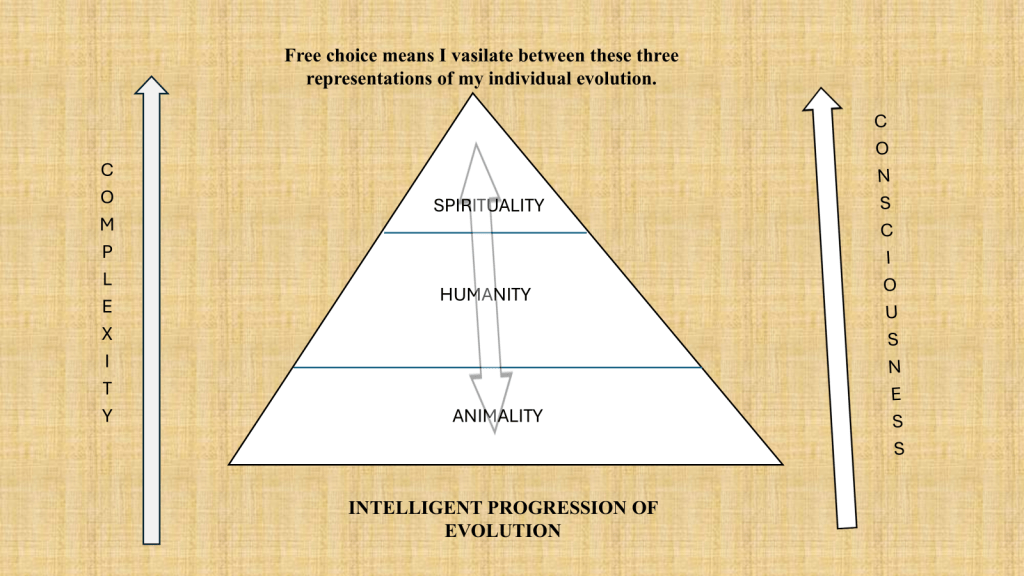
In my last blog, I raised the concept of individuals having, from birth to death, three distinct levels of evolution yet being one (sound familiar?). This individual evolution rides down the river of reality from Alpha to Omega using the same characteristics as the collective consciousness of humanity, but parceling it out to each and every human who lives. All reality exists so that I can make a free choice to move to the highest level of evolution, spirituality, because you and I exist to move to a level of existence after we die, which our senses and reason do not quite understand. St. Paul said it best in 1 Corinthians 2. I copied this from http://www.usccb.org, my one “go-to” website for all things authentically Catholic. I left the references and commentary for you at the end of this passage. I suggest you read the following Scripture from St. Paul with Figure 1. I have read this passage at least eleven times, each time mining for a spiritual goal that I had not seen before.
1 When I came to you, brothers, proclaiming the mystery of God,* I did not come with sublimity of words or of wisdom. a
2 For I resolved to know nothing while I was with you except Jesus Christ, and him crucified.b
3 I came to you in weakness* and fear and much trembling,
4 and my message and my proclamation were not with persuasive (words of) wisdom,* but with a demonstration of Spirit and power,c
5 so that your Faith might rest not on human wisdom but on the power of God.d
The True Wisdom.*
6 Yet we do speak a wisdom to those who are mature, but not a wisdom of this age, nor of the rulers of this age who are passing away.
7 Rather, we speak God’s wisdom,* mysterious, hidden, which God predetermined before the ages for our glory,
8 and which none of the rulers of this age* knew; for if they had known it, they would not have crucified the Lord of glory.
9 But as it is written:
“What eye has not seen, and ear has not heard,
and what has not entered the human heart,
what God has prepared for those who love him,” e
10f this God has revealed to us through the Spirit.
For the Spirit scrutinizes everything, even the depths of God.
11 Among human beings, who knows what pertains to a person except the Spirit of the person that is within? Similarly, no one knows what pertains to God except the Spirit of God.
12 We have not received the Spirit of the World but the Spirit that is from God, so that we may understand the things freely given us by God.
13 And we speak about them not with words taught by human wisdom, but with words taught by the Spirit, describing spiritual realities in spiritual terms.*
14 Now the natural person* does not accept what pertains to the Spirit of God, for to him it is foolishness, and he cannot understand it, because it is judged spiritually.
15 The spiritual person, however, can judge everything but is not subject to judgment* by anyone.
16 For “who has known the mind of the Lord, so as to counsel him?” But we have the mind of Christ.g
* [2:1] The mystery of God: God’s secret, known only to himself, is his plan for the salvation of his people; it is clear from 1 Cor 1:18 25; 2:2, 8–10 that this secret involves Jesus and the cross. In place of mystery, other good manuscripts read “testimony” (cf. 1 Cor 1:6).
* [2:3] The weakness of the crucified Jesus is reflected in Paul’s own bearing (cf. 2 Cor 10–13). Fear and much trembling: a reverential fear grounded in a sense of God’s transcendence permeates Paul’s existence and preaching. Compare his advice to the Philippians to work out their salvation with “fear and trembling” (Phil 2:12), because God is at work in them just as his exalting power was paradoxically at work in the emptying, humiliation, and obedience of Jesus to death on the cross (Phil 2:6–11).
* [2:4] Among many manuscript readings here, the best is either “not with the persuasion of wisdom” or “not with persuasive words of wisdom,” which differ only by a nuance. Whichever reading is accepted, the inefficacy of human wisdom for salvation is contrasted with the power of the cross.
* [2:6–3:4] Paul now asserts paradoxically what he has previously been denying. To the Greeks who “are looking for wisdom” (1 Cor 1:22), he does indeed bring a wisdom, but of a higher order and an entirely different quality, the only wisdom really worthy of the name. The Corinthians would be able to grasp Paul’s preaching as wisdom and enter into a wisdom conversation with him if they were more open to the Spirit and receptive to the new insights and language the Spirit teaches.
* [2:7 10a] God’s wisdom: his plan for our salvation. This was his own eternal secret that no one else could fathom, but in this new age of salvation, he has graciously revealed it to us. For the pattern of God’s secret, hidden to others and now revealed to the Church, cf. also Rom 11:25–36; 16:25–27; Eph 1:3–10; 3:3–11; Col 1:25–28.
* [2:8] The rulers of this age: this suggests not only the political leaders of the Jews and Romans under whom Jesus was crucified (cf. Acts 4:25–28) but also the cosmic powers behind them (cf. Eph 1:20–23; 3:10). They would not have crucified the Lord of glory: they became the unwitting executors of God’s plan, which will paradoxically bring about their own conquest and submission (1 Cor 15:24–28).
* [2:13] In spiritual terms: the Spirit teaches spiritual people a new mode of perception (1 Cor 2:12) and an appropriate language by which they can share their self-understanding, their knowledge about what God has done in them. The final phrase in 1 Cor 2:13 can also be translated “describing spiritual realities to spiritual people,” in which case it prepares for 1 Cor 2:14-16.
* [2:14] The natural person: see note on 1 Cor 3:1.
* [2:15] The spiritual person…is not subject to judgment: since spiritual persons have been given knowledge of what pertains to God (1 Cor 2:11–12), they share in God’s own capacity to judge. One to whom the mind of the Lord (and of Christ) is revealed (1 Cor 2:16) can be said to share in some sense in God’s exemption from counseling and criticism.
MY LAY CISTERCIAN WAY OF LIFE
I would like to share with you HOW I practice contemplative spirituality by using Cistercian practices and charism (silence, solitude, prayer, and work, within the context of community). Do I always do all the listed prayers and practices? No. At 85, I am lucky to remember what I had for breakfast or what day it is. Brother Michael Lautieri, O.C.S.O., our Junior instructor when I was in formation at Our Lady of Peace Monastery (Trappist), which I am still connected with by Zoom, told us, “Pray as you can, as you are, where you are.”
If I letSinn or guilt or any spouse, who blocks my spirituality and ridicules being a Lay Cistercian, be the arbiter of how I live as a human, get out of that bear trap. It takes courage to hold up for Catholic values, even though we might be functionally illiterate spiritually, especially when you are challenged with fuzzy ideas about how we all are going to the same place, so it doesn’t matter what we believe. Don’t be a reed broken by the wind. Don’t be an M&M Catholic, the nut covered by a thin shell of Faith that melts in the hands of adversity.
I can love someone who does not share my values or principles (Genesis, Christ, and The Spirit of Truth) won through the blood of the Lamb sacrificed on the cross, and confirmed by martyrs for Christ in Rome and other cities. Your Catholic heritage was and is being won through the martyrdom of blood even now, but, more importantly for you and me, by our living the martyrdom of Ordinary Daily Living with all its manic and depressive, animalistic and humanistic tendencies. Throw it away or don’t pass it on at risk of having to tell Jesus why you dropped the ball and did not show your children the skills to survive on this Earth until we reach the destiny planned for us before there was an Alpha from the Word. (John 1:1)
I try to love those with whom I have serious doctrinal issues by praying for both of us. I believe that God appeared to Abraham because of original Sin and the promise of a redeemer. I believe that God gave us a list of things we should do to be in the covenant between God and the tribes of Israel. I believe that Christ marks the next level of spiritual evolution, from tribes to people gathering in twos or threes in the name of Christ. I believe not only in what the Apostles’ Creed and Nicene Creed give the faithful as the core of their daily conversion from false self to true self. I believe that anyone who calls on the name of the Lord will be saved from the fires of Hell. I believe that Purgatory is a place where those who missed the boat and put themselves as Christ instead of sitting down in the presence of Christ and listening to His whispers. I believe that my Catholic religion is the true and only one that moves from Christ through to me, so that I can authentically move to Christ using the same train tracks. I don’t judge anyone’s faith or belief systems and can pray with others of other faiths, sincerely wishing God’s blessing on them, without compromising my Faith bought with the blood of Christ.
These practices are those used by Cistercian monks and nuns and interpreted by Lay Cistercians to their specific life experiences. https://thecenterforcontemplativepractice.org I have adapted them to my current life. Contemplation is a skill never quite mastered, but always a passion to be in the presence of Christ and wait.
- CONTEMPLATIVE READINGS
- REVISITING: Lay Cistercian Practices and Charisms
- WHAT IS A LAY CISTERCIAN?
- About
- WELCOME

REVISITING: Lay Cistercian Practices and Charisms
I met a man, quite similar in appearance and temperament to me, who keeps trying to pray as much as possible in the hopes of becoming more like Christ and less like himself. The more he prays, he thought, the holier he would become. Thus, the closer he would become to his center (Philippians 2:5). In trying to use the World as a measuring stick for holiness (quantity equals quality), he overlooked the dimension of the heart. The mind is good at measuring quantity, while the heart looks for quality. It is not how much you pray but how much your heart can make room (capacitas dei) for Christ. He was seduced into thinking that prayer was all verbal and must be done in Church, while, in fact, that is an integral part of the contemplative life for a Lay Cistercian, but there is always more. Formal prayers are not the end in themselves but only ways to be present to Christ, only the beginning of the process. This happens from the beginning of each day, which is why the Morning Offering prayer is so important. Prayer is not what you do as much as lifting the heart and mind to God, wherever and however you seek God daily.
One way to approach the Sacred is to follow a daily routine. Some people call it a habit. Do this every day for 30 days. If you are unable to do so, you might want to consider whether your spirituality needs to go to the gym. What follows is my exercise to move from self to God.
DAILY PRACTICES
Place this aide on your mirror. When you wake up in the morning, offer everything you do today as glory to the Father and for the grace to do God’s will, through Our Lord, Jesus Christ.
Monday: In reparation for my sins and those of the Church, those on my prayer list
Tuesday: For all family, friends, teachers, classmates from St. Meinrad Seminary, those on my prayer list
Wednesday: In honor of the Sacred Heart of Jesus, Immaculate Heart of Mary, and St. Joseph, those on my prayer list
Thursday: For all Lay Cistercians, Monks of Holy Spirit Monastery, Monks of St.Meinrad Archabbey, priests and religious of Diocese of Evansville, Monks of Norcia, Italy, and those on my prayer list
Friday: For an increase in grace to love God with all my heart, all my soul, all my mind, and my neighbor as myself.
Saturday: For all deceased, an increase in my Faith through the Holy Spirit, and for those on my prayer list.
Sunday: To give praise, honor, and glory to the Father through the Son by means of the Holy Spirit, the God who is, was, and is to come at the end of the ages
FIDELITY TO THE LIFE OF ONE WHO IS SIGNED WITH THE SIGN OF FAITH
In my life, I must have a schedule to follow. Refuse to be used by a schedule (feeling that I have sinned if I don’t adhere to it perfectly), but would rather use it to help me seek God where I am and as I am, each day. Share with you my daily practices. Must emphasize the word “daily”. It is such a simple word, but it’s crushed me more times than I would like to admit. These are the habits I follow daily, and I do not wish to impose them on you. You may wish to try some of them or none of them. If you do try them, do them daily, and feel the struggle that it takes to be worthy of being an adopted son or daughter of the Father.
EACH DAY, READ CHAPTER 4 OF THE RULE OF ST. BENEDICT. EXCEPTIONS! — The Rule contains practices offered to his monks by St. Benedict (c. 540 AD). Most chapters contain practical guides on organizing the daily lives of monks in his time. If you go to this site, you will find a wealth of information about St. Benedict, as well as a tutorial from the Abbott on the meaning of each chapter of the Holy Rule. The key here is to ask God to become what you are reading. tps://christdesert.org/prayer/rule-of-st-benedict Here are some of the Chapters of the Holy Rule that I use to take up my cross daily and follow Christ.
- Prologue
- Chapter 4 Tools for Good Works
- Chapter 5 Obedience
- Chapter 7 Obedience
- Chapter 19 The Discipline of Psalmody
- Chapter 20 Reverence in Prayer
I read and try to practice these Chapters as a professed Lay Cistercian of the Monastery of Our Lady of the Holy Spirit (Trappist) in Georgia, always mindful of the lifetime promises I made to Christ through the Abbott, Dom Augustine, O.C.S.O. I am not a monk living in a monastery. The monastery is the limit of the World in which I seek to find meaning. I am challenged to adapt the Rule to help me seek God daily, where I am and as I am. Some days are better than others. I have discovered that the time I take to calm myself down before presenting myself to God is also a prayer.
EACH DAY, RECITE THE OFFICE OF READINGS, THE MORNING PRAYER, AND THE EVENING PRAYER. These prayers are prayers of the Church Universal. Somewhere in the World, the faithful are reciting these prayers in praise of the Father through the Son in union with the Holy Spirit. They are public prayers of reparation for the sins and shortcomings of the Church and all its members. Praise and thanksgiving to the Father for considering us as adopted sons and daughters. Since before c 540 (St. Benedict), holy men and women have been praying these prayers seven times a day, 365 days a year, in continuous prayer for all of us to the Father that He grant us mercy, sinners all. These hours are not limited to “just Catholics.” There is no such thing as Catholic prayers. Our Catholic heritage includes prayers that have been part of our tradition for 20 centuries. We can pray these prayers because we don’t betray the Catholic Church or any Church. Our communication with Christ is our communication with Christ —mind to mind, heart to heart —and also to love others as Christ loves us. No one can say that Jesus is Lord without the Holy Spirit. Catholic groups also pray the Liturgy of the Hours together and are linked together by the Universal Prayer of the Church.
Watch an example of one of the Hours from Our Lady of the Holy Spirit Monastery (Trappist) in Georgia. tps://www.youtube.com/watch?v=VbE92dFGG50  What did you notice about this prayer? I was struck by how slow the monks sang hymns and prayed the Psalms. I was like walking in honey.
EACH DAY, READ OR LISTEN TO SACRED SCRIPTURE — Some people read the Scripture to prove they are better than anyone else. How far away are they from the Kingdom of Heaven? S John writes about why we have the Scriptures in John 20:30-31 when he says: “Conclusion.*30 Now Jesus did many other signs in the presence of [his] disciples that are not written in this book.s31 But these are written that you may [come to] believe that Jesus is the Messiah, the Son of God, and that through this belief you may have life in his name.” t
The biblical quotation is from a website you should bookmark under CATHOLIC UNIVERSAL. I am the website of the Conference of Catholic Bishops (USCCB) http://www.usccb.org/bible/john/20. .
EACH DAY, IN FACT, SEVERAL TIMES A DAY, DO LECTIO DIVINA.– When I first began doing Lectio Divina in June 1963, I was very scrupulous to follow Guigo III’s Order of Contemplation. As I approach the end of my life on Earth, I am much more forgiving about strictly following the letter of the law of following the steps of Guigo II. I am doing Lectio Divina (Philippians 2:5) without realizing that there are steps. E e, seven years ago, when I first became interested in applying to become a Lay Cistercian, I had one long session of Lectio. Now, my Lectio sessions total one or sometimes two hours per day, but I spread that out over three or four shorter sessions. My daily schedule is flexible yet strict enough that I pray at least once a day at 2:30 a.m. (twenty minutes), when I get up for a bathroom break, then do my Lectio Divina at my computer at 6:00 a.m., 2:00 p.m., and 8:00 p.m. Do I always meet these standards? No, but at least I aim for their fulfillment in my inner self.
If you are looking for a challenging read, open this URL. h tp //www.umilta.net/ladder.html
The Steps for Lectio Divina: Spiritual Reading (source unknown)
Step 1. Lectio (lex-ee-oh), “Reading”
Read the Scripture passage. Try reading it out loud. Try reading it several times. Let the words sink in deeply. O, in your mind and heart, to the meaning of the words.
Step 2. Meditatio (med-it-tots-ee-oh), “Meditation”
Reflect on the Scripture passage. Tis in deep thoughts. Ask ourselves questions such as the following:
What does this passage say to me?
Who am I in this passage?
What do I see? What do I hear?
What do I think?
Which character do I most relate to?
What do I most need to learn from this?
Try taking notes on your answers to the questions. T y ournaling about the insights gained with meditation.
Step 3. Oratio (or-o-t-see-ah), “Prayer”
More into the heart of the matter. Feel deep feelings. Consider the following questions as you respond to God:
What do I want to communicate to God?
What am I longing for in my relationship with God?
What do I desire in my prayer life?
What secrets of my heart are ready to be expressed? Is there joy?
Express your intimate self to God in your own personal way.
Step 4. Contemplatio (con-tem-plot-see-oh), “Contemplation”
Simply rest in the presence of God. Be passive and just enjoy God. Step into the tenderness of God’s
Additional Step 5. Actio (ax-ee-oh); “Action”
Ask yourself the following questions in utter honesty:
How is God challenging me?
Is there a good thing God is calling me to do?
Is there a harmful thing God wants me to stop doing?
What is the next step I need to take?
Decide on a course of action.
In my own Lectio Divina practice, I use this fifth step, remembering the words of Mary to the wine stewards at the Wedding Feast of Cana, “Do what he tells you.” I can’t express the joy I have in listening to the words Christ whispers to me each day. My new hobby is now making new wineskins to hold all the wisdom that the Holy Spirit shares with me. I don’t speak for the Holy Spirit (only the Holy Father does this), but I do listen and wait for instructions on making all things new once more. Each day becomes a lifetime.
IT ALL COMES DOWN TO THIS: THE END (OF MY EARTHLY CITIZENSHIP) IS THE BEGINNING OF MY ADOPTION AS SON OR DAUGHTER OF THE FATHER.
At the end of my life, and while I store up treasures in this earthly life to take with me to the next phase of my intelligent progression, I am more and more convinced that striving to be a perfect Catholic is good, but not the purpose of a lifetime of searching for the elusive Christ. There is still that nagging suspicion from my earthly self that my spiritual self has pulled one over on it. Palm 37 (www.usccb.org/psalm 27)
If I searched the Scripture and the traditions of the Catholic Church, the one prayer that seems to encapsulate who I am is the one below. I take it with me as one of those gold nuggets I have uncovered through a torturous life of floundering and almost loving God with my WHOLE mind, my WHOLE heart, and my WHOLE strength. It pains me that I cannot seem to give that last 10%. There is a nagging doubt that all of this may be so much fluff. It is reminiscent of Christ’s passion for His mission in the Garden of Gethsemane. I can only place myself in the presence of Christ on the couch of the upper room of my inner self and wait, wait for the Lord. To my astonishment, the waiting is not for Christ to come, but for me to purge my lips with that burning coal (which you read above) to purify myself of my seven deadly sins as much as I can, then, to call upon the name of the Lord to have mercy on me.
I conclude these shared experiences about The Art of Contemplative Practice, not to convert you to this or that way of life, but to clarify those meditative thoughts from the Holy Spirit, which I have written down for both of us to ponder on the
1a Of David.
A
I
The LORD is my light and my salvation;
whom should I fear?
The LORD is my life’s refuge;
of whom should I be afraid?
2When evildoers come at me
These my enemies and foes
themselves stumble and fall.
3 Though an army encamps against me,
my heart does not fear;
Though war be waged against me,
even then do I trust.
II
4 One thing I ask of the LORD;
this I seek:
To dwell in the LORD’s house
all the days of my life,
To gaze on the LORD’s beauty,
to visit his temple.c
5 For God will hide me in his shelter
in time of trouble,d
He will conceal me in the cover of his tent;
and set me high upon a rock.
6 Even now my head is held high
above my enemies on every side!
I will offer in his tent
sacrifices with shouts of joy;
I will sing and chant praise to the LORD.
B
I
7 Hear my voice, LORD, when I call;
have mercy on me and answer me.
8“Come,” says my heart, “seek his face”;*
your face, LORD, do I seek!e
9 Do not hide your face from me;
do not repel your servant in anger.
You are my salvation; do not cast me off;
do not forsake me, God my savior!
10 Even if my father and mother forsake me,
the LORD will take me in.f
II
11 LORD, show me your way;
lead me on a level path
because of my enemies.g
12 Do not abandon me to the desire of my foes;
malicious and lying witnesses have risen against me.
13 I believe I shall see the LORD’s goodness
14 Wait for the LORD, take courage;
be stouthearted, wait for the LORD!”
These THOMAS MERTON PRAYERS seem to sum up my longings and trepidation with even trying to be in the presence of Christ.
“My Lord God, I have no idea where I am going. I do not see the road ahead of me. I cannot know for certain where it will end. N r do I really know myself, and the fact that I think that I am following your will does not mean that I am actually doing so. But I believe that the desire to please you does, in fact, please you. And I hope I have that desire in all that I am doing. I hope that I will never do anything apart from that desire. And I know that if I do this, you will lead me by the right road, though I may know nothing about it. Therefore, will I trust you always, though I may seem to be lost and in the shadow of death. I will not fear, for you are ever with me, and you will never leave me to face my perils alone.”
The THOMAS AQUIAS PRAYER is another seemingly insignificant collection of thoughts about Faith, but one that has touched me at that deepest level of my humanity.
“Lord”, I believe, help my unbelief.”
“Give us, O Lord, a steadfast heart, which no unworthy affection may drag downwards; give us an unconquered heart, which no tribulation can wear out; give us an upright heart, which no unworthy purpose may tempt aside. Bestow upon us also, O Lord our God, understanding to know you, diligence to seek you, wisdom to find you, and a faithfulness that may finally embrace you; through Jesus Christ our Lord.“
https://www.azquotes.com/author/490-Thomas_Aquinas
The PRAYER OF SAINT CHARLES de Focauld blends my dual citizeships of Earth (St. Paul terms it the World) and the Spirit in a way that makes sense to me. Galatians 5. The move from the realm of humanity that is just physical and mental, to that of physical, mental, and spiritual, takes continuous abandonment of false self to true self, and a consistent conversion of life each day to have in me the mind of Christ Jesus (Philippians 2:5-12). I take comfort from the ideas and prayers of Saint Charles de Foucauld on the importance of abandonment in My Lay Cistercian Way.
“Father,
I abandon myself into your hands;
do with me what you will.
Whatever you may do, I thank you:
I am ready for all, I accept all.
Let only your will be done in me,
and in all your creatures –
I wish no more than this, O Lord.
Into your hands I commend my soul:
I offer it to you with all the love of my heart,
for I love you, Lord, and so need to give myself,
to surrender myself into your hands without reserve,
and with boundless confidence,
for you are my Father.”
Charles de Foucauld
To all of this, I hope to become what I have tried and tried to learn about The Art of Contemplative Practice. I will never achieve mastery of these ideas from Christ on how to know, how to love, and the meaning of truth in this lifetime. But I hope I have all the time there is to continue my movement away from myself and towards Christ Jesus.
Praise be to the Father, and to the Son, and to the Holy Spirit, now and forever. The God who is, who was, and who is to come at the end of the ages. –Cistercian doxology
That in all things, God be glorified. –St. Benedict
Amen and Amen.
Discover more from The Center for Contemplative Practice
Subscribe to get the latest posts sent to your email.
 The Center for Contemplative Practice
You must be logged in to post a comment.