The Center for Contemplative Practice
A Lay Cistercian Looks at Spiritual Reality
WHAT GOD DOES OR DOES NOT LOOK LIKE AT 84.11.
Don’t get me wrong, my understanding of who God is or is not depends entirely on me. If I am like a big sponge (like those from Tarpon Springs, Florida), then I have filtered many lessons through my cells and learned many valuable lessons, both uplifting and those I wish I could forget. I share with you who I think God is (for me) at this stage of my life, approaching death with some apprehension and a little fear of the unknown. My feelings carry the weight of how I look at, or was looked at, reality as I advanced through the gauntlet of people and situations all crying out for me to choose them as part of this reality.
My notion of God is not yours, just as you are not me and I am not you. My God is different from your God only in our awareness and integration of the Sacred into those hours we have left to do so. Lest I fly under false colors, I have listed some random ideas about God, which are floating in what is left of my conscious awareness of my humanity.
WHAT GOD LOOKS LIKE AT 84.11 YEARS OF AGE.
I. I HOPE I AM CORRECT THAT WHAT JESUS TELLS ME IS TRUE, WILL ACTUALLY HELP MY HUMANITY EVOLVE TO THAT NEXT LEVEL OF EXISTENCE FOR HUMANS. It is no coincidence that the three theological virtues are FAITH, HOPE, AND LOVE, as found in I Corinthians 13. This is so important, and has such multiple consequences for what is to come, that I offer it to you in its entirety from http://www.usccb.org.
“1 If I speak in human and angelic tongues* but do not have love, I am a resounding gong or a clashing cymbal. A 2 And if I have the gift of prophecy and comprehend all mysteries and all knowledge; if I have all faith to move mountains but do not have love, I am nothing.b 3 If I give away everything I own, and if I hand my body over so that I may boast but do not have love, I gain nothing.c 4* Love is patient, love is kind. It is not jealous, [love] is not pompous, it is not inflated,d 5 it is not rude, it does not seek its own interests, it is not quick-tempered, it does not brood over injury,e 6 it does not rejoice over wrongdoing but rejoices with the truth. 7 It bears all things, believes all things, hopes all things, endures all things.f 8* Love never fails. If there are prophecies, they will be brought to nothing; if tongues, they will cease; if knowledge, it will be brought to nothing. 9 For we know partially and we prophesy partially, 10 but when the perfect comes, the partial will pass away. 11 When I was a child, I used to talk as a child, think as a child, reason as a child; when I became a man, I put aside childish things. 12 At present, we see indistinctly, as in a mirror, but then face to face. At present, I know partially; then I shall know fully, as I am fully known.g 13* So faith, hope, love remain, these three;h but the greatest of these is love.
- * [13:1–13] This chapter involves a shift of perspective and a new point. All or part of the material may once have been an independent piece in the style of Hellenistic eulogies of virtues, but it is now integrated, by editing, into the context of 1 Cor 12–14 (cf. the reference to tongues and prophecy) and into the letter as a whole (cf. the references to knowledge and to behavior). The function of 1 Cor 13 within the discussion of spiritual gifts is to relativize all the charisms by contrasting them with the more basic, pervasive, and enduring value that gives them their purpose and their effectiveness. The rhetoric of this chapter is striking.
- * [13:1–3] An inventory of gifts, arranged in careful gradation: neither tongues (on the lowest rung), nor prophecy, knowledge, or faith, nor even self-sacrifice has value unless informed by love.
- * [13:4–7] This paragraph is developed by personification and enumeration, defining love by what it does or does not do. The Greek contains fifteen verbs; it is natural to translate many of them by adjectives in English.
- * [13:8–13] The final paragraph announces its topic, Love never fails (1 Cor 13:8), then develops the permanence of love in contrast to the charisms (1 Cor 13:9–12), and finally asserts love’s superiority even over the other “theological virtues” (1 Cor 13:13).
- * [13:13] In speaking of love, Paul is led by spontaneous association to mention faith and hope as well. They are already a well-known triad (cf. 1 Thes 1:3), three interrelated (cf. 1 Cor 13:7) features of Christian life, more fundamental than any particular charism. The greatest…is love: love is operative even within the other members of the triad (7), so that it has a certain primacy among them. Or, if the perspective is temporal, love will remain (cf. “never fails,” 1 Cor 13:8) even when faith has yielded to sight and hope to possession.
- a. [13:1] 8:1; 16:14; Rom 12:9–10; 13:8–10.
- b. [13:2] 4:1; 14:2 / 1:5; 8:1–3; 12:8 / Mt 17:20; 21:21; Col 2:3.
- c. [13:3] Mt 6:2.
- d. [13:4] Eph 4:2 / 4:6, 18; 5:2; 8:1.
- e. [13:5] 10:24, 33; Phil 2:4, 21; 1 Thes 5:15.
- f. [13:7] Prv 10:12; 1 Pt 4:8.
- g. [13:12] 2 Cor 5:7; Heb 11:1 / 2 Tm 2:19; 1 Jn 3:2.
- h. [13:13] Col 1:4; 1 Thes 1:3; 5:8. (www.usccb.org)
In my search for the answer to these unrequited longings that still inform my heart, there are three questions (my own) that I have identified as a constant nagging for resolution.
- What does it mean to know at the deepest level of my humanity?
- How can I love in such a way that I fulfill that longing in my heart to be one with someone?
- Where can I find the truth that is beyond compromising and retionalism?
There are six answers at my core of what it means to be human at that deepest level of humanity, and I am in a constant process of becoming, in which I search for answers.
- What is the meaning of life?
- What is the meaning of my life within that definition?
- What does reality look like?
- How does it all fit together?
- How to love fiercely?
- I know I am going to die; now what?
Read it three times, once to know, once to listen, and the last time to become what you read. This passage from I Corinthians 13 is one where I often go to find some answers, which leads me to my next item on the list of what God is.
II.GOD IS MY LIBRARIAN AND CLOSEST SPIRITUAL DIRECTOR AND CONFIDANT.
III.GOD WROTE A BOOK THAT HELPS ME GET TO HEAVEN, NOT PROVE HOW THE HEAVENS GO (Galileo Galilei).
IV. I TRUST GOD BECAUSE HE HAS PROVED TO ME THAT HE EXISTS, NOT EXCLUSIVELY INTELLECTUALLY, BUT BECAUSE HE TOOK THE TIME WITH ME TO TAME MY HEART. https://www.youtube.com/watch?v=FOA7CcVOFIs
V. JUST AS I AM NOT YOU AND YOU ARE NOT ME, SO GOD IS NOT ME, AND I AM, MOST CERTAINLY, NOT GOD.
VI. HUMILITY AND SEEKING TO SUSTAIN IT EVERY DAY, IS TO REALIZE WHO GOD IS BY REALIZING WHO I AM AT THE DEEPEST LEVEL OF BEING HUMAN, THUS GAINING JUST A GLANCE OF PURE LOVE, THE ONE IN WHOSE IMAGE AND LIKENESS I AM CREATED. I have come to the realization, as did St. Thomas Aquinas, that I cannot know who God is but rather turn my attention to who I am to discover the One whose fingerprints are all over me.
VII. GOD ONLY SPEAKS SILENCE (not English, Music, Scientific language, or of any religion). I can only listen to the God whisperer in that upper room of my inner self (Matthew 6:5), where I sit in a room of my creation (over a lifetime) and wait.

VII. HEAVEN IS GOD’S PLAYGROUND, SO IF I WANT TO PLAY IN THE SAND, I MUST FOLLOW GOD’S RULES. There is only one rule: “Love God with your whole heart, your whole mind, and all your strength. Love your neighbor as yourself.” (Deuteronomy 6:5 and Matthew 22:35)
VIII. THE GOD WHO HAS NO BOUNDARIES HAS SET BOUNDARIES FOR HUMANS TO HELP THEM TRAVERSE THE QUICKSAND OF ORIGINAL SIN. THESE BOUNDARIES ARE SOMETIME AT ODDS OR THE OPPOSITE OF WHAT THE WORLD SAYS IS MEANINGFUL. JESUS CAME TO SHOW US HOW TO BECOME HUMAN AT OUR DEEPEST LEVEL OF HUMANITY BY USING PURE ENERGY AND PURE LOVE TO RISE UP TO THAT NEXT LEVEL OF OUR EVOLUTION, SONS AND DAUGHTERS OF THE FATHER AND HEIRS TO THE KINGDOM OF HEAVEN.
IX. THE CHURCH IS FOUNDED BY CHRIST TO BE THE WAY, THE TRUTH, AND THE LIFE IN EACH AGE, INDEED IN EACH PERSON WHO ACKNOWLEDGES JESUS IS LORD. THE FOUR MARKS OF THE CHURCH (ONE, HOLY, CATHOLIC, AND APOSTOLIC) ARE QUANTUM STRINGS OF ENERGY THAT WE CAN ACCESS BY PLACING OURSELVES IN THE PRESENCE OF CHRIST AND BEING OVERSHADOWED BY THE HOLY SPIRIT. The head of the Church, Christ, is holy, but all other humans, except the Blessed Mother, face the gauntlet of good or evil each day. The Catholic Church is not just a place to go on Sunday because, somehow, you feel better giving God one hour per week (life insurance), but rather what happens during the remainder of the time, based on what you learned and experienced during the Eucharist. Church is the occasion, in each age and time, where I can learn the lessons of love that Christ requires of me. I do that through placing myself in the presence of Christ without conditions (try that one on for size) and waiting. Because humans want results and usually instantaneously, my humanity fights against the notion of silence, solitude, and retiring to that upper room of my inner self just to be in the presence of the one I love. It is learning to believe without seeing the physical presence of Christ, yet asking God for the grace to believe in the Real Presence of Christ under the appearance of a wafer of bread. Catholicism is not for the weak of heart and demands the suspension of reason for something out there that is not definable nor possessable. It is in the very act of abandonment of all that is real (dependence on the world for meaning) that a new reality is added to the physical and mental universes that we so comfortably inhabit. If you want an easy path to heaven, it is not the Catholic Church. The Catholic Church has centuries and centuries of trial and error about what is good and evil, much like all the books of the Old Testament. What is different between the Old and New Testaments is the Holy Spirit, given as a silent advocate to help the Church from completely making a fool of itself, more than is normal for a human-based society that must choose between good and evil. My Catholic Faith is my 84.11 years of trying to discover who I am as a human being and what is the deepest level of my humanity that evolves beyond the physical and mental confines in which I must exist until I die. Unlike many philosophies of meaning, the Catholic Church holds that humans are created in the image and likeness of God and are therefore intrinsically good while nevertheless being under the influence of imperfection and false pathways to perfection (orginal sin), we need the power from Christ through the Holy Spirit to refocus outselves on a way that is out of this world,l literally. Because we live in a continuing flow of reality from Alpha to Omega (see the Teilhard map below), time means we both move towards complexity and also consciousness inexorably and non-stop. We cannot reverse time, only learn how to use it and why we have it at all.
X. CHRIST IS THE BEGINNING AND END (ALPHA AND OMEGA) OF ALL THAT IS, OR WAS, OR WILL BE. THIS MAP BY TEILHARD DE CHARDIN (UNATTRIBUTED) ALLOWS MY MIND TO APPRECIATE THE HANDIWORK OF GOD AND FEAR THE LORD (HUMILITY).https://thecenterforcontemplativepractice.org/wp-content/uploads/2025/07/image-2.png
XI. GOD IS THE RIVER BANKS OF REALITY AS IT CAREENS INEXORABLY TOWARD BOTH COMPLEXITY AND COUNSCIOUSNESS. (See above) God is the one who has no boundaries, who sets boundaries for all of reality, from Alpha (Creation) to Omega (heaven, which has no boundaries for my humanity). My boat has been embarking on this river for 84.11 years (so far). God is not the river, which is all reality, visible and invisible, but provides a pathway for all of reality (matter, life, animality, humanity, spirituality), who must float downstream using the parameters of their own nature. My boat must go with the flow of the current, sometimes calm, sometimes with whitecaps, sometimes just dead still. I row my own boat, and so do you. On my boat, I am the captain and set the course. God is the navigator and tells me where the rocks are or the correct direction. This water contains currents that actively seek to beach my bark, or mislead me with false promises of a side river that will give me true freedom and the direction dictated by my nature as a human. I cross over the boundaries when I don’t follow the directions of the navigator and get lost. The only way to get back to the true way is to ask the navigator where I am going once more and how to get there, then I can lead a life that is the next level of my evolution as a human. God won’t do it for me (take up your cross daily and follow me), but if I am meek and humble of heart, I can see past my imperfections and those of the Church, to what is real and make choices based on being within the boundaries of my humanity set and maintained for me in each age. All the rowers in the world won’t help my boat (community) if it has a hole in it. Fortunately, God is the boat builder and gives me the Sacrament of Penance to keep my boat free from barnacles and holes.
XII. THE CATHOLIC CHURCH IS THE SCHOOL OF LOVE AND GOD (Father, Son, and Holy Spirit) are the Magister Noster (One teacher but three courses all taught by three persons yet one), outlined in the Rule of St. Benedict, a way of life that is devoted to having in each of us the mind of Christ Jesus. I accepted this rule of spirituality (one of many) with the addition of Cistercian interpretations of this Rule. I commit to using the practices and charisms (to the best of my ability) each day, as a prayer to the glory of the Father, the Son, and the Holy Spirit, now and forever. The God who is, who was, and who will be, at the end of the ages.
The Cistercian (Benedictine) practices are:
Needing prayer in my upper room of my inner self, several times a day, and waiting (contemplation).
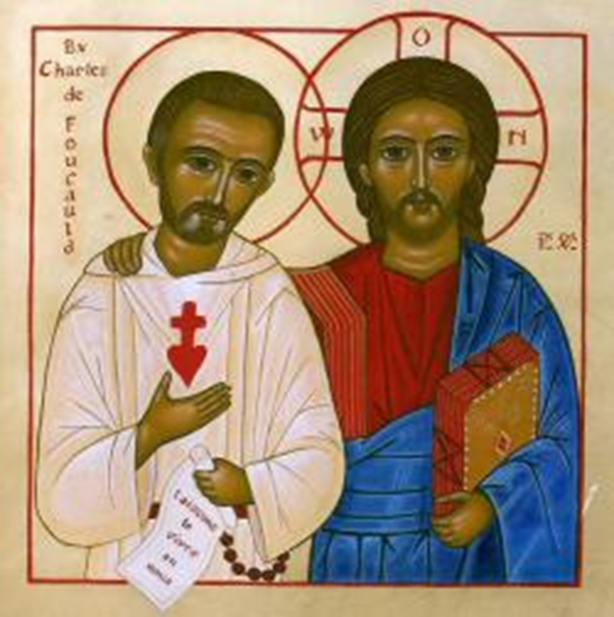
Placing myself in the presence of Christ in Lectio Divina, the Holy Rosary, Eucharistic adoration in the tabernacle within my personal temple of the Holy Spirit (I am 84.11 and don’t get out much), and waiting. No agenda, no formal prayers, just a continuous emptying of self as described by St. Charles de Foucauld.
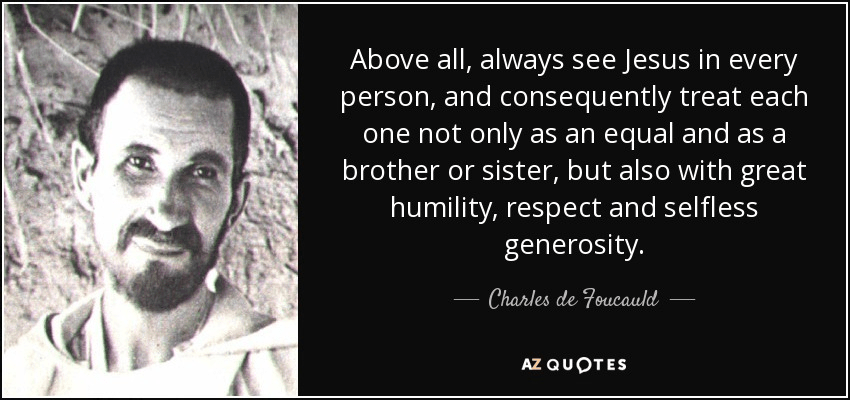
“To love anyone is to hope in him forever. From the moment at which we begin to judge anyone, to limit our confidence in him, from the moment at which we identify him with what we know of him and so reduce him to that, we cease to love him and he ceases to be able to be better.” ~ Charles de Foucauld
“We should never forget the two axioms: ‘Jesus is with me’ and whatever happens, happens by the will of God.” ~ Charles de Foucauld
“To receive the grace of God, you must go to the desert and stay awhile.” ~ Charles de Foucauld
“The moment I realized God existed, I knew that I could not do otherwise than to live for Him Alone…Faith strips the mask from the world and renders meaningless such words as anxiety, danger, and fear, so the believer goes through life calmly and peacefully, with profound joy–like a child, hand and hand with his mother.” ~ Charles de Foucauld
Here are some key themes and related quotes:
1. Abandonment to God’s Will:
- “Father, I abandon myself into your hands; do with me what you will. Whatever you may do, I thank you. I am ready for all, I accept all. Let only your will be done in me, and in all your creatures.”
- “Into your hands I commend my soul; I offer it to you with all the love of my heart, for I love you, Lord, and so need to give myself, to surrender myself into your hands, without reserve, and with boundless confidence, for you are my Father.”
2. Prayer and Action:
- “We must never act without praying – never. We also must not pray without acting, when we have the means to act.”
- “It is not necessary [for you] to teach others, to cure them, or to improve them. No, it is only necessary to live among them, sharing the human condition and being present to them in love.” http://www.azquotes.com
XIII. THE PURPOSE OF THE CATHOLIC CHURCH IS TO BE THE REAL PRESENCE OR EXTENSION OF CHRIST PRESENT IN EACH AGE SO THAT I, THE INDIVIDUAL CATHOLIC, CAN BE PRESENT TO HIM AND RECEIVE THE ENERGY TO SUSTAIN MYSELF IN THE MATRYRDOM OF ORDINARY LIVING. The Catholic Church, because it is the living Body of Christ in the past, the present, and the future, provides what Christ thought we needed to keep our heads above the waters of human frailty and sheer stupidity at killing each other, and hating each other, treating each other as THINGS and not as humans that are flawed but redeemable. (Martin Buber’s notion of I and Thou versus I and It is a way I find useful to look at flawed and floundering humans [Church included].) https://plato.stanford.edu/entries/buber/#DiaITho
XIV. THE PRINCIPLE OF SUBSIDIARY AND THE MINDSET OF BEING A PENITENT CATHOLIC AND LAY CISTERCIAN. This next quote is from AI generated on my computer. I think it is relevant to this topic that I wanted you to read it in its entirety.
“The principle of subsidiarity, a core tenet of Catholic Social Teaching, emphasizes that decisions should be made at the lowest level of authority possible, closest to the individuals and communities affected. Larger social entities, like the state, should only intervene when smaller ones are unable to adequately address a situation. This principle aims to empower individuals and communities, foster personal responsibility, and promote the common good.
Here’s a more detailed explanation:
Core Idea: Subsidiarity suggests that social and political issues should be addressed at the most local level capable of handling them effectively. This means empowering individuals, families, communities, and smaller organizations to resolve problems before resorting to larger, more centralized authorities.
Key Aspects:
- Decentralization:.Subsidiarity promotes a decentralized approach to decision-making, ensuring that power is not concentrated at the top.
- Empowerment:.It seeks to empower individuals and communities to take ownership of their lives and participate in shaping their societies.
- Respect for Human Dignity:.Subsidiarity recognizes the inherent dignity of each person and the importance of allowing individuals to exercise their freedom and responsibility.
- Support, not Interference:.Larger entities should support smaller ones, rather than taking over their responsibilities.
- Common Good:.Subsidiarity is ultimately aimed at promoting the common good by ensuring that individuals and communities can flourish.
Examples:
- Family: Parents should guide their children, but also allow them age-appropriate freedom and responsibility.
- Workplace: Managers should empower employees to make decisions and contribute their skills and creativity, rather than micromanaging.
- Government: The government should support local communities and organizations, rather than imposing top-down solutions.
Relationship to Other Principles:
- Solidarity: Subsidiarity is closely linked to solidarity, which emphasizes the interconnectedness of the human family and the need for mutual support.
- Common Good: Subsidiarity is a means to achieve the common good, which is the well-being of all members of society.
RESULTS FROM MY SWITCHING ASSUMPTIONS
In essence, the principle of subsidiarity is a call for a more human-centered approach to social organization, where individuals and communities are empowered to take responsibility for their own lives and contribute to the well-being of society as a whole.”
Just as I am not you and you are not me, so too Catholicism is most effective at the lowest level of practice (you and me). This is My Catholicism, or how I have chosen to take the principles of faith, hope, and love from being in the presence of Jesus and find meaning in my life. Each person is a different Catholic, yet the Church is One, Holy, Catholic, and Apostolic.
One of those very random searches on the Internet led me to a site of Our Lady of Akita (Japan). This site details the apparition of the Blessed Mother to a nun with words of advice that have sharpened my spirituality toward reparation of sin and living a penitential life as I can. Here is a site from EWTN if you are interested. https://www.ewtn.com/catholicism/library/message-from-our-lady–akita-japan-5167
What I did was to refocus my spirituality with Lay Cistercians on being penitential and praying for mercy for those of the Church and those in purgatory. O Yes, I had to begin with myself, and it is a work in progress each day. The following is the activity that I aspire to keep that allows me to be in the presence of Christ and plead for my own mercy and those of others in the Church. If you will allow me this indulgence, I would like to share with you what the Holy Spirit and I came up with. It is my Catholicism, and it is in addition to the regular rosary with Mysteries, as is normal. I only say the five decades of the Sorrowful Mysteries of the Rosary with a focus on reparation for my sins. The five decades are as follows:
- Reparation for my sins and failure to have Christ as my center now, and in the past.
- Reparation and Blessings for all those I know or have known in my lifetime, and for reparation for their sins.
- Reparation and Blessings for all priests, nuns, and brothers, and those of the Lay Cistercian communities all over the world.
- Reparation for the Church Universal is the stiffness of their hearts and mercy on all religions.
- Reparation for the whole world, those I don’t even know, that God not treat us as we deserve but with mercy and love.
I have also added a notion that seemed proper for me to do, although I admit it is a bit out of the ballpark. I now dedicate a bead to those I love, those with whom I share my faith journey. The bead dedication is for the Michael bead and all those who know him, those of his family and friends, that they may be loosed from their sins. I don’t need to think about Michael and family when I say it, so it saves me time to think about the passion, death, and resurrection of Christ in my poor, broken-down life.
After saying the Apostles’ Creed, the first bead is for my four traveling companions on my journey. They are Mary, Joseph, St. Michael, and Jesus, Son of God, Savior. You might be thinking that I have the order wrong in this quartet of traveling companions. Shouldn’t Jesus always come first? Jesus can and does always come first, but with this one exception. In one of my Lectio Divina sessions, I proudly said to Jesus, You and Mary and Joseph, and St. Michael are my Mount Rushmore of the Faith. In my contemplative prayer, Jesus asked me if he could speak with me in private. We both went to a place in my upper room where Jesus asked me, “Would you do me a favor, Michael?” “Sure, Lord, name it and you’ve got it,” I replied. “It would mean a lot to me if you would put my mother first, and Joseph second, Michael third, and me last,” he said with his hands on my shoulders. I blurted out something that sounded like, “My Lord, and My God.” Now you know the rest of the story and why I believe in a God who believes in me first.

In another blog, I will deal with the various things I think God is NOT.
uiodg
Discover more from The Center for Contemplative Practice
Subscribe to get the latest posts sent to your email.
 The Center for Contemplative Practice

You must be logged in to post a comment.