The Center for Contemplative Practice
A Lay Cistercian Looks at Spiritual Reality
TEN OBSERVATIONS ABOUT CATHOLICISM FOR THOSE NEW TO CONTEMPLATIVE PRACTICE

I admit it. I am a reformed Catholic of the Roman Rite who, over ten years ago, wanted to grow deeper in my spirituality, inherited and, I might add, taken for granted for most of my lifetime. It’s like being on an iceberg and suddenly discovering that 90% of it has been hidden from view. Here are some of my observations about my own struggles with institutional Catholicism and how I now see it. Make your own conclusions.
IF MATTER EVOLVES, SO DOES MY SPIRITUALITY. Teilhard de Chardin’s map (unattributed) forms the basis for my view of spirituality and its inherent efficacy.
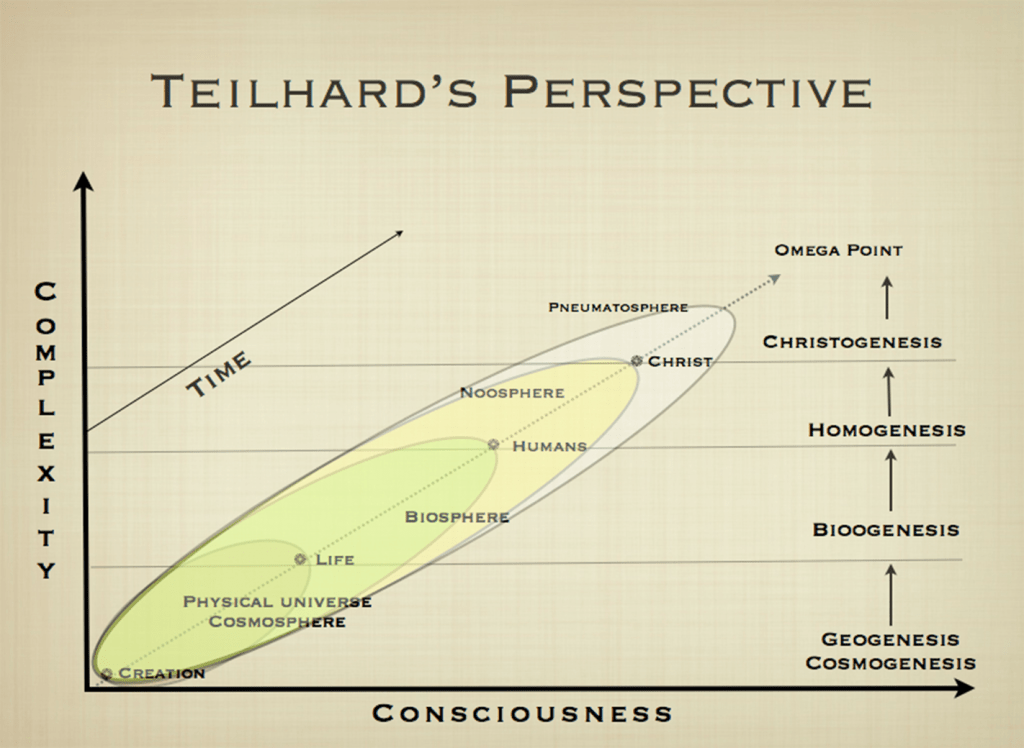
The phenomenon of change from now to a new now is time. One observation that I learned from my studies of Cistercian spirituality is how life is alive and buzzing like a transformer full of electricity. Some know how to use this power (contemplative practice), and others never peer into the depths of the inner self to explore what it means to be fully human, while those who dismiss this view of reality altogether as examples of human superstition or fantasy.
Christ came to teach us how to make all things new. Like giving each one who seeks how to dig for your earthly gold of meaning. Looking at the map above, Teilhard’s vision is that all reality (physical matter, the search for meaning as a human, and how spirituality, invisible though it is, is real. If it exists, in ways that only humans can discern with their reason and choice of freely accepting a way of thinking consistent with love and truth, two realms emerge: those things that we can see, and those things that are essential to humanity but invisible to the eye and not measurable by science or psychology. This invisible reality of spirituality is subject to the two dimensions of Teilhard’s view of reality, a) movement toward complexity, and, b) movement of each person ascribing experiences and learning to consiously grow in capacitas dei (movement that reflects just waiting for Christ’s presence to fill out humanity with energy that our human nature alone is incapable of producing) and conversion morae (converting daily experiences into meaningful applications based on the Scriptures).
LEARNING POINTS:
Not only does matter evolve in complexity and consciousness, so do the mental and spiritual universes, those realms or kingdoms opened up by free will and reason.
There is dual citizenship for all Catholics, although they might only be aware of one (physical and mental).
The two types are the mental universe, which all humans share the characteristics of humanity (human reasoning plus free will to choose anything to make us fulfilled), even though it might harm us.
Two Cistercian charisms of capacitas dei (growing in the presence of God in me) and conversion morae (openness to the consciousness that all reality exhibits for our learning) exemplify the notion of making all things new in Christ.
Making all new things in Christ illustrates the notion of making new wineskins to hold the daily new wine we receive from being in the presence of Christ.
New wineskins take an act of our will to consciously put Christ in our lives each day.
The effort to make all things new is a deeper level of Catholicism because the Church throughout the ages is the repository of what Jesus taught that is not corrupted by the “isms” of the world, as alluring as they might be.
If matter evolves, so does all reality in its own way. The Church Universal keeps moving because it is the second citizenship, the kingdom of heaven on earth. Yet, Christ bids each of us to be refreshed each moment by His meekness and humility of heart.
Those young (in their acceptance of Jesus Christ as their Savior and Boundary for the earthly kingdom) are not inexperienced nor lack the faith that older and more seasoned (broken-down old temples of the Holy Spirit), but need practice to recognize that what is real in the kingdom of heaven is the opposite of what is touted as meaningful by the kingdom of the earth.
Just because the Church is organized, doesn’t mean it is not the discipline each person needs to sustain and maintain Jesus in their hearts through Cistercian practices and charisms. What might seem as foolishness to the world in denying the boundaries set by humans, makes complete sense in the kingdom of heaven on earth now, and in the life to come. Earth is but a classroom where humans learn the rules of living after death, and Jesus is the Magister Noster (Our Teacher)
uiodg
Discover more from The Center for Contemplative Practice
Subscribe to get the latest posts sent to your email.
 The Center for Contemplative Practice
You must be logged in to post a comment.