The Center for Contemplative Practice
A Lay Cistercian Looks at Spiritual Reality
A MOSAIC PIECE OF MY LIFE: What can soothe the dissonance of my humanity using my life lessons and experiences?

Here is the second piece of glass mosaic that takes a lifetime of trial and error to settle on what quells the dissonance of my humanity in finding an answer to the three innate questions imprinted on my being and possibly all humans (not animals).
Only humans are capable of knowing the longings of the human heart. Here is the beginning of my search to find what fills that void, one which St. Augustine called: “Our hearts are restless until they rest in Thee.” Using the progressive Teilhard Map (unattributed) as one guide, I think about why humans are different from all other lifeforms, although we share many characteristics in our common heritage.
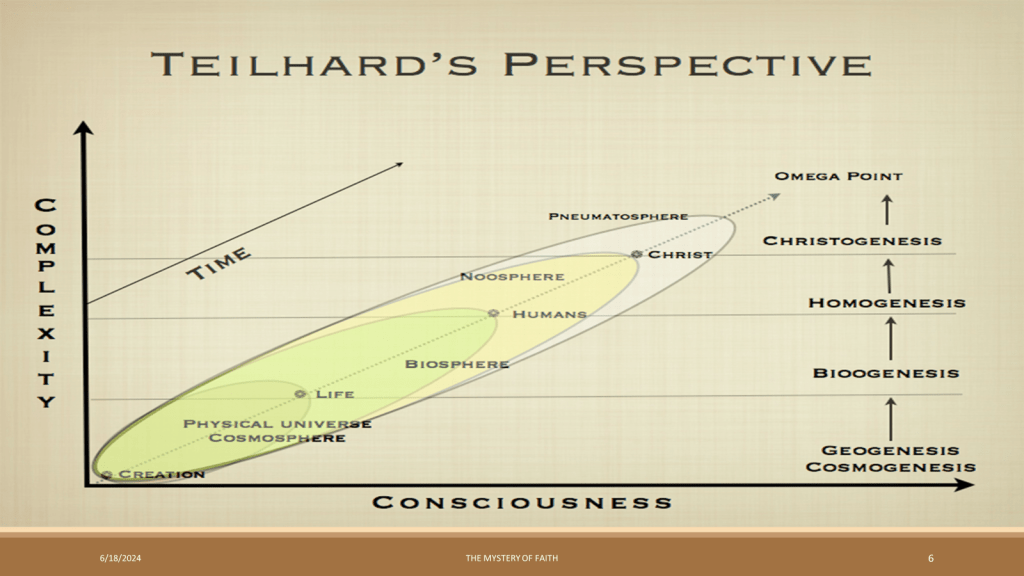
This Teilhard Map, named after Jesuit paleontologist Pierre Teilhard de Chardin, is one I use to see life through the lens of The Christ Principle, my personal experiences, and research to answer the first mosaic about those three innate longings of the human heart.
I am not you; you are not me; God is not us; and we, most certainly, are not God. Against this context, I map my quest for what it means to be fully human. My rationale is that all of these phases of consciousness and complexity in time are just a little too structured to be the random fallout from nature.
When I look at my limited time alive, I keep asking myself why all of this grand and wonderous flotsam and jetsam of matter and consciousness doesn’t have a fulfillment? Is my worth just terminated when I die, like an animal? I have two characteristics that hint that there is more to life than a causal one-night fling at being.
What soothes my inquisitive nature to discover my deeper meaning is my ability to go deeper in my knowledge of what I can see, but even more spectacularly, what I can’t see but know to be accurate. To do this, which each human possesses but does not always use effectively, is the ability to reason and choose what is good for me as I trudge down my life path.
Paying reluctant homage to B. F. Skinner and his ideas about operant conditioning, when I am faced with two choices, one of which is easy and one of which is correct, I tend to choose the one with no pain. To do otherwise would take an act of free will inconsistent with what I know my human nature to be. I don’t like pain.
I know that I know; I am aware that I am aware; I choose as good what will help me answer those three hidden questions of the heart, which always beckon my thoughts to seek an answer. What happens when my reason tells me that to choose what is right, I must choose something foreign to my everyday thinking, akin to dying to all I know, to embrace a reason beyond the limits of my ordinary capacity and capability?
I have found this picture of a cup in a window to signify my struggle with discovering my deeper self, one in which I must give up that very tightly held gift of humanity and replace it with something else. Who sees the big picture enough to help me bridge that immense gap between what is known and what is not known but is better for me filling my humanity? These mosaics are my struggle to discover how it all fits together?
In my quest for answers to the innate longings of my heart for resonance in the dissonance of my daily experiments with what is good for me, I had to use reason and freedom to choose what I think is good for me. But not all choices are good for me or lead to a deepening of my awareness of how it all fits together. Despite all the billions of people who did live or who have lived, I am the only one who can say YES or NO to anything set before my table to bring into myself as part of what it means to be me. Hold onto that thought.
To be continued…
uiodg
Discover more from The Center for Contemplative Practice
Subscribe to get the latest posts sent to your email.
 The Center for Contemplative Practice
You must be logged in to post a comment.