The Center for Contemplative Practice
A Lay Cistercian Looks at Spiritual Reality
FIVE ADDITIONAL VERTICAL, CONTEMPLATIVE TOOLS TO KEEP MY FOCUS ON CHRIST’S PRESENCE
Having completed my first iteration of contemplative tools that I use to probe ever deeper into vertical contemplative practices, I found there are a few more techniques that have been helpful. The tools for good works are found in Chapter 4 of the Rule of St. Benedict. These five and now ten techniques are unique to My Cistercian Way. I selected what I wanted to help my spirituality and bring it into my wheelhouse.
As with any tool or technique, its purpose is not an end in itself but rather a way to enable my will and reason to focus on the most important goal: to sit in the presence of Christ and wait until I am called.
In no order of importance, here are five additional ways I try to grow in Christ (capacitas dei).
I. THE RULE OF THREES
Based on my book of the same name, I see spirituality as having at least three core processes:
- The Rule of Centers– everyone has one center that informs and compels them to act in terms of what is good or bad for them.
- The Rule of Revolving Centers– as soon as you select a center, you must fight with your free will to keep it on the top.
- The Rule of Opposites–spiritual reality means you have died to the meaning of what the authentic world says is true and meaningful only to find that you still have what you had before PLUS now a deeper dimension to your human evolution or intelligent progression.
Cross-cutting behaviors that temper and inform what it means to be spiritual for me.
- Awareness-– this unsung hero of my spiritual encounters with the Sacred is the awareness that I am aware that God is God and I am, well, my sinful self. St. Benedict terms it as the first step for those who climb the ladder of humility, the first rung being “fear of the Lord.” This attribute means awareness that, despite the humanity of Christ being familiar, God still compels my attention and focus, not merely human traits. Awareness means, using the Rule of Opposites, that the cross is the paradigm of meaning for me, not money, fame, fortune, glory, or power. That makes no sense if I am only living in the human dimension beset by the ever-present effects of Original Sin. Baptism removes all sin, including Original Sin, but it does not diminish the effects of sin against which I must always struggle as an adopted son (daughter) of the Father.
- The Flaming Sword of the Word — St. Michael is not the only one who wields the power of the flaming sword. Remember awareness? I am aware that, as soon as the cross is traced on my forehead, I am a pilgrim in a foreign land, which seems like a defenseless weakling destined to always choose what is easy versus what is right. But, just when all humanity of the world seems to have lost its senses (which it has), I am aware that I must battle the forces of darkness that relentlessly pull me towards doing what makes me feel good at the moment rather than taking up my cross at the invitation to be irrelevant (sin) and slay the snake. None of the practices and charisms of Cistercian Spirituality, as much as I know of it, are ends in themselves but only serve to allow me to sit in the presence of The Christ Principle and absorb energy (grace) to strengthen my resolve here and now to give thanks to the Father for my adoption. This Word, this sword of Truth from the Holy Spirit, allows me to cut away the darkness around me in my Lectio Divina at Eucharist, during my sleepy hours when my thoughts can tend to turn to my animalistic human nature and allow the evil one to seduce me into cultivating that Mirror of Erisade, the facade of authentic meaning. https://youtu.be/Ck4Bk6SKO7o All techniques and tools of good works (St. Benedict Chater 4) are flaming swords of the Word. The Word is God. The Word has the power when I use it to dispel bad thoughts by replacing evil and temptations to be animalistic with Love, the flaming sword that no evil can endure. I say the word, “Jesus,” or “Jesus, Son of God, have mercy on me, a sinner,” whenever I now encounter the Evil One in idle thoughts or fantasies about love, power, adulation, lust, hatred, and others found in Galatians 5. Before being a Lay Cistercian, I was a Catholic but one who did not fight for my heritage against the forces that would drag me away from The Light. Now, at least, I am aware of what is going on, and, more often than not, abruptly stop my daydreaming or drifting off during Lectio Divina or Eucharist. Self-awareness helps me to stay more focused than before because I now realize that I must fight for my Faith like Adam and Eve had to work for their food. It is only with the power of Christ to sustain me in my humanity that I can be aware that I am not only a citizen of the earth (world) but also of the citizen of heaven on earth. It works only if I work.
- Constancy and Consistency – Because of the effects of original sin, Genesis 2-3 provides classic examples of how humanity acts, after the Fall from Grace. One such mention is that we must work for what we get. No entitlement comes with assuming the role of adopted son of the Father. In fact, because we are no longer mere citizens of earth, our whole paradigm has shifted toward doing what is right (God’s will) versus what is easy (our free will). The attributes of both constancy (repetitiveness or the martyrdom of the ordinary) and consistency (the habitual choice to continue to focus on having in me the mind of Christ Jesus) are key not only to dredging up new wineskins for new wine but also to keep moving forward past the inevitable pull of original sin to give up work that goes against our nature. As an adopted son, our new nature is still human but enhanced now with Christ being the center and the Holy Spirit helping with our human foibles and failures to do what we say we will do (classic St. Paul). My Lay Cistercian Way means I am conscious of my resolve and aware that I must be consistent in purpose, even if dark nights of the soul challenge my resolve. The feeling of challenge deep inside me means I must call upon the name of the Lord frequently. “Not my will, but Thine be done” is my mantra.
THE RULE OF CENTERS —
A technique I use every day in my Art of Contemplative Practice is to center myself. Delving into what that means behaviorally, I must make a conscious act of my will each and every morning to begin that day by recognizing and being aware that I am me and God is God. This is what St. Benedict terms step one in the ladder of humility as set out in Chapter 7 of his Rule. I am free, as you are, to place anything at my center. My personal center that I have selected and attempted to maintain since 1963, is “Have in you the mind of Christ Jesus.” (Philippians 2:5) It has been my only lectio for my Lectio Divina since that time.
“10 The first step of humility, then, is that a man keeps the fear of God always before his eyes (Ps 35[36]:2) and never forgets it. 11 He must constantly remember everything God has commanded, keeping in mind that all who despise God will burn in hell for their sins, and all who fear God have everlasting life awaiting them. 12 While he guards himself at every moment from sins and vices of thought or tongue, of hand or foot, of self-will or bodily desire, 13 let him recall that he is always seen by God in heaven, that his actions everywhere are in God’s sight and are reported by angels at every hour.”
Rule of St. Benedict, Chapter 7
A nicer. but deeper spiritual awareness of St. Benedict’s Rule may be found in the Benedictine Abbey Christ in the Desert by Abbot Philip Lawrence, O.S.B. I have used this commentary as part of my spiritual reading about The School of Love and how these Rules are not rules in the worldly senses of barriers, but rather how to grow deeper in Christ Jesus. (capacitas dei) https://christdesert.org/rule-of-st-benedict/
II. THE DIVINE EQUATION– This is my favorite technique (I say that about each one of them) because I see it as receiving both questions and answers from beyond my nature (from Jesus with the Holy Spirit). I call it divine, not because it tells me who God is, which it can’t and doesn’t, but rather, what it means for me to take that next step in my human evolution and become all that my nature intended but which Adam and Eve messed up. I have written extensively on this topic in past blogs and books, so I will not try to duplicate my prior reflections. They are:
- What is the purpose of life?
- What is the purpose of my life based on that purpose of life?
- What does reality look like?
- How does it all fit together?
- How do I love fiercely?
- You know you are going to die; now what?
It is my contention that every human must answer these questions correctly to make it to the next level of our collective evolution. The big question becomes who has the key, who possesses the truth that unlocks these seven locks to reveal its authentic answers? It must be the template of truth.
III. THE TEMPLATE OF TRUTH– Being one who has adopted the Catholic Way of looking at reality, which includes My Cistercian Way of being Catholic, means that absolute truth comes, not from humans or my humanity, but from divine nature. My choice is to acknowledge this and not fight it but to use it to help me reach a level of human evolution that the physical and mental universes alone could not enable. My spirituality is being aware of this duality and voluntarily placing myself in the presence of God in the upper room of my inner self and just waiting. That makes absolutely no sense to my humanity without my freely dying to that former self only to rise to a new level of awareness, now in the presence of absolute truth. Truth does not come to me but I can allow it to permeate my way of thinking about the purpose of life, my purpose in life, what reality looks like, how it all fits together, how to love fiercely, and what to do, now that I know I am going to die soon. (The Divine Equation)
What I place at my very center is what I consider the purpose of my life, that one principle that, if taken away makes the rest of my values powerless.
One Reality with Three Principles
Using Teilhard’s Map of Intelligent Progression, there are three principles that I use to make sense of the chaos of the world. They are:

As you can see in the map above, there are milestones of evolution or intelligent progression through which all reality (not just humanity develops). As I grapple with what all of this means, three principles of reality from which and into which all life seems to move using consciousness and complexity in the crucible of time, stand out:
The Genesis Principle — This principle is characterized by the physical universe of matter, all its properties, and movement from inanimate to animate life (creation, life, humans). Life, be it cosmological or animal to rational, continues to create the foundation principle. The ultimate evolution of humanity is from animality to rationality with reason and freedom to choose being its defining characteristic. There is a problem. human evolution keeps bumping into a wall that does not allow it to be what it should be by creation. All of this Genesis Principle is created good but it is imperfect, limited in its own energy as a race to evolve beyond matter and the limitations of human nature. Human nature is like the dam that holds back the normal evolution of time and complexity with our humanness bumping into the blockage unable to flow to the next level of our progression without help. Someone has to break that dam, someone who is not human but who created the natural intelligent progression in the first place. The maker must tweak its creation without causing it to lose its characteristics of reasoning and the ability to say YES or NO to each action of existence. Humans evolved the ability to reason and to freely block anything that anyone presents to them as individuals but without the experience on how to use it appropriately. Hence, sin came into the world, sin being the mindset that I must do what pleases me. That itself is not bad in and of itself but rather that my judgment may be influenced by my humanity and its proneness to do what is easy rather than what is right.
If there is a next step in humanity from animality to being the fulfillment of what nature intended humans to be, then humanity as a collective person could not lift its leg to make that next step. It is a step that does not use human energy or power to move its evolutionary complexity forward as in the natural progression of matter. We are talking here about the complexity of collective human consciousness taking that next step, one that the first humans took from their animality to being novice humans.
The Christ Principle
God had to do something so drastic only God could have thought of it. God sent his Son to take on human nature so that he, like the archetype Adam who took that first step from animality to rationality, would not reverse human distinctiveness but gently lift it up so that all humanity would be able to continue to journey on to their destiny as nature had dictated. But, again a problem. Humans to move from Point A (their earthly nature) to Point B, a step up, and only individuals using their reason and freedom to choose would have to make it case by case or one by one. This happens only if the person is aware that to move to that next step, one must abandon everything that seemed to make sense and embrace a new paradigm, one that is The Rule of Opposites, one where I have to give up those two characteristics, human rationality or reasoning and the ability for me to choose good and bad for me, and die to that notion. That is not possible unless I know that there is a way that is the absolute truth and leads to a life that is more fully human than before and now the flow of intelligent progression leads me toward what nature intended my humanity to be all along.
Now, I am aware of two principles (Genesis and Christ) but what does that mean for My Cistercian Way? How can I use it to deepen my understanding of what reality is and find out how it all fits together? I use contemplation to sit in the presence of Christ, close my eyes (custos oculi), and ask the Holy Spirit what it means. That makes perfect sense to me because I don’t have either the questions or the answers to these cosmic paradigms.
In humility and obedience to God being God, I wait for whatever the Holy Spirit and Jesus want me to know. After all, earth and heaven are their playground, and, if I want to play in it, I must use the rules that are the characteristics of who God is. I must use God’s knowledge (as I am capable) to love others as Christ loved us so that I can share that playground and all the wonderful rides and sandbox with others. (Deuteronomy 6:5 and Matthew 22:36)
It is only with Christ and the energy of the Holy Spirit that I can take that step, being held up by my two Advocates, as an old man needing help to walk up the stairs of life. I can only be grateful that I have the awareness of Faith needed to ask for and receive assistance in My Cistercian Way.
The Principle of Truth
It is no accident that Christ entrusted the Holy Spirit with ensuring that His living Body of members would endure despite all the foibles of humans trying to do their will rather than His. The gates of Hell will not prevail over the Church but as it plays out in each age, all that is best about original sin and its effects impacts the gathering of faithful left. .
Collectively, this principle is one of truth, an unseen yet gravitational-like pull on each human to have that elusive template that makes everything make sense. Taken together, The Genesis Principle (humanity and what it means to be human), The Christ Principle (fulfillment and now the opportunity to become one who loves as authentically as we are capable) plus The Principle of Truth (the Holy Spirit being present to us to give each person the divine energy they need to fulfill their humanity) are all one, a Trinity of image and likeness we can all assimilate based on our capability (Cistercian conversio morae) and capacity (Cistercian capacitas dei). One reality with three divine principles, our template for emulation and movement from false self to our true calling as redeemed human being.
IV. DIGGING INTO THE WORD OF GOD– I am mindful, whenever I read or listen to the Word of God, that it is just that. Using the notion of vertical contemplative growth (capacitas dei), I try to cultivate a habit of moving through five levels of every deepening awareness, going from the proclaimed Word or read Word to that approaching the mystery of Faith, hidden amid God’s energy somewhere. Because I have described these steps in depth in an earlier blog, I will just state them, but with the caveat that all habits must become habitual and move from relying on these steps to moving through them automatically.
In My Lay Cistercian Way, I like to read or listen to the passage one time per level and then take some time to reflect on it. The five techniques that I use to move deeper into the mystery of faith are:
- Say, Listen, or Read the Word of God– This applies only to Sacred Scripture primarily but also works for me with spiritual readings or watching Bishop Barron on YouTube.
- Pray the Word of God — Prayer, in its essence, is taking time to focus on the Word of God as prayer. Prayer is transformative if we move from our false self to that true self which enables our humanity to accept adoption as a son (daughter) of the Father and listen rather than tell God what it means.
- Share the Word — Anything to do with God always has three dimensions, if I direct my mind to think like Christ (Philippians 2:5-12) because we are made in the image and likeness of God. They are: a) Knowledge, b) Love, and c) Service. My Lay Cistercian Way has reduced itself over ten years of focusing on consistency and continuity to become just the prayerful act of going to the upper room of my inner self and waiting. I know what love and sharing are because Christ first loved and shared Himself with me, through the power of the Holy Spirit, and not just once. Each time I abandon my human tendency to limit my awareness to just the physical and mental universes, I share, first of all, with Christ, then with those with whom I gathered in listening to the Word, and finally with everyone I might encounter that day or week. The Word is meant to be shared, just as the Eucharist is not just an idea to be remembered in our minds, which it is, but also harkens to that Old Testament sacrifice of the blemished lamb called the Thanksgiving Sacrifice (God gets a part of it, the priests get a part of it, but all the people get a part of that sacrifice, the ransom for many). It is no accident that gratitude or thanksgiving is at the core of any Eucharist Sacrifice, a sort of festive picnic to eat the body and blood of Our Savior and take Him into our temple of the Holy Spirit and reserve humanity and divinity in the Arc of the Covenant. Without dying to self, the Eucharist becomes nothing more than a boring exercise rather than my encountering the Real Presence in the flesh (and blood).
- Become the Word — Ironically, it is only in, with, and through Christ that my humanity has the power (Holy Spirit) of being lifted up and together we approach the Father with praise and glory. When I say my daily prayer of Chapter 4 of St. Benedict’s Rule on the Tools of Good Works, that continuity and consistency allow me to let God do the work through the Spirit. All I have to do is show up and dispose of myself by realizing that God is God and I am me. (Chapter 7 on Rule of St. Benedict) I transform from my old sinful self (citizen of the World) to that of an adopted son (daughter) of Our Father, with Christ.
- There are no human words that explain the Love Christ has for each human being. This is why my ultimate act of Faith is one of silence, solitude, simplicity, serenity, abandonment of God’s will, and merely showing up to be with the person I love because He has first loved me. I wait for the Lord.
Here is my favorite Psalm (27th) and the culmination of my Lay Cistercian Life, now and in the life to come. I encourage you to read this Psalm using these five levels of awareness. Take your time and read it five times with reflection in silence and solitude. Break up the time over five days, if you wish.
1aOf David.
A
I
The LORD is my light and my salvation;
whom should I fear?
The LORD is my life’s refuge;
of whom should I be afraid?
2When evildoers come at me
These my enemies and foes
themselves stumble and fall.
3Though an army encamp against me,
my heart does not fear;
Though war be waged against me,
even then do I trust.
II
4One thing I ask of the LORD;
this I seek:
To dwell in the LORD’s house
all the days of my life,
To gaze on the LORD’s beauty,
to visit his temple.c
5For God will hide me in his shelter
in time of trouble,d
He will conceal me in the cover of his tent;
and set me high upon a rock.
6Even now my head is held high
above my enemies on every side!
I will offer in his tent
sacrifices with shouts of joy;
I will sing and chant praise to the LORD.
B
I
7Hear my voice, LORD, when I call;
have mercy on me and answer me.
8“Come,” says my heart, “seek his face”;*
your face, LORD, do I seek!e
9Do not hide your face from me;
do not repel your servant in anger.
You are my salvation; do not cast me off;
do not forsake me, God my savior!
10Even if my father and mother forsake me,
the LORD will take me in.f
II
11LORD, show me your way;
lead me on a level path
because of my enemies.g
12Do not abandon me to the desire of my foes;
malicious and lying witnesses have risen against me.
13I believe I shall see the LORD’s goodness
14Wait for the LORD, take courage;
be stouthearted, wait for the LORD!
https://bible.usccb.org/bible/psalms/27
V. THE LADDER OF LECTIO DIVINA — This is the first technique I used, now being almost eleven years ago, when I was first accepted by the Abbot to discern if I wanted to embrace the Lay Cistercian lifestyle. This fifth type, and certainly not the last technique I use, is the one that I consistently and constantly try to follow. Read the blog from the USCCB for yourself (United States Conference of Catholic Bishops). https://www.usccb.org/beliefs-and-teachings/how-we-teach/catechesis/catechetical-sunday/prayer/adult-faith-formation-binz
I just automatically add a fifth step, one recommended by Pope Benedict XVI, which is called ACTIO, or do something with it.
LECTIO — A phrase or word from Sacred Scripture.
MEDITATIO- In silence and solitude, reflect on this word and say it repeatedly. There are no right or wrong thoughts here (as long as they are focused on Christ). Let the ideas flow from reflecting on growing deeper in awareness (capacitas dei) to prayer for the Holy Spirit to “Let it be done according to God’s will.”
ORATIO– Pray that what you just heard by listening with the “ear of your heart” will allow you the stillness and steadfastness waiting for what the Holy Spirit shares with you.
CONTEMPLATION — For me, this is just waiting for the Holy Spirit to show up, realizing that, in that upper room of my inner self, the Holy Spirit has been waiting for me since before there was a before. I sit on the couch next to Christ with the energy of the Holy Spirit overshadowing me, saying, “Jesus, Son of David, have mercy on me, a sinner. Thy will be done.”
ACTIO — The Holy Spirit is the personification of service or action. In the pure energy that is God, the Father and Son love each other,, and this produces divine energy. To use this analogy of our being made in God’s image, Christ and I (we) love each other, and this produces divine energy from which I can take a drink according to my capacity (capacitas dei) and capability (conversio morae). The Church, the living Body of Christ in Heaven and on Earth with Purgatory, is the energy of knowledge, love, and service. For all its warts, bruises, and seemingly incoherent ways through the centuries, it is filled with sinners, just like you and me. We need help and we have it. We need to learn what it means to be human, and we have that. We need to learn what it means to love fiercely or as Christ loved us, and we also have that. We need to know what is true (knowledge of the tree of good and evil), and we have to do is have the patience to wait for the Lord and be open to the ontic possibility of the manifest ability of all being and reality.
FRAGMENTS OF THOUGHTS FROM THE LEFTOVERS OF THESE TEN TECHNIQUES
No technique or Cistercian practice is an end in itself but only allows us to place ourselves in the occasion of grace whereby our hearts rest next to Christ.
Waiting in silence, stillness, solemnity, sacredness, and solitude is the anthesis of modern thinking with its stress of self-fulfillment of human needs.
As a Catholic, each of us must die to ourselves (grow ever deeper in our vertical spirituality), shedding the old skins to hold the new wine without sacrificing our tradition and heritage. I don’t mean just Roman Catholics but those who are part of the Catholic Universal Church. Outside the Church, there is no salvation.
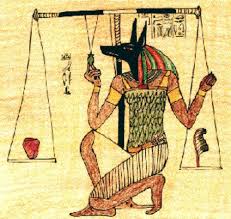
Purgatory looms more and more reasonable for how all of this fits together. God judges the heart, just as the Ancient Egyptian God Anubis is depicted with a scale. On one side is the heart of a person, while on the other side, Anubis places a single, light feather. If the heart is as light as a feather, people can enter into the realm of the living again. What a wonderful thought about how God judges each of us, according to our works (knowledge, love, and service). Deuteronomy 6:5 and Matthew 22:36 contain the core of what life is about or why we are here.
Our task is awareness of self, others, events, and service to others all related to that key to being fully human. If any of us die and don’t know or don’t care about God or Christ or haven’t received the overshadowing of the Holy Spirit, God gives us a second chance with Purgatory. How good is that?
The more I discover what heaven is like now, while I live, the more I can enjoy all the linkages I make with goodness and what I want to pack for the journey to tomorrow. I make the limits of what my heaven will be. With God, there are no limits. With me, My Lay Cistercian Way helps me to grow daily in awareness and gratefulness that God would love “a wretch like me,” as the hymn Amazing Grace points out.
These ten tools go hand-in-hand with St. Benedict’s Tools for Good Works, Chapter 4 of the Rule of Benedict.
Eucharist is the ultimate prayer of Christ to the Father, the Last Supper becomes the food of angels (panis angelicus) and a key to overcoming the dense fog of the world for all things signed by the cross. Read
Discover more from The Center for Contemplative Practice
Subscribe to get the latest posts sent to your email.
 The Center for Contemplative Practice
You must be logged in to post a comment.